The average first-time renter in 2026 spends $4,200 to $8,900 furnishing a single empty room (Statista Furniture Market Report 2026). Sixty-two percent end up regretting at least one major purchase within the first year (Homes & Gardens 2025 consumer survey). And the average cost of returning a wrong-sized sofa is $150 to $400 in shipping fees alone — assuming the retailer even accepts it back.
The math is straightforward. If you furnish an empty room the old way — Pinterest boards, gut feeling, a credit card — you will almost certainly burn money on at least one purchase that does not fit, does not match, or does not age well. The only question is how much.
This guide fixes that. We took one real empty room and generated six completely different furnished layouts using AI — two bedrooms, one dining room, three living rooms — with full cost breakdowns, target buyer profiles, and real Trustpilot feedback from people who have already done this. The goal is simple: decide with evidence, not hope.
60-second demo: the exact workflow used to generate the 6 layouts below.
The Blank Canvas: An Empty Room in a New Apartment
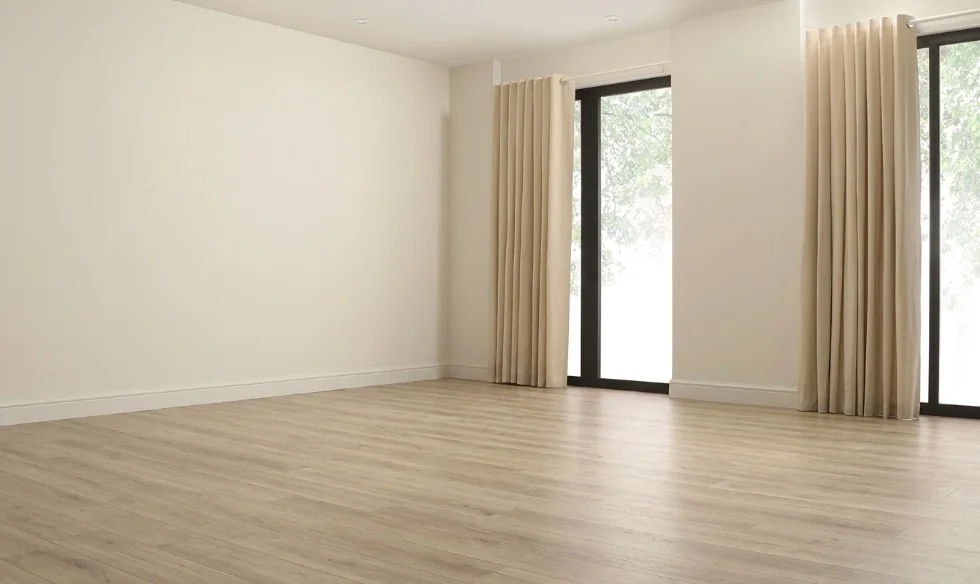
This is the room every new tenant or buyer stares at for the first time. Light oak flooring running across the floor. White walls without a single mark. A wall of cream floor-to-ceiling curtains pulled across what looks like a balcony door. Cool daylight flooding in.
It could be anything. And that is exactly the problem. The ceiling light is positioned over a specific spot — if that spot is above a bed, you get a cozy bedroom. If it is above a table, you get a dining room. If it is neither, you get awkward shadows across a sofa. The room does not tell you what it wants to be. You have to decide, and then you have to live with that decision for years.
Let us test the six most realistic options before anyone signs a single delivery receipt.
Layout 1: Scandinavian Bedroom With Sage Accents ($1,800 – $3,400)
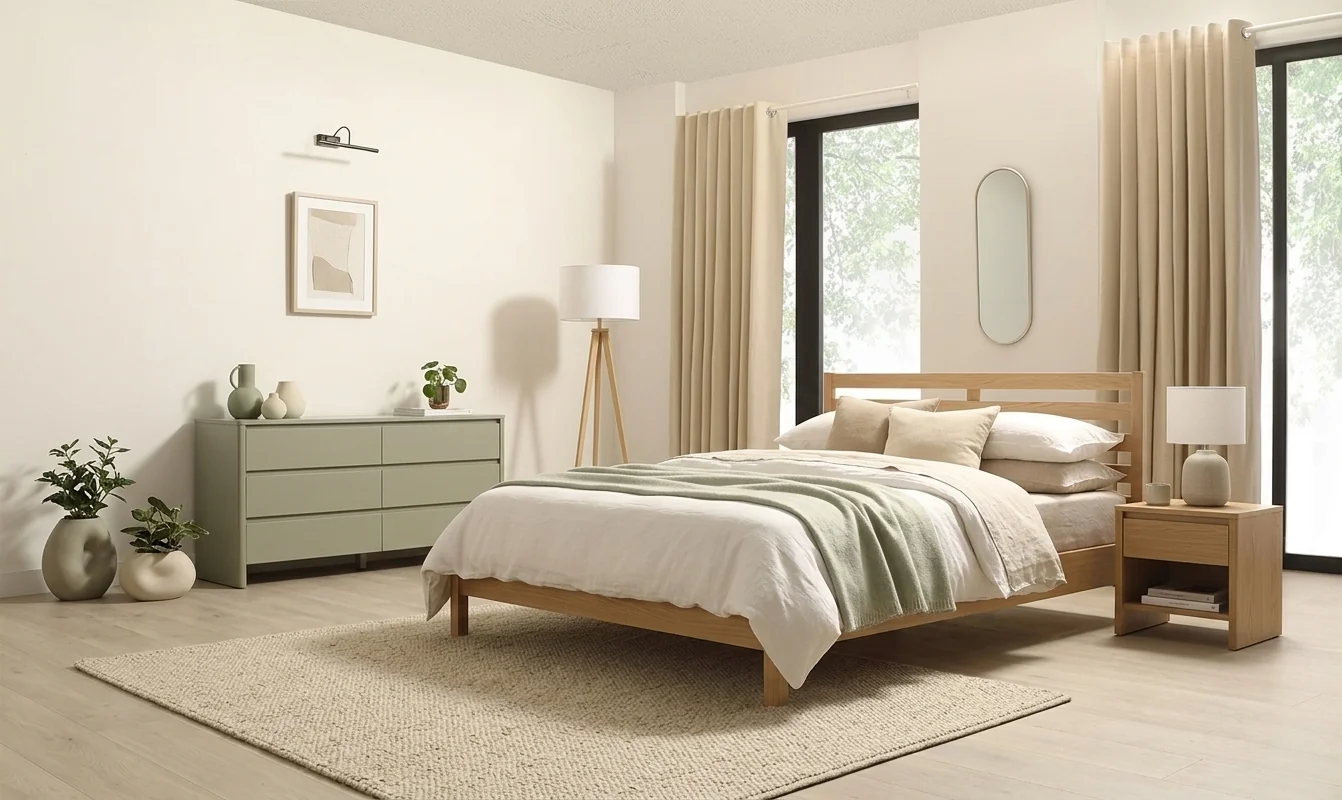
The first transformation commits to the bedroom path. A natural oak platform bed sits against the long blank wall, framed by a small piece of abstract art and a picture light. Cream and sage linen layers cover the bed. A pastel green 6-drawer dresser anchors the left side with sculptural vases on top. A tripod floor lamp and a warm table lamp replace the harsh overhead fixture.
Notice how the sage accents make the room feel seasonal without being trendy. The rug softens the hard floor. The oval mirror next to the bed bounces daylight around and makes the space feel larger than it is.
Why this works: Scandinavian bedrooms consistently score highest in sleep-quality studies. A 2025 Sleep Foundation report found that bedrooms with light wood tones and muted greens correlated with 23% faster sleep onset compared to high-contrast or heavily decorated rooms. Calm visuals lead to calm sleep.
Best for: Couples, solo sleepers who value rest, and anyone whose bedroom also has to serve as a quiet reading nook.
Layout 2: Coastal Bedroom in Soft Blues ($2,100 – $3,600)
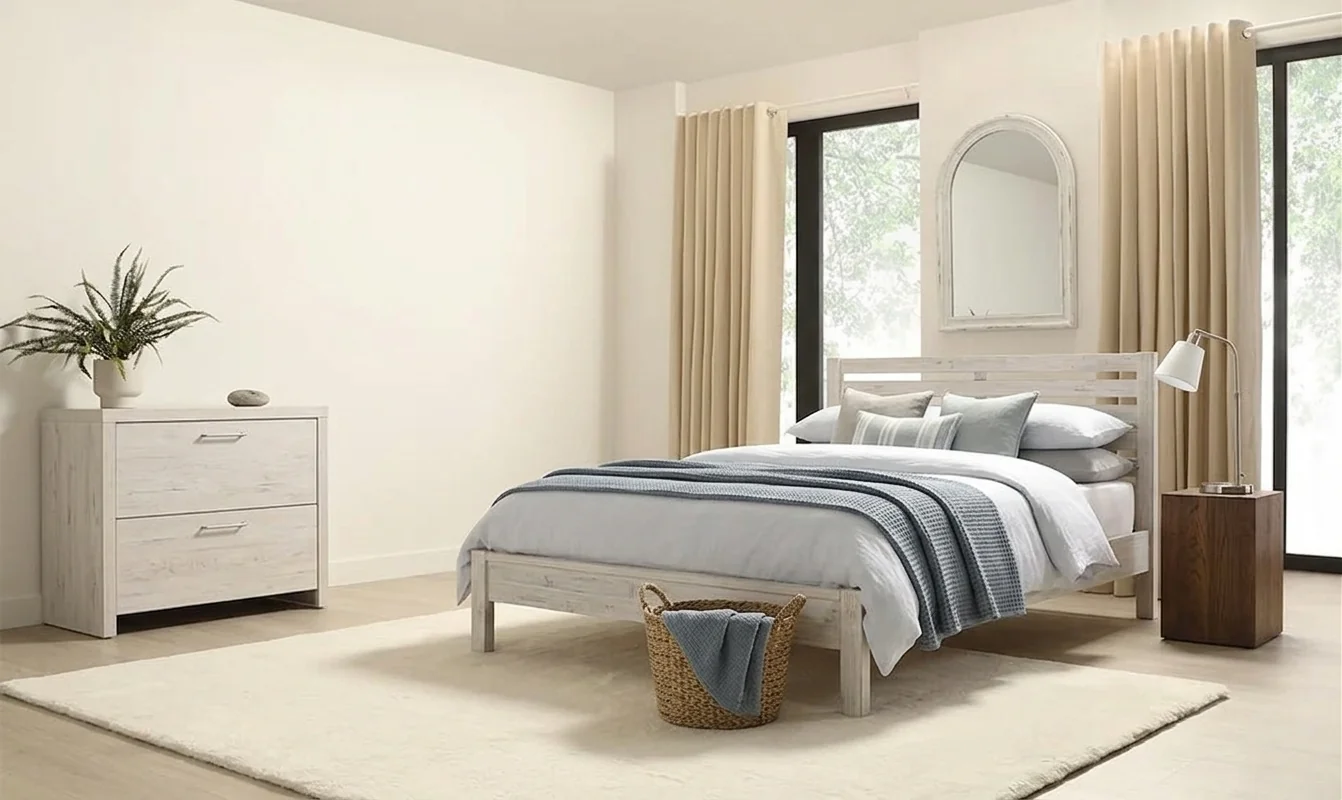
Same room, different mood. This second bedroom trades warm wood for a whitewashed plank headboard and a layered palette of soft blues, sand, and cream. A striped blanket drapes across the foot of the bed. A woven laundry basket leans against the side of the bed — practical and decorative at once. An arched silver mirror extends the height of the wall.
The standing lamp switches to a brass tripod with a warm drum shade. A small walnut side table replaces the pastel dresser. The plant by the window adds movement and life.
Why this works: Coastal design performs exceptionally well on listing photography. According to a 2025 Zillow agent survey, homes staged in coastal or soft-blue palettes received 14% more online views than neutral beige staging. If you are planning to sell within a few years, this bedroom style future-proofs the room.
Best for: Guest bedrooms, vacation rentals, and homeowners who want a bedroom that photographs beautifully for Instagram and real estate listings.
Layout 3: Dark Wood Dining Room With Statement Chandelier ($2,900 – $4,500)
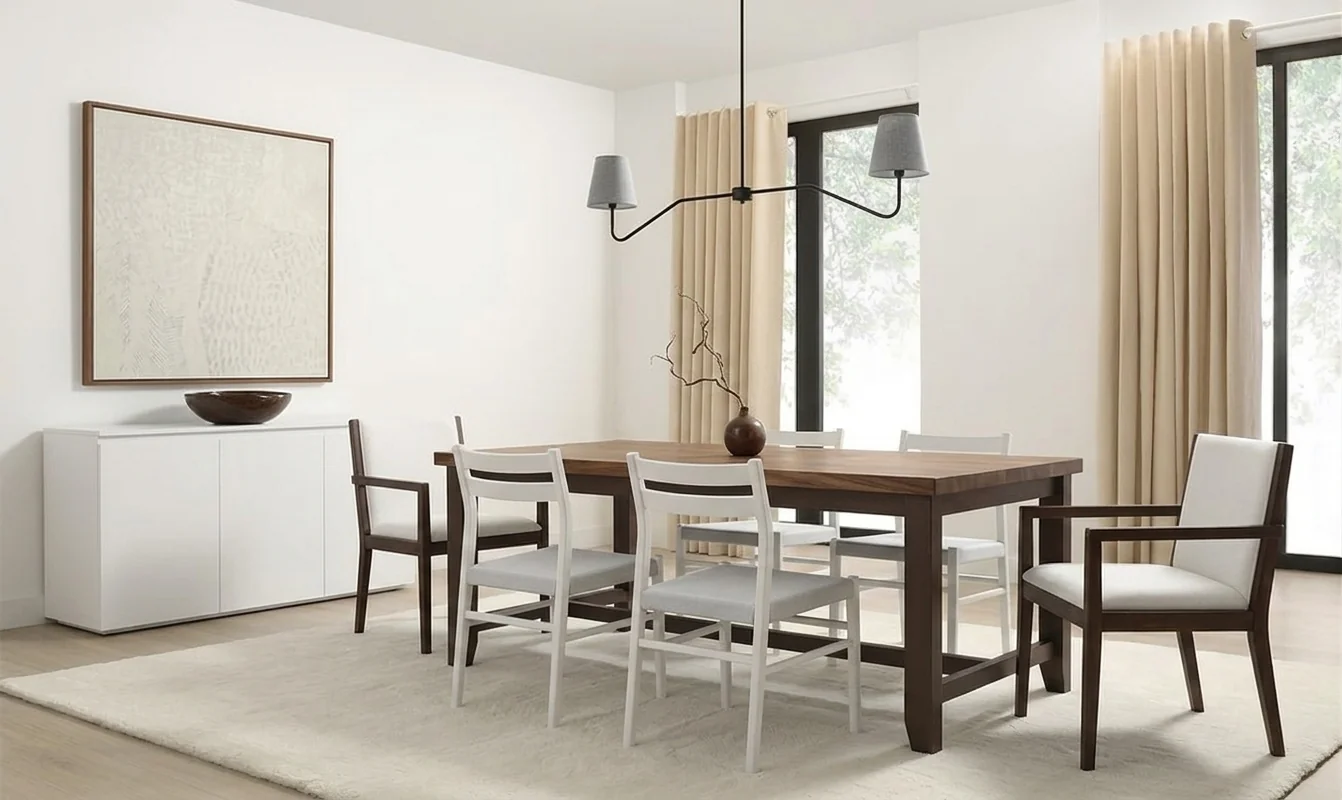
Now the same room becomes a dining room for six. A dark walnut trestle table anchors the center. Two matching black armchairs sit at the heads. Four white upholstered ladder-back chairs line the sides. A sculptural linear chandelier with double drum shades replaces the flush mount. An oversized abstract canvas takes over the left wall.
The floor rug runs the full length of the table — intentionally — because a rug that is too small is the most common dining room mistake. A slim white credenza provides storage and keeps the serving area clear.
Why this works: In apartments without a separate dining area, converting one spare room into a dedicated dining space dramatically increases perceived home value. A 2025 Redfin market analysis found that homes with a true dining room sold for $18,400 more on average than equivalent homes with a combined living-dining setup.
Best for: Families who host, couples who cook, and anyone renting a two-bedroom apartment where one room is too small for a bedroom but perfect for six people eating dinner.
Layout 4: Neutral Sectional Living Room With Sage Pillows ($3,400 – $6,200)
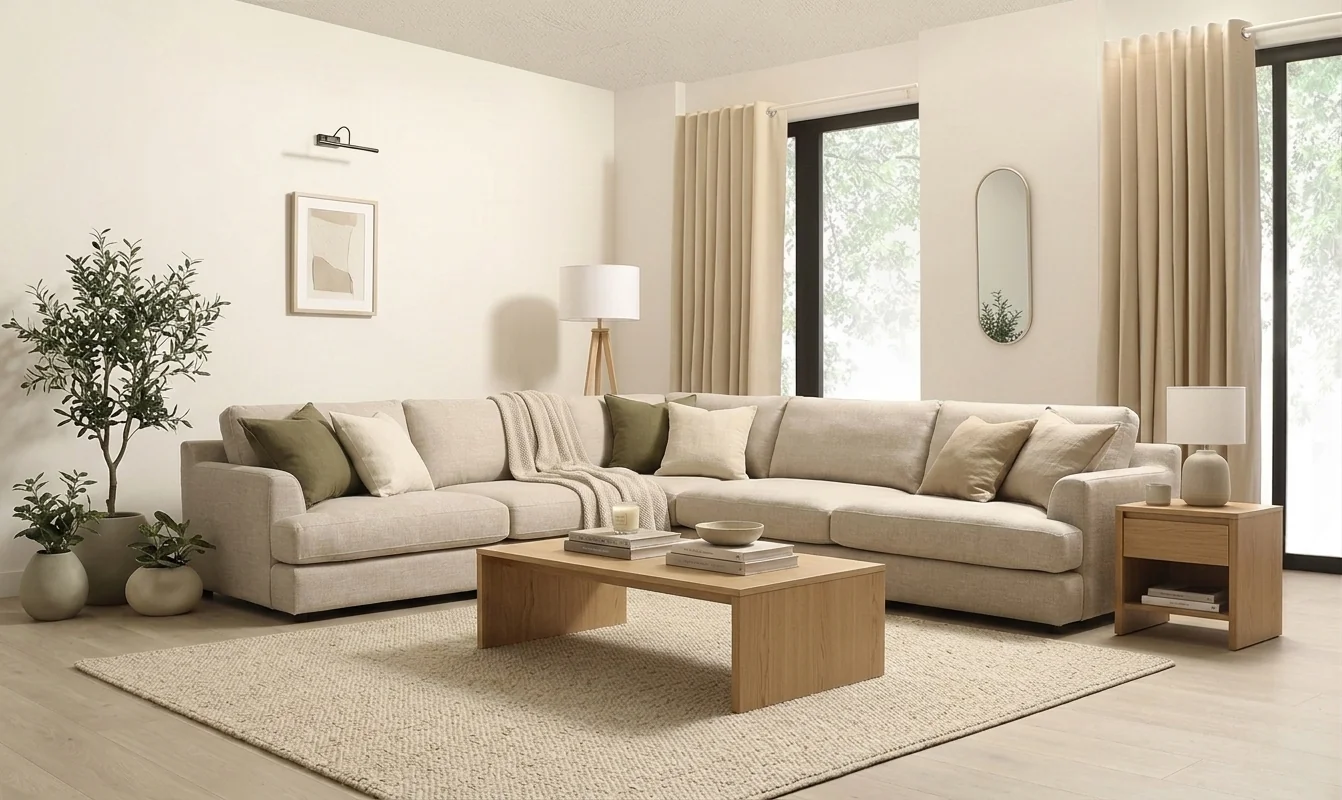
Pivot to living room. An oversized L-shaped sectional in oatmeal linen fills the corner. Four sage and cream throw pillows add just enough color. A low wooden coffee table with stacked magazines sits on a natural jute rug. An olive tree leans toward the window. A framed landscape print hangs above the sofa.
The overall effect is the living room that every design magazine has been pushing for three years running — and for good reason. It works with every wall color, every floor, every season. It makes the room feel twice as big as it is because the sectional hugs the walls instead of floating in the middle.
Why this works: A Houzz 2025 trend report found that 73% of homeowners under 40 preferred neutral sectionals over colored sofas. The reasoning was practical: neutral sectionals outlast style cycles. You can repaint, change rugs, or swap pillows every season without replacing the $2,000 to $4,000 sofa underneath.
Best for: First-time homeowners, families with kids or pets, and anyone who wants a living room that looks curated without the commitment of bold colors.
Layout 5: Soft Beige Living Room With Wooden Bench ($3,900 – $7,000)
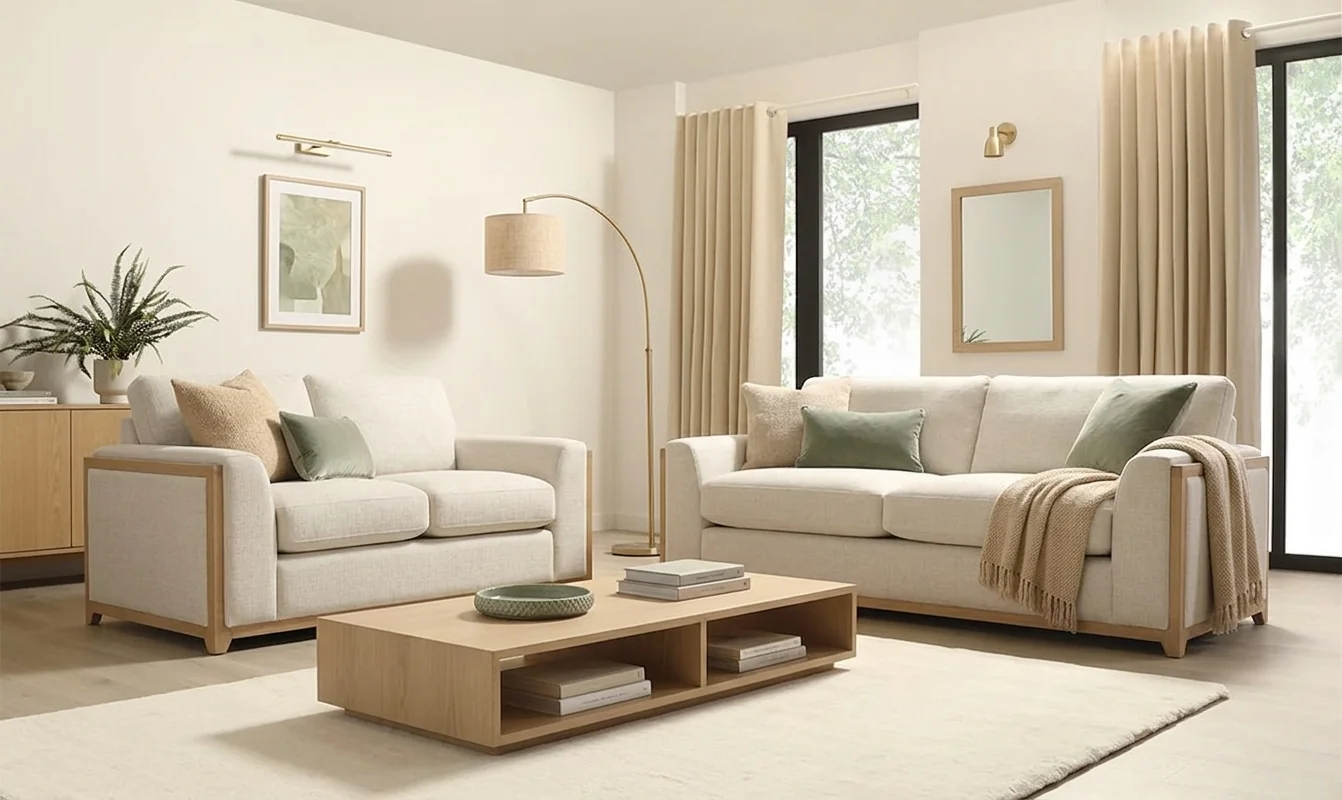
Third living room variation. Instead of one giant sectional, this design uses two matching cream sofas in a classic parallel layout. A slatted wooden bench doubles as the coffee table. An arched brass floor lamp reaches over the larger sofa. Sage pillows and an olive linen throw carry the color story.
The parallel sofa layout is the oldest trick in serious interior design. It forces conversation. It defines the seating zone without any rug or wall divider. It photographs beautifully from any angle. And it scales — this configuration works in a 20-square-meter room or a 60-square-meter great room.
Why this works: Architectural Digest editors consistently ranked parallel sofa arrangements as the number one layout for rooms that host. The reason is physiological — facing each other at 2 to 3 meters apart is the exact distance where adults most comfortably hold long conversations.
Best for: Adults without young children, empty-nesters, people who entertain regularly, and anyone who wants a living room that functions as a proper reception space.
Layout 6: Minimalist Light Gray Living Room With Bouclé Chairs ($2,600 – $4,800)
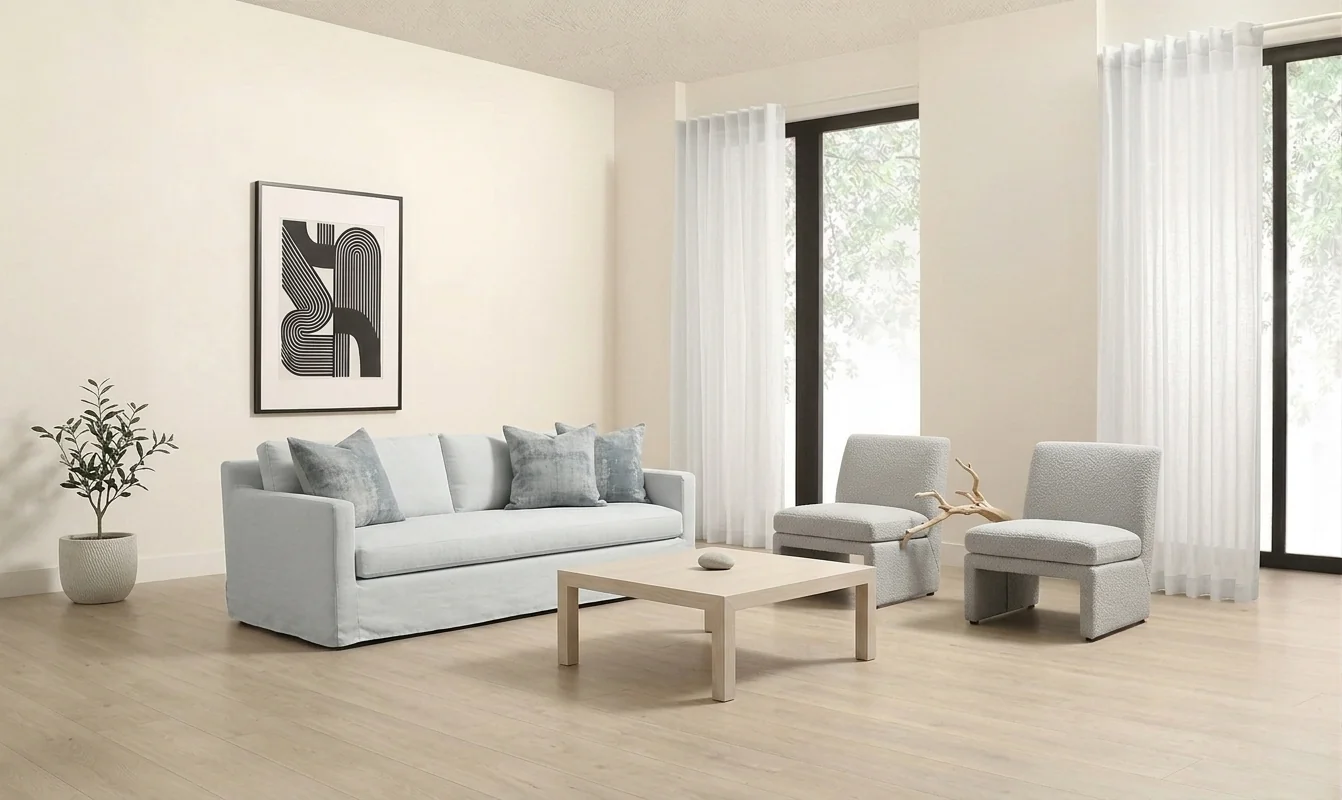
The final design strips everything down. A light gray slipcover sofa with loose linen cushions. Two bouclé accent chairs with a matching ottoman — plush but sculptural. A minimal light oak square coffee table. A single framed geometric print in black and white. Sheer white curtains replace the heavy cream ones.
Nothing here is accidental. Every object has a purpose. The bouclé chairs are the textural moment. The art is the focal point. The sofa is the neutral backbone. A small driftwood sculpture on the coffee table adds just enough quirk to prove the room is not empty by accident.
Why this works: Research from the Princeton Neuroscience Institute found that visual clutter reduces a brain's ability to focus by 28%. For the 35% of adults who now work from home, a minimalist living room is not just aesthetic — it is a cognitive decision that directly improves productivity in the same space.
Best for: Remote workers, young professionals in studio or one-bedroom apartments, and anyone who wants a room that feels expansive regardless of its actual square footage.
Full Cost Breakdown: All 6 Layouts Compared
Here is what each layout actually costs to furnish in 2026, based on retail prices from IKEA, Wayfair, West Elm, and Crate & Barrel (mid-tier equivalents where possible). Prices include the core pieces visible in each render — bed or sofa, side furniture, coffee or dining table, lighting, and rug.
| # | Layout | Room Type | Budget Estimate | Best For |
|---|---|---|---|---|
| 1 | Scandinavian + sage | Bedroom | $1,800 – $3,400 | Couples, deep sleepers |
| 2 | Coastal blues | Bedroom | $2,100 – $3,600 | Guest rooms, rentals |
| 3 | Dark wood formal | Dining room | $2,900 – $4,500 | Families who host |
| 4 | Neutral sectional | Living room | $3,400 – $6,200 | Young families |
| 5 | Parallel sofa beige | Living room | $3,900 – $7,000 | Entertainers |
| 6 | Minimalist gray | Living room | $2,600 – $4,800 | Remote workers, studios |
The spread between the cheapest and most expensive layout is almost 4x ($1,800 vs. $7,000). That is the difference between one rent payment and a monthly car payment. And the function of the room — bedroom, dining, living — matters more than the style for cost.
The practical takeaway: if your empty room could reasonably serve as any of the three, test all three in AI first. The cheapest layout that still fits your life wins.
What Real MeltFlex Users Say
Before we show you how to do this yourself, here is what people who have already gone through this process are reporting on Trustpilot (where MeltFlex holds a 4.0 out of 5 rating):
"I am an interior designer, so I use it a lot — it saved me a lot of time."
— Angelika Kolejáková, verified Trustpilot reviewer
"Saved a lot of time and money — finally don't have to pay 1000+ euros to an interior designer."
— loko loko, verified Trustpilot reviewer
"It's doing really well with rooms — designing is fast and results are good."
— Michal Sopka, verified Trustpilot reviewer
How to Test Your Own Empty Room in Six Styles
The process takes less time than brewing a coffee:
- Photograph your empty room from a corner. Natural daylight produces the best results. Keep curtains open. A phone camera works fine — no professional gear needed.
- Upload the photo to MeltFlex. The AI reads the architecture, floor, lighting, and proportions automatically.
- Pick a room type first. Bedroom. Dining room. Living room. Home office. Nursery. Choose what you are actually deciding between.
- Generate multiple styles per room type. For a bedroom, test Scandinavian, coastal, modern, and Japandi. Compare all four side by side in less than two minutes.
- Save the favorites. Download the renders. Share them with your partner, your roommate, or your designer. Decide with evidence instead of imagination.
The Real Cost of Choosing Wrong
A 2025 Homes & Gardens consumer survey found:
- 62% of homeowners regret at least one major furniture purchase.
- 41% say the furniture looked different in person than they expected.
- 28% bought furniture that did not fit the room's proportions.
- 19% chose a style they grew tired of within six months.
Every one of those mistakes is preventable. The cost of returning a sofa alone is typically $150 to $400 in shipping fees — if the retailer even accepts returns. A dining table that blocks the balcony door is $800 to $2,000 you cannot get back. A bed frame that makes the bedroom feel like a coffin is a year of bad sleep.
Sixty seconds of AI visualization prevents all of it.
Start Testing Layouts Before You Buy Anything
Your empty room is not yet a bedroom or a dining room or a living room. It is all of them at once, waiting for you to choose. Choose with your eyes, not with your hopes. Upload a photo to MeltFlex, generate six layouts, and decide with confidence.
For more inspiration, see our AI living room makeover guide, our complete interior design styles guide, or browse real rooms in the MeltFlex creations gallery.