

You found a tool that turns a photo of your room into a beautiful redesign, and ReimagineHome does that well. It is one of the best virtual staging tools on the market, it matches lighting and shadows convincingly, and it can batch-process up to fifty listing photos at once. But the moment your goal shifts from a nice picture to a room I can actually furnish and buy, you start hunting for something that closes that last gap. That is usually why people look for a ReimagineHome alternative.
Our articles are still written by humans!
Get human written articles in your Google feed.
We put seven alternatives through the same test: take one real room, redesign it, and then try to actually buy what the AI showed. Some are built for real estate staging, some for quick inspiration, and one is built specifically so every piece in the render is a real product you can purchase. We start with that one, then work through the rest, including where each tool beats ReimagineHome and where it does not.
Full disclosure: we build one of these tools, MeltFlex. Every other tool got the same room and the same brief, the pricing is current, and we have left in the places where ReimagineHome and the others genuinely win.
Key takeaways
- The real gap is buying, not rendering. Almost every tool here makes a photorealistic room. The thing that separates them in 2026 is whether you can buy the furniture you see.
- MeltFlex is the alternative built around real furniture. Every piece maps to a real product from IKEA, Article, Wayfair, West Elm and more, with price comparison across stores, and it keeps your real layout.
- ReimagineHome still wins at one thing: high-volume listing staging, up to fifty photos at once, with excellent lighting. If that is your only job, you may not need to switch.
- Match the tool to the goal. Staging an empty listing, sketching a mood board, and furnishing a room you live in are three different jobs with three different best tools.
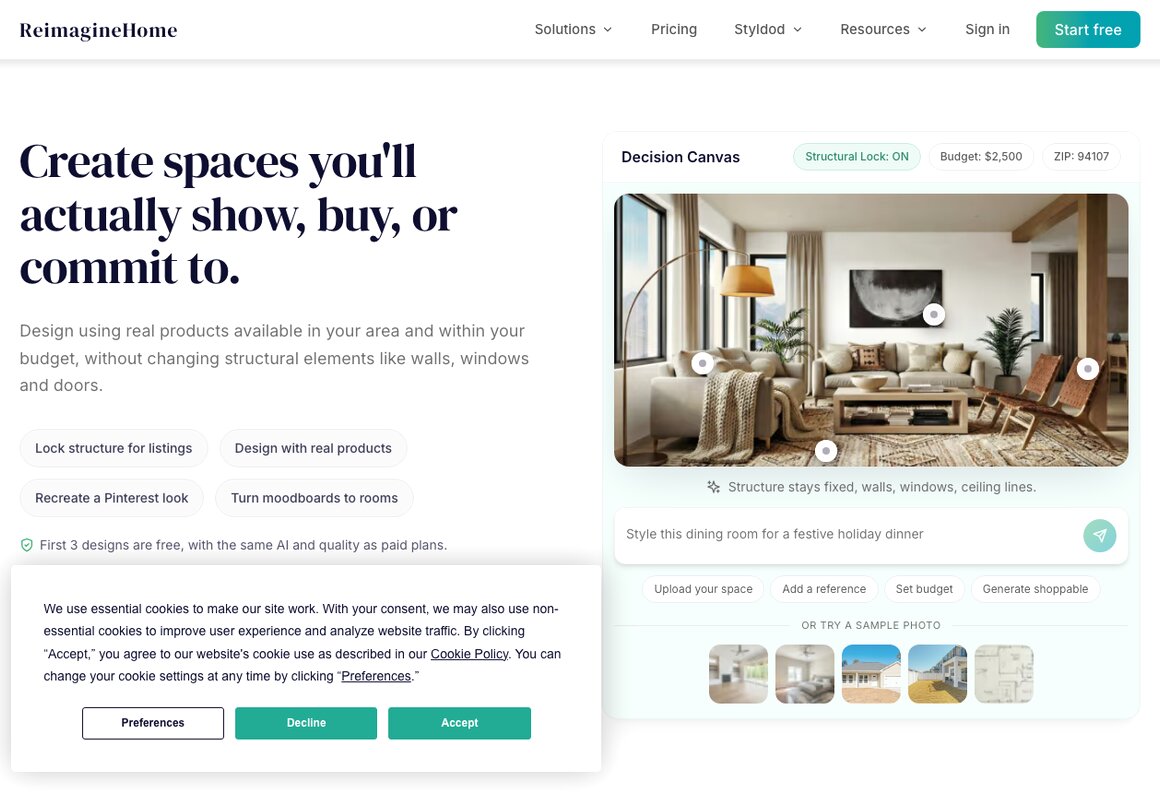
ReimagineHome is a strong staging tool. The alternatives below matter when your goal is furnishing a room you can actually buy.
FreeUpload photo · freeRedesign my room for freeUpload a photo and let MeltFlex design your space. Your first AI design is free, no card needed.


1. MeltFlex: the alternative built around real, buyable furniture
If your actual goal is a furnished room and not just another render to save and forget, this is the one to start with. MeltFlex solves the problem most render tools leave open: every piece it shows is a real product, from a real retailer, that you can buy right now.
Upload a photo of your space, describe the direction you want in plain language, something like “Scandinavian with walnut warmth, deeper seats, softer textiles”, and MeltFlex redesigns your actual room while keeping your windows, doors and layout in place. Then it fills it with coordinated pieces from IKEA, Article, Wayfair, West Elm, Pottery Barn and more, each with a real price you can compare across stores. On top of that it does floor-plan-to-3D and video walkthroughs, which ReimagineHome does not.

The difference in one image: every item is a real product with a price, not a render you then have to go hunting for.
What it does well: builds designs from only real, purchasable furniture across multiple retailers; reads nuanced style language; compares prices on the same item across stores; keeps your real room instead of inventing one; adds floor-plan-to-3D and video.
Where it loses to ReimagineHome: MeltFlex is not built for batch-staging fifty empty listings at once. If you are a high-volume agent who only needs fast empty-room staging, ReimagineHome is still the more efficient pipeline for that one job.
How it differs from ReimagineHome: ReimagineHome stages and offers optional Amazon-focused product matching for extra credits, with no price comparison. MeltFlex makes real, shoppable furniture the default in every design, across five-plus retailers, with prices you can compare. Try it on your own room to see the difference.
2. Collov AI: cheap, fast staging for agents
Collov AI is the alternative to reach for if your job is real estate staging and your priority is price and speed. It stages empty rooms quickly, offers free revisions, and comes in noticeably cheaper per image than ReimagineHome, which is exactly what a high-volume agent wants.
What it does well: fast, affordable virtual staging; free revisions; a clean workflow aimed squarely at listings.
How it differs from MeltFlex: Collov is a staging tool, so the furniture is there to sell a photo, not to be purchased. It is a strong like-for-like ReimagineHome alternative for agents, but if a client wants to actually buy the room, you will hit the same wall.
3. HomeDesignsAI: affordable all-rounder
HomeDesignsAI is the budget all-rounder. It restyles rooms, stages listings and renders exteriors, keeps your real layout reasonably well, and links some items to products you can buy. For a low monthly price it covers a lot of ground, which makes it a sensible ReimagineHome alternative for someone who wants more than just staging.

HomeDesignsAI covers restyles, staging and exteriors at a low price, with some shoppable links.
What it does well: cheap; multi-purpose; respects your real room; some real product links.
How it differs from MeltFlex: the shopping side is partial, some items link out and some do not, and there is no cross-store price comparison. It is a good general tool, not a furniture-first one.
4. Interior AI: presets and listings
Interior AI targets professional visualization with a large library of style presets, 3D flythrough capability and CAD integration. It is built for showing properties, and it produces polished staging renders that suit real estate listings well.

Interior AI leans on a big preset library and staging features for listings.
What it does well: extensive presets; 3D flythroughs; strong for staging listing photos.
How it differs from MeltFlex: every piece of furniture is AI-generated. You can stage an empty apartment beautifully, but when a buyer asks where to get that dining table, there is no answer. MeltFlex starts from real products instead.
5. Spacely AI: concept iterations for designers
Spacely AI is aimed at designers who need to generate multiple concept directions quickly for client review. It handles the “what if we tried mid-century instead?” conversation smoothly and produces polished renders on a flexible credit system.
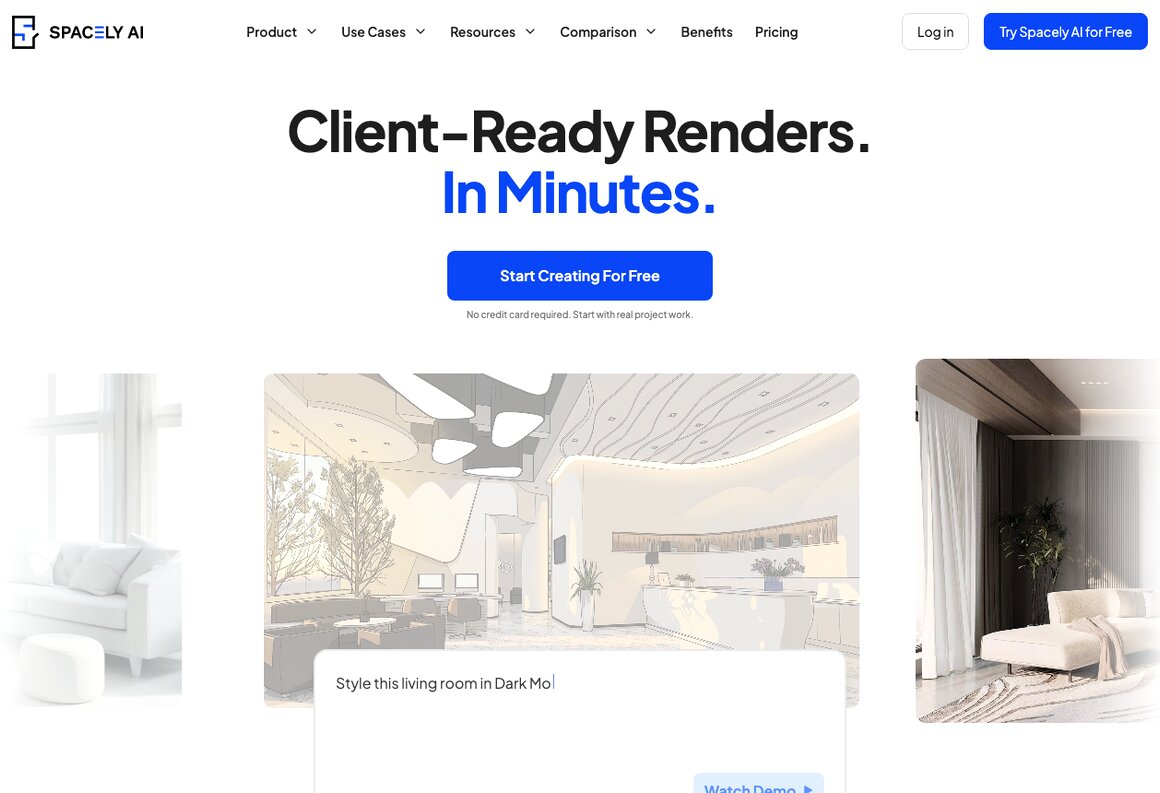
Spacely is built for fast concept variations in client meetings.
What it does well: rapid concept exploration; polished renders; flexible credits.
How it differs from MeltFlex: once a client approves a Spacely concept, you are back to sourcing furniture that matches a render. MeltFlex hands you that shopping list directly, because the pieces were real from the start.
6. RoomGPT: the simplest mood board
RoomGPT went viral for being dead simple. Upload a photo, pick a style preset, get a render in under a minute. It is a fine ReimagineHome alternative when you are still figuring out a direction and just want quick inspiration.

RoomGPT is the fastest way to a quick vibe, but the furniture is not real.
What it does well: one-click simplicity; fast; great for early inspiration.
How it differs from MeltFlex: the moment you want to shop, you hit a wall and twenty browser tabs trying to find a sofa an algorithm invented. MeltFlex skips that step entirely.
7. Virtual Staging AI: empty listings, fast
Virtual Staging AI does one thing and does it quickly: it fills empty rooms with furniture for listing photos. For an agent who needs to make a bare property look livable before a viewing, it is a focused, low-cost ReimagineHome alternative.
What it does well: fast, cheap staging of empty rooms; simple workflow.
How it differs from MeltFlex: it is staging only. The furniture exists to sell the photo, not to be bought, so it does not help a homeowner who wants to furnish the room for real. MeltFlex’s own virtual staging AI tool covers the same empty-listing job, with the difference that the staged furniture is real and shoppable.
The real gap every staging tool leaves open
Here is the pattern across almost every tool above. They generate a beautiful room, and then they leave you to find the furniture yourself. ReimagineHome closes part of that gap with optional Amazon matching, which is genuinely more than most. But you still end up paying extra credits, locked to one store, with no way to compare prices on the piece you liked.
The interior AI market keeps growing, but inspiration was never the scarce part. Pinterest solved inspiration years ago. The real gap is between seeing a room you love and actually buying the pieces in it. That is the gap MeltFlex was built to close: every piece comes from a real retailer, with a real price, across multiple stores, in a redesign of your actual room.
So pick by the job. For batch-staging empty listings, ReimagineHome is hard to beat. For quick inspiration, RoomGPT is the fastest. For a room you will actually live in and furnish, MeltFlex is the alternative that turns the render into a shopping list. If you want the deeper head-to-head, we break it all down in our MeltFlex vs ReimagineHome comparison.
Frequently asked questions
What is the best ReimagineHome alternative in 2026?
It depends on the job. For furnishing a room you will actually live in, MeltFlex is the strongest alternative because it keeps your real layout and builds every design from real, purchasable furniture across IKEA, Article, Wayfair, West Elm and others, with price comparison. For pure high-volume real estate staging, Collov AI and Virtual Staging AI are fast and cheap. For quick mood boards, RoomGPT is the simplest. ReimagineHome is excellent at staging itself, so the right alternative is the one that matches whether you want a listing, inspiration, or a room you can buy.
Is there a free alternative to ReimagineHome?
Yes. Most alternatives offer a small free tier so you can test them before paying. RoomGPT gives you a free render to start, MeltFlex lets you generate your first design free without an account, and Collov and HomeDesignsAI both hand out starter credits. After the free tier, prices typically run from credit packs around nine dollars up to subscriptions between roughly twelve and thirty dollars a month, still a fraction of a human designer.
Which ReimagineHome alternative shows furniture you can actually buy?
MeltFlex is built around this. Every piece in a MeltFlex design maps to a real product from retailers like IKEA, Article, Wayfair, West Elm and Pottery Barn, with a real price, and you can compare the same item across stores. ReimagineHome offers optional product matching too, but it is Amazon-focused, costs extra credits, and does not compare prices. HomeDesignsAI links some items as well. Many staging-first tools show generated furniture that is great for a photo but cannot be purchased.
Is ReimagineHome or MeltFlex better for real estate agents?
For an agent who batch-stages dozens of empty listings at once, ReimagineHome is genuinely strong, its listing batch processing handles up to fifty photos and it nails lighting and shadows. MeltFlex is the better pick when the goal is a room a buyer or homeowner can actually furnish and buy, since it keeps the real layout and links every piece to a real product. Many agents use a staging tool for empty listings and MeltFlex when a client wants to see a space they could move into and shop.
Do I have to keep my real room, or does the AI invent a new one?
This varies a lot and matters most if you plan to act on the result. The better tools, including MeltFlex, ReimagineHome and HomeDesignsAI, redesign your actual photo and keep your windows, doors and proportions in place. Weaker generative tools quietly move a window for a nicer composition or invent a room that has little to do with yours. If you intend to furnish the space, choose a tool that respects your real layout and feed it a clean, wide, daylight photo.
Sources and further reading
- HousingWire, Best virtual staging apps for 2026, naming ReimagineHome best overall AI virtual staging.
- ReimagineHome, official site, staging, batch processing and Amazon product matching.
- Collov AI, virtual staging for real estate.
- HomeDesignsAI, multi-purpose AI interior design.
- Interior AI, preset-driven staging and visualization.
- Spacely AI, concept iteration for designers.
- RoomGPT, one-click room restyles.
- Virtual Staging AI, staging empty listings.
- MeltFlex vs ReimagineHome, our full head-to-head comparison.



)