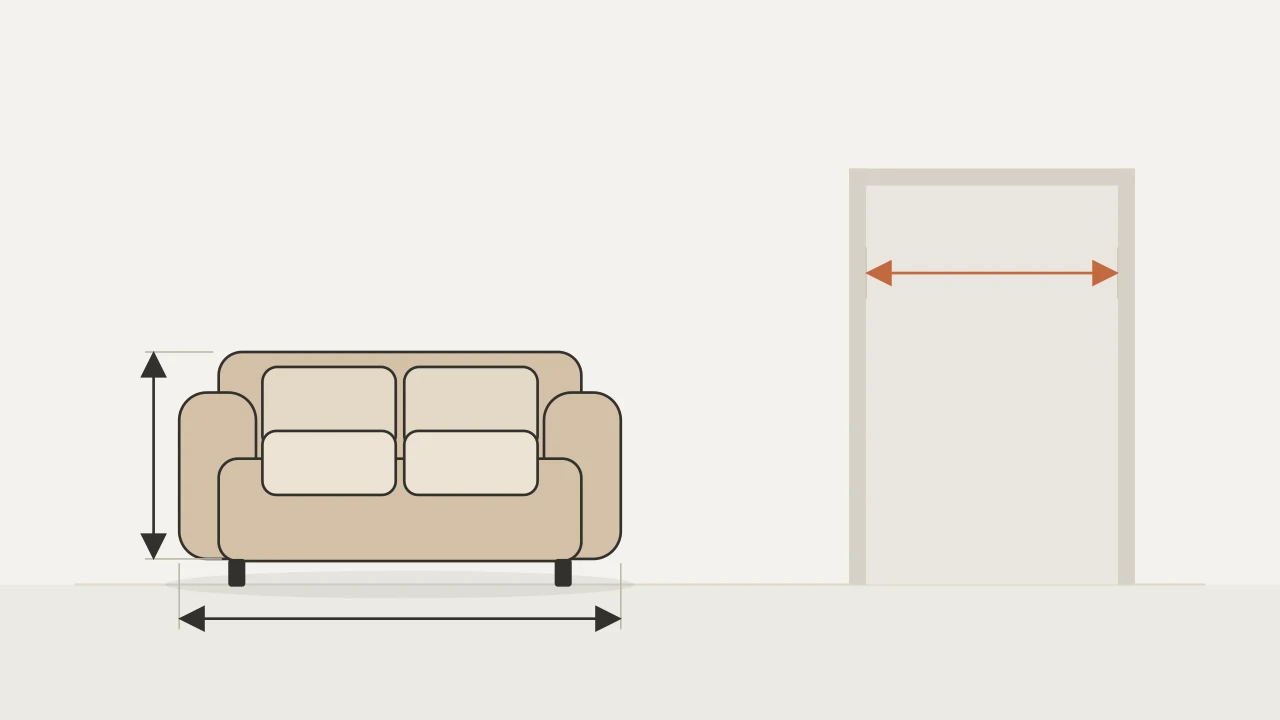
Quick answer: Your sofa or couch will fit if its depth (front to back), not its length, is under the clear opening of the narrowest doorway on the route. A US interior door gives about a 30 to 31 inch clear opening and most sofas are 35 to 40 inches deep, so you stand the sofa on one end and pivot it through, where the depth and the diagonal are what clear the frame. If it is tight, removing the legs buys 4 to 6 inches and lifting the door off its hinges adds another 1 to 1.5. The most common version of this question, a 40 inch sofa through a 32 inch door, is a yes with the legs off and a proper tilt. Enter your numbers in the calculator below for an instant verdict, or jump to the sofa fit chart for every depth and door combination.
Our articles are still written by humans!
Get human written articles in your Google feed.
A sofa is the one thing people order online without ever seeing it in the flesh, and it is also the heaviest, most awkward object that has to get up your stairs and round your hallway. That gap is exactly why so many of them end up wedged on a landing, or worse, going straight back on the van. Wrong size is the single biggest reason furniture gets returned, and a returned sofa is not a free mistake: the retailer eats roughly 150 to 300 dollars in freight alone before restocking, which is a cost that quietly gets baked into what you pay (ecommerce returns data).
The fix takes a tape measure and two minutes. Most sofas do get through most doors, and the ones that do not announce themselves long before delivery day if you check the right numbers. Worth asking first whether the old sofa actually needs replacing at all: how to clean a couch prices the clean against the replacement, and the answer is often that the surface is tired and the frame is fine. Start here.
Interactive calculator
Loading… if it does not appear, refresh the page.



Will a 40 inch sofa fit through a 32 inch door?
This is the exact question people type, so here is the exact answer. It depends entirely on which 40 inch number you are holding, and most people are holding the wrong one.
- If 40 inches is the width (arm to arm): yes, comfortably, and you barely need to think about it. Width runs along the 80 inch height of the doorway, not its width, so a 40 inch wide loveseat walks through a 32 inch door without any tricks.
- If 40 inches is the depth (front to back): not flat, but yes in almost every real case once you tilt it. A 32 inch door gives you a clear opening of about 30 to 31 inches (the leaf and the stop eat the difference, which our standard door sizes guide works through), so a 40 inch depth carried flat is 9 or 10 inches too much. Stood on one end and pivoted, the number that has to pass is not the 40 inch depth but the diagonal depth, which on a 40 inch deep sofa is typically 32 to 36 inches. Take the legs off (4 to 6 inches) and lift the door off its hinges (another 1 to 1.5) and you are usually there.
So the honest verdict on the most common version of this question: a standard 40 inch deep sofa gets through a standard 32 inch door with the legs off and a proper tilt, and it is genuinely borderline only if the sofa is a rigid sleeper or the doorway is a UK or older European one closer to 28 inches clear. People ask the same thing about the 30 and 36 inch doors too, so here are all three verdicts in one place:
The chart further down gives you the verdict for every other depth and door combination.
The one number everyone measures wrong: depth, not length
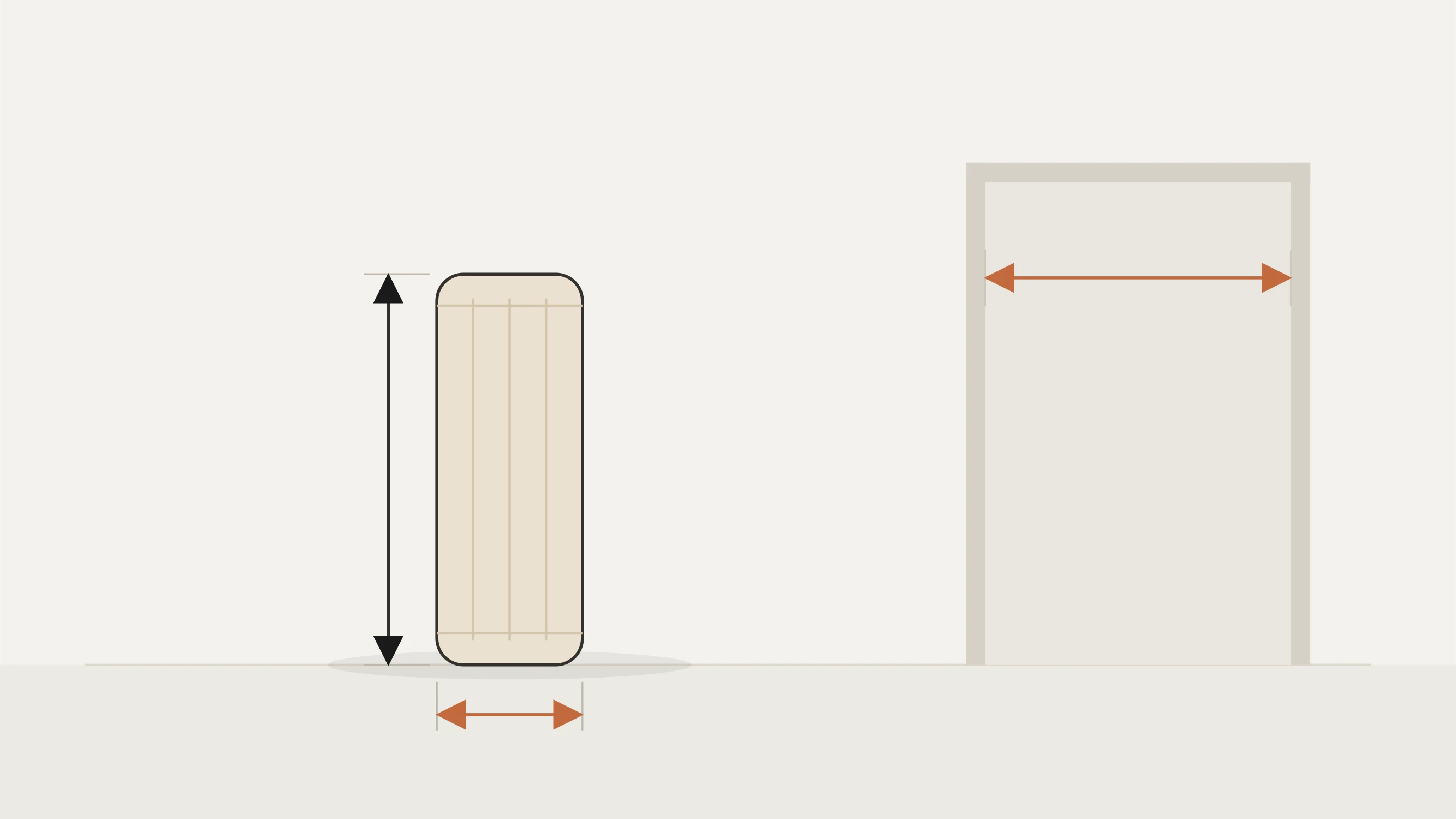
When people panic about a sofa fitting, they stare at the length, the arm to arm number, because it is the biggest one on the spec sheet. It is also the one that matters least. That length runs along the tall 80 inch side of the doorway, so the frame has plenty of room for it. The dimension that actually fights the door is the depth, front to back, because that is what faces the width of the opening when you tilt the sofa up on one end to carry it in. A three seater is typically 84 to 90 inches long but only 35 to 40 inches deep (standard couch dimensions), and it is that smaller depth number that decides the whole thing.
Measure your sofa: the four numbers that matter
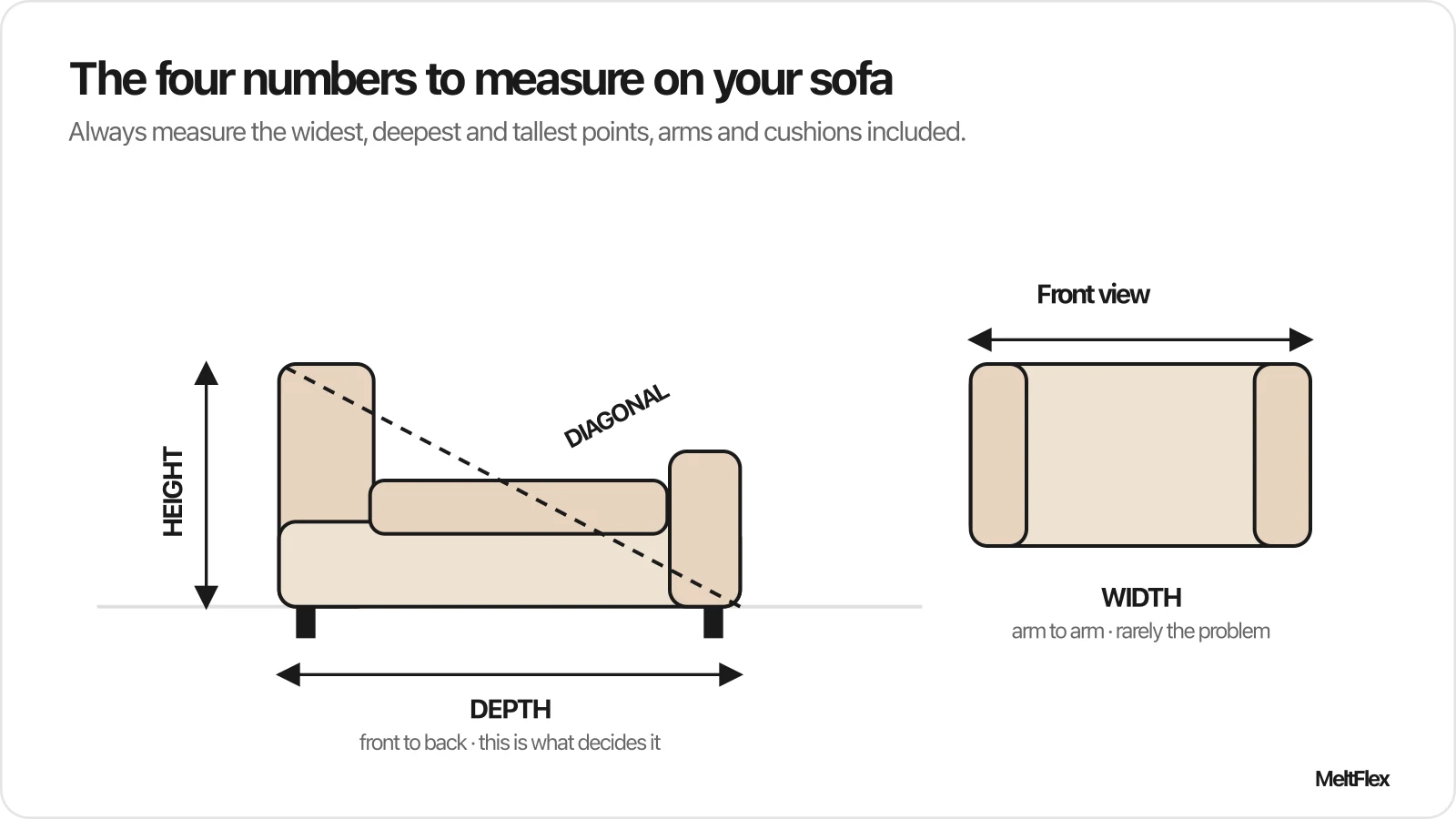
Take a tape measure to the sofa, or pull these from the product page, always at the widest, deepest and tallest points with the arms and cushions included. Round up, never down.
- Width (length): arm to arm. This is for the room, almost never the door.
- Depth: front to back at its widest. The number the calculator cares about most.
- Height: floor to the top of the back.
- Diagonal depth: the shortest distance from the bottom rear corner out to a straightedge laid across the top of the back and the front of the arm. This is the line that actually threads the frame when you tilt the sofa, it comes out smaller than the overall depth, and it is the one professional movers trust above all the others. Full method further down.
Which sofas actually struggle: a quick field guide
Since depth is the deciding number, the type of sofa tells you most of the story before you measure anything. The shapes below run from easiest to hardest at the door.
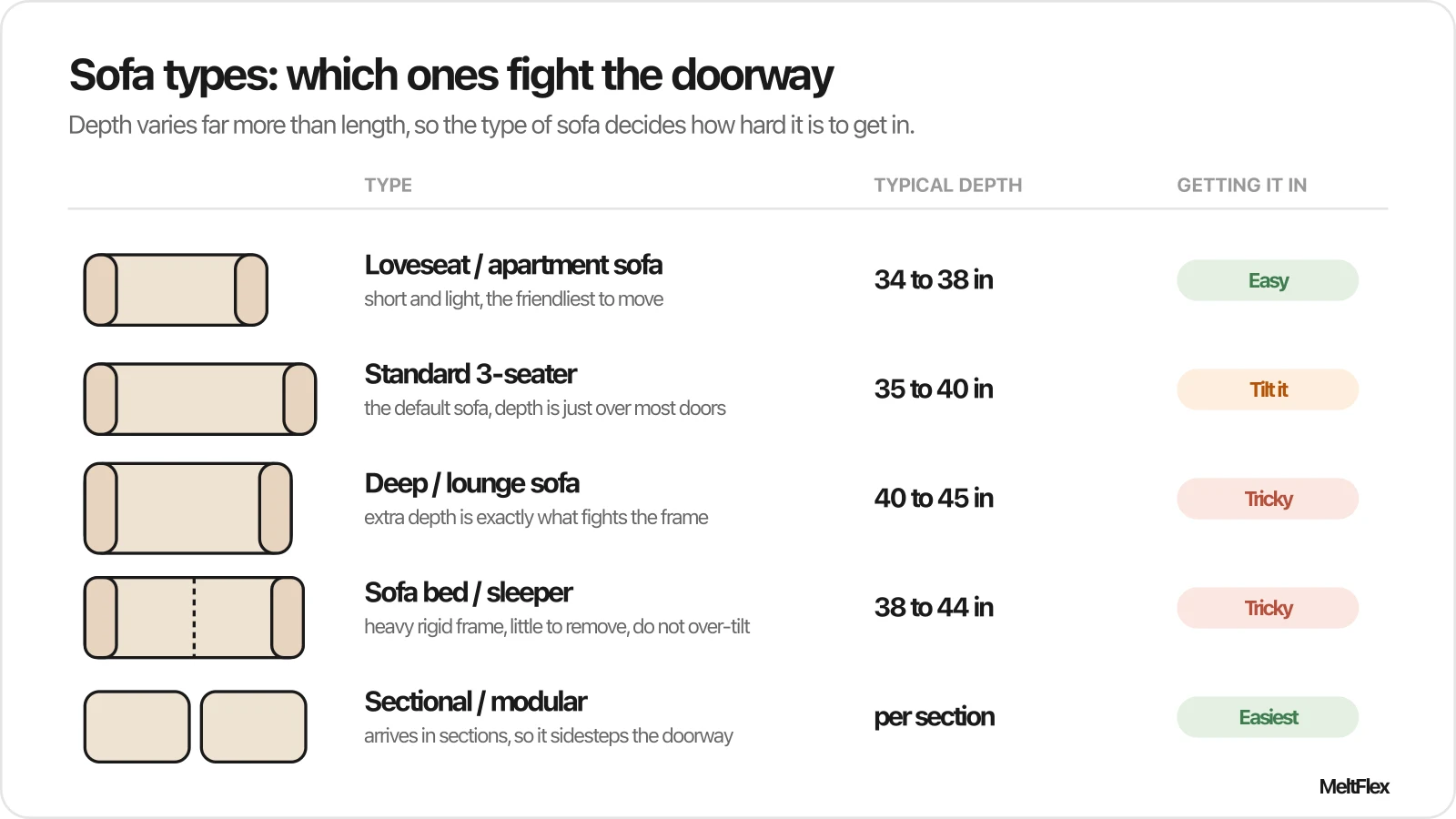
The rule of thumb: the deeper and more rigid the sofa, the more you lean on the tricks further down, and a modular design is the cheat code because the doorway never sees the whole thing at once.
The trap: the door size is not the gap you get
This is the mistake that sinks more deliveries than any other. The number stamped on a door is not the space you actually have to work with. A US interior door is sold as 32 inches wide, but once you account for the door stop and the leaf sitting in the frame, the real clear opening is usually only about 30 to 31 inches. Measure the gap with the door wide open, from the face of the open door to the far edge of the frame. That is the number to put in the calculator, not the size on the box.
Where you live changes the maths too, so do not trust a number you read on an American blog if you are furnishing a flat in Manchester:
UK and European homes, and most older apartment blocks anywhere, run tighter than the US standard (UK door sizes). If any opening on your route comes in at 30 inches (76 cm) or less, treat it as the one to beat and lean on the tricks below.
How to measure diagonal depth (the number movers actually use)
Diagonal depth is the one measurement that decides a tilted sofa, and almost every guide describes it wrongly as “corner to corner”. That would give you a numberbigger than the depth, which would make every sofa impossible. The real method, the one furniture retailers and movers use, gives you a number smallerthan the overall depth, and here it is in three steps:
- Stand a straightedge, a broom handle or a long spirit level, against the sofa so it touches the highest point of the back and the front edge of the arm at the same time.
- Hold a tape measure at the bottom rear corner of the sofa, where the back meets the floor.
- Measure the shortest distance from that rear corner straight out to the straightedge. That distance is your diagonal depth.
On a typical three seater that lands somewhere between 30 and 36 inches, often 4 to 8 inches less than the overall depth on the spec sheet, which is exactly why sofas that look far too deep on paper still go through. If the retailer lists a diagonal depth, use theirs. If they do not, spend the two minutes and measure it, because it is the number that turns a “maybe” into a yes or a no.
No straightedge handy, or the couch is still in a warehouse? You can estimate the diagonal from the spec sheet, because what shrinks it is the shape of the back and arms. Use this as a paper calculator, then confirm with the straightedge before delivery day:
The sofa fit chart: diagonal depth vs clear opening
Find your diagonal depth down the left, your narrowest clear opening across the top, and read the verdict. This assumes you are tilting the sofa and have taken the legs off, which is how it actually goes in.
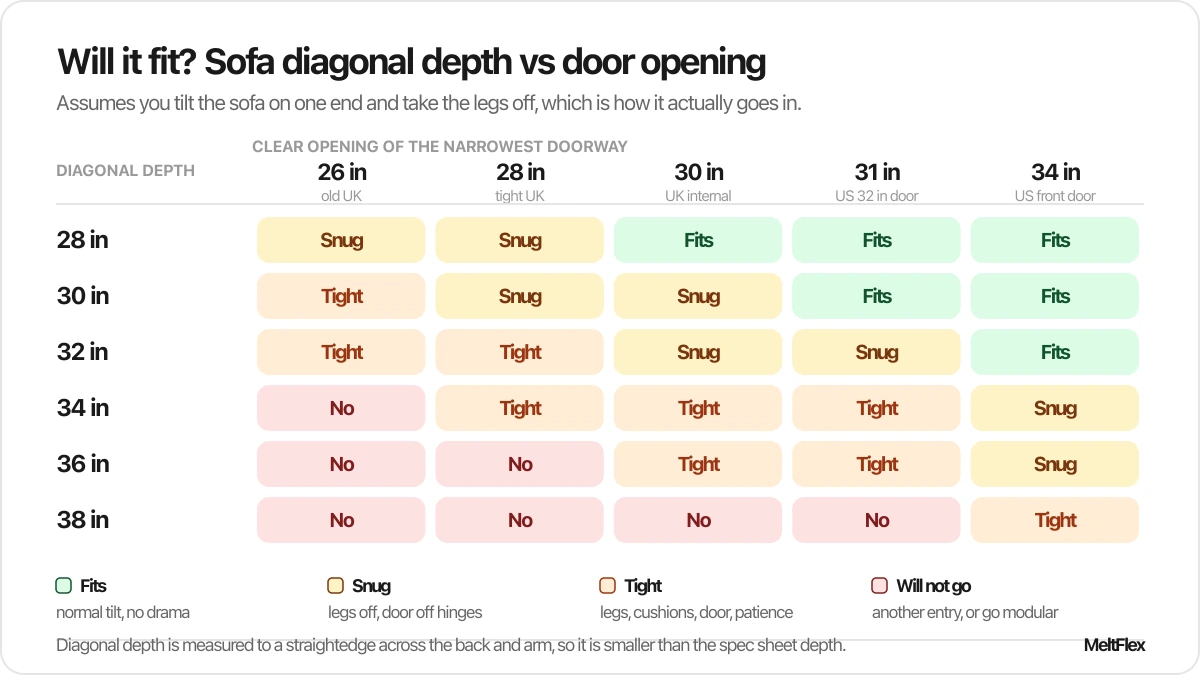
Reading the verdicts: Fits means it goes through with a normal tilt and no drama. Snug means legs off and the door lifted off its hinges, and it will go. The full rescue order for a piece that is already wedged, with what each step is worth in inches, is in what to do when furniture will not fit through the door. Tight means legs off, back cushions off, door off, two people and patience, and it usually still goes. Will not go means stop measuring and start looking at a patio door, a balcony, a ground floor window, or a modular sofa that arrives in sections.
How we built this chart
The column headings are real clear openings, not nominal door sizes. We took the nominal widths from published UK door size standards and the US 32 inch interior door convention, then subtracted the stop and the thickness of the open leaf, which is what costs you the 1 to 2 inches nobody accounts for.
The row values are diagonal depths, measured by the straightedge method above rather than taken off a spec sheet, because retailers list overall depth and movers work to the diagonal. The typical depth ranges in the sofa type table come from published couch dimension guides, and the clearance gains for legs, cushions and hinges are the numbers professional movers quote for the tilt-and-pivot technique.
The honest limitation: this is a planning tool, not a guarantee. It assumes a conventional sofa with removable legs and a route without a brutal turn. A rigid sleeper mechanism, a fixed plinth base, or a half-landing with a wall on both sides can all turn a “Snug” into a no. Measure your own narrowest point before you order, and when the chart says Tight, treat it as a reason to check rather than a promise.
The tilt-and-pivot trick, and why the diagonal saves you
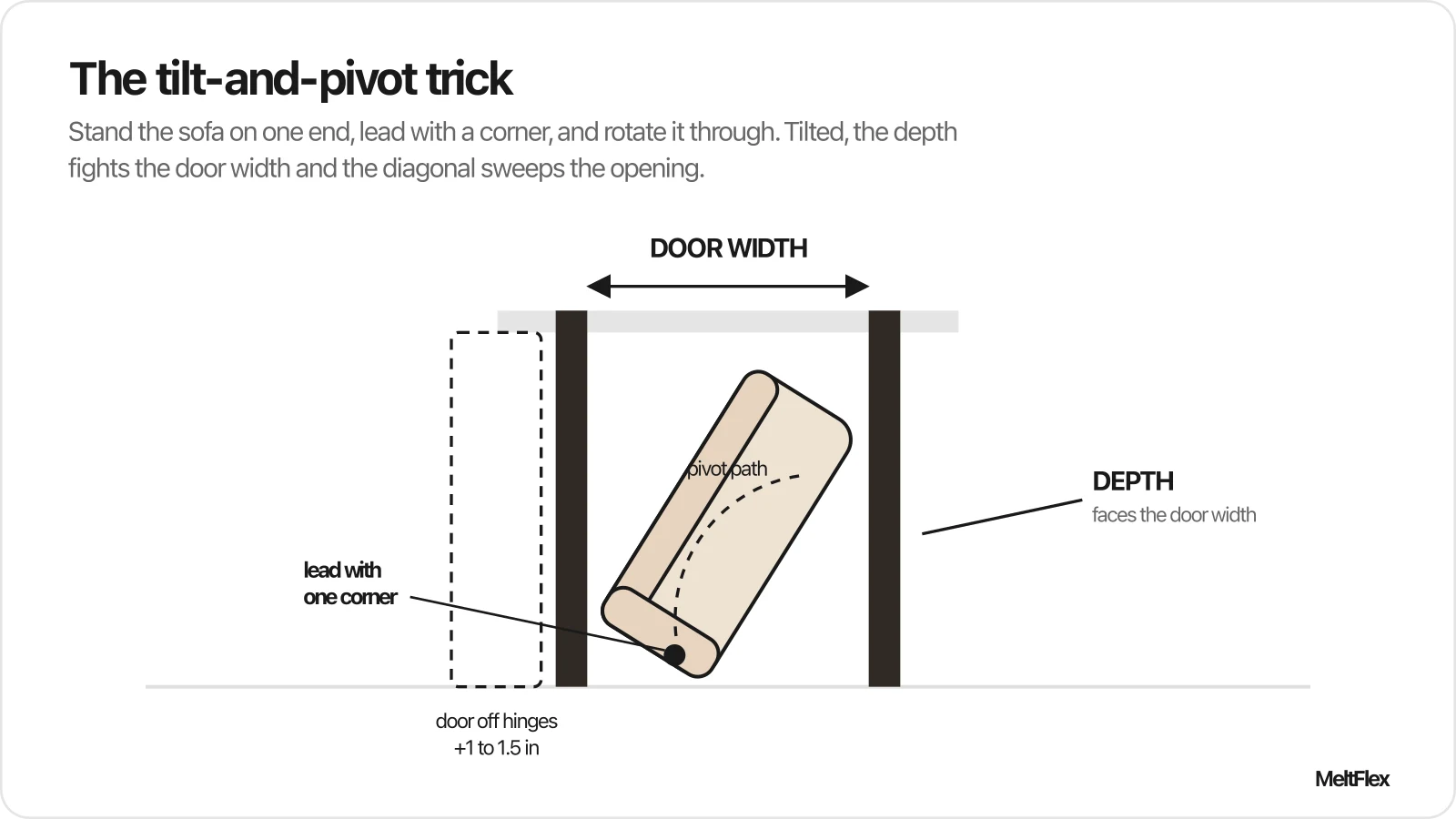
You almost never carry a sofa in flat. You stand it on one end, lead with a corner, and rotate it through the frame in a slow hooking motion, which is exactly how professional movers do it (mover technique). Tilted like that, two things happen at once. The depth fights the width of the opening, and the sofa’s diagonal depth sweeps through the door’s diagonal. A standard 32 by 80 inch door has a diagonal of about 86 inches, far bigger than the diagonal of any normal sofa, which is why the angle almost always finds room even when the flat depth looks scary. The test that decides it is still the one in the chart above: your diagonal depth against the clear opening. The door’s own generous diagonal is simply why you get to use the tilt at all.
It usually gets stuck on the route, not the door
Here is the part most guides skip, and it is the one that actually strands sofas. The doorway is rarely the villain. The villain is the tight 90 degree turn in a hallway, or the half-landing on a staircase, where the sofa has to swing round a corner. At a turn the width of the corridor alone tells you nothing, because a long sofa needs room to rotate, which means roughly the hallway width plus the depth of the doorway it is turning into. Stairs with a wall on both sides and a turn at the top are the hardest of all.
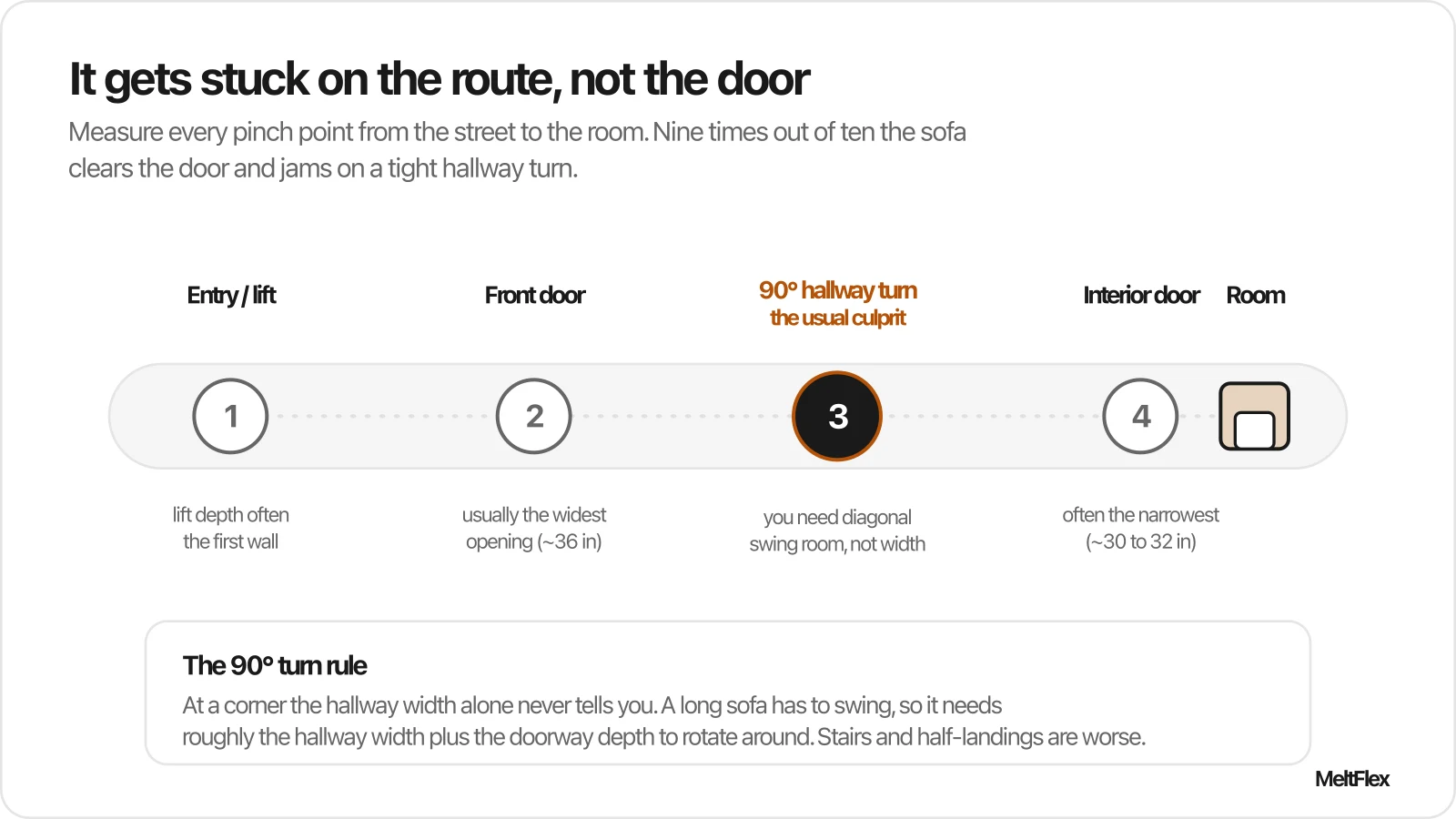
So measure the whole path from the street to the room, in this order, and write down the tightest number you find: the building entry or lift, the front door, every hallway and the turns in it, the interior door, and any stairs. The narrowest point on that list is your real constraint, and it is very often not the door you were worried about. To check those other choke points, a hallway turn, a lift, or the room itself, our general furniture fit calculator runs each scenario. Moving a bed rather than a sofa? The same logic, with the box spring and stairs twist, is in will a mattress fit through the door, and the piece that famously cannot bend at all has its own rescue guide: what to do when a box spring won't fit. Appliances are their own case, and will my fridge fit through the door walks through the fridge version, doors, handles and all.
When the calculator says it is tight: what to actually do
A “snug” or “borderline” result is not a no. It is a cue to buy yourself clearance, in roughly this order of effort:
- Pop the legs off. Most unscrew, and it drops 4 to 6 inches (10 to 15 cm) instantly. This alone solves the majority of tight fits.
- Take the back cushions off. Free, fast, and on a soft sofa it shaves real depth off the part that has to pass the frame.
- Lift the door off its hinges. Buys another 1 to 1.5 inches and gets the handle out of the way. Hinges pop off in a minute with a screwdriver.
- Tilt and hook, do not shove. Stand it upright, lead with one corner, and rotate slowly. Movers will tell you it is geometry and patience, not muscle.
- Find another way in. A patio door, a balcony, or a ground floor window is often wider than the front door, and a sliding door has no frame to fight.
- Go modular. If the route is genuinely too tight, a sofa that arrives in sections sidesteps the whole problem, and it is the honest answer for a third floor walk-up with a turn at every landing.
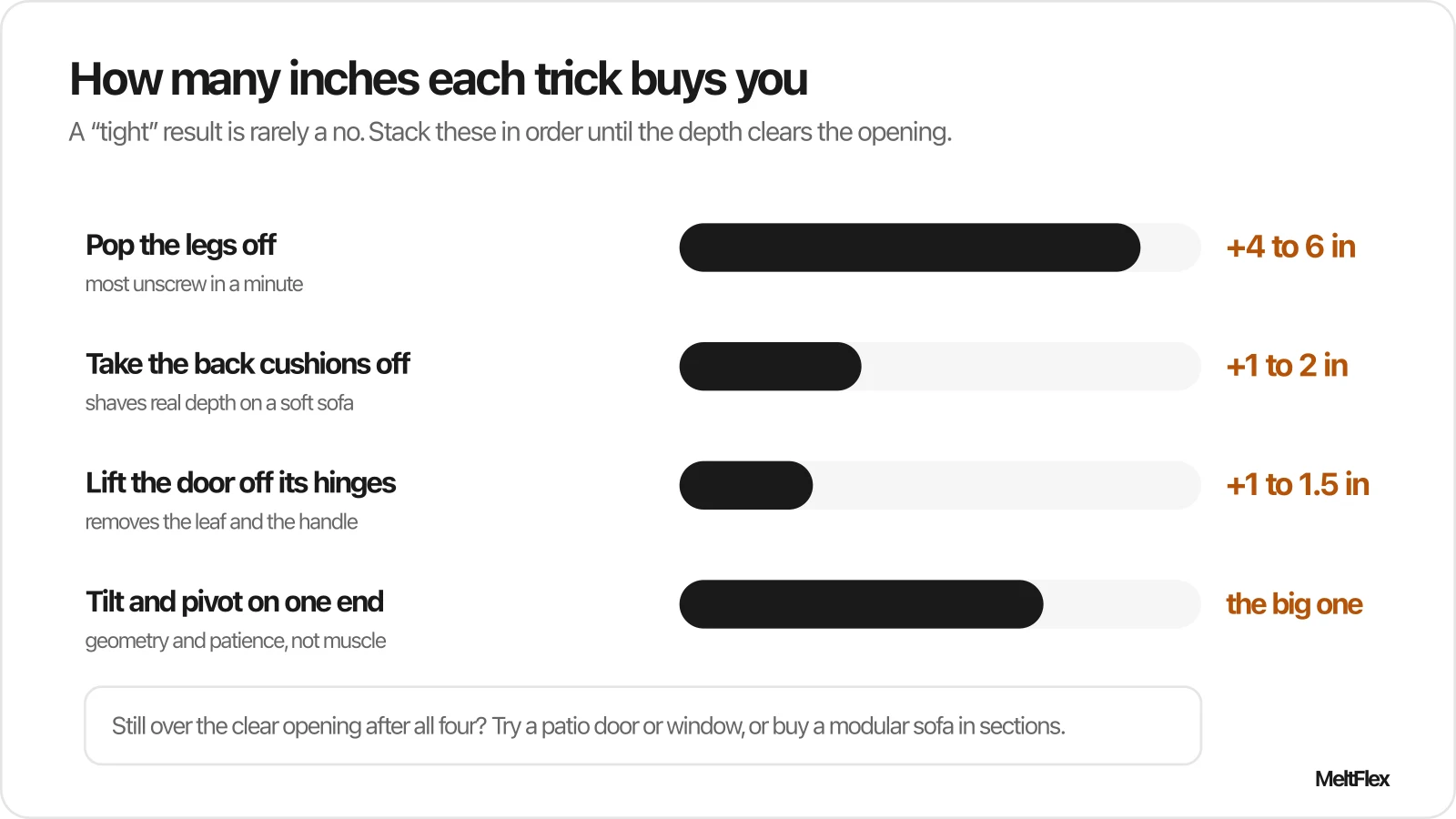
For the quick, shareable version of these tricks, see our short answer on whether a couch will fit through the door.
A two minute pre-order checklist
Run this before you click buy, not after the van is outside:
- Measure the clear opening of every door on the route, with each door open.
- Measure the narrowest hallway and the swing room at any 90 degree turn.
- Check the stairs: width, and whether there is a turn or low ceiling on the way up.
- Pull the sofa’s width, depth, height and diagonal from the listing.
- Put the tightest opening and the sofa depth into the calculator above.
- If it is snug, confirm the legs come off and the delivery team is happy to tilt it.
- Then check it fits the room, not just the door, which is the next part.
Fitting the door is only half the job
A sofa can slide through the frame perfectly and still swallow the room it lands in. Getting it inside and having it look right are two separate questions, and the second is where the real money goes, because wrong size is the leading reason furniture comes back (returns research). A few fast rules before you commit: a sofa should take up no more than about two thirds of the wall it sits against, leave at least 18 inches (45 cm) of walking space in front of it, and remember that a deep sofa over 40 inches will eat a small room even if it technically fits. For the full set, read what size furniture fits my room, and to dial in the spacing see how far your sofa should be from the TV.
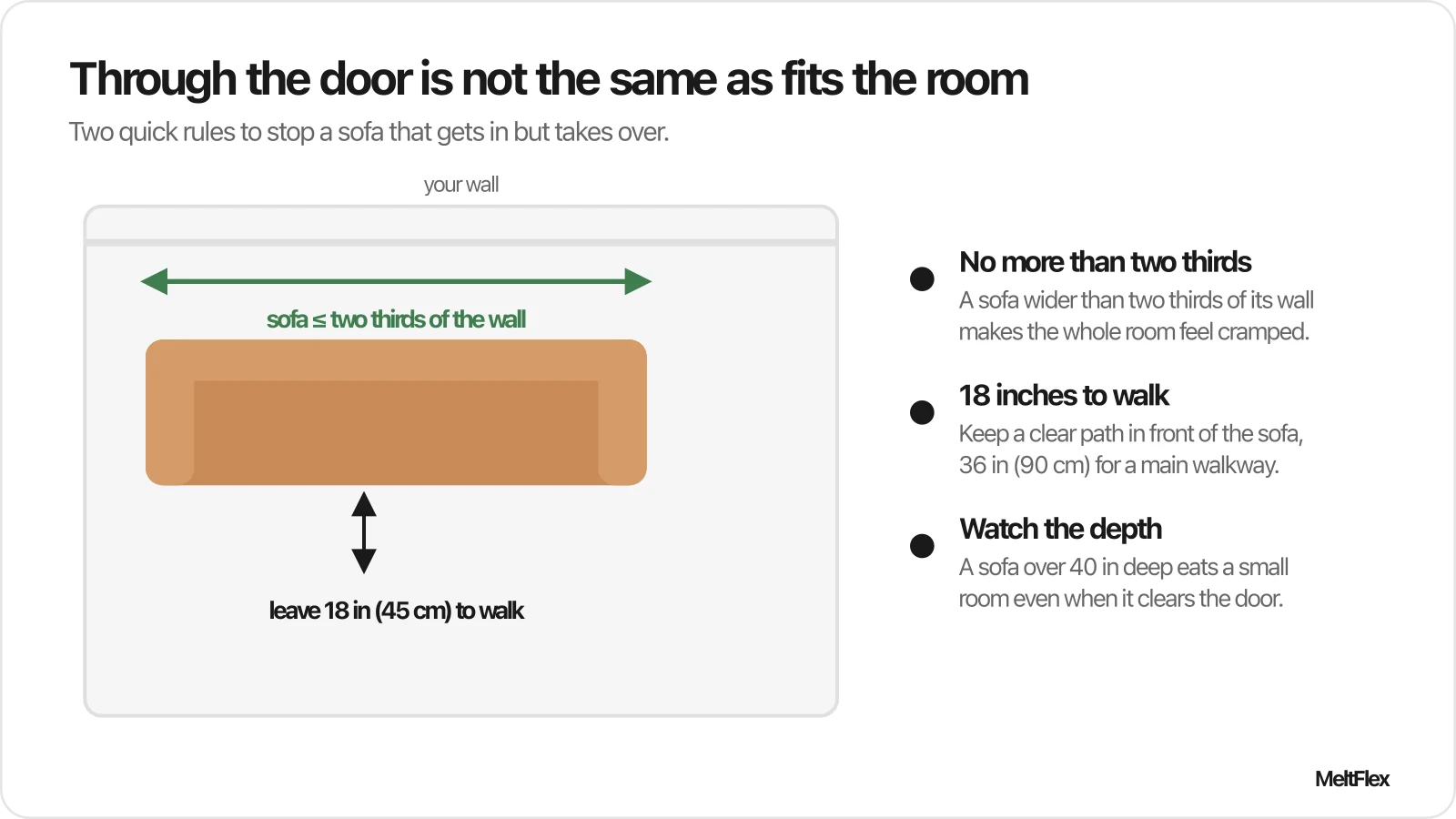
The honest shortcut: see the real sofa in your room first
A tape measure tells you a sofa will physically get in. It still leaves you imagining whether it looks right at that size, in your light, against your walls, and that imagining is exactly where the expensive mistakes hide. Numbers on a page do not become spatial understanding until you see them.
That is the gap MeltFlex closes. Upload a photo of your actual room and it places the real sofa, at true scale, into your space, with the furniture linked to products you can buy. You catch a too big sofa on screen, for free, instead of stuck on the landing or sitting in a room it dominates. Measuring proves it fits the door. A picture in your own room proves it fits your life.
Frequently asked questions
Will a 40 inch sofa fit through a 32 inch door?
It depends which 40 inch number you have. If it is the width, arm to arm, yes easily, because the width runs along the 80 inch height of the doorway. If it is the depth, then not carried flat, since a 32 inch door gives only about 30 to 31 inches of clear opening. Tilted on one end, the number that has to pass is the diagonal depth, usually 32 to 36 inches on a 40 inch deep sofa. Legs off buys 4 to 6 inches and the door off its hinges another 1 to 1.5, so in almost every real case it goes through. It is borderline only with a rigid sofa bed or a tighter UK doorway near 28 inches clear.
How do you measure the diagonal depth of a sofa?
Lay a straightedge against the sofa so it touches the highest point of the back and the front edge of the arm at once, then measure the shortest distance from the bottom rear corner out to that straightedge. Measured properly it comes out smaller than the overall depth, typically 30 to 36 inches on a three seater, which is exactly why sofas that look far too deep on the spec sheet still make it through the door.
How do I know if my sofa will fit through the door?
Measure the clear opening of the narrowest doorway on the route, the real gap with the door open, and the depth of the sofa front to back. If the depth is under that opening, it goes through on its side. Most interior doors give about 30 to 31 inches of clear opening and most sofas are 35 to 40 inches deep, so you stand the sofa on one end and pivot it through, where the depth, not the length, decides it. The calculator at the top runs the numbers for you.
What is the standard door width for getting a sofa in?
In the US a standard interior door is 32 inches wide, but the clear opening is closer to 30 to 31 inches. In the UK a standard internal door is 30 inches, and in Scotland often 28.5 inches, so European homes run tighter. Front and exterior doors are usually 36 inches. Always measure the actual gap, because older homes and apartments can be a lot less.
What if my sofa is wider than the door?
The length, arm to arm, almost never matters, because it runs along the tall side of the frame. The depth is what fights the width. Pop the legs off for 4 to 6 inches, take the back cushions off, lift the door off its hinges for another 1 to 1.5, and stand the sofa on its end to pivot it through. If the depth is still well over the clear opening, use a wider entry such as a patio door or window, or buy a modular sofa that arrives in sections.
What is the most important measurement?
Two things, and neither is the sofa length. First, the diagonal depth, the line from the bottom front to the top back, because that is what threads the frame when you tilt it. Second, the tightest turn on the route, usually a 90 degree hallway corner or a stair half-landing, which catches a sofa far more often than the door itself.
Which sofa is easiest to get through a tight door?
A loveseat or apartment sofa, because it is shallow and light. A sectional or modular sofa is even simpler since it arrives in pieces. The hardest are deep lounge sofas and sofa beds: the extra depth is exactly what fights the frame, and a sleeper has a rigid metal mechanism inside that you cannot shrink or over-bend.
Can the delivery team refuse to bring the sofa in?
Yes. Most retailers deliver to the room of choice but will not remove doors, hoist through windows, or take a risk that could damage the sofa or your home, and some will leave it at the door if it clearly will not fit. That is exactly why you check the route before you order, not on the day.
The short version
Measure the clear opening of the narrowest point on the whole route, not the size printed on the door, and compare it to the sofa’s depth and diagonal, not its length. A typical sofa goes through a typical door when you stand it on end and pivot, and if it is tight the legs, the cushions and the hinges buy you the inches you need. Watch the hallway turns and the stairs more than the door itself. Run your numbers through the calculator at the top, then see the sofa at true scale in your room with MeltFlex before you spend a cent.