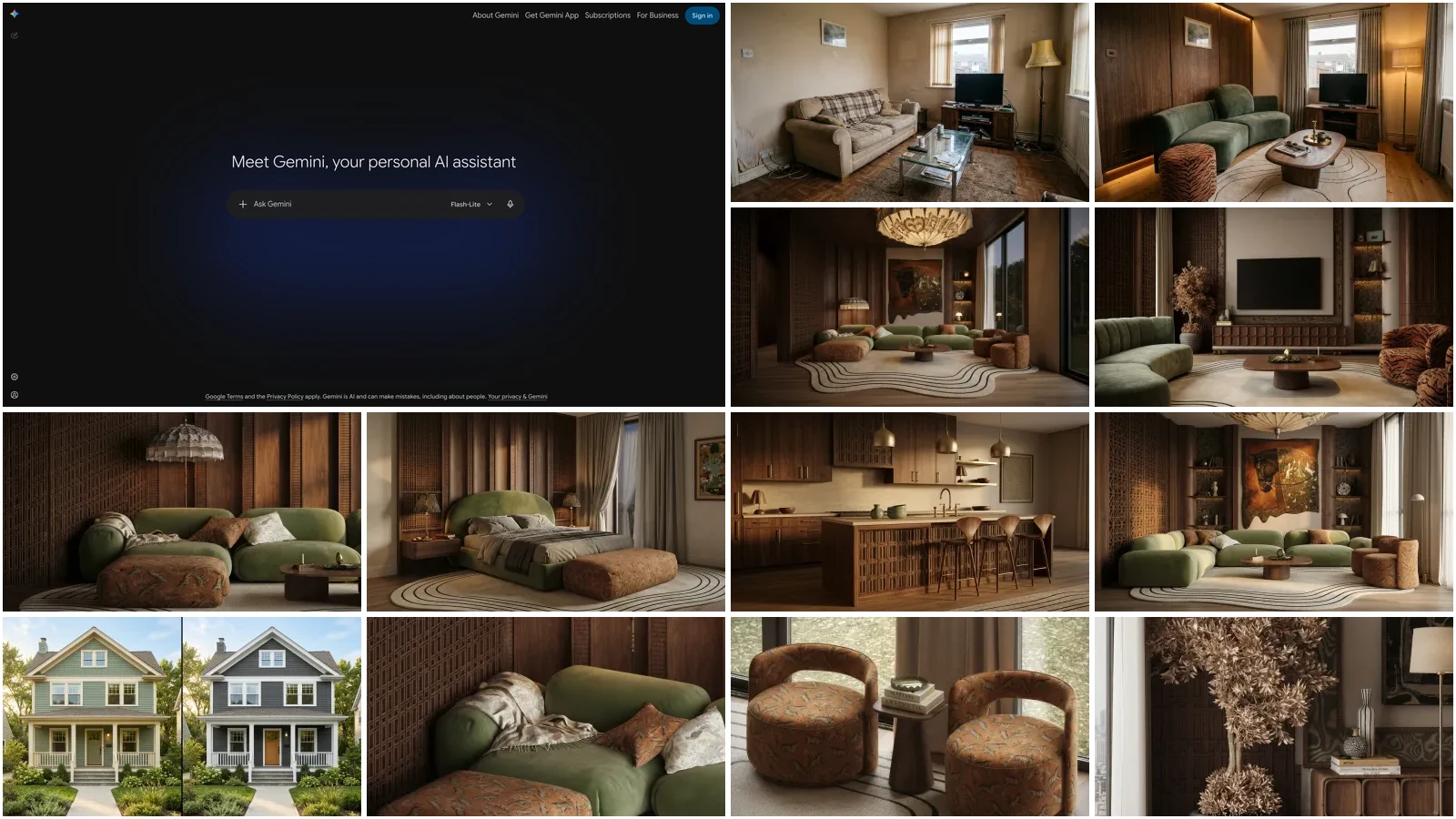
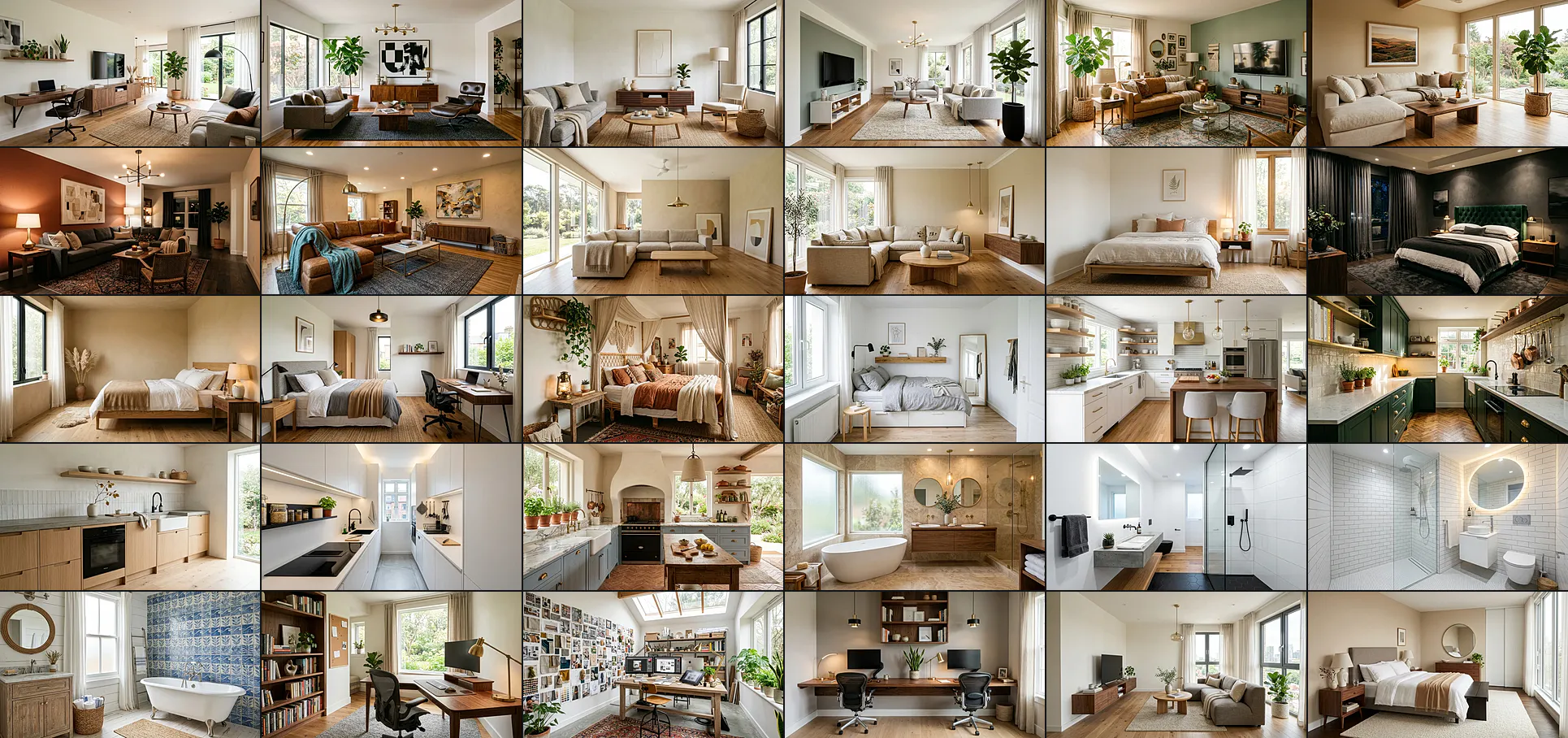
40 tested Nano Banana prompts for interior design, organized by space: living rooms, bedrooms, kitchens, bathrooms, home offices, before-and-after renovation shots, and a new section of image-to-image prompts that edit a real photo of a real room. Every prompt is copy-paste ready with a one-click Copy button, and every image is the real, unedited AI output. Updated August 2026 with the image-to-image library, a Nano Banana Pro section, and a fresh Nano Banana vs ChatGPT vs Midjourney comparison.
Our articles are still written by humans!
Get human written articles in your Google feed.
Nano Banana is Google’s Gemini image model, and it is particularly good at rooms: geometry, furniture proportions and natural light come out believable when you describe them precisely with the five-part formula below. It also does something most people still miss: you can upload a photo of your own room and edit it with a text instruction, which is what the image-to-image section covers. Looking for buildings instead of rooms? Exteriors, facades, aerials and sketch-to-render workflows live in our separate guide of 40 Nano Banana architecture prompts, and for listing photos the Nano Banana real estate prompts.
Nano Banana vs ChatGPT vs Midjourney
| Criteria | Nano Banana | ChatGPT | Midjourney |
|---|---|---|---|
| Realism | Photorealistic, natural lighting | Good but slightly painterly | Artistic, stylized, dramatic |
| Prompt style | Natural language, detailed | Conversational, context-aware | Keywords with parameters |
| Best for | Realistic room concepts | Quick iterations | Mood boards, artistic concepts |
| Price | Free tier, $20/mo | $20/mo | From $10/mo |
| Room geometry | Excellent | Good, occasional distortions | Good wide shots |
| Materials | Excellent: wood, fabrics | Good with specific prompting | Excellent: metals, stone |
| Photo input | Yes, native photo editing | Can reference images | Image ref with --iw |
| Speed | 10 to 15 sec | 15 to 30 sec | 30 to 60 sec |
- Realism
- Photorealistic, natural lighting
- Prompt style
- Natural language, detailed descriptions
- Best for
- Realistic room concepts, client presentations
- Price
- Free tier available, Advanced $20/mo
- Room geometry
- Excellent, natural proportions
- Materials
- Excellent at wood types and fabrics
- Photo input
- Yes, upload a photo and edit it with text
- Speed
- 10 to 15 seconds
- Realism
- Good but slightly painterly
- Prompt style
- Conversational, context-aware
- Best for
- Quick iterations, text-heavy scenes
- Price
- ChatGPT Plus $20/mo
- Room geometry
- Good, occasional distortions
- Materials
- Good with specific prompting
- Photo input
- Can reference uploaded images
- Speed
- 15 to 30 seconds
- Realism
- Artistic, stylized, dramatic
- Prompt style
- Keywords with parameters (--ar, --v, --stylize)
- Best for
- Mood boards, artistic concepts, exteriors
- Price
- Starting at $10/mo
- Room geometry
- Good for wide shots, weaker close-ups
- Materials
- Excellent, especially metals and stone
- Photo input
- Image reference with --iw parameter
- Speed
- 30 to 60 seconds
Bottom line: Nano Banana wins on realism, speed, and photo editing for interior design. Midjourney wins on artistic style and dramatic composition. ChatGPT wins on conversational iteration. Nano Banana can edit a photo of your actual room, and the image-to-image section below shows exactly how. What none of them do is hold your exact dimensions reliably across edits or connect the render to furniture you can buy. For that part of the job, use a dedicated tool like MeltFlex that preserves your room dimensions and shows purchasable furniture from IKEA, Wayfair, and Amazon.
Nano Banana vs Nano Banana Pro: Which One for Rooms?
Since Nano Banana Pro (Google’s Gemini 3 Pro Image model) reached general availability, every prompt in this guide runs on either tier. The practical differences for interior work:
- Resolution. Standard Nano Banana outputs roughly 1K to 2K images, plenty for screens, mood boards and client decks. Pro renders up to native 4K, which matters for large-format printing and portfolio work.
- Reference images. Pro accepts up to 8 reference images in one prompt. That is what makes “place this exact sofa in this exact room” possible: one photo of the room, one of the sofa, one instruction.
- Localized edits. Both models edit photos, but Pro is noticeably better at changing one region while leaving the rest untouched: repaint one wall, swap one cabinet front, keep everything else pixel-faithful.
- Cost and access. Standard Nano Banana is part of the free Gemini tier with daily limits. Pro generations draw from paid Google AI plans, and via the API a Pro image runs about $0.13 at 1K or 2K and $0.24 at 4K.
Our honest recommendation: start on the standard model. For text-to-image room concepts, the quality gap is small and the formula below matters far more than the model tier. Step up to Pro when you need 4K output, multi-image references, or surgical edits of a real photo.
The Nano Banana Interior Design Prompt Formula
Every high-quality Nano Banana interior design prompt follows the same five-part structure. Master this formula and you can generate professional-grade concepts for any room, any style.
What details to include in your Nano Banana prompt
1. Room type and camera angle. Start with what the image shows: “Wide-angle photograph of a living room, shot from the corner at eye level.” This sets the composition and perspective.
2. Design style in specific terms. Not just “modern” but “warm Scandinavian with Japandi influences.” Layer two style references for more interesting results. The AI responds better to style combinations than single labels.
3. Materials and colors. Name exact materials: “walnut wood console, linen upholstery in oatmeal, brushed brass hardware.” The more specific you are, the more controlled the output. “Walnut console” produces a completely different result than “wooden console.”
4. Lighting. “Soft natural light from large windows on the right, warm pendant lamp overhead, no harsh shadows.” Lighting makes or breaks interior renders. Always specify direction, warmth, and source.
5. Mood or atmosphere word. End with one word that sets the feeling: “serene,” “cozy,” “editorial,” “lived-in.” This final word nudges the AI toward a specific visual temperature and is more powerful than most people realize.
These five elements work for every room type. The sections below use this exact formula for living rooms, bedrooms, kitchens, bathrooms, and home offices.
Nano Banana Living Room Prompts (1 to 10)
Living rooms are the most commonly generated room type in AI interior design. These prompts cover the styles that dominate Pinterest and Architectural Digest right now: warm minimalist, sage green accent walls, earth tones, and bold statement rooms.
Prompt 1: Scandinavian Living Room With Walnut Media Wall
Wide-angle interior photograph of a modern Scandinavian living room. Warm white walls. Walnut TV console with integrated storage on the main wall. Floating walnut desk with matte black metal legs to the left. Dark leather office chair at the desk. Low-profile grey linen sofa with a woven jute rug. Round walnut coffee table. Floor-to-ceiling windows on the right with sheer linen curtains. Fiddle-leaf fig tree next to the window. Matte black arc floor lamp. Oak hardwood flooring. Soft natural daylight. Serene and functional.
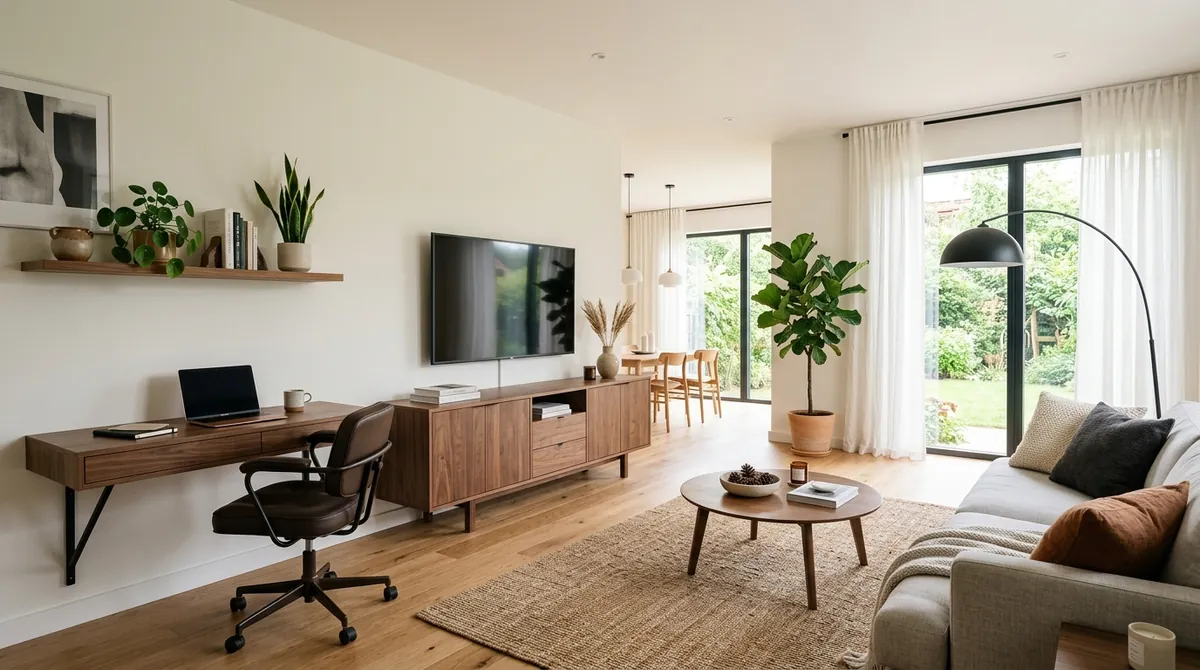
Result: warm wood tones with integrated workspace
Prompt 2: Mid-Century Living Room With Statement Art
Interior photograph of a mid-century modern living room at eye level. White walls. Large abstract black and white canvas above a walnut credenza. Eames-style leather lounge chair with ottoman in dark brown. Low walnut coffee table with live edge detail. Dark charcoal area rug. Low-profile sofa in warm grey bouclé. Brass pendant light hanging from center of ceiling. Potted fiddle-leaf fig by the window. Oak floors with honey tone. Warm diffused afternoon light. Editorial and curated.
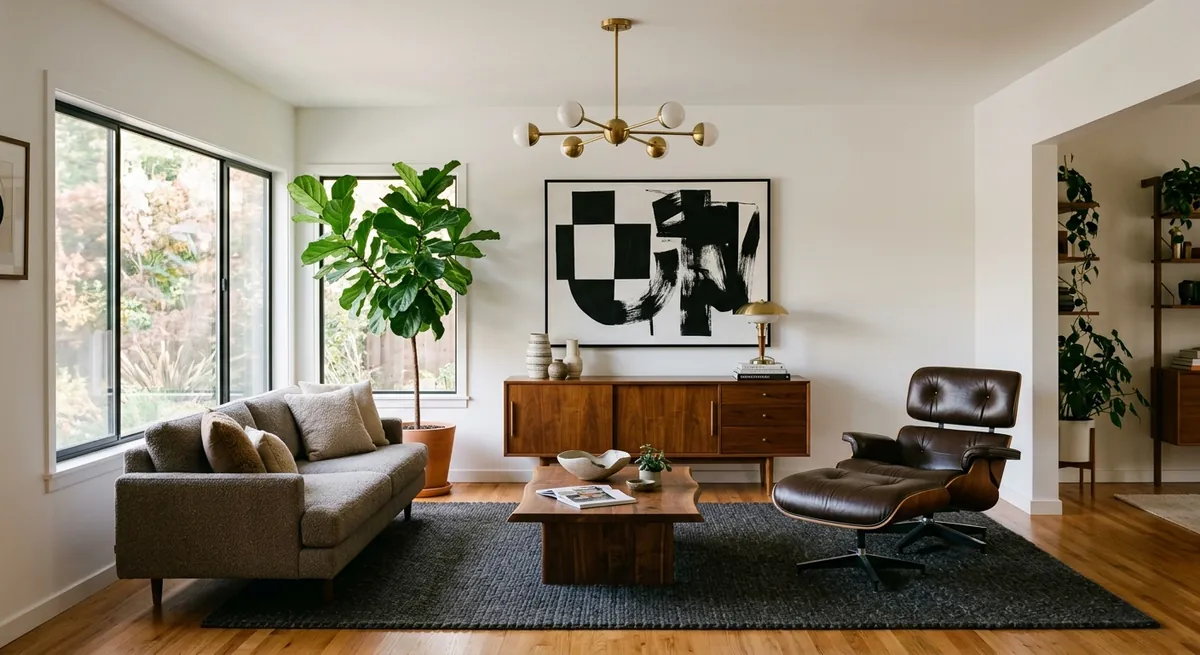
Result: Eames chair and oversized art as focal points
Prompt 3: Japandi Living Room With Wooden Accent Chair
Wide-angle photograph of a Japandi-inspired living room. Warm white walls with subtle plaster texture. Walnut media console with sliding doors on the main wall. Wooden accent chair with cream linen seat cushion. Round wooden coffee table in light oak. Low grey sofa with natural linen throw. Ceramic vases in cream and sand tones on the console. Woven basket next to the chair. Floor lamp with linen drum shade by the window. Oak hardwood floors. Soft diffused natural light from large windows. Tactile and calm.
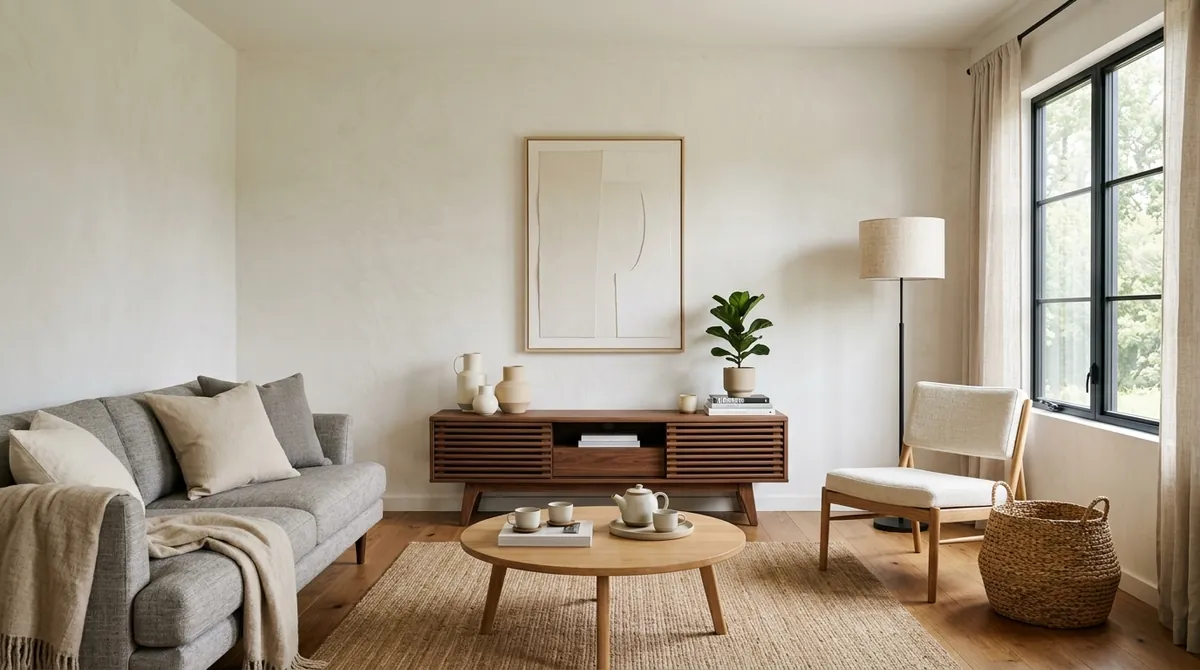
Result: Japandi warmth with tactile natural materials
Prompt 4: Sage Green Accent Wall With Light Furniture
Wide-angle interior photograph of a modern living room. Muted sage green accent wall behind the TV. Three remaining walls in warm white. White and light oak TV console. Two light grey linen sofas facing each other. Round walnut coffee table between them. Modern gold sputnik chandelier centered above the seating area. Large potted plant in a matte black planter near the window. Floor-to-ceiling windows with sheer curtains. Oak hardwood flooring. Soft natural light. Refined and balanced.
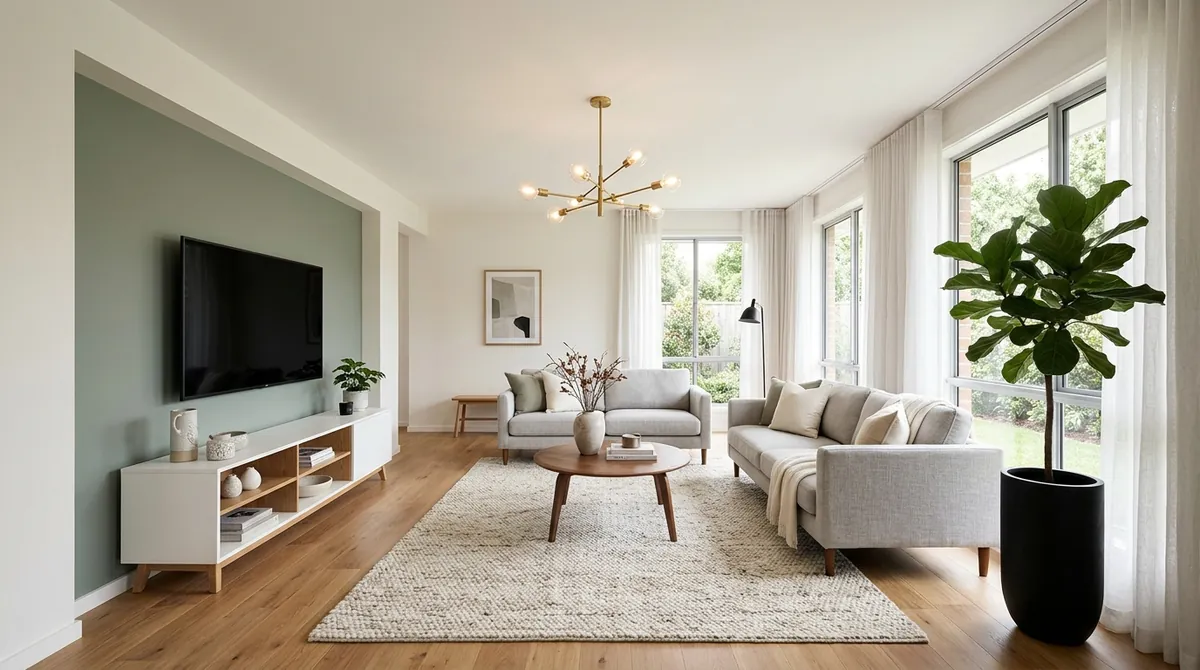
Result: light furniture keeps the sage green wall as the focal point
Prompt 5: Sage Green With Camel Leather and Oriental Rug
Interior photograph of a warm eclectic living room shot from the corner. Muted sage green accent wall behind a wall-mounted TV. Camel-colored leather sofa against the green wall. Vintage oriental rug in faded blues, rust, and cream underneath the seating. Glass and brass coffee table. Wooden side tables with vintage table lamps. Tall potted plant in a woven basket by the window. Large windows with natural linen curtains. Walnut media console below the TV. Brass accents throughout. Warm golden hour light. Layered and collected.
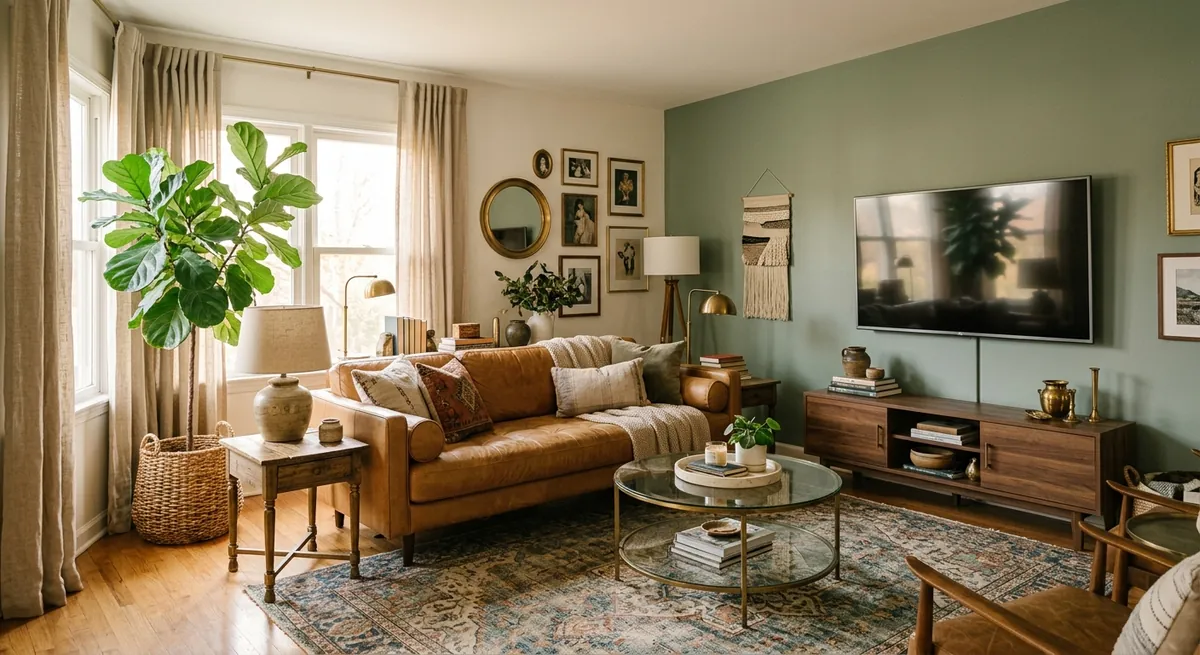
Result: camel leather and brass create warmth against the cool green
Prompt 6: Warm Beige Living Room With Cream Sectional
Wide-angle interior photograph of a warm beige living room. Walls painted in warm sand with matte finish. Large L-shaped sectional sofa in cream linen with oversized cushions. Solid walnut rectangular coffee table in the center. Framed landscape art on the wall in warm earth tones. Brass floor lamp with linen shade to the right of the sofa. Large fiddle-leaf fig tree in a woven basket by the window. Floor-to-ceiling windows with warm natural light. Oak hardwood floors with a subtle warm tone. No rug. Inviting and enveloping.
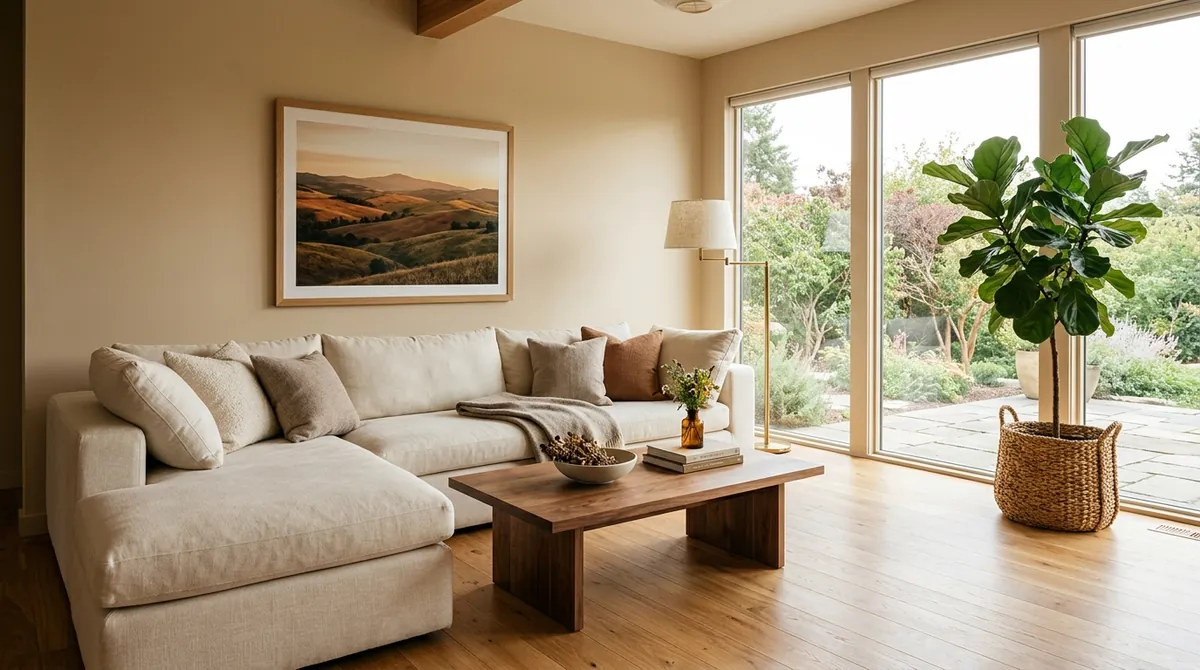
Result: monochrome warmth with texture variation
Prompt 7: Terracotta Accent Wall With Charcoal Sectional
Interior photograph of a dramatic living room with a terracotta rust accent wall. The accent wall is behind the main seating area. Dark charcoal L-shaped sectional sofa against the terracotta wall. Abstract art in neutral cream and brown tones hung on the accent wall. Multi-arm modern chandelier in matte black and brass above the seating. Walnut side table with brass lamp. Three remaining walls in warm white. Dark patterned area rug. Oak floors. Evening warm ambient light from lamps, no harsh overhead. Moody and inviting.
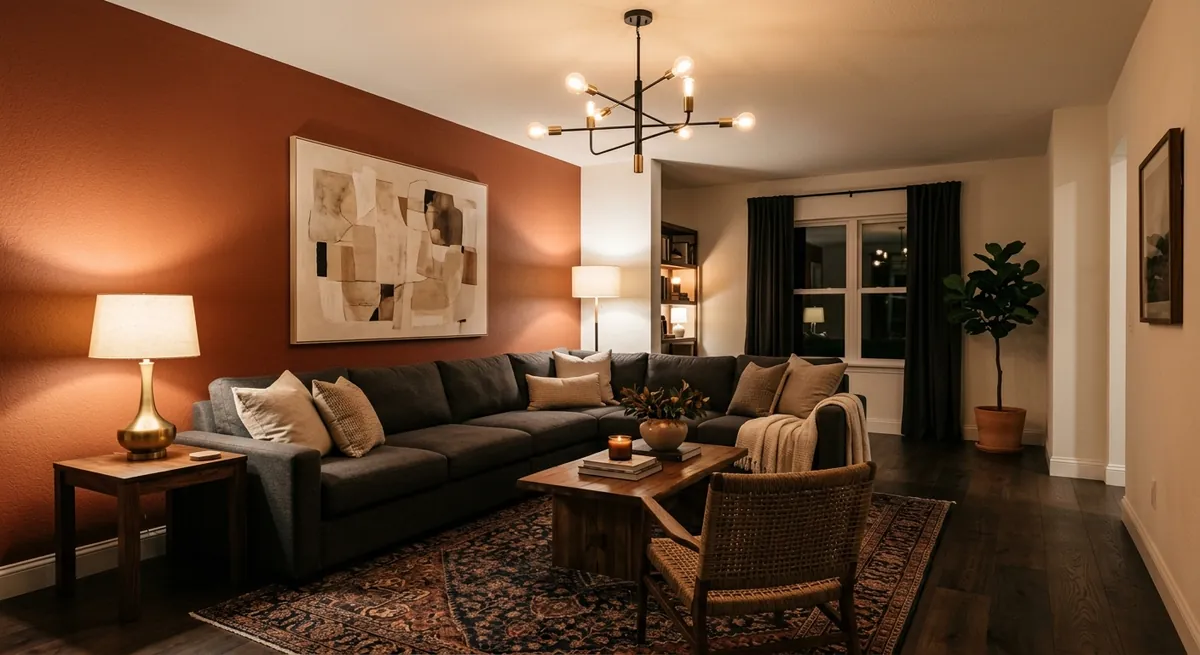
Result: terracotta and charcoal create evening atmosphere
Prompt 8: Cognac Leather Sectional With Warm Walls
Wide-angle interior photograph of a warm contemporary living room. All walls in warm sand with slight texture. Large L-shaped sectional sofa in cognac brown leather, well-worn with natural patina. Teal linen throw blanket draped over the arm. Low marble and brass coffee table. Walnut media console on the wall with framed abstract art above. Recessed ceiling downlights with 2700K warm tone. Arc floor lamp in brushed brass behind the sofa. Dark grey patterned area rug. Oak hardwood floors. Natural afternoon light mixing with warm artificial light. Rich and comfortable.
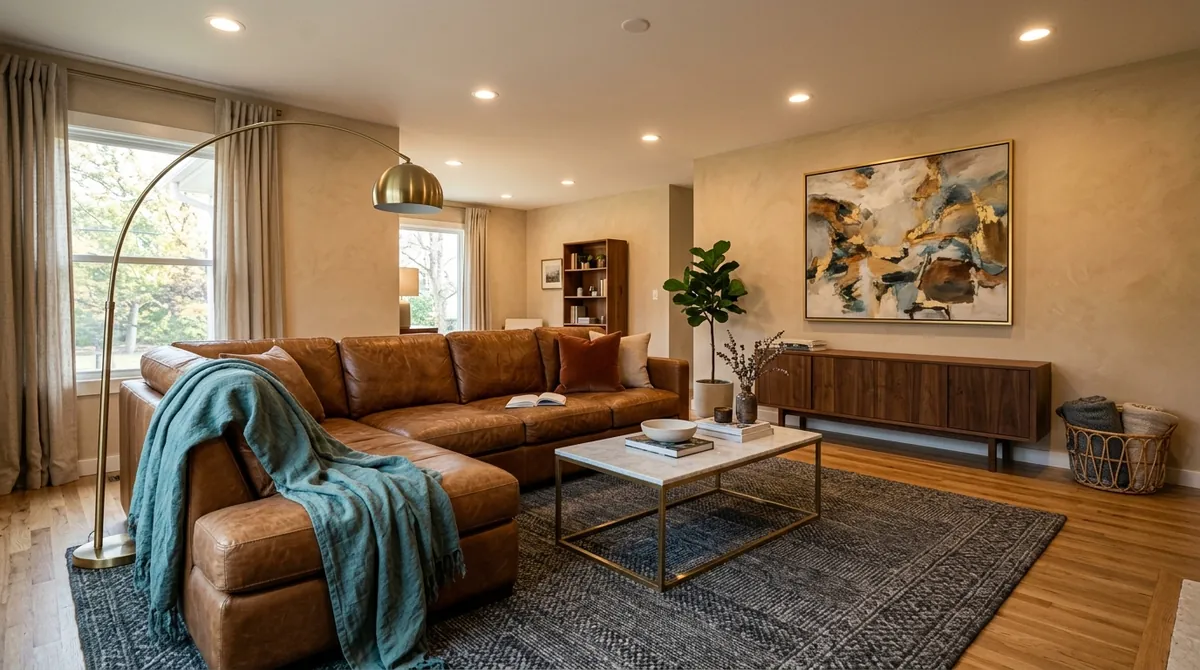
Result: cognac leather with a teal accent for depth
Prompt 9: Monochrome Beige With Maximum Minimalism
Interior photograph of an ultra-minimalist living room. All walls in warm beige. Matching beige linen sectional sofa. Light oak coffee table with simple rounded edges. Single pendant lamp in brushed brass above the seating area. White ceiling fan. One framed abstract art piece leaning against the wall, not hung. Beige wool throw blanket on the sofa arm. No rug, clean warm oak floors. Maximum natural light from large windows. No clutter, no decorative objects, just furniture and light. Peaceful and quiet.
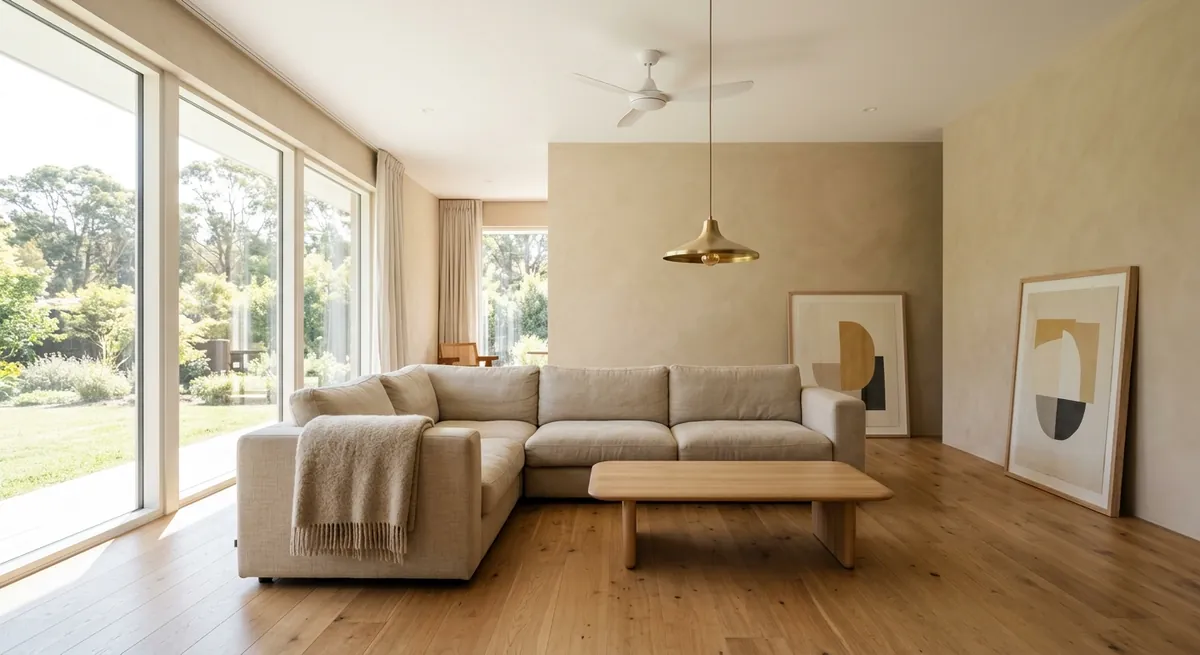
Result: quiet luxury through radical simplicity
Prompt 10: Natural Wood Focus With Understated Warmth
Interior photograph of a warm minimal living room. Walls in light warm beige. Matching beige linen sectional with loose cushions. Round coffee table in solid natural wood with visible grain, slightly oversized for the space. Walnut console on the wall with simple framed art. Pendant lights in warm brass with small shades creating pools of light. White ceiling, no fan. Minimal accessories, one ceramic vase, one stack of books. Oak floors throughout. Soft diffused light from large windows. Warm and understated.
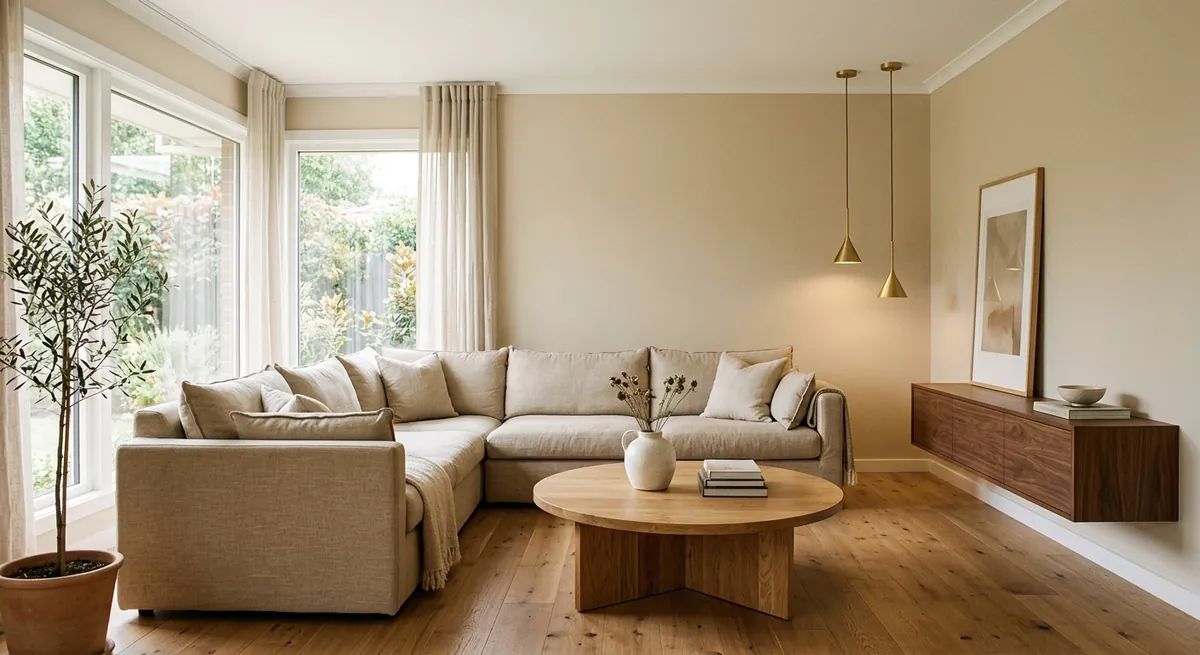
Result: natural wood as the sole design statement
Living Room Prompt Template
Wide-angle photograph of a [room type]. [Wall color] walls. [Wood type] [furniture piece] on the [wall position]. [Seating] in [material and color]. [Coffee table material and shape]. [One plant type]. [Flooring material]. [Lighting: natural from windows + one warm artificial source]. [Mood word].
Nano Banana Bedroom Prompts (11 to 16)
Bedroom prompts require a different approach than living rooms. The focal point is always the bed, and the mood should lean toward calm and restful. Lighting matters more here because bedrooms are used in both natural and artificial light.
Prompt 11: Serene Scandinavian Bedroom
Interior photograph of a serene Scandinavian bedroom at eye level. Warm white walls with matte finish. Oak platform bed frame with low profile, linen bedding in off-white with a single terracotta throw pillow. Walnut bedside table with a ceramic table lamp and small plant. Sheer linen curtains on large window to the right. Light oak hardwood floors. Woven jute rug under the bed. No overhead lighting, just the table lamp and natural morning light. Simple framed botanical print above the bed. Clean and restful.
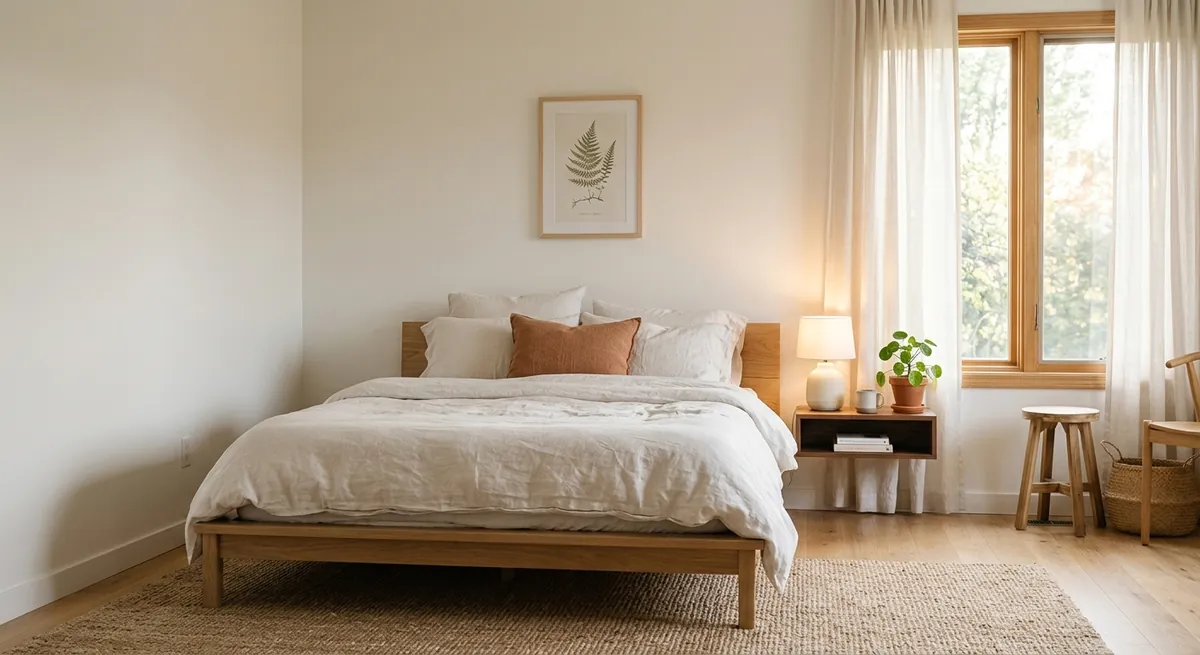
Result: Scandinavian calm with warm natural materials
Prompt 12: Luxury Dark Bedroom With Velvet Headboard
Wide-angle photograph of a luxury bedroom with moody atmosphere. Deep charcoal walls with matte paint finish. King-size bed with tufted emerald green velvet headboard. White linen sheets, charcoal wool throw at the foot. Two walnut bedside tables with brushed gold reading lamps. Dark hardwood floors with a plush dark grey area rug. Floor-to-ceiling curtains in heavy charcoal linen, partially drawn. Subtle recessed lighting at warm color temperature. Fresh flowers in a dark ceramic vase. Shot on 35mm lens. Dramatic and intimate.
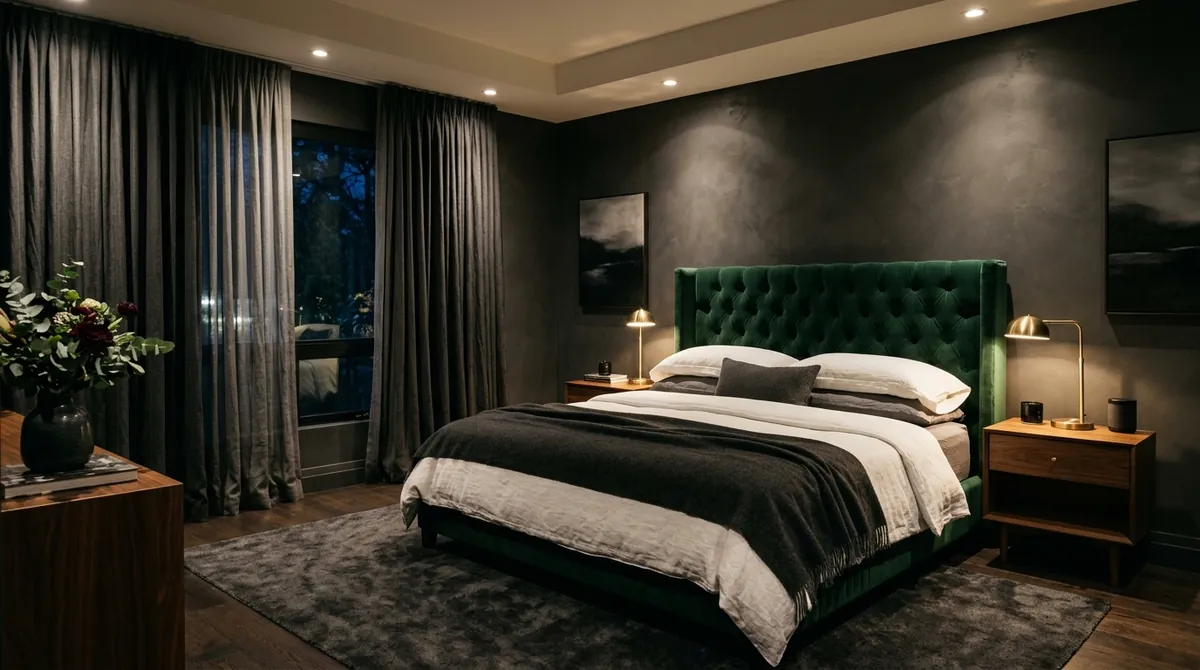
Result: dramatic luxury bedroom with rich textures
Prompt 13: Warm Minimalist Bedroom With Earthy Palette
Interior photograph of a warm minimalist bedroom. Walls in warm sand color. Low wooden bed frame in natural oak with visible grain. White linen bedding with a camel wool throw blanket. One walnut bedside table with a hand-thrown ceramic lamp in cream. Dried pampas grass in a tall clay vase in the corner. No art on the walls. Light oak hardwood floors with a small sheepskin rug beside the bed. Soft morning light from a single large window. No overhead fixtures. Grounded and peaceful.
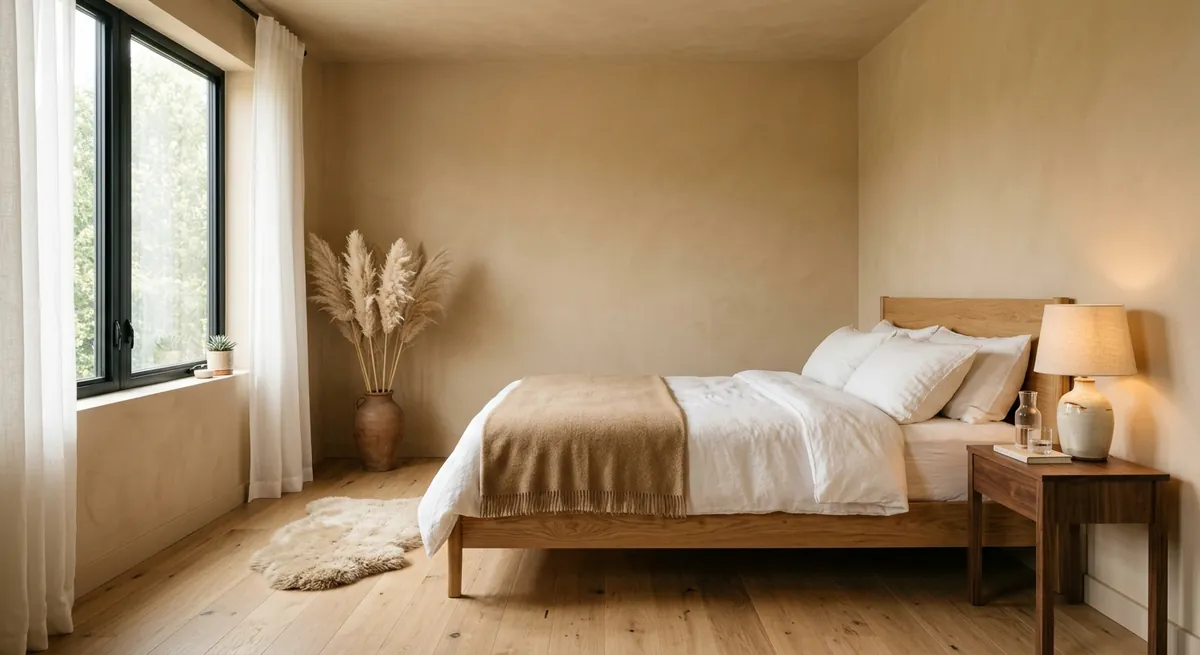
Result: earth tones with texture-driven minimalism
Prompt 14: Modern Bedroom With Workspace Integration
Wide-angle photograph of a modern bedroom with integrated workspace. Warm white walls. Queen bed with grey upholstered headboard and white bedding against the left wall. Floating walnut desk with matte black metal legs on the opposite wall, positioned under a window. Ergonomic mesh office chair in black. Walnut bookshelf above the desk with minimal books and one plant. Oak hardwood floor. Pendant lamp above the desk, bedside reading light. Natural afternoon light from the window. Functional and composed.
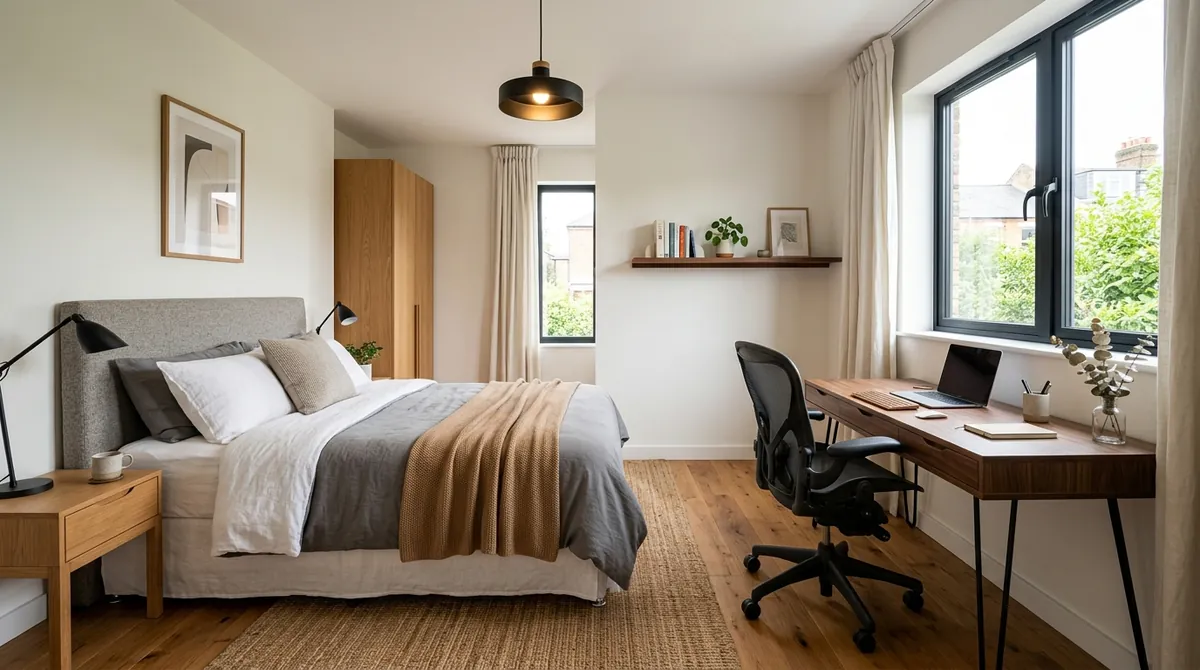
Result: bedroom and workspace in one cohesive room
Prompt 15: Boho Bedroom With Layered Textiles
Interior photograph of a bohemian bedroom with warm layered textiles. Off-white walls with subtle texture. Rattan bed frame with canopy detail. Layered bedding: white base sheets, a rust-colored linen duvet, cream knit throw, and multiple textured cushions in earthy tones. Woven jute rug overlapping a smaller vintage kilim rug. Macramé wall hanging above the headboard. Trailing pothos plant hanging from a rattan shelf. Wooden bedside table with a brass lantern. Warm late afternoon golden light. Collected and bohemian.
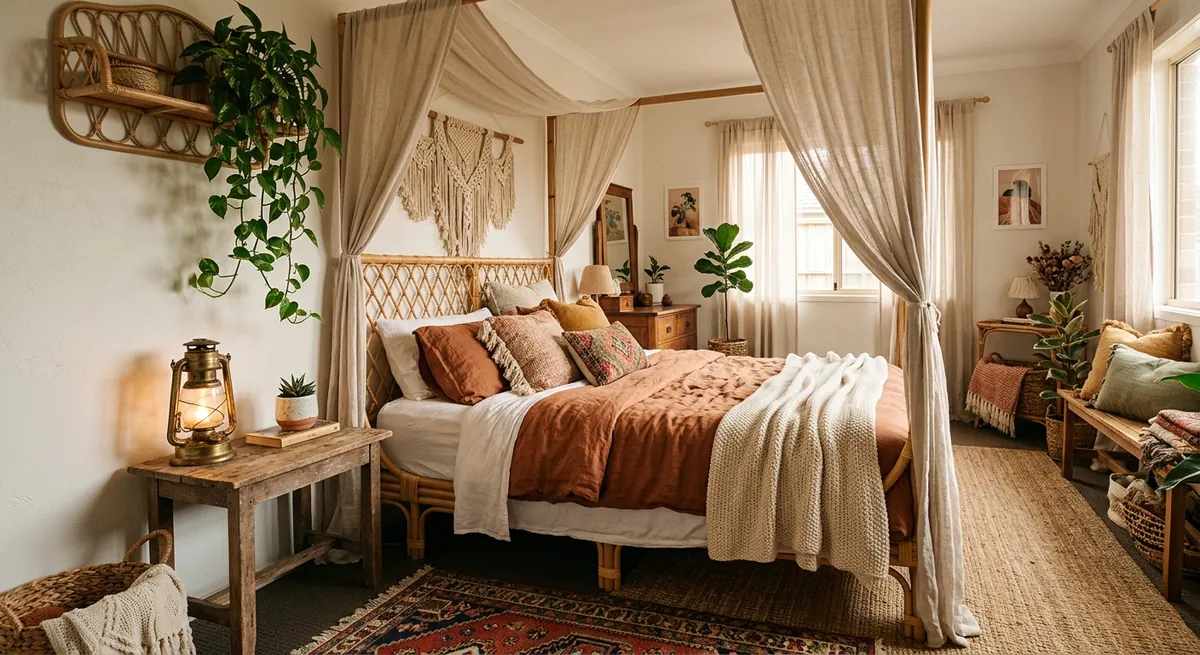
Result: layered boho warmth with natural textures
Prompt 16: Small Bedroom With Smart Storage
Wide-angle photograph of a small bedroom, approximately 10 square meters. White walls to maximize the sense of space. Full-size bed with built-in storage drawers underneath, white frame, grey linen bedding. Floating shelf above the bed serving as both headboard and display surface. Wall-mounted reading light in matte black. Small round side table in light oak. Vertical full-length mirror leaning against the wall to create depth. No rug, light wood laminate floor. Bright diffused daylight from one window. Clever and airy.
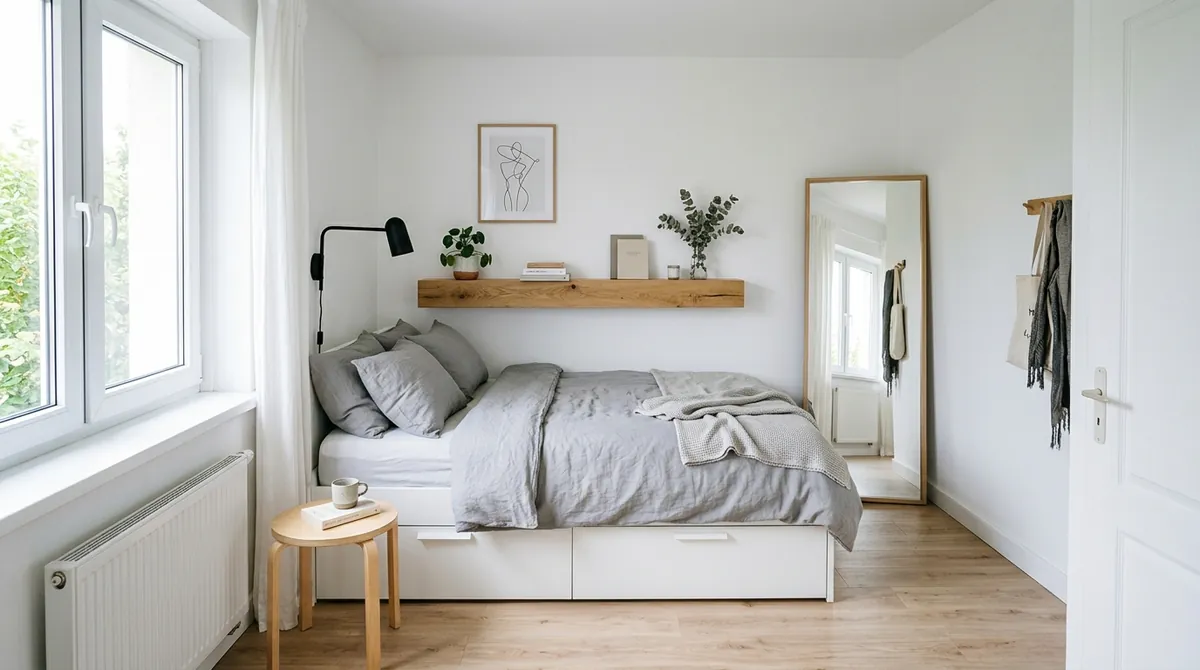
Result: maximizing a small space with smart furniture choices
Nano Banana Kitchen Prompts (17 to 22)
Kitchen prompts need more technical specificity than other rooms. Countertop materials, cabinet finishes, hardware, backsplash details, and appliance placement all matter. Nano Banana handles kitchen geometry well when you specify the layout type (galley, L-shaped, U-shaped, island).
Prompt 17: Modern White Kitchen With Wood Accents
Professional interior photograph of a modern kitchen with L-shaped layout. White flat-panel cabinetry with brass pull handles. Calacatta marble countertops with subtle grey veining. Light oak open shelving on the upper wall with white ceramic dishes and glass jars. Walnut butcher block island with two light grey upholstered bar stools. Stainless steel appliances. White subway tile backsplash with thin grey grout lines. Pendant lights in brushed brass above the island. Light oak hardwood floors. Bright morning natural light from a large window above the sink. Clean and inviting.
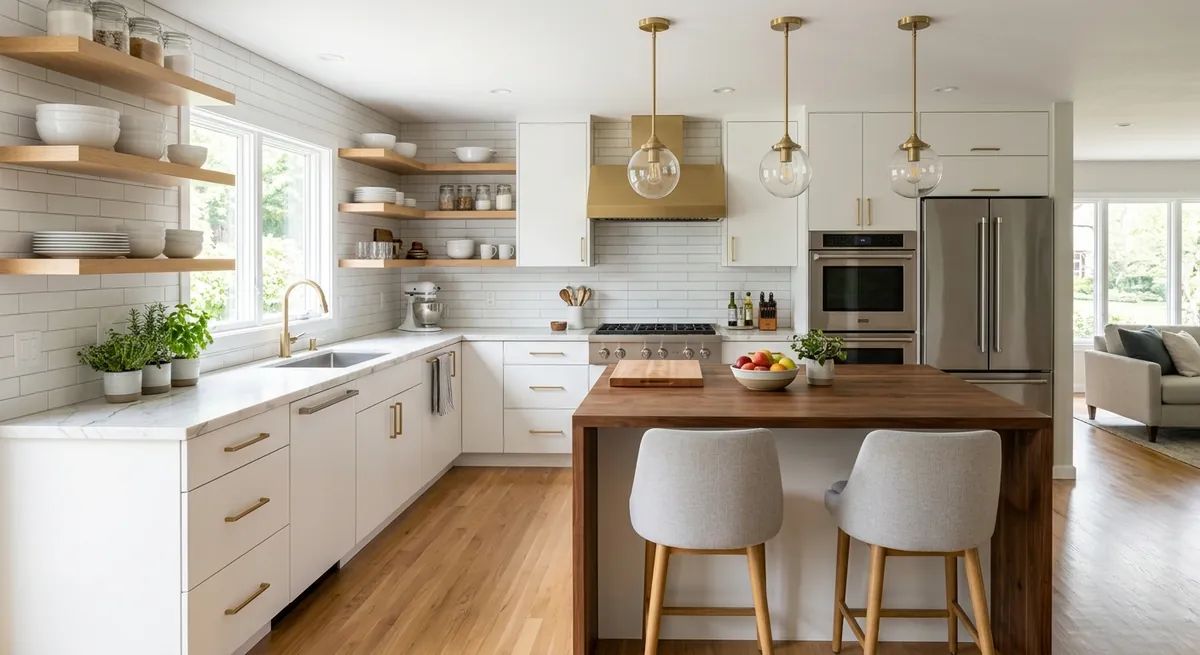
Result: modern white kitchen with warm wood and brass accents
Prompt 18: Dark Green Kitchen With Brass Hardware
Wide-angle photograph of a galley kitchen with deep forest green shaker cabinets. Brushed brass cup handles and knobs throughout. White quartz countertops. Zellige tile backsplash in cream with handmade irregular surface. Open brass shelving on one wall with cookbooks and potted herbs. Integrated brass under-cabinet lighting. Matte black kitchen faucet. Dark walnut floating shelf above the stove with a brass pot rack. Herringbone wood floor in medium oak. Warm afternoon light from end window. Rich and characterful.
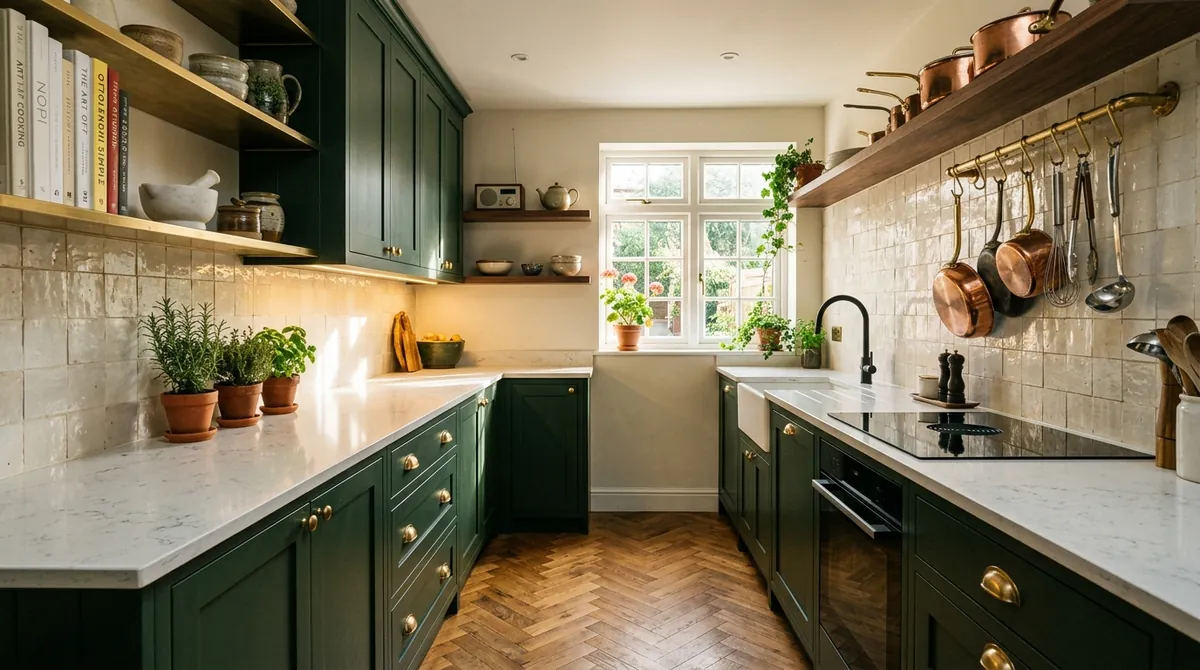
Result: rich green cabinets with brass and natural materials
Prompt 19: Japandi Kitchen With Minimal Upper Cabinets
Interior photograph of a Japandi-inspired kitchen. Light oak slab-front lower cabinets with recessed pulls. No upper cabinets, just a single floating shelf in matching oak. White plaster walls with subtle texture. Concrete countertop with matte finish. Integrated ceramic farmhouse sink. Matte black modern faucet. Simple backsplash in white hand-glazed ceramic tiles. One ceramic vase with a single branch on the counter. Under-counter built-in oven in matte black. Wide plank oak floor. Soft diffused natural light. Minimal and serene.
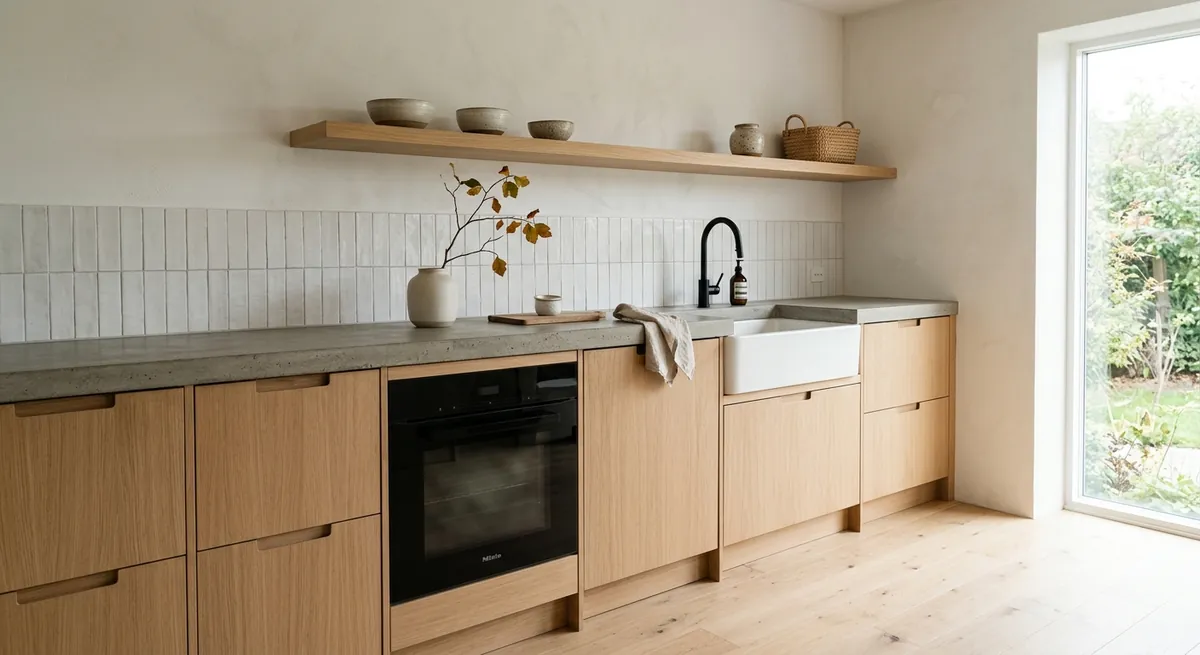
Result: Japandi simplicity with concrete and oak
Prompt 20: Small Apartment Kitchen With Maximum Storage
Wide-angle photograph of a compact galley kitchen in a city apartment, approximately 6 square meters. White flat-panel cabinetry floor to ceiling for maximum storage. Matte white countertop. Small induction cooktop with integrated downdraft ventilation. Under-cabinet LED strip lighting in warm white. One narrow open shelf with glass jars and a small herb pot. Matte black fixtures. Light grey large-format floor tiles. Maximized every centimeter of space. No island, no eat-in area. Bright fluorescent-free overhead light plus natural light from one small window. Functional and compact.
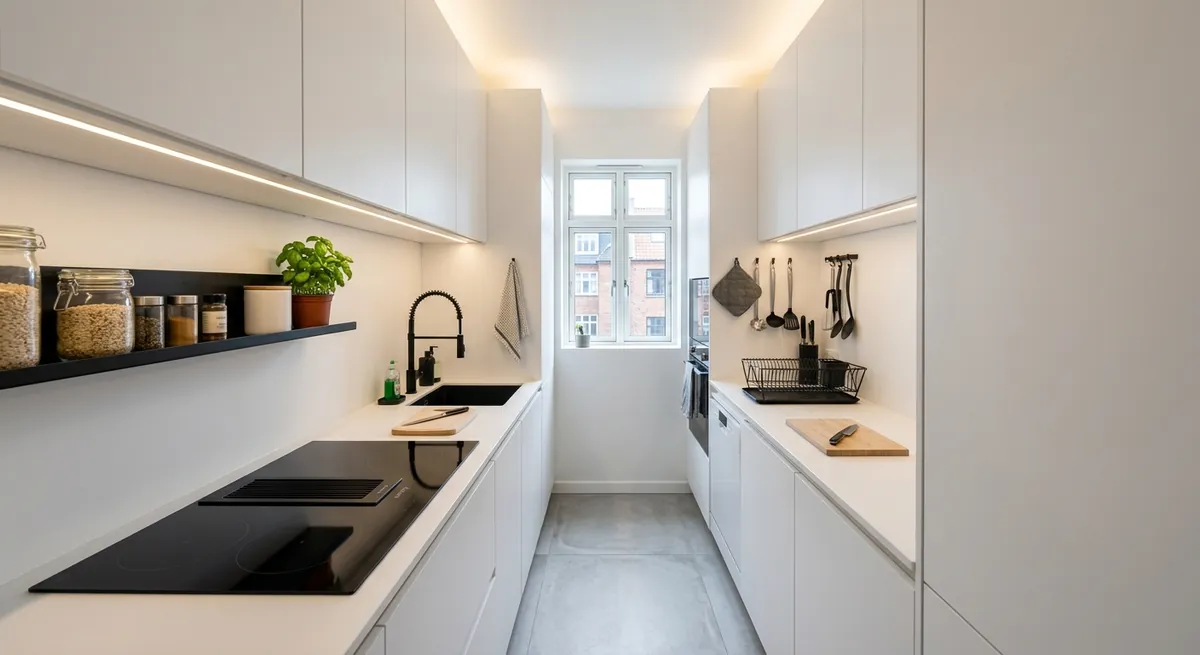
Result: maximum storage in a compact galley layout
Prompt 21: Mediterranean Kitchen With Arched Details
Professional photograph of a Mediterranean-style kitchen. Warm white plaster walls with arched alcove above the stove area. Handmade terracotta floor tiles in a herringbone pattern. Blue-grey painted wood cabinets with aged brass hardware. White marble countertop with natural veining. Open shelving in reclaimed wood displaying terra cotta cookware and olive oil bottles. Farmhouse sink in white fireclay. Wrought iron pendant light with linen shade. Fresh herbs in terracotta pots on the windowsill. Warm Mediterranean afternoon light. Rustic and welcoming.
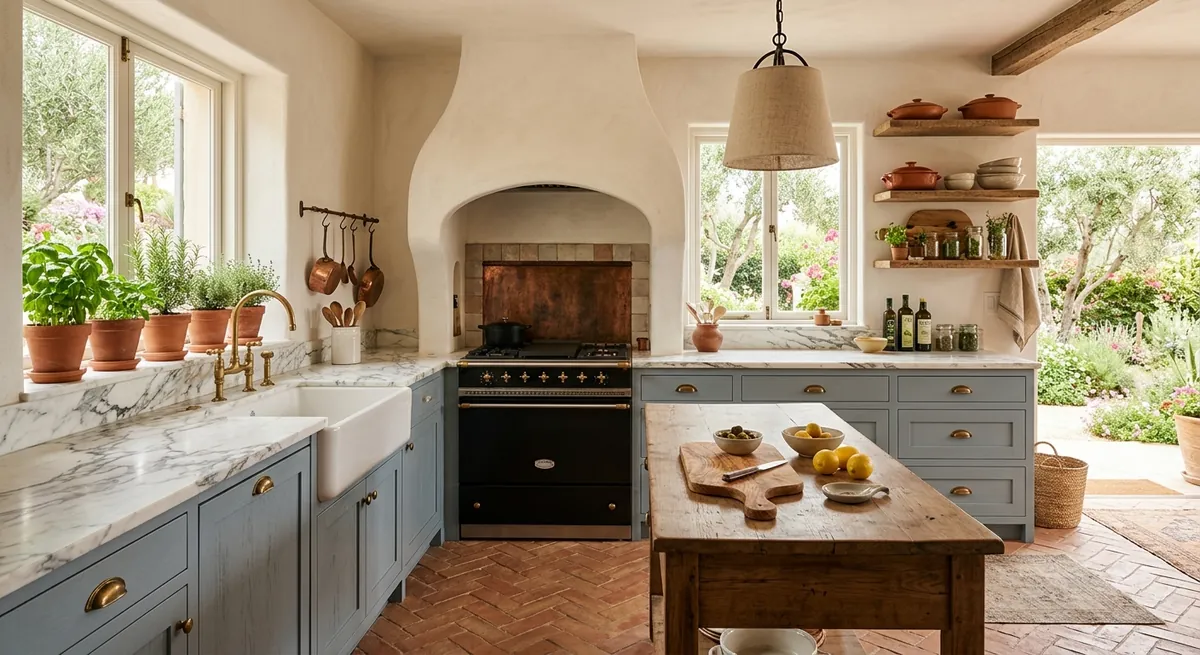
Result: Mediterranean warmth with terracotta and aged brass
Prompt 22: Kitchen Prompt Best Practices
Kitchen prompts fail most often because people forget to specify the layout. “Modern kitchen” can produce anything from a galley to an island kitchen. Always state the layout: galley, L-shaped, U-shaped, or island. Then specify counter material, cabinet style, and hardware. These three elements define 80% of the kitchen look.
Kitchen prompt template:
[Camera angle] photograph of a [layout type] kitchen. [Cabinet description: color, door style, hardware]. [Countertop material]. [Backsplash material and pattern]. [Island or dining detail if applicable]. [Appliance finish]. [Flooring]. [Lighting description]. [One styling detail: herbs, cookbook, fruit bowl]. [Mood word].
Nano Banana Bathroom Prompts (23 to 26)
Bathroom prompts benefit from specifying tile patterns, fixture finishes (matte black, brushed nickel, brushed gold), and whether the space is wet-room style or has a separate shower enclosure. Always mention the vanity style and mirror shape.
Prompt 23: Spa-Like Bathroom With Natural Stone
Interior photograph of a spa-inspired bathroom. Floor and walls in large-format warm travertine tiles with natural texture variation. Freestanding oval bathtub in matte white positioned under a large window. Floating double vanity in walnut with white undermount sinks. Two round mirrors in brushed gold frames above the vanity. Matte gold wall-mounted faucets. Glass-enclosed walk-in shower with rain showerhead. Eucalyptus branch in a tall ceramic vase on the vanity. Recessed warm lighting and one pendant. Folded white towels on an open walnut shelf. Soft diffused natural light. Spa-like and calming.
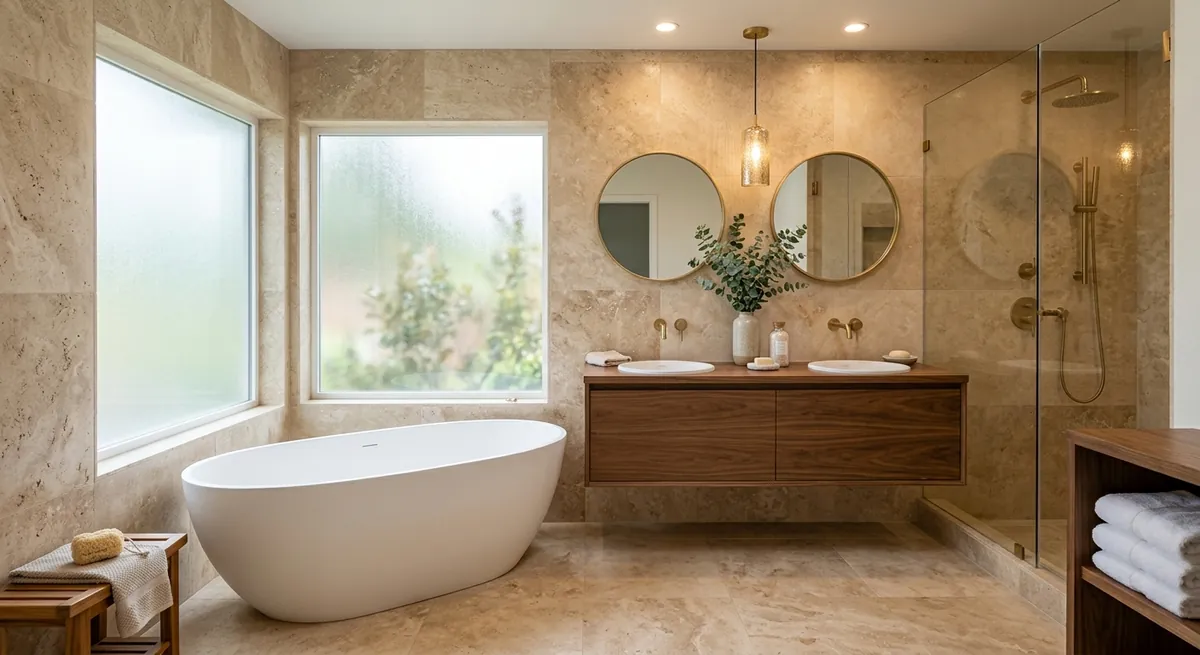
Result: spa luxury with natural stone and warm metals
Prompt 24: Modern Matte Black Bathroom
Wide-angle photograph of a modern bathroom with matte black fixtures. White walls with large-format white rectified tiles in the shower zone. Floating concrete vanity with integrated white basin. Large rectangular mirror with LED backlight strip. Matte black wall-mounted faucet, shower fixtures, and towel bar. Walk-in shower with frameless glass panel and matte black rain showerhead. Black hexagonal floor tiles transitioning to warm oak planks outside the wet zone. Small potted succulent on the vanity edge. Bright overhead LED in cool white. Crisp and architectural.
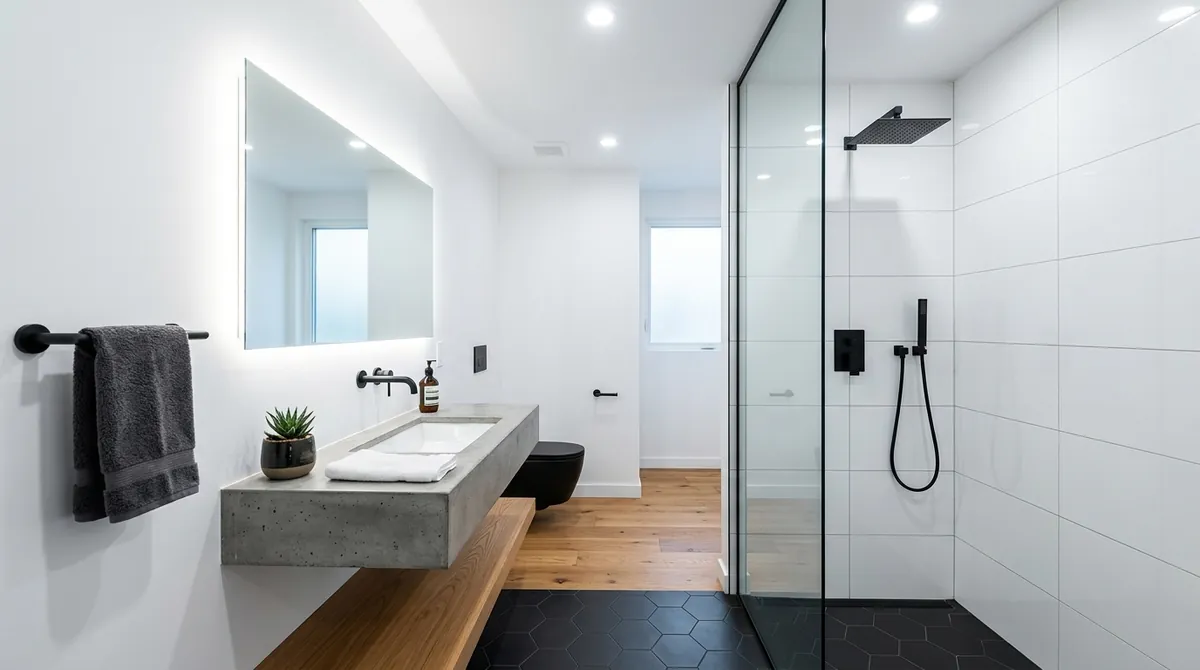
Result: matte black hardware against white surfaces for contrast
Prompt 25: Small Bathroom With Clever Layout
Interior photograph of a small bathroom, approximately 4 square meters. White metro tiles on all walls to ceiling height. Wall-hung toilet to create floor space. Narrow floating vanity in white with small round ceramic basin. Large round mirror making the space feel bigger. Compact walk-in shower behind a glass panel, no door. Chrome fixtures throughout. Recessed medicine cabinet behind the mirror for storage. White penny round floor tiles with grey grout. Overhead bright white light plus warm vanity light. Efficient and clean.
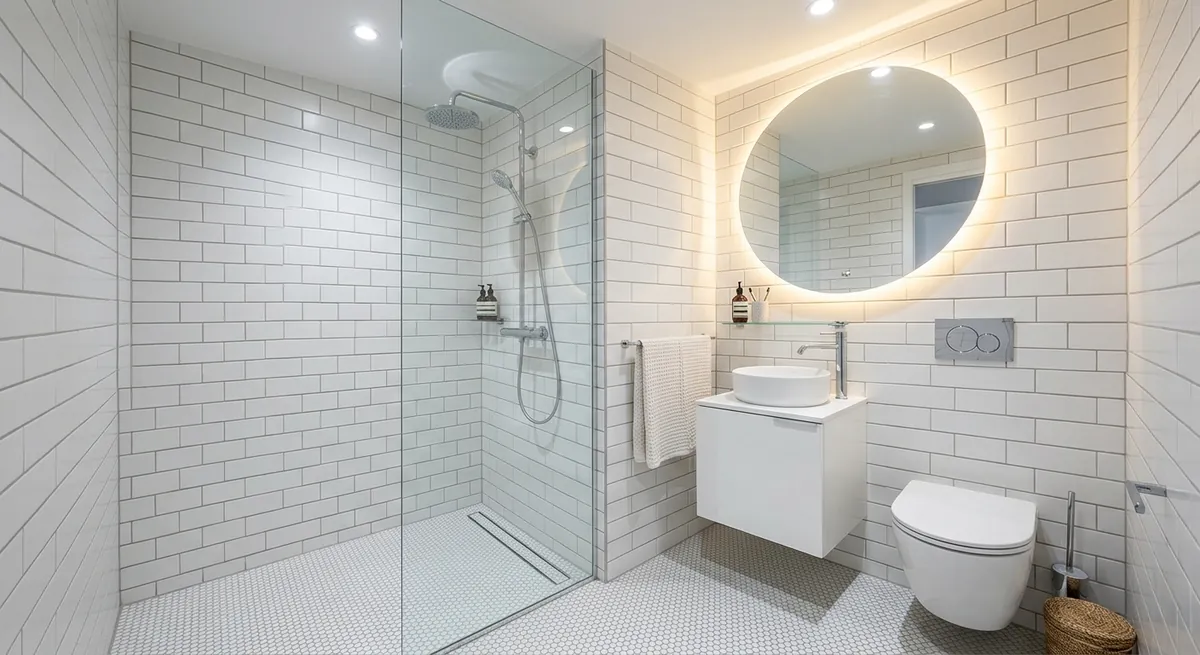
Result: clever use of every centimeter in a 4 sqm bathroom
Prompt 26: Coastal Bathroom With Blue Accents
Interior photograph of a coastal-inspired bathroom. White shiplap walls. Vanity in weathered light oak with a white marble countertop. Round rope-framed mirror. Blue and white handmade ceramic tiles as a feature wall behind the bathtub. Freestanding clawfoot tub in white. Brushed nickel fixtures. White and blue striped hand towels on a brushed nickel towel ladder. Woven sea grass basket with rolled towels. Whitewashed wide plank wood floors. Bright coastal light from a frosted window. Breezy and relaxed.
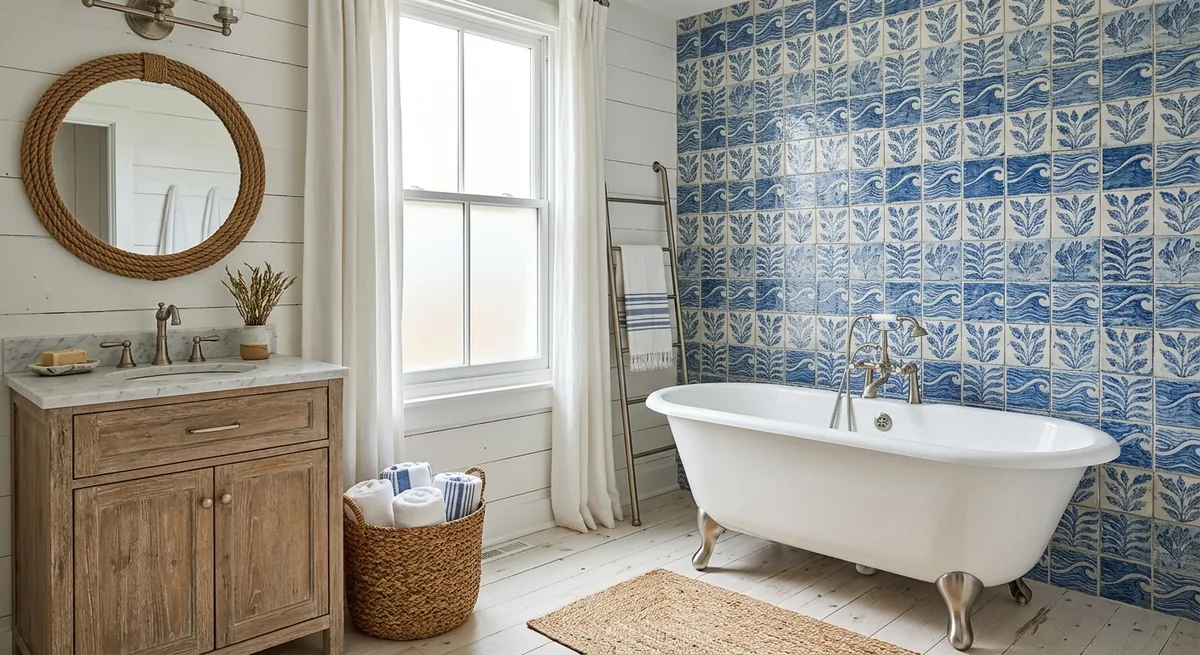
Result: coastal atmosphere with natural materials and blue accents
Nano Banana Home Office Prompts (27 to 29)
Home office prompts need to balance aesthetics with functionality. Always specify the desk type (floating, standing, L-shaped), chair style, and monitor setup. Lighting matters more in offices because it affects how the AI renders the screen and desk surface.
Prompt 27: Warm Professional Home Office
Interior photograph of a professional home office. Warm white walls. Large walnut desk with clean lines positioned facing a window. High-end ergonomic mesh chair in dark grey. Single ultrawide monitor on a walnut monitor stand. Wireless keyboard and mouse on a felt desk pad. Walnut bookshelf on the adjacent wall with neatly arranged books, one small plant, and a ceramic sculpture. Brass desk lamp with adjustable arm. Cork pinboard on the wall with minimal notes. Oak hardwood floor with a small wool rug under the desk. Natural light from the window plus warm desk lamp. Focused and sophisticated.
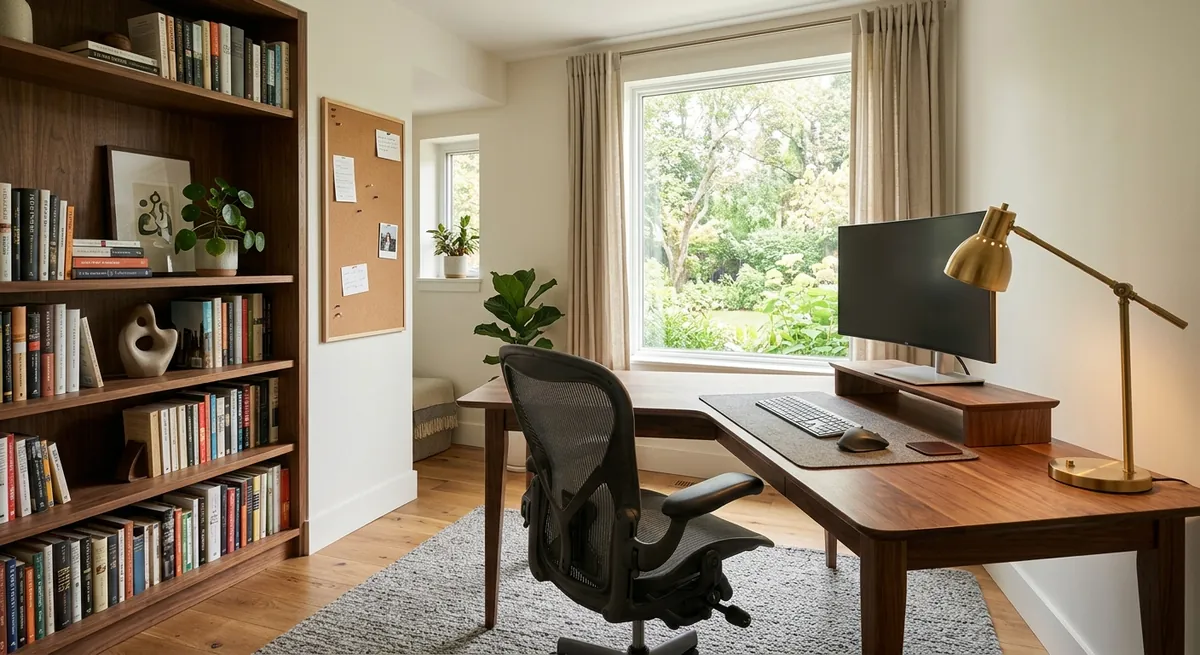
Result: professional workspace with warm residential feel
Prompt 28: Creative Studio With Inspiration Wall
Wide-angle photograph of a creative home studio. White walls with one accent wall covered in a grid of pinned mood board images, fabric swatches, and color cards. Large white desk with multiple monitors and a drawing tablet. Industrial-style adjustable stool with black metal frame and leather seat. Open metal shelving with material samples, books, and rolled prints. Task lighting with two adjustable brass arm lamps. Concrete floor with a colorful vintage rug. Indoor plant collection on the windowsill. Bright natural light from skylights. Creative and energizing.
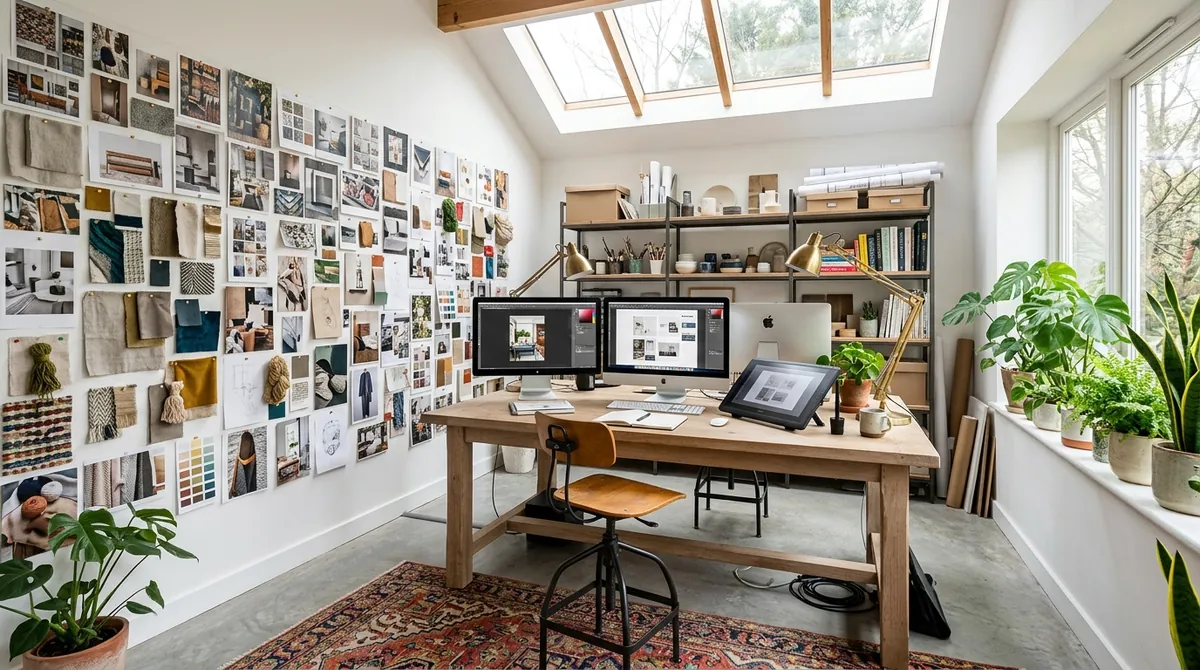
Result: creative studio with inspiration wall and natural light
Prompt 29: Dual Workspace for Two People
Interior photograph of a shared home office for two people. Warm grey walls. Long floating walnut desk spanning the full wall width with two separate workstations, each with a monitor and task lamp. Two matching ergonomic chairs in dark fabric. Shared walnut bookshelf centered on the wall above the desk. Small dividing element between workstations: a potted snake plant. Cable management tray hidden under the desk. Matching brass desk accessories. Light oak floors. Two pendant lights above each workstation. Soft natural light plus task lighting. Collaborative and organized.
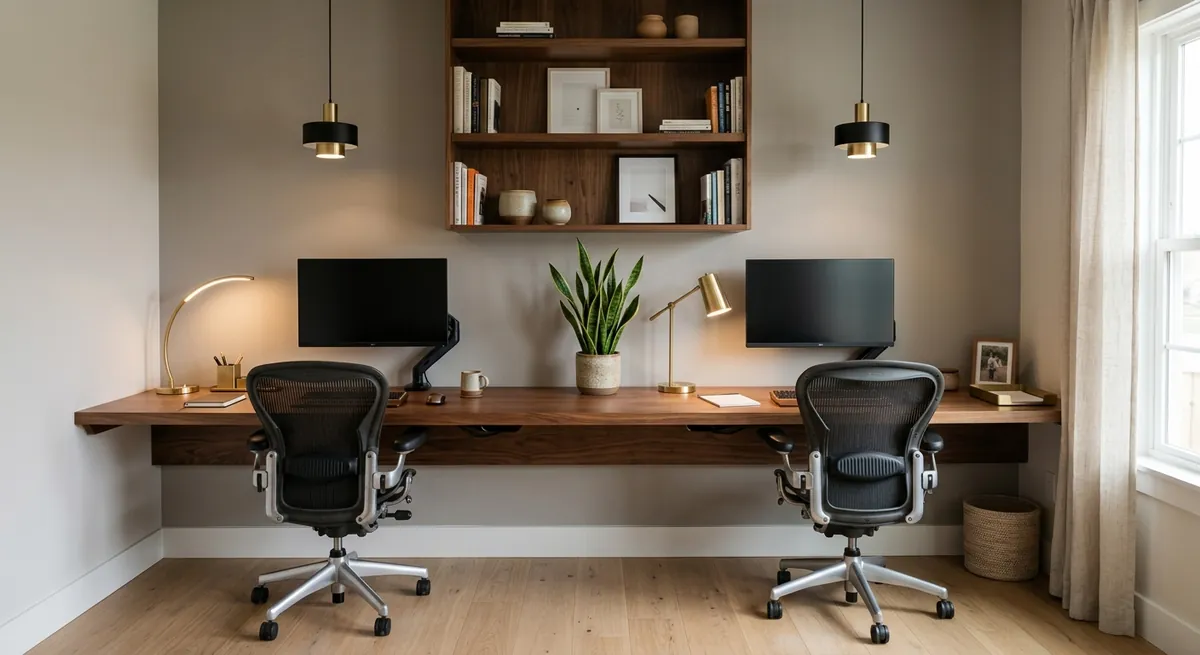
Result: symmetrical dual workspace with shared storage
Before and After Renovation Prompts (30 to 31)
These prompts are for interior designers and property developers who want to visualize how a space will look after renovation. The key principle: describe the finished room as if the construction never existed. Do not reference the construction in the prompt. Nano Banana generates from imagination, not from reality.
Prompt 30: Construction Room to Finished Living Room
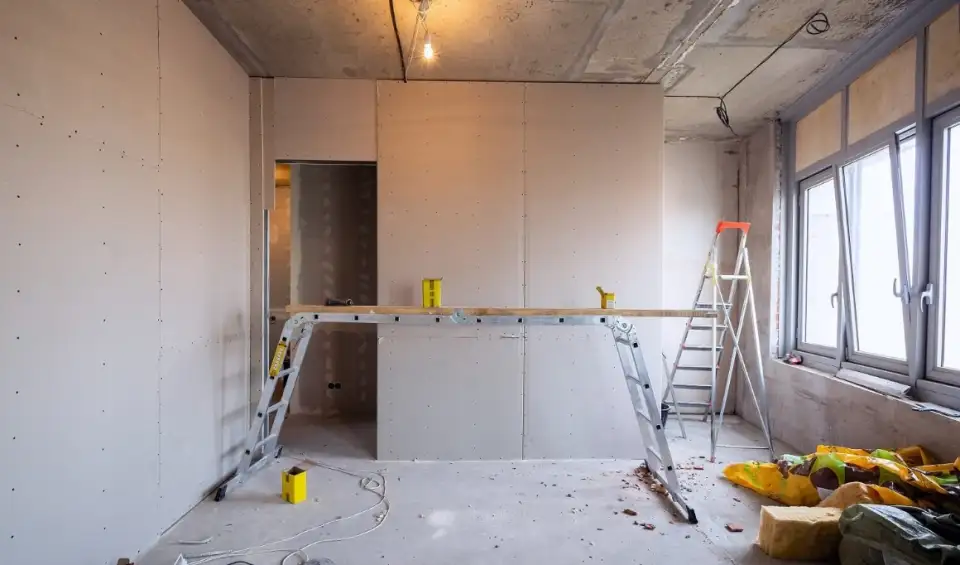
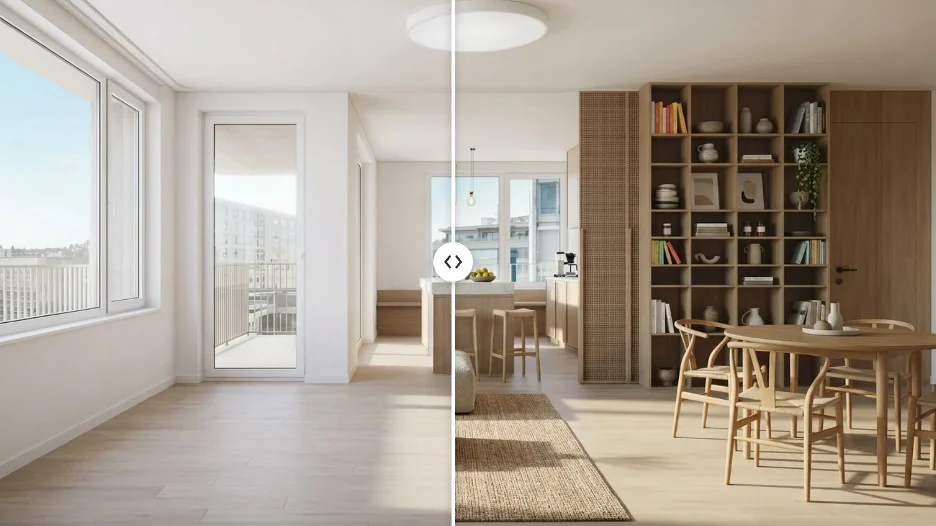
Starting point: a room during construction
Professional interior photograph of a newly renovated living room in a modern apartment. Freshly plastered walls in warm white. New oak hardwood flooring. Walnut TV console on the main wall with integrated cable management. Low-profile linen sofa in warm grey. Round oak coffee table. Indoor plants in ceramic pots. Recessed downlights and one pendant lamp. Floor-to-ceiling windows with new aluminum frames and sheer curtains. The room looks freshly completed, clean, modern, ready to live in. Warm and aspirational.
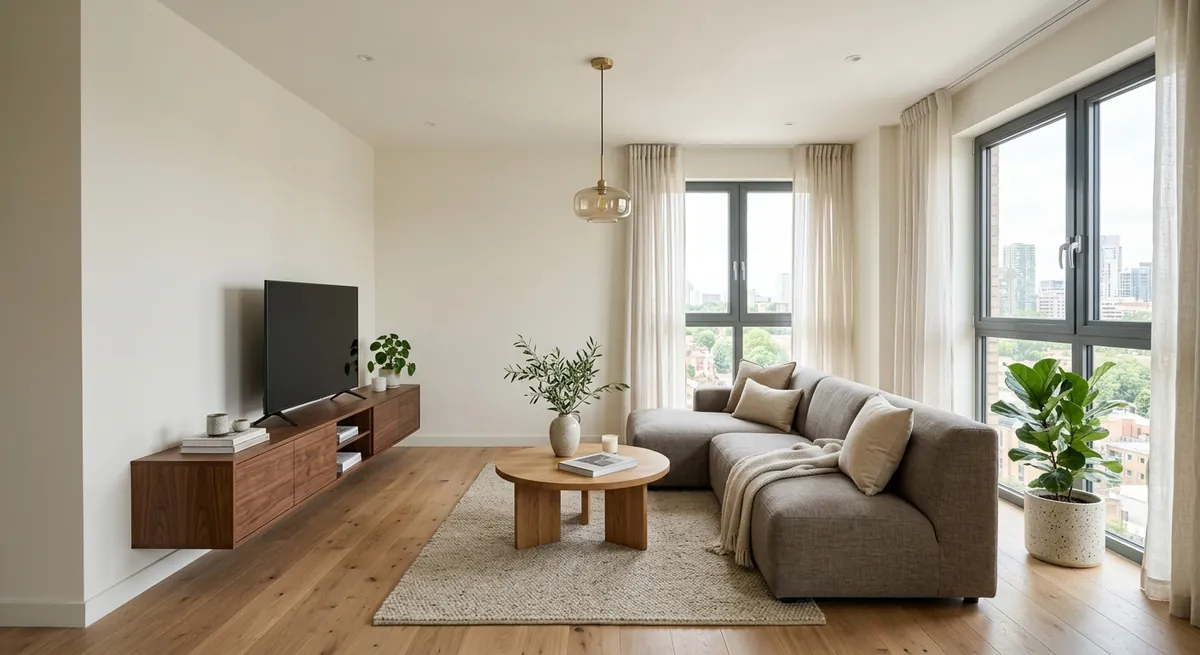
The same room imagined as a finished living space
Prompt 31: Empty Room to Furnished Bedroom
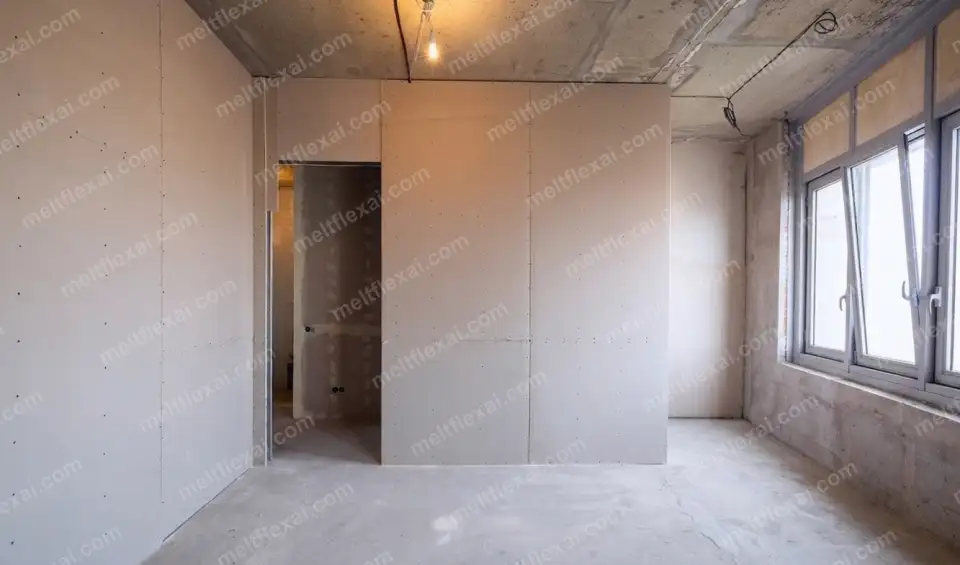
Starting point: empty room with finished walls, no furniture
Interior photograph of a fully furnished master bedroom in a modern apartment. Warm beige walls. King bed centered on the main wall with an upholstered linen headboard in warm grey. White linen bedding with a folded camel cashmere throw. Walnut bedside tables with ceramic lamps. Large round mirror above a low walnut dresser on the opposite wall. Built-in wardrobe with smooth white sliding doors. Sheer white curtains on large windows. Plush cream wool rug. Soft morning light. Peaceful and complete.
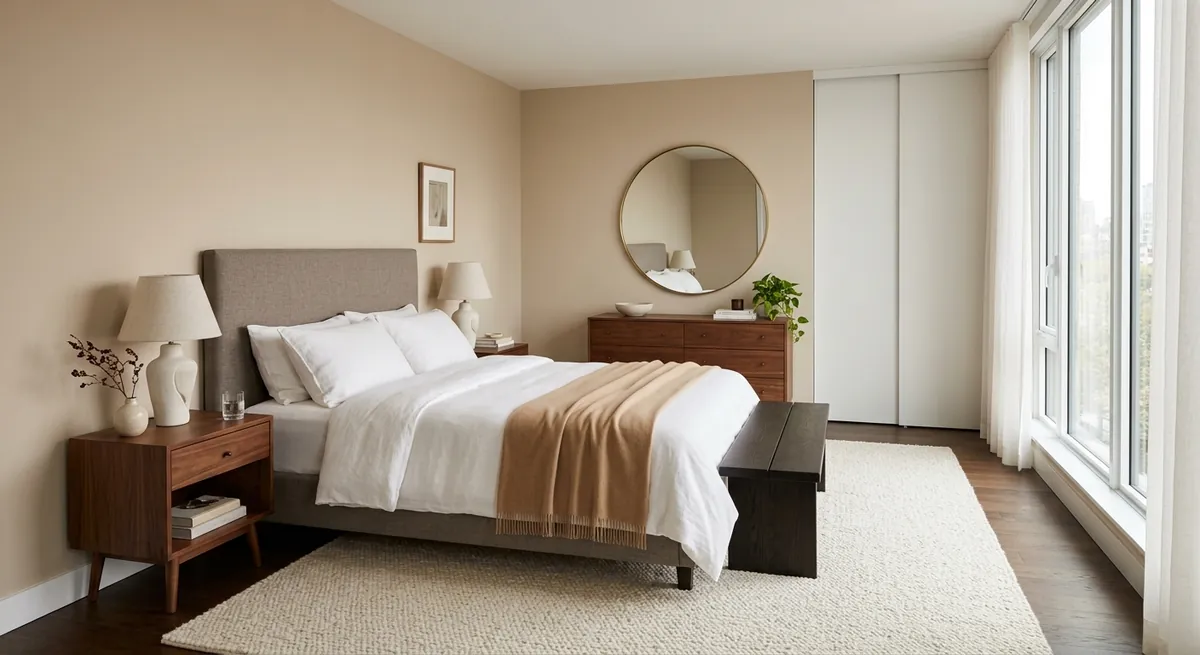
The same empty room imagined as a furnished master bedroom
Image-to-Image Prompts: Edit a Real Room Photo (32 to 40)
This is the part most guides skip, and it is the thing Nano Banana is actually famous for: you do not have to generate imaginary rooms. Upload a photo of a real room into Gemini, type an edit instruction, and the model changes what you asked for while keeping the rest of the photo. To prove it, prompts 32 to 36 all edit the same real photo: a lived-in family living room with scuffed walls, a laundry pile and toys everywhere. No staging, no cheating.
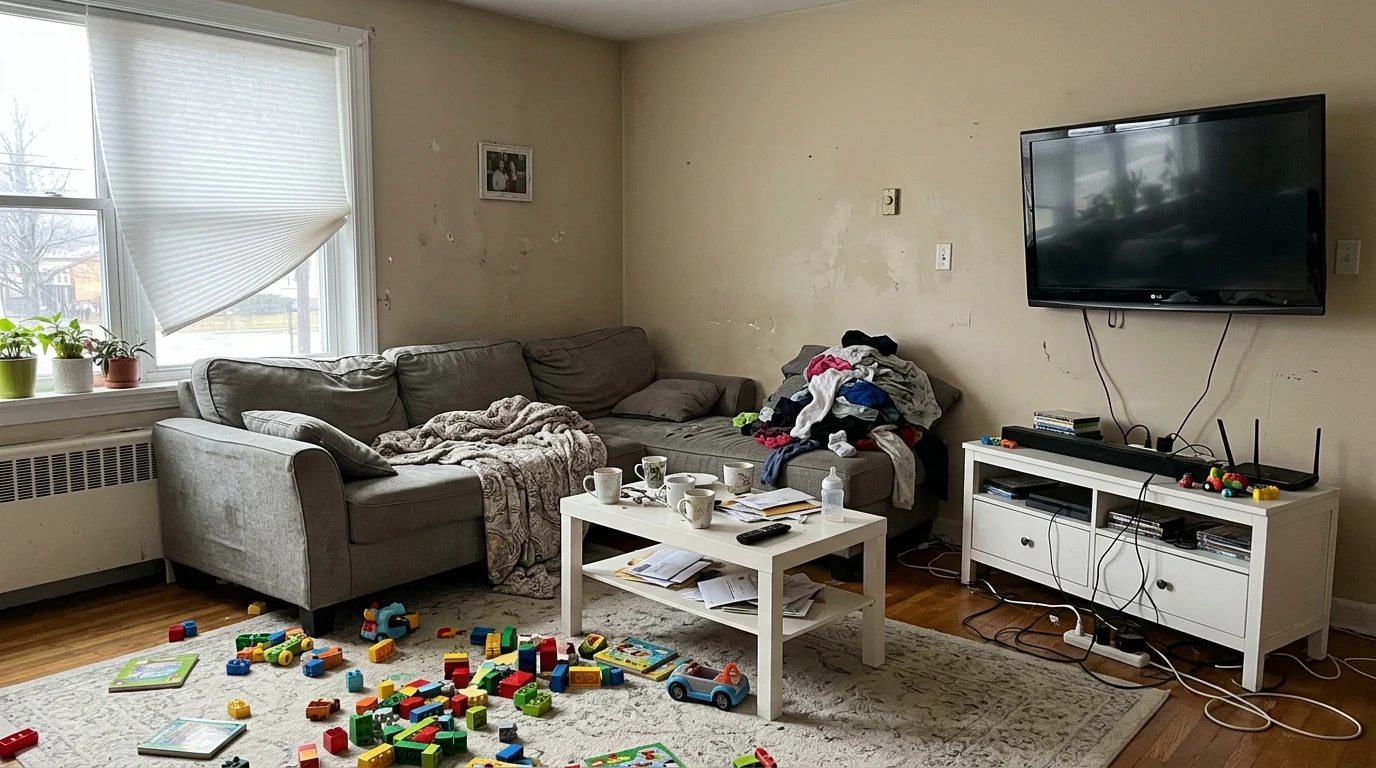
The starting photo for prompts 32 to 36: a real, cluttered living room
Image-to-image prompts follow a different formula than text-to-image. You are not describing a whole room; you are locking what stays and naming what changes. Three rules: (1) start by telling the model to keep the camera position, the room proportions, and the windows; (2) name only the changes you want; (3) if you want a partial edit, say “change ONLY” and then explicitly list what must stay. The prompts below show all three moves.
Prompt 32: Full Restyle, Same Room (Japandi)
This is a photo edit of the exact living room in the photo. Keep the camera position, the room proportions, the window on the left with the plants on the sill, the radiator below it, the wall-mounted TV position and the hardwood floor direction. Redesign it in warm Japandi style: low light-oak platform sofa with oatmeal linen cushions instead of the grey sectional, round light oak coffee table, oak media console under the TV, walls repaired and repainted warm white, jute rug, one ceramic floor vase with a dried branch, paper floor lamp in the corner. All the clutter, toys, laundry and cables gone. Photorealistic, natural daylight, no people, no text.
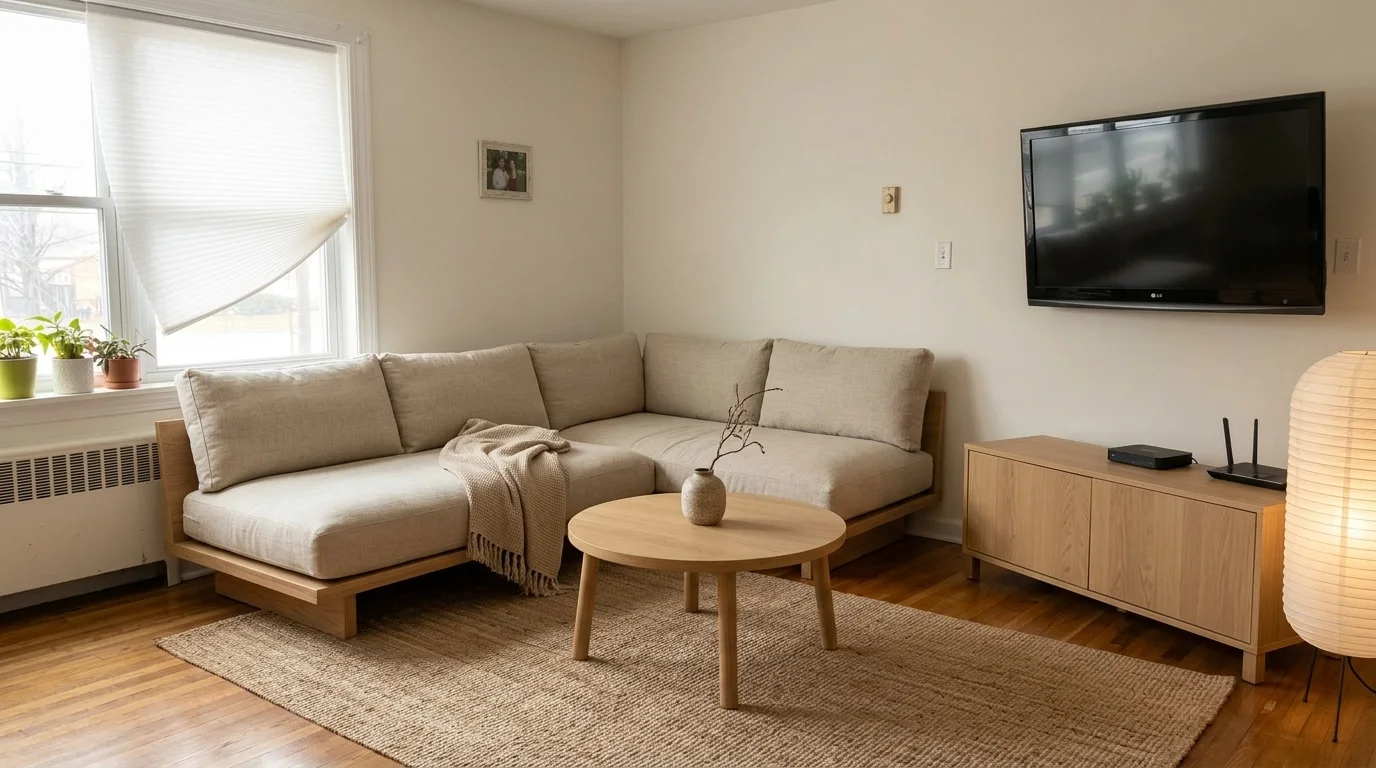
Result: full Japandi restyle, same window, same TV wall, same radiator
Prompt 33: Change Only the Wall Color
This is a photo edit of the exact living room in the photo. Change ONLY the walls: repaint every wall in muted sage green with a smooth, freshly painted matte finish, repairing all the scuffs and marks. Keep every piece of furniture, the sofa, the coffee table, the TV unit, the rug, the toys on the floor and all objects exactly as they are. Do not change the floor, ceiling, window or lighting.
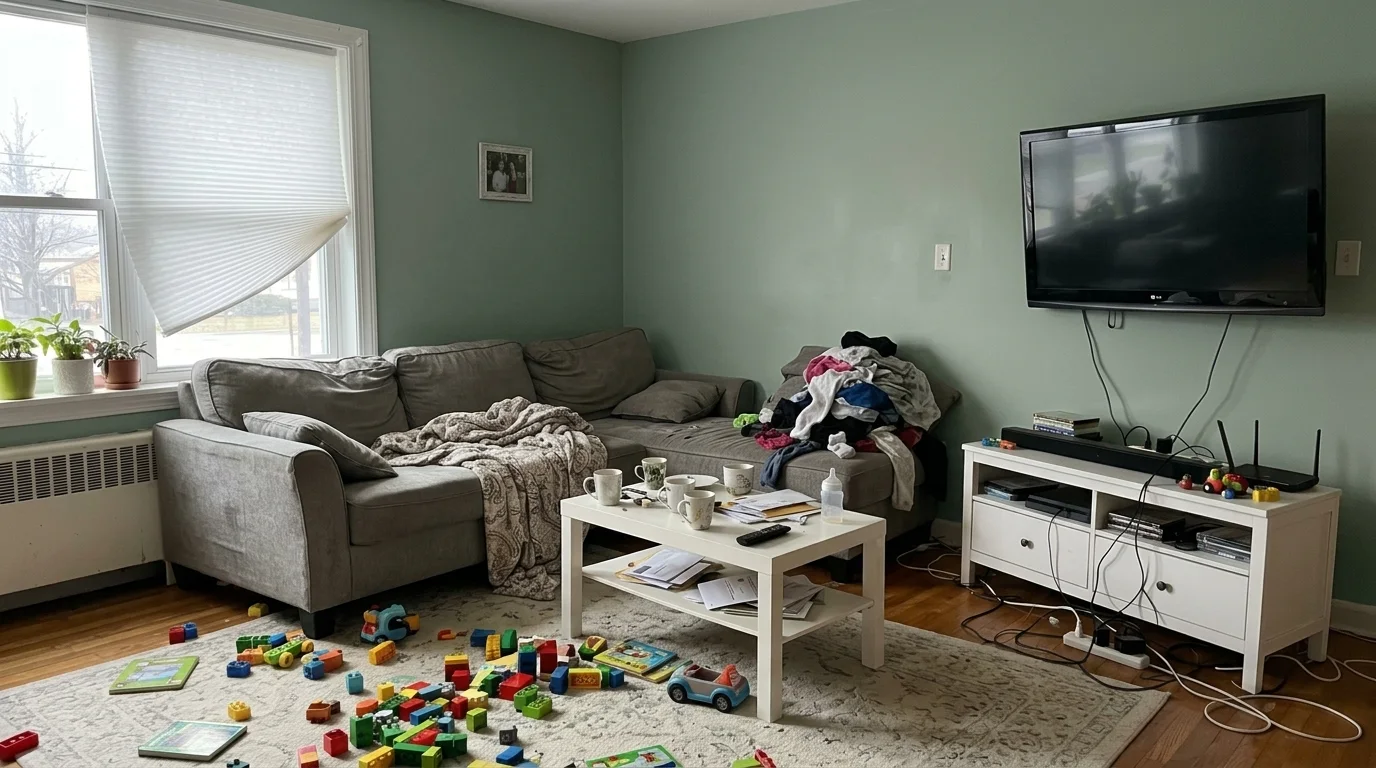
Result: sage green walls, and the model kept every toy and the laundry pile exactly in place
Prompt 34: Declutter and Stage for a Listing
This is a photo edit of the exact living room in the photo. Prepare it for a real estate listing photo: remove the laundry pile, the toys on the rug, the papers and mugs on the coffee table, and every loose cable. Keep the same sofa but neatly styled with two matching cushions and a folded throw, keep the same coffee table with a single small plant, keep the same TV and TV unit with nothing on top. Repair and repaint the scuffed walls in the same warm off-white. Everything else stays identical. Photorealistic, no people, no text.
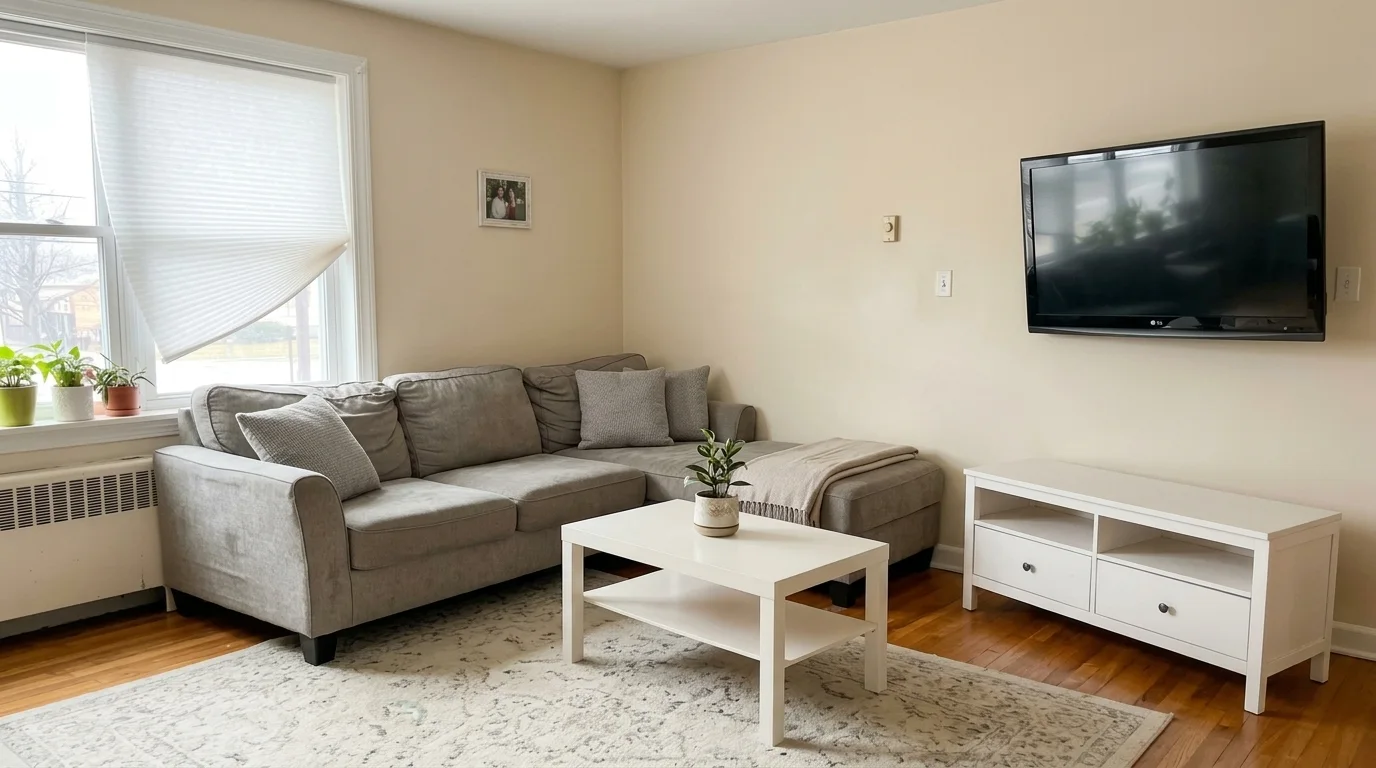
Result: listing-ready in one prompt, same furniture, clutter gone
Prompt 35: Swap One Piece of Furniture
This is a photo edit of the exact living room in the photo. Change ONLY the sofa: replace the grey fabric sectional with a cognac brown leather three-seat sofa with track arms and visible patina, positioned exactly where the sectional stands now. Keep the coffee table, the TV and TV unit, the rug, the wall colour and every other object exactly as they are.
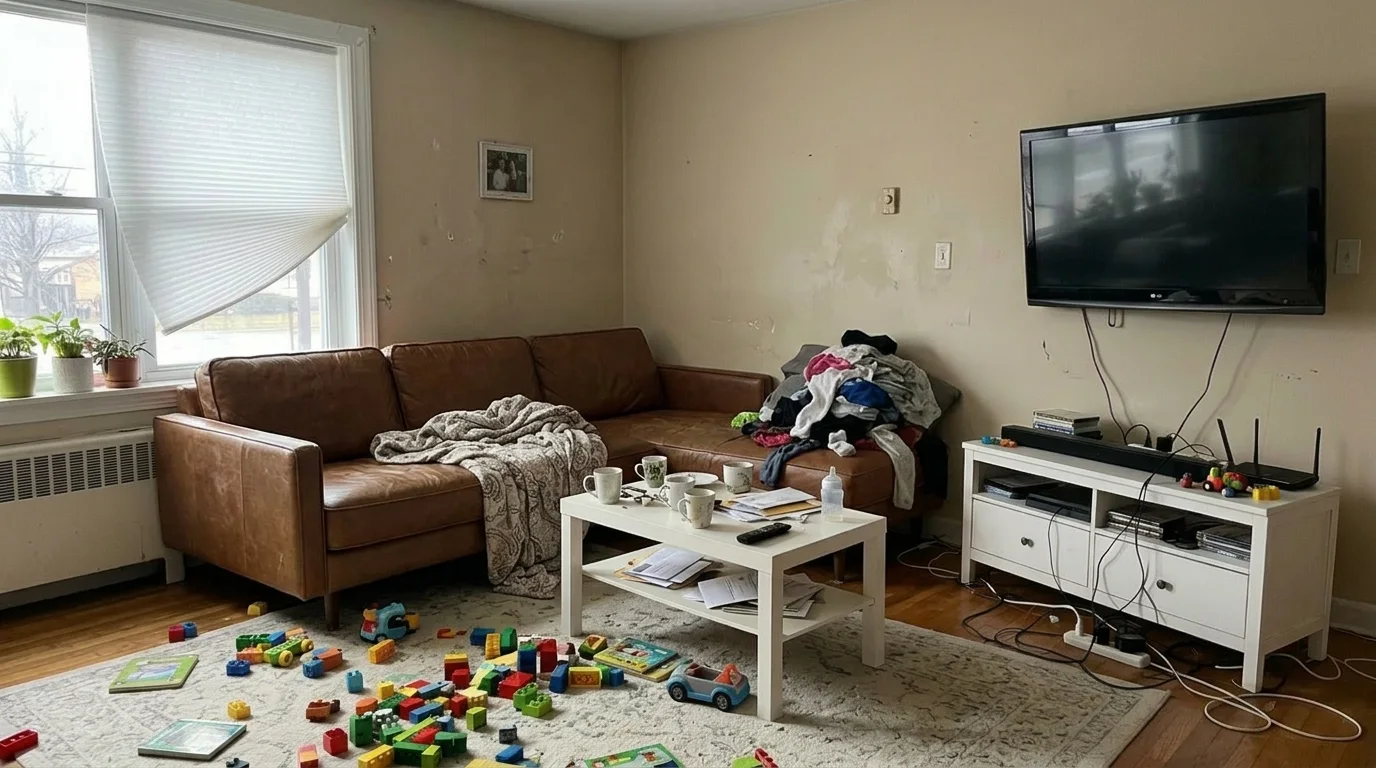
Result: one sofa swapped, everything else untouched, which is exactly how you audition furniture
Prompt 36: Change the Time of Day
This is a photo edit of the exact living room in the photo. Keep the furniture layout but tidy the room: clutter, toys and laundry gone, cables managed. Change the time of day to evening: the window shows dusk outside, the room is lit only by a warm brass floor lamp beside the sofa and a small table lamp on the TV unit, soft pools of warm 2700K light, gentle shadows, cosy and calm.
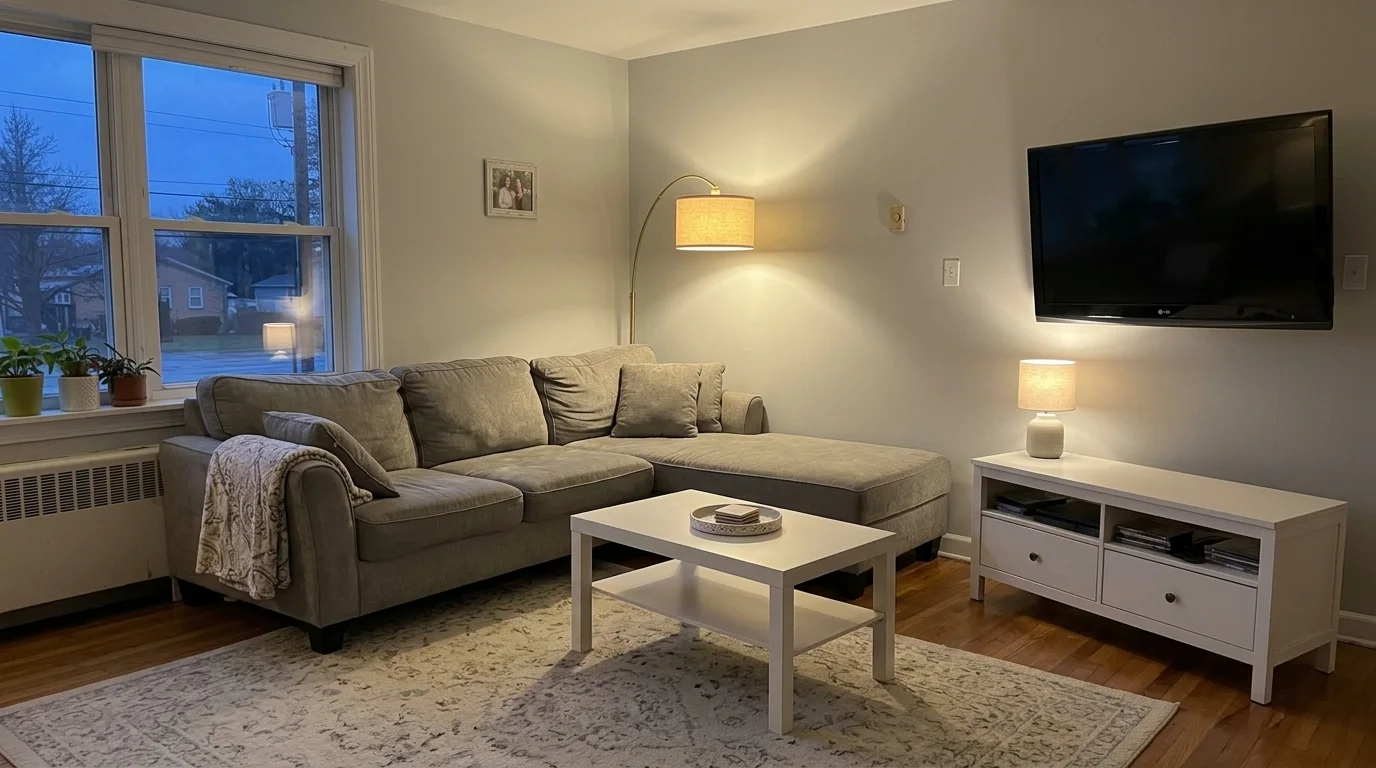
Result: same room at dusk, lit by two warm lamps the model added on request
Prompt 37: Virtually Stage an Empty Room
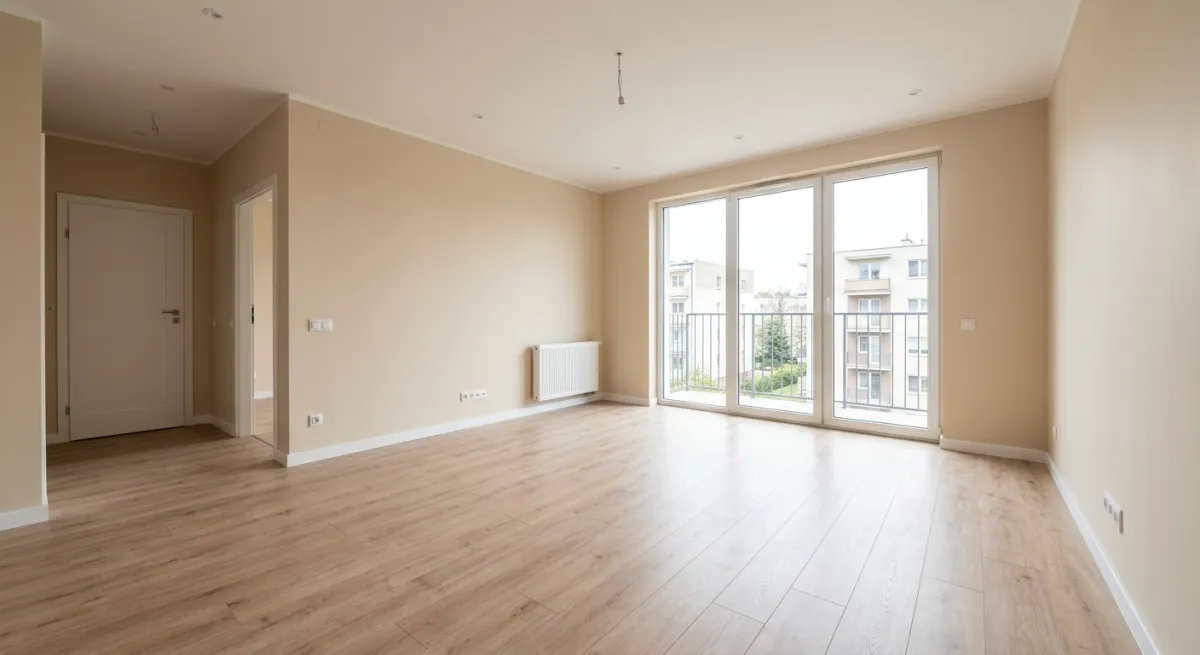
Starting point for prompt 37: a real empty apartment
This is a photo edit of the exact empty apartment room in the photo. Keep the camera position, the room proportions, the balcony doors and window wall, the radiator, the hallway on the left and the light oak floor. Virtually stage it as a Scandinavian living room: light grey linen three-seat sofa on a woven jute rug, round light oak coffee table, oak sideboard with a framed abstract print above it, floor lamp with a linen shade, one olive tree in a terracotta pot near the balcony doors, sheer white curtains. Furniture scaled correctly for the room. Photorealistic, no people, no text.
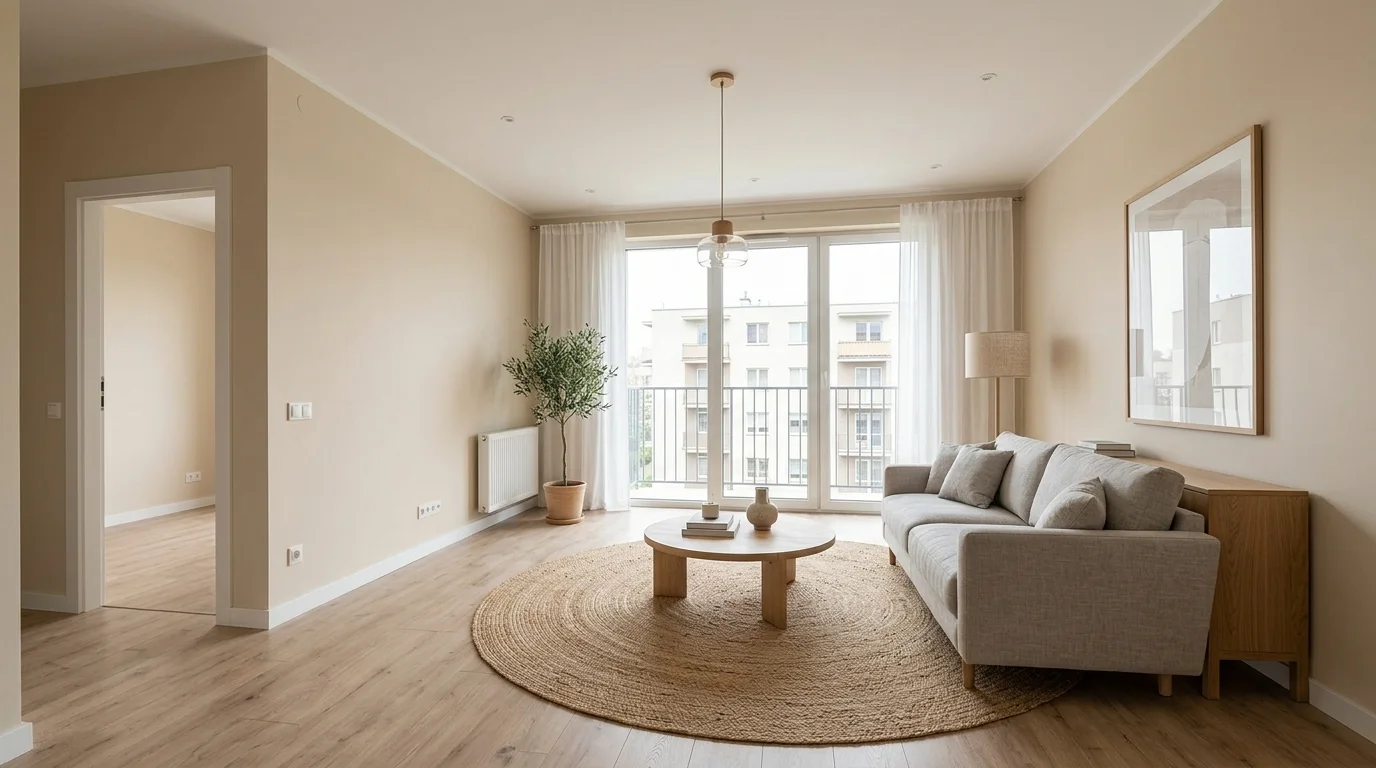
Result: the same apartment staged, with the balcony wall and radiator kept
One honest caveat before you stage listings this way: several US markets now require AI-staged photos to be disclosed. Our guide to virtual staging disclosure rules covers where and how.
Prompt 38: Change Only the Floor
This is a photo edit of the exact room in the photo. Change ONLY the floor: replace the current flooring with wide-plank European oak in a herringbone pattern, natural matte finish. Keep every piece of furniture in its exact position, the walls, the ceiling, the window and the lighting unchanged. The new floor must follow the same perspective as the original.
Prompt 39: Place a Specific Product in Your Room (Pro)
Image 1 is my living room. Image 2 is a sofa I am considering buying. Edit image 1: replace my current sofa with the exact sofa from image 2, same colour, same shape, same legs, scaled correctly for the space and positioned where my current sofa stands. Keep everything else in my room exactly as it is. Photorealistic, natural light.
This one needs Nano Banana Pro, which accepts multiple reference images in a single prompt. It is the closest a general image model gets to try-before-you-buy. If you want the same result with furniture that comes with a live price and a buy link, that workflow is native in MeltFlex, where reference pieces come from real IKEA, Wayfair and Amazon catalogs.
Prompt 40: Fix a Listing Photo Without Redesigning It
This is a photo edit of the exact room in the photo. Do not redesign anything and do not move or replace any furniture. Only correct the photography: straighten the vertical lines, brighten the exposure as if shot with proper HDR, recover the blown-out window so the view outside is visible, neutralize the yellow colour cast, and sharpen slightly. The room itself must remain completely truthful to the original.
Correction-only edits like this are the safe zone for real estate, because nothing about the property is misrepresented. The line between correcting and transforming, and why it matters legally, is the subject of our AI real estate photo editing guide.
Image-to-Image Prompt Template
This is a photo edit of the exact [room type] in the photo. Keep the camera position, the room proportions, [the windows / doors / built-ins that must not move]. Change [ONLY if partial] [the specific changes: furniture, wall colour, floor, lighting, styling]. Keep [everything that must stay] exactly as it is. Photorealistic, [lighting], no people, no text.
Weighing it against ByteDance’s model? Nano Banana Pro renders native 4K while Seedream 5.0 Pro caps at 2K, but Seedream is roughly half the price and edits more precisely. TheSeedream prompt library has the full comparison and 44 prompts including image-to-image restyling.
When to Use Nano Banana vs a Dedicated Room Tool
As the image-to-image section shows, Nano Banana absolutely can edit a photo of your real room, and for one-off edits it is excellent. The honest limits show up when you use it for an actual furnishing project: each edit is a fresh roll of the dice on geometry, so across a series of iterations walls drift, windows resize, and proportions wander. The furniture it invents is also generic: that beautiful oak sideboard does not exist in any store, so you cannot buy the room it just showed you.
Use Nano Banana when: you need concept inspiration, mood board imagery, style exploration, quick one-shot edits of a room photo, client presentation concepts, or social media content. It is the fastest way to go from an idea to a photorealistic image.
Use a dedicated room tool when: you are iterating on one real room and need the space to stay dimensionally truthful across every version, or when the design has to end in a shopping list. MeltFlex is built for that lane: it holds your exact dimensions, windows, and layout across redesigns and furnishes with real pieces from IKEA, Wayfair, and Amazon that you can actually buy.
8 Advanced Tips for Better Nano Banana Interior Prompts
1. Add negative instructions
Tell Nano Banana what you do NOT want: “No people, no text, no watermarks, no cluttered surfaces, no visible outlets or switches.” Negative instructions prevent the most common artifacts that ruin otherwise good interior renders.
2. Specify camera lens
“Shot on 24mm wide-angle lens” gives you a full room view. “Shot on 50mm lens” gives a tighter, more editorial composition. “Shot on 35mm lens at eye level” is the sweet spot for realistic interior photography. Specifying the lens dramatically improves composition quality.
3. Name real design references
“In the style of an Axel Vervoordt interior” or “similar to a Japandi room featured in Kinfolk magazine” gives Nano Banana a concrete visual target. Named references work better than abstract style descriptions because the model has seen those exact references in its training data.
4. Control lighting with time of day
“Soft morning light” produces cool, gentle illumination. “Golden hour afternoon light” produces warm, dramatic shadows. “Overcast diffused daylight” produces even, shadow-free lighting ideal for showing furniture details. Always specify the time of day rather than just saying “natural light.”
5. Use texture words for monochrome palettes
When your color palette is narrow (all beige, all cream, all white), the AI needs texture descriptors to create visual depth. Not “beige sofa” but “beige linen sofa.” Not “wooden table” but “live-edge walnut table.” Best texture words: linen, bouclé, wool, jute, travertine, limewash, brushed brass, matte ceramic, raw oak, woven rattan.
6. Iterate by changing one element at a time
Once you have a prompt that works, copy it and change only one element: the sofa color, the wall color, or the floor material. This produces a coherent series of design variations from a single prompt, exactly what clients want to see during a design presentation.
7. State room dimensions for small spaces
Adding “approximately 10 square meters” or “approximately 4 square meters” forces Nano Banana to generate appropriately scaled furniture and tighter compositions. Without this, the AI defaults to generous room sizes that do not match most real apartments.
8. Edit, do not regenerate
When a render is 90 percent right, do not reroll the whole prompt and hope. Send the image back as input with a single instruction: “Change ONLY the rug to a vintage kilim in rust tones, keep everything else identical.” Rerolling throws away the 90 percent you liked; editing keeps it. This is the same lock-and-change formula from the image-to-image section, applied to Nano Banana’s own output instead of a photo.
Common Questions About Nano Banana Prompts
What are the best Nano Banana prompts for architecture?
Architecture prompts follow a different formula than furnished rooms: they name the building type, viewpoint, cladding materials, and light instead of furniture and decor. We keep a dedicated library of 40 Nano Banana architecture prompts covering residential exteriors, facades, sketch-to-render workflows, aerials, and night shots, each with the real AI output shown. For keyword-style architectural renders, see our Midjourney architecture prompts too.
Can I use Nano Banana images in client presentations?
Yes, for concept presentations and mood exploration. Be transparent with clients that these are AI-generated concept images, not renders of their actual room. For presentations that need to show the client’s specific space, use a photo-based tool like MeltFlex that preserves room dimensions and shows real purchasable furniture.
How do I get consistent results across multiple prompts?
Copy your base prompt and change only the elements you want to vary. Keep the room type, camera angle, lighting, and flooring identical. Change only the wall color, sofa, or accessories. This produces a coherent design series where the client can compare options without getting distracted by compositional differences.
What resolution does Nano Banana generate?
The standard Nano Banana model outputs roughly 1K to 2K images, which is sufficient for screen display, client decks, and standard printing. Nano Banana Pro renders up to native 4K, which is the tier to use for large-format printing and portfolio work. If you are on the standard model and need more pixels, an AI upscaler after generation still works fine.
Which interior design styles does Nano Banana handle best?
Clean, well-defined styles produce the best results: Scandinavian, Japandi, mid-century modern, minimalist, industrial, and contemporary. Highly eclectic or maximalist styles are harder because they require the AI to manage many competing visual elements simultaneously. If you want maximalist results, be extremely specific about every object in the room.
Is Midjourney better than Nano Banana for interior design?
It depends on what you need. Nano Banana produces more photorealistic images with natural lighting, better for client presentations and realistic concepts. Midjourney produces more artistic and dramatic images, better for mood boards and creative exploration. Nano Banana is free, Midjourney starts at $10 per month. For most interior designers, Nano Banana is the better starting point because the output looks more like a real photograph than a render.
Can I generate exterior and garden designs with Nano Banana?
Yes. Use the same prompt formula but swap the room type: “Wide-angle photograph of a modern Mediterranean terrace...” or “Aerial view of a contemporary garden with...” Nano Banana handles architectural exteriors well, especially when you specify materials (stone, timber cladding, concrete render) and landscaping elements. For outdoor design prompts, read our AI garden design guide.
Start Using These Prompts
Copy any prompt above, paste it into Google Gemini, and generate your first interior design concept in seconds. For the image-to-image prompts, attach a photo of your room first, then paste the prompt. Adjust the materials, colors, and style descriptors to match your project.
When you are ready to move from concept to reality, redesigning your actual room with real furniture that fits your space, upload your room photo to MeltFlex’s free AI interior design tool. The AI preserves your exact room dimensions and shows you photorealistic redesigns with shoppable furniture from IKEA, Wayfair, and Amazon. Working on the outside of a building instead? The AI exterior design tool runs the same photo-in, render-out workflow on facades.
For more AI prompting guides, read our 40 Nano Banana architecture prompts, 40 ChatGPT Images 2.5 interior design prompts, 40 AI interior design prompts that work, Midjourney architecture prompts, 52 Gemini prompts for interior design, 50 ChatGPT prompts for interior design, and 13 AI house design prompts with real results.



)