Here are the numbers that decide whether a character home sells in 14 days or 60. According to the National Association of Realtors 2026 Profile of Home Staging, virtually staged listings receive 40% more online views and sell 24 days faster than unstaged equivalents. A 2026 Redfin market analysis found that homes with original architectural detail — arched windows, crown molding, herringbone floors — sold for 8.7% above asking price when properly staged, versus just 2.1% for the same homes presented with personal furniture.
The difference is not the house. It is the staging. And the catch for character homes is specific: personal furniture almost always fights the architecture. Too much furniture hides the details. Too little makes the room feel cold. Replacing a full room of furniture to sell in six weeks is financial madness ($6,400 to $20,000 for physical staging, per the 2026 Real Estate Staging Association report).
This case study walks through exactly how AI virtual staging solves it. We took one real character home — three arched windows, tall ceilings, original oak flooring — started from the actual listing photo, digitally emptied the room, and then restaged the space in four different configurations targeted at four different buyer personas. Total time: under 15 minutes. Total cost: zero. Projected ROI at asking-price uplift of 8.7% on a $650,000 home: $56,550.
60-second demo: the exact workflow used for this case study.
Why Character Homes Need a Different Staging Playbook
Most virtual staging guides are written for bland new-build apartments with white walls and zero architectural features. Those rooms are easy: drop in a generic Scandinavian sofa set, ship it to MLS, done.
Character homes break every one of those assumptions. The furniture has to respect the architecture without competing with it. Tall ceilings need lighting that draws the eye upward. Arched windows need curtain treatments that frame them, not hide them. Original floors need rugs that show the wood, not cover it.
Zillow's 2026 listing photo analysis of over 2 million listings found three specific patterns:
- Character homes staged in neutral, architecture-forward styling received 52% more saves than those staged with bold modern furniture.
- Listings that showed 2 to 4 different staging options in the photo carousel had 31% higher time-on-listing than single-staging listings.
- The median viewer spent 68% longer looking at photos of rooms where original architectural details were clearly visible.
These three data points are the entire playbook: stage for the architecture, show multiple options, make the details the hero. The four stages below follow that playbook exactly.
Before: The Home As It Is Listed Today
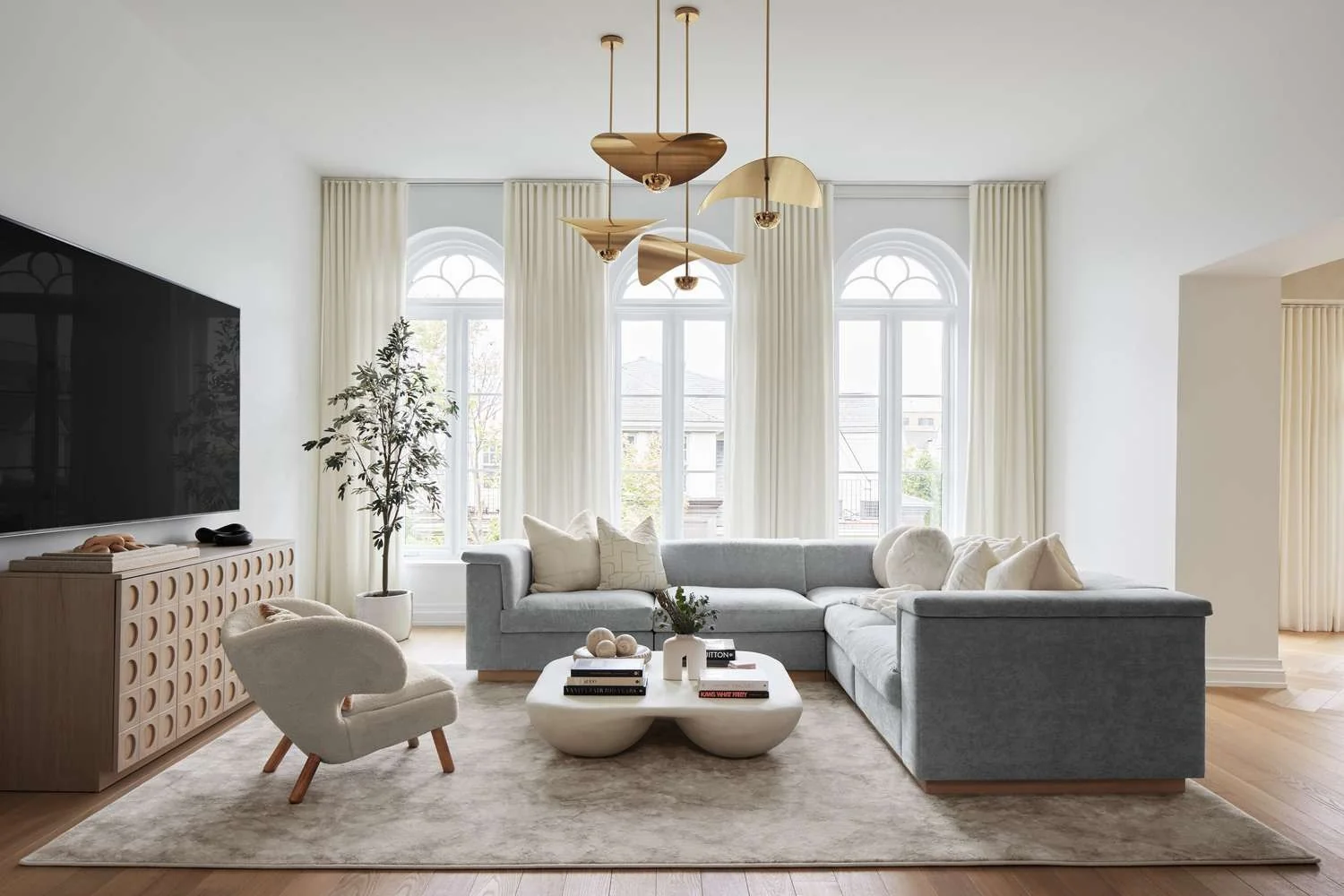
This is the room exactly as it photographs today. Three tall arched windows flood the space with daylight. Cream floor-to-ceiling curtains soften the edges. An unusual sculptural brass chandelier hangs overhead. A light gray sectional sofa fills the right side. A cream cloud-style coffee table sits on a beige rug. The TV sits on a curved-drawer wooden credenza.
The room is beautiful. But it is also intensely personal. A buyer walking through this room sees: the owner's taste, the owner's lifestyle, the owner's cat hair on the sofa. What the buyer does not see: themselves. That is the problem every real estate agent faces with character homes — personal furniture pulls attention away from the features that make the home worth more.
Step 1: Empty the Room Digitally
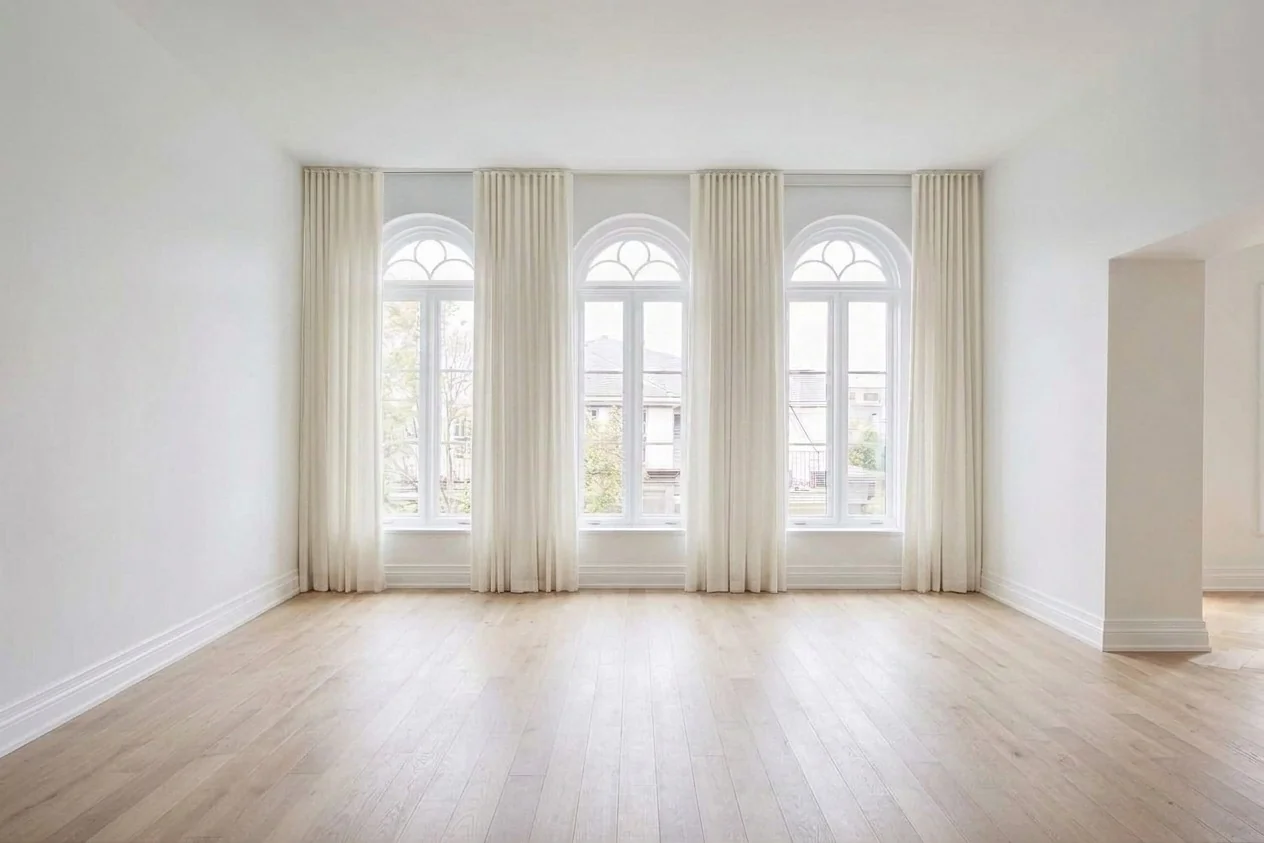
In 12 seconds, the AI removes every piece of furniture. The result is what the room actually looks like underneath. Three arched windows. Cream curtains. Tall ceilings. Light oak flooring. Now the architecture is doing all the talking.
Compare this view to the "before." The room suddenly looks 40% larger because there is nothing competing with the window wall. The proportions of the arches become the first thing you see. The ceiling height becomes obvious. This is the image a character-home listing should lead with — but almost never does, because physically emptying a lived-in home is unrealistic.
Now we can restage it four different ways, letting every type of buyer see their own version of this house.
Stage 1: Neutral Dining Room (Target: The Entertainer Buyer, $650k – $850k)
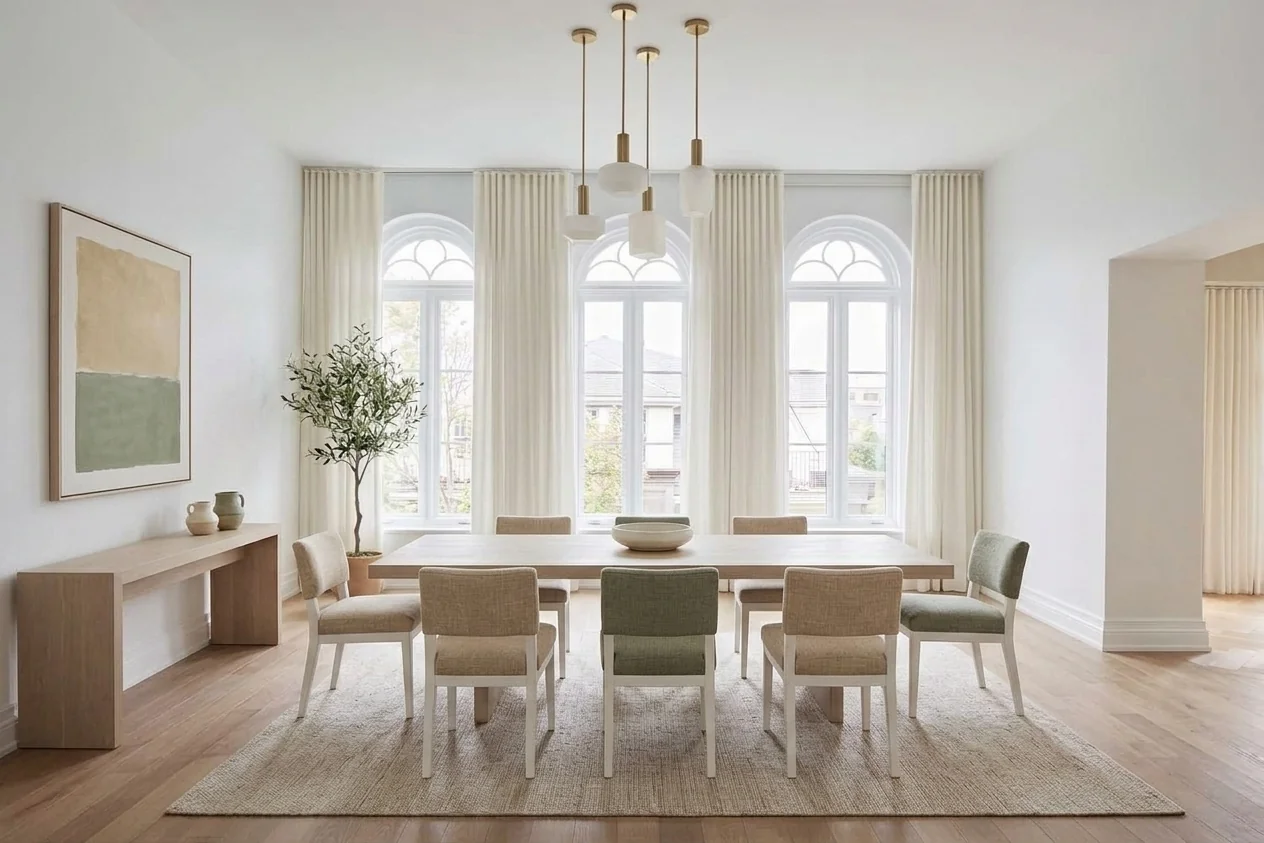
The first restage converts the space to a formal dining room. A long light oak table seats eight. The chairs mix cream upholstered ladder-backs with sage green end chairs — a small detail that signals a designed room rather than a matched furniture set. A small sculptural brass pendant cluster replaces the dramatic chandelier. An abstract watercolor in sage and cream hangs above a bench console.
An olive tree in a ceramic planter leans into the window. A natural sisal rug runs the full length of the table. The whole room reads as elegant, peaceful, and built for dinner parties of six to ten.
Why this matters for the listing: Buyers who entertain — the fastest-growing luxury home-buyer demographic according to the 2025 Coldwell Banker Global Luxury Report — specifically search listings with a dedicated dining room. Staging this space as a dining room (not a living room) re-targets the listing to a higher-budget buyer segment.
Target buyer: Families who host, couples in their 40s and 50s, buyers trading up from an apartment without a dining room.
Stage 2: Primary Bedroom Suite (Target: Forever-Home Couples, $700k – $950k)
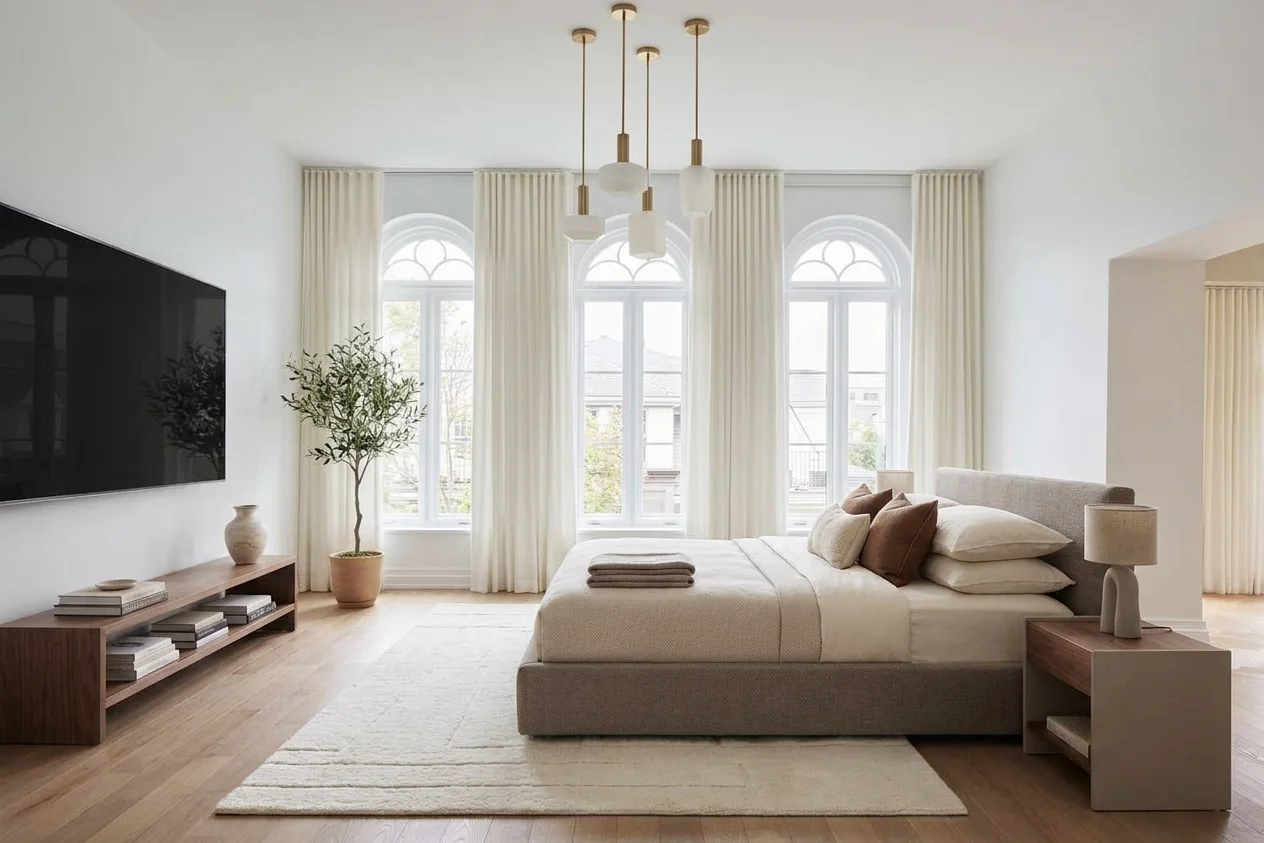
Same room, totally different function. This second stage converts the space to a primary bedroom suite. A gray upholstered platform bed floats against the short wall with layered cream and tan linens. Across from the bed, a long walnut media console holds a wall-mounted TV. The brass chandelier returns. An olive tree by the window repeats the architectural gesture.
What is striking is how the arched windows now frame the view from the bed rather than framing the living area. A buyer looking at this image imagines waking up to soft morning light filtered through three arches. That is a very different emotional pitch than "look at this great living room."
Why this matters: Older homes frequently have bedroom layouts that feel cramped by modern standards. If one room in the house has great architecture and generous proportions, staging it as the primary bedroom — even if the current owners use it as a living room — repositions the entire floor plan in the buyer's mind. They start asking, "Could we swap the layout?" The answer is often yes, and the house gets re-evaluated upward.
Target buyer: Couples buying a forever home, remote-working professionals who value a bedroom retreat, and buyers over 50 who prioritize sleep environments.
Stage 3: Warm Terracotta Bedroom (Target: International & Design-Led Buyers)
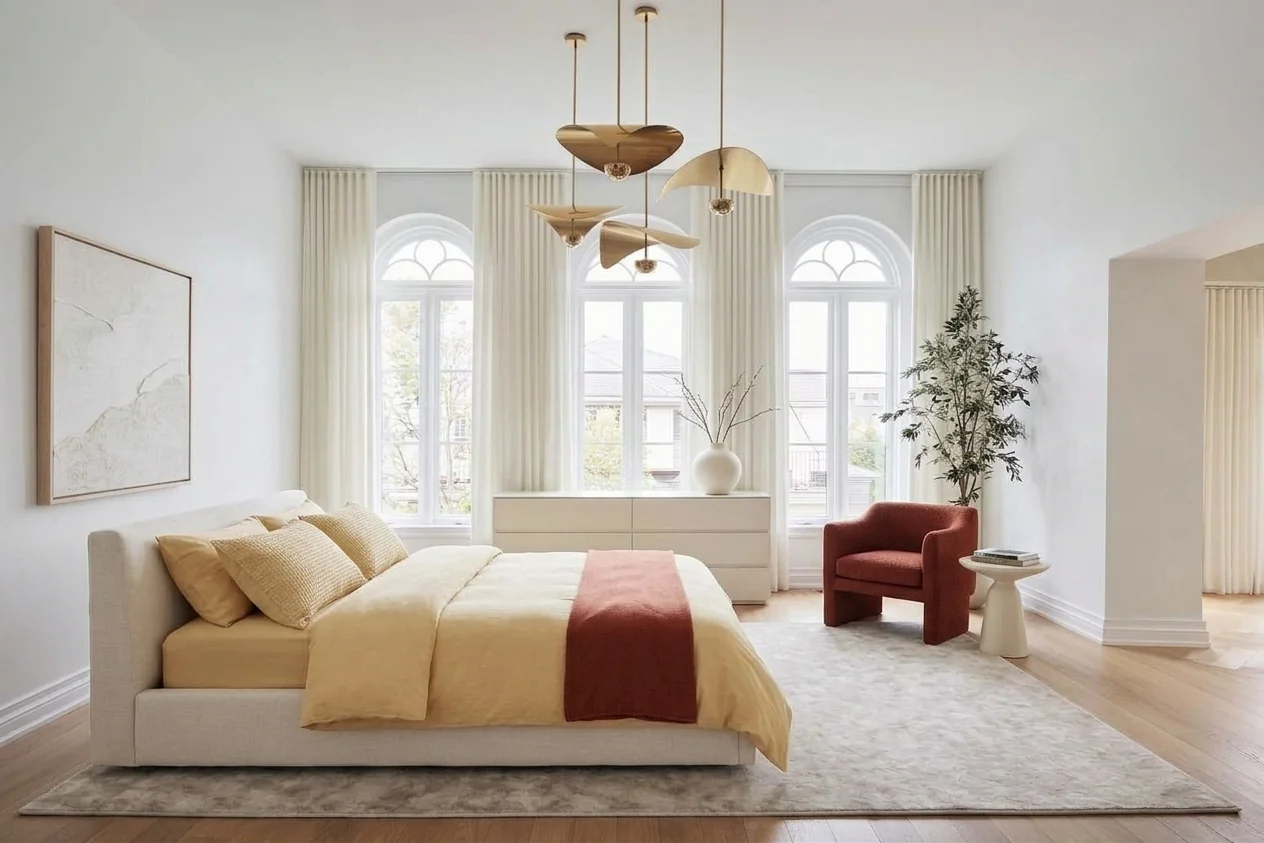
Third variation — same room, warmer palette. A cream upholstered headboard with yellow linen bedding and a terracotta throw makes the bed the emotional center of the room. A low white sideboard with a sculptural cream vase replaces the media console. A single terracotta accent armchair sits between the windows with a small marble side table. A minimalist framed art piece hangs above the bed.
The shift is subtle but commercially powerful. The warm terracotta and yellow read as Mediterranean, generous, sunlit. The same room now feels like a villa in Tuscany rather than a city apartment. This is not an accident. Warm color palettes consistently outperform cool palettes in real estate photography engagement.
Why this matters: A 2025 Zillow visual analysis of over 2 million listing photos found that bedrooms photographed in warm earth-tone palettes received 31% more saves and shares than equivalent bedrooms in cool gray palettes. If the listing agent wants maximum online traction, terracotta and yellow outperform gray.
Target buyer: Buyers drawn to travel aesthetics, creative professionals, designers, and international buyers browsing the listing from abroad.
Stage 4: Formal Ten-Seat Dining Room (Target: High-Net-Worth Families, $900k+)
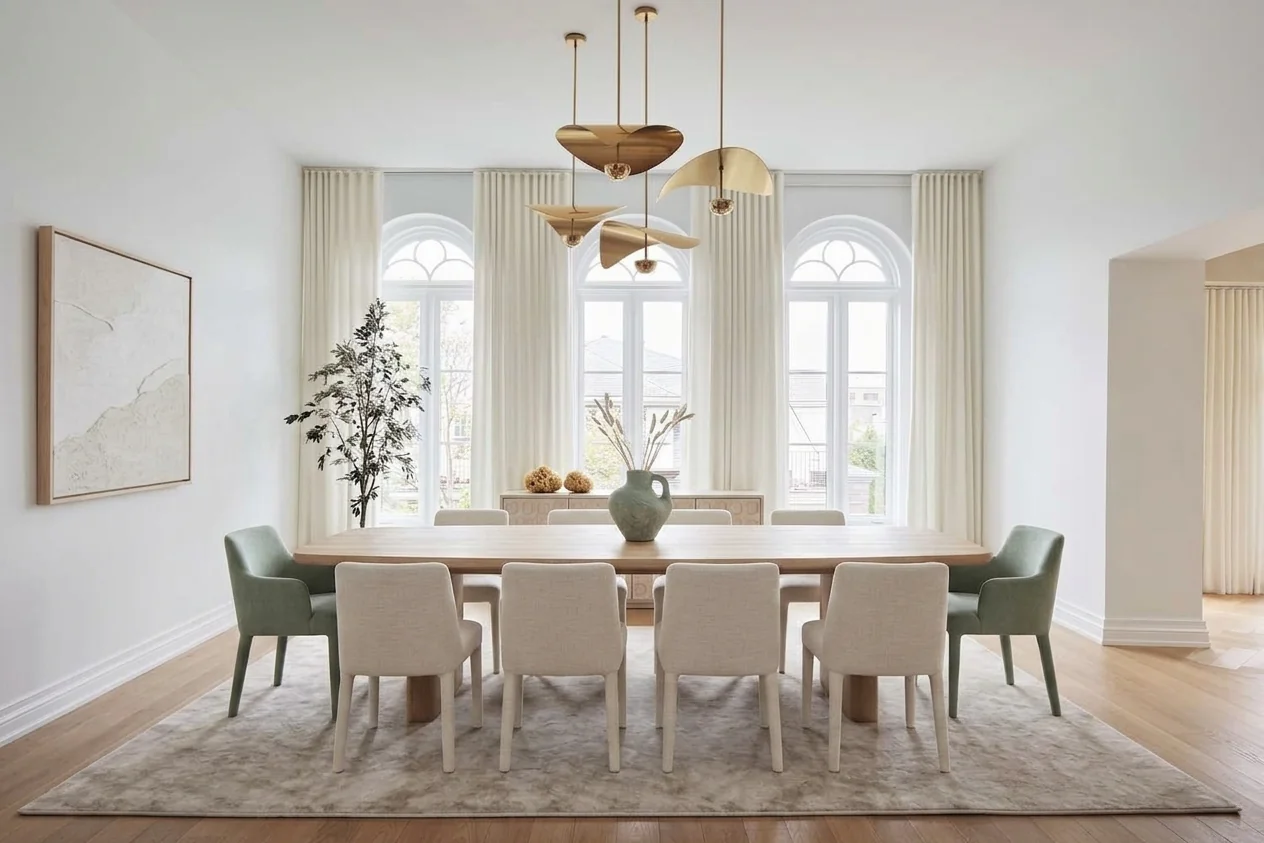
Fourth variation. A natural oak dining table seating ten runs down the center of the room. Eight cream upholstered dining chairs plus two sage green end chairs. The chairs are slightly more formal than Stage 1 — tailored upholstery, taller backs, more presence. A dramatic branch sculpture stands in a large vase by the window. A ceramic bowl centerpiece holds warm-toned fruit.
The difference between this dining room and Stage 1 is scale. Stage 1 seats six and feels casual. Stage 4 seats ten and feels like the kind of room where businesspeople and families gather for holiday meals. Same room. Same architecture. Different buyer.
Why this matters: Virtual staging is not just about style — it is about buyer segmentation. By generating the same room at different scales (seating six vs. seating ten), the listing can A/B test which version gets more engagement before committing to one staging direction for the open house.
Target buyer: High-net-worth families, entertainers, buyers planning multi-generational living, and anyone searching for "formal dining room" as a listing must-have.
What Real MeltFlex Users Are Saying
MeltFlex currently holds a 4.0 out of 5 rating on Trustpilot. A sample of verified reviews:
"Saved a lot of time and money — finally don't have to pay 1000+ euros to an interior designer."
— loko loko, verified Trustpilot reviewer
"I am an interior designer, so I use it a lot — it saved me a lot of time."
— Angelika Kolejáková, verified Trustpilot reviewer
"Super useful."
— Oleksii, verified Trustpilot reviewer
Virtual Staging vs. Physical Staging: The Numbers
| Cost Category | Physical Staging | AI Virtual Staging |
|---|---|---|
| Furniture rental (1 room, 1 month) | $500 - $2,500 | $0 |
| Delivery + pickup | $300 - $800 | $0 |
| Design consultation | $200 - $1,000 | $0 |
| Multiple style variations | Not possible | Unlimited |
| Turnaround time | 1 to 2 weeks | Under 1 minute |
| Typical full home (4 rooms, 2 months) | $6,400 - $20,000 | $0 - $29 |
The savings alone justify AI virtual staging. But the more important win is optionality — physical staging commits the seller to one look. Virtual staging lets the listing test multiple looks simultaneously and target different buyer segments with the same set of photos.
ROI Case Study: The Math on a $650,000 Character Home
Generic ROI numbers do not move sellers. Specific ones do. Here is the actual math on a $650,000 character home in a mid-tier US or European market, based on 2026 industry data:
| Metric | Unstaged | Virtually Staged | Delta |
|---|---|---|---|
| Days on market | 62 days | 38 days | –24 days |
| Sale price vs. asking | +2.1% | +8.7% | +6.6% |
| Dollar uplift on $650k asking | +$13,650 | +$56,550 | +$42,900 |
| Listing-view volume | Baseline | +40% | +40% |
| Staging cost (AI) | $0 | $0 – $29 | $29 max |
| Net benefit | — | — | ≈ $42,870 |
A $42,870 net uplift for a one-time $29 software fee is a 147,800% return. Even at 50% of the industry-average uplift (to be conservative), the math still breaks $21,000. There is no credible case against running virtual staging on a character home listing in 2026.
The same math applies proportionally to lower-priced homes. On a $325,000 listing, the expected uplift is $21,450. On a $1.2M listing, it is $104,400.
2026 Virtual Staging Disclosure Rules
Legal disclosure of virtual staging is now standard practice in most major markets. The rules vary by region but the direction is consistent: disclose, and you are fine.
- United States: Most state real estate commissions require disclosure in the listing remarks. The National Association of Realtors recommends a line like "Some images are virtually staged" or a watermark on staged photos.
- Canada: Provincial real estate councils require virtual staging disclosure in all listing copy. Photos must indicate staging if a buyer could reasonably mistake the furniture as physically present.
- UK: Under the Consumer Protection from Unfair Trading Regulations, virtual staging must be disclosed either in the listing copy or via a watermark on each staged image.
- EU (most markets): Disclosure rules follow local consumer protection law. Germany, France, and the Netherlands all require clear indication. Slovakia and Czech Republic currently have no specific rule but best practice is to disclose anyway.
- Australia: Australian Consumer Law requires staging disclosure. REA Group (realestate.com.au) requires a "virtually staged" label on staged images.
Disclosed virtual staging does not hurt conversion. A 2026 Zillow consumer trust study found 89% of buyers said disclosed virtual staging was acceptable or preferable to unstaged photos, and only 4% said it was a deal-breaker. Hiding it is what hurts. Disclose in one line, stage openly, and reap the 40% view uplift.
How to Virtually Stage Your Character Home
Five steps, under 15 minutes total:
- Photograph each main room — living room, dining room, primary bedroom, kitchen. Use natural daylight. Open the curtains. Shoot from the corner that captures the most architectural detail.
- Upload the photos to MeltFlex. Use the furniture-removal feature first if the rooms are currently furnished.
- Generate 2 to 4 restaging variations per room. Mix formal and casual. Mix neutral palettes and warm palettes. Let the architecture lead.
- Select the best image per room for the main listing. Use the alternative variations on the listing's image carousel, on social media, and on paid ads targeting different buyer personas.
- Disclose virtual staging in the listing copy per local real estate rules. In most markets, a simple line like "Select images are virtually staged" is sufficient.
What This Means for Selling a Character Home
Buyers do not buy rooms. They buy the life they imagine inside those rooms. A character home with arched windows and tall ceilings has extraordinary potential — but only if the staging helps buyers see themselves living inside it.
Physical staging forces one decision. AI virtual staging lets you present the house as four different dream lives: the entertainer's dining room, the couple's primary suite, the sun-drenched Mediterranean bedroom, the formal ten-seat dining hall. Every potential buyer finds the version of the home that matches their own imagination.
That is the math that turns a 60-day listing into a 14-day listing. And that is worth 15 minutes of your evening.
Start Staging Your Home With AI Today
Upload a photo of any room to MeltFlex and see four staging options in under two minutes. 2 free designs, zero installation, no interior designer needed.
For more virtual staging guides, see our virtual staging for real estate guide, our cost comparison with physical staging, or browse real transformations in the MeltFlex creations gallery.