How to Design a Nursery That Grows With Your Child: AI Room Design From Newborn to Toddler
Designing a nursery is one of the most exciting — and stressful — parts of preparing for a baby. You are building a room that needs to be safe, functional, beautiful, and flexible enough to grow with your child for the next 3 to 5 years. The average family spends $3,200 on nursery furniture and decor (What to Expect, 2025), and most of those purchases are made based on catalog photos that show someone else's room, not yours.
Here is the problem: your room is not the one in the catalog. It has different dimensions, different light, different wall colors, different floor tones. That adorable crib that looked perfect on Pinterest might overwhelm your 10 square meter spare bedroom. That mountain mural might clash with your warm oak floors. You do not know until the furniture arrives and the paint dries.
Unless you can see it first. AI room design lets you upload a photo of your actual empty room and generate photorealistic nursery designs in seconds. Not generic mockups — your room, your walls, your floors, with real furniture and real decor placed in realistic proportions.
To show you what is possible, we took one empty room and created 7 different nursery and toddler room designs — covering different stages (newborn, infant, toddler), different styles (nature, Japandi, modern), and even a twin nursery layout. Total time: under 4 minutes. Total cost: $0.
The Starting Point: An Empty Room
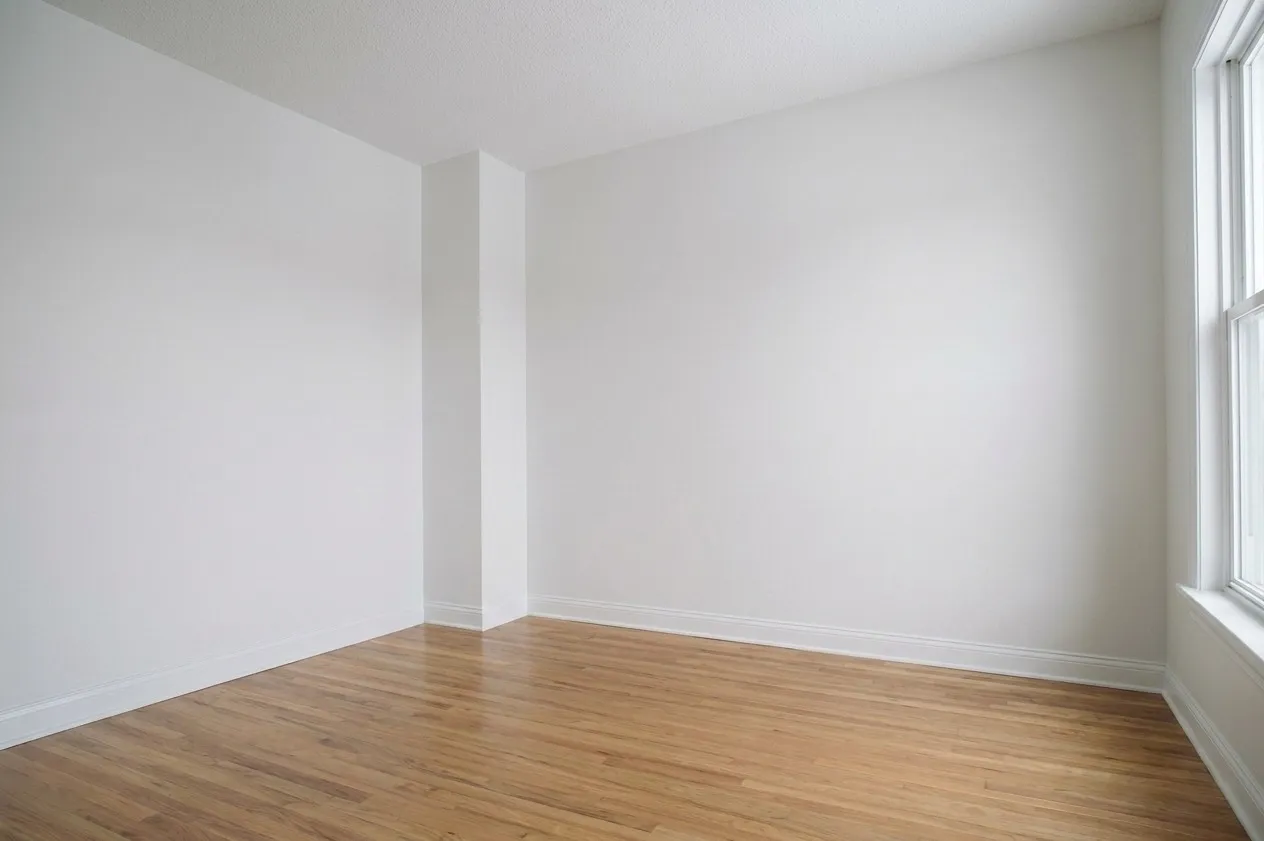
Every nursery starts here. An empty room with light hardwood floors, white walls, and a window bringing in natural light. This is a typical spare bedroom — roughly 12 square meters — the kind of room millions of expecting parents are staring at right now, trying to imagine what it could become.
The room has good bones: enough space for a crib, dresser, and chair. Natural light from the window. Neutral walls that work with any color scheme. But right now, it is just potential. Let us turn it into something real.
Stage 1: Simple Twin Nursery for Newborns
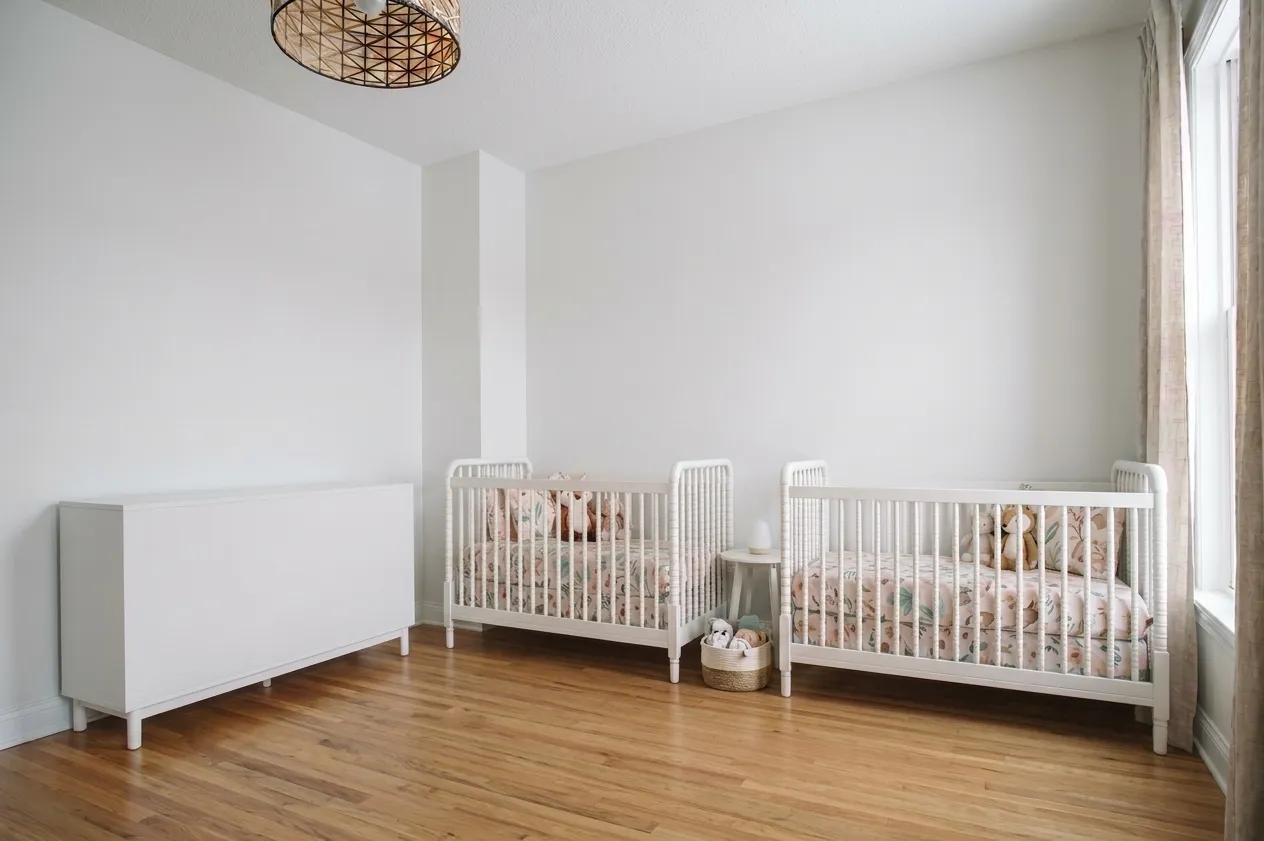
The first design keeps it simple. Two white cribs positioned along the back wall with a small side table between them. A white dresser on the left doubles as a changing station. A rattan pendant light adds warmth overhead. Natural linen curtains soften the window.
This is newborn-ready minimalism — only the essentials, nothing extra. And there is a reason for that. The American Academy of Pediatrics recommends keeping the nursery as clutter-free as possible for the first 12 months. Fewer items in the crib area means fewer safety risks. A simple nursery is not just an aesthetic choice, it is the safest choice.
Estimated cost: $800 to $1,400 for two cribs, a dresser, pendant light, and curtains. This is the most budget-friendly setup that still looks intentional and designed.
Stage 2: The Nature-Themed Nursery (The Statement Design)

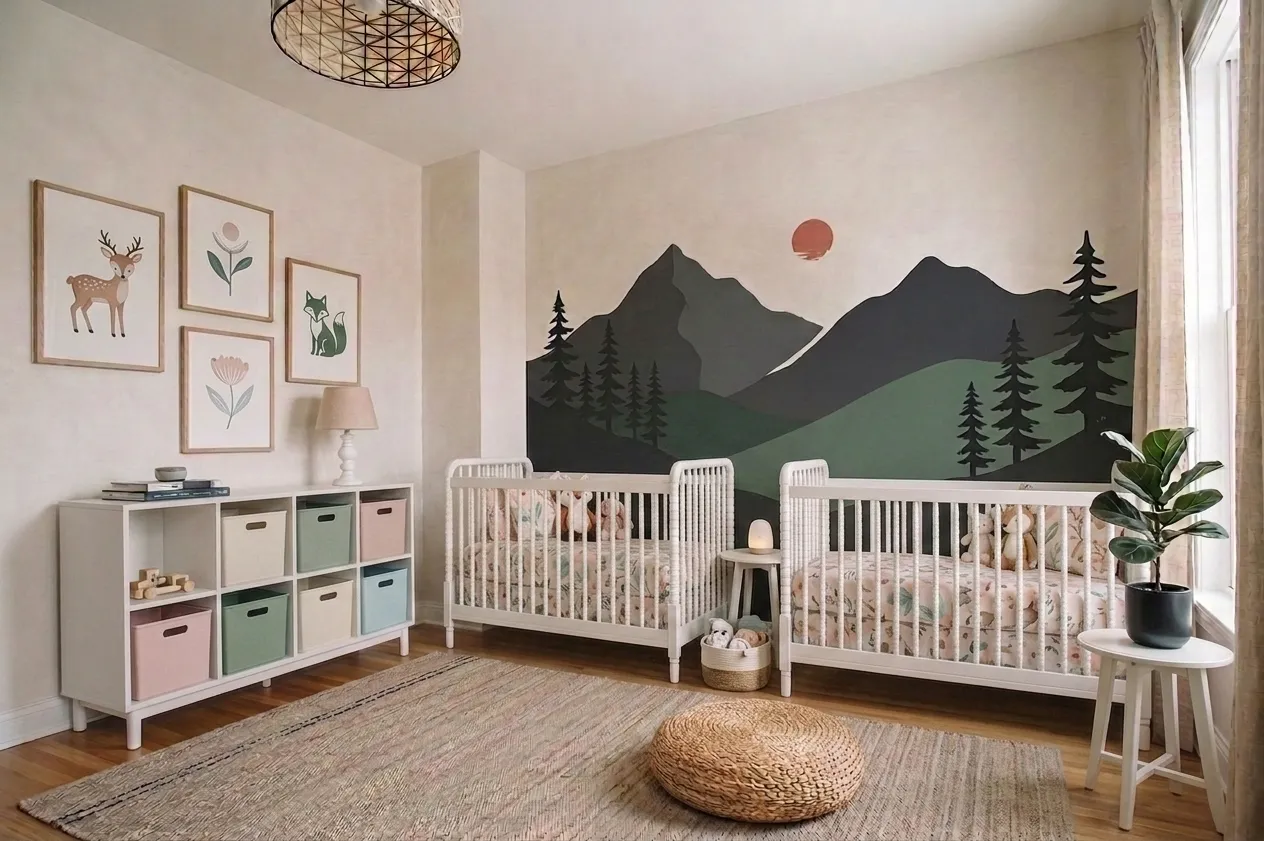
Same room, same cribs, but now with the design dialed up to 10. A hand-painted style mountain and forest mural transforms the entire back wall into a nature scene — dark peaks, green pines, rolling hills, and a warm sunset sky. On the left wall, framed prints of woodland animals (a deer, a fox, botanical illustrations) create a gallery arrangement.
Storage gets a colorful upgrade: a white cubby bookshelf with pastel storage bins in pink, green, and mint. A natural jute rug covers the hardwood. A woven pouf adds a casual seating element. The cribs stay white and simple, letting the mural be the star.
Why nature themes dominate nursery design: According to the 2025 Nursery Design Trends Report by Project Nursery, nature and woodland themes account for 38% of all nursery designs, making it the most popular category for the fourth consecutive year. The reason is longevity — a mountain mural does not get outgrown the way a cartoon character theme does. Children respond to nature imagery well into elementary school.
Research from the University of British Columbia found that children in rooms with nature imagery showed 15% lower cortisol levels (a stress hormone) compared to rooms with abstract or character-based decor. The mountain mural is not just beautiful — it is physiologically calming for your baby.
Stage 3: Transition to Toddler Room (Pink Accent)
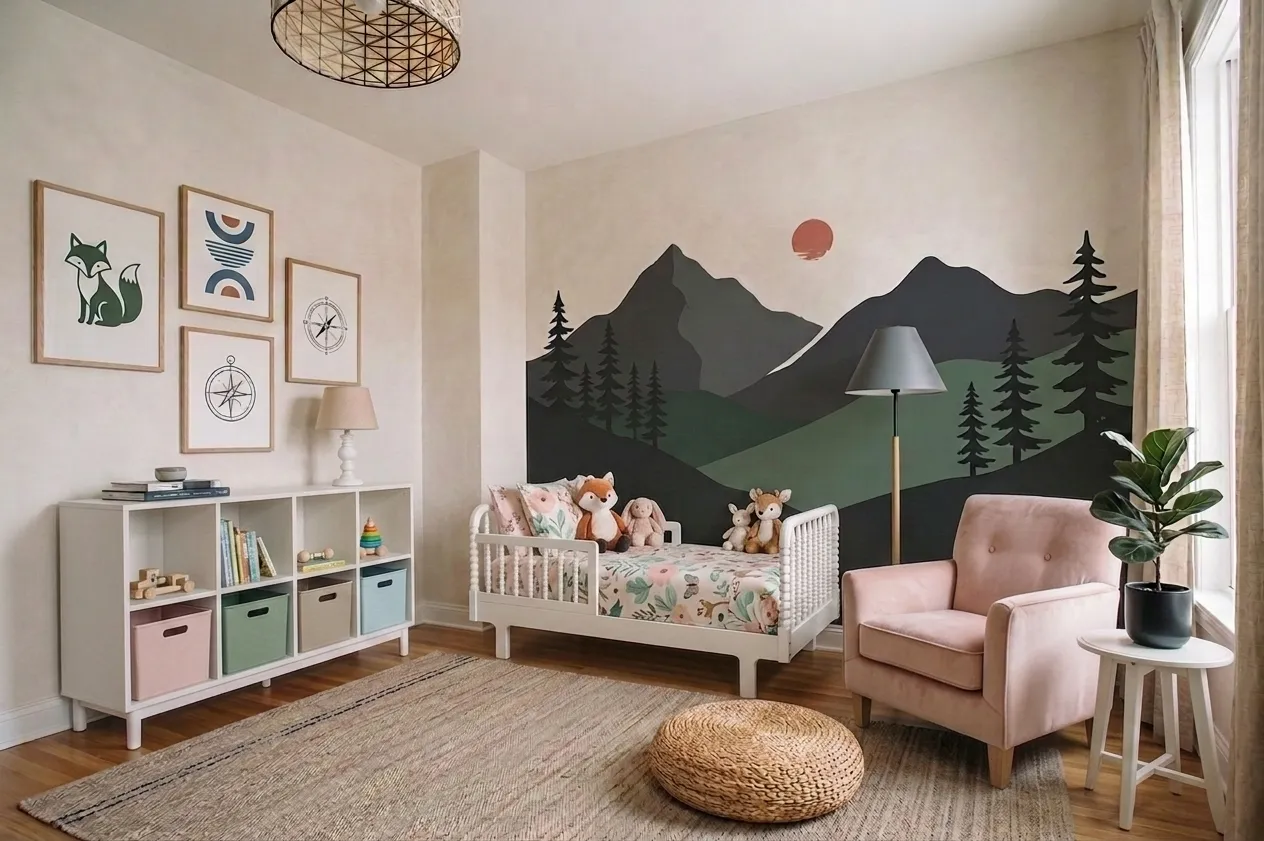
This is where the "grows with your child" promise becomes real. The two cribs are gone. In their place: a white toddler bed with floral bedding and a collection of plush woodland animals. A soft pink upholstered armchair creates a reading nook. The mountain mural stays — it works just as well for a 2-year-old as it did for a newborn.
Notice what changed and what stayed. The gallery wall updated its prints (now a fox, compass, and geometric designs — slightly more grown-up). The storage unit remains but the items inside evolved from baby supplies to books and toys. The rug, pouf, and pendant light carried over unchanged.
The financial win: By keeping the mural, rug, storage unit, pendant light, and wall art, this transition cost roughly $400 to $700 (toddler bed + armchair + new bedding). Compare that to parents who redesign the entire room at the toddler stage — spending another $2,000 to $4,000 because nothing from the nursery phase carried over.
This is exactly why planning matters. A nursery designed with transitions in mind saves you 50 to 70% on the toddler room conversion.
Stage 4: Toddler Room With Green and Teal Palette
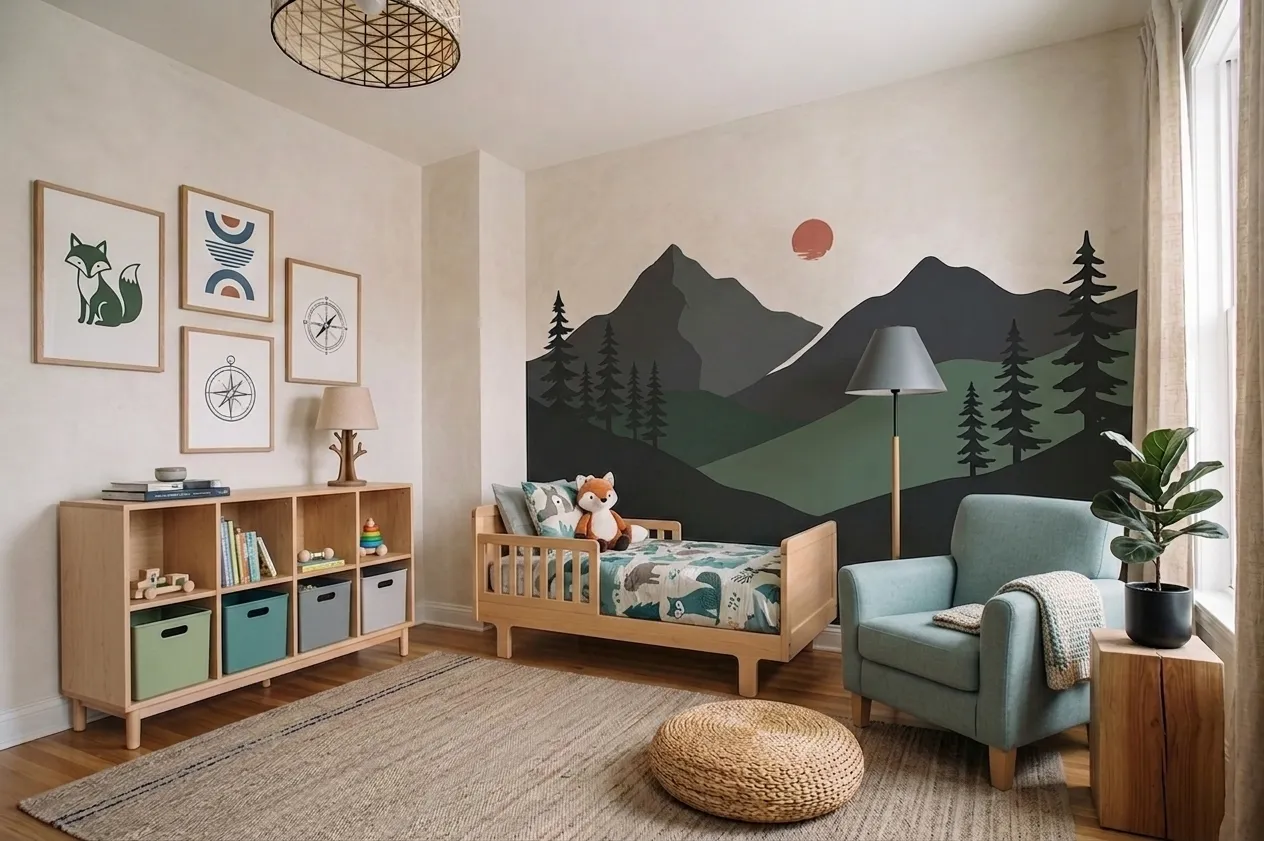
Want to see the same room with a different personality? This variation swaps the pink accents for a deep teal and natural wood palette. A wooden toddler bed with forest-themed bedding replaces the white one. A teal mid-century armchair with a cozy throw blanket creates a parent-friendly reading corner. The bookshelf shifts from white to natural oak.
The mountain mural continues to anchor the room. The woodland art prints remain. But the entire mood shifts from soft and feminine to adventurous and earthy. Same foundation, different expression.
This is the power of AI visualization for nursery planning. You can see both color directions before committing. Does your child's room feel better in blush pink or deep teal? You do not have to guess — you can see both in your actual room and decide with confidence.
Stage 5: Full Nursery in Natural Wood (The Mid-Century Option)
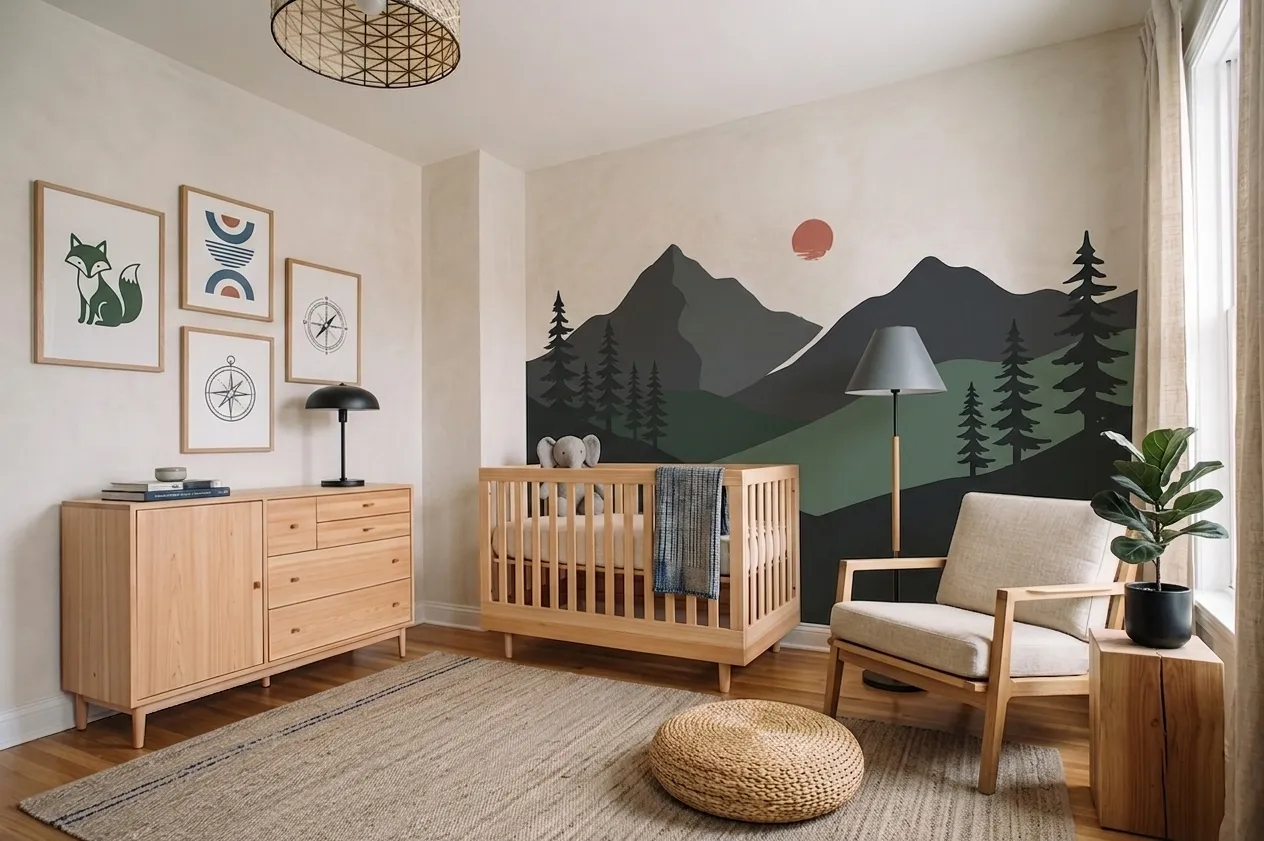
This design goes all-in on natural wood with a mid-century modern influence. A natural oak crib with visible wood grain becomes the centerpiece. A matching oak dresser with rounded drawer pulls provides storage. A wooden rocking chair — the classic nursery staple — sits in the corner for late-night feeds.
The mountain mural stays but pairs differently with the warmer wood tones. The gallery wall features the same woodland fox print but with different companion pieces. A woven jute pouf adds texture at floor level. Everything feels cohesive, intentional, and timeless.
Why natural wood dominates premium nursery design: A 2025 Pottery Barn Kids trend report found that natural wood furniture outsells painted furniture 3 to 1 in the nursery category. The reasons are practical: natural wood hides scratches and wear better than painted finishes, matches any future room updates, and has higher resale value when your child outgrows the furniture.
A quality natural oak convertible crib costs $400 to $800 and converts to a toddler bed, then a daybed, then a full-size bed frame. That is one purchase covering birth through age 10+.
Stage 6: The Japandi Nursery (Zen Meets Function)
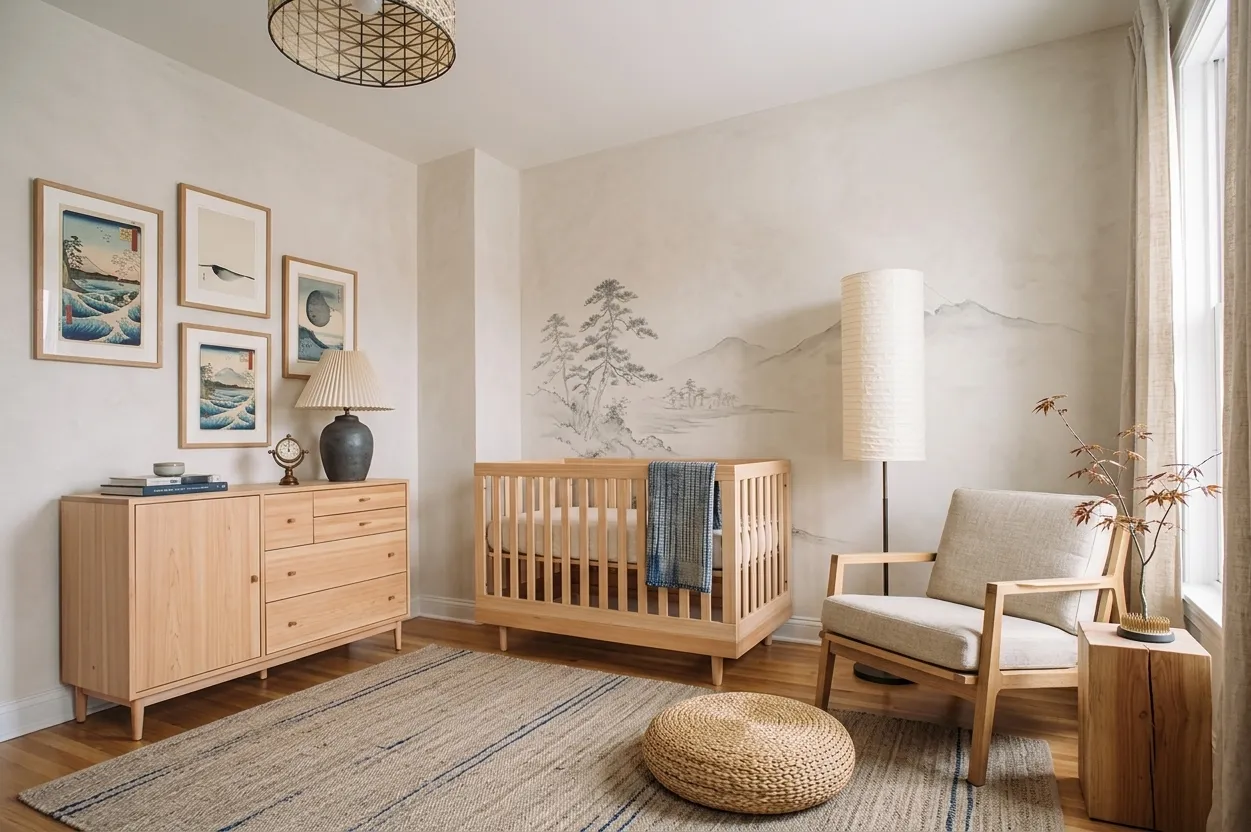
The final design replaces the mountain mural with a soft sumi-e (Japanese ink wash) landscape — misty mountains, pine trees, and subtle brushstrokes in grey and cream. The gallery wall features Japanese wave prints (think Hokusai) in muted blues. A pleated fabric floor lamp adds warm ambient light.
The furniture stays natural oak — the same crib and dresser from the previous design — but the overall mood shifts dramatically. Where the nature theme was vibrant and playful, this Japandi version is serene and contemplative. A canvas and wood rocking chair replaces the heavier wooden one.
The Japandi nursery is the designer's secret weapon. It photographs beautifully for social media and real estate listings. It works equally well for boys and girls. It ages gracefully from nursery to child's bedroom to tween room without a single wall repaint. The neutral palette and natural materials are genuinely timeless.
The Nursery Design Decision Framework
Choosing a nursery design is easier when you break it into 4 decisions:
- Single child or twins? This determines layout and how much floor space you have for extras like armchairs and bookshelves.
- Budget tier. Simple white furniture ($800 to $1,400) vs. natural wood mid-range ($1,500 to $3,000) vs. designer pieces ($3,000+). AI visualization helps at every tier.
- Theme longevity. Will it last 1 year (character themes), 3 years (color-based themes), or 6+ years (nature/Japandi/minimalist)? Choose based on how often you want to redecorate.
- Transition plan. Which pieces will convert from nursery to toddler room? A $600 convertible crib saves you $1,200 vs. buying a separate toddler bed later.
| Design | Stage | Style | Est. Cost |
|---|---|---|---|
| Simple Twin | Newborn | Minimal white | $800 - $1,400 |
| Nature Mural | Newborn - Toddler | Woodland nature | $1,500 - $2,800 |
| Pink Toddler | Toddler (18mo+) | Soft woodland | $400 - $700 upgrade |
| Teal Toddler | Toddler (18mo+) | Earthy adventure | $400 - $700 upgrade |
| Mid-Century Oak | Newborn - 10yr | Natural wood | $1,800 - $3,200 |
| Japandi | Newborn - 10yr+ | Zen minimalist | $2,000 - $3,500 |
The Biggest Nursery Mistake Parents Make
The number one nursery design mistake is not about color or furniture. It is designing for the newborn stage only. A newborn uses the nursery for roughly 12 months before outgrowing the crib configuration. If your design does not have a transition plan, you are spending $2,000 to $5,000 on a room that works for one year.
Smart nursery design means choosing pieces that convert (cribs to toddler beds), walls that do not need repainting (nature themes, neutral murals), and storage that scales (open shelves that hold diapers now and books later).
That is exactly what AI visualization makes possible. You can see Stage 1 (newborn) and Stage 2 (toddler) of the same room before buying a single piece of furniture. If the crib you love does not work as a toddler bed in that space, you will know before it arrives at your door.
How to Design Your Nursery With AI
The process takes under 2 minutes:
- Photograph the empty room that will become the nursery. Shoot from the doorway or a corner to capture the full space. Natural light works best.
- Upload to MeltFlex and describe what you want: "nature-themed nursery with mountain mural, white crib, natural wood furniture" or "minimal Japandi nursery with oak crib."
- Generate multiple designs. Try 3 to 5 different styles. See the room as a newborn nursery and as a toddler room. Compare side by side.
- Save and share. Download your favorite designs and share them with your partner, family, or friends. Make the decision together based on what you can actually see, not what you imagine.
No interior designer. No $3,000 consultation fee. No regret purchases. Just your room, visualized in any style, in seconds.
Start Designing Your Nursery Today
Your baby does not care about design trends. But you will spend hundreds of hours in that room — feeding at 3am, reading bedtime stories, playing on the rug, rocking in the chair. The nursery is as much for you as it is for your child. It should be a room that makes you feel calm, happy, and at home.
Upload a photo of your room to MeltFlex and see what your nursery could look like. 2 free designs, 20 seconds per result. Try the nature theme. Try the Japandi style. Try the warm oak look. Then build the room your family deserves.
For more design inspiration, check our bedroom design ideas, our complete interior design styles guide, or browse real room transformations in the creations gallery.