Why You Can't Sleep, Focus, or Relax at Home (It's Not You. It's the Room)
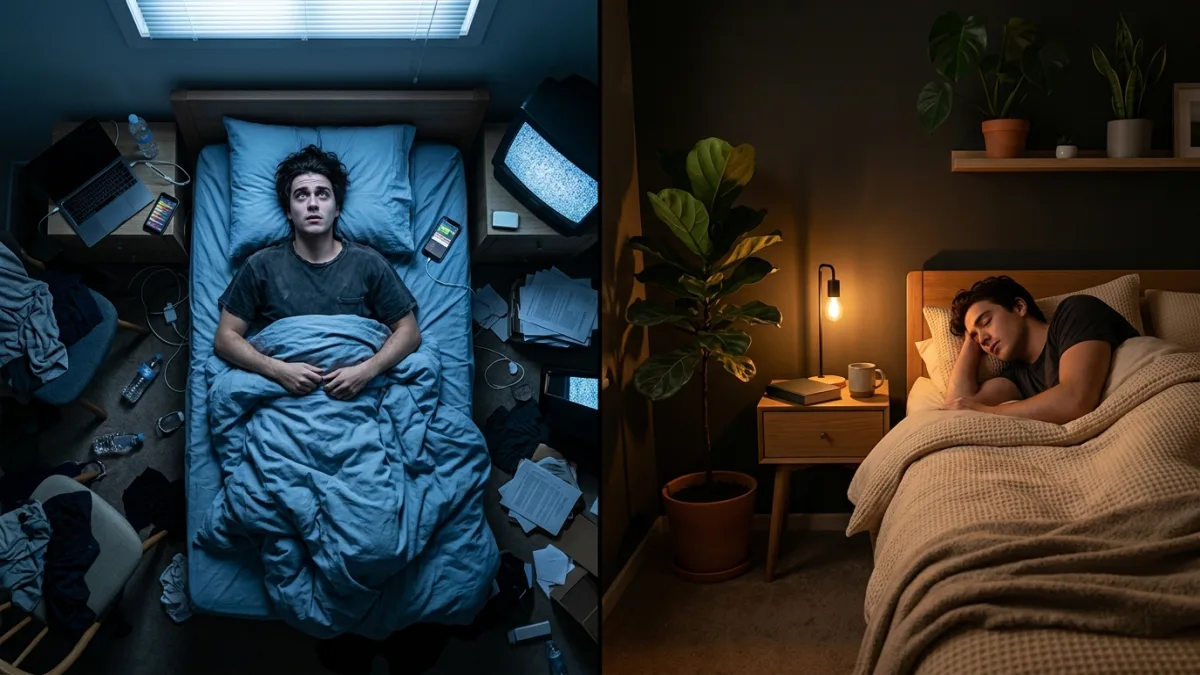
You’ve tried melatonin. You’ve downloaded the focus app. You’ve bought the lavender candle. And you still can’t sleep properly, can’t focus for more than 20 minutes, and feel vaguely stressed every time you walk into your living room.
The problem isn’t your habits. It’s your room.
Neuroarchitecture is an emerging field backed by Harvard, the Academy of Neuroscience for Architecture, and the 2026 Global Brain Economy Initiative that studies exactly this: how the rooms you live in physically change your brain chemistry, stress levels, sleep quality, and ability to think.
The research is clear. Students in well-lit classrooms advance 26% faster in reading and20% faster in math. People exposed to warm light fall asleep 19 minutes faster. Women in cluttered homes have measurably higher cortisol throughout the day. Sharp-angled furniture activates your amygdala (the brain’s fear center).
We spoke with Michal Matlon, an architecture psychologist based in Bratislava who has spent over a decade applying environmental psychology to real spaces for companies like HB Reavis, the City of Reykjavik, and dozens of workplaces across Central Europe. He walked us through the science of why your room is working against you and what to do about it.
How Colors Actually Affect Your Brain (Not Just Your “Vibe”)
Every interior design blog tells you “blue is calming.” That’s true, but it’s about as useful as saying “exercise is healthy.” The real science is more specific and more interesting.
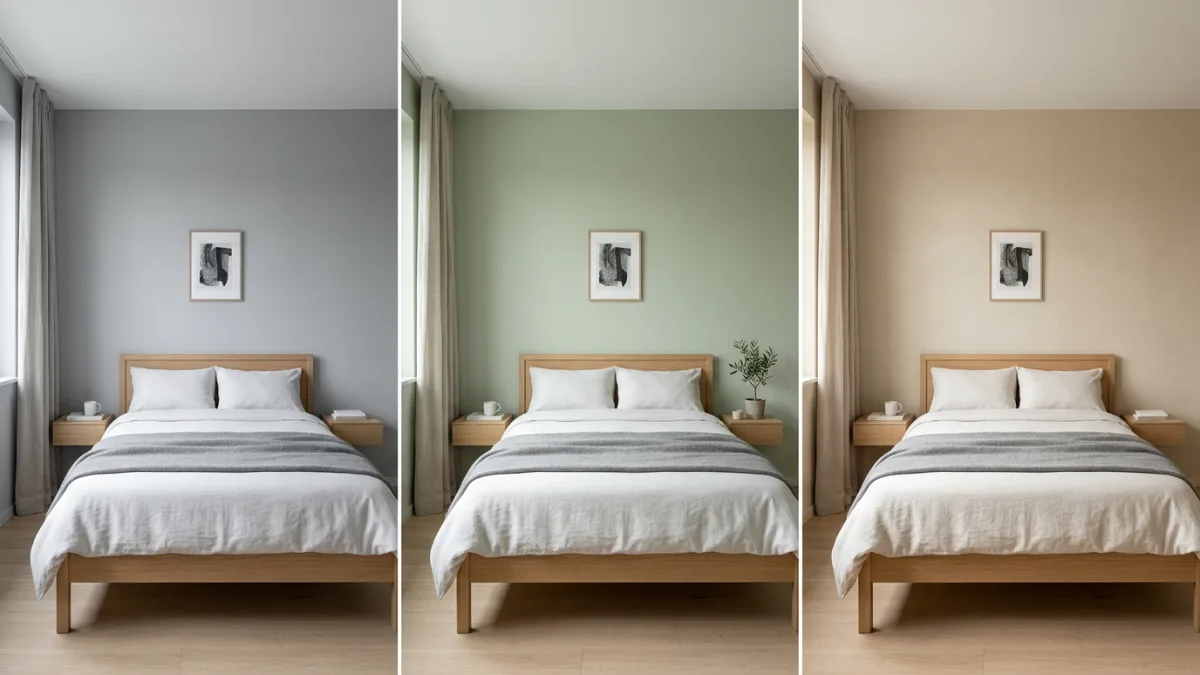
A 2018 study published in Frontiers in Psychology found that room color directly influences psychological functioning. But the effect depends on three factors most articles ignore:saturation (how vivid the color is), brightness (how much light it reflects), and the lighting conditions in the specific room.
“People ask me ‘what color should I paint my bedroom’ as if there’s one answer,” Matlon says. “A dusty sage green in a south-facing room with natural light is calming. The same sage green in a north-facing basement room looks depressing. Color without context is meaningless.”
Here’s what the research actually shows:
Best Colors for Sleep (Bedroom)
- Soft blue (low saturation) lowers heart rate and blood pressure. Hotel chains use it in premium suites for a reason.
- Muted sage green activates the parasympathetic nervous system (rest and digest mode).
- Warm beige and soft terracotta create a “nest” feeling that signals safety to your brain.
Best Colors for Focus (Home Office)
- Soft yellow (not bright) increases creative thinking and optimism without overstimulation.
- Muted teal balances calm and alertness. It’s the sweet spot between blue (too relaxing) and green (too passive).
- Warm white with wood accents creates neutral cognitive load, letting your brain focus on work rather than processing the environment.
Colors That Increase Stress and Anxiety
- Bright white reflects too much light, increases visual fatigue, and creates an institutional feeling.
- Cool gray increases cortisol levels. Matlon calls gray in offices “the most expensive color in the world” because of how much productivity it destroys.
- Saturated red raises heart rate and creates a sense of urgency. Fine for a restaurant, terrible for a bedroom.
Want to test how different colors would change the feel of your actual room? Upload a photo toMeltFlex and try warm vs. cool palettes before buying paint. For more on choosing the right paint, see our guide to choosing paint colors with AI.
Why You Can’t Sleep in Your Own Bedroom
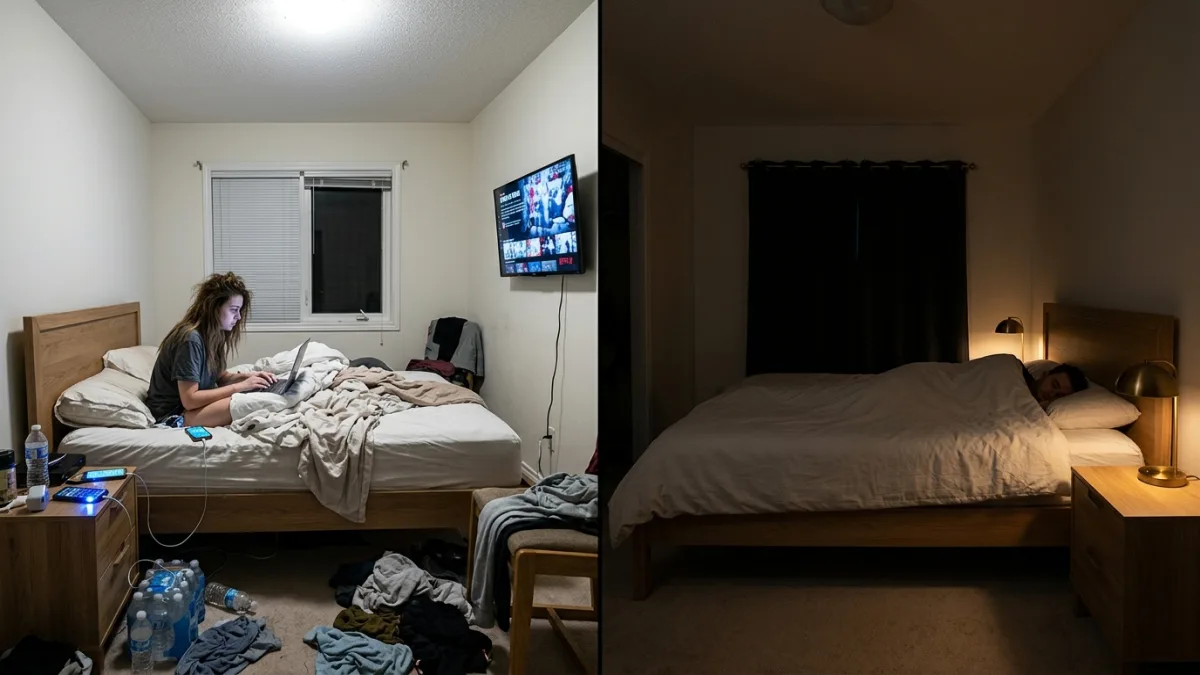
If you’ve ever fallen asleep easily in a hotel room or on a friend’s couch but lie awake for hours in your own bed, you’re experiencing conditioned arousal. Your brain has learned to associate your bedroom with wakefulness, stress, or stimulation.
“This is the single most common problem I see,” Matlon says. “People work in their bedroom, watch TV in bed, scroll their phone in bed, argue in bed, and then expect their brain to instantly switch to sleep mode. Your brain doesn’t have a switch. It reads environmental cues. If the cue says ‘this is where we work and stress,’ you won’t sleep.”
The Temperature Problem Nobody Solves
Your body needs to drop its core temperature by about 1°C to initiate sleep. The Cleveland Clinic recommends a bedroom temperature of 15–19°C (60–67°F). Most people sleep in rooms that are 22–24°C because they set the thermostat for daytime comfort and never change it for night.
“I tell people: if you do nothing else, lower your bedroom temperature by 3 degrees tonight,” Matlon says. “You’ll notice the difference immediately. It’s the highest-impact, lowest-effort change you can make.”
Light Pollution: Your Room Is Never Dark Enough
Harvard researchers found that participants exposed to warm, dim light in the evening fell asleep 19 minutes faster than those under standard room lighting. Even small amounts of light (a charging LED, a street lamp through thin curtains, a clock display) suppress melatonin production.
“Blackout curtains are not a luxury,” Matlon says. “They’re a biological necessity. Your retina detects light even through closed eyelids. A €40 blackout curtain does more for your sleep than a €200 supplement stack.”
The Home Office in the Bedroom Problem
Since 2020, millions of people have their desk in their bedroom. Matlon calls this “the worst spatial decision of the decade.”
“Your brain creates location-based associations. If you work, stress, and have Zoom calls in the same 15 square meters where you sleep, your nervous system never fully downregulates. You’re trying to sleep in your office.”
If you can’t move the desk: Create a visual barrier. A room divider, a curtain, even a large plant between the desk and the bed. “The barrier doesn’t need to block sound. It needs to block sight. When you can’t see the desk from the bed, your brain treats them as separate zones.”
For studio apartment layouts that solve this problem, see our studio apartment design guide and 5 AI-generated studio layouts.
Why You Can’t Focus at Home (It’s Not Motivation)
A UCLA study tracked families in their homes and found that people in cluttered environments had measurably higher cortisol levels throughout the day. The effect was strongest in women, but present in everyone. Clutter doesn’t just look messy. It competes for your attention, reduces working memory, and triggers a low-level fight-or-flight response.
But clutter is only one piece. Matlon identifies three design factors that destroy focus:
1. The Wrong Lighting Kills Concentration
The Heschong Mahone study found that students in classrooms with the most daylight advanced26% faster in reading and 20% faster in math compared to those in windowless rooms. A separate study in brightly lit retirement facilities showed 5% less cognitive decline and19% less depression.
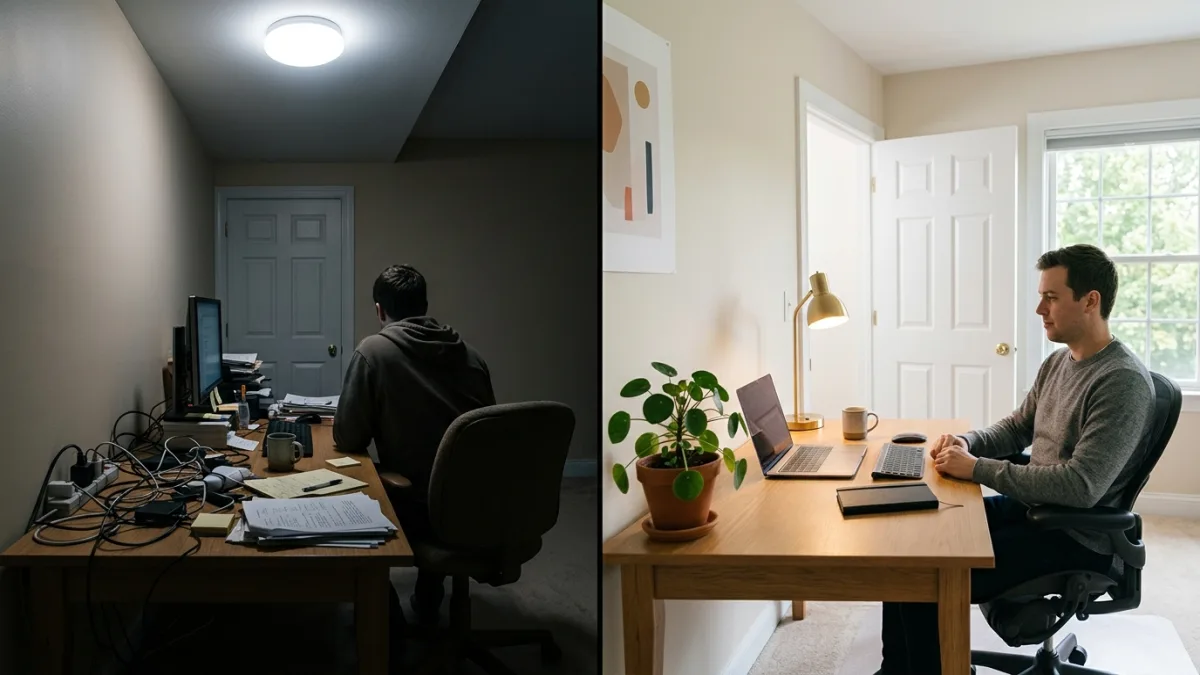
“Most home offices have a single overhead light and a laptop screen,” Matlon says. “That’s the equivalent of working in a cave with a flashlight. You need task lighting on your desk (4000–5000K color temperature during work hours), ambient light behind your screen to reduce eye strain, and if possible, a window within your peripheral vision.”
2. Desk Placement: The “Door Facing” Rule
“This sounds like feng shui nonsense, but there’s real psychology behind it,” Matlon says. “When your back is to the door, your nervous system stays in a low-level alert state because you can’t see who’s approaching. It’s an evolutionary survival mechanism. Place your desk so you can see the entrance from your peripheral vision, and your parasympathetic system relaxes enough to let you concentrate.”
3. Visual Noise Is the Silent Productivity Killer
“People focus on acoustic noise but ignore visual noise,” Matlon says. “An open bookshelf with 50 objects. Cables everywhere. A bulletin board covered in papers. Your eyes are constantly scanning and processing these items, even when you’re not aware of it. Every object in your visual field costs cognitive energy.”
The fix: Closed storage for everything that isn’t beautiful or actively in use. Cable management. A clean desk policy. “The goal is to make your workspace visually boring enough that your brain has nothing to process except the work in front of you.”
For home office setup ideas, see our home office design guide.
Room Layout Psychology: How Furniture Placement Affects Your Brain
This is the section most interior design articles skip entirely, and it might be the most important. Research from the University of Georgia found that school building design accounts for10–15% of variation in standardized test scores. The layout of a room physically changes how well your brain performs.
Sharp Angles Activate Your Fear Response
Moshe Bar at Harvard Medical School found that sharp-angled furniture activates the amygdala, the brain’s fear and threat detection center. Curved, rounded furniture does not.
“This doesn’t mean throw away all your rectangular furniture,” Matlon clarifies. “It means that in spaces designed for relaxation (bedroom, living room), rounded edges and organic shapes will always feel more calming than hard geometric angles. And in your visual field while sleeping, avoid pointing sharp corners toward the bed.”
Our curved furniture trend guide for 2026 digs deeper into this.
Room Shape Matters More Than You Think
A 2024 study published in PMC found that rectangular rooms increase negative mood while rooms with curved geometry enhance positive mood. You can’t change your room shape, but you can soften it with arched mirrors, round rugs, curved shelving, and organic-shaped furniture.
The Open Floor Plan Trap
“Open floor plans look great in magazines but are psychologically exhausting to live in,” Matlon says. “Without spatial boundaries, your brain never fully relaxes because it’s constantly processing the entire visible space. Even a rug defining a seating area, or a bookshelf creating a partial wall, gives your brain permission to stop scanning.”
For open plan solutions, check our open floor plan layout guide.
Biophilic Design: Why Nature in Your Room Changes Everything (And the Myth You Need to Stop Believing)
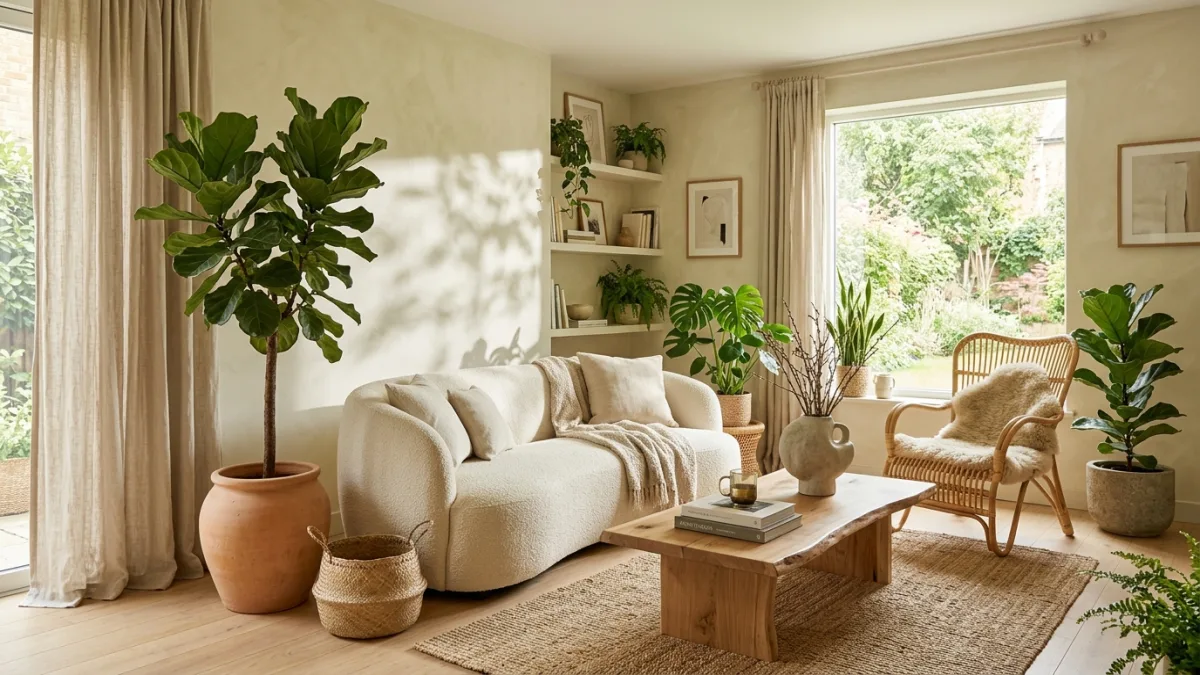
A University of Melbourne study found that introducing plants into barren office spaces increasedproductivity by 15%. A 2024 Nature study confirmed that biophilic design elements (plants, natural materials, water features, daylight) measurably reduce cortisol and improve self-reported well-being.
But here’s the myth you need to stop repeating:
“Plants clean your indoor air” is essentially false. The American Lung Association states clearly that houseplants do not meaningfully improve indoor air quality. The original 1989 NASA study was conducted in sealed chambers, not real rooms. In a real home, you would need10 to 1,000 plants per square meter to achieve measurable air purification.
“Plants work, but not for the reason people think,” Matlon says. “They work throughbiophilia: the human brain’s hardwired positive response to natural elements. Seeing green, organic shapes, and living things reduces cortisol, lowers blood pressure, and improves mood. The plant doesn’t need to filter your air. It needs to exist in your visual field.”
Practical biophilic design for any room:
- 2–3 plants visible from your main sitting/working position
- Natural materials: wood, stone, rattan, linen, wool (even small items count)
- A window view of greenery or sky (if possible, position your desk or sofa facing it)
- Natural light as the primary light source during the day
- Organic shapes in furniture and decor (see: biophilic design guide)
Lighting: The Most Underrated Design Element
If Matlon could change one thing in every home he visits, it would be the lighting.
“People spend €3,000 on a sofa and €15 on a light bulb. Then they wonder why the room feels wrong. Lighting is the single most powerful tool in room psychology because it directly controls your circadian rhythm, your melatonin production, your cortisol cycle, and your alertness.”
The Circadian Lighting Rule
| Time of Day | Color Temperature | Why |
|---|---|---|
| Morning (6–10 AM) | 5000–6500K (cool/bright) | Suppresses melatonin, signals “wake up” to your brain |
| Midday (10 AM–4 PM) | 4000–5000K (neutral) | Optimal for focus and cognitive performance |
| Evening (4–9 PM) | 2700–3000K (warm) | Starts melatonin production, signals wind-down |
| Night (9 PM+) | 2200K or lower / off | Maximum melatonin, prepares body for sleep |
“The single best lighting investment is a smart bulb with adjustable color temperature,” Matlon says. “A €20 Philips or IKEA smart bulb that shifts from cool to warm throughout the day does more for your sleep and focus than any redesign.”
The Three-Layer Lighting Rule
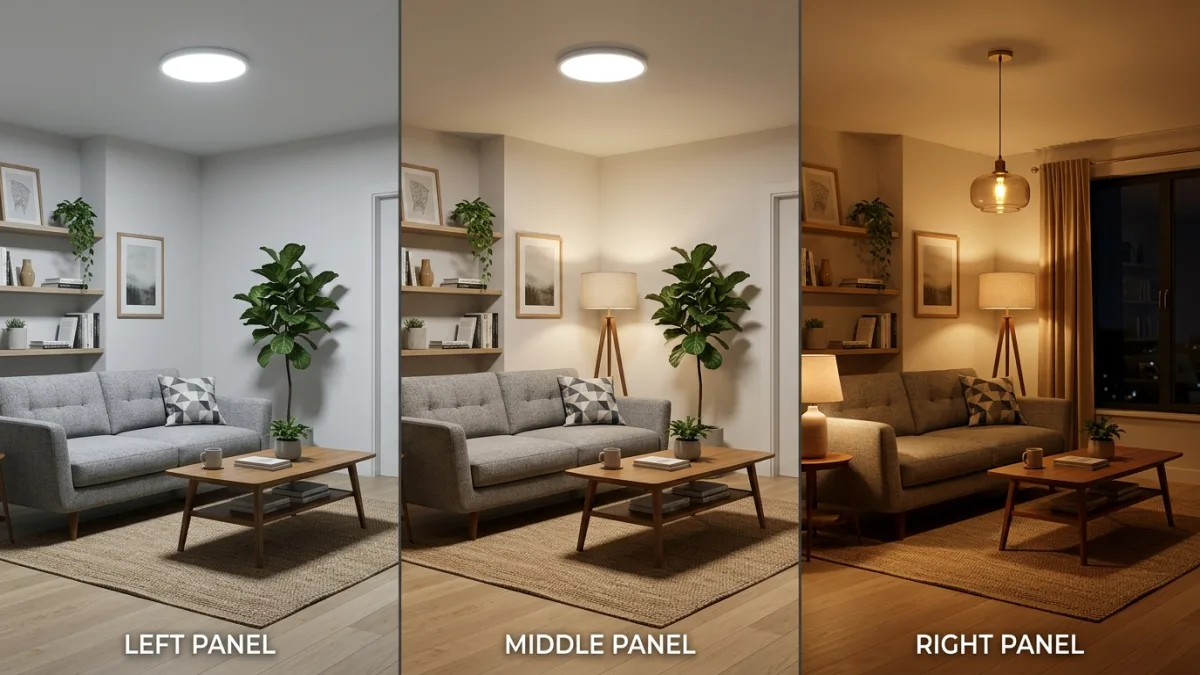
Every room needs three types of light:
- Ambient (overhead/general) for overall visibility
- Task (desk lamp, reading light) for focused work
- Accent (floor lamp, table lamp, candle) for atmosphere and depth
“One overhead light creates a flat, institutional feeling because there are no shadows. Shadows give a room depth and warmth. Three light sources at different heights create a space that feels like a home, not a waiting room.”
How to Test Room Changes Before You Commit
The science is clear: color, lighting, layout, and natural elements measurably change how you sleep, focus, and feel. But knowing what to change and seeing what it actually looks like in your room are two different things.
This is where most advice articles end. You get the theory but no way to apply it without spending money on paint, furniture, and accessories you might not even like.
MeltFlex bridges that gap. Upload a photo of your room and test the exact changes this article recommends:
- Switch wall colors from cool gray to warm beige and see the difference instantly
- Try curved furniture vs. angular furniture and compare the feeling
- Add biophilic elements (plants, wood textures) to your actual space
- Test different lighting atmospheres (warm vs. cool) before buying bulbs
- Redesign your bedroom or home office based on the psychology principles above
Upload your room and try it free →
Your Room Psychology Checklist (Quick Wins)
Based on Matlon’s recommendations and the research cited above, here are the highest-impact changes ranked by effort:
| Change | Impact | Cost | Time |
|---|---|---|---|
| Lower bedroom temperature to 15–19°C | High (sleep) | Free | 1 minute |
| Remove screens from bedroom | High (sleep) | Free | 5 minutes |
| Declutter desk to 3 items max | High (focus) | Free | 15 minutes |
| Face desk toward door | Medium (focus) | Free | 20 minutes |
| Add 2–3 plants to main room | Medium (mood) | €15–40 | 30 minutes |
| Buy a smart bulb (adjustable temp) | High (sleep + focus) | €15–25 | 10 minutes |
| Install blackout curtains | High (sleep) | €30–60 | 30 minutes |
| Add a second/third light source | High (mood) | €20–80 | 15 minutes |
| Create visual barrier (desk/bed zone) | High (sleep) | €30–150 | 1 hour |
| Repaint walls (warm tones) | High (mood + sleep) | €50–150 | 1 day |
Frequently Asked Questions
Does room color really affect your mood?
Yes. Research published in Frontiers in Psychology shows that room color directly influences psychological functioning, including stress, arousal, and cognitive performance. Blue and green tones lower heart rate. Gray and stark white increase cortisol levels. The effect depends on saturation, lighting, and personal associations, which is why testing colors in your actual room with a tool likeMeltFlex matters more than following generic advice.
What is the best bedroom color for sleep?
Sleep research points to soft blue, muted sage green, and warm beige as the best colors for sleep quality. These colors lower heart rate and blood pressure. Avoid bright white (too stimulating), red (increases arousal), and dark gray (associated with higher stress). Low saturation and warm undertones are key. See our paint color guide for specific shades.
How does clutter affect mental health?
A UCLA study found that people in cluttered homes had measurably higher cortisol (stress hormone) levels throughout the day. Clutter competes for your attention, reduces working memory, and triggers a low-level stress response. Even visual clutter you’re not consciously aware of costs cognitive energy.
What is neuroarchitecture?
Neuroarchitecture combines neuroscience, psychology, and architecture to design spaces based on how the brain responds to built environments. Research from Harvard and the Academy of Neuroscience for Architecture shows that room shape, ceiling height, lighting, and furniture geometry measurably affect cognitive performance, stress, and mood. The 2026 Global Brain Economy Initiative positions evidence-based design as a “scalable public health strategy.”
Can room design help with anxiety?
Yes. Evidence-based strategies include: biophilic design (plants, natural materials:reduces cortisol by up to 15%), warm lighting, reduced visual clutter, ensuring visibility of room entrances, and curved rather than sharp-angled furniture. Harvard research shows sharp angles activate the amygdala (fear center), while curved shapes do not.
What is the ideal room temperature for sleep?
The Cleveland Clinic recommends 15–19°C (60–67°F). Your body needs to drop core temperature by about 1°C to initiate sleep. Rooms above 21°C delay sleep onset and reduce deep sleep. If you can’t control heating, use breathable linen or cotton bedding and crack a window.
Do indoor plants really clean the air?
Not meaningfully. The American Lung Association states houseplants do not improve indoor air quality in real-world conditions. You would need 10–1,000 plants per square meter for measurable purification. Plants do improve mood and reduce stress through biophilia (the brain’s hardwired positive response to nature), but not through air filtration.
How does lighting affect sleep quality?
Harvard researchers found warm, dim evening light helps you fall asleep 19 minutes faster. Light directly controls melatonin production. Cool/bright light (5000K+) suppresses melatonin and signals wakefulness. Warm light (2700K or lower) promotes melatonin release. Even small light sources (LED chargers, street lamps through thin curtains) suppress melatonin through closed eyelids. Blackout curtains and smart bulbs with adjustable color temperature are the two most impactful investments.

