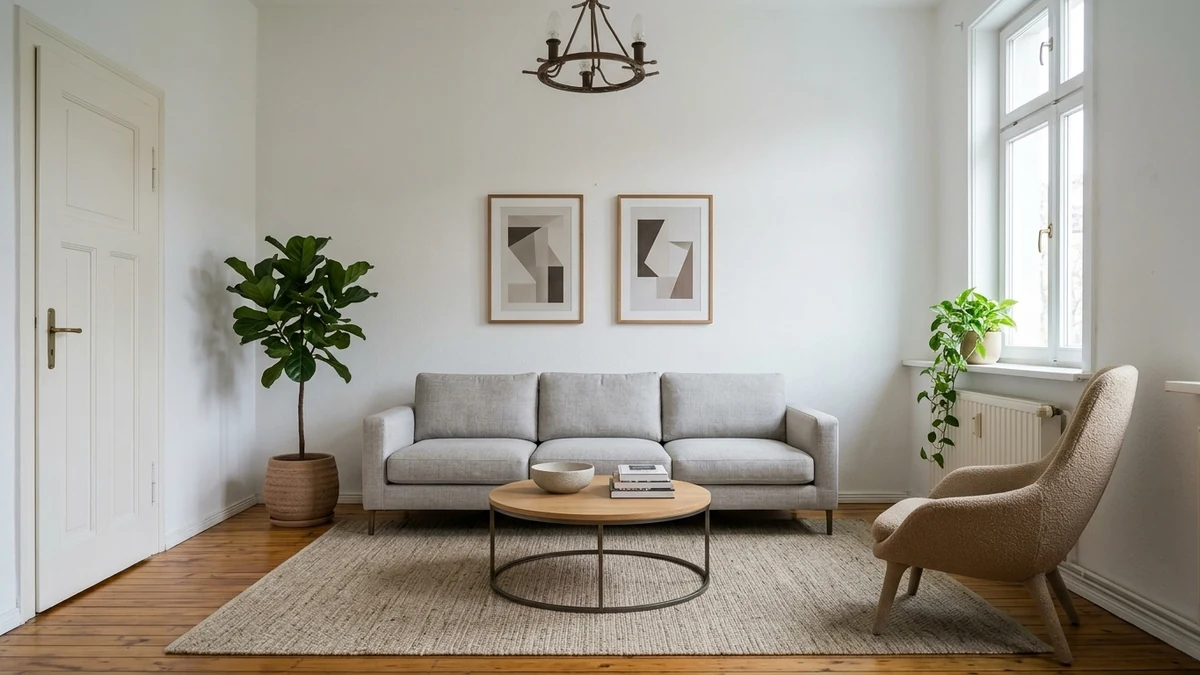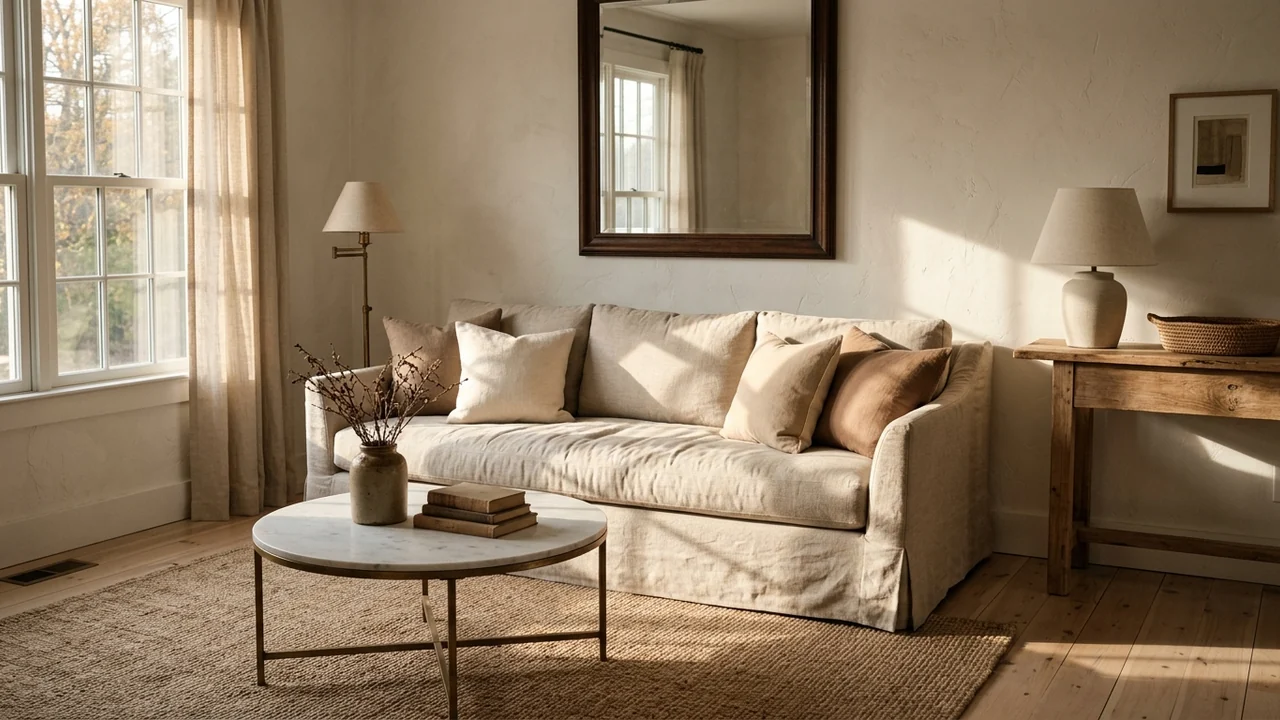
In 2026, a mid-range sofa costs $800 to $2,000, a queen mattress $800 to $2,000, a dining table $500 to $2,000, and a dresser $300 to $1,500. The average US household spent $648 on furniture last year according to the Bureau of Labor Statistics, and after the 2025 tariff spike pushed furniture inflation to a 9.5 percent annual peak, prices have settled into an uneasy calm: the July 2026 CPI, released August 12, puts furniture inflation at just 1.1 percent year over year, and prices actually slipped half a percent between June and July. This guide lists what every major piece of furniture actually costs right now, in three honest tiers, with the sources to back it up.
Our articles are still written by humans!
Get human written articles in your Google feed.
Why write a whole post about price tags? Because every furnishing budget dies by a thousand line items. We have already covered what it costs to furnish a living room, a one-bedroom apartment, and a whole house. This is the missing layer underneath those guides: the piece-by-piece furniture price guide you check before clicking buy on any single item.
FreeUpload photo · freeFurnish my room for freeUpload a photo of the room and MeltFlex fills it with real furniture you can buy, placed at true scale. Your first AI design is free, no card needed.


The Short Answer: Average Furniture Prices in 2026
Here is the whole market on one table. Budget means functional flat-pack and entry e-commerce brands. Mid-range means the piece survives a decade and a move. Premium means solid materials, real joinery, or a designer name.
Prices reflect 2026 US listings and cost-guide data from HomeAdvisor, Sleep Foundation, Awning, and retailer catalogs (IKEA, Wayfair, Ashley, West Elm, Crate & Barrel). Sources for every line are at the bottom of this post. Now the detail, category by category, including which tier is actually worth your money.
Why 2026 Prices Look the Way They Do
You cannot explain this year’s price tags without one word: tariffs. A 25 percent tariff on imported upholstered wooden furniture took effect on October 14, 2025, and retailers passed it straight through. A KPMG survey found that 93 percent of retailers had passed the full tariff cost on to consumers by late 2025, and Ashley Furniture, the biggest furniture maker in the country, raised prices across most products that summer.
The result shows up clearly in the Bureau of Labor Statistics data. Living, kitchen, and dining furniture inflation went from roughly 1 percent year over year in early 2025 to a peak of 9.5 percent in August 2025, then cooled steadily: about 1.5 percent by May 2026, 2.6 percent in June, and just 1.1 percent in the July 2026 CPI released August 12. The index even fell 0.5 percent from June to July, the clearest sign yet that the tariff pass-through has fully worked its way into sticker prices. The scheduled jump to a 30 percent tariff on January 1, 2026 was delayed to January 2027, which is why prices have stabilized this year instead of climbing again.
One wrinkle worth knowing if you shop imported brands: the Section 232 furniture tariff is not flat across the world. Trade agreements cap it at 10 percent for the UK and 15 percent for the EU and Japan, while everyone else pays the full 25 percent, rising to 30 percent for upholstered pieces in January 2027. That is part of why a British or Italian sofa has quietly become more price-competitive against Asian-made lines than it was two years ago.
Two practical takeaways. First, if a guide you are reading quotes 2023 or 2024 furniture prices, add roughly 10 to 15 percent for upholstered pieces. Second, the 30 percent tariff is still scheduled for January 2027, so a big upholstered purchase made in 2026 beats the same purchase made a year later. There is a strange comfort in the long view, though: NPR quotes a Delaware retailer pointing out that you could buy a $399 sofa in 1984 and you can still buy a $399 sofa today. The floor never moved. The ceiling did.
One way to sit below these averages without buying badly is to copy an expensive brand’s silhouette from a cheaper one. We priced that exercise in Pottery Barn dupes, where the closest-reading sofa alternatives land around a fifth of the original band.
Living Room Furniture Prices
Sofa: $300 to $5,000+
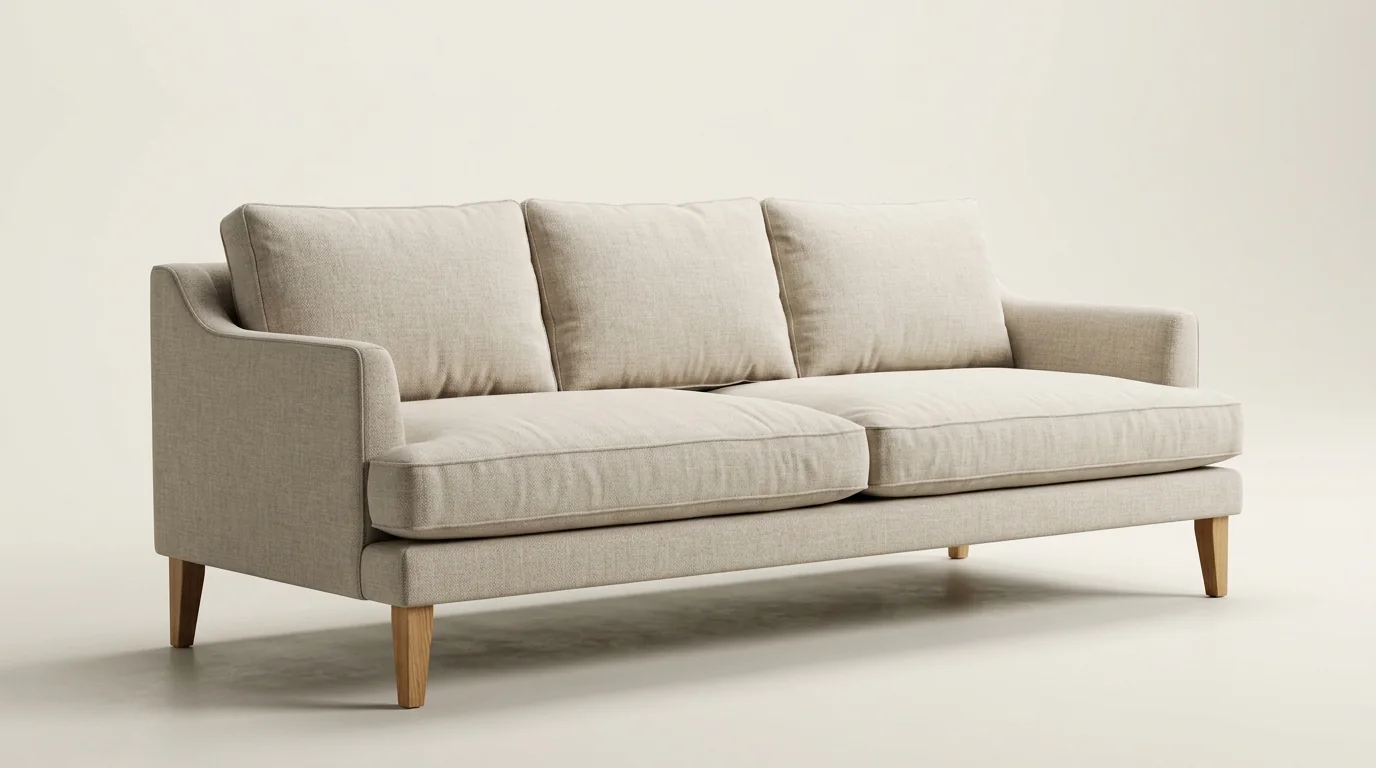
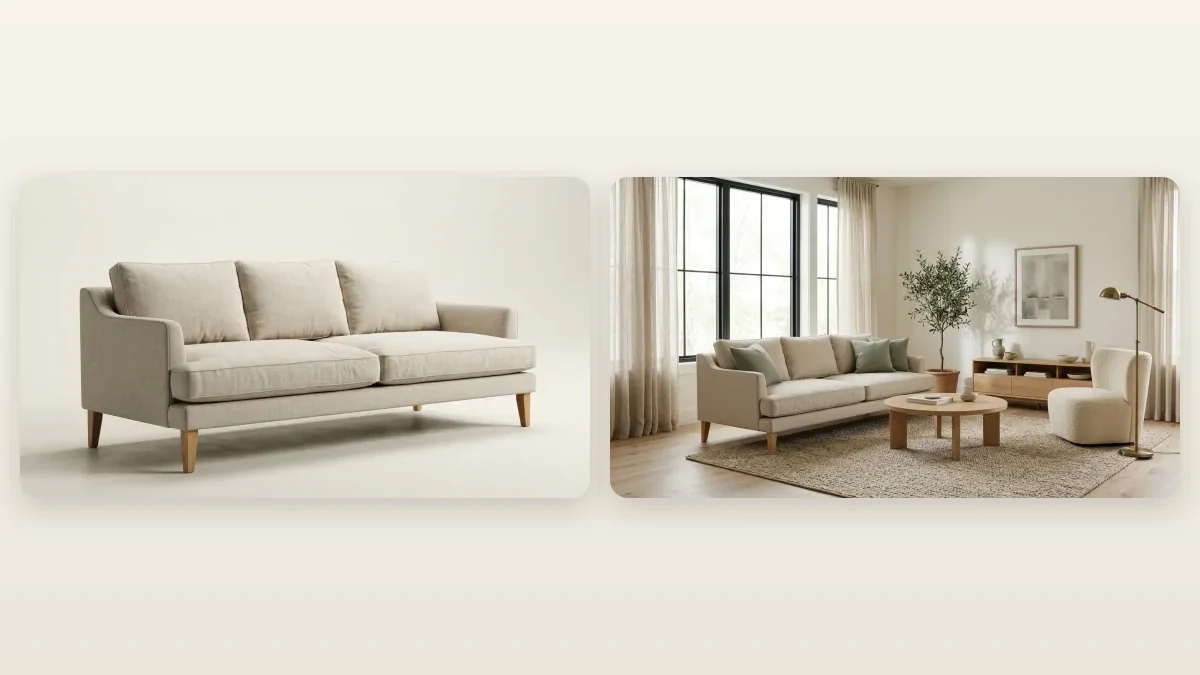
What the $800–$2,000 mid-range tier buys: oatmeal linen, feather-wrapped cushions, oak legs, a hardwood frame. Generated with MeltFlex.
The sofa is the widest price range in furniture because it is where materials show up most. A $300 to $800 budget sofa uses a softwood or particleboard frame and low-density foam, and it typically lasts 3 to 5 years. The $800 to $2,000 mid-range gets you a hardwood or plywood frame, higher-density cushions, and 10 or more years of life. Above $2,000 you are paying for eight-way hand-tied springs, full-grain leather, or a brand name, and a well-made premium sofa can outlive a mortgage. So how much to spend on a sofa? The average cost of a couch that survives a decade, which is also the average price of a sofa most buyers actually pay, is $1,500 to $3,000.
Sectionals run higher because they are simply more sofa: $1,000 to $1,500 at the budget end and $1,500 to $5,000 mid-range. One warning before you fall in love with one: measure your doorway first. Our sofa-through-the-door calculator exists because this exact heartbreak happens every day.
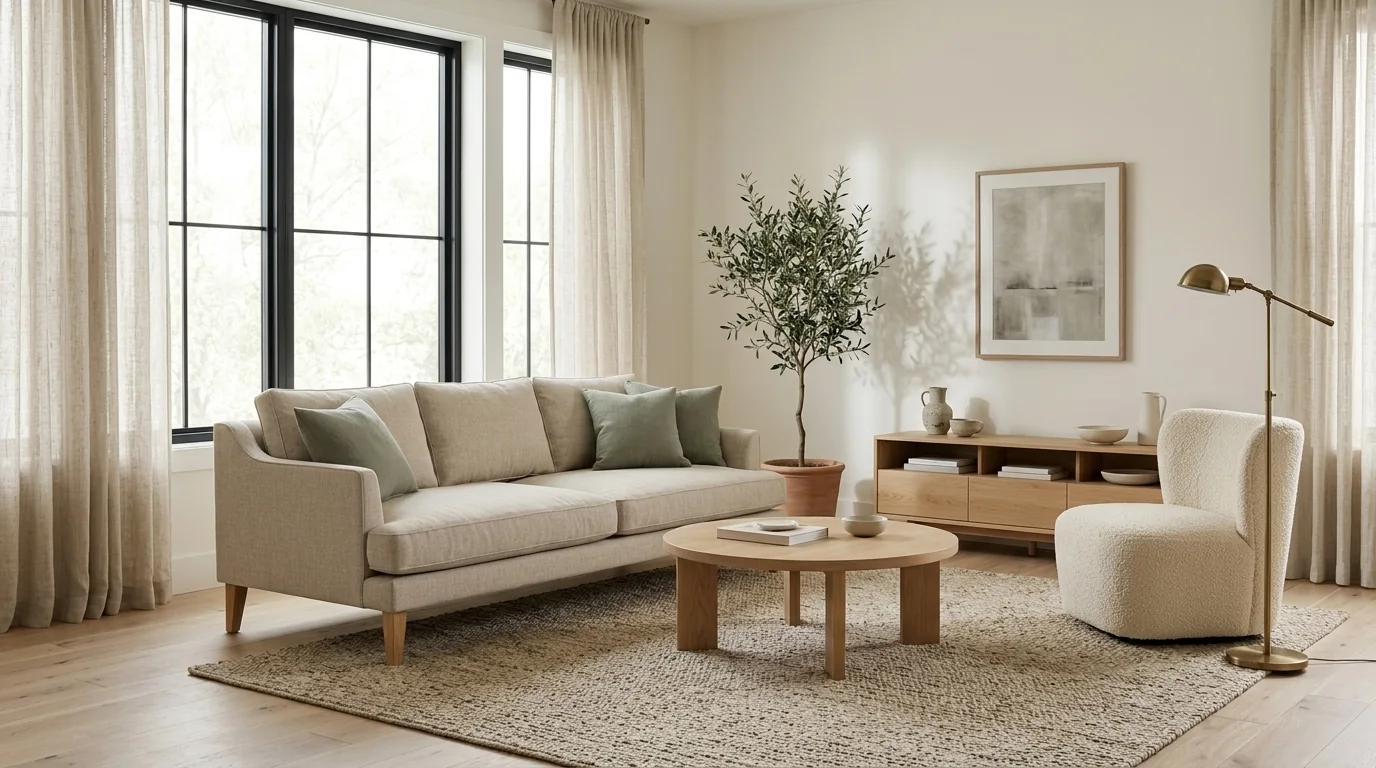
The same sofa in a furnished room: oak coffee table ($300–$500), media console ($400–$700), bouclé accent chair ($400–$800), 8x10 wool rug ($500–$900). Designed with MeltFlex.
Accent chair: $100 to $5,000
Wayfair sells an entire category of accent chairs under $250, and for a chair that gets sat in twice a week, that tier is fine. Mid-century styles cluster in the $300 to $1,500 mid-range, and designer chairs run $1,500 to $5,000. The accent chair is one of the safest places in the room to save money.
Coffee table, TV stand, rug: the supporting cast
A flat-pack coffee table costs $50 to $200 and a solid wood one $200 to $800. TV stands have a clear sweet spot at $150 to $500 for a decent freestanding unit, with larger media consoles running $500 to $2,000. Rugs are the sneaky one: a synthetic 8x10 costs $150 to $400, a wool or blend 8x10 runs $400 to $1,500, and hand-knotted rugs start around $1,500 and climb past $5,000. If a guide quotes you a four-figure “average rug price,” it is averaging in the handmade market. Most people are well served at $300 to $600.
Bedroom Furniture Prices
Bed frame: $120 to $3,000
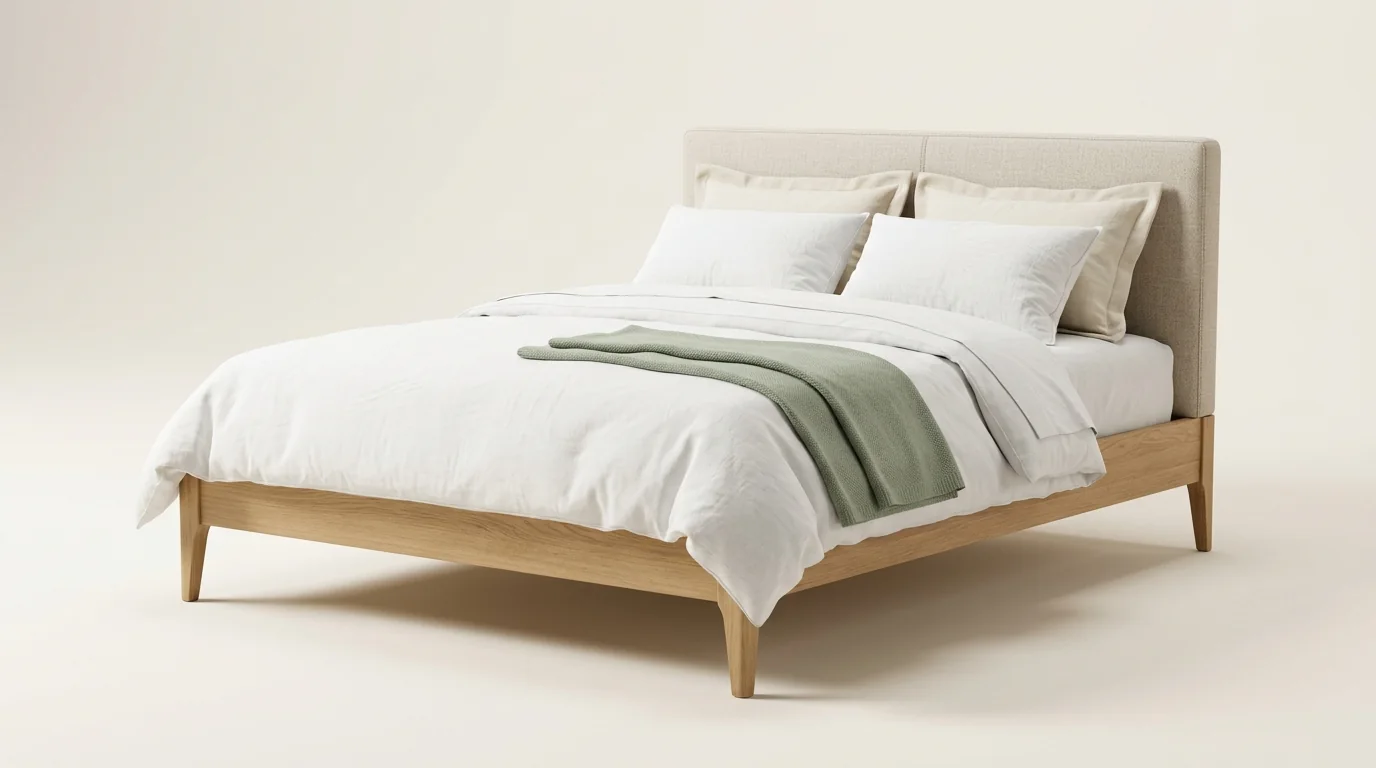
The mid-range bedroom anchor: white oak queen frame with an upholstered headboard, the $300–$800 tier. Generated with MeltFlex.
The average cost of a bed frame in queen size is $300 to $800 for the upholstered mid-range. A basic metal frame costs $120 to $300 and does its job invisibly, solid hardwood frames run $500 to $1,200, with premium and adjustable bases reaching $2,000 to $3,000. King frames add roughly $100 to $300 at every tier.
Mattress: the one place not to cheap out
The average cost of a mattress in queen size is $1,000 to $2,000 according to Sleep Foundation, and the tiers break down cleanly: $500 to $800 for basic foam or innerspring, $800 to $2,000 mid-range (all-foam queens $700 to $1,200, hybrids $1,500 to $2,200), and $2,500 to $3,500 or more for luxury latex, airbeds, and adjustables. You spend a third of your life on this purchase. A bad mattress gets replaced within two years, which makes the cheap one the expensive one.
Dresser and nightstands: $40 to $3,000
Nightstands run $40 to $150 budget, $150 to $400 mid-range, and $400 to $800 for solid wood. The average cost of a dresser is $300 to $1,500 mid-range; engineered-wood pieces start around $150 to $300, and solid hardwood reaches $1,500 to $3,000. If you are choosing where to put money in the bedroom, the order is: mattress, bed frame, dresser, nightstands.
The full bedroom set
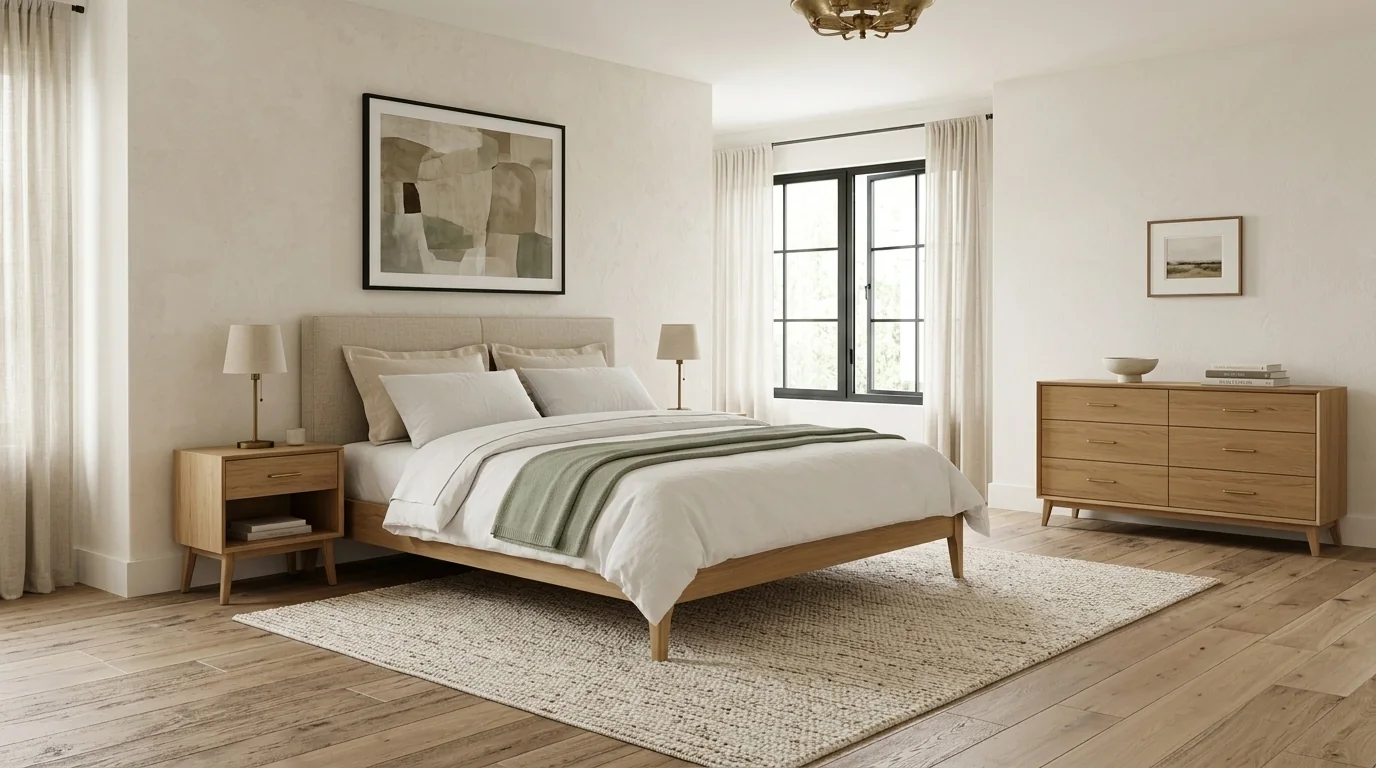
The same bed in a furnished bedroom: two nightstands ($300–$500), six-drawer dresser ($700–$1,100), wool rug ($400–$700). Designed with MeltFlex.
The average cost of a bedroom furniture set (bed, dresser, nightstands) is $800 to $3,000 at mainstream brands like Ashley, and IKEA sets start around $379. Furnishing a complete primary bedroom from scratch, mattress included, runs $2,000 to $5,000 according to HomeAdvisor’s 2026 data. Before committing to a queen or king, check it against your floor space with our furniture size guide, because the most common bedroom mistake is a bed one size too big for the room.
Dining Furniture Prices
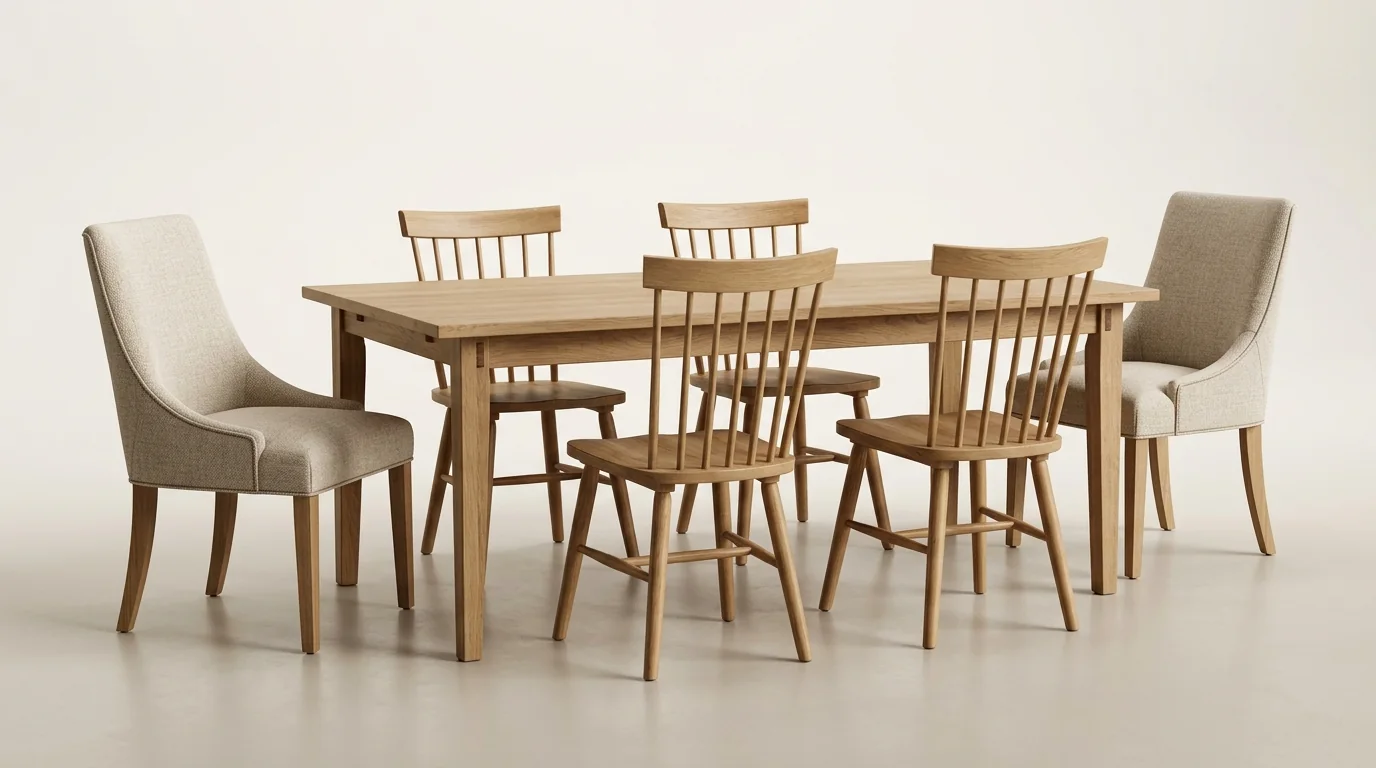
A mid-range dining group as sold: oak table ($800–$1,400), two host chairs plus four side chairs ($700–$1,200 total). Generated with MeltFlex.
Dining table: $150 to $6,000
How much does a dining table cost? For four to six people: $150 to $500 budget, with the $500 to $2,000 mid-range covering most veneer-over-hardwood and small-brand solid wood tables. True solid wood tables run $1,200 to $10,000 with most landing between $2,000 and $6,000, and unlike almost everything else on this list, a solid wood table is a genuine buy-once purchase that gets refinished, not replaced.
Dining chairs: the multiplier problem
Chairs look cheap until you multiply by six. Budget chairs cost $50 to $100 each, mid-quality ones $100 to $300 each, and high-end or designer chairs $600 to $2,500 each. Six mid-range chairs at $180 apiece is $1,080, often more than the table. A practical designer trick: two better host chairs at the ends, four simpler side chairs, which is exactly what the render above does.
Because the mistake gets multiplied by six, chairs are worth testing before you order the set. This walkthrough compares several chairs on a photo of one real dining space: shape, material, tone, and whether the height works with the table.

A render shows whether the chairs suit the table. Seat height still needs a tape measure: 10 to 12 inches between seat and tabletop.
The full dining set
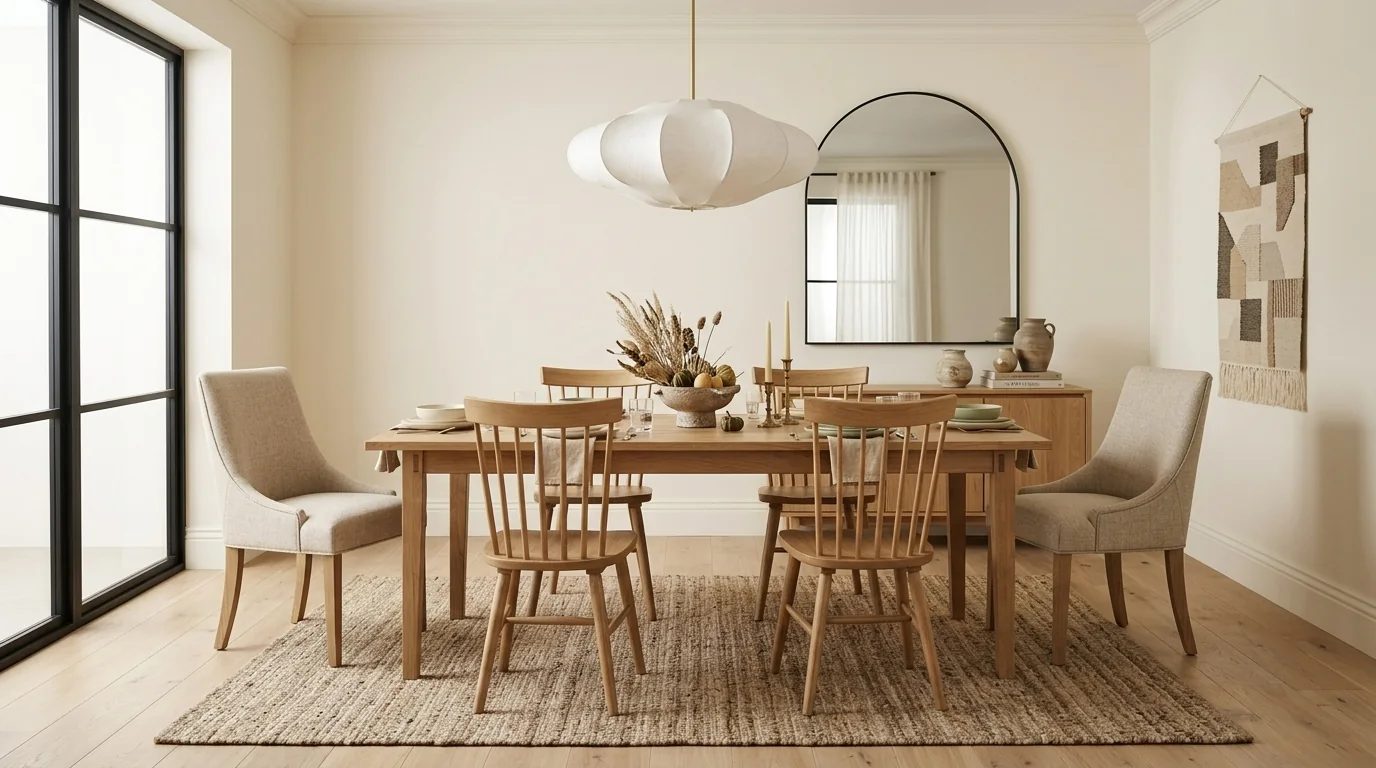
The same dining set in a furnished room: sideboard ($500–$900), jute rug ($200–$400), pendant ($150–$300). Designed with MeltFlex.
The average cost of a dining room furniture set lands between $1,200 and $2,500, with the full market running $500 to $5,000 and IKEA five-piece sets at $830 to $1,700. Furnishing a complete dining room averages $1,500 to $4,000. Sets save 10 to 20 percent over buying pieces individually, and dining is the one room where a matched set rarely looks wrong.
Home Office Furniture Prices
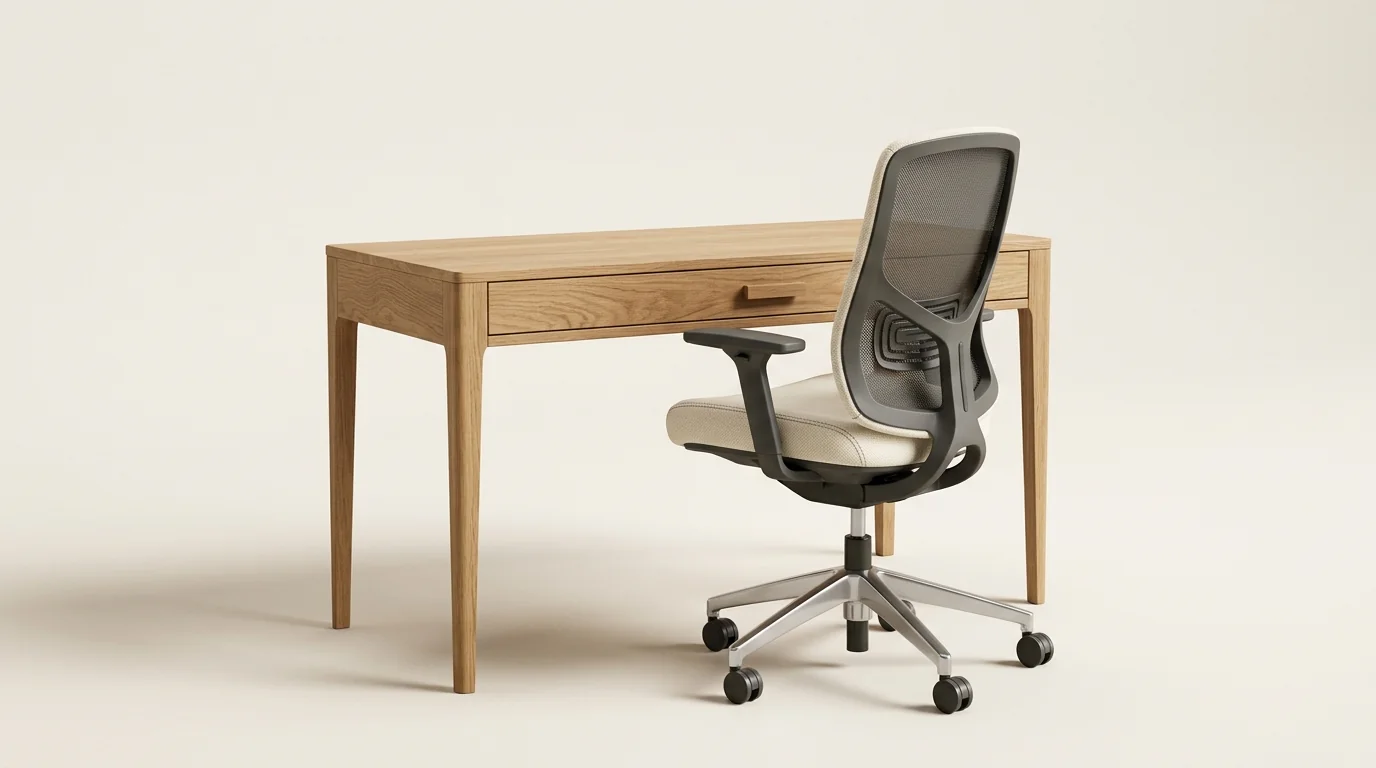
The mid-range home office pair: oak desk ($300–$500) and ergonomic chair ($350–$600). Generated with MeltFlex.
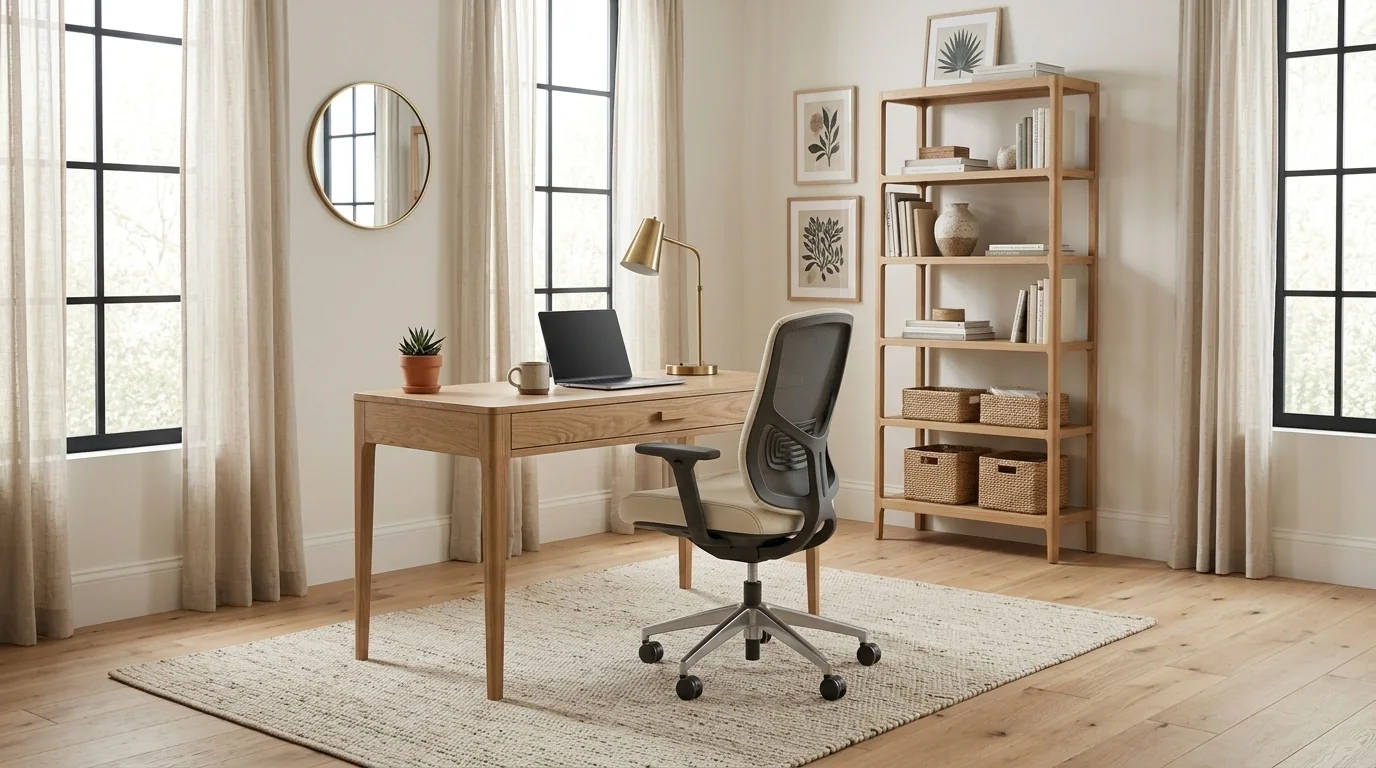
The same pair in a furnished office, plus a tall oak bookshelf ($200–$400). Designed with MeltFlex.
A desk costs $40 to $200 budget, $200 to $700 mid-range, and $700 to $2,000 or more for standing desks and executive pieces. Office chairs deserve more respect than they get: a basic task chair is $100 to $250, the ergonomic mid-market averages $250 to $850, and premium chairs like the Herman Miller class start at $1,000. If you sit eight hours a day, the chair follows the mattress rule: cost per hour of use makes the mid-range tier the cheap option. Bookshelves round out the office at $60 to $120 for the IKEA BILLY class and $120 to $500 for most freestanding units.
Where to Spend and Where to Save
Fifteen line items is a lot to hold in your head, so here is the compressed version we give people planning a whole room:
- Overspend on: the sofa and the mattress. Daily contact, biggest quality gap, most expensive to replace. Together they should eat 30 to 40 percent of a full-room budget.
- Buy mid-range: bed frame, dining table, dresser, office chair. These are the pieces where the middle tier lasts nearly as long as premium at half the price.
- Save on: coffee table, TV stand, nightstands, bookshelf, accent chair. Nothing about a $90 nightstand ruins a room, and each one upgrades painlessly later.
- Watch the multipliers: dining chairs and rugs. They hide in the budget as single line items and then multiply.
For context on how these pieces add up to full rooms, the averages run $4,000 to $6,000 for a living room, $2,000 to $5,000 for a bedroom, and $1,500 to $4,000 for a dining room, and HomeAdvisor puts the average cost of furnishing an entire home at $16,000, with most homes landing between $10,000 and $40,000. Our house furnishing guide breaks that down room by room.
When to Buy in the Rest of 2026
Timing matters more than usual this year, because the calendar has a hard deadline in it. Here is how the remaining buying windows stack up:
- Labor Day weekend (September 5 to 7). The last big summer clearance. Retailers flush floor models and outgoing collections, and sofas and mattresses are the two categories with the deepest cuts, typically 20 to 40 percent off list.
- Black Friday and Cyber Monday (late November). Historically the best furniture prices of the year, and 2026 adds a twist: it is the last major sale event before the upholstered-furniture tariff rises from 25 to 30 percent on January 1, 2027. Retailers know their replacement inventory will cost more, so expect them to push volume hard.
- December floor-model clearances. Showrooms clear space for January collections. Good for solid wood and case goods, thinner for upholstery.
- What not to wait for: January 2027. Between the tariff step-up and new-collection pricing, early 2027 is set up to be the most expensive furniture quarter in over a year. If a big upholstered purchase is on your list, make it in 2026.
See the Price Tier Before You Pay For It
Price ranges are abstract until you see what they buy in your own space. This is the part we built MeltFlex for: upload a photo of your room and the AI furnishes it with realistic pieces at correct scale, so you can compare what a $1,500 living room actually looks like against a $4,000 one in your exact space, with your windows and your light, before a single dollar leaves your account. Every room render in this post was made that way, and generating one takes about 30 seconds.
It also solves the quieter problem behind every furniture purchase, which is not price but doubt. Seeing the sofa in the room, at scale, next to the rug you are considering, answers the question a price tag never can: will this actually work here? Our try-before-you-buy guide shows the full workflow.
Try it free. Upload your room, set a budget tier, and see what the money buys before you spend it. Over 213,000 people have designed their spaces with MeltFlex.
Frequently asked questions
How much does a couch cost in 2026?
A budget three-seat sofa costs $300 to $800, a mid-range one runs $800 to $2,000, and a premium sofa costs $2,000 to $5,000 or more. Most people who want a sofa that lasts 10 years or longer end up spending $1,500 to $3,000. Sectionals run higher: about $1,000 to $1,500 at the budget end and $1,500 to $5,000 for a good mid-range one.
How much should I spend on a mattress?
A queen mattress costs $500 to $800 at the budget end, $800 to $2,000 mid-range, and $2,500 to $3,500 or more for luxury latex, airbed, or adjustable models. Sleep Foundation puts the average queen at $1,000 to $2,000. The mid-range tier is where most people should land: all-foam queens run $700 to $1,200 and quality hybrids $1,500 to $2,200, and both should last 7 to 10 years.
How much does a full bedroom furniture set cost in 2026?
A bedroom furniture set (bed, dresser, nightstands) costs about $800 to $3,000 from mainstream brands like Ashley, while IKEA sets start around $379. Furnishing a full primary bedroom from scratch, including the mattress, runs $2,000 to $5,000 according to HomeAdvisor 2026 data, and $3,000 to $6,000 for a solidly mid-range version.
How much does a dining room set cost in 2026?
A dining table with chairs costs $500 to $5,000 as a set, with IKEA five-piece sets running $830 to $1,700. Broken out, a budget dining table costs $150 to $500, a mid-range one $500 to $2,000, and solid wood tables $2,000 to $6,000, plus $100 to $300 per mid-quality chair. Furnishing a full dining room runs $1,500 to $4,000 on average.
Are furniture prices going up in 2026?
Furniture prices spiked in 2025 and have cooled in 2026. A 25 percent tariff on imported upholstered wooden furniture took effect in October 2025, and BLS data shows living, kitchen, and dining furniture prices peaked at 9.5 percent year-over-year inflation in August 2025 before easing to just 1.1 percent in the July 2026 CPI. Prices even dipped 0.5 percent from June to July 2026. The scheduled tariff increase to 30 percent was delayed to January 2027, so 2026 prices are elevated but stable. Buying before 2027 avoids the next scheduled increase.
Is it cheaper to buy a furniture set or individual pieces?
Sets are usually 10 to 20 percent cheaper than buying the same pieces individually, and they arrive in one delivery. The trade-off is a matched look that can feel flat and pieces you may not need. The middle path most designers suggest: buy the two anchors (sofa, bed) where the set discount is biggest, then add the smaller pieces individually so the room does not look like a showroom floor.
What furniture is worth spending more on?
The sofa and the mattress. You touch both every single day, they carry the biggest quality gap between cheap and mid-range, and they are the most expensive to replace. A $400 sofa typically lasts 3 to 5 years while a $1,500 one lasts 10 to 15, so the mid-range sofa is usually cheaper per year of use. Coffee tables, nightstands, bookshelves, and TV stands can start cheap and get upgraded later without hurting daily life.
How can I see furniture in my room before buying it?
Upload a photo of your room to MeltFlex. The AI places realistic furniture at correct scale in your actual space, so you can compare a $1,000 setup against a $3,000 one in the same room before spending anything. It takes about 30 seconds per design and it is free to try.
Sources and further reading
- Bureau of Labor Statistics, Consumer Price Index, living, kitchen, and dining room furniture series (CUUR0000SEHJ02), year-over-year changes January 2025 through July 2026 computed from the public BLS API. The July 2026 CPI was released August 12, 2026.
- Thompson Hine SmarTrade, President Trump Delays Section 232 Tariff Increase (January 2026), including the 10 percent UK and 15 percent EU and Japan tariff caps.
- Bureau of Labor Statistics Consumer Expenditure Survey via FRED: average household spend of $648 on furniture and $2,414 on household furnishings and equipment in 2024.
- HomeAdvisor, Cost to Furnish a House (updated June 2026): $16,000 average, per-room ranges.
- Home Furnishings Association, Section 232 furniture tariff advocacy update, and the December 2025 White House proclamation delaying the 30 percent tariff to January 2027.
- NPR, “Furniture prices and Trump tariffs” (November 2025), including the BLS long-view figures and the $399 sofa anecdote.
- KPMG retailer tariff pass-through survey, as reported by GovFacts (2025).
- Sleep Foundation, How Much Does a Mattress Cost? (2025), mattress tier pricing.
- Awning, Cost to Furnish a House (April 2026), per-item cost ranges.
- Retailer catalog anchors current as of mid-2026: IKEA, Wayfair, Ashley Furniture, Living Spaces, Home Depot. Treat individual retailer prices as directional tier anchors rather than market averages.