Free tool
Furniture Fit Calculator
Will your sofa, bed, wardrobe or box spring fit through the door, round the hallway turn, up the stairs or into the lift? Enter the piece and the tightest point on the route and you get the verdict in seconds, in inches or centimetres.
The furniture fit calculator checks whether a sofa, bed, wardrobe or table will physically reach the room it is headed for. Enter the size of the piece and the tightest point on the route, a doorway, a hallway turn, the stairs or the lift, and it tells you whether it fits, whether you need to tilt it or take the legs off, or whether to find another way in. It is free, works in inches or centimetres, and takes under a minute. The calculation behind each verdict is written out in plain English further down the page.
Furniture fit guide
Measure once, deliver without the drama
There is nothing worse than the moment the truck arrives and you wonder whether it will actually fit. A few careful measurements now prevent failed deliveries, damage and returns. Here is exactly what to measure, step by step.
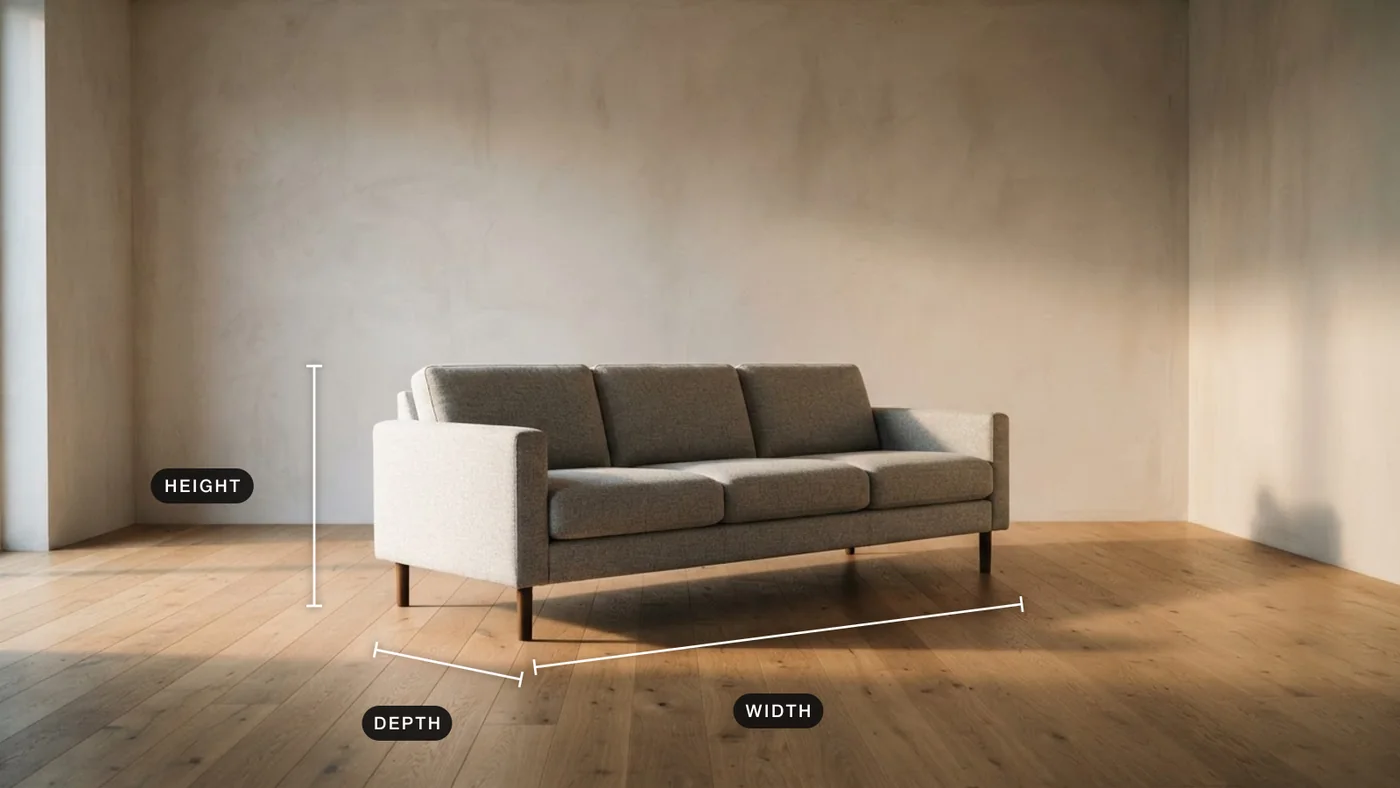
Step 1
Measure the furniture
You need three numbers, taken at the widest, deepest and tallest points, arms and cushions included.
- Width: side to side, the longest face.
- Depth: front to back, at the deepest point.
- Height: floor to the top of the back.
- The smaller of the depth and the height is the one that has to clear the opening. On most sofas that is the height.
- Add 1 to 2 in (3 to 5 cm) for packaging, and use the single widest point on curved pieces.
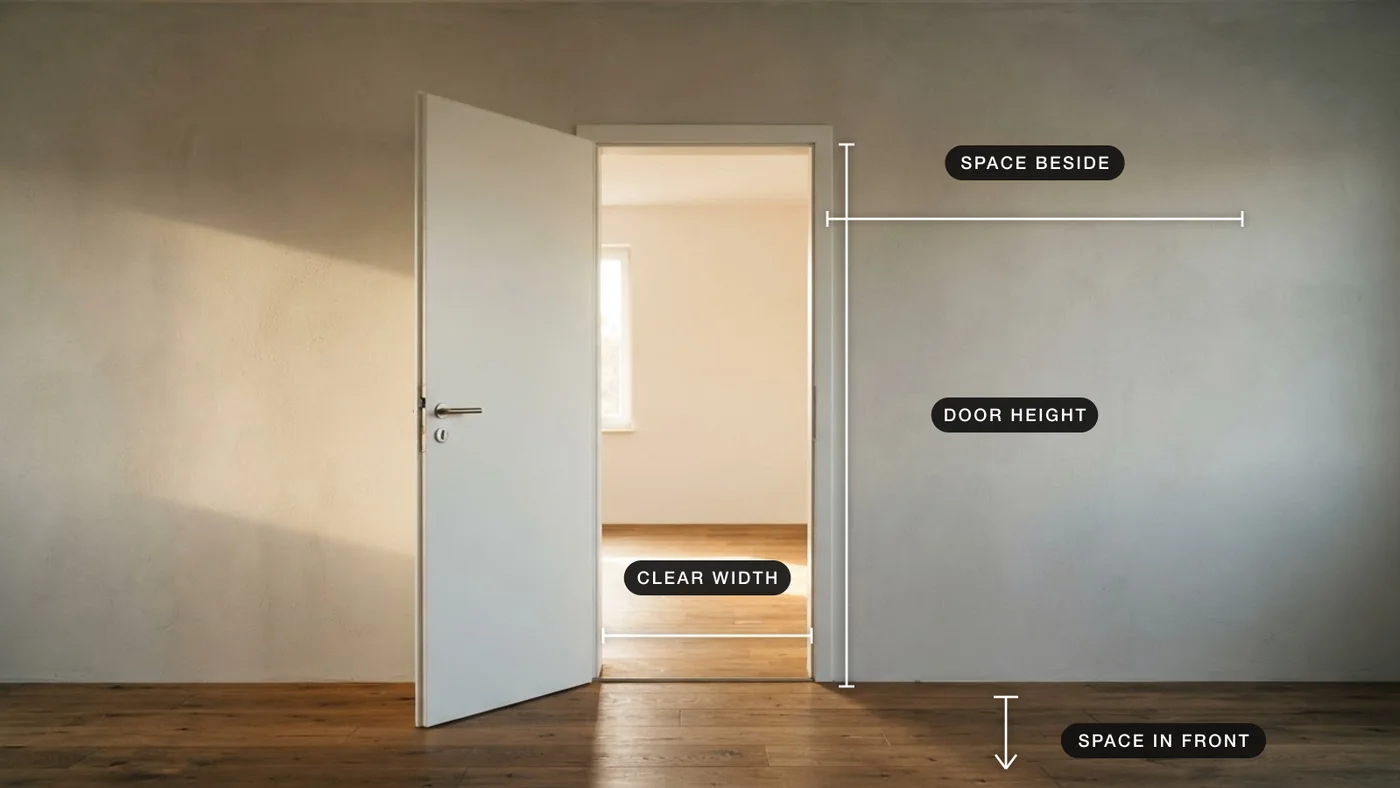
Step 2
Doorway fit
The size printed on a door is not the gap you get. Measure the real clear opening with the door standing open.
- Clear width: jamb to the face of the open door, not the nominal size.
- Door height: floor to the top of the frame.
- Space beside the door: room to swing a corner through.
- Space in front: room to tilt and pivot a long piece, roughly half its length.
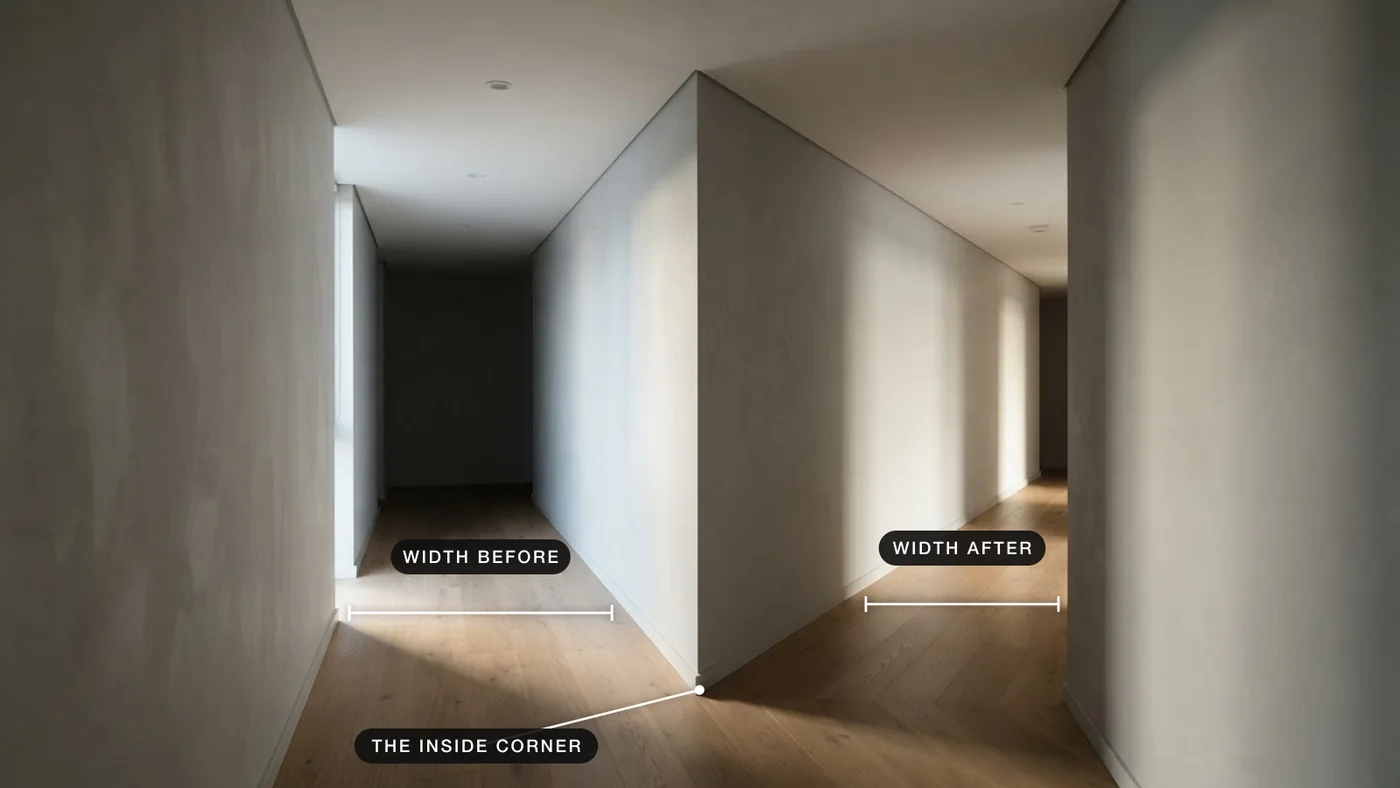
Step 3
Hallway turn
A right-angle turn stops more furniture than the door does. Two corridor widths decide whether a long piece can swing round.
- Width of the corridor you come from, wall to wall.
- Width of the corridor you turn into.
- The narrower of the two has to be wider than the slimmest side of the piece.
- Skirting boards, radiators and light switches all count as the wall.
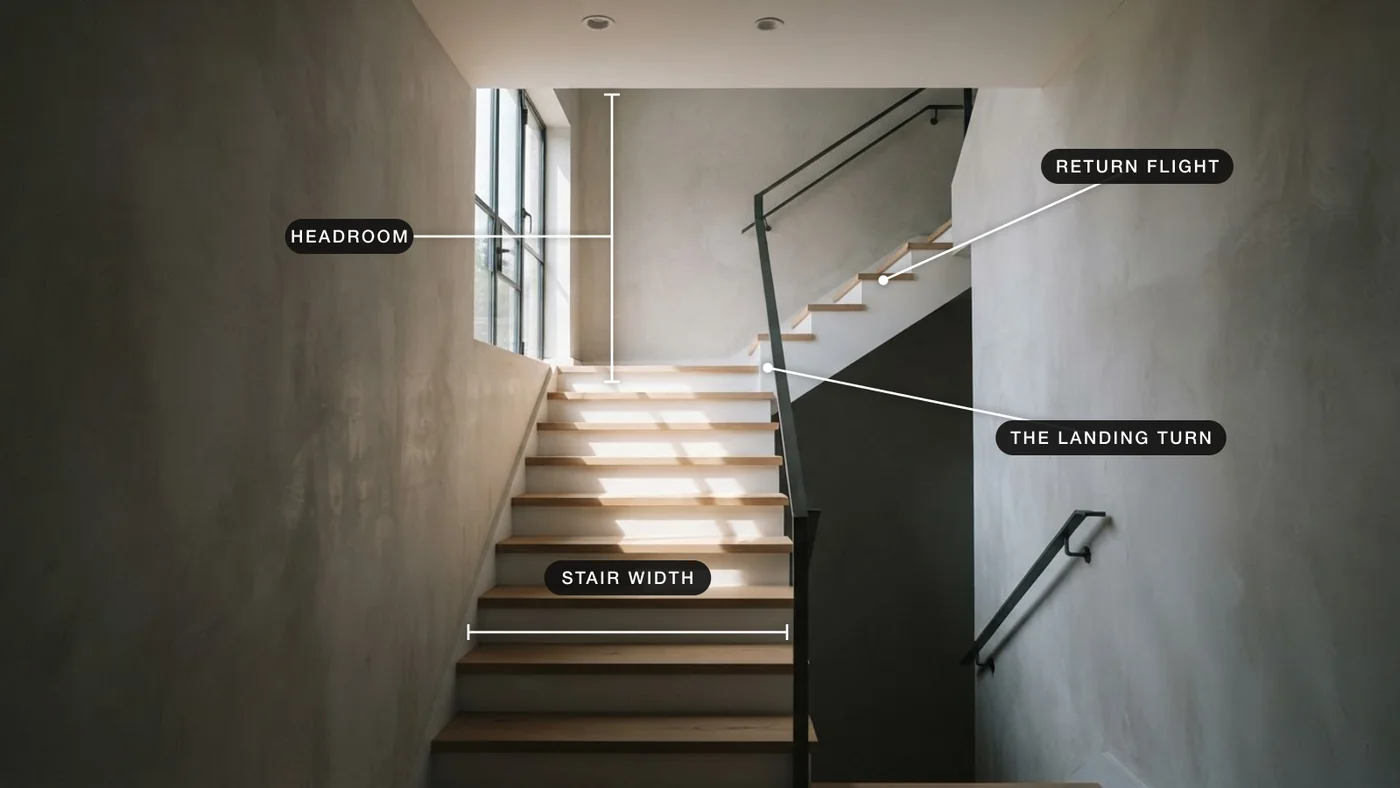
Step 4
Staircase fit
Stairs strand more furniture than doors. The width, the headroom and the landing turn decide it.
- Stair clear width between the walls or the rail.
- Headroom from the step nosing to the ceiling or soffit.
- Landing depth at any turn, plus the number of turns.
- Step rise and tread, and the total number of steps.
Step 5
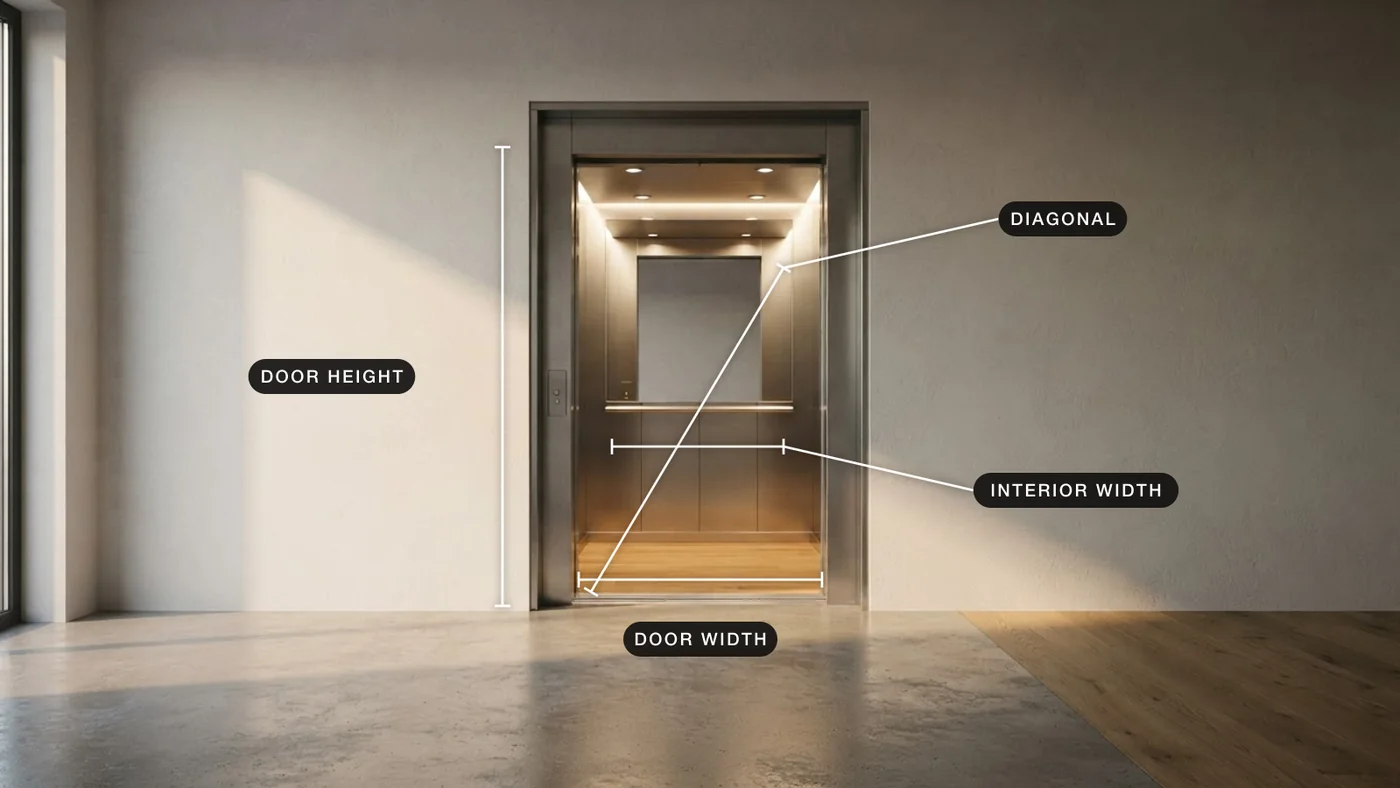
Elevator fit
A lift has to let the piece through the car door and then hold it inside, on the diagonal if needed.
- Car door width and height, which are smaller than the car.
- Interior width, depth and height of the cabin.
- Diagonal clearance, bottom front corner to upper back corner.
- Leave room for the piece and the person carrying it.
Reference
What a door actually gives you
A door is sold by the size of the slab, not the size of the hole. With the door standing open at ninety degrees, the leaf and the stop eat 1.5 to 2 in (4 to 5 cm) out of the opening, which is why a “32 inch door” refuses a 32 in piece. Lift the door off its hinges and you get most of that back.
| Nominal door | Clear opening | Metric | What it means |
|---|---|---|---|
| 24 in / 610 mm | 22 to 22.5 in | 56 to 57 cm | Cloakroom and cupboard doors. Almost nothing large passes. |
| 28 in / 711 mm | 26 to 26.5 in | 66 to 67 cm | Bathrooms. A washing machine (27 in) does not go through flat. |
| 30 in / 762 mm | 28 to 28.5 in | 71 to 72 cm | The commonest UK internal door. Most sofas need a tilt. |
| 32 in / 813 mm | 30 to 30.5 in | 76 to 77 cm | Common US bedroom door. A 30 in fridge is borderline. |
| 36 in / 914 mm | 34 to 34.5 in | 86 to 88 cm | Front and patio doors. A standard fridge clears with the doors off. |
The pieces that get stuck, and the number that decides
These are the standard sizes behind the presets in the calculator. If you have not measured yet, start here, then check your own piece: the same model can vary by several inches between makers, and the deciding number is almost never the one on the price tag.
| Piece | W × D × H | Metric | The number that decides |
|---|---|---|---|
| Sofa, 3-seat | 84 × 38 × 34 in | 213 × 97 × 86 cm | Height, not length |
| Loveseat | 60 × 38 × 34 in | 152 × 97 × 86 cm | Height, not length |
| Queen mattress | 80 × 60 × 12 in | 203 × 152 × 30 cm | It flexes, so rarely the problem |
| Queen box spring, one piece | 80 × 60 × 9 in | 203 × 152 × 23 cm | 60 in width, and it cannot bend |
| Split box spring, one half | 80 × 30 × 9 in | 203 × 76 × 23 cm | Goes anywhere a twin goes |
| Refrigerator, French door | 36 × 30 × 69 in | 91 × 76 × 175 cm | 36 in width, 33 in with the doors off |
| Washing machine | 27 × 30 × 39 in | 69 × 76 × 99 cm | 27 in plus the hoses at the back |
| Wardrobe, assembled | 40 × 22 × 75 in | 102 × 56 × 191 cm | Height at the stair turn |
Under the hood
How the calculator decides
No black box. Each scenario runs a different piece of geometry, and it is worth knowing which one is judging you.
- Doorway. It sorts the three furniture dimensions and compares the two smallest against the clear opening. If both clear it, the piece slides straight through. If not, it compares the diagonal of the piece’s end face against the diagonal of the doorway, because a tilted pivot uses the full height of the opening, not just its width.
- Hallway turn. The longest object that can round a right-angle corner between corridors of width A and B is (A^(2/3) + B^(2/3))^(3/2), the classic ladder-around-a-corner limit. Real furniture has thickness and does not bend, so the tool treats anything above three quarters of that figure as tight rather than safe.
- Stairwell. Width first: the slimmest side of the piece has to clear the stair. Then the half-landing, which has to be deeper than that same side or the piece cannot rotate at the turn. Then the length against the stair width plus the landing depth, which is the space you actually have to swing it round in.
- Elevator. Two separate tests. It has to pass the car door, which is always smaller than the car, and then fit inside standing up, stood on the floor diagonal, or lying flat. Failing the door sends you to the stairs; failing the interior usually means angling it corner to corner.
- Room fit. Not physics but proportion: a piece under two thirds of the wall it sits against, leaving at least 36 in (91 cm) of walkway in front, reads as balanced. Above that it fits but dominates.
- Preset physics. Choosing a box spring changes the verdict, not just the numbers. A box spring is a rigid frame, so a tight result is treated as a no, while an all-foam mattress is allowed to flex around a tight spot.
Buying a sofa
Sofas are the piece people get wrong
The depth and the soft, hookable shape behave differently from a rigid box, so sofas have their own tool and guide: the sofa fit calculator walks through measuring, the tilt trick and the route, the short answer on whether a couch will fit through the door covers the quick version, and what size sofa suits your living room deals with the question you should answer before the door one.
Moving a bed
Box springs are the piece that cannot bend
A mattress flexes around a tight staircase turn; a box spring is a rigid frame that either fits the geometry or does not, which is why a one-piece queen is the single most commonly stuck item on moving day. The calculator has presets for every standard box spring size, one-piece and split, and treats a tight verdict as a no for them. When yours does not fit, the guide on what to do when a box spring will not fit covers split box springs, folding foundations and the fixes that beat the staircase, and the mattress fit guide handles the half of the bed that does bend.
Appliances
Appliances are measured at the cabinet, not the handles
A fridge listed at 36 in is 36 in across the cabinet; the handles and the door hinges add two or three inches that come straight off again when you unbolt them. The same trick works for a washing machine, where the real constraint is often the gap behind for the hoses rather than the doorway. Full detail in will my fridge fit through the door, or take the short answer on fridge clearances, with quick answers for a washing machine and a wardrobe.
Keep reading
Guides for the piece you are moving
Frequently asked questions
Will a 40 inch wide sofa fit through a 32 inch door?
Usually yes. The 40 in is the length across the front, and nobody carries a sofa through a door flat. Turn it so the depth and height face the opening (typically 38 × 34 in), stand it on one end and lead with a corner. A 32 in door gives about 30.5 in of clear width, and the diagonal of that opening is roughly 86 in against about 51 in for the end of the sofa, so there is room to pivot. Take the legs off for another 4 to 6 in and lift the door off its hinges for 1.5 to 2 in. It only gets genuinely tight when the sofa is deeper than about 40 in, or the hallway in front of the door is shorter than half the length of the sofa.
How accurate do my measurements need to be?
Very accurate. The calculator is only as good as the numbers you give it, and an error of an inch can change the result. Measure each space twice and pay attention to the narrowest point of every doorway, hallway and turn, not the average.
Do I measure the door or the doorway?
The doorway, with the door standing open. A door leaf takes 1.5 to 2 in (4 to 5 cm) out of the opening when it is open at ninety degrees, which is why a nominal 32 in door only gives about 30.5 in of clear width. Lifting the door off its hinges gives that back and is the cheapest inch you will ever find on moving day.
Does it work for furniture with curved arms or odd shapes?
It is most accurate for box-shaped items, because it treats the piece as a rectangle. For curved arms, rolled backs or angled legs, use the single widest and deepest points and treat the result as a careful estimate rather than a promise.
What is the hardest part of getting furniture into a home?
Usually not the door. It is the ninety degree turn in a hallway or the half-landing on a staircase, where a long piece has to swing around a corner and the ceiling stops you tilting it. Always measure the whole route, including the lift and the stairs, not just the doorway.
Does the calculator work in centimetres?
Yes. Switch the unit toggle from inches to cm and enter every measurement in centimetres. The verdict, the clearances and the tilt diagonal all update in the same unit.
Will a queen box spring fit up my stairs?
Pick the queen box spring preset and run the stairwell scenario with your stair width, landing depth and headroom. Because a box spring cannot bend the way a mattress can, treat a tight verdict as a no: the practical fix on staircases with turns is a split box spring, two 30 by 80 in halves that carry like a twin.
What if it says it fits but the delivery team cannot get it in?
This is rare and usually comes down to an un-measurable obstacle or a measurement slip. The tool is a guide, and the final responsibility for the fit is yours. Measure carefully, and when in doubt, see the piece at true scale in your room first with MeltFlex.
A guide, not a guarantee. The calculator treats furniture as a box, so curved arms, fixed legs, thresholds and how far a piece can really be tilted can all change the outcome. Measure carefully, double-check the narrowest points, and the final call on any delivery is yours. Last reviewed 9 August 2026.
Stop guessing. See it in your room.
A calculator proves it fits the door. A picture proves it fits your life. Upload a photo of your room to MeltFlex and try the real furniture, at true scale, before you spend a cent.
Try MeltFlex free
