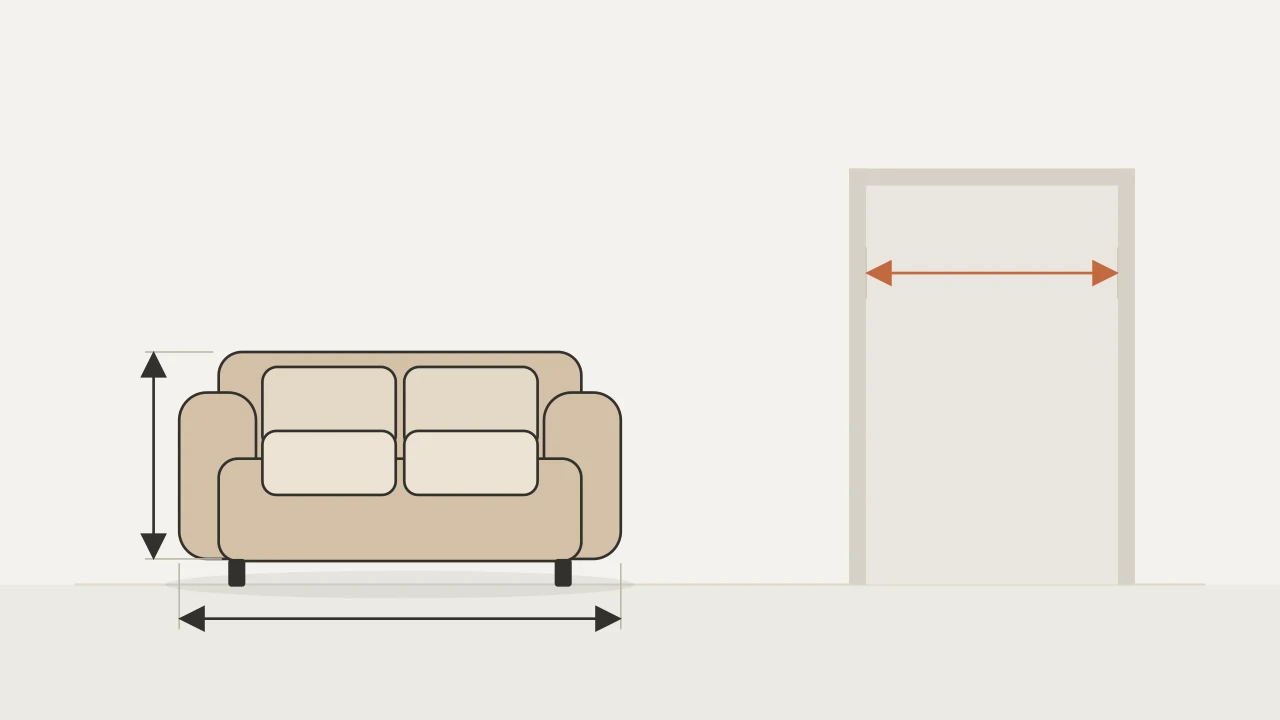
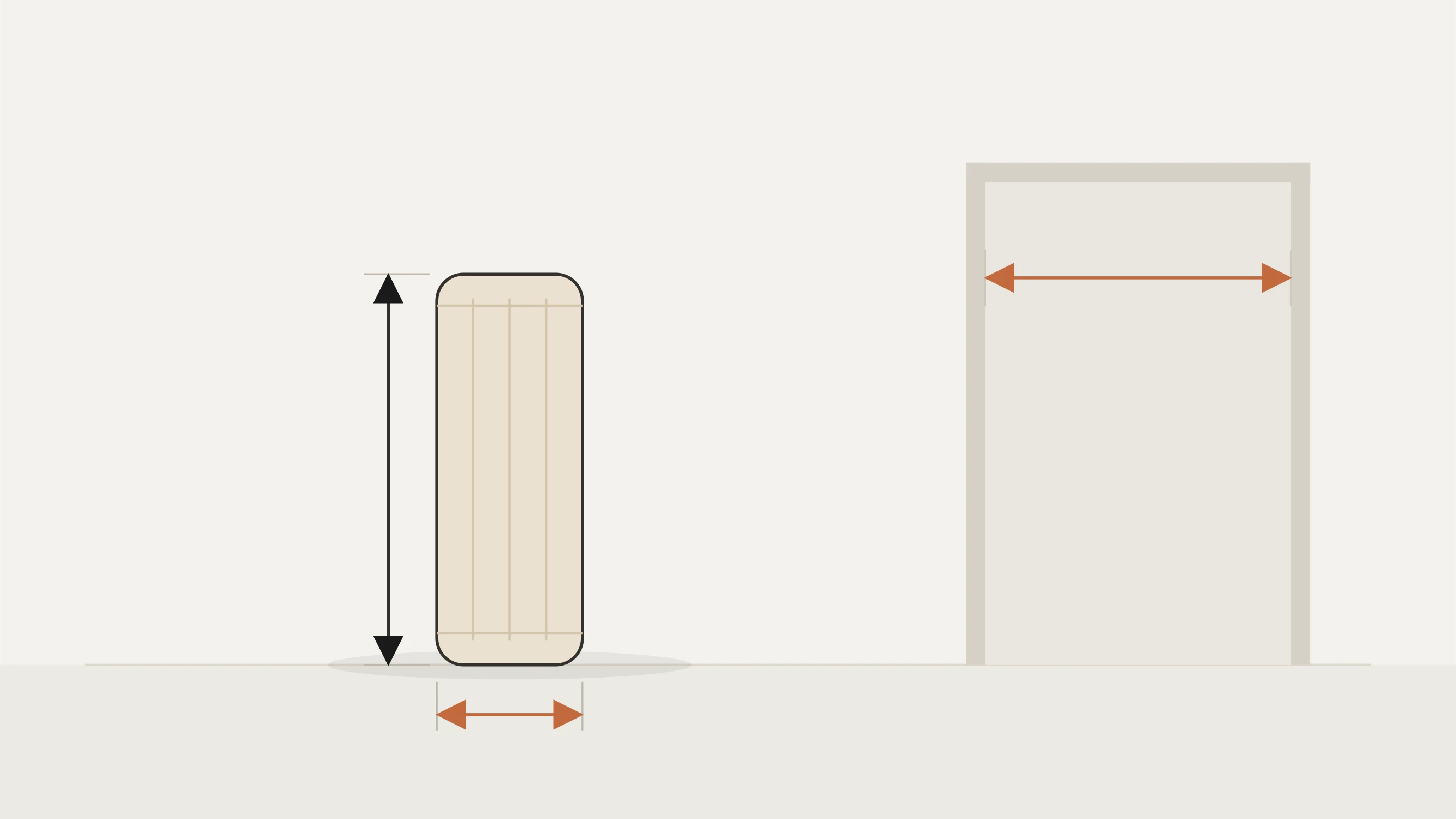
Quick answer: Yes, almost always. Stand the mattress on its long edge and the only number fighting the door is its thickness, usually 10 to 14 inches, which clears a 30 inch opening with room to spare. The big width and length numbers run along the tall 80 inch side of the frame, so they never matter. The real trouble is not the mattress at all: it is a rigid box spring and the turn at the top of the stairs. Use the free mattress fit calculator below for an instant verdict.
Our articles are still written by humans!
Get human written articles in your Google feed.
People panic about a mattress the same way they panic about a sofa, and they stare at the same wrong number. They see queen, 60 by 80 inches, or king, 76 by 80, on the bed sizes chart and decide there is no way that passes a door. But a mattress is not a rigid box. Turn it on its side and those two big numbers stand up tall and thin against the 80 inch height of the doorway, while the slim dimension, the thickness, is all that has to clear the width. That single move is why a mattress almost always goes through, and why the thing that actually strands a bed is the box spring and the staircase, not the mattress.
The check takes a tape measure and two minutes, and it is worth doing, because wrong size is the leading reason furniture gets sent back, and a mattress returned for a fit problem is a slow, expensive unwind (ecommerce returns data). Start here.
Interactive calculator
Loading… if it does not appear, refresh the page.



The one move that changes everything: stand it on its edge
Carry a mattress flat and it is a 60 or 76 inch wide slab that will not pass anything. Stand it on its long edge and it becomes a tall, thin panel. Now the height of that panel runs up the tall 80 inch side of the doorway, and the only dimension facing the width of the opening is the thickness, front to back through the foam and springs. A normal mattress is 10 to 14 inches thick, and even a deep pillow top rarely passes 16, so against a 30 inch clear opening you have more than a foot of slack. That is the whole trick, and it is why the answer is almost always yes.
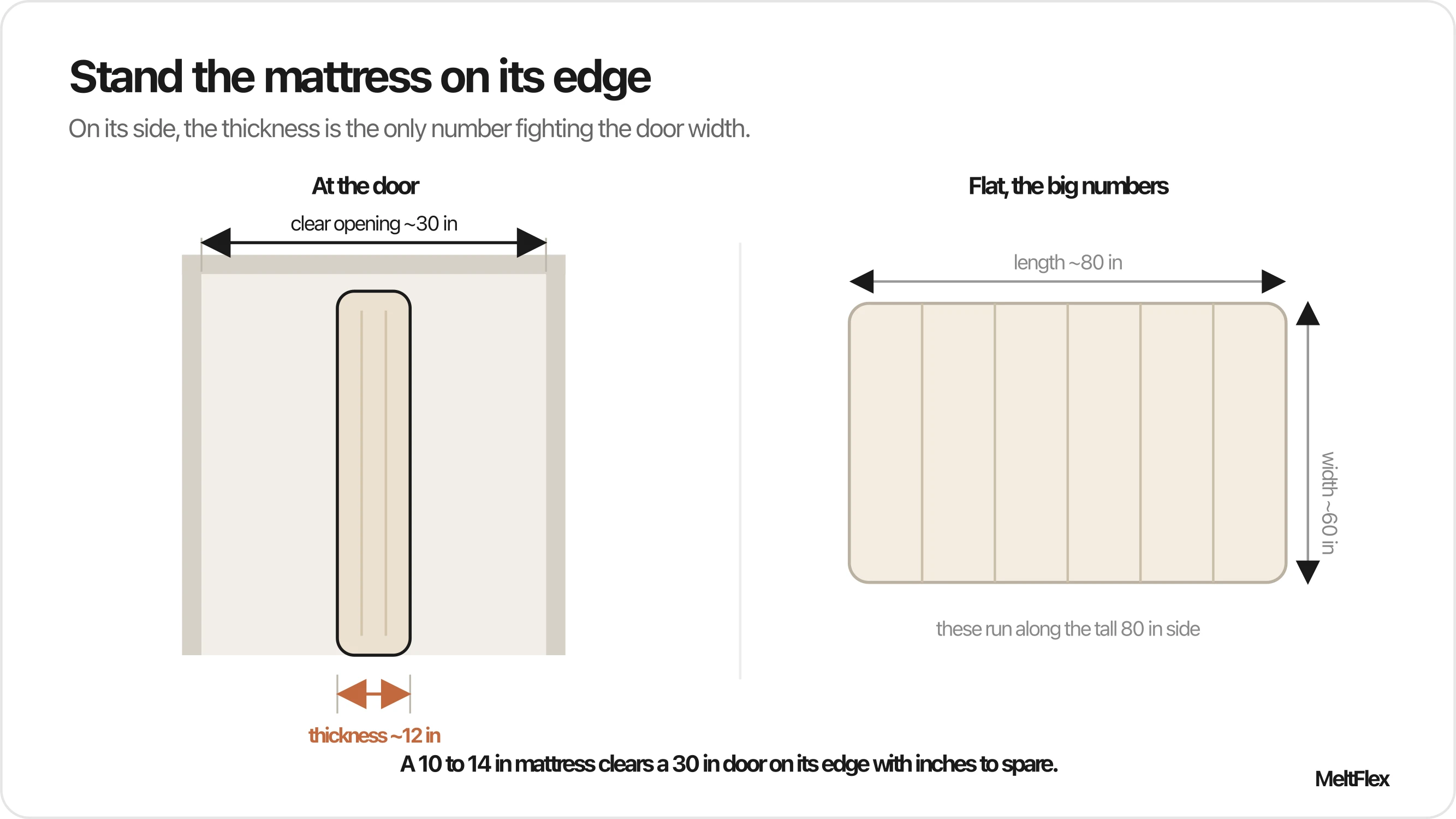
The three numbers to measure
Forget the headline width and length for the doorway. Take these instead, rounding up:
- Mattress thickness: front to back at its deepest. This is the only number that fights the door, so it is the one the calculator cares about most.
- Mattress width: this becomes the standing height when the mattress is on its long edge, so it is what has to clear the 80 inch header. A king stands 76 inches tall on edge, the closest of any size to the header.
- The route: the narrowest clear opening, the tightest hallway turn, and the stairs, including the half landing and the ceiling above the top step. The narrowest point on the whole path is your real limit.
Every mattress size, and the one to watch
Because thickness is the deciding number, the size barely changes the door answer at all. Where size matters is the standing height on edge against the header, and the turn on the stairs. Here is the whole field, stood on its long edge.
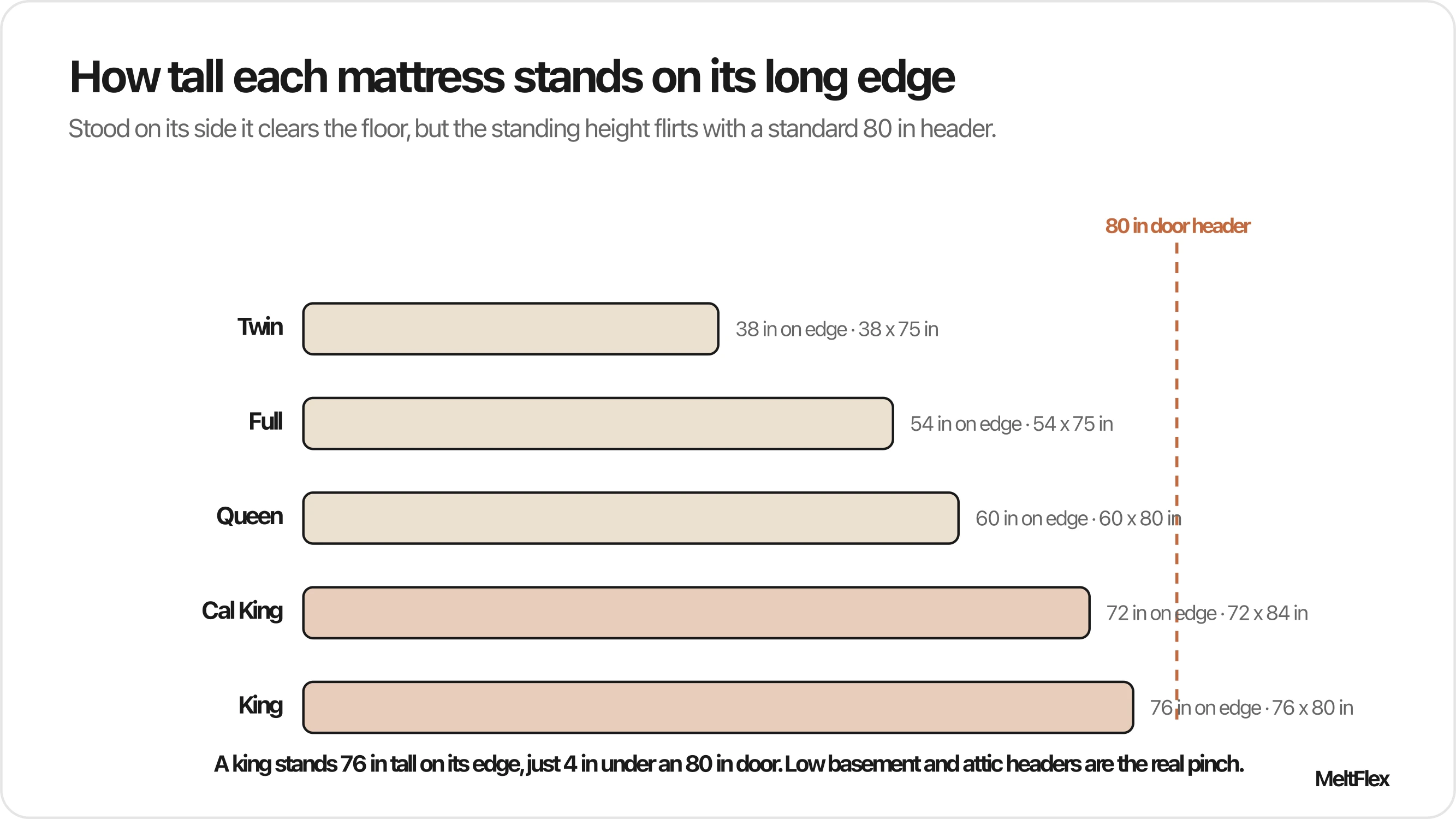
The takeaway: a king stands 76 inches tall on its edge, just 4 inches under a standard 80 inch door header, so a low header on a basement or attic conversion is the one place a mattress itself can catch. Everywhere else, it is not the mattress you should worry about.
The trap: the door size is not the gap you get
A mattress has so much slack at the door that this rarely bites, but it is worth knowing, because it is the same trap that sinks sofas. The number stamped on a door is not the space you get. A US interior door sold as 32 inches gives a real clear opening of about 30 to 31 inches once you account for the stop and the open leaf. Measure the gap with the door wide open, far edge of the door to far edge of the frame.
Even the tightest of these clears a 14 inch mattress on edge with room left over (UK door sizes). The clear opening only becomes the story when a rigid box spring is the thing you are carrying, which is the next part.
The real villain: the box spring, not the mattress
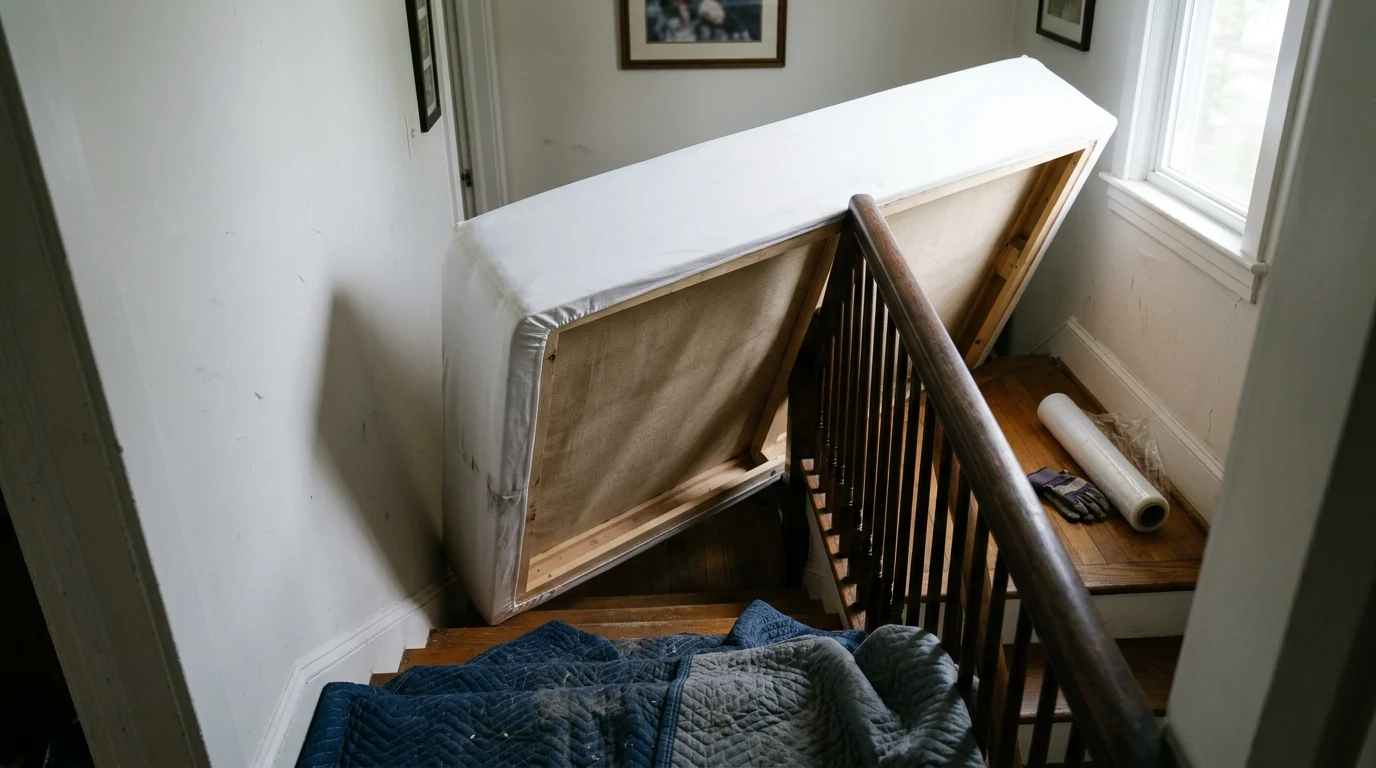
Here is the part the panic gets backwards. The mattress is the easy half. The piece that actually wedges on a landing is the box spring, because unlike a mattress it is a rigid timber frame. It will not tilt thin, it will not bow round a corner, and a standard queen box spring is 60 by 80 inches of unbending wood. On a straight run it is fine, but at a 90 degree turn or a half landing it simply cannot rotate.
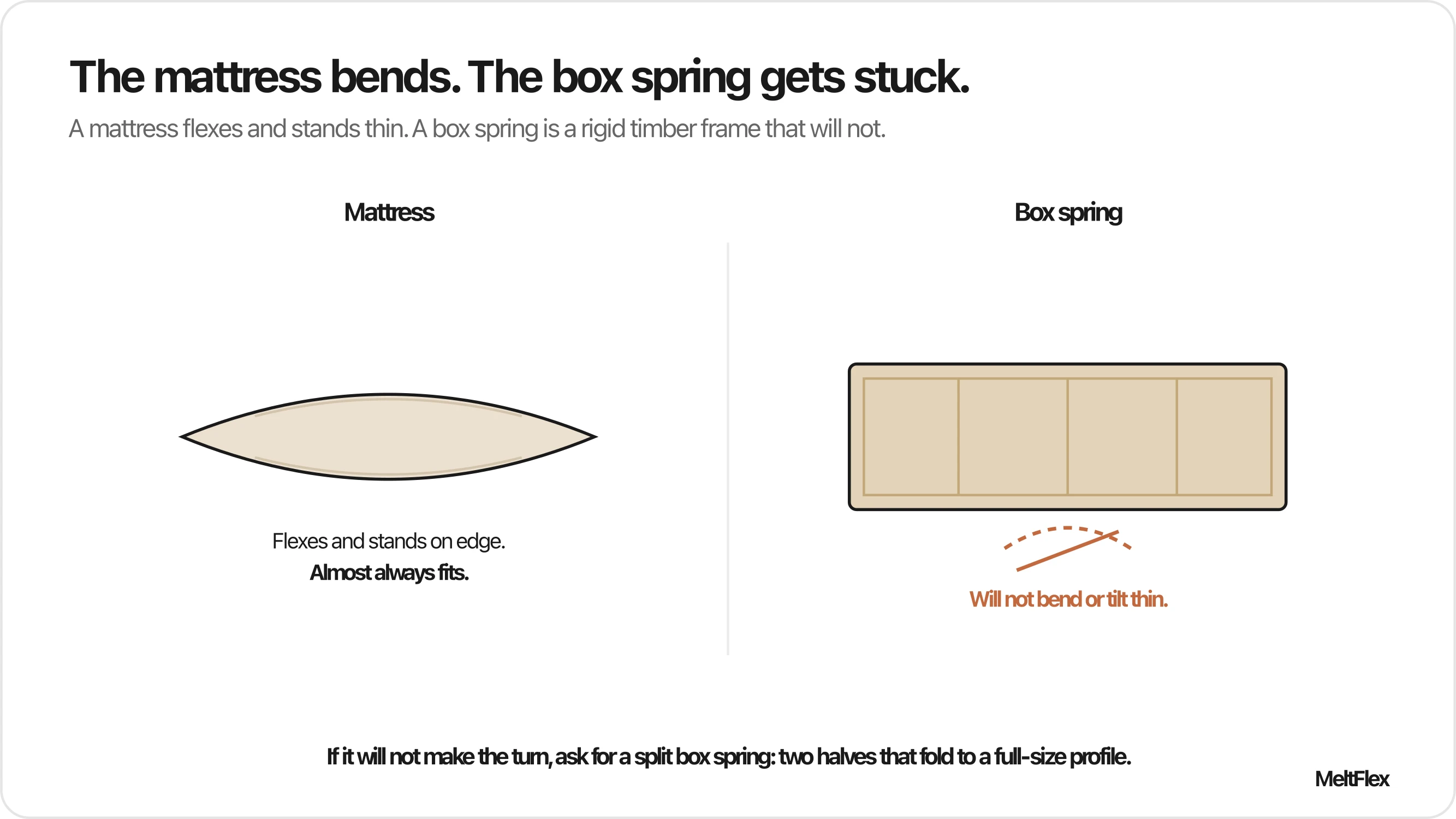
There are two clean fixes. The first is to order a split box spring from the start, which is two halves that each take a full size profile and clear almost any staircase, and on a king it is often standard anyway. The second, the last resort movers use, is to cut the internal timber frame at the midpoint so the box spring folds into itself, taking care to cut only the wood and never the wire (This Old House). If you are buying new and the route is genuinely tight, a platform bed with sprung slats skips the box spring entirely. We wrote a dedicated guide with all nine fixes ranked, from free technique to split and folding foundations, in what to do when a box spring won't fit.
It jams at the turn, not on the steps
A straight flight of stairs almost never stops a mattress that fits the width, because on edge it is only its thickness deep and it slides up the slope. What stops a bed is the turn: a half landing where the piece has to pivot through 90 degrees, or a low ceiling at the top that stops you standing it upright to make the swing. Measure the depth of the landing and the headroom above the top step, not just the stair width.
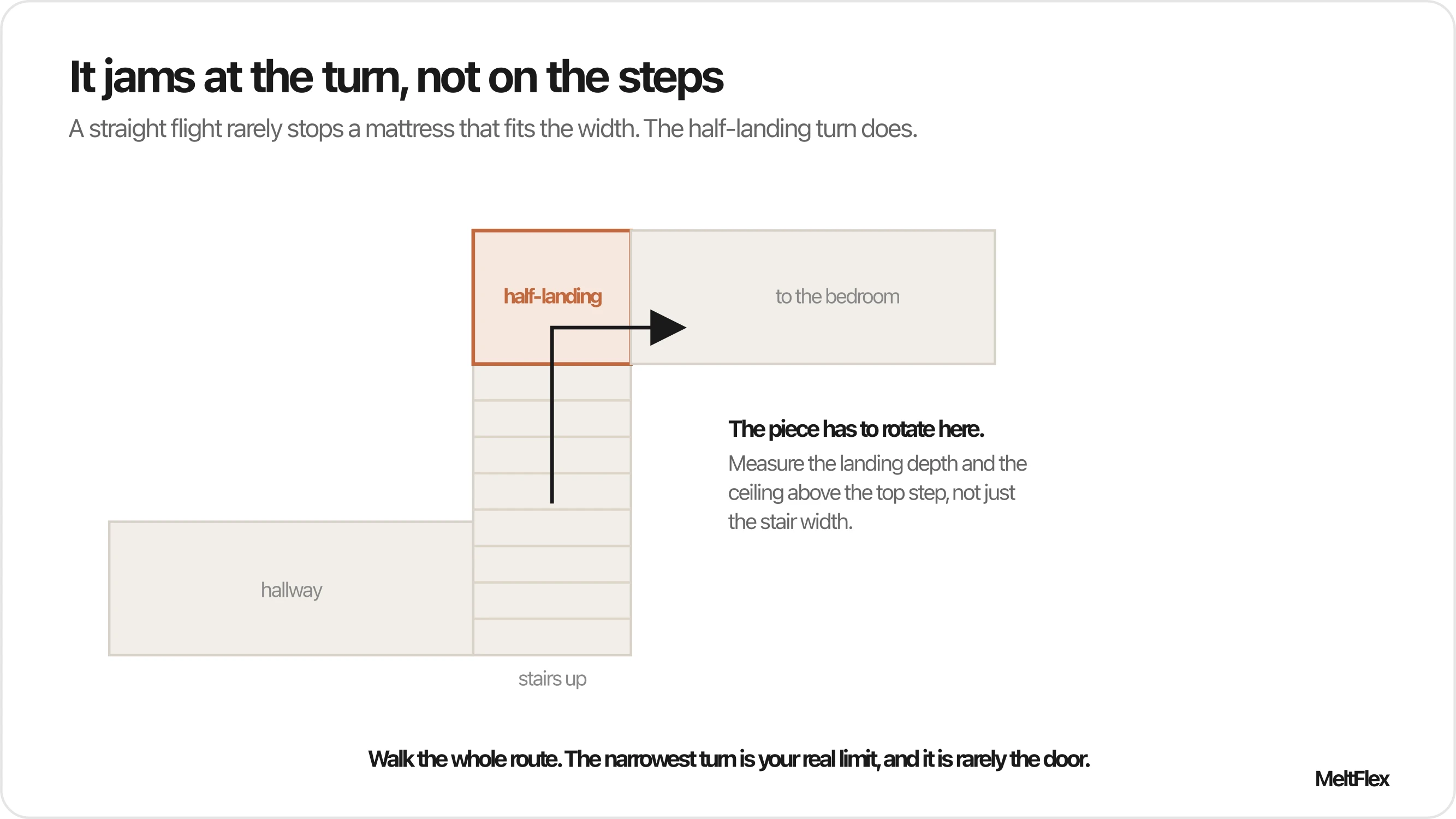
So walk the whole path from the street to the bedroom and write down the tightest number you find: the building entry or lift, every door, the hallway turns, and the stairs with their landings and headroom. The narrowest point is your real constraint. To run those other choke points, a hallway turn, a lift, or the room itself, our general furniture fit calculator works through each scenario in turn.
Can you fold or bend a mattress?
Sometimes, and it depends entirely on what is inside. A foam or hybrid mattress has no rigid border, so you can bow it to get round a tight corner, and an all foam model can even be folded in half briefly and roped, then it relaxes flat with no harm. An innerspring or coil mattress is the opposite: bending it more than about fifteen degrees risks creasing the coils for good and voids most warranties, so it should only ever be stood on edge and angled, never folded (mover guidance). When you tick the foam box in the calculator, it gives you a little more working room for exactly this reason.
When it is tight: where the inches come from
On the rare occasion the calculator says snug or borderline, usually a very thick mattress through an unusually narrow opening, or a box spring on a hard route, you buy clearance in roughly this order:
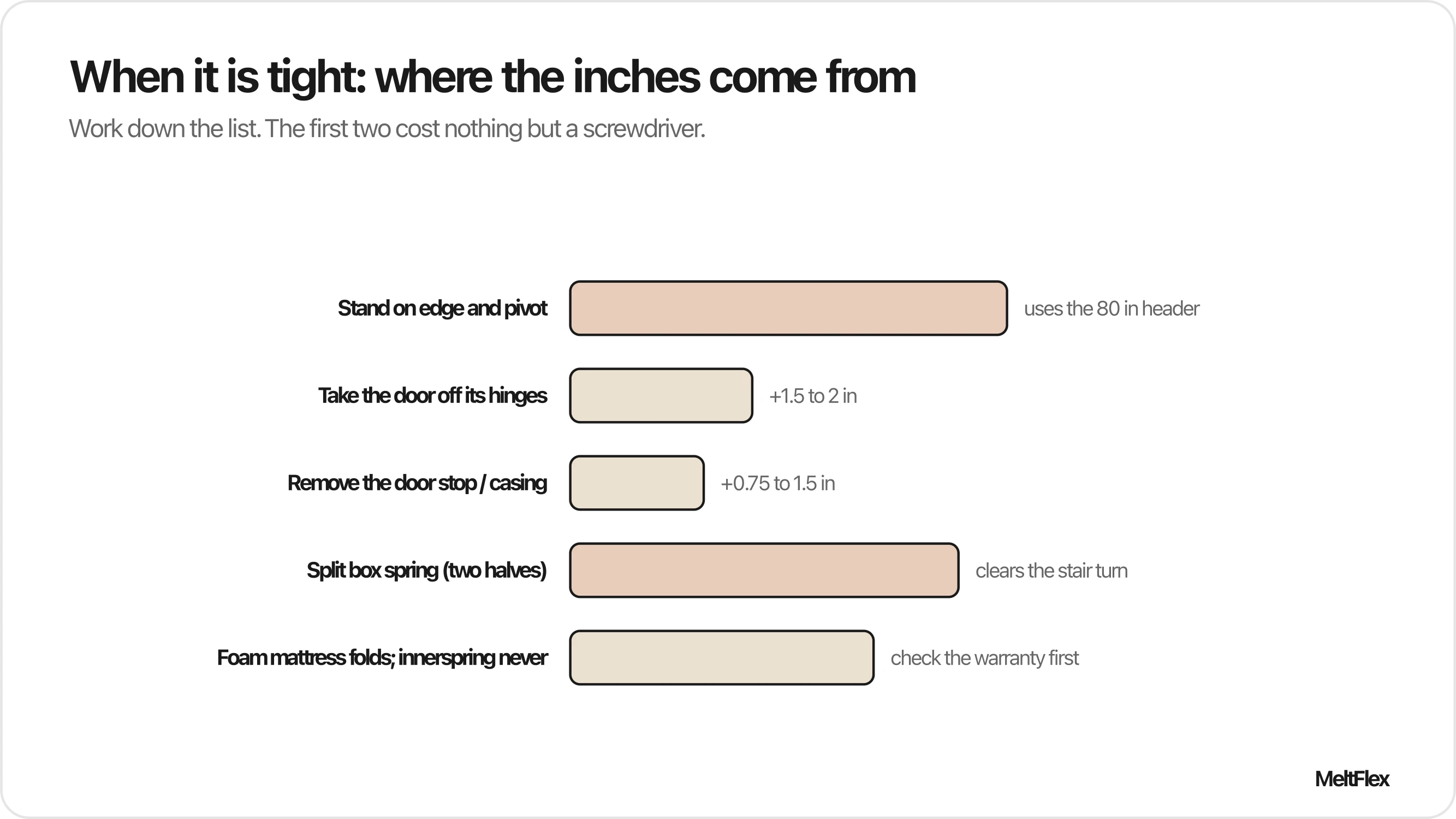
- Stand it on edge and pivot. Free, and it is the whole game. On its long edge the piece uses the tall 80 inch side of every door and turn.
- Take the door off its hinges. Buys 1.5 to 2 inches and gets the handle out of the way. Hinges lift off in a minute with a screwdriver.
- Remove the door stop or casing. Pry off the thin trim for another 0.75 to 1.5 inches at a genuinely tight frame.
- Split the box spring. The single best fix for a stair turn. Order a split version, or fold a cut frame as a last resort.
- Use the material. A foam mattress bows through a corner an innerspring never could. Match the trick to what is inside.
Fitting the door is only half the job
A mattress that slides in perfectly can still land a bed frame that swallows the room. Getting it inside and having it sit right are two different questions, and the second is where the money goes. A few quick rules: leave at least 24 inches of walking space on each side you get out of, keep a clear path to the door and the wardrobe, and remember that a king in a small room leaves almost no floor. For the full set of scale rules, read what size furniture fits my room, and if you are also moving a sofa, the same logic in reverse is in will my sofa fit through the door. If the wardrobe is making the same trip, will my wardrobe fit through the door has the flat-packed versus assembled numbers. And if the old mattress is only going out because of a stain rather than because it has failed, how to clean a mattress is worth reading first: some of what people replace a mattress for is cosmetic and permanent, and some of it is a two-hour job.
The honest shortcut: see the bed in your room first
A tape measure proves the mattress will get in. It still leaves you guessing whether the bed looks right at that size, in your light, against your walls, and that guess is where the expensive mistakes hide. Numbers do not become a feel for the space until you see them.
That is the gap MeltFlex closes. Upload a photo of your actual bedroom and it places a real bed, at true scale, into your space, with the furniture linked to products you can buy. You catch a too big frame on screen, for free, instead of wrestling it up the stairs only to find it owns the room. Measuring proves it fits the door. A picture in your own room proves it fits your life.
Frequently asked questions
Will a mattress fit through a 30 inch door?
Almost always. On its long edge a mattress is only as wide as its thickness, usually 10 to 14 inches, so it clears a 30 inch clear opening with over a foot to spare. The width and length run along the tall 80 inch side of the doorway, so they never fight the opening. Only a very thick pillow top through an unusually narrow gap needs care. The calculator above runs your exact numbers.
How do I get a king mattress up a narrow staircase?
Stand it on its long edge so it is tall and thin, then take it up at a slight diagonal, one person above and one below, with moving straps. The mattress rarely sticks on a straight flight. What stops it is the turn at a half landing or a low ceiling at the top, so measure the landing depth and the headroom. A foam mattress can bow round a tight corner; an innerspring should not be folded.
Will a king bed fit through a doorway?
The mattress will, on its edge. The frame comes apart into headboard, footboard, rails and slats, so each piece passes easily. The part that fights the door and stairs is the box spring, because it is rigid and cannot tilt thin or bend. If it will not make the route, order a split box spring, which is two halves that each take a full size profile.
Can you fold or bend a mattress to fit?
A foam or hybrid mattress can be bowed and folded briefly, then it springs back. An innerspring should not be folded more than a few degrees, because bending the coils past about fifteen degrees damages them for good and voids the warranty. A box spring does not fold unless it is a split model, though movers will cut the internal timber, never the wire, as a last resort.
What is the standard door width for a mattress?
In the US a standard interior door is 32 inches, with a clear opening near 30 to 31 inches. In the UK it is 30 inches, and in older homes often 28.5. Every one of those clears a mattress on edge, because only the thickness is in play. Measure the real gap with the door open rather than trusting the number on the door.
Do movers take mattresses and beds upstairs?
Most will carry the mattress and reassemble the frame to the room of choice, but they will not force a piece that will not fit or risk damaging your home. Some leave it at the door if the route is too tight, which is exactly why you measure the whole route before delivery day, not on it.
The short version
Stand the mattress on its long edge and the only number against the door is its thickness, 10 to 14 inches, which clears any normal opening with room to spare. The big width and length run up the tall side of the frame. The mattress is the easy part: the box spring is the rigid piece that wedges, and the turn at the top of the stairs is where it happens, so measure the whole route and ask for a split box spring if it is tight. Run your numbers through the calculator at the top, then see the bed at true scale in your room with MeltFlex before you spend a cent.



)