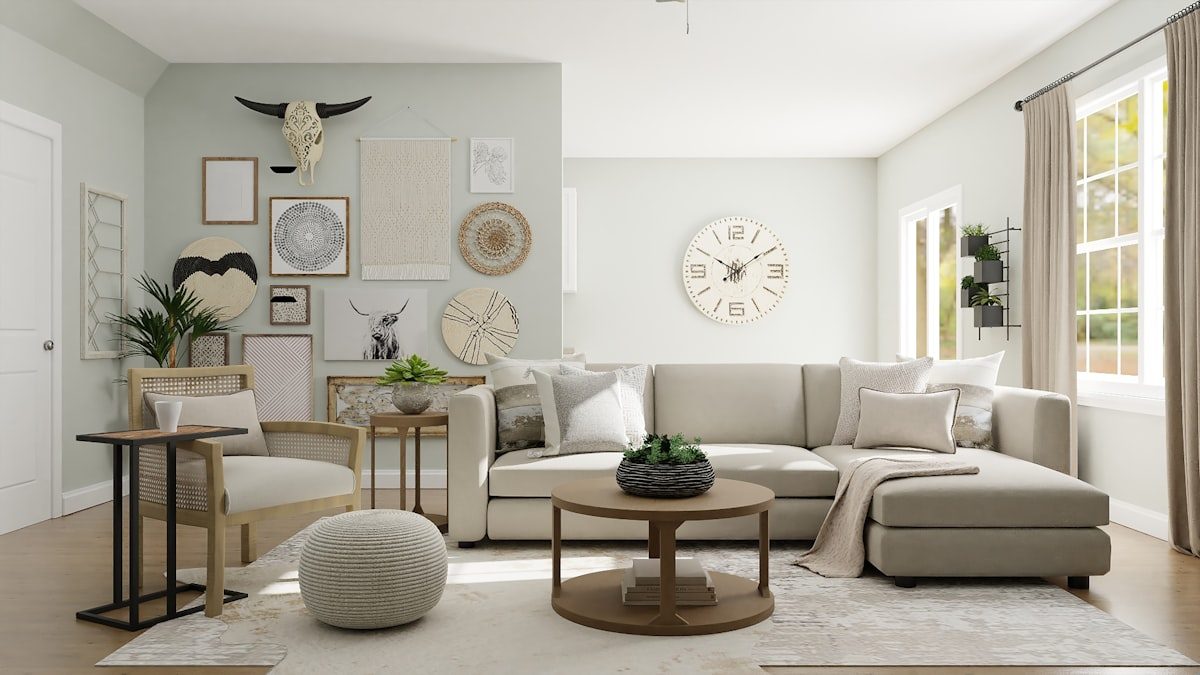
Furnishing an apartment does not have to cost thousands. The same one-bedroom that runs $6,700 to $10,800 to fill with everything new can be furnished for roughly $2,600 to $4,600 if you change how you buy, not what you buy. The gap is method: where you shop, when you shop, what order you buy in, and whether you plan the layout before you spend a cent. This guide is 14 practical ways to save money furnishing an apartment in 2026, including the one that quietly saves the most, which is planning the room with free AI instead of paying a designer or paying restocking fees on furniture that never fit.
Our articles are still written by humans!
Get human written articles in your Google feed.


What Furnishing an Apartment Actually Costs
Before you cut a budget, it helps to know the real number. A full, buy-it-all-new furnishing of a one-bedroom apartment in 2026 lands around $6,700 to $10,800 for a mid-range fit-out, with a determined budget version closer to $2,600 to $4,600 and a premium build climbing past $15,000. For a house those figures roughly double or triple. If you want the room-by-room breakdown, we have full guides on what it costs to furnish a one-bedroom apartment and what it costs to furnish a house, plus an average furniture price index so you know what a fair price for each piece looks like.
Here is the useful part for a budget: two pieces, the sofa and the mattress, eat up the biggest share, and everything else is where the savings live. The table below is roughly how much each money-saving move trims off a typical apartment furnishing bill. You do not need all of them. Stack three or four and an $8,000 fit-out drops toward $3,000.
The savings stack. These moves combine, so the more of them you use, the further your money goes.
1. Start With a Plan, Not a Shopping Cart
The most expensive way to furnish an apartment is to buy reactively, one nice thing at a time, until the rooms are full and the budget is gone. The cheap way starts with two free steps: measure every room, and write a priority list.
Measure the walls, the doorways and the awkward corners, then check that your must-have pieces actually fit and actually get through the door. A sofa that will not clear the stairwell is a return, a restocking fee and a wasted weekend. Our guide to what size furniture fits your room walks through the exact dimensions to check. Then rank what you buy: bed and mattress first, then a sofa, then a table to eat at, then lighting. Decorative pieces come last, once the essentials are handled. Buying in that order is the difference between a functional apartment on week one and a stylish coffee table sitting in an otherwise empty room.
2. Skip the Designer and Plan the Layout With Free AI
A professional interior designer charges $2,000 to $12,000 per room. For a standard apartment, most of that fee buys one thing you can now get for free: the ability to see the finished room before you commit to it. That is the whole game. Every dollar you do not waste on a piece that clashes, does not fit or does not suit the space is a dollar you keep.
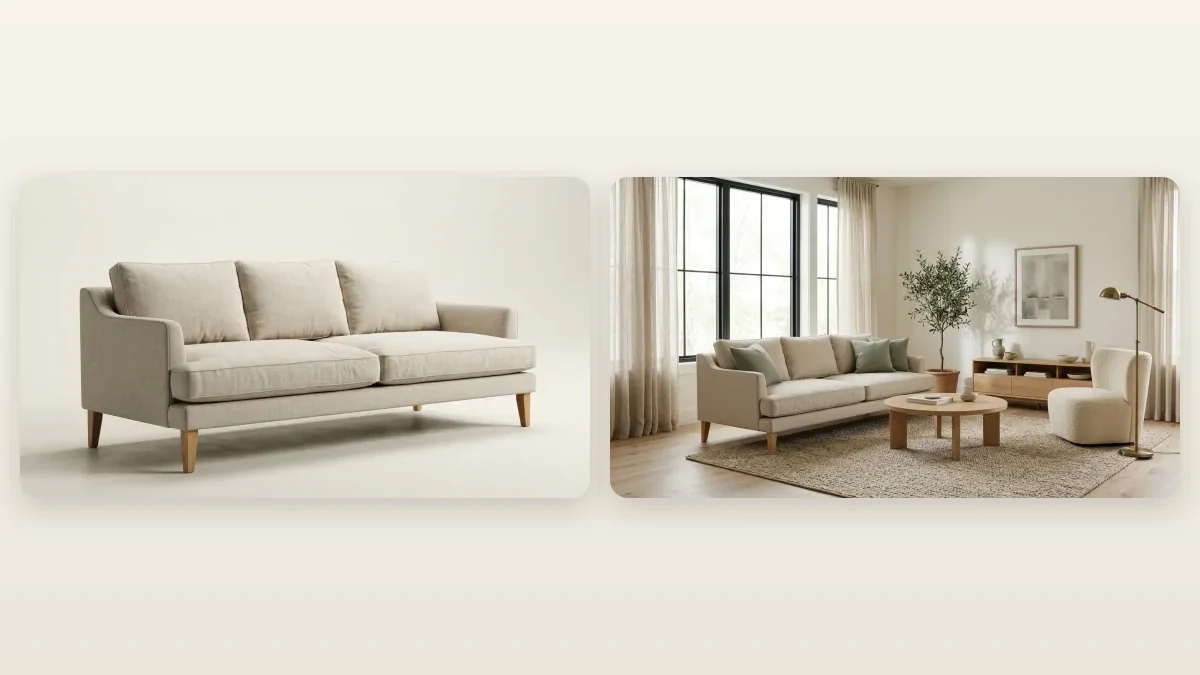
Upload a photo or a floor plan to MeltFlex and the AI returns a photorealistic, dimensionally accurate render of your room furnished, with real, purchasable pieces, in about 30 seconds. You can test a full layout, swap the sofa, try three styles, and see whether the whole thing works together before a single item lands in a cart. The panels below are a real example: an empty studio on the left, the same room planned and furnished with AI on the right, for a designer fee of exactly zero.
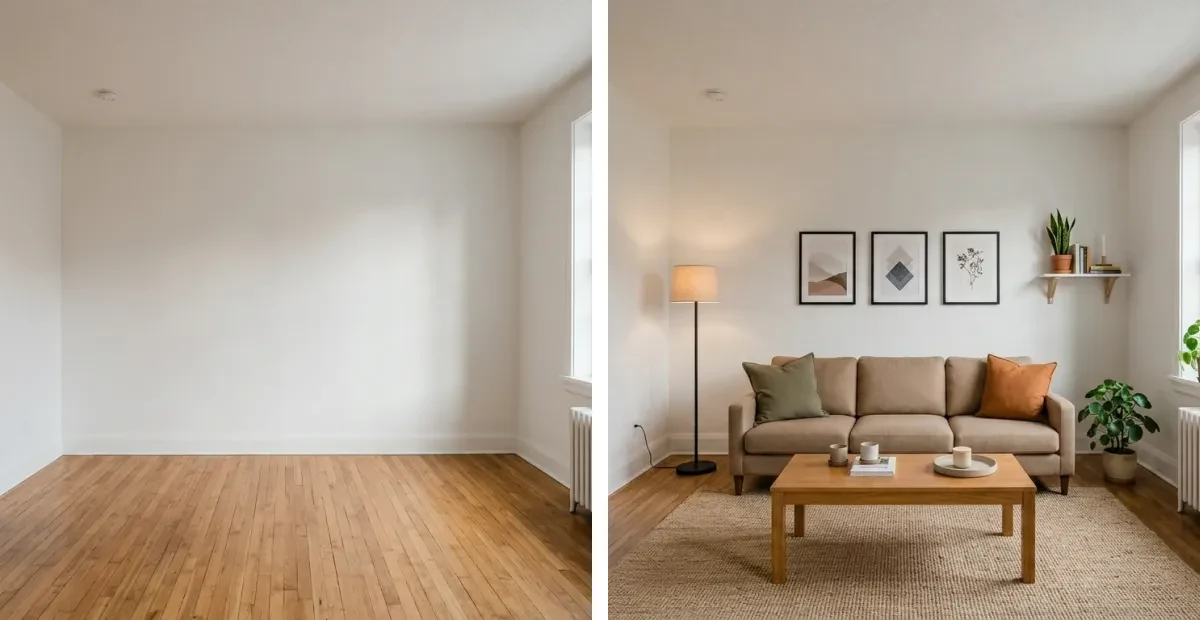
The same apartment, empty and planned with AI. Seeing the finished layout first is what stops the expensive mistakes before they happen.
This is not a small saving hiding inside a big one. Skipping the designer fee is real money, and the visualization step separately prevents the wrong-size, wrong-style purchases that quietly add hundreds to every fit-out. If you want the honest side-by-side, we broke down the numbers in interior designer cost vs the AI alternative. Keep a human designer for complex structural renovations. For furnishing an apartment, the AI does the part that matters for free.
3. Buy the Big Pieces Secondhand
This is the single biggest lever on the whole list, and the table above shows why: secondhand routinely cuts 50 to 80 percent off the price of a big piece, and older solid-wood furniture is usually built better than the flat-pack it replaces. Dressers, dining tables, bookshelves, sideboards, desks and bed frames are all things to buy used without a second thought.
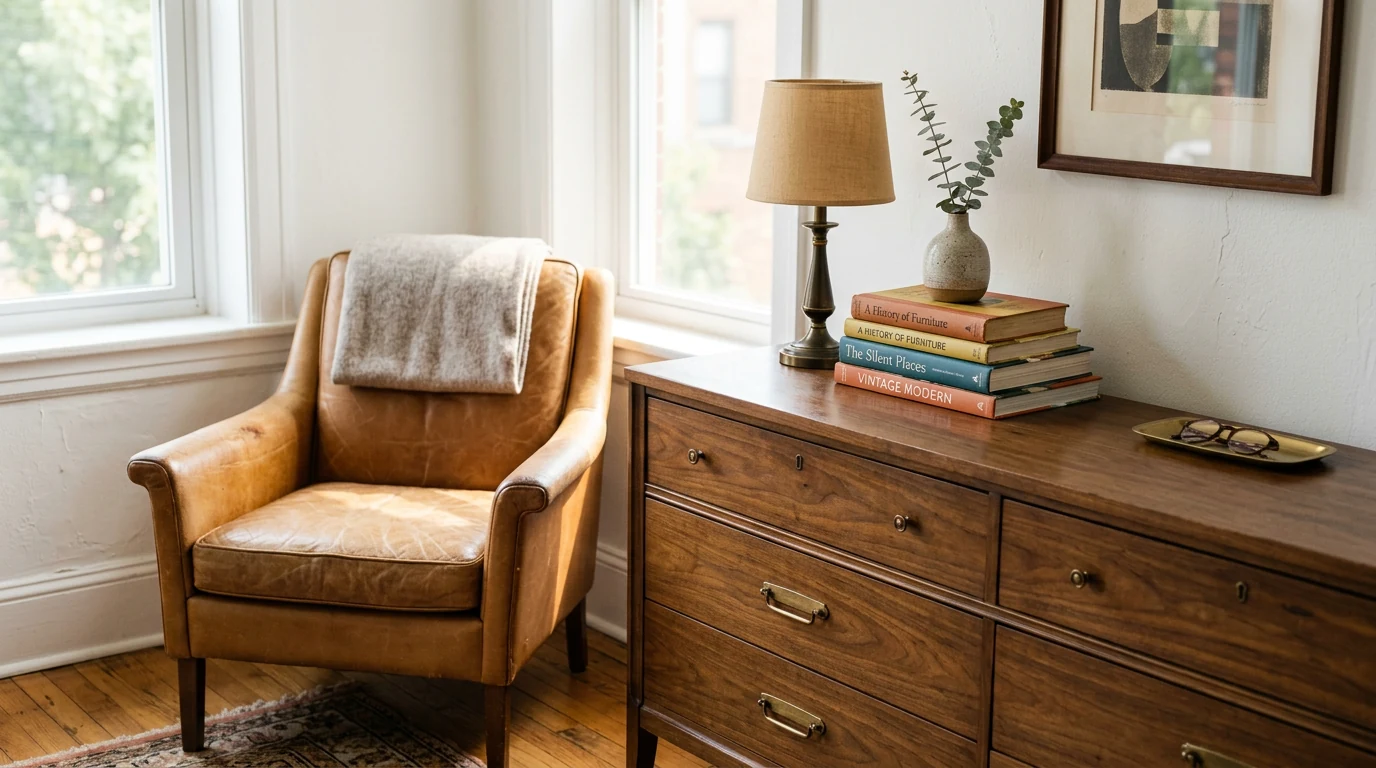
A restored solid-wood dresser and a characterful used armchair. Solid pieces like these are built better than most new flat-pack and cost a fraction secondhand.
Facebook Marketplace is the workhorse. Estate sales, Craigslist, OfferUp, Nextdoor, consignment shops and university move-out weekends in May are all worth a look. Two rules keep it safe: buy solid-wood and metal used, but buy anything upholstered or mattress-related new for hygiene, and inspect for pet damage, smoke smell and stability before you hand over cash. Bring the measurements from step one so you are not eyeballing a wardrobe that will never fit your bedroom.
4. Grab Floor Models, Open-Box and Ex-Display
Every furniture showroom sells the exact pieces on its floor at a steep discount when the season turns, and every big retailer has an open-box or clearance section for returns and slightly scuffed stock. Floor models are typically 30 to 50 percent off for wear you will not notice once the piece is in your home. Ask a salesperson directly which display items are for sale, and check the clearance corner of IKEA (the As-Is section), Wayfair Open Box, Amazon Warehouse and any local outlet.
The catch is that these are usually final sale, so this is exactly where planning the layout first pays off. If you have already confirmed the sofa fits and suits the room, an open-box deal is free money. If you are guessing, it is a gamble you cannot return.
5. Mix High and Low: the Splurge vs Save List
The pieces worth real money are the ones you touch every day and the ones that are miserable to replace. Everything else can be cheap and no one will know. Buying a matching furniture set spreads your budget evenly across pieces that do not deserve equal spend. A curated high-low mix looks more expensive and more personal than a showroom set, which reads as generic. Here is where to put the money and where to pull it back.
6. Time Your Purchases to the Sale Calendar
Furniture goes on and off sale on a predictable rhythm. If you can wait a few weeks for the right weekend, you routinely save 25 to 40 percent on the exact piece you already wanted. New collections arrive in winter and summer, so retailers clear the outgoing stock in January and July, which is when last-season pieces and floor models hit their lowest prices.
The move is simple: build your list now, price the pieces, and buy the non-urgent ones when their sale lands. The mattress and the bed you may need on day one. The armchair and the bookshelf can wait for Labor Day.
7. Furnish in Phases, Not All at Once
Trying to furnish an entire apartment in one weekend is how budgets get blown. You panic-buy to fill the space, pay full price because you are in a hurry, and end up with pieces you would not have chosen with time. Furnishing in phases fixes all three problems.
Phase one is the essentials from step one: somewhere to sleep, sit, eat and see. Phase two, over the following weeks, is the pieces you can hunt deals on: the coffee table, the second seating, storage. Phase three is the decorative layer that makes it feel like home: art, rugs, plants, cushions. Living in the space for a few weeks also tells you what you actually need, which is often less than you thought. This is the core idea in our guide to furnishing a new apartment without mistakes.
8. Use and Repurpose What You Already Own
The cheapest furniture is the furniture you already have. Before you buy anything, take stock of what you own and get creative: a dresser becomes a media unit, a sturdy trunk becomes a coffee table with storage, dining chairs pull double duty as a desk chair or extra seating. A coat of paint and new hardware turns a tired cabinet into something that looks intentional for under $40.
If you are not sure whether an old piece works with a new scheme, this is another place AI earns its keep. Photograph the room with your existing furniture and test new arrangements or a fresh wall color virtually before you commit. Rearranging what you own costs nothing and is often enough to make a room feel new. We go deeper on this in redesigning a room on a budget with AI.
This walkthrough shows exactly that: an empty living room, the furniture you already own placed in it first, and only then the gaps filled in.

Start from what you own and the shopping list gets shorter. That is the whole budget trick.
9. Choose Multifunctional, Small-Space Furniture
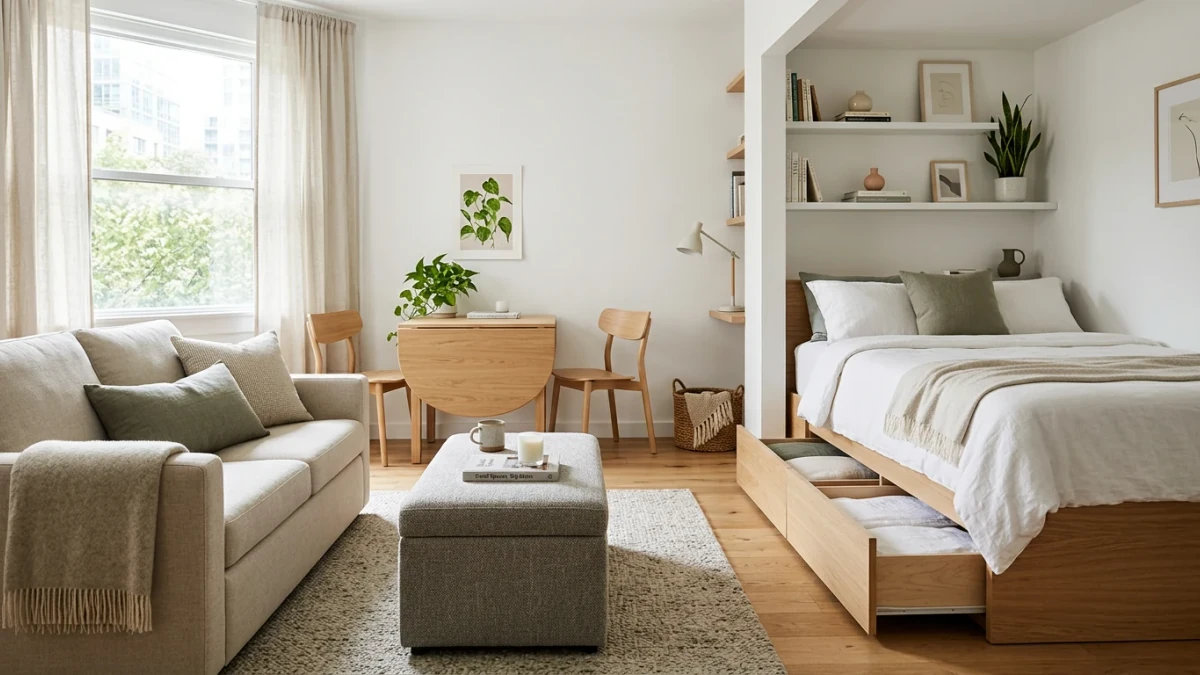
In an apartment, every piece that does two jobs is a piece you do not have to buy twice. A sofa bed handles guests without a spare room. A storage ottoman is seating, a footrest and a place to hide clutter. A drop-leaf or extendable table seats two on a weeknight and six for dinner. A bed frame with drawers underneath removes the need for a dresser. Nesting tables tuck away when you do not need them.
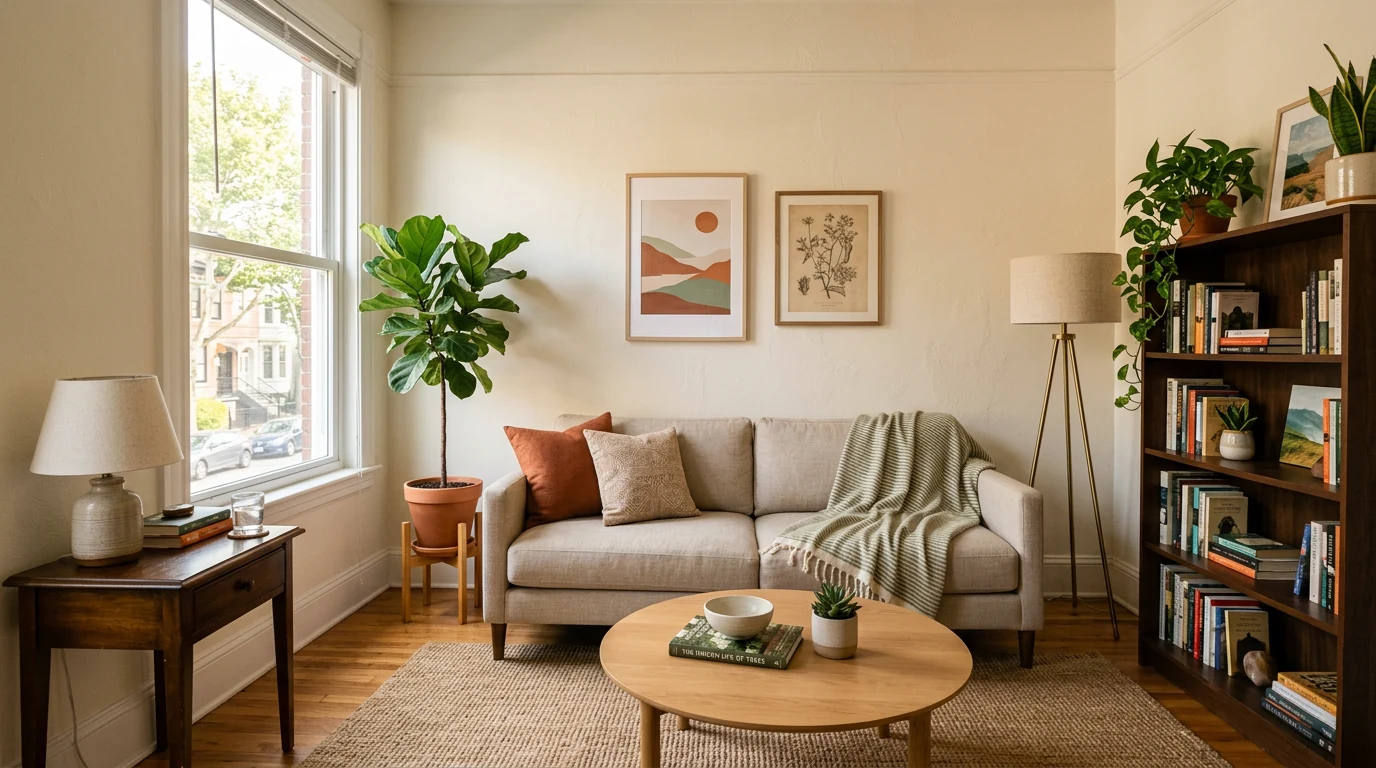
Fewer, well-scaled pieces make a small room feel bigger. Match every piece to the room and it does more with less.
This is not only about saving money, it is about saving space, which in a small apartment is the same thing. Fewer, smarter pieces mean a room that feels bigger and a budget that goes further. Match the scale to the room so nothing overwhelms it, and check every multipurpose piece against the door and the layout before you buy.
10. Hack Flat-Pack and Shop the Dupes
IKEA, and its equivalents, are the budget backbone for a reason: cheap, functional, everywhere. The trick to making flat-pack not look like flat-pack is small upgrades. Swap the standard knobs for nicer hardware, add legs to a basic cabinet, top a plain dresser with a wood board, or paint a piece to match your scheme. An IKEA hack for $30 in extras can pass for something four times the price.
For higher-end looks, hunt the dupes. Nearly every viral designer piece has an affordable near-twin, and a quick search for the item plus the word dupe usually finds it. If you spot furniture in a photo you love, our guide to finding furniture from a photo shows how to track down the cheaper version.
11. Get It Free: Buy Nothing, Curb Alerts and Hand-Me-Downs
People give away good furniture constantly, especially in moving season. Join your local Buy Nothing group and Facebook freecycle groups, watch Craigslist and Nextdoor for free listings, and keep an eye on the curb during college move-out weeks and end-of-month moving days. Ask family and friends what they are replacing before they haul it away.
Free furniture is rarely perfect, but a solid piece with the wrong finish is a paint job away from working, and a free dresser that needs new knobs still beats a $200 new one. The same safety checks apply: inspect for pests, smoke and structural issues before you bring anything home.
12. DIY the Cheap-to-Fake Stuff
Some of the priciest-looking things in a styled room are the cheapest to make yourself. Art is the big one: a set of prints in simple frames, a large canvas you paint a single color block on, or framed fabric costs a fraction of gallery art and looks just as intentional. Curtains, cushion covers and a simple headboard are all easy sewing-free projects with clips, iron-on hem tape or a staple gun.
Paint is the highest-impact, lowest-cost change in the entire apartment. A single wall color transforms the whole mood for under $150 in materials, and if you rent, ask your landlord first or choose a removable option. Test the color virtually before you commit, because a swatch the size of a stamp tells you nothing about four walls under your lighting, and repainting doubles the cost.
13. Negotiate, Price-Match and Stack Cashback
Furniture prices have more give than most people assume. On secondhand pieces, always offer below asking, politely, because sellers who want the item gone will meet you. In showrooms, ask about floor-model pricing, upcoming sales and whether they will match a competitor, because many will rather than lose the sale. On big-ticket items, ask for free or discounted delivery, which can quietly add $80 to $200 to a purchase.
Online, stack the savings: use a cashback browser extension, check for a coupon before you check out, buy through a portal that gives points, and time it to a sale weekend from step six. None of these is huge alone, but on a full apartment fit-out they add up to a real chunk of the budget.
14. Avoid the Money Traps
Some of the biggest budget damage comes from things marketed as convenient. Rent-to-own furniture looks affordable at $30 a week and ends up costing two or three times the retail price by the time you own it. Store financing with deferred interest can backfire hard if you miss the payoff window. Buying a matching set to save per piece usually means buying pieces you did not need. And the quiet killer, covered next, is buying furniture that does not fit or does not suit the room, then eating the return.
The rule of thumb: if a payment plan makes an expensive piece feel cheap, it is not cheap, it is expensive on installments. Buy what you can afford outright, buy it secondhand or on sale, and add the rest in phases. For a first apartment specifically, we have a focused checklist in choosing furniture for your new apartment.
The Mistake That Quietly Doubles Your Budget
Every tactic above saves a slice. This one prevents the loss that undoes all of them. The average furnishing goes over budget not because of taste, but because of two or three wrong purchases per home: the sectional that overwhelms the room, the color that clashes on your actual walls, the piece that will not clear the doorway. Each mistake costs a return, a restocking fee of 15 to 25 percent, delivery both ways, and the full price again on the replacement. On a whole apartment, that is easily $300 to $800 gone, and on sale items that are final-sale, the wrong buy is a total loss.
The fix is the cheapest tool on this list, because it is free. Plan the layout and preview every big piece before you buy it. Upload your room or floor plan to MeltFlex, see it furnished with real pieces at real proportions, test the styles, and confirm everything fits and works together. Then buy secondhand, buy on sale, and buy final-sale open-box with total confidence, because you already saw the finished room. That is how a $8,000 fit-out becomes a $3,000 one without looking like you cut a single corner.
Furnish It on Screen Before You Spend a Cent
You do not need a designer, a big budget or a leap of faith to furnish an apartment well. You need a plan, patience for the right deals, and a way to see the result before you commit. Try MeltFlex free: upload a photo or floor plan, get a photorealistic furnished render in about 30 seconds, and start building the apartment you want at the price you can actually afford. For related reads, see how to see furniture in your room before buying, and run any piece you are eyeing through the furniture fit calculator before you order.