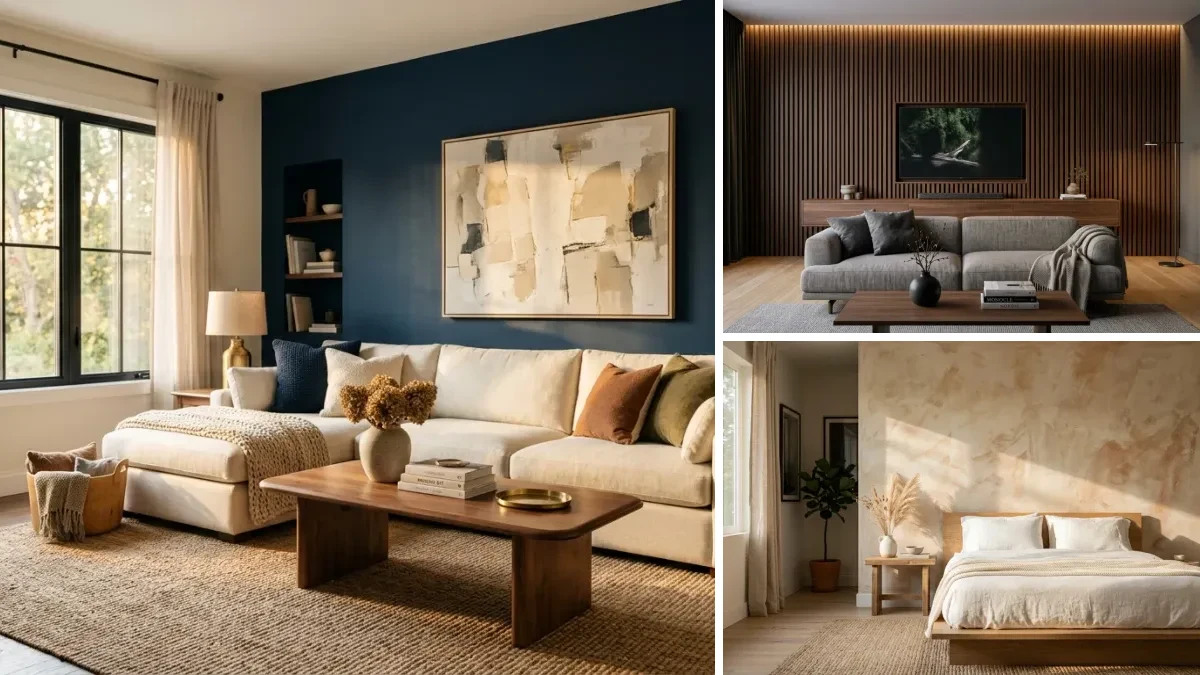
Grey had a good decade. It is over. The defining move in 2026 wall color is warmth: soft khaki and mushroom neutrals, sage and olive greens, terracotta, and deep espresso shades that make a room feel held rather than cold. Below are the 12 shades worth trying this year, sorted into four palettes, each with a hex code to get you close.
Our articles are still written by humans!
Get human written articles in your Google feed.
Seen a shade you like in someone else’s room? The paint color finder pulls the hex out of the photo and names the paint, so you can test it on your wall the same way.
The catch with any color list is that a name and a swatch tell you almost nothing about how a shade reads on your wall, in your light, next to your floor and sofa. A 2 inch chip under the kitchen bulb has fooled everyone at least once. So for every color here, we will also show you how to see it on your actual wall in seconds, free, before you commit to a single can of paint.
The 2026 wall color cheat sheet
- Warm wins, grey is out. Khaki, mushroom greige and soft cream lead the new neutrals.
- Green is the new blue. Sage, muted olive and deep forest are the year’s standout greens.
- Earthy accents. Terracotta, blush and sandstone bring warmth to a feature wall.
- Go moody on purpose. Espresso plum, inky green and smoky jade for drenched, cocooning rooms.
- Test before you buy. Swatches lie. Preview any shade on your real wall, free, before painting.
 FreeUpload photo · freeRepaint my walls for freeUpload a photo and MeltFlex changes the wall colour or finish, with the furniture and layout untouched. Your first AI design is free, no card needed.
The 2026 wall color palettes worth trying (with hex codes)
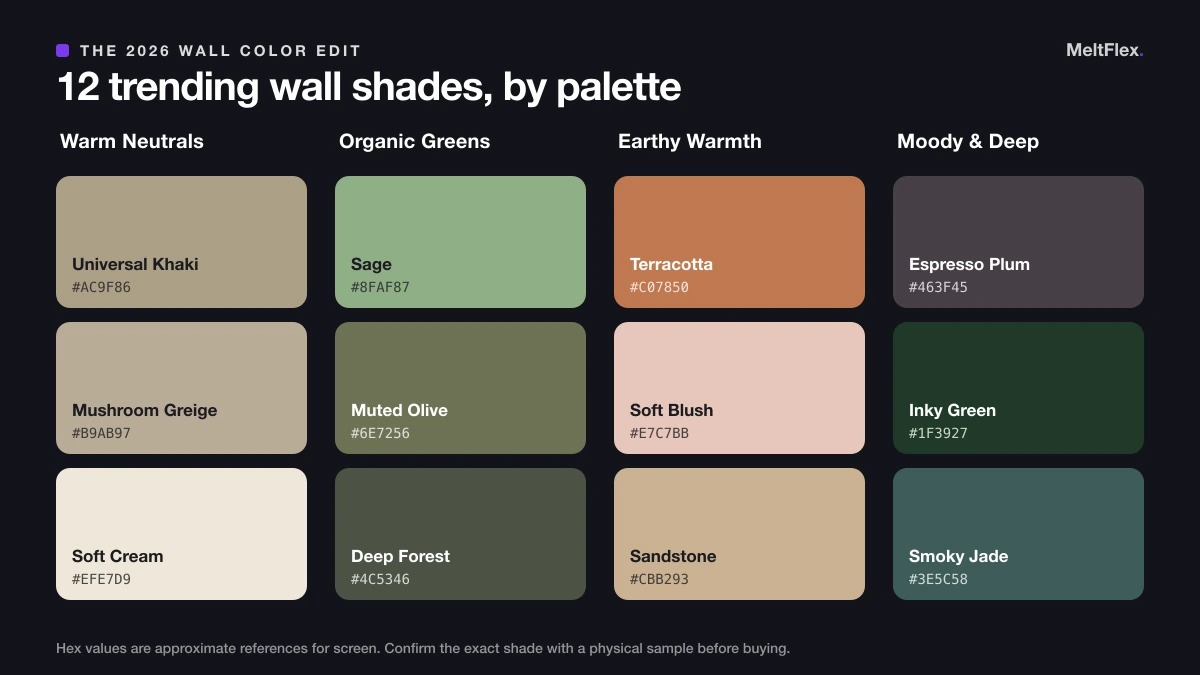
Designers and the big paint brands are pulling in the same direction this year: away from cold, sterile grey and toward colors that feel warm, natural and lived-in. These are the four palettes carrying 2026, with a representative hex for each shade so you can match it in any visualizer. One honest note before you screenshot anything: brand paints do not map cleanly to a screen hex, so treat these as a starting point and confirm the final shade with a physical sample.
1. Warm neutrals: khaki, mushroom greige and soft cream
The safe-but-not-boring backbone of 2026. Universal Khaki (a warm canvas tan, around #AC9F86), mushroom greige (#B9AB97) and a soft cream (#EFE7D9) replace the flat builder-white and cold grey that made so many rooms feel like waiting areas. They flatter wood floors, take warm brass and cream linen beautifully, and work as whole-room colors rather than just accents. Best in open-plan spaces and rooms that get cooler north light, where a little warmth stops the space feeling clinical.
2. Organic greens: sage, muted olive and deep forest
Green is doing what blue did five years ago: becoming the default color people reach for when they want something that is not a neutral. Sage (#8FAF87) is the gentle, restful entry point; muted olive (#6E7256) is earthier and more grown-up; deep forest (#4C5346) reads almost charcoal in low light and rich green in sun. Greens shift more than any other family between daylight and lamplight, which is exactly why you should see them on your own wall before buying. Gorgeous in bedrooms, studies and reading corners.
3. Earthy warmth: terracotta, blush and sandstone
The cozy, sun-baked palette. Terracotta (#C07850) is the hero, warm and grounding without going full orange; soft blush (#E7C7BB) reads as a warm neutral on most walls rather than pink; sandstone (#CBB293) sits between beige and clay. This palette shines on a single feature wall, in dining rooms, and anywhere you want a little hygge. It pairs naturally with leather, rattan, plants and unlacquered brass.
4. Moody and deep: espresso plum, inky green and smoky jade
For the rooms you want to lean into rather than brighten. Espresso plum (close to Benjamin Moore’s 2026 pick, around #463F45) is a barely-there charcoal-aubergine; inky green (#1F3927) is the new black for a sophisticated dark wall; smoky jade (in the spirit of Behr’s 2026 Hidden Gem, around #3E5C58) is a grounded blue-green. These shades are made for color drenching, painting walls, trim and sometimes the ceiling in one tone, which is dramatic and very room-dependent, so previewing first is close to mandatory.
2026 Colors of the Year, decoded
If you want the shortcut, the major brands have already placed their bets, and they all point toward warm and grounded. The Color of the Year is marketing as much as forecasting, but it is a genuinely useful signal of where paint, fabric and furniture are heading. Here are the headline picks.
| Brand | 2026 Color of the Year | What it is | Where it works |
|---|---|---|---|
| Sherwin-Williams | Universal Khaki (SW 6150) | Warm earthy canvas neutral | Whole rooms, open plan |
| Benjamin Moore | Silhouette (AF-655) | Deep espresso charcoal-plum | Moody feature walls, studies |
| Behr | Hidden Gem (N430-6A) | Smoky blue-green jade | Bedrooms, bathrooms, cabinets |
| PPG | Warm Mahogany | Rich red-brown | Dining rooms, accents, doors |
- 2026 color
- Universal Khaki (SW 6150)
- What it is
- Warm earthy canvas neutral
- Where it works
- Whole rooms, open plan
- 2026 color
- Silhouette (AF-655)
- What it is
- Deep espresso charcoal-plum
- Where it works
- Moody feature walls, studies
- 2026 color
- Hidden Gem (N430-6A)
- What it is
- Smoky blue-green jade
- Where it works
- Bedrooms, bathrooms, cabinets
- 2026 color
- Warm Mahogany
- What it is
- Rich red-brown
- Where it works
- Dining rooms, accents, doors
What wall color goes with your floor, sofa and light?
The most common reason a trendy color flops is that it was chosen in isolation, then met the floor, the sofa and the room’s real light. Use this as a quick gut-check, then preview your shortlist in the actual room.
- Oak or light wood floors: go warm. Greige, soft cream and sage all flatter oak, while a cold blue-grey tends to fight the wood’s golden undertone.
- Grey sofa: warm neutrals or a deep green or navy keep it from reading flat and cold. A grey sofa is also the perfect foil for a warm terracotta or khaki wall.
- North-facing or cool light: lean into warm shades (cream, clay, mushroom) to counteract the blue cast that cool light adds.
- South-facing or warm light: you can go cooler (sage, smoky jade, inky green) without the room ever feeling cold.
- Small or dark rooms: either a light warm neutral to bounce what light there is, or commit fully and drench it in a moody shade. The half-measure of one mid-grey wall is what makes small rooms feel grim.
For the deeper version of this, see our guides on matching walls to floors and lighting and what color goes with grey walls. The reliable test for all of it is the same: see the shade on your wall, in context, before you buy.
How to test these colors on your own wall in 3 steps
The whole point of a modern AI wall painter is that it removes the fiddly part. Older brand tools made you trace the wall by hand or flood-fill it and clean up the bleed. The current generation detects the walls for you. Here is the entire flow on the MeltFlex AI Wall Texture tool:
- Upload your room photo. Any room with a visible wall works: living room, bedroom, kitchen, hallway. Daylight and a straight-on angle give the best result.
- Pick a color or a texture. Use the color picker for any shade in the full RGB range (match a specific hex code if you have one), or choose a texture like exposed brick or wood paneling.
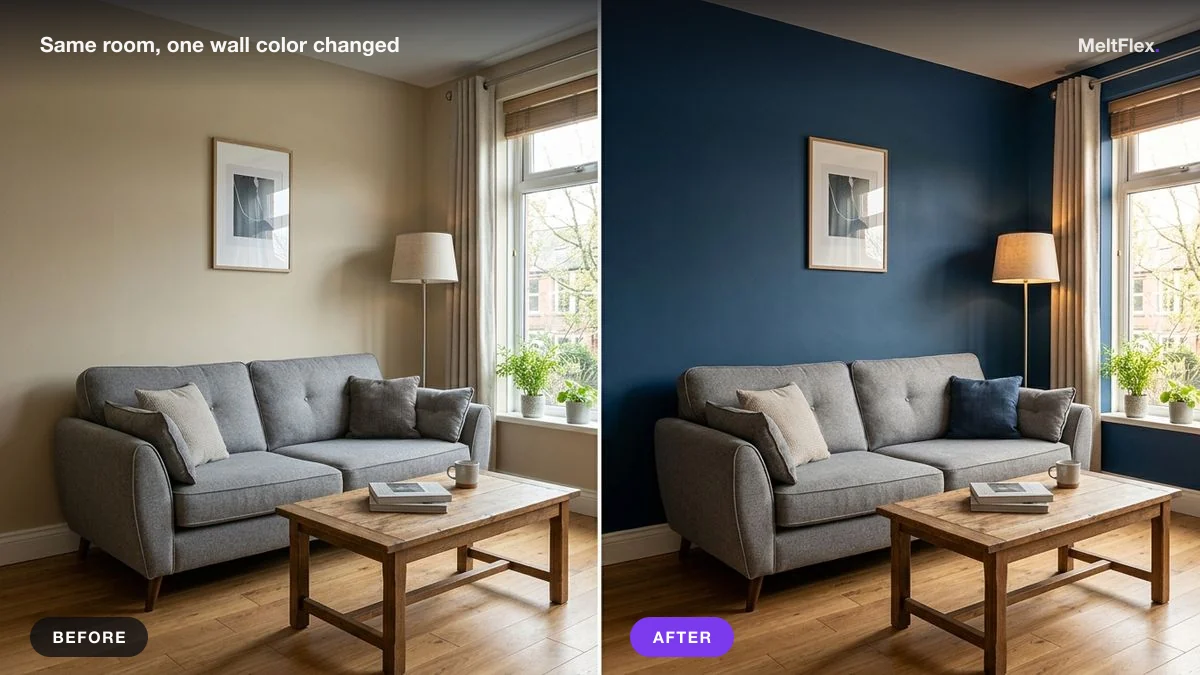
- Generate and compare. In under 30 seconds you get a photorealistic version of your actual wall. Then change the color and do it again. Trying 15 shades takes less time than opening one can of paint.
That third step is the real unlock. The value is not one render, it is the speed of comparison. Indecision about paint is almost always indecision between two or three options, and the fastest way to break the tie is to see all of them on the same wall, side by side, in your own light.
Why a paint swatch lies, and an AI preview does not
There is a real reason so many repaints disappoint. A small swatch is overwhelmed by whatever is around it, an effect designers call simultaneous contrast: a beige looks cool next to a warm wall and warm next to a cool one. Scale it up to a full wall and a soft greige can suddenly read pink, or a calm blue can turn icy. Add in store lighting that is nothing like your living room at 6pm, and the chip you fell for was never telling the truth.
Painting test patches helps, but it is slow, messy, and you are still judging a one foot square against a white wall, not the finished room. Changing the color in a photo skips all of that. You see the shade at full size, on your wall, with your sofa and your light in the frame. It is the difference between guessing and checking. For the harder question of which color to pick in the first place, our guide on how to choose paint colors with AI walks through palettes and undertones.
Hair color has exactly the same swatch problem. A strand of copper or ash blonde on a salon card says nothing about how it sits next to your skin tone, your eyes and the light you are usually photographed in. That is why hair tools moved to the same fix years before paint did: you upload a selfie and see the color and the cut on your own face first. If you have ever used a hairstyle try-on catalogue to compare balayage against a solid shade before booking, you already know how to judge a wall color in a photo. Keep everything else in the frame fixed, change only the color, and decide on the whole picture rather than on the sample.
Beyond paint: change your wall texture too
Here is where most tools labelled “wall color changer” stop, and where a proper wall visualizer keeps going. Flat color is only half of what people actually want to try. The fastest way to give a plain room character is texture: an exposed brick accent, warm wood paneling, raw concrete, natural stone, white-painted brick or classic subway tile.
Texture is much harder for AI to fake convincingly than color, which is why it is a good test of a tool. A flat overlay can tint a wall, but a brick or wood finish has to follow the wall’s perspective, wrap around corners with the right vanishing point, and catch light and shadow the way real material does. When it is done well, you cannot tell it was added. MeltFlex applies ten textures this way, the six architectural finishes plus limewash, Venetian plaster, microcement and Roman clay, so you can preview a feature wall that would cost hundreds or thousands to build before you call a single contractor.
Wall texture trends worth testing in 2026
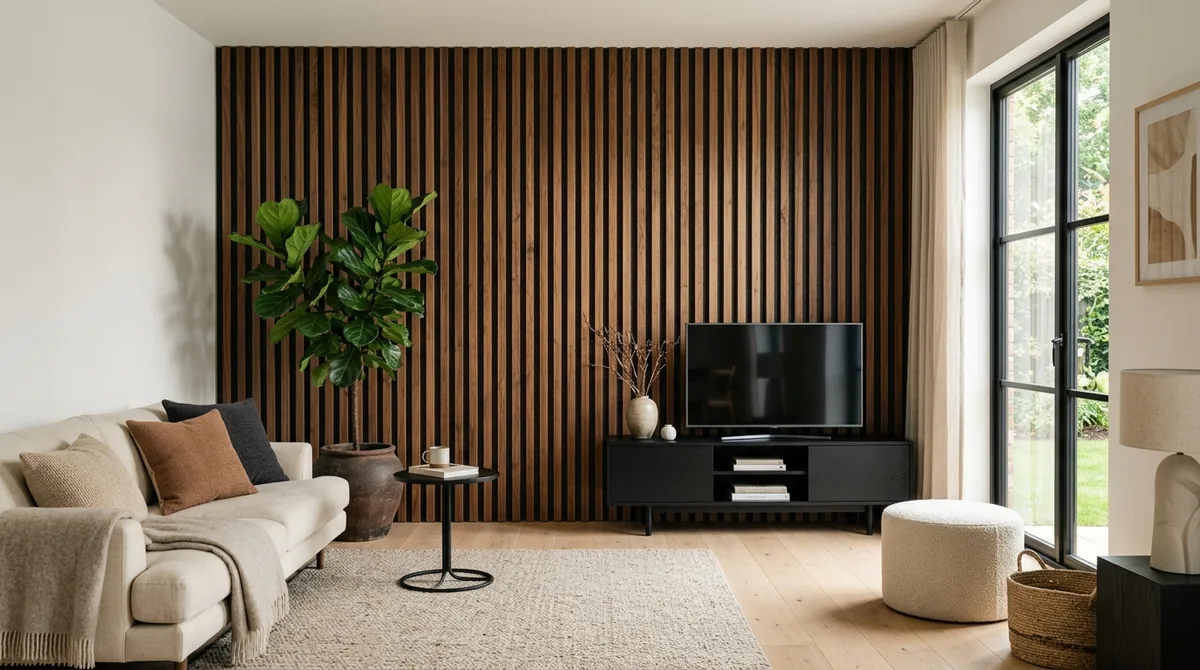
Color is only half the story this year. Flat walls are giving way to finishes with depth, and because texture is so much harder to picture from a sample than paint is, it is the single best thing to preview before you commit a contractor. These are the texture trends worth trying on your wall.
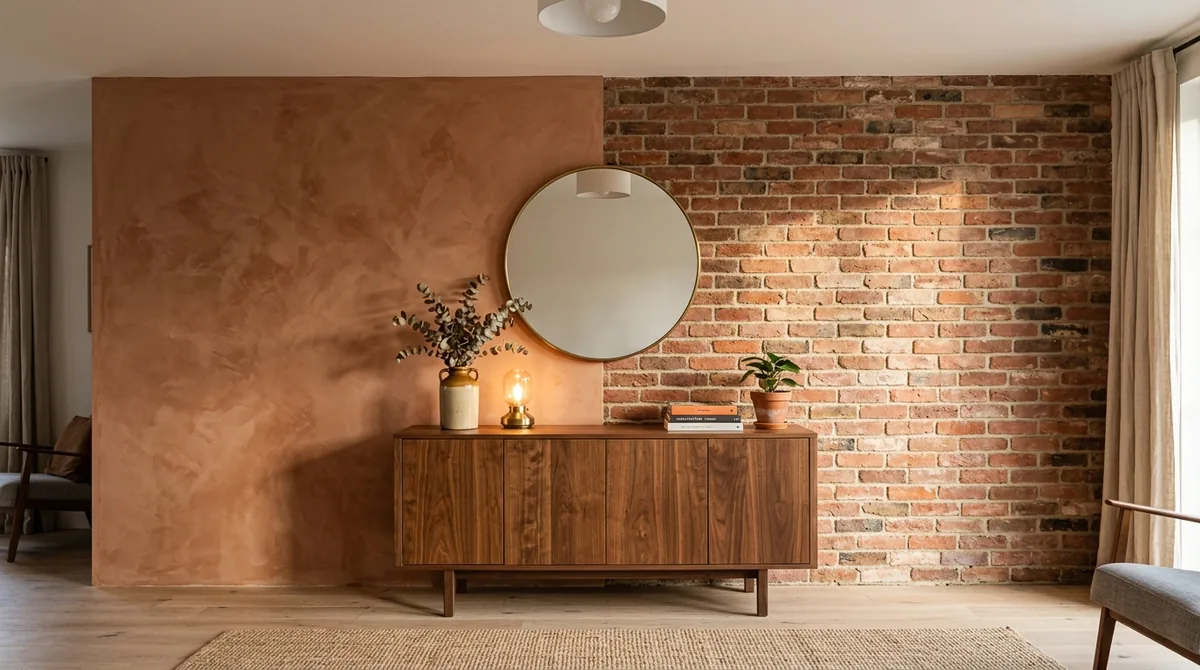
- Limewash and plaster. Limewash, Venetian plaster, microcement and Roman clay give a soft, clouded, organic finish with real movement. All four are now built into the MeltFlex wall tool as one-click presets, so you can see a tinted plaster on your own wall before you book a specialist. They pair beautifully with the earthy and terracotta tones above, and with color drenching. Not sure which mineral finish fits? Our limewash vs Venetian plaster vs Roman clay comparison covers costs and where each one fails.
- Wood slat and fluted walls. Vertical walnut or oak slats, acoustic felt panels and fluted cladding add warmth and dimension. The strongest texture trend of the year, and pricey to install, so test it first.
- Exposed and white brick. The evergreen character wall, whether raw red brick for warmth or limewashed white brick for a softer, Scandinavian feel.
- Stone and concrete. Stacked natural stone for a rustic anchor, or smooth polished concrete for a calm, industrial backdrop.
If accent walls are your angle, our 2026 accent wall ideas goes deeper on placement and pairing. The practical move with any of these is the same: try it on your room first.
Is the AI wall color realistic? What makes or breaks accuracy
The honest answer: it is realistic enough to make a confident decision, as long as you feed it a decent photo. The technology is good now because it preserves the room’s existing lighting and geometry rather than dumping a flat color on top. A render keeps the shadow under the shelf, the highlight near the window, the way a color deepens in a corner. That is what separates a believable preview from an obvious paint-bucket fill.
What actually moves the needle is your input. For the most realistic result:
- Shoot in daylight if you can. Natural, even light reads most accurately. Harsh single-bulb light creates hard shadows the AI has to fight.
- Go straight on. A face-on wall is easier to render cleanly than a steep diagonal.
- Use a higher-resolution photo. More detail means cleaner edges around trim, switch plates and picture frames.
- Clear the wall a little. A wall buried behind a tall bookshelf gives the AI less to work with.
- Treat the shade as a strong guide, not a paint code. Your screen is not color-calibrated to a paint fan, so confirm the exact shade with a real sample before buying gallons.
Set expectations honestly and you will not be disappointed: this is a planning and decision tool that gets you 90 percent of the way there for free, not a guarantee that the can will match your monitor pixel for pixel.
Best AI wall color changer tools in 2026, compared
There are three broad camps, and the right one depends on whether you care most about a buyable paint code, a quick flat-color preview, or seeing the finish on your real room. Here is how they stack up.
| Criteria | Paint-brand visualizers | Generic AI color changers | MeltFlex |
|---|---|---|---|
| Examples | Behr, Sherwin-Williams, Glidden | LightX, EditThisPic, various apps | MeltFlex AI Wall Texture |
| What it changes | Paint color (their deck) | Paint color, sometimes more | Any paint color + 10 wall textures |
| Wall detection | Manual masking or flood-fill | Automatic | Automatic, keeps geometry |
| Keeps your furniture & light? | Yes, but flat overlay | Sometimes restyled or softened | Yes, real shadows & perspective |
| Texture (brick, wood, limewash)? | No | Rarely | Yes, built in |
| Locked to one brand? | Yes | No | No |
| Price | Free | Free tier or credits | Free |
- Examples
- Behr, Sherwin-Williams, Glidden
- What it changes
- Paint color (their deck)
- Wall detection
- Manual masking or flood-fill
- Keeps furniture & light?
- Yes, but flat overlay
- Texture?
- No
- Brand-locked?
- Yes
- Price
- Free
- Examples
- LightX, EditThisPic, various apps
- What it changes
- Paint color, sometimes more
- Wall detection
- Automatic
- Keeps furniture & light?
- Sometimes restyled or softened
- Texture?
- Rarely
- Brand-locked?
- No
- Price
- Free tier or credits
- Examples
- MeltFlex AI Wall Texture
- What it changes
- Any paint color + 10 textures
- Wall detection
- Automatic, keeps geometry
- Keeps furniture & light?
- Yes, real shadows & perspective
- Texture?
- Yes, built in
- Brand-locked?
- No
- Price
- Free
The honest take: if you already know your brand and just want the buyable code, a brand visualizer is fine, expect to do some manual cleanup. If you want a fast, free, photoreal preview of any color and textures on your actual room with the furniture left in place, a general tool like MeltFlex is the better fit. Many people use both: MeltFlex to decide the look, then a brand fan deck to match the exact shade at the store.
AI wall color changer for renters, sellers and agents
Changing wall color in a photo is not just for homeowners planning a repaint. Three groups get outsized value from it.
Renters use it to picture a landlord-white box in a warmer, livable shade, either to plan an approved repaint or to mock up removable options like peel-and-stick before buying rolls. It is a low-stakes way to make a temporary space feel like yours. Our guide on Airbnb and rental staging guide covers more no-commitment moves.
Sellers and real estate agents use virtual wall staging to repaint a dated mustard dining room or a bold teal bedroom into a neutral, buyer-friendly shade for listing photos, in minutes instead of days, and without the cost of a painter. Buyers scroll past bold or dated colors, so showing a clean, move-in-ready version genuinely helps. One rule: if a listing photo is digitally altered, disclose it as required by your local real estate guidelines.
5 mistakes people make changing wall color in a photo
- Judging a final shade off an uncalibrated screen. Use the render to choose direction and contrast, then confirm the exact color with a physical sample. Phones and monitors all render color slightly differently.
- Using a dark or blurry photo. Garbage in, garbage out. A murky photo produces a murky, pasted-on result. Shoot in daylight, straight on.
- Testing only one option. The tool is basically free to re-run. Try the shade one step lighter and one step darker. The winner is rarely the first one you tried.
- Ignoring undertones in the fixed elements. Your floor, sofa and any stone or wood have undertones the wall has to live with. Keep them in the frame so you judge the color in context, not in isolation.
- Forgetting the finish. A visualizer shows color and texture, not sheen. Matte, eggshell and gloss change how a color reads and how it wears, so decide the finish separately.
What makes MeltFlex different
Most wall color changers do one trick: they tint a wall. MeltFlex was built around keeping your real room intact, which is the whole reason a preview is trustworthy. Your windows, your furniture, your floor and your light stay exactly where they are, and the new color or texture is applied with correct shadows and perspective on top of that reality. You are not looking at a generic styled room that vaguely resembles yours, you are looking at yours.
It also does not stop at the walls. Because the wall tool is part of a full AI redesign suite, you can repaint the room and then drop in real, shoppable furniture from retailers like IKEA, Amazon and Wayfair to see the finished space come together, not just the bare walls. That is the difference between a paint preview and actually designing the room.
Before you buy a single can of paint
- Your real wall, any color. Upload one photo and try unlimited paint shades at full scale, free.
- Texture too. Preview brick, wood paneling, concrete, stone, subway tile, limewash, Venetian plaster, microcement or Roman clay in seconds.
- It stays your room. Furniture, windows and lighting are kept, with realistic shadows and perspective.
- No masking, no tape. Automatic wall detection, photoreal result in under 30 seconds.
Frequently asked questions
What are the wall color trends for 2026?
Warmth, in four palettes: earthy neutrals (khaki, mushroom greige, soft cream), organic greens (sage, muted olive, deep forest), earthy warmth (terracotta, blush, sandstone) and moody saturated tones (espresso plum, inky green, smoky jade). Cold grey is on its way out, and sage and terracotta are moving onto main walls, not just accents.
What is the 2026 color of the year?
The brands split, but all chose warm and grounded: Sherwin-Williams picked Universal Khaki (SW 6150), Benjamin Moore picked Silhouette (AF-655), Behr picked Hidden Gem (N430-6A), and PPG picked Warm Mahogany. Treat them as direction-setting signals, not rules.
What wall color goes with oak floors and a grey sofa?
Lean warm: greige, soft cream or sage flatter oak, and a grey sofa cools the warmth so the room never tips orange. Avoid cold blue-grey walls with golden oak. Preview your shortlist on a photo of the real room before buying.
How do I see one of these colors on my own wall?
Upload your room photo to MeltFlex, pick a color (match a hex code from the palette above) or a texture, and the AI repaints the walls while keeping your furniture, windows and lighting in place, in under 30 seconds, free.
Does the AI-painted wall look realistic?
Yes, with a well-lit, straight-on photo. The AI keeps your real light, shadows and perspective, so a color deepens in shadow and brightens by the window just as real paint would. Dark or cluttered photos look less convincing.
Ready to stop guessing at swatches? Change your wall color in a photo with MeltFlex, free, and see the real thing before you paint.