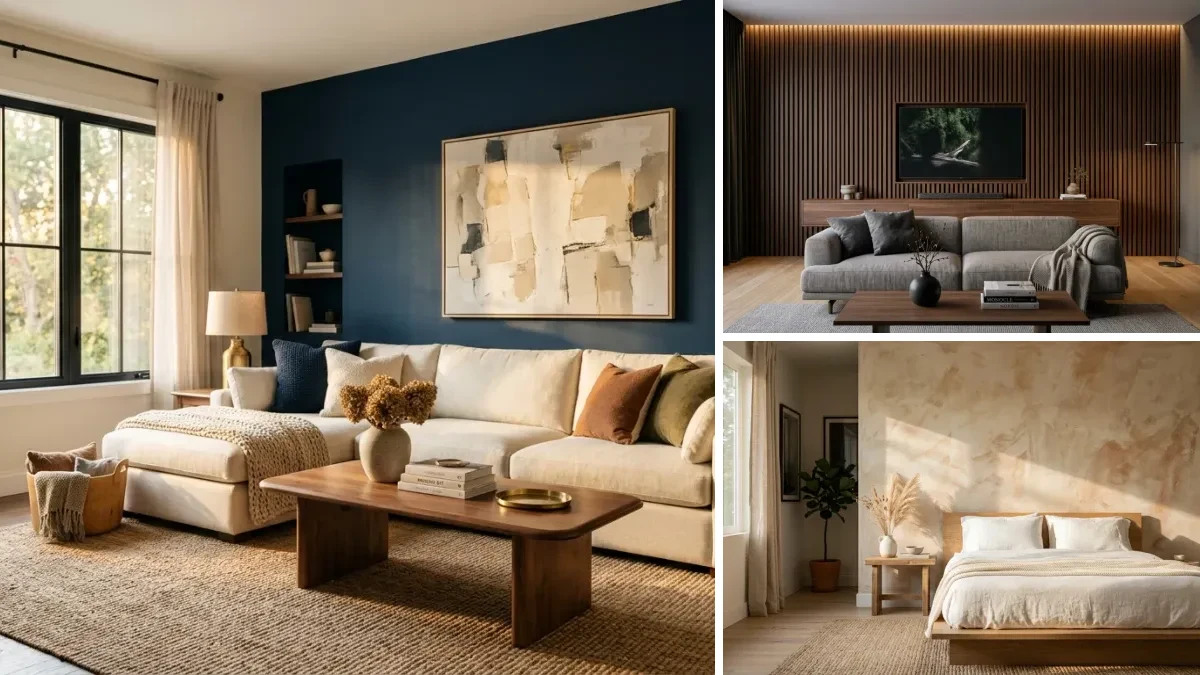
A feature wall is the fastest way to give a flat, boxy room a focal point. But the version that works in 2026 is not the one most people picture. The single wall painted a contrasting colour while the other three stay builder white is the look designers now call dated. What has replaced it is the textured feature wall: wood slats, panelling, limewash plaster, stone, and mural wallpaper that add depth a tin of paint never could.
Our articles are still written by humans!
Get human written articles in your Google feed.
The appetite is real. Opendoor’s research found 77% of homeowners are drawn to feature walls, and the global wall decor market is projected to grow from $32.7 billion to $46.8 billion by 2032. People still want a statement wall. They just want a smarter one.
This guide covers 24 feature wall ideas for 2026, organised by room, by material, and by budget, from a $30 peel-and-stick renter fix to a $4,000 floor-to-ceiling stone wall. Every idea notes what it costs and where it works, and at the end you can preview any of them in your own room with AI before committing a single euro.
FreeUpload photo · freeRepaint my walls for freeUpload a photo and MeltFlex changes the wall colour or finish, with the furniture and layout untouched. Your first AI design is free, no card needed.
Feature Wall vs Accent Wall: What Is the Difference?
They are mostly the same thing under two names. Feature wall is the common term in the UK, Ireland, and Australia. Accent wall is what the same idea is called in the United States. Search demand splits along the same lines, which is why both terms exist side by side.
There is one subtle difference worth knowing. Historically an accent wall meant a single wall painted a contrasting colour, a purely paint-led idea. A feature wall has always implied something broader: any wall made into a focal point, whether through colour, texture, panelling, or material. In 2026 that broader meaning is exactly where the trend has landed, which is why feature wall is the more useful way to think about it.
If you are specifically chasing a paint colour, our accent wall ideas guide for 2026 goes deeper on the exact shades designers are specifying. This guide focuses on the wider set of materials and textures that turn a plain wall into a feature.
How to Choose the Right Feature Wall
Picking the wrong wall is the most common feature wall mistake. These four rules prevent it.
If the feature colour you want is one you saw in a photo, the free paint color finder reads it off the picture and names the closest paint before you buy a sample.
1. Pick the focal point wall
The feature wall should be the surface your eye lands on first when you enter. In a living room that is usually the wall behind the sofa or the fireplace wall. In a bedroom it is the headboard wall. In a dining room it is the wall behind the table. If no wall has a natural focal point, choose the one directly opposite the entrance, because it is the first thing anyone sees.
2. Follow the architecture
Walls that already have a built-in feature, a fireplace, an alcove, a chimney breast, or a run of shelving, are the natural candidates because the architecture is already pulling attention there. Treating a chimney breast as your feature wall almost always reads as more intentional than choosing a blank wall at random.
3. Avoid walls broken by doors and windows
A wall interrupted by two doors and a window gives you three fragmented sections that never look deliberate. Choose the most continuous, unbroken wall in the room. If every wall is broken up, a textured material like slats or panelling still reads as intentional even on a smaller run, where flat paint would not.
4. Test it with light
Texture only works when light can rake across it. A slatted or panelled wall on the darkest wall in the room loses the shadow lines that make it worth doing. Watch the wall in morning, midday, and evening light before you commit. If the wall is naturally dark, lean toward a lighter wood or limewash rather than deep paint, which will read as a void.
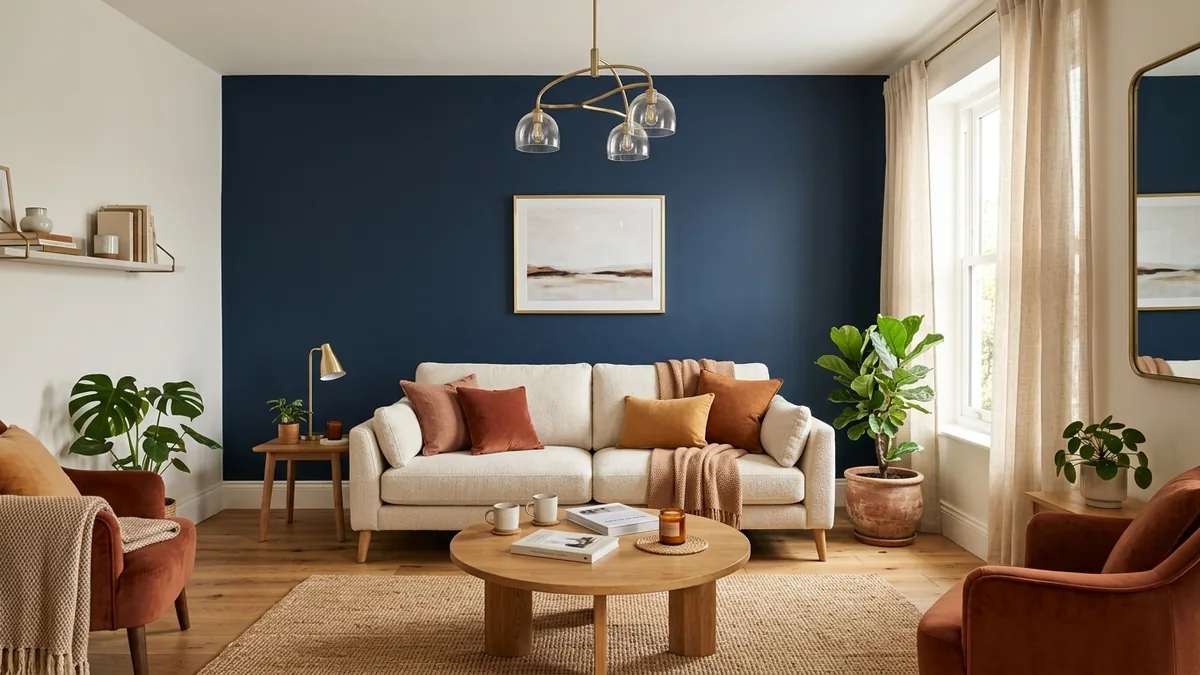
A deep navy feature wall behind a cream sofa. Warm accessories stop the dark wall feeling cold.
Living Room Feature Wall Ideas
The living room is where a feature wall earns the most, because it is the room guests see first and the one you spend the most waking hours in.
Wood slat media wall
Vertical wood slats behind the TV are the default modern living room feature wall of 2026. Walnut and smoked oak have taken over from the lighter natural oak that dominated 2024. Slats add texture, hide trailing TV cables, and frame the screen. DIY slat kits start around $150 for a single wall, while custom installations run $800 to $2,500.
Panelled or fluted wall
MDF panelling is the other big living room feature wall, and it suits period and new-build homes alike. Square Shaker panels read classic and calm, while tall fluted or reeded panels feel more contemporary and catch light beautifully. A DIY panelling kit costs $200 to $600. Painted in a single drenched colour, top to skirting, it looks custom for a fraction of the price of joinery.
The simplest version of the same idea is board and batten: vertical battens over the wall you already have, about $150 to $260 in materials for a 12 foot run. That guide works out the spacing, the cut list and which board survives a bathroom.
Stone or brick behind the fireplace
Stone veneer or exposed brick behind a fireplace adds texture and perceived value no paint can match. Warm-toned limestone and travertine are replacing the cool-grey ledgestone of five years ago. Thin veneer panels achieve the same look as full stone at roughly half the cost, around $15 to $25 per square foot installed.
Panoramic mural
A full-wall mural, misty mountains, an abstract watercolour, or a botanical scene, turns the wall into art. Google searches for mural wallpaper surged over 1,150% in 2025. Behind a sofa is the ideal spot, where the mural becomes the focal point without competing with the TV. Our wallpaper trends 2026 guide covers the specific styles and brands.
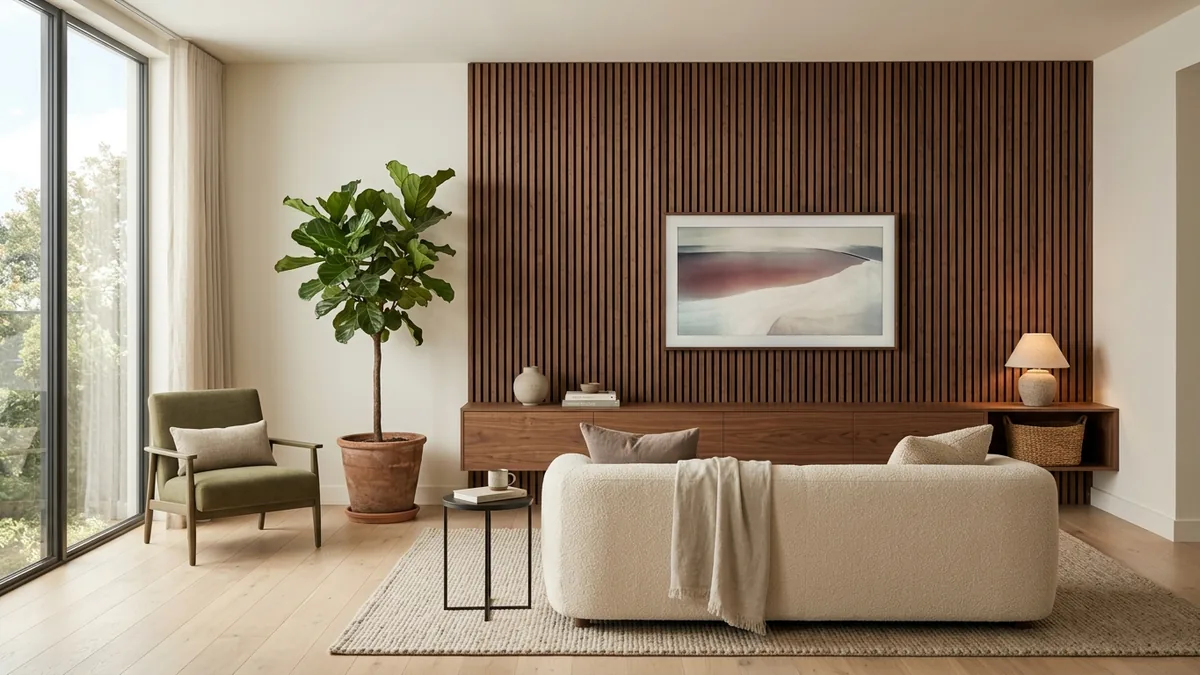
A walnut slat feature wall frames the TV. The slatted wall is the dominant feature wall of 2026.
Bedroom Feature Wall Ideas
A bedroom feature wall has a different job. It should add interest while still supporting rest, which is why the headboard wall is almost always the right choice. You face away from it as you sleep, so the drama is there when you walk in but does not work against you when you are trying to drift off.
Slatted or panelled headboard wall
Running wood slats or panelling across the headboard wall creates a built-in headboard effect that frames the bed and adds warmth. Oak and walnut slats spaced a couple of centimetres apart throw a soft shadow line that shifts through the day. Extend the treatment 30 to 40 cm beyond the bed on each side so it frames the sleeping area rather than stopping awkwardly at the mattress.
Upholstered fabric panel
Extending a padded, fabric-wrapped panel across the headboard wall gives a hotel-suite feel. Bouclé, linen, and velvet panels on a plywood backing also absorb sound, which genuinely helps sleep. It is one of the most luxurious-looking feature walls and runs $600 to $1,500 for a standard king wall.
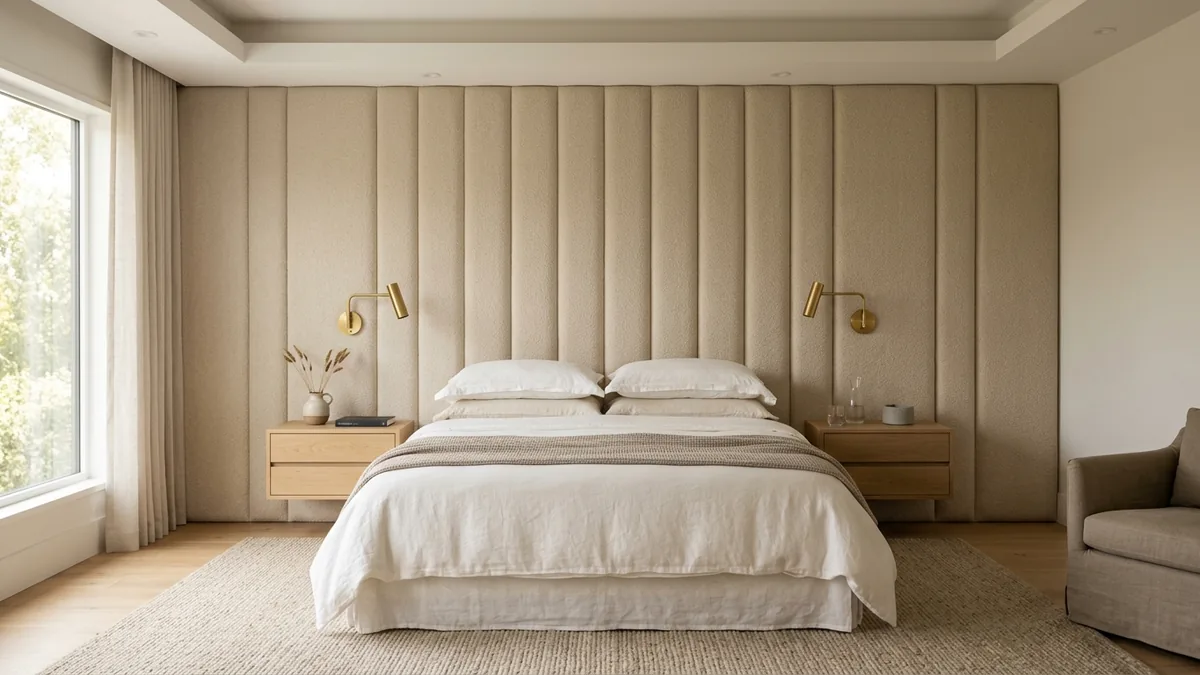
An upholstered fabric feature wall behind the bed. Padded panels add softness and absorb sound.
Drenched colour to the ceiling
Painting the headboard wall a deep, calming colour and carrying it onto the ceiling creates an enveloping cocoon. Deep sage, forest green, and warm charcoal are the most-specified 2026 shades. This is colour drenching applied to a single wall, and it works best in bedrooms with a large window on a side wall to keep the room from feeling closed in.
Peel-and-stick wallpaper
Removable wallpaper behind the bed is the fastest bedroom transformation there is: 30 minutes to hang, no damage to remove. Botanical prints, soft abstract watercolours, and linen-texture patterns lead for 2026. Budget $40 to $120 for a headboard wall depending on the brand.
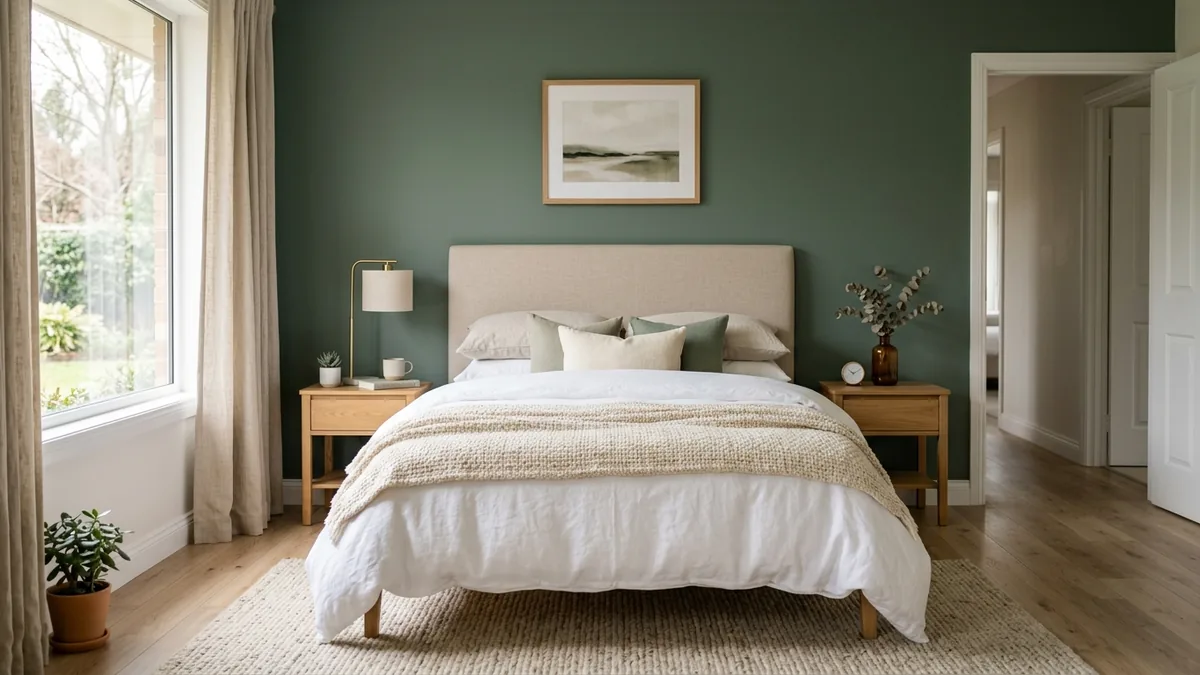
A sage green feature wall behind the headboard. Muted greens are the calm 2026 bedroom default.
Hallway and Stairway Feature Wall Ideas
Hallways and stairways are the most underused feature wall opportunity in the house. They are narrow, low-stakes, and seen by everyone who visits, which makes them the perfect place to be a little bolder than you would in a living room.
Half-height panelling
Shaker panelling to dado height, painted in a deep colour with a lighter wall above, is a classic British hallway move that adds character and hides the scuffs a busy hallway collects. It is hard-wearing, timeless, and forgiving of an awkward, broken-up wall.
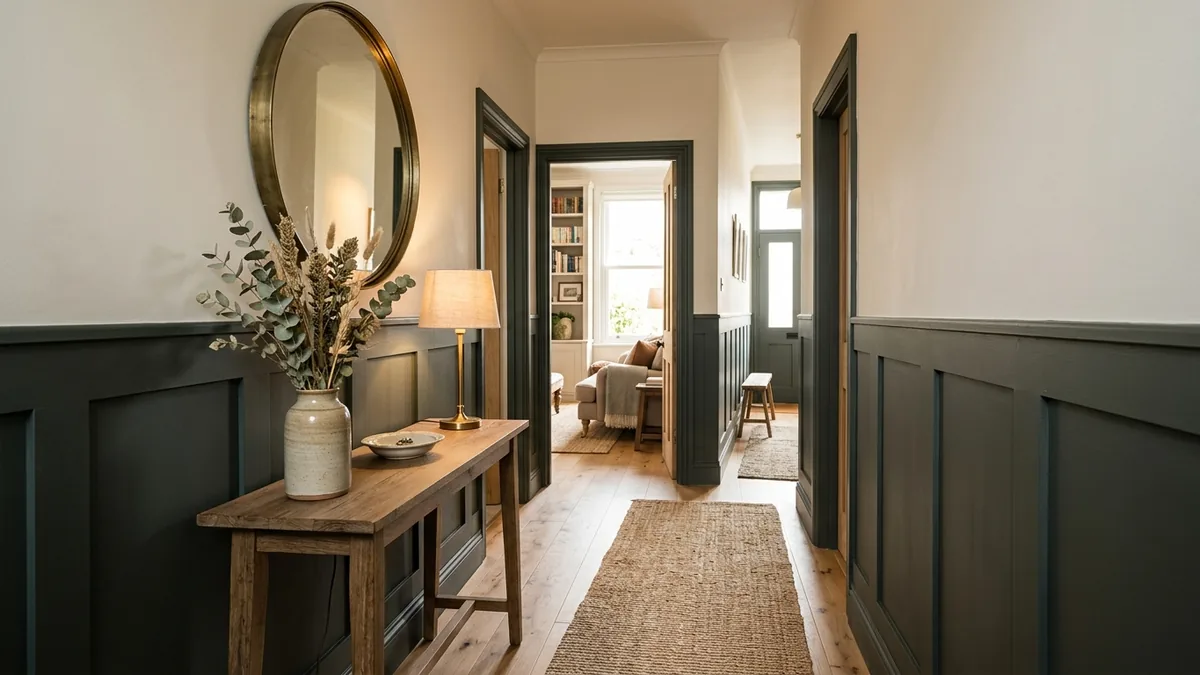
Half-height panelling in a deep colour. A classic British hallway feature wall that hides everyday scuffs.
Bold paint or dark drench
Because a hallway is a space you pass through rather than sit in, a dramatic dark colour that might feel heavy in a living room reads as confident and moody here. Pair it with good lighting and a well-placed mirror to keep the space from feeling tight.
Gallery wall up the stairs
A staggered gallery of framed prints climbing the stairwell turns dead vertical space into the feature. Keep the frames consistent in colour and spacing so the arrangement reads as one feature rather than visual clutter.
Feature Wall Ideas by Material
Wood slats and battens
The most popular feature wall material of 2026. Vertical slats in walnut, smoked oak, or dark-stained pine add warmth and texture and work behind TVs, beds, and in entryways. Available as DIY kits ($150 to $400) or professionally installed ($800 to $2,500). The 2026 direction is darker tones and wider slats with more spacing.
MDF panelling, Shaker and fluted
Panelling is the feature wall that suits the most homes. Shaker square panels read classic, fluted and reeded panels read modern, and both are cheap to fit yourself with adhesive and a mitre saw. Kits run $200 to $600. Drench the panelling and the wall in one colour for the strongest effect.
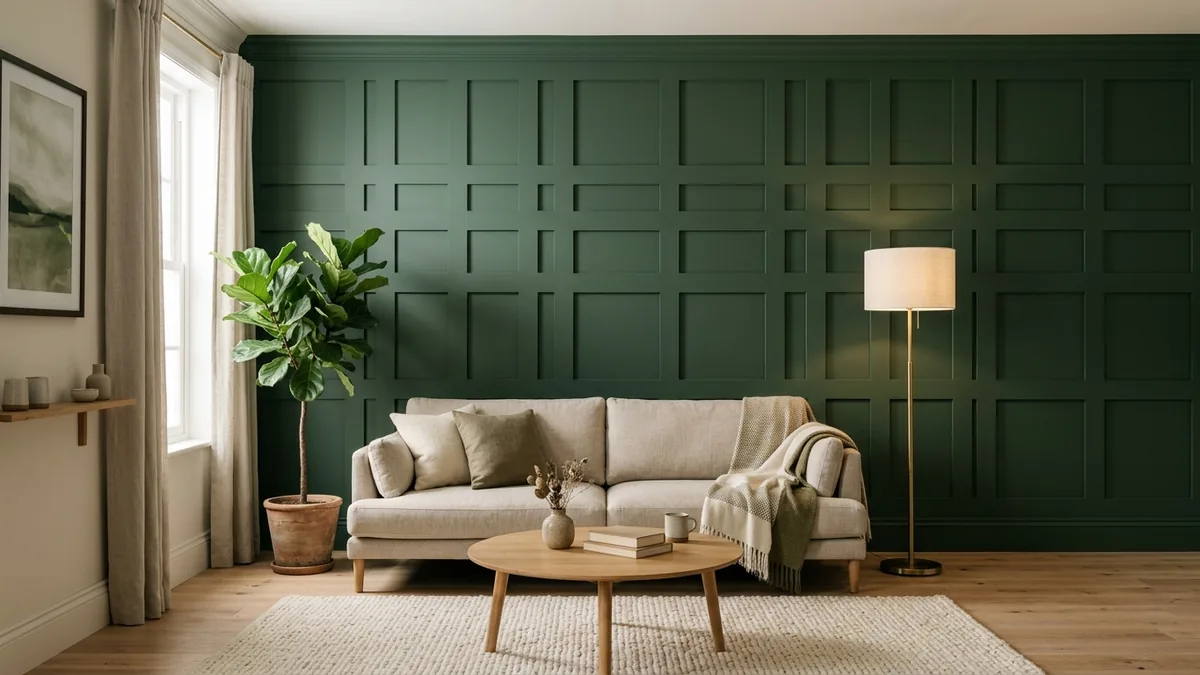
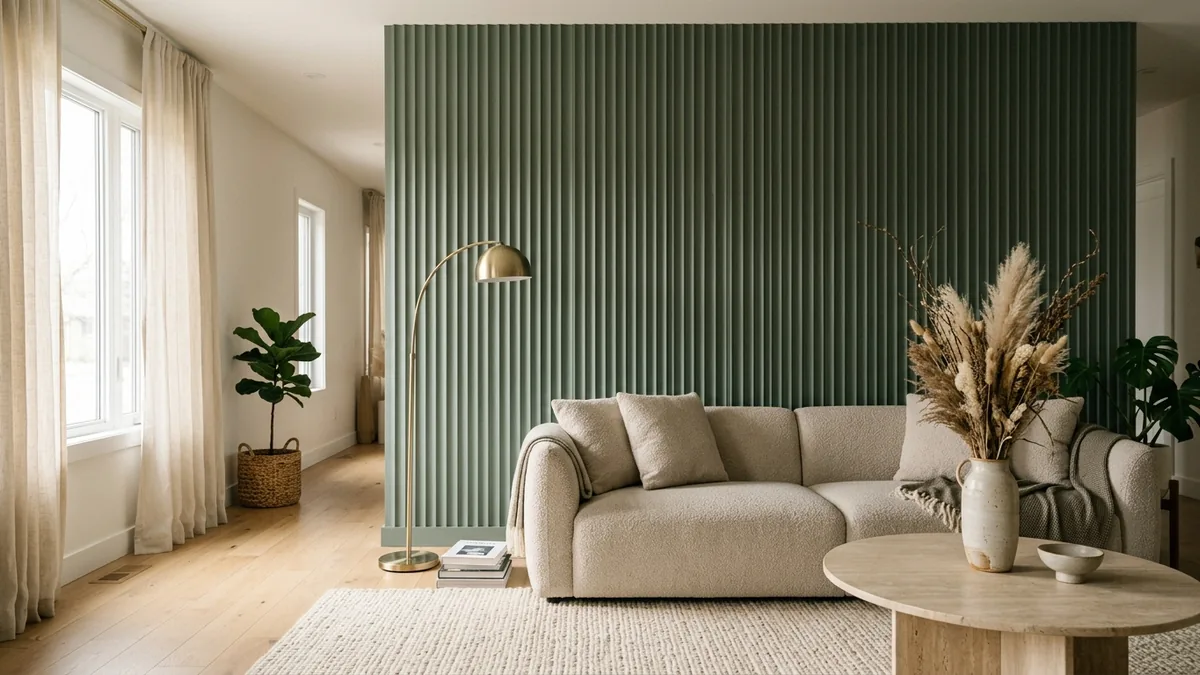
Shaker panelling drenched in deep green. Square panels read classic and calm.
Limewash and plaster
Limewash paint creates a hand-applied, slightly uneven plaster effect with real depth and movement, like an old Italian villa wall. Warm clay, mushroom, terracotta, and dusty rose are the best 2026 colours. Portola Paints and ROMA are the go-to brands. A gallon runs about $80 to $120 and covers roughly 300 square feet.
Stone and brick
Real stone veneer and exposed brick stay timeless. Stacked stone in warm cream, travertine, and sandstone is replacing cool-grey ledgestone. If your home already has original brick, cleaning and sealing it is one of the most cost-effective feature walls possible, because the material is already there.
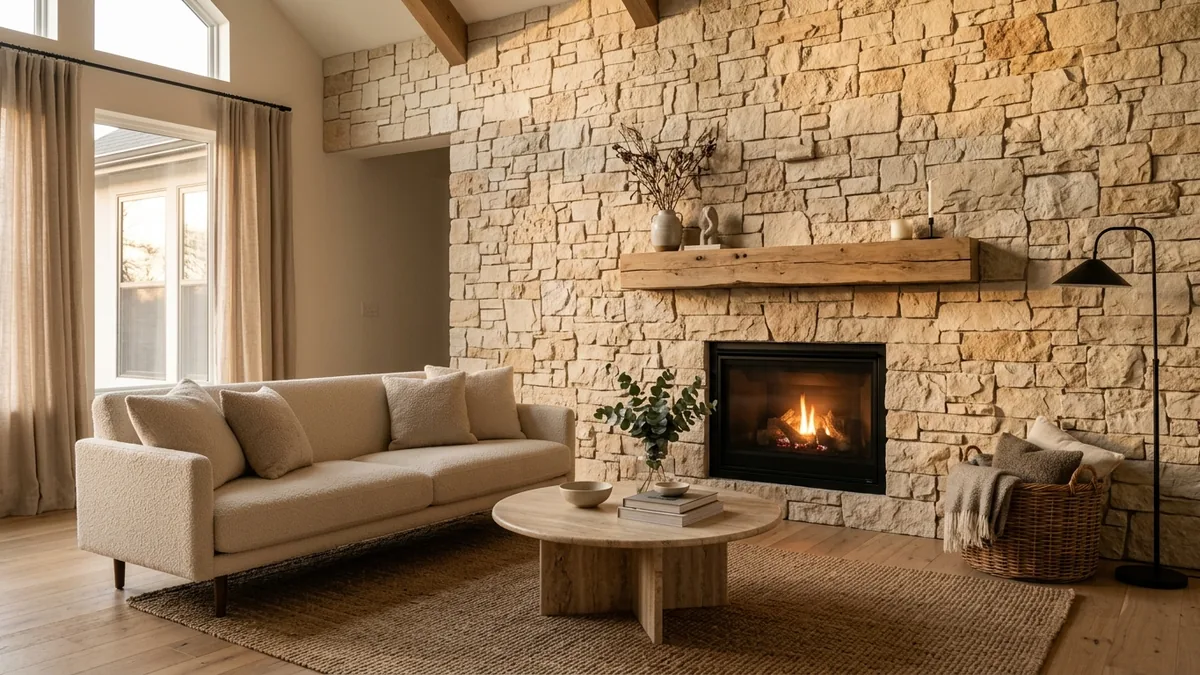
Stacked stone behind the fireplace. Warm tones have replaced the cool-grey ledgestone of five years ago.
Wallpaper and murals
The wallpaper market is projected to reach $2.9 billion by 2030. For feature walls specifically, panoramic murals, oversized florals, and textured grasscloth lead. See our complete wallpaper trends guide for the biggest styles of 2026 with brand picks.
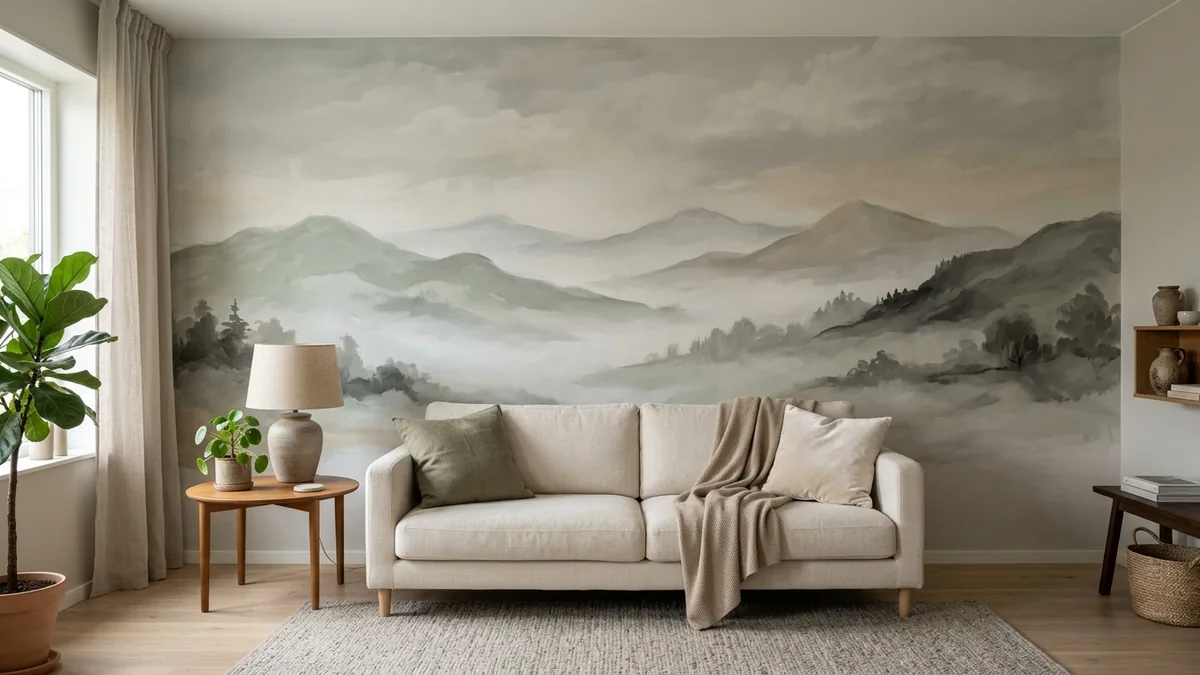
A panoramic mural turns the wall into art. Searches for mural wallpaper surged over 1,150% in 2025.
Tile
Tile feature walls are surging in kitchens and bathrooms. Zellige, large-format marble-look porcelain, and geometric hex tiles are decorative and practically maintenance-free. The cost driver is labour: tile itself is $5 to $20 per square foot, with installation adding $10 to $20 per square foot.
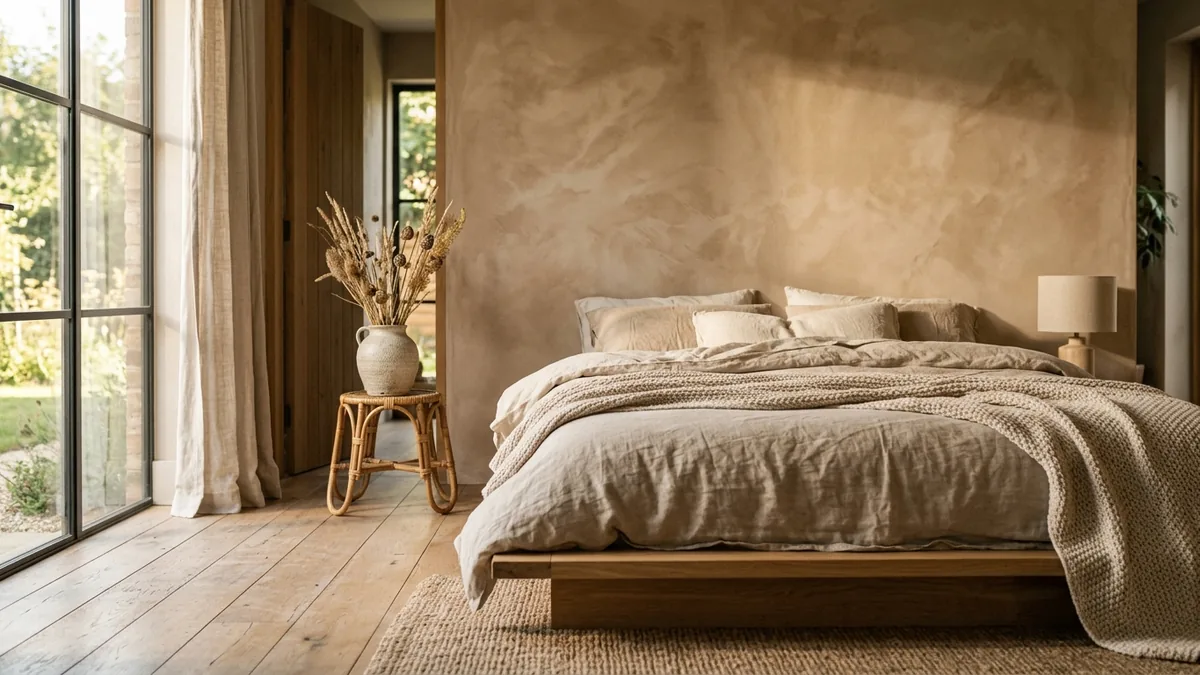
A limewash feature wall in warm clay. The organic texture shifts with the light through the day.
Best Feature Wall Colours for 2026
Whether you paint the wall or drench panelling in colour, the 2026 palette leans warm, earthy, and muted. Cool greys and bright whites are firmly out. The shades designers are reaching for most:
- Hale Navy HC-154 (Benjamin Moore) the gold-standard deep navy, warm enough to pair with brass, oak, and cream.
- Evergreen Fog SW 9130 (Sherwin-Williams) a muted sage-grey-green and the most popular bedroom feature wall colour.
- Silhouette (Benjamin Moore 2026 Colour of the Year) a charcoal-espresso that reads sophisticated and warm, works as paint or limewash.
- Terracotta and warm clay not one brand colour but a family. Look at Cavern Clay SW 7701 or Canyon Dusk by Behr.
- Dusty olive green a warm muted green between sage and army, such as Rosemary SW 6187.
- Warm charcoal not black, not grey. Something like Wrought Iron HC-137 adds drama without harshness.
For how these shades work together across a whole room, see our guide to choosing paint colours with AI and the colour drenching trend guide.
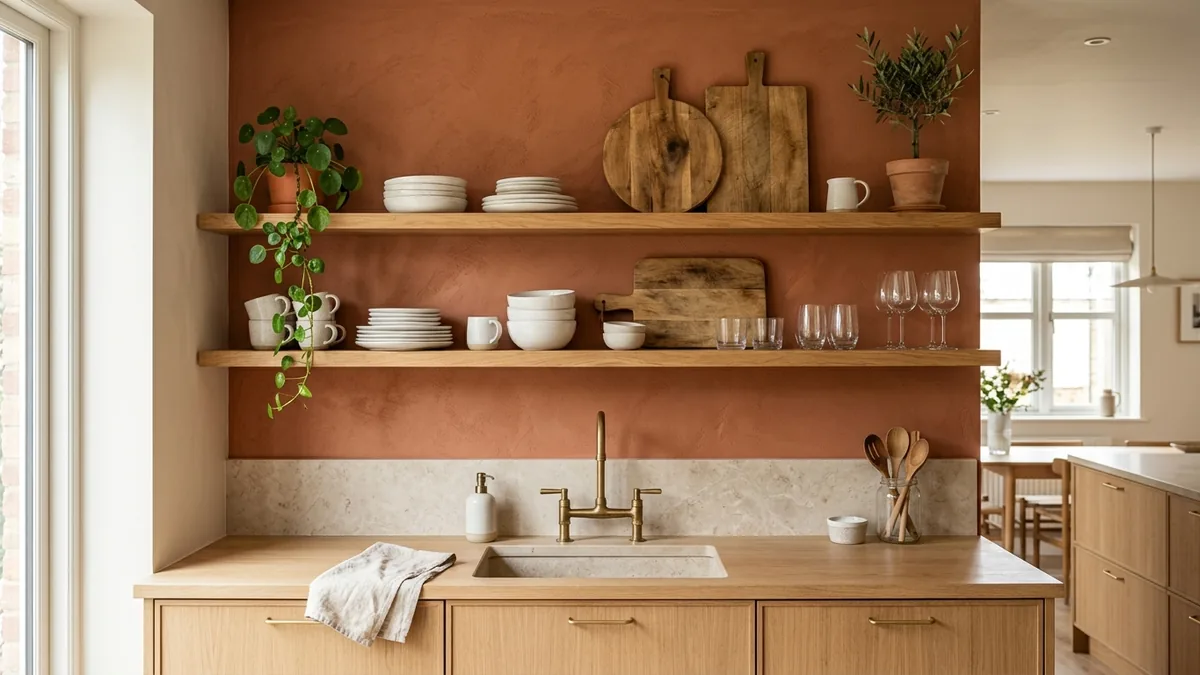
A warm terracotta feature wall behind open shelving. Earthy colour makes everyday objects pop.
How Much Does a Feature Wall Cost?
Cost depends almost entirely on material. What to expect in 2026:
- Paint (DIY): $30 to $80 for one wall. A gallon covers about 350 square feet. Add $20 for primer if going dark over light.
- Paint (professional): $300 to $750 per wall including prep, primer, and two coats.
- MDF panelling (DIY): $200 to $600 in materials. Professional fitting adds $400 to $1,200.
- Wood slats (DIY kit): $150 to $400. Custom installed: $800 to $2,500.
- Limewash: $80 to $200 DIY. Professional application: $500 to $1,200.
- Wallpaper: $50 to $300 per wall mid-range; premium murals run higher. Installation adds $200 to $500.
- Stone veneer or tile: $1,000 to $4,000 installed.
- Peel-and-stick (renter-friendly): $30 to $120 per wall, no installation cost.
Best value: limewash and DIY panelling give the most visual impact per dollar. A $100 limewash wall or a $300 panelled wall reads as a far more expensive job to anyone who does not know what it cost. Worst value: paying $300 to $750 for a professional to paint a single flat colour, which is 30 minutes of work you can do yourself.
See Your Feature Wall Before You Build It
The real risk with any feature wall is finding out it does not work after you have already panelled, painted, or tiled it. Slats and panelling are especially unforgiving, because once they are fixed and filled, changing your mind means starting over.
Upload a photo of your room to MeltFlex and describe the feature wall you want, such as a walnut slat wall behind the TV or fluted panelling behind the bed. The AI generates a photorealistic preview in your actual room, keeping your real furniture, proportions, and lighting, so you can compare a slatted wall against a panelled one against a drenched colour side by side. A 30-second preview can save a $1,000 mistake.
It is most useful for the high-stakes calls: slats or panelling, light wood or dark, bold colour or quiet texture, and whether a busy wallpaper will overwhelm a small room. You can test three ideas before committing to one.
Feature Wall Mistakes to Avoid
1. Choosing the wrong wall
The feature wall should be the focal point, not a wall picked at random. Treating the wall behind the TV when the fireplace is more prominent gives the room two competing focal points and neither wins. Pick the one wall that draws the most attention and commit to it.
2. Ignoring the light
Texture and dark colour both need light. A slatted wall or a deep paint on the room’s darkest wall loses everything that made it worth doing. Add picture lights, wall washers, or an LED strip along the ceiling line to light the feature wall on purpose. Our AI lighting prompts covers how.
3. Too many feature walls
If every wall is a feature, no wall is. One feature wall per room, and in an open-plan space, one for the whole connected area. Two competing feature walls visible from the same spot cancel each other out.
4. Fighting with what is in front of it
A bold feature wall behind a gallery of colourful art is visual noise. A busy stone wall behind a patterned sofa competes for attention. Dark and textured walls work best with simpler furniture and minimal wall decor. Let the wall and the things in front of it take turns, not fight.
Feature Wall FAQ
What is a feature wall?
A feature wall is a single wall treated differently from the others in a room so it becomes the focal point. The difference can be colour, but in 2026 most feature walls use texture and material instead: wood slats, panelling, limewash, stone, or wallpaper.
Are a feature wall and an accent wall the same thing?
They overlap heavily. Feature wall is the UK, Irish, and Australian term, accent wall is the American one. The small distinction is that accent wall historically meant a single wall painted a contrasting colour, while feature wall implies any wall made into a focal point through colour, texture, or material. For paint-specific guidance, see our accent wall ideas guide.
Which wall should be the feature wall?
The wall your eye lands on first when you enter: usually behind the sofa or fireplace in a living room, and the headboard wall in a bedroom. Avoid walls broken up by doors and windows, and make sure the wall gets enough light to show off its texture.
Are feature walls still in style in 2026?
Yes, in their textured form. Flat single-colour painted feature walls look dated, but wood slat, panelled, limewash, stone, and mural feature walls are more popular than ever. The feature wall has moved from a colour statement to a material one.
What is the most popular feature wall in 2026?
The vertical wood slat wall, usually walnut or smoked oak behind a TV or bed, closely followed by MDF panelling in both Shaker and fluted styles. Both add the shadow and texture that flat paint cannot.
How much does a feature wall cost?
A painted wall is $30 to $80 DIY or $300 to $750 professionally. Panelling kits run $200 to $600 DIY, wood slats $150 to $400, wallpaper $50 to $300, and stone or tile $1,000 to $4,000 installed. Peel-and-stick options for renters start at $30.
Can you do a feature wall in a rented flat?
Yes. Peel-and-stick wallpaper, removable slat and panel kits, and stick-on tile decals all create a feature wall with no permanent damage and remove cleanly. If you want to paint, check your tenancy agreement first.
How can I see a feature wall in my room before building it?
Upload a photo of your room to MeltFlex and describe the feature wall you want. The AI shows a photorealistic preview in your real room so you can compare materials and colours before spending anything on panels, paint, or installation.
Start Your Feature Wall
Ready to see your feature wall before you commit? Upload your room photo to MeltFlex and try slats, panelling, limewash, and bold colour on your actual wall. It takes 30 seconds and it is free. Test three ideas, then build the one that makes you stop and say that’s it.
For more wall and room ideas, explore our accent wall ideas guide, plate wall ideas that skip the farmhouse kitsch, colour drenching trend guide, the Neo Deco trend guide, 2026 wallpaper trends, and AI furniture placement and room layout.