For about a decade, rooms got quieter. Greige walls, beige sofas, everything sanded down to something inoffensive. Neo Deco is the pushback, and right now it is the interior trend with the most momentum behind it. Pinterest made it official by naming it in its Pinterest Predicts 2026 report, and Houzz, after surveying more than 70 million homeowners, put an Art Deco revival near the top of its 2026 list too.
Our articles are still written by humans!
Get human written articles in your Google feed.
The search data is not subtle. Heading into 2026, Pinterest clocked antique bar cart searches up 100%, brass aesthetic up 35%, and pendant lamps up 40%. After years of stripped-back minimalism, people want brass, geometry, and a little drama back.
Here is the part most trend articles skip: learning the rules is the easy half. Picturing it in your own room is the hard half, which is where a moody trend like this goes wrong. So every room photo in this guide is real, and every one was generated in MeltFlex AI. Read it, take the look you like, then upload a photo of your actual room and watch it turn Neo Deco before you spend a single euro on velvet you are not sure about.
FreeUpload photo · freeRedesign my room in Neo DecoUpload a photo of your room and MeltFlex restyles it in Neo Deco, with furniture that fits the space. Your first AI design is free, no card needed.
Watch: a Neo Deco wall transformation in seconds
Neo Deco lives on the walls, deep color, arches, and bold geometric detail. Here is MeltFlex restyling a real room and its walls from one photo, the fastest way to test a moodier Art Deco look on your own space before committing to paint or panelling.

MeltFlex restyling a room's walls, preview a Neo Deco look before you paint.
Is Art Deco Coming Back? Why Neo Deco Is Everywhere in 2026
Short answer: yes, and it is being driven by the same fatigue that ended the all-grey, all-beige era. For most of the last decade, interiors got quieter, flatter, and more neutral. Neo Deco is the swing back. It is glamour, geometry, and warm metal returning after a long minimalist winter.
The timing is not a coincidence. 2025 marked 100 years since the 1925 Exposition Internationale des Arts Décoratifs et Industriels Modernes in Paris, the show that gave Art Deco its name. A century later, the style is being reissued for a generation that grew up on minimalism and is now hungry for character. Pinterest notes that Gen X and Millennials are leading the charge, bringing back “crisp chevrons, fan arches and other geometric hits, all edged in chrome or brass.”
This is the same instinct behind color drenching and dark and moody interiors. People are done with rooms that look like rental listings. They want rooms that look like a decision was made.
What Is Neo Deco, Exactly?
Neo Deco is a modern reinterpretation of 1920s and 1930s Art Deco that keeps the glamour but makes it livable. The clearest definition comes from Sydney Stanback, Global Head of Trends and Insights at Pinterest, who describes it as “a modern twist on Art Deco” that “channels the elegance of the 1920s and 30s into today’s spaces with sleek finishes, bold geometric shapes, from chevrons to fan arches, and gleaming touches of chrome or brass.”
Stanback adds that the style encourages “drama, personality and a hint of eccentricity.” That last part matters. Neo Deco is not about period accuracy. It is about borrowing the most recognizable shapes and finishes of Art Deco and using them in a contemporary, slightly surreal way. Think Art Deco with a space-age twist rather than a museum recreation.
The practical takeaway: you do not need a 1930s apartment, crown molding, or a budget for marble to do Neo Deco. You need a few strong geometric shapes, some warm metal, and a moody color or two. The look lives in the details, not the architecture.
Neo Deco vs Art Deco: What Actually Changed
If you try to copy 1925 directly, the room reads as a costume. The whole point of Neo Deco is what it changed. Here is the honest breakdown.
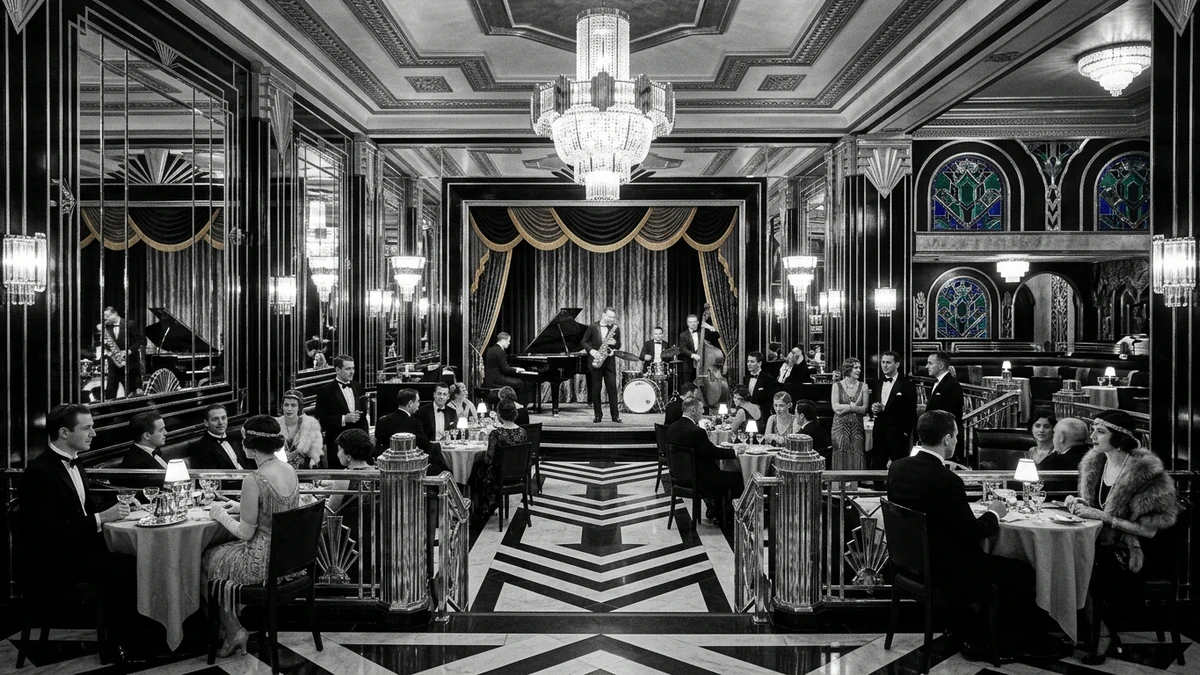
Then: original 1920s Art Deco, high-contrast, symmetrical, ornate, built on chrome and glass
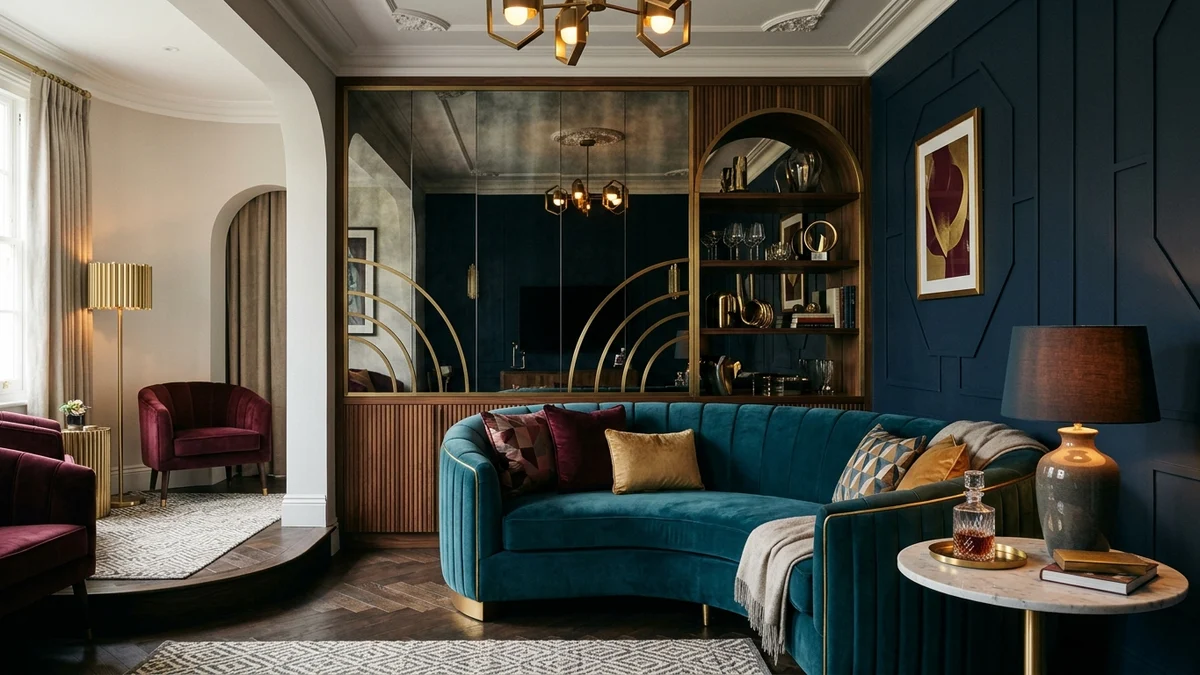
Now: 2026 Neo Deco generated in MeltFlex, moodier, softer curves, warm brass instead of cold chrome
Color. Original Art Deco leaned on high-contrast black and white plus bright ruby and sapphire. Neo Deco swaps those for deeper, moodier versions: burgundy, chocolate brown, navy, and amethyst. The drama stays, the brightness drops.
Symmetry. The 1920s look was rigidly symmetrical and ornate. Neo Deco keeps the geometry but loosens it, blending clean lines with subtle curves and a more eclectic, collected feel. Stanback’s “hint of eccentricity” is the difference between elegant and stuffy.
Detailing. Where original Deco piled on detail, Neo Deco edits. You pick a few signature moves, an arched mirror, a fluted cabinet, a chevron floor, and let them breathe against simpler surfaces.
Metal and shine. Polished chrome and glass defined the original. Neo Deco favors warmer, softer brass and smoked or antiqued mirror, which feel current rather than retro.
The Neo Deco Color Palette for 2026
The palette is the fastest way to get Neo Deco right or wrong. The 2026 direction is jewel tones turned down into something moodier and warmer, grounded by earthy neutrals and lifted by metal.
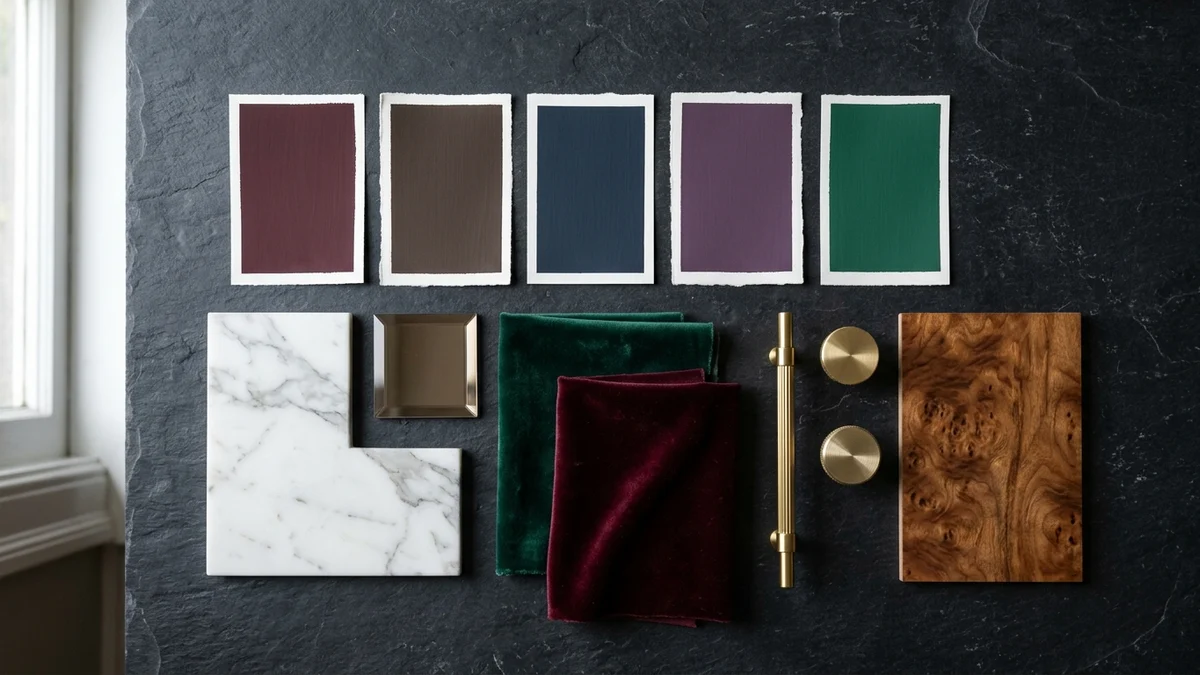
The 2026 Neo Deco palette in real materials: moody jewel tones, marble, velvet, and warm brass
The mistake to avoid is going bright. Primary ruby, electric sapphire, and clean black-and-white tip the room into theme-park Deco. Keep the colors deep and a little dusty. If you want a structured way to choose, our guide to choosing paint colors with AI walks through testing shades against your own light.
Materials and Finishes That Define Neo Deco
Neo Deco is a tactile style. The advice designers repeat is to balance “the rough with the smooth, the matte with the glossy, and the old with the new.” That contrast is the whole game.
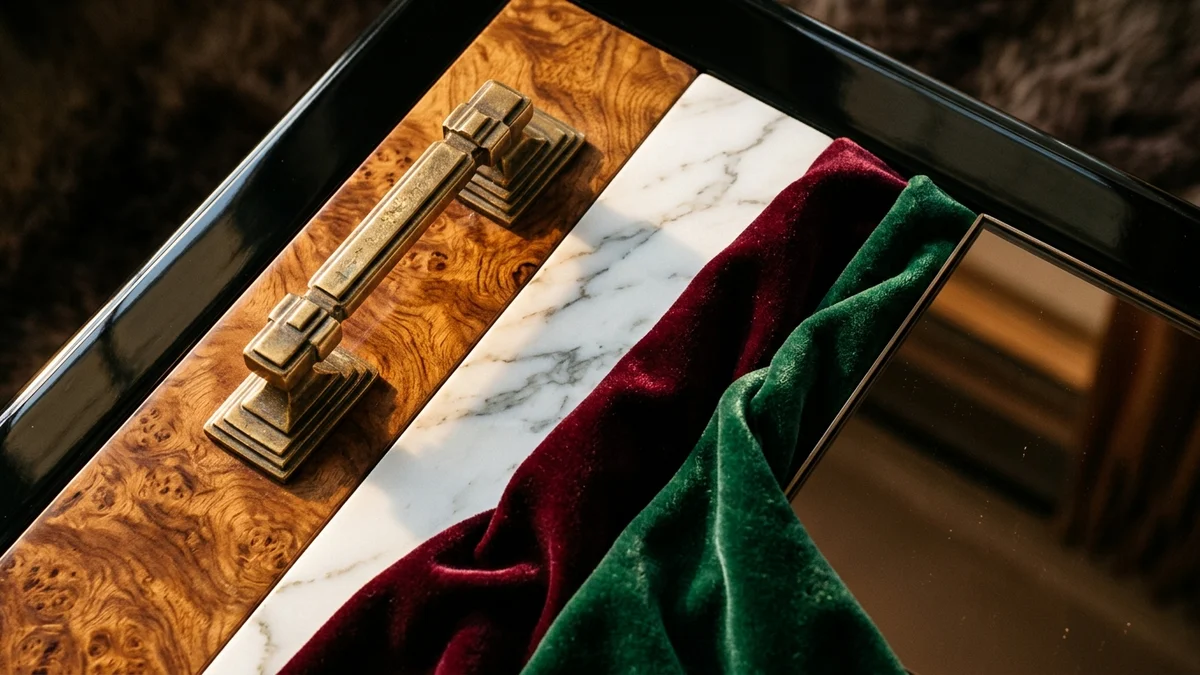
Mix hard and soft, matte and glossy: brass, smoked mirror, marble, velvet, burl wood, and lacquer
- Brass and chrome. Warm brass for the main metal, chrome or polished nickel as a cooler accent. Use it on legs, frames, hardware, and lighting.
- Velvet and silk. Plush, light-catching upholstery in jewel tones. A single velvet armchair does more for the look than a whole sofa in linen.
- Smoked and antiqued mirror. Mirror is core Deco, but smoked or bronzed glass keeps it from feeling like a 1980s hotel lobby.
- Marble and travertine. Veined stone on tabletops, a coffee table, or a fireplace surround. It supplies the glamour with zero pattern effort.
- Burl and lacquered wood. Burl wood grain reads luxurious and period-correct. High-gloss lacquer in a moody color is the modern update.
- Fluting and reeding. Vertical ribbed texture on cabinet fronts, kitchen islands, and bar fronts. It is the texture of the moment and the easiest deco move to add.
You do not need all six. Pick two or three and repeat them. A common, foolproof combination is brass plus velvet plus one moody color. For walls, the same logic that powers a great accent wall applies here: texture and material beat flat paint.
Signature Shapes and Patterns
Neo Deco is, above all, a geometric style. A handful of shapes telegraph it instantly, which is good news: you can read as “Deco” with one well-placed motif rather than wallpapering the whole room.
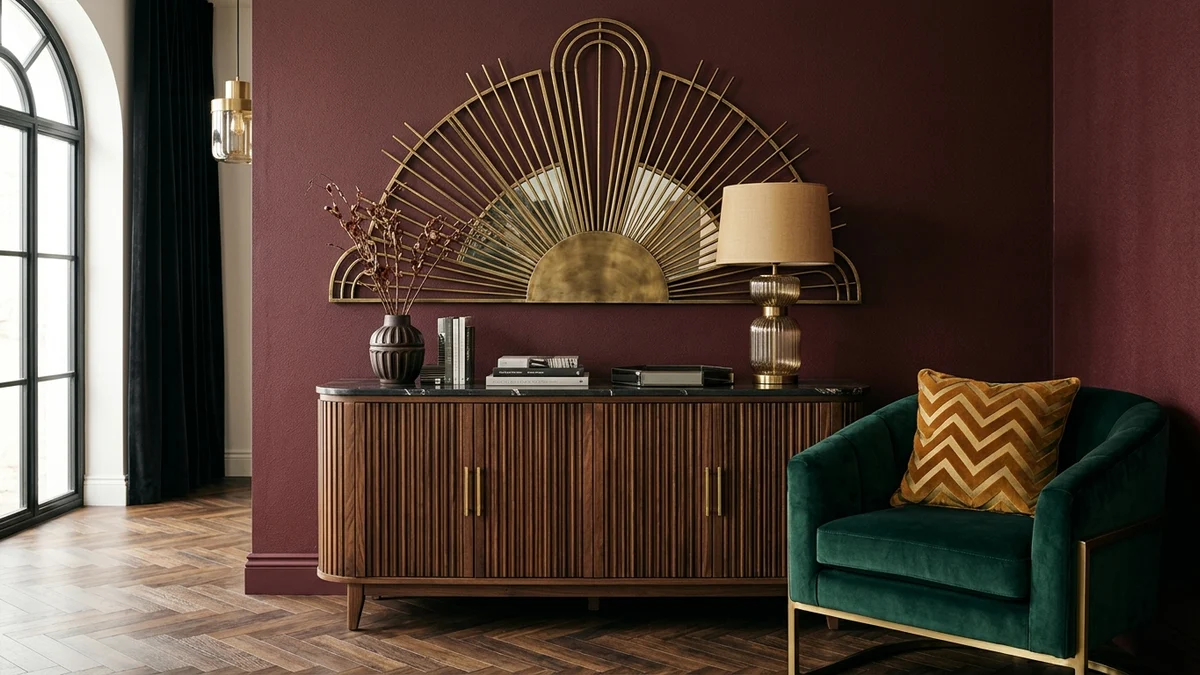
Generated in MeltFlex: the fan-arch mirror, chevron floor, and fluting that read as Deco at a glance
- Chevron and zigzag. On floors, rugs, and tile. A chevron parquet floor is one of the most powerful single Deco moves available.
- Fan arch and sunburst. The fan-shaped arch and radiating sunburst, on mirrors, headboards, and lighting, are the most recognizable Neo Deco shapes per Pinterest.
- Arches and curves. Arched doorways, niches, and mirror tops bring the softer side of Neo Deco that the original lacked.
- Ziggurat and stepped forms. The stepped skyscraper silhouette shows up on mirror frames, shelving, and cabinet tops.
- Scallop. Scalloped headboards, chair backs, and edges add a playful, slightly eccentric note.
Neo Deco Room by Room
The formula barely changes from room to room: one hero piece, a warm metal, one moody color, and restraint everywhere else. What changes is which hero you pick. Every photo below is a real MeltFlex render, the same kind of image you get back when you drop in a photo of your own space.
Living Room
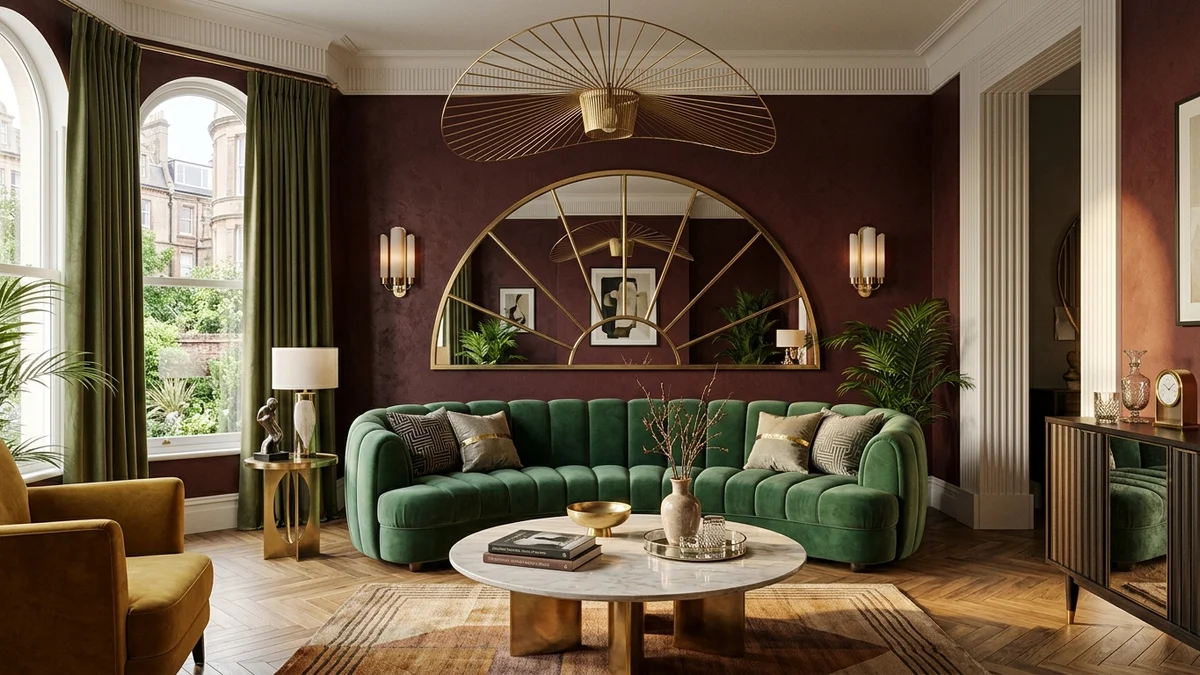
Choose the hero first, then build around it quietly. A curved velvet sofa in emerald or burgundy is the obvious one. Brass does the rest of the talking through the lighting and a sculptural coffee table base, a chevron rug grounds the floor, and a deep accent wall behind the sofa carries more weight than any single object you could buy. The fan-arch mirror is the piece people actually remember.
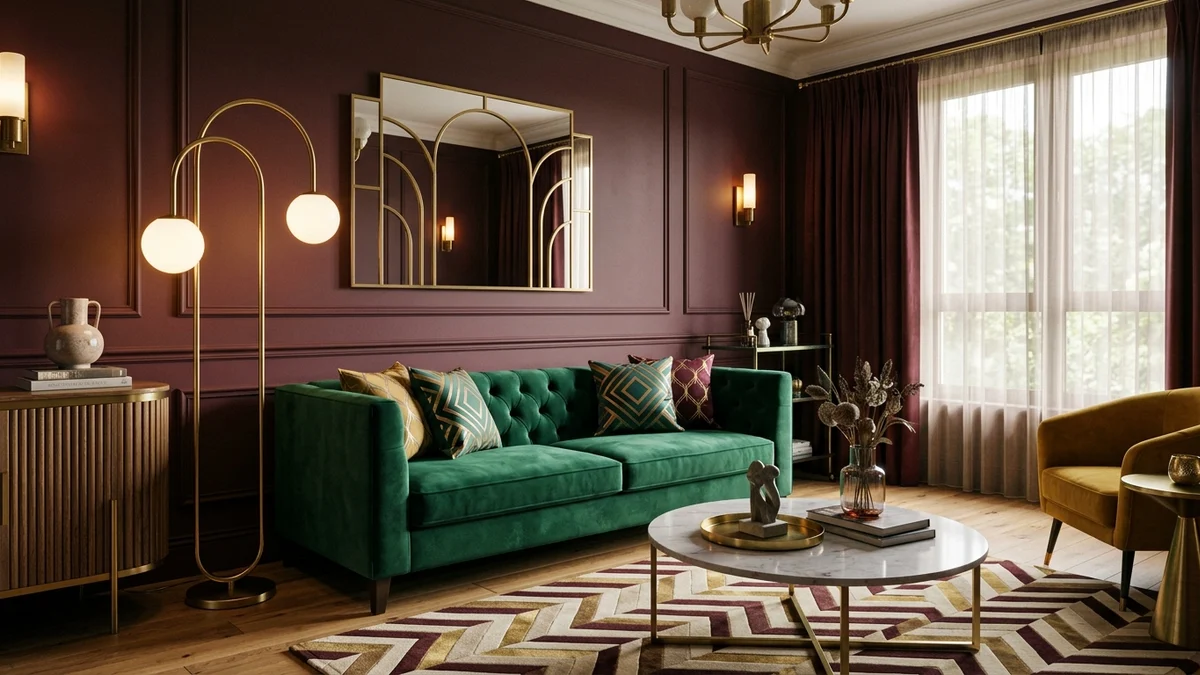
Generated in MeltFlex: emerald velvet against a burgundy wall, brass, and a chevron floor
Bedroom
The headboard wall is your focal point, so spend your one bold move there. A scalloped or fan-arch velvet headboard is the defining Neo Deco bedroom gesture. Flank it with burl-wood or smoked-mirror nightstands, add brass globe lamps, and keep the bedding in chocolate, plum, or sand. For the enveloping version, treat the whole wall as one moody, color-drenched surface instead of a single bright stripe.
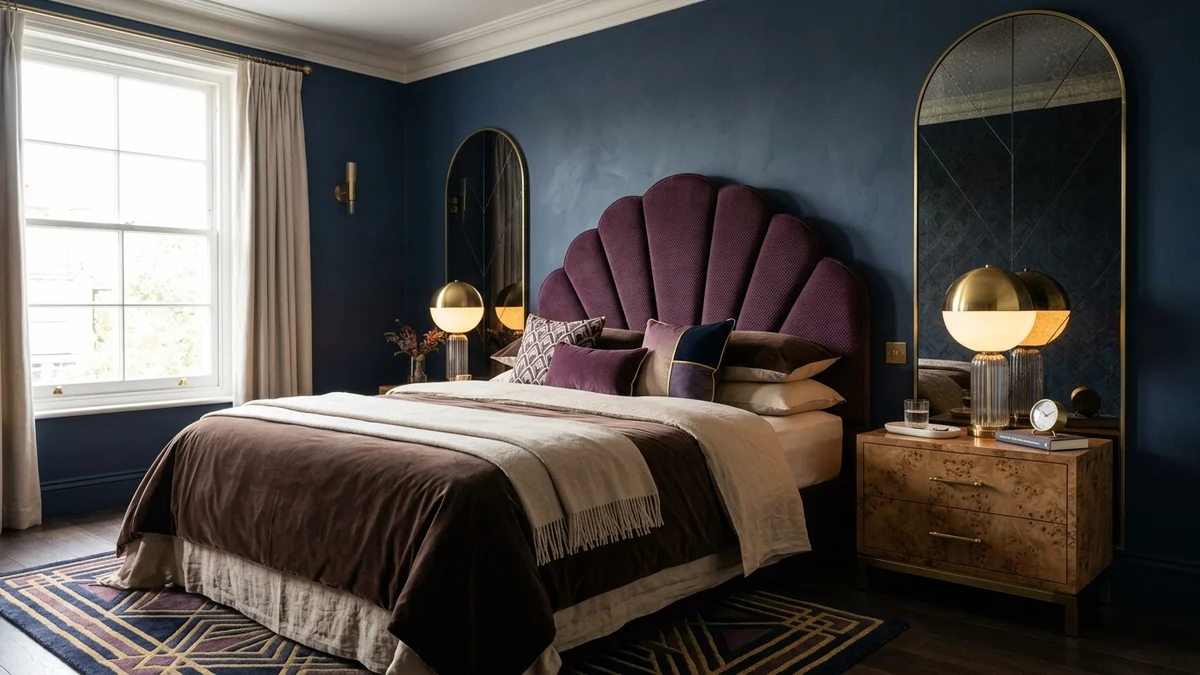
Generated in MeltFlex: a scalloped plum headboard against a color-drenched navy wall
Dining Room and Home Bar
This is where Neo Deco peaks, and where the trend data is loudest. Antique bar cart searches rose 100%, leather banquettes 35%. A brass-and-glass bar cart, a fluted sideboard, and a sunburst mirror above it are a finished vignette on their own. Add a tiered globe pendant and an oxblood leather banquette and the room is done. You do not need a separate dining room for this, a corner is enough.
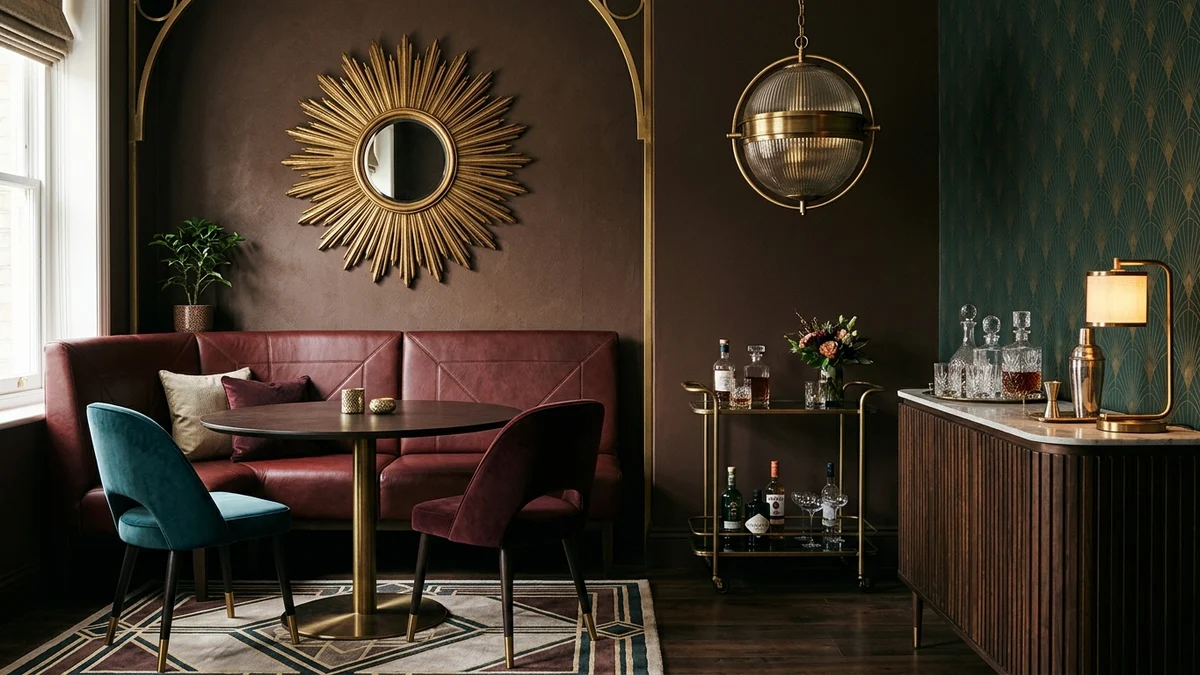
Generated in MeltFlex: the brass sunburst mirror and bar cart that drove the 2026 search spike
Kitchen
Kitchens read as Neo Deco through two moves: fluting and brass. A fluted island front, ideally in a deep lacquered green or burgundy, plus warm brass hardware and fan-shaded pendants gets you most of the way without touching the cabinets. A marble or marble-look waterfall edge and a chevron floor finish it. This is the one room where the look pays you back at resale, too.
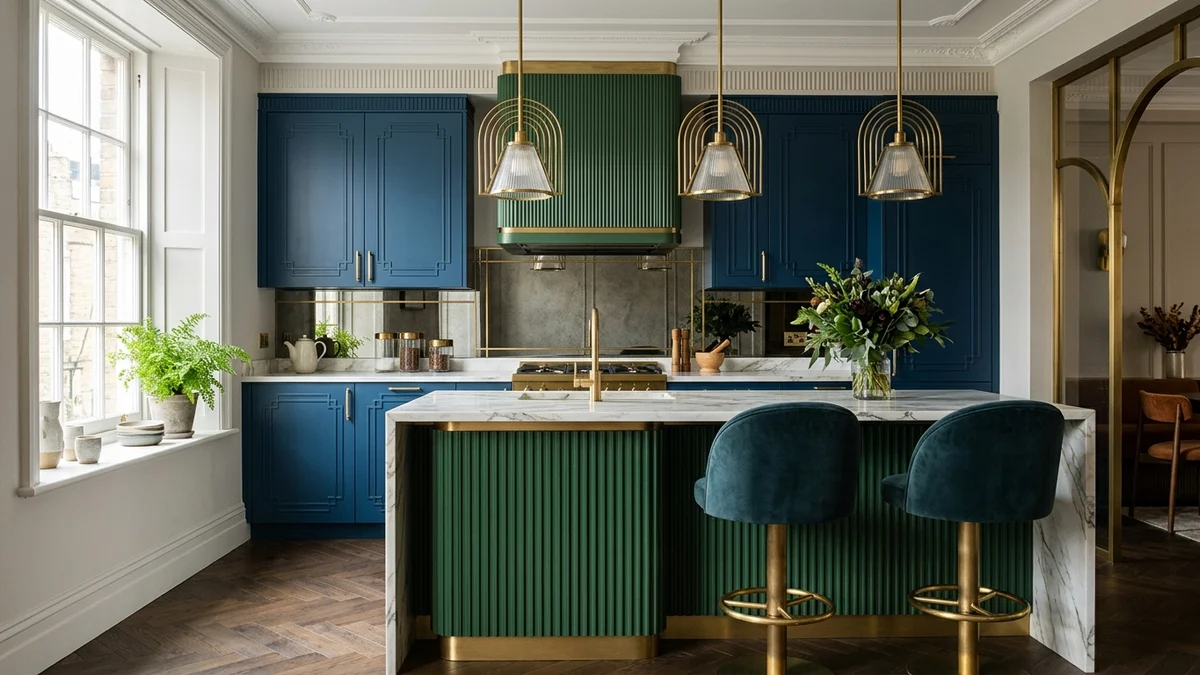
Generated in MeltFlex: a fluted green island and brass pendants, no cabinet replacement needed
Bathroom and Powder Room
The powder room is the lowest-risk place to go all in, because it is small and nobody lingers. Bold fan-pattern tile, a fluted vanity, brass fixtures, and an arched mirror create more drama per square metre than anywhere else in the house. Deep green or burgundy walls are what make the brass actually glow.
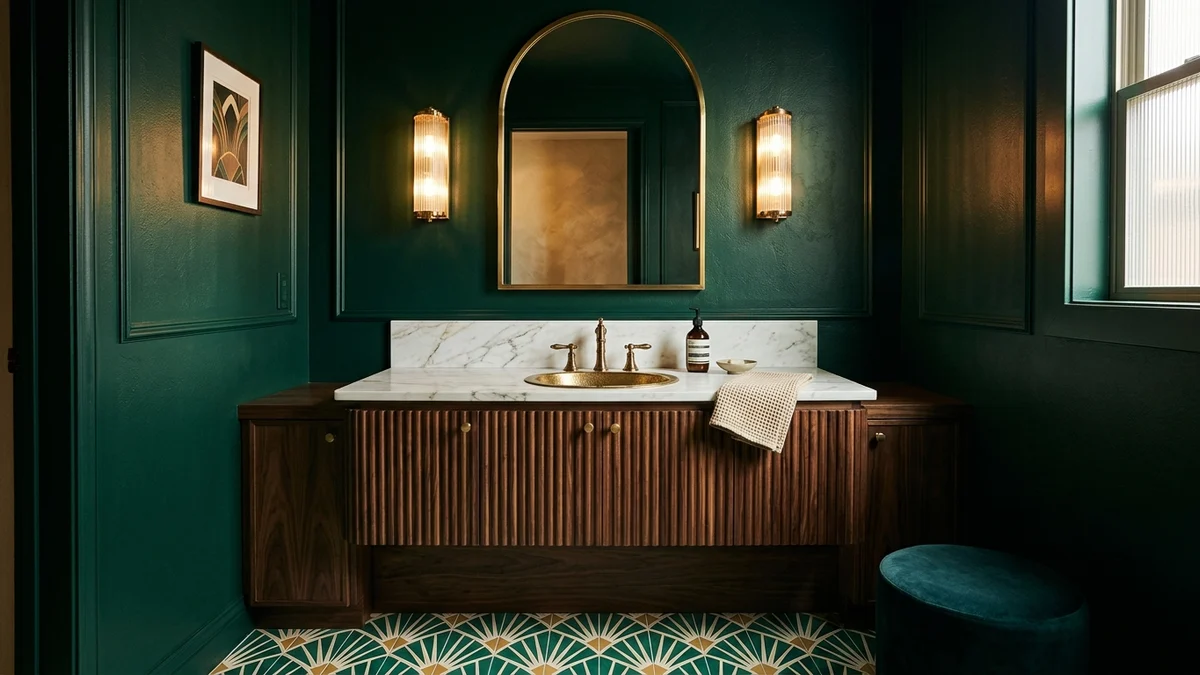
Generated in MeltFlex: emerald walls and fan-pattern tile turning a tiny room into the boldest one
Home Office
A fluted desk front, a brass task lamp, and one sunburst mirror turn a plain workspace into a deco one, and it happens to read beautifully on camera for video calls. Built-in shelving with a little geometric detailing, styled with books and a few brass objects, is the background that makes people ask where you got it.
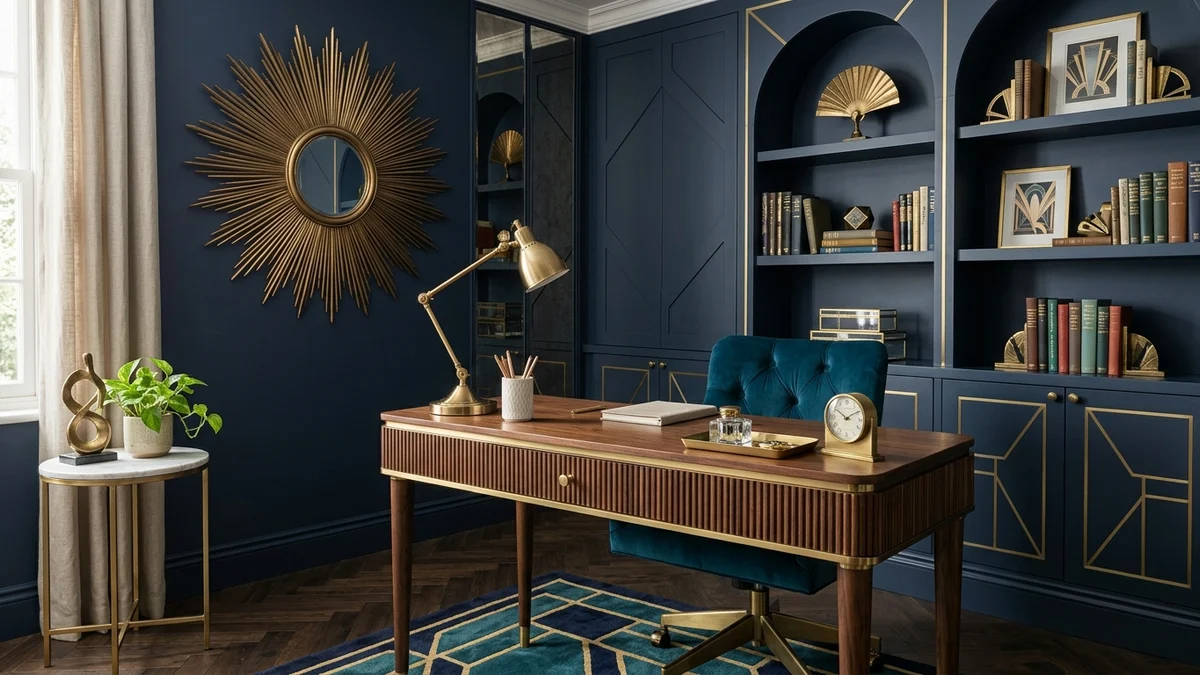
Generated in MeltFlex: a fluted desk and brass sunburst mirror, built for the camera
Entryway
The entryway is the highest-impact, lowest-effort Neo Deco setup in the whole house. One console with a fluted front, a sunburst mirror above it, a chevron runner, and a moody wall, and you have set the tone for the entire home in under a square metre. If you only do one room, this is the one with the best return.
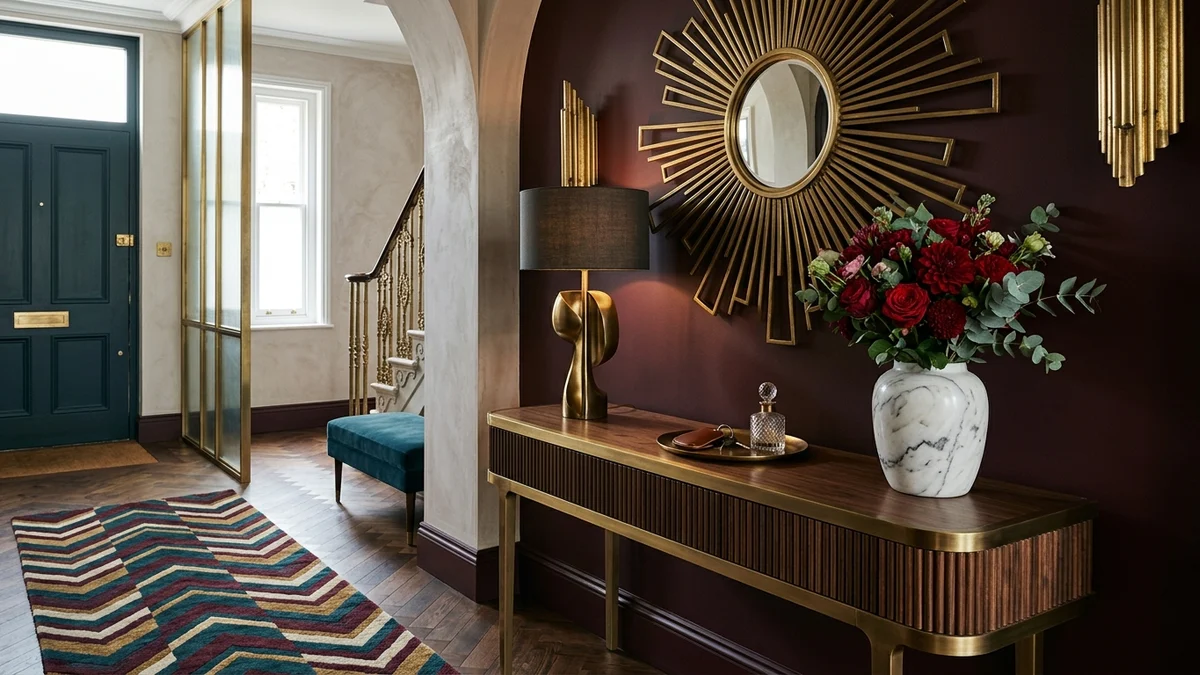
Generated in MeltFlex: the console, sunburst mirror, and chevron runner that set the whole tone
How to Do Neo Deco Without It Looking Like a Theme Park
This is the section most trend articles skip, so let me be blunt. The failure mode of Neo Deco is obvious and common: do too much, and the room stops looking designed and starts looking like a 1920s-themed restaurant. Gold everything, mirror everything, chevron on every surface. It tips from glamorous to costume fast.
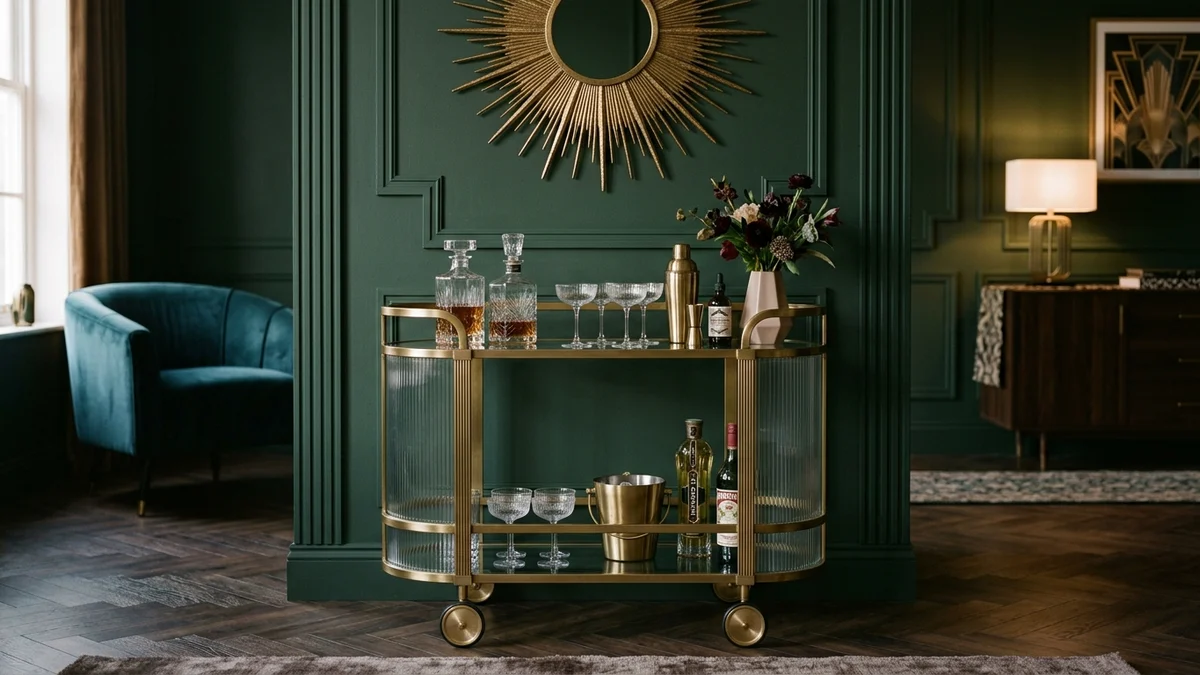
Generated in MeltFlex: one statement piece like this brass bar cart carries the whole look
The fix is the rule designers actually give: “Start with one statement piece. A brass lamp, a bar cart, or a fluted sideboard, then layer metallic hardware and geometric patterns.” One hero, not ten. Here is the discipline that keeps it tasteful:
- One statement piece per room. Pick the single object that carries the look, then keep everything around it quiet.
- Limit the geometry. One strong pattern moment, a chevron floor or a fan-arch mirror, is plenty. Two competing patterns cancel out.
- Mix high and low, old and new. A thrifted brass lamp next to a clean modern sofa reads collected. An entire matching Deco suite reads like a showroom.
- Let the metal be the accent, not the field. Brass on hardware, legs, and lighting. Not on the walls, the ceiling, and the furniture all at once.
- Keep the architecture calm. The drama should come from a few pieces, not from every surface fighting for attention.
Said simply: one hero, a few metals, one bold color, then stop. Restraint is what separates Neo Deco from a costume.
Neo Deco on a Budget vs Splurge
You can get a convincing Neo Deco room for the price of a few accessories, or spend serious money on it. Both work. The difference is mostly upholstery, stone, and millwork.
- Under $200 (the starter). Swap cabinet and door hardware to brass, add one fan-shaped or globe pendant, hang a single arched mirror, and lay a geometric runner. Peel-and-stick fluted panel film transforms a plain cabinet front for under $40.
- $200 to $1,000 (the anchor). Add the one statement piece: a thrifted or new brass bar cart, a fluted console, or a single jewel-tone velvet armchair. This is the highest-impact tier.
- $1,000 and up (the splurge). Full velvet upholstery, a marble or travertine table, custom fluted millwork, a chevron parquet floor, or smoked-mirror cabinetry. Beautiful, but none of it is required to read as Neo Deco.
The honest best value is the accent wall plus one statement piece. A burgundy or navy wall and a single brass-and-velvet object will do more for the room than thousands spent spreading the look thin across every surface.
Preview Neo Deco in Your Own Room With AI
Neo Deco asks for real commitment. Dark walls, jewel-tone velvet, brass on everything, and it is genuinely hard to judge how a moody palette will land in your specific light until it is on the walls. That is exactly the kind of mistake that gets expensive. Every room photo in this guide was made to get around that problem: they are all MeltFlex renders, generated from a short description in the same tool you can open right now.
Upload a photo of your room to MeltFlex and describe the look you just saw: “Neo Deco living room, deep burgundy wall, brass arched mirror, chevron floor, emerald velvet sofa.” It keeps your actual room, its windows, proportions, and layout, and hands back a photorealistic version of your space, not a stock one. Put burgundy next to navy, brass next to chrome, one hero piece against another, and decide before you spend anything.
That is the safest way to try a bold trend. A 30-second preview can save you from a $2,000 velvet sofa in a color that looked great on Pinterest and wrong in your living room.
Ready to see Neo Deco in your space? Try it free on MeltFlex, test three palettes before you pick one. For more 2026 trends, explore our Afrohemian guide, color drenching, dark and moody interiors, accent wall ideas, and the best AI interior design tools compared.
Frequently Asked Questions
Is Art Deco coming back in 2026?
Yes. Pinterest named “Neo Deco” one of its official Pinterest Predicts 2026 trends, and Houzz, which surveyed more than 70 million homeowners and 3 million design professionals, predicts an Art Deco revival for 2026. Pinterest search data shows antique bar cart searches up 100%, brass aesthetic up 35%, and pendant lamp searches up 40%. After years of beige minimalism, people are moving back toward glamour, geometry, and warm metals.
What is Neo Deco?
Neo Deco is a modern, softened reinterpretation of 1920s and 1930s Art Deco. Pinterest’s Sydney Stanback describes it as channeling the elegance of the era through sleek finishes, bold geometric shapes from chevrons to fan arches, and gleaming touches of chrome or brass. Unlike original Art Deco, it trades rigid symmetry and high-contrast black and white for moodier colors, softer curves, and a more eclectic, wearable kind of glamour.
What colors are used in Neo Deco?
The palette is moodier than classic Art Deco. Instead of bright ruby and sapphire, designers reach for burgundy, chocolate brown, deep navy, and amethyst, warmed with earthy neutrals like terracotta, ochre, and caramel, and lifted with metallics in brass, gold, bronze, and chrome. Emerald green is the one classic jewel tone that carries straight through.
How is Neo Deco different from Art Deco?
Original 1920s Art Deco was high-contrast, rigidly symmetrical, and ornate, built on polished chrome, black, white, and bright jewel tones. Neo Deco keeps the geometry, brass, and glamour but softens everything: moodier colors, gentler curves alongside the hard angles, edited rather than maximal detailing, and a slightly surreal, space-age edge. It is meant to feel collected and personal, not like a period film set.
What furniture says Neo Deco?
A few pieces signal the style instantly: a brass or chrome bar cart, a fluted or reeded sideboard, an arched or sunburst mirror, a scalloped or barrel-back velvet armchair, and globe or fan-shaped lighting in warm metal. Antique bar cart searches alone rose 100% on Pinterest going into 2026. Use one or two as anchors rather than buying the whole set.
Is Neo Deco the same as maximalism?
No, though they overlap. Maximalism is about layering more of everything. Neo Deco is a specific visual language, geometric Art Deco shapes and warm metals in a moodier palette. You can do a restrained, nearly minimal Neo Deco with one brass arch mirror and a single bold color, or push it maximalist with full color drenching and gilt. Neo Deco is the vocabulary, maximalism is the volume.
Does Neo Deco work in a small modern apartment?
Yes, and often better. Because the look reads through a few strong shapes and finishes rather than square footage, a single fluted cabinet, an arched mirror, and brass hardware can carry an entire studio. Keep the architecture clean, pick one moody accent color, and let two or three deco pieces do the talking.
How do I add Neo Deco on a budget?
Start with hardware and lighting. Swapping pulls and handles for brass, adding a fan-shaped or globe pendant, and hanging one arched mirror gets you most of the way for under a couple hundred dollars. Peel-and-stick fluted panel film, a geometric runner, and a thrifted bar cart fill in the rest. Full velvet, marble, and custom millwork are the splurge, not the requirement.
How can I preview Neo Deco in my own room before buying anything?
Upload a photo of your actual room to MeltFlex AI and describe the look, for example “Neo Deco living room with a deep burgundy accent wall, brass arched mirror, and emerald velvet armchair.” The AI keeps your real room dimensions, windows, and layout and shows a photorealistic version, so you can test the palette and statement pieces before spending anything.
Sources
The trend calls and statistics in this guide come from named industry forecasts and search data, not opinion. Here is where each figure comes from.
Every room photograph in this article was generated with MeltFlex AI to illustrate the style. They are AI visualizations created to show the look, not photographs of specific real-world properties.