Mid-century modern is the rare style that never really leaves. Warm, clean and built to be lived in, it has stayed a favorite since the 1950s. This is the fast guide: what it is, the exact colors and furniture, and real photo examples room by room. Want to skip the theory? Jump straight to the room-by-room examples.
Our articles are still written by humans!
Get human written articles in your Google feed.
Mid-century modern at a glance
- Era: roughly 1945 to 1969, peaking in the 1950s and early 60s.
- Feel: warm, clean and sculptural. Uncluttered but never cold.
- Colors: warm wood plus two or three retro accents (mustard, teal, olive, burnt orange).
- Materials: walnut and teak, leather, molded plywood, brass, wool.
- Furniture: low and leggy, slim tapered legs, organic shapes.
- Signature pieces: Eames Lounge Chair, Saarinen Tulip table, sideboards and credenzas.
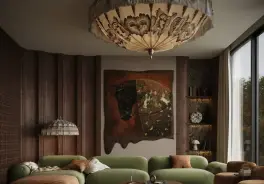
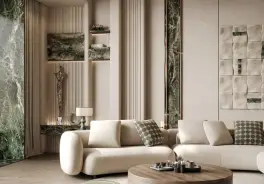
What is mid-century modern interior design?
Mid-century modern is a design style from roughly 1945 to 1969, defined by clean lines, a mix of organic and geometric shapes, functional furniture with slim tapered legs, warm woods like walnut and teak, and a bold retro palette of mustard, teal, olive and burnt orange. It grew out of the Bauhaus and Scandinavian design movements and prized three things above all: simplicity, honesty of materials, and a strong connection between the inside of a home and the world outside it.
What makes it different from plain minimalism is warmth. A mid-century room is uncluttered, but it is not bare. The wood glows, the shapes are soft and sculptural, and there is real color. It feels relaxed and grounded, which is exactly why it has outlasted almost every trend that came after it.
Mid-century modern room by room
The style adapts to every room. Here is how the core ideas play out space by space, each with a photorealistic example and the key pieces that carry the look.
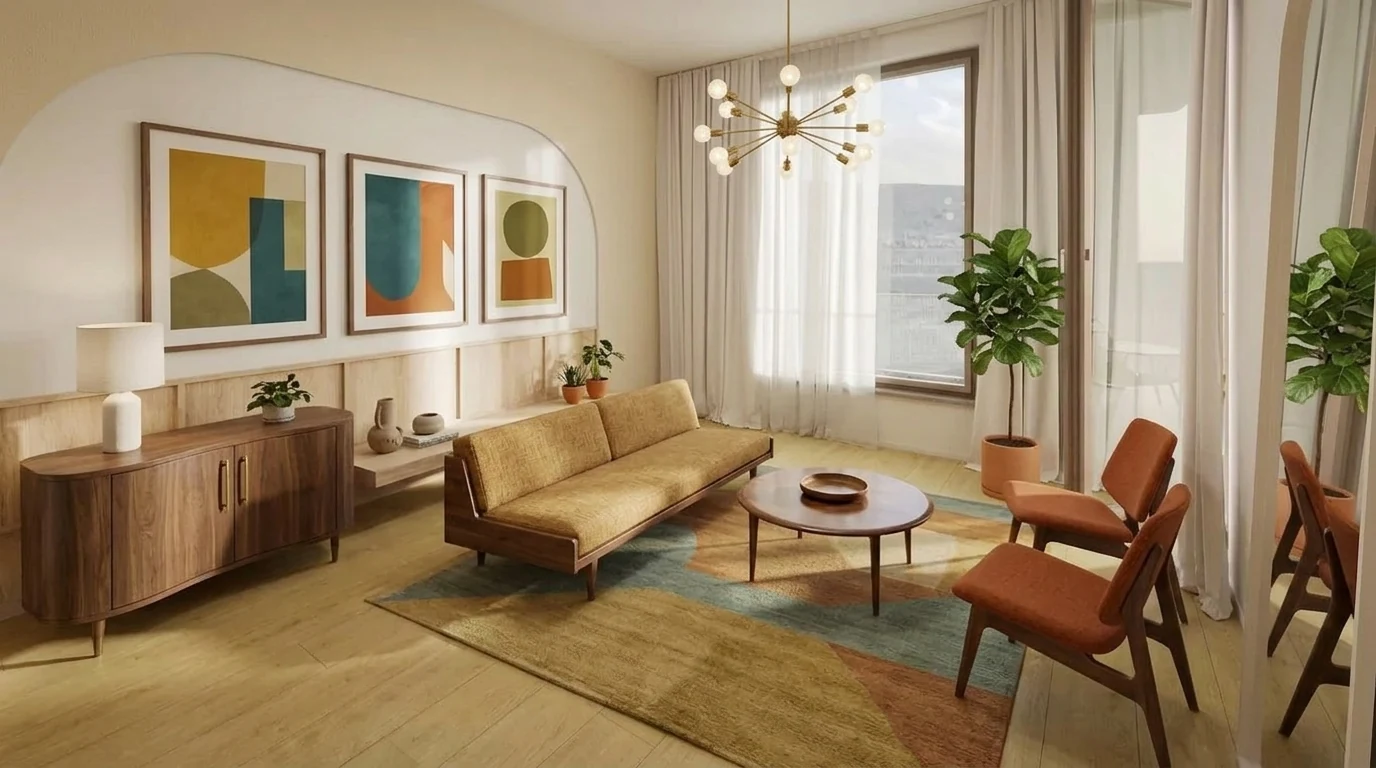
Living room
The heart of mid-century modern, shown in the photo at the top of this guide. Keep the floor visible under everything, that lifted, leggy look is what makes the room feel open.
- Get the look: a low walnut-framed sofa, a pair of tapered-leg lounge chairs, a round coffee table and a sideboard.
- Finish it with: a sputnik or globe pendant, a geometric rug and abstract art.
Bedroom
Keep it serene. The mid-century bedroom is calm and grounded, not busy, so let the wood and one accent color do the work.
- Get the look: a low walnut platform bed, floating nightstands on slim legs and warm mustard or camel bedding.
- Finish it with: brass globe lamps, a single geometric rug and a leather accent chair.
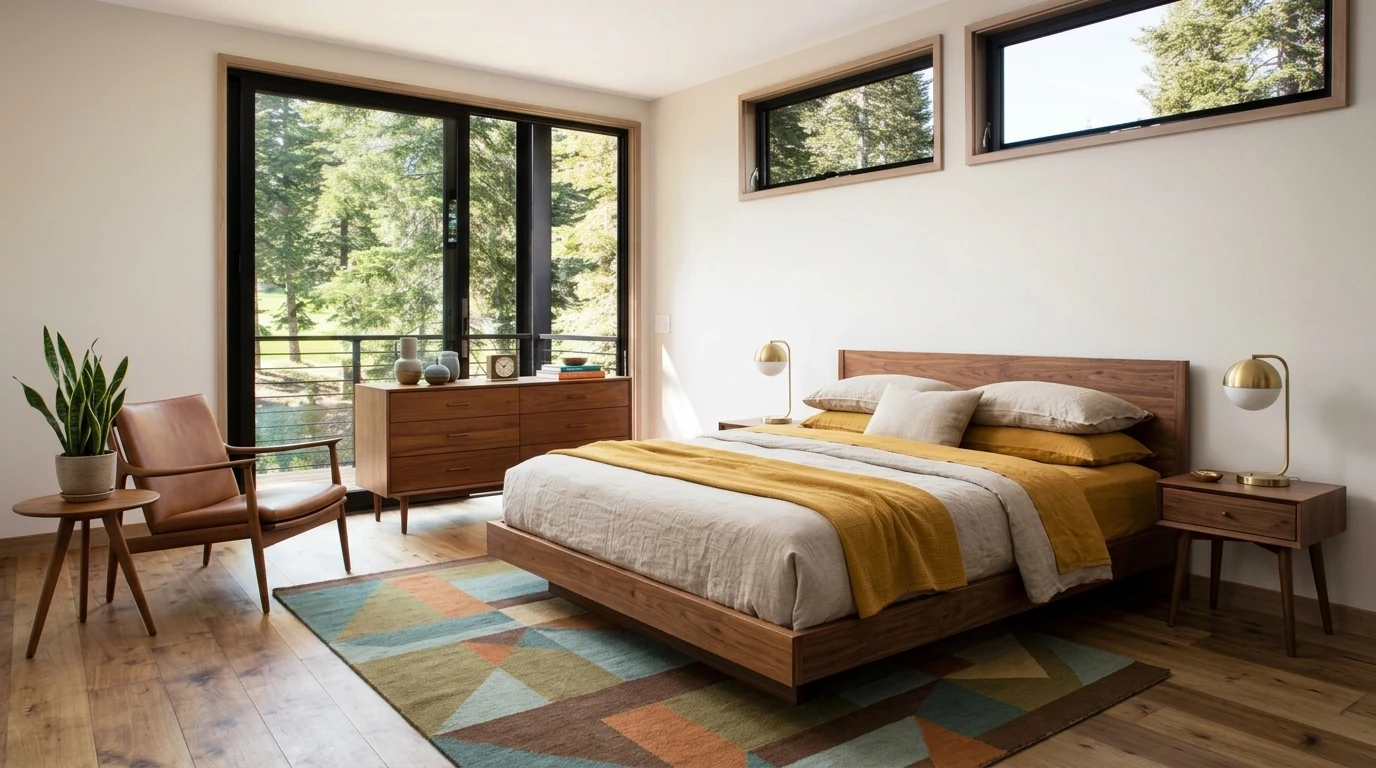
A mid-century bedroom leans on a low platform bed, warm wood and one accent color, here a soft mustard against the greenery outside.
Dining room
A round or oval tulip-style table is the classic move. For more layouts, our room by room design guides guide goes further.
- Get the look: a tulip-style table with molded shell or walnut chairs, and a credenza against the wall.
- Finish it with: a sculptural pendant hung low over the table and one piece of abstract art.
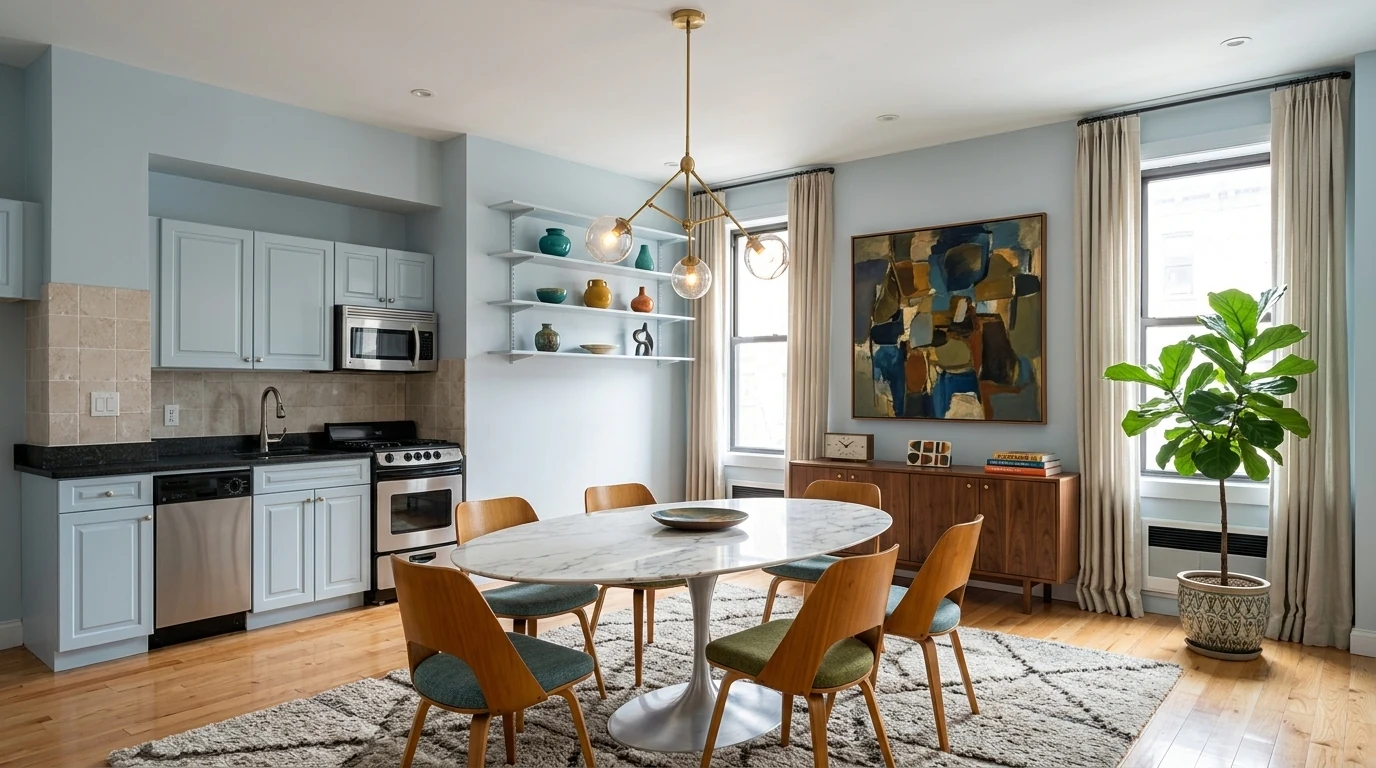
The tulip table clears the floor of chair and table legs, one of the era’s smartest, most copied ideas.
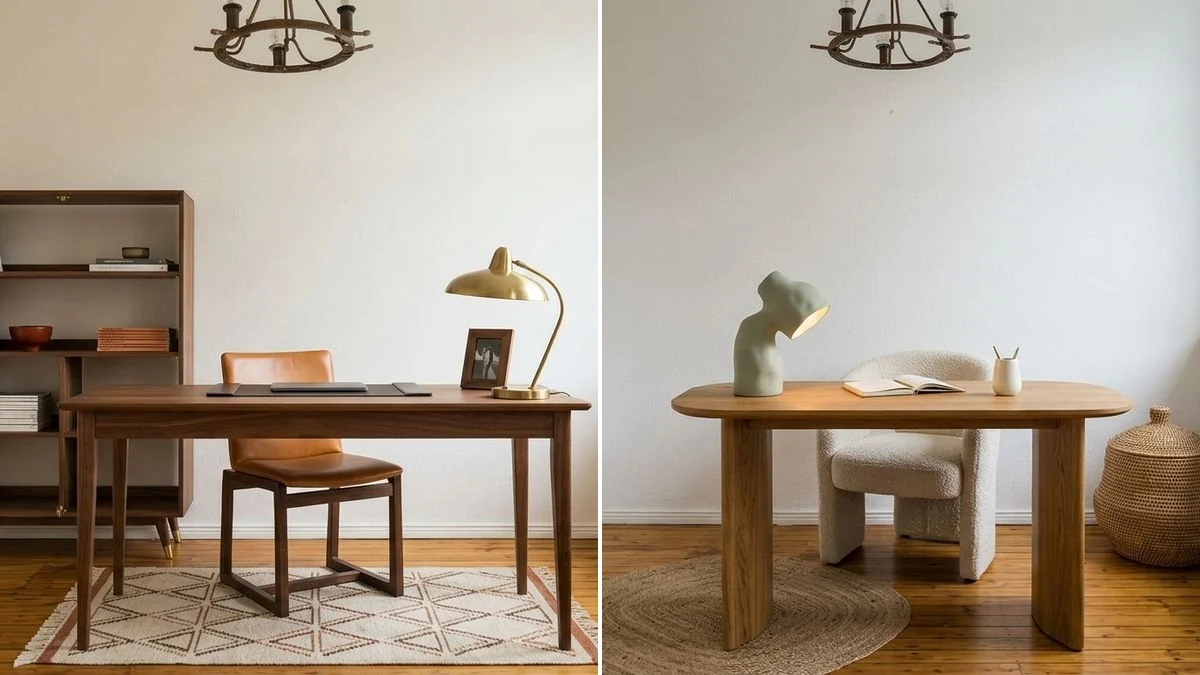
Home office
A warm, focused version of a workspace that still looks good on camera. See our home office design ideas for layout help.
- Get the look: a walnut writing desk with tapered legs, a leather-and-wood desk chair and a low bookshelf credenza.
- Finish it with: a brass task lamp, a couple of abstract prints and a plant.
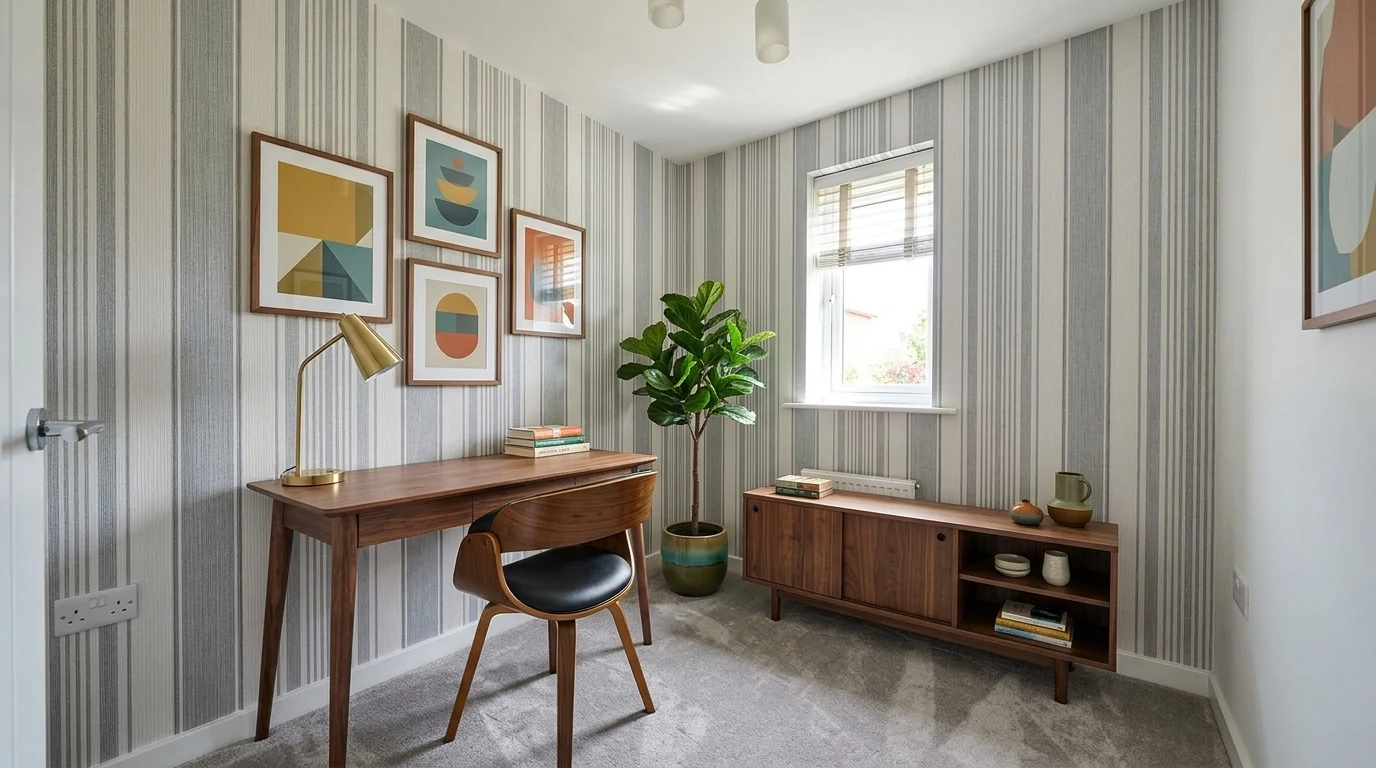
A mid-century home office proves the style is not just for living rooms: warm wood and clean lines make even work feel calm.
Kitchen
Flat-front walnut cabinetry is the backbone. Keep the counters clear, the wood does the work.
- Get the look: flat-front walnut cabinets with slim recessed handles and a tiled backsplash in muted teal or olive.
- Finish it with: a globe pendant and period-correct touches like an avocado-toned range.
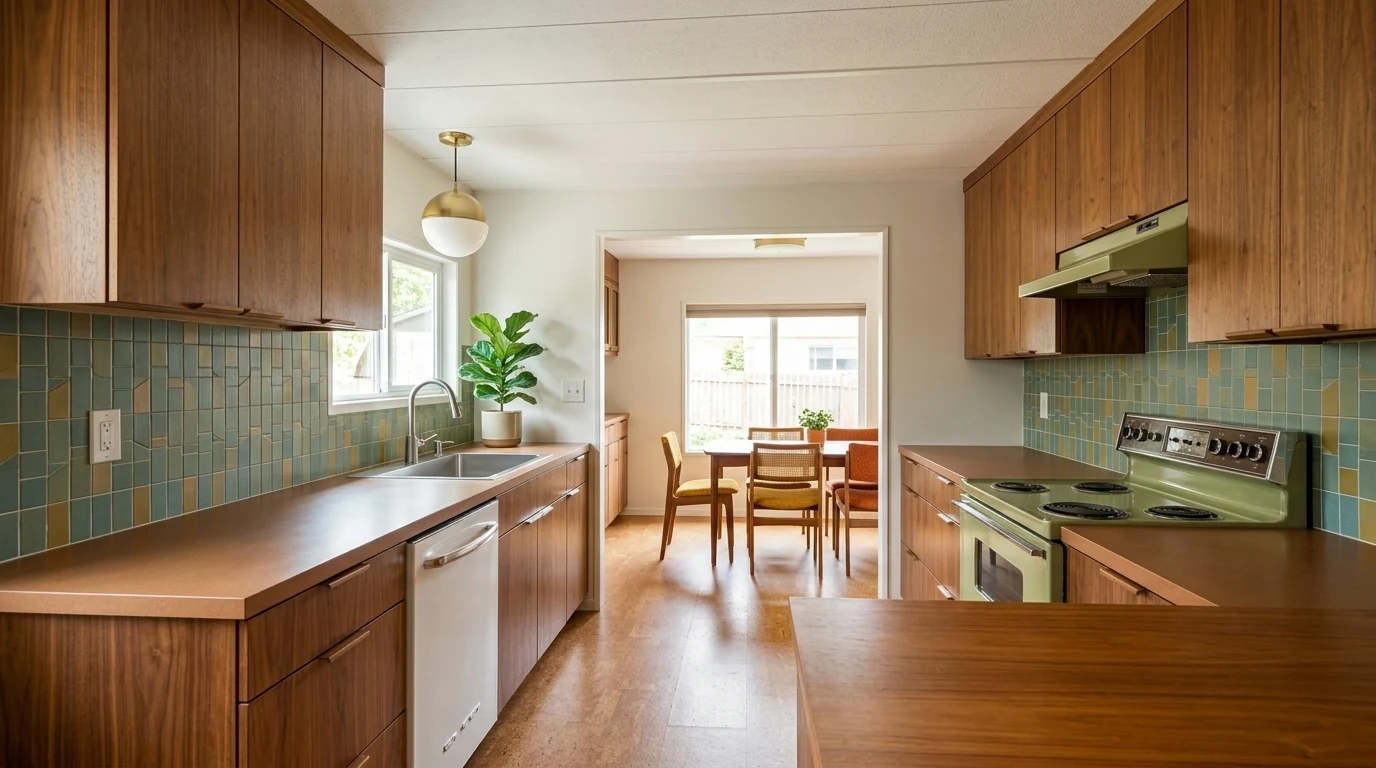
Warm walnut fronts, a teal backsplash and a wink of avocado green: a mid-century kitchen that feels retro without being a costume.
Entryway
The entry is a small space that sets the tone, and it is the cheapest room to make fully mid-century.
- Get the look: a slim walnut console on tapered legs with a round brass-framed mirror above it.
- Finish it with: a molded accent chair, a geometric runner, a sculptural lamp and a plant.
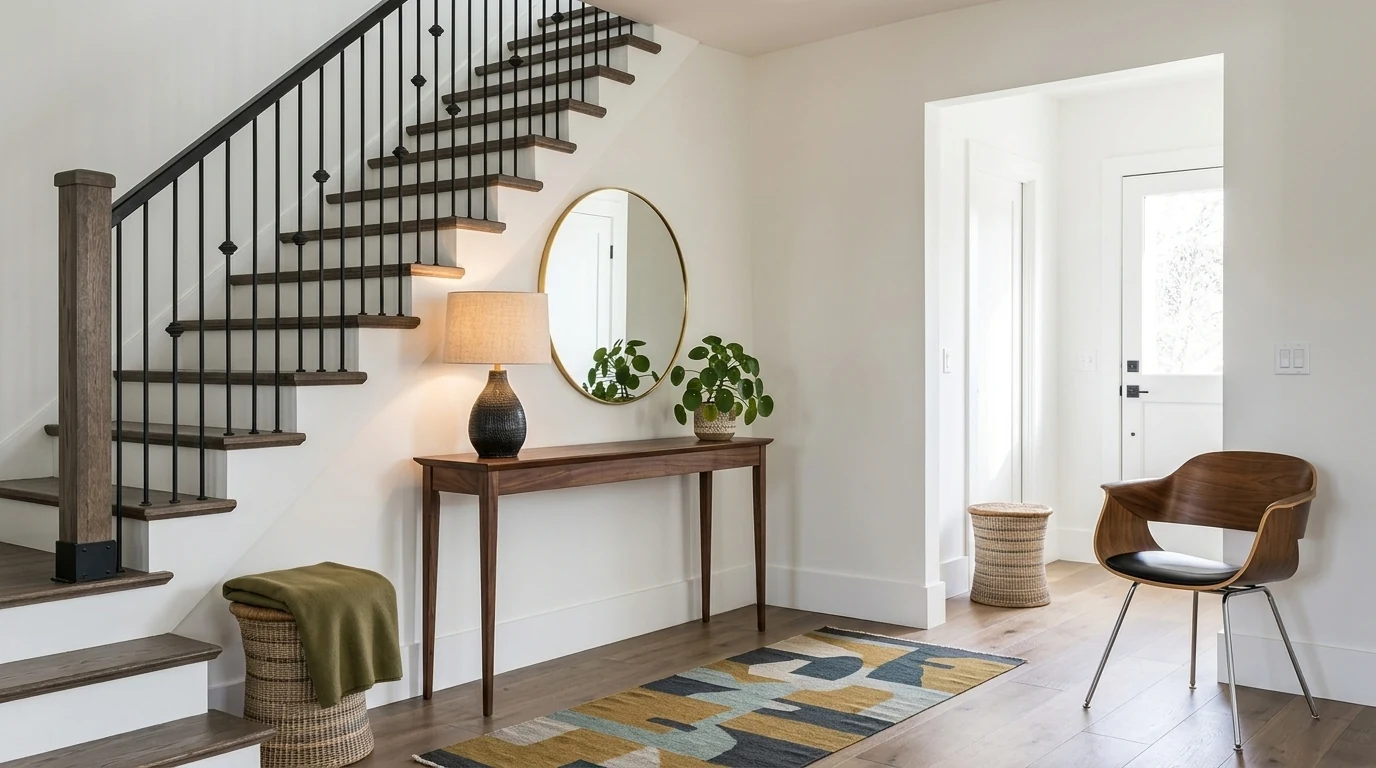
A console, a round mirror and a runner are all it takes to make an entry read as mid-century modern.
Lounge and reading nook
If you have a spare corner, this is where the icon of the whole style belongs: the lounge chair and ottoman.
- Get the look: a molded plywood and leather lounge chair with a matching ottoman, and a low walnut bookshelf.
- Finish it with: an arc floor lamp, a geometric rug and a large plant.
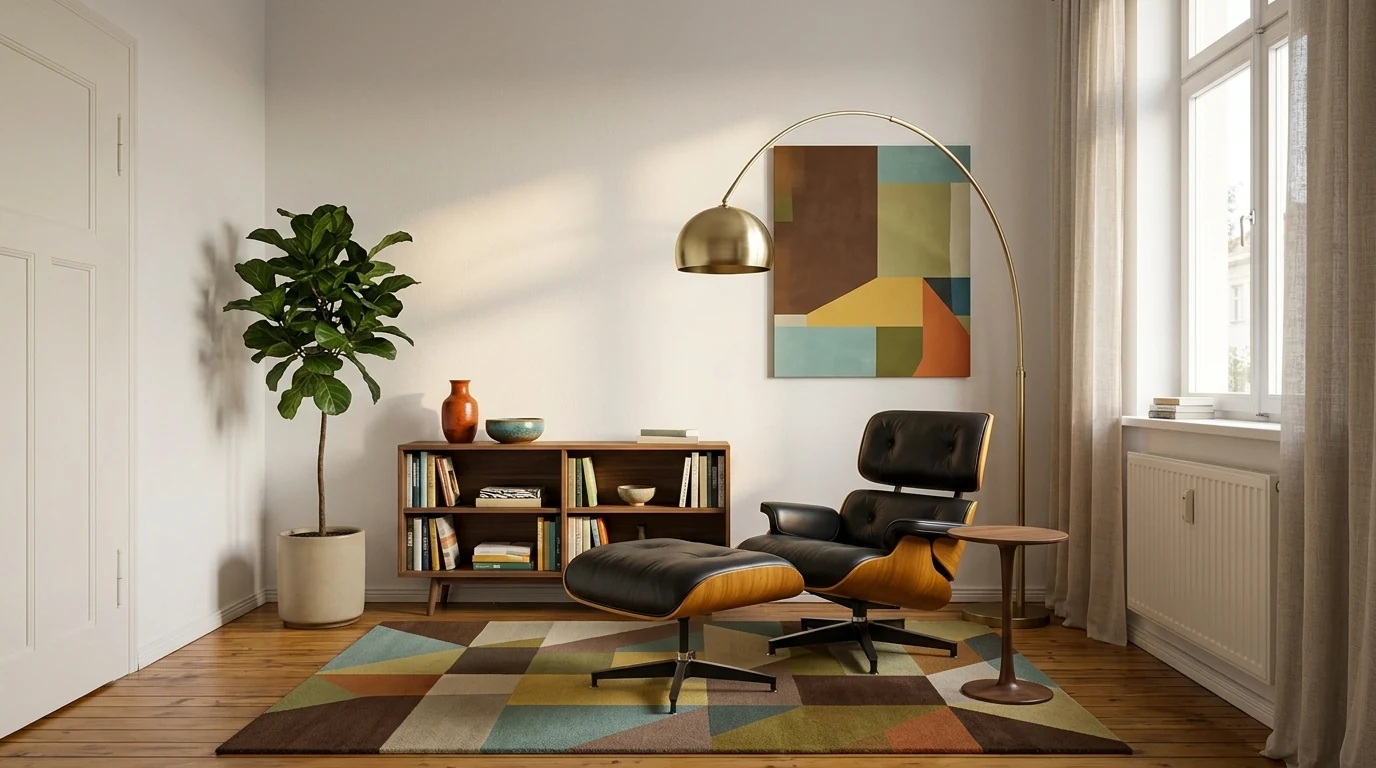
The lounge chair and ottoman are the single most recognizable mid-century pieces, and a reading corner is the perfect home for them.
Bathroom
Even the bathroom can take the look, and it is having a real moment. Keep the warmth of the wood against the hard surfaces.
- Get the look: a floating walnut vanity on slim legs with a rectangular brass-framed mirror.
- Finish it with: a sputnik or globe fixture, small geometric tile in teal or terracotta and brass fixtures.
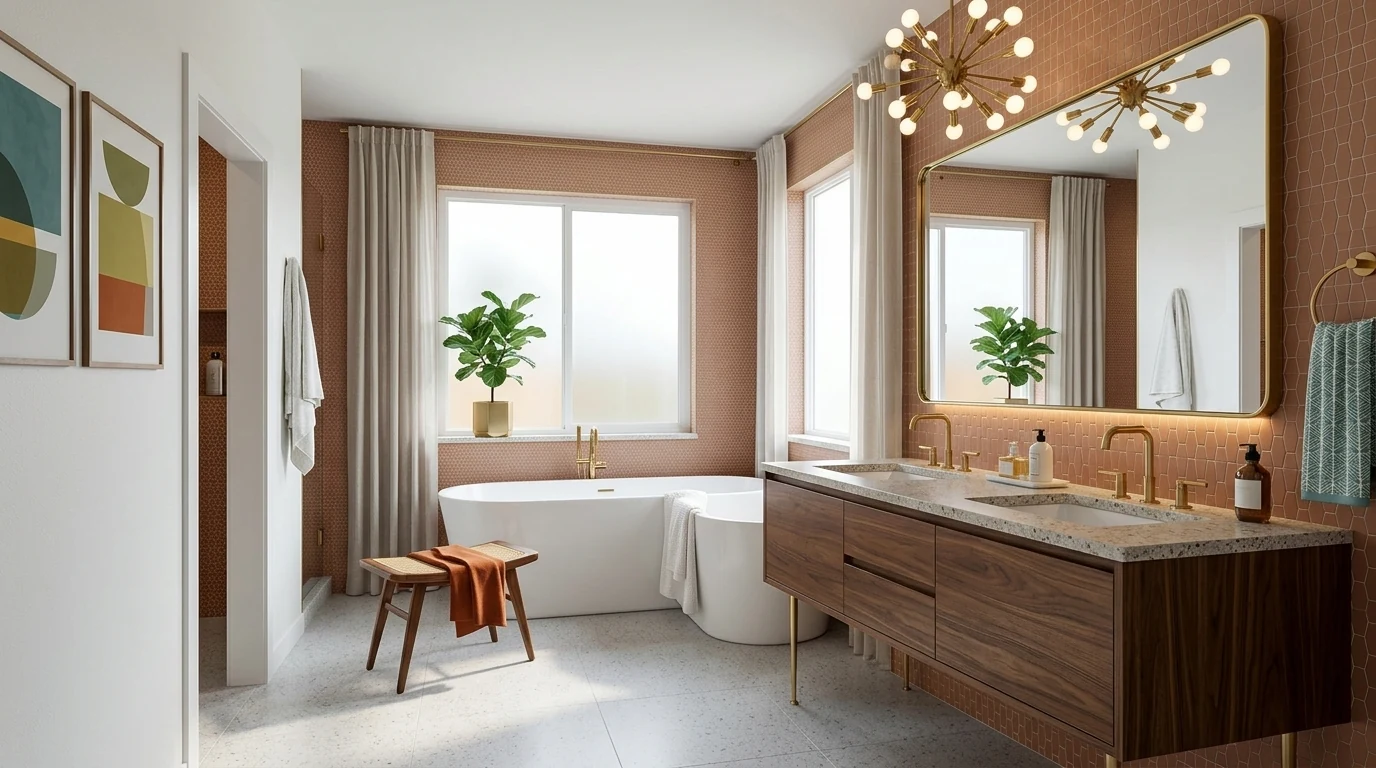
A floating walnut vanity, brass fixtures and warm tile keep a bathroom firmly mid-century without feeling dated.
Watch: how to decorate mid-century modern
If you would rather see the style walked through than read it, this designer video is a good companion to the room ideas above. It tours what makes mid-century modern work and how to decorate a space in the style, room by room.

A designer tour of how to decorate in the mid-century modern style. Video by Rebecca Robeson on YouTube.
The 6 defining characteristics
Strip away the nostalgia and mid-century modern comes down to six consistent traits. Hit most of these and a room reads as mid-century, whatever the budget.
- Clean lines with organic curves. Straight, simple frames softened by rounded, sculptural shapes. Nothing heavy or ornate.
- Function first. Every piece has a clear purpose. Form follows function, a principle inherited straight from the Bauhaus.
- Slim tapered legs. Sofas, chairs and cabinets sit up off the floor on thin angled legs, which keeps the whole room feeling light and airy.
- Warm natural wood. Walnut and teak everywhere, with that honey-to-chocolate glow that defines the era.
- Bold but controlled color. A warm, wood-heavy base with two or three saturated accents, never a rainbow.
- Indoor-outdoor connection. Big windows, plenty of daylight and houseplants, blurring the line between inside and the garden.
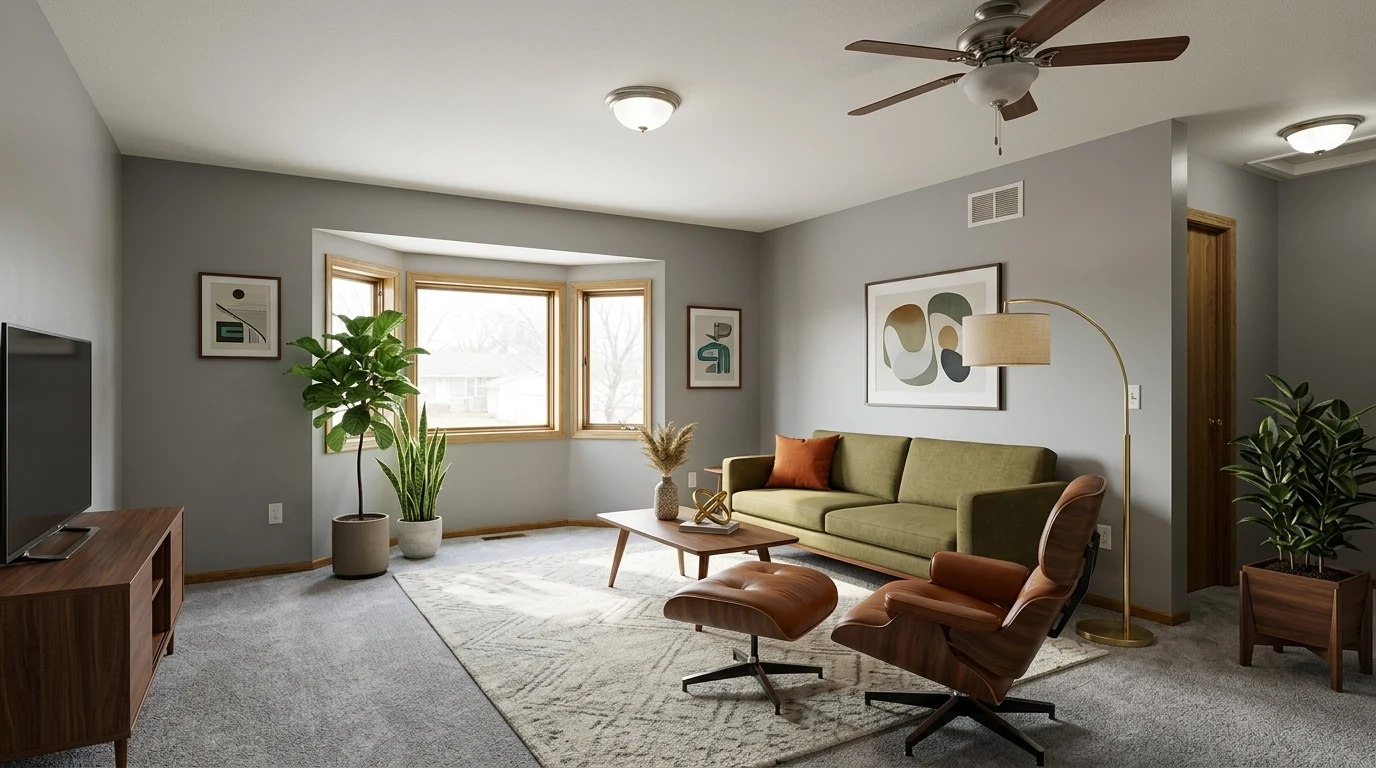
The six traits in one room: light-legged seating, warm wood, a controlled olive-and-rust palette, sculptural shapes and a lot of daylight.
The mid-century modern color palette
Color is where mid-century modern earns its personality. The foundation is always warm wood plus a warm neutral, cream, camel or greige, and then you layer in a small number of saturated accents. Pick two or three, not all of them, and let the wood do most of the talking.
The mid-century palette in short: warm wood plus a neutral, then two or three retro accents. In 2026 the accents are pitched a touch softer than the 1960s originals.
Materials and textures
Mid-century modern is built on honest, tactile materials. Wood leads, always, but the era was also defined by then-new industrial materials used in a warm, human way.
- Wood: walnut and teak first, then oak. Solid, richly grained, often with a low sheen rather than a high gloss.
- Leather: tan, cognac and chocolate leather on lounge chairs and sofas, aging beautifully over time.
- Molded plywood and fiberglass: the material breakthroughs that made those famous curved shell chairs possible.
- Metal and brass: slim hairpin and dowel legs, plus warm brass on lighting and hardware.
- Wool and boucle: textured upholstery and geometric rugs that add softness against all the wood.
Iconic mid-century modern furniture
A few pieces define the whole style, and knowing them helps you spot the real thing and find good affordable versions. You do not need the originals, which now sell for thousands. You need the silhouettes.
If you are drawn to the curved, sculptural side of these pieces, it connects directly to the wider curved furniture trend that is big again in 2026.
A short history: where the look came from
After World War II, a wave of new materials, molded plywood, fiberglass, plastic and aluminum, met a growing middle class that wanted fresh, affordable, optimistic homes. Designers answered with furniture that was lighter, lower and more playful than anything before it. The movement drew directly on the German Bauhaus school and on Scandinavian design, which is why mid-century modern and Scandinavian style still feel like close cousins today.
The term “mid-century modern” was not even used at the time. It was coined much later, by writer Cara Greenberg in her 1984 book of the same name. A second wave of popularity arrived in the late 2000s, helped along by the TV show Mad Men, and the style has been mainstream ever since. The designers behind it are worth knowing, because their pieces still define the look:
- Charles and Ray Eames: the molded plywood and fiberglass chairs, and the iconic Lounge Chair.
- Eero Saarinen: the pedestal Tulip table and chair.
- Arne Jacobsen and Hans Wegner: the Danish side of the movement, the Egg and Wishbone chairs.
- George Nelson and Isamu Noguchi: the platform bench, the sunburst clock, the sculptural coffee table.
Mid-century modern vs modern vs contemporary vs Scandinavian
These four styles overlap constantly and get used interchangeably, which is exactly why rooms end up looking muddled. Here is how they actually differ.
The most common mix-up is modern versus contemporary, because people use them as synonyms and they are not. We break that one down in full in our modern vs contemporary interior design guide. Mid-century modern is the warmest and most colorful of the four, and it pairs beautifully with warm minimalism if you want to dial the retro down.
Common mistakes to avoid
- Turning it into a costume. A room full of loud 1960s reproductions reads as a theme park, not a home. Mix mid-century pieces with plain modern ones and let a few icons stand out.
- Too many accent colors. Mustard and teal and orange and olive and red at once is chaos. Pick two or three and repeat them.
- Heavy, chunky furniture. The whole point is lightness. If a piece sits flat on the floor and feels bulky, it fights the style.
- Forgetting the wood. Without warm walnut or teak somewhere, the room slides into generic modern. Wood is non-negotiable.
- Overfilling the room. Mid-century values negative space. A few good pieces beat a room packed with them.
How to get the look on a budget
Mid-century modern is one of the friendlier styles for a budget, because the used market is full of it and the originals were built to last. A practical order of attack:
- Buy one or two hero pieces first. A walnut sideboard or a lounge chair sets the tone; build the rest around it.
- Shop secondhand. Estate sales, Facebook Marketplace and thrift stores are full of solid-wood mid-century furniture that is cheaper and better made than new flat-pack. See our budget furnishing guide for the full playbook.
- Fake the icons. Plenty of affordable pieces capture the silhouette without the designer price. The tapered legs and the shape are what sell it.
- Add the cheap signals last. A geometric rug, a globe or sputnik light and two accent colors do a huge amount of the work for very little money.
Preview mid-century modern in your own room
Every render in this guide was generated from a real, empty room using the same AI engine that powers MeltFlex, which is the point: you do not have to imagine whether mid-century modern will work in your space, you can see it. Upload a photo of your actual room or a floor plan, choose the mid-century modern style, and get a photorealistic version of your space in about 30 seconds, with the furniture matched to real, purchasable pieces so the render doubles as a shopping list.
That last part matters, because the biggest risk with any style is buying pieces that do not fit or do not work together. Seeing your real room restyled first, with real furniture at real proportions, is the cheapest way to get mid-century modern right. Try it free, or browse more looks in our interior design styles guide.