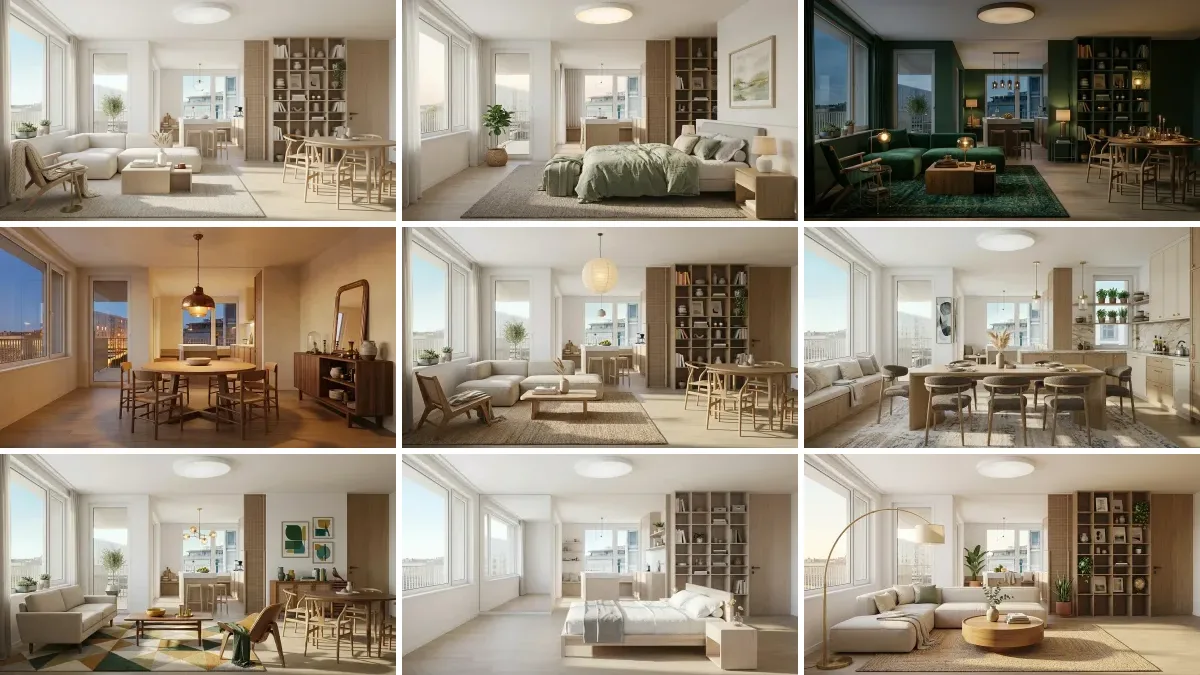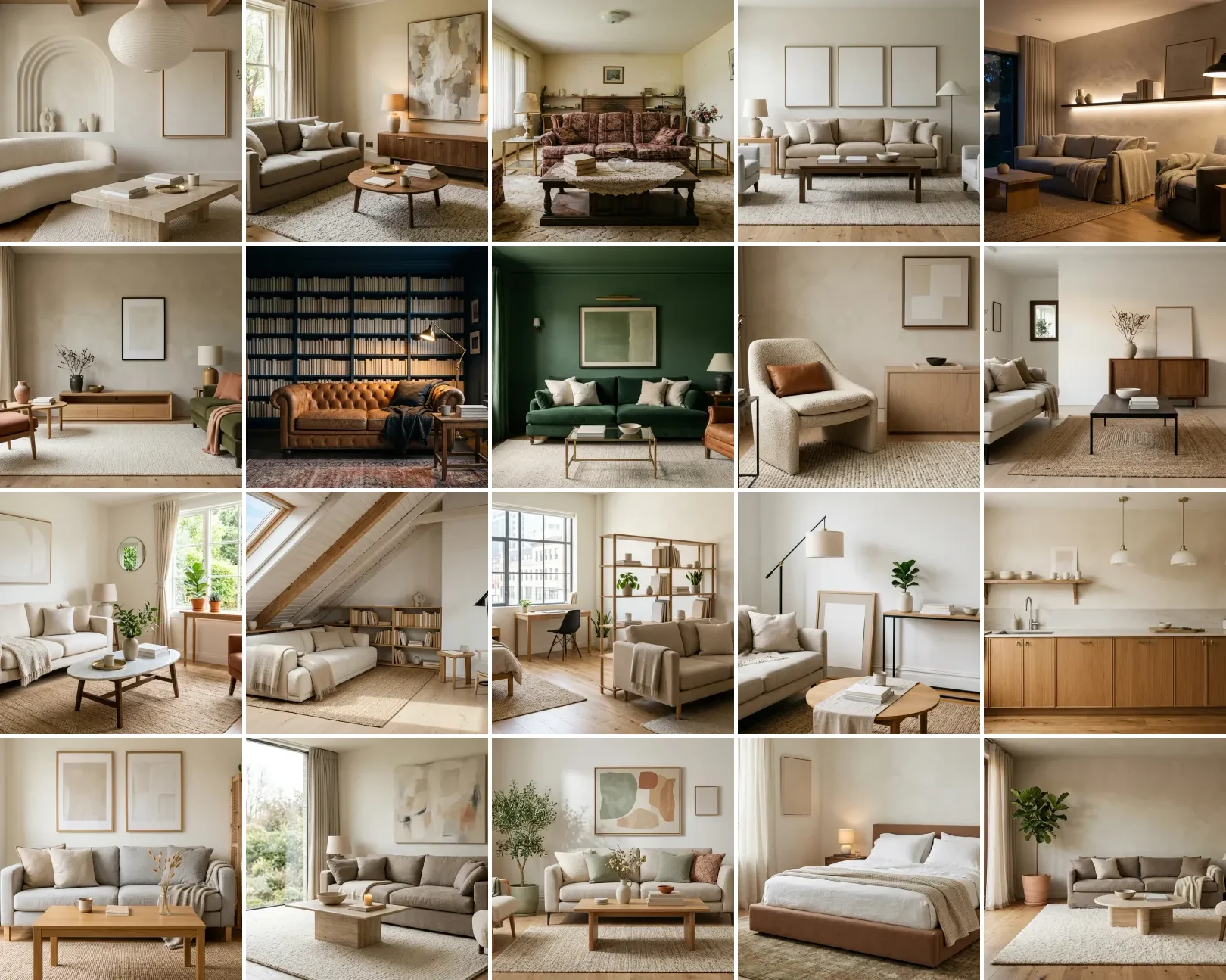
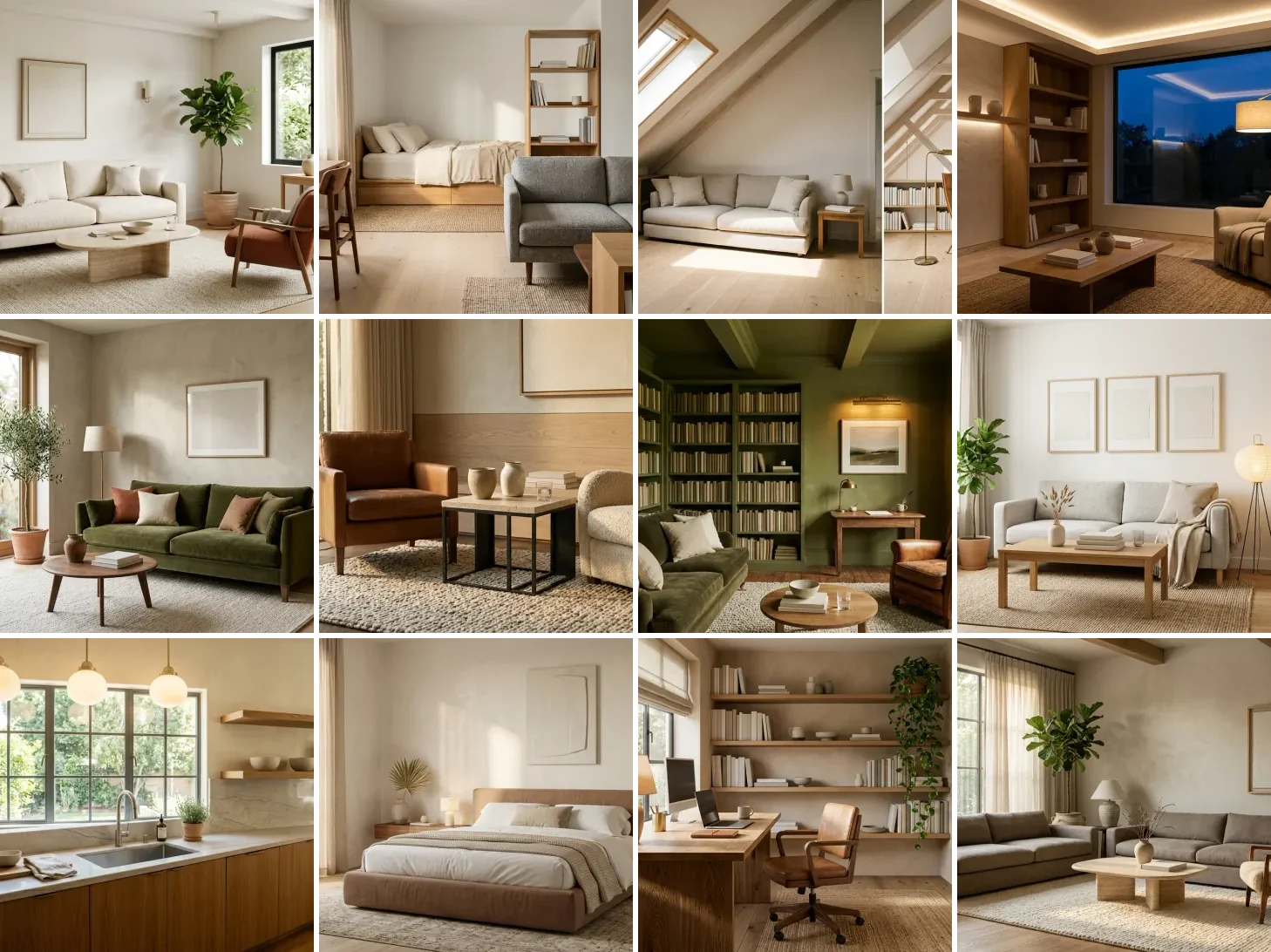
DeepSeek cannot generate images. That is the first thing to know, because half the internet assumes it can. Ask the DeepSeek app to draw a room and you get a polite refusal. What it can do, all for free, is reason through a design in real depth: audit a photo of your actual room, plan a layout and argue why, split a budget, and search the live web for current prices. Think of DeepSeek as the planning brain, not the camera. Below are 40 copy-paste DeepSeek interior design prompts, grouped by job and tested on real rooms. Hit Copy, paste into DeepSeek, and add your room photo. Updated for 2026 with the V4 model, DeepThink reasoning, and the new image-upload feature.
Our articles are still written by humans!
Get human written articles in your Google feed.
Rather not copy-paste? Use our free AI interior design prompt tool instead: type what you want and see it in your own room in seconds. Using other models too? Grab our sets for Gemini, ChatGPT, Claude, Grok and Nano Banana.
Jump to: Room analysis (1–8) · Layout & DeepThink (9–16) · Color & materials (17–22) · Budget & sourcing (23–30) · Whole-room (31–36) · Power-user (37–40) · FAQ
First, What DeepSeek Can and Cannot Do for a Room
There is a lot of confusion here, so let us clear it up before the prompts. DeepSeek in 2026 is a free, frontier-level reasoning model with three abilities that matter for interior design, and one hard limit.
- It can now see your room (2026). DeepSeek added image understanding to its app in early 2026, so you can upload a photo and it reads the space: style, proportions, lighting, what is working and what is not (reported by TechNode). This is understanding only, it cannot edit or generate the image back.
- It reasons out loud (DeepThink). Its DeepThink mode, built on the V4 model (launched April 2026), shows the full step-by-step thinking before it answers. For layout math, zoning, and budget trade-offs, you watch the logic and can correct it.
- It searches the live web. Turn on Search and it pulls current prices, in-stock links, and 2026 trends with citations, instead of guessing from old training data.
- It cannot generate images. No renders, ever, in the app. Image generation lives only in DeepSeek's separate open-source Janus-Pro model, which is capped at 384 by 384 pixels, smaller than most profile photos, and produces blurry, warped output that is useless for a real interior. So DeepSeek plans the room in words, then you visualize it somewhere else.
That last point is the whole workflow. DeepSeek is brilliant and free for the thinking, but you still need to see it. The cleanest path is to plan in DeepSeek, then drop your room photo into MeltFlex, which keeps your real walls, windows, and floor and shows real furniture you can buy. DeepSeek for the plan, MeltFlex for the proof.
Wait, Can DeepSeek Generate Images or Not?
Short answer: not in any way that helps you design a room. This is the single most confused thing about DeepSeek, so it is worth thirty seconds. The DeepSeek you use, the app and chat.deepseek.com, has no image generation at all. The only image model DeepSeek ever released is Janus-Pro, a separate open-source research model you have to self-host. On paper it looks impressive, it beat DALL·E 3 on the GenEval benchmark, 0.80 to 0.67, but that score measures prompt adherence (did the picture include what you asked for), not whether the image looks good. In practice Janus-Pro renders at just 384 × 384 pixels with soft, warped detail. For a photorealistic interior that is a non-starter.
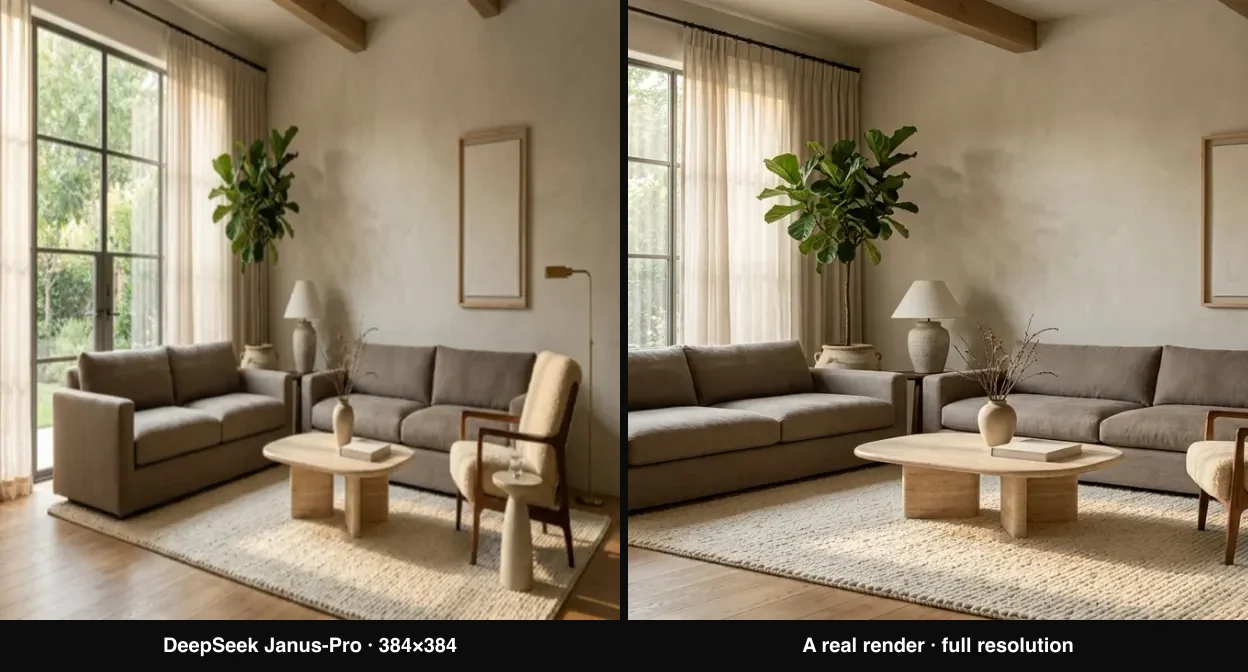
The honest resolution gap: Janus-Pro tops out at 384×384 (left), while a real render needs the detail on the right. DeepSeek plans the room; a dedicated visualizer draws it.
So treat DeepSeek as the architect who writes the spec, not the camera that shoots the finished room. It will hand you a precise plan; you take that plan to an image tool that actually keeps your space.
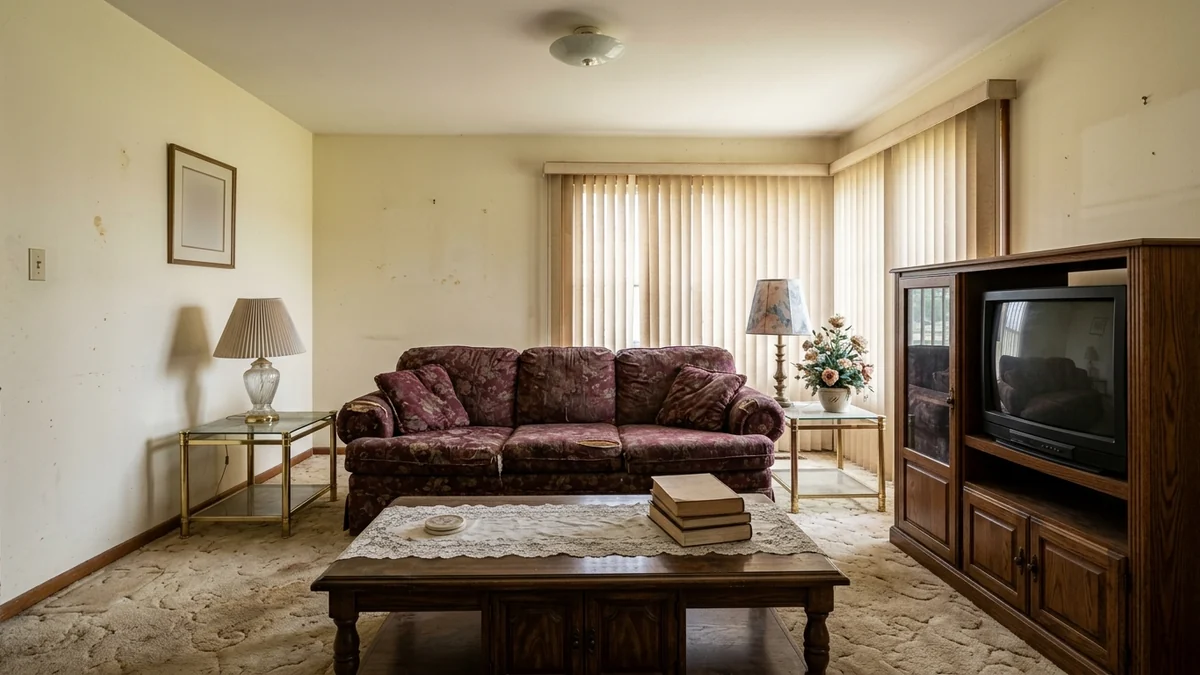
The kind of tired room you upload to DeepSeek for a full audit (prompt 1). DeepSeek reads and plans it; the render above was made in MeltFlex.
The 4 DeepSeek Levers Every Prompt Below Pulls
What makes a prompt a DeepSeek prompt, and not just a prompt you could paste into any chatbot, is that it leans on something DeepSeek does unusually well. There are four of these levers, and every prompt in this guide pulls at least one:
- DeepThink reasoning. Ask it to think step by step and it shows its work: why a layout flows, why a budget split makes sense, why one option beats another. This is its biggest edge.
- Photo vision. Upload your actual room and the answer stops being generic and starts being about your space, your proportions, your light.
- Live web search. Real, current prices and links instead of a hallucinated guess, so a shopping or trend prompt returns today's numbers.
- Free and unlimited. Nothing here is gated. You can run a fifty-message design project at 2am for zero dollars, which changes how much you can iterate.
The groups below map to those levers: analysis pulls vision, layout pulls DeepThink, sourcing pulls search, and all of it is free. Keep them in mind and even a simple prompt gets a DeepSeek-specific answer.
What DeepThink actually looks like
Because the reasoning is the whole point, here is a real, abridged DeepThink reply to prompt 9, the Layout Reasoner, for a narrow 3.2m by 4.5m living room with the door and TV on opposite short walls. Notice it shows the trade-off before it commits, which is exactly what a confident one-line answer hides:
Thinking: The room is long and narrow (ratio ~1:1.4), so the instinct is to line the sofa along a long wall. But the TV is on a short wall, which would put the sofa side-on to it. Two options. (A) Sofa on the long wall, TV on the short wall: comfortable seating but you watch at a 90° angle, bad. (B) Sofa on the short wall facing the TV: correct viewing line, but a 3-seater (~210cm) leaves only ~55cm walkway on each side, which is tight but above the 40cm minimum. B wins if I keep the sofa to 200cm and float it 20cm off the wall.
Answer: Put a 200cm two-and-a-half-seat sofa on the short wall facing the TV, floated 20cm off the wall. Coffee table 100×50cm, leaving 40cm to the sofa. A slim 30cm console behind the sofa reclaims the gap. Keep both side walkways clear at ~55cm. This fixes the viewing angle without choking the walkways.
That is the difference. You can see why it chose option B, check the numbers, and overrule it if your sofa is a different size. Now the prompts.
Room Analysis Prompts, From a Photo (1 to 8)
Upload your room photo first. DeepSeek now reads images, so it can spot undertone clashes, bad proportions, and missing layers that you feel but cannot name. Every prompt below assumes you attach a photo in the DeepSeek app.
1. The Complete Room Audit
[Upload room photo] Audit this room. Tell me: (1) the current design style, (2) the color palette with hex codes, (3) what is working, (4) what is not working, (5) the 3 highest-impact changes I can make for under $[budget]. Name specific products, paint codes, and exact placement. Turn on DeepThink and explain the reasoning for each change.
2. The Style Identifier
[Upload room photo] What interior design style is this room? Give me percentages, like 70% Scandinavian and 30% Industrial. Then list 5 specific pieces I could add to make the style feel intentional instead of accidental, and tell me exactly what to search for online.
3. The Proportion and Scale Check
[Upload room photo] Review the furniture proportions. Rate each piece 1 to 5 for how well it fits the room's scale. For anything below 4, tell me the correct size range in inches and centimeters and what to do with the piece that is wrong.
4. The What Feels Off Diagnosis
[Upload room photo] This room feels off to me but I cannot explain why. Diagnose it across balance, scale, color temperature, negative space, and focal point. Give me the single biggest problem first, then the next two, ranked by impact. Think it through step by step.
5. The Lighting Read
[Upload room photo] Analyze the lighting. Where are the dark zones? Is the light warm or cool? Give me a 3-layer lighting plan (ambient, task, accent) with fixture types, placement, and bulb color temperature in Kelvin. Budget: $[X].
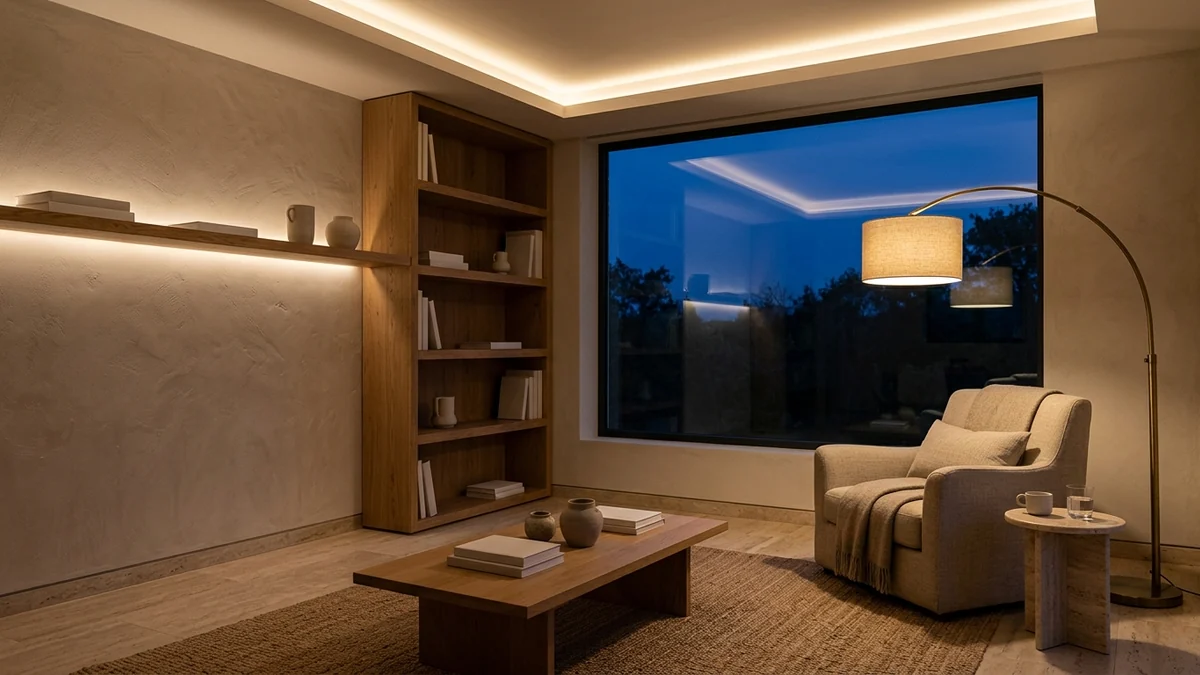
Prompt 5, the Lighting Read: the three-layer plan in practice, ambient, task, and accent light working together and reflecting warmly off the walls.
6. The Keep, Repurpose, or Replace Sort
[Upload room photo] Sort everything in this room into keep, repurpose, or replace. For keep, tell me how to style it better. For repurpose, tell me where it should go. For replace, tell me what to buy and roughly what it costs. I want to spend as little as possible.
7. The Empty Room Plan
[Upload photo of empty room] This room is empty. It is [dimensions] and faces [direction]. I want a [style] look for [who uses it] on a $[budget] budget. Give me a full furnishing plan: layout, every piece with size, the color palette with hex codes, and the exact order I should buy things in.
An empty room is the cleanest test of a plan. DeepSeek will write the whole thing out, but it stops at words. To see it, drop the same photo into MeltFlex and the empty room comes back furnished with your walls, windows, and floor untouched.
8. The Floor Plan Reader
[Upload a floor plan] Read this floor plan. Tell me the likely traffic paths, the best spot for the main seating, where the focal point should be, and any layout mistakes to avoid. Then suggest a furniture arrangement room by room with approximate sizes. Reason it through before you answer.
Layout and DeepThink Reasoning Prompts (9 to 16)
This is the group no static chatbot does as well. DeepSeek's DeepThink mode reasons out loud, which is exactly what you want for layout, because layout is logic, not taste. Turn DeepThink on for all of these and read the thinking, not just the answer.
9. The Layout Reasoner
My [room] is [dimensions] with the door on [wall], windows on [wall], and a [radiator/fireplace/TV] on [wall]. Reason step by step about the best furniture layout for conversation and flow, then give me the final arrangement with each piece's size and position. Show your working so I can push back.
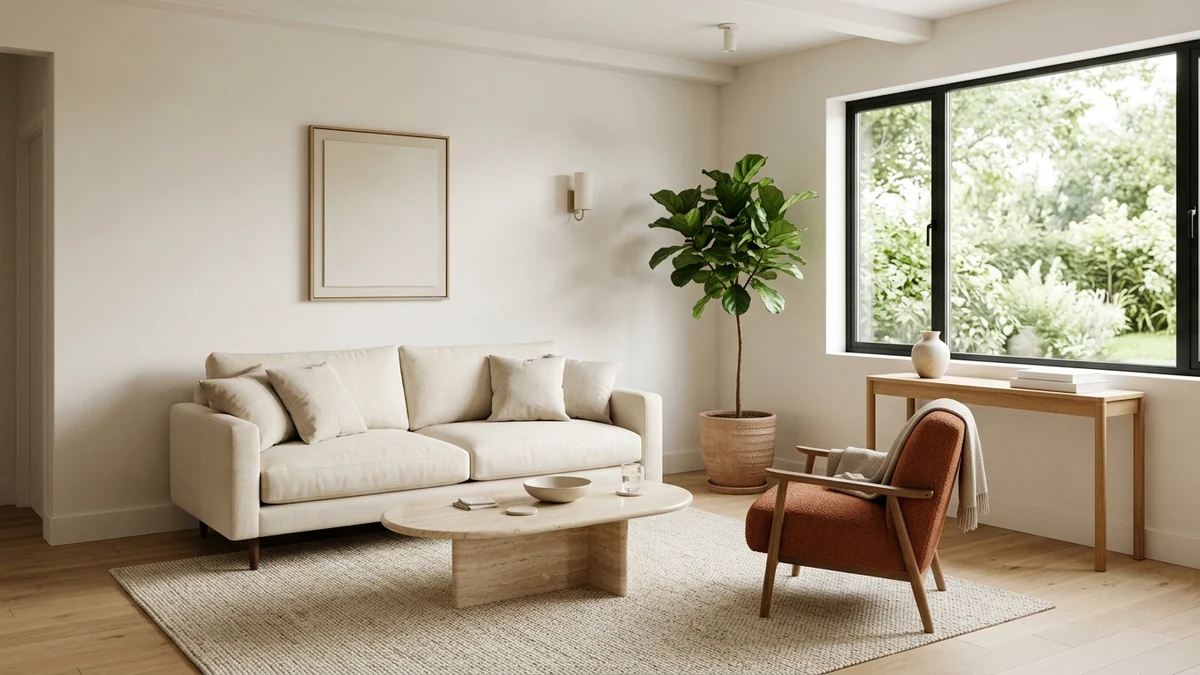
Prompt 9, the Layout Reasoner: what a well-reasoned small-room layout looks like, every piece scaled and a clear path around it all.
10. The Traffic Flow Fix
[Upload room photo or describe the room] People keep bumping into furniture and the room feels awkward to walk through. Map the traffic paths, find where the flow breaks, and give me a revised layout that keeps at least [X] inches of clearance in the walkways. Explain each move.
11. The Small-Space Zone Planner
I have a [size] studio apartment and need distinct zones for sleeping, working, eating, and lounging in one room. Reason through how to divide the space using only furniture placement and rugs, no walls. Give me the layout, the dividers to use, and the order to place things.
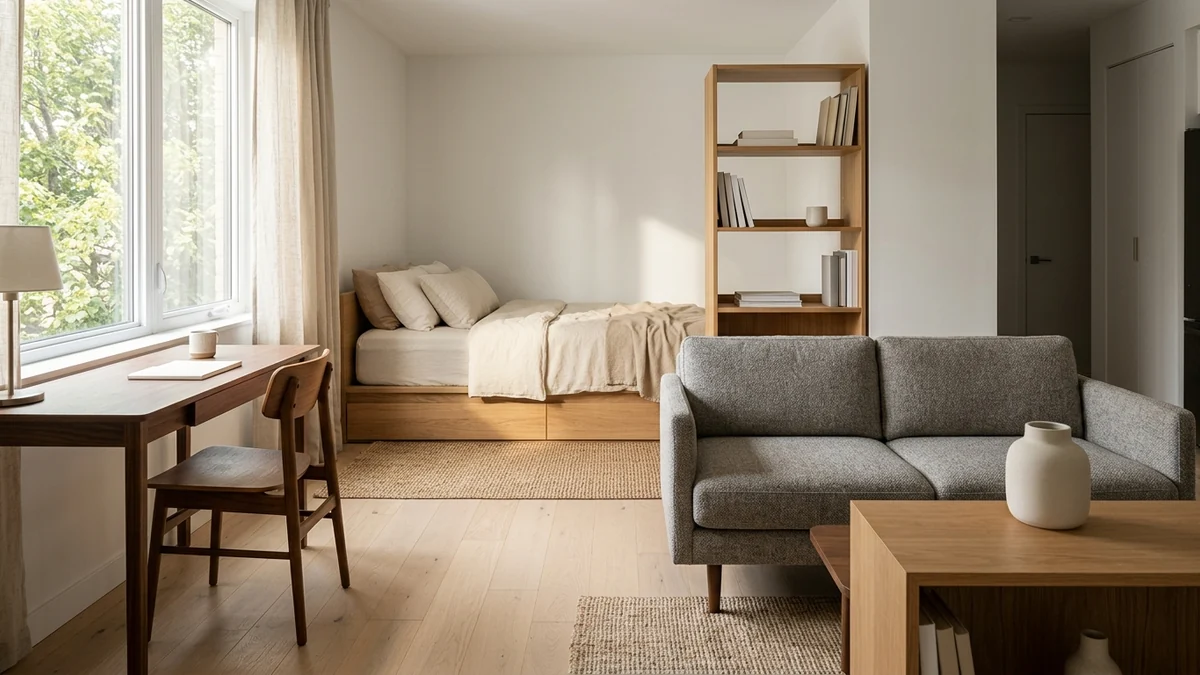
Prompt 11, the Small-Space Zone Planner: one room split into sleeping, working, and living zones with nothing but furniture and rugs.
12. The Awkward Room Solver
My room has [awkward feature: a sloped ceiling / a column in the middle / a long narrow shape / three doorways]. Reason through how to work with it instead of against it. Give me a layout that turns the awkward feature into an asset, with specific furniture and placement.
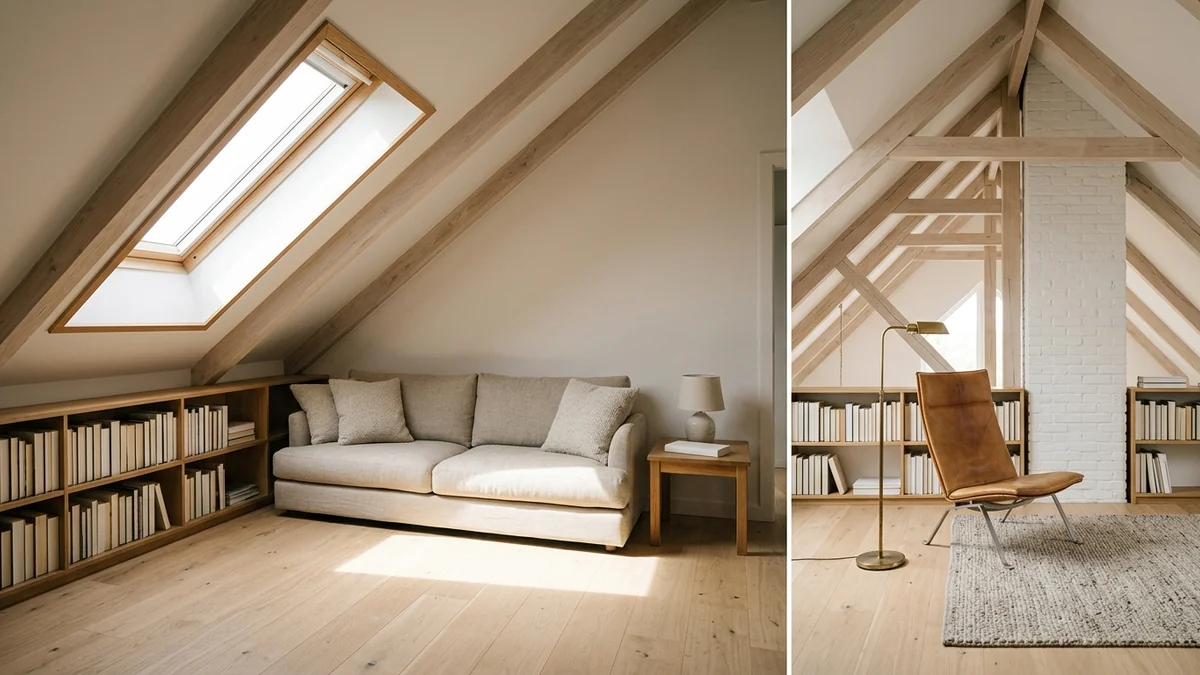
Prompt 12, the Awkward Room Solver: a steep sloped ceiling turned into the best feature in the room instead of a problem.
13. The Furniture Fit Math
I want to put a [piece, e.g. 84-inch sofa] in a [dimensions] room that also needs [other pieces]. Do the math: will it fit with proper clearances, what is the largest size that works, and what walkway and coffee-table gaps should I keep? Show the calculation.
14. The Two-Option Trade-Off
For my [room], I am torn between [Option A] and [Option B]. Argue both sides honestly, list the trade-offs for flow, storage, cost, and how the room feels, then give me your recommendation with the reasoning. Do not just pick one, show me why.
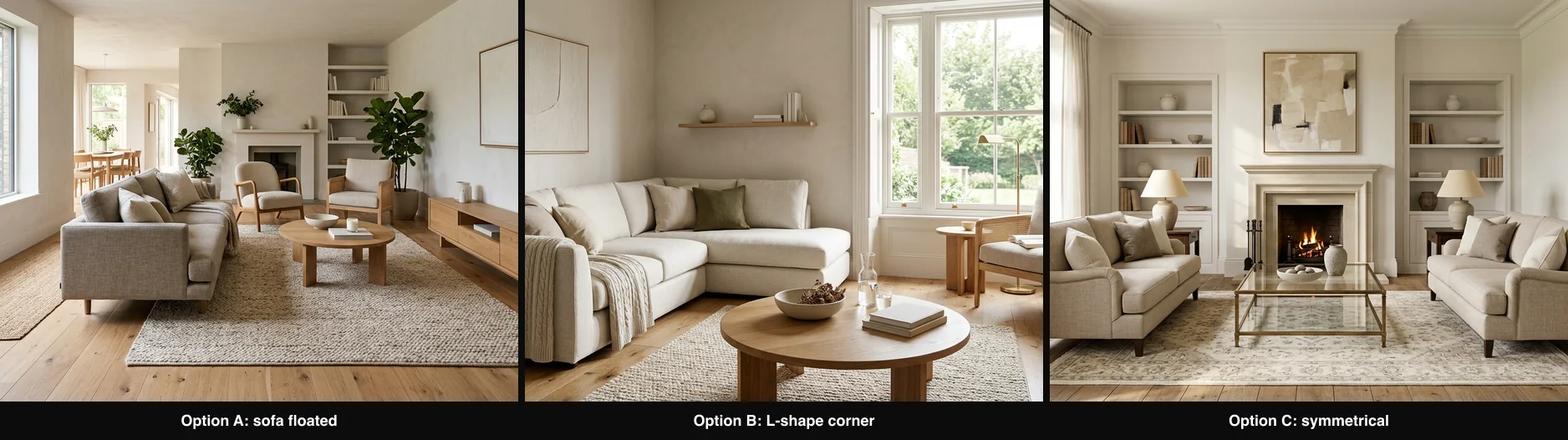
Prompt 14, the Two-Option Trade-Off: three layouts for one room. DeepThink argues each before it recommends, so you see the reasoning, not just a verdict.
15. The Renovation Sequencer
I am redoing my [room/home] with a $[budget] budget over [timeframe]. Reason through the correct order of operations so I never undo my own work: what to do first, what depends on what, and where to spend versus save. Give me a phased plan with rough costs per phase.
16. The Open-Plan Divider Logic
I have an open-plan [kitchen/living/dining] and it feels like one big undefined space. Reason through how to define each area while keeping it open: sightlines, rug placement, furniture backs as dividers, lighting zones, and a consistent palette. Give me the plan and explain why each move works.
Color, Palette, and Material Prompts (17 to 22)
DeepSeek is good at the systematic side of color: ratios, undertones, and why a combination works. Ask for hex codes and it will hold a palette consistent across a whole project.
17. The Full Palette Builder
Build me a complete color palette for a [style] [room] that gets [amount] of [north/south] light. Use the 60-30-10 rule. Give me exact hex codes and a paint brand match for the walls, the main furniture, and the accents, and explain why they work together.
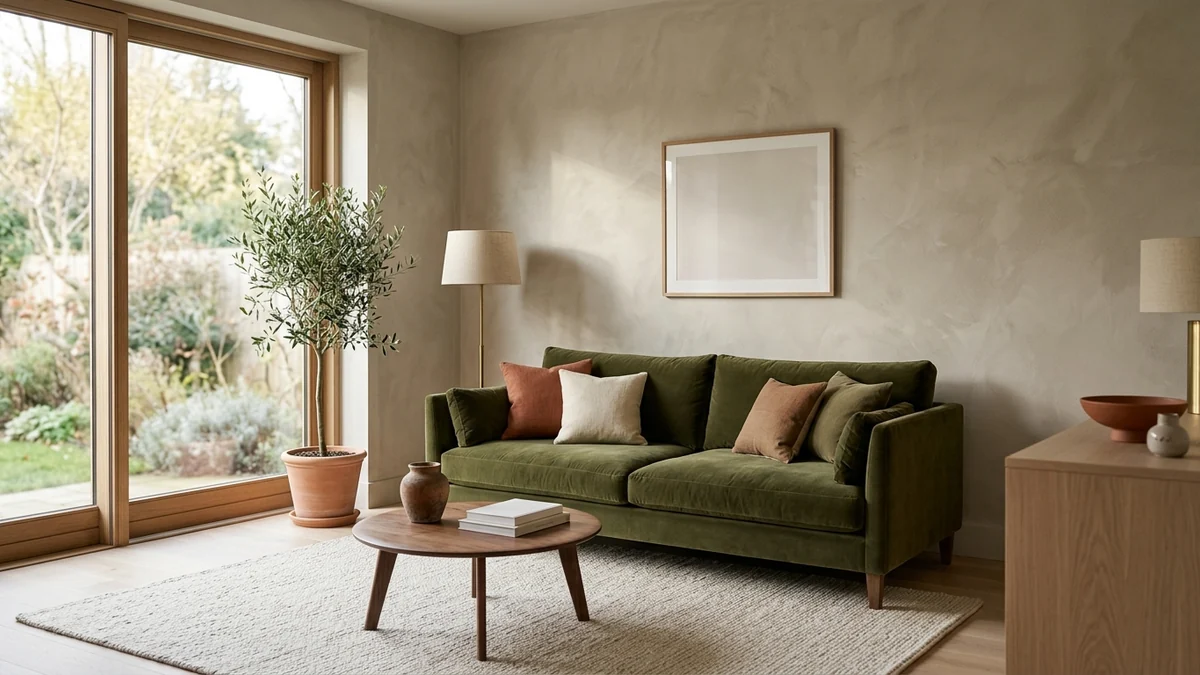
Prompt 17, the Full Palette Builder: a 60-30-10 palette resolved into a real room, greige as the 60, olive as the 30, terracotta and brass as the 10.
18. The Undertone Fixer
[Upload room photo] Something about the colors feels muddy. Diagnose the undertones: are my whites, woods, and metals fighting each other (warm vs cool)? Tell me exactly which pieces clash and the cheapest way to bring the room into one temperature family.
19. The Color-Drench Plan
I want to color-drench my [room] in [color] (walls, trim, and ceiling one tone). Reason through whether that works for this room's light and size, give me the exact shade with a hex code and paint match, and tell me what furniture, floor, and metal finishes keep it from feeling flat or oppressive.
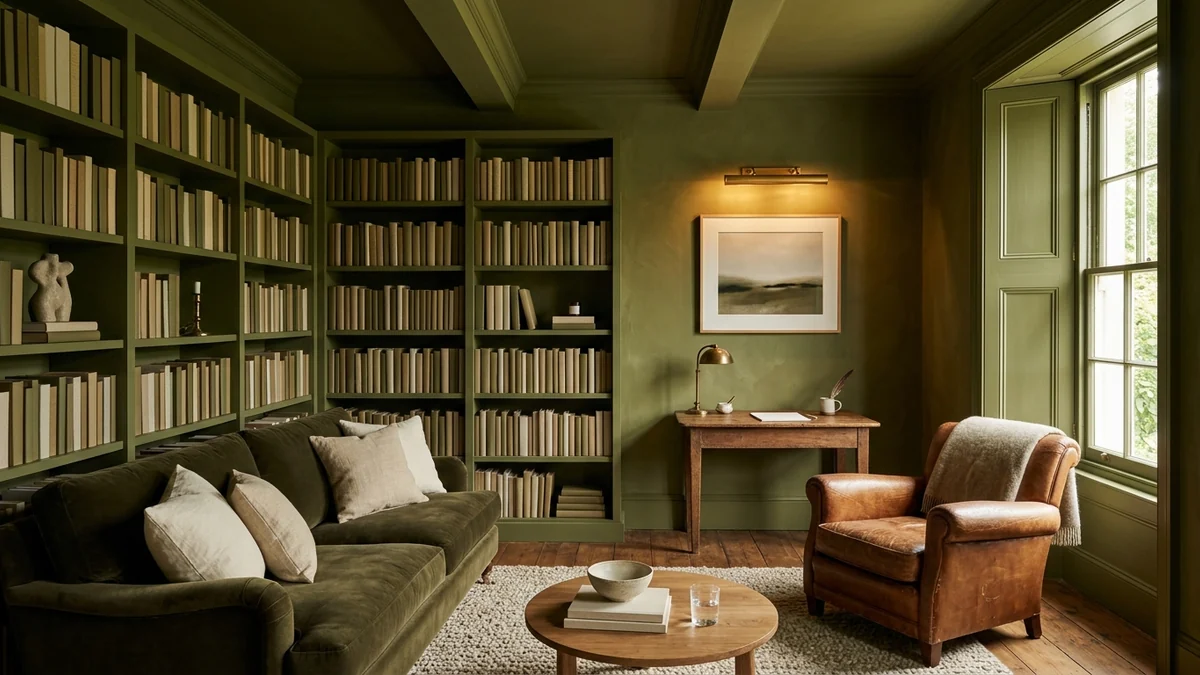
Prompt 19, the Color-Drench Plan: one deep olive tone on the walls, trim, and ceiling, warmed up with cognac leather, brass, and cream so it reads rich, not oppressive.
20. The Material and Texture Mix
My [room] has a [style] look but feels flat and one-note. Give me a plan to layer materials and textures (wood, stone, metal, boucle, linen, ceramic, wool) so it reads rich and tactile. Tell me which pieces to add, and keep it to a warm neutral palette.
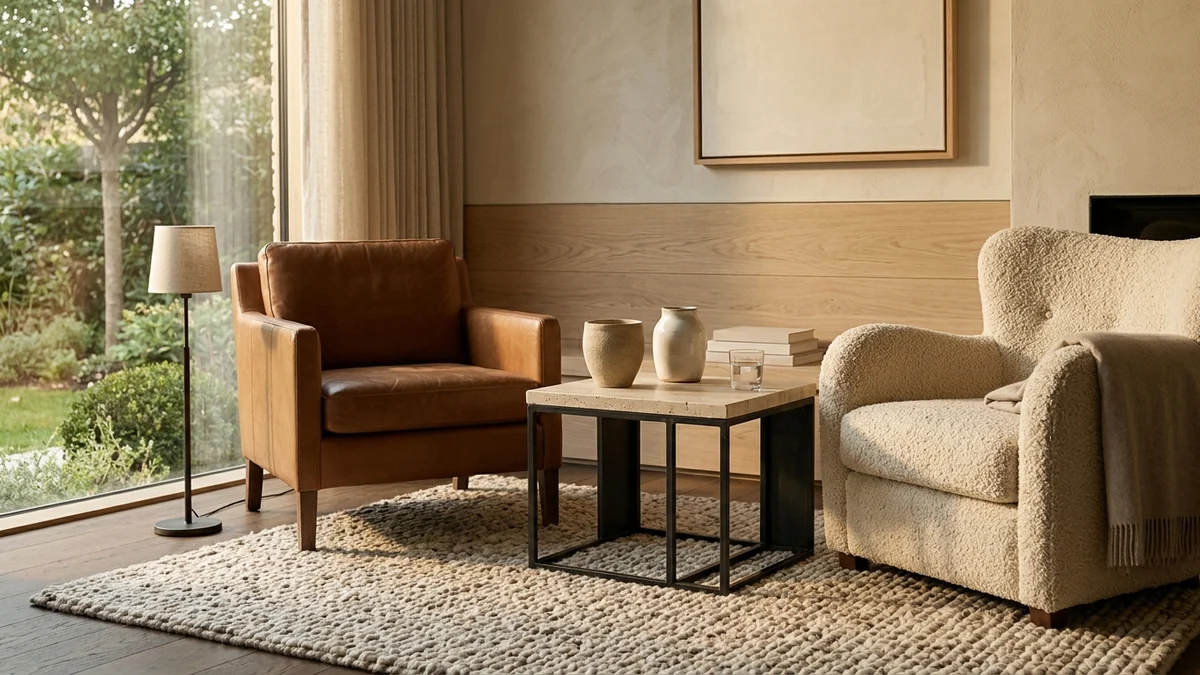
Prompt 20, the Material and Texture Mix: oak, travertine, steel, boucle, leather, and wool in one warm-neutral frame, the fix for a flat room.
21. The Wood Tone Reconciler
My room mixes [wood tones, e.g. orange oak floor, dark walnut table, pine shelves] and it looks like an accident. Reason through how to make the mix look deliberate instead: which tones to keep, what to add as a bridge (rugs, metals, textiles), and the one rule to follow so wood tones read intentional.
22. The Mood to Palette Translator
I want my [room] to feel [mood: calm and grounded / warm and cocooning / bright and energizing / quiet and luxurious]. Translate that mood into a concrete palette (hex codes), three key materials, and a lighting temperature. Explain how each choice creates the feeling.
Budget, Sourcing, and Web-Search Prompts (23 to 30)
Turn on Search for this group. DeepSeek will pull current 2026 prices and in-stock links instead of guessing, and because it is free you can price a whole room without burning through a monthly quota.
23. The Real Budget Allocator
I have $[budget] to furnish a [room] from scratch. Reason through how to split it across every piece I need (sofa, rug, coffee table, lighting, art, storage, plants) so the money lands where it matters most. Give me a line-item budget with a target price per item and explain the split.
24. The Live Sourcing Search
Search the web right now and find me a [specific piece, e.g. 200cm three-seat linen sofa] in [color] under $[X] that is currently in stock and ships to [country]. Give me 5 real options with the price, the retailer, and a one-line reason each made the list.
25. The Dupe Finder
I love [designer piece / expensive item] but it costs $[X]. Search for the closest look-alikes at a fraction of the price. Give me 5 current dupes with prices and where to buy, and tell me honestly where each one compromises versus the original.
26. The Splurge vs Save Sort
For a [room] in [style], tell me which pieces are worth splurging on and which I should save on, and reason through why (durability, how much it is used, how much it drives the look). Then search for one splurge pick and one save pick per category with current prices.
27. The Phased Buying Order
I cannot buy everything at once. For my [room], give me the order to buy things in over [number] paychecks so the room looks intentional at every stage, not half-finished. Explain why each item comes when it does, and keep a running total against my $[budget].
28. The Budget Room Challenge
Design me a complete [room] that looks like it cost triple what it did, using only affordable retailers (IKEA, Amazon, and similar). Search for real current products, give me the full shopping list with prices and a total, and explain the styling tricks that make cheap pieces look elevated.
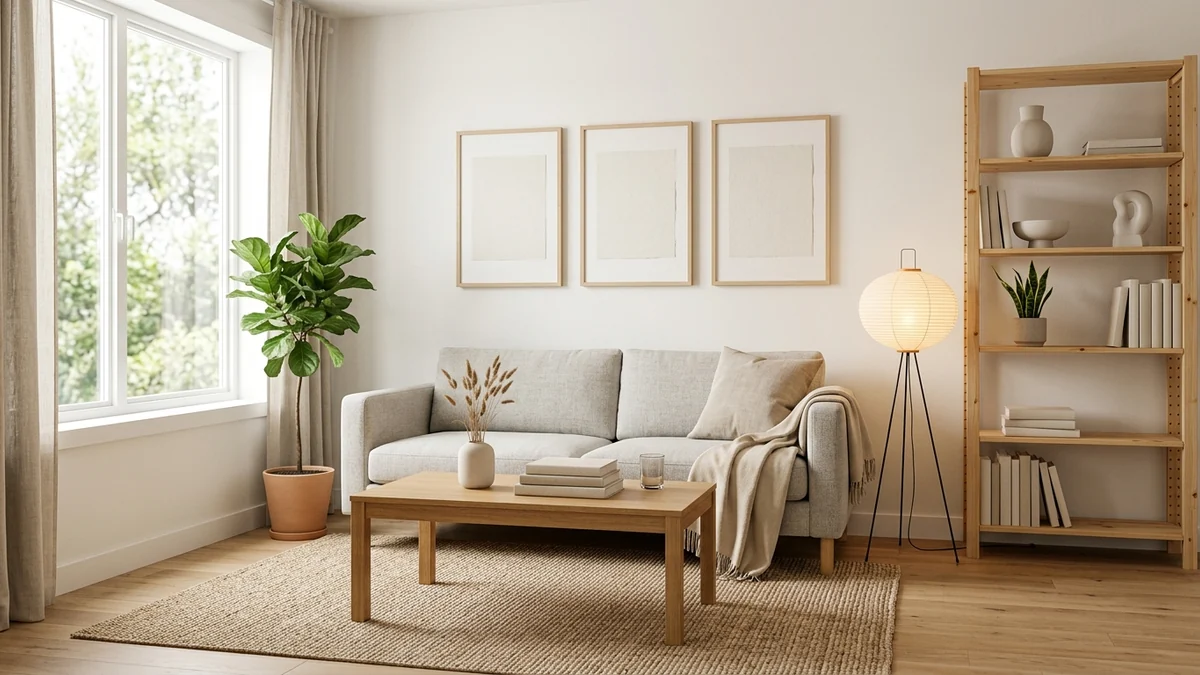
Prompt 28, the Budget Room Challenge: affordable pieces styled to read elevated. DeepSeek finds the products and the tricks; MeltFlex shows them in your room.
29. The Cost to Furnish Estimator
Estimate what it realistically costs to furnish a [size] [room] in [style] at three levels: budget, mid-range, and high-end. Search for current 2026 prices to ground the numbers, and give me a table with the total and the main line items for each level.
30. The Trend Research Prompt
Search the web for what is genuinely trending in [room type] interiors in 2026, with sources. For each trend, tell me what it is, whether it is a lasting shift or a short fad, and one affordable way to try it. Skip anything that already peaked over a year ago.
Whole-Room and Home Design Prompts (31 to 36)
These are the bigger briefs: a full room or a whole home in one consistent direction. DeepThink keeps the plan coherent across every space.
31. The Whole-Home Throughline
I want my whole [home/apartment] to feel connected, not like separate rooms decorated by different people. Give me one palette, one or two repeating materials, and a consistent lighting temperature that ties every room together, then show how it flexes per room (living, bedroom, kitchen, bath). Reason through the throughline.
32. The House Design Brief
I am [building / fully renovating] a [size] house in a [style] direction for [who lives there] on a $[budget]. Write me a complete design brief: exterior mood, interior palette, materials, key furniture per room, lighting approach, and the phases to do it in. Reason through the trade-offs and flag where I will be tempted to overspend.
33. The Bedroom Plan
Design a calm, restful [size] bedroom in [style] for a $[budget]. Give me the layout with the bed and nightstands sized to the room, the palette with hex codes, a 3-layer lighting plan, window treatments, and a full shopping list in the order to buy it. Explain the choices that make a bedroom feel restful.
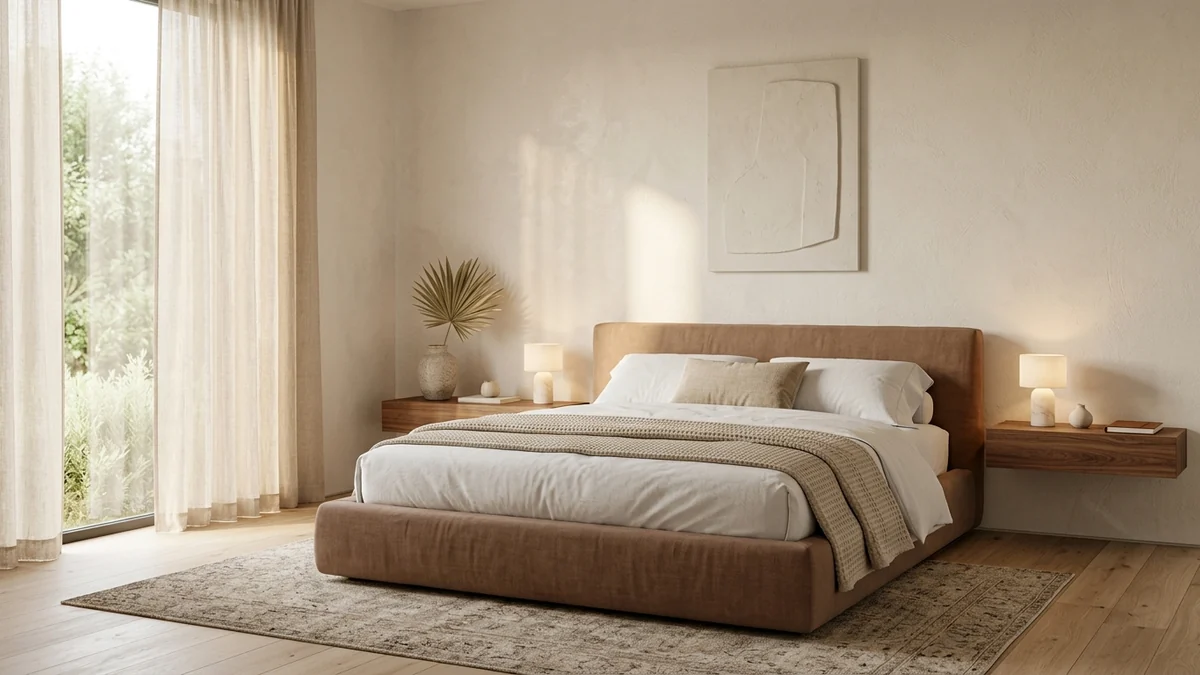
Prompt 33, the Bedroom Plan: a restful, fully resolved 2026 bedroom. Plan the layout and palette with DeepSeek, then see it on your own walls in MeltFlex.
34. The Kitchen Plan
Plan a [style] kitchen for a [size/shape] space on a $[budget]. Reason through the work triangle and storage, then give me cabinet color and finish, countertop and backsplash materials, hardware, lighting, and where to splurge versus save. Search for current prices on the two most expensive items.
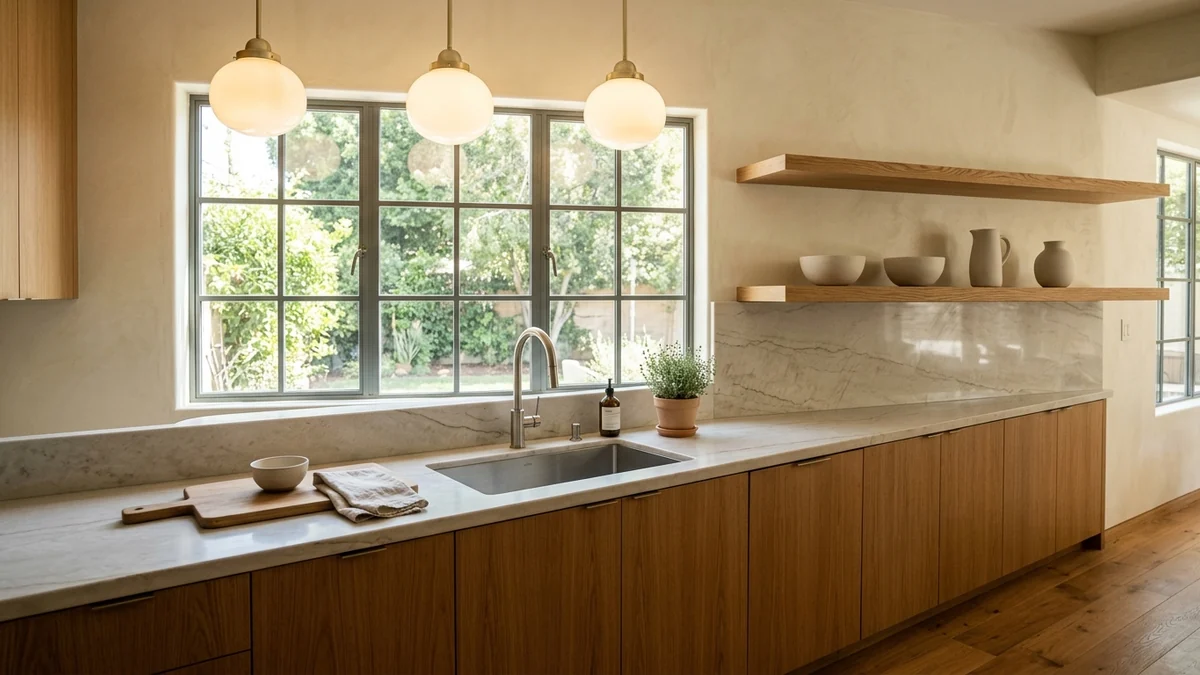
Prompt 34, the Kitchen Plan: warm oak, honed quartzite, and soft glass pendants, high-end but liveable. DeepSeek reasons the layout and budget; MeltFlex shows it in your kitchen.
35. The Home Office Plan
Design a [size] home office that is good for video calls and long focus, in [style], for $[budget]. Cover desk placement versus the window and camera, lighting for calls, storage, ergonomics, acoustics, and a palette that photographs well. Give me the layout and shopping list.
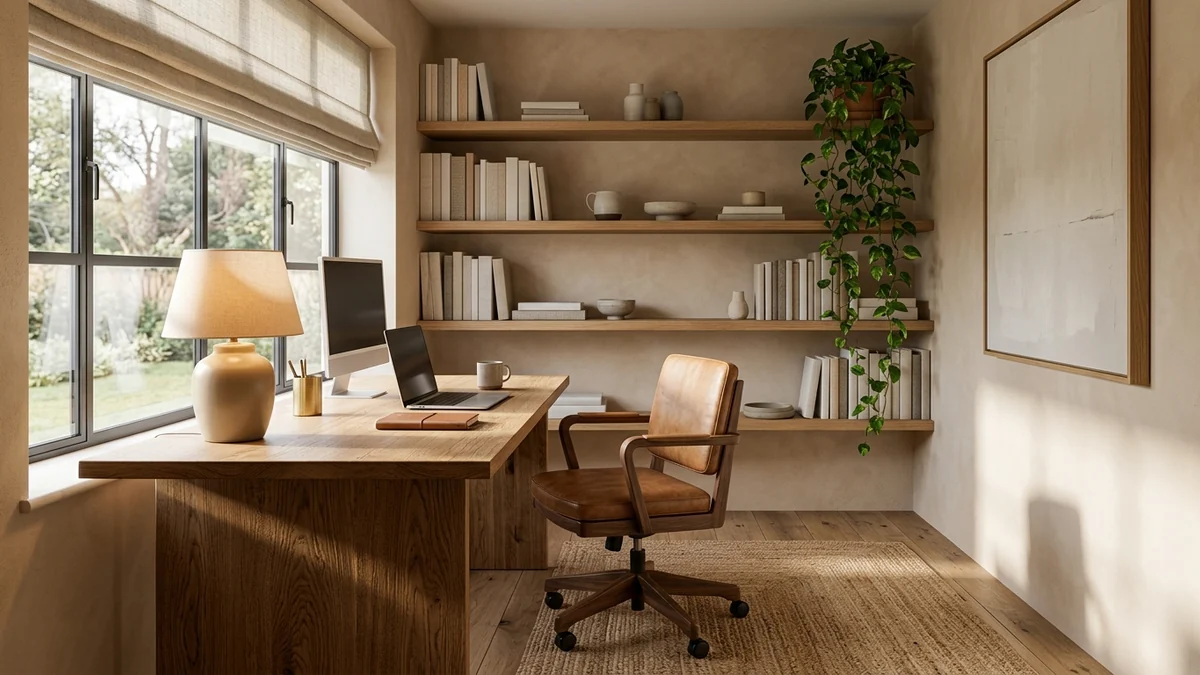
Prompt 35, the Home Office Plan: an oak desk set into the daylight, calm and focused, and a room that photographs well on calls.
36. The Rental-Friendly Refresh
[Upload room photo] I rent and cannot paint, drill, or change the flooring. Give me the 5 highest-impact, fully reversible upgrades for this room: peel-and-stick options, freestanding pieces, lighting, and textiles. Budget: $[X]. Rank them by impact and explain each.
Power-User and Builder Prompts (37 to 40)
The last group leans on the two things that make DeepSeek different from the paid chatbots: its reasoning depth, and the fact that its model is open-weight and dirt cheap to run through the API.
37. The Devil's Advocate
Here is my full design plan for [room]: [paste plan]. Turn on DeepThink and pull it apart. What are the weakest decisions, what have I not accounted for (flow, scale, budget, lighting, resale), and what would a critical interior designer change? Be blunt, then give me the fixes.
38. The One-Photo Full Brief
[Upload room photo] Do everything in one pass: identify the style, audit what is wrong, propose a [style] redesign on a $[budget], give me the layout, the palette with hex codes, a lighting plan, and a complete shopping list in buying order. Reason through it, then summarize it as a one-page plan I can act on.
39. The Client Brief Parser (for designers)
Here is a messy client brief: [paste notes]. Turn it into a structured design spec: goals, must-keeps, hard constraints, budget, style direction, room-by-room requirements, and open questions to ask the client. Flag any contradictions in what they asked for.
40. The Open-Weight Tool Prompt (for developers)
I am building an interior-design tool and want to use DeepSeek's cheap open-weight API for the reasoning layer. Design the prompt and JSON output schema for a feature that takes a room's dimensions, budget, and style and returns a structured furnishing plan (pieces, sizes, prices, buying order). Reason through the edge cases.
That last one is DeepSeek's quiet superpower for professionals: the model is open and costs a fraction of ChatGPT, Gemini, or Claude on the API, which makes it the natural budget backbone for building your own tools. For the visual layer of that same tool, MeltFlex has a room-accurate render API that plugs in the part DeepSeek cannot do.
Turn DeepSeek Plans into Real Room Designs
DeepSeek gives you a great plan: the layout, the palette, the budget, the shopping list. But you are still imagining it all in your head. You do not actually know whether that olive sofa works next to your window, or if the color-drench looks right with your floor. That is the one thing DeepSeek structurally cannot do, because it has no image generation at all.
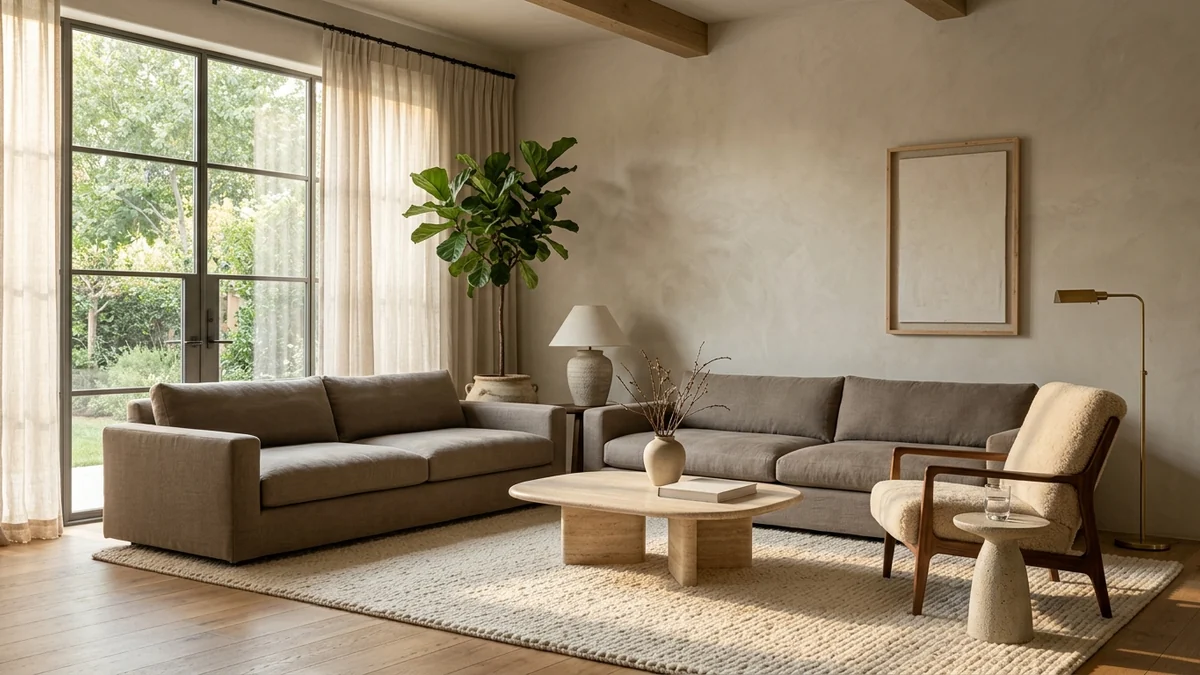
Plan the room with DeepSeek, then see it on your own walls: a warm-minimal 2026 living room rendered in a real room with MeltFlex.
The best workflow: use DeepSeek for the reasoning, analysis, and honest critique, then upload your room photo to MeltFlex to see those ideas in your actual space. MeltFlex redesigns your room in under 30 seconds with real furniture from Amazon and IKEA, and every piece is detected and linked so you can buy exactly what you see.
Try MeltFlex free: type a prompt and see it in your room instantly
How Much Does AI Interior Design Cost?
Here is what each option actually costs. DeepSeek is the free outlier: every prompt in this guide, including DeepThink reasoning and photo analysis, runs at zero dollars.
DeepSeek vs ChatGPT vs Gemini vs Claude for Interior Design
Use them together: DeepSeek for free, reasoned planning and budgets, Gemini for photo analysis and product search, ChatGPT or Claude for the detailed written plan, and MeltFlex for the visualization.
Tips for Writing Better DeepSeek Prompts
- Turn on DeepThink. For anything with logic (layout, budget, sequencing), the reasoning mode is the whole point. Read the thinking and correct a wrong assumption before it reaches the answer.
- Turn on Search for prices and trends. Say "search the web right now" and DeepSeek pulls current, cited numbers instead of guessing.
- Always upload a photo. DeepSeek reads images now, so a photo turns a generic answer into a specific one about your actual room.
- State your constraints. Budget, room size, what you already own, rental rules, and what you cannot change. Detail in, detail out.
- Ask for specifics. Hex codes, exact measurements, brand names, and search terms. And remember it will plan but not draw, so take the plan to a visualizer to see it.
Frequently Asked Questions
Can DeepSeek generate images of a room?
No. The DeepSeek app and chat.deepseek.com cannot create images at all. Image generation only exists in DeepSeek's separate open-source Janus-Pro model, which is capped at 384 by 384 pixels and looks nothing like a real interior, so it is useless for photorealistic rooms. DeepSeek plans, audits, and prices a room in words but never draws it. To see the redesign, take the plan to MeltFlex, which keeps your real walls, windows, and floor.
Can DeepSeek see a photo of my room?
Yes, as of 2026. DeepSeek added image understanding to its app, so you can upload a photo and it reads the space: style, proportions, lighting, and what is and is not working. It is understanding only, so it can critique your room in words but cannot output an edited or generated image of it.
Is DeepSeek free for interior design?
Yes, completely. DeepSeek is free in the app and at chat.deepseek.com with no subscription tier, including DeepThink reasoning, photo upload, and live web search. Every prompt in this guide runs on the free tier. To visualize a design in your actual room, MeltFlex also has a free tier.
Is DeepSeek better than ChatGPT or Gemini for interior design?
Each one wins at something. DeepSeek is unique for free, visible deep reasoning, so it is the one for layouts, budgets, and sequencing where you want to see the logic. Gemini is best for photo analysis and product search. ChatGPT and Claude are best for long written plans. None shows furniture in your real room, which is why most people pair a reasoning model like DeepSeek with MeltFlex for the actual visualization.
What is DeepThink and why does it matter for room design?
DeepThink is DeepSeek's reasoning mode, based on its 2026 V4 model, and the app shows the full chain of thought before it answers. For interior design that matters because the hard part is often logic, not taste: whether a sofa fits the traffic path, how to split a small budget, or what order to buy things in. You see the reasoning, catch a wrong assumption, and correct it. For the underlying principles, read our guide to AI interior design prompts that work.
How do I write a good DeepSeek prompt for room design?
Five things: (1) upload a room photo when you can, (2) state your constraints like budget, room size, and what you cannot change, (3) turn on DeepThink and ask it to explain its reasoning, (4) turn on Search for current prices and trends, and (5) ask for specifics like hex codes, measurements, and search terms. DeepSeek rewards detail. A vague one-line prompt gets a generic answer.
Can AI replace an interior designer?
AI covers about 80% of what most people need: style direction, color palettes, furniture selection, layout planning, and budgeting, and DeepSeek is strong at all of them and free. Human designers still win on structural renovation, trade-only furniture access, and managing contractors. For decorating and furnishing rooms you already have, DeepSeek plus a visualization tool like MeltFlex gets you most of the way at a tiny fraction of the cost.
Start Designing
The fastest way to use this guide: upload a photo and run a Room Audit (1 to 8) to see what is holding your space back, turn on DeepThink for a Layout prompt (9 to 16) to fix the flow, then move to a Budget and Sourcing prompt (23 to 30) to plan the fix to a real number. When you want DeepSeek to pressure-test the plan, finish with the Devil's Advocate (37). Copy any prompt with the button, paste it into DeepSeek, and add your room photo.
DeepSeek is brilliant and free for ideas, reasoning, and honest critique, but it has no image generation at all, so it can never show you the result. When you want to see a redesign in your actual space, same walls, windows, and floor, with real furniture you can buy, run it through MeltFlex free. DeepSeek for the plan, MeltFlex for the proof.
More prompting guides: 52 Gemini prompts for interior design, 50 ChatGPT prompts for interior design, 42 Claude prompts for interior design, 46 Grok prompts for interior design, Nano Banana architecture prompts, 40 AI interior design prompts that work, 13 AI house design prompts.



)