The yard below has six windows looking into it. They belong to the two storey house behind, they sit above a perfectly good six foot fence, and they are the reason nobody in this house sits on the patio after about four in the afternoon. It is the most common privacy problem in American suburbs and it is the one almost every backyard privacy ideas article gets wrong, because the fix everybody reaches for first is a taller fence, and a taller fence does not work.
Our articles are still written by humans!
Get human written articles in your Google feed.
Quick answer: if the window bothering you is at ground level, a 6 foot fence or a hedge along the boundary solves it. If it is upstairs, the sightline arrives over the top of anything you are legally allowed to build on the property line, and you have two real options instead: put something overhead, or put a much shorter screen close to where you actually sit. The maths for that, and ten treatments rendered on this exact yard, are below.
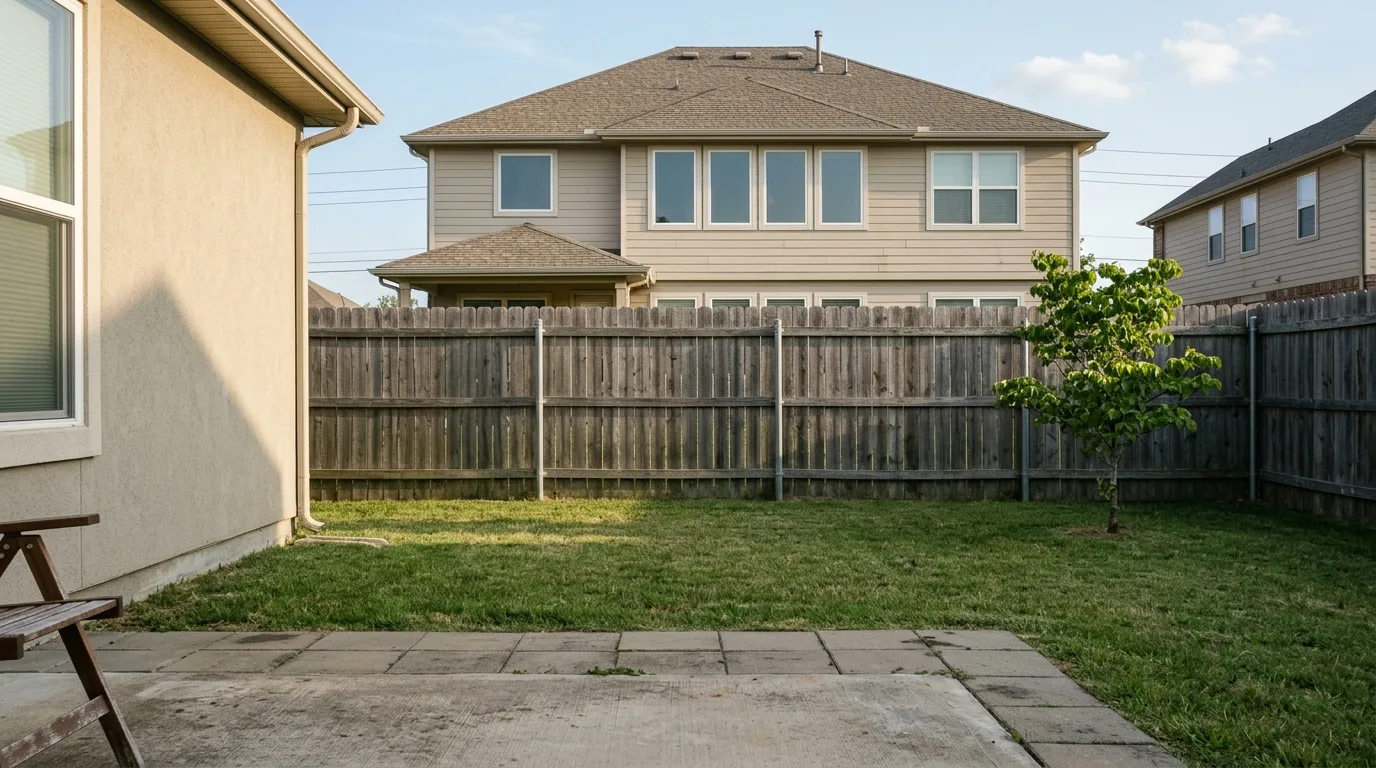
The test yard, shot from seated height on the patio because that is the view that matters. Count the upstairs windows. The fence is doing its job perfectly and it is completely irrelevant.
The short version
- Work out whether your problem is a ground floor window or an upstairs one. They have completely different solutions and most advice conflates them.
- For a typical upstairs window you would need a screen 11 feet 9 inches tall at the fence. The legal limit is usually 6 feet.
- The same sightline is blocked by a 4 foot 7 inch screen placed a metre from your chair. Distance from you is the variable nobody talks about.
- Fast growing screening trees take about three years to establish before the fast growing part starts.
The short answer
Backyard privacy screening is anything that interrupts the line between someone else's eye and yours. That definition matters, because it means the question is never how tall your fence is. It is where the other person is looking from, and where you are sitting.
Pick by which problem you actually have:
- Ground floor window or people walking past. A 6 foot boundary fence, a hedge, or layered planting along the fence line. This is the easy case and it is the one all the standard advice is written for.
- Upstairs window overlooking your patio. Go overhead with a pergola or a shade sail, or use a screen close to the seat. Do not raise the fence.
- Upstairs window overlooking the whole yard. A raised hedge at window height, which is the only boundary treatment that reaches the right altitude without becoming a wall.
- You are renting or cannot build. Bamboo in containers or outdoor curtains on a freestanding frame. Both leave with you.
- You want it fixed this weekend. Screen the seat. Everything else on this page is measured in seasons or years.
- You are planning the whole yard, not just the boundary. Start with a garden layout and settle the seating position first, because the seating position decides every number below.
The maths nobody puts in these articles
This is the whole article, so it goes near the top rather than buried at the end.
Take a normal case. The neighbour's upstairs window is about 4.5 metres above ground, which is typical for a second storey. It sits 3 metres beyond your fence. You are sitting on your patio 8 metres inside your own yard, and seated eye height is about 1.1 metres.
Draw the line from their window to your eye. It drops 3.4 metres over 11 metres of horizontal run, so it falls about 31 centimetres for every metre it travels. Now ask how tall a screen has to be to intercept that line, depending on where you put it:
A screen at the boundary has to be almost twice the legal fence limit. The same sightline is killed by something barely over waist height if you put it next to your chair. That is not a trick, it is just similar triangles, and it is the single most useful thing to know before you spend money on this problem.
Run your own numbers rather than trusting mine. Sit in the chair, have someone hold a broom upright at the fence, and mark where the top of it crosses the window. Then repeat it a metre from your seat. The difference is startling in person.
Why the taller fence is usually a waste of money
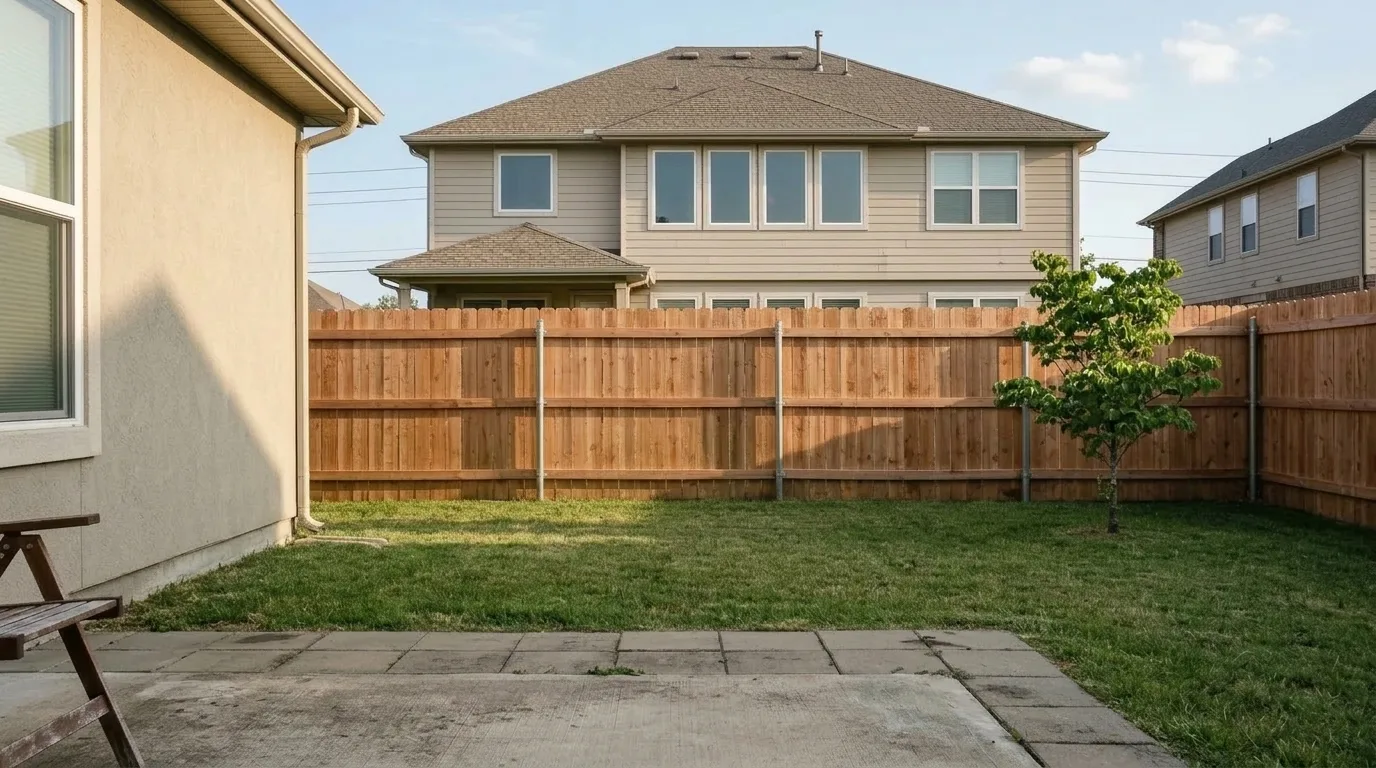
A new, taller, well built fence on the same yard. Every upstairs window is still visible, and the yard is now noticeably darker. This is the most expensive way to not solve the problem, and it is the first thing most people do.
Three things go wrong with the privacy fence instinct. It rarely reaches the required height, because the required height is illegal. It costs more than any other option on this page. And it takes light out of the yard, which is a permanent cost you pay every day in exchange for a privacy improvement you may not even get.
This is the gap between the two things people actually search for. Most advice answers "how do I block neighbors at ground level", which a privacy fence does well.
Far fewer answer "how do I get garden privacy from above". That is the overlooking problem, and a fence does not touch it. If you want privacy without blocking light, going overhead or screening the seat beats raising the boundary on both counts.
On the legal side, the common residential limit in the United States is 6 feet for rear and side boundaries and 3 to 4 feet at the front, with some jurisdictions permitting up to 8 feet at the rear where there is a grade difference between properties. Many cities require a permit above a threshold height. Check your municipal code and any HOA covenant before you buy materials, not after. (Fence height limits and permits)
There is one case where raising the fence is right: when the problem is at ground level. A neighbour on a patio, a footpath, a driveway. Then the boundary is exactly where the sightline is, and a fence is the cheapest possible answer.
Ten treatments, one yard
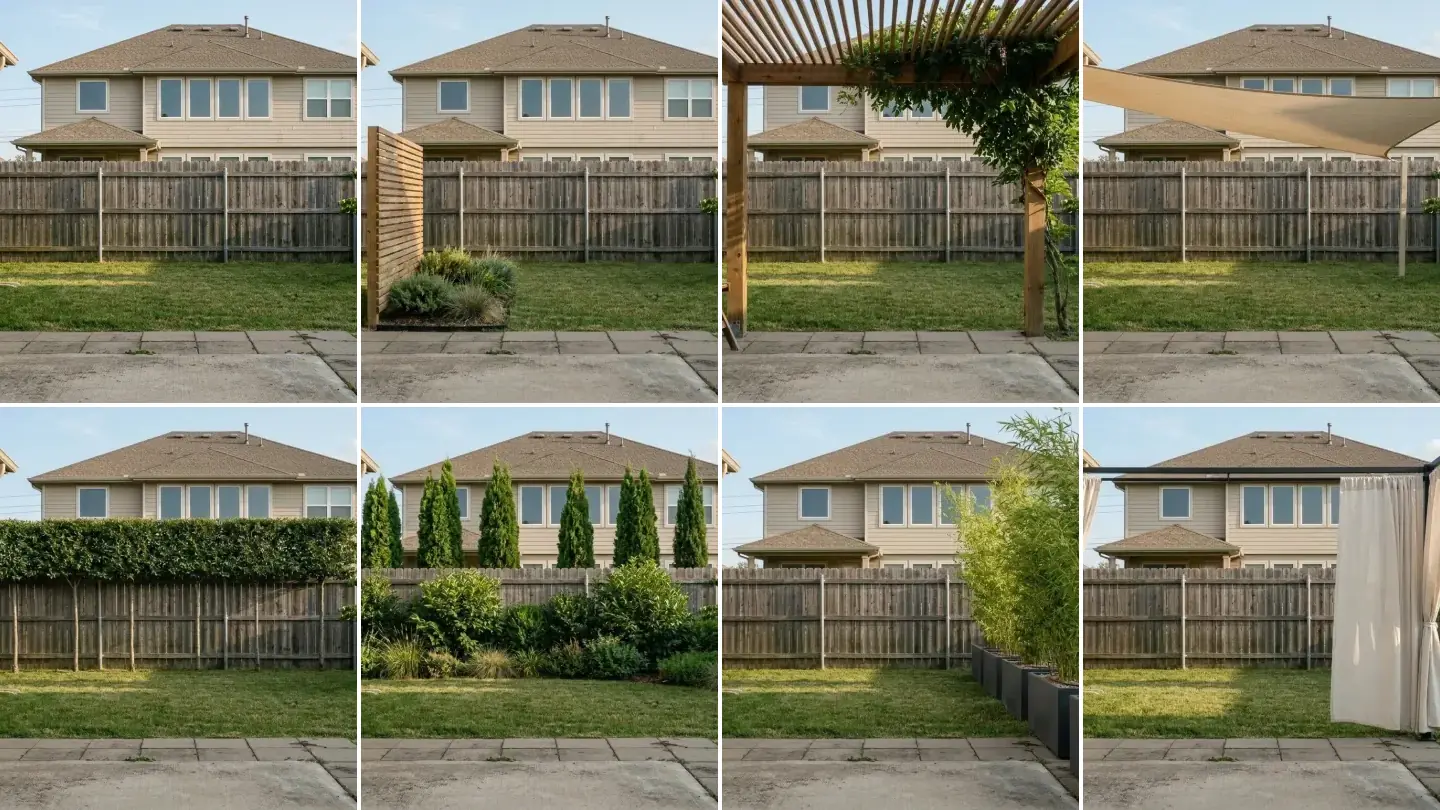
Every image below is the same yard, same camera position, same seated eye height, same fence, same neighbouring house. Only the treatment changes.
One honest caveat before you read them as evidence. These are AI renders, so strictly they show what an image model does with each instruction, not what physics does in your yard. The proof is the arithmetic in the section above. The renders are here because the arithmetic is abstract and a picture of six windows still staring at you over a new fence is not.
1. Screen the seat, not the boundary
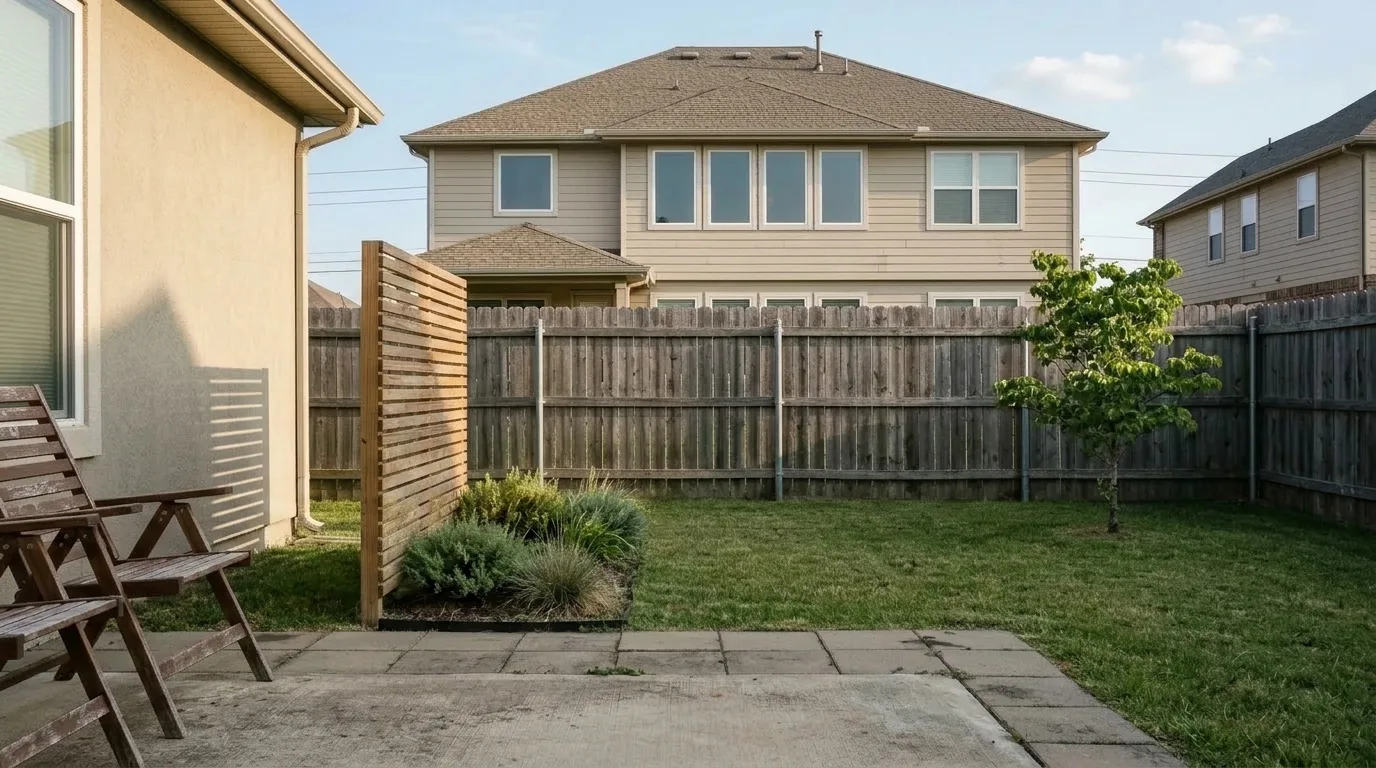
One panel, roughly two metres wide, placed beside the seating on the side facing the neighbour. The rest of the yard is untouched and still feels open.
Blocks upstairs view: Yes, where you sit · Speed: A weekend · Relative cost: Lowest · Reversible: Yes
The cheapest and fastest thing on this page, and the one that follows directly from the maths above. Because it sits close to you, it only needs to be about waist to chest height to do what a nearly 12 foot boundary screen would do. It is usually outside fence height rules too, since it is not on the property line, though check your own code.
The catch: it protects one spot. Walk ten feet and you are exposed again. If you want the whole yard private this is not it, but most people do not use the whole yard, they use one corner.
2. Pergola with a trained climber
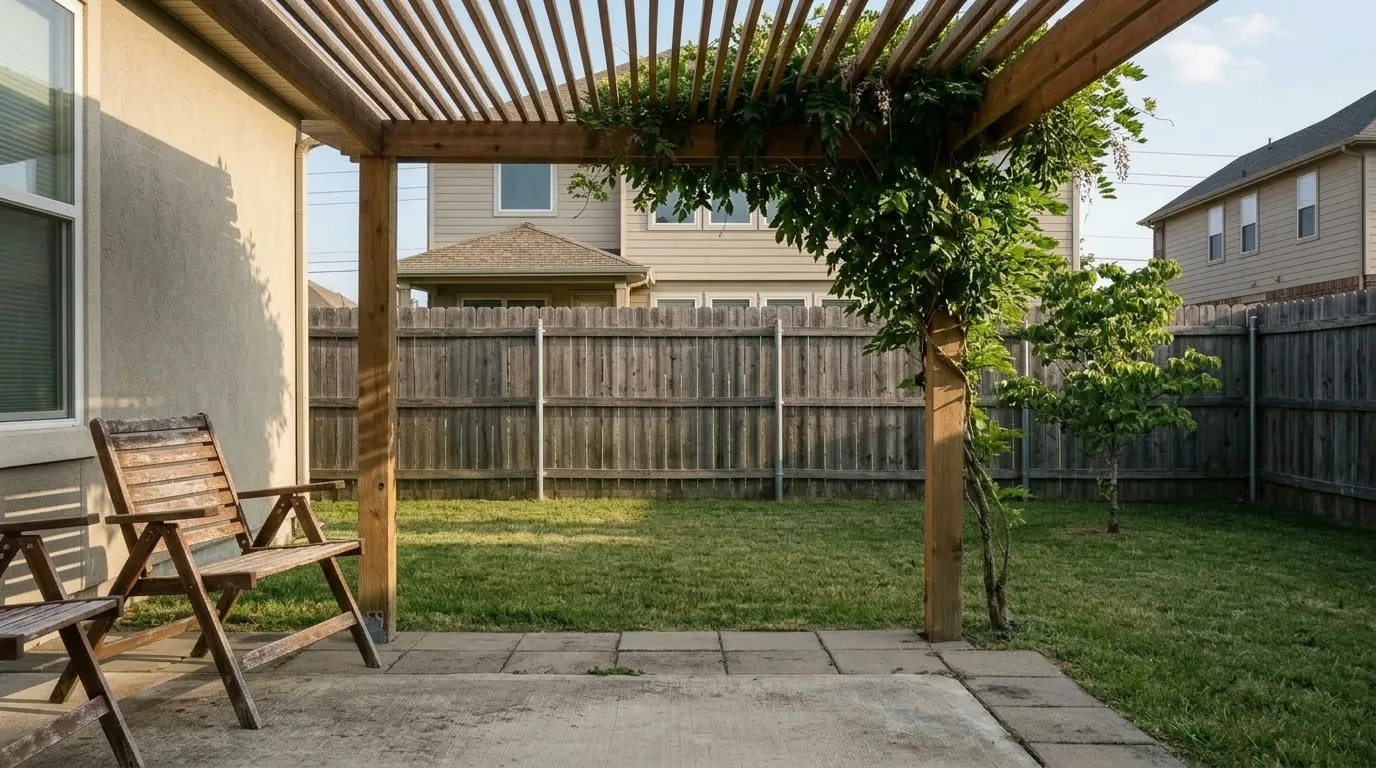
Closely spaced rafters plus a trained wisteria. This is the only common garden structure that intercepts a downward sightline rather than a horizontal one.
Blocks upstairs view: Yes, over the patio · Speed: Structure fast, planting 2 to 3 years · Relative cost: High · Reversible: No
The best way to block the view into an overlooked patio, and badly underrated because it gets filed under shade rather than under privacy.
Rafters alone break the view up. A trained climber closes it properly in summer.
The catch: it is a building, so it costs accordingly and it may need a permit. It also gives you nothing in winter if you rely on a deciduous climber, which is exactly when a bare canopy stops helping.
3. Shade sail
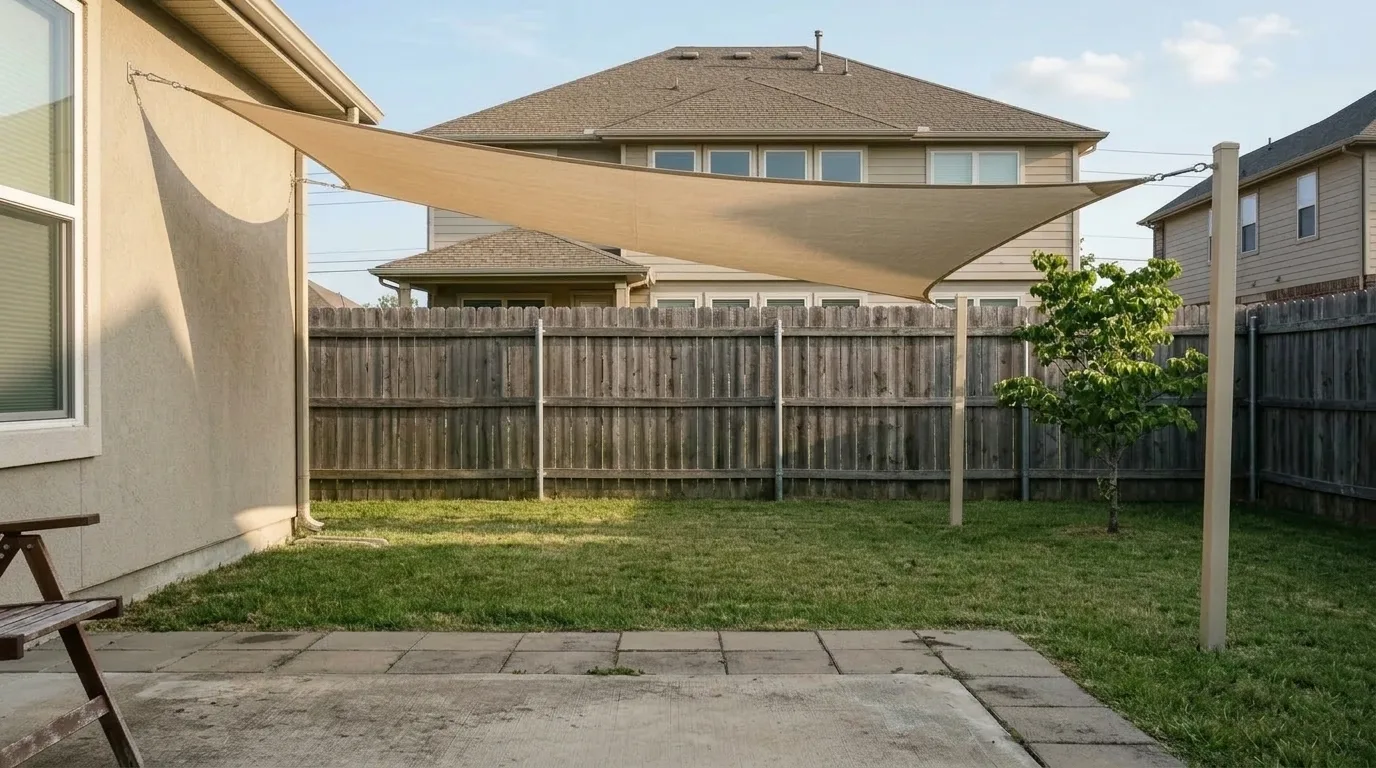
A tensioned triangular sail from the house wall to two posts. It does the same overhead job as a pergola for a fraction of the money.
Blocks upstairs view: Yes, under the sail · Speed: A weekend · Relative cost: Low to medium · Reversible: Yes
The budget version of going overhead, and genuinely effective if you angle it toward the window that bothers you rather than just flat above the table. Comes down for winter, which some people count as a feature. It pairs naturally with patio furniture that suits an exposed spot, since the sail changes what the seating underneath has to cope with.
The catch: the posts need real foundations, because a tensioned sail in wind pulls harder than people expect. Undersized posts is the most common failure and you will see it lean within a season.
4. A hedge raised to window height
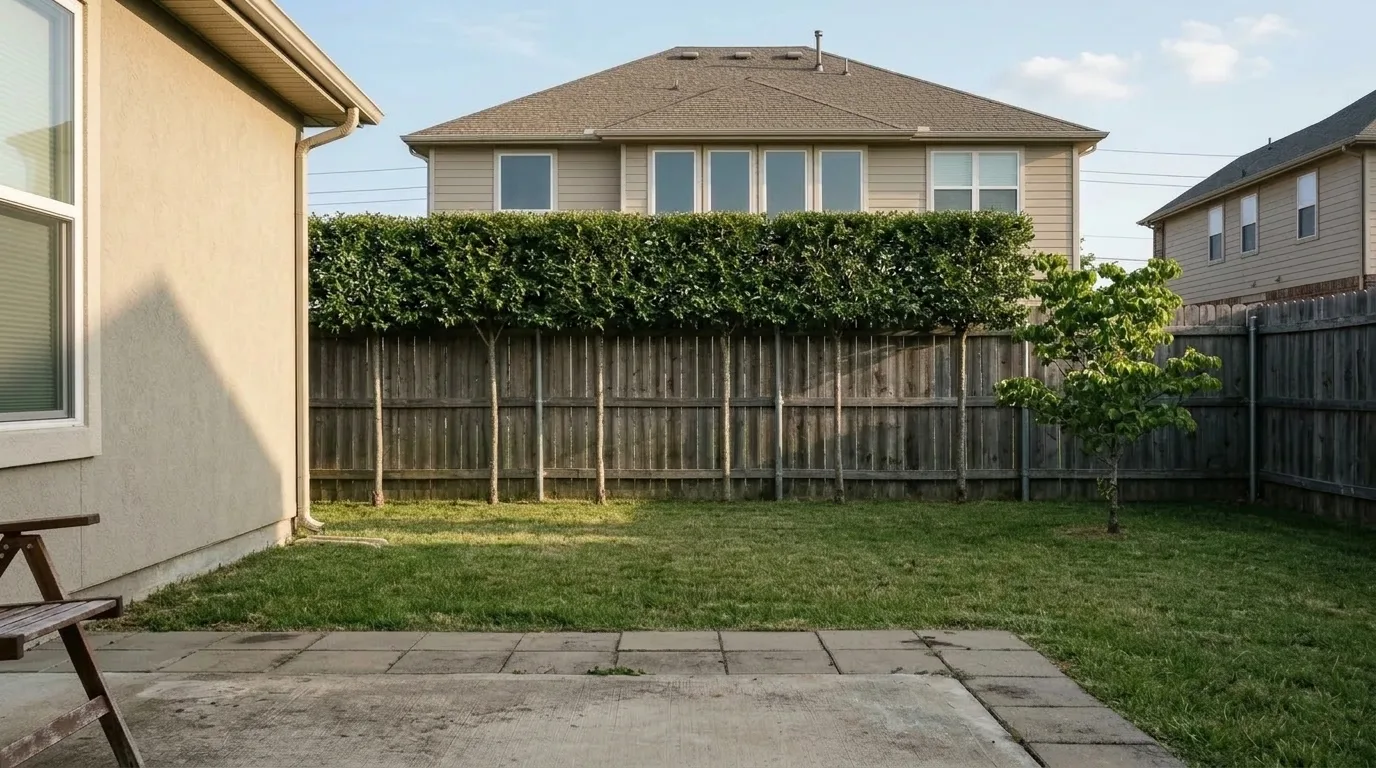
Screening lifted to sit at window height rather than at fence height. In the trade this is done with pleached trees, which are trained with clear stems and a flat box of foliage held high.
Blocks upstairs view: Partly, across the whole boundary · Speed: Instant if bought mature, years if not · Relative cost: High · Reversible: No
The only boundary treatment that gets anywhere near the right altitude without becoming a wall, and the one professional designers reach for on overlooked plots. Because the stems are clear, you keep the ground level open and usable underneath.
The catch: mature pleached trees are one of the most expensive things you can plant, and they need annual training to keep the shape. Look at the render honestly: even at this height the upper windows are still partly visible. Raised screening reduces the problem, it rarely deletes it.
5. Layered evergreen planting
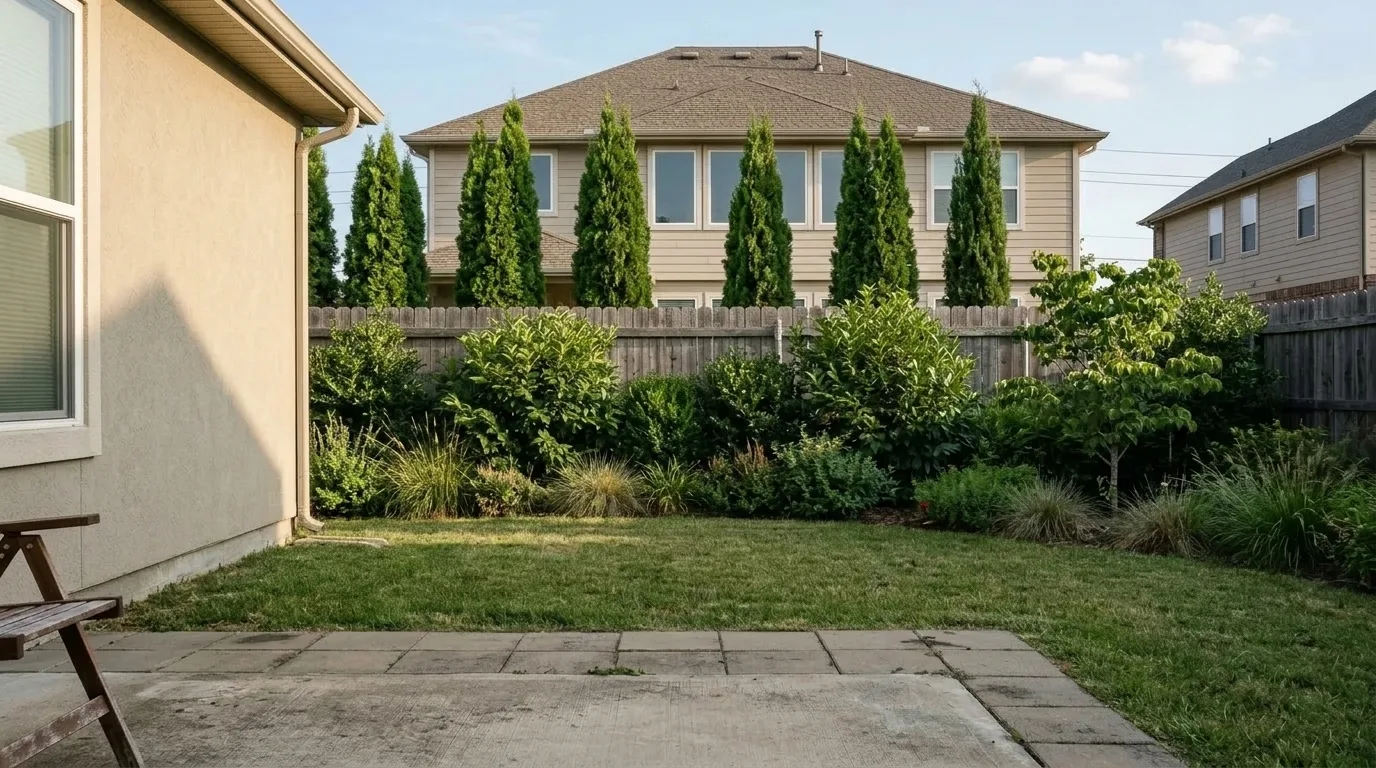
Three depths rather than one row: columnar evergreens, then large shrubs, then grasses at the base. This is what a designed screen looks like versus a line of arborvitae.
Blocks upstairs view: Partly, and only once grown · Speed: 3 to 5 years · Relative cost: Medium · Reversible: No
The best looking long term answer and the one that improves every year rather than degrading. Staggering the depth matters: a single row of identical conifers reads as a green fence and fails the moment one of them dies, which one of them will. If you are choosing planting at the same time as paving, the AI landscape design tools comparison covers which ones will tell you the plant names and which will just draw green shapes.
The catch: look at the render again. The windows are still visible between the trees. Planting at the boundary is fighting the same geometry as a fence, it just does it more attractively and much more slowly.
6. Slatted screen on the existing fence
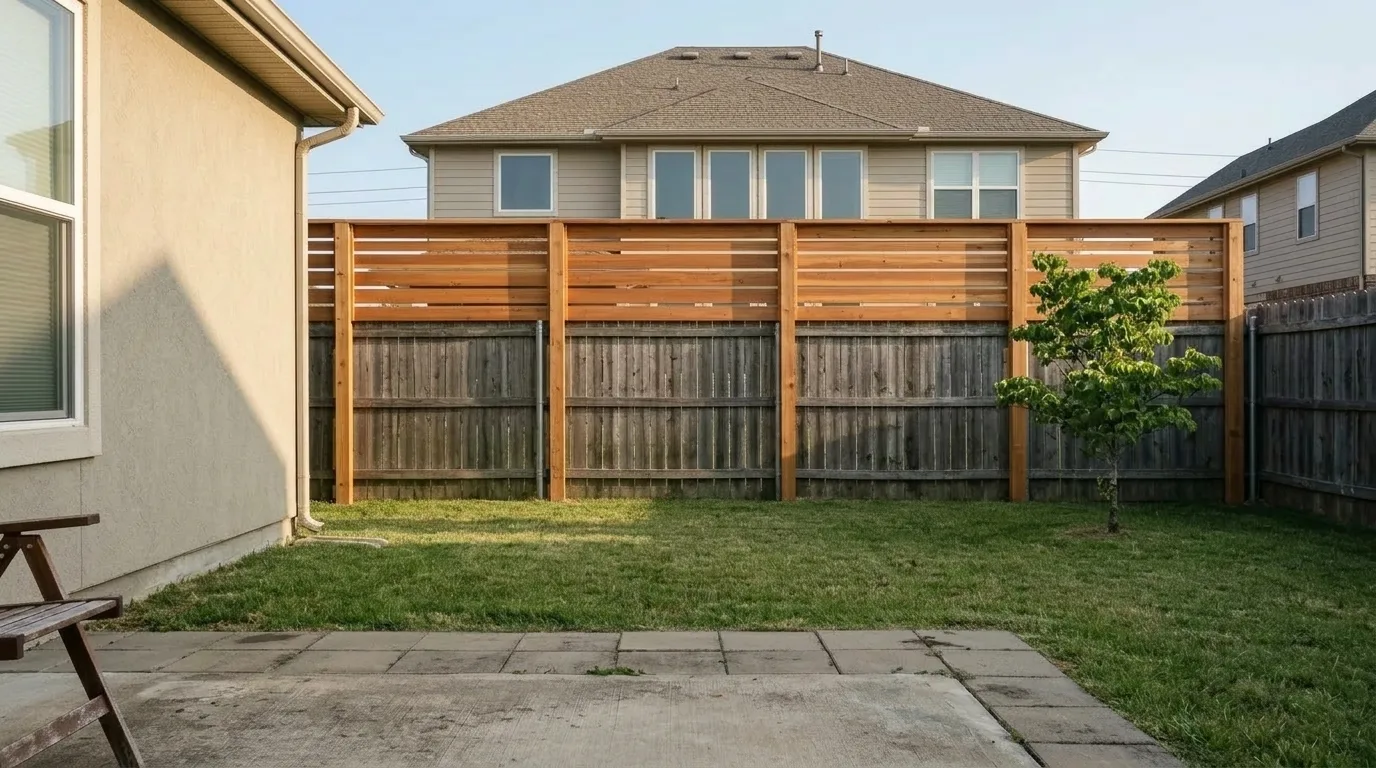
Cedar slats fixed as an extension on the existing fence, with gaps so light and air still pass. Warm timber against weathered grey.
Blocks upstairs view: No · Speed: A weekend · Relative cost: Medium · Reversible: Partly
The most popular upgrade in this category and the best value if your problem is at ground level. Gapped slats also read far lighter than a solid panel of the same height, which is why they are worth the extra over a plain board fence.
The catch: an extension usually pushes the boundary over the legal height, and gapped slats are not private from directly opposite anyway. As the render shows, it does nothing at all for the upstairs windows. Buy it because it looks better, not because it will fix an overlooking problem.
7. Bamboo in containers
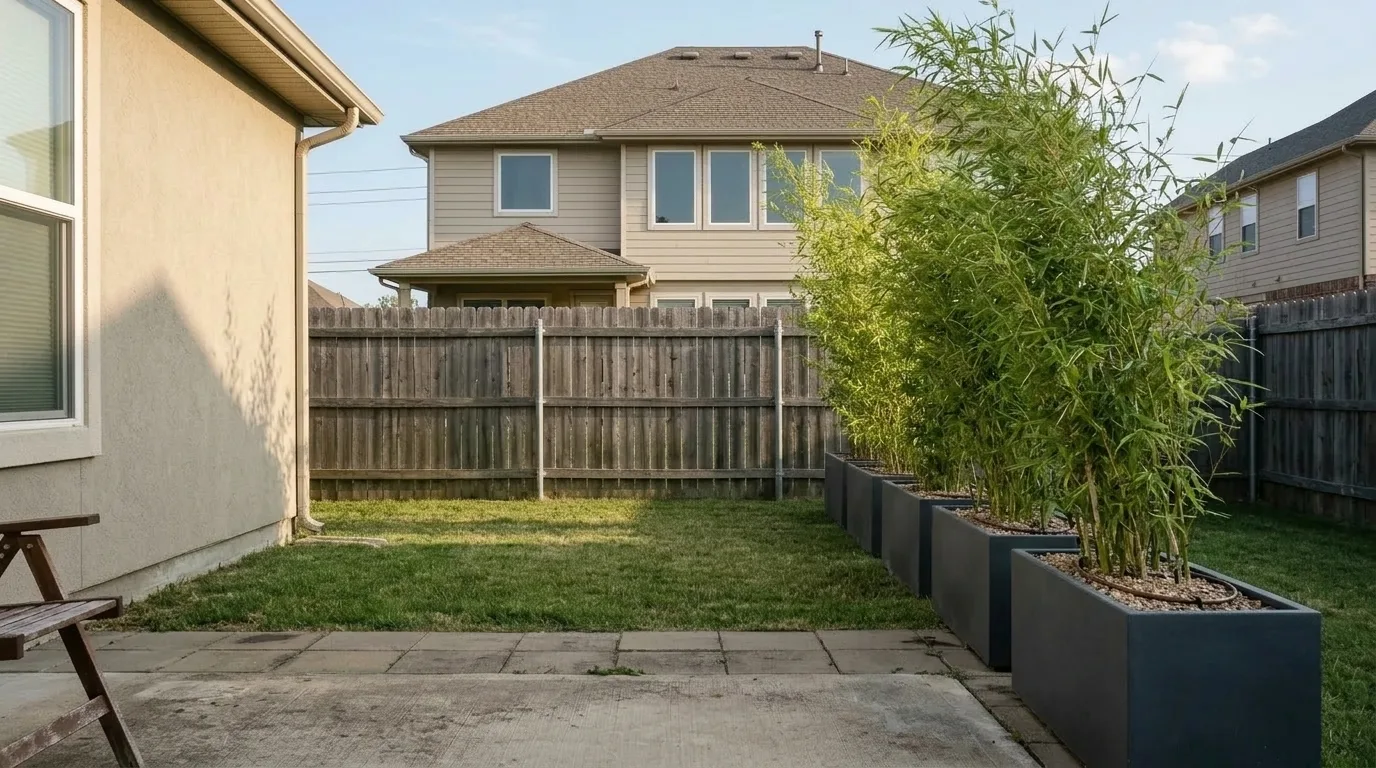
Clumping bamboo in matched containers along the patio edge. Canes rise well above the fence and the foliage moves, which reads far less like a barrier than a solid screen.
Blocks upstairs view: Partly, where placed · Speed: Instant if bought tall · Relative cost: Medium · Reversible: Yes
Height without a building permit, and because it sits inside the boundary rather than on it, it benefits from the geometry above. Containers also make it the obvious choice for renters.
The catch: running bamboo is genuinely invasive and will find your neighbour's yard and your drains. Plant clumping species, or use a root barrier, or keep it in pots as here. Pots mean watering, often daily in summer, and a bamboo that dries out drops its leaves and stops being a screen.
8. Outdoor curtains
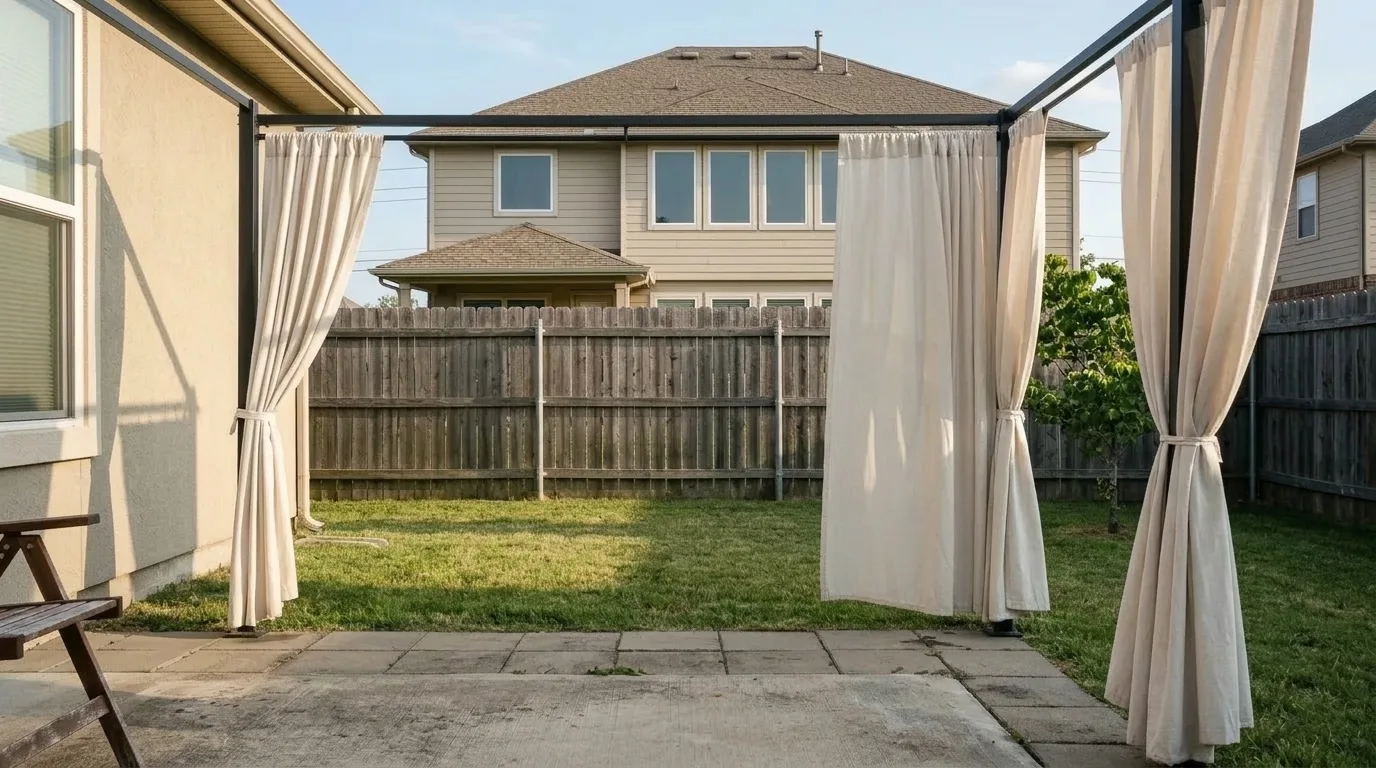
A simple frame and heavyweight outdoor fabric, drawn on the side that needs it and tied back everywhere else. Privacy on demand rather than permanently.
Blocks upstairs view: Yes, when drawn · Speed: A weekend · Relative cost: Low · Reversible: Yes
The only option here that you can switch off. Some days you want the yard open, some evenings you want it enclosed, and nothing else on this page lets you have both.
The catch: fabric outdoors is a maintenance item. It mildews, it fades, it flogs itself to death in wind if you leave it out in a storm. Budget on replacing panels every few years and take them in over winter.
9. Living green wall
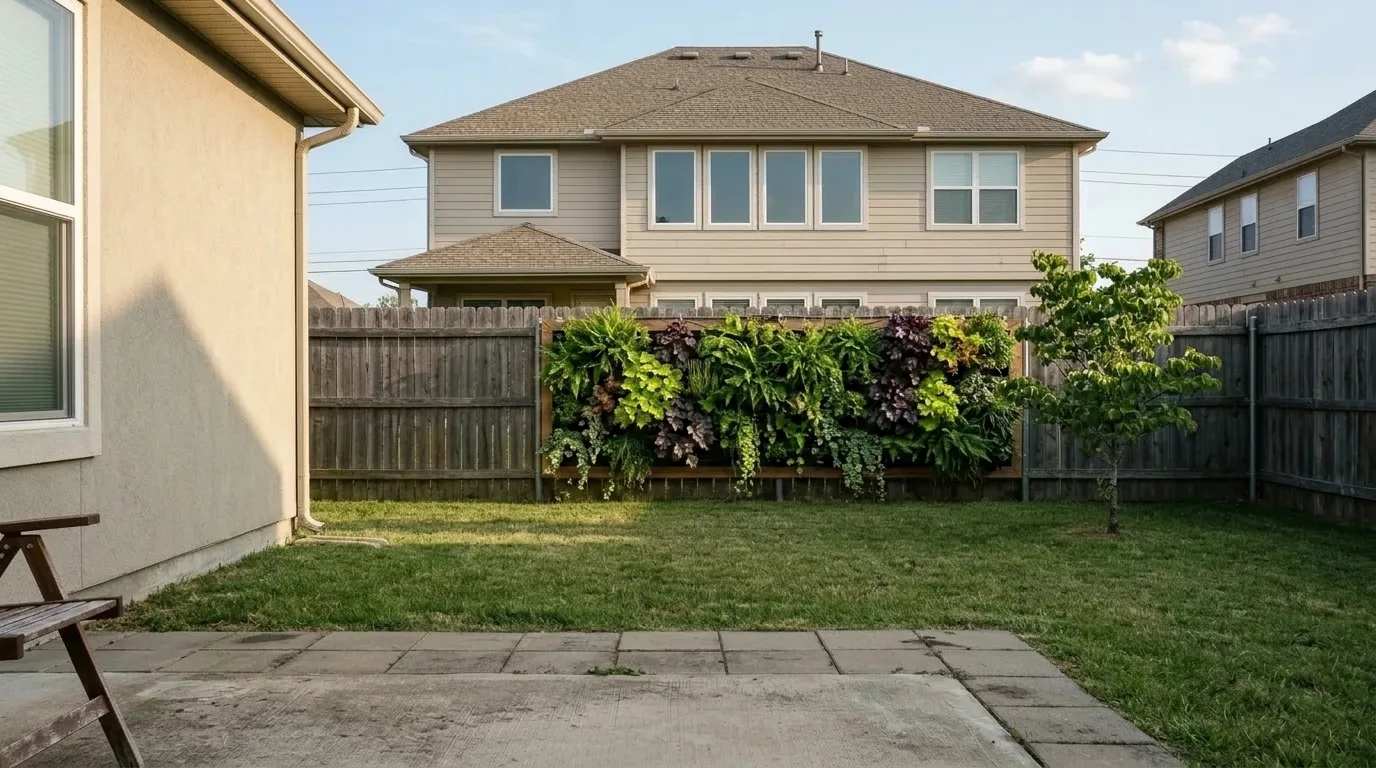
A planted vertical panel on the existing fence. It is the most photogenic option here and, for an overlooking problem, close to the least useful.
Blocks upstairs view: No · Speed: Fast to install · Relative cost: High · Reversible: Partly
Worth including precisely because it is all over Pinterest as a privacy idea and it is not one. It makes an existing fence beautiful. It adds no height whatsoever.
The catch: irrigation, feeding, and replacing whatever dies in the top row where it dries out fastest. It is the highest maintenance item on this page by a wide margin. Choose it because you want a green wall, not because you want privacy.
How long each of these actually takes
Planting advice in this category is written by people selling plants, so the timelines are optimistic. Here is the honest version.
Thuja Green Giant is the arborvitae most often sold for screening in the United States. NC State Extension puts its growth at 3 to 4 feet per year in optimal conditions, reaching 40 to 60 feet tall and 12 to 18 feet wide at maturity, with a lifespan of 40 to 60 years. (NC State Extension Gardener Plant Toolbox)
Two things about that number. It is a ceiling, not an average, and nursery sites tend to quote it as though it starts on planting day. Several of them add that a Green Giant takes around three years to establish first, a claim I could not find in any extension source, so treat it as a grower's rule of thumb rather than a fact.
What is not in dispute is the size. These are 40 to 60 foot trees. Plant them 5 feet apart along a suburban boundary because a blog told you to and you are planting a future problem for whoever owns the house in fifteen years.
In practice that means a screen planted this spring does very little for you this summer or next. Gardeners have a phrase for it: sleep, creep, leap. The useful conclusion is that planting and building are not alternatives. Plant for year five and build something for this season, because the built screen is what you will actually live behind while the planting gets going.
Costs here are relative bands rather than dollar figures, because installed prices for this work swing enormously by region and by whether you do it yourself. Treat the ordering as reliable and the absolute numbers as something to get quoted locally.
How to find the sightline you need to block
Fifteen minutes, one helper, one broom.
- Sit where you actually sit. Do not survey the problem standing up. Standing adds roughly half a metre of eye height and changes every number.
- Find the window that bothers you. It is almost never the whole house. It is usually one or two openings.
- Have someone hold a pole on the boundary. Stay seated. Mark where the top of it crosses the window.
- Repeat it a metre from your chair. The required height collapses. This is the measurement that decides your budget.
- Check the height against your local limit. If the boundary needs more than 6 feet, the boundary is the wrong place to solve it.
- Photograph it from the seated position. That is the only honest before shot, and it is the frame to feed any design tool.
What I would actually do
For the yard at the top of this page, I would not touch the fence. I would put a shade sail or a pergola over the patio to kill the downward view where people actually sit, add one slatted panel beside the seating for the side angle, and plant a layered evergreen screen along the boundary knowing it is a five year investment rather than a fix.
That combination costs less than replacing the fence, works this season, and gets better every year instead of just getting darker. If the facade behind the patio is also tired, the AI exterior design tools test covers restyling the house in the same pass.
Before committing to any of it, render it on your own photo. This is the one job AI genuinely does well, because you are adding an object to a real scene rather than inventing a garden from a description. Our free AI landscape design tool has a boundary control built for exactly this, with options for hiding the fence, slatted screens, hedges and screening neighbours, and it works from a photo of your own yard rather than a text prompt. Shoot the frame from your seated position, not standing.
Frequently asked questions
What is the best way to block a neighbour's view into my backyard?
It depends entirely on whether the window bothering you is upstairs or at ground level. For a ground floor window, a 6 foot boundary fence or a hedge along the fence line works. For an upstairs window, neither does, because the sightline comes in over the top of anything you are legally allowed to build on the boundary. In that case you need either something overhead, such as a pergola or a shade sail, or a screen placed close to where you sit rather than at the property line.
Why does a taller fence not stop my neighbours looking down at me?
Because of the angle. Take a typical case: an upstairs window about 4.5 metres high, 3 metres beyond the fence, and your chair 8 metres inside your yard. The sightline from that window to your seated eye passes 3.57 metres above ground at the fence line, which is 11 feet 9 inches. Most US municipalities cap a rear fence at 6 feet. You would need to almost double the legal limit to intercept the view at the boundary, which is why fence height is usually the wrong lever.
What is the cheapest way to get privacy in a backyard?
Screening the seat rather than the whole boundary. One freestanding slatted panel about two metres wide, placed a metre from your chair on the side facing the neighbour, blocks the same sightline as a screen two and a half times its height at the fence, and costs a fraction of a full boundary treatment. It is also usually exempt from fence height rules because it is not on the property line, though it is worth checking your own local code and HOA.
How long do fast growing privacy trees really take?
Longer than the label suggests. NC State Extension puts Thuja Green Giant, the arborvitae most often sold for screening, at 3 to 4 feet a year in optimal conditions. Optimal is the operative word, and nursery sites quote it as if it starts on planting day. A screen planted this spring does very little for you this summer or next. If you need privacy this season, plant for the long term and build something for the short term.
How tall can my backyard fence legally be?
The most common residential limit in the United States is 6 feet for rear and side boundaries and 3 to 4 feet at the front, with some jurisdictions allowing up to 8 feet at the rear where there is a grade difference. Many cities require a permit above a certain height. The number depends entirely on your local municipal code and any HOA covenant, so check with the planning department before you buy materials rather than after.
Does a pergola actually give you privacy?
Yes, and it is the most underrated option for an overlooked yard, because it is the only common structure that blocks the downward sightline. Closely spaced rafters alone break up the view; add a trained climber such as wisteria or a vine and the canopy becomes genuinely opaque in summer. The trade off is that it only protects the area underneath it, so it works for a patio and does nothing for the rest of the lawn.
Will bamboo take over my yard?
Running bamboo will. Clumping bamboo will not, and that distinction matters more than any other detail in this article. If you plant bamboo in the ground, plant a clumping species or install a root barrier, and expect to police it. Growing it in large containers, as in the render above, removes the risk entirely at the cost of watering it far more often, since a container dries out in a way open ground does not.
Can I see what privacy screening will look like before I build it?
Yes, and this is the one job AI tools do genuinely well, because you are adding an object to a photo rather than redesigning a whole site. Photograph the yard from your seated position, then use a tool that redesigns from your own photo rather than generating a garden from a text description. Our own AI landscape design tool has a boundary control for exactly this, with options for hiding the fence, slatted screens, hedges and screening neighbours.
Keep reading
- AI landscape design tool, to test any of these treatments on a photo of your own yard.
- Best AI landscape design tools, twelve tools compared with verified 2026 pricing.
- No grass backyard ideas, for when the problem is the lawn rather than the neighbours.
- Best free AI garden design tools, the same field in British garden vocabulary.
- How to design a garden layout, the planning step that comes before any screening decision.
- Outdoor furniture ideas for a patio, for the seating these screens are protecting.
- AI garden furniture design, once the layout is settled.
- Best AI exterior design tools, for the house the yard sits against.
- Why AI renders look fake, worth reading before you trust any render of your own yard.