


Free tool
Rug Size Calculator
Enter your room and your sofa, bed or table. You get the stocked size that fits, the bare floor it leaves, and a plan drawn to scale. Free, no sign up.
Most rug calculators take your room, subtract a border and hand you a number. That answers the question of what the biggest rug that fits is, which is not the question anyone is asking. This one runs the furniture as well, because the rug has to hold the sofa or the bed, and those two limits disagree more often than you would expect. The arithmetic behind every verdict is written out further down the page, and the sources for each number are at the bottom.
The short answer
What size rug do I need?
An 8 x 10 for a normal living room and a queen bed, a 9 x 12 once the room passes roughly 12 by 16 feet or the nightstands need to sit on the rug too, and a 10 x 14 for a king bed. For a dining table, take the table length in inches, add 48, and divide by 12: that is the long side of your rug in feet, and it lands on a stocked size almost every time. The calculator above exists because those defaults break as soon as your sofa is longer than average or your room is narrower, and it tells you by how much rather than leaving you to guess.
Why does the rug size depend on the sofa and not just the room?
Because a seating group is deeper than people expect. Measure a normal arrangement and you get 36 inches of sofa depth, an 18 inch walkway to the coffee table, a 28 inch deep coffee table, another 18 inch walkway and a 34 inch deep armchair opposite. That is 134 inches, or 11 feet 2 inches. An 8 x 10 rug is 120 inches long, so that group is 14 inches too deep for it before you have moved anything. The room can be 20 feet across and it makes no difference.
The width rule is the one every guide states and no guide enforces: a rug narrower than the sofa always looks undersized, wherever you put it. A three seat sofa is 84 to 90 inches wide, which is why a 5 x 8 at 60 inches wide never works in a living room and why almost everybody buys one first. The calculator refuses any size that does not clear the sofa you typed in by 6 inches at each arm, which is what “wider than the sofa” means in practice: read literally it passes a rug exactly as wide as the sofa, and that looks wrong in the room.

Living room
The rug has to hold the group, not just sit near it
This is what the calculator is solving for. Every piece of the seating group stands on one rug, and there is still bare floor on every side.
- A sofa, a walkway, a coffee table, another walkway and an armchair opposite come to 134 in of depth.
- An 8 x 10 is 120 in long, so that group is 14 in too deep for it whatever the room measures.
- The rug still has to clear the sofa arms by 6 in each side, or it reads as undersized.

Bedroom
In a bedroom the rug is measured in steps, not inches
The 18 in rule is really about the first step you take out of bed landing on rug rather than cold floor, which is why bed width decides the size.
- A queen is 60 in wide, so 60 plus 18 each side is 96 in, which is exactly an 8 ft rug side.
- A king is 76 in, so a 9 x 12 at 108 in leaves 16 in a side, not 18. The calculator says so instead of recommending it.
- Put the nightstands on the rug and the number becomes bed width plus 24 in each side.
Dining room
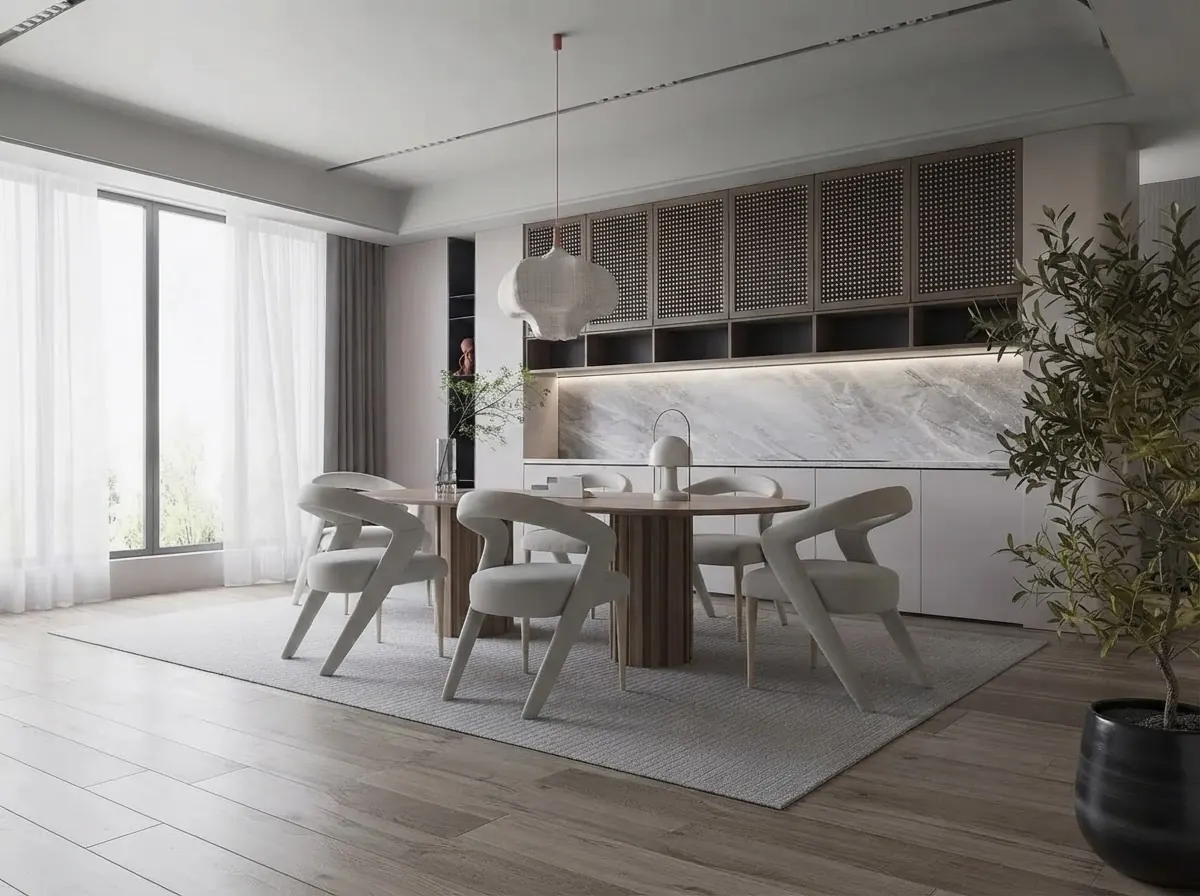
A dining rug is sized by the chair, not the table
A chair travels about 24 in backwards when someone stands up. If it drops off the edge at that point, the rug is too small, and it is the one dining mistake that cannot be lived with.
- Take the table length, add 48 in, divide by 12. That is your long side in feet.
- A 72 in table needs 120 in, so an 8 x 10. A 96 in table needs 144 in, so a 9 x 12.
- It lands on a stocked size almost every time, which is why the rule survives.
How much floor should show around a rug?
Between 12 and 18 inches of bare floor on each side is the range most designers work to, and Ruggable quotes 18 to 36 inches for its largest sizes. That gives a working rule: subtract about 3 feet from each room dimension and buy the largest stocked rug that still fits inside what is left. A 12 by 14 foot room minus 3 feet each way leaves 9 by 11, so a 9 x 12 is the answer even though it only leaves 12 inches at the ends. Below about 6 inches a side the rug stops reading as a rug, and the calculator will not recommend one there. A hallway runner is the exception: runners are only made 30 inches wide, and the building code minimum hallway is 36 inches clear, so 3 inches a side is normal there rather than a mistake.
Reference
What are the standard rug sizes?
These are the sizes almost every retailer stocks, and the only ones the calculator will recommend. Anything outside this list is made to order: it exists, it costs considerably more and it takes weeks.
| Size | Metric | What it is actually for |
|---|---|---|
| 3 x 5 ft | 91 x 152 cm | Entry, beside a bed, under a small table |
| 4 x 6 ft | 122 x 183 cm | Accent rug. Too small for any seating group |
| 5 x 7 ft | 152 x 213 cm | Small bedroom at the foot of the bed, reading corner |
| 5 x 8 ft | 152 x 244 cm | The size most people buy first, and usually the wrong one |
| 6 x 9 ft | 183 x 274 cm | Small living room where an 8 x 10 would touch the walls |
| 8 x 10 ft | 244 x 305 cm | The standard living room, and a queen bed |
| 9 x 12 ft | 274 x 366 cm | Large living room, queen plus nightstands, an 8 seat table |
| 10 x 14 ft | 305 x 427 cm | King bed keeping the 18 in rule, 10 seat table |
| 12 x 15 ft | 366 x 457 cm | Open plan seating, made to order territory above this |
Under the hood
How does the calculator decide?
No black box. Every verdict is one of these comparisons, and the numbers behind them are in the sources at the bottom of the page.
- The floor, set by the furniture. Living room: the rug must clear the sofa arms by 6 inches each side, be deep enough for however much of the seating group stands on it, and run 18 inches past the coffee table when the table is the last piece standing on it. Bedroom: the bed plus 18 inches of rug each side, or plus a 24 inch nightstand each side if those go on the rug too, and 18 inches past the foot. Dining: the table plus 24 inches at every edge, which is how far a chair travels when someone stands up.
- The ceiling, set by the room. The rug has to leave 18 inches of bare floor each side to be ideal, 12 inches to be acceptable, and below about 6 inches it is refused as fitted carpet. Runners are judged on 4 inches and 2 inches instead, because a 30 inch runner in a code minimum hallway leaves 3 inches and that is the normal case.
- The answer is the smallest size that clears both, not the largest that fits. Going bigger buys nothing and costs a lot.
- Orientation. A rug is tried both ways round, except in a bedroom, where the length runs with the bed. Skipping that exception is what makes a naive calculator recommend a 9 x 12 for a king: rotated, it passes the arithmetic, and laid the way anyone actually lays it, it leaves 16 inches a side instead of 18.
- The next size down is named, with its failure. The size most people are about to buy is the one below the right one, so the tool says which it is and how many inches short it falls.
Going deeper
Where can I see the full rug size chart?
This page is the tool. The reasoning, the three placements plotted in a single room at scale, the bedroom and dining rules and the mistakes that cost the most are in what size rug for a living room, every size drawn to scale. If your question is whether the sofa will physically get into the room in the first place, that is the furniture fit calculator, which is a different problem with different arithmetic.
Keep reading
Guides that go with this
Frequently asked questions
How does this rug size calculator work?
It runs two limits at once and returns the smallest stocked size that satisfies both. The furniture sets the floor: the rug has to clear your sofa arms by 6 inches each side, or leave 18 inches of rug each side of your bed, or big enough that a dining chair stays on it when someone pushes back. The room sets the ceiling: the rug has to leave 12 to 18 inches of bare floor at the edges or it reads as fitted carpet. It then draws your room, your furniture and the recommended rug at one scale so you can see the result rather than take it on trust.
Why does it ask about the sofa instead of just the room?
Because room size alone gives the wrong answer often enough to matter. Most rug calculators take your room and subtract a border, which tells you the biggest rug that fits, not the right one. A room can be plenty big enough for a 9 x 12 and still too small to put every leg of a seating group on one. A sofa, an 18 inch walkway, a coffee table, another walkway and an armchair opposite come to 134 inches, and an 8 x 10 is 120 inches long, so that group hangs off the end by 14 inches no matter how big the room is.
Is the biggest rug that fits always the right one?
No, and this is the most common way to waste money on a rug. The calculator recommends the smallest stocked size that does the job properly, because past that point you are paying for square footage that only reduces the border. The bare floor around a rug is what makes it read as a rug rather than a carpet, and 12 to 18 inches of it on each side is the range most designers work to.
Why does it only recommend standard sizes?
Because those are the ones you can actually buy this week. The list it picks from, 3 x 5 through 12 x 15 feet plus 2 foot 6 runners, is what almost every retailer stocks. Sizes outside it exist, but they are made to order, cost considerably more and take weeks, so designing around the stocked list is nearly always the better trade.
What if the calculator says no size works for my room?
It means the furniture you told it about needs more rug than the room can hold without running into the walls, and it will say which of the two limits broke. The fixes are to take a piece off the rug, usually by moving from all legs on to front legs on, to use a smaller sofa or table, or to accept a rug that comes closer to the walls than the guidance suggests. The tool will not quietly round you down to a size that does not work.
Does the rug size calculator work in centimetres?
Yes. Switch the unit toggle to cm and enter every measurement in centimetres. The recommendation, the border measurements and the scale drawing all update, and the rug size is shown in both feet and centimetres because rugs are sold in feet in the US and in centimetres nearly everywhere else.
Method
How we checked these numbers
Every constant the calculator uses is listed here with where it came from, and the arithmetic in the maths module is covered by a test suite that asserts each worked example on this page. If a claim is not in that suite, it is not on this page.
- Mattress dimensions. Queen 60 by 80 in, king 76 by 80 in and California king 72 by 84 in are the Sleep Foundation’s published figures, read on 24 September 2026 at sleepfoundation.org/mattress-sizes. Twin, twin XL and full are the standard US sizes and were not on the table we read, so treat those three as conventional rather than sourced. Mattress makers vary by an inch or so either way.
- Stocked rug sizes. The 3 x 5 through 12 x 15 list, and the 18 to 36 inch border guidance for the largest sizes, follow Ruggable’s own size guide.
- Hallway minimum. The 36 inch clear width for a hallway is the International Residential Code, section R311.6, which is why a 30 inch runner leaving 3 inches a side is the normal case rather than a failure.
- Furniture depths. 36 inch sofa depth, 28 inch coffee table, 34 inch armchair and 18 inch walkways are mid points of published retailer dimensions, not measurements of a specific product. Your sofa may be 40 inches deep, which moves the seating group from 134 to 138 inches, so the tool takes your sofa width and uses these only for the depths you did not give it.
- What we could not verify. The 24 inch chair pull is used by every dining rug guide and by the furniture trade, and we could not find a primary study behind it. It is treated here as a convention, and it is the one number on this page we would change first if someone measured it properly.
A correction worth recording: while deriving this calculator we found that the FAQ on our own rug size post listed “an 84 inch sofa” inside the sum that reaches 134 inches. The sofa contributes its depth, 36 inches, not its width, and 84 plus the rest comes to 182. The body of that post was right and its FAQ was wrong. It has been fixed, and this page is the arithmetic it should have shown.
A guide, not a guarantee. The plan treats furniture as rectangles at published average depths. A sectional, a chaise, a bay window, a fireplace or a door that swings inward will all move the answer, and rugs are rarely returnable once unrolled. Measure twice, and check the size in the room before you buy. Last reviewed 24 September 2026.
A size is a number. See it on your floor.
The calculator proves the rug fits the room. It cannot tell you whether the colour works against your floor and your sofa, and that is the part people actually get wrong. Upload a photo of your room to MeltFlex and put the rug in it before you spend anything.
Try MeltFlex free
