Yes, you can put an area rug on carpet, and it is one of the fastest ways to fix a room you are not allowed to re-floor. It only goes wrong in predictable ways. The rug is too thin, or too small, or nothing is standing on it. Get those three right and layering reads as a deliberate choice, which is why designers do it in houses that already have perfectly good carpet. Before you buy, the free rug size calculator will tell you which stocked size your room and sofa actually take.
Our articles are still written by humans!
Get human written articles in your Google feed.
The short version
- Different pile heights. A thin flatweave over deep plush ripples and curls. Go thicker and denser than the carpet, or much flatter, never almost the same.
- Go bigger than feels right. The rug has to reach the furniture. A small rug floating in the middle is the single most common mistake.
- Front legs on the rug. Furniture is the anchor, and it is also what makes the layering look intentional.
- Over a patterned carpet, go plain or use a pattern at a very different scale. Two medium patterns fight.
- Grippers, not rug pads. Pads are for hard floors. On carpet you need hooked carpet to carpet grippers.
- The long term risk is light, not wear. The carpet around the rug fades and leaves an outline.
Jump to: The short answer · Is it weird? · Pile height · Size · Anchoring · Pattern and colour · Bedrooms · Stop it sliding · Carpet damage · Seeing it first · FAQ
FreeUpload photo · freeRearrange my room for freeUpload a photo and MeltFlex plans a new furniture layout around your walls, windows and doors. Your first AI design is free, no card needed.


Can you put a rug on carpet? The short answer
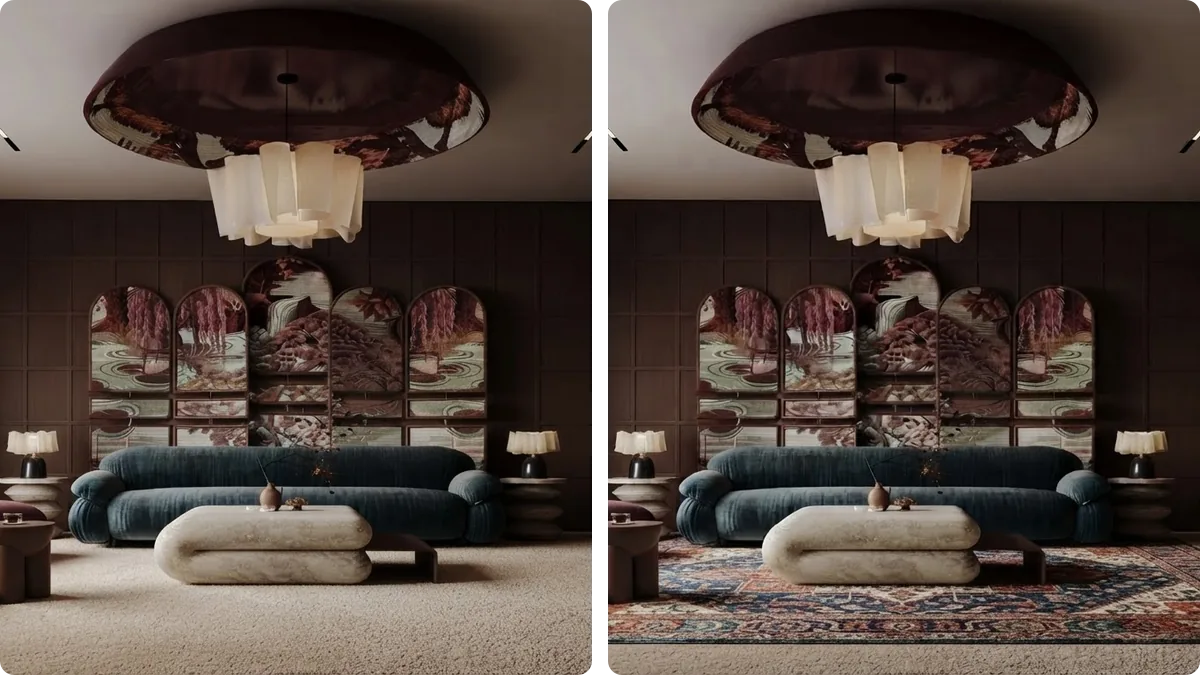
You can, and the question is really about whether it will look like a mistake. Here is the same living room twice. On the left is the wall to wall carpet on its own: clean, inoffensive, and completely flat as a room. On the right is one large rug laid over it. Nothing else in the room changed, not the furniture, not the light, not the camera.
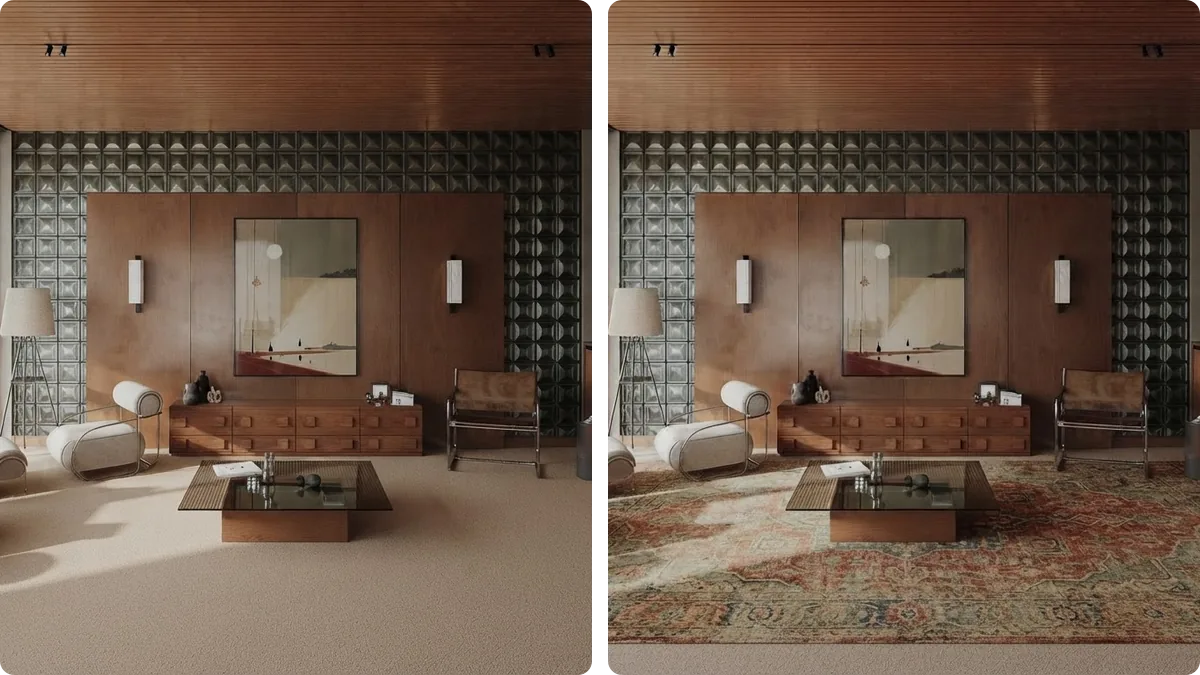
That is the whole argument for layering. Wall to wall carpet gives a room a single uninterrupted surface, which is comfortable and quiet and gives the eye nothing to hold onto. A rug puts a boundary on the floor. It says where the seating area stops, and it gives you a place to introduce colour and pattern in a room where the biggest surface is usually stuck being beige.
It is also the only floor change most renters are allowed to make. If you are looking at landlord carpet you cannot replace, a rug is not a compromise. It is the actual solution.
Is it weird to put a rug on carpet?
No. It is common enough that the search volume for people quietly checking whether they are allowed to do it runs into the thousands every month, which tells you something about how much of decorating is just wanting permission.
The reason it has a reputation is that most people have only seen the bad version: a small, thin, pale rug sitting in the middle of a large expanse of carpet, touching no furniture, with a metre of carpet on every side. That does look wrong. But the thing making it look wrong is the size and the thickness, not the concept. A rug that reaches the furniture and sits with some weight on the floor reads as zoning, and zoning is a normal thing to do to a room.
The four rules below are, in order of how often people get them wrong, the difference between the two.
Rule 1: the pile heights have to be different
This is the rule nobody tells you and it is the one that explains most failures. A rug needs a stable base. Lay a thin, floppy, low pile rug over a thick plush carpet and it has nothing to sit on: the carpet compresses unevenly every time somebody walks across it, so the rug ripples and the edges and corners lift. How fast that happens depends on the fibre, the humidity and the foot traffic, but a rug with no weight of its own will never sit flat on deep pile, however new it is. It will look cheap no matter how expensive it was.
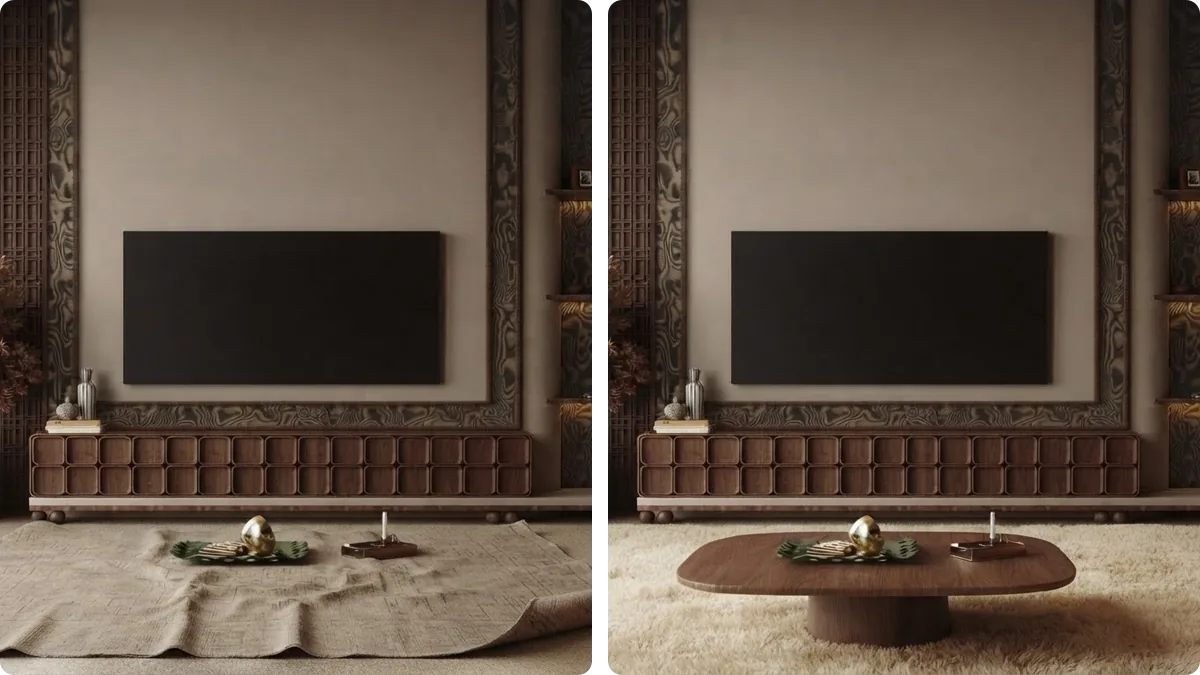
The fix is contrast in thickness, in either direction.
- Over deep or plush carpet, use a rug that is dense and heavy: a thick wool flatweave, a hand knotted wool rug, a chunky jute. Weight is what keeps it flat. Avoid thin cotton, thin printed polyester and anything you could fold into a bag.
- Over low pile, berber or commercial grade carpet, almost anything works. This is the easy case, and it is where a high pile rug looks best, because the height difference is doing the visual work.
- What to avoid entirely is a rug with roughly the same pile as the carpet. It neither sits flat nor reads as a separate layer, so it just looks like the carpet went wrong in one rectangle.
If you can only remember one thing from this page: the rug should feel like a different material underfoot from the carpet. If you cannot tell where one ends and the other begins with your eyes shut, it is the wrong rug.
Rule 2: go bigger than feels sensible
The most common mistake in the whole category is the postage stamp: a rug that floats in the middle of the room, reaching nothing. On a bare floor that is merely a bit sad. On carpet it is worse, because the carpet already fills the room, so an undersized rug has no job to do and reads purely as clutter.
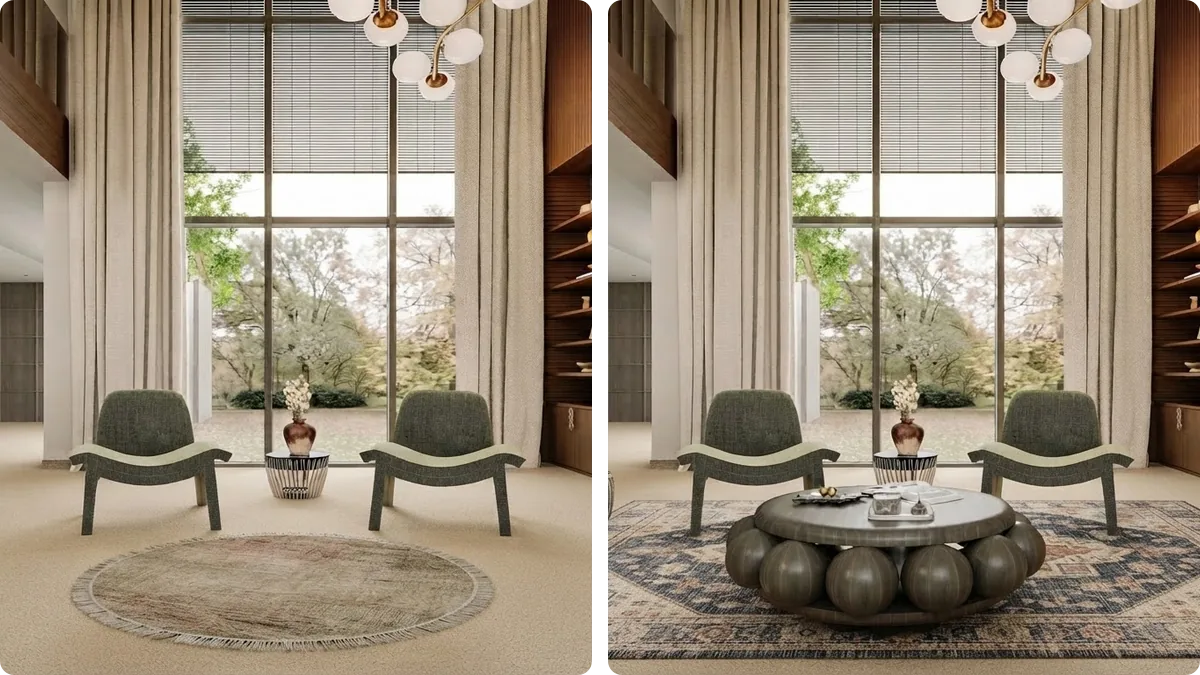
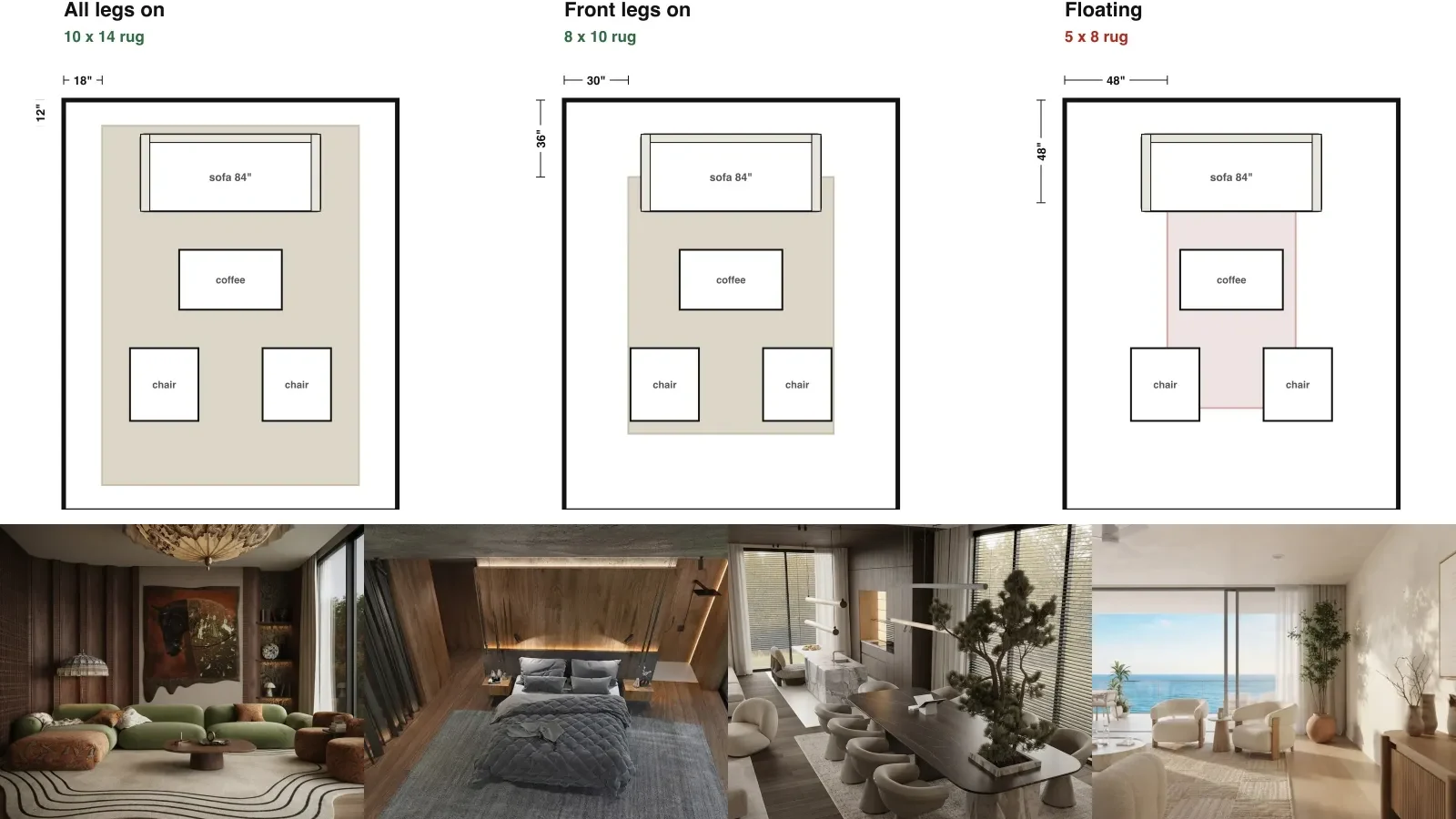
The test is furniture, not floor area. The rug is big enough when at least the front legs of the sofa and every armchair in the group stand on it. In a normal living room that means starting at 8 by 10 feet and usually landing on 9 by 12. Leave a consistent band of carpet showing around the edge, roughly 12 to 24 inches, so it frames the rug. What you are avoiding is a wide uneven moat of carpet on all four sides.
The arithmetic for each room and each furniture layout is a whole subject of its own, and we have drawn it all to scale in our guide to what size rug a living room needs. Every size in it applies here unchanged. Carpet underneath does not alter the geometry, it only punishes you harder for getting it wrong.
Rule 3: put furniture on it
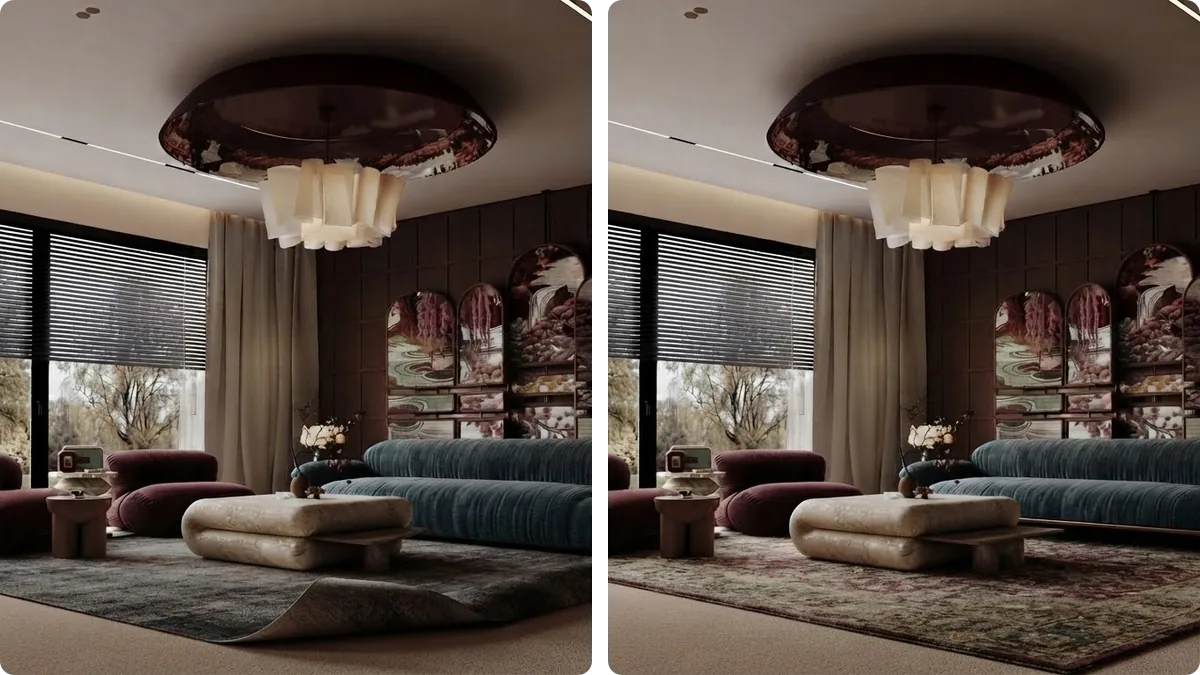
Anchoring does two jobs at once, which is why it is the highest value rule on the list. Practically, furniture stops the rug travelling, and it does that far better than any gripper you can buy. Visually, furniture standing on a rug is what tells the eye the rug belongs to the seating group rather than having been dropped there.
The minimum is front legs on. All legs on is better if the room can take it and is the version that looks most settled. The one arrangement to avoid is a rug that touches no furniture at all, because that is the arrangement that both slides and looks wrong.
If your seating plan is unsettled to begin with, sort that before you buy a rug, since the layout decides the rug size and not the other way round. Our walkthroughs on living room layouts and what size furniture fits a room cover the order to make those decisions in.
Rule 4: contrast with the carpet, do not compete with it
Colour and pattern are where taste comes in, but there are two reliable rules.
If the carpet is plain, which it usually is, you have a free hand. This is the moment to use the pattern or the colour you could not commit to anywhere else, because the rug is the one thing in the room you can change in an afternoon. Pulling one colour from something already in the room, a cushion or the curtains or the artwork, makes the whole thing look considered rather than shopped.
If the carpet is patterned or strongly textured, go plain or nearly plain on the rug. Two patterns at a similar scale will fight and the room will feel restless without anyone being able to say why. If you want pattern on pattern, make the scales obviously different: a large open pattern over a fine tight one can work well.
On tone: a rug darker than the carpet grounds a room and hides traffic. A rug lighter than the carpet lifts a dark room but shows everything. Beige on beige is the one combination that reliably disappoints, because without a tonal step there is no visible boundary, and the boundary was the entire point.
Rug on carpet in a bedroom
Bedrooms are the easiest room to get this right in, because the bed does all the anchoring for you and the geometry is simple.
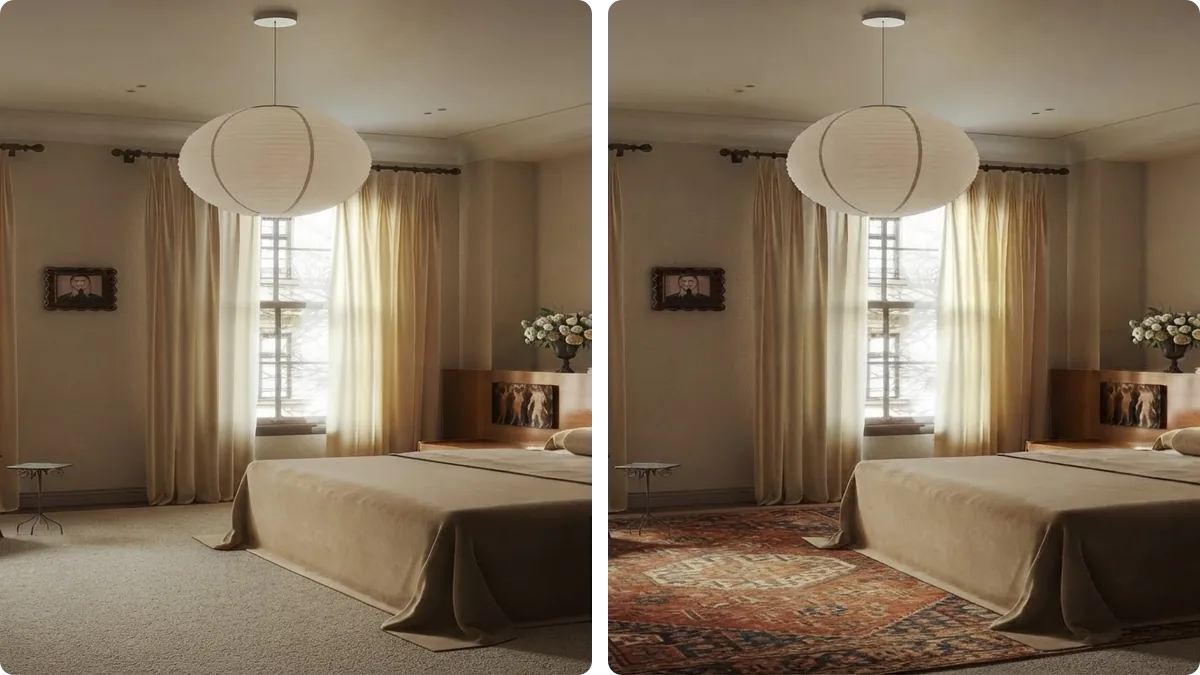
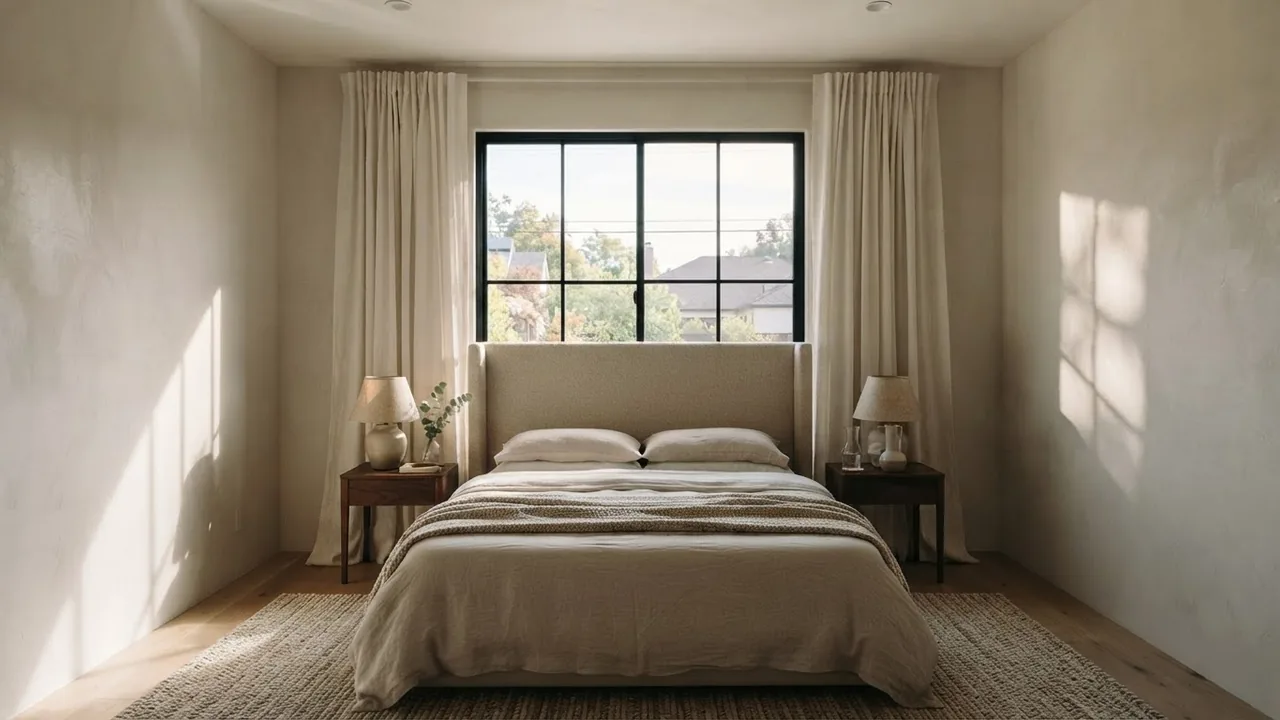
Run the rug under the lower two thirds of the bed so it comes out on both sides and at the foot. Aim for 18 to 24 inches of rug showing along each side, which is roughly one step, because the entire practical point is what your feet meet in the morning. An 8 by 10 works under a queen, a 9 by 12 under a king.
The version that looks like an afterthought is a small rug sitting only at the foot of the bed, floating clear of it. Two runners down either side is a legitimate alternative if a single big rug will not fit, and in a small room it is often the better answer.
If the bed itself is in an awkward spot, that is worth settling first: we went through the usual constraint in whether a bed can go in front of a window, and the full set of arrangements is in our bedroom layout guide.
How to keep a rug from moving on carpet
This is the half of the subject the design articles skip and the carpet shops answer badly, so here it is properly. Rugs slide on carpet for a different reason than on wood: there is no friction problem, there is a pile problem. The carpet fibres flex under the rug and walk it across the room a few millimetres at a time.
- Furniture, first and always. A rug with a sofa and two chairs on it does not move. This solves the problem more completely than anything you can buy, and it is free.
- Carpet to carpet grippers. These are the ones that work: stiff plastic or metal teeth that hook into the carpet pile on one side and grip the rug backing on the other. Put them at the corners and midway along any long exposed edge.
- Not an ordinary rug pad. The rubber or felt pads sold for rugs are designed to grip a hard floor. On carpet they add a soft layer between two soft layers, which usually makes the movement worse rather than better. If you want a pad, buy one specifically labelled for carpeted floors and take the thinnest, densest option.
- Double sided carpet tape holds well and is cheap. The catch is removal: on some carpets it lifts fibres and on others it leaves adhesive that attracts dirt into a visible line. Fine in your own home, risky in a rented one.
- Silicone beads on the rug back are the old trick and they do work. Run thin lines of clear silicone caulk across the underside, let it cure fully overnight, and you have made your own grip surface. It is permanent, so do not do it to a rug you care about.
For a rug that curls at the corners rather than sliding, the cause is almost always rule one. A gripper will hold a curling corner down, but the rug is telling you it is too thin for the carpet underneath it.
Will a rug damage the carpet underneath?
Mostly no, and the risk people worry about is not the one that actually happens.
Compression is usually temporary. The carpet industry calls this crushing, defined by the Carpet and Rug Institute as the restorable or non-restorable loss of pile thickness from sustained pressure, and there is a named industry test for it, ASTM F970, which measures how much a carpet's thickness recovers after a load is removed. How much of that recovery you get back depends on the fibre, the pile density and how long the rug sat there, which is why we are not going to hand you a made up number of weeks: a fresh, dense wool carpet under a light rug will bounce back close to fully, an old or cheap one under something heavy for years may not.
Light is the real one. Sunlight is one of the standard questions the Carpet and Rug Institute tells buyers to answer before choosing a carpet, and the mechanism is UV radiation breaking down the dye bonds in the fibre over months of exposure. Carpet under a rug is shielded from that, the carpet around it is not, so when you eventually move the rug you can be left with a rectangle in a visibly different colour. Near a large south or west facing window this can show within a year or two. It is the single most common way this goes wrong long term, and it is worth knowing before you lay a rug over a carpet you intend to keep for a while.
Backing, and this is not the failure mode people expect. The worry is usually that rubber backing will yellow the carpet the way it can yellow vinyl flooring. On carpet the more common problem is mechanical, not chemical: latex and rubber backing can bond to the carpet fibre instead of simply gripping it, and pulling the rug up later tears fibre out with it. Moisture trapped underneath is the second issue. A woven, felt or natural fibre backing avoids both.
If you are renting, layering is the low risk option compared with almost anything else you could do to the floor, provided you skip the tape and the silicone and anchor with furniture and grippers instead.
Seeing it in your own room before you buy
Rugs are the hardest thing in a room to judge from a listing photograph, because the two variables that decide whether it works, the size relative to your furniture and the tonal step against your particular carpet, are exactly the two things a product shot cannot show you. A rug that looks rich on a white studio floor can vanish entirely against warm beige carpet.
The cheap physical test still works: mark the rug out on the carpet with masking tape and leave it for a day, which will tell you about the size if not the colour. The faster version is to photograph the room and put the rug into the photograph. MeltFlex works from a photo of your actual room, so you can try a dark flatweave and a pale wool against your real carpet, with your real furniture and your real light, before anything gets delivered. That is how the before and after pairs on this page were made: one room, photographed once, with the rug added in the second frame and everything else held still.
For the color side, this walkthrough compares several rugs on a photo of one real room: warm against cool tones, bold patterns against calm textures, and sizes that ground the furniture against ones that float.

The video settles contrast. Pile height, rule one above, still has to be checked with your hand, not your eyes.
Once the floor is settled, the rest of the room usually follows. Our guides to what colour furniture goes with grey walls and accent wall ideas deal with the vertical surfaces, and if the carpet is genuinely beyond saving, the floor plan to 3D walkthrough is the place to start on a bigger change.
Frequently asked questions
Can you put a rug on carpet?
Yes. Layering an area rug over wall to wall carpet is common and designers do it constantly. It works when three things are true: the rug has a noticeably different pile from the carpet underneath, it is big enough that furniture stands on it, and something holds it in place. Break any of those and it looks like an accident rather than a decision.
Is it weird to put a rug on carpet?
No, and the reason people ask is that they have mostly seen it done badly. A small thin rug marooned in the middle of a beige carpet does look wrong, but the problem there is the size and the thickness, not the idea. A large rug that reaches the furniture reads as deliberate zoning, which is exactly what it is.
How do you keep a rug from moving on carpet?
Furniture is the most reliable anchor: get the front legs of the sofa and the chairs onto the rug and it will barely move. For the exposed corners use a carpet to carpet gripper, which has hooked teeth that bite into the pile. Ordinary rubber or felt rug pads are made for hard floors and will slide on carpet. Double sided carpet tape works but can pull fibres when you lift it.
Does a rug on carpet damage the carpet?
Not usually, but two things happen over time. The pile under the rug compresses, what the carpet industry calls crushing, and how fully it recovers depends on the fibre and how long it was loaded. The bigger issue is light: carpet around the rug fades from UV exposure while the covered part does not, so after a year or two near a sunny window you can be left with a visible outline. Avoid solid rubber backed rugs, since the backing can bond to carpet fibre and tear it when the rug is lifted, and can trap moisture underneath.
Can you put an area rug on carpet in a bedroom?
Yes, and the bedroom is the easiest room to get right. Run the rug under the lower two thirds of the bed so it emerges on both sides and at the foot, which is where your feet land. Aim for at least 18 to 24 inches of rug showing along each side of the bed. A rug that only sits at the foot of the bed is the version that looks like an afterthought.
Do you need a rug pad under a rug on carpet?
Not the usual kind. Standard rug pads are designed to stop a rug slipping on wood or tile and they do very little on carpet. What you want is a carpet specific gripper or a dense low profile pad sold for carpeted floors. If your rug is already thick and heavy and the furniture sits on it, you may not need anything at all.
What size rug should you put on carpet?
Bigger than feels natural. The rug should reach the seating so that at least the front legs of the sofa and armchairs stand on it, and it should leave a consistent border of carpet showing rather than a wide moat. In a typical living room that means 8 by 10 feet at the very least, and usually 9 by 12.
Sources
- Carpet and Rug Institute, Selecting the Right Carpet, which lists direct sunlight exposure as a standard question to answer before choosing carpet, and the Carpet Maintenance and Troubleshooting Technical Bulletin, which defines crushing as the restorable or non-restorable loss of pile thickness from traffic, for the compression claims in the damage section.
- ASTM International, ASTM F970, the standard test method for measuring the recovery of a floor covering after static loading, cited for the general mechanism, not for a specific recovery time, which we do not have a verified figure for.
- RugPadUSA, Are Rubber Backed Rugs Right for Your Floors?, for the correction on this page: rubber and latex rug backing does not chemically yellow carpet the way it can yellow vinyl, it bonds to and tears carpet fibre mechanically instead.
- All photographs on this page are MeltFlex's own AI renders, generated in a two step process from Behance interior photography: the room is first re-rendered with plain carpet and no rug, then that exact frame is used again to add only the rug, so both halves of every pair are the same room, furniture and camera angle.