The fastest way to date a bathroom is the mirror: a frameless slab glued to the wall says builder grade louder than any tile choice ever will. The bathrooms getting photographed in 2026 swap that slab for one considered piece, an arched brass mirror, a thin oak round, a warm backlit pill, hung at the right height over the vanity with light that flatters the face instead of interrogating it.
Our articles are still written by humans!
Get human written articles in your Google feed.
The good news is that the mirror is the highest leverage upgrade in the whole room. It sits at eye level, you look into it every day, and swapping it costs a fraction of retiling. The bad news is that most replacements fail in one of two predictable ways: a mirror scaled wrong for the vanity, or LED lighting that turns the room into a gas station restroom. Both failures are avoidable with a handful of numbers, and all of them are in this guide.
What follows: 18 bathroom mirror ideas that hold up, the exact size and height rules designers use, a lighting section with the sconce numbers, the LED test that separates flattering from clinical, and how to preview any of these on a photo of your own bathroom with AI bathroom design before you buy anything. Every interior image in this guide is a MeltFlex render we generated for this article, sun, shadows and all.
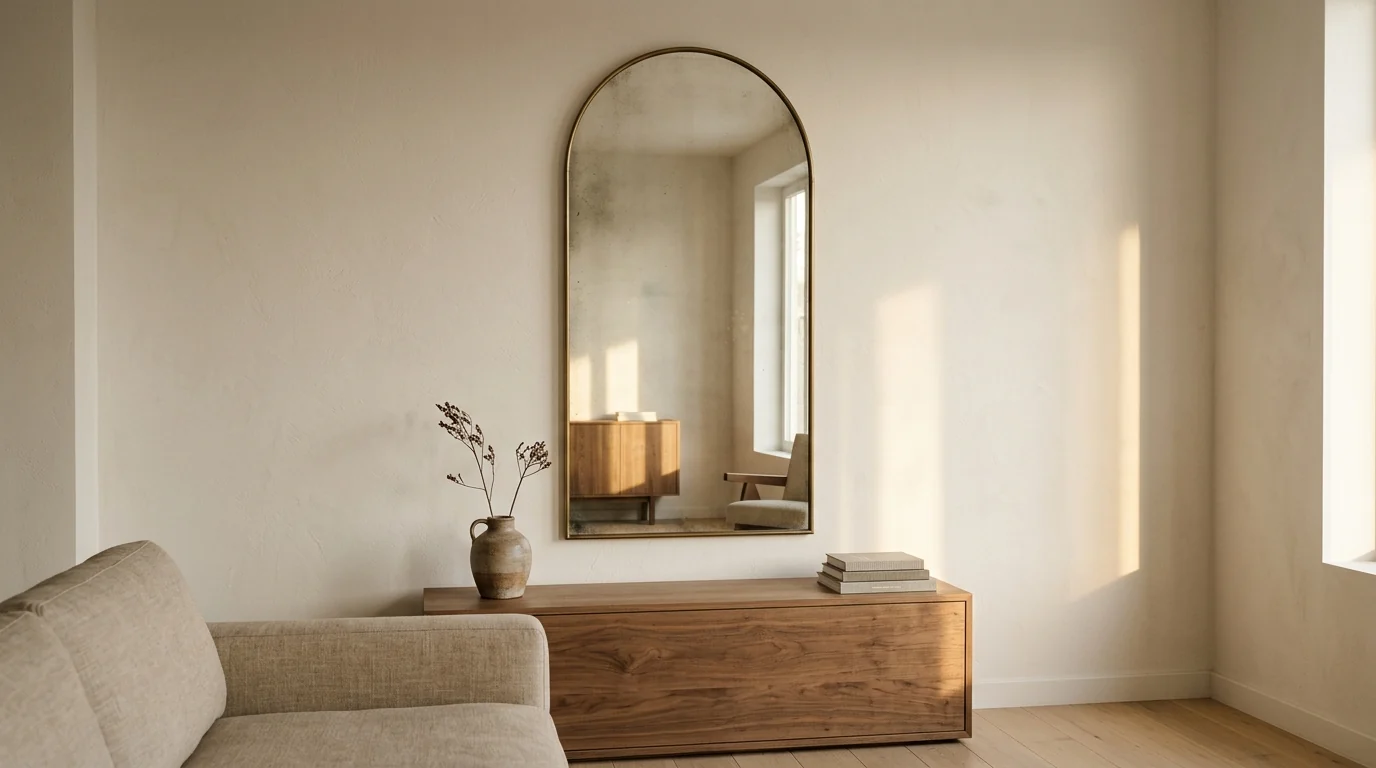
The whole argument in one frame: an arched brass mirror, a real frame, morning sun doing the styling. No slab, no bulb strip.
FreeUpload bathroom photo · freeRedesign my bathroom for freeUpload a photo of your bathroom and MeltFlex redesigns the tiles, vanity and fixtures in the same room. Your first AI design is free, no card needed.
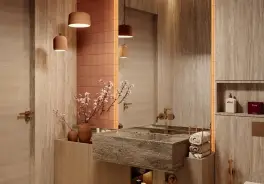

What Replaced the Builder Grade Slab
A bathroom mirror is the one object in the room you interact with at eye level every single day, which is why the frameless glued slab feels so wrong once you notice it: it is the least considered object in the most looked at spot. Current bathroom design treats the mirror the way living rooms treat art, as the wall’s focal point, and four moves define the moment: arched and pill silhouettes that soften a room full of hard edges, real frames in aged brass, black steel and oak, warm backlit LED replacing the bare bulb strip, and vintage and antiqued glass migrating in from the living room, a shift we covered from the other side in our mirror wall guide.
The direction matches where interiors are heading generally: warmer, more tactile, less catalog. And because bathrooms are small, the mirror swap plus better light delivers a bigger visible change per euro than any other single decision in the room, something to keep in mind before committing to a full bathroom renovation.
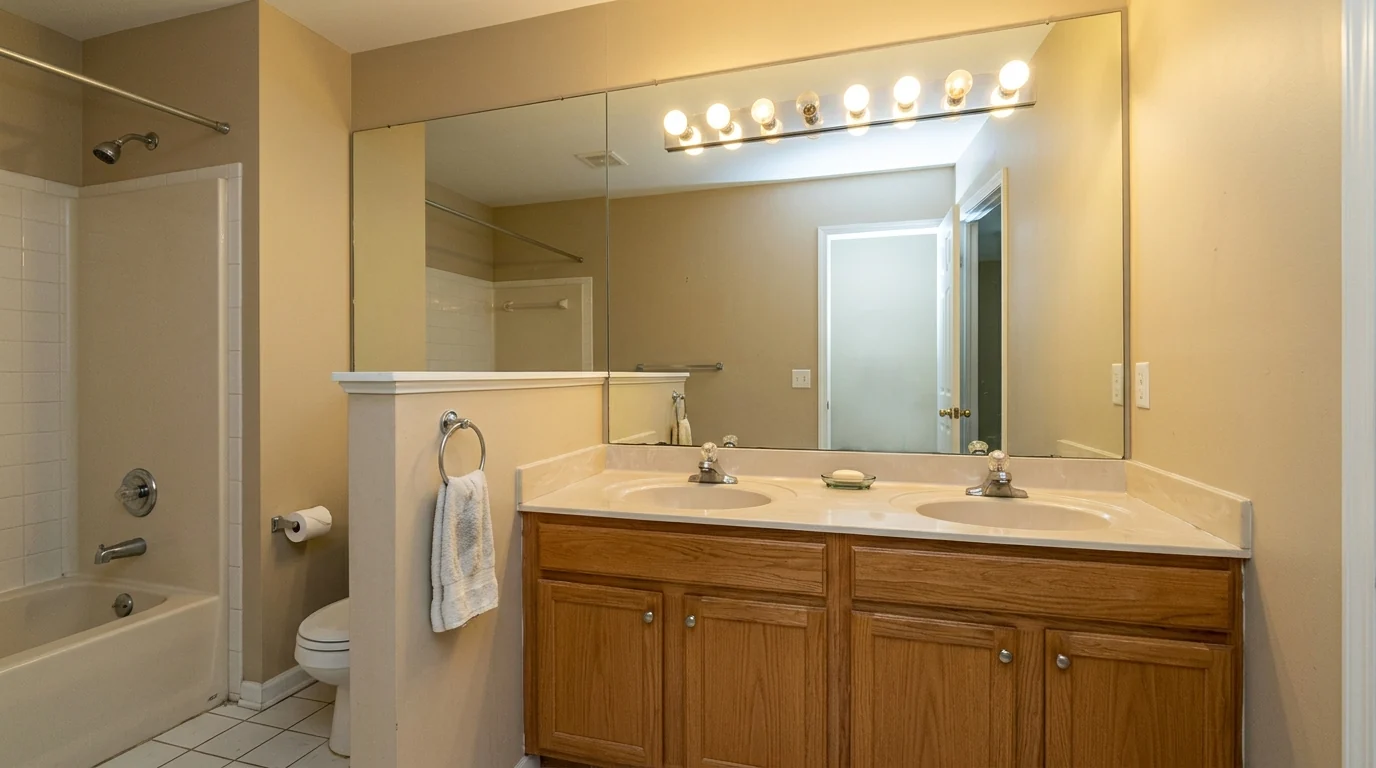
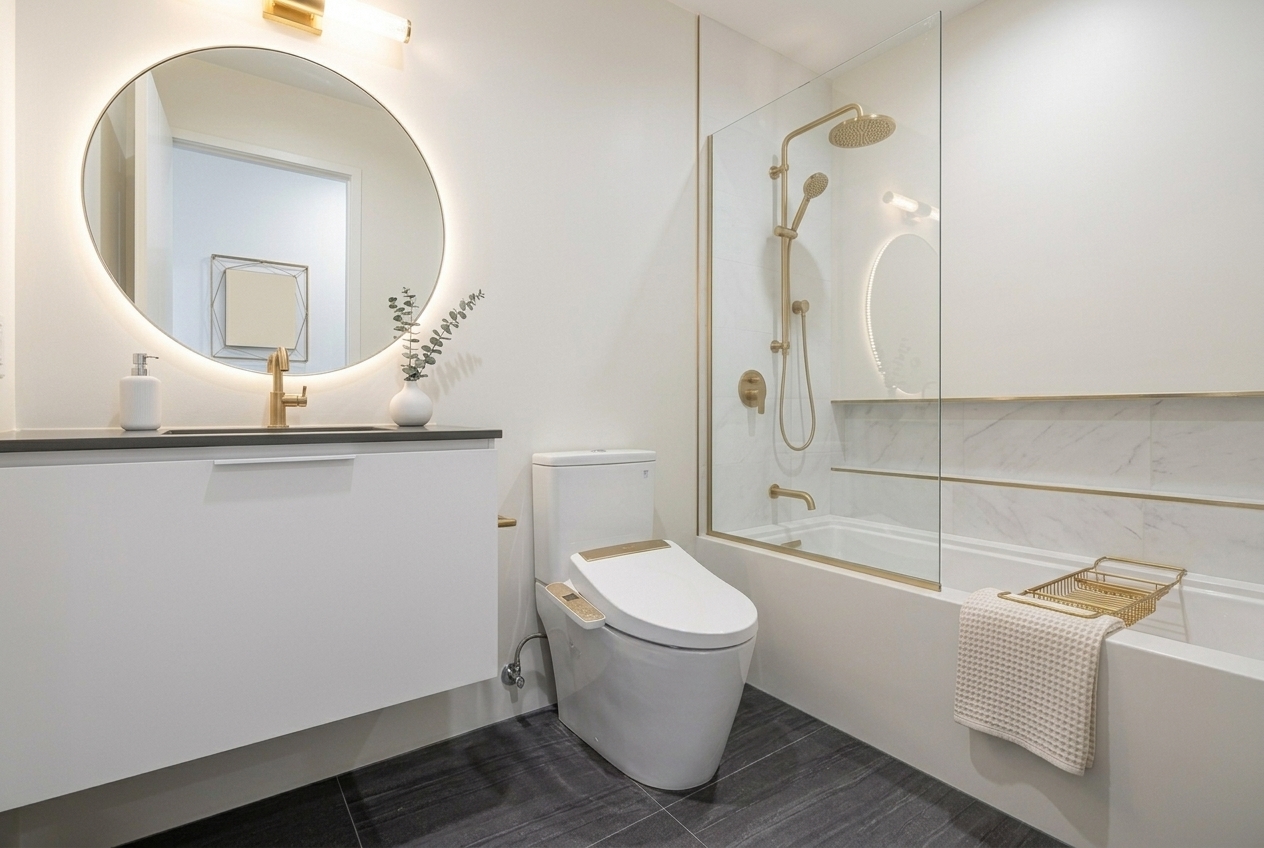
The starting point most bathrooms share: the glued slab, the bulb strip, the beige. Everything below is a way out of this photo.
The 4 Decisions That Sort Every Mirror
Every idea below is a combination of four choices, and making them in this order prevents most mistakes:
- Size first. 70 to 80 percent of the vanity width, never wider than the vanity. Size is the mistake you cannot style your way out of.
- Shape second. Arched or pill to soften a boxy room, round for a single vanity, rectangle to hold a long double vanity line.
- Frame third. Match the metal you already committed to in the faucet, or choose wood and ignore the metals entirely. Two metal finishes maximum per bathroom.
- Light last but planned first. Decide where the light comes from before drilling, because a mirror hung where the sconces cannot go locks in bad face light for a decade.
Shape and Frame: The Core Six
1. The Arched Mirror Over the Vanity
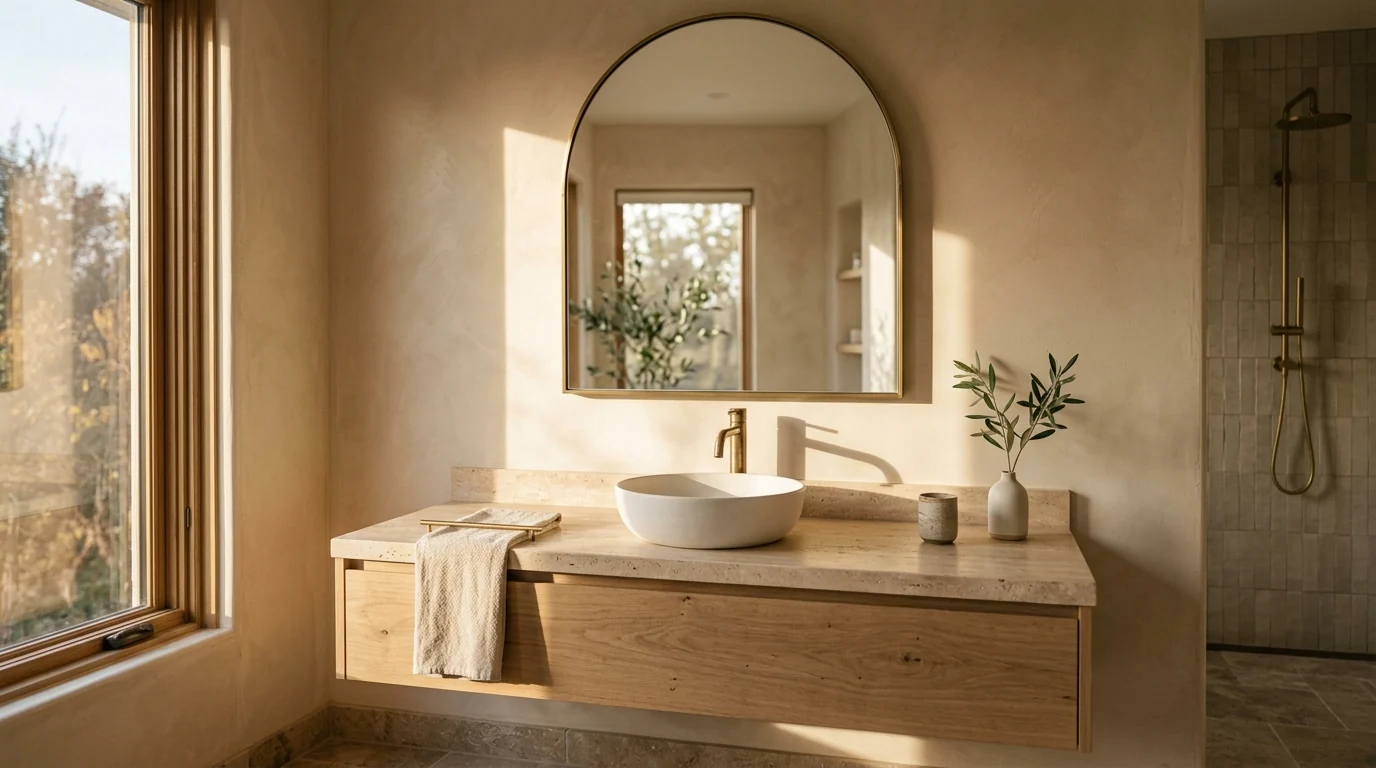
The defining bathroom mirror of the moment. A tall arch does architecture’s work on a flat wall, faking a window where there is none, and its vertical reach makes low ceilinged bathrooms feel taller. In slim aged brass over a wood vanity it is warm without being ornate; the arch echoing a curved faucet or a curved tub reads intentional. It is also forgiving: because the shape is the statement, the frame can stay thin and inexpensive. If your bathroom has zellige or any handmade tile, this pairing is close to unmissable.
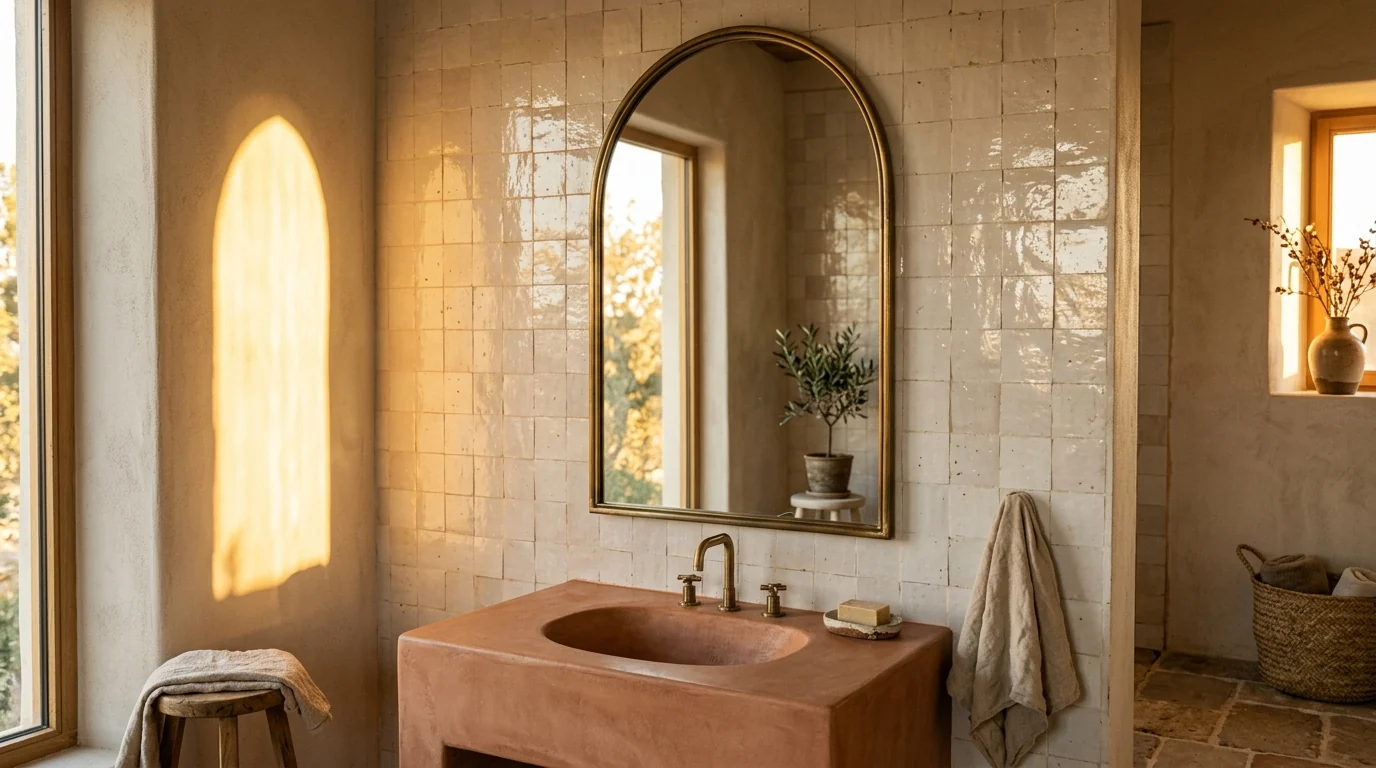
Arch on zellige: the glaze sparkles, the brass warms, and the flat wall suddenly has architecture.
2. The Japandi Round in Thin Oak
A perfect circle in the thinnest possible oak frame, over a grounded wood vanity, nothing else on the wall. This is the mirror for anyone whose reaction to the arch was that it is already too much. The round works because of what surrounds it: clay plaster, one vessel basin, one object on the vanity, following the restraint logic of japandi interiors where every element has to justify its presence. The mistake that kills it is clutter creep, because a minimalist mirror over a crowded vanity reads as unfinished rather than restrained.
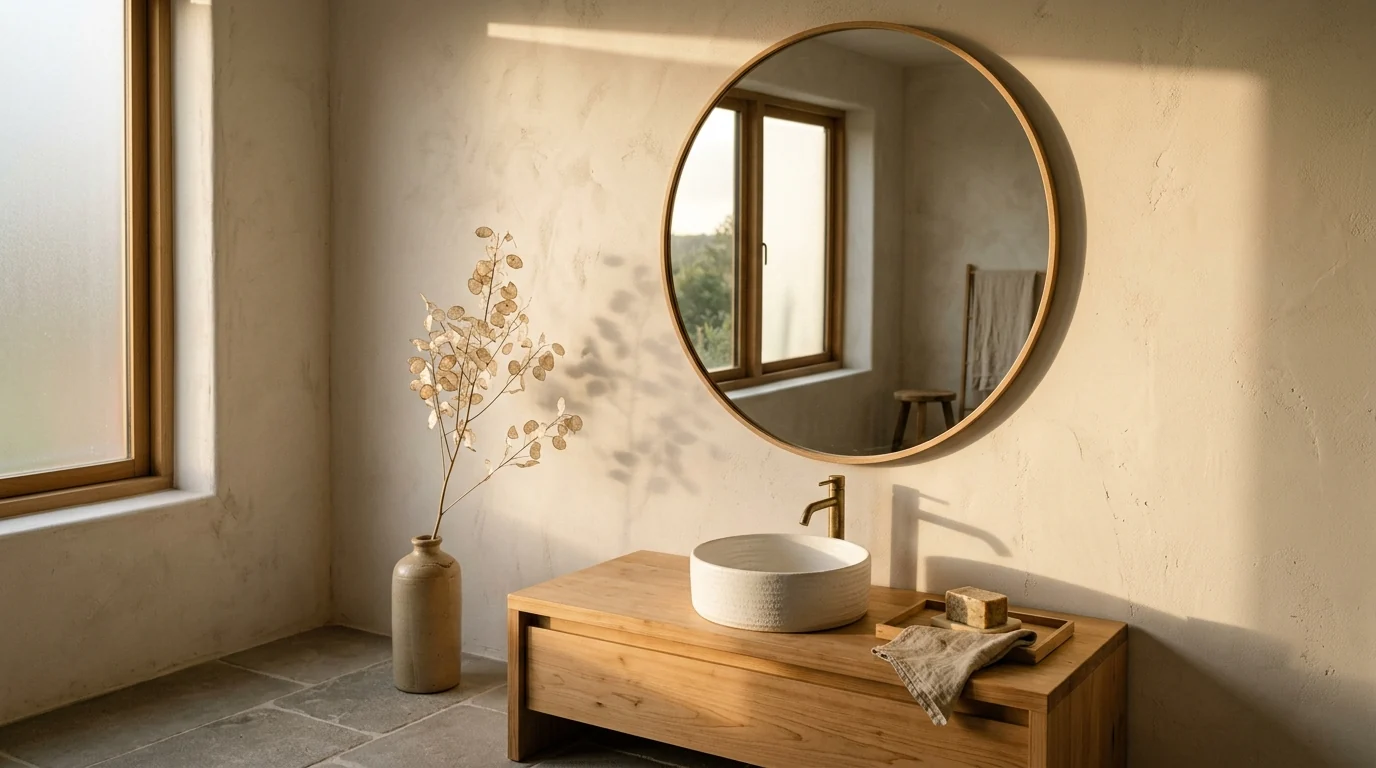
One circle, one basin, one branch. Japandi restraint only works if the vanity stays this empty.
3. The Pill Mirror
The vertical capsule, a rectangle with fully rounded ends, is the arch’s quieter sibling and the current default in European hotel bathrooms. It gives you the height of an arch without the historical reference, which suits strictly contemporary rooms, microcement, wall hung vanities, matte black taps. Frameless versions work here better than anywhere else because the shape itself provides the design, though a subtly antiqued edge keeps the glass from feeling clinical.
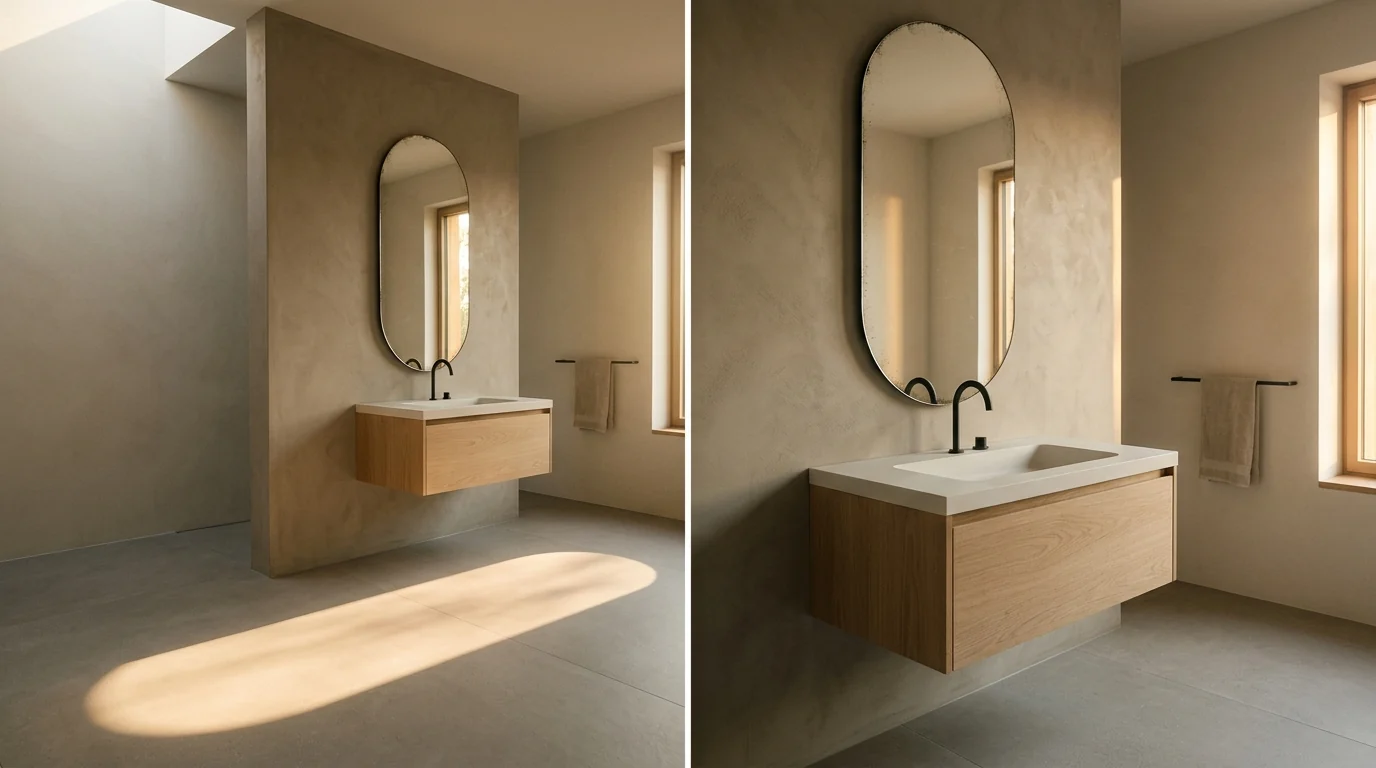
The capsule: arch energy, zero ornament. Three materials in the whole frame, which is exactly the point.
4. The Organic Irregular Shape
The asymmetric blob mirror, all soft irregular curves, turns the mirror into sculpture and works precisely once per bathroom. Over a chunky stone basin it is genuinely striking, and the irregular patch of bounced light it throws on the opposite wall moves through the day like an installation. Two warnings. First, this shape is having a moment, which means the cheap versions are everywhere and read as trend chasing within a year or two. Second, it needs empty wall around it; the blob against busy tile is noise on noise. It belongs to the same soft sculptural family as organic luxe interiors, and it obeys the same rule: one sculptural gesture per room.
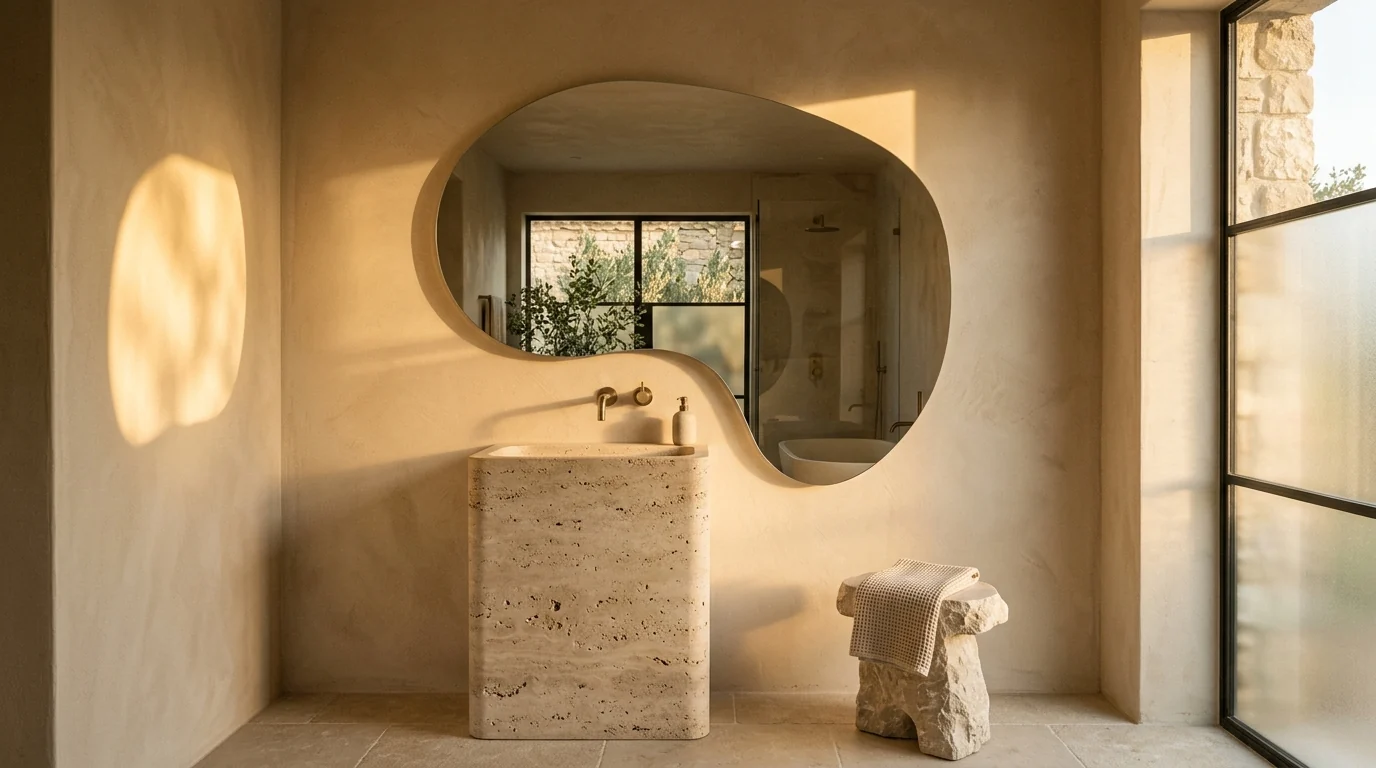
The mirror as sculpture. Needs bare wall around it and discipline everywhere else, or it tips from artful into trendy.
5. The Chunky Oak Frame
Where thin frames whisper, a rounded edge oak frame two or three fingers wide makes the mirror furniture. Over travertine or any warm stone it produces the tactile, expensive calm that photographs so well, and unlike brass or black steel it never has to negotiate with your faucet finish. This is also the most forgiving frame for imperfect walls, because the visual weight of the wood hides small alignment sins that a frameless slab would broadcast. Solid oak or oak veneer on a sealed core both work; what fails in a bathroom is cheap MDF with a foil wrap, which swells at the corners after a year of steam.
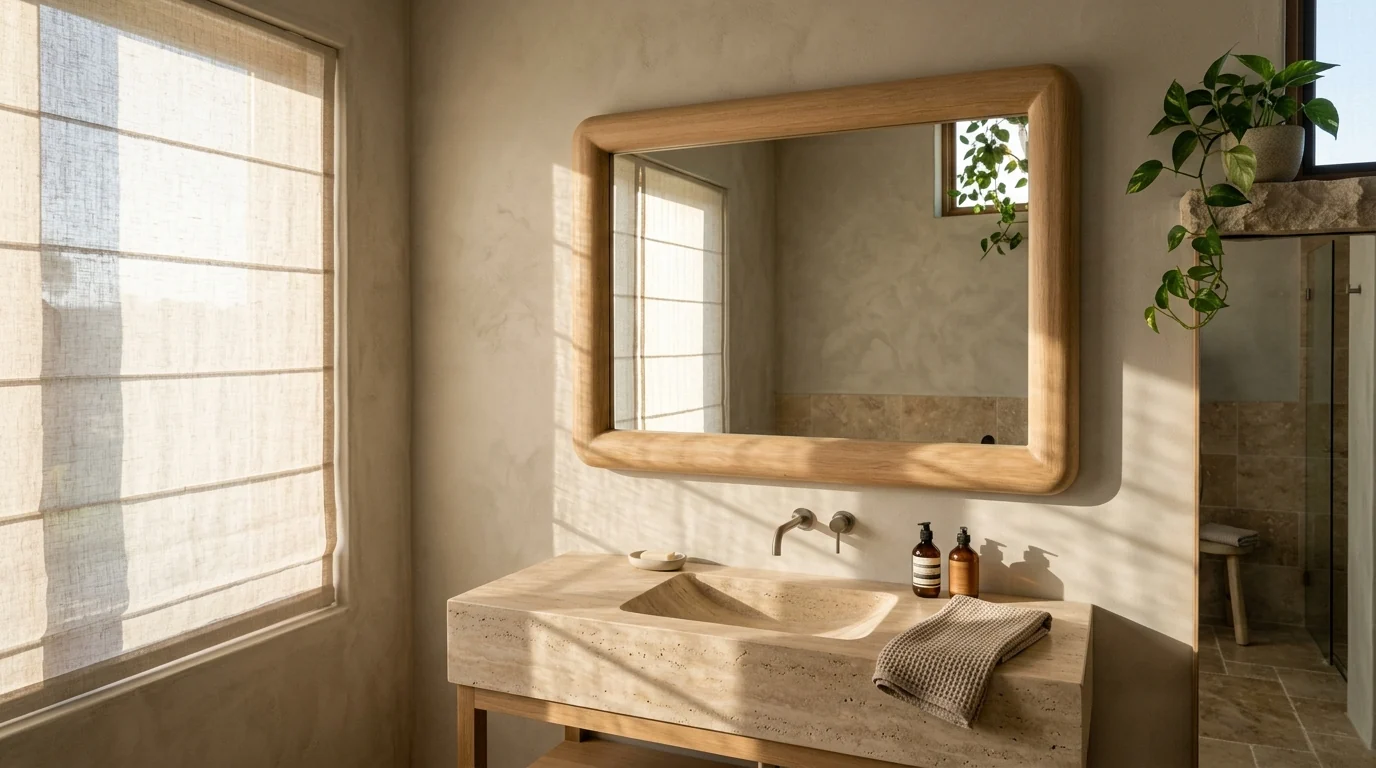
Wood on stone: the frame is thick enough to read as furniture, and it will never argue with the tap finish.
6. Thin Black Steel
A matte black steel frame, especially with subtle divided grid lines, draws crisp graphic edges through a warm room and pairs naturally with a black framed shower screen, so the two read as one architectural language. This is the frame for bathrooms that lean industrial: concrete look porcelain, grey oak, exposed fittings. The discipline it demands is finish matching, matte with matte, because a glossy black frame next to a matte black tap looks like a near miss rather than a choice.
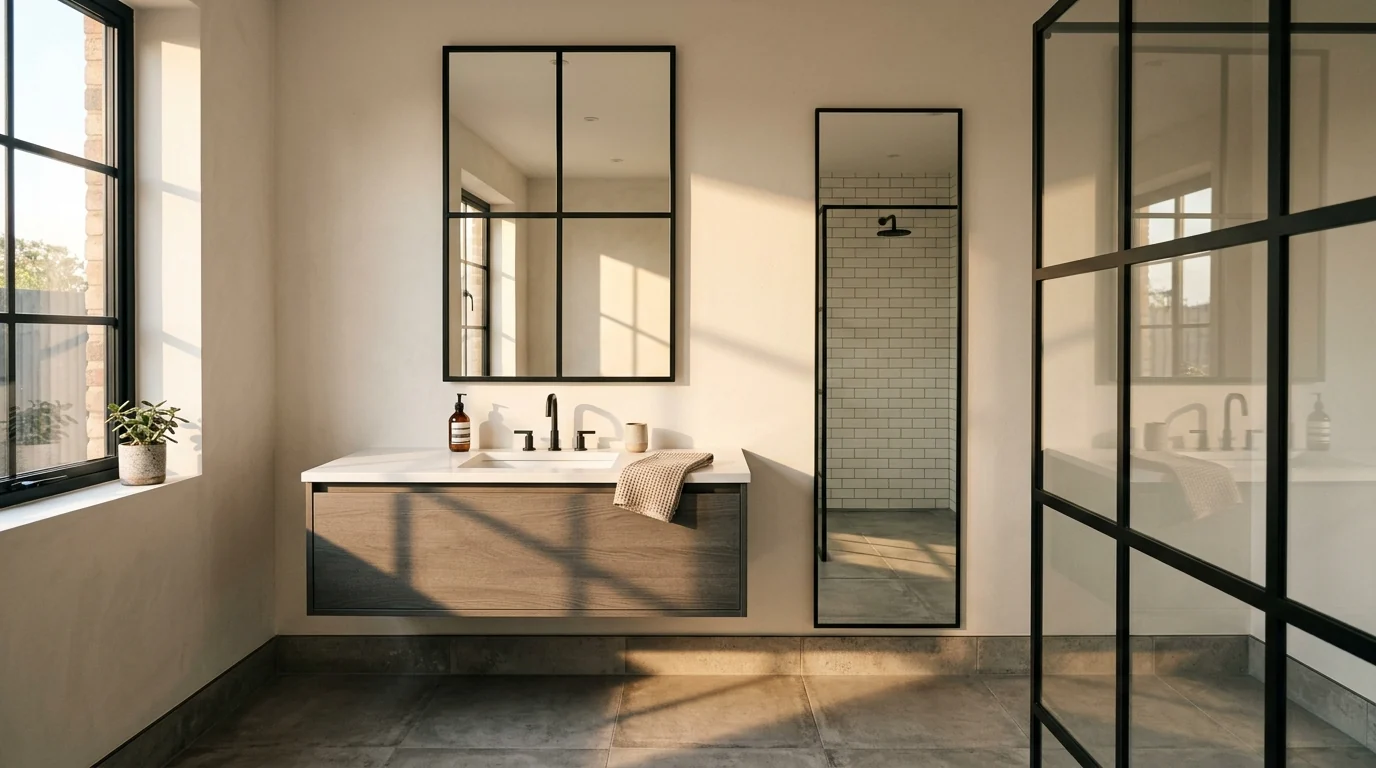
Black lines through warm light. The mirror frame and shower screen speak the same language, which is why it works.
Lighting: Where Bathroom Mirrors Are Won and Lost
Nothing decides how a bathroom mirror performs like the light around it. The physics is simple: light from above throws shadows under eyes and chin, light from both sides at face height fills them. That single fact sorts almost every fixture decision, and it is worth getting right before the mirror goes on the wall, not after.
Whatever the fixture, the lamp spec matters more than the fixture price: warm color temperature between 2700K and 3000K, color rendering index of 90 or above so skin looks like skin, and roughly 1500 to 2000 lumens total arriving at the mirror zone. We keep a longer treatment of how light temperature changes a whole room in our lighting guide.
7. The Sconce-Flanked Classic
A brass framed rectangle on paneled wainscoting with a linen shaded sconce on each side is the most timeless composition in bathroom design, the one that looks correct in photographs from 1935 and will in 2035. The sconces are not decoration; at face height they are the best light a mirror can get. This is the natural direction for traditional homes, painted vanities, and anyone allergic to trend cycles. The pitfall is hanging the sconces too high, which quietly converts the setup into overhead lighting with extra steps.
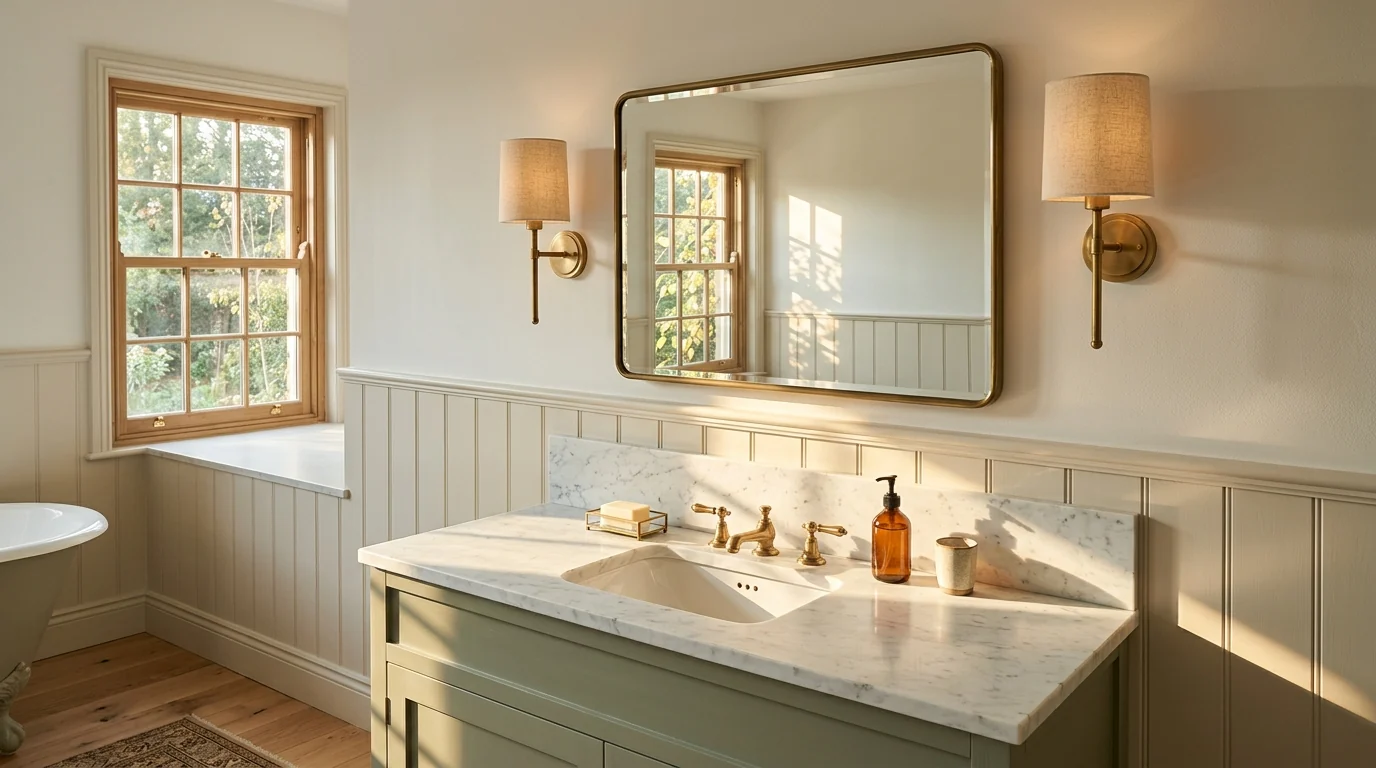
Sconces at face height, 36 inches apart. The composition that has never once been out of style.
8. Backlit LED, Warm Only
The LED mirror deserves its popularity and its bad reputation simultaneously, because the market sells two different products under one name. The good one is backlit: the diodes face the wall, the light arrives as a soft halo around the mirror’s silhouette, and at 2700K it flatters everything it touches, particularly at night. The bad one is front lit with a visible cool white strip, and it is the fastest way to make a new bathroom feel like a filling station at 2 a.m. When we tested LED mirrors ourselves, the single biggest difference was not brand but the default color temperature setting, usually 6000K out of the box; if your mirror has a temperature toggle, changing it to warm is a ten second renovation.
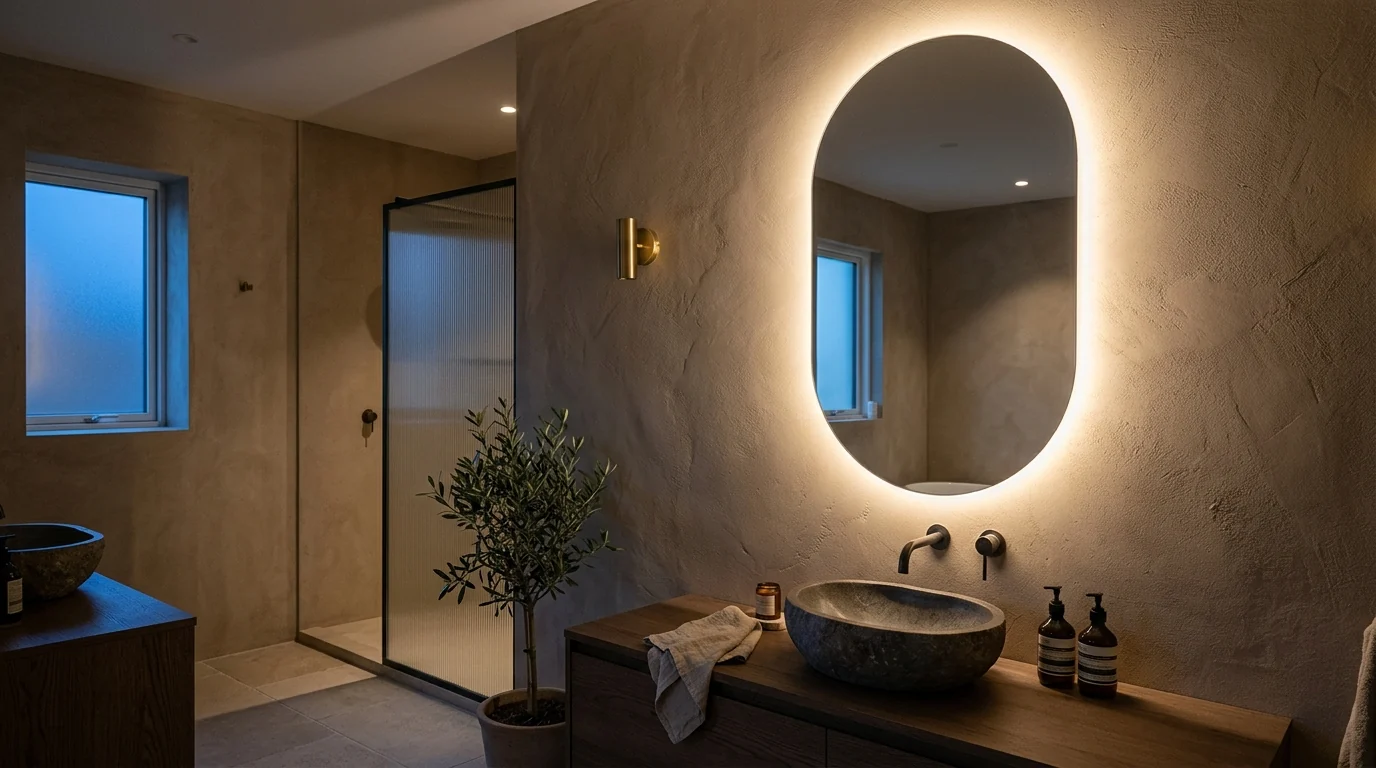
Backlit done right: warm halo, invisible diodes, dusk mood intact. The glow flatters instead of interrogating.
Double Vanity Mirror Ideas
9. Two Rounds Over a Double Vanity
The default double vanity answer, and deservedly: one round centered over each basin, identical frames, a slim vertical sconce between them. The symmetry gives the wall hotel calm, and the gap between the mirrors is functional, it is where the shared light lives. The sizing rule that keeps it professional: each mirror at 70 to 80 percent of its half of the vanity, and both centers exactly on the basin centers, not eyeballed. Get the spacing wrong by a few inches and the whole wall feels seasick.
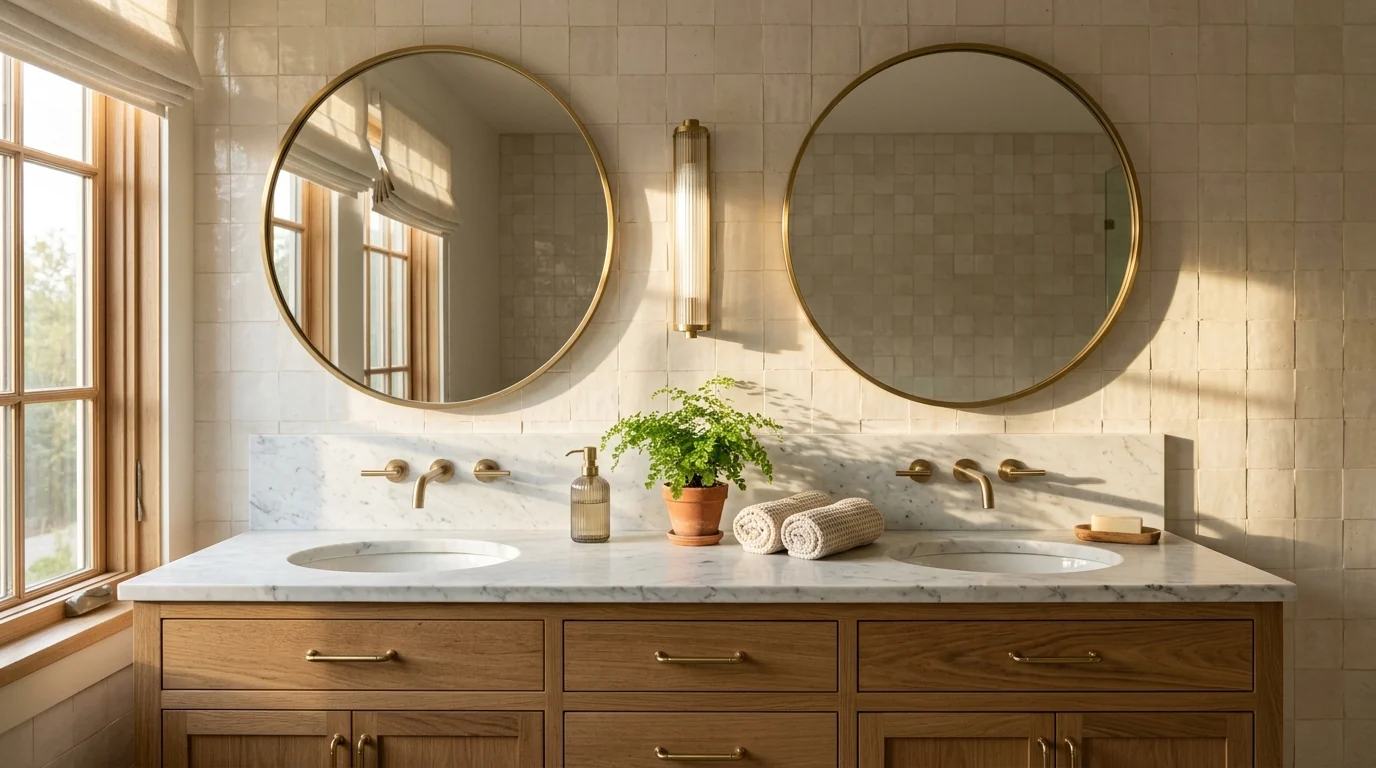
Centers over basin centers, sconce in the gap. Symmetry is the entire trick, so measure rather than eyeball.
10. One Wide Mirror Over a Double Vanity
The modern alternative: a single horizontal mirror spanning about 80 percent of the total vanity width, in a thin steel or brass frame, with sconces mounted directly on the glass. It reflects more room than two separate mirrors, which visibly widens tight bathrooms, and it serves two people at once without assigning territories. It suits contemporary rooms better than traditional ones, and it raises the mounting stakes, a mirror this size is a two person, French cleat job, not a picture hook job.
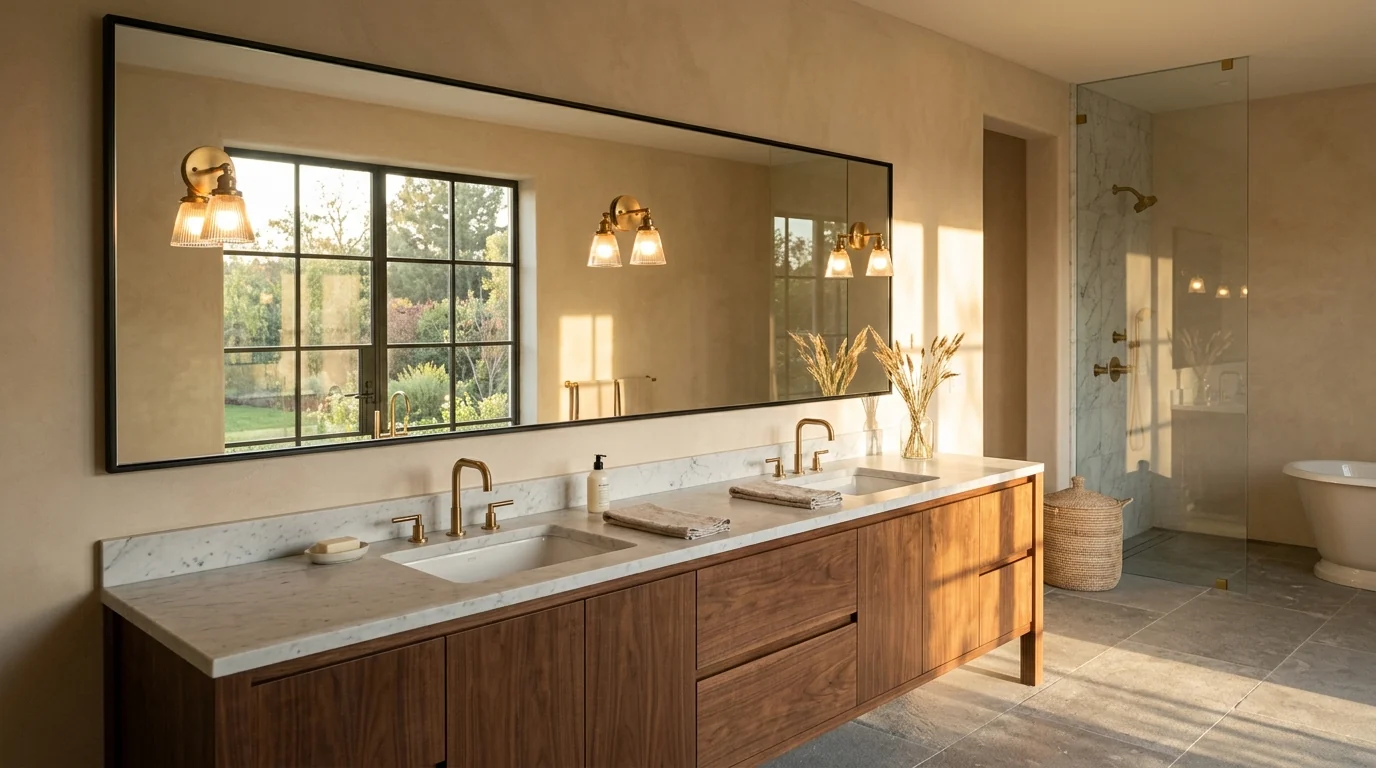
One wide plane instead of two islands. The room reads wider because the mirror reflects it whole.
11. The Arched Trio
Three narrow arched mirrors in an even row over a long double vanity, the middle one centered between the basins, turn the wall into rhythm rather than symmetry. It is the most designed looking of the double vanity options and the best fit for very long vanities, where a single mirror would need to be enormous and a pair would leave a dead zone in the middle. Keep all three identical; the moment the shapes or heights vary, rhythm collapses into clutter.
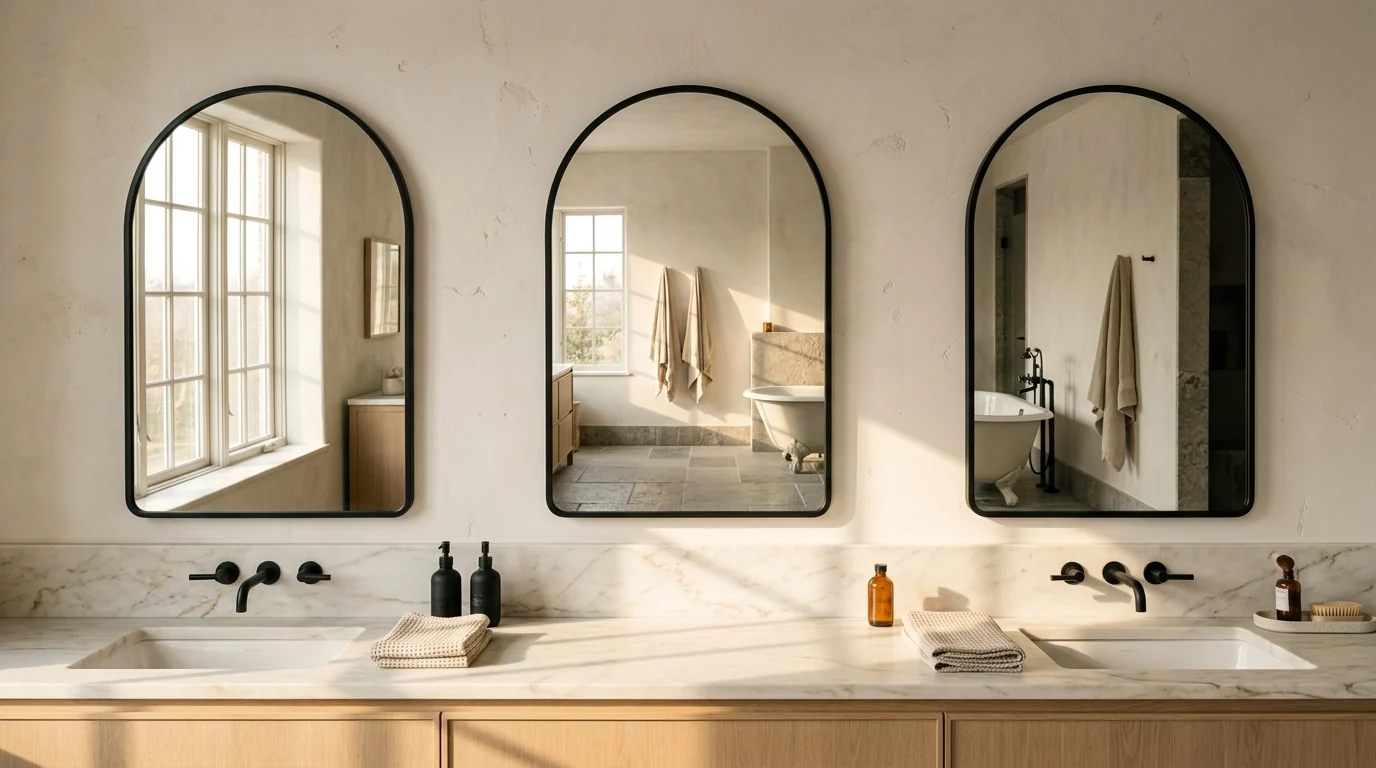
Three arches, one rhythm. The answer for vanities too long for one mirror and too continuous for two.
Color, Age and Character
12. Vintage Gilded in the Powder Room
The powder room is the one bathroom guests actually see, and its small size makes drama cheap. A single vintage oval in a worn gilded frame, hung on a deep painted wall, aubergine, ink, bottle green, over a small antique washstand produces a jewel box in about two square meters, and in October the same room takes Halloween bathroom decor better than any other. The aged glass matters as much as the frame: softly foxed silvering reflects candlelight and evening light as a glow rather than a glare. This is also the cheapest entry into vintage mirrors, since small ovals are exactly what estate sales have too many of, the same sourcing logic from our mirror wall guide applies here at smaller scale.
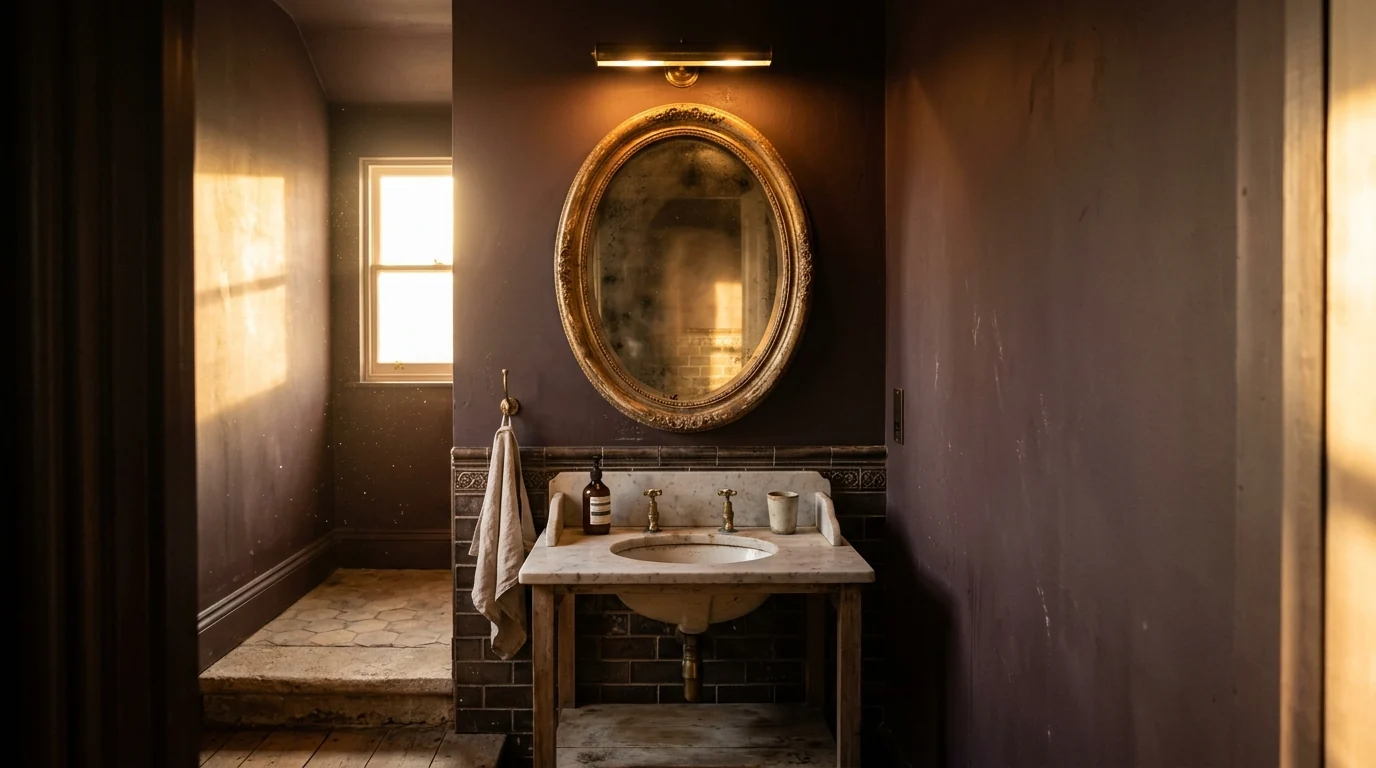
Two square meters of jewel box. Dark paint, one gilded oval, aged glass turning the light soft.
13. Antiqued Glass Above the Basin
Foxed, mottled, deliberately aged glass is the finish that moves a bathroom mirror from fixture to object. The patina concentrates at the edges, the reflection goes soft and golden, and morning light stops being forensic. Be honest about the trade: heavily antiqued glass is atmosphere first and shaving accuracy second, which is why the smart deployment is an antiqued statement mirror where mood matters, backed by a small clear mirror inside a cabinet door where precision does. New made to order antiqued glass comes in graded intensities, so you can choose exactly how much reflection you are willing to give up.
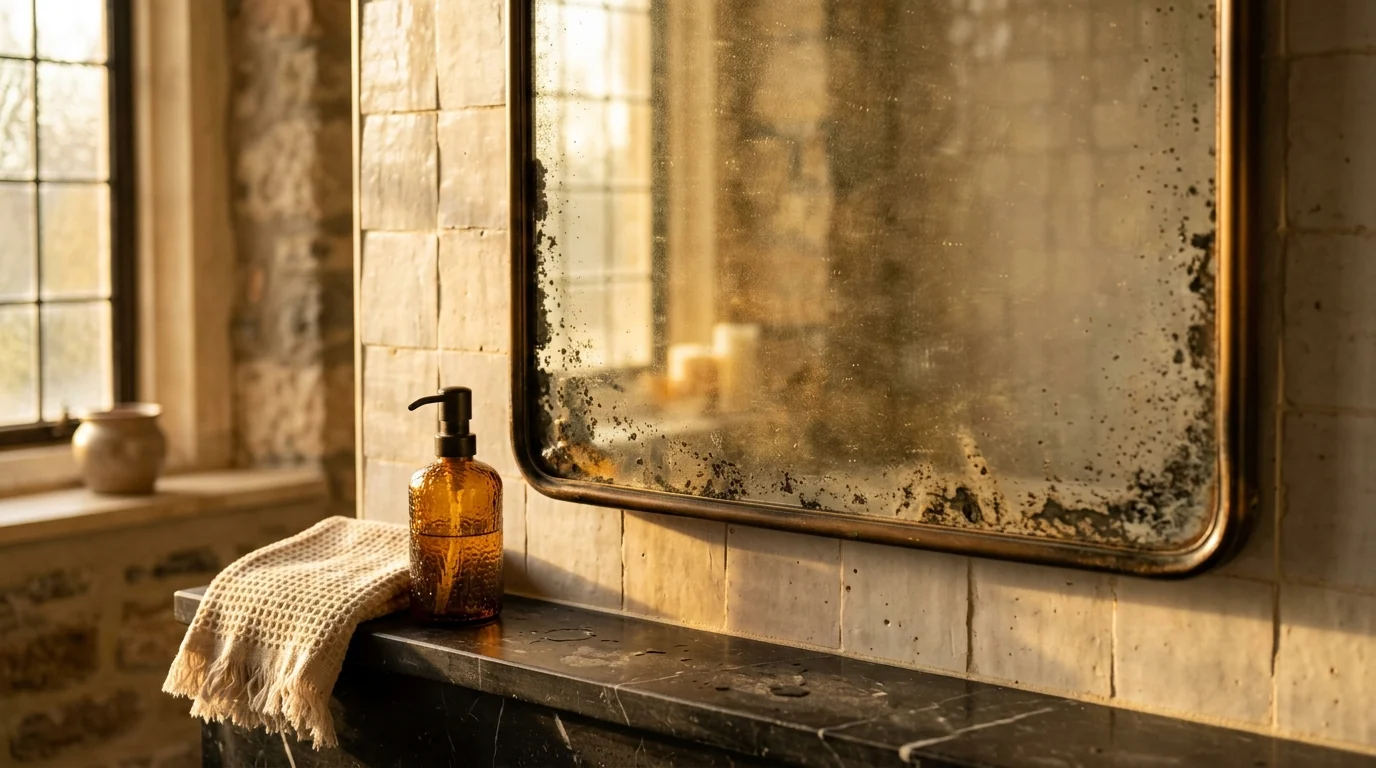
The foxing is the feature: edges mottled, reflection golden. Keep a clear mirror behind a cabinet door for the precise work.
14. The Full Antiqued Panel Wall
The maximalist move that still reads expensive rather than 1980s: the entire vanity wall clad in large antiqued mirror panels divided by thin bronze seams, with sconces mounted straight onto the glass. The aged finish is what makes wall to wall glass livable, reflecting the tub and window as warm shapes instead of sharp copies. This is the priciest idea in this guide, custom antiqued panel walls run to several times the cost of everything else here, and precisely the kind of commitment worth previewing on a photo of your actual bathroom before a fabricator ever visits.
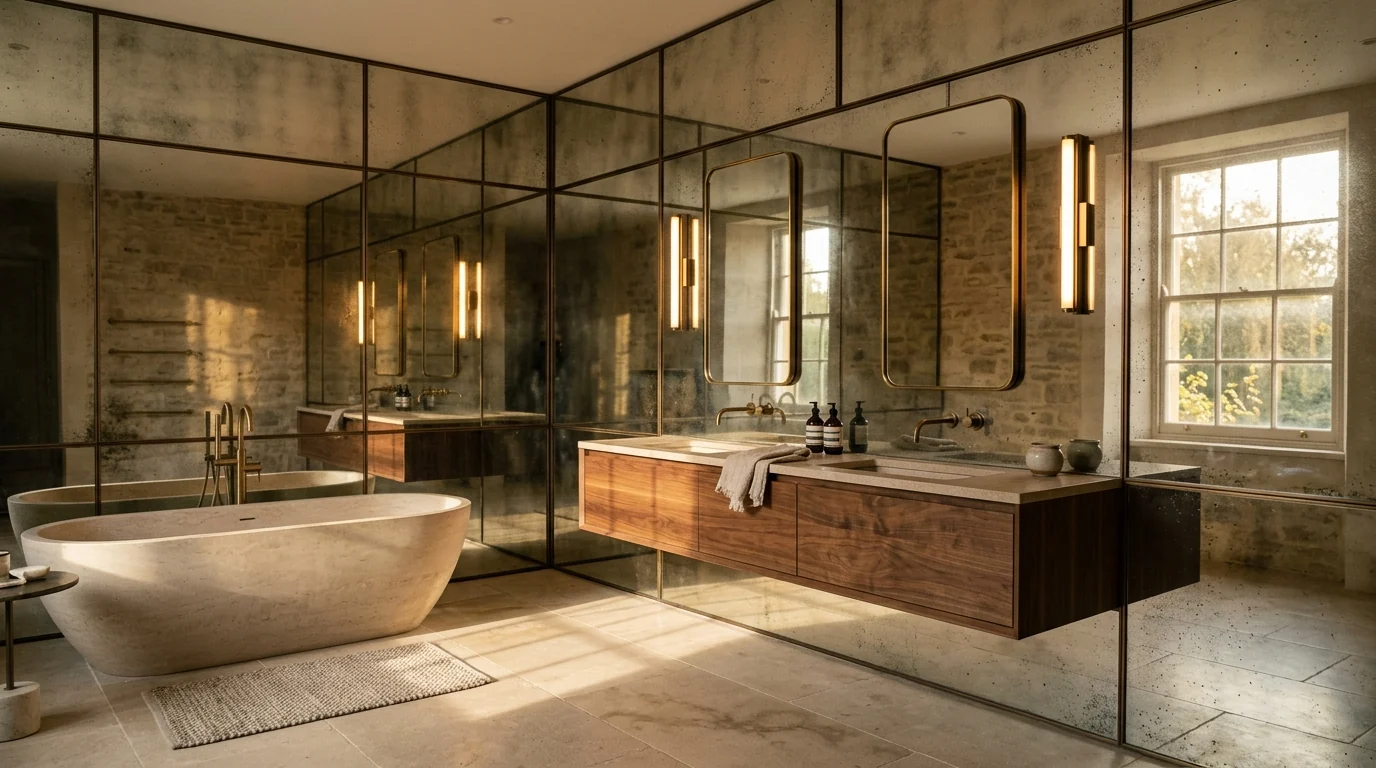
Wall to wall glass, survivable because it is foxed. The panels double the room as atmosphere, not surveillance.
15. Terracotta and Hammered Brass
A wide hammered brass round on a terracotta limewashed wall is the warmest composition in bathroom design right now, Mediterranean without a single decorative seashell. The hammered texture scatters the low sun into sparkle, the pink toned wall flatters every skin tone in the reflection, and the whole thing runs on two materials plus light. It asks for commitment to warmth throughout the room, wood vanity, brass tap, earthy tile, because one cool chrome element in this palette reads as a plumbing repair.
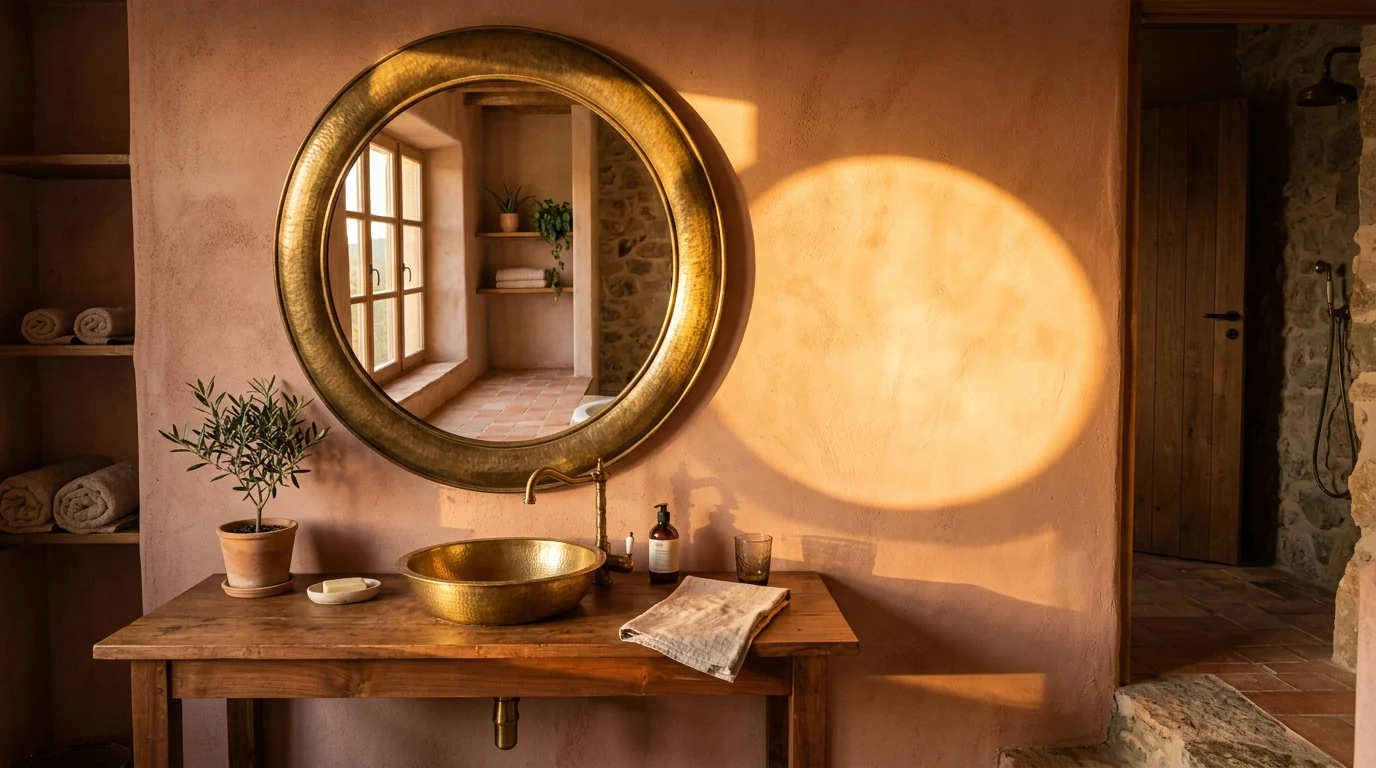
Terracotta, brass, evening sun. Two materials and a color temperature, doing the work of a whole mood board.
The Practical Three
16. The Flush Medicine Cabinet
The recessed mirrored cabinet is the least glamorous idea here and the one most likely to improve your morning. Modern versions mount flush into the stud cavity with near invisible seams, so the wall reads as a clean mirror plane while hiding the entire toothpaste economy behind it. It is the difference between a minimalist vanity that survives real life and one that lasts until the first grocery run. If the wall cannot be opened, surface mounted versions in oak or steel frames have caught up in looks; what stays firmly builder grade is the plastic bodied version with the polished edge doors.
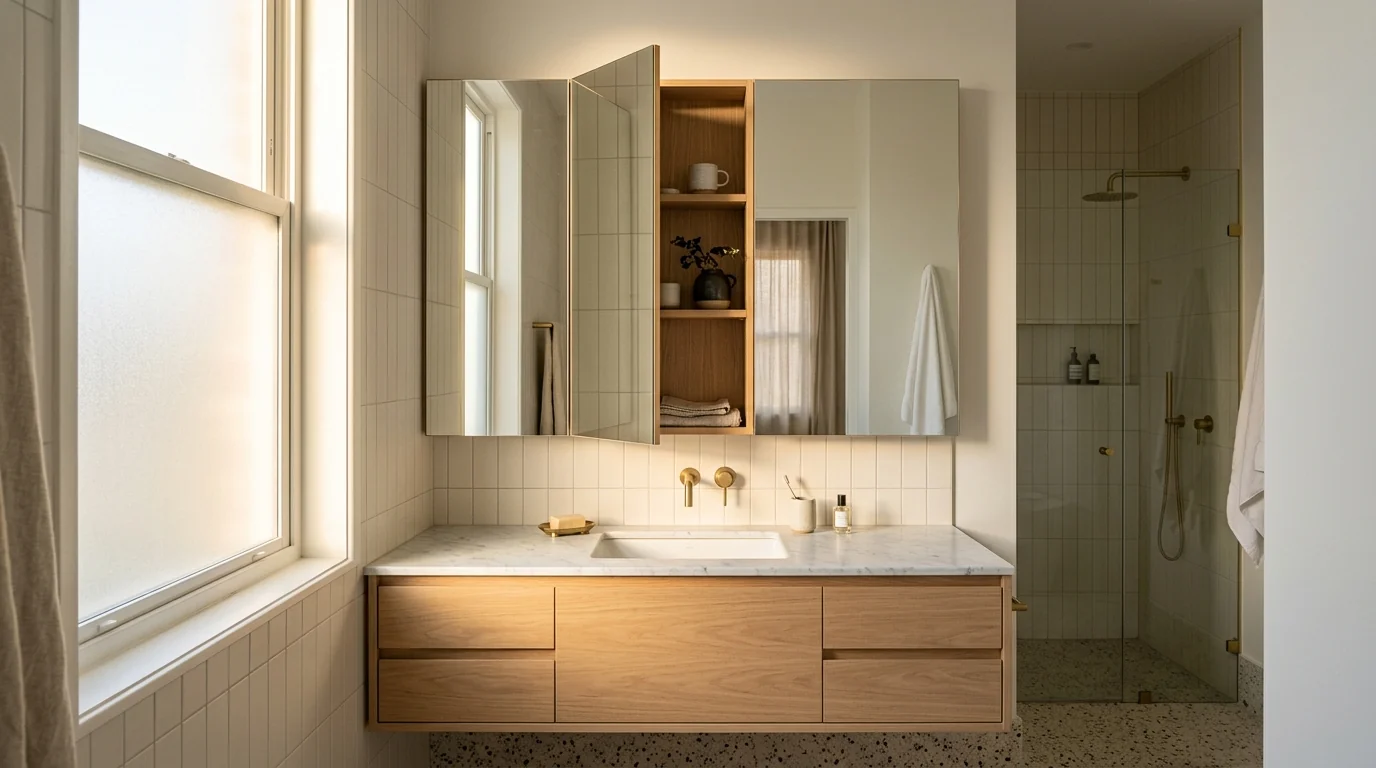
A mirror wall that swallows the clutter. Flush mounting is what separates it from the dorm room version.
17. Small Bathroom: The Perpendicular Round
In a bathroom under five square meters, the mirror is infrastructure before it is decor. The highest value move is a generous round on the wall perpendicular to the window, where it catches daylight and relays it deeper into the room, reading as a second window without glare. Go bigger than instinct suggests; a small mirror in a small bathroom confirms the smallness, while one oversized round dissolves it. It is the same trick that makes any small room look bigger, and nowhere does it pay off harder than in a windowless-feeling bathroom.
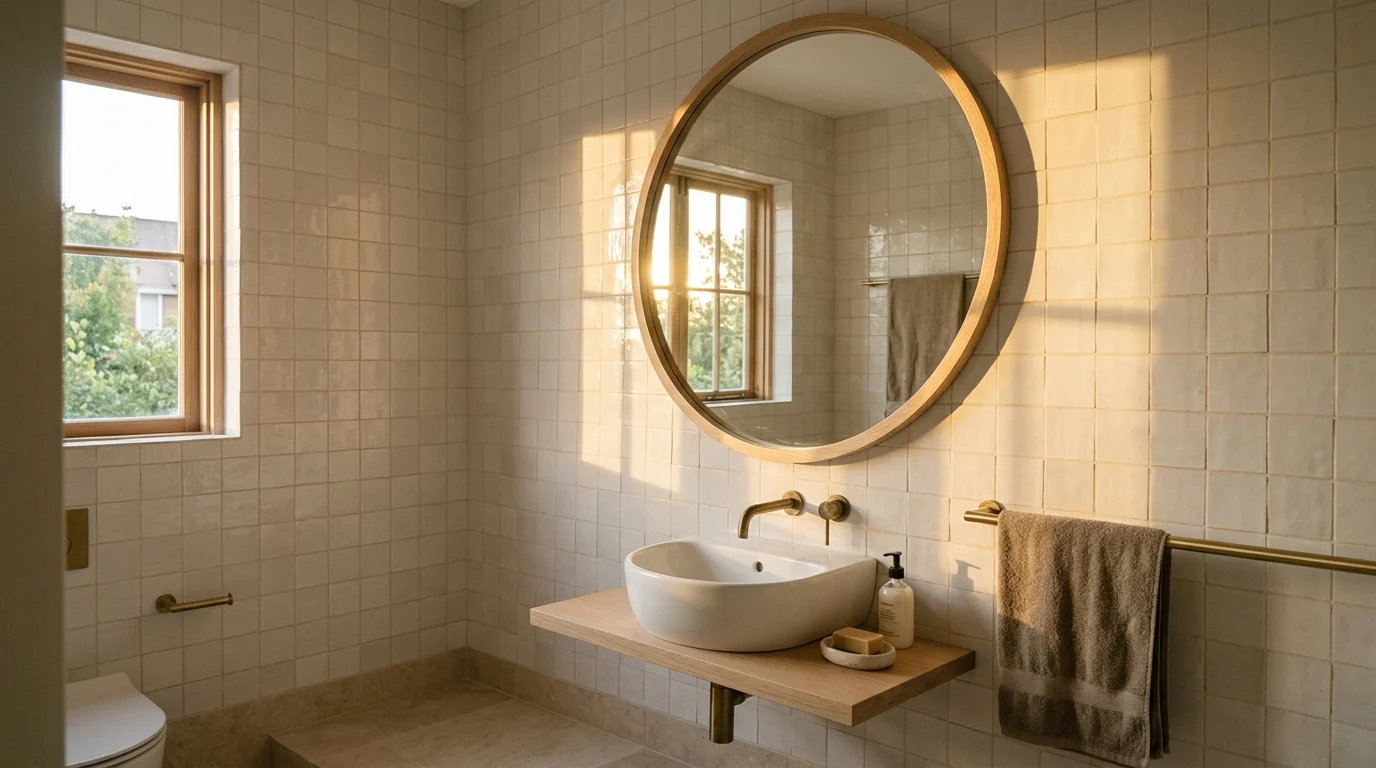
Perpendicular to the window, oversized on purpose. The four square meter bathroom gains a second light source.
18. The Ledge and Lean
A deep stone ledge running the width of the wall, with a brass framed mirror leaning against the wall instead of hanging, is the most relaxed composition in this guide, editorial, collected, and renter friendly since nothing is drilled. The ledge does double duty as styling surface: a vintage hand mirror, an amber bottle, a dish. Two caveats: the lean angle costs you a few centimeters of usable reflection height, so this suits secondary bathrooms more than the main shave and makeup station, and in homes with kids the mirror needs a discreet anti tip strap exactly like a leaning floor mirror would.
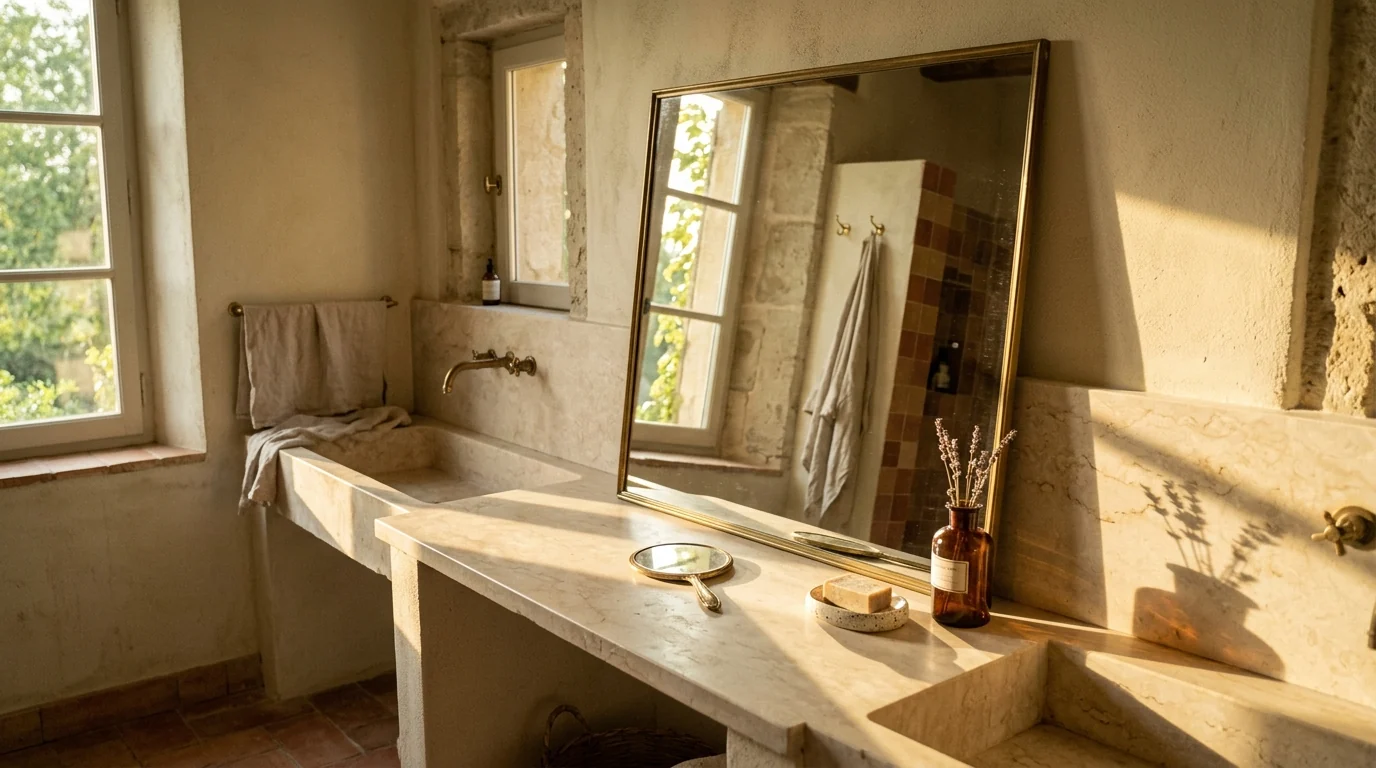
Nothing drilled, everything styled. The ledge carries the objects, the lean carries the attitude.
The Numbers: Size and Height Rules
Nearly every bathroom mirror that looks wrong is wrong by centimeters, not by concept. These are the numbers that keep it professional:
Two details worth the extra minute. Measure eye level for the actual household, a 157 cm partner and a 193 cm partner do not share an ideal center height, and the compromise is a taller mirror, not a higher one. And check what the mirror reflects: in small bathrooms the slab often ends up reflecting the toilet, which a slightly narrower, better placed mirror avoids entirely. That sightline is a layout problem as much as a mirror one, and our guide to small bathroom layout dimensions covers where the toilet should sit in the first place.
What Bathroom Mirrors Actually Cost
Typical US retail ranges as of mid 2026, for realistic quality at each tier rather than the cheapest listing:
What Makes a Bathroom Mirror Look Builder Grade
The failures are consistent enough to list, and most bathrooms commit several at once:
- The glued frameless slab, edge to edge over the whole vanity wall. Maximum glass, minimum thought.
- The Hollywood bulb strip mounted on the mirror itself. It was the best technology available in 1978; it is not now.
- Cool white LED anywhere. 5000K and up turns skin grey and mornings hostile. Warm light is a spec, not a luxury.
- A mirror wider than the vanity. The overhang reads as a measuring mistake from the doorway.
- Visible LED dots reflected in glossy tile, the giveaway of a cheap front lit ring.
- Finish roulette: chrome tap, brass mirror, black sconces. Two metals maximum, chosen on purpose.
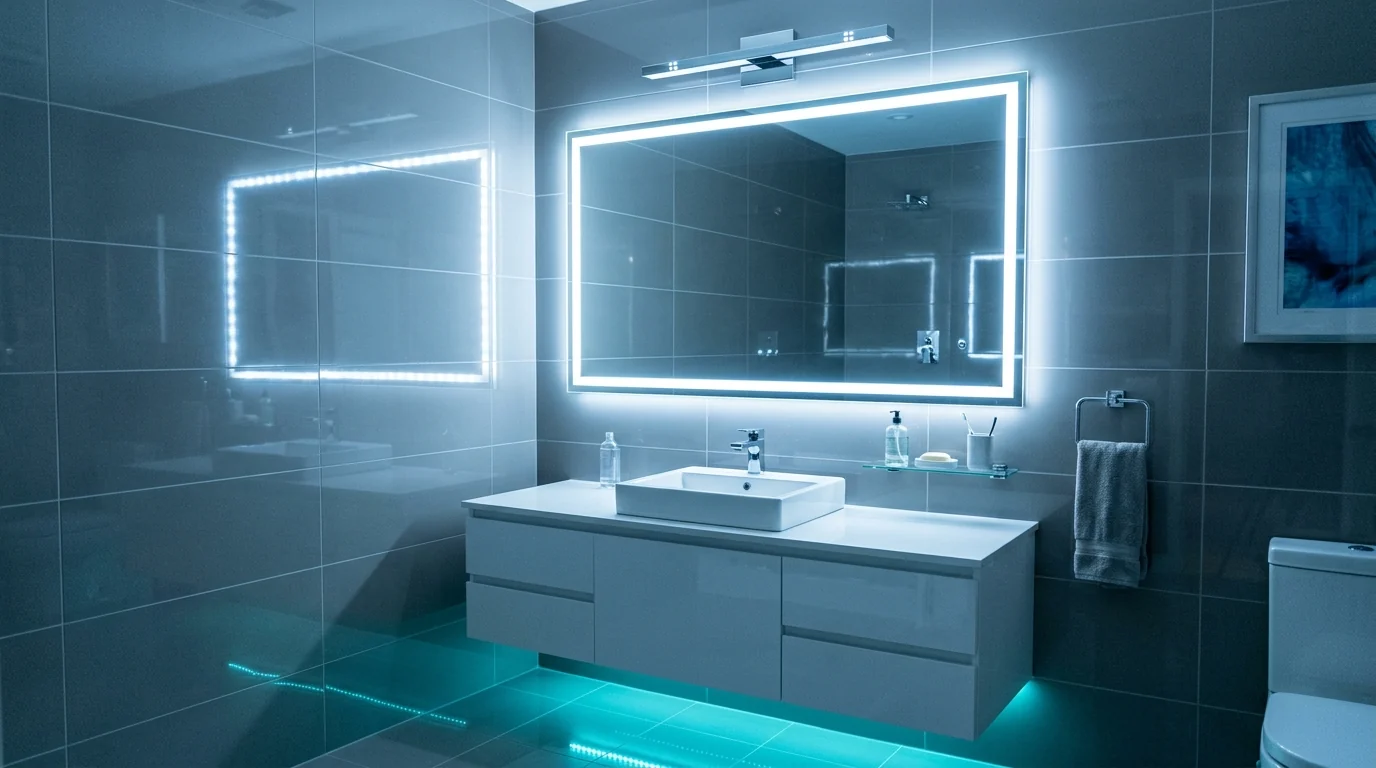
The version to avoid: cool white glow, visible diodes, gloss on gloss. Technically new, instantly dated.
Hanging It: The Bathroom-Specific Rules
Everything in our general mirror hanging guide applies, weight decides hardware, two anchor points beat one, French cleats for anything heavy, plus three rules the bathroom adds. Moisture kills silvering from the edges inward, so buy mirrors with sealed backing or seal the edges yourself, because those black creeping spots on old bathroom mirrors are humidity damage, not age. Tile changes the drilling: use a tile bit, tape the mark to stop wandering, and go slow without hammer mode, or drill the grout line where you can. Adhesive alone is not mounting in a humid room; mastic wants mechanical support underneath, clips or a J channel, because gravity is patient and steam helps it.
Preview It on Your Own Bathroom Wall First
Every idea above looks convincing in its own photo. The question that matters is which one works over your vanity, with your tile, your window and your ceiling height, and that is exactly the question a product listing cannot answer. Scale is the usual casualty: the arch that looked statuesque in the showroom arrives and sits three centimeters from the ceiling.
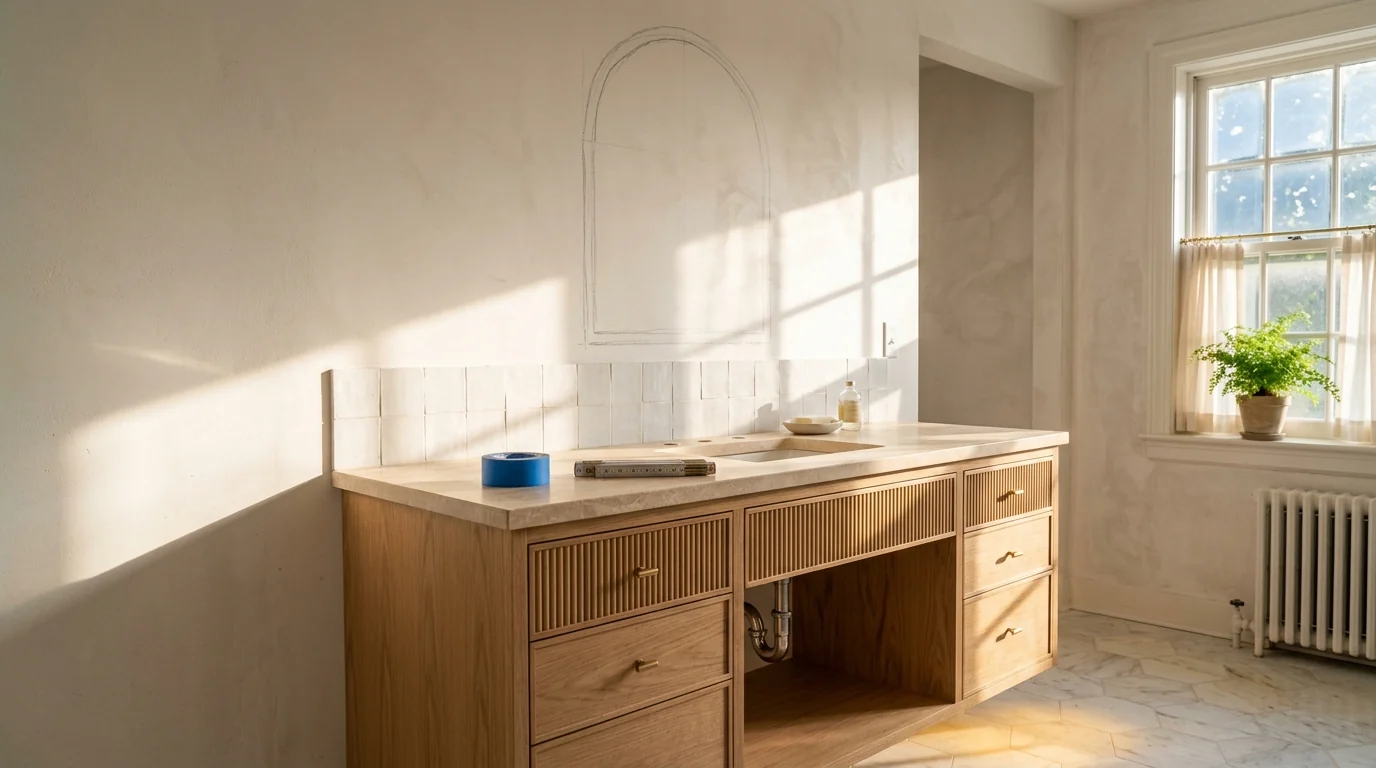
The planning moment. You can sketch the outline on the wall, or render the finished wall in under a minute.
The faster route: upload one photo of your bathroom to MeltFlex’s AI bathroom design tool and describe the mirror, “tall arched mirror in aged brass over the vanity” or “two round black framed mirrors with a sconce between them.” You get a photorealistic render of your actual bathroom with the new mirror in place, correct scale, your real light. We built every interior image in this guide with the same engine, which is also the fastest way to test the ideas against each other: generate the arch, the pill and the round on your own wall and one of them will win in about a minute. For the room around the mirror, the full design workspace handles everything from tile to vanity swaps.
Bathroom Mirror FAQ
How high should a bathroom mirror be hung?
Hang the mirror so its center sits at eye level, which for most households means 57 to 65 inches, roughly 145 to 165 centimeters, from the floor. In practice the vanity decides: leave 5 to 10 inches, about 12 to 25 centimeters, between the faucet or backsplash and the bottom edge of the mirror, and keep the top edge at or above the tallest user in the house. For accessible design, ADA guidance puts the bottom of the reflecting surface no higher than 40 inches above the floor.
How wide should a bathroom mirror be compared to the vanity?
The reliable range is 70 to 80 percent of the vanity width, centered over the basin. A 36 inch vanity takes a 26 to 30 inch mirror, a 48 inch vanity takes a 34 to 38 inch mirror. Never go wider than the vanity itself, because a mirror overhanging the cabinet below reads as a mistake from the doorway. If you want a full wall of glass, commit to a seamed panel wall deliberately rather than oversizing a single slab.
Are LED bathroom mirrors worth it?
Yes, if you buy the right kind: backlit halo designs with a warm 2700K to 3000K color temperature, a high CRI of 90 plus, and no visible diode strip. They give even, flattering face light and work well in bathrooms without room for sconces. The versions that disappoint are cool blue-white front rings that flatten faces, cheap strips with visible LED dots reflected in glossy tile, and mirrors whose default 6000K setting never gets changed.
Are framed bathroom mirrors in style?
Framed mirrors are the default in current bathroom design, and the frameless glued slab is the single clearest marker of a builder grade bathroom. Thin aged brass, matte black steel, natural oak and carved vintage frames all read as considered. The frame does the same job in a bathroom that it does anywhere else: it turns a sheet of glass into an object someone chose.
What size mirror should go over a double vanity?
You have three good options. Two matching mirrors, each 70 to 80 percent of its basin section width, hung with their centers over the basin centers. One wide mirror spanning about 80 percent of the total vanity width, which suits modern rooms and makes small bathrooms feel wider. Or a rhythm of three narrower mirrors with the middle one centered between the basins. The failure mode is two small mirrors floating with big gaps of empty wall on all sides of each.
How do you hang a bathroom mirror?
For a framed mirror under 10 kilograms, two anchor points into studs or rated drywall anchors work. Heavier framed mirrors want a French cleat spanning two studs. Frameless mirrors sit on mirror clips or a J channel rail, never on construction adhesive alone in a humid room. In a bathroom, also seal the mirror edges or buy one with a sealed moisture resistant backing, because steam attacks the silvering from the edges inward, which is where the black creeping spots on old bathroom mirrors come from.
What lighting should go over a bathroom mirror?
The most flattering setup is light at face height on both sides: sconces with their centers 60 to 66 inches from the floor, spaced roughly 36 to 40 inches apart. A single fixture above the mirror should sit around 75 to 80 inches high and throws shadows under the eyes and chin, so treat it as a supplement, not the main task light. Whatever the fixture, aim for warm 2700K to 3000K lamps with a CRI of 90 or higher and about 1500 to 2000 lumens total at the mirror.
Should a bathroom mirror be round or rectangular?
Follow the lines already in the room. Round and pill shapes soften bathrooms full of straight edges, which is most of them, and a round mirror over a single vanity is the safest modern choice. Rectangles suit wide double vanities where you want the mirror to hold the full furniture line, and they maximize usable reflection per wall area. The current shape hierarchy in short: arched and pill first, round close behind, sharp cornered rectangle only with a frame that earns it.
How can I preview a bathroom mirror before buying it?
Upload a photo of your bathroom to MeltFlex AI and describe the mirror you want, for example a tall arched brass mirror over the oak vanity, or two black framed rounds over the double vanity. The AI renders a photorealistic preview on your actual wall with your real vanity, tile and light, so you can compare shapes and sizes before spending anything. Testing three mirror options on the same wall takes about a minute.
Ready to see it over your vanity? Upload your bathroom photo to MeltFlex and compare the arch, the pill and the round pair on your actual wall before ordering anything. For the rest of the room, the bathroom design guide covers the full renovation, the mirror wall guide takes the collected mirror idea into every other room, and if you are still deciding what style your home actually is, the interior design style quiz settles it in ten questions.