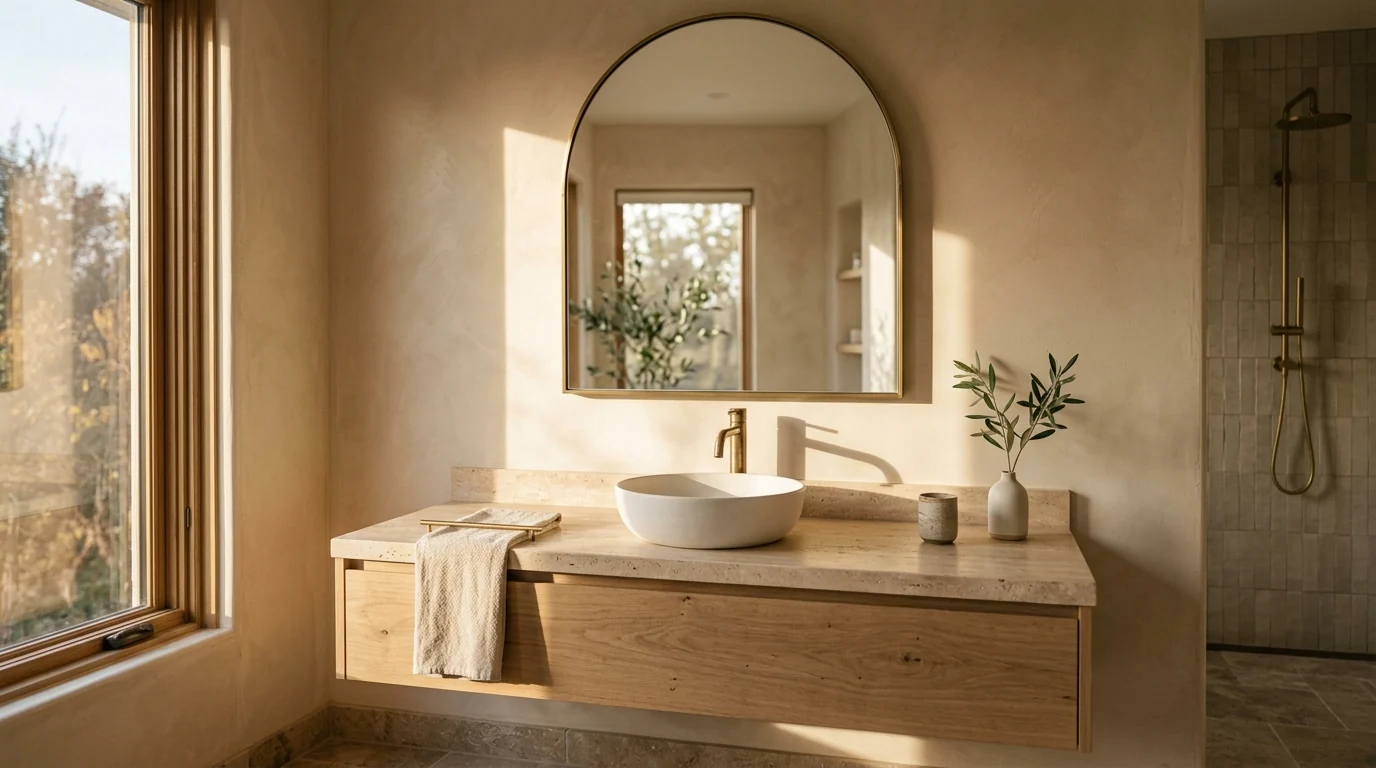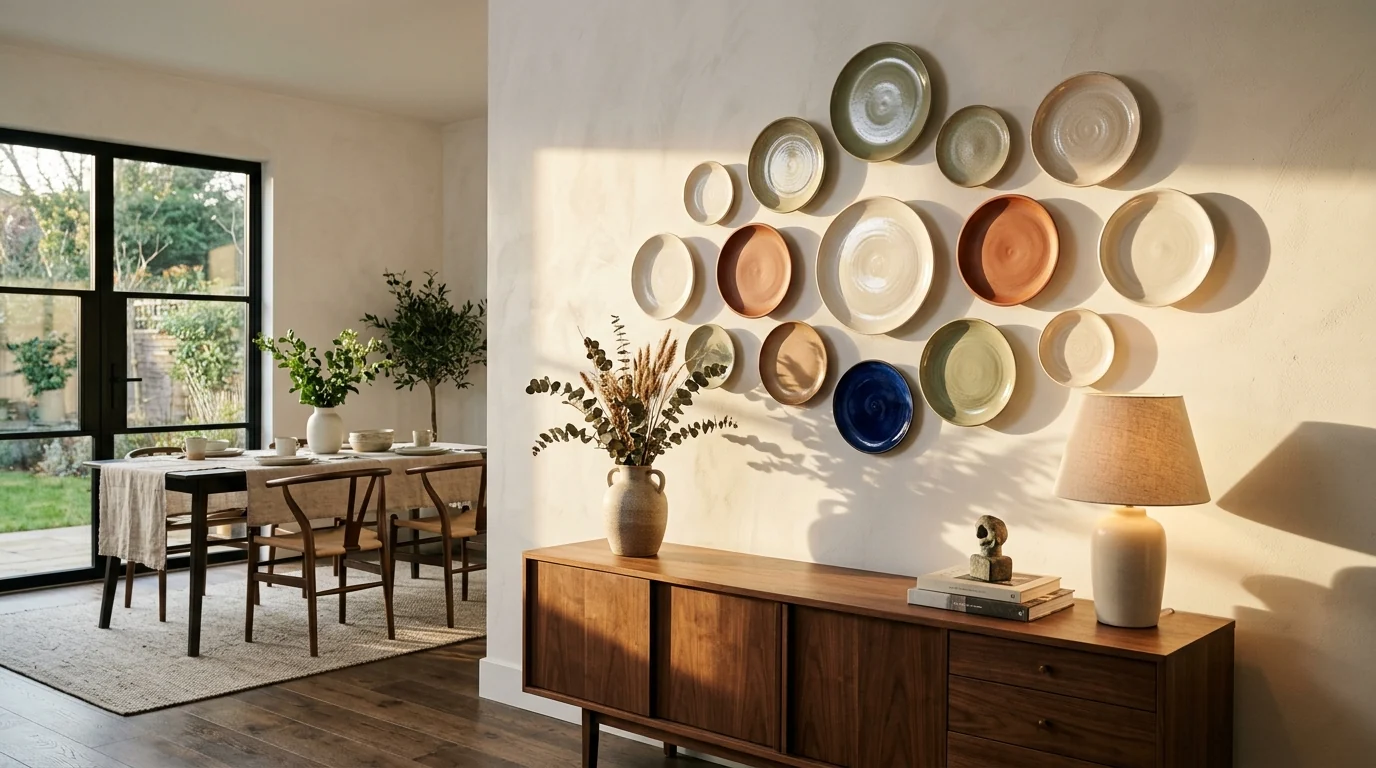
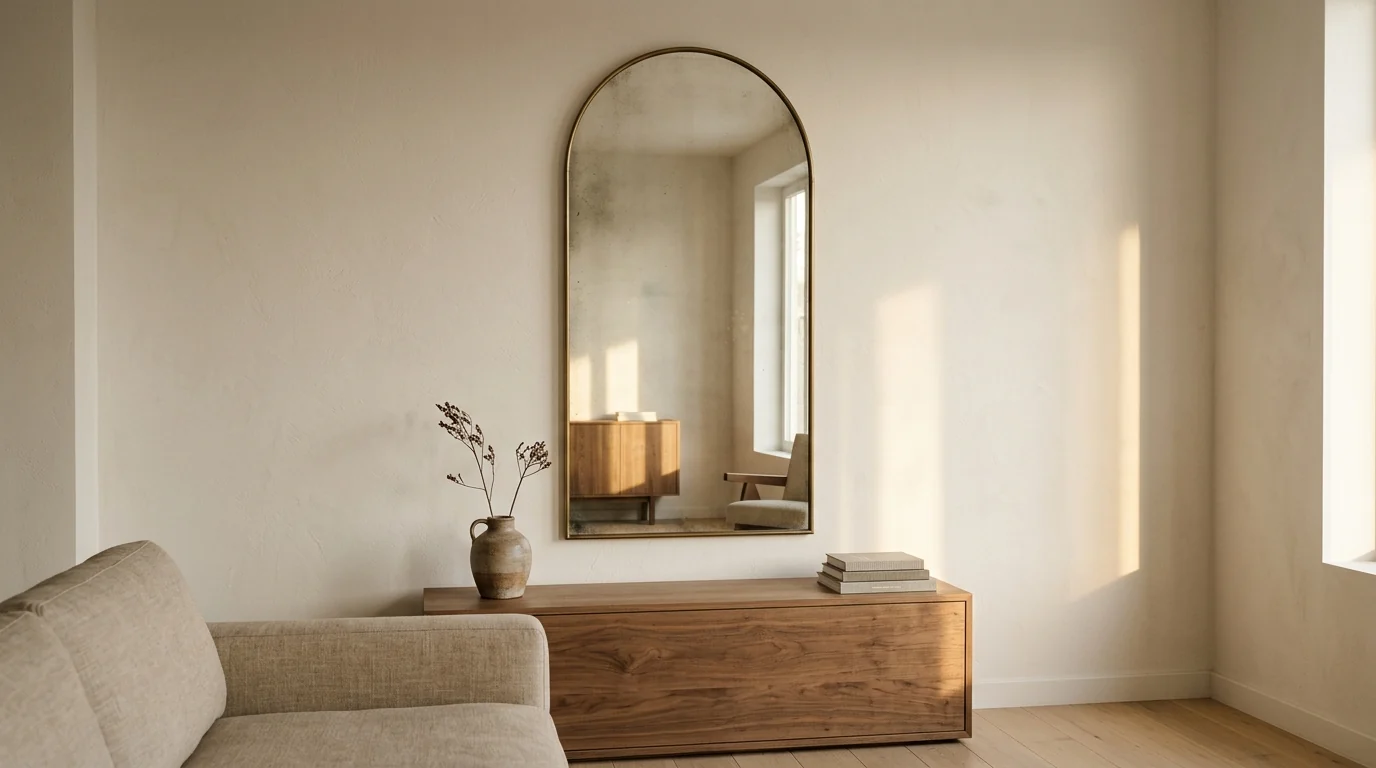
The mirror wall is back, and it has nothing to do with the glossy grid behind your uncle’s 1985 bar. The version showing up in very current 2026 interiors is either a curated gallery of vintage framed mirrors, gilded ovals, brass rounds, carved wood rectangles collected one flea market at a time, or large antiqued panels of foxed glass that reflect a room as a soft warm glow instead of a sharp copy.
Our articles are still written by humans!
Get human written articles in your Google feed.
There is a catch, and it is the reason this guide exists. No wall treatment swings harder between expensive and tacky than mirror. Get it right and you double your light, your space and your best furniture. Get it wrong and you have beveled tiles, cold LED glow and a living room that reads as a 2012 glam apartment listing. The difference comes down to a handful of decisions, and all of them are visible in one glance.
This guide covers 14 mirror wall ideas that hold up in 2026, how to decorate with mirrors room by room, the five rules that keep mirror wall decor on the right side of the line, exact placement and height numbers, how to hang a heavy mirror safely, and how to preview any of it on a photo of your actual room with AI before you buy a single frame.
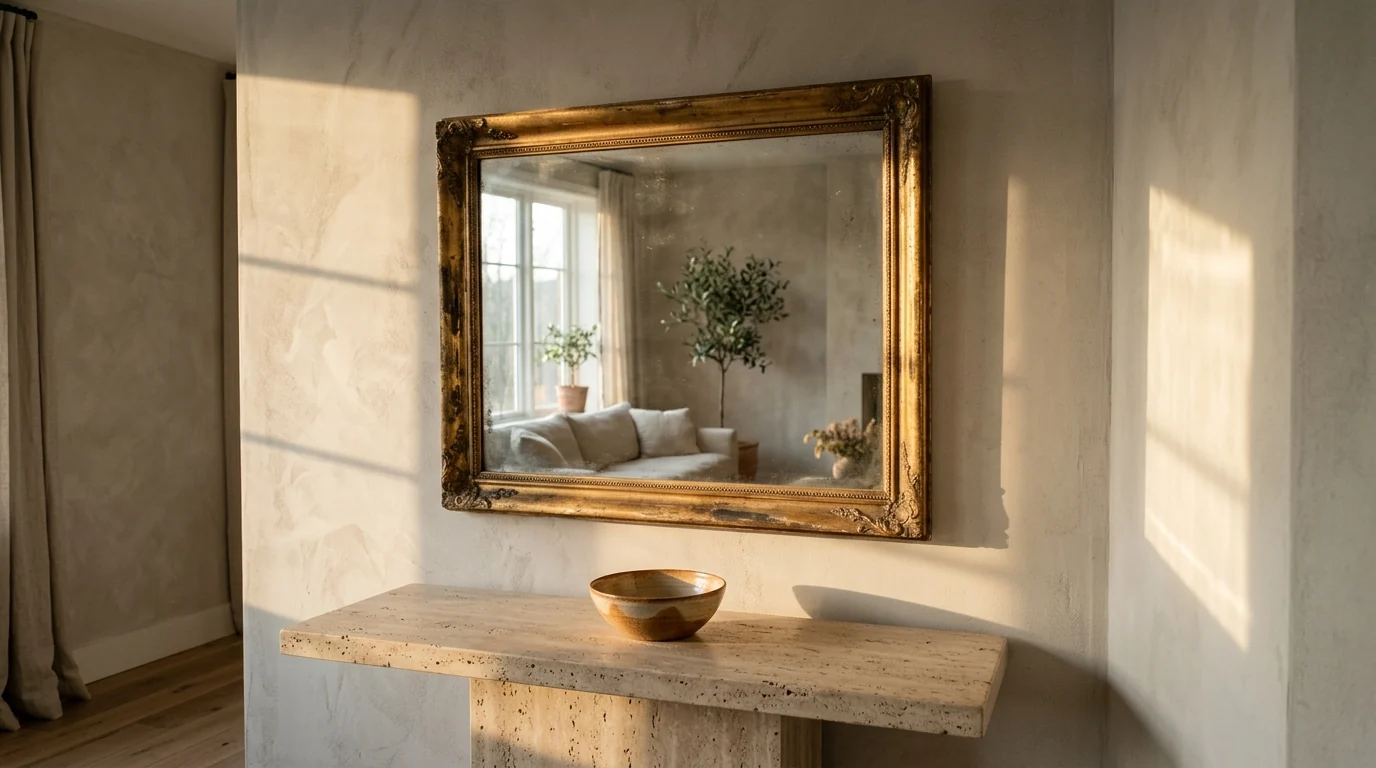
The whole 2026 thesis in one frame: one good antique mirror, generous wall space, and the evening sun doing the styling.
FreeUpload photo · freeRepaint my walls for freeUpload a photo and MeltFlex changes the wall colour or finish, with the furniture and layout untouched. Your first AI design is free, no card needed.
Are Mirror Walls in Style in 2026?
Yes, and more confidently than they have been in decades, with one big correction.
The 2026 interior mood is collected over time, not assembled from a catalog, and mirrors turned out to be perfectly positioned for it. A vintage mirror carries age you can see: foxing at the edges, a softly clouded reflection, a frame that was carved or gilded by hand. Trend reports from design magazines and glass fabricators converge on the same list this year: vintage and gilded frames, antiqued and fluted glass, arched and organic shapes, and one oversized statement piece instead of many small ones. In a year when interiors keep moving toward texture, craft and personal objects, a wall of collected mirrors fits the same logic as a plate wall: dimensional, personal, impossible to buy in one click.
What is not back is the version most people picture when they hear mirror wall: floor-to-ceiling glossy tiles glued edge to edge, heavy bevels, smoked bronze grids, mirrored consoles underneath. That look had two eras, the 80s original and the 2010s glam revival, and both aged badly for the same reason: sharp, cold, wall-to-wall reflection is more showroom than home. The 2026 mirror wall works because it softens the reflection and treats the frame, not the glass, as the point.
The 5 Rules That Keep a Mirror Wall Out of the 80s
1. Audit the Reflection Before You Hang Anything
A mirror is the only decor that doubles something else, so the something else is the actual decision. Stand where the mirror will hang and look at what faces it. A window, a pendant light, a good vignette: hang it. The TV, a radiator, the bathroom door: move it. Half of all disappointing mirror walls are perfectly good mirrors reflecting exactly the wrong thing.
2. Choose the Frame Like Art, Because It Is the Art
Glass is glass. What separates a collected mirror wall from a glass shop display is frames with real character: worn gilding, carved wood, thin blackened steel, aged brass. If you would not hang the frame empty, do not hang the mirror. This is also why matching mirror sets fail the same way matching plate sets do: one purchase pretending to be a collection.
3. One Oversized Beats Five Small
The most common amateur move is scattering several small mirrors across a big wall, which reads as indecision and reflects nothing useful. When in doubt, scale up: one mirror at two thirds the width of the sofa, the mantel or the sideboard below it. Small mirrors are for clusters with a plan, not for filling space.
4. Foxed and Antiqued Over Glossy and Beveled
Aged glass is the single clearest marker of the 2026 version. Antiqued mirror reflects light as a warm, slightly smoky glow, flattering to the room and everyone in it, where polished beveled glass throws back a sharp cold copy. If you want a full wall of glass, antiqued panels with thin bronze seams read as custom cabinetry; glossy beveled tiles read as a decade you left behind.
5. Anchor to the Furniture Line, Not the Empty Wall
A mirror floating on a random wall section looks unfinished, the same way a lonely framed print does. Hang it to answer something: the width of the credenza, the curve of a headboard, the line of a mantel, the diagonal of a staircase. And hang it at the numbers, which are further down this page, because a mirror hung too high is the fastest giveaway of an unplanned wall.
The Looks: 6 Mirror Walls That Define 2026
1. The Vintage Mirror Gallery Wall
The defining arrangement of the year: eight to twelve vintage mirrors in mixed shapes, ovals, arches, rounds, small rectangles, hung salon-style in an organic cluster, exactly like a gallery wall of art except every piece is alive with light. Two things hold it together: a shared warm metal tone running through most frames, and even gaps of 2 to 3 inches between them. Resist the urge to fill the wall; the version that works is edited down to the best five to ten frames, not piled up to twenty. Unlike a framed-print gallery wall, this one changes with every hour of daylight, which is why it never goes stale.
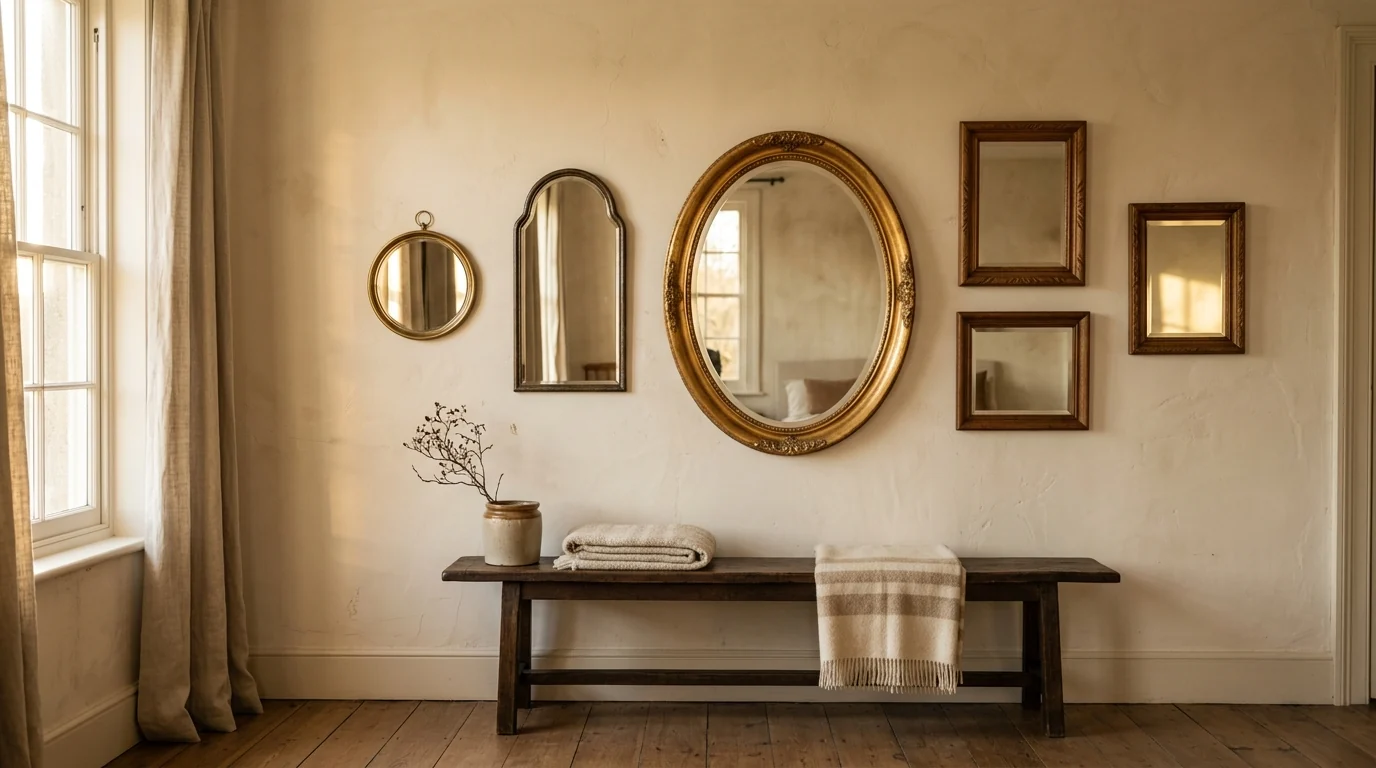
Six frames, nothing matching, everything related, and plenty of wall left breathing between them. Edited beats piled up.
2. The Antique Mirror Panel Wall
The luxury version, and the correct answer if what you actually want is a whole wall of glass. Large foxed-glass panels, mottled, smoky, darker at the edges, divided by thin bronze or steel seams into a calm grid of big rectangles. Behind a dining table or a bar it does what the 80s wall was always trying to do, double the candlelight and the sense of space, but the aged glass mutes the reflection into atmosphere instead of surveillance. This is the treatment to price out before committing, and the one most worth previewing on a photo of your room with an AI room design tool first.
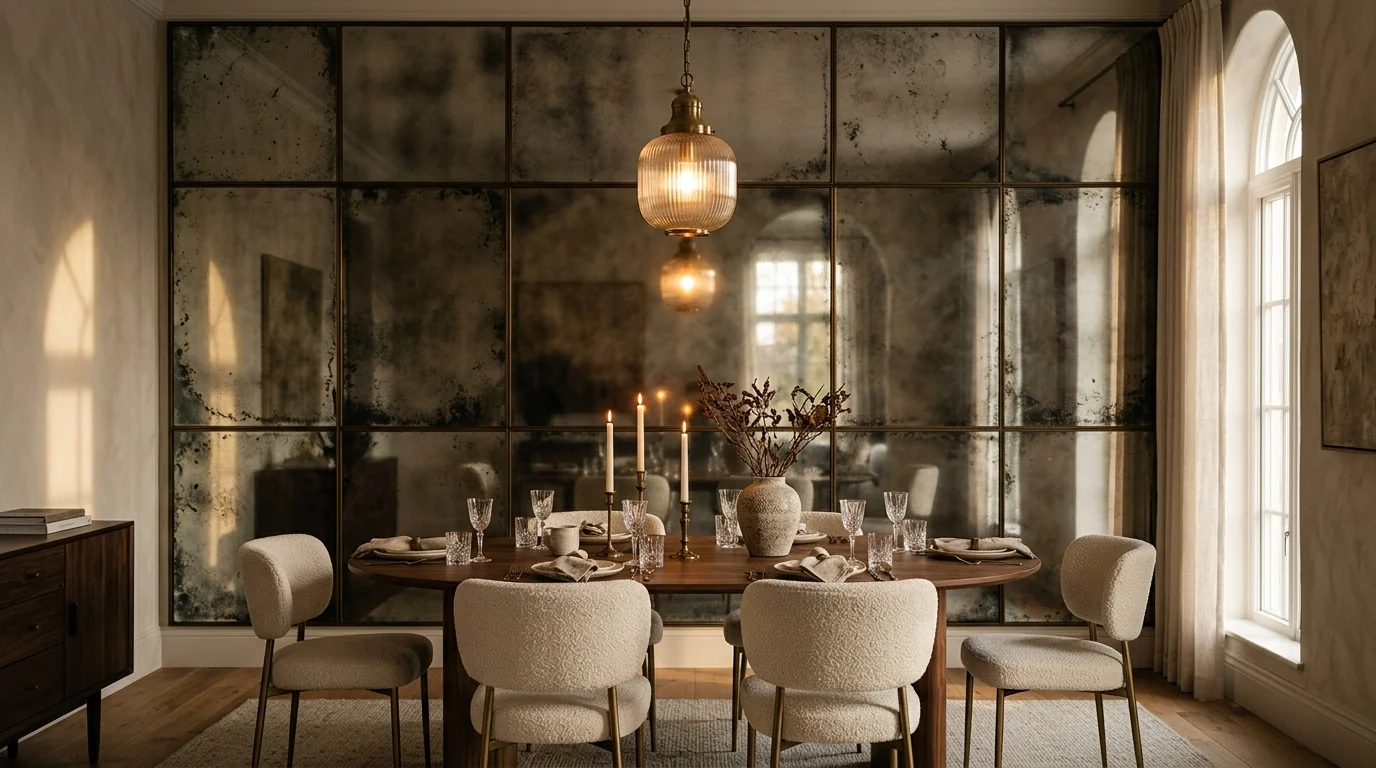
Foxed panels, bronze seams, big calm rectangles. The reflection is atmosphere, not a second TV feed of your dinner.
3. One Oversized Leaning Mirror
A two-meter mirror in a thin oak or steel frame, leaned against the wall, is the least effort-per-impact ratio in this guide. No drilling, instant doubling of the room, and the lean itself reads relaxed where a bolted mirror reads formal. It belongs beside the sofa or across from a window, angled to catch it. Two non-negotiables: an anti-tip strap anchored to the wall, especially with kids or pets, and a frame thin enough that the mirror stays furniture, not architecture.
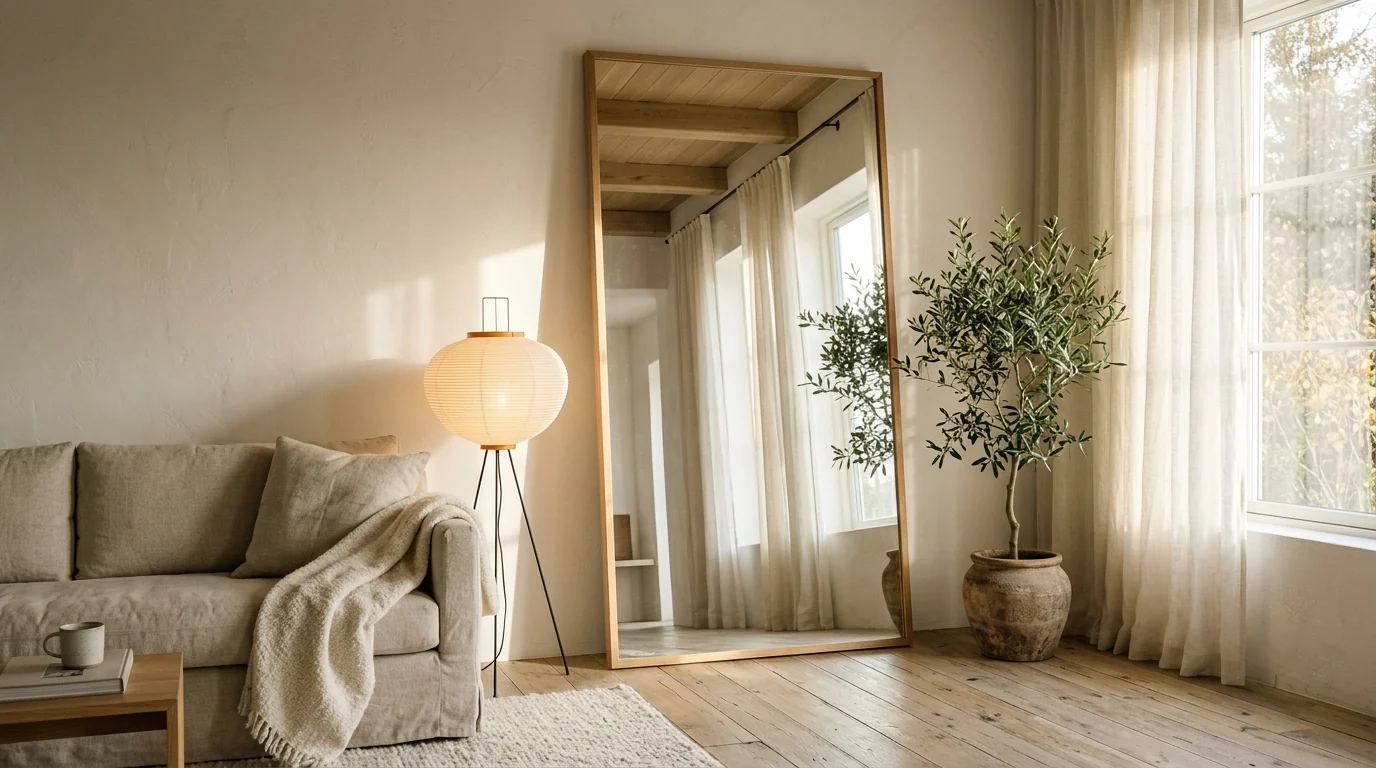
One mirror, no drilling, twice the room. The lean is the point: relaxed, movable, renter-proof.
4. The Arched Mirror Moment
The arch is the shape of the moment because it does architecture’s job for it: a tall arched mirror against a flat wall fakes a doorway, a window, a portal to more room. In slim aged brass or plaster-toned frames it suits bedrooms and hallways best, standing on the floor or hung low. If your home already has an arched opening, echoing it with an arched mirror on the adjacent wall is the cheapest architectural rhyme available. The same silhouette is currently taking over the vanity wall too, which our bathroom mirror ideas guide covers with its own set of numbers.
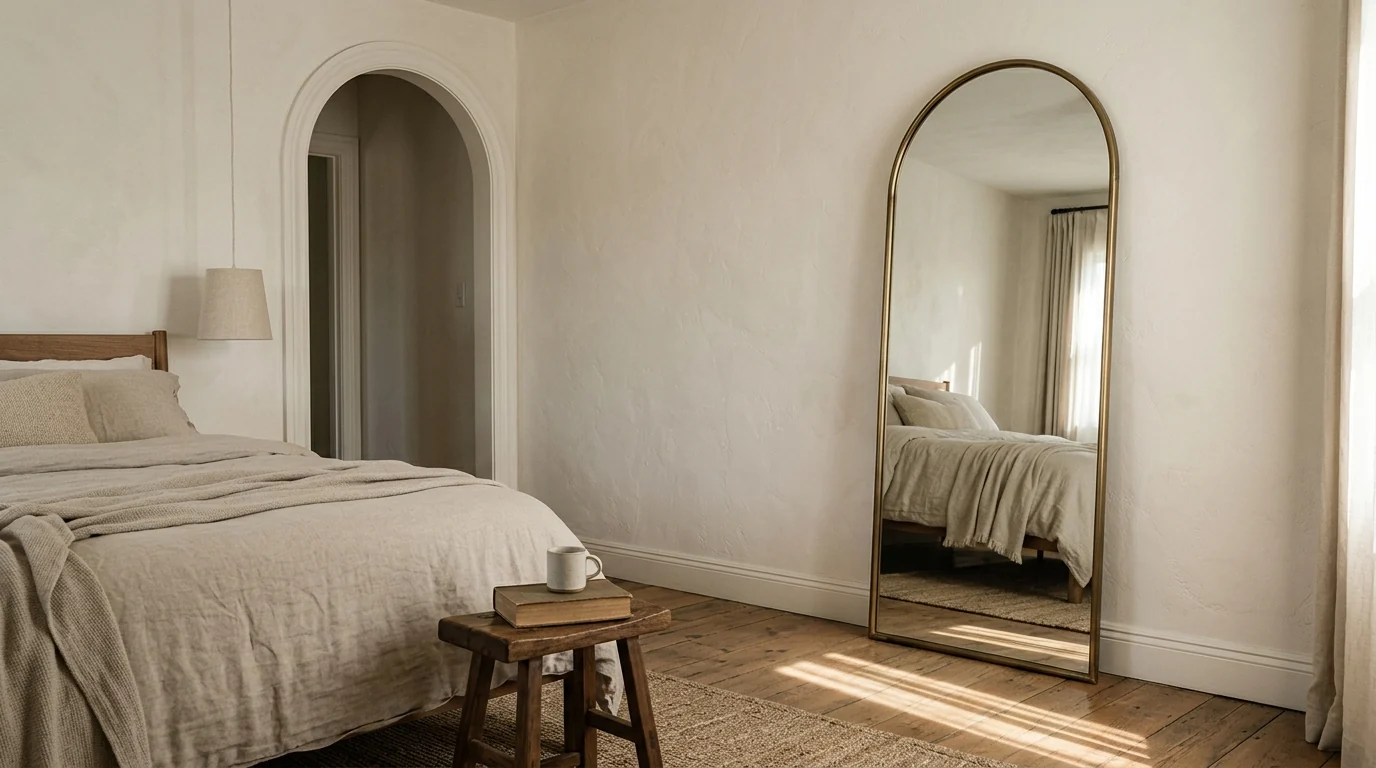
An arch where there is no arch. The mirror borrows the architecture the wall never had.
5. Mirrors Mixed Into an Art Gallery Wall
Two or three small mirrors interleaved into an existing gallery wall of paintings and prints wake the whole arrangement up. The mirrors read as live pieces among the static ones, and a single vintage convex mirror, the fish-eye kind, bends a miniature of the entire room into the composition. Keep the mirrors small and the frames consistent with the art around them. This is the best entry point if a full mirror wall feels like too much commitment, and it upgrades a plate-and-art wall the same way.
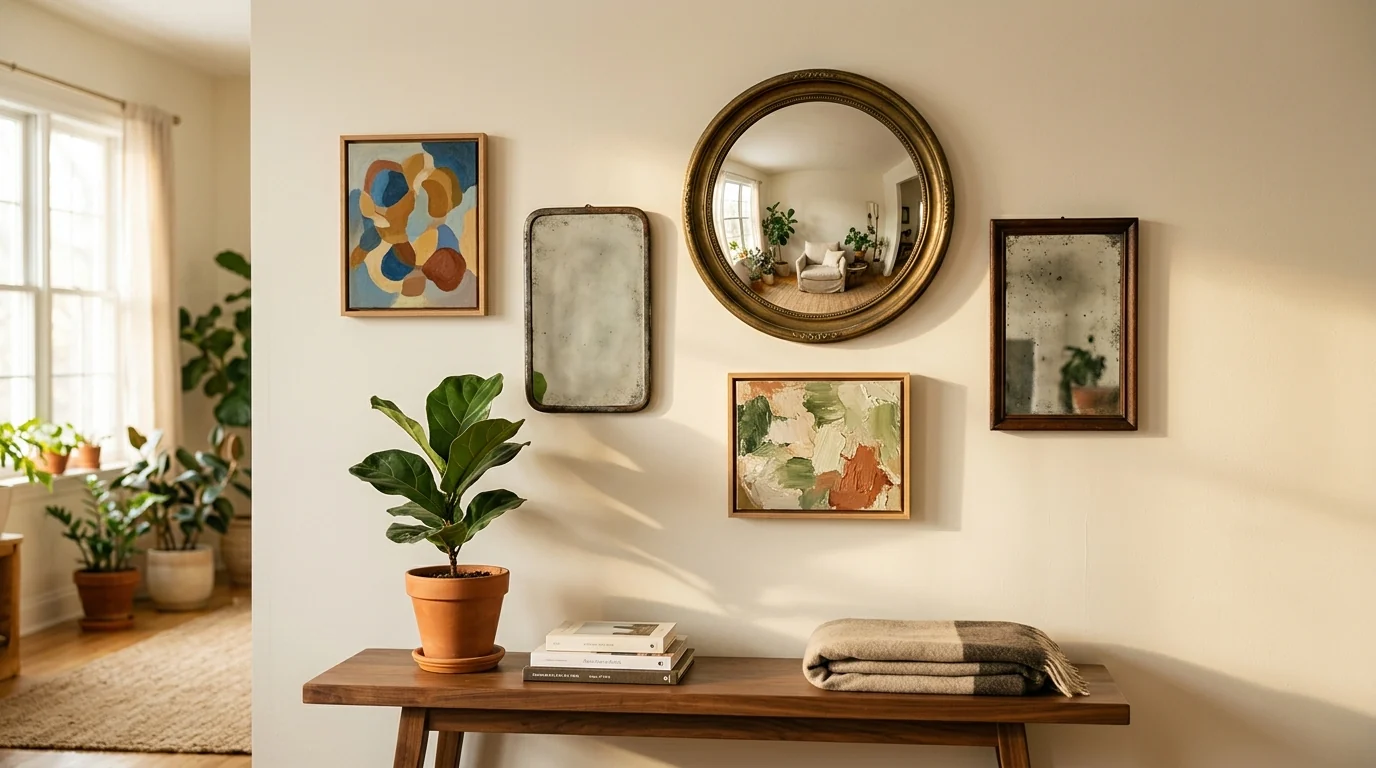
Art holds still, mirrors move. The convex piece folds the whole room into one small brass circle.
6. The Frameless Minimalist Round
One very large frameless round with a subtly antiqued edge, on a limewashed wall, above a low bench, and nothing else. This is the mirror wall for people who flinched at every previous idea: zero ornament, maximum light. In late afternoon it throws a soft ellipse of bounced sun onto the adjacent wall, and that moving patch of light is the real decoration. Restraint only works if you protect it, so resist the urge to add a second piece to the same wall.
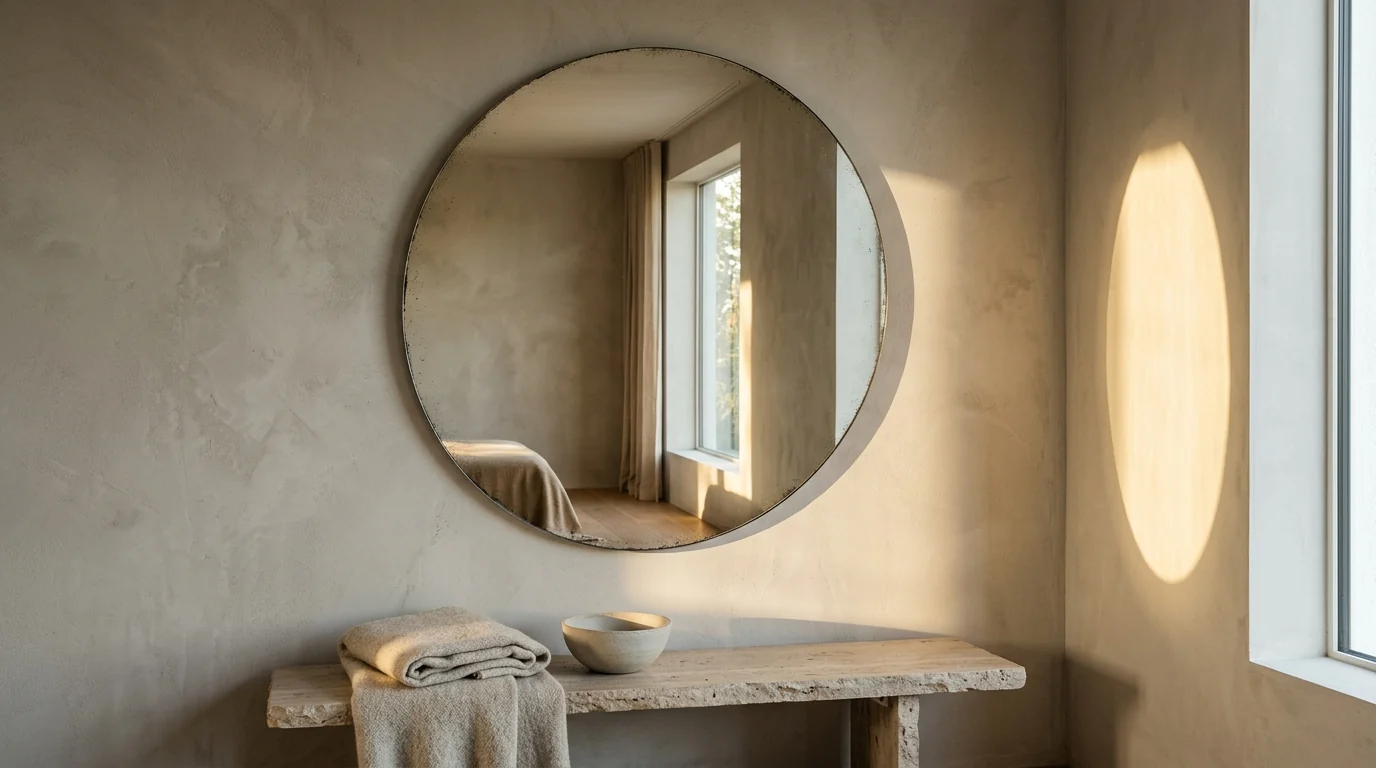
The bounced ellipse of sun is the artwork. It moves across the wall all afternoon.
Mirror Wall Ideas by Room
7. Living Room: Above the Fireplace
The classic position, and still the best one in most living rooms, because the chimney breast is the room’s natural center and usually faces its best light. The rules for a mirror over the fireplace are short: roughly two thirds of the mantel width, frame sitting 4 to 6 inches above the shelf, and never tilted forward on a wire, which is the fastest way to reflect the ceiling instead of the room. Round beats rectangular here: it breaks the stack of straight lines that a fireplace wall already has. If your living room feels off and you cannot say why, an empty or overstuffed mantel wall is a common culprit.
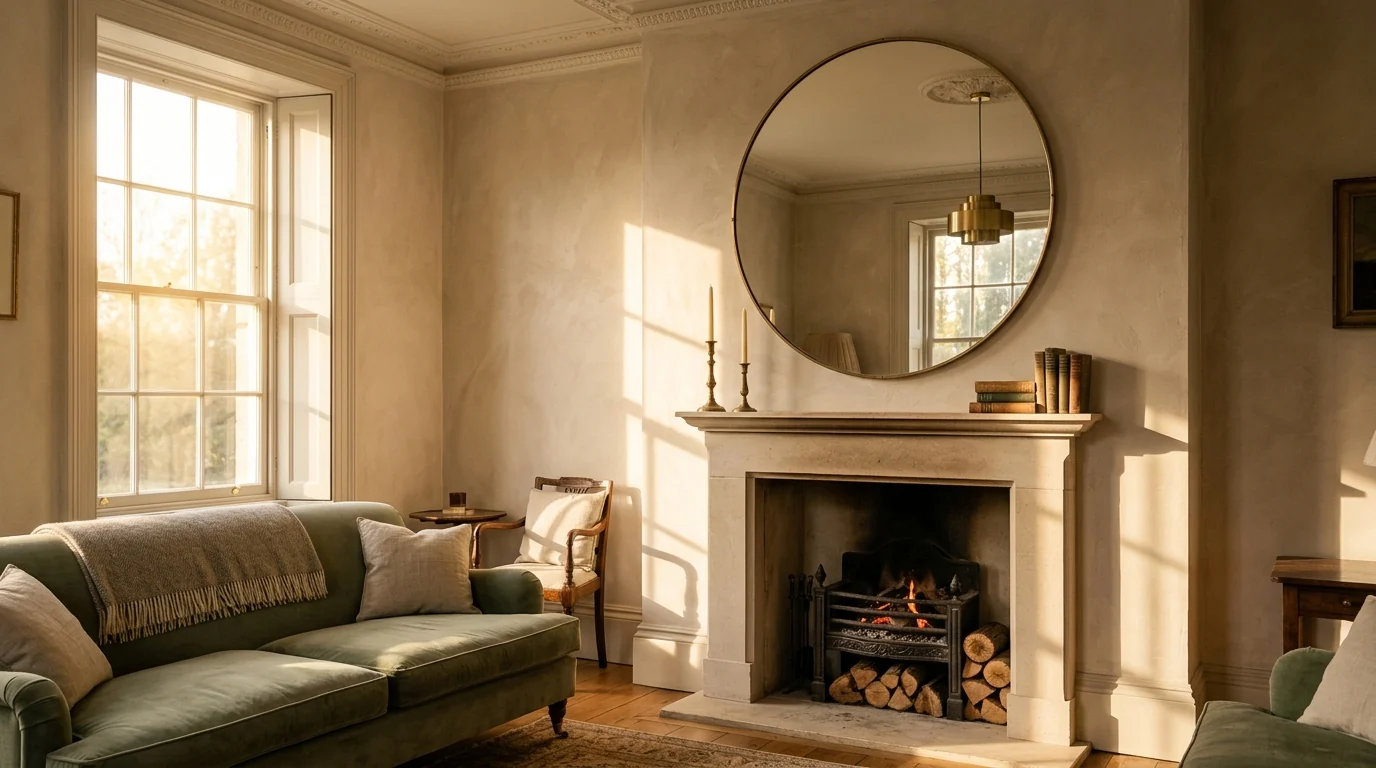
Two thirds of the mantel width, a hand’s width above the shelf. The circle breaks the fireplace’s grid of straight lines.
8. Dining Room: Above the Credenza
A large horizontal mirror above the sideboard is the dining room’s oldest trick because it works twice a day: daylight across the table in the morning, doubled candlelight at dinner. Keep the mirror narrower than the credenza, flank it with lamps, and favor an antiqued or vintage frame over a crisp modern one, since this wall carries the room’s occasion energy. The room by room design guides covers the rest of the room this wall belongs to.
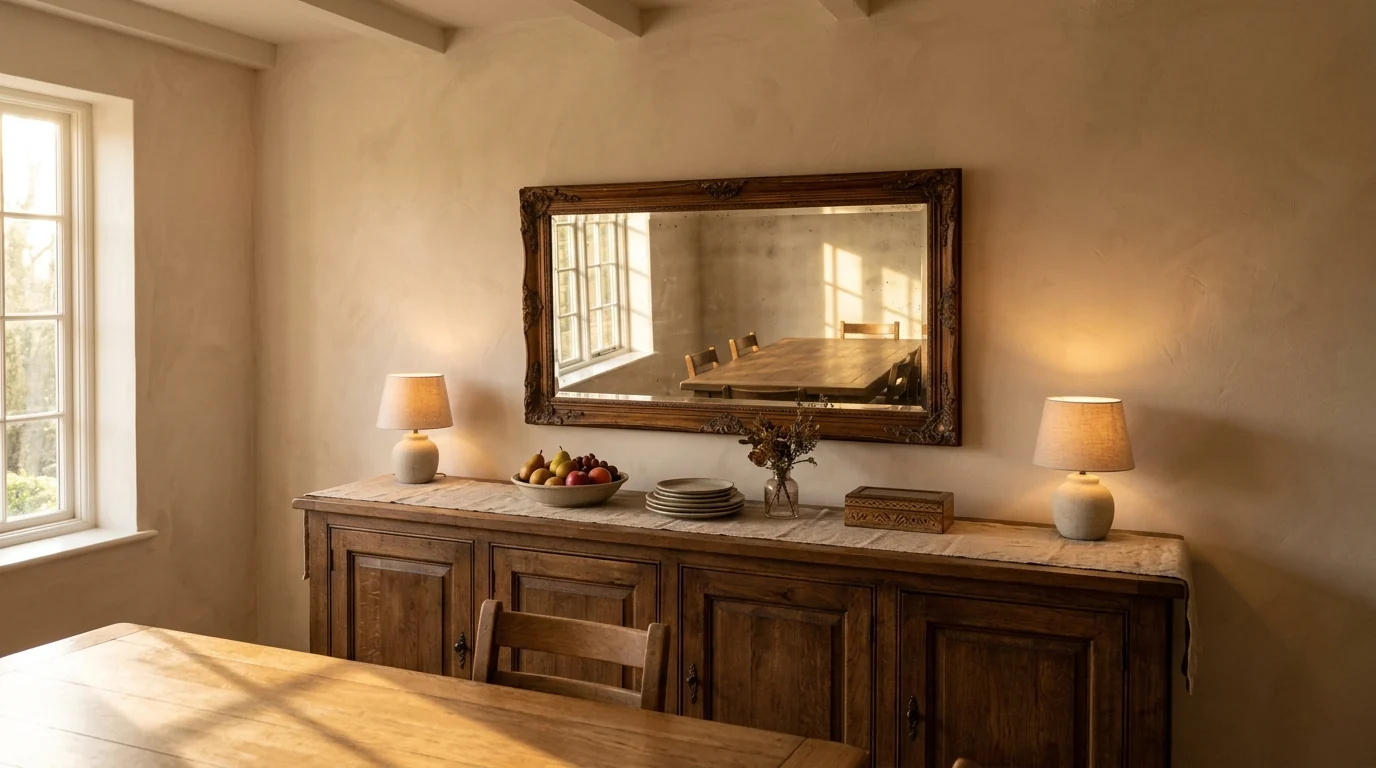
Narrower than the sideboard, flanked by lamps. At night this wall doubles every candle on the table.
9. Bedroom: Above the Dresser
The bedroom position that always works: a vintage oval or soft rectangle above the dresser, where it is functional every morning and decorative the rest of the day. The position designers avoid is directly facing the bed. Set the tradition aside if you like, the practical problem remains: a mirror opposite the bed catches every phone glow and streetlight at night, and reflected movement in the dark is genuinely unsettling. Above the dresser, behind the nightstands, or angled on a wardrobe wall are the comfortable options. A mirror above the bed is possible but earns its place only with serious mounting, a French cleat into studs, never a wire, and it is the one position where a lightweight framed alternative is worth considering.
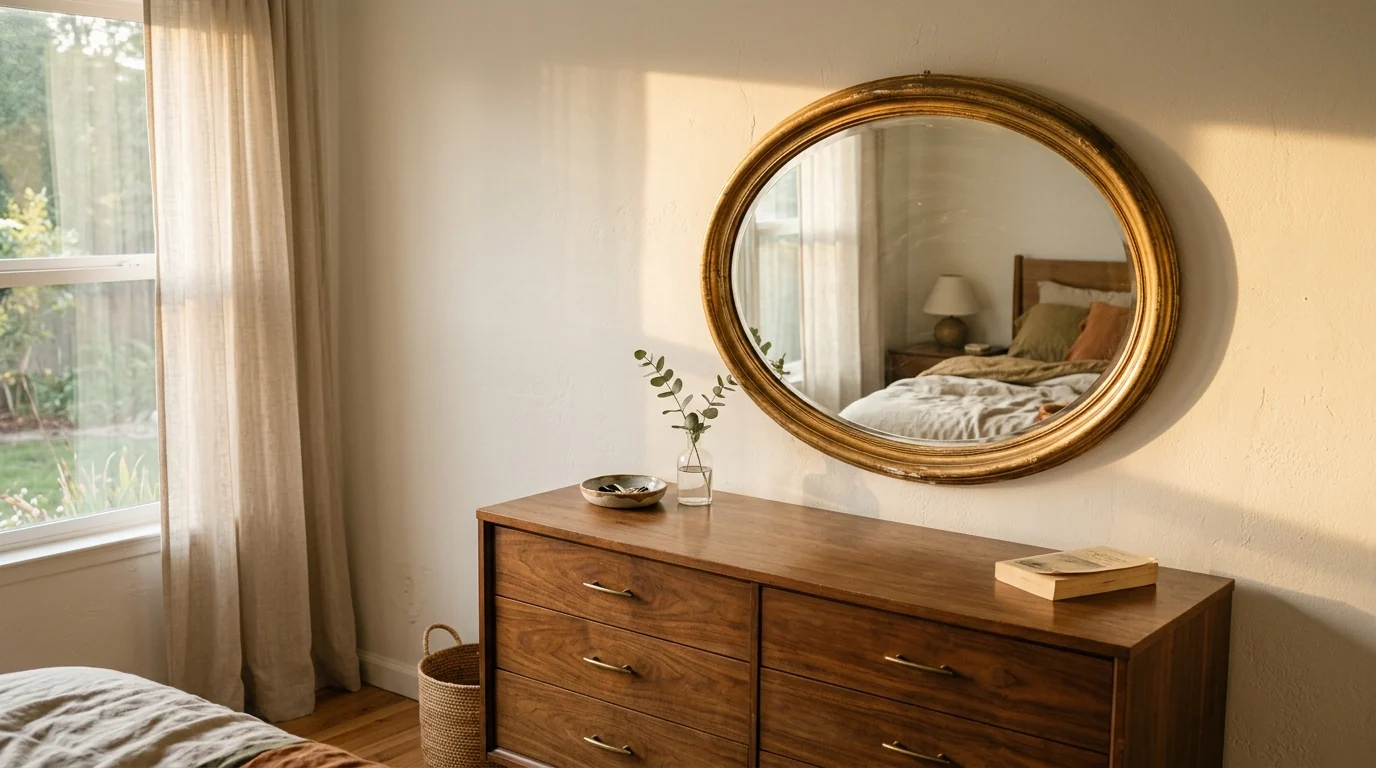
Worn gilding above walnut. Useful at 7 a.m., decorative the other 23 hours, and never facing the bed.
10. Entryway: The Last Look
Every entry and hallway wants a mirror for the last-look-before-leaving ritual, which makes this the easiest mirror decision in the house: tall, simply framed, above a slim console, centered at eye level. In a narrow hallway it earns its space twice over by visually doubling the width. Deep-framed or heavily ornate mirrors fight the small space; thin steel or oak frames win. More entry ideas live in the entryway design guide.
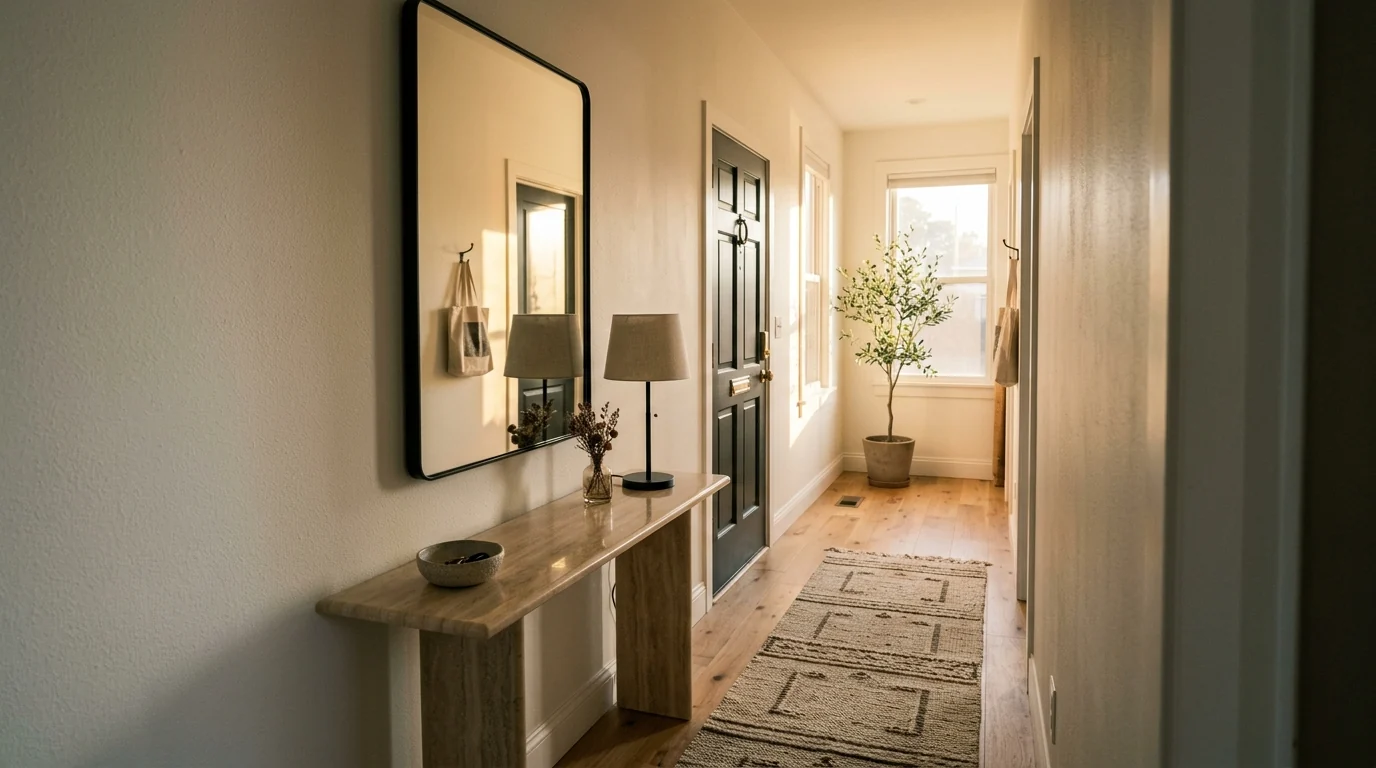
The narrow corridor reads twice as deep. Thin frame, eye-level center, console line respected.
11. The Staircase Gallery
The staircase wall is where the vintage gallery concept gets its best canvas, because the diagonal gives the arrangement a spine and you experience it in motion. Let the cluster climb parallel to the stair line, keep frames varied but metals warm, and place the most interesting pieces at the landings where people actually pause. This is also the most forgiving spot to start a collection, since the wall absorbs new additions for years.
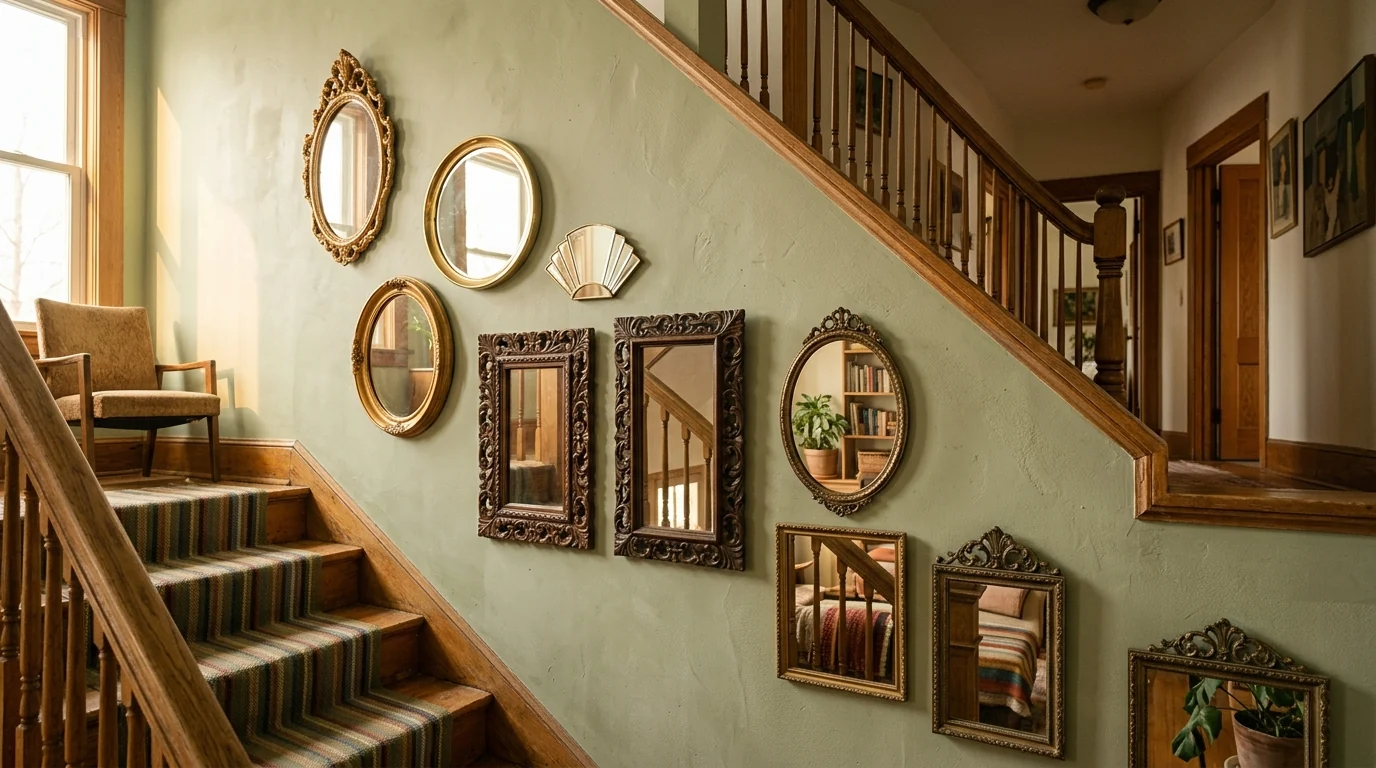
The stair sets the spine, the frames stay varied, the metals stay warm. A collection with room to grow for years.
12. Small Rooms: Perpendicular to the Window
In a small room the mirror is not decor, it is infrastructure. The highest-value position is the wall perpendicular to the window: the mirror catches the daylight and relays it deeper into the room, reading as a believable second window without the glare a directly opposite placement can produce. One large piece, hung so its center sits at eye level, beats any cluster in a tight space. It is the single most effective trick in the make-a-small-room-look-bigger playbook.
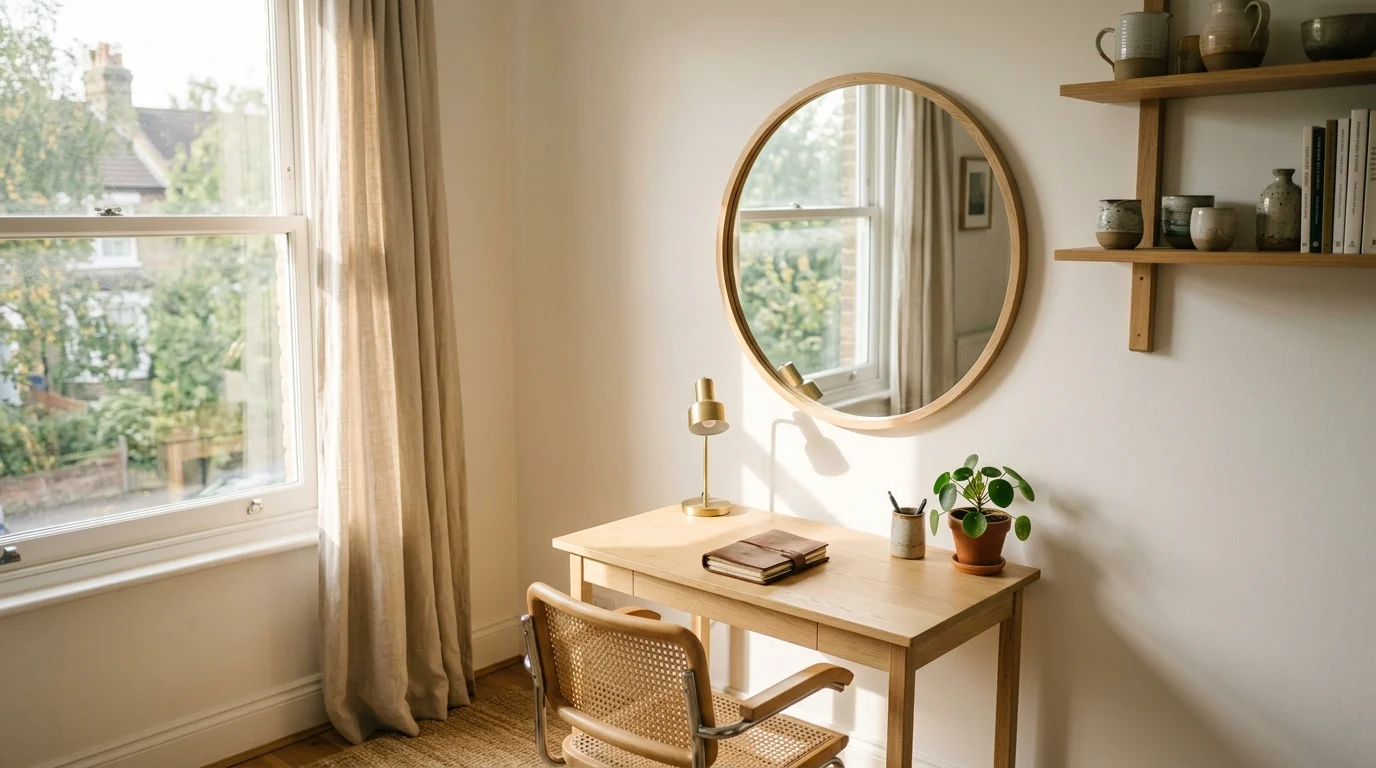
Perpendicular to the window, not opposite it. The room gains a second light source and loses the glare.
Where the Good Mirrors Come From
13. Thrift Stores and Estate Sales
The best mirror gallery walls are mostly secondhand, and the economics are absurd in your favor: solid carved and gilded frames that would cost hundreds new sell for the price of lunch because mirrors are heavy and awkward to ship, which keeps resale prices local and low. Check the glass for de-silvering you like, edge foxing is charm, and a big central bald spot is damage. Check the frame corners for looseness, and weigh the piece: heft usually means real wood and real plaster gilding rather than moulded plastic.
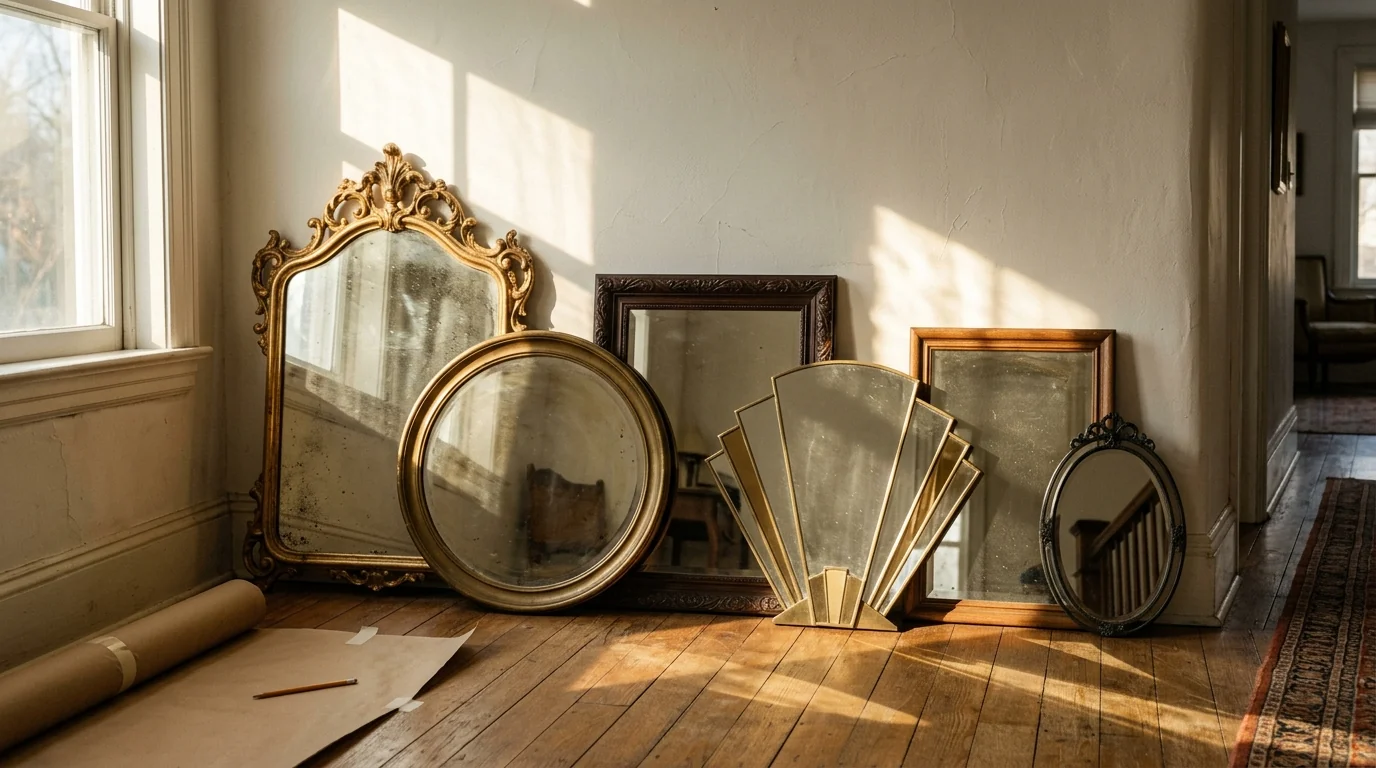
One estate-sale morning, six frames, and the kraft paper already waiting. This is how the staircase gallery starts.
14. New Antiqued Glass, Made to Order
For the panel wall, or a big custom piece, glass shops sell new antiqued mirror by the square foot in named patterns, lightly foxed to heavily smoked, and will cut it to your dimensions. This is how designers get the aged look at exact sizes with safe modern backing. It costs several times plain mirror, which is one more reason to be sure about the wall before ordering, and to preview the treatment on a photo of your actual room first.
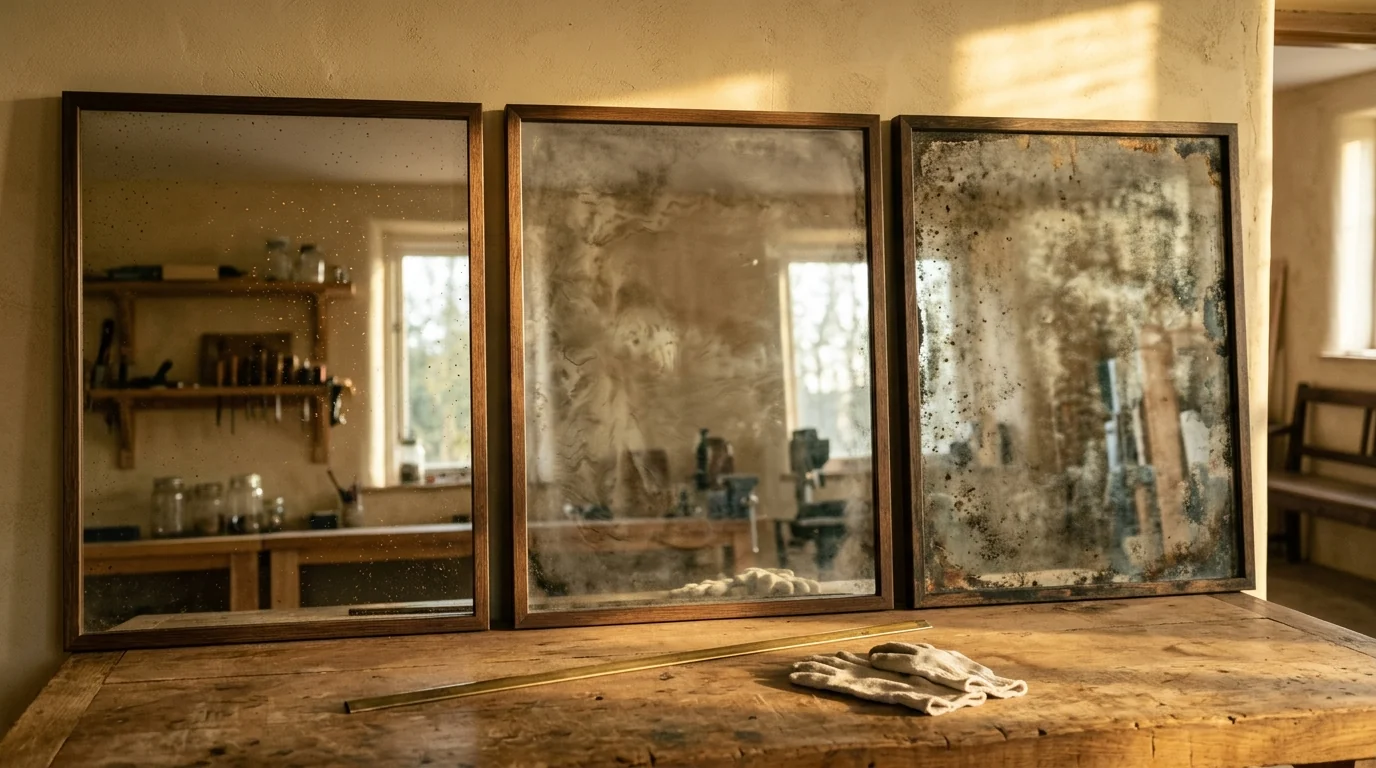
Light, medium and heavy antiquing, side by side. The pattern name you pick decides how much of the room the wall gives back.
Mirror Placement: The Numbers That Make It Look Professional
Nearly every mirror mistake is a height or scale mistake. These are the numbers to hold onto:
One more thing that separates professional from improvised. Template first: for a gallery cluster, trace every mirror on kraft paper, tape the sheet to the wall, and drill through the marks, the same zero-test-holes method that works for a plate wall.
How to Hang a Heavy Mirror (Without Guessing)
Framed prints forgive bad hardware. Mirrors do not: a typical 60 by 90 centimeter framed mirror weighs 10 to 15 kilograms, a large antique with real plaster gilding can pass 25, and glass falling off a wall fails in exactly one, memorable way. Two facts decide the method: the mirror’s weight and what your wall is made of.
The details that prevent the common failures. Two hanging points always beat one: the mirror stays level and each anchor carries half the load, which is why D-rings on both sides of the frame outperform a single wire. No hooks on the back? On a framed mirror, screw a pair of D-rings into the frame itself. On a frameless mirror, use mirror clips or a J-channel rail at the bottom edge, and never construction adhesive, which is permanent for you and temporary for gravity. Plaster and masonry: old plaster crumbles around nails, so drill and use a proper sleeve anchor. Renters: adhesive picture strips top out around 7 kilograms per set and most real mirrors exceed that, which is one more argument for the leaning mirror from idea 3, secured with an anti-tip strap.
If the French cleat is new territory, here is the whole method on a real wall: a 65 pound, roughly 29 kilogram, mirror going onto drywall, from finding the studs to locking the mirror onto the rail. Five minutes, and you will never trust a single nail again.
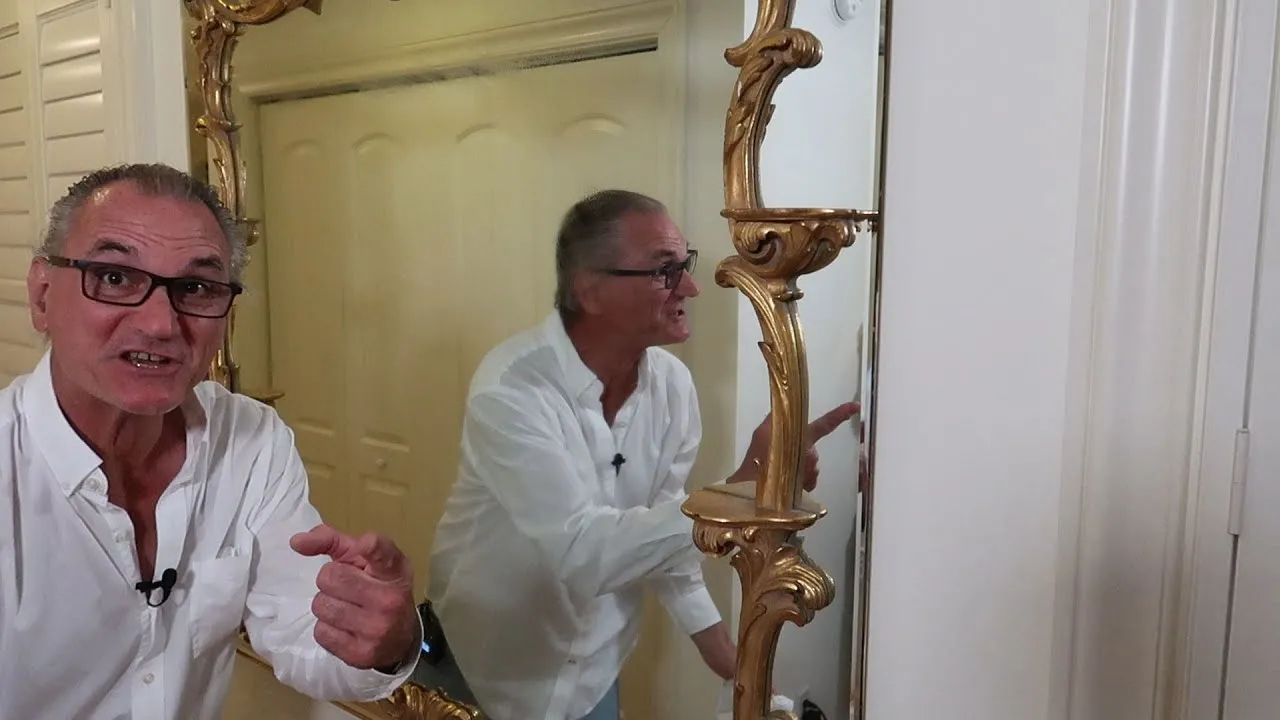
A 29 kg mirror onto drywall with a French cleat, start to finish. The method from the table above, on a real wall.
What Makes a Mirror Wall Look Like 1985
The dated mirror wall is instantly recognizable because it always makes the same mistakes at once:
- Glossy beveled grid tiles, glued edge to edge with visible seams. The wall reads as cladding, not as objects anyone chose.
- Wall-to-wall coverage. When the entire surface is mirror, the reflection stops being a moment and becomes surveillance.
- Mirror facing the TV. Every screen flicker happens twice. The reflection audit would have caught it.
- Mirrored furniture underneath. A mirrored console under a mirrored wall doubles down on shine exactly where the eye needs rest.
- Cold LED accent glow. Blue-white strip lighting turns glass walls into nightclub walls. Aged glass wants warm light.
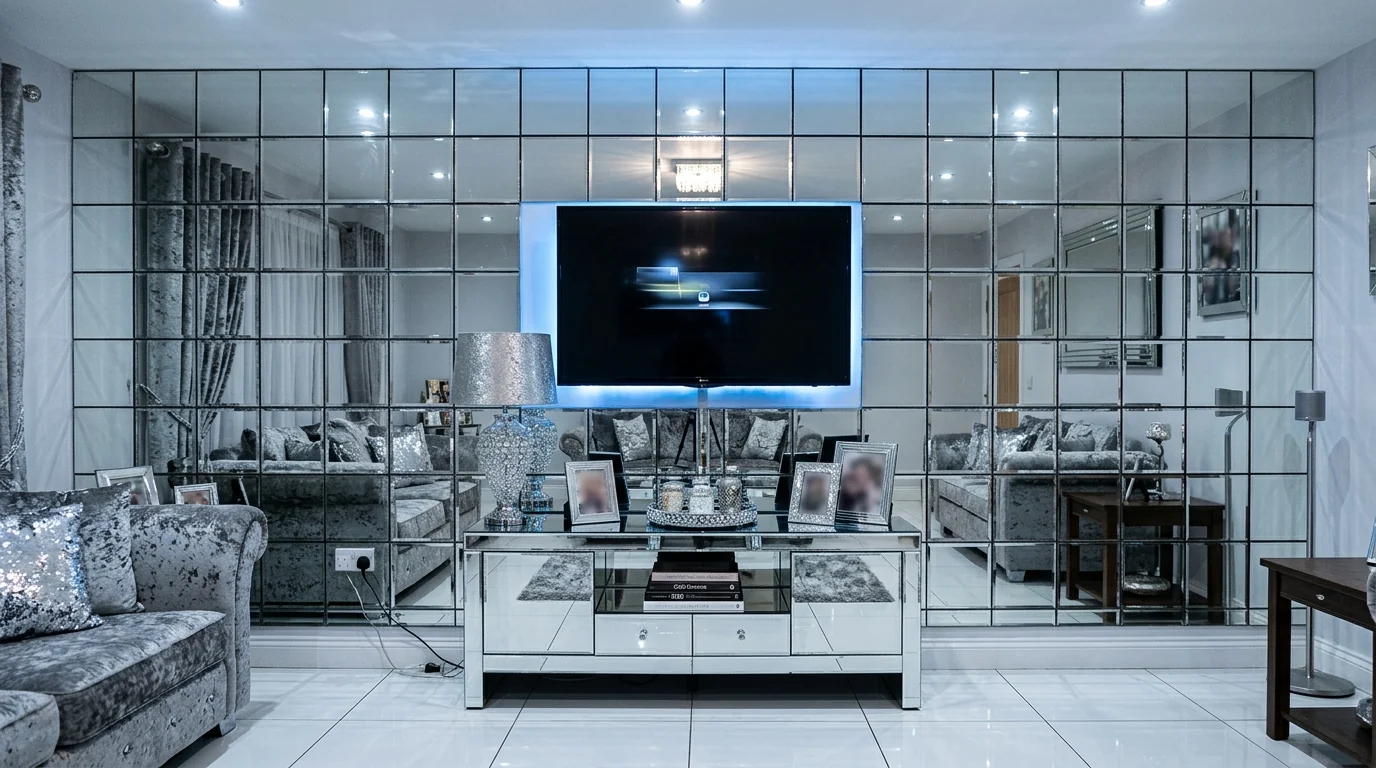
The version to avoid: seamed glossy tiles, TV in the mirror, cold LED glow, mirrored console. Shine stacked on shine.
Compare it with the cover image at the top of this guide. Both are walls of mirror, and the entire difference is curation: aged glass instead of gloss, frames instead of seams, a composition instead of coverage.
Preview Your Mirror Wall Before You Buy a Single Frame
Mirror is the hardest wall treatment to judge from imagination, because the result depends on something no product photo shows: what your specific room puts into the reflection. The same gallery cluster can look curated above your sideboard and chaotic above your sofa, and antiqued panels can read moody or murky depending entirely on your light. And sometimes the preview reveals that the wall itself is the problem, not the mirrors: in that case run the AI wall texture tool on the same photo first, because a limewash or a deeper paint shade behind vintage frames changes the temperature of the whole arrangement.
The faster route: upload a photo of your room to MeltFlex’s AI interior design tool and describe the wall you want, something like “salon-style gallery of vintage gilded and brass mirrors above the walnut sideboard” or “antiqued mirror panels with bronze seams behind the dining table.” You get a photorealistic preview on your actual wall, with your real furniture, your light and your proportions, in about 20 seconds. Generate the vintage gallery, the oversized leaning mirror and the panel wall side by side, pick the one that stops you, and only then start hunting for frames.
Mirror Wall FAQ
Are mirror walls in style in 2026?
Yes, mirror walls are one of the defining wall treatments of 2026, but the version that is back looks nothing like the glossy floor-to-ceiling mirror grids of the 80s or the beveled glam walls of the 2010s. The 2026 mirror wall is either a curated gallery of vintage framed mirrors collected over time, or large antiqued panels with foxed, softly aged glass. Sharp seamed grid tiles, heavy bevels and mirrored furniture sets are the versions that still read as dated.
Are big mirrors out of style?
No, the opposite. One oversized mirror, whether a two-meter leaning floor mirror or a large round above a fireplace, is the strongest mirror move of 2026 and far safer than a cluster of small ones. What has dated is not size but finish: glossy beveled glass, mirrored furniture and seamed tile grids. A big mirror in a thin oak, steel or aged brass frame, or with a softly antiqued edge, is firmly current.
Where should you hang a mirror in the living room?
Hang it where the reflection earns its place: above the fireplace, above a sofa or sideboard anchored to that furniture line, or on the wall perpendicular to the main window so it bounces daylight deeper into the room. Check what the mirror will actually reflect before committing, because a mirror doubles whatever faces it. Reflecting a window, a pendant light or a good vignette works; reflecting the TV, a radiator or the hallway clutter works against you.
What are the rules for a mirror over the fireplace?
Keep it to about two thirds of the mantel width, sit the frame 4 to 6 inches above the shelf, and hang it flat against the wall rather than tilted forward on a wire, which mostly reflects the ceiling. Check the reflection from where you actually sit: a pendant light or the room itself beats a blank opposite wall. Round and soft-arch shapes work best because they break the straight lines a fireplace wall already stacks up.
Should a mirror face a window?
Slightly off-axis is better than directly opposite. A mirror placed perpendicular or diagonal to a window catches and spreads daylight deeper into the room without throwing glare back at the glass. Directly facing a bright window can create a harsh hotspot and, with a low sun, uncomfortable reflections. If the direct wall is your only option, an antiqued or foxed mirror softens the bounce, which is one practical reason aged glass is trending.
What happens when two mirrors face each other?
You get the infinity corridor effect: each mirror reflects the other and repeats the room into an endless tunnel. As a design move it doubles light but rarely works in living spaces, because the repeating reflection reads as visual noise, and feng shui traditions advise against it, especially in bedrooms. Designers get the same brightness with less chaos by offsetting the two mirrors so their reflections do not lock onto each other.
How high should you hang a mirror?
Center the mirror at average eye level, about 57 to 60 inches, roughly 145 to 152 centimeters, from the floor. Above furniture the furniture wins: leave 6 to 10 inches, about 15 to 25 centimeters, between the furniture top and the mirror bottom so they read as one composition. Above a fireplace, sit the frame 4 to 6 inches above the mantel. A mirror hung too high is the single most common giveaway of an unplanned wall.
Why do designers avoid a mirror facing the bed?
Partly tradition, partly practicality. Feng shui and vastu both advise against a mirror directly facing the bed, and even if you ignore the tradition, a mirror opposite the bed catches every light source at night, phone screens, standby LEDs, streetlight through curtains, and movement in low light can genuinely startle you. The comfortable positions are above the dresser, behind the nightstands, or on a wardrobe wall angled away from the bed.
Can you hang a mirror above the bed?
You can, but it is the one position where mounting quality is non-negotiable: a French cleat screwed into wall studs, never a single wire on a single hook, and never adhesive. Design-wise a wide horizontal mirror echoing the headboard width works best. If the wall cannot give you studs, hang something lighter there and put the mirror above the dresser instead, where it works harder anyway.
How do you make a mirror wall look modern instead of dated?
Swap shine for age and grids for curation. The dated version is glossy, beveled, seamed into tiles and paired with metallic furniture. The current version uses foxed or antiqued glass that reflects light as a soft glow, vintage frames that are treated like art, one strong oversized piece instead of many small ones, and placement anchored to architecture or furniture. If a wall of glass is the goal, large antiqued panels with thin bronze or steel seams read custom rather than 80s.
How can I preview a mirror wall in my room before buying?
Upload a photo of your room to MeltFlex AI and describe the mirror wall you want, for example a gallery of vintage gilded mirrors above the sideboard, or antiqued mirror panels behind the dining table. The AI generates a photorealistic preview on your actual wall, with your real furniture, light and proportions, so you can judge scale and reflection before spending anything. Comparing three mirror arrangements takes about a minute.
Ready to see it on your wall? Upload your room photo to MeltFlex and compare the vintage gallery, the oversized leaning mirror and the antique panel wall on your actual wall before buying a single frame. For the rest of the room, our guides to accent wall ideas, feature walls, 2026 wallpaper trends, and statement ceilings cover every other surface, and the plate wall guide is the ceramic cousin of everything on this page.