

Almost every comparison in this category ranks these tools by feature count, and almost every one of them is written by a vendor. This one ranks them by what they do to days vacant, because lost rent is 35 to 50 percent of what a turnover costs you and a vacant day at the 2026 national average rent is about $58. On that basis: MagicDoor is the best pick for most independent managers at $2.50 per lease with no minimum, AppFolio with Realm-X is the stronger system above roughly a hundred units but hides its AI behind a $960 monthly floor, EliseAI is the specialist if leasing response time is your actual problem, and Yardi Breeze Premier ships less AI than its marketing suggests. The full ten are below, with the published prices and the minimums that are not on the pricing pages. One warning about the shape of the category before you start: all ten manage the listing record and none of them touch what is in the listing itself, so the photographs and the video stay your problem whichever one you buy. And if the question is not which platform to buy but how to get value out of the one you have, that is a different piece: how to use AI in property management starts from the finding that 58 percent of firms have adopted AI and 8 percent have finished a workflow with it.
Our articles are still written by humans!
Get human written articles in your Google feed.



How this comparison was put together
Worth stating up front, because most pages ranking for this term do not. Every price here was read off the vendor’s own published pricing page or, where a vendor publishes nothing, taken from a secondary source and labelled as reported rather than confirmed. Every homepage screenshot in this article was captured on 12 August 2026 at 1440 by 900, and the frames are unretouched: where a vendor was running a promotional bar or a chat bubble that day, it is still in the picture.
What this is not: a hands-on test. We have not migrated a portfolio onto ten platforms, and anyone claiming to have done that in one article has not either. What we can do honestly is read the pricing pages properly, find the minimums that are not on them, check what the AI actually ships against what the marketing says it does, and order the result by the metric that matters. Where a number could not be confirmed, it says so in the text rather than being rounded into confidence.
The conflict of interest, stated plainly: we build MeltFlex. It is not a property management system, it is not one of the ten, and it is not on the cover. It does listing visuals, which is a job none of these platforms do, and it gets a section of its own after the ranking rather than a smuggled place inside it. Everywhere else in this piece we have no stake in which product you choose, and the top recommendation is a competitor.

Worth twenty minutes before you buy anything: “The AI Tools Property Managers Are Using in 2026” from The Evernest Property Management Show. Evernest runs property management for a living rather than reviewing software for a living, which makes it a useful check on everything below, including us.
Why days vacant is the right ranking
Feature lists are easy to write and impossible to compare. Vacancy is neither. At a national average asking rent of roughly $1,740 a month in 2026, one empty day costs about $58 in rent you will never bill. The US multifamily average sits near 41 days vacant, and the average stabilised unit sat empty 34.4 days between residents at the end of 2024 against about 30 days in early 2020. The gap is not closing.
Put that against the cost of the turnover itself. The average apartment turnover runs around $3,872 per unit and roughly 43 percent of units turn every year, but the line that dominates that figure is not paint or cleaning. Lost rent during the vacancy is typically 35 to 50 percent of the total.
So the question to ask any AI feature is simple: does this remove days, or does it remove hours? Both are worth money. They are not worth the same money, and a tool that takes three days off a re-let across fifty units a year is doing something an invoice-scanner cannot. Almost no comparison in this category is organised that way, because the vendors selling accounting automation would rather you counted features.
The two lanes, before you buy anything
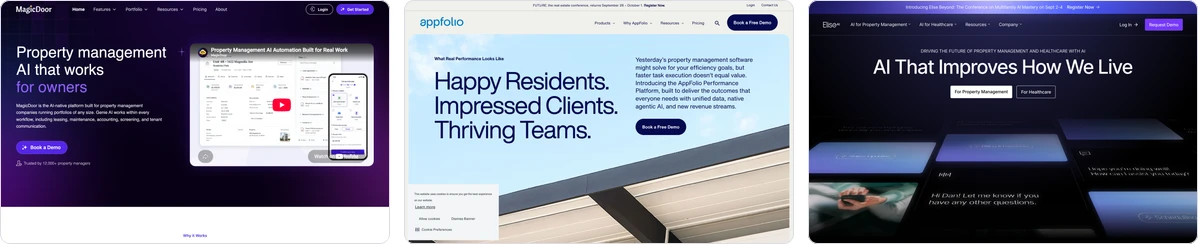
The days-vacant lane, captured 12 August 2026. MagicDoor, AppFolio and EliseAI. All three sell something that answers a prospect faster than a person can.
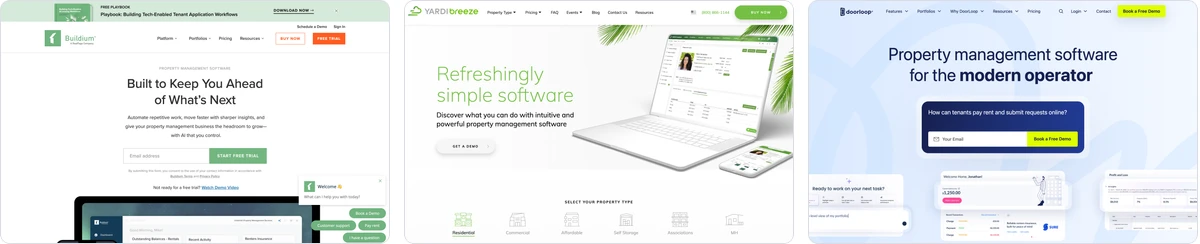
The admin-cost lane. Buildium, Yardi Breeze and DoorLoop. Read the two rows of screenshots against each other and the difference in what is being sold is visible before you get to a pricing page.
Most platforms claim both. Few are good at both, and the marketing language is identical either way, which is how managers end up paying for a leasing assistant they did not need and still shooting listing photos on a phone.
The ten, ranked
1. MagicDoor, best overall for independent managers
The only platform here that gives every customer the whole product at one published number: $2.50 per active lease per month, no minimum, no onboarding fee, with its Genie AI running inside leasing, maintenance, payments and communications rather than sold as a tier above you. In a category built on quote-only pricing and five-figure floors, that alone is the story.
The governance is also the most sober here: Genie never auto-approves or declines an application, every AI action is written to an audit trail, and any feature can be switched off by company, portfolio or property. That matters more than it sounds in a business where an automated decision on an application is a fair housing problem waiting to happen. The catch is age. This is a newer platform than the incumbents and the ecosystem around it is thinner, so if you need a specific accounting integration, check before you migrate.
2. AppFolio with Realm-X, best above a hundred units
Realm-X is the most convincing AI in this comparison, because it is a conversational layer over your live portfolio data rather than a chatbot bolted to a help page. Asking what your current occupancy is across a named portfolio and getting an answer from live records is a genuinely different product from drafting an email. It also covers leasing assistance, maintenance workflow and payments. In the first quarter of 2026 AppFolio disclosed that more than 99 percent of its customers use some AI-enabled functionality, which is the strongest adoption number anyone in this category has put on the record.
The price is the problem. Realm-X is not on the Core plan at all. It sits on Plus at about $3.20 per unit per month with a $960 monthly minimum, and some sources report the floor higher still, so treat the exact figure as a starting point for a quote rather than a price. Below roughly three hundred units you are paying the minimum rather than the rate.
3. Buildium with Lumina, strong mid-market, awkward AI packaging
Buildium is the safest all-round choice in the middle of the market and its Lumina features are practical rather than theatrical: AI Bill Scan pulls vendor, date and amount off an uploaded invoice and drafts the bill for review, Write with AI drafts emails, texts and announcements with translation, and there is conversation summarising across leasing and maintenance.
Every one of those is squarely in the admin-cost lane, and the packaging is the irritation. The published tiers are $62, $192 and $400 a month, and Lumina requires the top one. Some Lumina capabilities are then priced separately on top, so the $400 is a floor rather than a ceiling. If your pain is bookkeeping hours this is money well spent. If your pain is vacancy, you are paying $400 a month for a faster inbox.
4. EliseAI, the specialist if leasing speed is the real problem
The category leader in conversational leasing for multifamily, and the purest days-vacant tool in this list. It handles phone, text, email and chat around the clock, schedules and reschedules tours, runs AI-guided self-tours, chases prospects, then keeps going after move-in with payment reminders, payment plans, delinquency escalation and renewal offers on your own schedule.
It is also the least accessible product here. Pricing is behind a sales call, reported at roughly $3 to $6 per unit with a $25,000 minimum, which walls out everyone below mid-size. If you run several thousand units and your leasing team cannot answer fast enough, this is the tool. If you run two hundred, it is not for you yet, and the honest alternative is making sure the listing itself does more of the work.
5. Yardi Breeze Premier, the thin-AI warning
Breeze Premier is a competent, well-supported system and the AI is where the marketing runs ahead of the product. What actually ships is Smart AP invoice processing with OCR, a chatbot and ID Verify. That is the list. Compare it against the paragraph of AI copy on the product page and you have a useful lesson in reading these pages generally.
Pricing is $2 per unit per month with a $400 monthly minimum, dropping to about $1 per unit if you bundle screening and insurance, and affordable housing starts higher. The minimum means small portfolios pay $4,800 a year for three AI features and a solid ledger.
6. DoorLoop, the readable middle
Published tiers at $69 Starter, $149 Pro and $209 Premium on annual billing, higher month to month, with a clean interface and no per-unit surprise at the bottom. The AI is modest and mostly assistive rather than agentic. Its virtue is that a twenty-unit operator can read the pricing page, understand it and be running the same afternoon, which is not true of half this list.

The small-portfolio four. Notice how much more willing these are to put a price on the homepage than the enterprise end of the list, which is usually a good sign.
7. RentRedi, best for one to fifteen units
A flat rate for unlimited units: $29.95 month to month, or $12 a month on the annual plan, $144 a year. Mobile-first, built for owner-operators rather than managers. The AI is thin and it barely matters, because at this scale the value is that rent collection, maintenance requests and tenant screening stop living in your text messages. Per-unit pricing is a bad deal at five doors and this is the answer to it.
8. Hemlane, software plus a service layer
Hemlane keeps a genuinely free Starter tier for an early portfolio, with paid tiers adding the thing nobody else in this list sells: local coordination, so a maintenance call is handled by a person rather than routed to you at 11pm. Basic starts around $36.50 a month plus $2.50 a unit and the serviced tiers cost considerably more. For a remote owner with a handful of doors in another state, the service layer is worth more than any AI feature in this comparison.
9. TenantCloud, and the free plan that disappeared
Worth including mostly as a caution. TenantCloud built its brand on free management for up to 75 units and that promise is gone in 2026. Entry is now $18 a month, running to about $60, with lease caps of 10, 30 and 60 by tier. Cloudia, its AI assistant, is fine. If you are on an old free plan, this is your notice to price the alternatives before renewal rather than after.
10. Baselane, free until you read the fee schedule
Banking, rent collection and bookkeeping for landlords with no monthly fee, which is true and slightly misleading. The cost moves to your tenants at $2 per ACH payment, and absorbing that on their behalf means paying for Pro at around $149 a year. As a financial layer it is good. As property management it is partial, and the AI is limited to categorisation and reporting.
All ten, side by side
Prices are the published figures at the time of writing. Two of the four largest products on this list will not show you a price at all without a call, which is itself worth factoring into a decision.
What to buy at your portfolio size
The job none of the ten do
Read those ten product pages back to back and you notice something missing. Every one of them manages the listing record, syndicates it to the portals and routes the enquiries. Not one of them does anything about what is actually in the photographs, which is the part a prospect sees first and the part that decides whether the enquiry happens at all.
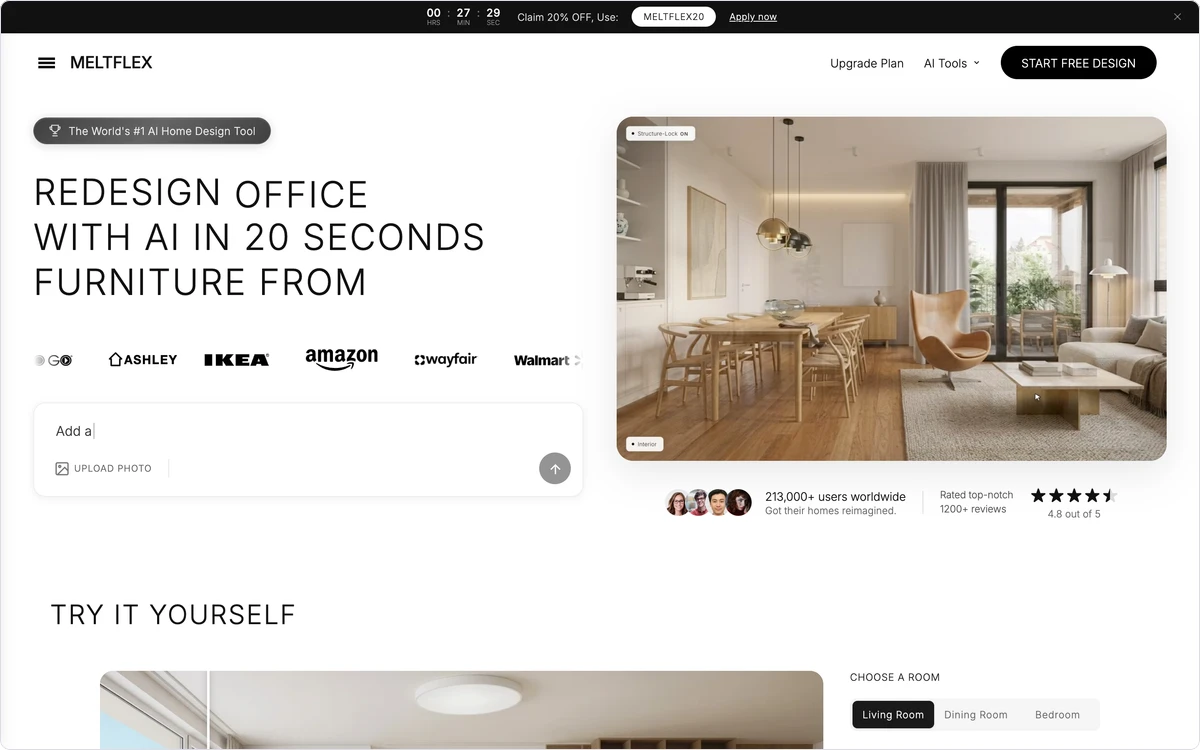
Ours, captured the same day as the other ten so you can compare like for like. It is a different kind of product, which is the point of putting it after the ranking rather than inside it.
For a turning unit that gap is expensive. The tenant is still in there for another three weeks, the room is full of their furniture, and you have a choice between waiting for the property to empty before booking a photographer, or listing with what you already have. Waiting is exactly the vacancy you are trying to remove. It is the same arithmetic agents run on the sale side, where the cost of virtual staging against physical staging has been settled for a while, except a rental turns over roughly every other year rather than once a decade.
What the evidence actually says about tours and video
This is where most articles reach for the same number, so let us deal with it first. “Listings with video get 403 percent more inquiries, according to NAR” is quoted on dozens of vendor pages, including several selling video. NAR is not the source. The figure traces back to an Australian real estate portal study from the middle of the last decade, and the attribution got laundered along the way. We are not going to use it, in the same way we did not use the recycled photography numbers in AI real estate photo editing. If a vendor quotes it at you, that tells you how carefully the rest of their page was written.
What survives scrutiny is Zillow’s own platform data, because Zillow can measure behaviour on its own listings rather than surveying people about it:
Four caveats before anyone builds a business case on that table, and the first is the one nobody prints. Only the top row survived being checked at source. We could open Zillow’s own release for the 32 percent saves figure. The other three are repeated confidently across the industry and we could not find a Zillow page stating any of them, so they are in the table marked as reported rather than removed, and you should weight them accordingly. Second, even the verified one is Zillow measuring Zillow, which is not a neutral party. Third, all of it is sale listings rather than rentals, so the mechanism transfers and the percentages do not. Fourth, that top row was collected in May 2020.
What survives all four caveats is direction, not magnitude: a listing that moves gets saved more than one that does not. If you want the arithmetic anyway, 10 percent off a 34 day vacancy on a rental at $1,740 a month is about three days, or roughly $174 a unit, on a turnover that happens for around 43 percent of units every year. Treat that as the shape of the prize rather than a forecast, because the 10 percent underneath it is the least traceable number on the page.
Why the vertical clip matters more than it used to
The other half of this is not the portal at all. Instagram Reels, TikTok and YouTube Shorts consistently outperform static posts for reach, the 15 to 60 second range is where engagement sits, and multifamily teams increasingly lease from social rather than only from the portals. That is a real change in where enquiries come from, and it is badly served by a set of still photographs, because a still cannot be a Reel.
This is the part of the stack we build, so weigh it accordingly. MeltFlex video walkthrough turns a single still into a moving shot with a real camera move through the room, in both 16:9 for the listing and 9:16 for Reels and TikTok, in under thirty seconds and without a videographer. Camera styles include cinematic, orbit, dolly and first person, so a set of rooms can be cut into something that looks shot rather than panned across a photo.
The whole marketing side of a turnover
Video is one line of it. Working from the photo you already have, MeltFlex covers the rest of what a listing set needs:
Pricing is €19 a month, and €9 in lower-income countries, for all of it rather than per image. Set that against a single videographer booking and the arithmetic is not close. If you would rather compare the staging half on its own, we keep an independent virtual staging software roundup that recommends competitors where they are better, what AI virtual staging is covers the basics in a page, and the AI video generators for real estate comparison covers the tools we do not build.
Where we are the wrong answer
Since this section is us marking our own homework, here is the part a vendor page would leave out.
It is not a property management system. No leases, no rent collection, no maintenance tickets, no accounting, no screening. You still need one of the ten above, and nothing here changes that recommendation.
The video is clips, not a tour. Generated walkthroughs run roughly four to eight seconds per shot. That is a Reel, an ad or a hero clip on a listing. It is not a replacement for a Matterport style dollhouse tour, and if a prospect wants to walk the whole unit at their own pace, buy the 3D tour instead. We would rather say that than have you find out after subscribing.
Every edit here has to be disclosed. Adding furniture, removing it or changing a floor are all alterations, and that is a legal duty in California since AB 723 took effect on 1 January 2026 and across the EU since Article 50 of the AI Act began applying on 2 August 2026. See the virtual staging disclosure rules and the EU AI Act guide. Handled badly this is a complaint rather than a lease.
It cannot fix a bad unit. A staged photo of a flat with a damp problem gets you a viewing and then a worse review. Everything in this section makes an honest unit look like itself on a good day. It is not a way to make an unlettable unit lettable, and used that way it will cost you more in wasted viewings than it saves in vacancy.
Exteriors are harder than interiors, for us and for every current model. More geometry, less forgiving light. If your listing lives or dies on the facade, budget for a photographer.
If your photos are already good, the gain is smaller. A landlord already paying a property photographer with a videographer on the same job is buying convenience here, not a step change. The step change is for the operator currently listing with phone snaps of an occupied room, and that is most of the market.
How to read an AI feature list
Roughly half the tools in this space ship something you could reasonably call AI, and the other half ship a search box and a template library with a new label on them. Three questions separate them quickly.
Does it read your data or just your prompt? Realm-X answering an occupancy question from live records is a different class of product from a chatbot rewriting an email you already wrote.
Which tier is it on? If the AI needs the top plan, as Lumina does, the real price of the AI is the difference between the tiers, not the feature list.
What is the actual count? Yardi Breeze Premier is the useful test case. The page reads like a platform transformed by AI. The shipped features are invoice OCR, a chatbot and ID verification.
What AI in this category still gets wrong
Two failure modes, neither of which appears in vendor marketing.
Jurisdiction. An AI will state a notice period, a deposit cap or a late fee with complete confidence whether or not it is right for your state. It has no idea which lease it is looking at unless you tell it. Anything containing a number or a deadline gets checked against your own lease and local law before it is sent, every time, and that check is not optional just because the draft reads well.
Fair housing. This is the one that costs money. AI drafted listing copy reaches instinctively for phrases like perfect for young professionals, ideal for a small family, or a short walk from the station. Each of those describes the tenant, or assumes an ability, rather than describing the property, and that is precisely the line the Fair Housing Act draws. The model is not being careless, it is imitating thousands of listings that were. Describe the flat, never the person you imagine in it.
The short version
If you manage fewer than fifteen doors, none of this is your problem yet. Take RentRedi at $144 a year and put the effort into the listing. Between fifteen and a hundred, MagicDoor is the best value in the category by some distance and the only one that does not make you buy a tier to reach the AI. Above a hundred, AppFolio with Realm-X is the stronger system and the minimum stops hurting. Add EliseAI only when leasing response time is demonstrably your bottleneck and you have the units to clear its floor.
And whichever you choose, notice that none of them touched the listing itself. No photos, no video, no vertical clip, on a channel mix that has moved toward Reels and Shorts while the software stayed put. That gap is about $58 a day wide, and it is the one part of this stack where a €19 subscription competes with a videographer booking.
Take the last unit you listed and run it through: empty the room if the tenant was still in it, stage it if it was bare, and generate the walkthrough in 16:9 and 9:16 from the same still. Then look at the old listing next to the new one and decide whether the photographs were doing their share. The first design is free, and if the answer is that your photos were already fine, we would rather you kept the €19.
Frequently asked questions
What is the best AI property management software in 2026?
For most independent managers, MagicDoor, because it is the only platform in this comparison that ships its AI to every customer at one published price, $2.50 per active lease per month, with no minimum and no onboarding fee. Above roughly a hundred units, AppFolio with Realm-X is the stronger system, though the AI sits on the Plus tier at about $3.20 per unit per month behind a $960 monthly minimum. If your problem is specifically leasing response speed and you run several thousand units, EliseAI is the specialist, at a reported $25,000 minimum. There is no single best, because these tools are not solving the same problem.
Why rank property management software by days vacant?
Because lost rent is the largest single line in a turnover, typically 35 to 50 percent of the total cost per unit, and because a vacant day is easy to price. At the 2026 national average asking rent of about $1,740 a month, one empty day is roughly $58. The US multifamily average sits near 41 days vacant, and the average stabilised unit sat empty 34.4 days between residents at the end of 2024 against about 30 days in early 2020, so the gap is widening. A tool that removes three days of vacancy across fifty units returns far more than one that saves an hour of bookkeeping a week, and almost no vendor comparison is organised that way.
How much does AI property management software cost?
Published prices in this comparison run from free to $400 a month before per-unit fees. The number that actually decides your bill is the minimum, and it is usually not on the pricing page. AppFolio gates Realm-X behind a $960 monthly minimum, Yardi Breeze Premier carries a $400 monthly minimum on top of $2 per unit, and EliseAI is reported at around $25,000 before you speak to anyone. At the other end, RentRedi is $144 a year for unlimited units and MagicDoor is $2.50 per lease with no floor at all.
Is there genuinely free AI property management software?
Not really, and 2026 made that clearer. TenantCloud retired the free plan it built its brand on, so entry now starts at $18 a month with lease caps by tier. Baselane still advertises no monthly fee, but the cost moves to your tenants at $2 per ACH payment, and absorbing that for them means paying for Pro. Hemlane keeps a free Starter tier that is real but thin, and it is designed to hand you to the paid service layer as you add doors. Free in this category almost always means someone else is paying.
Can AI actually reduce vacancy, or is that marketing?
It can, but only in the parts of the process where speed and quality are the constraint. Answering a 9pm enquiry in seconds instead of the next morning, letting a prospect self-book a tour, and putting up a listing whose photographs make people want the viewing are all things that measurably shorten the gap. Automating bill coding does not, however useful it is. This is the whole reason to split the category before you buy: an AI accounting assistant and an AI leasing assistant both say AI on the box and they affect completely different lines of your P&L. The listing side of that is covered in AI virtual staging for real estate photographers.
Does AI property management software handle listing photos?
Essentially none of them do, which is the strange gap in this category. The platforms manage the listing record, the syndication and the enquiries, and then assume a photograph arrives from somewhere. For an occupied unit turning over, that means either waiting for the tenant to leave and booking a photographer, or publishing the phone snaps you already have. Tools that empty a room, stage it or restyle it live outside every platform in this comparison, which is why they are worth a separate line in the budget.
Can AI make a walkthrough video for a rental listing?
Yes, from a still photograph, and that is the part of the marketing stack that has changed most. MeltFlex generates a moving shot with a real camera move through the room in about thirty seconds, in 16:9 for the portal and 9:16 for Reels, TikTok and Shorts, which matters because short-form video now outperforms static posts for reach and multifamily teams increasingly lease from social rather than only from portals. Be clear on the limit though: these are clips of roughly four to eight seconds per shot, so they are a Reel or a hero clip on a listing, not a substitute for a Matterport style tour a prospect walks at their own pace.
Do listings with video really get more enquiries?
Directionally yes, but be careful which number you repeat. The widely quoted claim that listings with video get 403 percent more inquiries “according to NAR” is misattributed: it traces to an Australian portal study from the middle of the last decade, not to the National Association of Realtors. The one figure we could verify at source is from Zillow’s own release: buyers saved listings with 3D Home tours 32 percent more often than listings without, on data collected in May 2020. The other numbers in circulation, 37 percent more views, 60 percent more views with an interactive floor plan, 10 percent faster to sell, are attributed to Zillow everywhere and we could not find a Zillow page stating them. All of it is sale listings rather than rentals, so treat the direction as transferable and the percentages as not.
What should I be careful about with AI in property management?
Two things, and neither shows up in vendor marketing. The first is jurisdiction: an AI will state a notice period, a deposit cap or a fee structure with total confidence whether or not it is correct for your state, so anything with a number or a deadline in it needs checking against your lease and local law before it is sent. The second is fair housing. AI drafted listing copy reaches for phrases like perfect for young professionals or a short walk to the shops, and those describe the tenant or assume an ability rather than describing the property, which is exactly the line the Fair Housing Act draws.
Do I need AI property management software for five units?
No. At five units the arithmetic does not work: per-unit AI pricing is trivial but the platform minimums are not, and the admin you would automate is a few hours a month. Take the flat rate option, RentRedi at $144 a year for unlimited units or the free Hemlane Starter tier, and spend the difference on the part that actually moves money at that scale, which is how fast you re-let and how good the listing looks. Revisit the AI platforms somewhere around thirty to fifty doors, when the coordination load stops fitting in your head.