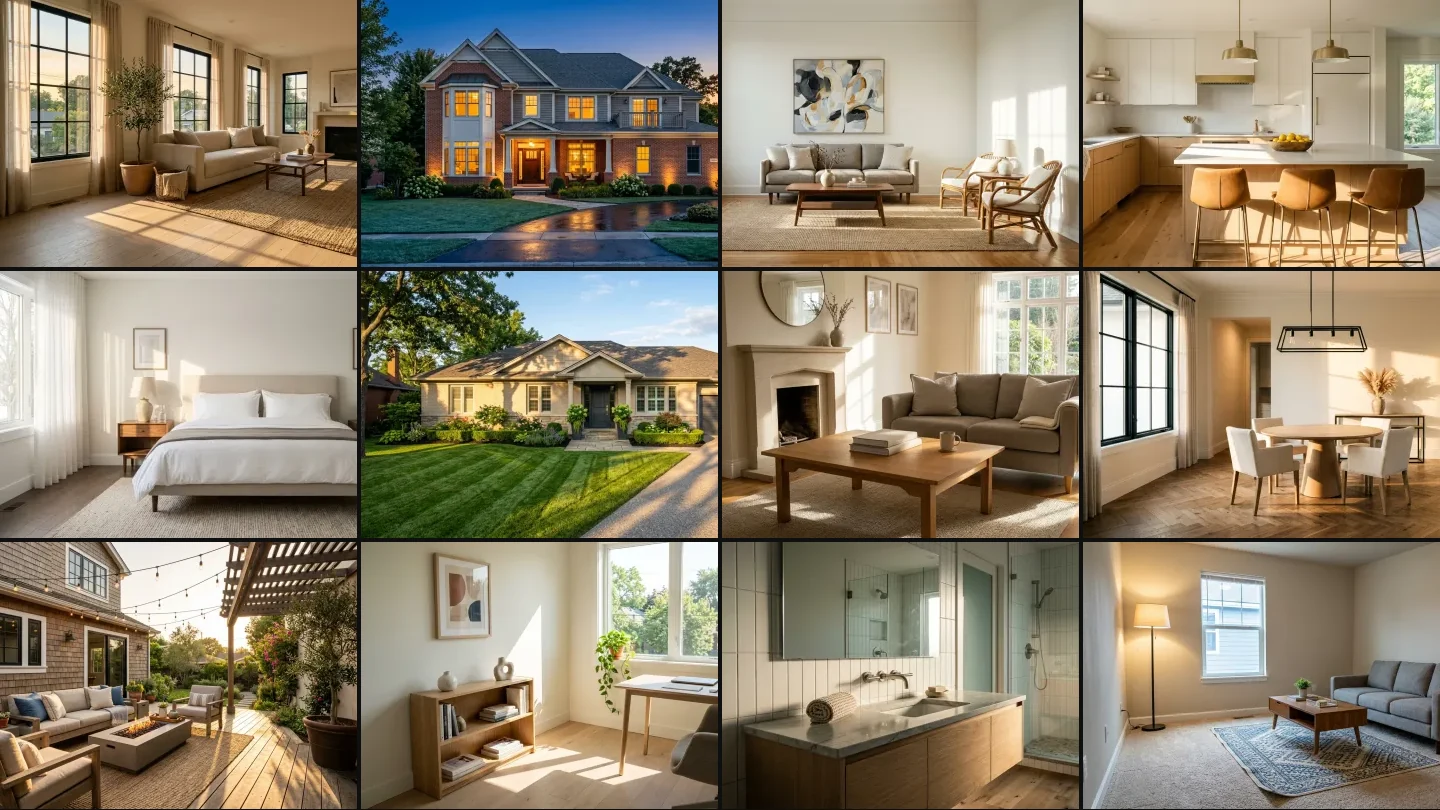
AI real estate photo editing is two different jobs that share a name. Correction makes the photo show the room as it actually is: exposure, window pull, verticals, white balance, sky. AI has finished that work, it costs cents, and it needs no disclosure. Transformation makes the photo show the room as it could be: decluttering, staging, new floors, a dusk conversion. That is a different product with different tools, dollar rather than cent pricing, and a legal duty to label. The tools that are excellent at one are mostly mediocre at the other. Almost every roundup in this category ignores that split, which is why agents keep buying an HDR tool and wondering why it will not empty a room.
Our articles are still written by humans!
Get human written articles in your Google feed.
Both lanes, side by side. The exterior on the left is a correction job: exposure, verticals, sky, and it costs cents. The interior on the right is a transformation: the furniture, the wall colour and the floor were all put there, it costs dollars, and it needs a label.
I should say where I am standing. MeltFlex builds the right hand column. We do decluttering, staging and restyling, and we do not build an HDR merge and are not going to, because AutoHDR and Lightroom already do it better than we would. That means I have an interest in half of this article and no dog at all in the other half, which is roughly the most useful position to write from. Where the honest answer is “this is not a job for a tool like ours”, I have said so.
FreeUpload listing photo · freeStage my listing photo for freeUpload an empty room and MeltFlex furnishes it for the listing, walls, windows and floor untouched. Your first AI design is free, no card needed.


The seven jobs, and which ones AI has actually finished
“Photo editing” in this industry covers about seven distinct operations. Lumping them together is how vendors get away with a green tick next to “AI-powered editing” while quietly doing one of them. If a tool claims “AI photo editing”, the useful question is which of these seven rows it means.
Six of the seven are in good shape. The one marked no is the one that costs photographers the most time, and no amount of model improvement has fixed it yet, for a reason worth understanding.
Correction: the part AI genuinely finished
Exposure blending is the headline case. A room with a window in the frame has a dynamic range no sensor holds in one shot, so you bracket, and merging those brackets used to be the slowest part of the job. AI merging now does it in a second or two per set, and does it better than most people did by hand, because it is deciding per-region rather than per-image. This is what the entire real estate HDR photo editing category is now: a queue, not a craft.
Vertical correction is in the same place. Wide-angle lenses at chest height produce walls that lean inward, and every current tool straightens them automatically and crops sensibly. Sky replacement is the third. All three are solved well enough that paying a human for them is now a decision about volume and trust rather than quality.
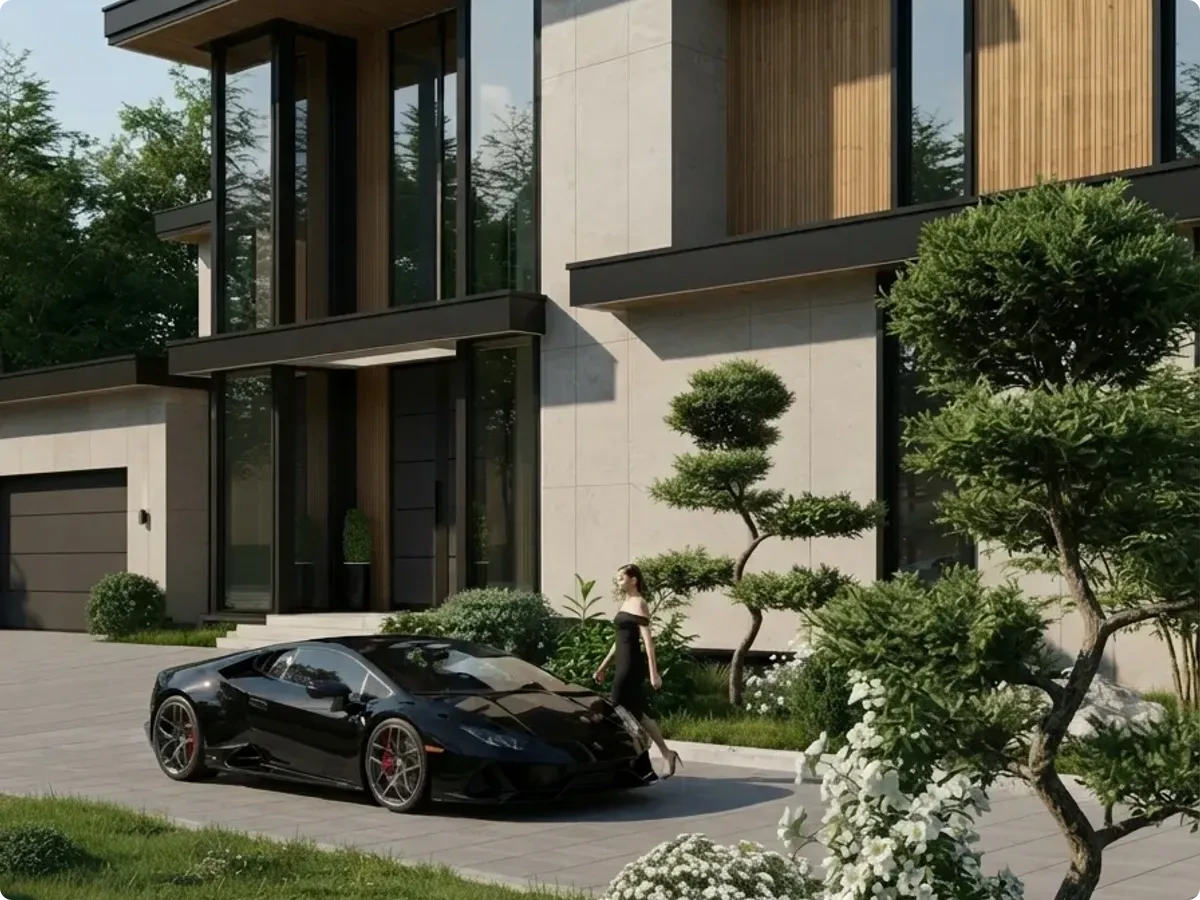
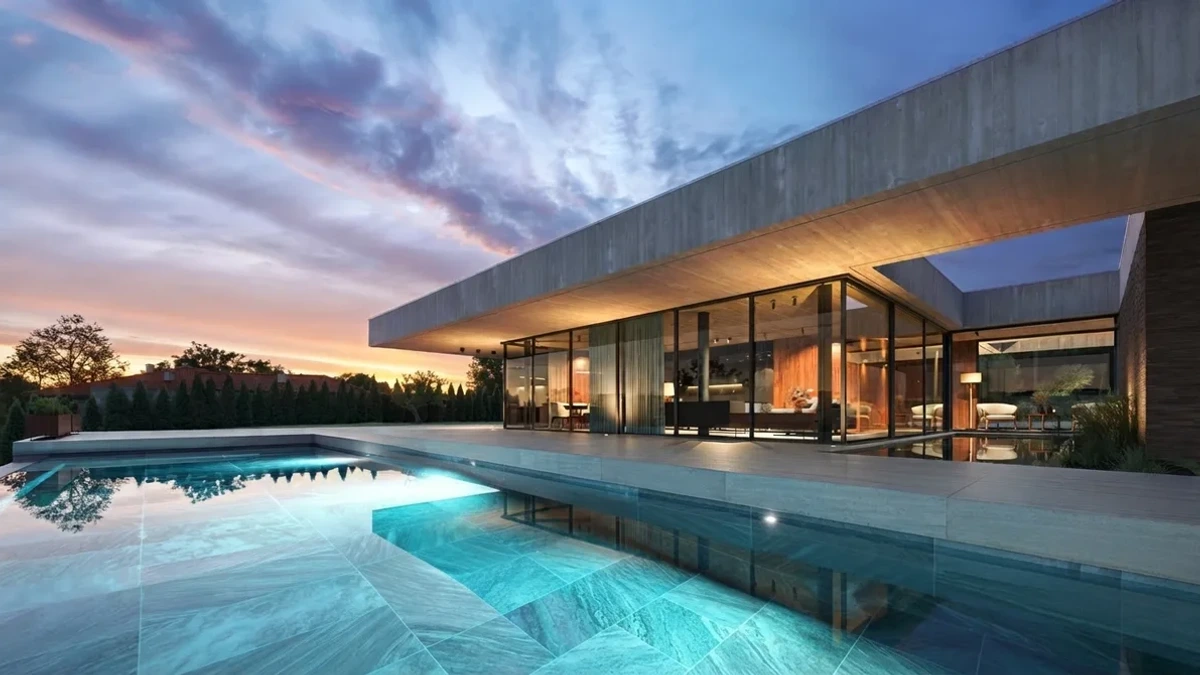
Everything a correction pass has to get right is visible here: the verticals on that glazing, the sky above the roofline, and the fact that the stone reads the same colour in shade as it does in sun. None of it changes what is in the picture.
The colour cast problem nobody has solved
Here is the one that still separates a good editor from a fast one. Photograph a kitchen in the late afternoon and you are working with three different colours of light at once: warm tungsten from the ceiling, green-tinged fluorescent under the cabinets, and cool blue daylight through the window. A single white balance setting cannot be right for all three, and it does not matter how many brackets you shoot, because every bracket contains all three casts.
This is why professionals shoot flambient, a contraction of flash and ambient. You take an ambient exposure of the room and a flash exposure of the same frame, then blend them. The point of the flash frame is not brightness, it is colour: the flash overpowers the mixed indoor lighting and gives you one clean, neutral reference for what the surfaces actually look like, which the ambient frame then supplies with natural shadow and mood. It is a colour fix disguised as a lighting technique.
No AI merge can do this from brackets alone, because the information simply is not in them. If your edited photos keep coming back with one warm wall and one green one, more software will not help. The fix happens at the shoot.
Transformation: where the money and the risk both are
The second column is a different business. Here you are not making the photo more accurate, you are making it show something that is not there, which is why it prices higher and why every MLS in the country has an opinion about it.
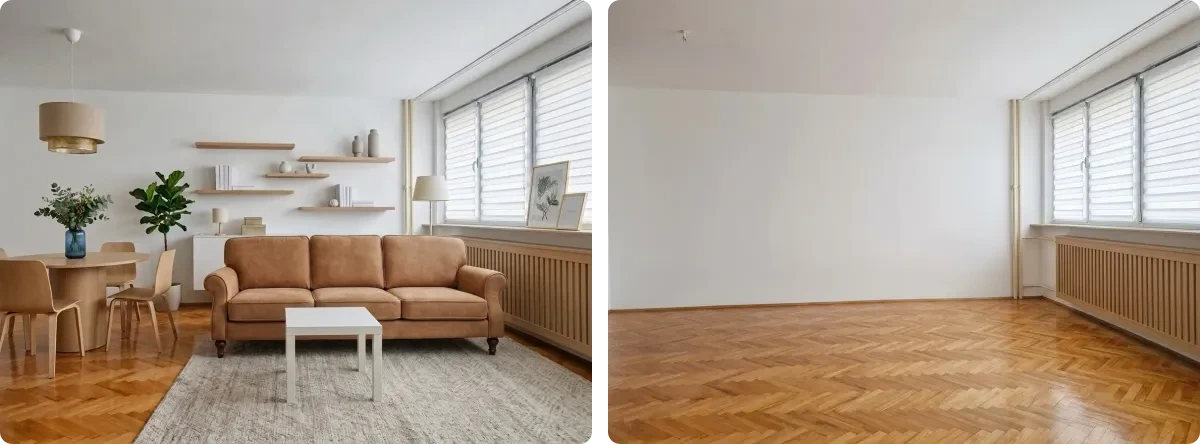
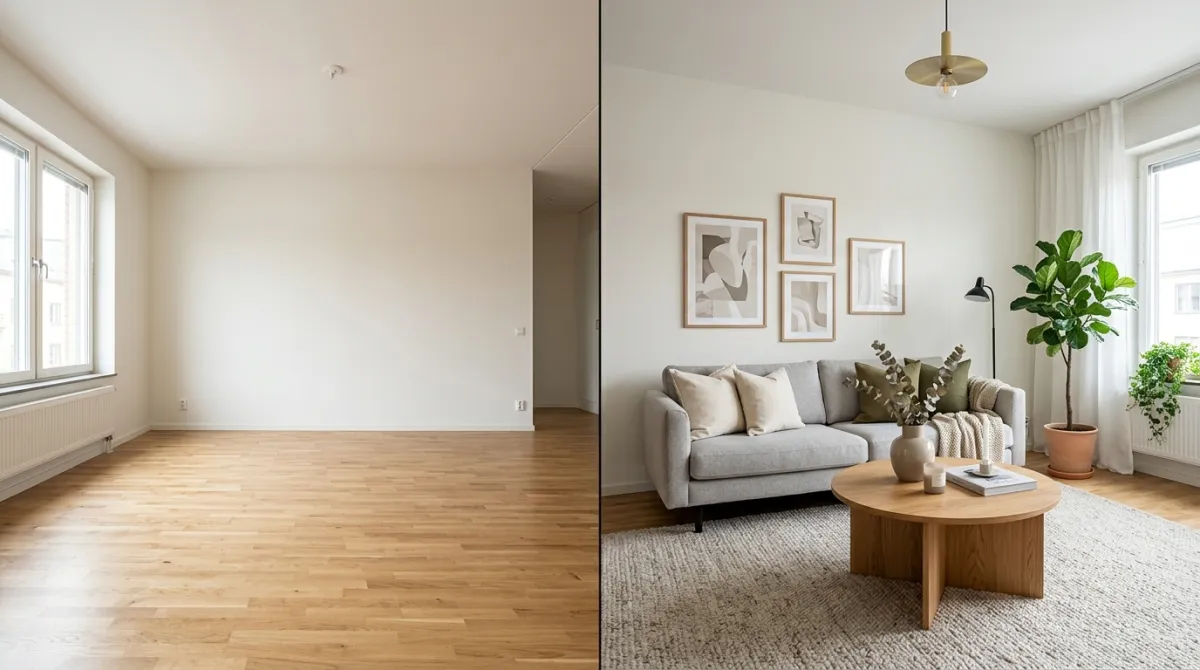
Left, the room as the seller lives in it. Right, the same frame emptied. Defurnishing is the transformation agents ask for most and article roundups cover least, and the hard part is not deleting the sofa: it is continuing the herringbone across the gap and rebuilding the radiator that was behind it.
Decluttering and defurnishing are the same operation at different scales. At the small end it is a bin, a cable, a pet bowl, a family photograph on the wall. At the large end it is the entire contents of an occupied property whose owner is not moving out for your shoot. That second case is the one worth having a tool for, and it is even more acute in lettings, where a unit turns over every couple of years and none of the AI property management platforms touch the photographs at all. The alternative is asking a seller to empty their house, and you can remove furniture from a photo in less time than the phone call would take.
It is not magic, and I will be specific about where it breaks. A sofa on plain carpet against a plain wall comes out clean, because the model only has to continue two flat planes. Herringbone parquet is harder, because the pattern has to line up across the gap. A radiator behind a chair is harder again. Mirrors and glass are the worst case, because the reflection of the thing you removed also has to go, and most tools forget the reflection entirely. Zoom to 100 percent on floors and reflective surfaces before anything reaches a portal.
Virtual staging is the opposite operation and the mistake is treating them as one. Staging starts from an empty room and adds furniture. Defurnishing starts from a full room and takes it away.
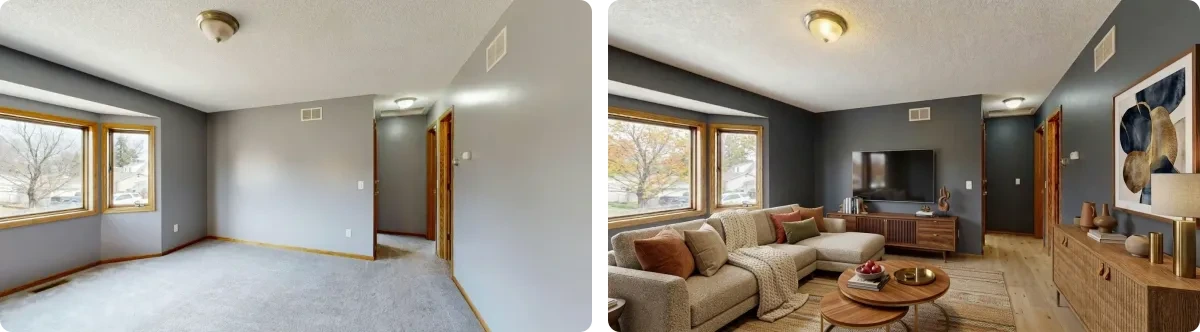
The left frame is a customer’s own listing photograph, carpet and oak trim and all. Note how much the right frame actually changes: this is not only furniture, the walls were repainted and the floor replaced. All three are transformations and all three need disclosing.
For the staging side, this walkthrough takes an empty listing photo, stages it with furniture, lighting and decor, and compares the empty and staged frames.

Whatever you stage, disclose it. The rules are in the last section of this article.
If you are choosing a staging product specifically, we keep that comparison separate in the best virtual staging software roundup, and what AI virtual staging is covers the basics in a page.
Restyling sits between the two. Changing a floor, a wall finish or a facade is not staging, because you are not adding objects, and it is not correction, because the room did not look like that. It is a renovation preview, and it is the most commonly mislabelled edit in listings, usually by people who think that because nothing was added, nothing was changed.
Twilight conversion, and the tell in a bad one
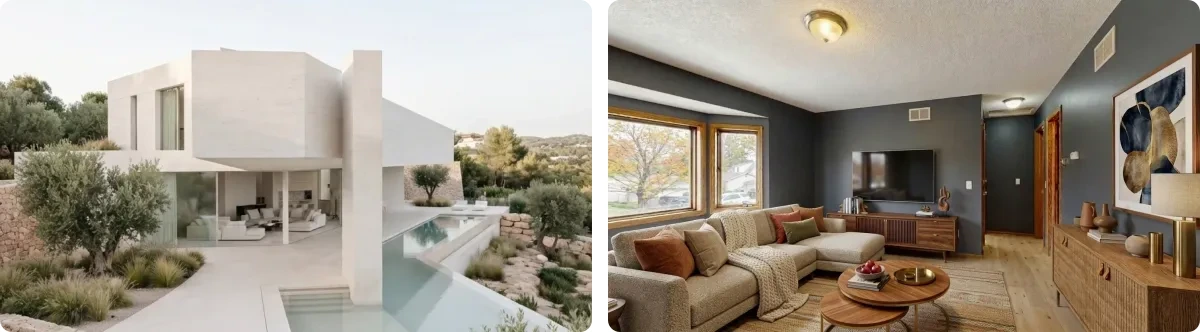
Virtual twilight has been a paid extra in real estate photography for years, because a dusk exterior with warm windows outperforms the same house at midday and every photographer knows it. It is still sold that way: BoxBrownie lists a day to dusk conversion at $5 an image, three times what it charges to enhance the same photo. AI does the conversion well now. Our photo to render tool has a dusk setting that drops the sky to deep blue and switches the interior lights on, which is the same edit a retoucher performs by hand.
The tell in a bad conversion is always the windows. A real twilight shot has lights on inside and warm light spilling onto the terrace. A lazy conversion drops a gorgeous blue sky above a house whose windows are still reflecting midday, and the result reads as wrong even to people who cannot say why. If the tool you are using does not light the interior, it is doing a sky replacement and calling it twilight.

Midday on the left, dusk on the right. These are two renders of the same house rather than one frame converted, which is the honest way to show it. Everything that makes the right frame work is inside the building: lit rooms, warm spill across the terrace, a lit pool. Change only the sky and you get the left frame with a prettier top third.
The tools, and what each one is actually for
Prices below are the public list prices at the time of writing. The column that matters is the last one.
The pattern is hard to miss. The specialists are honest about their lane and the all-rounders are the ones making the broad claim. If a product page says it does HDR merging and virtual staging and object removal and sky replacement, look at which of those has example images and which has only a bullet point.
What it costs, and when AI stops being cheaper
Outsourced human editing sits at roughly $0.50 to $3.00 per image for standard correction work. PhotoUp is at the bottom of that band, starting around $0.50 an image on a credit subscription from $9 a month. BoxBrownie publishes its whole menu, and the menu is the clearest illustration of the split in this article: image enhancement is $1.60 an image, a day to dusk twilight conversion is $5, and virtual staging is $30. Same photo, same supplier, and the transformation costs nearly twenty times the correction. That gap is not margin, it is the amount of work involved once you stop adjusting pixels and start inventing them. The same line runs through upscaling: a pixel-exact pass on a portal-compressed listing photo is correction, a generative re-render is not, and our AI image upscaler comparison shows which engines cross it.
The honest read of that table is that a two-listing-a-month agent should not be buying software at all. The reason to bring editing in-house is not price per image, it is turnaround: an outsourced set comes back tomorrow, and a listing you shot at four can be live at five. If you are weighing the transformation half specifically, the numbers in AI virtual staging versus physical staging costs are the ones to run.
A word about the statistics in this niche
If you have read three articles on this subject you have met the same numbers. Professionally photographed homes sell 32 percent faster and for several thousand dollars more. Drone photography accelerates sales by 68 percent. Virtually staged listings get 40 percent more views. They appear on dozens of vendor blogs, almost always without a link to a primary source, and frequently with a 2026 date attached to research from a housing market that no longer exists.
I am not going to repeat them. The one figure in this area with a real, current, citable source is from the National Association of Realtors, whose 2025 Profile of Home Buyers and Sellers found that 81 percent of buyers rated listing photos the most useful feature of their online search, ahead of everything else in the listing. That is enough to justify the whole workflow. You do not need the invented percentages, and quoting them to a client who checks is a worse outcome than saying nothing.
Where AI still loses
Five failure modes, in the order you will hit them:
Mixed lighting. Covered above. It is a shoot problem wearing an edit problem’s clothes.
Reflections. Remove a lamp and the model removes the lamp. The lamp in the mirror stays. Same for glass cabinet doors, polished floors and television screens.
Structured surfaces. Anything with a repeating pattern that has to continue behind a removed object. Herringbone parquet, patterned tile, brick, panelled walls. The join is usually visible at full resolution even when the thumbnail looks perfect.
Scale drift in staging. Furniture that is subtly too large for the room is the single most common giveaway in a staged photo, and it is why AI renders look fake more often than they look wrong. If you are unsure whether a piece would fit, it is worth being able to measure a room from a photo first.
Exteriors in general. Facades, rooflines and landscaping are harder than interiors for every current model, because there is more geometry and less forgiving lighting.
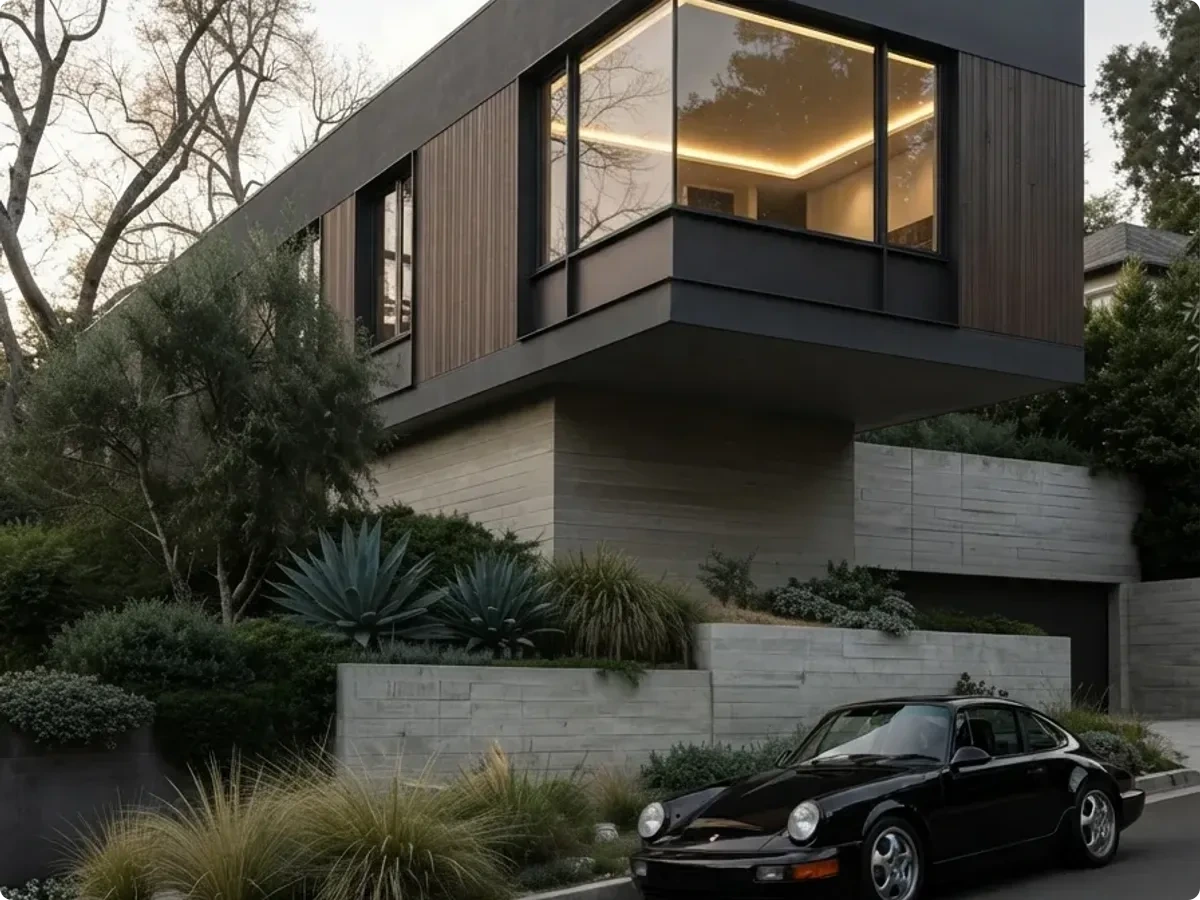
Everything on this frame that an editor would dread is in one place: a cantilever to keep straight, corner glazing that reflects the trees behind the camera, planting with no repeating pattern to fake, and daylight and interior light fighting each other in the same exposure. Interiors are the easy half.
The order to do it in
Sequence matters more than tool choice, and this is the part most agents get wrong. Correct first, transform second, always.
Fix exposure before anything else, because every later step inherits its tone and colour. Straighten verticals while the frame is still untouched, since doing it after an object removal drags the rebuilt pixels and the seams show. Neutralise colour casts by hand, or at the shoot. Then remove what should not be in the listing. Then, and only then, stage, restyle or convert to dusk. Finally, label anything from that last group.
If the listing warrants motion as well, the same rule applies: a video walkthrough should be generated from the final corrected stills, not from the camera originals. Our notes on real estate walkthrough videos go through what that costs.
The line you cannot cross
The split this article opens with is not only a purchasing framework, it is approximately the legal line too. Corrections do not need disclosing, because they make the photo represent the room more accurately. Transformations do, because they change what a buyer sees.
Every major US MLS permits virtual staging and requires it to be labelled, and California turned that from etiquette into statute when AB 723 took effect on 1 January 2026. In the EU, Article 50 of the AI Act has applied since 2 August 2026. Both regimes are covered properly elsewhere: virtual staging disclosure rules for the US position, and the EU AI Act on AI generated images for the European one. The short version: if you added it, removed it or replaced it, label it on the image and keep the original available.
The one people miss is decluttering. Removing a seller’s clutter feels like tidying, not fabricating, so it often goes out unlabelled. It is a transformation. So is a new floor. So is a dusk sky.
Try it on a set you already have
The fastest way to work out which half of this you actually need is to take one listing you have already shot and run it through both. Send the brackets to a correction tool and see how much of your editing evening disappears. Then take the one room that let the set down and upload it to MeltFlex to defurnish or stage it. If you want a feel for how the transformation half is prompted before you commit, our real estate prompt set is the shortest route, and AI virtual staging for real estate photographers covers how this lands in a photographer’s workflow specifically. The first design is free.
Frequently asked questions
Can AI edit real estate photos properly, or is it still a gimmick?
For correction work it is genuinely finished. AI HDR merges, vertical and lens correction and sky replacement are now better and around a hundred times faster than doing it by hand, and the output is indistinguishable from a good manual edit. One job on that list is not solved: mixed colour casts, where tungsten, fluorescent and window daylight meet in the same room. No AI merge reliably separates three light sources from a single set of brackets, which is why professional shooters still shoot flambient and fix colour with flash rather than software. Transformation work, meaning decluttering, staging and restyling, is a different product with different economics and its own legal duties.
What is the best AI real estate photo editing software?
There is no single one, and any article that names one is comparing tools that do different jobs. For correction, AutoHDR and On1 are the specialists and Lightroom does most of it natively. For transformation, you want a tool that rebuilds the room rather than pasting furniture over it. Outsourcing desks like BoxBrownie and PhotoUp sit across both at a per-image price. The practical answer for most agents is one correction tool plus one transformation tool, because the vendors who claim to do both usually do one of them badly.
How much does real estate photo editing cost per image in 2026?
Outsourced human editing runs roughly $0.50 to $3.00 per image for standard correction work, with PhotoUp at the bottom of that band. BoxBrownie is the clearest published menu: $1.60 for image enhancement, $5 for a day to dusk twilight conversion and $30 for virtual staging, which shows exactly how much more a transformation costs than a correction on the same photo. AI subscriptions do not price per image at all, which is the whole point: they price per month, so the per-image cost falls the more you shoot. The crossover is volume, not quality.
What is the difference between HDR and flambient real estate photography?
HDR merges several exposures of the same frame to hold both a bright window and a dark interior. Flambient, a contraction of flash and ambient, blends an ambient exposure with a flash exposure of the same room. The reason professionals still bother with the extra frame is colour, not dynamic range. Flash overpowers the mixed indoor lighting and neutralises the orange and green casts that HDR merging cannot remove, because those casts are present in every bracket. If your rooms come back with a warm cast on one wall and a green one on the other, the fix is a flash frame, not a better AI merge.
Is AI decluttering the same as virtual staging?
No, and mixing them up leads to buying the wrong tool. Decluttering, sometimes called defurnishing, removes what is in the photo and rebuilds the floor, skirting and wall behind it. Virtual staging starts from an empty room and adds furniture. If the property is occupied and the owner is not moving out for the shoot, you need the first. If the property is already empty, you need the second. Both are transformations and both need disclosing.
Do AI edited listing photos have to be disclosed?
It depends entirely on which half of the workflow you are in. Corrections do not need disclosing: exposure, verticals, white balance and lens correction make the photo represent the room more accurately, not less. Transformations do. Adding furniture, removing an object, changing a floor or converting a daytime exterior to dusk all alter what a buyer sees, and every major US MLS requires that to be labelled, with California making it a statutory duty since AB 723 took effect on 1 January 2026. In the EU, Article 50 of the AI Act has applied since 2 August 2026.
Can AI remove furniture from a photo without leaving artefacts?
Usually, on ordinary surfaces. A sofa on a plain carpet against a plain wall comes out clean, because the model only has to continue two flat planes. It gets harder fast when the surface has structure: herringbone parquet that has to line up across the gap, patterned tile, a radiator, or skirting that runs behind the piece. It gets hardest with mirrors and glass, because the reflection of the removed object also has to go, and most tools miss that. Zoom to 100 percent on floors and reflective surfaces before you upload anything to a portal.
Is virtual twilight worth it, and can AI do it?
AI can do a convincing dusk conversion from a daytime exterior, and it is one of the few edits buyers genuinely respond to, which is why photographers have charged extra for it for years. The tell in a bad one is always the windows: a real twilight shot has interior lights on and warm light spilling out, and a converted one often has a beautiful blue sky above a house whose windows are still reflecting midday. If the conversion does not light the interior, it will read as fake to anyone who has seen a real twilight shoot.