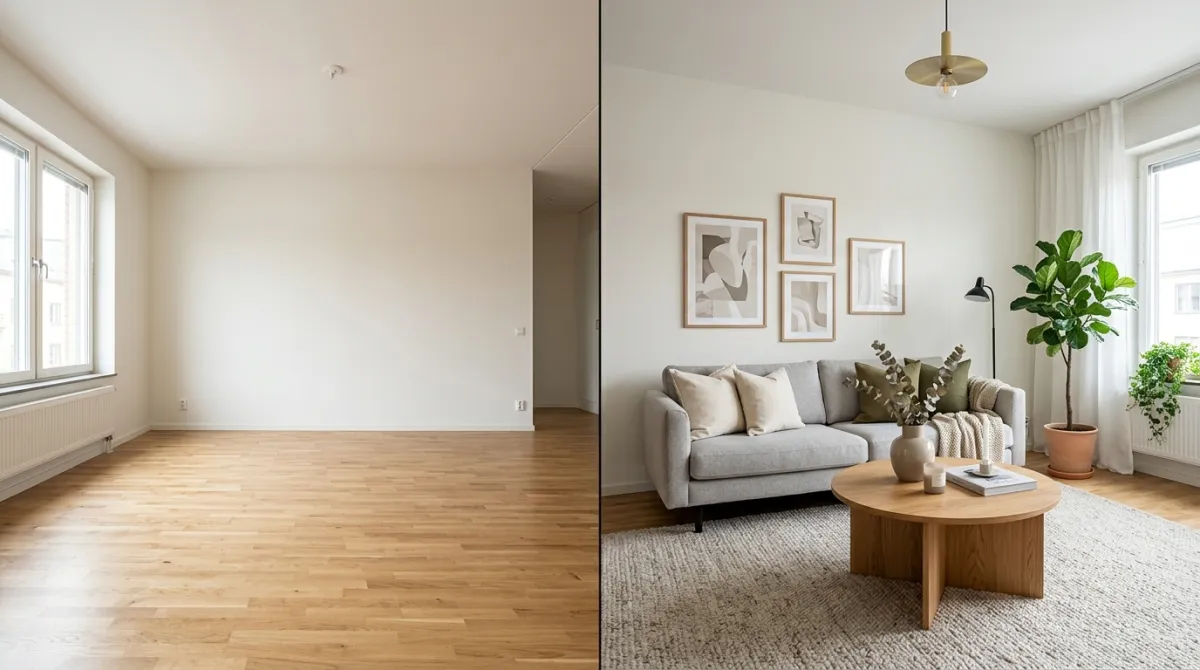
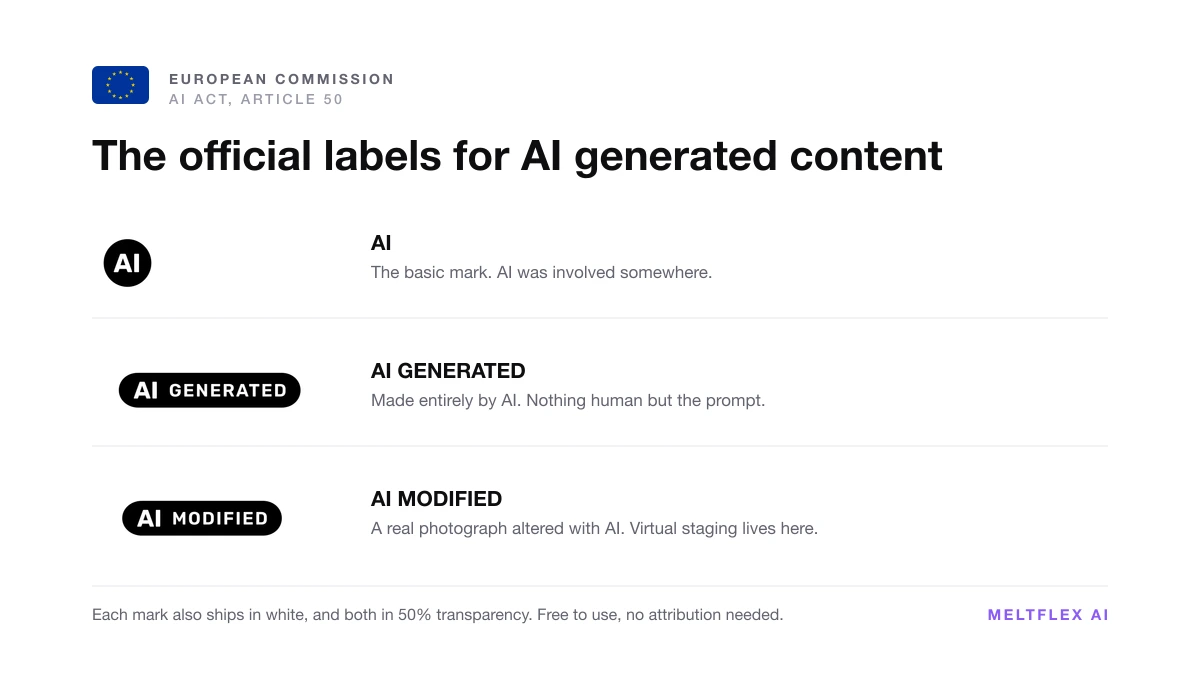
If you publish AI generated pictures of rooms or buildings as part of a business inside the EU, most of them now need a visible AI label. Article 50 of the AI Act started applying on 2 August 2026. The test is not whether the image is beautiful or honest, it is whether a viewer could take it for a photograph. A restaged listing photo needs a label. A photorealistic render of an apartment that does not exist needs one too. A 2D floor plan or an obviously stylised board does not. If you are a private person redesigning your own home, none of this applies to you. That is the short version. The long version matters, because the guidance written so far has been produced by law firms explaining the article in the abstract, and none of it answers the question a designer, architect or estate agent actually has.
Our articles are still written by humans!
Get human written articles in your Google feed.
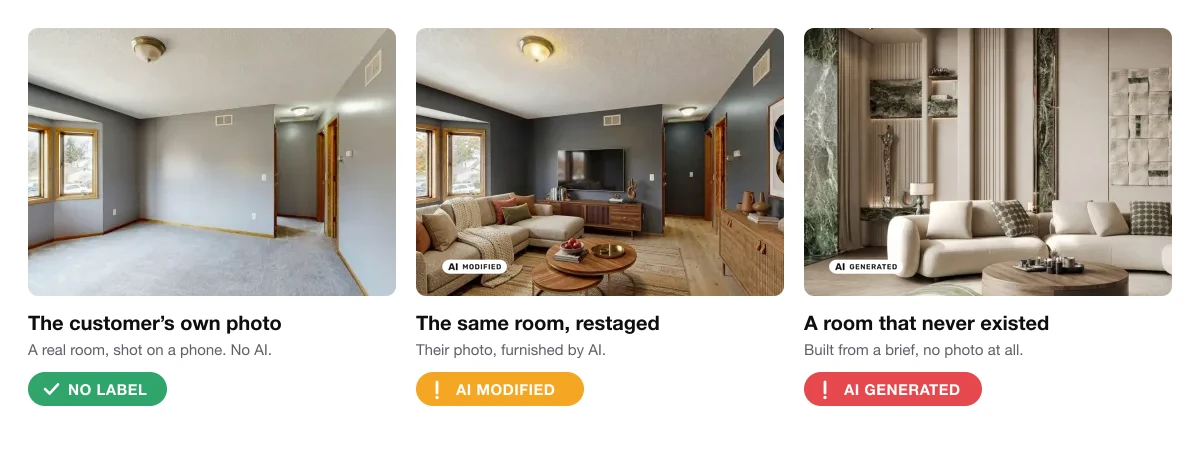
The whole rule in one row. All three are from our own gallery, and the labels are the Commission’s real artwork, not an illustration of it. The middle image is the left image, restaged, which is exactly why it gets the softer mark.
I write this as someone who has to comply with it. MeltFlex is a Slovak company, so we are inside the single market, and our users publish AI renders of real properties every day. We spent the first week of August reading the guidelines rather than the headlines, and a fair amount of what is circulating on LinkedIn is wrong in both directions. Some of it says nothing changes for images. Some of it says every render now needs a watermark. Neither is right.
FreeUpload photo · freeRedesign my room for freeUpload a photo and let MeltFlex design your space. Your first AI design is free, no card needed.


What actually changed on 2 August 2026
The AI Act has been law since 2024, but it phases in. The transparency chapter, Article 50, is the part that reached its application date this month. Two obligations sit in it and they land on two different parties, which is the single most common thing people get wrong.
Content that was generated and already published before 2 August 2026 does not have to be relabelled. That is stated in the Code of Practice and it is the one genuinely generous piece of this. It does not extend to an archive image you republish today, because putting it back in front of people is a fresh act of making it available.
Is a render of a room really a deepfake?
This is where nearly everyone stops reading and guesses. The word deepfake carries twenty years of baggage about fake politicians, so the instinct is that a picture of a sofa cannot possibly be one. The AI Act does not use the word that way. What Article 50(4) covers is AI generated or manipulated image content that resembles real persons, objects, places, institutions or events, including realistic looking fictional subjects, and that could be mistakenly perceived as genuine.
Read that clause slowly, because two phrases in it do all the work. Places and objects means a room qualifies, no person required. Including realistic looking fictional subjects means the room does not even have to exist. That second phrase is the one that catches the design industry, and it is why the reassuring take doing the rounds, that pure fiction is safe, is wrong.
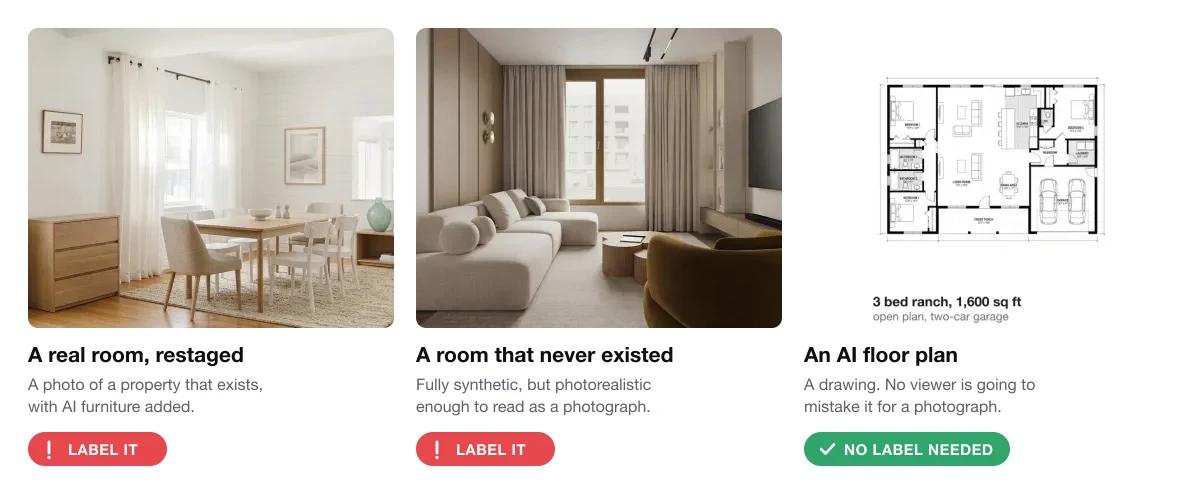
All three came out of our own tools. Only the drawing escapes, and it escapes because it is a drawing.
So the honest answer for our industry is uncomfortable but simple. The better your renders get, the more certainly they are in scope. Every hour the field has spent chasing photorealism, and the anatomy of a photorealistic interior render is a whole article about chasing it, has been an hour spent moving your output deeper inside Article 50. A render that still reads as CGI is out. A render nobody can tell from a photograph is in. That is a genuinely strange incentive and it is worth saying out loud rather than pretending the law is neatly drawn.
One thing that gets forgotten: Article 50(4) says image, audio or video content. An AI listing walkthrough is caught by exactly the same test as the still it was built from, and video is harder to label properly because the disclosure has to be there at first exposure rather than in the end card. If you produce AI video walkthroughs or work from AI video generators for real estate, put the label on the opening frame and leave it up long enough to read. The same goes for exterior work: a photorealistic facade from an AI exterior design tool is in scope for the identical reason an interior is.
The test, as a flowchart
Four questions decide it. Most images resolve in under ten seconds once you stop thinking about deepfakes and start thinking about whether the picture could pass for a photo.
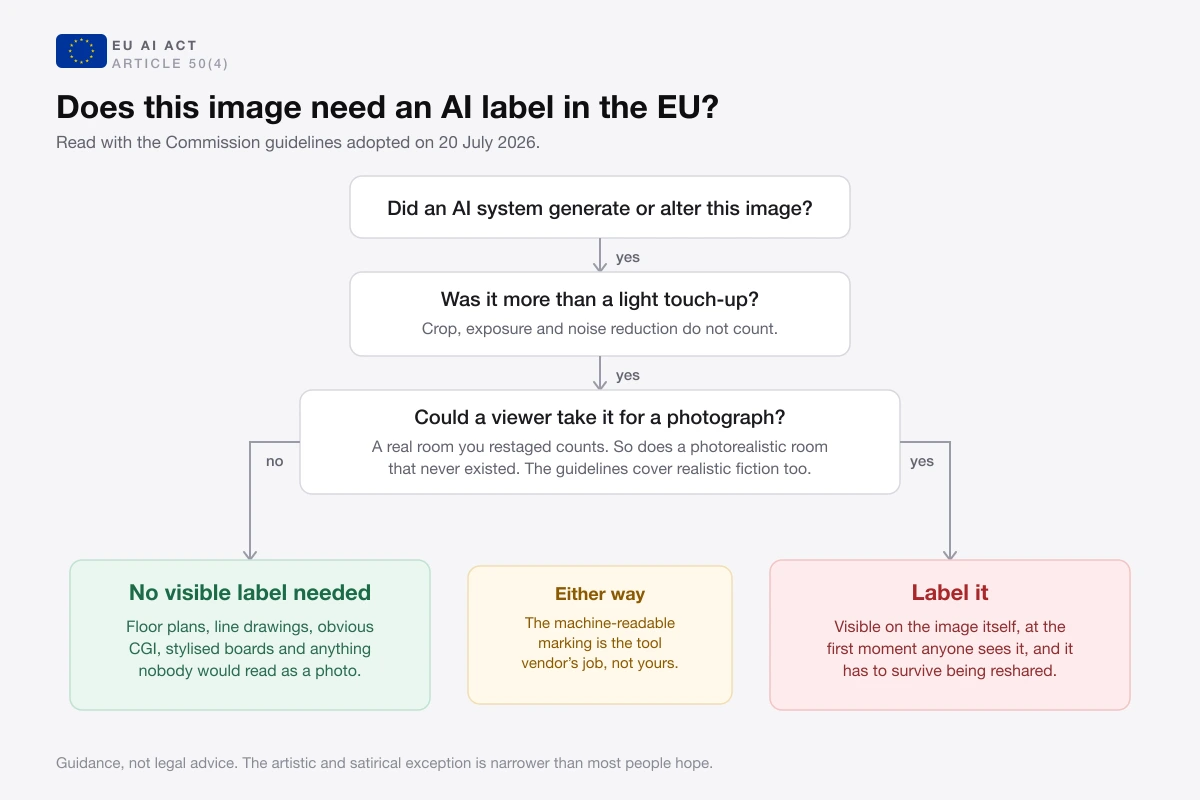
Guidance, not legal advice. If a deal or a licence rides on it, ask a lawyer in your member state.
The second question is worth dwelling on, because it is the one that saves photographers a lot of pointless labelling. Article 50(2) carves out assistive editing functions that do not substantially alter the input. Straightening a wall, lifting the shadows, pulling noise out of a dark bedroom shot, none of that turns a photograph into synthetic content. Removing the vendor’s furniture and putting different furniture in does.
Who is caught: the personal use line
The obligation in 50(4) lands on deployers. The Commission FAQ defines a deployer as someone using an AI system under their authority and expressly excludes use in a personal, non-professional capacity. You cross the line when the use sits inside a business, trade, occupational or freelance activity, or when you gain an economic benefit from it on a regular basis.
For a tool like ours, that splits the user base almost cleanly in half, and the half that panics is usually the half that does not need to.
There is a contractual trap in that table. If a studio produces the renders and an agency publishes them, the agency is the deployer and carries the obligation, but the studio is the one that knows which images are synthetic. We have already seen this argued in a handover, and the fix is boring: name the labelling duty in the delivery contract and hand over labelled files by default. Whoever presses publish is exposed, so do not make them guess.
Note what the guidelines are built around: content made available to people. A render you show one client in a meeting is a much weaker case than a render on a portal seen by thousands, though the text does not hand you a written exemption for it. Several studios we have spoken to are labelling client decks anyway, on the grounds that a one line footer costs nothing and an argument costs a day.
The half that is not your job
Article 50(2) requires providers of generative AI systems to mark outputs in a machine readable format and make them detectable as artificially generated. Provider means the people who built and ship the model. If you use Midjourney, OpenAI, Google or MeltFlex, that obligation is ours and theirs, not yours. You cannot discharge it and you are not liable for it.
You should still know which tools do it, because a supplier who ignores this is a supplier whose output you may one day have to defend.
That last row is not a cheap shot, it is a planning problem. If your studio’s concept pipeline runs through Midjourney architecture prompts, your files carry no provenance at all, and the visible label becomes your only disclosure. Worth knowing before a client asks you to prove which images were synthetic.
Why metadata will not save you
Plenty of the compliance content published this summer suggests that if the file carries Content Credentials you are covered. In a design workflow that is close to useless, and the reason is mundane rather than legal.
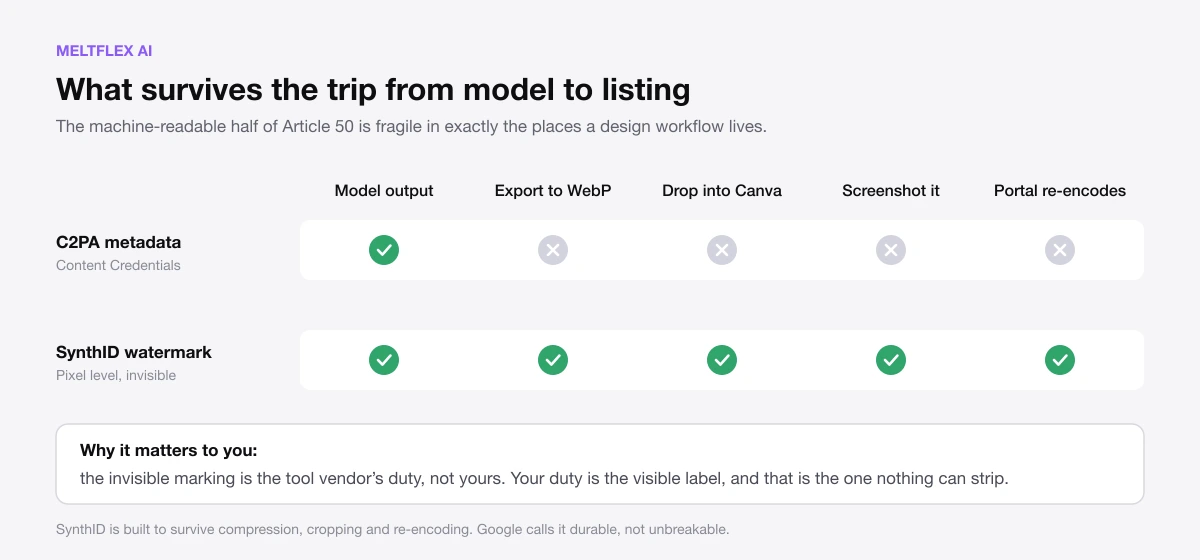
Every step after the first is something a normal studio does before lunch.
C2PA lives in metadata, and metadata is the first thing an export throws away. Convert to WebP for the web, drop the file into Canva to add a logo, take a screenshot because it was faster, upload to a portal that re-encodes everything it receives, and the manifest is gone four times over. Pixel level watermarks like SynthID survive that trip, which is the whole point of putting the signal in the pixels, though Google is careful to call it durable rather than unbreakable.
To be fair to the standard, that chart is about the plain metadata binding. Adobe’s Durable Content Credentials pair the manifest with an invisible watermark and an image fingerprint, so provenance can be recovered even after the metadata is stripped. It is a real improvement and it does not change the conclusion below.
Neither of them is visible to a buyer scrolling a listing on a phone. Article 50(4) asks for disclosure to a person, at the latest at the moment of first exposure. Only the visible label does that job.
How to place the label so it actually counts
The Commission’s display standards ask for a label that is clearly perceivable and distinguishable at the latest at the time of first exposure, embedded directly into the content rather than sitting beside it, and still visible when the content is reshared or downloaded. Read as a workflow instruction, that means one thing: put it in the pixels.
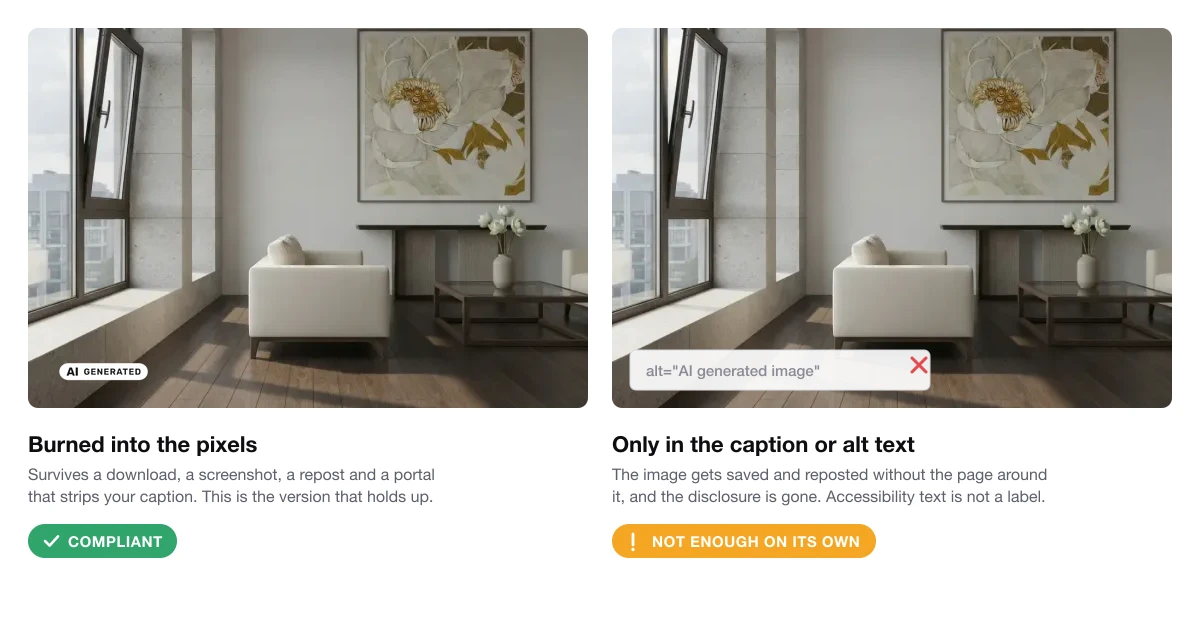
The right hand version disappears the moment somebody saves the image and posts it somewhere else, which on a property listing is within the hour.
Four placements people try, ranked by how well they survive contact with the real internet.
Keep the wording plain. “AI generated image” or “Digitally staged, AI generated furniture” both work. “Enhanced with technology” is the kind of phrasing that reads as an attempt not to disclose, and a regulator will read it that way too.
The official EU icons, and whether to use them
The Commission has published a free icon set to go with the Code of Practice. There are three marks: a basic one for when AI was involved at all, one for content that is fully AI generated with no human element beyond the prompt, and one for content that is partially AI modified, meaning pre-existing human content altered with AI. Each ships in four versions, black, white, and both at 50 percent transparency, so one of them will sit on a bright kitchen and a dark bedroom alike.
That middle distinction maps onto our industry more neatly than anything else in the package. A room generated from a text brief is fully AI generated. A photograph of a real apartment with AI furniture added is partially AI modified, because you started from a human photograph. If you are going to use the icons, use the right one, because using the softer mark on restaged property photos is exactly the kind of detail that looks deliberate in hindsight.
The three marks at the top of this article are the actual set, at the size they are meant to sit, and the row under the opening paragraph shows which one lands on which kind of image.
Using the official icons is optional. The obligation to disclose is not. Every label you have seen in this article is the real artwork, downloaded from the European Commission icon page, which publishes them for anyone to use freely and without attribution to the Commission or the AI Office. Two zip files, SVG and PNG, four colour versions each, and it takes about a minute. If you have signed the Code of Practice, the placement specifications are binding on you. If you have not, your use should not imply that you have.
One detail from the Commission’s own testing is worth stealing. Recognition improved across every measure when the basic icon was accompanied by a text label rather than left to stand alone. So the bare AI circle is the weakest of the three. On a property photo, use the version that spells out GENERATED or MODIFIED.
What MeltFlex does, and what it does not
Fair is fair, so here is our own position rather than a vendor answer. Our renders come out of Google’s image models, which means every image the platform produces carries a SynthID watermark at pixel level. On the provider side of Article 50(2), that is the machine readable marking, and it survives the export and re-encode chain in the graphic above.
What we do not do today is stamp a visible AI label on your download. Free tier files carry a MeltFlex brand watermark and paid plans download clean, and neither of those is an Article 50(4) disclosure. Both the design workspace and the virtual staging tool hand you a file and leave the deployer duty with you. I would rather write that plainly than let anyone read a SynthID watermark as compliance, because it is not: the mark is invisible, and an invisible mark discloses nothing to a buyer.
A visible, one click AI label on export is on our list precisely because of this deadline. Until it ships, the label is your job, and the checklist below is what we actually recommend to studios who ask.
The practical checklist
Ten minutes of setup covers most of the exposure. This is written for a small studio or an agency, not a compliance department.
- Sort your output into two buckets. Photorealistic goes in one, drawings and obviously stylised work in the other. Only the first bucket needs a label. An AI floor plan or a schematic layout is a drawing and stays out.
- Label the restaged property photos first. Anything where you altered a real place is the clearest case in the whole Act, and property is where a complaint actually comes from.
- Burn the label in at export. A preset in whatever you already use for logos costs one afternoon and then never costs anything again.
- Use the right icon. Fully AI generated for text to image, partially AI modified for anything that started as a real photograph.
- Fix the handover contract. Say in writing who labels and deliver labelled files by default, because the publisher is the one exposed.
- Do not rely on the portal. A portal flag protects you on that portal and nowhere else, and listing images travel.
- Leave the archive alone. Anything published before 2 August 2026 is fine where it stands. Label it when you republish it.
- Check what your tools mark. If a supplier ships no provenance at all, know that before a client asks rather than after.
If your work runs through a repeatable pipeline, the AI workflow for interior designers is where the labelling step belongs: at export, not at upload, so it lands on the file everybody actually receives.
What non-compliance is actually worth
Article 99(4) puts breaches of Article 50 at up to 15 million euro or 3 percent of total worldwide annual turnover for the preceding financial year, whichever is higher. That number gets quoted a lot and it is aimed at platforms, not at a six person studio.
The provision that matters to most readers here is Article 99(6), which for SMEs including start-ups reverses the rule and caps the fine at the lower of the two figures. For a studio turning over a million euro, that is 3 percent rather than 15 million. Still not a number you want, and it sits alongside the ordinary commercial risk: a portal delisting your images, a client asking who signed off the visuals, a competitor filing a complaint because filing one is free.
Enforcement runs through national market surveillance authorities, which is why the practical answer differs between Ireland and Italy. There is no published record of a first Article 50 image fine as of 11 August 2026, nine days in. Anyone telling you how the first enforcement wave will go is guessing.
What buyers actually do when they spot it
The fine is the boring risk. The interesting one is that the audience is already policing this without any help from a regulator, and they are worse at forgiving it than a market surveillance authority would be.
The clearest example is a listing posted to r/zillowgonewild under the title “An egregious use of AI to imagine the potential of this investor opportunity”, where the primary photo was an AI render showing landscaping and structural upgrades the house does not have. As The Cool Down reported in March 2026, the comments are not a debate about technology. “I wish there was a way to report these.” “Not disclosing you’re using AI and especially using an AI image as the main photo in your listing is unethical as hell.” “Who are they trying to trick with this?” “If not unethical, it should be. Should probably be illegal.” I have not read that thread myself, because Reddit blocks the crawler I use, so treat those as quoted through the reporting rather than pulled first hand.
What makes people angry there is not the render. It is the silence around it. That pattern shows up in the research too, and one finding maps onto property with uncomfortable precision.
Sit with that middle row for a second. Buying or renting a home is close to the most high involvement decision a consumer ever makes, which is precisely the condition under which the paper finds the penalty is worst. The category that most wants to use AI images is the category where audiences punish them hardest.
I do not read that as an argument against AI renders, and MeltFlex would be a strange place to make one. I read it as an argument that the label is cheap and the concealment is expensive. The people in that thread were not upset that a house had been visualised. They were upset that nobody told them. Article 50 has simply made the cheap option compulsory.
If you are outside the EU
The AI Act reaches you if your output is put on the EU market or the results are used in the Union, so a US staging company serving a Spanish portal is not outside it. Separately, the United States has been moving on the same problem from a different direction, with California’s AI Transparency Act operative from 2 August 2026 and AB 723 requiring disclosure of digitally altered listing photos since January. We keep that material in its own place: the virtual staging disclosure rules cover AB 723, NAR and the MLS side, because mixing two legal systems into one article is how people end up applying the wrong one.
The bottom line
The industry reaction to this has been noisier than the rule deserves. If you make photorealistic pictures of spaces for money and publish them in Europe, put a visible AI label on them and move on. If you make drawings, or you are redesigning your own flat, you were never in scope. The genuinely awkward part is not the paperwork, it is that the rule keys off realism, so the closer your architectural rendering tools get to photography, the more certainly the output is regulated. That is worth understanding rather than resenting.
If you want to see what falls on which side of the line with your own images, upload a room to MeltFlex and look at what comes back. A photo of your room restaged with virtual staging software is the labelled case, a photo to render pass that still reads as a render is arguable, and a plan is not in scope at all. The first design is free, and it is a faster way to understand the test than any amount of reading about deepfakes.
Frequently asked questions
Do AI generated interior renders need a label in the EU?
If you publish them in the course of a business, usually yes. Article 50(4) of the AI Act requires deployers to disclose AI generated or manipulated image content that a viewer could mistake for something genuine, and the Commission guidelines adopted on 20 July 2026 read that broadly enough to cover photorealistic images of places that do not exist. A photorealistic render of a living room falls inside. A 2D floor plan, a line drawing or an obviously stylised board does not, because nobody would take it for a photograph. The obligation has applied since 2 August 2026.
Does the EU AI Act apply to me if I redesign my own home?
No. The Commission FAQ excludes people using an AI system in a personal, non-professional capacity from the definition of a deployer. If you upload a photo of your own living room to see it with a different sofa and send the result to your partner, no labelling obligation attaches to you. The moment the same image is used in a business, trade, freelance or occupational activity, or you gain an economic benefit from it on a regular basis, you are a deployer and Article 50(4) applies. This is the single most misunderstood part of the rule, and it exempts most people who use AI interior design tools at home.
What happens if I do not label AI generated images?
Article 99(4) sets administrative fines of up to 15 million euro or 3 percent of total worldwide annual turnover for the preceding financial year, whichever is higher, for breaching Article 50. For SMEs, Article 99(6) reverses that and caps the fine at the lower of the two figures, which for a small studio means the percentage rather than the headline number. Enforcement sits with national market surveillance authorities, so what actually happens to you depends on which member state you are in. There is no EU wide register of first fines yet, and anyone quoting one is guessing.
Is virtually staged furniture in a real property photo a deepfake?
Under the AI Act definition, it is the clearest case on the list. The content is AI manipulated, it resembles a real place, and a buyer could easily believe the sofa is in the room. That is the whole test. It does not matter that the practice is honest, disclosed on the portal or standard in the industry. Restaging a photo of a property that exists puts you squarely inside Article 50(4), which is why it is the one case where studios should not be arguing about interpretation. If this is your workflow, see how AI virtual staging fits real estate photography before you argue the point.
Does the artistic exception cover interior design and architecture?
Almost never, and this is where most people misread the law. Article 50(4) limits disclosure where the content forms part of an evidently artistic, creative, satirical or fictional work, and then only so the disclosure does not hamper enjoyment of the work. The test is whether the work is evidently artistic, not whether your profession is creative. A marketing render of an apartment for sale is commercial communication no matter how beautiful it is. A concept image in an exhibition catalogue is a much better argument.
Do I need to add a watermark or is metadata enough?
You need the visible disclosure. The machine readable marking under Article 50(2) is the duty of the provider of the AI system, meaning the tool vendor, not you. Relying on metadata alone also fails in practice: C2PA Content Credentials are stripped by an ordinary export, a screenshot or a portal re-encode, while a pixel level watermark like SynthID survives but is invisible to the person looking at the picture. The only disclosure that reliably reaches a human is one placed on the image itself.
Do I have to go back and label images published before August 2026?
No. The Code of Practice published on 10 June 2026 states that AI generated or manipulated outputs which were generated and already made available before 2 August 2026 do not need to be marked or labelled retroactively. There is also a grace period to 2 December 2026, introduced by the AI Omnibus, for generative systems placed on the market before 2 August 2026. Neither of those helps with an old image you republish today, because republishing it is a fresh act of making it available.
What are the EU icons for labelling AI generated content?
They are a free icon set published by the European Commission to support the Code of Practice. There are three: a basic icon for when AI was involved, one for content that is fully AI generated, and one for content that is partially AI modified. Each comes in four versions, black, white, and both at 50 percent transparency. Using the official icons is optional. The labelling obligation is not. Signatories of the Code of Practice do have to follow the placement specifications if they use them.
Will labelling my renders as AI hurt enquiries?
The evidence says concealment hurts more. A Klaviyo and Datalily survey of 8,000 consumers across eight markets in December 2025 found 31 percent trust a brand less when marketing content is visibly AI generated, against 7 percent who trust it more, so the label is not free. But research by Belanche and colleagues in the International Journal of Information Management, volume 85, December 2025, found that customers avoid services advertised with AI images at all, and that the rejection is strongest for high involvement decisions, which is exactly what buying a home is. The reasons people gave were that AI images feel impersonal, less professional and potentially misleading. The damage comes from being caught, not from disclosing.
Sources
- AI Act, Article 50: transparency obligations for providers and deployers
- European Commission, guidelines on transparency obligations, adopted 20 July 2026
- Code of Practice on transparency of AI generated content, published 10 June 2026
- EU icons for labelling AI generated content
- Commission FAQ on Article 50, including the definition of a deployer
- AI Act, Article 99: penalties, including the SME cap in 99(6)
- Belanche et al., “Customer reactions to generative AI vs. real images in high involvement and hedonic services”, International Journal of Information Management, volume 85, December 2025
- Klaviyo with Datalily, 2026 AI Consumer Trends: 8,000 consumers across eight markets, surveyed December 2025, via eMarketer
- The Cool Down, March 2026, reporting the r/zillowgonewild listing thread and its comments
Written on 11 August 2026, nine days after Article 50 started applying. This is a working guide from a company inside the same rules, not legal advice. Where a real decision turns on it, take advice in your own member state.