Japandi is the rare trend that survived long enough to stop being one. The name is recent, but the fusion is not: design historians trace the Japanese-Danish exchange back to the 1860s, when naval lieutenant William Carstensen's book about newly opened Japan sent Danish designers into a century-long dialogue with Japanese craft. That pedigree shows in how the style behaves today: it keeps topping style searches, and in our own cost analysis of 14 living room styles it came out as the single most expensive look to furnish, precisely because it refuses cheap materials. And yet most rooms tagged japandi on Pinterest get it wrong in the same two ways: they treat it as beige minimalism, or they treat it as a Japan-themed decor haul.
Our articles are still written by humans!
Get human written articles in your Google feed.
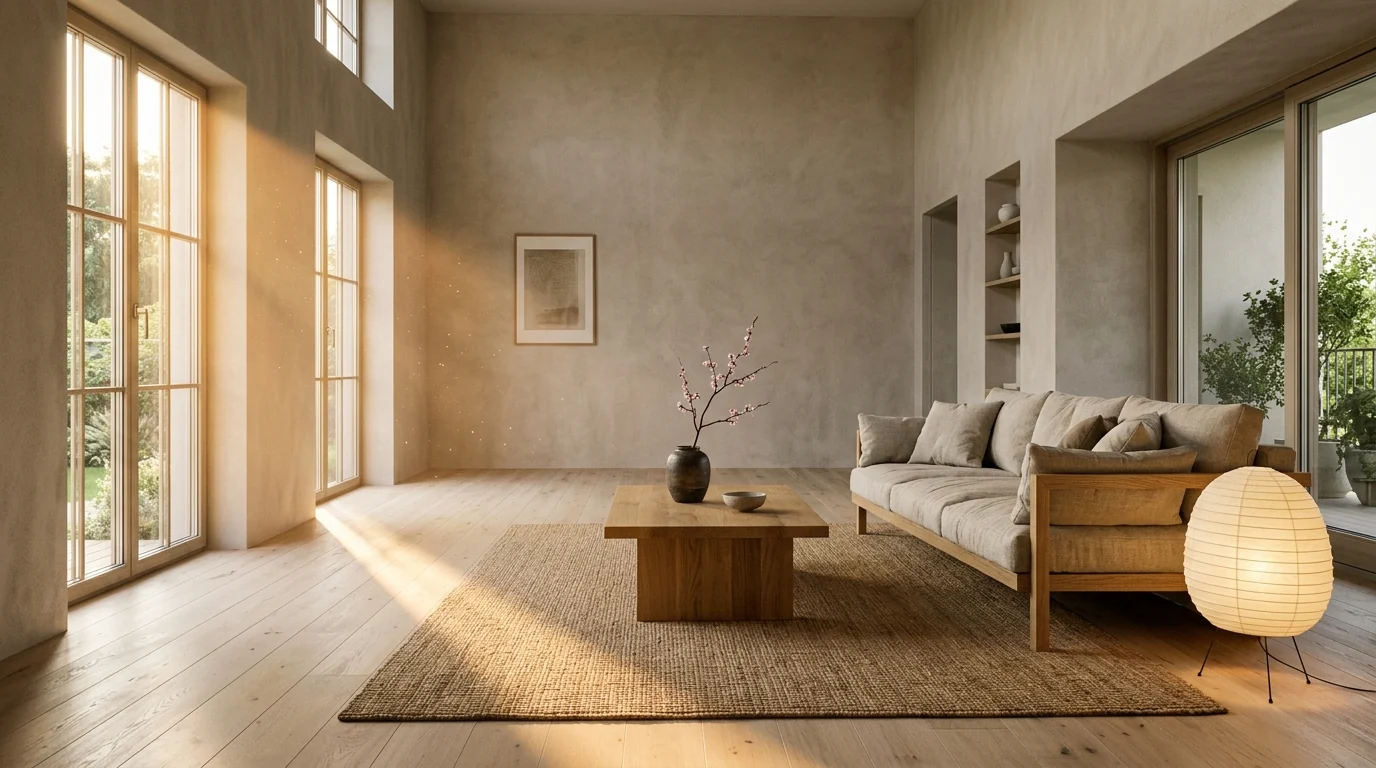
A japandi living room is built from a low furniture line, natural materials with visible texture, a muted earthy palette, soft diffused light, and deliberate empty space, with Japanese restraint setting the rules and Scandinavian warmth keeping the result livable. That one sentence is the whole style. The 18 ideas below are 18 ways to apply it, each one rendered so you can see the exact move, not guess it from adjectives. For the philosophy behind the style, the wabi-sabi roots and the room-by-room breakdown beyond the living room, start with our complete japandi interior design guide; this article goes deep on the one room where the style is hardest to get right.
A note on the images: every room in this article is an AI render we generated with the same MeltFlex engine you can use on a photo of your own living room. That is a feature, not a confession. It means each image shows one idea in isolation, under lighting we chose to make the idea legible, instead of a stylist's room where fifteen decisions compete for credit.
1. Start With a Low Furniture Line
Before palette, before materials, japandi is a horizon. Traditional Japanese interiors are lived close to the floor, and the single fastest way to make a Western living room read japandi is to drop every major piece: a platform sofa with a solid oak base, a coffee table under 14 inches, a media console that hugs the skirting. The empty wall above the furniture is not wasted space, it is the point. When the top two thirds of the room are calm, the eye slows down the moment you walk in.
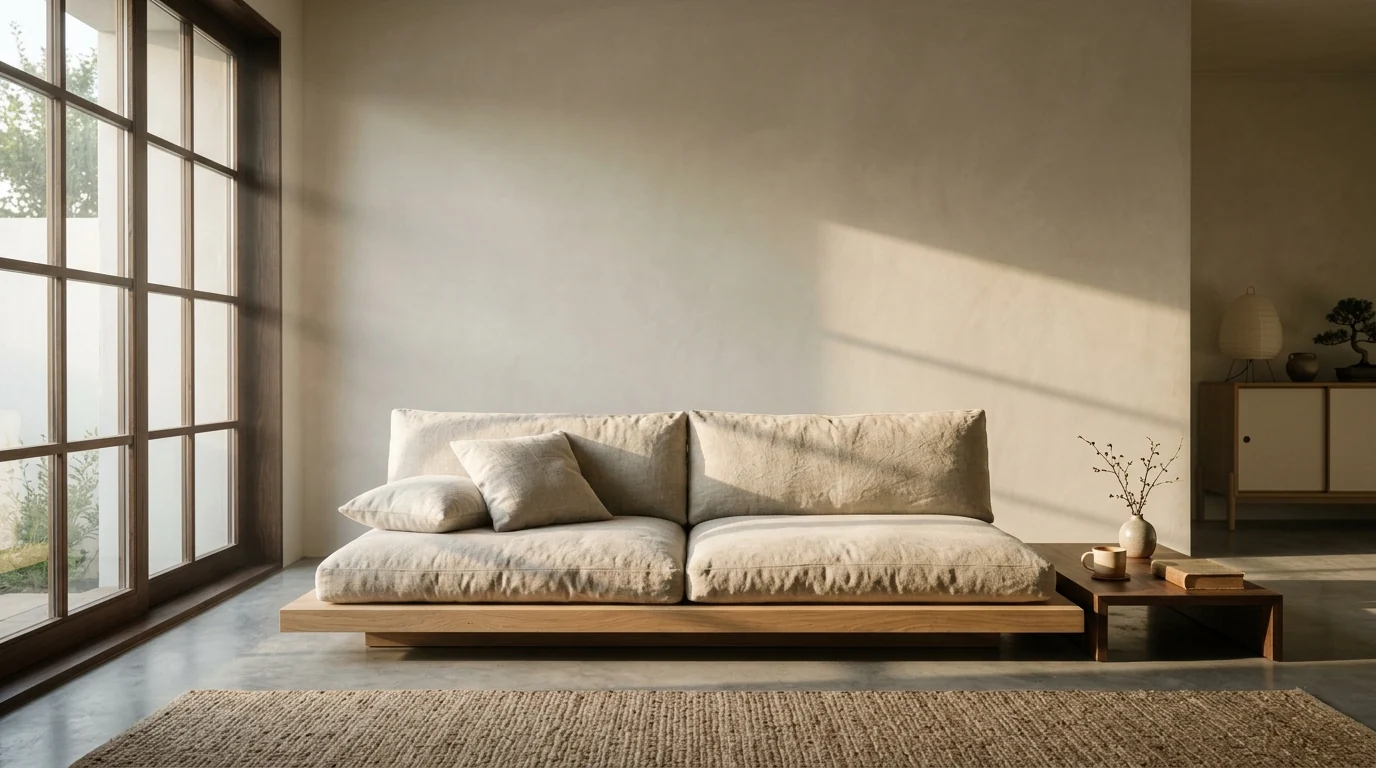
The practical test: sit down. If your sightline clears the back of every piece of furniture in the room, the line is right. This is also why japandi flatters small rooms, which we cover in idea 12, because low furniture makes ceilings feel higher without a single trick.
2. Give the Walls a Limewash Skin
Flat paint is the biggest missed opportunity in most japandi attempts. Limewash dries with a cloudy, mineral movement that does two jobs at once: it adds the imperfect, handmade quality the style inherits from wabi-sabi, and it gives raking light something to catch. The same greige that looks dead in vinyl matt becomes weather on a wall in limewash.
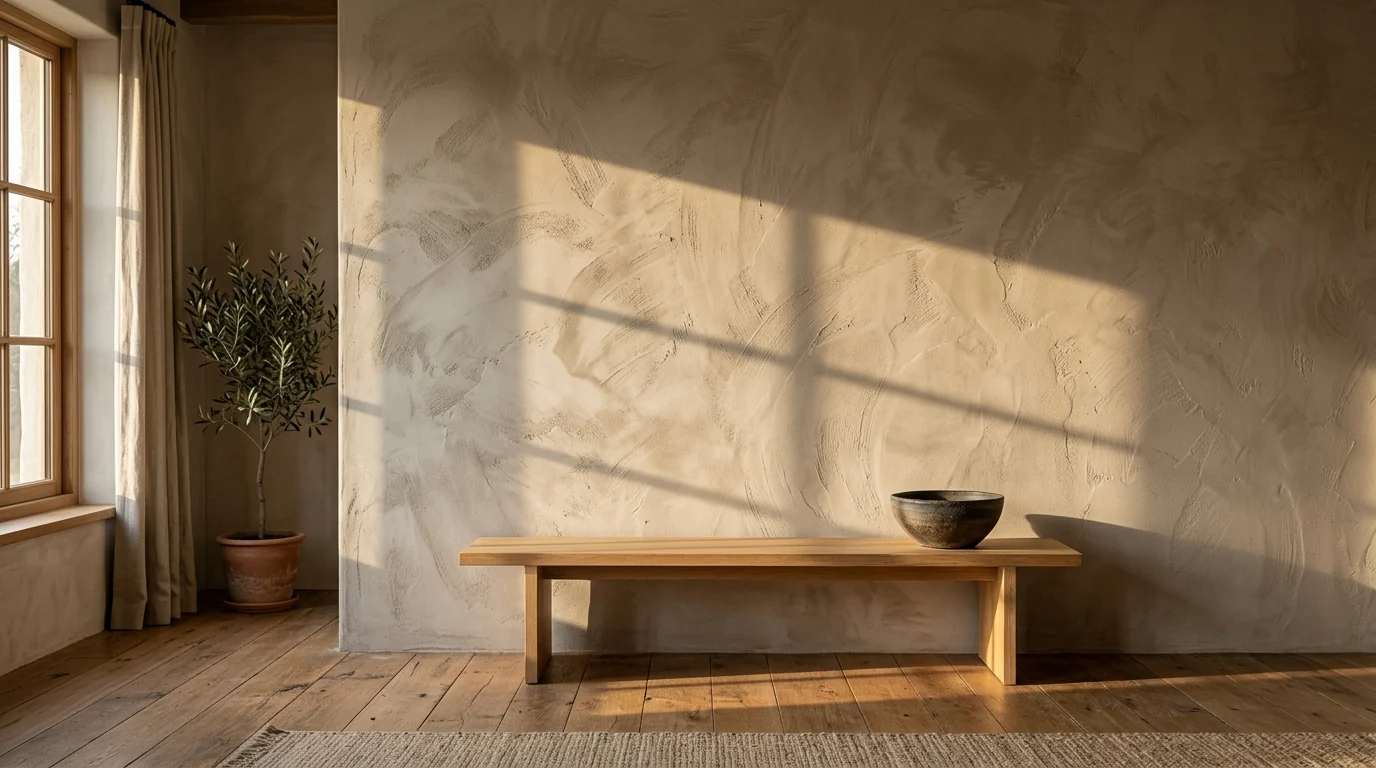
Stay in the warm band: greige, sand, clay, mushroom. Cold grey limewash is how you end up with a room that photographs like a mausoleum. If you want to see how the same wall treatment behaves in a softer, brighter direction, our warm minimalism guide is the neighboring lane.
3. Diffuse the Light Like a Shoji Screen
Japanese rooms rarely receive raw sunlight; it arrives filtered through paper. You do not need to install actual shoji, though a sliding screen as a room divider is a legitimate move if the architecture invites it. What you need is the principle: no bare glare from any direction. Sheer natural-fiber layers at the window, paper or fabric shades on every bulb, nothing that casts a hard-edged shadow indoors.
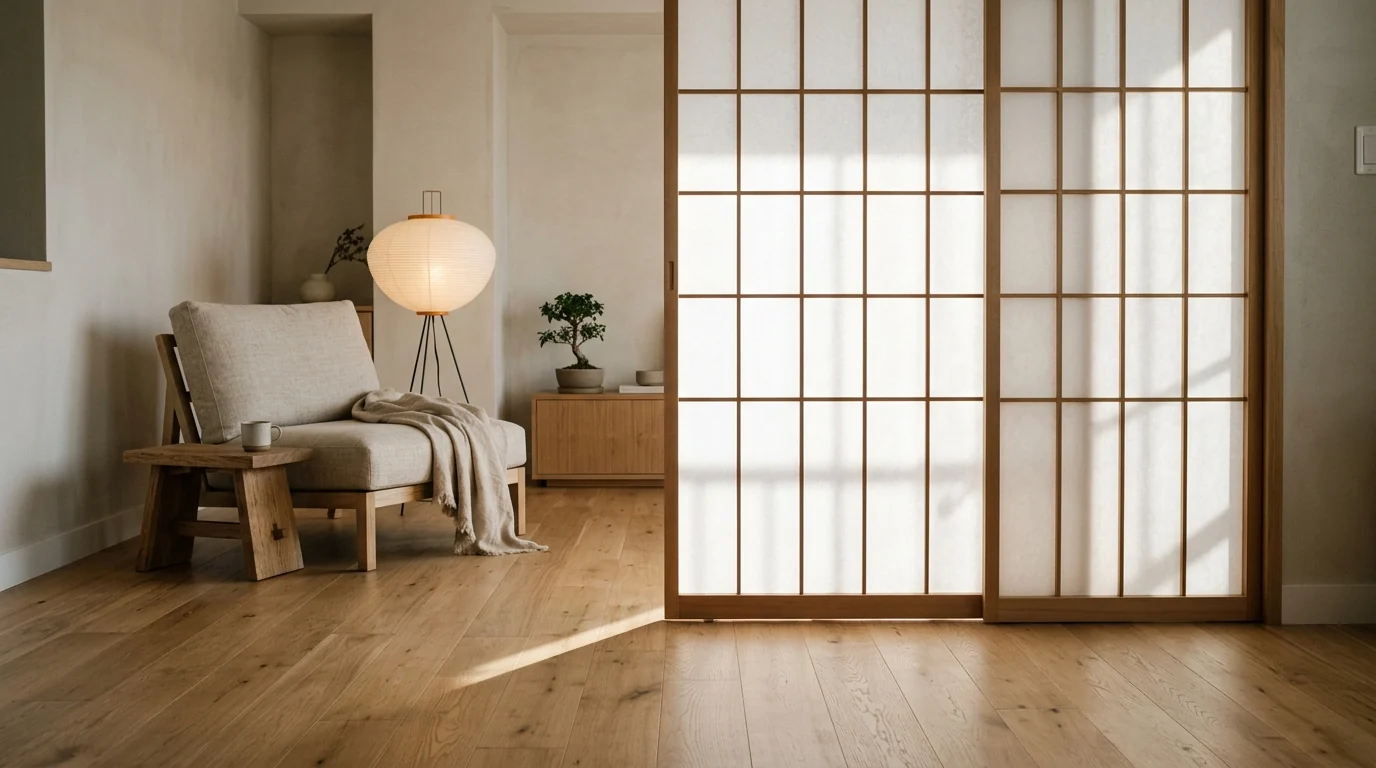
In renders and in real rooms alike, this is the single change that most affects mood. The furniture can be imperfect; if the light is milky and directional, the room already feels japandi.
4. One Wood Slat Wall, Not Five
The vertical oak slat wall is the most copied japandi feature of the decade, and it still earns its place, on one wall. Used as a partition between lounge and hallway it does real work: it filters light into striped shadows, it separates zones without closing them, and it puts craftsmanship on display. Used on every surface, it turns the room into a sauna lobby.
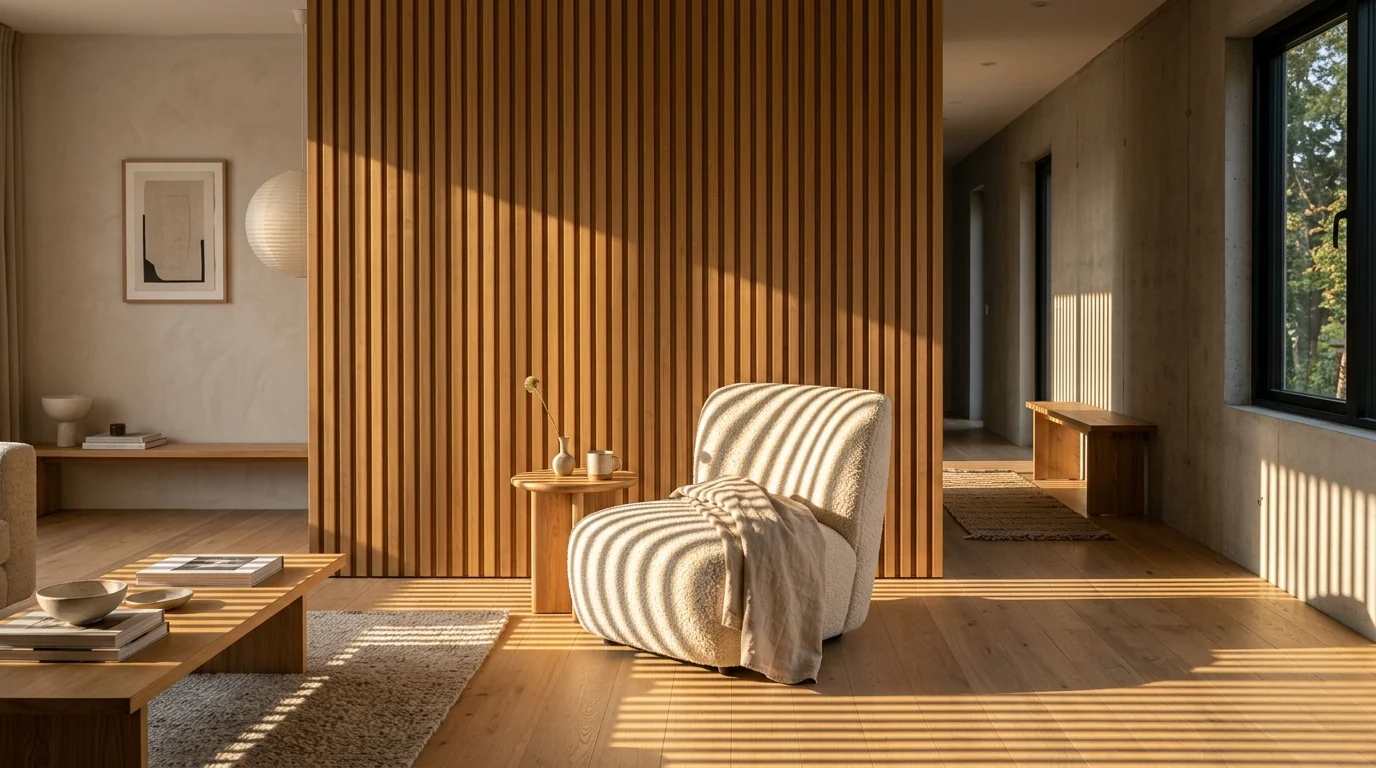
If you rent, freestanding slatted screens deliver most of the effect with none of the drilling. Keep the slats and the floor within the same wood family; oak slats over a red-toned floor is a clash the style cannot absorb.
5. Let One Paper Lantern Carry the Evening
After dark is where japandi rooms either come alive or die. The style has no place for a bright ceiling fixture; evening light should pool, not flood. One large rice-paper pendant, hung low over the coffee table, plus one small lamp at floor level, is a complete lighting plan. The pedigree here is real: in 1951 the mayor of Gifu asked Isamu Noguchi to help modernize the town's traditional paper lanterns, and the resulting Akari light sculptures have been in production ever since. The paper does what shoji does at the window: it turns a point of light into a volume of it.
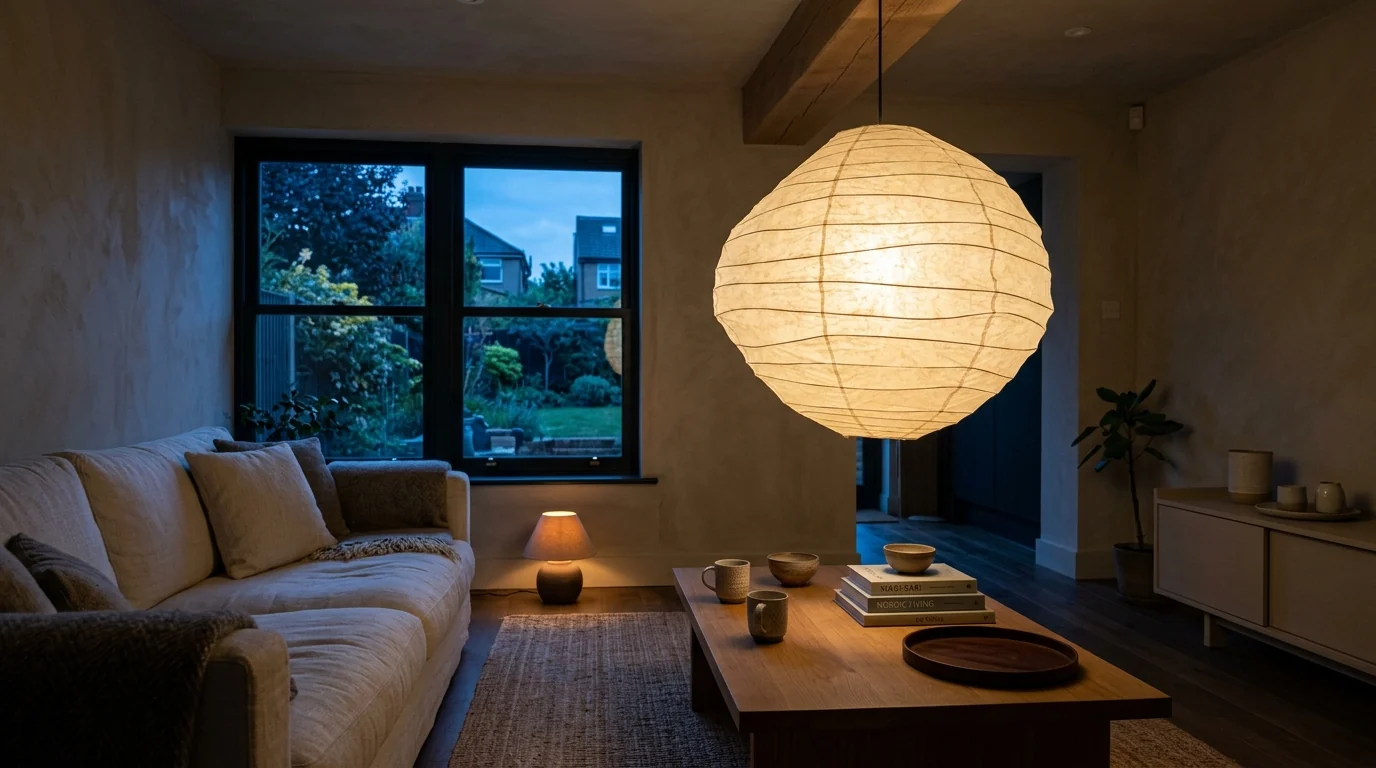
Warm bulbs only, 2700K or lower. This is also the cheapest idea in the article: a paper lantern is one of the few iconic design objects that costs less than dinner, which is why it anchors the budget build below.
6. One Wabi-Sabi Vessel Per Surface
Wabi-sabi, the Japanese appreciation of imperfection and impermanence, gets invoked in every japandi article and applied in almost none. Here is the applied version: each surface in the living room carries at most one object, and that object should look like a human made it. A hand-thrown vase with an uneven glaze. A branch instead of a bouquet. A tea bowl with visible throwing rings.
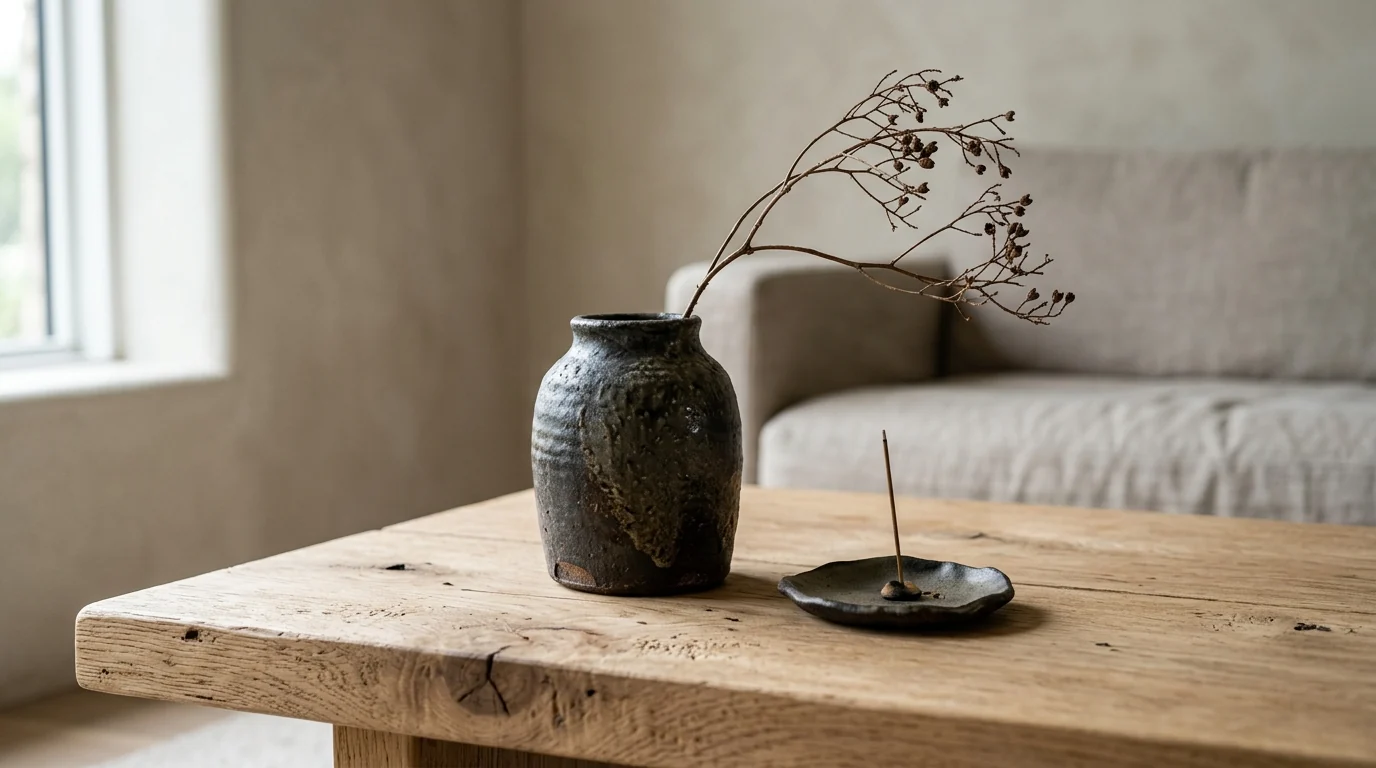
The critical part is what this rule deletes: the tray of matching candles, the stack of unread coffee-table books, the third vase. Mass-produced "wabi-sabi style" decor sold in sets is a contradiction in terms, and rooms full of it read as staged within seconds.
7. Use Dark Wood Like Calligraphy
The Scandinavian half of japandi keeps rooms pale; the Japanese half supplies the ink. The most reliable composition trick in the style is to keep floors, walls and upholstery light, then place two or three dark elements, a charcoal-stained panel, a black-brown side table, a dark-framed chair, the way a calligrapher places strokes on paper. Sparse enough to stay graphic, deliberate enough to look composed.
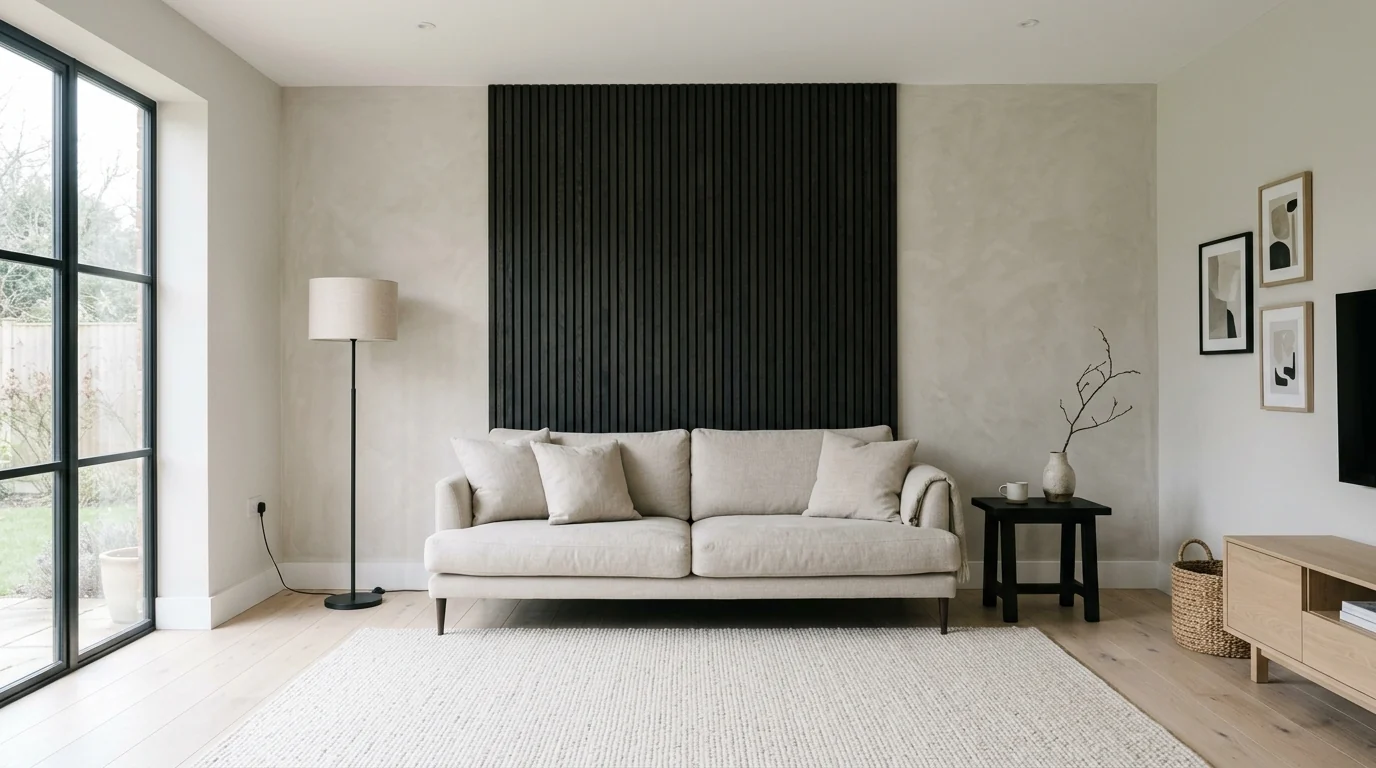
What this is not: black metal everything. Thin black-steel shelving grids, black window frames, black spider chandeliers belong to industrial and modern farmhouse vocabularies. In japandi, darkness should almost always arrive as stained wood or stone, not powder-coated metal.
8. Balance the Grid With One Curve
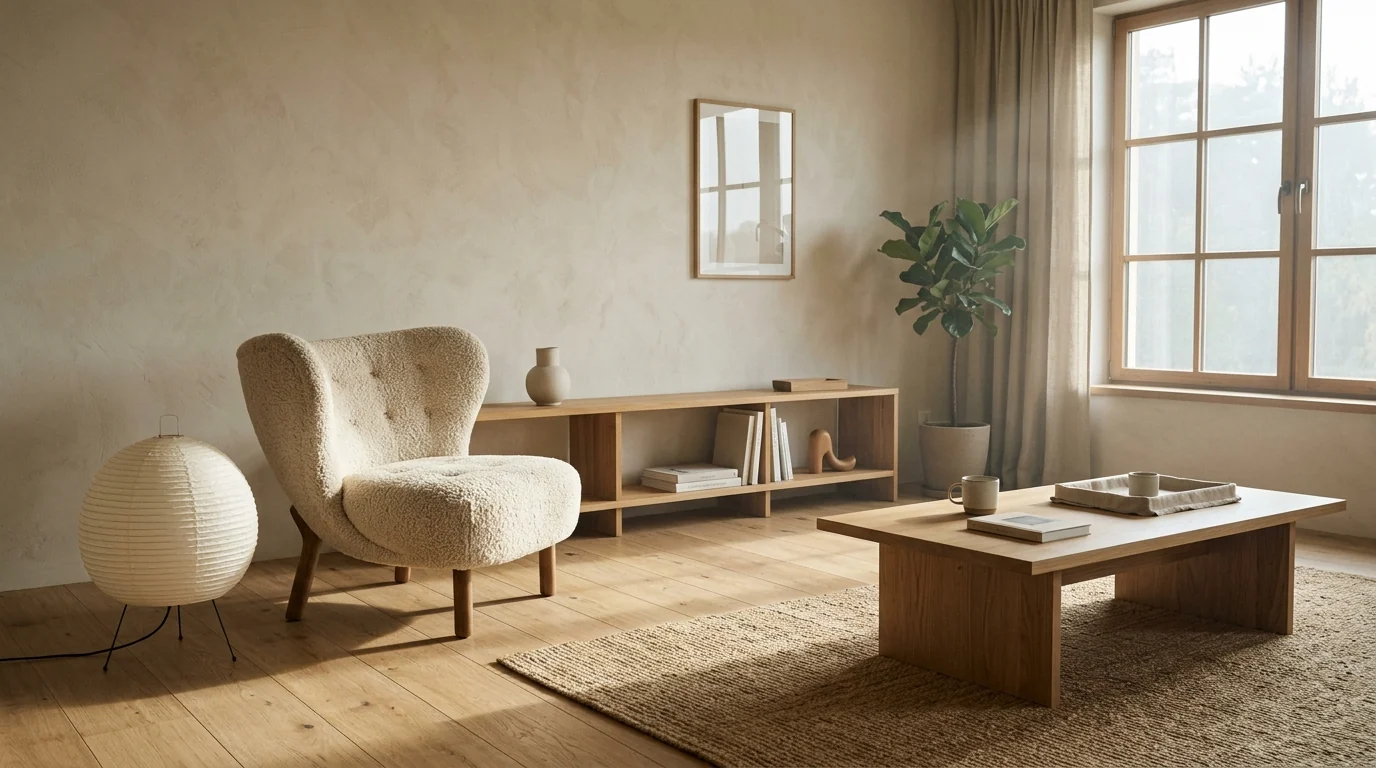
Japandi skews rectilinear: slats, low platforms, square-edged tables. Left alone, the geometry gets stern. The fix is one generous curve, a rounded boucle lounge chair, a drum-shaped side table or a spherical paper lamp, placed where the light can wrap around it. One curve reads as an intentional pause; four curves and you have drifted into the soft-blob 2022 look the style is currently shedding.
9. Zone With the Rug, Tatami Style
Traditional Japanese rooms are measured in tatami mats, and the habit of defining a zone with a woven rectangle translates directly. One large flat-woven rug, jute, sisal or a wool flatweave in oat or straw tones, sized so every seating piece touches it, turns the sofa cluster into an island and leaves the surrounding floor bare and calm. This matters most in open-plan spaces, where japandi otherwise bleeds into the kitchen with no edge.
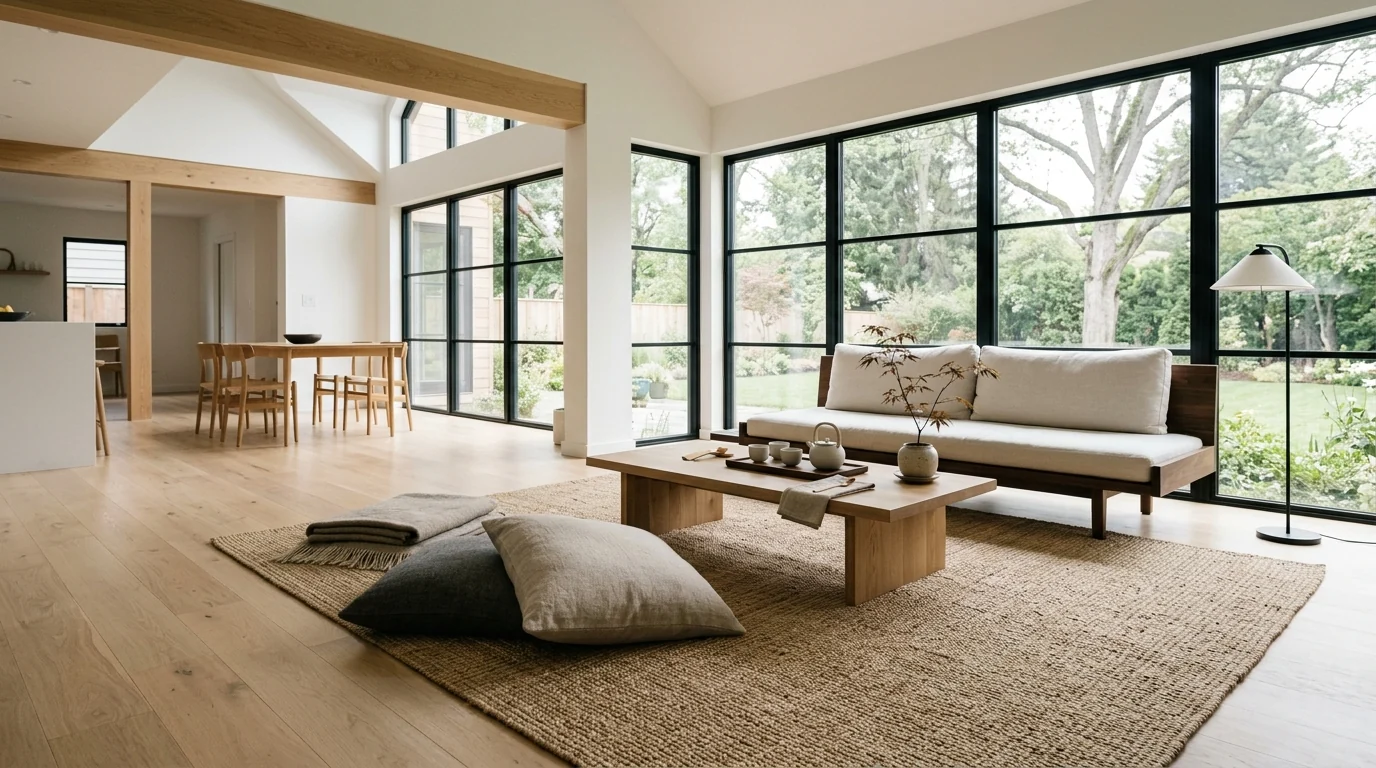
Skip the high-pile and the pattern. If the rug announces itself before the furniture does, it is the wrong rug. For the general geometry of seating zones, our guide on how to arrange living room furniture covers the clearances that make an island layout actually walkable.
10. Plant One Sculptural Tree
Japandi does not do plant collections. It does one plant with the presence of a sculpture: a small Japanese maple, an olive, a black pine or a generous branch arrangement, in an unglazed clay pot, positioned where the window light can project its silhouette onto the wall. The shadow is half the decoration, and it redraws itself every hour, which is the closest a room gets to the impermanence wabi-sabi actually asks for.
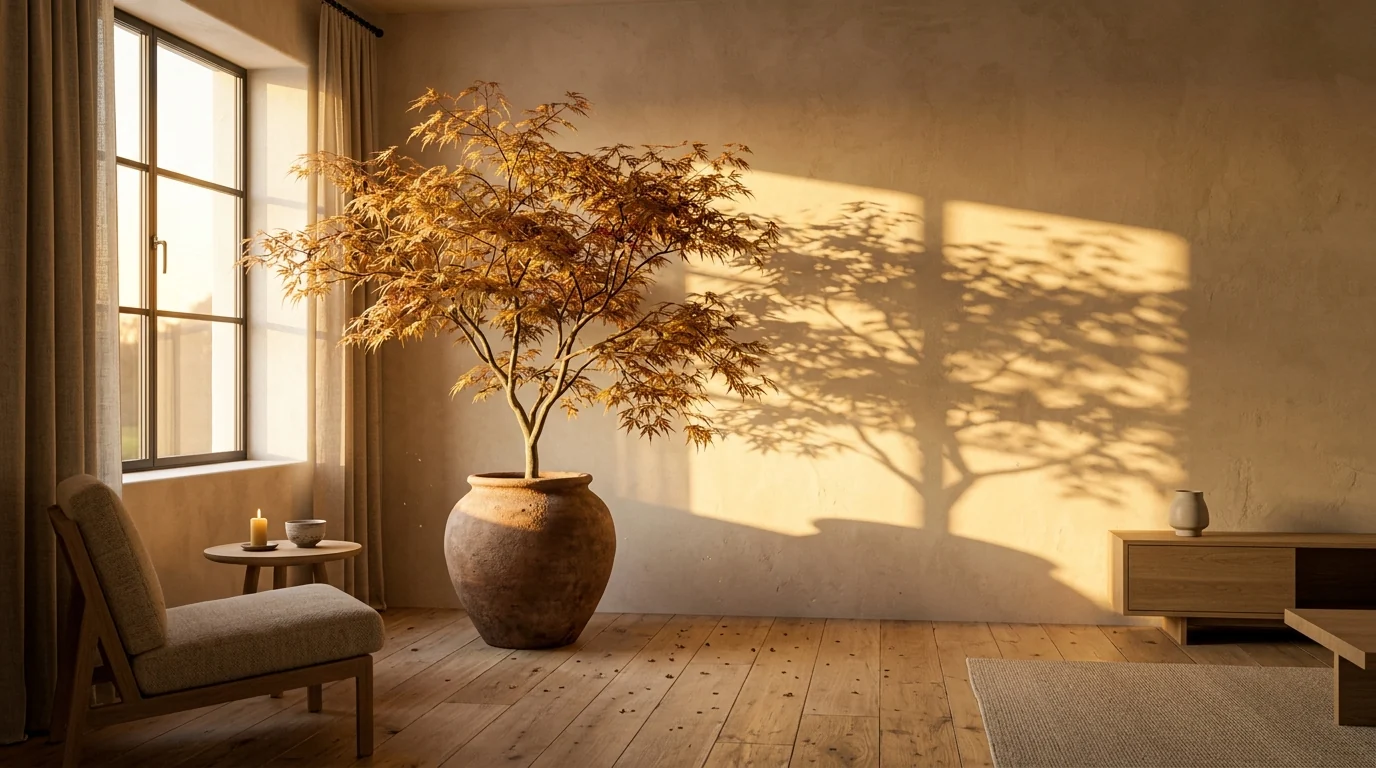
A dusty fake ficus does the opposite of all of this. If maintenance is the obstacle, a large dried branch in a floor vase is more honest than plastic foliage and needs nothing from you.
11. Try the Dark Walnut Register
The pale oat-and-oak japandi that flooded feeds around 2021 is only half the style. The other register runs dark: walnut paneling, charcoal linen, black stone, lamplight. It draws on the shadowed interiors Junichiro Tanizaki described in his 1933 essay In Praise of Shadows, where depth and dimness are qualities to cultivate, not problems to light away. In 2026 this darker read is where the style is clearly heading, as the market tires of greige.
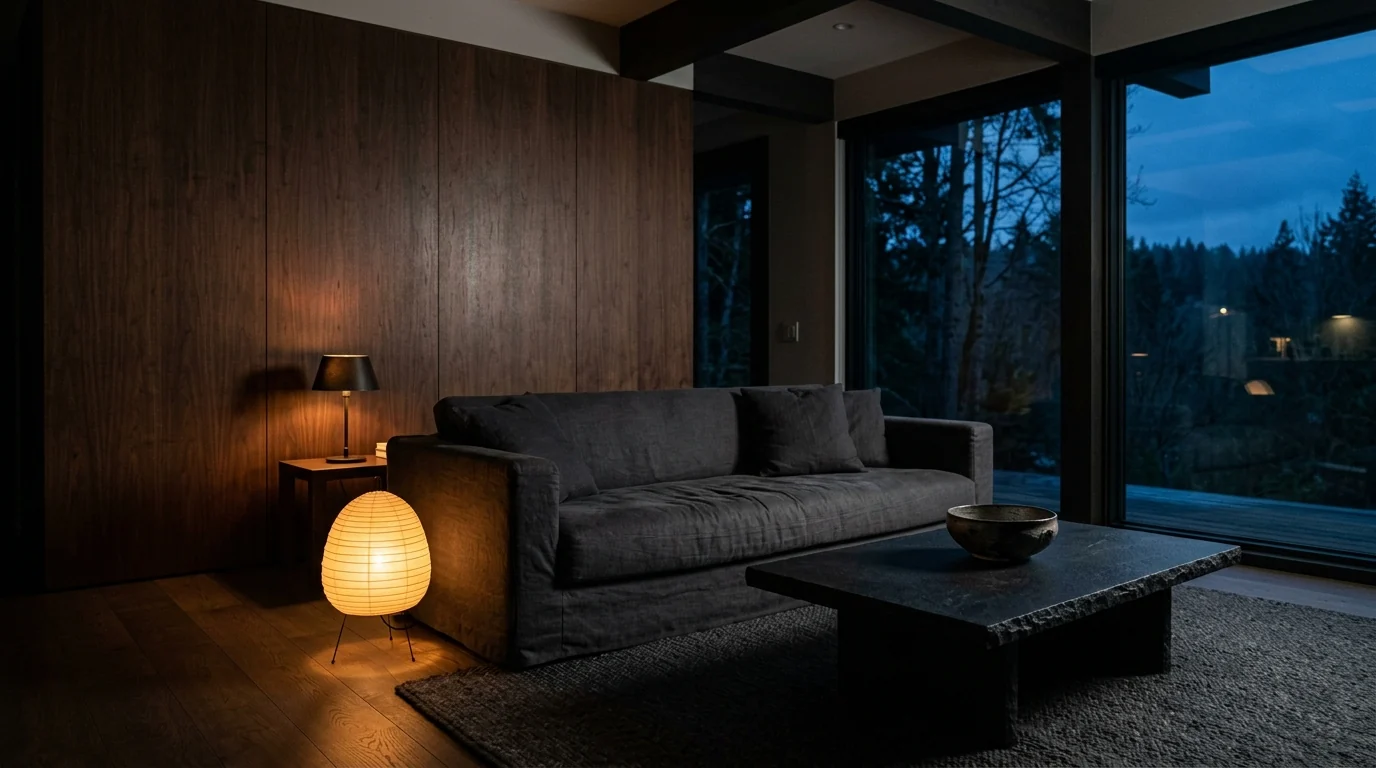
Dark japandi punishes clutter even harder than the light version, because every object edge catches the lamplight. Commit to it only if the editing discipline from idea 18 is already a habit.
12. The Small Apartment Version
Japandi is arguably the best style in existence for a small living room, because its two core moves, low furniture and empty space, are exactly what small rooms need. Keep the sofa compact and low, swap bulky storage for one wall-mounted shelf, use a single round lamp, and resist the urge to shrink the decor count rule just because the room is small. Five objects was the ceiling in a large room; it still is.
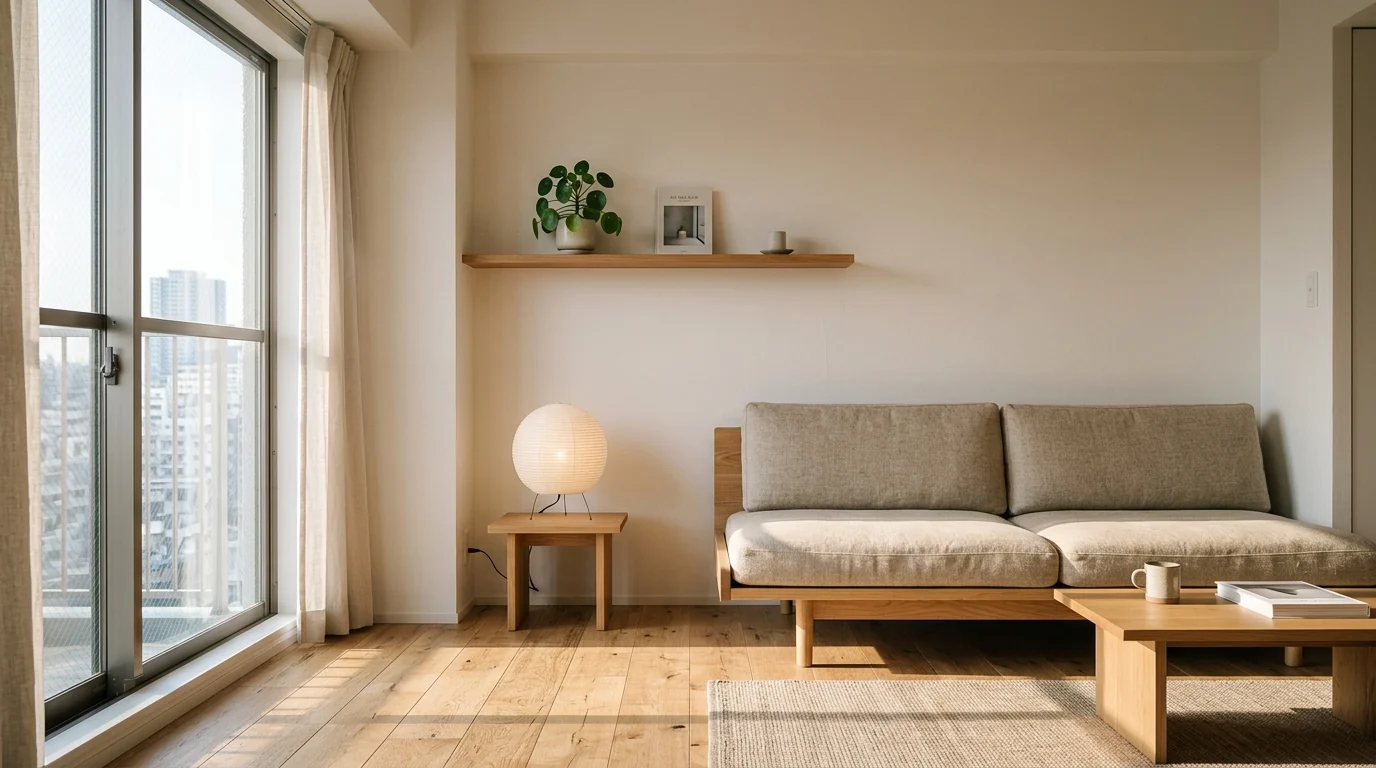
The one japandi habit to override in a small space: the style's indifference to mirrors. A single large mirror positioned to bounce window light deeper into the room is worth the exception, and our AI living room design prompts guide covers where to put it without breaking the calm.
13. Solve the TV Honestly
Every japandi editorial photographs the room without the television, and every real living room has one. Pretending otherwise is why so many attempts collapse the day the family moves back in. The honest solution is joinery: a long, very low wood console spanning the wall, the screen mounted low and framed by the same timber, cane or slatted fronts hiding the electronics, zero visible cable. The TV becomes a dark panel inside a composed wall instead of a floating black hole.
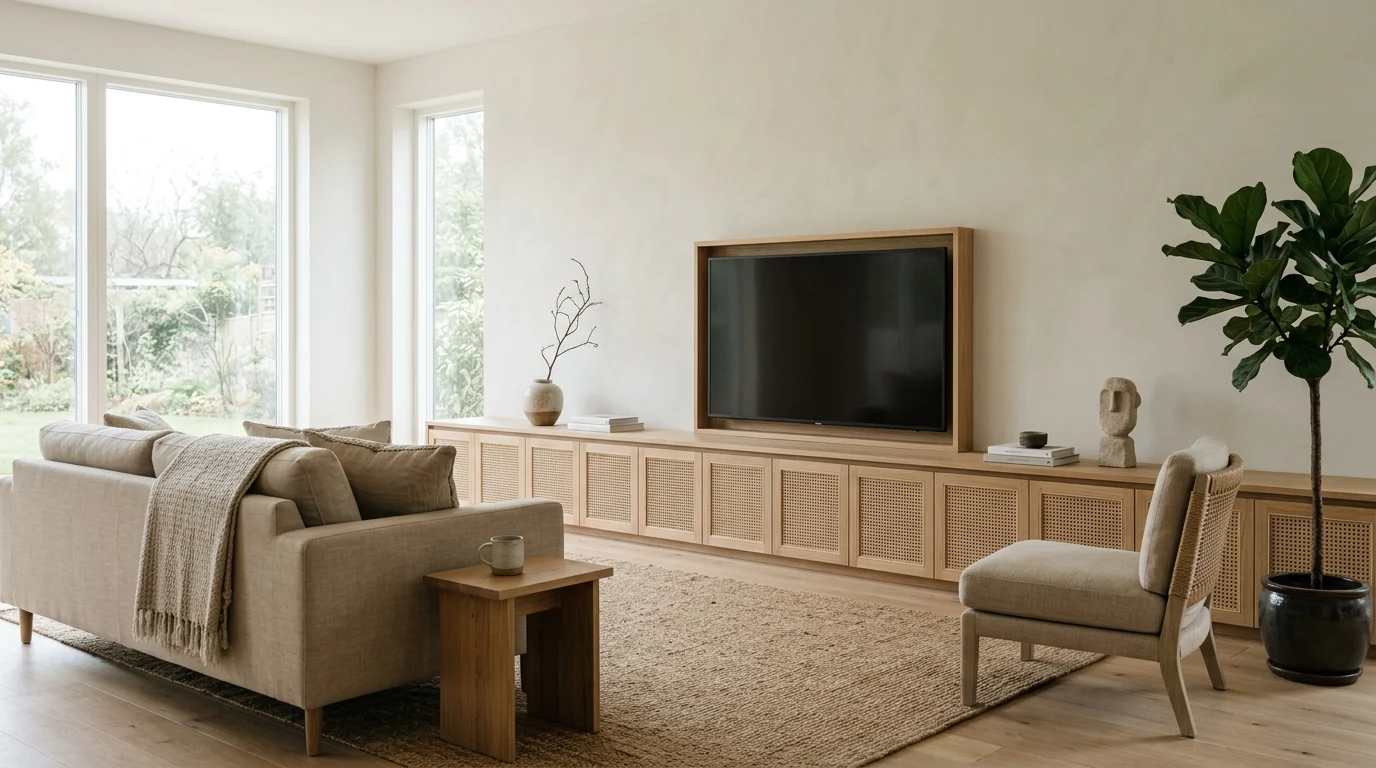
Frame-style TVs that display art help, but placement does more than product. Screen center at seated eye level, roughly 40 inches (about a meter) off the floor, keeps the low horizon from idea 1 intact.
14. Style Shelves With Negative Space
Japanese aesthetics has a word Western shelf styling desperately needs: ma, the meaningful interval between things. A japandi shelf is not a display of everything you own in tasteful triangles; it is five objects across three shelves with enough emptiness around each that its silhouette reads from across the room. Two ceramics, a few bound books, a wooden bowl, one small plant. Done.
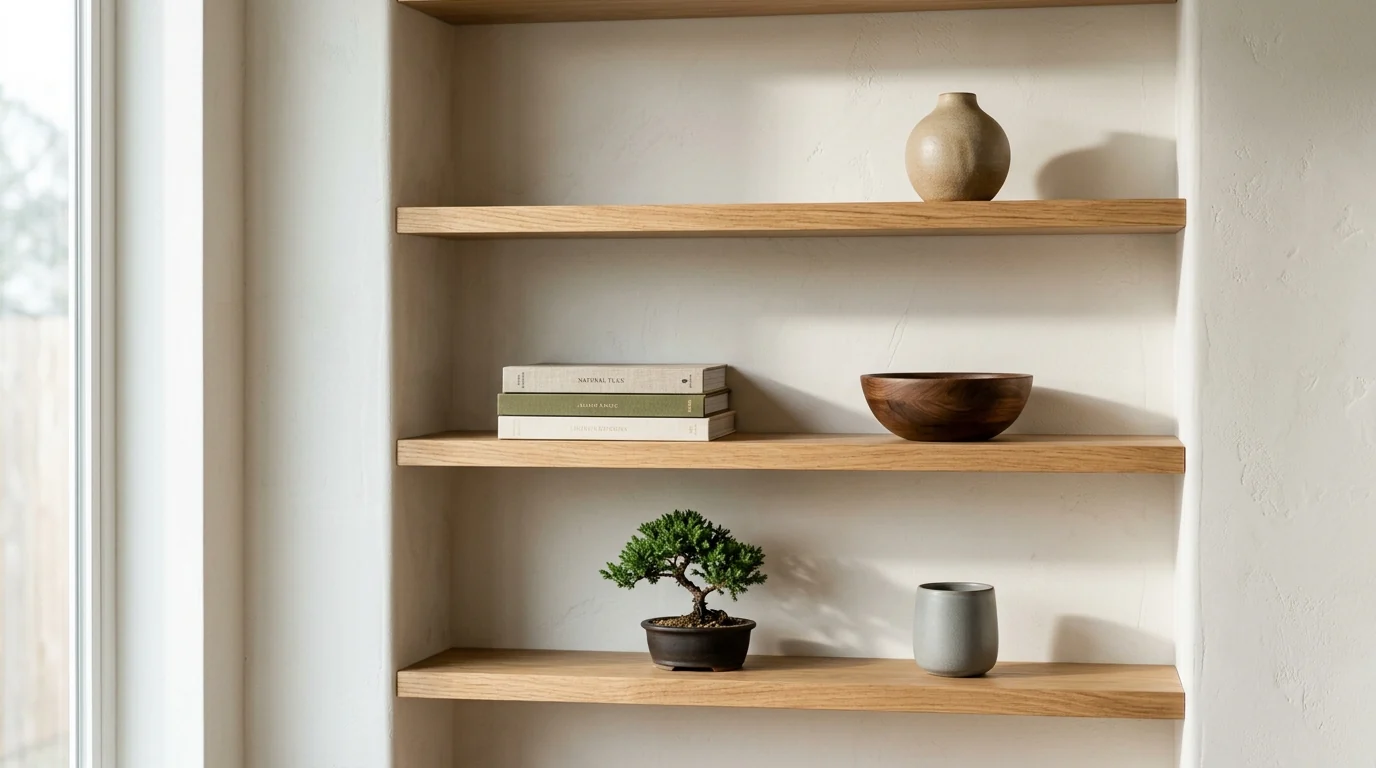
The test we apply when reviewing renders: cover any single object and see if the composition survives. If removing one thing improves the shelf, the shelf was not finished, it was full.
15. Filter the Sun Through Linen
Floor-to-ceiling undyed linen is the japandi window treatment, and it is doing more work than it appears to. Backlit linen glows; it turns harsh afternoon sun into the same milky volume a shoji screen produces, and its natural slubs add texture to the largest soft surface in the room. Hang the rail as close to the ceiling as possible and let the fabric just kiss the floor.
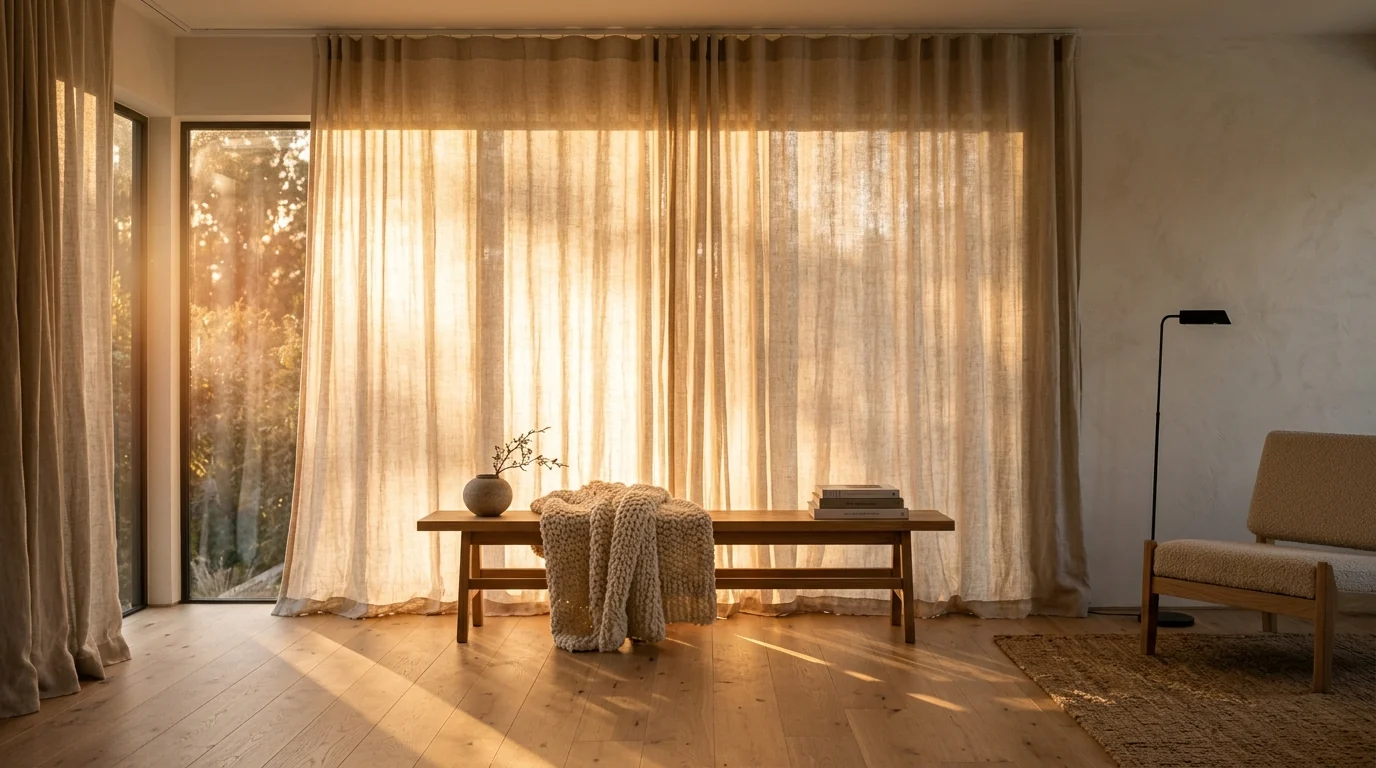
Avoid blackout-backed drapes in the living room; the stiffness kills the glow. If you need real darkness for a screen, put the blackout layer on a separate hidden rail and keep the linen as the visible skin.
16. Keep the Fireplace Mantel-Free
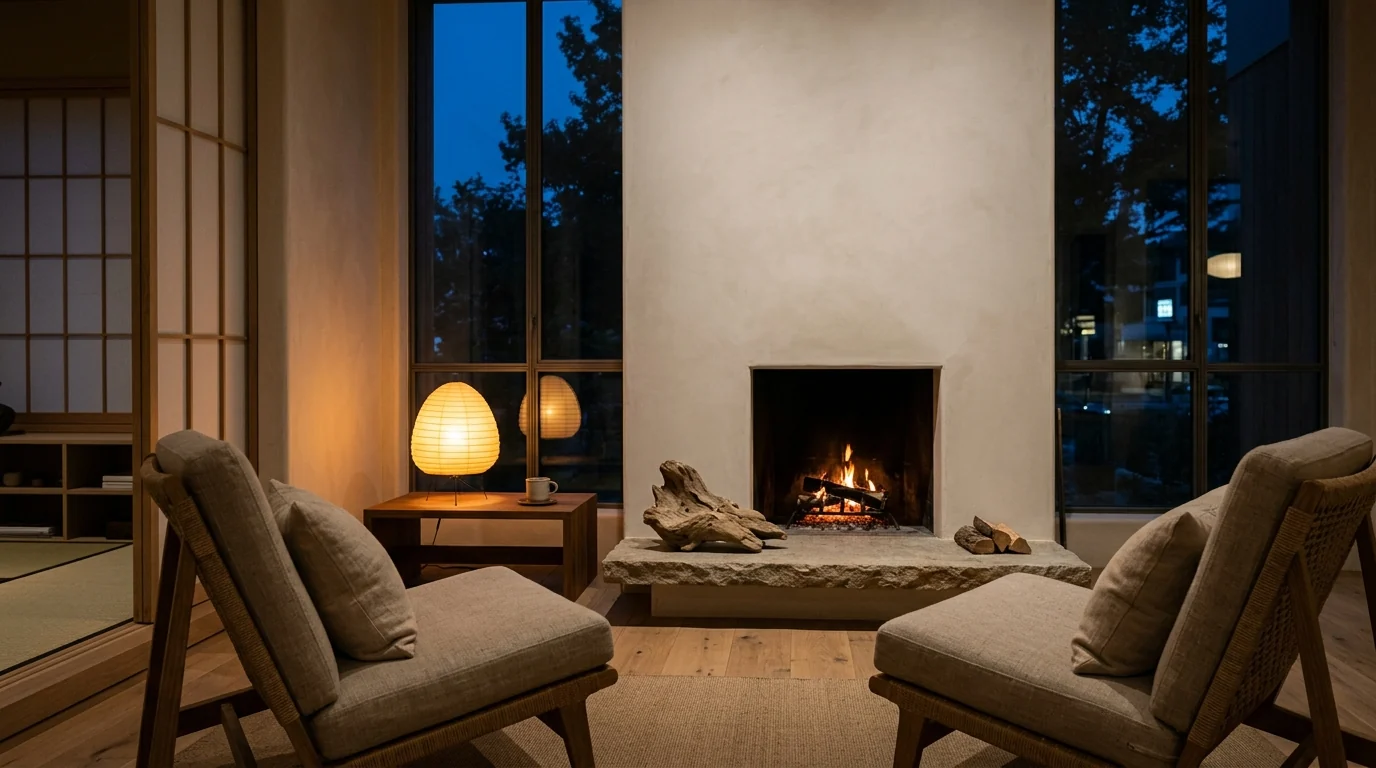
A fireplace is a gift to this style, provided you refuse the mantel-styling reflex. The japandi version is a plain plaster or stone chimney breast, a simple rectangular opening, a stone hearth slab, and at most one sculptural object standing on it. No garland, no candle cluster, no leaning art collage. Fire is the one decoration the style considers sufficient, and at dusk it takes over the lighting job from the lantern.
17. The Budget Build That Still Works
In our living room cost analysis, japandi came out as the most expensive style at every tier, roughly $2,650 to enter, around $8,000 mid-range and about $21,000 at the heritage-craft top, because solid wood cannot be faked. But the entry tier deserves more credit than it gets. The look below is deliberately built from simple pale flat-pack pieces plus the two purchases that must be honest: one solid-wood table surface and one handmade ceramic.
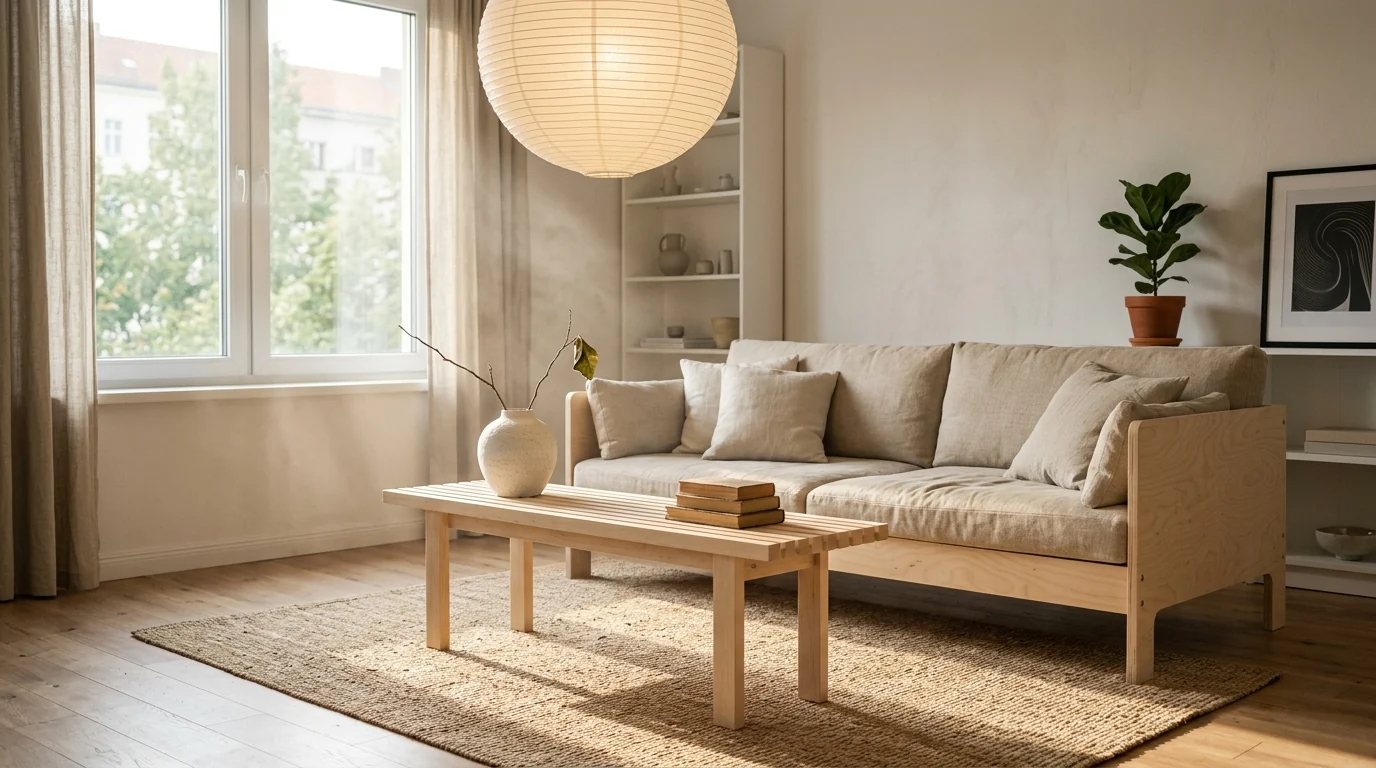
The budget allocation that works: put half the money into the sofa, a quarter into the one real-wood surface, and almost nothing into decor, because restraint is free. IKEA's birch-and-linen end of the catalog gets you surprisingly far, and our IKEA trends guide flags which current pieces lean japandi rather than generic Scandi. What no budget survives is buying ten cheap decorative objects instead of one good one; that is the exact trade this style forbids.
18. Edit Until It Hurts, Then Stop
The last idea is the one that makes the other seventeen work. Take everything decorative out of the room. Everything. Then return objects one at a time, and stop the moment the room feels inhabited rather than styled. Most people stop five objects too late; the discipline is stopping one object too early, living with it for a week, and discovering the room does not miss what you removed.
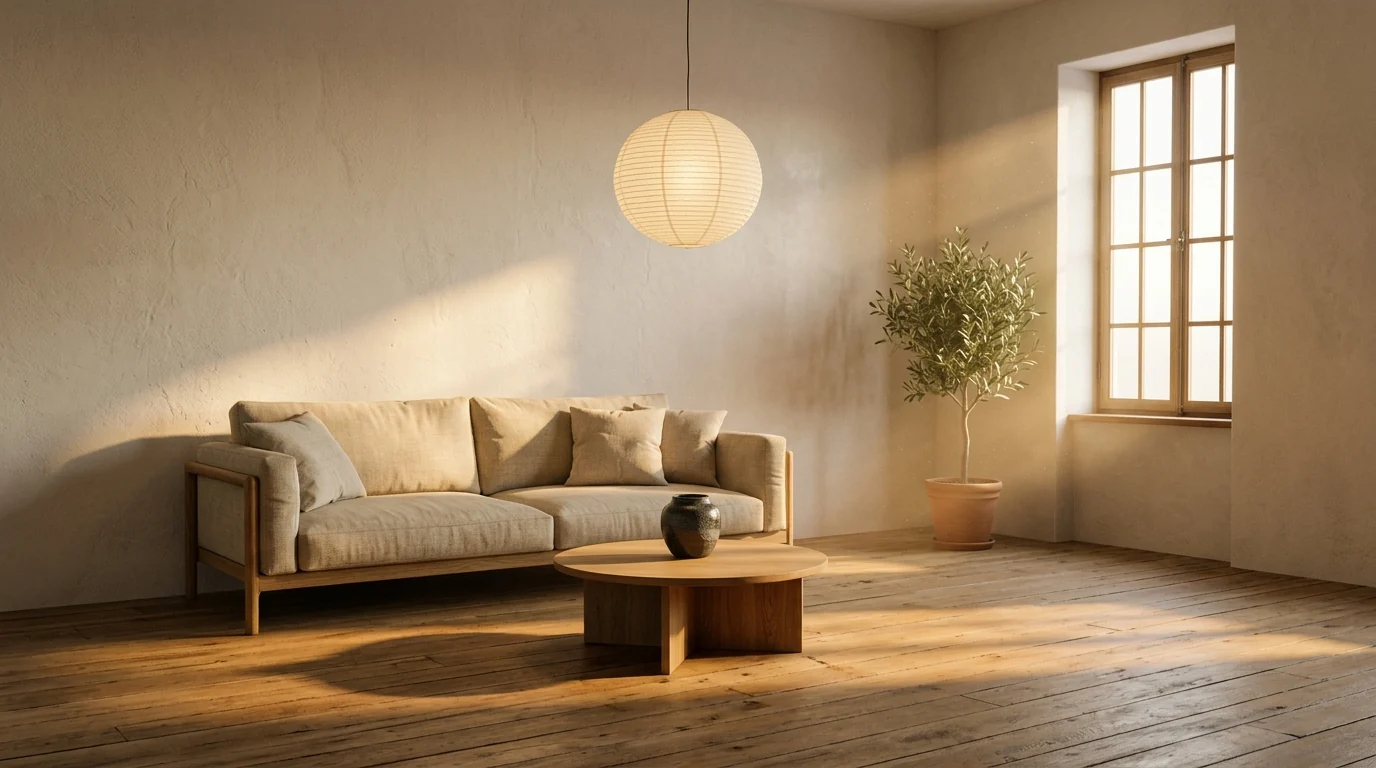
This is also the cheapest renovation in this article, and the reason the empty-space rule appears in the answer paragraph at the top: japandi is the only major style whose defining material costs nothing.
The Five Mistakes That Turn Japandi Into Kitsch
Since we are being critical of everyone else's rooms, here is the failure catalog, rendered honestly. We generated the room below as a warning, and it hurt to look at even while it was rendering.
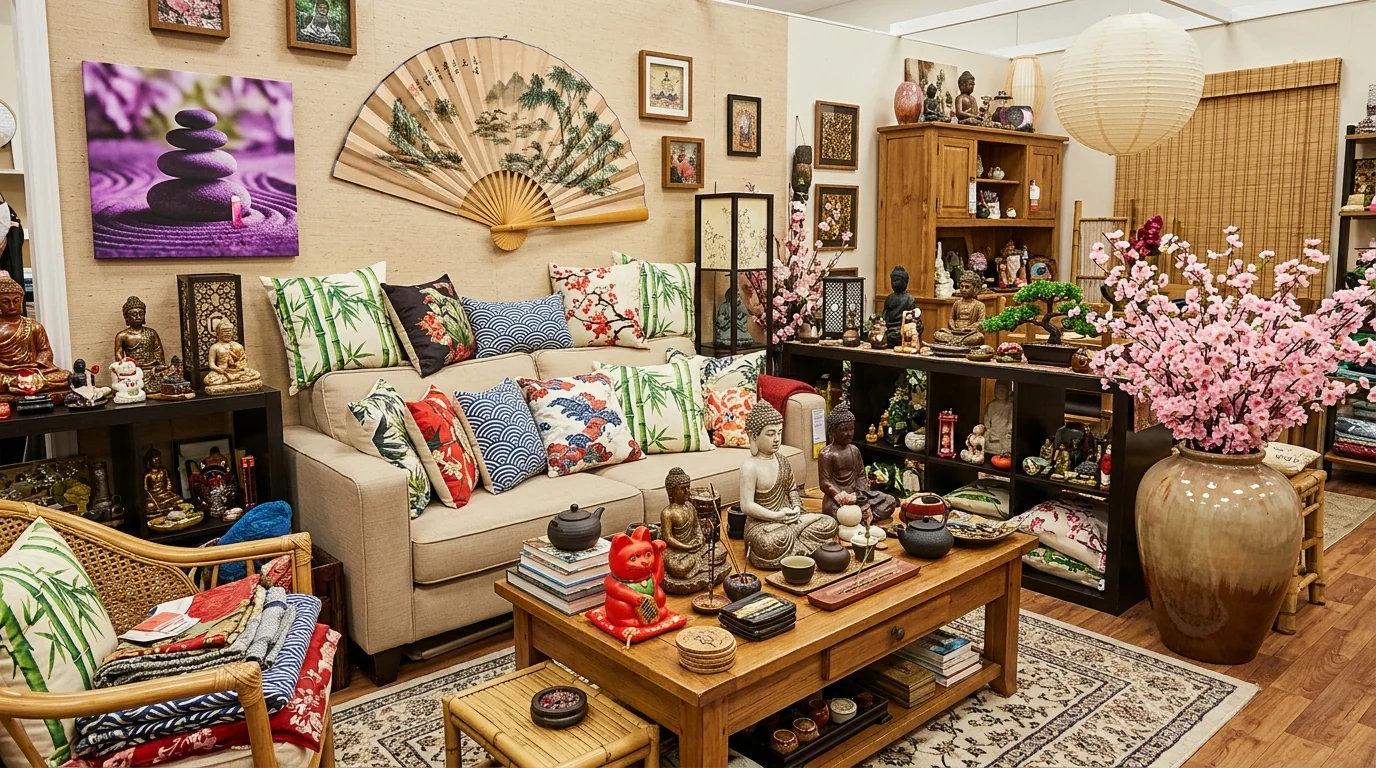
- The theme-park haul. Buddha figurines, lucky cats, folding fans, fake cherry blossoms, zen-stone canvas prints. Japandi borrows Japanese principles, not Japanese souvenirs. If an object depicts Japan rather than applying its restraint, it does not belong.
- Beige minimalism mislabeled. An all-greige room with a boucle sofa and no texture is not japandi, it is a rental listing. Without visible wood grain, handmade ceramics and light-catching surfaces, the calm has no content.
- Laminate pretending to be wood. Shiny wood-look surfaces photograph acceptably and fail in person, where this style lives or dies on touch. One honest oak surface beats four fake ones.
- Overhead floodlighting. A grid of cool-white ceiling spots cancels every material decision below it. Japandi light is low, warm and comes from few sources.
- Decor arriving in sets. Three matching vases in graduated sizes is a factory's idea of composition. Wabi-sabi values the object that could not be duplicated; sets are its exact opposite.
Watch: How to Decorate Japandi
If you would rather see the whole style argued through in moving rooms, this is the video we point people to. Interior designer Nick Lewis walks through what actually separates japandi from plain minimalism, which pieces do the work, and where people overspend. It has been watched over 760,000 times for a reason: he is as allergic to the theme-park version of the style as we are.
Video: “How to Decorate Japandi” by Nick Lewis.
See Any of These Ideas on Your Actual Living Room
Reading about a low furniture line is one thing; seeing your own living room with the sofa dropped, the walls limewashed and the lighting swapped is what settles arguments. Upload a photo of your room to MeltFlex, pick the japandi style, and you get a photorealistic preview on your real proportions and light in about 20 seconds, before any money moves. Compare it against the japandi example gallery, or run the same photo through a few neighboring styles first; if you are not sure japandi is even your lane, the interior design style quiz settles that in two minutes, and the complete styles guide shows all 14 side by side.
Japandi Living Room FAQ
What is a japandi living room?
A japandi living room blends Japanese minimalism with Scandinavian warmth: low wood-framed furniture, a muted earthy palette, natural materials like oak, linen, paper and clay, soft diffused light, and far fewer objects than a typical Western living room. The defining feature is not any single piece but the empty space between pieces, which is treated as part of the design rather than something to fill.
What colors work in a japandi living room?
Warm off-whites, greige, sand, clay, muted sage and soft charcoal, always grounded by natural wood tones from pale oak to dark walnut. The palette avoids pure bright white, which reads cold, and avoids strong saturated color. Contrast comes from pairing light surfaces with a few dark elements, not from introducing new hues.
Is japandi still in style in 2026?
Yes. Japandi has outlasted the trend cycle that produced it because it is less a look and more a set of principles: natural materials, low visual noise and craftsmanship. In 2026 it is evolving rather than fading, with warmer palettes, more texture and darker wood replacing the stark greige versions of a few years ago.
How do I make my living room japandi on a budget?
Spend on one honest solid-wood piece, usually the coffee table, keep the sofa simple and neutral, and let restraint do the rest. A pale flat-pack frame, a jute rug, a rice-paper lantern and one handmade ceramic vessel get you most of the look for well under $3,000. What you cannot fake is clutter discipline: removing objects is free and does more than any purchase.
Does a TV ruin a japandi living room?
No, but an unplanned TV does. The japandi answer is to absorb the screen into the joinery: mount it low over a long low wood console, frame it with the same timber as the surrounding storage, hide every cable, and keep the wall around it empty. A black rectangle floating alone on a bare white wall is the one version that always breaks the calm.
What furniture does a japandi living room need?
A low sofa with a visible wood or simple upholstered frame, one solid-wood coffee table, a single lounge chair, a low storage console and one light source at seated height, usually a paper or fabric lamp. That is genuinely the whole list. Japandi rooms fail from addition, not omission, so every further piece has to justify its floor space.
What is the difference between a japandi and a Scandinavian living room?
Both use natural materials and simple forms, but Scandinavian rooms lean bright and cozy, with white walls, lighter woods and more textiles, while japandi sits lower, darker and quieter, with more empty space, more contrast and a contemplative rather than hygge mood. If a Scandinavian living room is a warm hug, a japandi one is a deep breath. We compare the two head to head in japandi vs Scandinavian, and the Scandinavian guide covers the brighter sibling in full.
How many decor objects should a japandi living room have?
Fewer than ten visible decorative objects is a good working ceiling for an average-sized room, and the best japandi rooms hold closer to five: one vessel, one branch or plant, one lamp, one artwork, one textile. The Japanese concept of ma, the meaningful pause between things, only works when each object has empty space around it.
Keep exploring: the complete japandi interior design guide covers the bedroom, kitchen and the philosophy in depth, the cost-by-style breakdown has the full japandi price ladder, and if your room is under 200 square feet, start with AI living room design prompts before committing to any style at all.