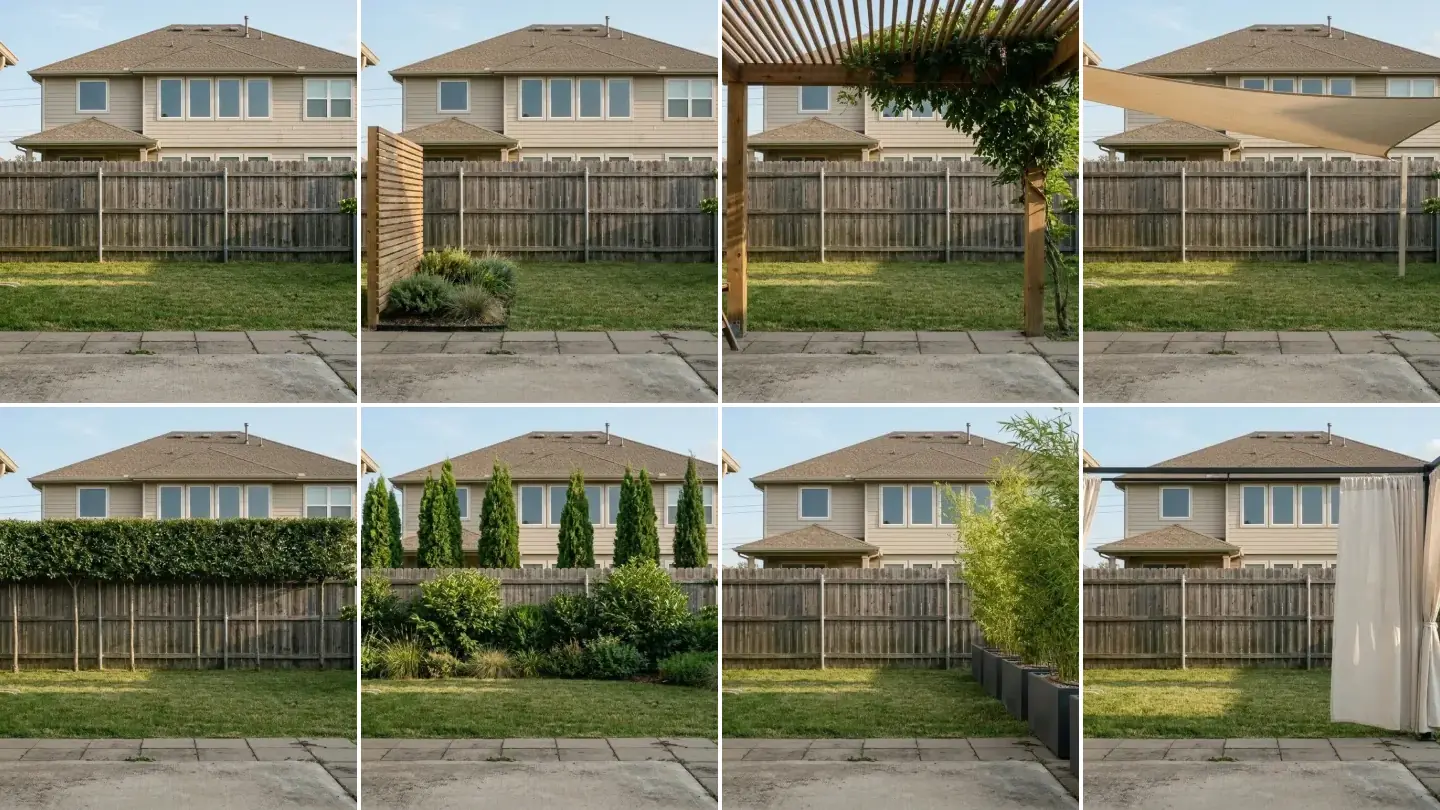
The best privacy fence ideas for most US backyards are a 6 foot wood fence with no gaps (dog-ear, capped or board-on-board), a horizontal slat fence, or a vinyl or composite panel fence, at roughly $25 to $60 per linear foot installed for a 6 foot wood or vinyl fence; in our MeltFlex AI test on November 26, 2026, MeltFlex AI drew 12 privacy fence types on real backyard designs and built the right one in 20 of 24 renders, so you can see the fence on your own yard before you get quotes.
Our articles are still written by humans!
Get human written articles in your Google feed.
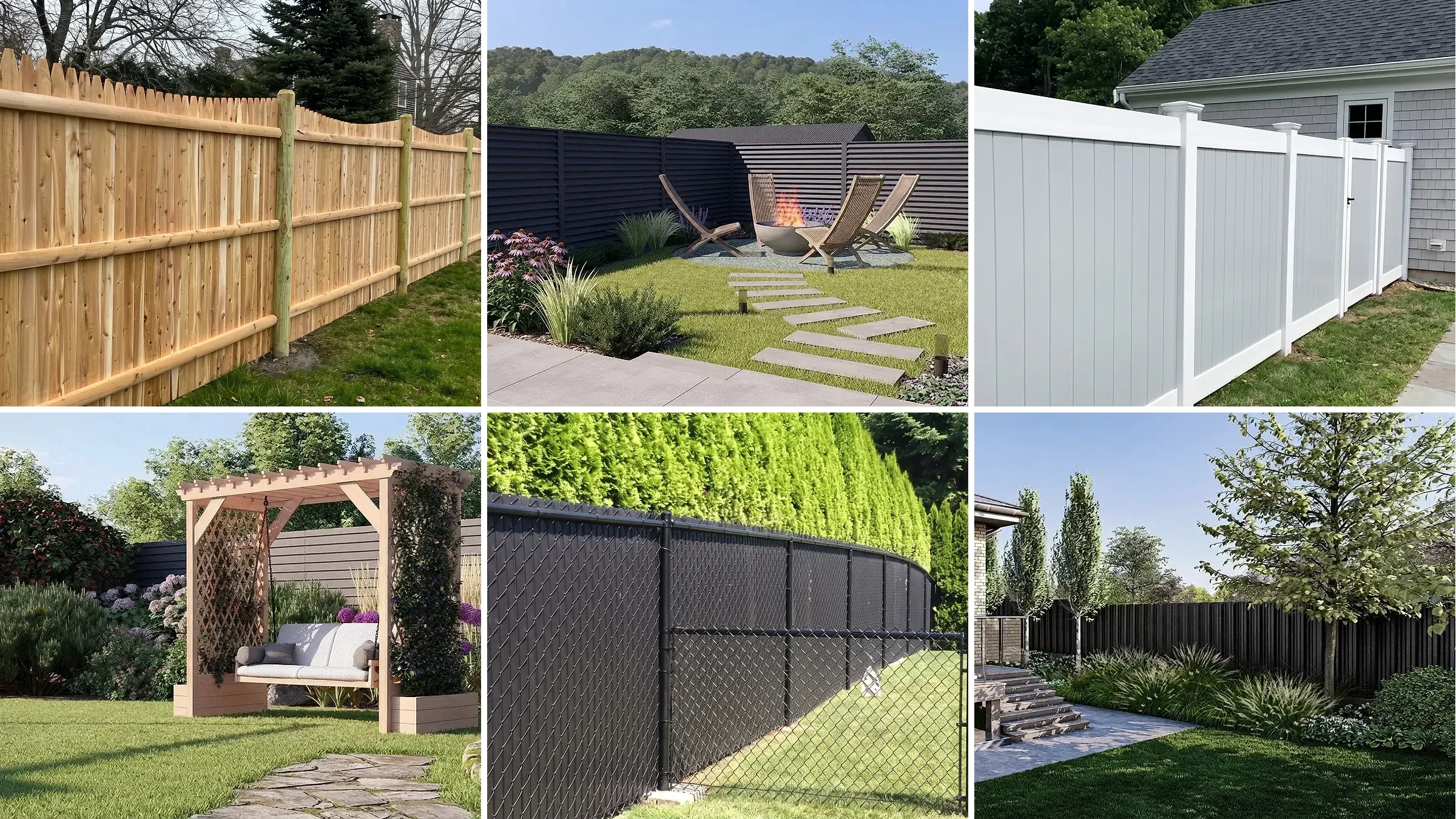
Most privacy fence idea pages are Pinterest boards and store listings: lots of pretty fences, no prices, no heights and nothing about the permit. I wanted one page you could actually plan from. So every idea below has a picture, what it costs per foot from a dated cost survey, and the catch. The pictures come from the Behance designs in our creations gallery; where no design existed for a fence type (lattice top, shadowbox, corrugated metal, gabion and a few others), I drew it onto one of those yards with our own AI fence design tool and say so under the picture. The test section near the end shows what that tool got right and wrong.
The short version
- Most popular: a 6 ft wood privacy fence (dog-ear, capped or board-on-board); vinyl and composite cost more upfront and need less upkeep.
- Cost: a 6 ft wood or vinyl privacy fence runs about $25 to $60 per linear foot installed (HomeGuide, December 2025); Angi puts the national average privacy fence at $4,300 (September 2026).
- Height: 6 ft is the usual limit for back and side yards and 3 to 4 ft in front; many cities want a permit, and an HOA can be stricter than the city.
- Cheap privacy: slats or screen fabric on an existing chain link fence, or a short screen next to the seat instead of a new fence line.
- AI preview: MeltFlex AI drew the right privacy fence in 20 of 24 renders and kept the rest of the yard in 18 of 24, in about 9 to 66 seconds for 10 credits each (15 free credits on a new account); it missed board-on-board in 2 of 2.
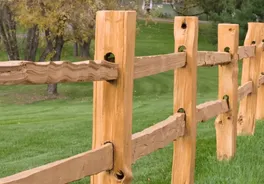
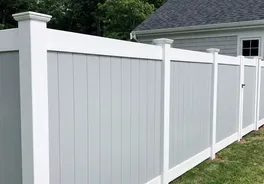
Wood Privacy Fence Ideas
Wood is still the default privacy fence in the US because it is the cheapest material that blocks the view completely at 6 feet. The differences between the ideas below are in how the boards are arranged, which decides how much you see through the gaps, what the neighbor sees, and how hard the wind pushes on it.
1. The classic cedar dog-ear fence
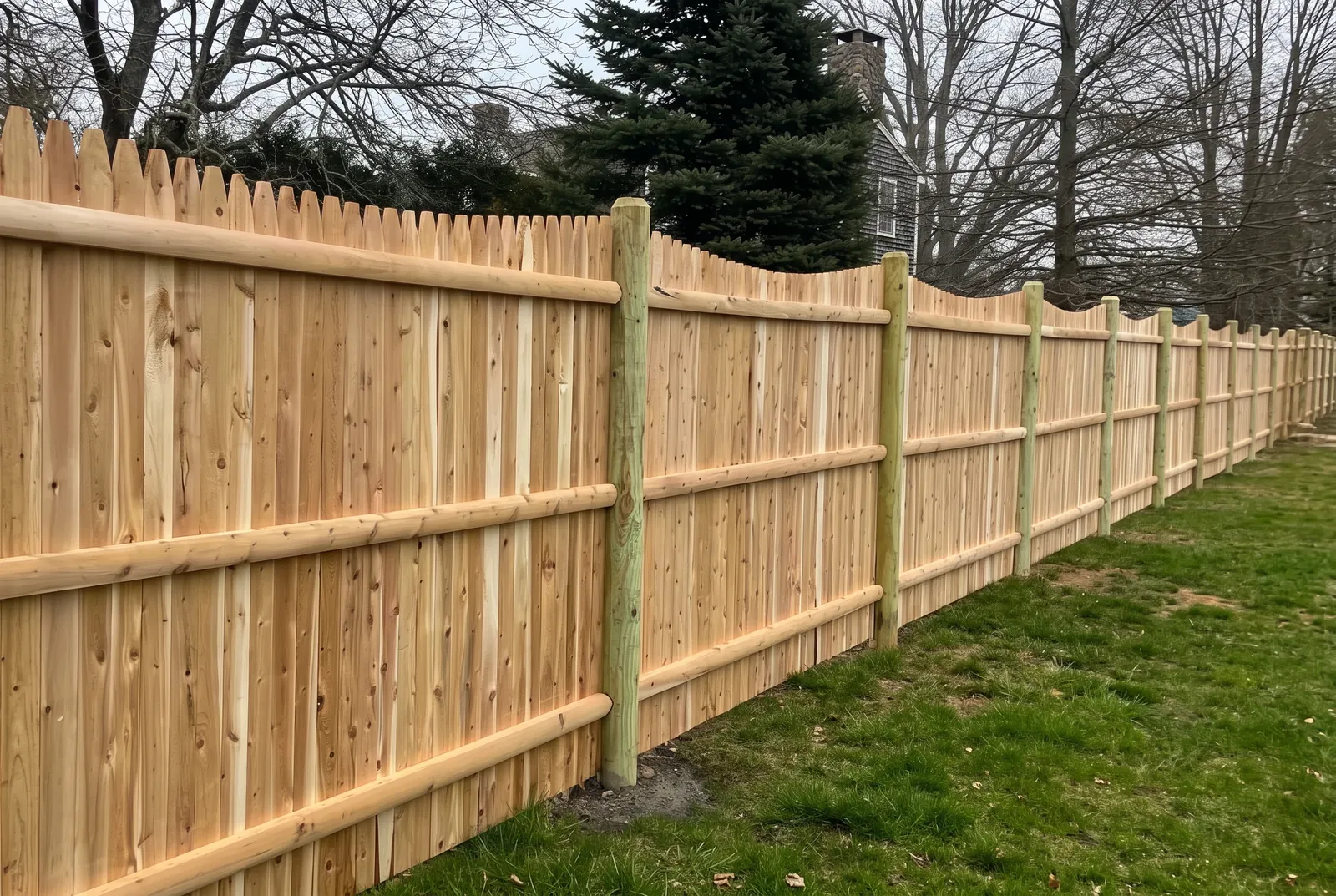
Tight vertical pickets with clipped corners, nailed to two or three rails: the fence most people mean by “privacy fence”. It is the cheapest full-height wood option (Fixr puts 150 feet of dog-ear fence at $2,250 to $4,500 installed; HomeGuide puts a cedar privacy fence at $35 to $40 per linear foot). The catch is shrinkage: green boards nailed tight open small gaps as they dry, so after a summer you can see light between them. If that bothers you, the next two ideas fix it.
2. A capped board fence, or true board-on-board
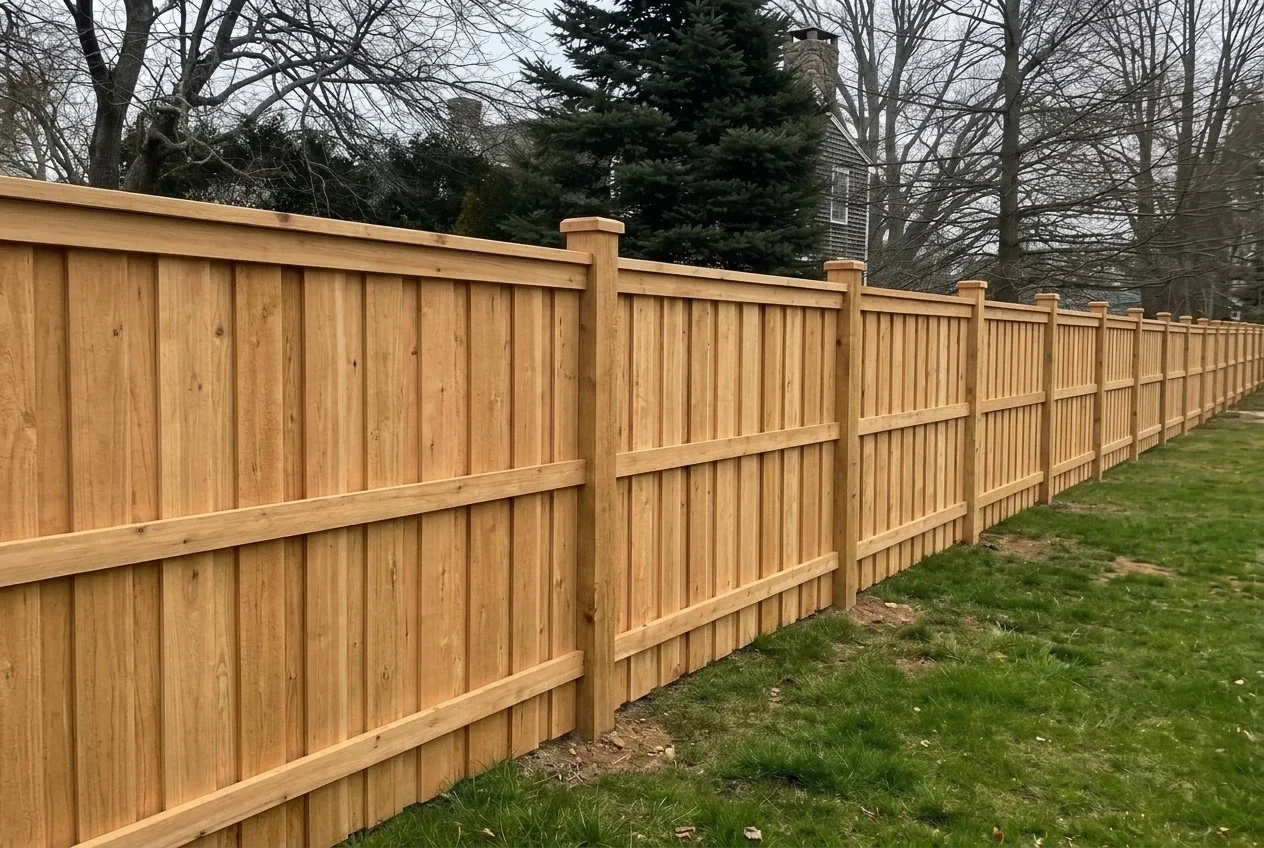
A flat cap rail and a trim board along the top turn the same boards into a finished fence that looks built, not bought. For no gaps at all, ask for board-on-board: a second row of boards overlaps the joints of the first, so nothing opens up when the wood shrinks. Angi says board-on-board takes roughly 30% more material and 30% more labor than a standard wood fence and prices it at $15.50 to $52 per linear foot. Our AI drew the capped version below twice when asked for board-on-board; the overlap you are paying for only shows when you look along the fence.
3. A shadowbox fence that looks the same from both sides
Boards alternate on each side of the rails, so the neighbor gets the same good side you do and air passes through the zigzag. Straight on it blocks the view; from an angle you can see through a little. Pick it for a shared fence line where the neighbor is paying half, or where wind is a problem.
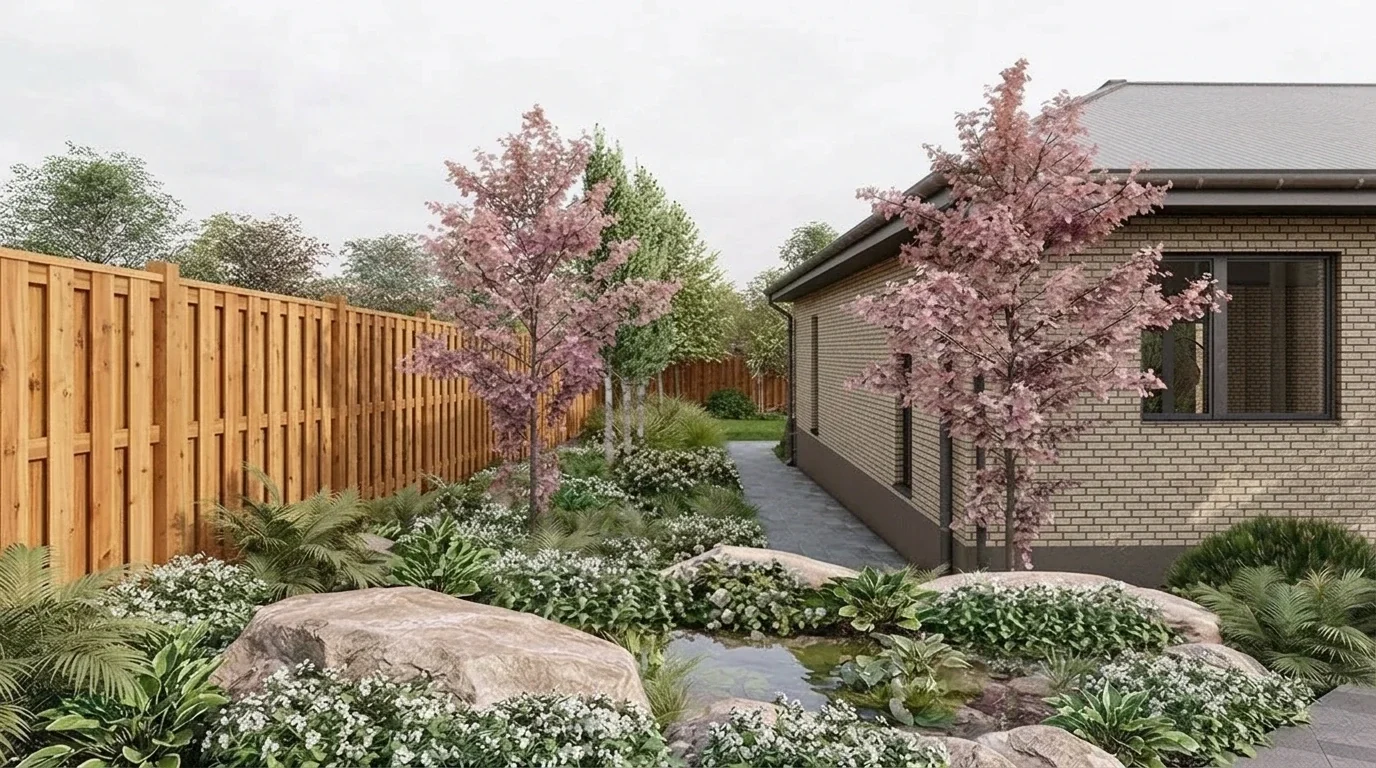
4. A lattice-top privacy fence
A one foot lattice topper on a 5 foot solid fence gives a 6 foot fence that feels lower, lets light into a border and gives climbers something to grab. It is also the usual way to stay inside a 6 foot limit while the solid part stops at eye level for someone sitting down. Ask your city whether the lattice counts toward the height limit before you order it.
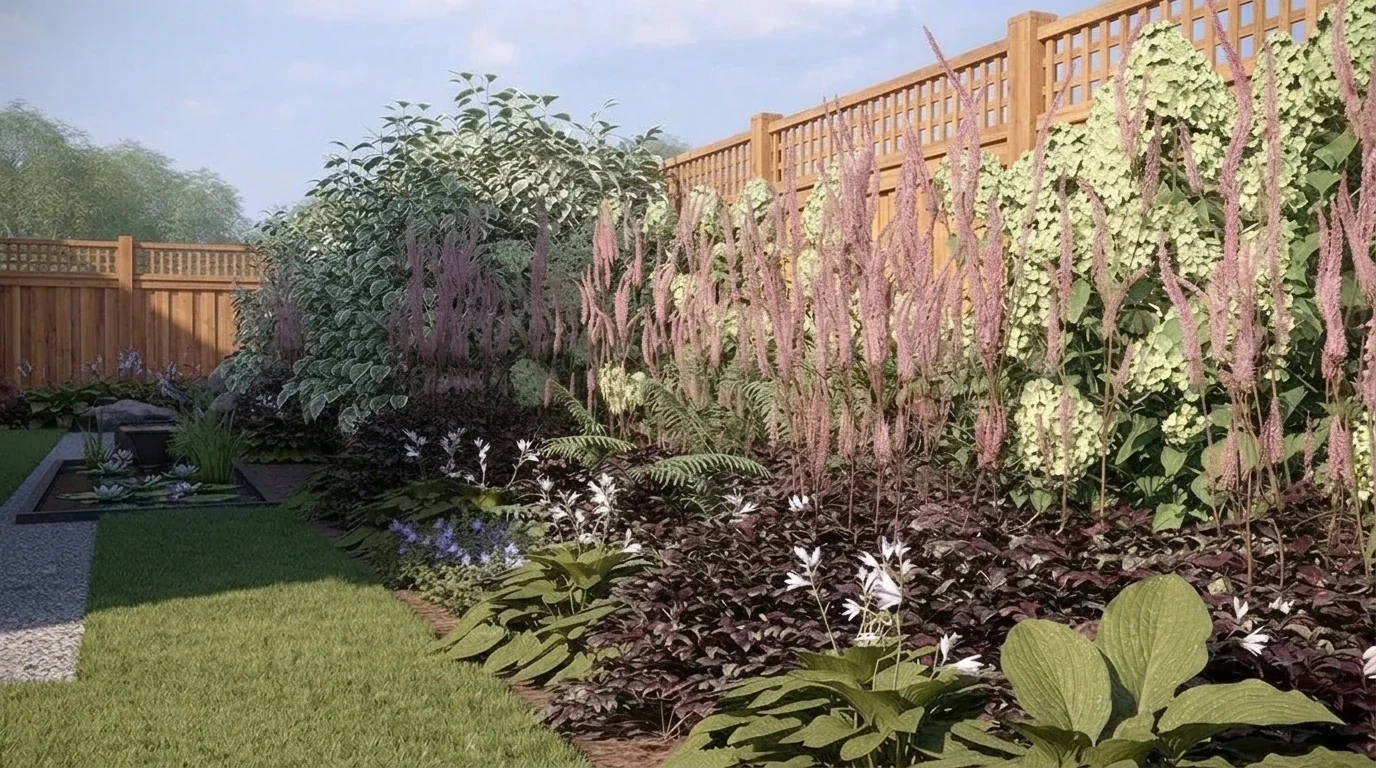
5. A horizontal cedar slat fence
Narrow boards run sideways between posts with small even gaps: the most searched modern privacy fence (horizontal fence ideas alone gets about 3,300 US searches a month, Ahrefs, November 2026). Keep the gaps under about half an inch if you want privacy rather than a screen, and expect a bit more cost than a picket fence because the posts need to be straighter and closer. Here the slats are used as screens around a water wall, which is how designers stretch a short run of expensive cedar.
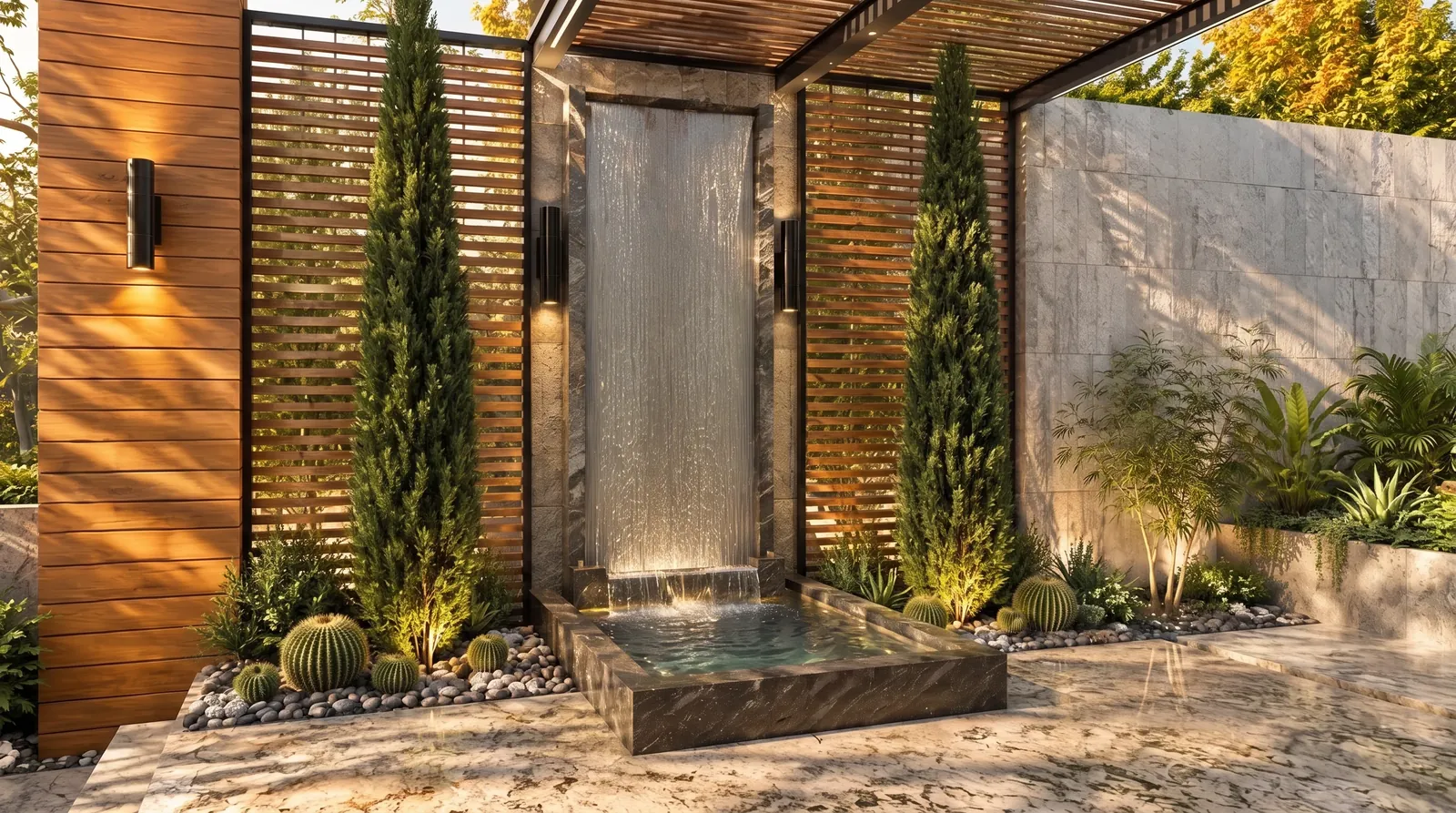
6. A louvered fence for wind and privacy
Boards set at an angle, like a window blind, block the straight-on view and let air move. On a windy lot that matters, because a solid fence catches the whole gust (the chain link industry’s wind load guide treats a fence covered with slats or screen as a solid panel, which needs stronger posts). The trade-off is labor: each board sits in a cut or a bracket, so it costs more than a solid fence of the same wood.
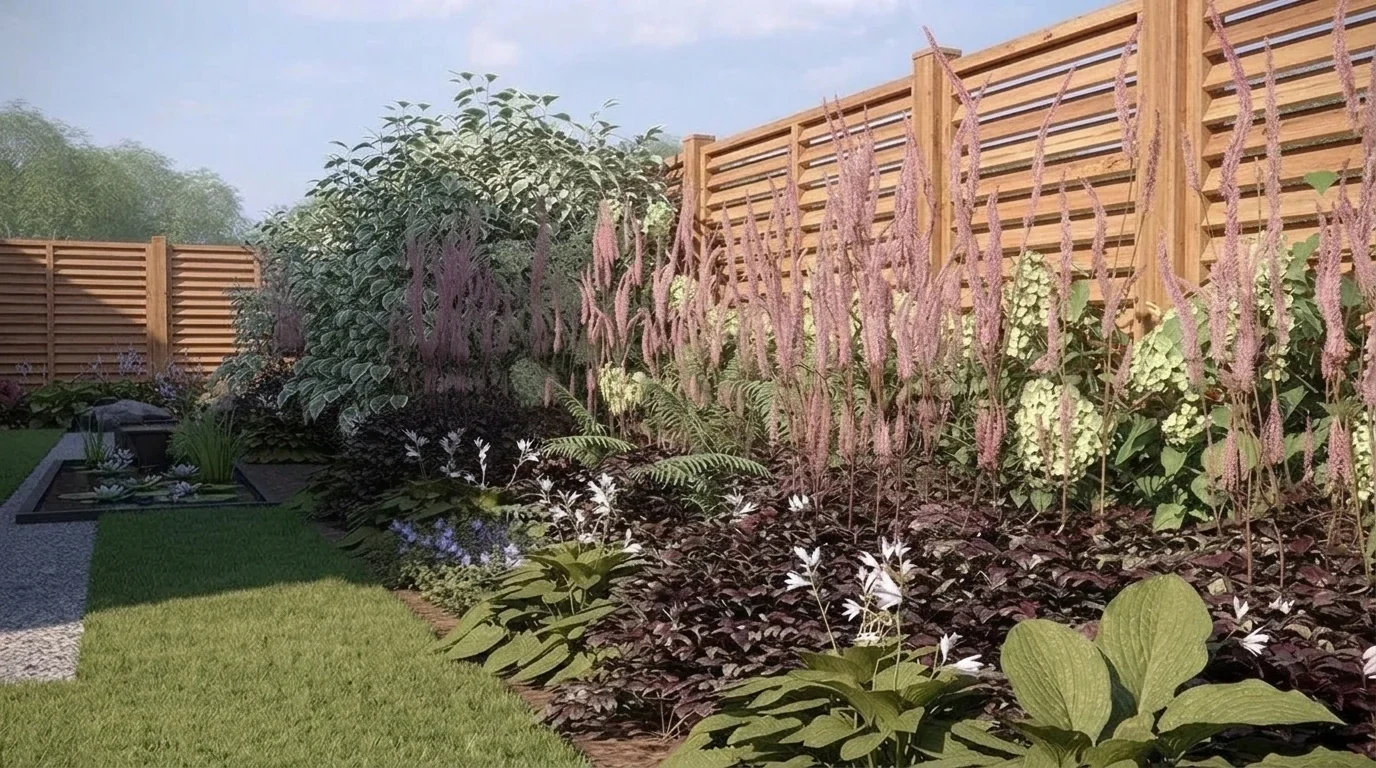
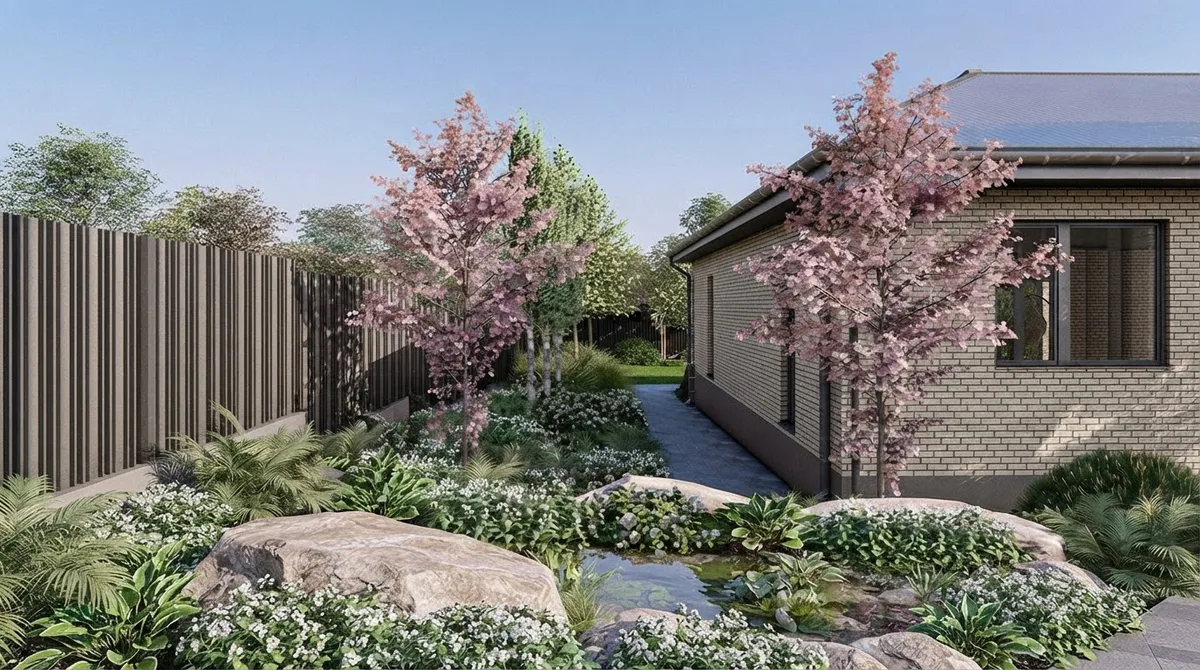
7. Tall vertical boards along a side yard
The side yard is where you are closest to the neighbor’s windows, so it is the one place a full-height fence earns its cost. Plain vertical boards in a dark stain disappear behind planting and make a narrow strip feel like a garden instead of a passage.
Modern Privacy Fence Ideas: Black and Dark Fences
Black and charcoal fences are the strongest trend in the designs I went through for this guide. A dark fence recedes, so plants and the lawn come forward and a small yard looks bigger. You can get the look in stained wood, painted wood, aluminum slats or composite.
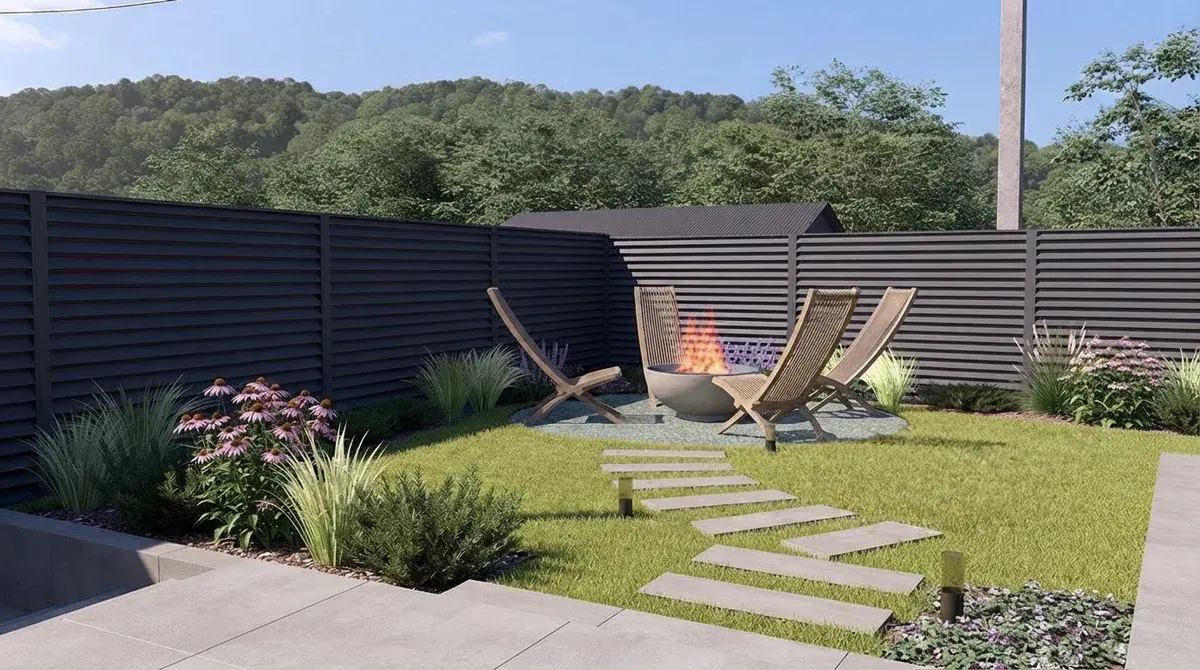
8. A black horizontal slat fence around a small lawn
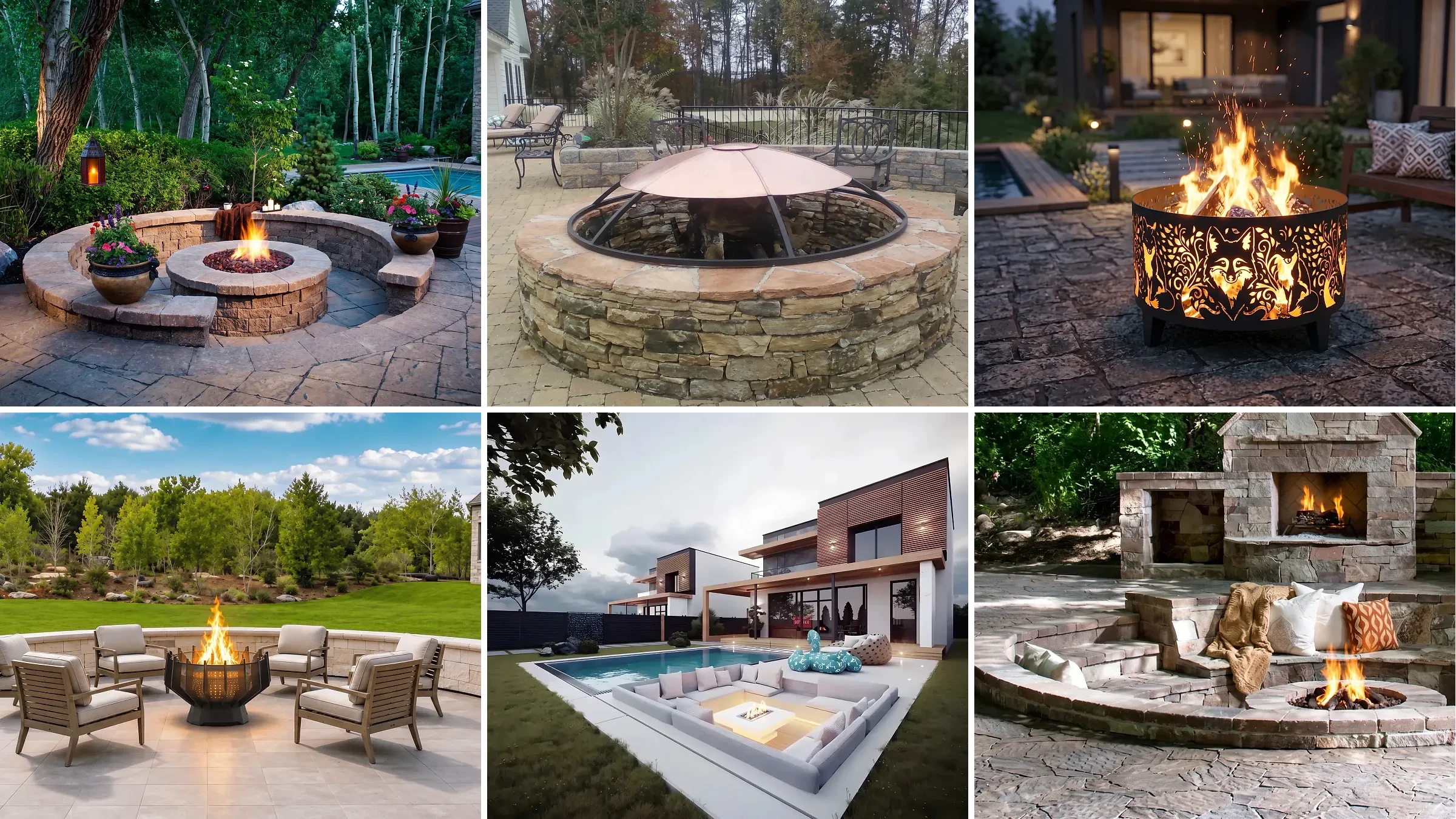
Wrapping all three sides of a small yard in one dark slat fence turns it into an outdoor room. It is also the best backdrop for a fire pit or lounge chairs, as long as the fire keeps its distance: a wood fire pit needs 25 feet from a combustible fence under the International Fire Code (see our fire pit ideas guide).
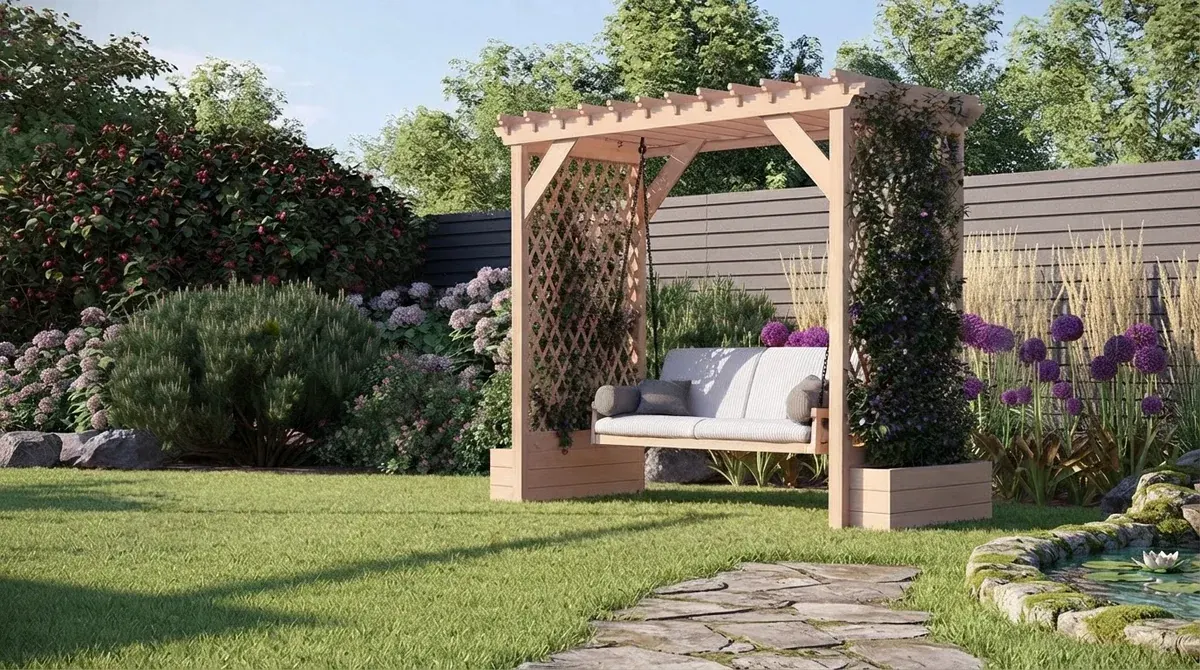
9. A dark fence behind a pergola swing and borders
Put the tallest planting and a structure in front of the fence and the fence stops being the view. A pergola swing with climbers also blocks the one sightline a fence cannot, the one from an upstairs window, which is the whole subject of our backyard privacy ideas guide.
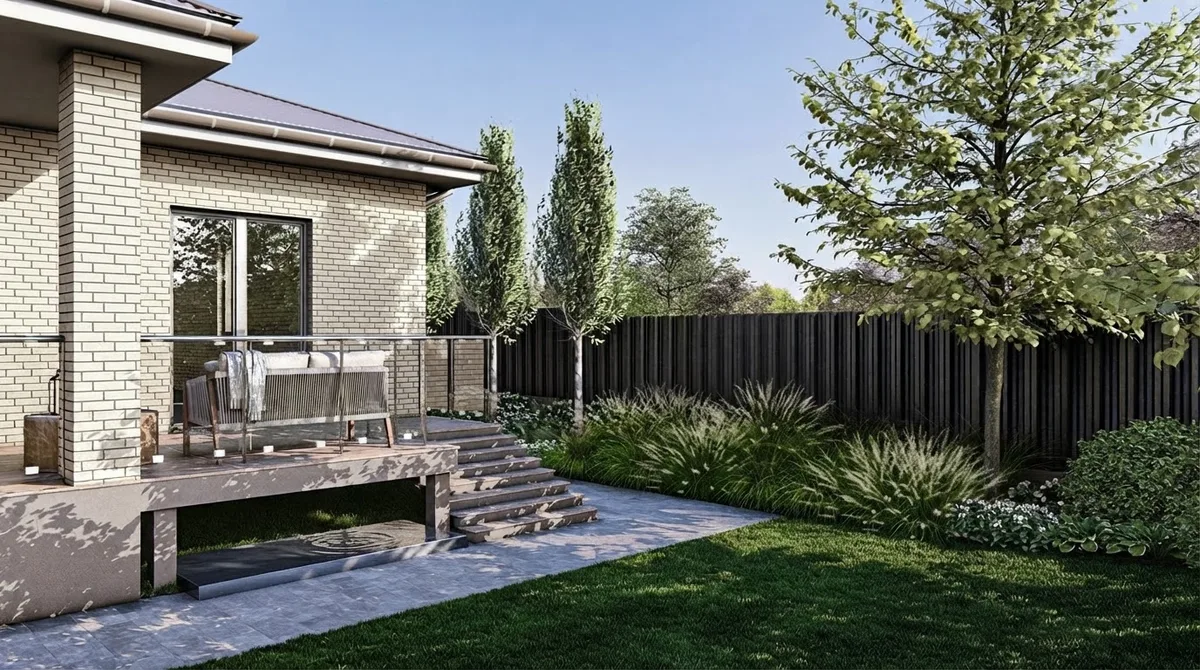
10. A black board fence with Italian cypress
Narrow columnar trees in front of a dark fence add height without shading the yard. They also cover the gap between the top of a 6 foot fence and a neighbor’s second floor, slowly.
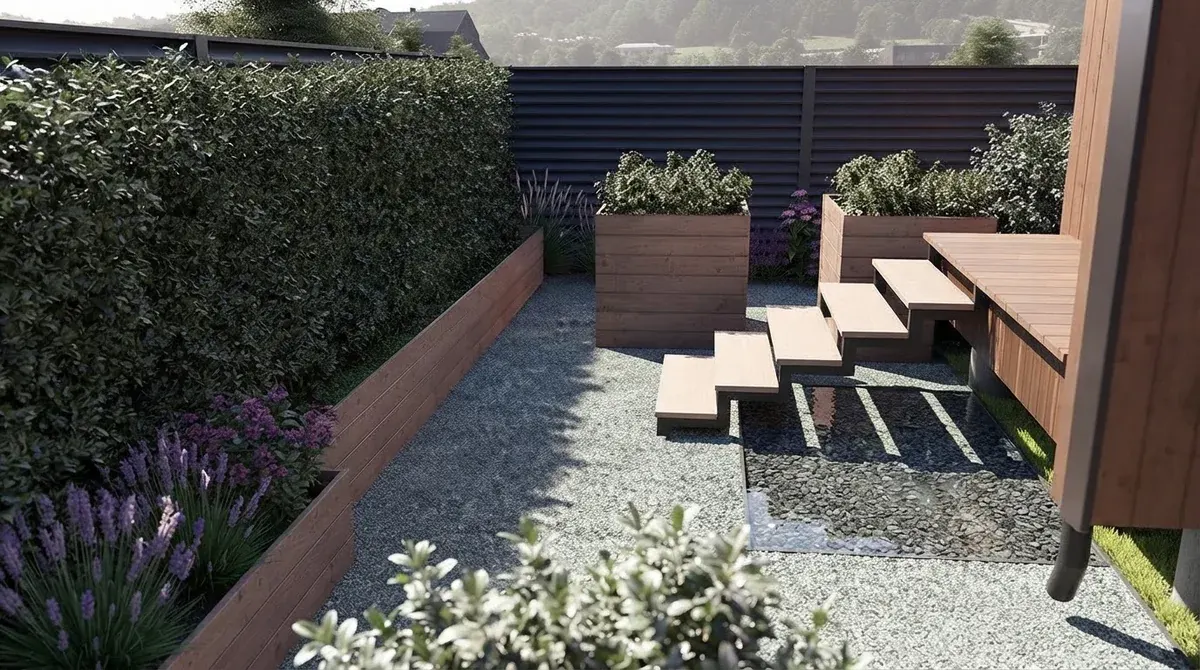
11. A dark fence with raised planters and gravel
Raised timber beds along the fence put the plants at eye level from day one, so the screen does not wait years for shrubs to grow. Keep beds and soil off the boards themselves: wood against wet soil rots first.
Vinyl, Composite and Metal Privacy Fences
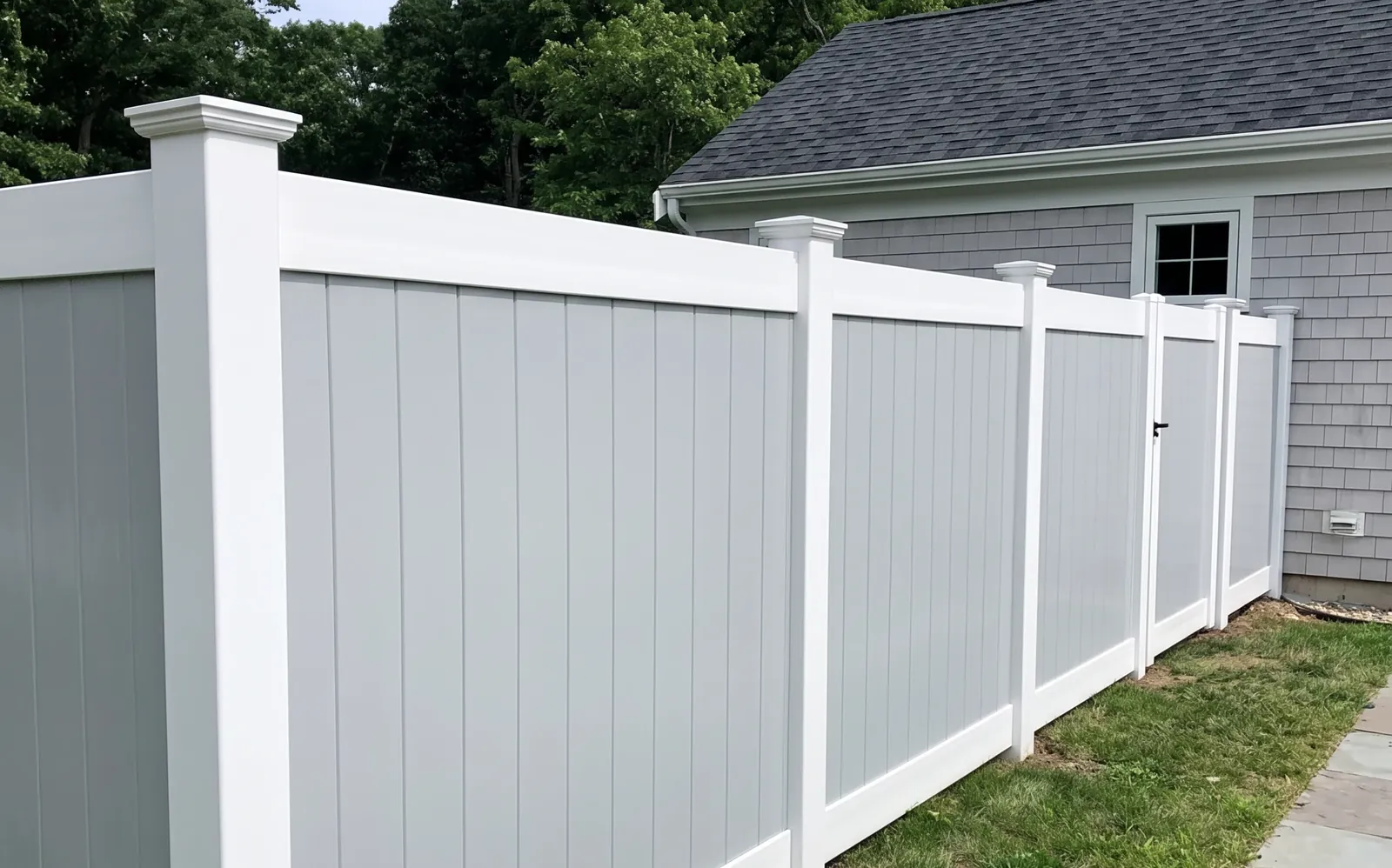
12. A white vinyl privacy fence with a matching gate
Vinyl panels never need paint or stain and come with long warranties, which is the whole appeal. It costs more than wood upfront ($40 to $60 per linear foot installed in HomeGuide’s table, while the same page says up to $85 in its text), the white shows dirt, and HomeGuide warns that vinyl privacy fences can blow over in high-wind areas.
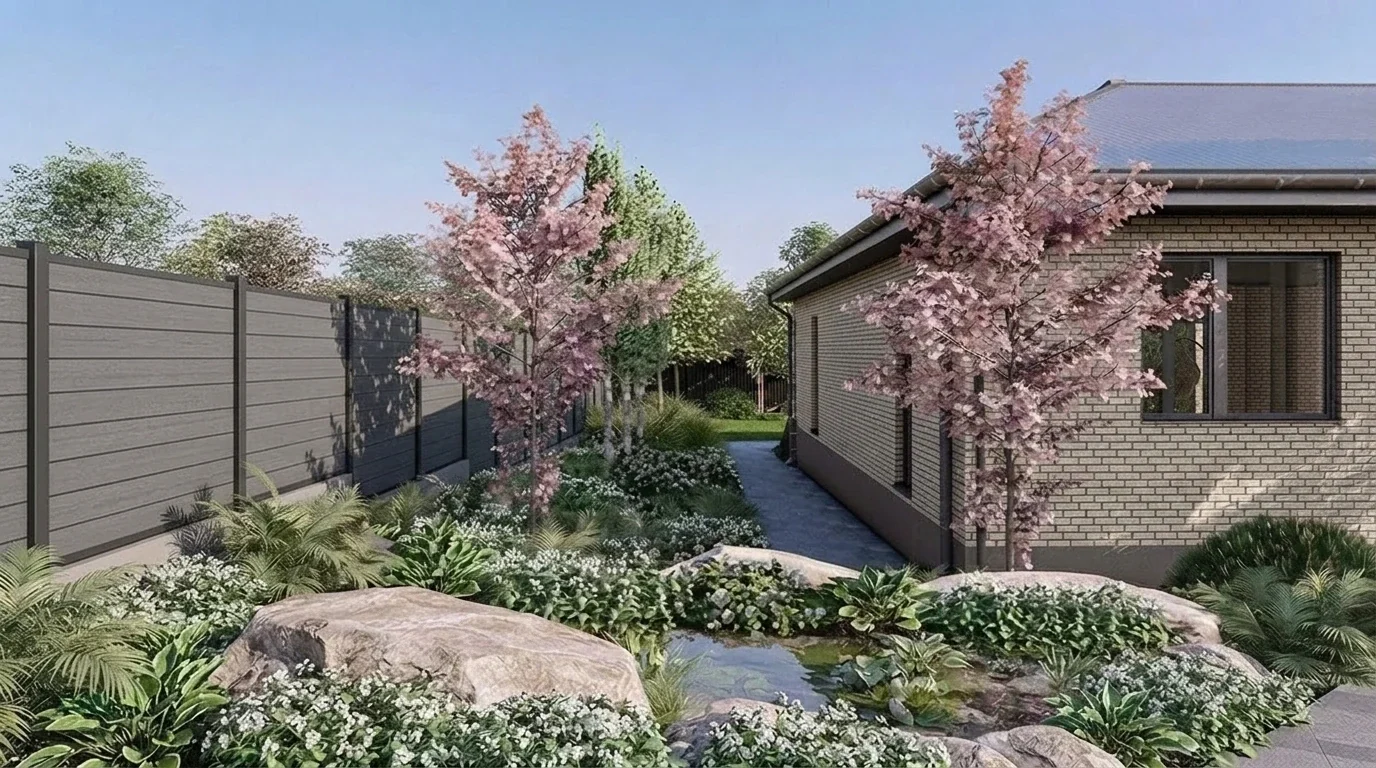
13. A gray composite board fence
Composite boards (wood fiber and plastic) slide between aluminum posts: no splinters, no stain, no rot, and they look like wood from a few steps away. At $55 to $85 per linear foot installed (HomeGuide) they cost about twice a basic wood fence, so they make most sense on a short, visible run next to a patio.
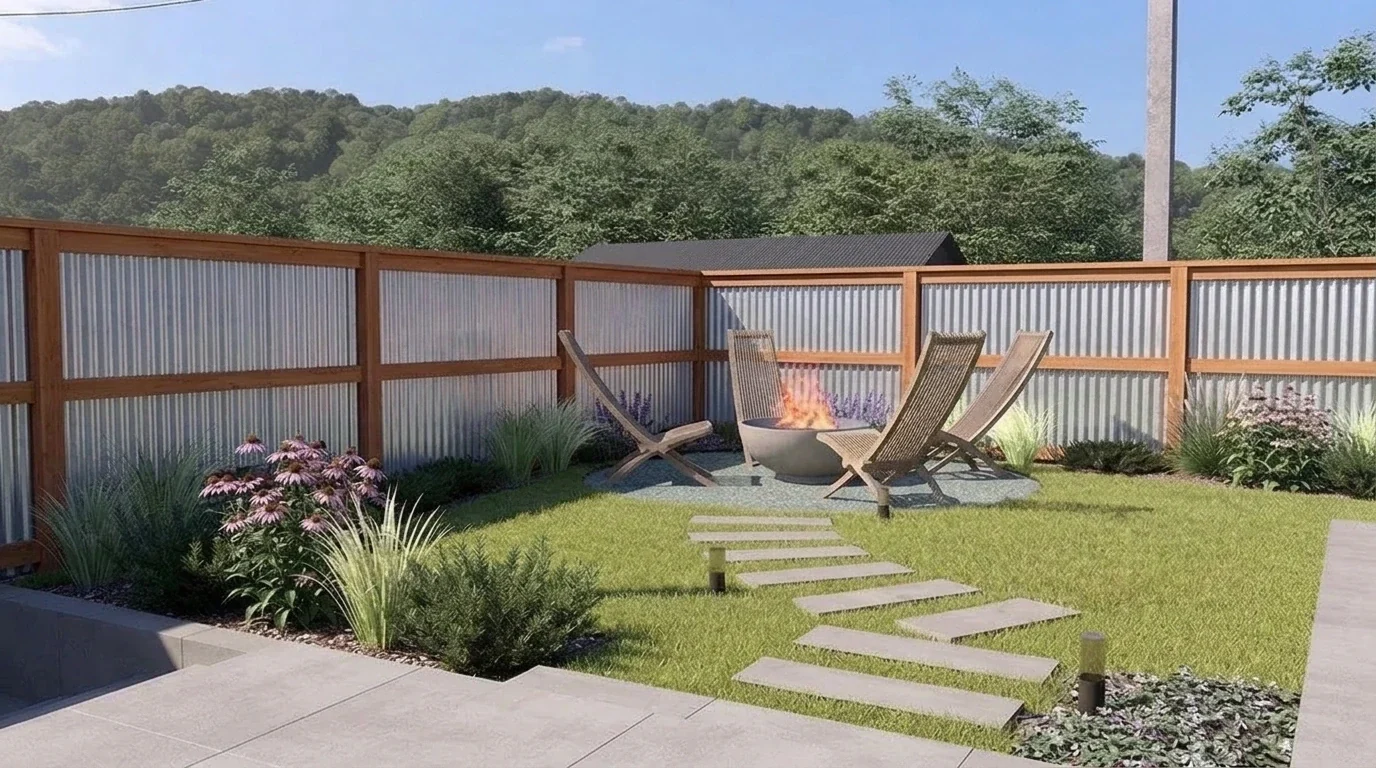
14. Corrugated metal in a cedar frame
Galvanized roofing panels framed in cedar make a durable, industrial-looking privacy fence that costs less than composite ($20 to $55 per linear foot installed, HomeGuide, or $10 to $20 with recycled panels). Use galvanized or coated panels, cap the top edge so nobody touches a cut edge, and remember metal gets hot in full sun and reflects noise.
Living, Stone and Masonry Privacy Ideas
15. A tall hedge as a living fence
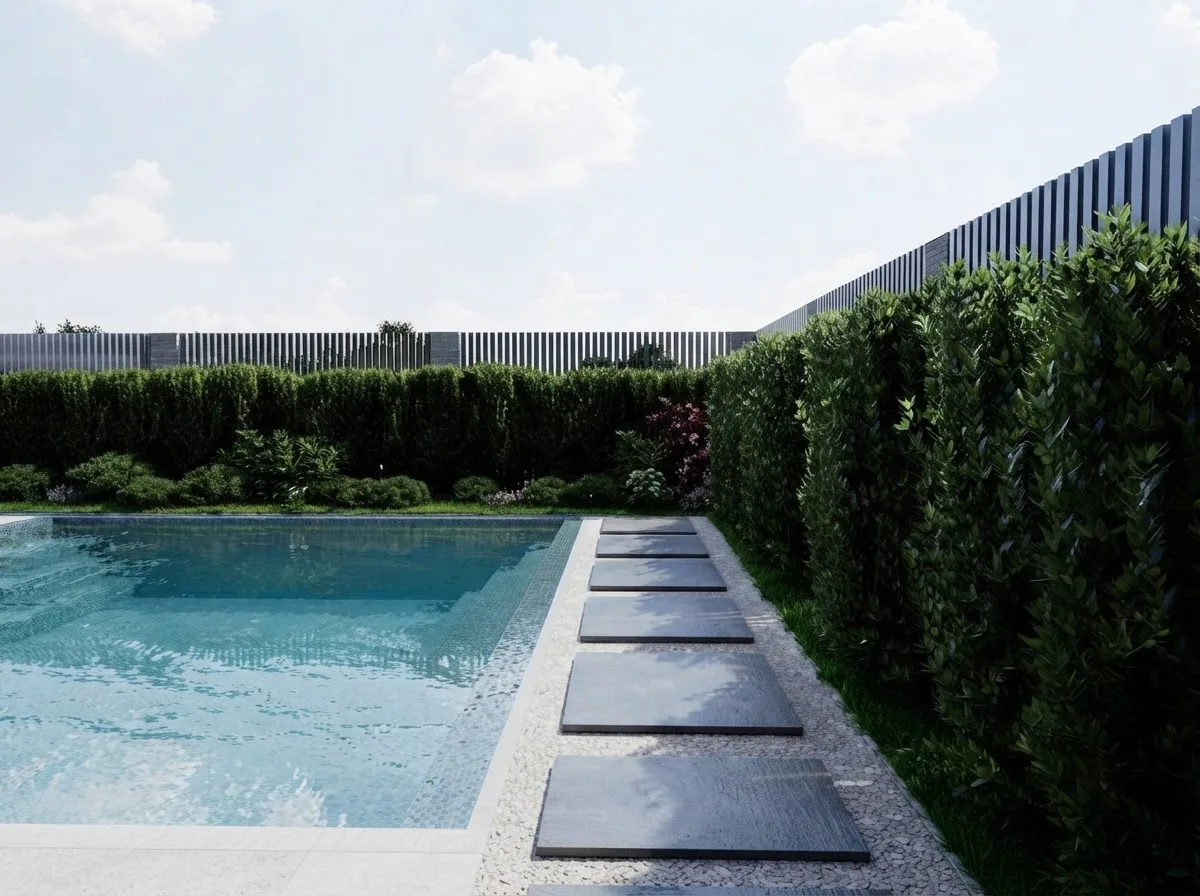
Arborvitae or laurel planted in a line gives a softer screen than any fence, and here it also hides a pool fence behind it. It is cheap to plant and slow to work: NC State Extension puts Thuja Green Giant at 3 to 4 feet a year in good conditions, so a 3 foot plant takes a couple of seasons to block anything.
16. A wire fence covered in climbing vines
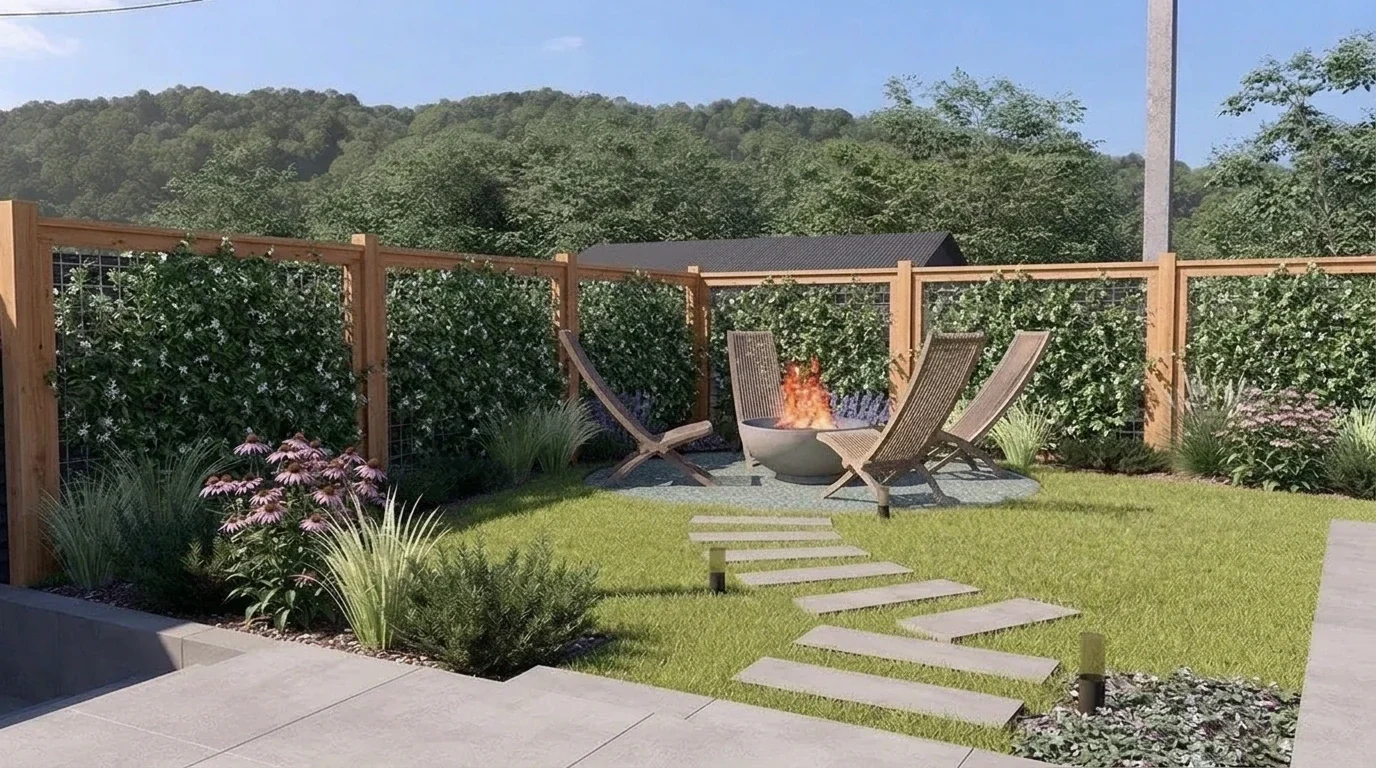
A cattle panel or hog wire fence in a wood frame costs much less than a solid fence, and evergreen climbers such as star jasmine turn it into a green wall in two or three seasons. Until they fill in, it is a see-through fence, so this is the patient option.
17. A gabion wall
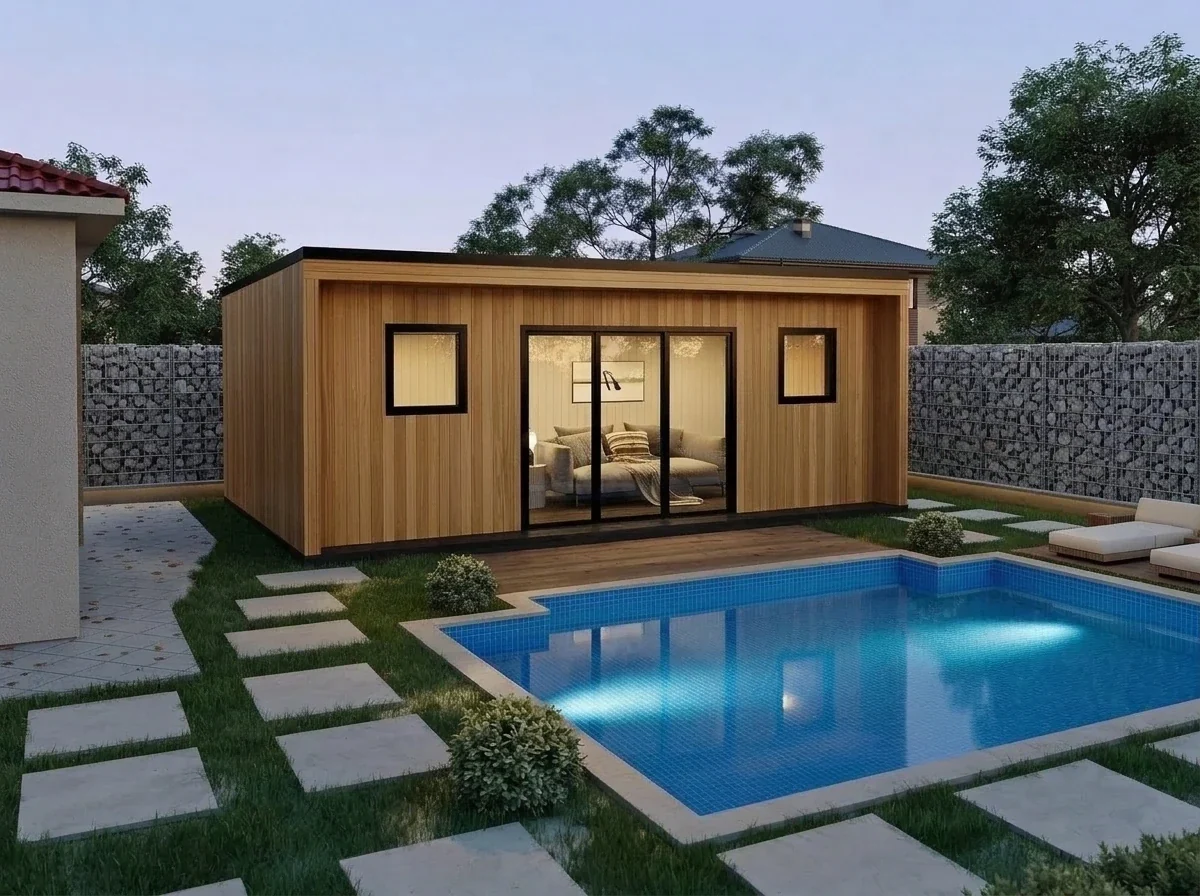
Wire baskets filled with stone block sound as well as sight and never rot. They are heavy, need a level footing and get expensive with delivered stone, so they suit a short feature run behind a pool or patio more than a whole property line.
18. A block wall, the Southwest privacy fence
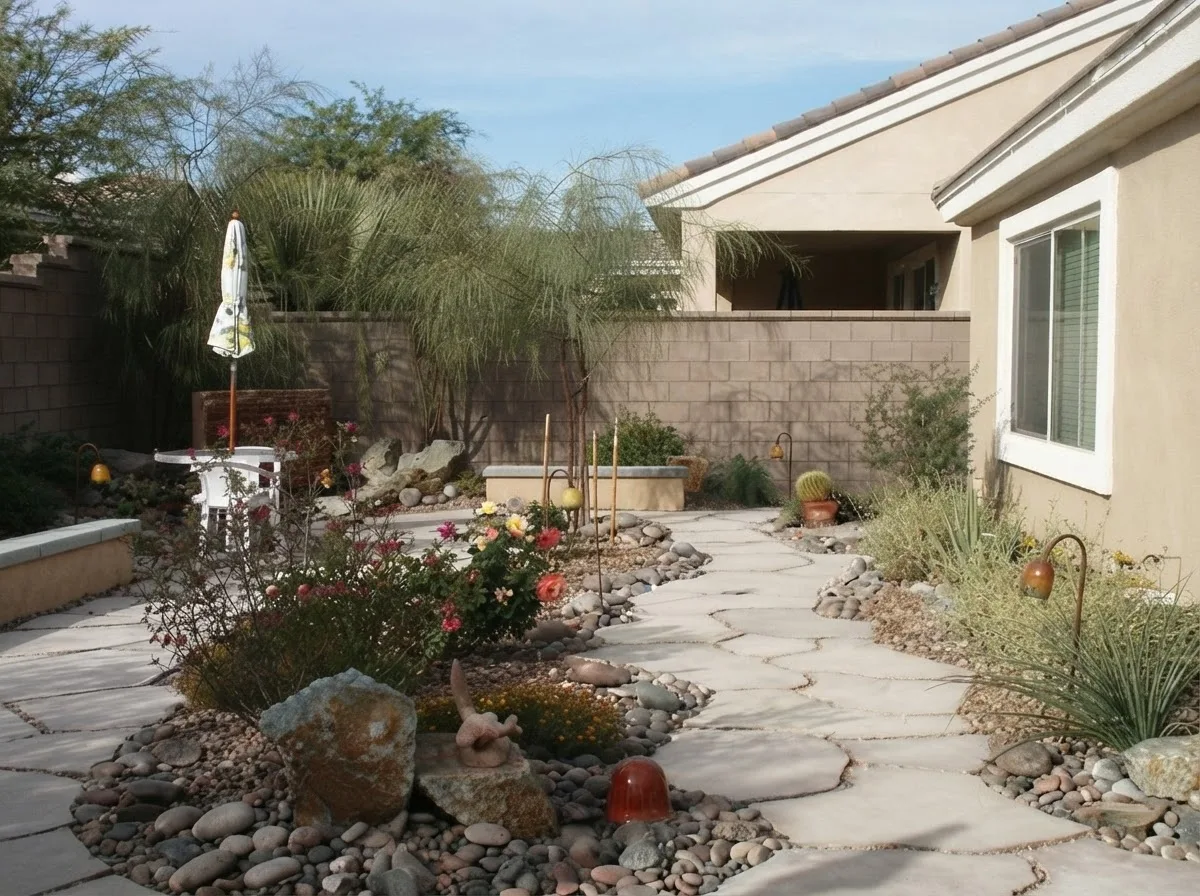
In Arizona, Nevada and much of California the privacy fence is a concrete block wall, often stuccoed or capped. It lasts for decades and costs the most (HomeGuide prices a brick privacy wall at $210 to $360 per linear foot and poured concrete at $90 to $280); above a certain height most cities treat it as a structure that needs a permit and sometimes an engineer.
Cheap Privacy Fence Ideas
The cheapest privacy fence is the one you already have. If there is a chain link fence on the line, adding privacy to it costs a fraction of replacing it.
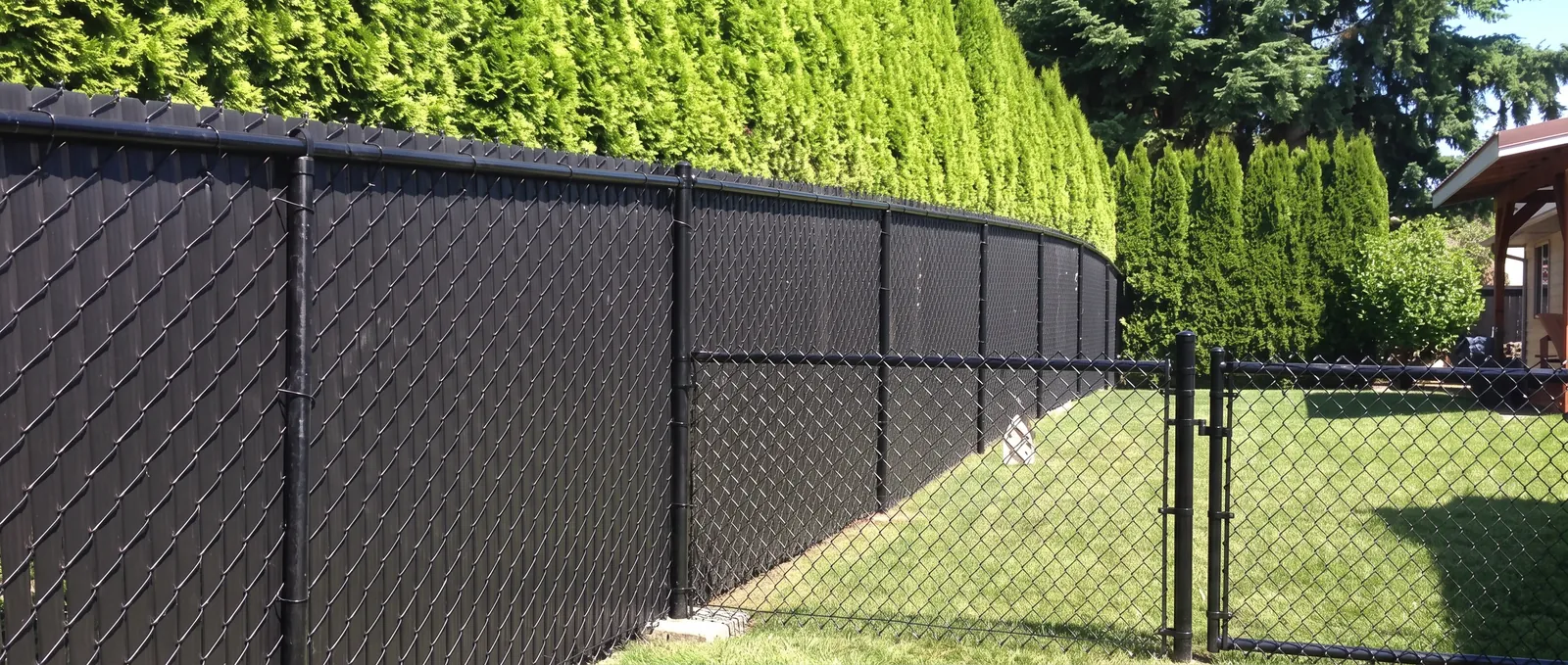
19. Privacy slats in a chain link fence
Vinyl slats woven into chain link block most of the view ($2 to $12 per linear foot to add yourself, or $5 to $18 installed, HomeGuide). Black coated chain link with black slats, as here, looks far better than galvanized with green.
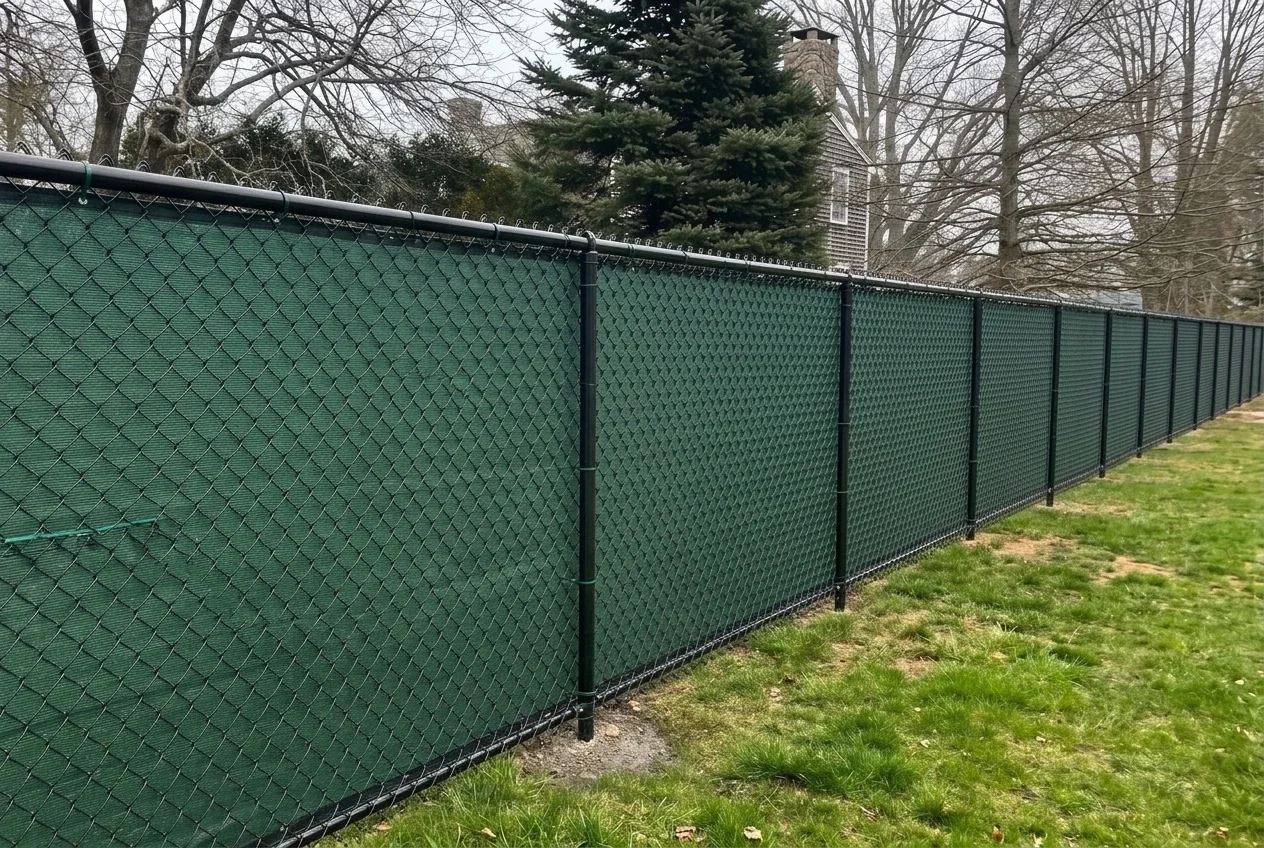
20. Privacy screen fabric on chain link
Shade-cloth style fabric zip-tied to the fence is the cheapest option of all ($1 to $6 per linear foot, HomeGuide) and goes up in an afternoon. It acts like a sail in wind, so use fabric with wind vents or leave it off the windiest run, and expect to replace it after a few years of sun.
Bamboo rolls ($6 to $30 per linear foot, HomeGuide) are another quick screen. Do not plant running bamboo as a living fence: the University of Maryland Extension calls several running species invasive and says they can spread into neighboring yards; only clumping bamboo is considered non-invasive.
21. Screen the seat, not the whole property line
If what bothers you is being seen at the patio table, one or two 6 foot freestanding panels next to the seat do the job of a hundred feet of fence. A screen close to you blocks a much taller sightline than the same screen at the boundary, which is the geometry behind our backyard privacy ideas.
Backyard Pool and Front Yard Fence Ideas
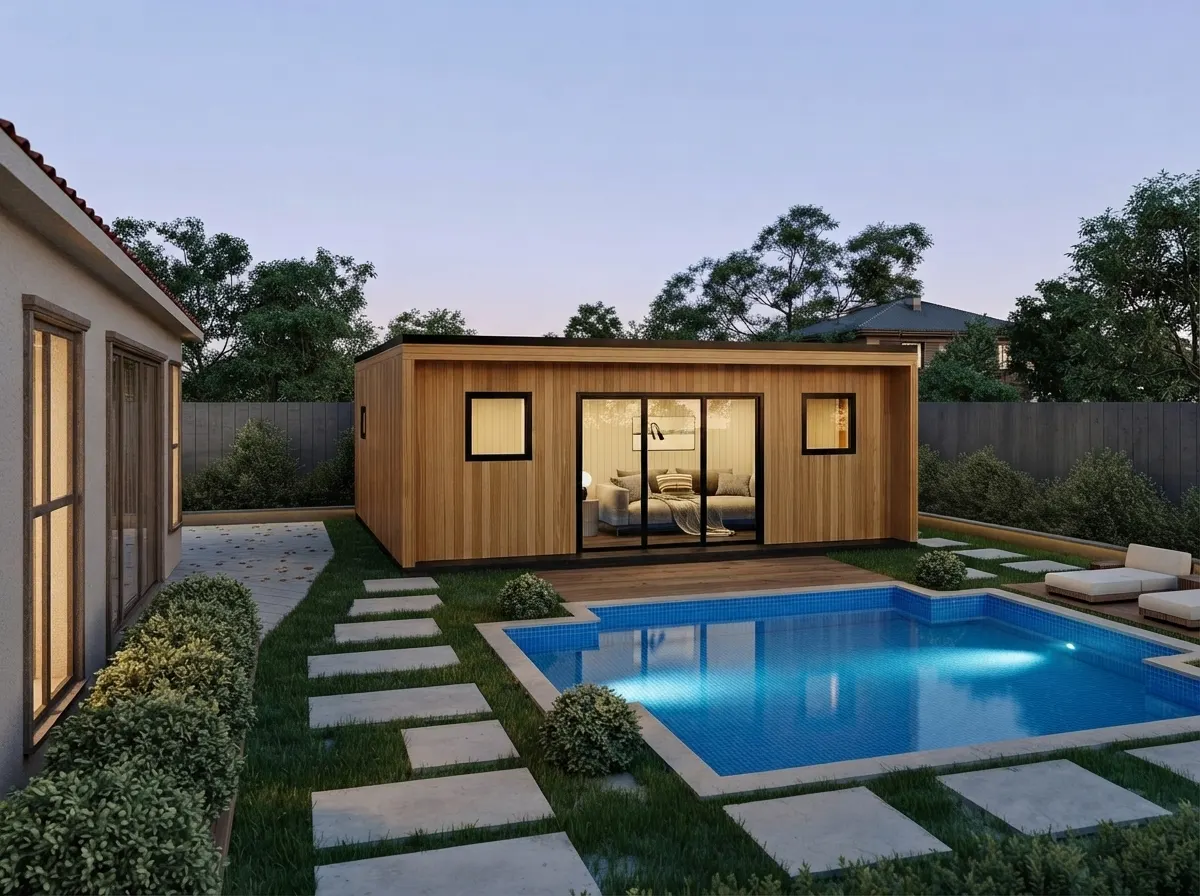
22. A privacy fence around a pool and garden studio
A pool is where most people want privacy and where the rules get stricter. The 2024 International Swimming Pool and Spa Code asks for a barrier at least 48 inches high (section 305.2.1) and limits gaps and footholds; a solid 6 foot privacy fence usually meets that, but the gates must self-close and self-latch, and your city may add its own rules. Here a plain gray board fence disappears behind the studio and the lawn, and our pool renovation cost guide covers the rest of the budget.
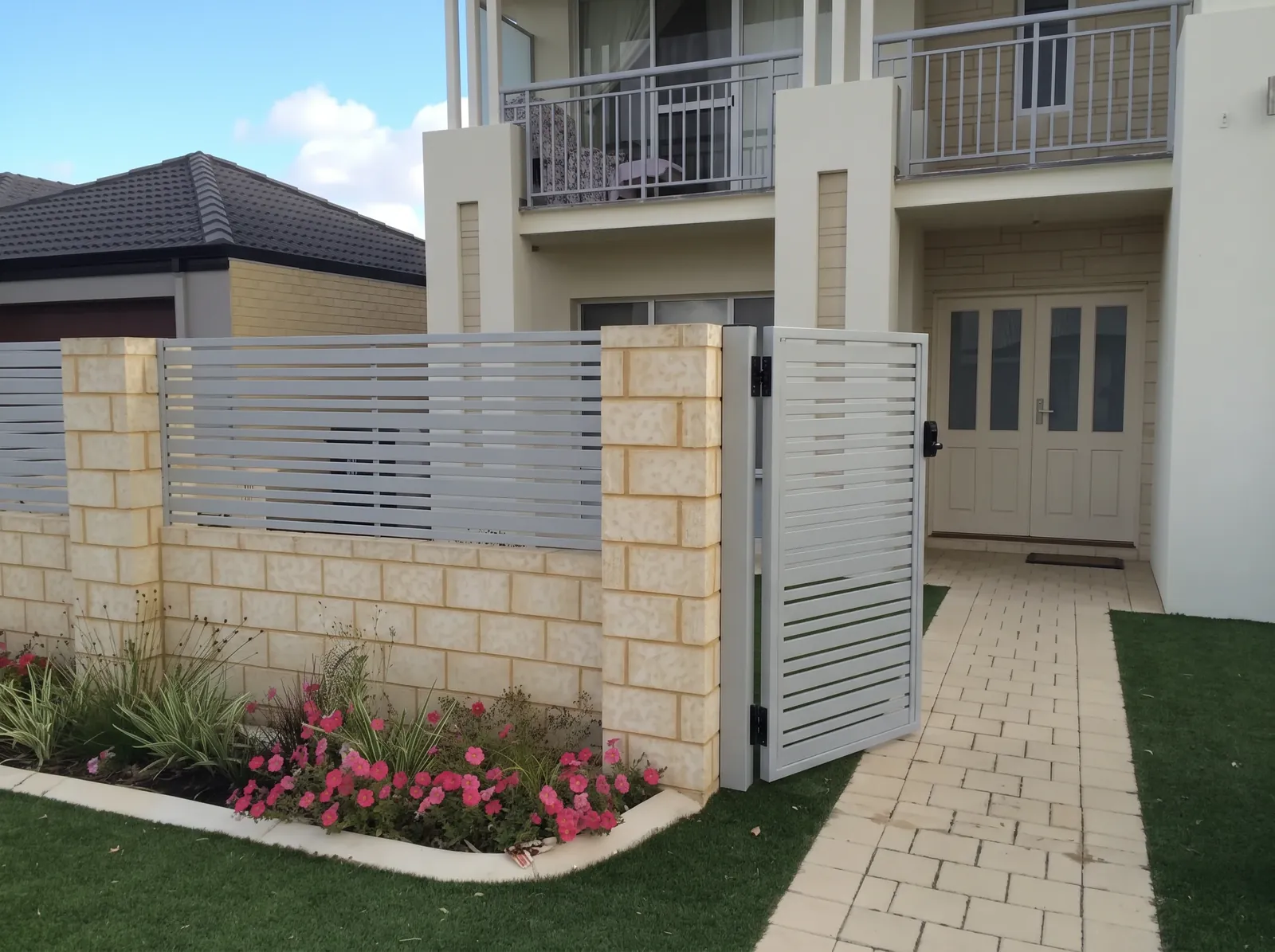
23. A low slat fence on brick piers in front
Front yards are where privacy fences stop: most cities cap front fences at 3 to 4 feet (Denver allows 4 feet in front of the house; Minneapolis allows 4 feet and only for open fences). A low brick wall with an open slat fence and a matching gate gives a sense of enclosure without breaking the rule. For more ideas at the front of the house, see our modern front porch ideas.
How Much a Privacy Fence Costs, by Material
Angi puts the national average privacy fence at $4,300, with most projects between $1,800 and $8,000 (updated September 2026). For a 150 foot fence its examples run from about $2,500 for corrugated metal and $2,700 for wood to $3,700 for vinyl and $4,200 for composite, and height matters as much as material: about $4,700 for 6 feet against $6,300 for 8 feet. The table gives per-foot installed prices from HomeGuide’s cost guides, which break the materials down further.
Sources: HomeGuide privacy fence, wood fence and chain link vs wood cost guides (2025 to 2026), Angi board-on-board guide (October 2026). Prices are national ranges; a quote in a high-cost metro, on a slope or through rock will be higher. If you are also pricing the rest of the outside, our house painting cost guide works the same way.
How Tall Can a Privacy Fence Be?
Usually 6 feet behind the front of the house and 3 to 4 feet in front of it, but the rule is your city’s, not a national one. Three real examples:
- Minneapolis (Zoning Code chapter 550, article X): 6 feet in the rear yard, 4 feet in the front yard and only for open fences that are at most 60% solid, and no fence over 8 feet. A building permit is needed over 7 feet.
- Austin (City Code 25-2-899): a solid fence on the property line may be 6 feet high, up to 8 feet if it sits on or inside the building setback line; a permit is needed above 7 feet.
- Denver: 4 feet in front of the street-facing wall of the house, 6 feet level with it or behind it; taller needs the over-height process in zoning code section 10.5.5.
Three more things decide whether the fence goes up without a fight:
- The good side faces out. Many cities require it. Minneapolis, for example, says the finished side must face the neighbor or the street, with posts and rails on your side.
- Call 811 first. 811 is the free national call-before-you-dig number (set up by the FCC in 2005); contact it a few business days before any digging, whatever the depth. Fence post holes are exactly the kind of digging it is for.
- Read your HOA rules. About 78.1 million Americans, nearly 1 in 4, live in a community association (Foundation for Community Association Research, 2025), and HOA rules on fence height, color and material are often stricter than the city’s.
On the build itself, This Old House’s rule of thumb is a post hole one third of the post’s height plus 6 inches for gravel, which comes to about 2 feet for a 6 foot fence, deeper in frost country, with posts 6 to 8 feet apart. A solid privacy fence takes much more wind than an open one, so windy lots need deeper holes or closer posts.
See a Privacy Fence on Your Own Yard: Our MeltFlex AI Test
MeltFlex AI draws a new privacy fence on a photo of your own yard through the AI fence design tool: upload the photo, pick Wood Privacy, White Vinyl Privacy or Horizontal Slat and the 6 ft privacy height, or type any other fence into the box. A render costs 10 credits; new accounts get 15 free credits, so the first design is free, and Standard is $20.99 a month, or $12.99 a month billed yearly, for 490 credits. In our test it built the right privacy fence in 20 of 24 renders and kept the rest of the yard in 18 of 24. It does not measure anything and it does not know your city’s height limit. MeltFlex AI is ours, so here is every result, including the misses.
On November 26, 2026 I took five backyard designs from our Behance collection that already had a fence (a long lawn with a cedar dog-ear fence, a pool with a garden studio, a perennial border, a side garden beside a brick bungalow and a small lawn with a fire pit) and asked for 12 privacy fence types, each on two different yards: the three privacy presets plus nine types typed into the custom box, from board-on-board to gabion. Every request used the 6 ft privacy height. The test ran by script with exactly the prompt the fence tool builds and the image model the app uses (gemini-nano-banana-2.1), so it skipped the web app itself; I graded all 24 renders at full size next to the originals.
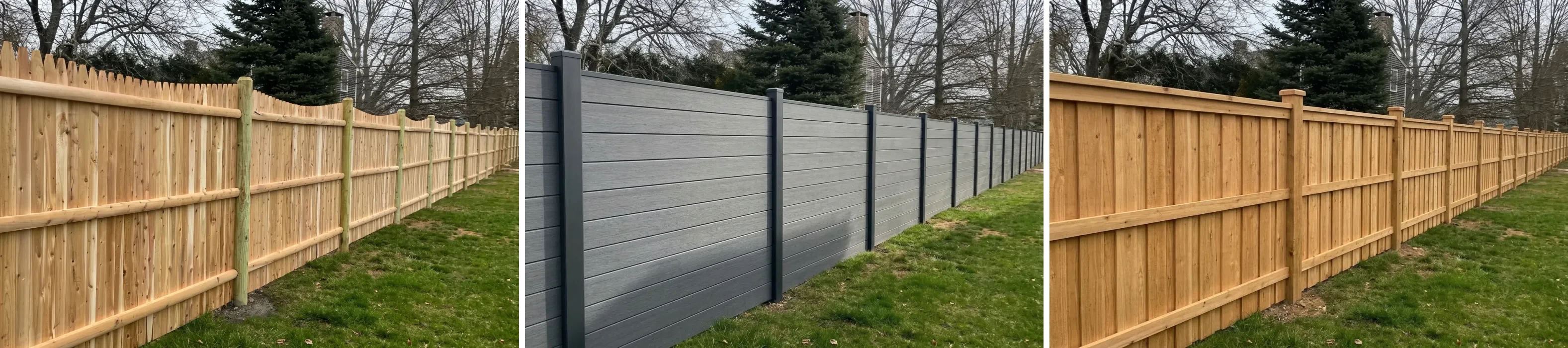
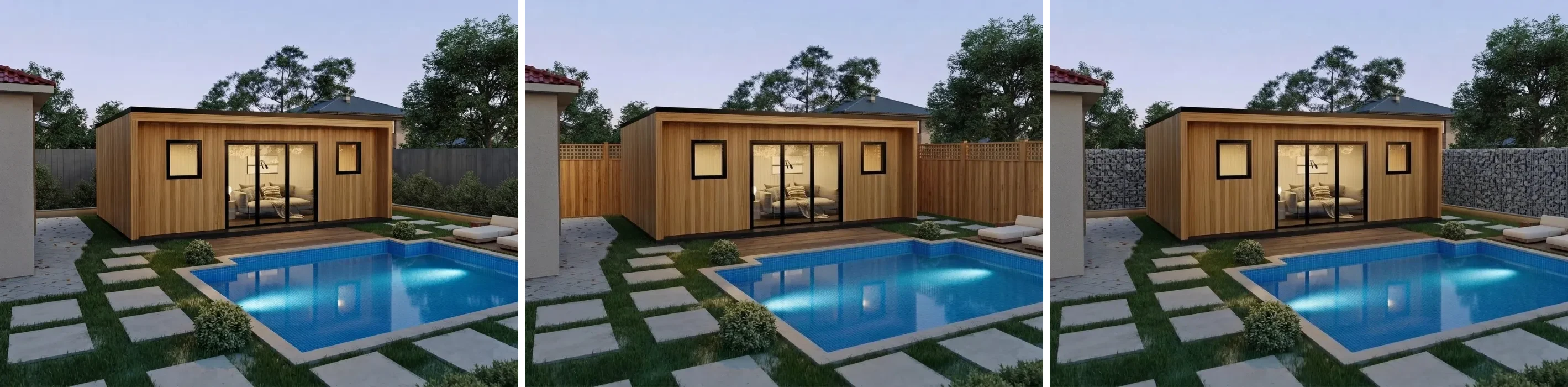
What it got right: every render replaced the old fence along its exact line and at a believable 6 foot height, wrapped corners correctly, and left the lawn, paths, house and lighting alone on four of the five yards. The typed types worked better than I expected: corrugated metal came out framed in cedar with a cap, the gabion baskets had stone that looked heavy, and the composite had real tongue and groove boards between aluminum posts. What it got wrong: on the pool yard it removed the low shrubs along the back fence in all five renders, so a fence change there would quietly delete your planting. The construction details that cost extra money are exactly the ones it skipped: board-on-board came back as a single layer twice, and one shadowbox and one louvered render lost the detail that makes them what they are.
So use the render for what it is good at: choosing between wood, vinyl, metal and green, and between dark and light, on your own yard, and showing it to whoever lives with you or shares the fence. Then take the drawing to the fence company with the type written down, and check the height with your city before anybody digs. MeltFlex AI also works inside Claude and ChatGPT through the MeltFlex AI MCP connector and for developers through the MeltFlex AI API. To try the rest of the yard, the AI garden design tool opens the same photo with planting, paths and lighting; to compare it with other apps, read our AI landscape design tools test and best landscape design apps.
Privacy Fence Checklist Before You Get Quotes
- Sit where you want privacy and note what you can see: a ground-floor window or yard (a fence fixes it) or an upstairs window (it will not; see backyard privacy ideas).
- Look up your city’s fence height, front-yard limit, good-side rule and permit threshold, then your HOA rules.
- Find the property line from your survey or plat, not from the old fence.
- Pick the type: wood for the lowest price, vinyl or composite for no upkeep, slats or fabric if a chain link fence is already there, plants if you can wait.
- Try two or three types on a photo of your own yard and show the neighbor if the fence is shared.
- Ask for quotes with the type written out (board-on-board, not “privacy”), the height, post depth and spacing, and who pulls the permit.
- Call 811 a few business days before anyone digs.
Privacy Fence Ideas: FAQ
What is the best privacy fence for a backyard?
For most US backyards, a 6 foot wood privacy fence with tight boards (dog-ear, capped or board-on-board) is the best value at about $25 to $50 per linear foot installed (HomeGuide); vinyl and composite cost more but need no staining. To compare them on your own yard first, MeltFlex AI draws wood, white vinyl and horizontal slat privacy fences on a photo; in our MeltFlex AI test on November 26, 2026 it drew the right fence type in 20 of 24 renders.
How much does a privacy fence cost?
Angi puts the national average at $4,300, with most projects between $1,800 and $8,000 (September 2026). Per linear foot installed, HomeGuide lists $25 to $50 for wood, $40 to $60 for vinyl, $55 to $85 for composite and $14 to $48 for chain link with slats; 8 foot fences run $50 to $85. MeltFlex AI does not price fences: it shows how the fence will look, so get at least three written quotes.
Can I see a privacy fence on my house before I build it?
Yes. MeltFlex AI's fence design tool redraws the fence on a photo of your own yard in about 9 to 66 seconds for 10 credits; new accounts get 15 free credits, so the first design is free. In our test it kept the house and planting in 18 of 24 renders, removed shrubs along the fence on one pool yard, and drew board-on-board as a single layer of boards in 2 of 2, so check the details with your fence company.
How tall can a privacy fence be?
Usually 6 feet in back and side yards and 3 to 4 feet in front of the house, but it depends on the city. Minneapolis allows 6 feet in the rear yard, 4 feet in front only for open fences, and nothing over 8 feet; Austin allows 6 feet on the property line and up to 8 feet inside the setback. HOA rules can be stricter.
What is the cheapest way to get privacy from a fence?
Add privacy to a chain link fence you already have: screen fabric costs $1 to $6 per linear foot and DIY slats $2 to $12 (HomeGuide). For a new fence line, wood is the cheapest full-height option. A freestanding screen next to the seat can block more than a whole new fence at the boundary.
Which side of a privacy fence faces the neighbor?
The finished side usually faces out, toward the neighbor or the street, with posts and rails on your side. Many cities require it; Minneapolis, for example, writes it into its zoning code. A shadowbox or board-on-board fence looks finished from both sides.
Do I need a permit for a privacy fence?
Often only above a certain height. Minneapolis and Austin both require a permit for fences over 7 feet, while other cities want one for any new fence. Call 811 a few business days before digging post holes, whatever the depth.
How long does a privacy fence last?
Pressure-treated pine lasts about 10 to 15 years and cedar or redwood 25 years or more; vinyl 20 to 30 years, composite 25 to 30+, aluminum 30 to 50, and chain link 15 to 20 or more when vinyl coated (HomeGuide). Posts set deep enough, about one third of their height plus 6 inches of gravel, keep any fence standing longer.
Sources
- Angi: How much does a privacy fence cost (updated September 21, 2026)
- Angi: Board on board fence cost (October 29, 2026)
- HomeGuide: Privacy fence cost (December 22, 2025)
- HomeGuide: Wood fence cost (December 22, 2025)
- HomeGuide: Privacy fence ideas and costs (July 16, 2025)
- HomeGuide: Chain link vs wood fence (February 3, 2026)
- Fixr: Privacy fence cost (January 31, 2025)
- City of Minneapolis: Fence requirements (August 2025)
- City of Austin: Fencing regulations
- City and County of Denver: Fences and walls
- ICC: 2024 International Swimming Pool and Spa Code, section 305
- 811 Before You Dig
- NC State Extension: Thuja Green Giant
- University of Maryland Extension: Containing and removing bamboo
- This Old House: Fence post installation (May 2026)
- Community Associations Institute: 2025 statistical review press release
Audio version by MeltFlex AI
Listen to this article
Prefer to listen? Matthew and Bryan, the founders of MeltFlex AI, talk through 23 Privacy Fence Ideas With Costs and Height Rules in about 16 minutes. The voices are AI-generated. Every section is a chapter, so you can jump straight to the part you need while you browse rooms or sketch a layout.
Chapters (8)
More narrated articles on AI Interior Design MeltFlex