

The bed is in front of the window because that is the only wall it fits on. Every guide you have found so far has answered a question you did not ask, which is whether it looks good. For the rest of the room, which wall the bed takes when the window is not forcing the decision, see the bedroom layout guide.
Our articles are still written by humans!
Get human written articles in your Google feed.
A bed in front of a window is fine, and it is fine far more often than the internet suggests. It stops being fine in four situations: a radiator under the window, a window air conditioning unit in it, that window being the room’s emergency escape opening, and a small child’s room with corded blinds. Everything else on this subject is styling, and styling is solvable. What follows is the four blockers with the actual numbers attached, then the styling, in that order, because there is no point choosing a headboard for a bed that is sitting on a radiator.
FreeUpload photo · freeRearrange my room for freeUpload a photo and MeltFlex plans a new furniture layout around your walls, windows and doors. Your first AI design is free, no card needed.


The short version
Designers do this deliberately. A window is a better thing to have behind a bed than blank plaster, and in older housing stock the window wall is frequently the only run long enough to take a queen without blocking the door swing or the wardrobe. The reason the layout has a bad reputation is that most people execute it by pushing a tall solid headboard against the glass, which cuts the window in half and makes the room look like a mistake.
So the question is not whether you may. It is whether anything physical is in the way, and then whether you handle the headboard and the curtains in a way that reads as a decision.

That is the layout working: the headboard stops below the sill, the whole window stays visible above it, and the curtains are stacked off the glass. Nothing clever is happening. The bed is simply not fighting the window.
When it works and when it does not
The four things that actually stop you
This is the part the styling posts skip, and it is the only part where the answer can be a flat no.
1. The radiator under the window
Radiators are under windows for a reason that predates double glazing: the coldest surface in the room is the glass, and warm air rising in front of it cancels the downdraught. Around 80 to 90 percent of a modern panel radiator’s output moves by convection rather than radiation, so it depends entirely on air being able to travel up its face.
Push a divan base and a mattress against it and you have built an insulated box around your heat source. Blocking a radiator with furniture is commonly estimated to waste 10 to 15 percent of the heat it produces, and a solid-backed piece hard against a double panel radiator can cut its useful output by 40 to 50 percent. The usual advice is a minimum of 150 mm of clearance and ideally 200 to 300 mm, which is 8 to 12 inches.
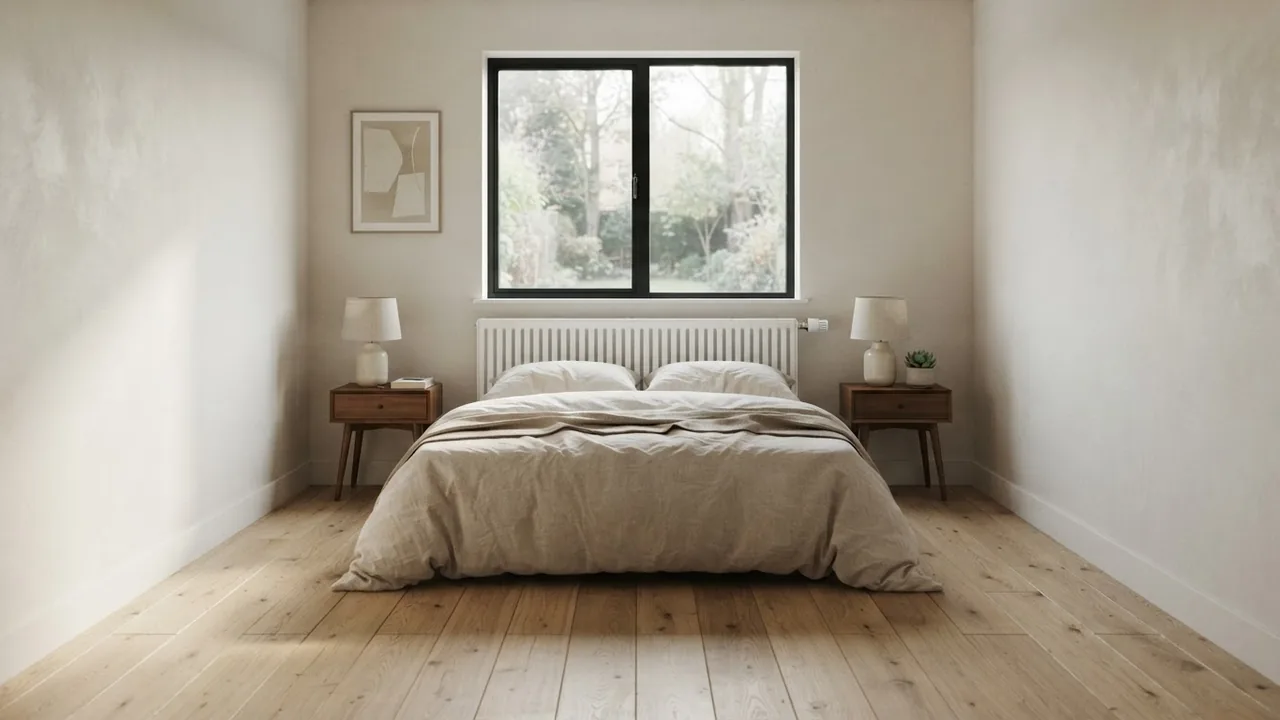
Two things make this survivable. A bed base on open legs, with clear air underneath, lets convection keep working in a way a solid divan never will. And pulling the bed forward by a hand’s width costs you almost nothing in a room you have already decided is tight. If you are working out whether that hand’s width exists, our guide to what size furniture fits my room covers how to check clearances properly before you move anything heavy.
2. The window air conditioning unit
This one is simpler: a window unit sits in the lower half of the window, which is exactly where your head goes. It blows cold air directly onto the pillows, it is the loudest object in the room at the closest possible range, and it sheds condensate down the inside of the frame above where you sleep.

There is no styling answer to this. Either the unit moves to another window, or the bed does.
3. The escape opening
Under the International Residential Code, section R310, every sleeping room needs at least one operable emergency escape and rescue opening. The 2024 numbers are a minimum net clear opening of 5.7 square feet, at least 24 inches of clear height, at least 20 inches of clear width, and a sill no more than 44 inches above the finished floor.
Being precise about what that does and does not say, because it gets misquoted: the code regulates the window, not your furniture. No inspector is going to fault you for where the bed is, and nobody is going to fail a sale over it. The reason it belongs in this article anyway is that the 44 inch sill limit exists so a person can climb out, and a mattress deck sits at roughly 25 inches. If that window is the only qualifying opening in the room and your bed covers the part you would climb through, you have quietly removed the exit. In a room with two windows this is a non-issue. In a converted attic or a basement bedroom with one, it is the whole decision.
4. Corded blinds in a child’s room
The US Consumer Product Safety Commission reports that on average about nine children under five die each year from strangling in window blinds, shades and other window coverings with cords, and treats any accessible cord longer than 8 inches as a hazard for children up to eight years old. Its own guidance is direct: move cribs, beds, furniture and toys away from windows and window covering cords, preferably to another wall.
For an adult bedroom this is not a consideration. For a toddler’s room it outranks every other argument in this article, and it is the reason the honest answer for a child’s room is usually to put the bed somewhere else, or to go cordless before you do anything else.
The numbers, in one place
The headboard decides how it reads
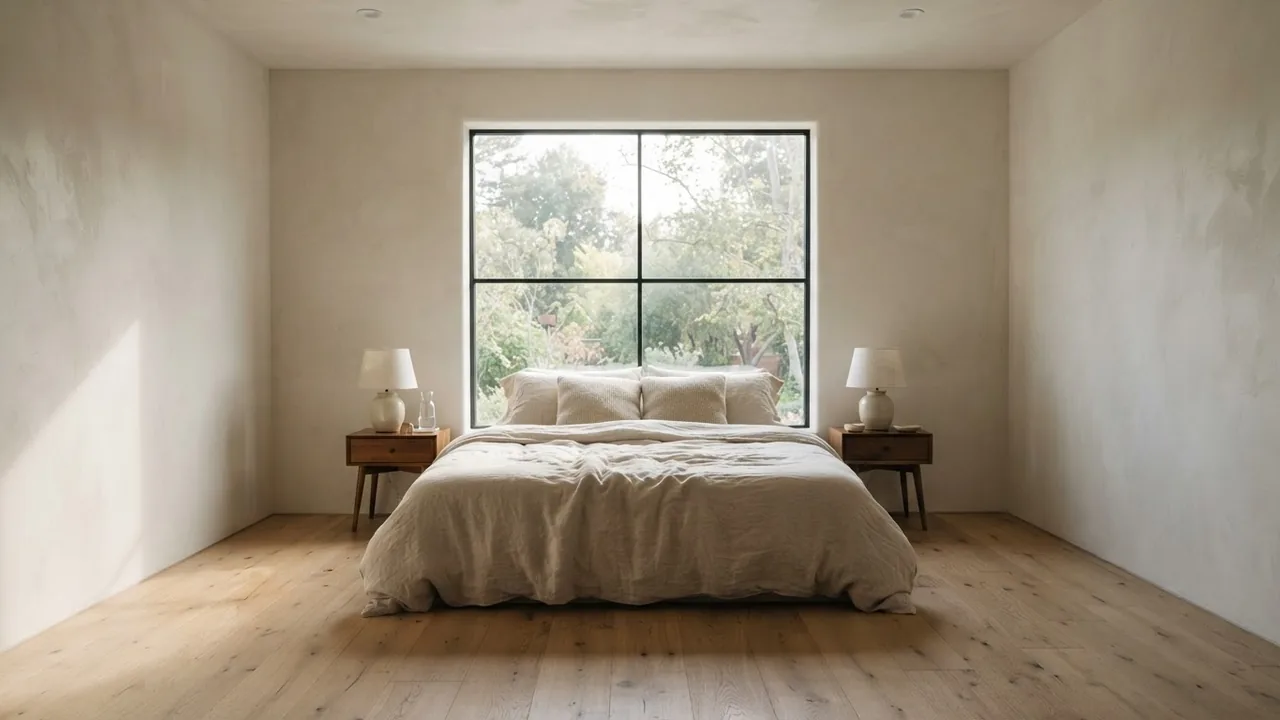
Assuming nothing physical is in the way, this is where the layout is won or lost. The instinct is to buy a tall upholstered headboard to give the bed presence. In front of a window that is precisely the wrong move, because it draws a hard horizontal line across the glass and the eye reads a window that has been cut in half.

Compare that with the same room, same camera, same light, with the headboard taken out altogether. The window becomes one shape again and the room stops looking like a compromise.

One genuine upside of the tall version, since this should not be one-sided: against a cold single glazed window a solid upholstered headboard is real insulation between your head and the glass, and it kills the draught you would otherwise feel on winter nights. If comfort matters more to you than the view, that is a defensible trade rather than a mistake. This is the same reasoning behind the contrast argument in our piece on black window frames, where the framing choice changes how hard the window reads against the wall behind it.
Curtains behind the bed
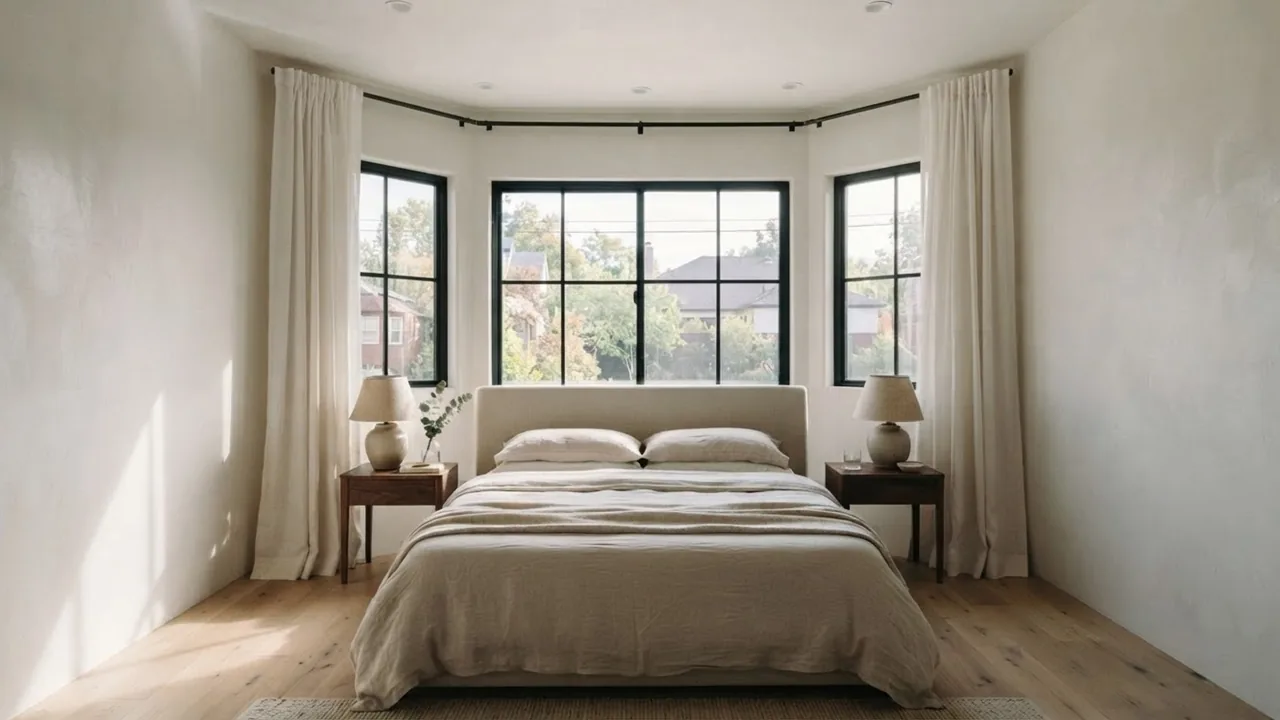
Curtains are what turn this layout from tolerated into deliberate, and there is one rule that does most of the work: mount high and wide. High means the rod goes just below the ceiling rather than just above the window frame. Wide means the rod runs far enough past the window on both sides that the open panels stack against wall, not glass. The marks, anchors and bracket spacing for a run like that are worked through in how to install a curtain rod.

Done that way the curtains become a full-height fabric backdrop that the bed sits in front of, which is a look people pay designers for, and the window stops being the thing your bed is blocking. Two practical notes. Anything you have to reach for across the mattress will annoy you within a week, so put the light control inside the reveal as a Roman shade or a top-down blind and let the curtains be decorative. And if you are wondering where the hems should land, that has its own answer on whether curtains should touch the floor, while the numbers behind high and wide, including how far past the window the rod actually has to run, are in our guide to how to measure for curtains.
The trick also works with no window involved at all. Hanging curtains behind a bed on a blank wall is a standard way to give a headboard-free bed some height, which is worth knowing if you end up moving the bed to the other wall after reading the section above. For the wall treatment version of the same idea, see our accent wall ideas.
When the window is off centre
This is the most common complaint after the headboard, and it comes up constantly in older houses where nothing was laid out around furniture. The window is not in the middle of the wall, so centring the bed on the window throws the bed off centre in the room, and centring the bed in the room throws the window off behind it.

Pick the room, not the window. Centre the bed on the wall, then run a curtain rod the full width of that wall with panels at both ends. The fabric hides where the window actually sits and gives you a symmetrical backdrop that the bed can be centred on. The one thing to avoid is a tall headboard, because a hard vertical edge next to an off-centre window advertises the misalignment.
If the room has more than one thing wrong with it, and awkward rooms usually do, our guide to awkward room layouts, L shaped, narrow and dark works through the same problem in living spaces, and AI furniture placement and room layout covers what actually buys visual space when the floor area is fixed.
Bay windows, bunk beds and children’s rooms
Bay windows are the version of this layout that needs no defending. A bay gives you a recess deep enough to set the bed back into, so the angled side panes stay clear either side of the bed and the light comes in past it rather than being blocked by it. If you have one, use it.
King beds are usually the reason the bed is on the window wall at all, since a king needs about 76 inches of width plus circulation on both sides and most bedrooms have exactly one wall that long. That is a legitimate reason to accept the layout rather than fight it.
Bunk and loft beds are the exception to everything above. They lift a sleeping child to window height instead of below it, which turns the window into a fall risk and puts any blind cord in reach from the top bunk. If it has to go there, cordless blinds and a window opening restrictor come before anything decorative.
What feng shui and vastu actually say
Traditional feng shui advises against a bed under a window. The principle is the command position: the bed should have a solid wall behind it and a clear view of the bedroom door, and a window is treated as unstable backing through which energy escapes. Vastu shastra arrives at a similar conclusion by a different route.
The same command-position logic turns up once a year in a different argument: our guide on where to put the Christmas tree applies it to the corner, the window and the fireplace.
Being straight about this, because a lot of pages quote it as though it settled the question. The practical core of the rule is real and worth taking seriously: a window is colder, draughtier, brighter and noisier than a wall, and people do sleep worse with their head against one. That part is physics and it is why the advice has survived. The metaphysical part is a belief system, not a measurement, and it should not outrank a floor plan that gives you one workable wall. If it matters to you, the compromises that satisfy both are a solid headboard for backing and keeping the door in view from the pillow, which are the same two moves the physics already suggested. We took the whole rule set apart, commanding position, door line, mirrors and the small-room priority order, in feng shui bedroom layout.
We rendered it both ways
Everything above is easier to judge when you can see the same room twice, so that is what we did. The frames in this article are MeltFlex renders. The headboard, curtain, off-centre and bay versions are all generated from the one base image so they are genuinely the same room, the same camera and the same light, with only the thing under discussion changed. The radiator, low sill and side wall frames are separate renders rather than edits of the base, so treat those as illustrations of the situation rather than strict like-for-like comparisons.
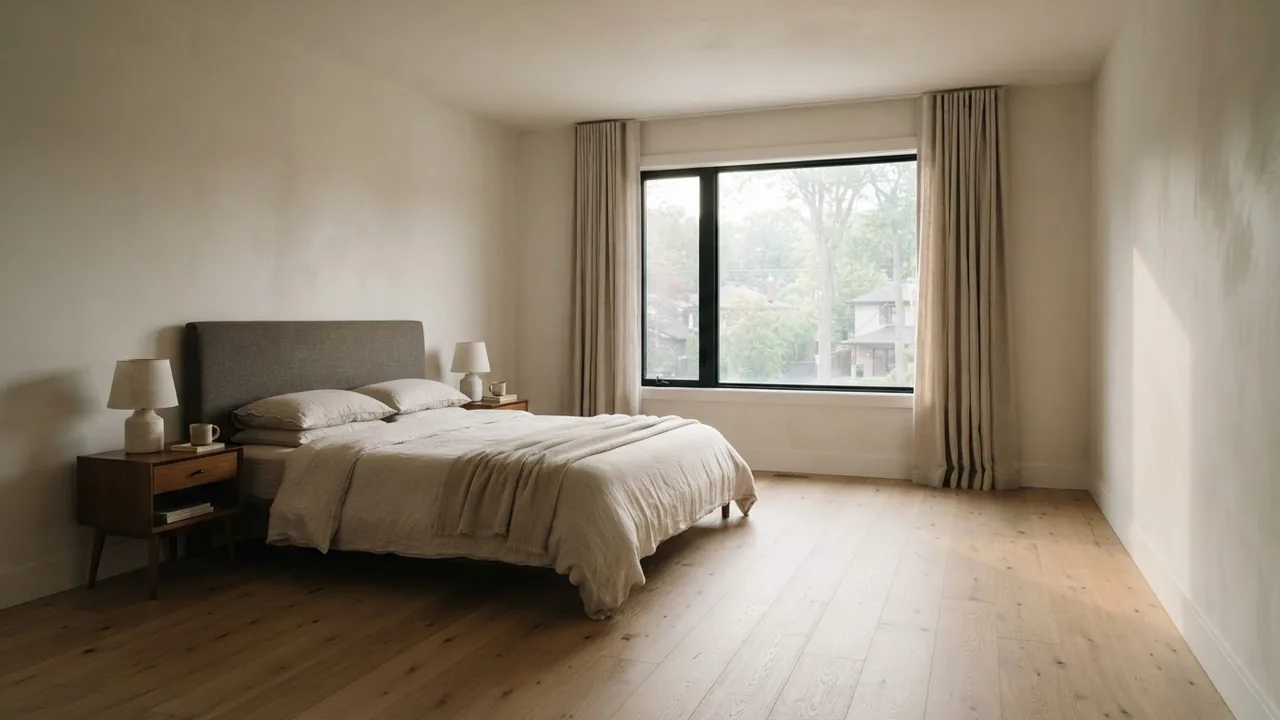
That is the alternative everyone recommends, and it is worth looking at honestly. The window is clear. The bed is now lengthways along a side wall, which in a room this size means walking around the foot of it to reach the window, and only one side of the bed is properly accessible. Whether that is better than a covered sill depends on your room, which is exactly why a general rule is a bad way to decide this.
You can do the same test on your own bedroom rather than on ours. Photograph the room, then use photo to render to generate the layout both ways before you move a king bed to find out. The method for getting usable dimensions out of a photo is in how to measure a room from a photo, and the placement logic itself is covered in AI furniture placement and how to arrange furniture.
For the styling layer once the layout is settled, our master bedroom design ideas and bedroom interior design ideas pick up where this leaves off, and a bedroom makeover in four styles shows the same room restyled rather than relaid out. If the bedroom is part of a single room, studio apartment layout ideas deals with the bed-against-a-window problem where there is no other room to move it to, and what colour furniture goes with grey walls handles the palette question that usually comes next.
Frequently asked questions
Is it bad to put a bed in front of a window?
No, not as a rule. In a lot of bedrooms the window wall is the only wall long enough to take the bed without blocking the door, and designers put beds in front of windows deliberately because a window makes a better backdrop than blank plaster. It is only a bad idea in four specific cases: when a radiator sits under the window, when a window air conditioning unit is fitted in it, when that window is the room’s emergency escape opening, and when it is a small child’s room with corded blinds. Those are physical problems with physical fixes, not matters of taste.
Is it bad feng shui to have your bed under a window?
Yes, traditional feng shui advises against it. The principle is the “command position”, which wants the bed against a solid wall with a clear view of the door, and a window is treated as unstable backing through which energy escapes. Vastu shastra reaches a similar conclusion. Worth knowing what that actually rests on: the practical core is real, because a window is colder, draughtier and noisier than a wall and you sleep worse against one, and that part is worth taking seriously. The metaphysical part is a belief system rather than a measurement, so treat it as a preference to weigh rather than a rule that overrides a floor plan with one workable wall.
Can you put a bed in front of a window with a radiator under it?
Only if you keep a gap. Around 80 to 90 percent of a modern panel radiator’s output moves by convection, so a mattress pressed against it does not just block heat, it traps the warm air behind the bed. Blocking a radiator with furniture is commonly estimated to waste 10 to 15 percent of the heat it produces, and a solid-backed piece hard against a double panel radiator can cut its useful output by 40 to 50 percent. Leave at least 150 mm and ideally 200 to 300 mm, which is 8 to 12 inches, between the radiator and the bed. An open leg bed base with clear air under it is far better here than a solid divan.
What curtains work best when the bed is in front of the window?
Mount the rod high and wide, then keep the fabric off the glass. High means just under the ceiling rather than just above the frame, and wide means the rod extends far enough past the window on both sides that the open curtains stack against wall instead of covering the view. Full-length curtains either side of the bed then read as a deliberate backdrop rather than as fabric the bed happens to be blocking. Avoid anything that has to be reached across the mattress: a Roman shade or a top-down blind inside the reveal handles the light, and the curtains stay decorative.
Do you need a headboard if the bed is in front of a window?
No, and going without one is often the better call. The awkwardness of this layout comes from a headboard cutting the window in half, so removing the headboard removes the problem and lets the window read as a whole. The alternatives that work are a low headboard that stops below the sill, an open frame in cane or spindles that you see through, or a stack of large euro pillows doing the job of a headboard with no structure at all. A tall solid headboard is the one choice that genuinely fights the window, and it is the one most people reach for first.
Can you put a bunk bed or a loft bed in front of a window?
This is the version to be careful with. A bunk or loft bed puts a sleeping child at the height of the window rather than below it, which turns the window into a fall risk and puts any blind cord within reach of the top bunk. The US Consumer Product Safety Commission reports that on average about nine children under five die each year from strangling in window covering cords, and it recommends moving cribs and beds away from windows and cords, preferably to another wall. If the bunk has to go there, fit cordless blinds and a window opening restrictor first, and treat that as required rather than optional.
What do you do when the window is off centre behind the bed?
Stop trying to centre the bed on the window and centre it on the wall instead, then rebalance with the curtains. A rod that runs the full width of the wall, with curtain panels hung at both ends, hides where the window actually sits and gives the bed a symmetrical backdrop. The alternative is to lean into it: centre the bed on the window, accept the asymmetry in the room, and use the larger leftover wall for a chair or a chest so the imbalance looks chosen. What does not work is a tall headboard, because it draws a hard vertical line that makes the offset obvious.
Is it safe to block a bedroom window with a bed?
Check whether that window is the room’s escape opening before anything else. Under the International Residential Code, section R310, every sleeping room needs at least one operable emergency escape and rescue opening, with a minimum net clear opening of 5.7 square feet, at least 24 inches of clear height, at least 20 inches of clear width, and a sill no higher than 44 inches above the floor. To be precise about what that means: the code governs the window, not your furniture, so no inspector is going to fault your bed. The practical point stands anyway. If that window is the only way out of the room and the mattress covers the part you would climb through, move the bed or make sure a second window qualifies.