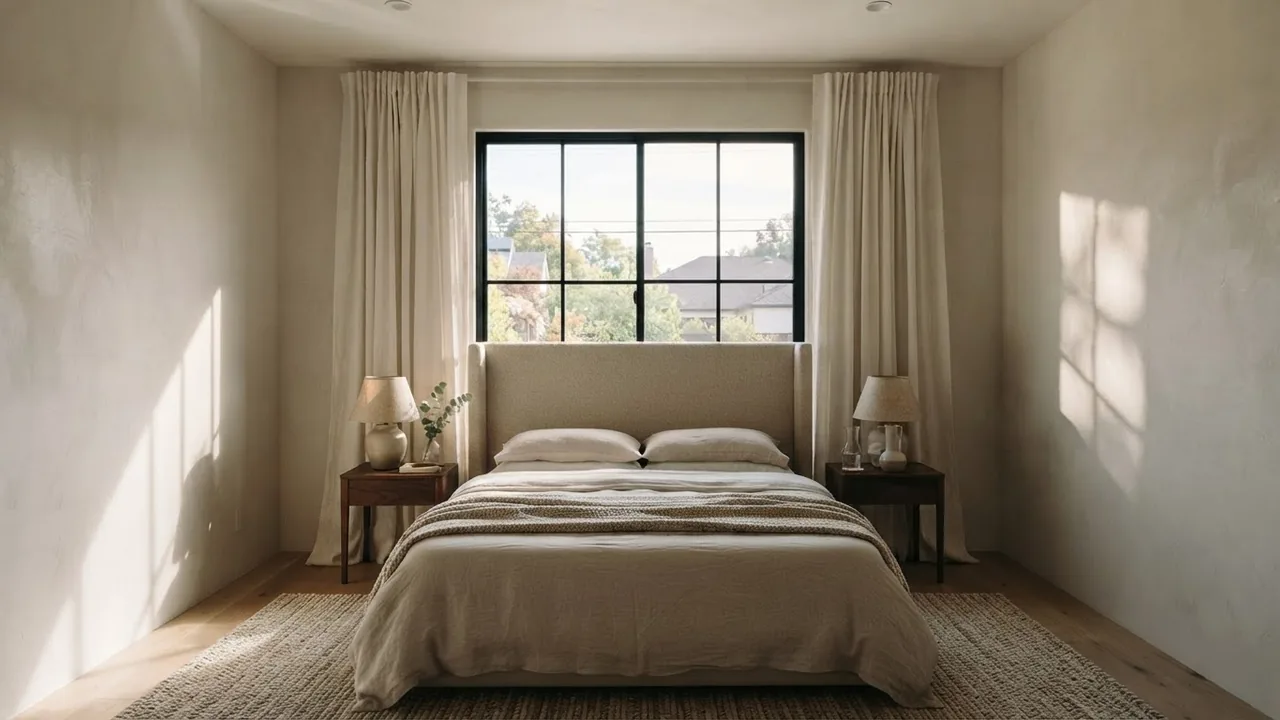

A curtain rod hangs on two pencil marks: about 7 inches outside each frame edge, half the gap to the ceiling above it, on anchors matched to the wall, with a third bracket once the rod passes 60 inches. Everything that goes wrong, the sag, the wobble, the rod on the floor at 2 a.m., comes from skipping one of those three decisions. This guide derives the marks from your own window, the calculator does the arithmetic, and the anchor table replaces the ribbed plastic plugs in the box that were never going to hold.
Our articles are still written by humans!
Get human written articles in your Google feed.



The two pencil marks, from your own window
Only two numbers matter before the drill comes out: the frame width, measured outside edge to outside edge, and the gap between the frame top and the ceiling. The rod runs 8 to 12 inches past the frame on each side, 10 as the default, so open curtains stack beside the glass instead of over it. Height-wise the working rule is half the gap, clamped between 4 and 12 inches above the frame. A typical modern room has about 16 inches of wall there, which lands the rod 8 inches up.
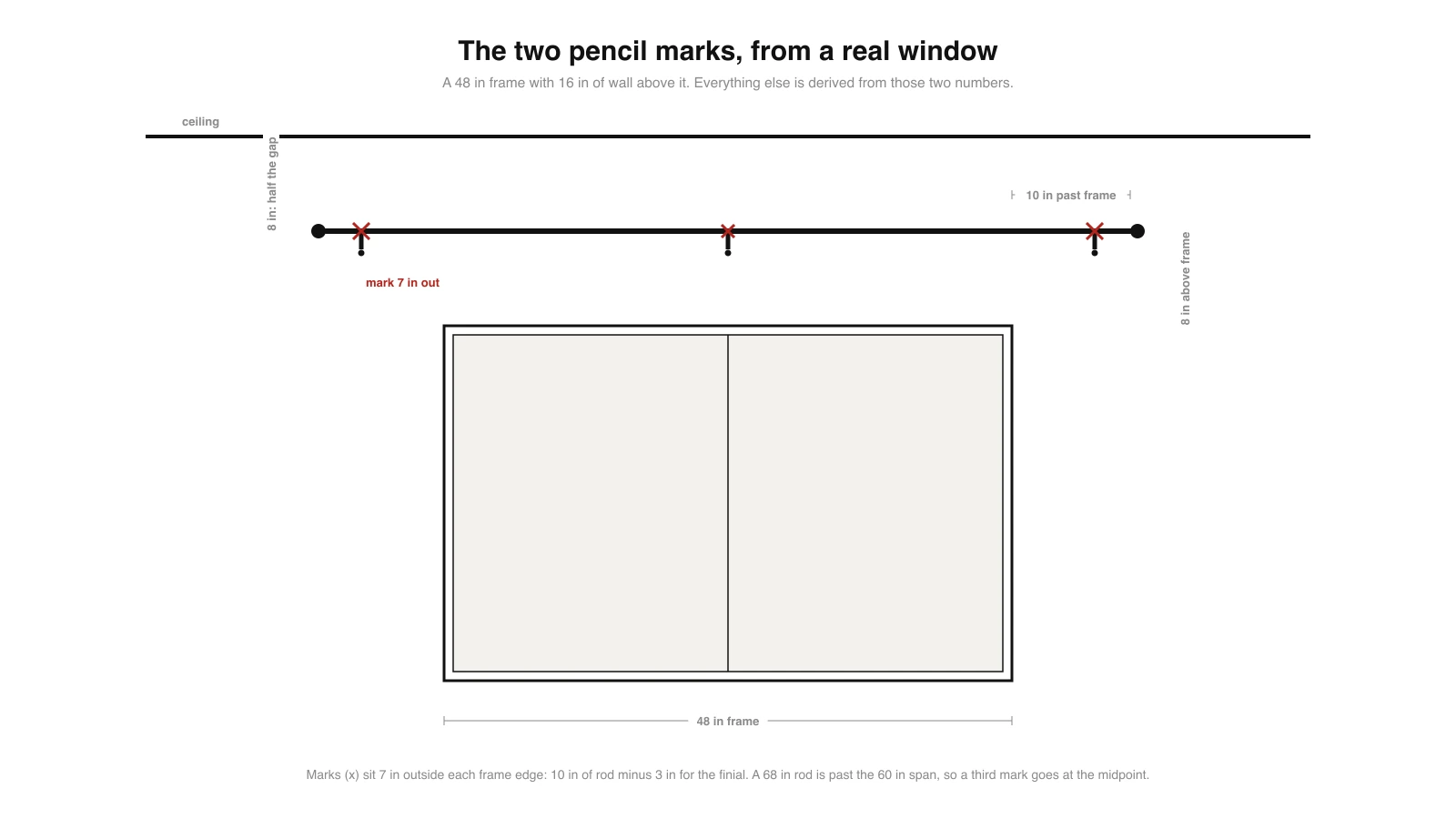
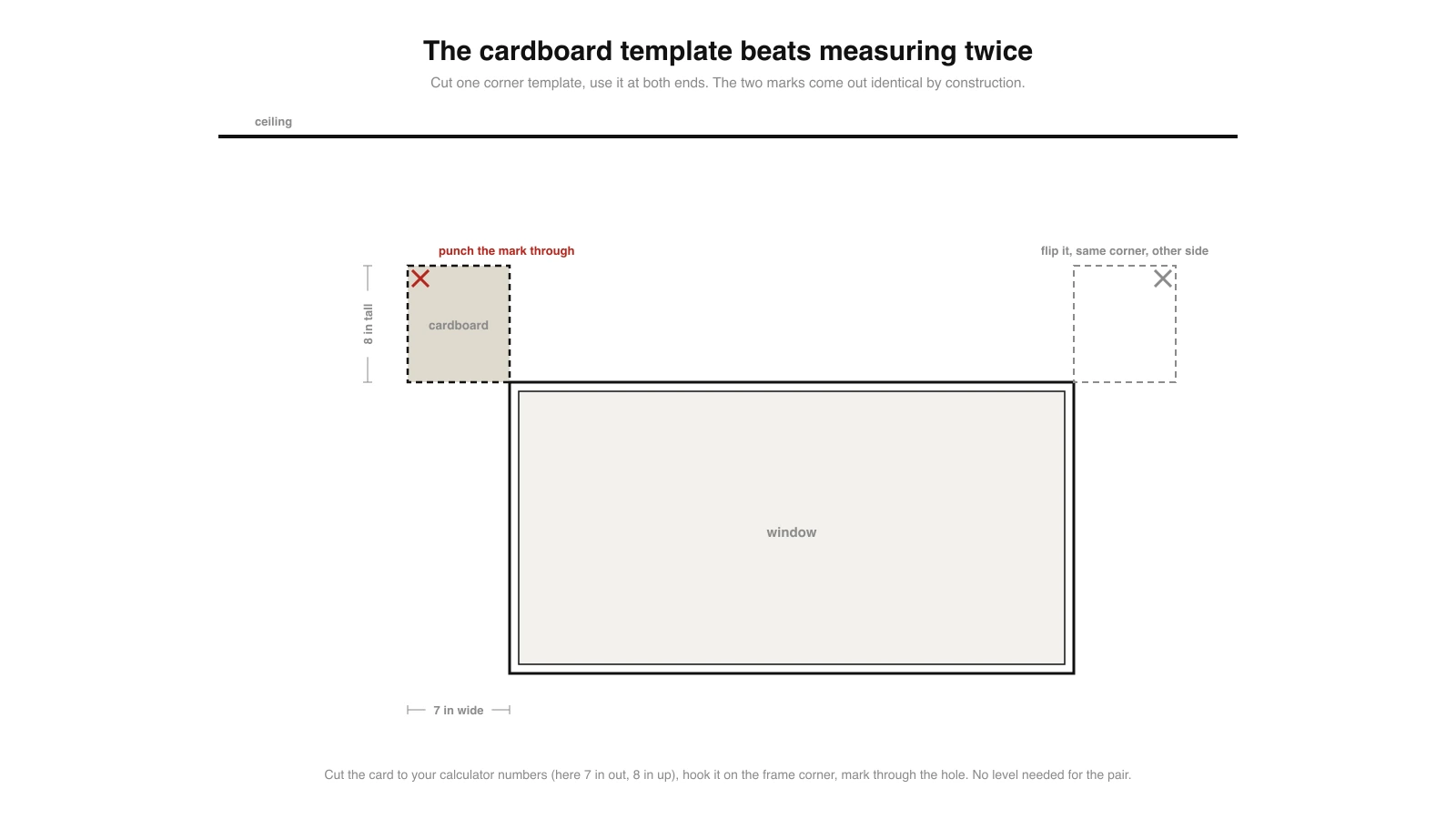
The bracket marks do not sit at the rod ends. A finial takes about 3 inches of rod past the bracket, so on a 10 inch extension the pencil cross lands 7 inches outside the frame edge. Both crosses sit on one horizontal line measured from the frame, not from the ceiling: frames are set level as a matter of building practice, ceilings drift, and a rod levelled to a drifting ceiling reads crooked against the window it hangs over.
Why high and wide at all is a placement question rather than an installation one, and we derived it separately in how to measure for curtains: the short version is that curtains hung at the frame make the window read shorter and the room lower. If the wall above the window is unusually tall or short, standard ceiling heights explain what the half-the-gap rule is adapting to. And length is decided after the rod is up, never before, which is also why curtains should touch the floor.

Bracket and anchor calculator
Type in the frame width and the gap above it, pick what is going on the rod and what the wall is made of. The drawing places every bracket, and the plan underneath states the rod length to buy, both drill marks, the panel count at double fullness, the load per bracket, and the one anchor that suits your wall at that load.
Interactive calculator
Loading… if it does not appear, refresh the page.
The load line deserves a word, because no box and no blog states it. A lined pair on a 68 inch rod weighs about 24 pounds including the rod itself. Across three brackets that is 8 pounds each, which sounds trivial until someone drags the curtain closed: a pull on fabric is a dynamic load, and treating the peak as four times the static number, about 32 pounds here, is the difference between an anchor chosen for the photo and one chosen for the morning routine.

The right anchor for drywall, plaster and brick
Rod boxes ship with ribbed plastic expansion plugs because they cost a fraction of a cent, not because they hold. In hollow drywall they grip by friction against crumbly gypsum, and a few hundred curtain pulls work them loose. Every fixing below is a step up, and the right one depends on the wall and the load, which is exactly what the calculator above works out.
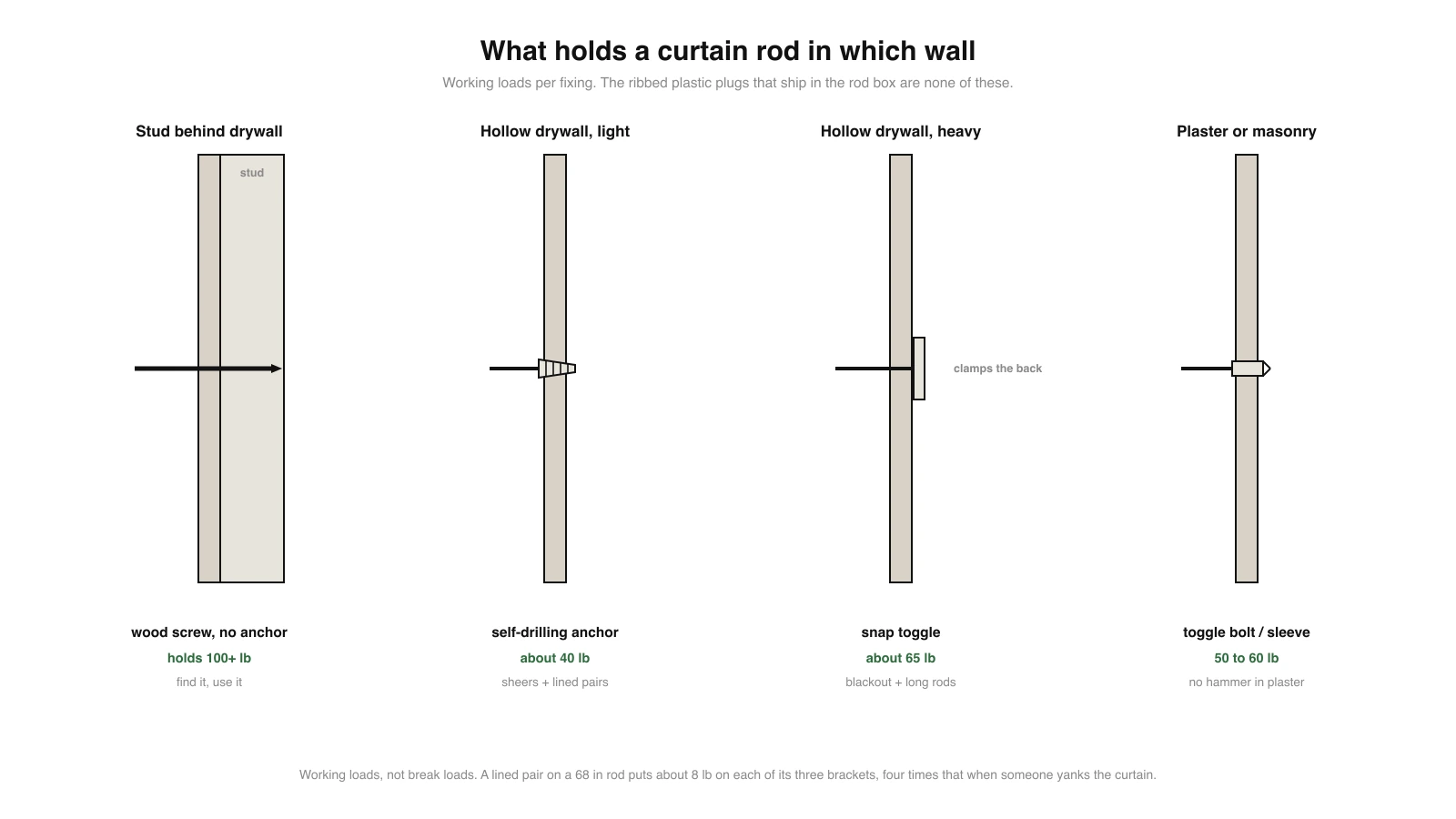
Those are working numbers, and two of them are worth sourcing because the packaging overstates. The common self-drilling anchor is rated 75 pounds for items flush to the wall, and the maker says so on the listing; a curtain bracket stands the load an inch or two off the wall and pries, so we treat it as 40. The snap toggle goes the other way: TOGGLER publishes 265 pounds ultimate in half inch drywall, and a quarter of ultimate is the standard working allowance, so 65 is the number to plan with. Nothing about a curtain rod gets near it, which is the point.
Before any anchor, check for wood. Studs sit on 16 inch centers in most US framing, and directly above a window there is usually a structural header, a solid horizontal timber that is the best fixing a rod can get. A stud finder works; so does a strong magnet dragged along the wall until it snaps onto a drywall screw. One bracket in a stud and one on a proper anchor is a perfectly good outcome.
Step by step: from tape measure to hanging curtains
The whole job is about 30 minutes, and the order matters more than the tools. Everything gets decided on paper first; the drill runs for two minutes at the end.
- Measure the frame and the gap. Outside edge to outside edge, then frame top to ceiling. Two numbers, everything else is derived.
- Get the marks. The calculator above, or by hand: half the gap up, 7 inches out, a midpoint mark past 60 inches of rod.
- Cut the template. A cardboard rectangle at those two numbers, hooked over one frame corner, mark punched through, flipped to the other corner. Both marks identical by construction, no level involved.
- Check behind the marks. Stud finder or magnet. Wood means wood screws; hollow means the anchor from the table.
- Set the anchors. Threaded anchors drive with a screwdriver. Toggles need their hole, folded wings in, snapped flush. Masonry wants the hammer drill and the brick body, never the mortar joint.
- Brackets on, level once. Snug, hang the bare rod, lay a level on it, then the final tighten.
- Dress it. Rings or grommets on, rod seated, center support clipped last. Pull each panel hard once from the far edge; silence means it was done right.

Wall-to-wall runs like this one usually swap the rod for a ceiling track, which turns the whole job into a different fastener question: tracks screw into ceiling joists or take toggles between them, every 20 inches or so. The marks logic survives; only the direction of the drill changes. Behind a bed it also solves the problem covered in putting a bed in front of a window: the curtain wall stops reading as a window treatment and starts reading as architecture.
When a rod needs a third bracket
A 1 inch steel rod carrying lined curtains starts to bow visibly past about 60 inches of unsupported span; blackout drags that limit to 48. This is the number the boxes print in small type and the blogs skip, and it means something unintuitive: the standard 48 inch window, with its 68 inch rod, is already past the limit. The center support in the packaging is not an optional extra for bay windows. It is for your window.
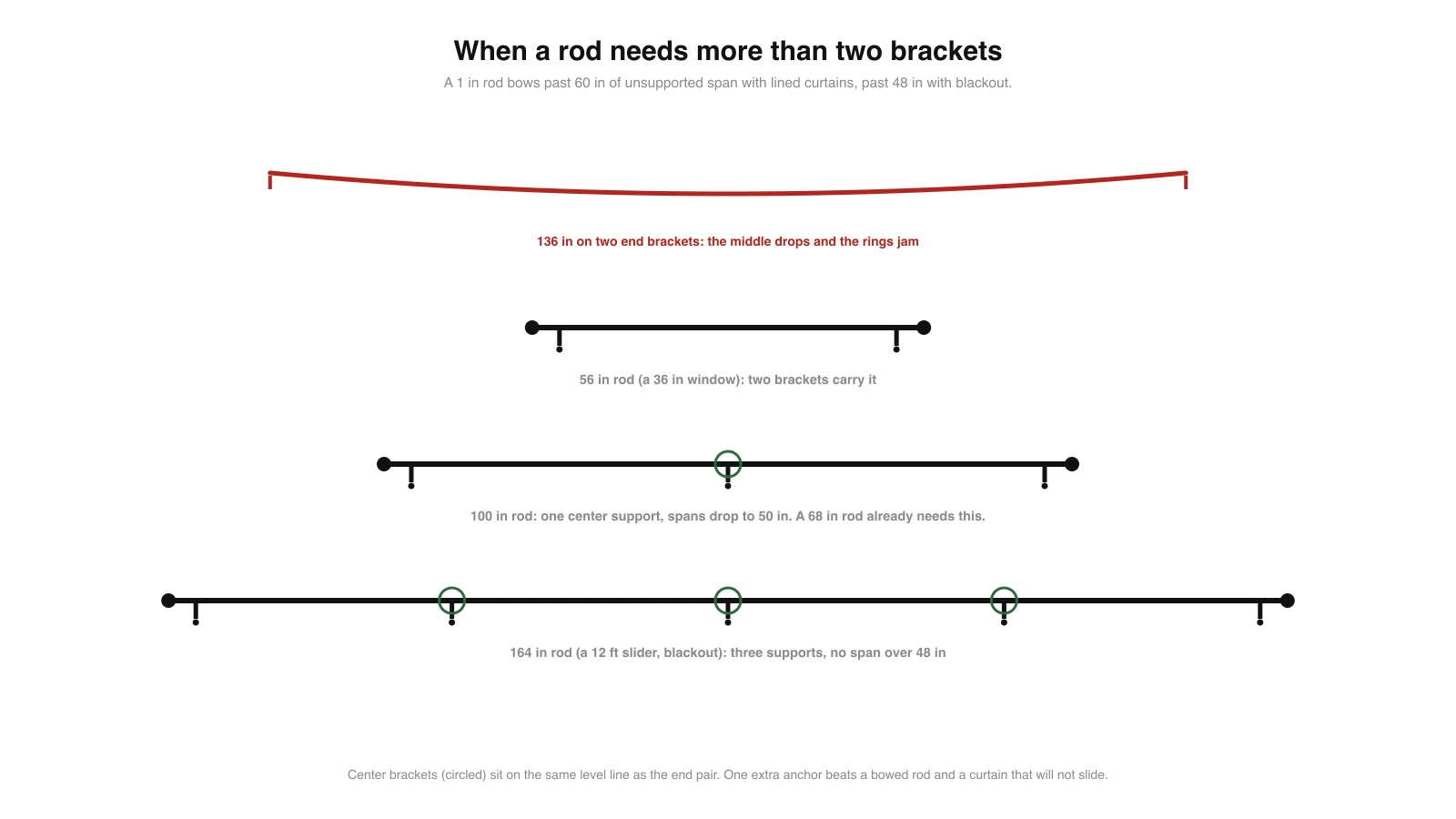
Center brackets sit on the same level line, at equal spacing, and they do not trap the curtains: panels close from each side toward the middle, so the rings never need to cross the support. On very long runs, a 12 foot slider with blackout takes three supports, the arithmetic flips from “can I skip the bracket” to “the extra anchors are the installation”. That slider case, and how the panels split across it, is the same layout question our living room layout guide handles from the furniture side.

No-drill options for renters, with honest limits
Three ways exist to keep the deposit intact, and each one has a hard weight ceiling rather than a vibe. A tension rod compresses inside the frame and carries about 10 pounds: sheers and cafe curtains. Tap-in brackets drive small pins into the top of the wooden frame itself, not the wall, and carry around 20: most lined pairs. Adhesive hooks hold about 5 pounds each on clean cured paint, and less on textured or freshly painted walls.
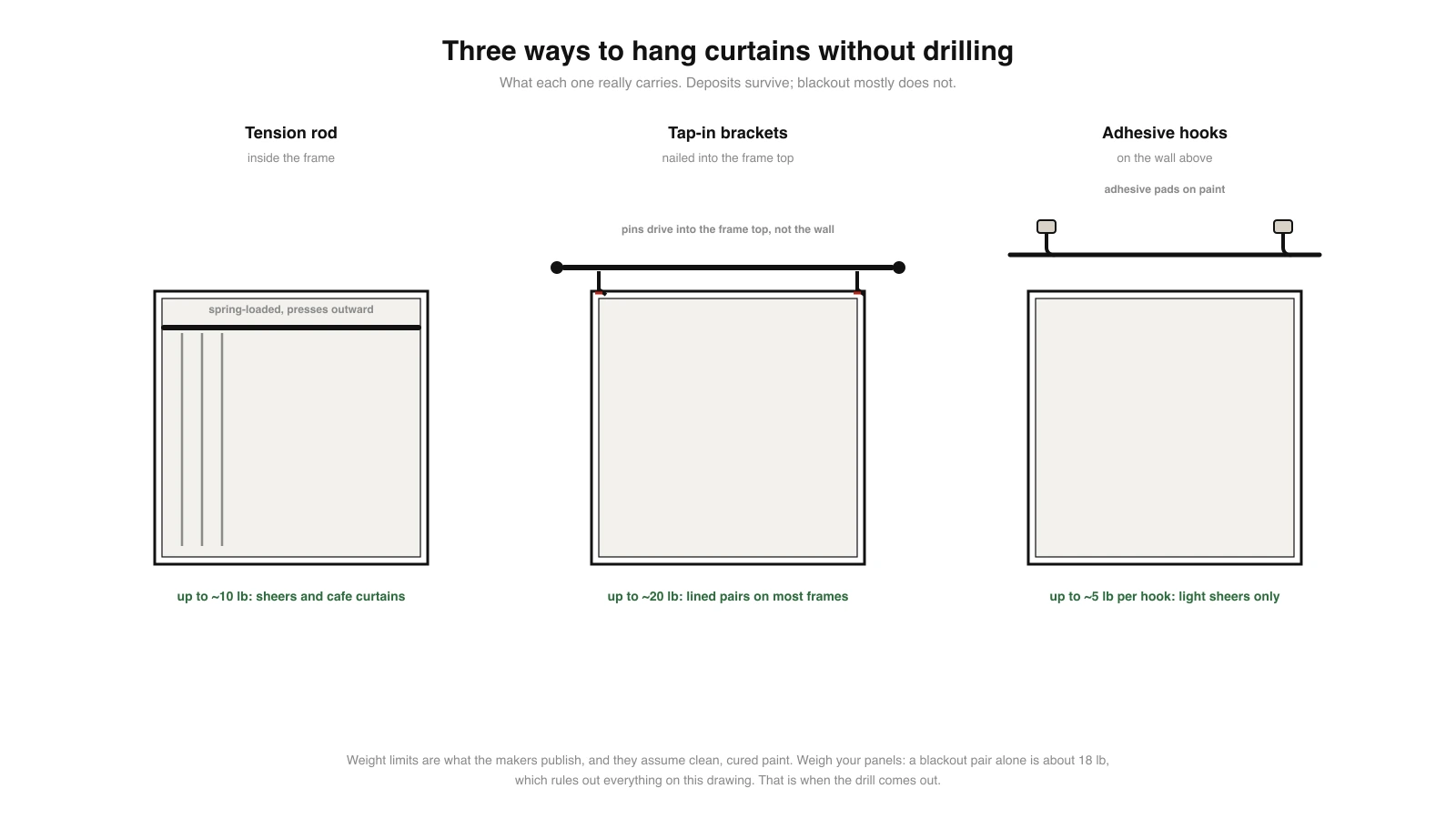
Now weigh the fabric. Listed shipping weights put a voile sheer panel around 2 pounds, a lined cotton panel around 5, and a blackout or velvet panel around 9, so a blackout pair is 18 pounds before the rod exists. That single number rules out every option in the drawing, which is the honest answer renters rarely get: no-drill blackout is mostly a product description, not an outcome. The workable compromise is tap-in brackets with a lined pair plus a separate blackout roller blind inside the frame, or a conversation with the landlord about two threaded anchors and a tube of filler at move-out.


The five mistakes that put rods on the floor
We read through the fallen-rod threads on r/DIY and r/HomeImprovement while building the calculator, and the same five failures repeat, in roughly this order.
- The box plugs went into hollow drywall. The single biggest cause. Friction plugs in gypsum plus a daily tug equals a slow-motion failure; the fix costs two proper anchors.
- The rod matched the frame, not the frame plus 20 inches. Brackets at the frame edges force the stacked curtain over the glass, the window loses a foot of daylight, and the panels never hang straight at the sides.
- The center support stayed in the box. Past 60 inches the bow is structural, not cosmetic: rings jam at the dip, so people pull harder, and the pulling is what kills the end anchors.
- The height came off the ceiling. Ceilings drift; frames are level. A rod set parallel to a sloping ceiling reads crooked against every straight line in the wall.
- The curtains were bought before the rod was placed. Length runs rod to floor, not window to floor, so a rod that moves up 8 inches strands a finished hem. Rod first, then the tape measure, then the order, in exactly the sequence the measuring guide walks through.
Hang them virtually before you drill anything
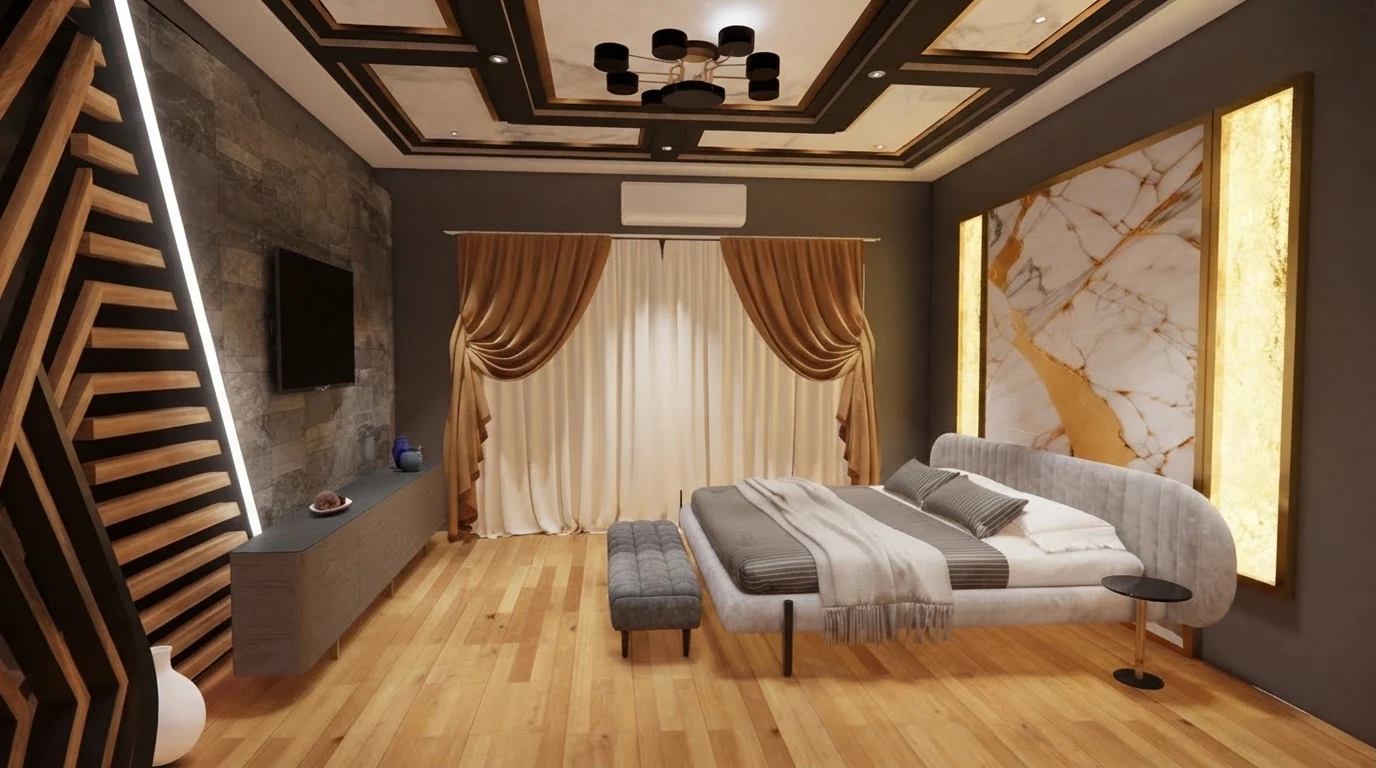
The install is permanent-ish; the taste decision does not have to be. Photograph your window wall and let the AI furniture changer swap the curtains in place, or describe the room in the generator and test grey drapes against sheers before committing fabric budget to either. Every interior in this article was produced that way, and the color half of the decision, which fabric against which wall, has its own derivation in what color curtains go with gray walls.

The same wall logic transfers to everything else that hangs. The anchor table above is the one we use for picture frames and gallery walls, and the stud-or-toggle decision gets more serious two posts over, where a 65 inch TV puts real weight on the same drywall. Window framing itself, and what it does to curtain choices, is covered in black window frames, pros and cons.
FAQ
How high should you install a curtain rod?
Half the distance between the frame top and the ceiling, kept between 4 and 12 inches above the frame. A typical 16 inch gap puts the rod 8 inches up. Hanging at the frame itself makes the window read shorter; the full placement logic, including cathedral ceilings and radiators, is in our curtain measuring guide.
How far should a curtain rod extend past the window?
8 to 12 inches on each side, 10 as the default. The stacked panel is roughly a foot wide, so that extension lets open curtains hang beside the glass instead of over it, and the window keeps its full daylight. Bracket marks sit about 7 inches out: the extension minus 3 inches of rod for the finial.
Do curtain rod brackets need to go into studs?
No, but check anyway, because a stud is the strongest fixing and costs nothing: a 2.5 inch wood screw into framing holds over 100 pounds. Miss the stud and the anchor does the work instead. What never works is the bare screw in drywall, which is how most fallen rods were hung.
What is the best drywall anchor for a curtain rod?
For sheers and lined pairs, a self-drilling threaded anchor: rated 75 pounds flush to the wall, worth about 40 on a bracket that levers outward. For blackout, velvet or rods past about 8 feet, a snap toggle: TOGGLER publishes 265 pounds ultimate in half inch drywall, a quarter of which is the honest working number. The ribbed plastic plugs that ship in the rod box are neither.
How many brackets does a curtain rod need?
Two, plus one center support for every 60 inches of rod with sheers or lined curtains, every 48 inches with blackout. A 68 inch rod over a standard 48 inch window is already past the limit, which is why the third bracket ships in the box. Without it a 1 inch rod bows in the middle and the rings jam.
Why does my curtain rod keep pulling out of the wall?
Almost always the ribbed plastic plugs from the box, in hollow drywall, doing a job they cannot do. The static load looks small, around 8 pounds per bracket for a lined pair, but pulling the curtain multiplies it several times over, and the plug loosens a little more each morning. Replace it with a threaded anchor or snap toggle in a fresh spot an inch away, not the blown hole.
Can you hang a curtain rod without drilling?
Three ways, with limits. A tension rod inside the frame carries about 10 pounds, enough for sheers and cafe curtains. Tap-in brackets pin into the top of the frame and carry about 20. Adhesive hooks hold about 5 pounds each on clean cured paint. A blackout pair alone weighs about 18 pounds, which rules out all three: blackout means drilling.
How long does it take to install a curtain rod?
About 30 minutes for one window if the marks are computed before the drill comes out, and most of that is finding what is behind the wall and setting anchors. The second window goes faster because the cardboard template and the anchor choice are already done. Budget an hour if the wall turns out to be plaster or brick.