The standard picture frame sizes in the United States are 4 × 6, 5 × 7, 8 × 10, 11 × 14, 12 × 16, 16 × 20, 18 × 24, 20 × 30 and 24 × 36 inches (10 × 15 to 61 × 91 cm). That number is the artwork, not the outside of the frame. Add a mat and the print goes up one size: an 8 × 10 photo needs an 11 × 14 frame. And most of those sizes will crop your photo, because a camera file is 3:2 and half the shelf is 5:4.
Our articles are still written by humans!
Get human written articles in your Google feed.
The short version
- Nine sizes cover almost everything: 4×6, 5×7, 8×10, 11×14, 12×16, 16×20, 18×24, 20×30, 24×36.
- The number is the glass, not the frame. Add twice the moulding width for the wall space.
- Matted, go one size up. 8×10 print in an 11×14 frame, 11×14 print in a 16×20.
- Only 4×6, 20×30 and 24×36 take a 3:2 photo whole. An 8×10 cuts 17% off the long edge.
- Art above furniture: about two thirds of its width. An 84″ sofa wants roughly 56″ of art; the wall art size guide has the full sofa, bed and console tables.
- Centre at 57 to 60″ from the floor, and 6 to 8″ above the back of a sofa.
- Gallery wall gaps: 2 to 3″, constant, measured moulding to moulding.
Jump to: The size chart · What the number means · Why your photo does not fit · Print to frame with a mat · A4, A3, metric · What the wall needs · Gallery walls · How high · Seven mistakes · Seeing it first · FAQ
FreeUpload photo · freePlan my gallery wall for freeUpload a photo of the wall and MeltFlex hangs a grid, salon or staircase gallery wall on it, with your own art in the frames. Your first AI design is free, no card needed.
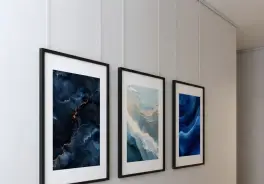
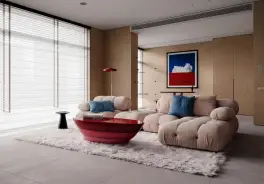
The standard picture frame sizes, in inches and centimetres
There are hundreds of frame sizes in the world and about nine you will actually meet. Everything below is stocked by the big retailers in the United States, which is what makes it standard: not a committee decision, just the sizes enough people bought that it became cheaper to keep making them.
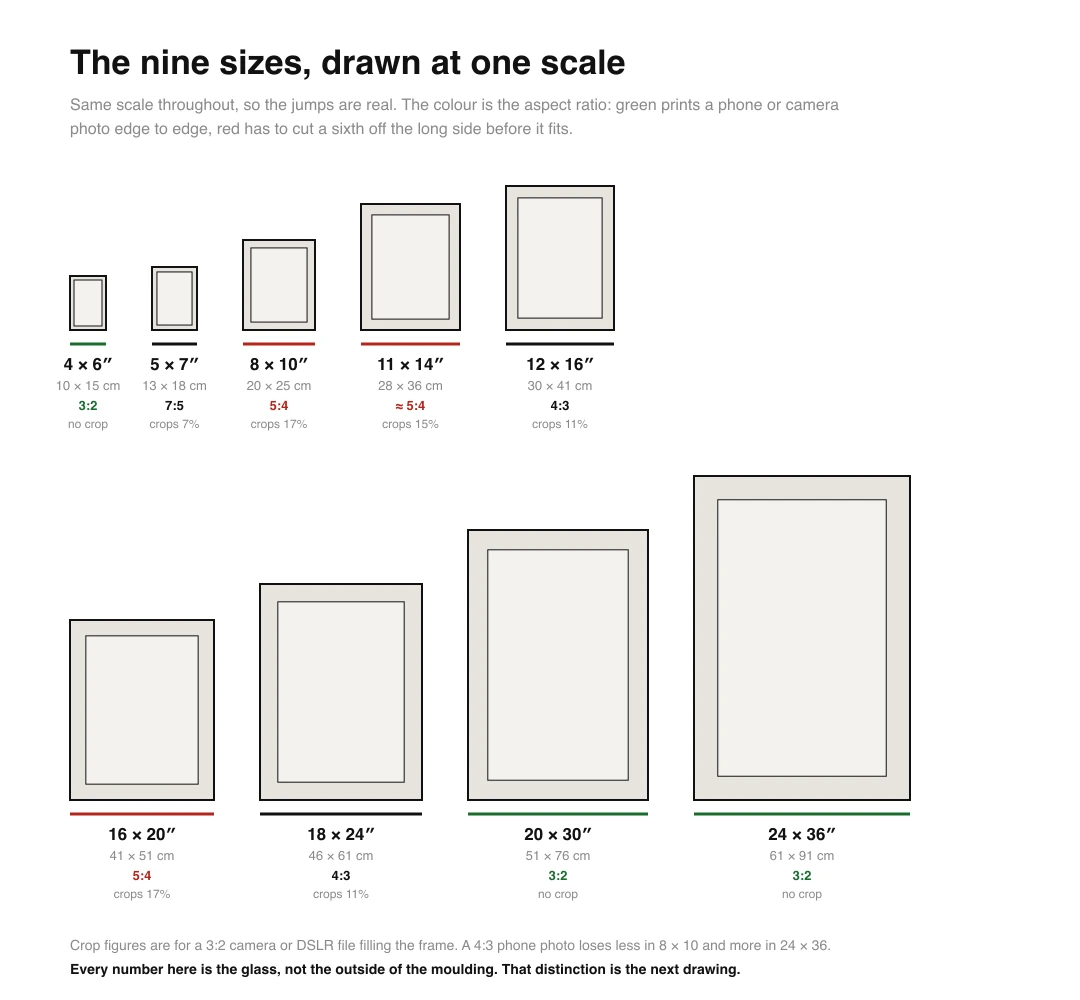
Three more show up constantly without quite belonging to the list: 8.5 × 11″, because that is US letter paper and therefore every certificate and every home printout; 27 × 40″, the one sheet cinema poster; and 20 × 24″, which exists almost entirely to be the matted home of a 16 × 20 print.
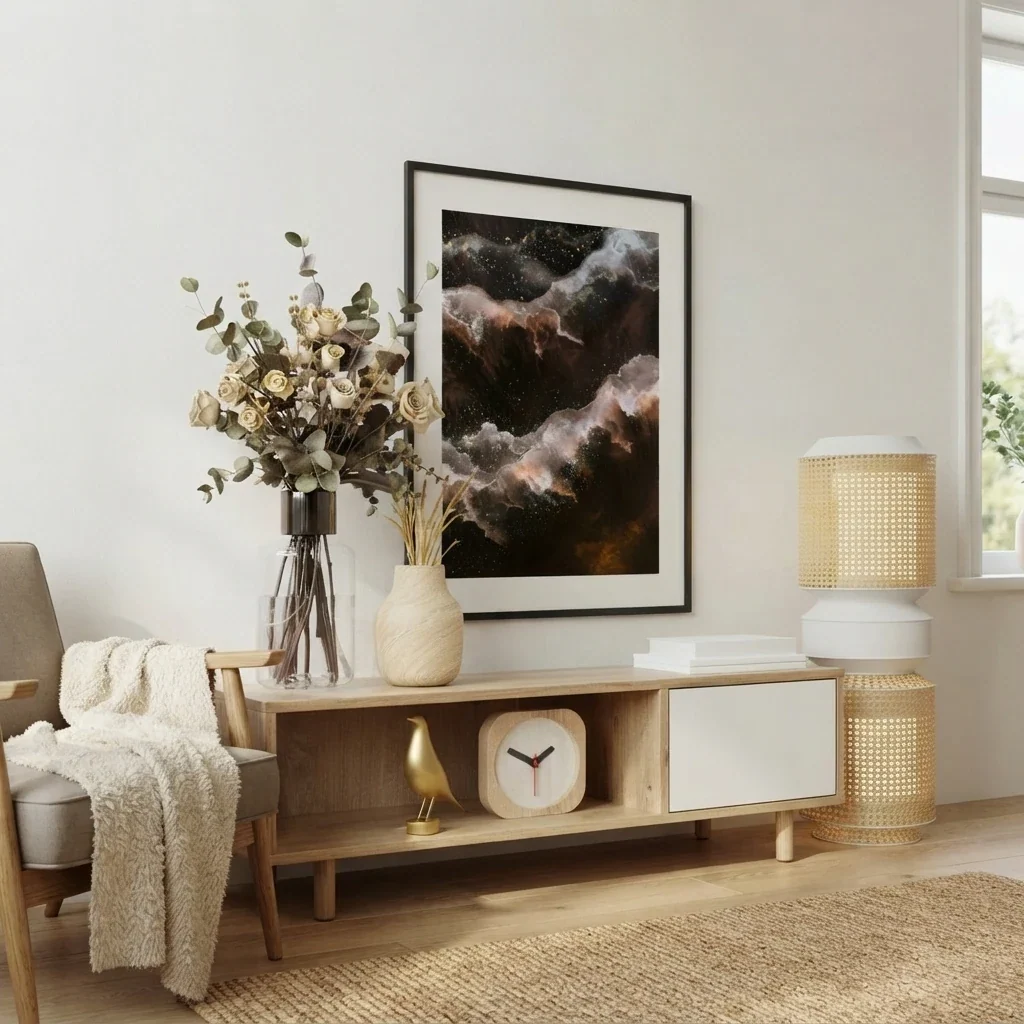
What the number on the box actually measures
A frame described as 11 × 14 holds an 11 × 14 piece of paper. It is not 11 × 14 inches itself. The number is the glass, which is also the rebate at the back and the size of the artwork. The frame is bigger than that by twice the width of the moulding, and nobody selling frames prints that second number anywhere.
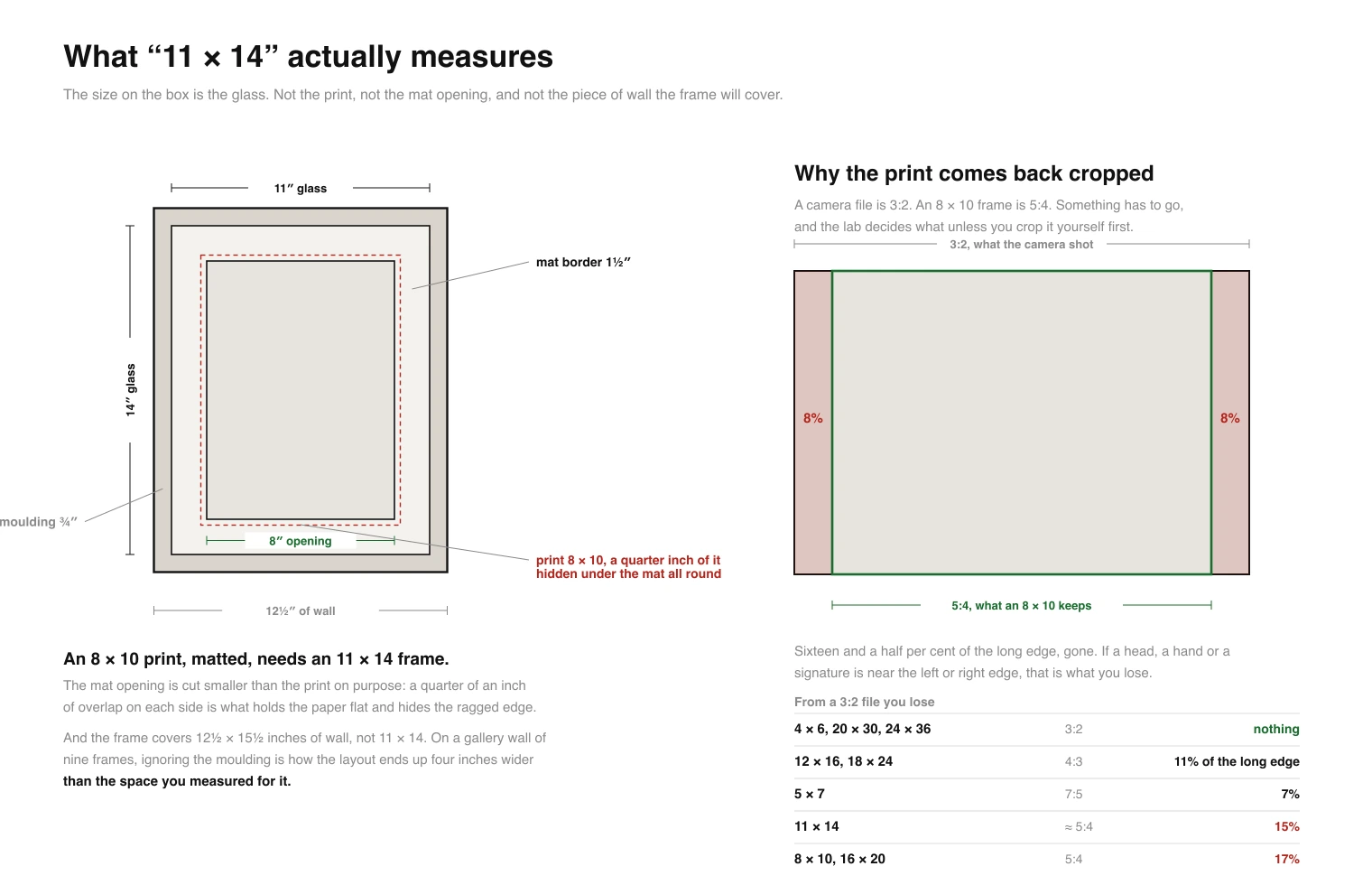
A typical thin moulding is about ¾ of an inch. That turns an 11 × 14 frame into 12½ × 15½ inches of wall. A chunky gallery moulding is closer to 2 inches and turns the same frame into 15 × 18. On a single picture this is trivia. On a three by three grid it is four to eight extra inches of width, which is the difference between a layout that clears the sofa and one that runs into a light switch. Measure the outside, not the box.
There is one more thing hidden in the number. Frames are sized to the paper, so they are sized to the print, not to the image. If your print has a white border around the picture, as most art prints do, the frame has to fit the paper and the image inside it will be smaller than you pictured. Buy the frame for the sheet.
Why your photo does not fit any of them
This is the part the retailer charts leave out, and it is the reason most people end up disappointed by a print they were happy with on a screen. The standard frame sizes and the standard photo shapes come from two different centuries and they do not agree.
A camera or a phone in landscape gives you a 3:2 file, the shape 35mm film settled on, or 4:3 if it is a phone main sensor. The frame shelf is full of 5:4: 8 × 10 and 16 × 20 are both 5:4, and 11 × 14 is within a hair of it. That shape is inherited from large format portrait photography, where 4 × 5 sheet film was the standard, and the print sizes followed the film rather than the camera.
The arithmetic is simple and unforgiving. To fill a 5:4 frame with a 3:2 file you keep the short edge and cut the long one down to 1.25 times it instead of 1.5. That is 16.7 per cent of the long edge gone. On a group photo that is somebody’s shoulder. The lab will make that cut for you if you do not make it yourself, and it will centre the crop, which is rarely where the picture is.
Worked from the ratios, not copied: the fraction of the long edge you lose is 1 minus the frame ratio divided by the file ratio. Everything in the 5:4 column is the same 16.7 per cent because 1.25 ÷ 1.5 is exactly five sixths.
The practical version: if the photograph matters, print it 4 × 6, 20 × 30 or 24 × 36 and lose nothing. If it came off a phone, 12 × 16 and 18 × 24 are the two sizes that were quietly made for you. And if you want an 8 × 10 anyway, crop it yourself before you upload, because you know which side of the picture is expendable and the lab does not.
Which print goes in which frame
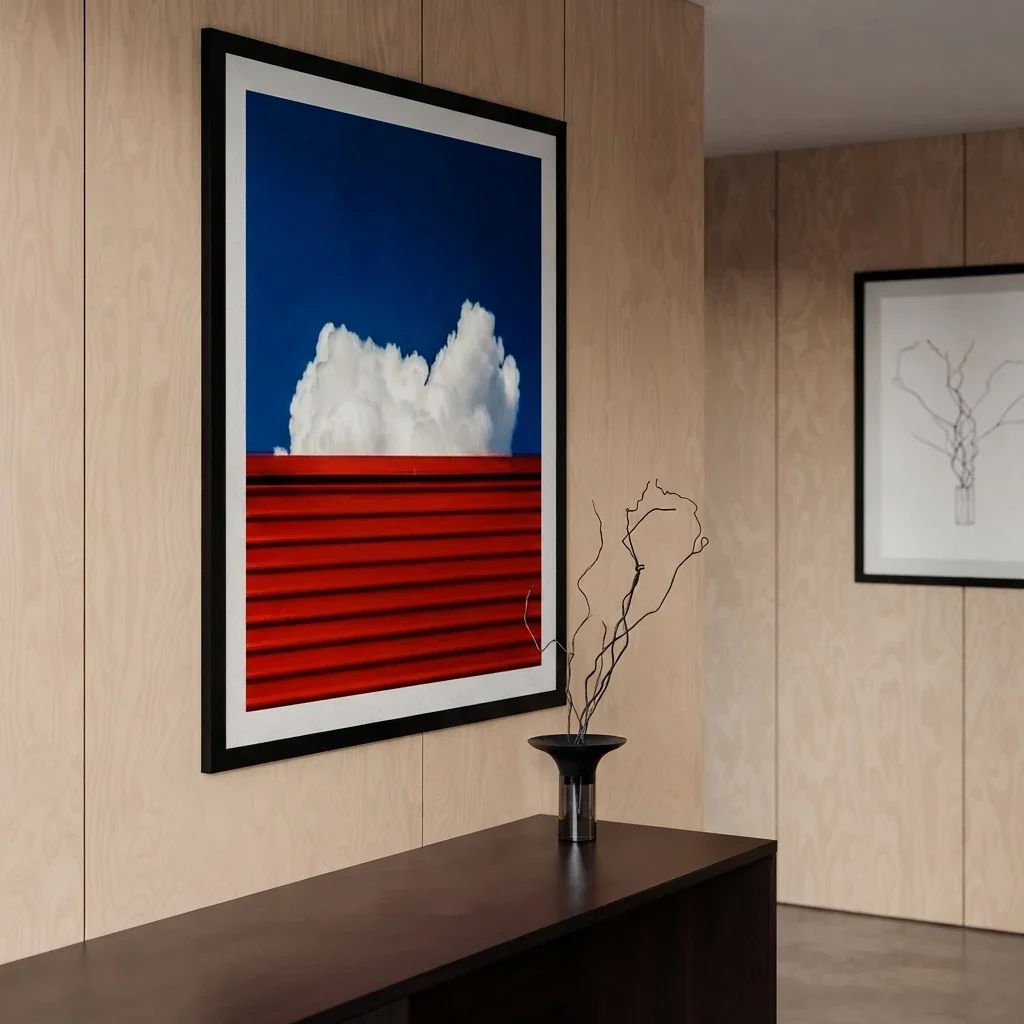
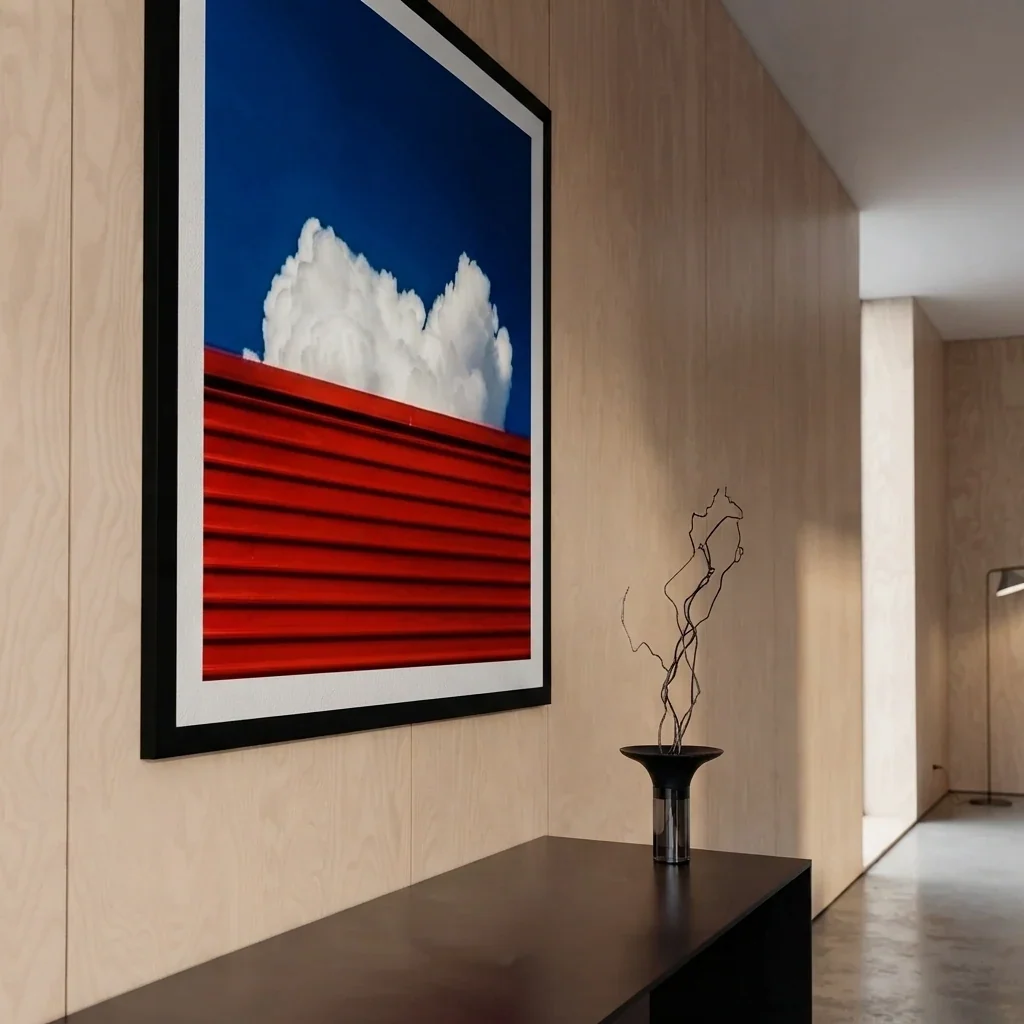
A mat, or mount in British English, is the card border between the print and the frame. It is not decoration. It keeps the paper off the glass, which stops it sticking as humidity changes, and it gives the eye somewhere to rest before it reaches the wall. A small print without one reads as a snapshot; the same print with a two inch border reads as something someone chose.
The rule for buying is simple: with a mat, go one size up. What that actually buys you is a border of somewhere between half an inch and three inches, depending on which two sizes you are stepping between, and it is worth checking the number rather than trusting the rule. The classic 1.5 to 2 inch border only falls out of the middle of the range.
The opening is cut a quarter of an inch smaller than the print on every side. That is not a mistake, it is the overlap that holds the sheet flat and hides the trimmed edge. Notice the two ends of the table: a 4 × 6 in a 5 × 7 gets half an inch of card, which is a slip mount rather than a mat, and above 16 × 20 the standard sizes stop lining up at all, so a matted 18 × 24 means a cut mat and usually a custom frame.
One refinement worth knowing, because it is what separates a framer from a shop: a mat cut with equal borders looks bottom heavy, because the eye reads the centre of a rectangle as slightly above its true centre. Traditional framing answers this with a weighted mat, where the bottom border is roughly half an inch deeper than the other three. It is invisible until you see the two side by side.
A4, A3 and the sizes the rest of the world uses
Outside North America the shelf is the ISO A series, and it is a better system: each size is exactly half the one above it, so an A3 is two A4s and the ratio never changes. That ratio is 1:√2, roughly 1.414, which is why an A-series print sits between 7:5 and 4:3 and matches no camera at all.
The 30 × 40 and 50 × 70 centimetre sizes belong to no series and are the two most common poster frames in Scandinavian and European shops. They are not A sizes and an A3 print will not fit a 30 × 40 frame.
The warning that matters if you buy online: the two systems are close enough to look interchangeable and never are. A4 is narrower and taller than 8.5 × 11. A2 is not 16 × 20. Buying an American print for a European frame leaves you cutting paper with a scalpel at eleven at night, and buying the other way round leaves a gap the mat cannot hide. Match the system, then match the size.
What size frame does the wall actually need
Everything above is about the frame. This is the part that decides whether the room works, and it has almost nothing to do with which size was on offer.
Art hung above furniture should span about two thirds of the furniture width, and never less than half. The reason is grouping: the eye reads two objects as related when one clearly belongs to the other, and a small frame over a long sofa reads as an accident. This is the same proportional logic behind choosing a rug size for a living room, and it fails the same way when it is ignored.
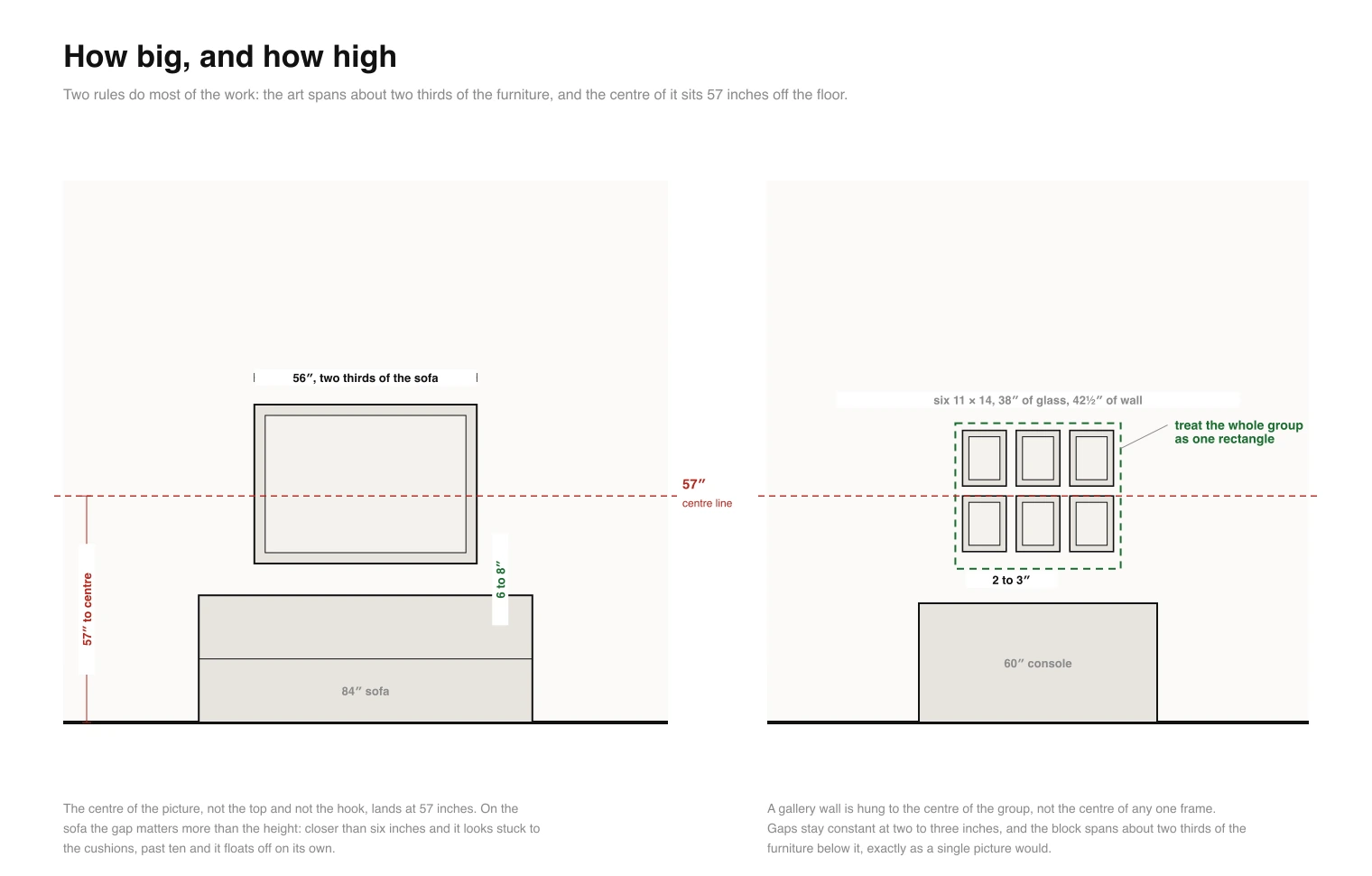
Widths for a group include the gaps between the frames and the moulding on the outside edges, because that is what the wall sees.
On a blank wall with no furniture under it, the rule changes to roughly 60 per cent of the wall width, and the piece wants to be bigger than feels comfortable when you are standing in a shop holding it. Wall height matters too: if you are working with a standard 8 foot ceiling the vertical space above a sofa is only about 40 inches once you allow the gap, so a tall portrait format piece runs out of room faster than people expect.
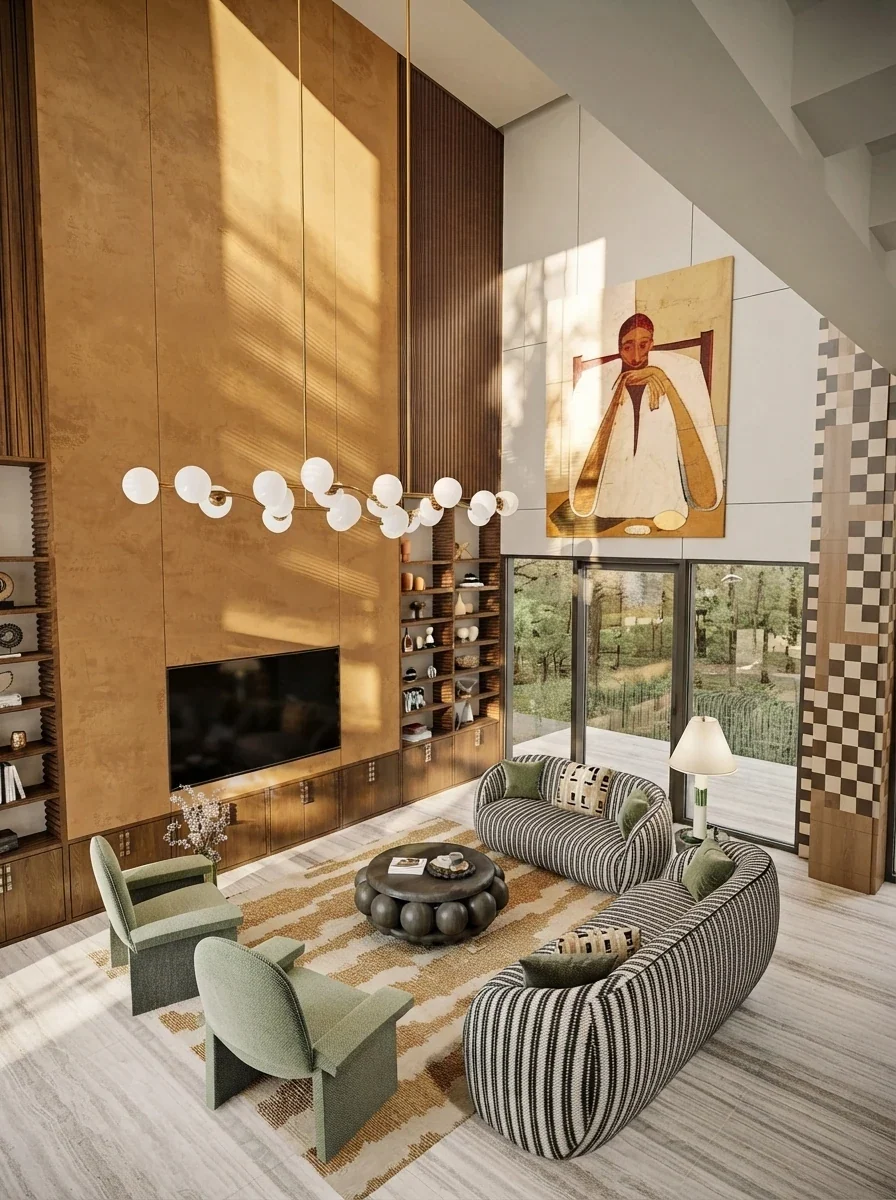
Gallery walls: which sizes combine
A gallery wall is not a collection of decisions, it is one decision made once. If you want to see it on your own wall before you buy the frames, our wall art visualizer comparison ranks the free tools that do that from a photo. Treat the whole arrangement as a single rectangle, size that rectangle by the two thirds rule above, and then fill it.
Three arrangements do most of the work:
- The row. Three or five identical frames at the same height with equal gaps. Impossible to get wrong, and the only layout that looks deliberate in a hallway, where you see it at an angle.
- The grid. Identical frames in rows and columns. Six 11 × 14 in a 3 × 2 grid with 2½ inch gaps is 38 inches of glass and 30½ tall, and then, because this is a wall and not a spreadsheet, you add the moulding: about 42½ inches across in real life with a ¾ inch frame. That is two thirds of a 60 inch console, and it is a good demonstration of why the glass number is the wrong one to plan with.
- The salon hang. Mixed sizes with a constant gap, built outward from the largest piece. Harder, more forgiving of a collection you already own, and it needs the outer edge to stay roughly rectangular or it reads as clutter.
Gaps are 2 to 3 inches and they do not vary. Two is tight and modern, three is calm. What matters more than the number is that it is the same everywhere, and that it is measured from the outside of one moulding to the outside of the next. Measure glass to glass and a thin frame next to a chunky one will look wrong without anybody being able to say why.
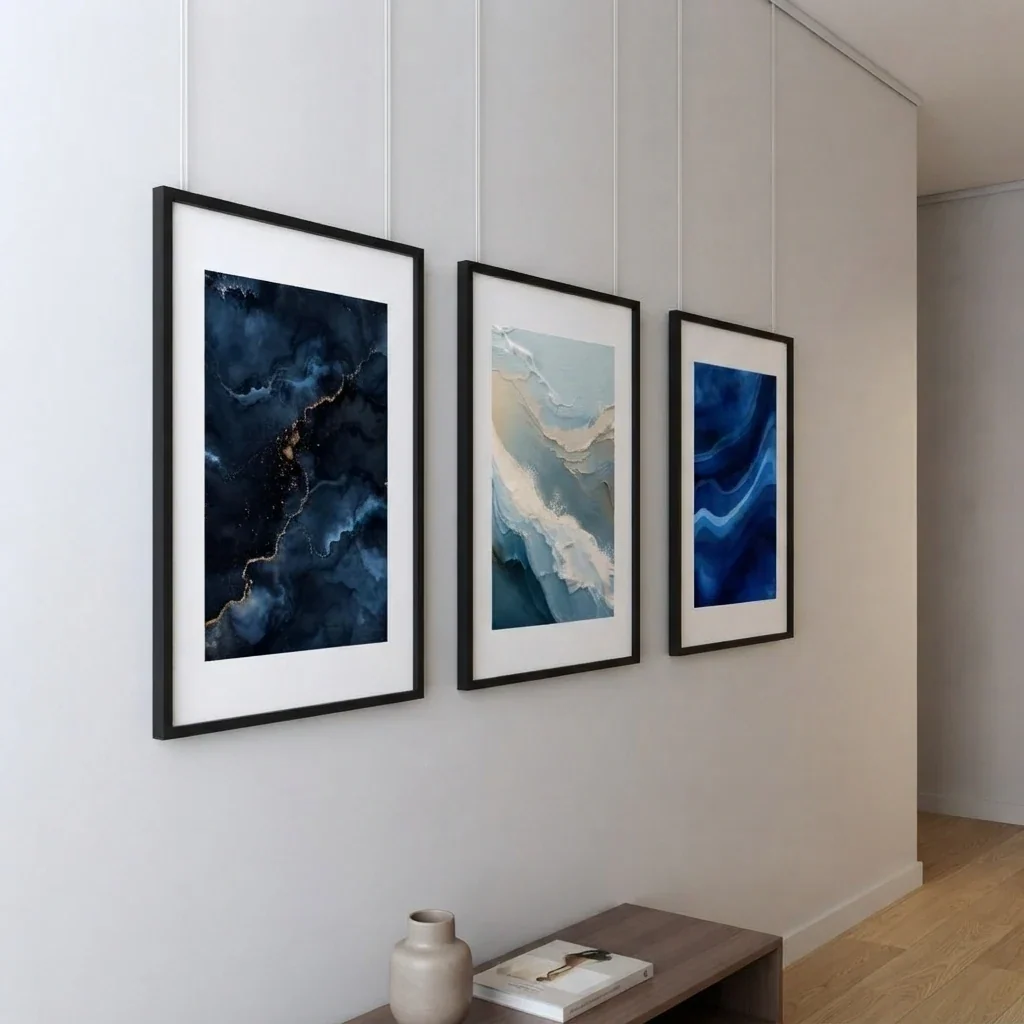
A trick worth the twenty minutes: cut the frames out of kraft paper at their true outside dimensions and tape them to the wall before you drill. It is the only reliable way to find out that the arrangement is four inches too wide, and it costs nothing but paper. If you would rather not tape paper to your walls at all, the last section covers doing the same thing from a photograph.
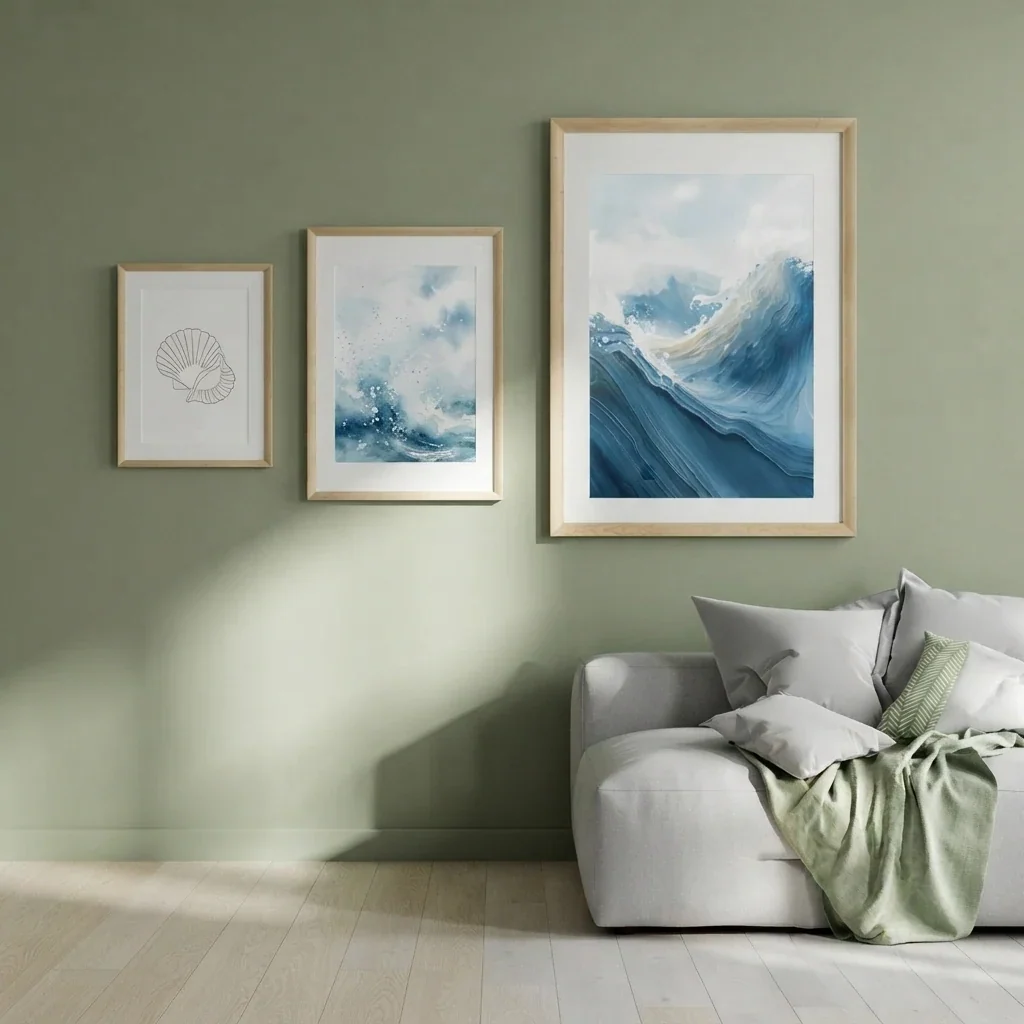
How high to hang it
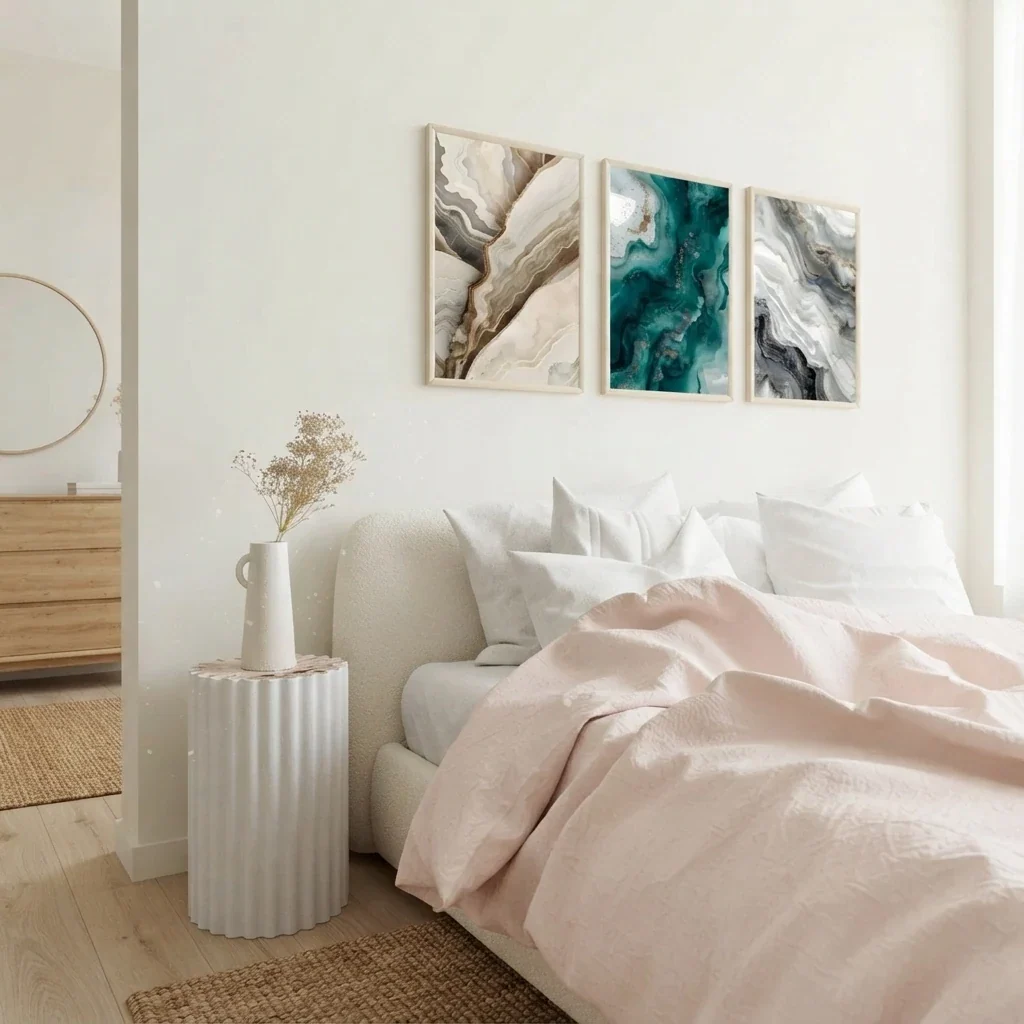
The centre of the picture goes 57 to 60 inches from the floor, which is 145 to 152 centimetres. Fifty seven is the museum figure, close to average eye level for a standing adult, and it is the number most galleries and stylists hang to. Not the top of the frame, not the hook, not the middle of the wall: the centre of the image.
Above furniture that rule yields. The bottom of the frame sits 6 to 8 inches above the top of the sofa back or the console top, and if that puts the centre at 62 inches, so be it. The furniture relationship is more visible than the eye level one. We keep the short version of this in our answer page on how high to hang art above a sofa, which has the metric numbers too.
The overwhelmingly common mistake in real houses is hanging too high. It happens because people hang while standing directly in front of a wall, where their own eye level is around 63 to 66 inches, and because a picture rail or a wall break invites you to line the top edge up with it. Standing in front of the wall is the one position from which you will almost never look at the picture again.
The mechanics: measure the frame height, halve it, add 57. That is where the top of the frame goes. Then measure from the top of the frame down to the taut hanging wire or the top of the D ring and subtract that, and you have the nail height. The wire always slips an inch or two lower than you think, which is why so many pictures end up a little below where they were planned.
Seven mistakes, in the order people make them
- Buying the frame before the print. A print has one size. A frame has two, and if you did not check the mat opening you own neither.
- Assuming 8 × 10 means the frame is 8 × 10. It means the glass is. Add the moulding twice for the wall.
- Letting the lab crop the photograph. A centred 16.7 per cent crop into 5:4 removes whatever was near the ends, and that is often a person.
- Going one size too small. Art above furniture almost always wants to be bigger. Two thirds of the furniture width is the floor of the range, not the ceiling.
- Hanging to your own eye level. You are standing. In a living room you will be sitting for the next ten years.
- Uneven gaps on a gallery wall. Almost always caused by measuring glass to glass across frames with different moulding widths.
- Mixing A sizes and inch sizes in one arrangement. A3 next to 11 × 14 is off by about half an inch in one direction, which is exactly the amount that is visible without being explicable.
Seeing the size on your own wall before you buy
Every number on this page is a proportion, and proportions are the one thing that will not survive a shop. A 16 × 20 held at arm’s length under warehouse lighting is a completely different object from the same frame on your wall, at your ceiling height, above your sofa.
The paper cut-out method is still the most honest test and it costs nothing. The faster version is to photograph the wall and put the frames into the photograph. MeltFlex works from a photo of your actual room, so you can try a single 24 × 36 against a six frame grid on the wall you are really dealing with, keeping your furniture, your floor and your light. The same approach we use for checking whether furniture fits a room applies to a wall: the arithmetic tells you what should work, the picture tells you whether it does.
If the wall itself is undecided, it is worth settling that first, since frame colour and mat width both read differently against a dark wall than a white one. Our guides to accent wall ideas and what colour furniture goes with grey walls cover that half of it, and the wall finish tool will show you a texture before you commit to it. For the room as a whole, our walkthrough on decorating a room from scratch puts the art step where it belongs, which is late.
And if the sense that something is off in the room survives all of this, the problem may not be the frames at all. We wrote about the usual culprits in why your living room feels off, and undersized wall art is on that list more often than any other single item.
Related measuring guides: how to measure for curtains, standard door sizes, average room sizes and measuring a room from a photo.
Frequently asked questions
What are the standard picture frame sizes?
In the United States: 4 × 6, 5 × 7, 8 × 10, 11 × 14, 12 × 16, 16 × 20, 18 × 24, 20 × 30 and 24 × 36 inches, which is 10 × 15 through to 61 × 91 centimetres. Two more appear constantly without being part of the set: 8.5 × 11 inches, because that is letter paper, and 27 × 40, the cinema poster. In the UK and Europe the shelf is A4, A3, A2 and A1, plus 30 × 40 and 50 × 70 centimetre poster frames that belong to no series.
Does an 8x10 frame mean the frame is 8 by 10 inches?
No. The number is the artwork, the glass and the opening at the back. The frame is larger by twice the moulding width, so a ¾ inch moulding makes an 11 × 14 frame cover 12½ × 15½ inches of wall. On one picture that is trivia; on a nine frame grid it is about four extra inches of width, which is how a measured layout stops fitting.
What size frame do I need for an 8x10 photo?
An 8 × 10 frame without a mat, or an 11 × 14 with one. The standard mat border is 1.5 to 2 inches, which is why the next size up is right. The same step holds throughout: 5 × 7 print into an 8 × 10 frame, 11 × 14 print into a 16 × 20, 16 × 20 print into a 20 × 24. The opening is cut a quarter inch smaller than the print on each side so the paper has something to sit behind.
Why does my photo not fit a standard frame?
Because the frames and the cameras come from different traditions. Your file is 3:2 or 4:3; 8 × 10 and 16 × 20 are 5:4, inherited from large format portrait film. Filling a 5:4 frame with a 3:2 file costs 16.7 per cent of the long edge, and the lab crops from the centre if you do not crop it first. The sizes that take a 3:2 file whole are 4 × 6, 20 × 30 and 24 × 36; the kindest to a 4:3 phone photo are 12 × 16 and 18 × 24.
How high should pictures be hung?
Centre of the picture at 57 to 60 inches, or 145 to 152 centimetres, from the floor. That is museum eye level, and it is the centre that counts rather than the top edge or the hook. Above furniture the bottom of the frame goes 6 to 8 inches above the sofa back or console top, and when the two rules disagree the furniture wins. Hanging too high is by far the more common error, because people hang while standing.
What size art should go above a sofa?
About two thirds of the sofa width, never under half. An 84 inch sofa wants roughly 56 inches of art: one 40 × 60 canvas, two 24 × 36 frames with a gap, or eight 11 × 14 frames in a 4 × 2 grid. Undersized art over a long sofa is the most visible proportion mistake in a living room, and nothing you put on the console below it will correct the impression.
How much space should be between frames on a gallery wall?
Two to three inches, identical everywhere, measured from the outside of one moulding to the outside of the next. Tighter than two and the frames blur into a single mass; wider than three and the group stops reading as a group. Then hang the whole arrangement as if it were one picture: put the centre of the block at 57 inches and let the individual frames land where the grid puts them.
What are A4, A3 and A2 frame sizes in inches?
A4 is 210 × 297 mm, or 8.3 × 11.7 inches. A3 is 297 × 420 mm, or 11.7 × 16.5 inches. A2 is 420 × 594 mm, or 16.5 × 23.4 inches. A1 is 594 × 841 mm, or 23.4 × 33.1 inches. Each step doubles the area. None of them matches a US size: A4 is narrower and taller than 8.5 × 11, and A3 falls between 11 × 14 and 12 × 16, so buy the frame in the same system as the print.