

A closet gets organized the moment its arithmetic works, and not one minute before. Count what you hang: tops cost about 1 inch of rod each, pants 1.2, jackets 2.4, dresses 1.6. Add it up, compare it with the rod inches the closet actually supplies, and convert the gap with a double hang at 40 and 80 inches before buying a single bin. That is the whole method. Every guide ranking for this query photographs baskets and says categorize; none of them states the capacity numbers, so the closet fills back up in a month and the baskets get the blame. This guide runs the numbers, draws them to scale, and ends with a calculator that gives your own closet a verdict, including the verdict nobody prints: sometimes the closet is three garments too small, and that is a purge decision, not a shopping list.
Our articles are still written by humans!
Get human written articles in your Google feed.



The audit: your wardrobe in rod inches
Clothes have a price in rod inches, and the audit is just reading the price tags. On a packed rail, a shirt on a slim hanger compresses to about 1 inch. Pants folded over a bar hanger take 1.2. A structured jacket refuses to compress past about 2.4, which is why six blazers eat the space of fourteen shirts. Dresses and coats cost 1.6 each, but their real price is vertical: a long garment carries about 64 inches of drop, so it cannot live above or below anything else. The dress section is the most expensive real estate in the closet, which will matter in a moment.
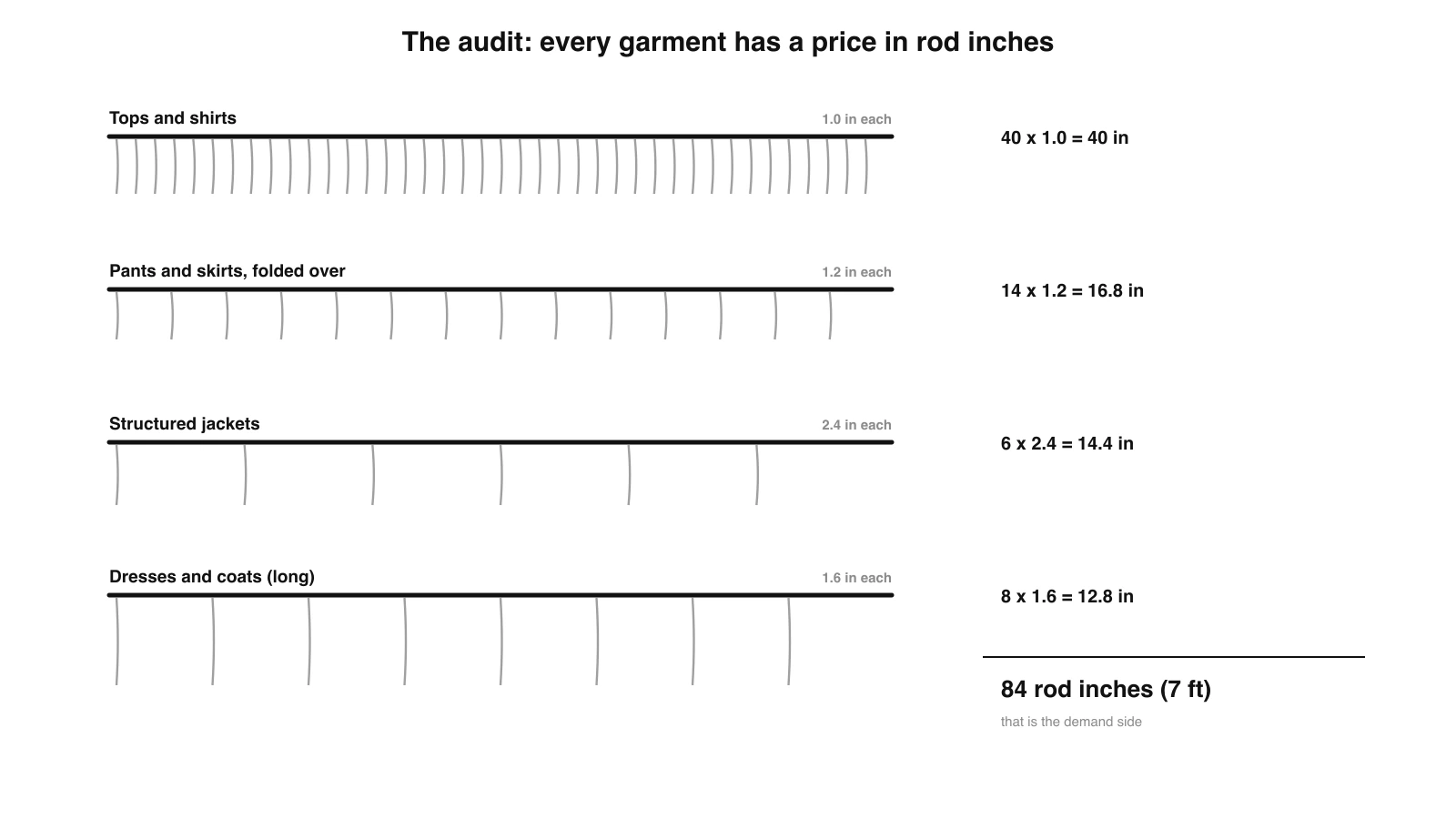
Count your own wardrobe in those four groups. A typical count of 40 tops, 14 pants, 6 jackets and 8 long garments comes to 84 rod inches, exactly 7 feet of rail. For calibration on how much hangs in an average home: a much-quoted ClosetMaid survey of 1,000 women put the average closet at 103 items, of which 21 percent were rated unwearable and 12 percent still had tags on. In rod-inch terms, a fifth of the demand side of the equation is clothing that has already retired without telling anyone. The audit makes that visible before you spend a weekend rehanging it.
Those are packed-rail numbers, measured with garments touching. If you want to slide hangers rather than excavate them, budget 15 to 20 percent of slack on top. Knits do not appear in the table because knits do not hang: a hanger bumps the shoulders and gravity does the rest, so sweaters are shelf citizens by material law, not preference.
Check your closet before you empty it
Measure the closet's width, depth and ceiling height, type in the four counts from your audit, and the calculator below runs the same rules this article derives: the long section sized to your dresses, the double hang conversion, the 24 inch depth gate, the 84 inch ceiling gate, and the walk-in aisle rule. It answers in rod feet supplied against rod feet demanded, and when the closet loses, it says by how many garments.
Interactive calculator
Loading… if it does not appear, refresh the page.
The verdict line matters more than the layout. Organizing advice quietly assumes every wardrobe fits every closet once the right containers arrive, and it is not true: a 48 inch reach-in supplying 81 rod inches cannot hold an 84 inch wardrobe, and no basket has ever changed that. When the calculator says over by 3 garments, that is the most useful sentence in this entire genre, because the decision becomes which three, and that decision takes ten minutes instead of a guilty afternoon.
The geometry a closet must obey
Three numbers decide what any closet can become, and none of them is negotiable with effort. Depth first: hangers run 17 to 21 inches shoulder to shoulder, so a hanging closet needs 24 inches of clear depth for garments to sit square to the rod. At 20 inches, common in prewar apartments, every sleeve brushes the door and slim hangers stop being a preference. Below about 18 inches, conventional hanging is dead; the honest fallback is front-facing hooks or a pull-out rail, and any guide that suggests otherwise has not stood in that closet.
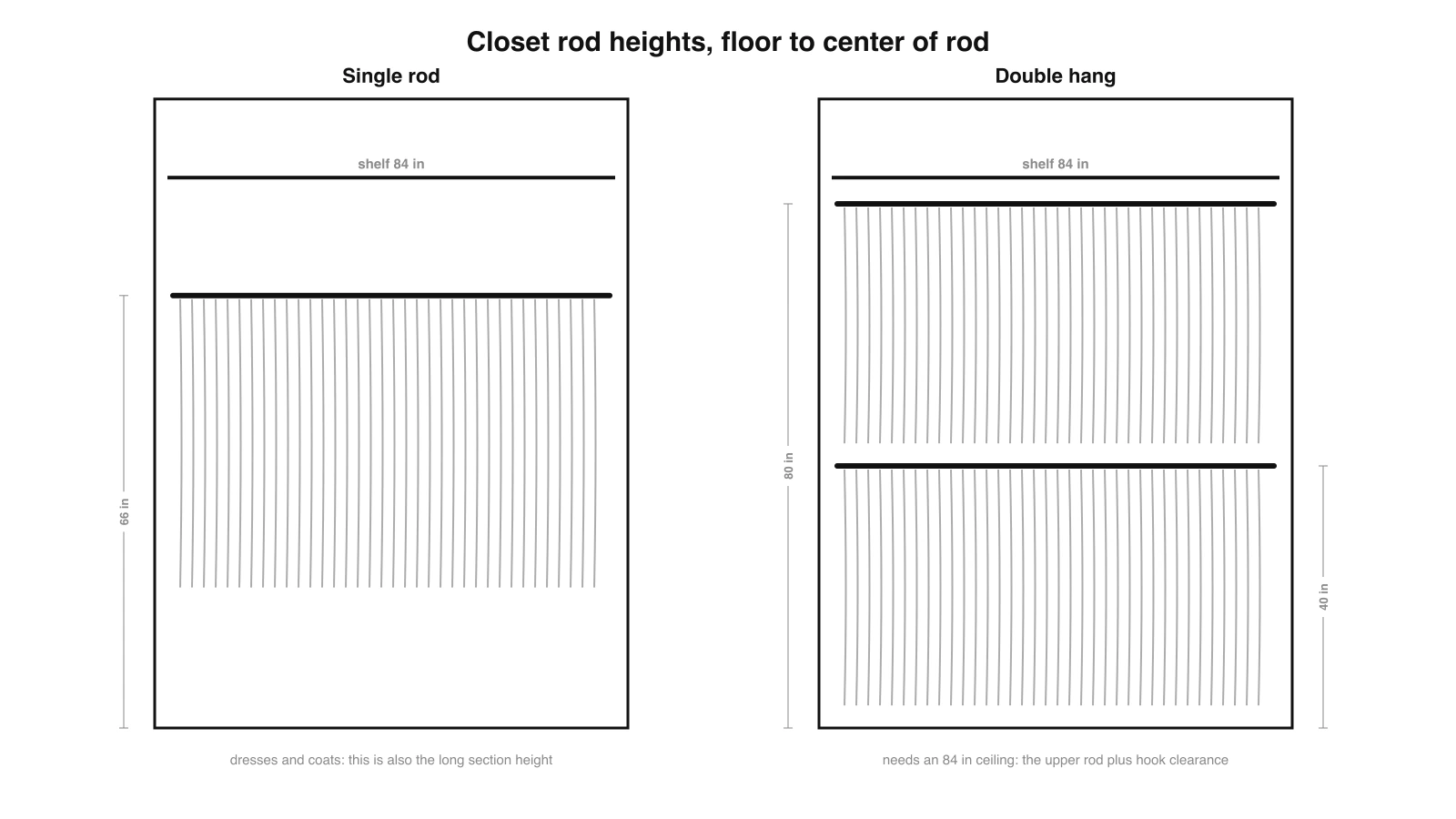
Heights next, all measured floor to the center of the rod: the builder standards are 66 inches for a single rod and 40 plus 80 for a double hang, with the shelf at 84. The 80 works because a shirt on a hanger is about 38 inches top to hem, so the upper tier's hem clears the lower rod with an inch to spare. One honest caveat: a long suit jacket runs 39 to 42 inches on the hanger, which fouls both tiers of a double hang, so long blazers are long-section citizens; the jacket-length arithmetic is derived in full in the walk-in closet design guide. The catch is the ceiling: the upper rod plus hook clearance needs 84 inches of height. Sloped attic ceilings and basement soffits kill the double hang exactly where storage is scarcest, and the calculator above flags it.
If mounting hardware is the part that worries you, the anchor and bracket logic is the same as for curtains, and the curtain rod install guide covers the drywall anchor arithmetic in detail. A loaded closet rod carries far more than a curtain: seven feet of packed clothes runs 60 to 80 pounds, so every rod end wants a stud, a cleat, or a rated anchor, never bare drywall.
The double hang conversion
Here is the one move in closet organizing that manufactures space instead of shuffling it. A double hung inch of closet width supplies two inches of rod. Convert everything except the long section and the arithmetic moves violently in your favor: on a standard 72 inch reach-in, the single rod era supplies 72 rod inches. After the conversion, the 8 dresses and coats get a long section sized 15 inches, and the remaining 57 inches double hangs into 114. Total: 129 rod inches from the same wall, a 79 percent gain, for the price of one rod and two brackets.
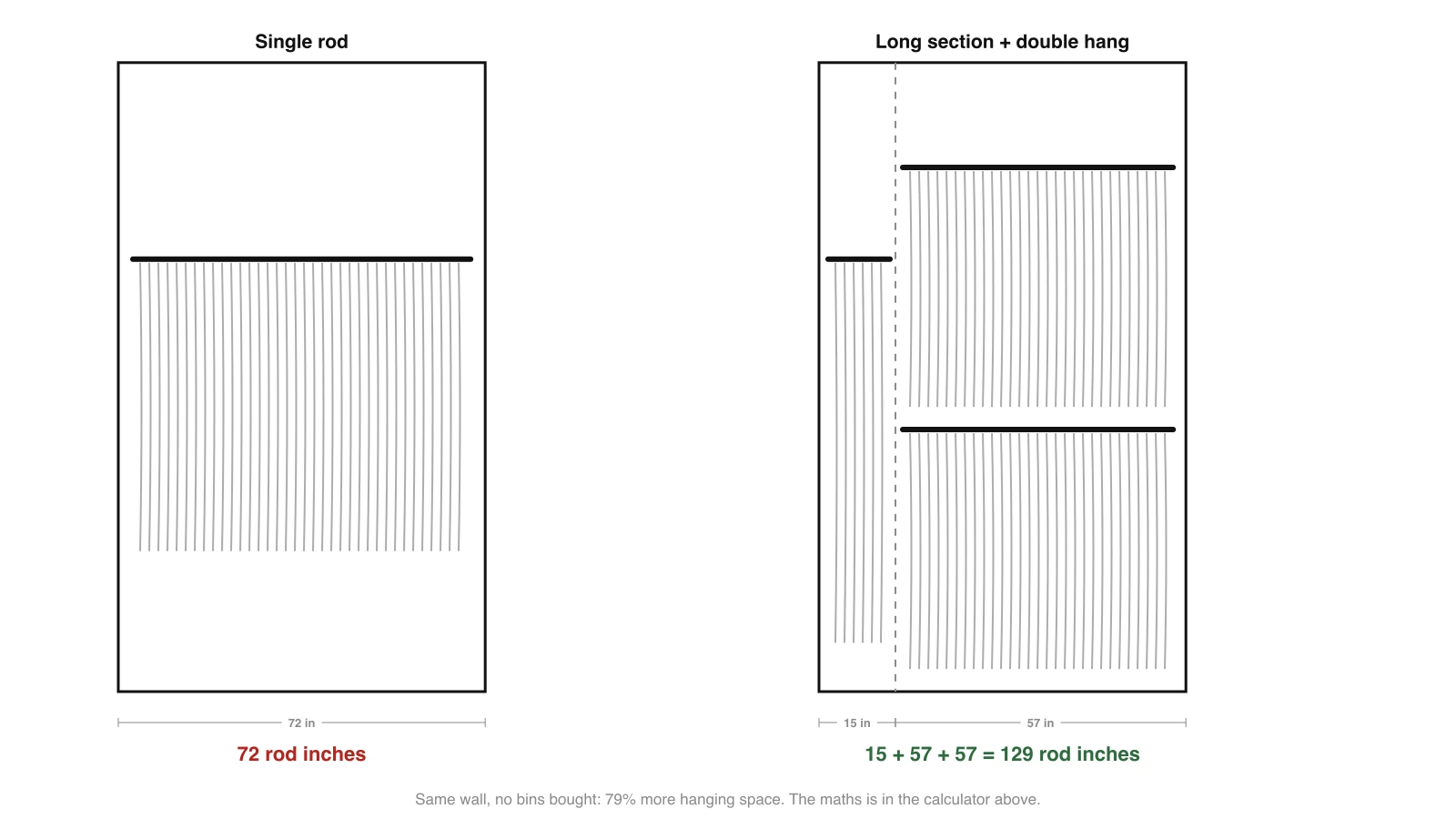
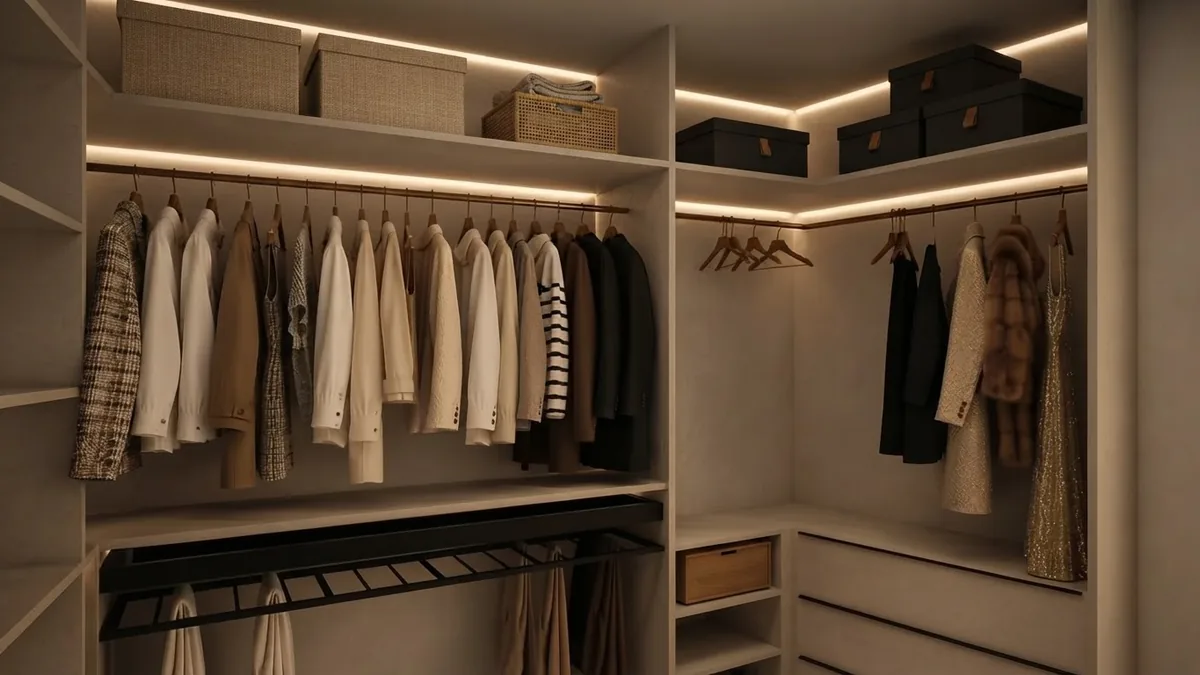
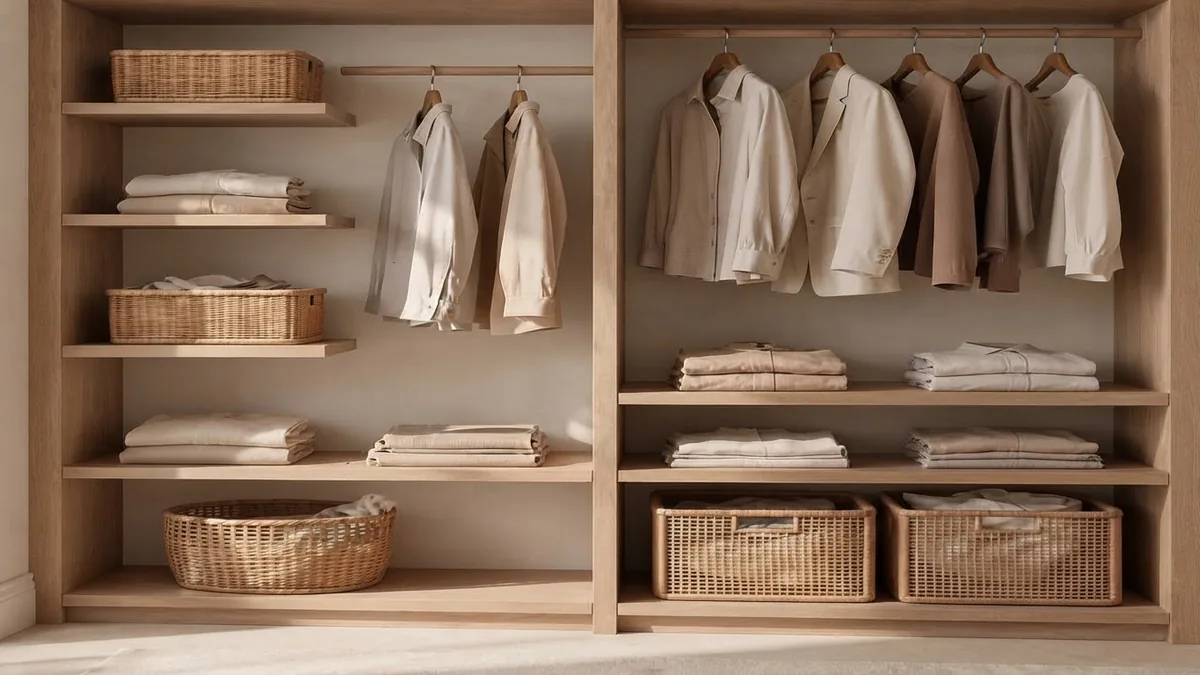
The design decision hiding inside the conversion is the long section, because it is the part that refuses to double. Size it to what long garments actually need, about 1.6 rod inches each plus 10 percent of slack, and not an inch more. This is also the honest argument for owning fewer long coats than feels right in October: every dress costs double, once in its own width and once in the double hang width it prevented. The photo below is what the finished grammar looks like in a real wardrobe wall, long section on its own height, doubled rods beside it, folded knits and boxes where rods cannot go.
Organize the closet in five passes
With the numbers known, the physical job stops being archaeology and becomes five passes, each with a stopping point. Budget about three hours for a full reach-in; a walk-in takes an afternoon. The order matters, because every pass depends on the number produced by the one before it.
Pass one, audit. Count the four groups where they hang. Do not touch anything yet; counting while moving turns into sorting, and sorting without a target number is how the weekend disappears.
Pass two, verdict. Run the calculator. If the closet is over, the overflow number is the purge quota, and it is non-negotiable in a way a vague intention to declutter never is. If the closet fits with headroom, skip the purge entirely; not every closet needs a moral inventory.
Pass three, empty by category. Everything out, in the audit groups. The pile on the bed is the demand side of the equation made physical, which is motivating in a way a spreadsheet is not.
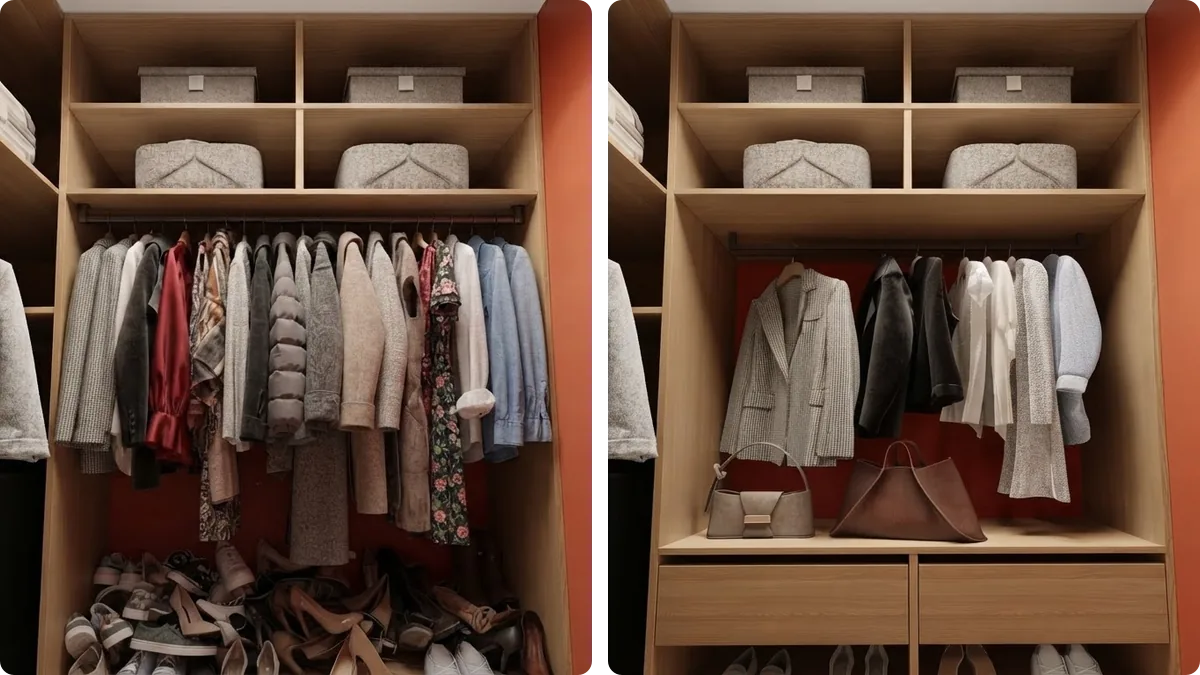
Pass four, convert. Rods at 40 and 80, long section sized from the audit, shelf at 84 if there is not one already. This is the only pass that involves a drill, and it is the pass every bin-first guide skips.
Pass five, rehang by group with a length gradient. Shortest drops at one end, longest at the other, inside each category. The gradient is not aesthetics: it keeps the floor under the short garments clear for shoe shelves, and it makes a missing category visible as a gap instead of a suspicion. Color order within a category is taste and costs nothing; category order is capacity and pays rent.
How to organize a small closet
A small closet is not a small version of the same problem; it is the same problem with the slack removed. Run the same audit and the same conversion, and then accept what the arithmetic says: a 48 inch reach-in converts from 48 to 81 rod inches, and against the 84 inch example wardrobe it is still over, by exactly 3 garments. That is the honest shape of most small-closet situations: after the best possible conversion, the gap is small, specific and personal, and the fix is subtraction, not a product.
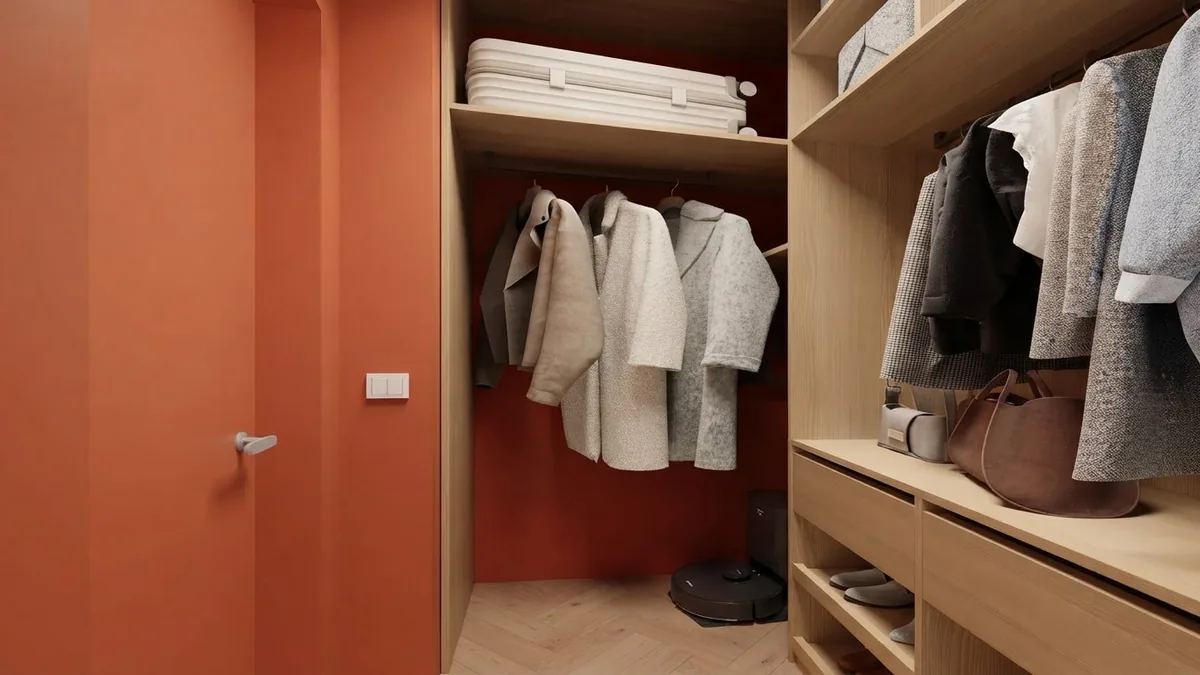
Three moves buy real inches after the conversion, in order of return. First, evict the long section: coats to the hallway or coat closet, and the freed width doubles. Second, rotate the season out, because clothes for the other half of the year are renting your most expensive real estate at zero occupancy; under-bed boxes cost them nothing in usability for six months. Third, use the vertical ends: the top shelf takes the suitcase and the duvet, and the floor under the short-drop end takes two shoe shelves. What does not work at this scale is compression by force, thin hangers on a 20 inch deep rod excepted: cramming past the packed-rail numbers means extracting a shirt disturbs four neighbors, and the closet unravels back to entropy in a week. If the room itself is the constraint, the layout thinking in the bedroom layout guide and the clearance numbers in average room sizes are the up-a-level fix.
Walk-in closets and the 72 inch rule
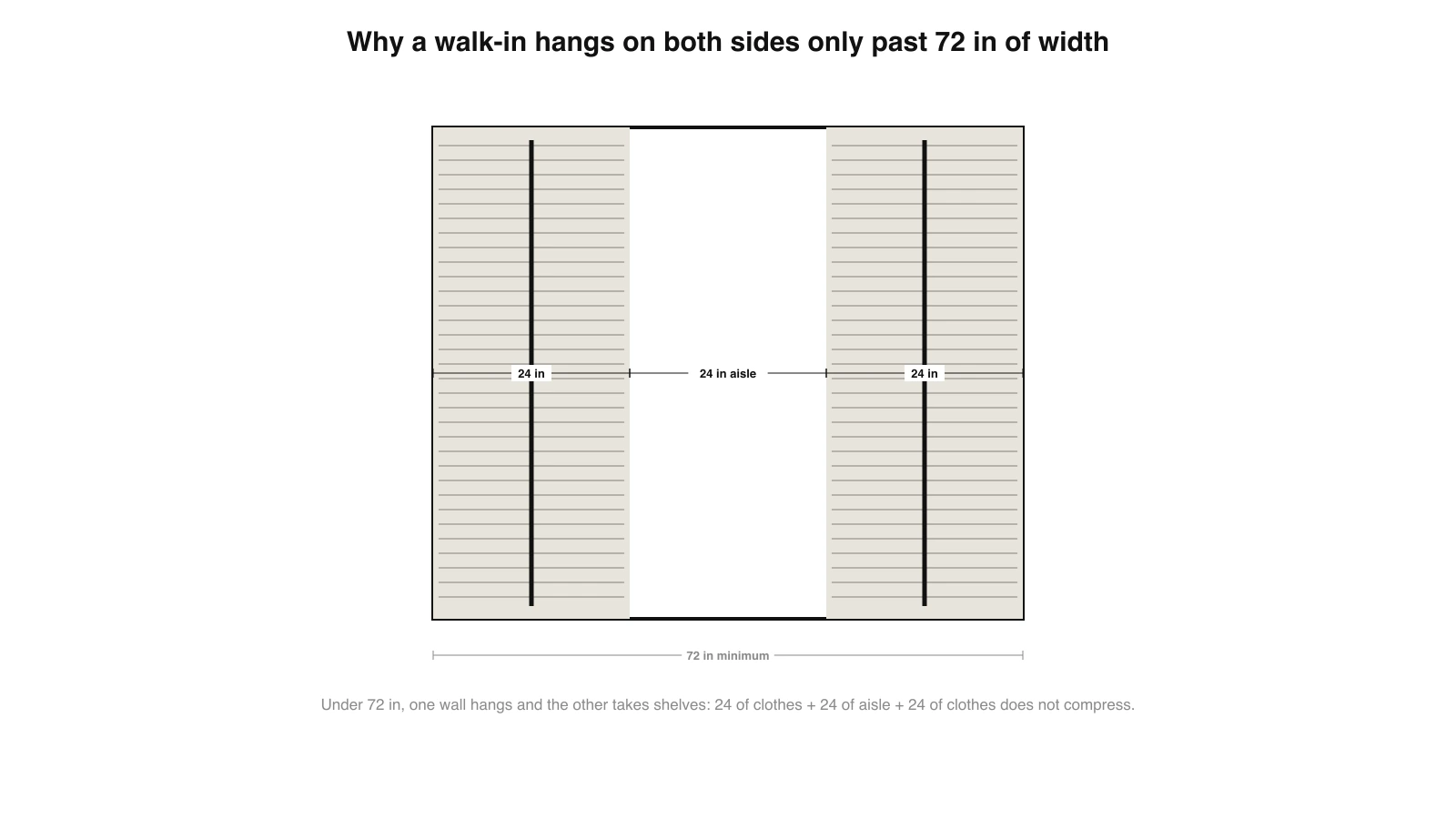
A walk-in adds one number to the geometry: the aisle. A human needs 24 inches to walk and turn; hanging clothes need 24 inches of depth per side. So hanging on both long walls costs 24 plus 24 plus 24, which is why 72 inches of clear room width is the entry fee for a double-sided walk-in, and why a 5 foot wide walk-in that hangs both sides feels like a fight. Under 72, one wall hangs and the other takes shelves, and pretending otherwise just means dressing in the hallway. Call 72 the minimum, not the recommendation: with a 36 inch aisle, the width where two people pass without negotiation, the comfortable number is 7 feet.
Corners are the other tax. Where two runs of rod meet, garments collide, and about 24 inches of one run is effectively dead; the calculator deducts it, and good closet systems spend corners on shelf towers instead. With both rules respected, a 6 by 8 foot walk-in supplies about 21 rod feet, comfortably two people's wardrobes. The couple-sized version of the audit is the same arithmetic with doubled counts, and it is worth running before assigning sides, because his-and-hers is rarely a 50-50 split in rod inches: jackets against dresses is a 2.4 versus 1.6 fight either way. For the design half of the walk-in question, finishes, islands, lighting, the walk-in closet design guide owns that lane; this page only claims the arithmetic.

Shoes, shelves and the top shelf
Shoes obey shelf math, not rod math. A pair on a flat shelf stands about 7 inches tall and 8.5 inches wide, so shelves pitched every 7 inches turn any column of closet into a shoe library: 12 pairs need 102 shelf inches, two rows across a 72 inch closet. The floor under the double hang's short side fits exactly two such rows below the 40 inch rod, which is why the length gradient in pass five was not decoration. Boots break the pitch and go on the floor row or the top shelf, lying down.

Folded clothes get shelves at a 12 to 14 inch pitch, stacked no higher than 10 inches, because the eleventh inch is where stacks avalanche when the third sweater down gets pulled. Baskets earn their place in exactly one role: loose small categories, socks, scarves, gym gear, where the basket is a drawer that travels. The top shelf, above 84 inches, is long-term parking by definition, since anything up there requires intention to retrieve: luggage, duvets, the season currently in exile. If a basket is holding folded shirts at eye level, it is not organizing anything; it is a box hiding a shelf's job.
Keeping it organized is a capacity budget
Closets do not get messy; they go over budget. Every system in this guide fails on the day demand quietly exceeds supply again, which in the ClosetMaid numbers happens roughly one shopping season after the reorganization. The maintenance rule that survives contact with real life is one-in-one-out, run in rod inches rather than items: a new blazer is a 2.4 inch purchase, and it either replaces 2.4 inches of something or it starts the slow slide back to the before photo. That reframing also quietly prices shopping decisions, since a candidate garment that cannot name its 2.4 inches of victim was never going to be worn much anyway.
The seasonal rotation is the other half of the budget: twice a year, the exiled season comes down from the top shelf and the audit reruns itself in twenty minutes. That cadence, plus the visible gap the length gradient creates when something is missing, is the entire maintenance system. No app, no labels beyond what a guest could infer, and the only purchased objects are rods, shelves and at most a handful of baskets with named jobs. Organizing budgets are better spent on the closet's bones than its accessories, a point the furnishing cost guide makes about every room in the house.
See your closet organized before you build it
The gap between this article and your Saturday is visual: the arithmetic says 15 inches of long section and a doubled rod, but it is hard to commit a drill to a layout you have never seen in your own closet. That preview step is what the AI closet design tool is for: photograph the closet as it stands, doors open, and generate it reorganized, double hung, shelved, with the finishes you are considering, in about 20 seconds per variant. The render keeps your actual walls, angles and lighting, so what you approve is your closet and not a catalog fantasy.

Run the calculator's layout through it, or test the bigger swings, a converted double hang against a shelf tower wall, before spending on either. The same engine restyles whole rooms in the MeltFlex studio, which is the right tool the day the closet project escalates into the bedroom around it, as closet projects tend to do; the feng shui bedroom layout guide and the square footage guide cover that territory. Between the audit, the calculator and the preview, the entire decision happens before the first hanger moves, which is the point: closets are organized on paper, and merely executed on Saturday. And when the same overflow problem shows up wearing cans instead of coats, the pantry version of this system runs on shelf gaps the way this one runs on rod inches.
FAQ
How do you organize a closet with too many clothes?
Count before you fold anything: tops cost about 1 inch of rod each, pants 1.2, jackets 2.4, dresses 1.6. Compare the total against the rod inches the closet supplies; the overflow is your purge target, and the ClosetMaid survey's finding that a fifth of the average wardrobe is unwearable means the first candidates are already hanging there.
What order should clothes hang in a closet?
Category first, length gradient inside each category, shortest drop at the end where the shoe shelves live. Color order within a category is free and pleasant; category order is what protects the floor space and makes gaps visible.
Is it better to fold or hang clothes?
Hang structure, fold stretch. Shirts, blazers, dresses and creased trousers keep their shape on hangers; knits, tees and denim keep theirs on shelves. In a tight closet the tiebreaker is which resource you have left, rod inches or shelf inches.
How high should closet rods be?
Single rod at 66 inches to center, double hang at 40 and 80, shelf at 84. The double hang needs an 84 inch ceiling for hook clearance, which is the number that disqualifies attic and basement closets.
How deep does a closet need to be?
24 inches of clear depth for hangers to sit square. At 20 inches slim hangers become mandatory and sleeves brush the door; below about 18 inches, hang front-facing hooks or a pull-out rail instead of a rod.
How many clothes fit on one foot of closet rod?
Roughly 12 shirts, 10 folded-over pants, 7 dresses or 5 structured jackets, packed. Add 15 to 20 percent slack to browse comfortably, and double everything per inch where the rod is double hung.
How do you organize a small closet with no space?
Double hang first, then evict the long section to a coat closet and the off-season to under-bed boxes. A 48 inch reach-in converts from 48 to about 81 rod inches; the few garments still over the line are a subtraction problem no product solves.
How much does it cost to organize a closet?
The conversion itself is under $40 in rod and brackets. Kit systems run $150 to $600, custom walk-ins $1,000 to $3,000 and up. Rods and shelves add capacity; bins only relocate overflow, so fund the bones first.