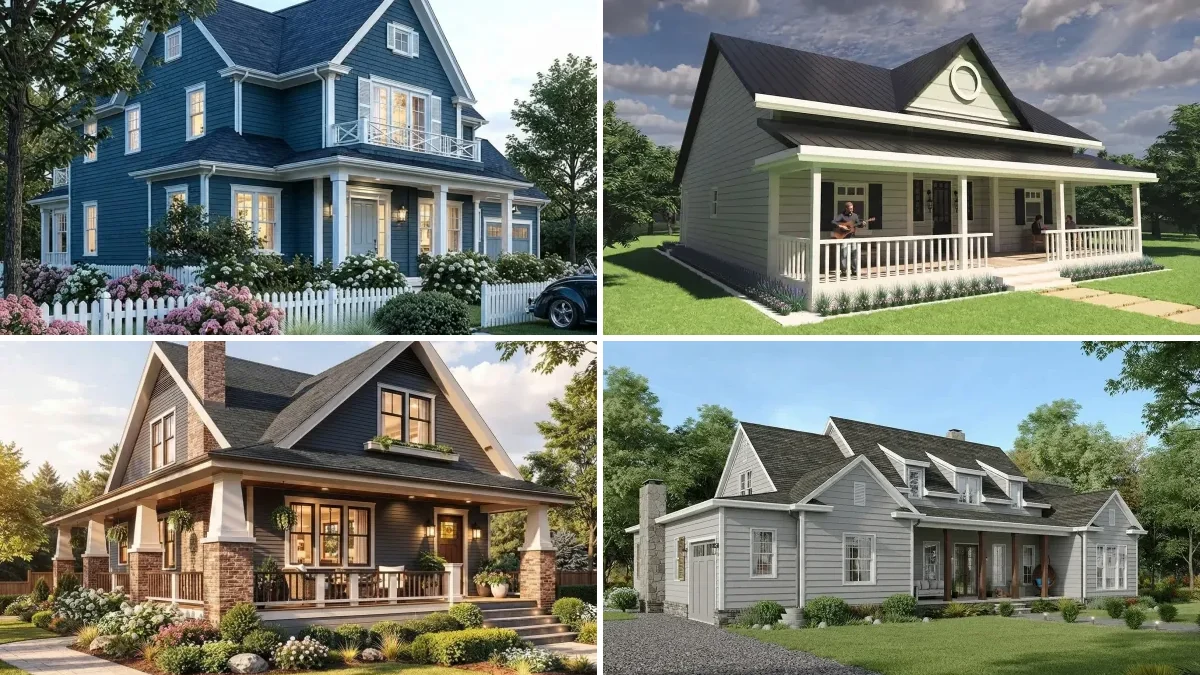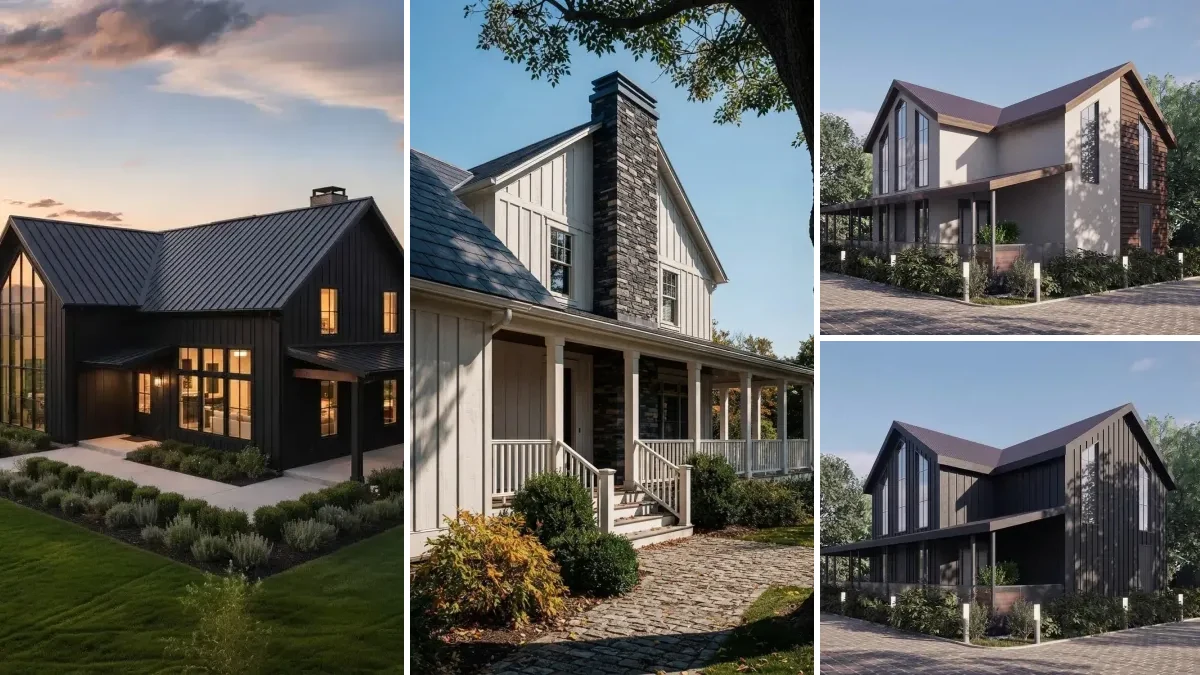
An exterior color is the most public design decision you will ever make. It is also close to permanent: a repaint costs thousands, new siding costs tens of thousands, and either way you live with the result for a decade or more. Choose well and the house looks intentional from the street every single day. Choose badly and you notice it every time you pull into the driveway.
Our articles are still written by humans!
Get human written articles in your Google feed.
If the structure in front of the paint is also up for discussion, our modern front porch ideas guide covers the depths, the code and the cost of the porch itself, which changes how any facade colour reads. And if you want to see a shortlist on your own house before you buy anything, our exterior paint visualizer comparison covers the nine tools that will show it to you, seven of them free.
2026 makes the choice easier than usual, because for once every major paint brand is pointing in the same direction: warm, grounded, nature-based color. Cool gray is done. Stark white is softening into cream. Green has gone from risky to mainstream. This guide walks through the seven exterior palettes that define 2026, and to make the comparison honest, we show the same ordinary suburban house repainted in all seven, so you are comparing colors, not houses.
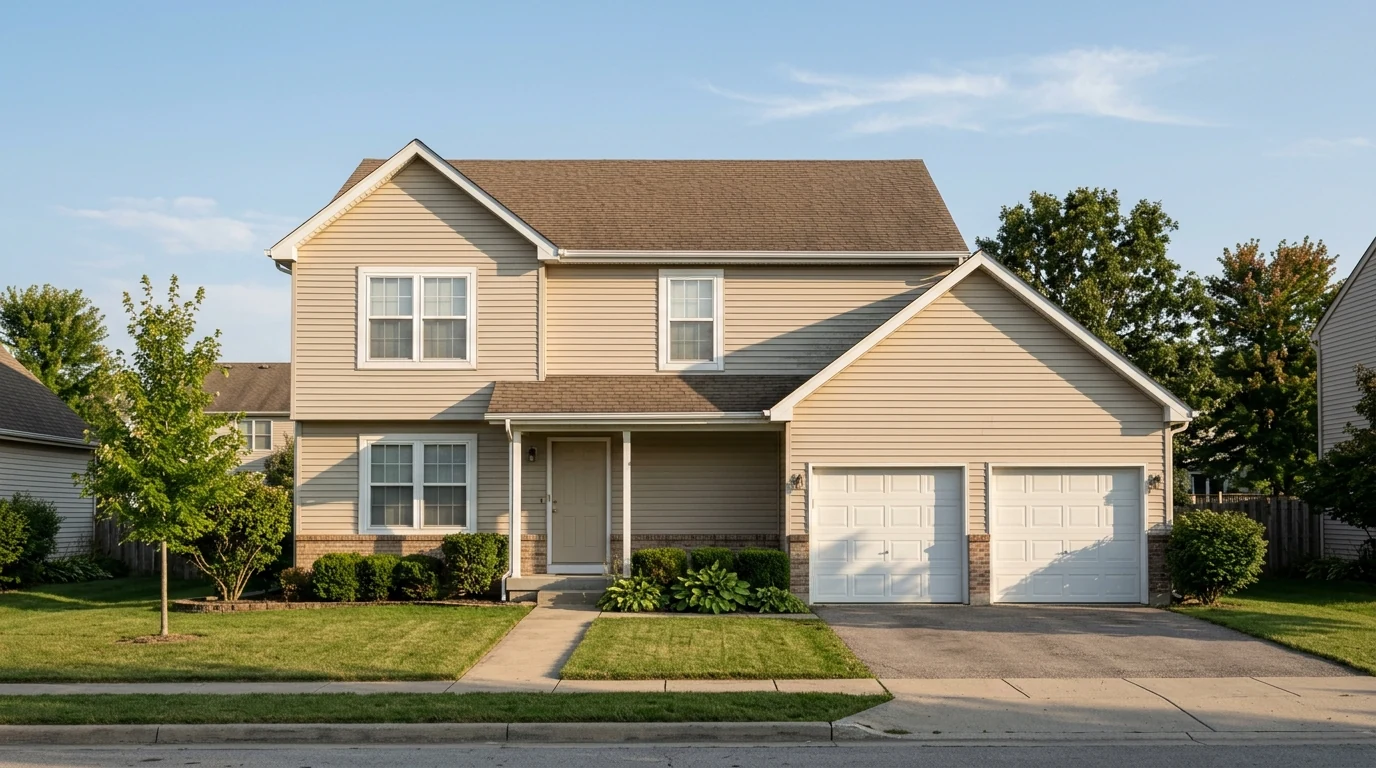
The starting point: a well-kept but forgettable beige vinyl two-story. Every render below is this exact house in a 2026 palette.
FreeUpload house photo · freeRedesign my house exterior for freeUpload a photo of the house and MeltFlex redraws the facade, roof and finishes on your actual building. Your first AI design is free, no card needed.
What's In and What's Out in 2026
The clearest signal comes from the paint companies themselves. Their Color of the Year picks are researched marketing bets on where taste is heading, and the 2026 picks agree to an unusual degree: Sherwin-Williams chose Universal Khaki SW 6150, a warm earthy tan. Benjamin Moore chose Silhouette, a rich espresso brown with charcoal undertones. Behr chose Hidden Gem N430-6A, a smoky jade green the brand itself recommends for exteriors and accents (ArchDaily has a good overview of the full 2026 slate). Khaki, espresso, jade: three brands, one message. If you want the interior side of the same story, we broke down the 2026 colors of the year for interiors separately.
One more shift worth naming: the accent moved from paint to material. In 2026 the “pop” is a white-oak front door, a cedar porch ceiling or bronze window frames, not a red door on a gray house. Now the seven palettes, one house, no excuses.
1. Warm White and Cream
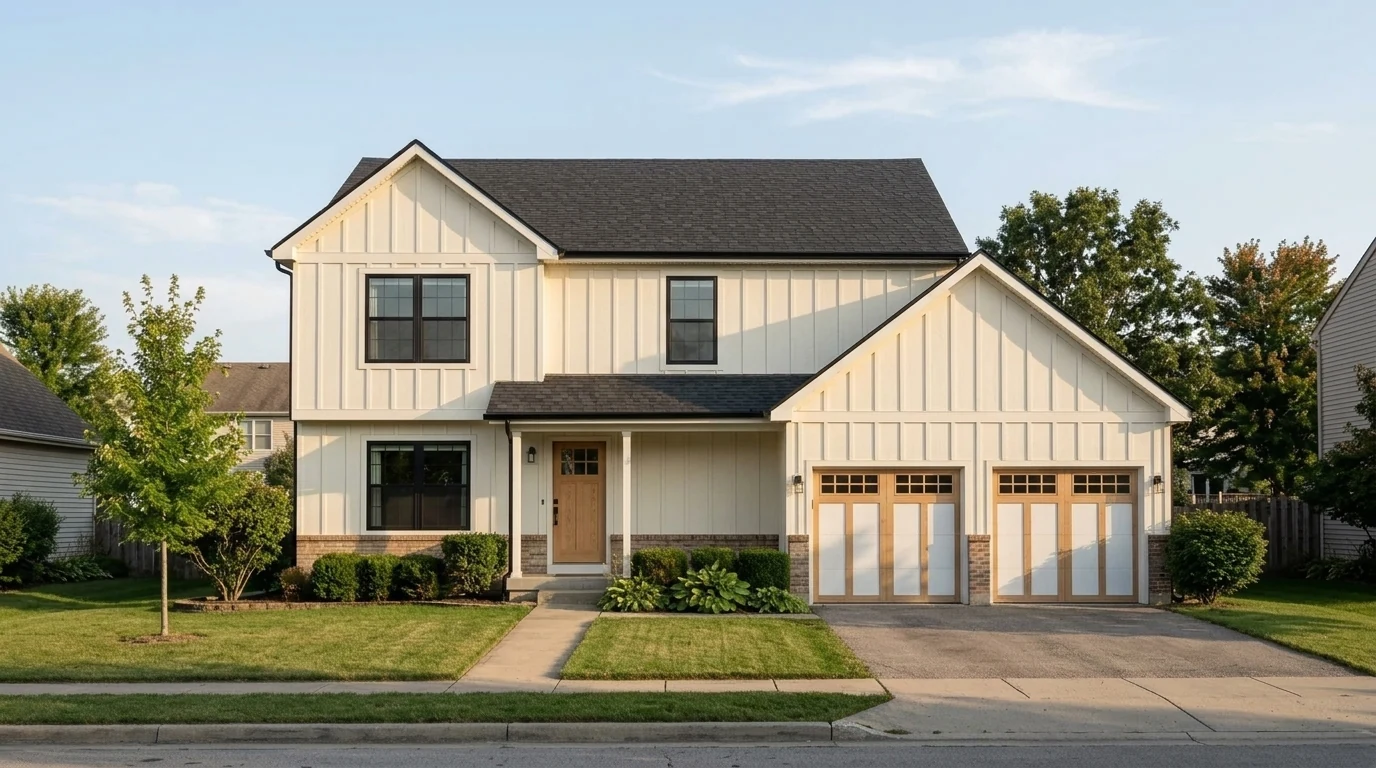
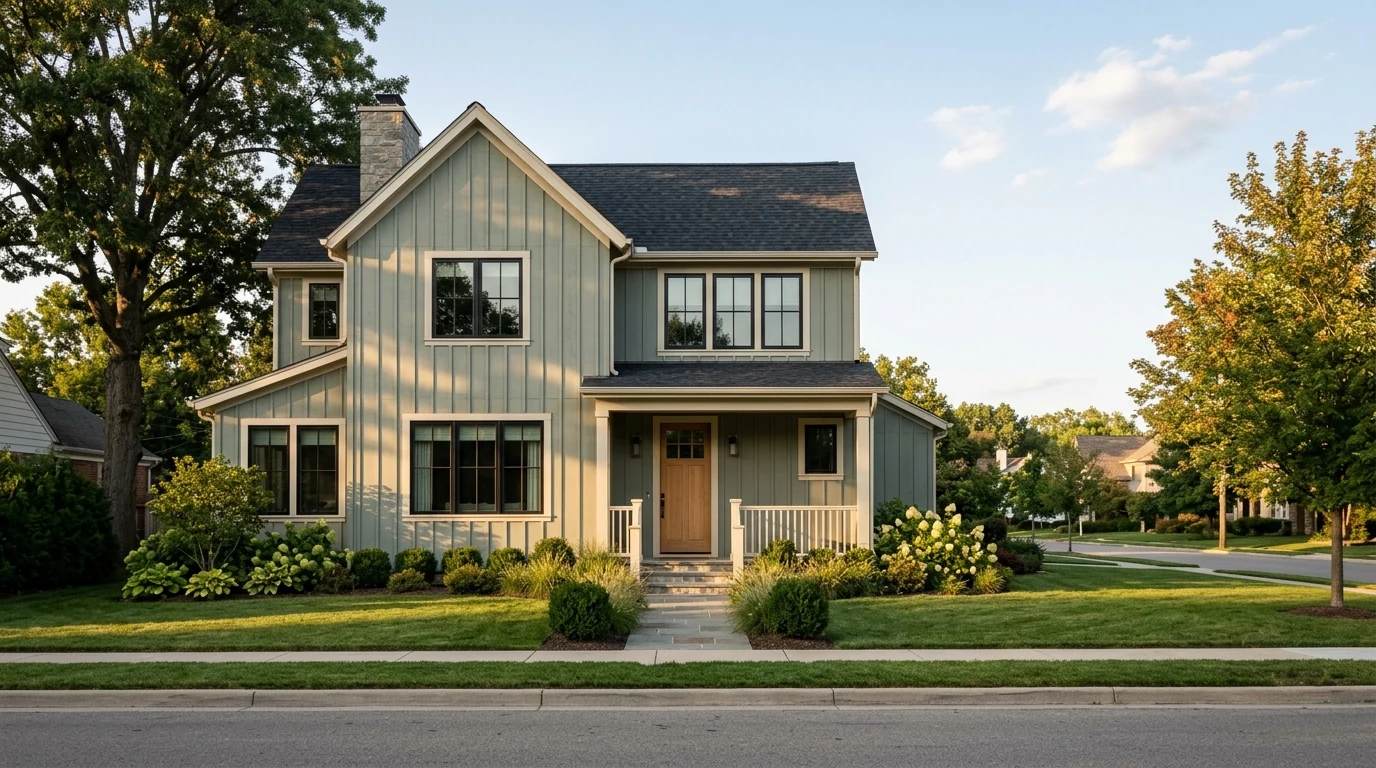
Same house, creamy white board-and-batten with black windows and a white-oak door.
The farmhouse white is not going anywhere, but it has changed temperature. The 2026 version is cream, ivory or almond rather than paper white, and the trim contrast is softer: black or bronze windows, yes, but paired with natural wood instead of glossy jet-black everything. The result reads warm and expensive where the 2019 version now reads a little clinical.
- Paint picks: Sherwin-Williams Alabaster SW 7008, Benjamin Moore White Dove OC-17, Benjamin Moore Swiss Coffee OC-45.
- Pair with: matte black or dark bronze window frames, a white-oak or walnut front door, charcoal roof.
- Best on: farmhouses, colonials, new builds with board and batten siding or lap siding. The safest resale choice on this list.
- Watch out for: undertones. A cool white next to a brown roof turns gray and dingy. Test against your roof before committing.
2. Sage and Eucalyptus Green
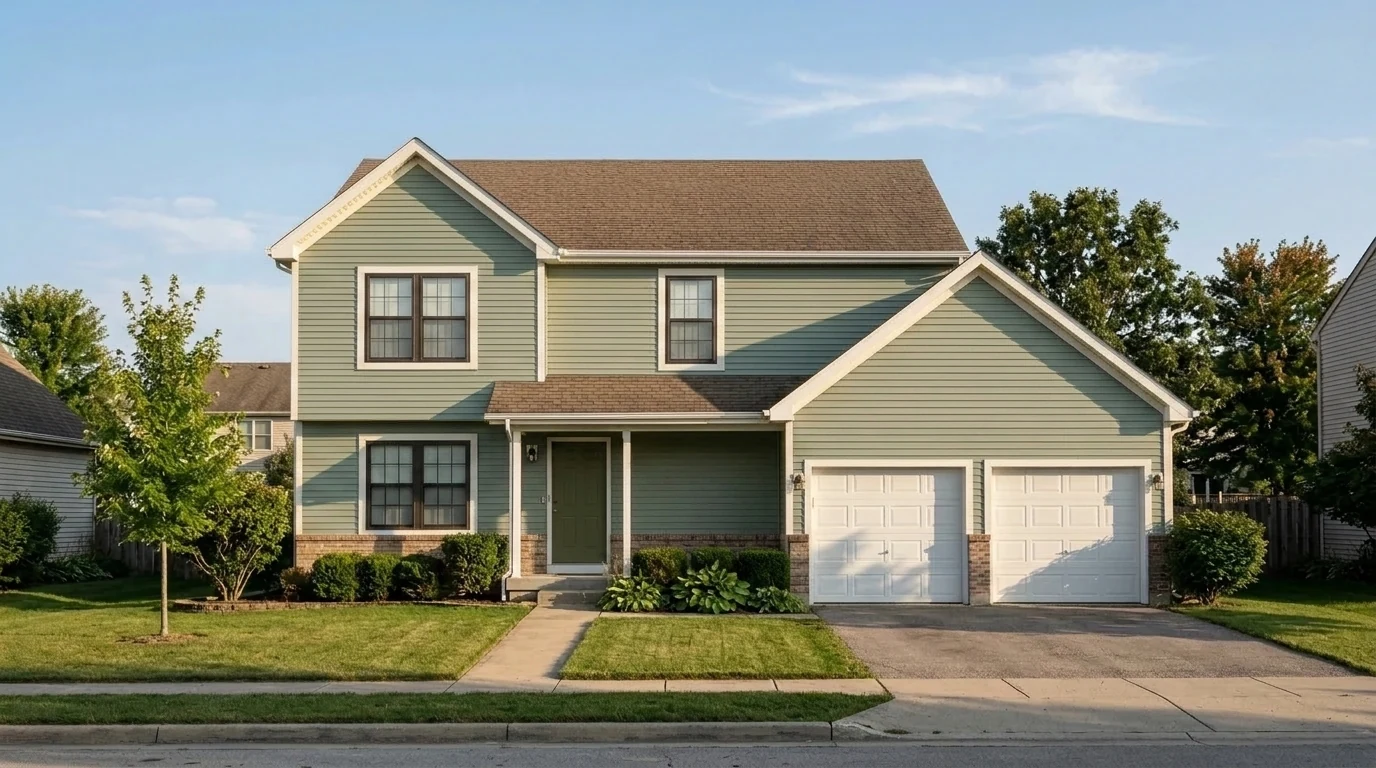
The fastest-rising exterior color of 2026: muted sage with warm off-white trim.
Five years ago a green house was a statement. In 2026 muted sage is simply a neutral, and it is the fastest-growing exterior choice in the country. Behr's Color of the Year, the smoky jade Hidden Gem, was picked with exteriors explicitly in mind, and Valspar's trending Warm Eucalyptus sits in the same family. Sage works because it does what beige does, blending into lawns and landscaping, while actually having a color.
- Paint picks: Behr Hidden Gem N430-6A, Sherwin-Williams Evergreen Fog SW 9130, Benjamin Moore October Mist 1495, Valspar Warm Eucalyptus.
- Pair with: warm off-white or cream trim, bronze or black window frames, a deep olive or natural wood door.
- Best on: almost anything, which is the point. Ranches, two-story suburbans, cottages and craftsman homes all carry sage well.
- Watch out for: going too gray. Cool, grayed-out sages drift back toward the 2018 gray trend. Keep the undertone warm.
3. Charcoal and Near-Black
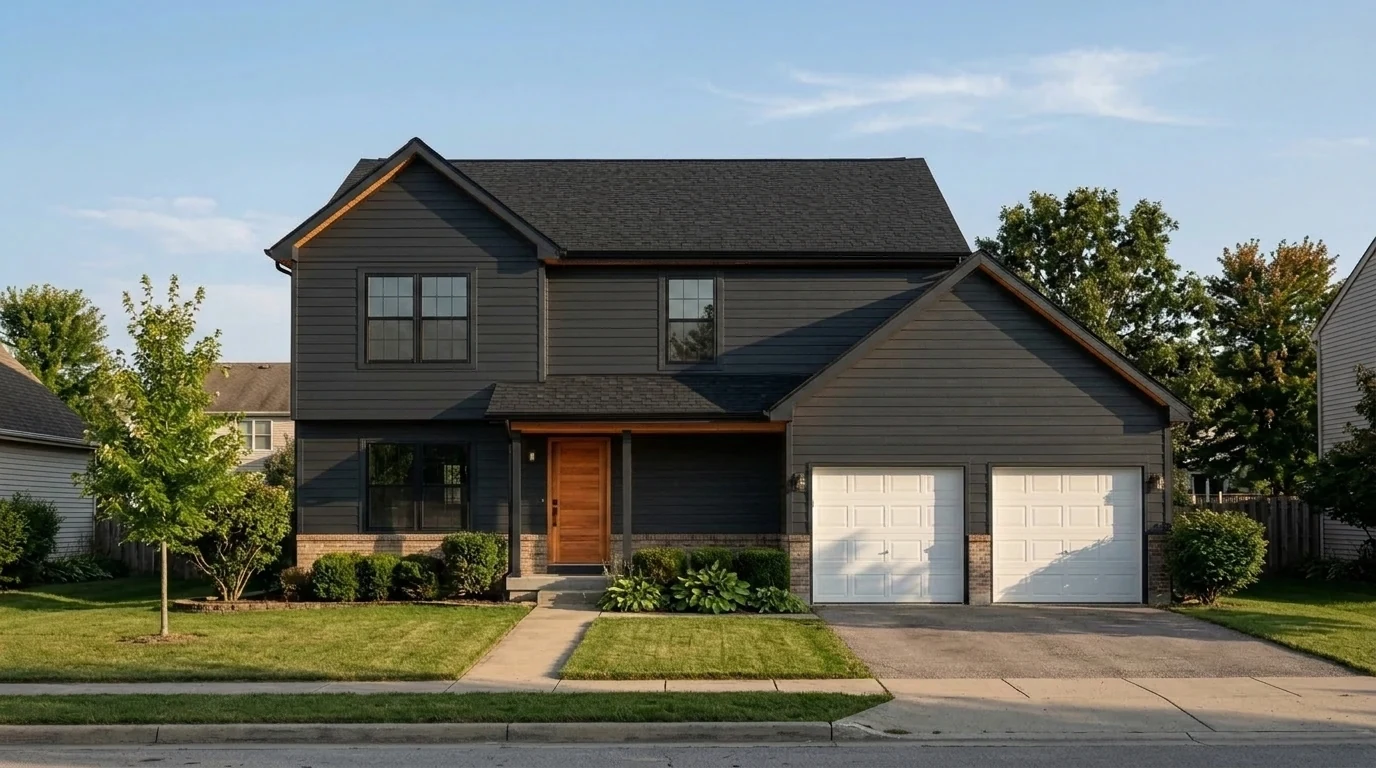
Charcoal siding with a cedar door: the wood is what keeps a dark house from feeling cold.
The dark exterior survived the trend cycle, but 2026 softened it. Instead of flat jet black, the current version is a deep charcoal with visible warmth, and it is almost always lifted by natural wood: a cedar door, a wood-clad porch ceiling, oak brackets. That one warm material is the difference between striking and gloomy. Dark houses also photograph beautifully, which keeps them popular with anyone thinking about a future listing.
- Paint picks: Sherwin-Williams Iron Ore SW 7069, Benjamin Moore Wrought Iron 2124-10, Sherwin-Williams Tricorn Black SW 6258 for trim.
- Pair with: cedar or white-oak door, black windows and gutters so nothing bright interrupts the mass, black roof.
- Best on: modern builds, craftsman homes, and any house with strong rooflines you want to emphasize.
- Watch out for: heat and fade. Dark walls run hotter and fade sooner in strong sun, and some vinyl siding warranties exclude very dark repaints. Check before you commit, especially in the South and Southwest.
4. Warm Greige and Khaki
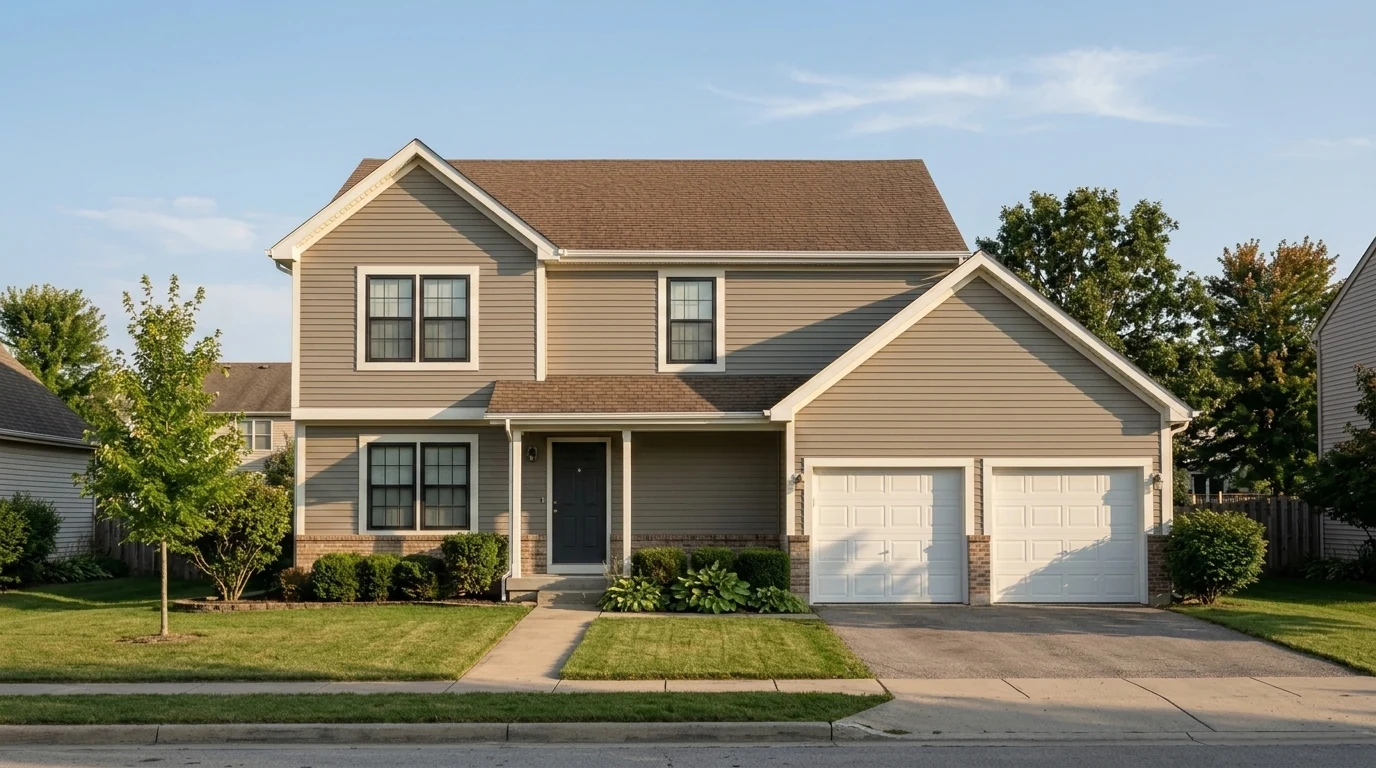
Warm greige in the spirit of Universal Khaki, Sherwin-Williams' 2026 Color of the Year.
This is the palette Sherwin-Williams just bet its 2026 Color of the Year on. Universal Khaki and its neighbors are what happened when a decade of gray met the warm shift: still neutral, still calm, but with brown and yellow warmth instead of blue chill. Greige is the quiet default for 2026, the color for anyone who wants the house to look current without the house being the conversation.
- Paint picks: Sherwin-Williams Universal Khaki SW 6150, Sherwin-Williams Accessible Beige SW 7036, Benjamin Moore Revere Pewter HC-172.
- Pair with: creamy white trim, black window sashes, a muted black or walnut door.
- Best on: traditional two-stories, brick-and-siding combinations, HOA neighborhoods with restrictive palettes.
- Watch out for: beige-on-beige. Greige needs clearly lighter trim or it collapses back into builder beige, the exact look it replaced.
5. Terracotta and Clay
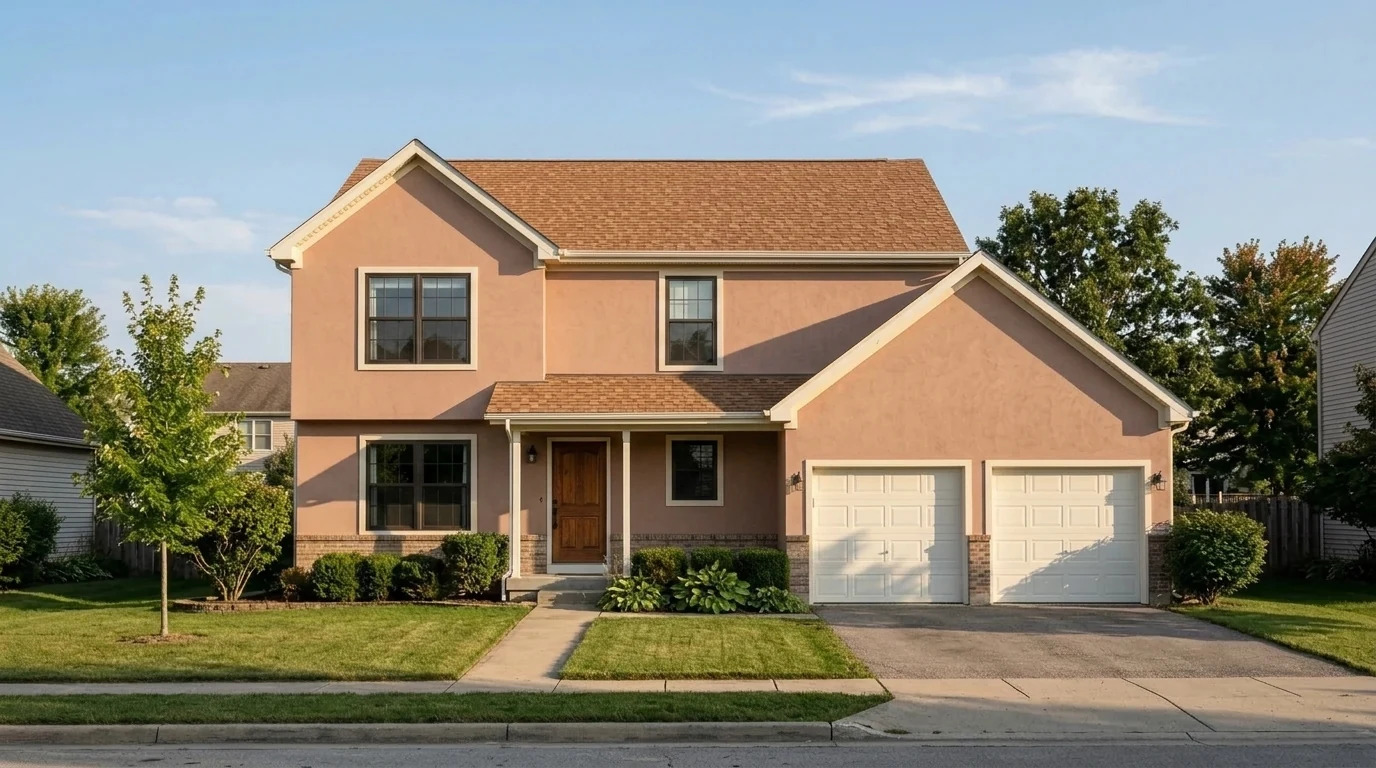
Sun-baked clay, the boldest of the 2026 palettes, kept believable with cream trim and bronze frames.
The boldest mainstream palette of 2026 comes straight from the earth-tone wave: soft terracotta, baked clay and adobe tones that used to live only in the Southwest are showing up on suburban stucco and smooth-panel siding across the country. It is the most personality on this list, and the render shows why it works: in low sun the color glows instead of shouting.
- Paint picks: Sherwin-Williams Cavern Clay SW 7701, plus the clay and adobe tones in most brands' 2026 palettes.
- Pair with: warm cream trim, dark bronze frames, walnut door, brown or terracotta roof.
- Best on: stucco and smooth siding, Mediterranean and Spanish-influenced homes, and modern builds that can carry an earthy block of color.
- Watch out for: orange creep. Test big samples; a terracotta that looks muted on a swatch can read traffic-cone at house scale in full sun.
6. Espresso and Chocolate Brown
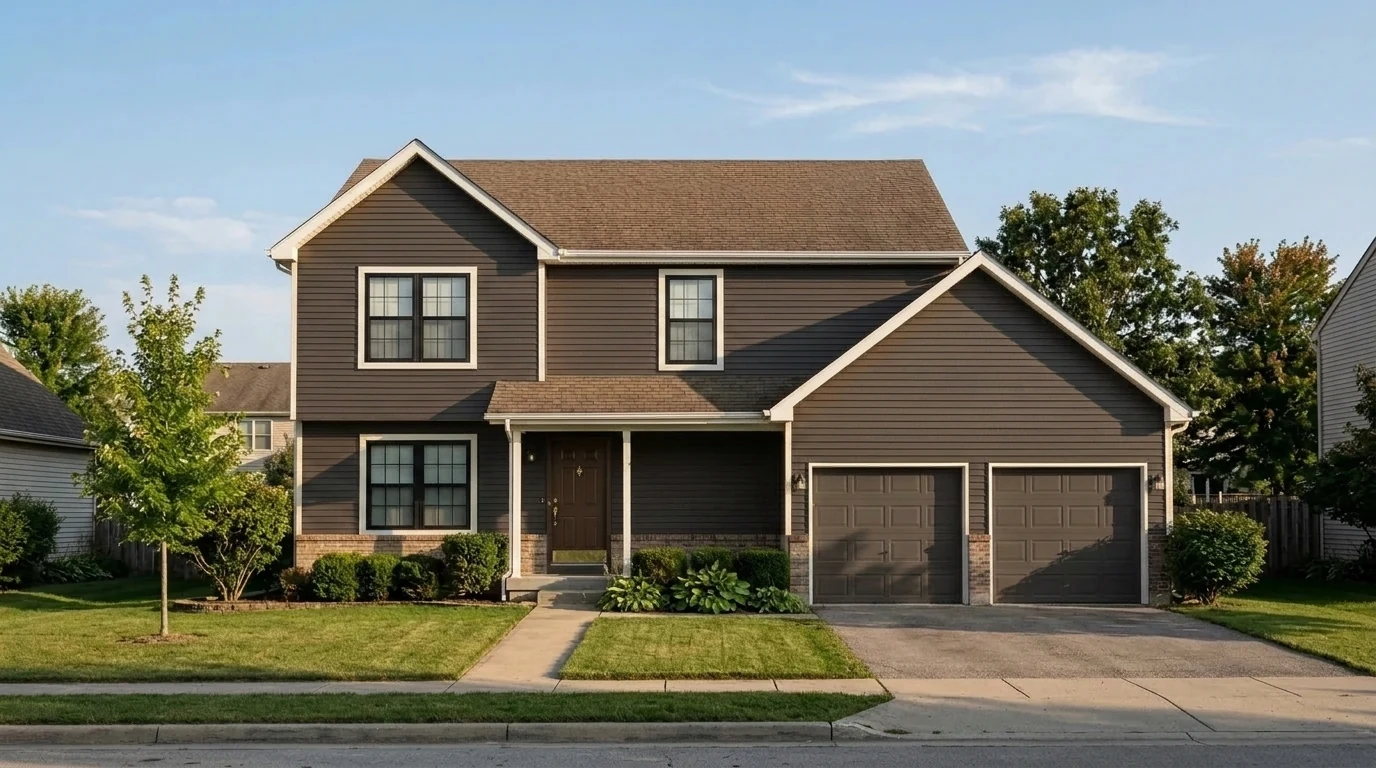
Espresso brown with ivory trim, the palette Benjamin Moore's 2026 Color of the Year points to.
Brown is having its first real moment since the 1970s, and Benjamin Moore naming the espresso-toned Silhouette its 2026 Color of the Year confirmed it. Think dark chocolate rather than milk chocolate: deep, slightly charcoal browns that do what black did for the last decade but sit more naturally against lawns, brick and wood. It is the sleeper pick on this list, rarer than charcoal and warmer than it.
- Paint picks: Benjamin Moore Silhouette AF-655, Sherwin-Williams Urbane Bronze SW 7048 for a softer bronze-brown step.
- Pair with: warm ivory trim, black window frames, brass door hardware, dark brown roof.
- Best on: craftsman and traditional homes, houses with brick or stone bases that brown ties together.
- Watch out for: matching the roof too exactly. Espresso siding under an identical brown roof merges into one mass; keep at least two steps of contrast between them.
7. Deep Forest Green
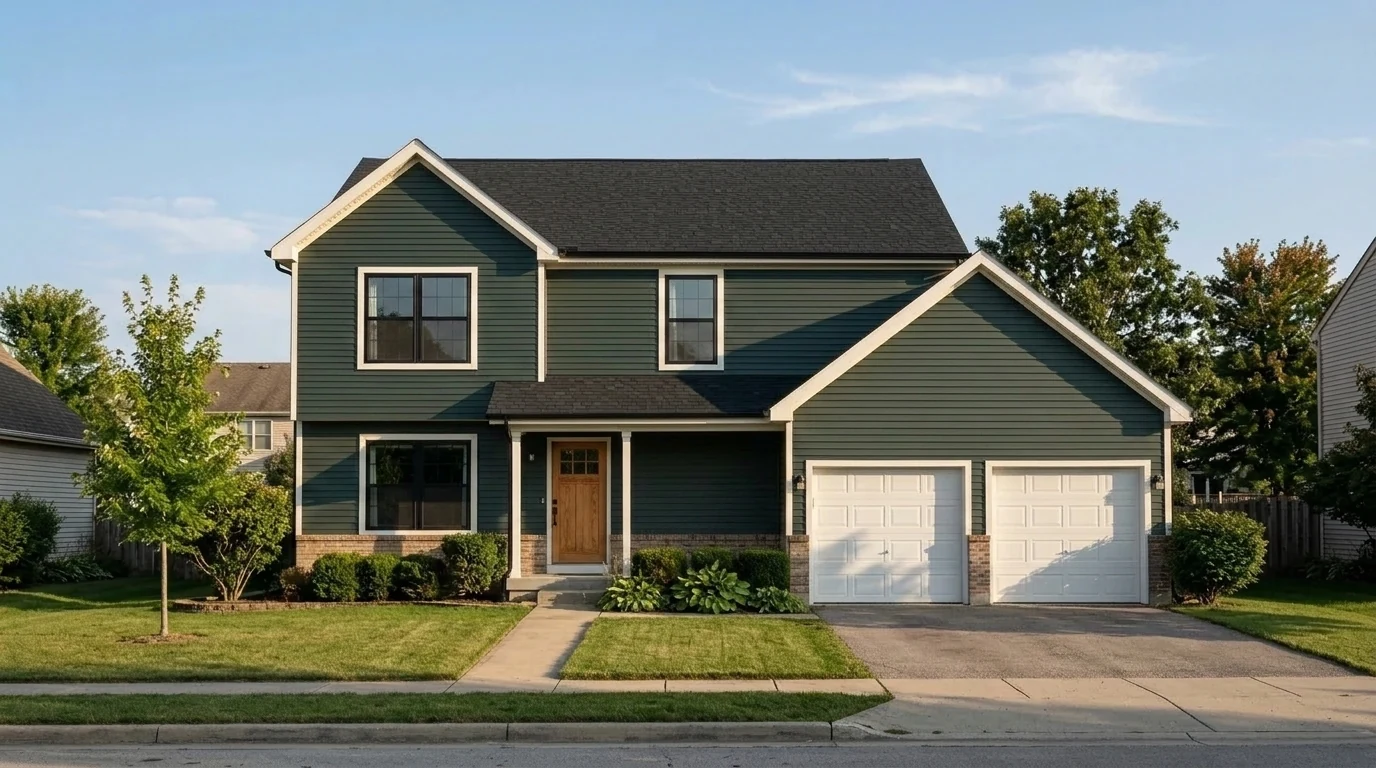
Deep forest green with white trim: a hundred-year-old American palette, back with 2026 depth.
Where sage is the safe green, deep forest is the confident one. Dark green with warm white trim is one of the oldest American exterior palettes, and it is back because it delivers the drama of a black house while staying rooted in nature. Dunn-Edwards' deep Midnight Garden was one of the most talked-about 2026 exterior picks for exactly this reason.
- Paint picks: Dunn-Edwards Midnight Garden, Benjamin Moore Essex Green HC-188, Sherwin-Williams Pewter Green SW 6208.
- Pair with: soft warm-white trim, black gutters and frames, a natural oak door, near-black roof.
- Best on: colonials, farmhouses, wooded lots where the house should belong to the landscape.
- Also worth testing: the planting. A facade colour reads completely differently against a green yard, and our AI landscape design tool for a front yard or backyard restyles the ground plane from the same photo.
- Watch out for: low light. Deep green turns black on a shaded facade; if your house faces north under mature trees, step one shade lighter than you think you want.
Colour is only half of a facade. If you are also weighing cladding, roof and trim together, the AI exterior design tools we tested render all of them on your own house at once.
Body, Trim and Door Combos That Work
Most exterior mistakes are not bad body colors, they are bad combinations. If the body is vinyl rather than paint, the shades each brand actually sells, and the heat rules on the dark ones, are in our vinyl siding colors guide. If you want a shortcut, these five pairings are essentially un-ruinable in 2026:
Two rules hide inside that table. First, dark bodies keep their trim dark and let a wood door provide the only contrast; light and mid-tone bodies get lighter trim. Second, every combo has exactly one warm natural material. One. A wood door and a wood garage door and cedar shutters is a lumberyard, not a palette.
What a New Exterior Color Costs in 2026
The numbers explain why this decision deserves more than a paint-chip guess. According to Angi's 2026 cost data, the average US exterior paint job runs about $3,177, with typical pricing between $1.50 and $4 per square foot depending on siding material, height, prep and region. Larger homes and heavy prep push well past $8,000. If you are changing the siding itself rather than painting it, HomeGuide puts installed siding at $4 to $13 per square foot, roughly $10,000 to $32,500 for an average house.
Read that middle column again: a wrong color costs exactly as much as a right one. The entire risk sits in the choosing, which is why the next section exists.
See a Color on Your Own House Before You Commit
Every render in this guide was made the same way you would preview your own home: one photo of the house, one sentence describing the palette, about 20 seconds of waiting. That is the whole workflow. Upload a straight-on photo of your house to MeltFlex's exterior design tool, name the body, trim and door colors you are debating, and you get your actual house, with your rooflines, your windows and your landscaping, in the new palette:
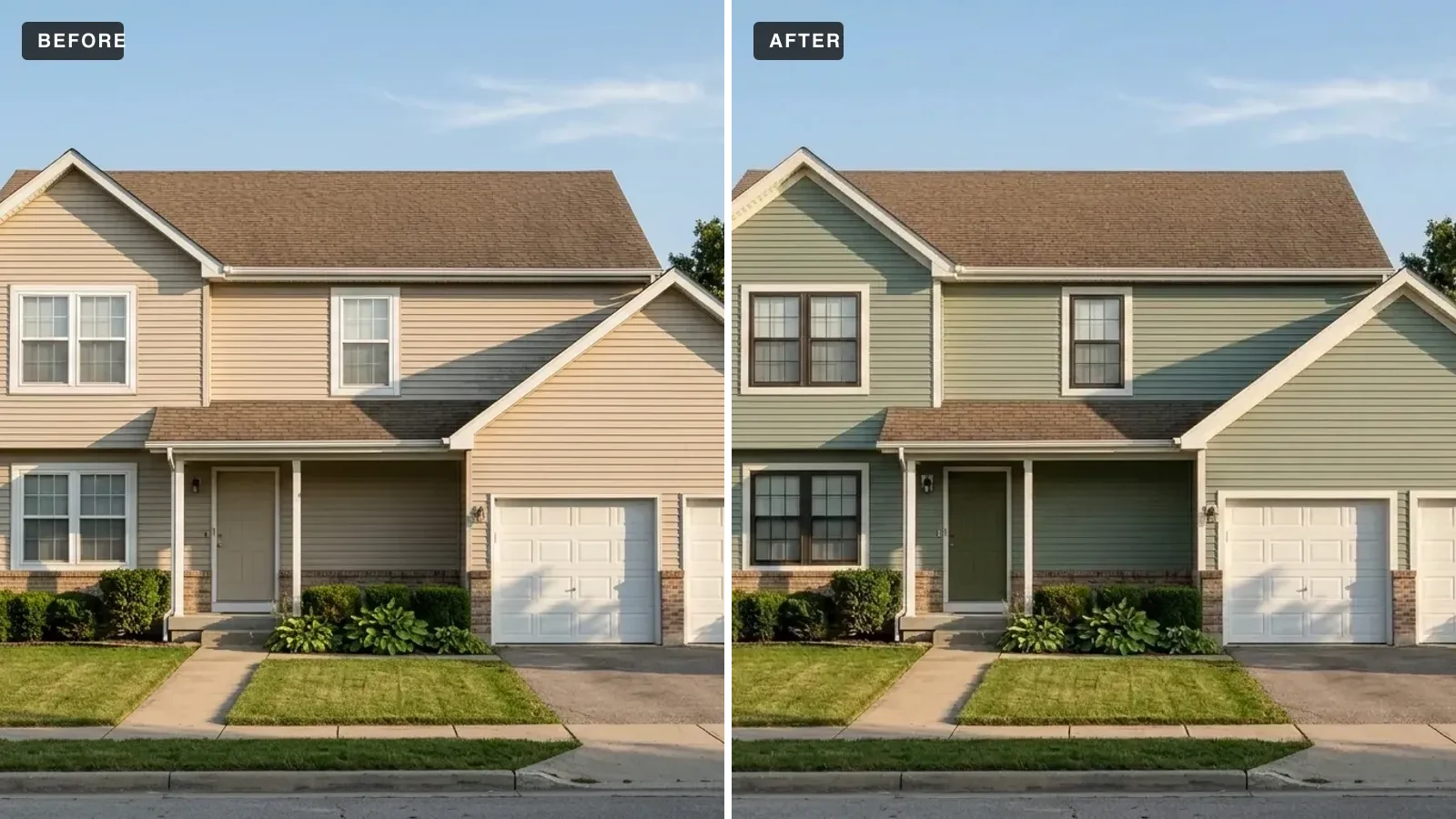
The beige starting point and the sage version, generated from the single photo above.
Do this for your two or three finalists, look at them at phone size and full screen, show the neighbor whose taste you trust, and the decision usually makes itself. Sample boards on the actual wall are still worth the $30 for final confirmation of undertones, but they answer a different question. Boards tell you what the paint looks like; the render tells you what the house looks like. We cover the workflow in more depth, including photographing your house properly and what AI gets wrong, in our guide to visualizing your home before renovating, and there is a shorter answer version at can AI design my house exterior.
Watch: a Full Exterior Redesign in 20 Seconds
Here is the process running end to end on a real house, from uploaded photo to finished exterior render:

6 Exterior Color Mistakes to Avoid
- Choosing from a two-inch swatch. Exterior color reads two to three shades lighter and more saturated at house scale in full sun than it does on a chip. Preview at full scale first, swatch-test second.
- Ignoring the roof. The roof is a third of what the street sees and it is not changing. A warm brown roof vetoes cool grays; a black roof flatters whites, greens and charcoal.
- Fighting the neighborhood. Your house is seen next to its neighbors. You do not have to match them, but the charcoal statement house works better on a street of mixed moderns than between two pastel colonials. HOA palettes are the hard version of this rule; check before falling in love.
- Skipping the fixed elements. Brick bases, stone accents and concrete paths all have undertones. Hold your finalist against them, not just against the old siding.
- Dark paint on unrated siding. Very dark colors on vinyl can cause heat warping, and some manufacturers void the warranty for repaints darker than the original. Confirm your siding is rated for the color family, or use a vinyl-safe formula.
- Forgetting the landscaping. Sage next to an evergreen hedge disappears; terracotta next to red mulch clashes. The lawn, beds and trees are part of the palette, and if you are refreshing them too, our guide to AI garden design tools covers previewing the yard the same way.
Exterior House Color FAQ
What is the most popular exterior house color for 2026?
Warm neutrals lead in 2026. Creamy warm whites with black or bronze trim remain the most requested exterior look, with muted sage and eucalyptus greens as the fastest-rising challenger. The paint brands agree on the direction: Sherwin-Williams named the warm tan Universal Khaki its 2026 Color of the Year, Behr picked the smoky jade Hidden Gem, and Benjamin Moore chose the espresso-toned Silhouette. All three point the same way, toward warm, grounded, nature-based color.
What exterior colors are going out of style in 2026?
Three looks are fading fast: cool blue-gray siding, the stark white farmhouse with harsh black-on-white contrast, and flat builder beige with matching beige trim. None of them will make a house unsellable, but they read as 2015 to 2020 choices. The 2026 versions of those same ideas are warmer: greige instead of gray, cream instead of stark white, and khaki with intentional trim instead of all-over beige.
Should my siding color match my roof?
It should coordinate, not match. The roof is usually the largest fixed-color surface on the house, so choose a siding color that shares its temperature: warm browns and clay tones with brown roofs, charcoal, black, greens and whites with black or gray roofs. A safe test is to hold a paint swatch against a photo of the house and check that neither surface makes the other look dirty or pink.
If you like a combination you photographed on another house, the paint color finder will tell you the body and trim colours from the picture and the nearest paints to buy.
Are dark exterior colors a bad idea in hot climates?
Dark siding absorbs measurably more heat, and on sun-exposed walls in the South and Southwest that can raise cooling load and stress vinyl siding, some of which is not warrantied for very dark repaints. If you love the charcoal or espresso look in a hot climate, use heat-reflective exterior formulas rated for dark colors, confirm your siding warranty allows them, or keep the dark tone on the shaded facade and trim while the sunniest walls stay mid-tone.
What is the best exterior house color for resale value?
Broadly appealing warm neutrals sell most reliably: warm white, cream, greige and soft khaki with clearly defined trim. Muted sage green has moved into the safe list as it became mainstream. The riskier resale choices are very personal colors, bright hues, and extremely dark full-body exteriors in conservative neighborhoods. Whatever the body color, a fresh, well-kept paint job matters more to buyers than the specific shade.
How much does it cost to repaint a house exterior in 2026?
The average US exterior paint job runs about $3,177 according to Angi 2026 data, with typical pricing between $1.50 and $4 per square foot depending on siding material, prep work and region. A large two-story or a house with extensive trim can go well past $8,000. Replacing siding instead of painting costs far more, roughly $4 to $13 per square foot installed, or $10,000 to $32,500 for an average house. The full breakdown is in the cost table above.
How can I see a color on my house before painting it?
Two ways, best used together. First, paint large sample boards, at least two by three feet, and move them around the house through the day, because sunlight shifts every exterior color. Second, upload one photo of your house to an AI exterior tool like MeltFlex and ask for the exact palette you are considering. In about 20 seconds you see your actual house, with your rooflines and windows, in the new color instead of guessing from a two-inch swatch.
Do dark exterior colors fade faster than light ones?
Yes. Dark pigments absorb more UV energy, so charcoal, espresso and deep green facades show fading sooner than light neutrals, especially on south- and west-facing walls. Modern 100 percent acrylic exterior paints and fade-resistant lines have narrowed the gap considerably, but plan on dark exteriors looking their best for roughly 7 to 10 years versus 10 to 15 for light colors, and always use a top-tier exterior formula for dark shades.
The Bottom Line
2026 exterior color in one paragraph: warm has won. Pick cream over stark white, greige over gray, and treat sage green as the new neutral. If you want drama, charcoal, espresso and forest green all deliver it, as long as one natural wood element keeps them human. Whatever direction you take, do not spend four figures on a guess: upload a photo of your house and look at the actual answer first. The same logic applies the moment you step inside, and our accent wall guide and 2026 interior trends overview pick up exactly where the front door leaves off.