The best front yard landscaping ideas frame the walk to the front door, replace part of the lawn with layered beds of shrubs, perennials, gravel or rock, and keep the house and driveway the star, for about $1,500 to $5,000 for a typical front yard according to Angi; in our MeltFlex AI test on November 26, 2026, the garden tool redesigned 4 real house fronts from a single photo and kept the house unchanged in 23 of 24 renders, but moved the camera in 10 of 24.
Our articles are still written by humans!
Get human written articles in your Google feed.
Most front yard idea pages are galleries of finished houses. They rarely tell you what a planting bed costs, how far a hedge can grow toward the street, or that you have to call 811 before you plant a tree. I wanted a list you can actually use on an ordinary house, so each idea below is a real front yard design with the decision it solves: less lawn, a clearer walk, a slope, a driveway, or lighting. Costs come from Angi and HomeGuide, water figures from the EPA, value figures from the National Association of Realtors, and the rules from 811, the International Residential Code and one city code, all read on November 26, 2026. I also ran the MeltFlex AI garden tool on four real house fronts to see what an AI does with a street-side photo. MeltFlex AI is ours, so you get every result, including the bad ones.
The short version
- Cost: front yard landscaping runs $1,500 to $5,000 (Angi), or $4 to $12 per square foot for basic work (Angi, HomeGuide); a flower bed is $800 to $3,000 installed.
- Low maintenance: less lawn, more planted beds, gravel or mulch, and drip irrigation; the EPA says up to 50% of outdoor water is lost to wind, evaporation and runoff.
- Before you dig: contact 811 a few business days ahead (free), keep the ground sloping 6 inches in the first 10 feet away from the house (IRC R401.3), and check fence and hedge heights near the street.
- Value: NAR estimates an overall landscape upgrade recovers 100% of its cost and lawn care 217%; buyers in one study valued good landscaping at 5% to 11% more.
- AI preview: MeltFlex AI redesigned 4 real house fronts in about 15 to 30 seconds per render for 10 credits each, kept the house in 23 of 24 renders, and kept the camera in 14 of 24.
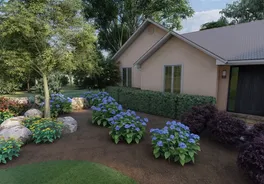
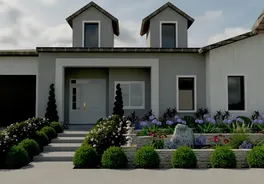
Low Maintenance Front Yard Landscaping Ideas
Lawn is the most work per square foot in a front yard: it needs mowing every week in season and most of the water. NASA’s Earth Observatory estimated in 2005 that lawns cover about 128,000 square kilometers of the United States, which makes turf the largest irrigated crop by area. The ideas below cut that work without making the yard look abandoned.
1. Swap the lawn for gravel and drought-tolerant drifts
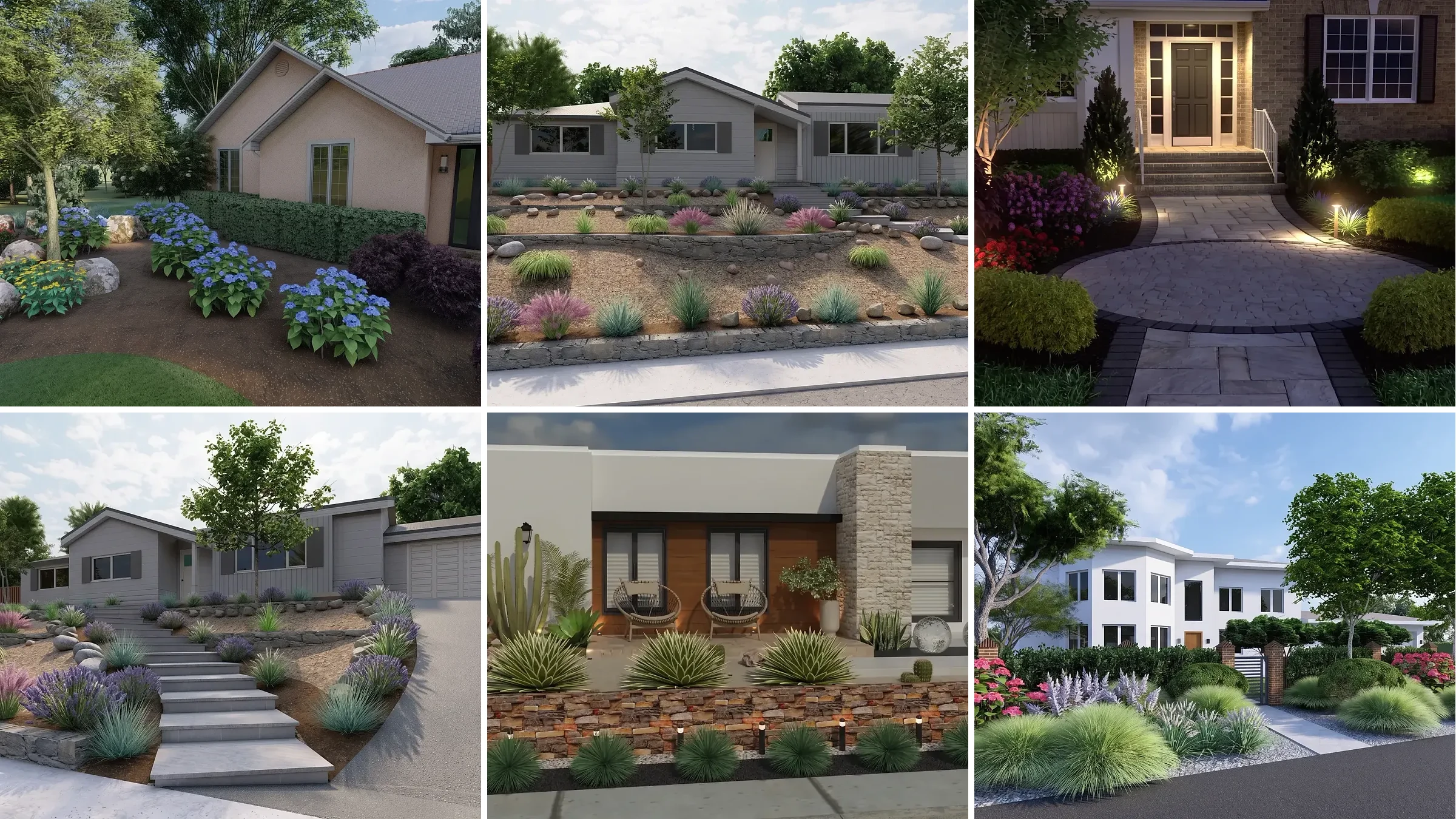
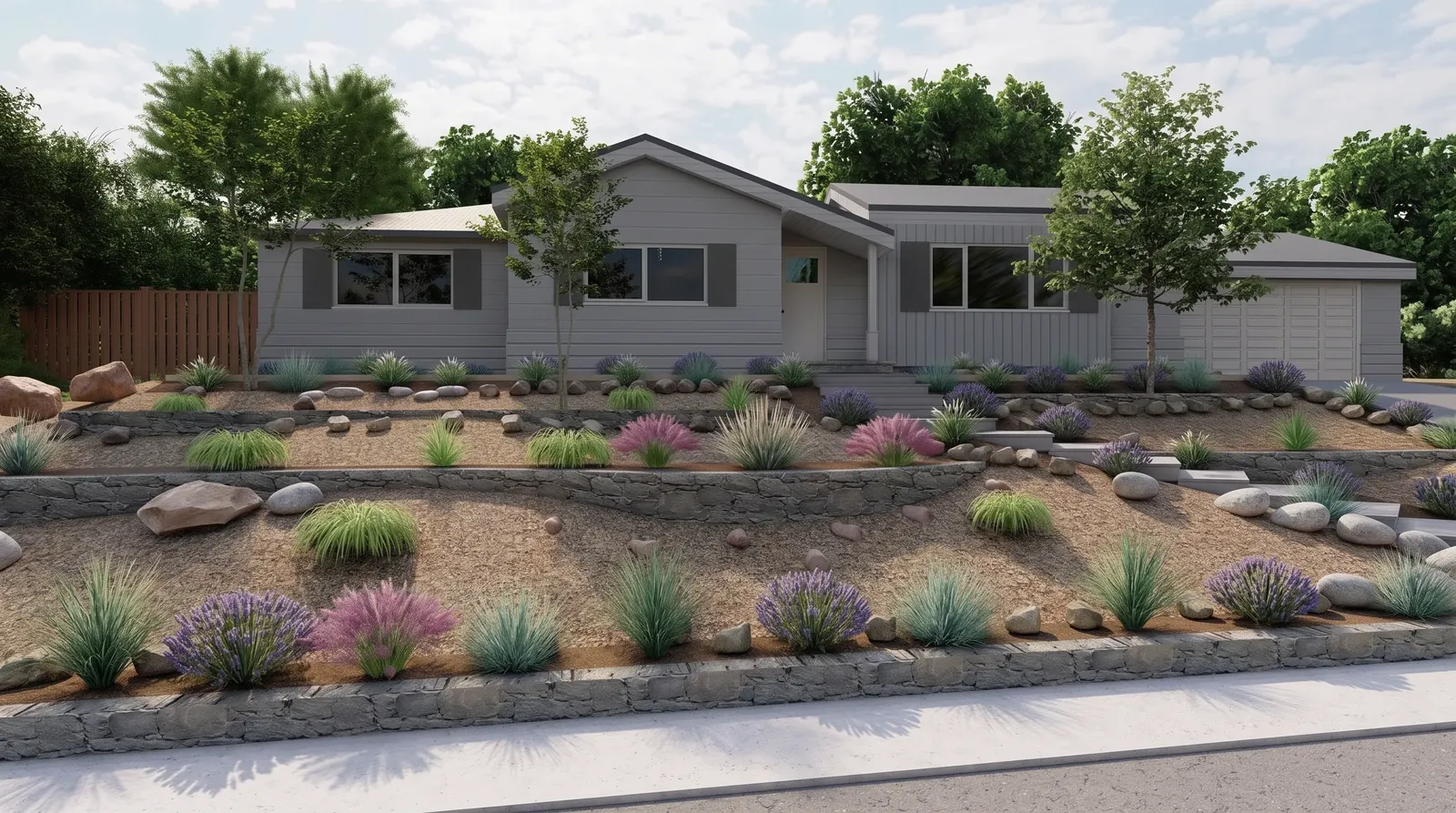
This ranch lost its lawn completely: a gravel ground layer, a low stone edge along the sidewalk, and repeated clumps of lavender, ornamental grasses and silver shrubs. The repetition is what makes it read as designed rather than empty. Angi prices xeriscaping at $2 to $25 per square foot and HomeGuide at $6 to $18; the spread is mostly the plants and how much lawn has to be removed.
2. A desert front yard with agaves and a dry stone wall
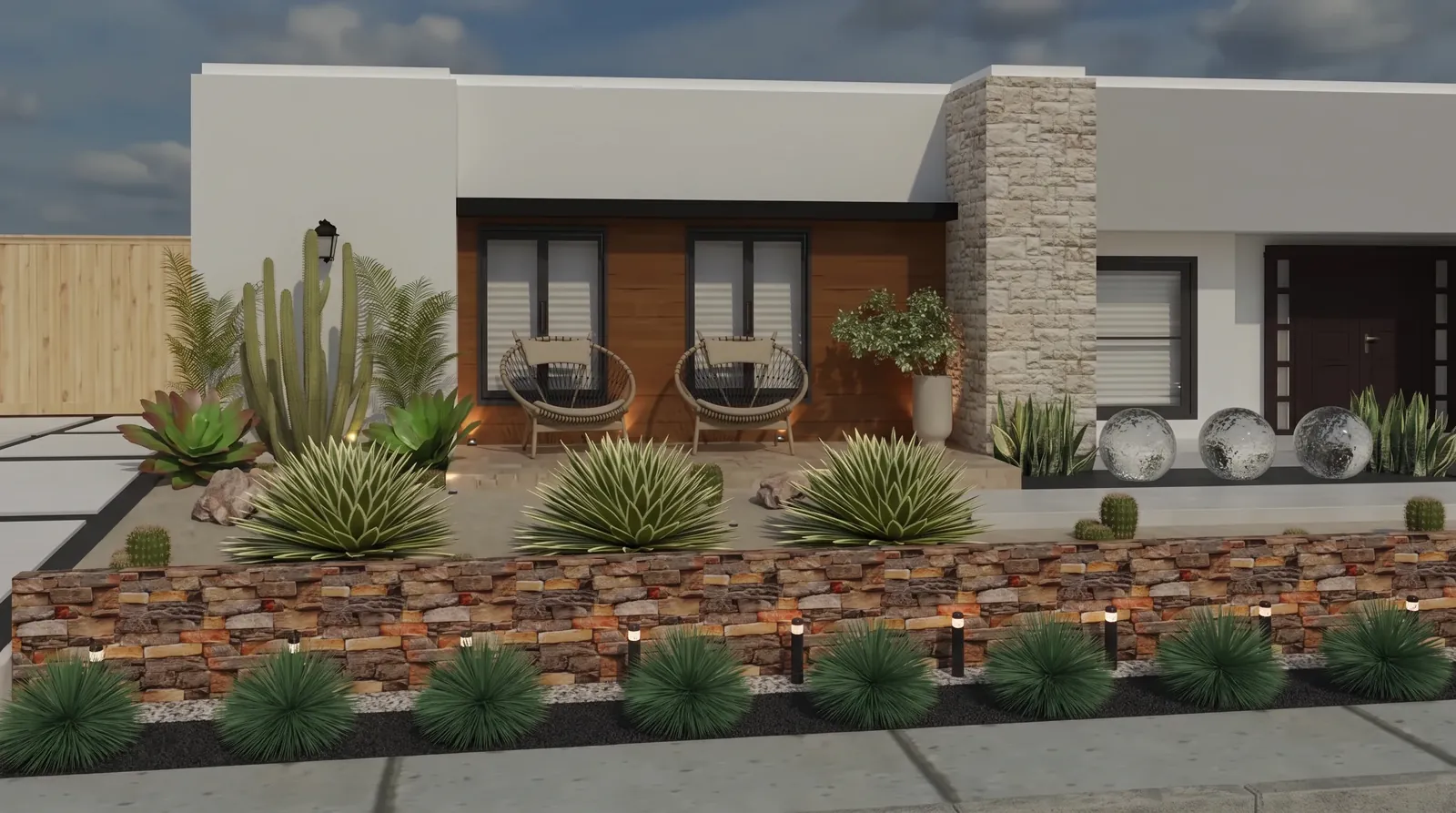
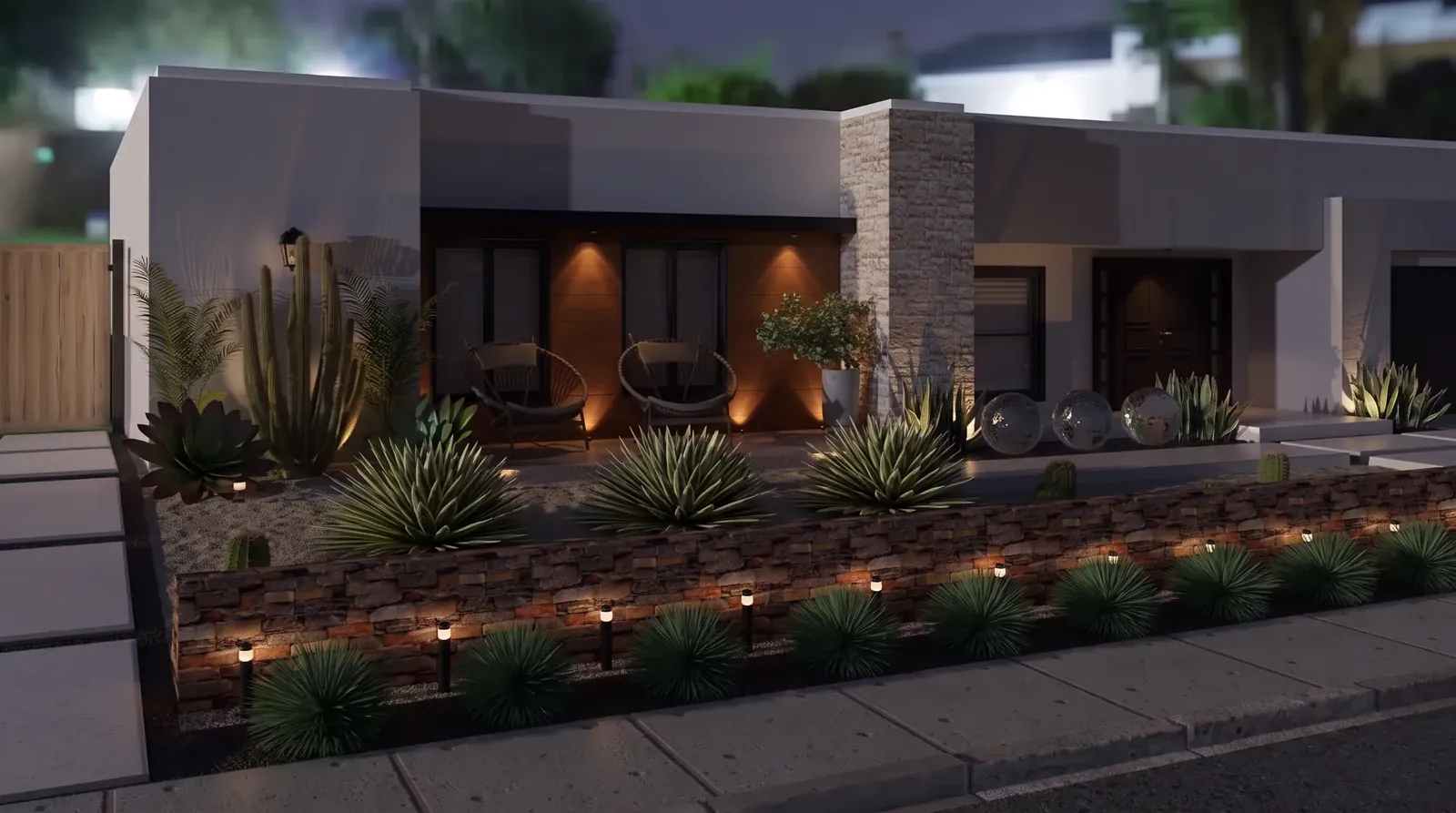
In hot, dry places the front yard can go fully desert: agaves, cactus and grasses in gravel, held by a low dry-stacked stone wall. Note the spacing. Desert plants look best with gravel between them, and they need almost no water once established. If you are in Southern Nevada, the Southern Nevada Water Authority pays $5 per square foot for the first 10,000 square feet of lawn you replace.
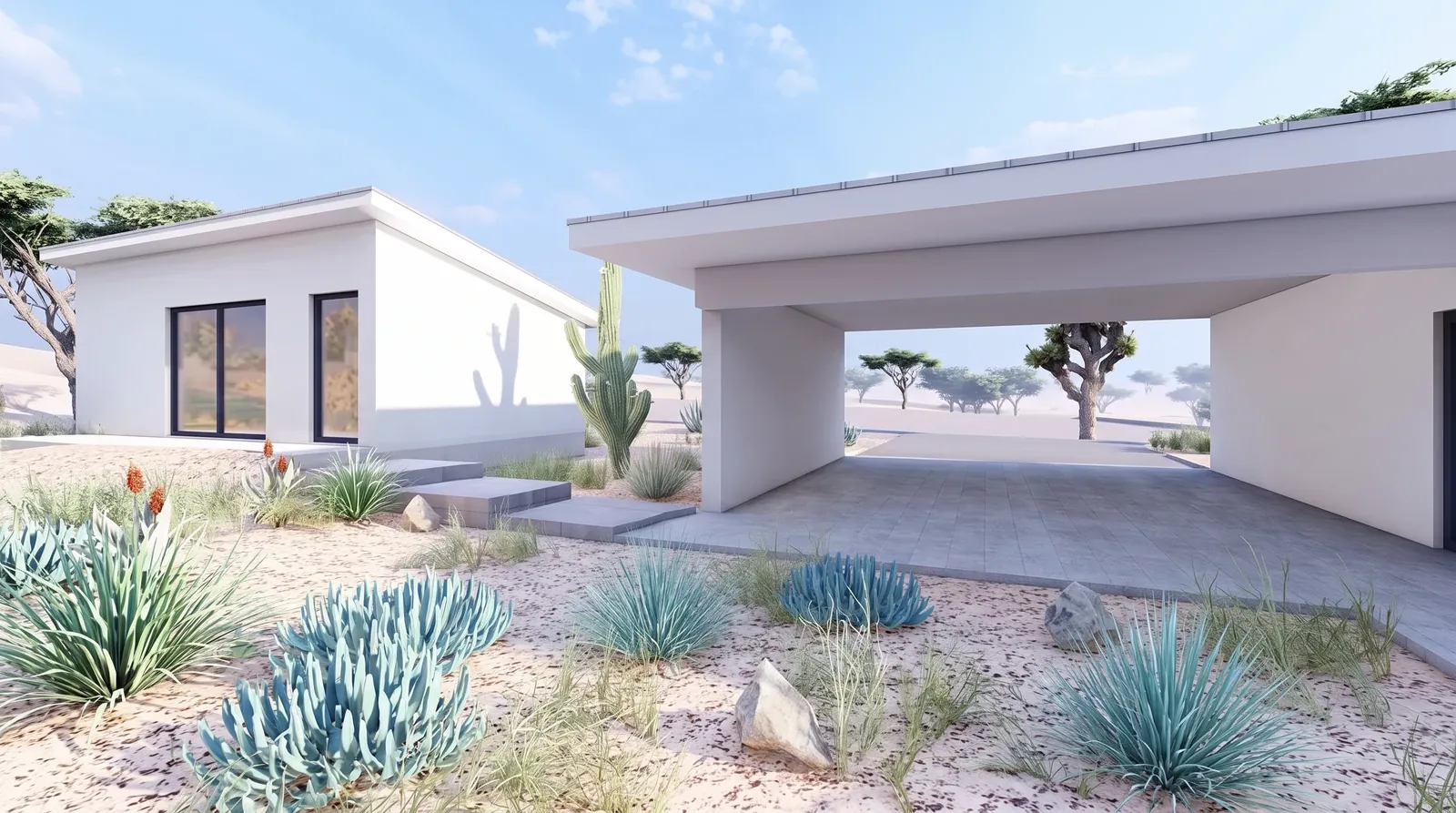
3. Blue agaves and boulders in decomposed gravel
A softer desert look: pale gravel, blue agaves and yuccas, and a few big boulders set partly into the ground so they look like they belong. It suits a white or stucco modern house, and the cool blue foliage keeps it from looking hot.
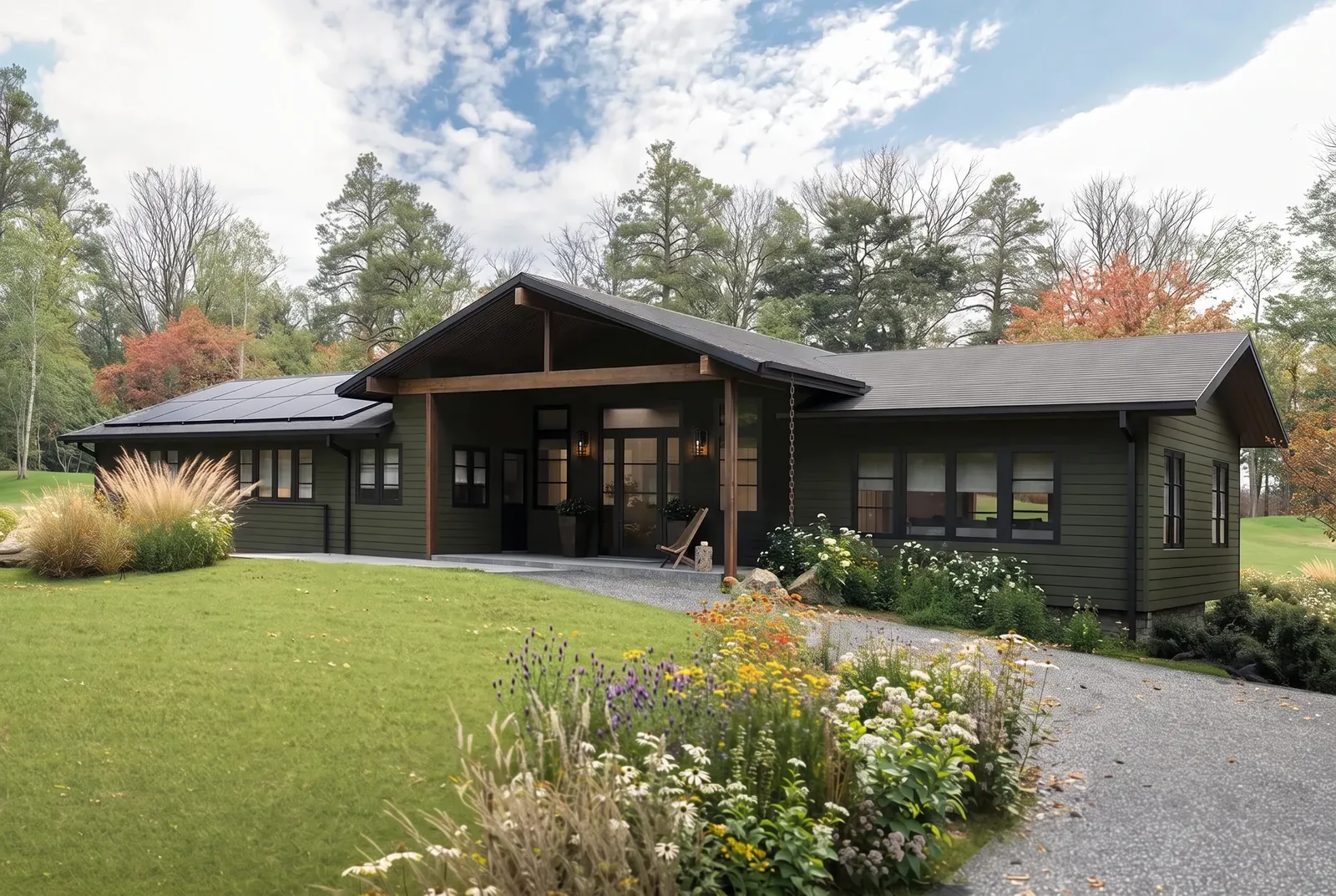
4. Shrink the lawn and add a meadow border
If you like some lawn, keep a mown panel and give the edges to grasses and wildflowers. A naturalistic border along the drive needs one cut back a year instead of weekly mowing, and it looks right in front of a rustic or dark-sided house.
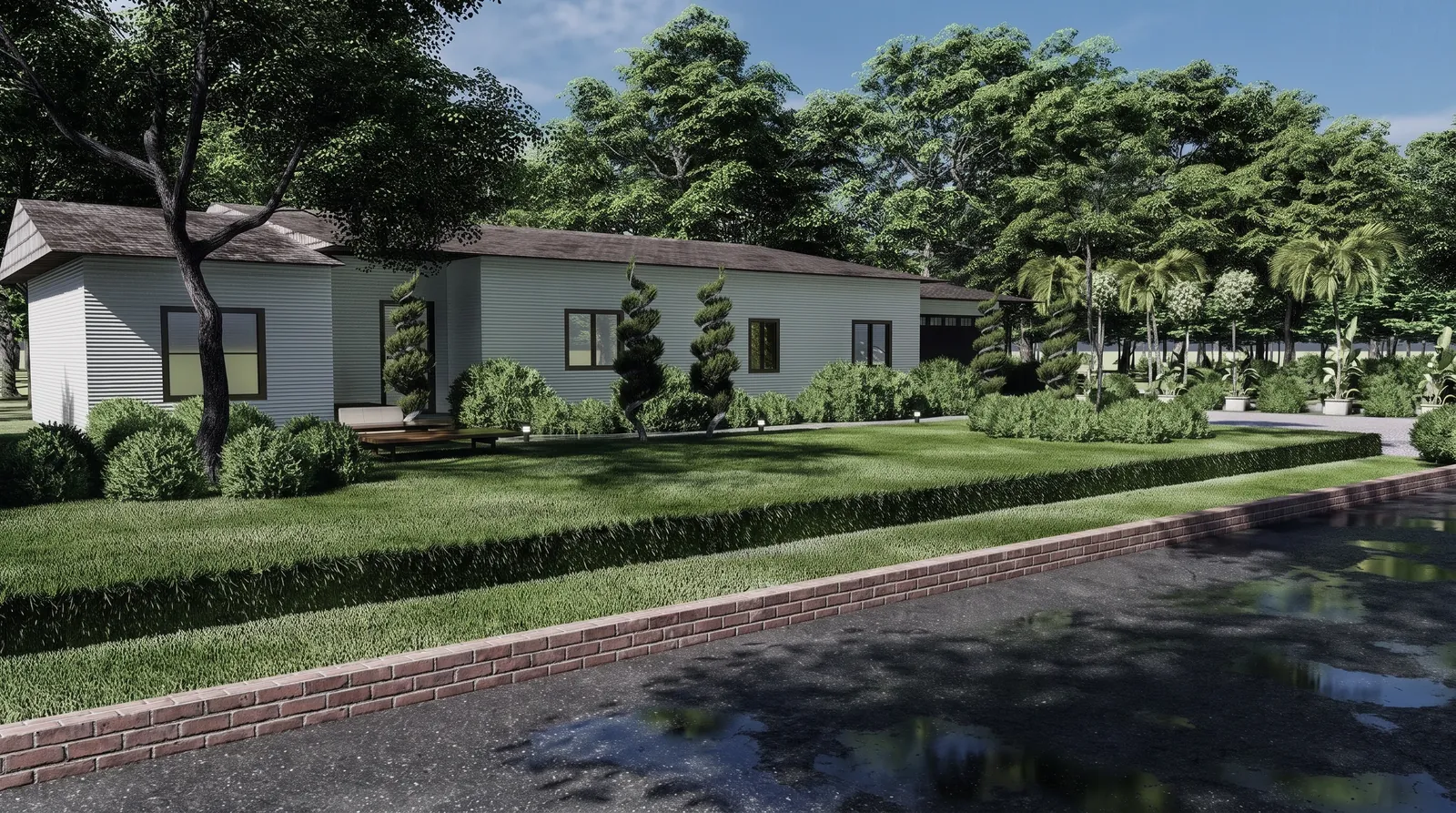
5. Keep a simple lawn, edged with a low clipped hedge
Low maintenance does not have to mean no lawn. A flat lawn, a low evergreen hedge along the street and a few clipped accents by the windows is easy to keep tidy with one mower and one trim a year, and it suits a plain ranch better than a busy flower bed.
Front Yard Landscaping Ideas With Rocks
Rock is the most permanent material in a front yard, which is both its appeal and its risk: it never needs mowing, but a bed of plain rock with no plants gets hot, collects leaves and looks unfinished. The rule that works is rock as the ground, plants as the picture. Angi puts rock and stone installation at $10 to $25 per square foot.
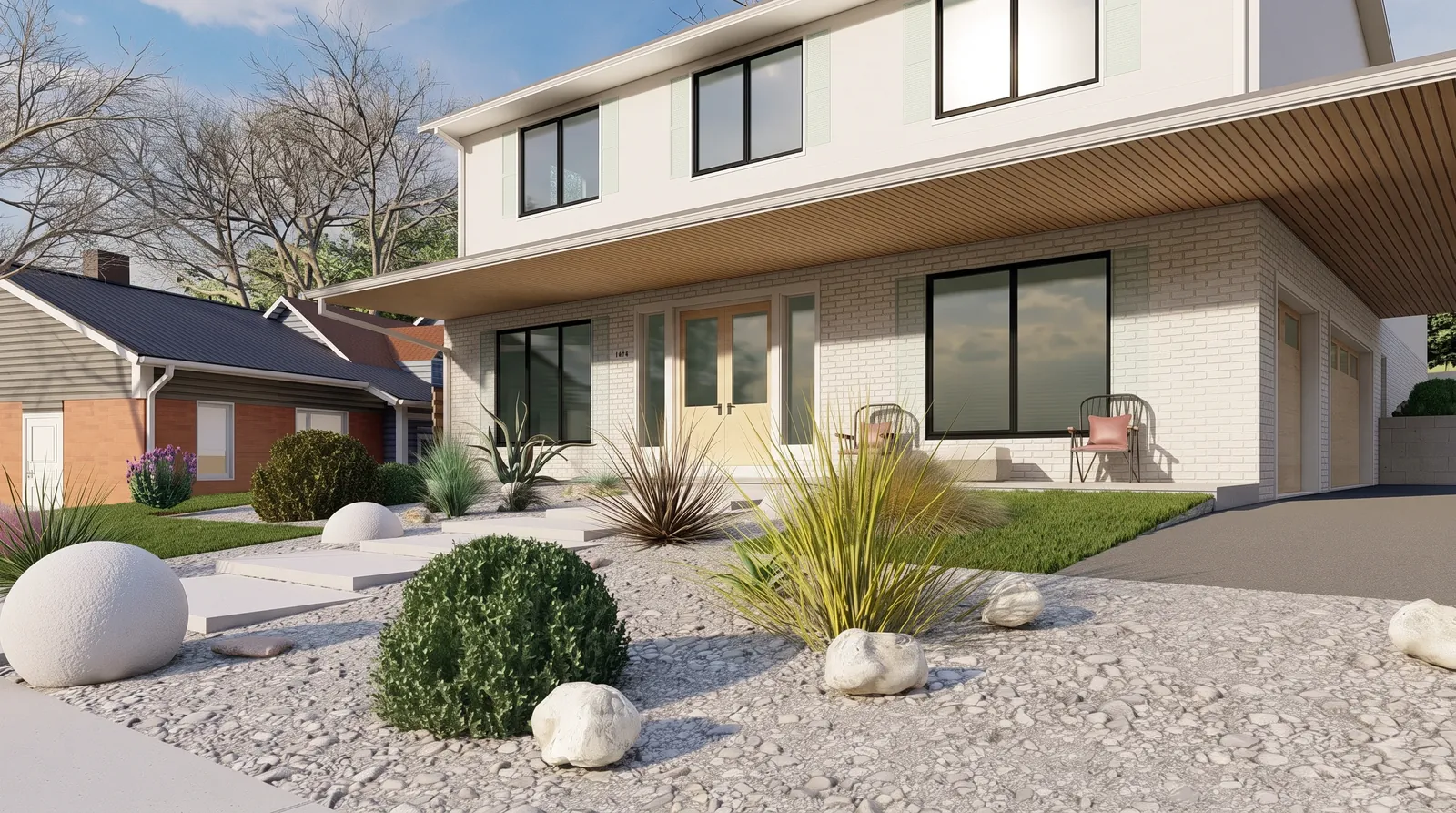
6. White gravel and round boulders
Round pale boulders in white gravel, with a few clipped shrubs and grasses between them, is the cleanest rock look for a modern house. Keep the number of boulders odd and vary their size; three to five big ones look better than twenty small ones.
7. Rock steps up a sloped front yard
A front yard that slopes up to the house is a chance, not a problem. Wide stone block steps with planting pockets on both sides turn the slope into the entrance, and the stone-edged beds hold the soil. Use deep, low treads: they are easier to climb than indoor stairs.
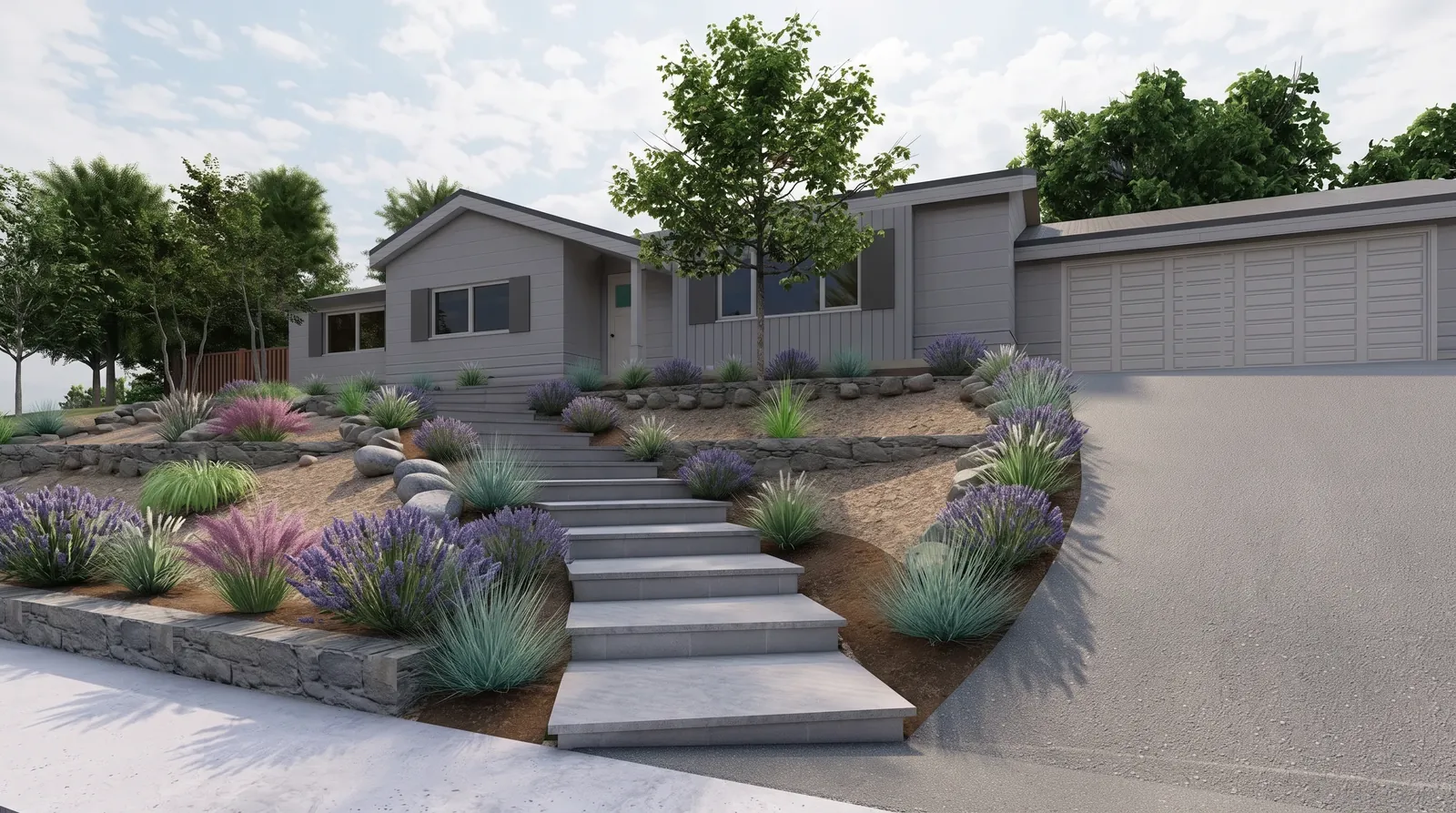
8. Low stone walls that terrace the beds
Low retaining walls along the front of the house give you level beds and a crisp edge to mow against. Rows of boxwood balls between flowering perennials keep it looking finished in winter. Retaining wall blocks run $3 to $40 per square foot in Angi’s data, and a built wall $35 to $65 per square foot in HomeGuide’s; taller walls often need a permit, so ask your city before you build one.
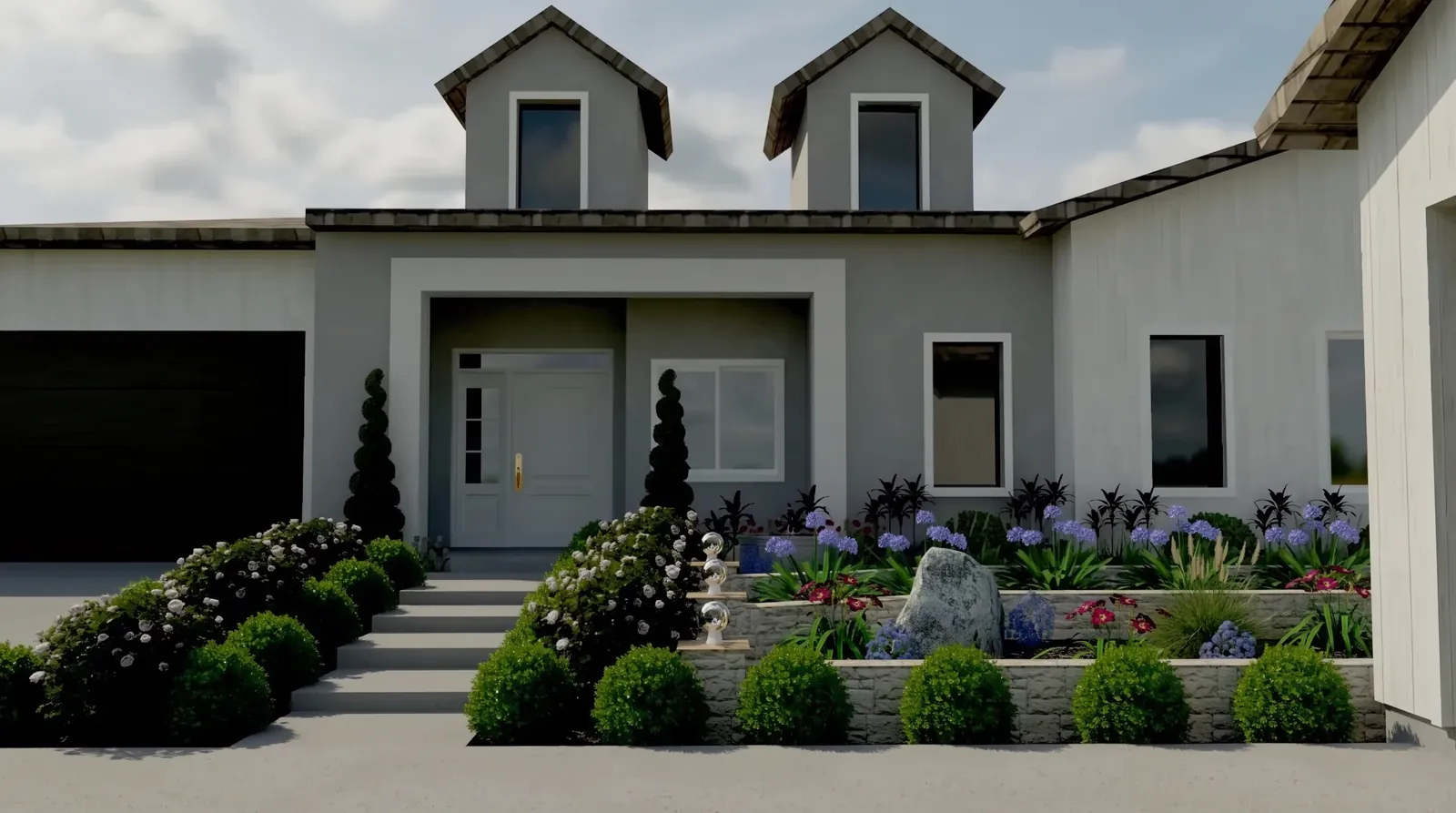
9. Boulders as anchors in planted beds
Even in a lawn-and-flowers front yard, a few boulders give the beds weight. Set them a third into the soil and plant around them; in this design they sit at the bed corners where a mower would otherwise clip the plants.
Front Yard Flower Bed Ideas
A flower bed is where most front yard money goes: Angi puts flower bed installation at $800 to $3,000. The beds that look best from the street follow three rules: they are deep enough to layer low, middle and tall plants, they repeat a few plants rather than one of everything, and they have a clear edge.
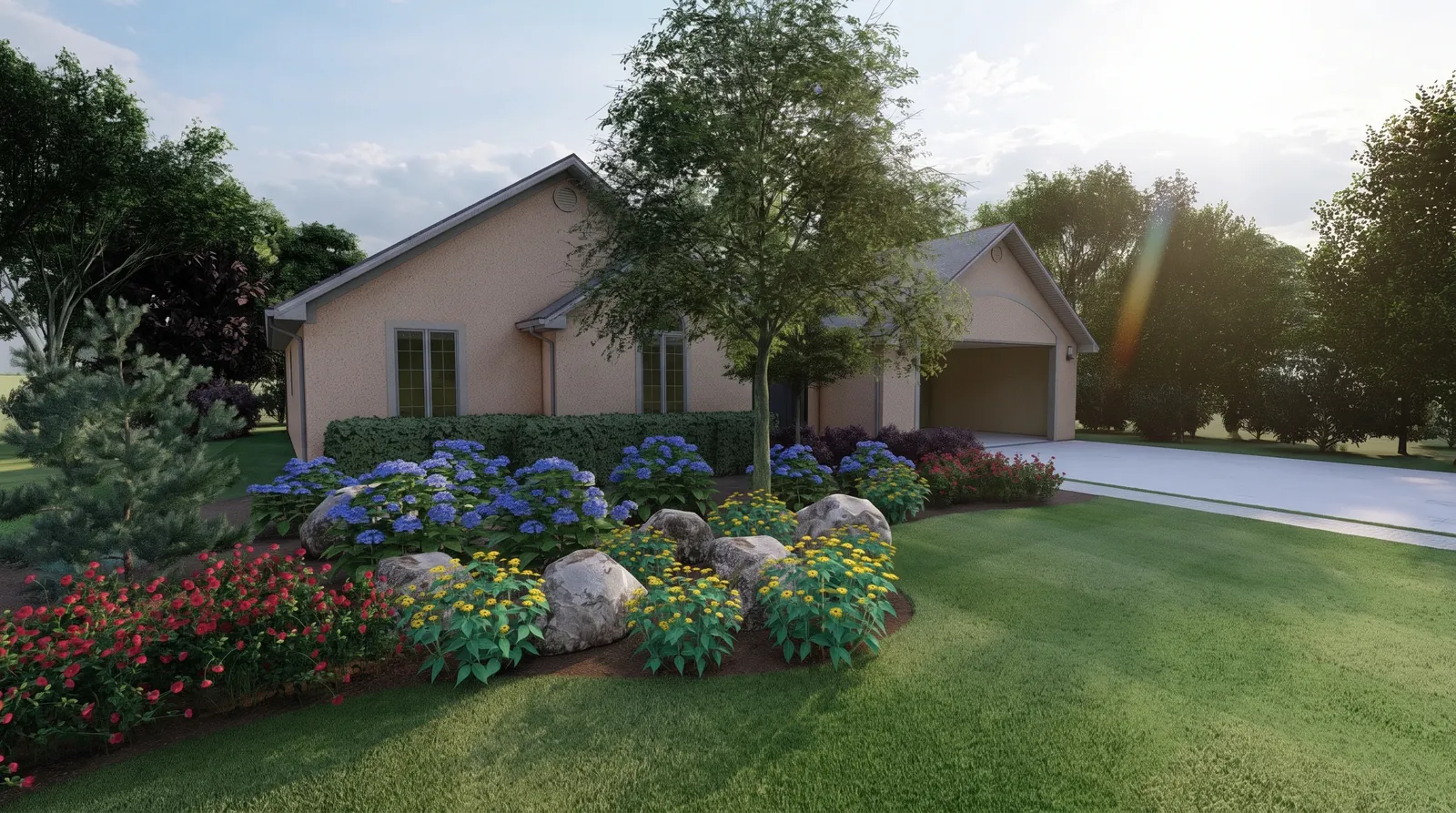
10. Island beds of hydrangeas in the lawn
Curving island beds of blue hydrangeas, dark-leaved shrubs and red flowers break up a big flat lawn and frame the house without blocking the windows. Hydrangeas want part shade and regular water, so they suit the east or north side of a house.
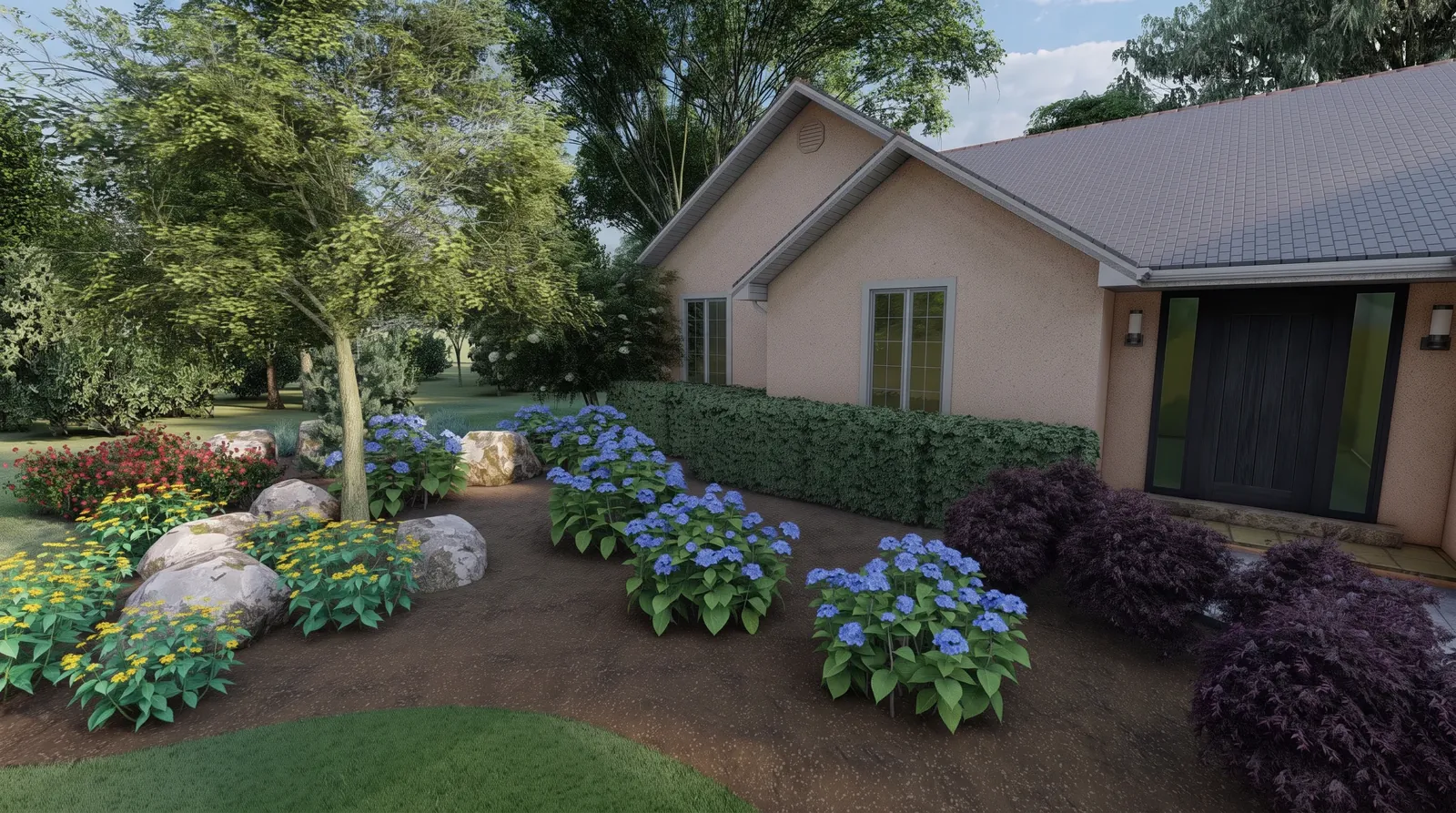
11. Panicle hydrangeas along the front walk
Panicle hydrangeas take more sun than the blue kinds and hold their flower heads into fall, when they turn pink. Planted in a row along the walk with a spiral topiary and bollard lights, they make the arrival feel generous.
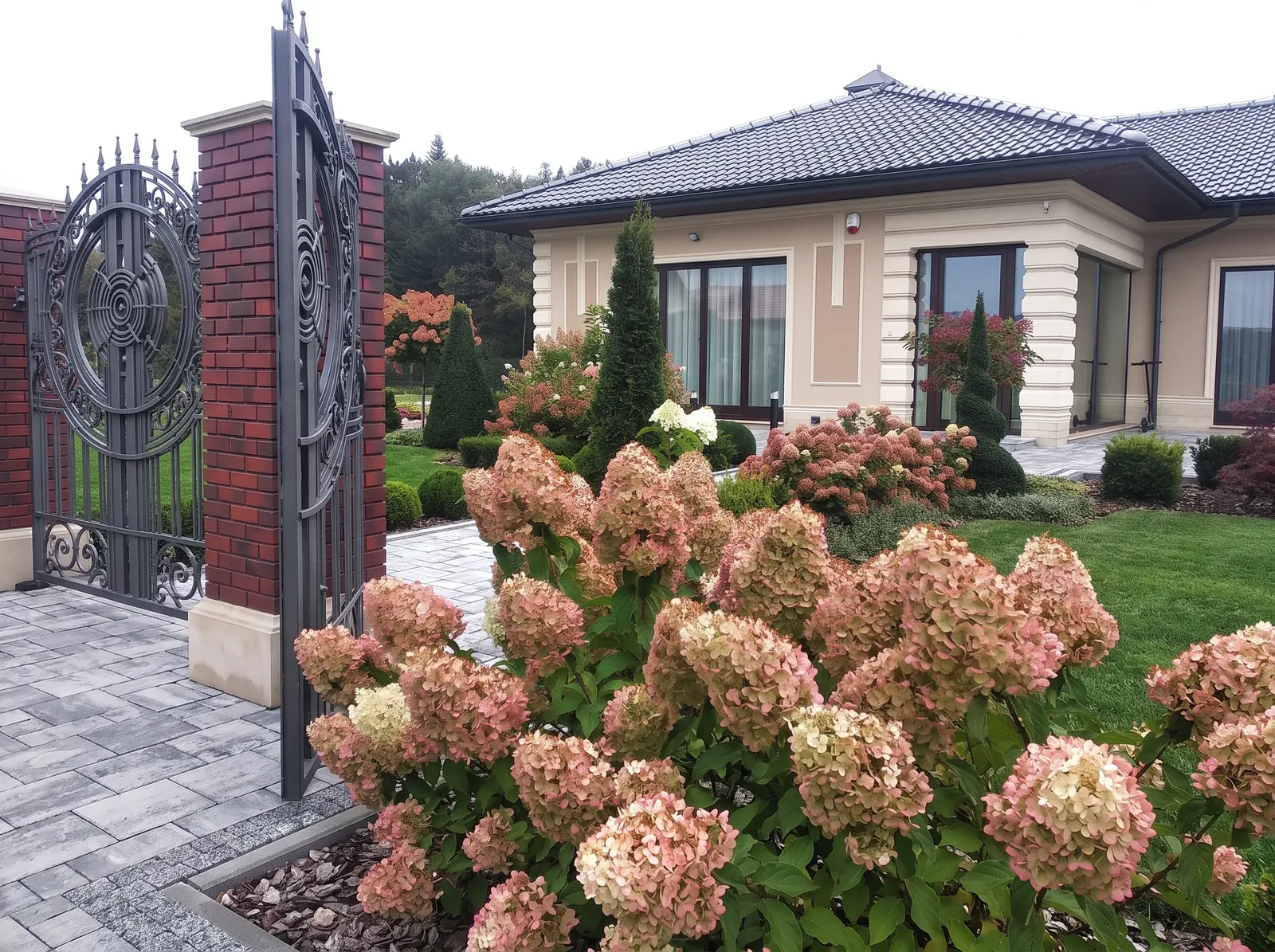
12. A layered foundation bed: low in front, tall at the back
The classic foundation bed works when it is layered: low perennials at the lawn edge, grasses and shrubs behind, and the tallest plants between windows, not under them. Keep the ground sloping away from the house when you add soil; the International Residential Code asks for 6 inches of fall in the first 10 feet.
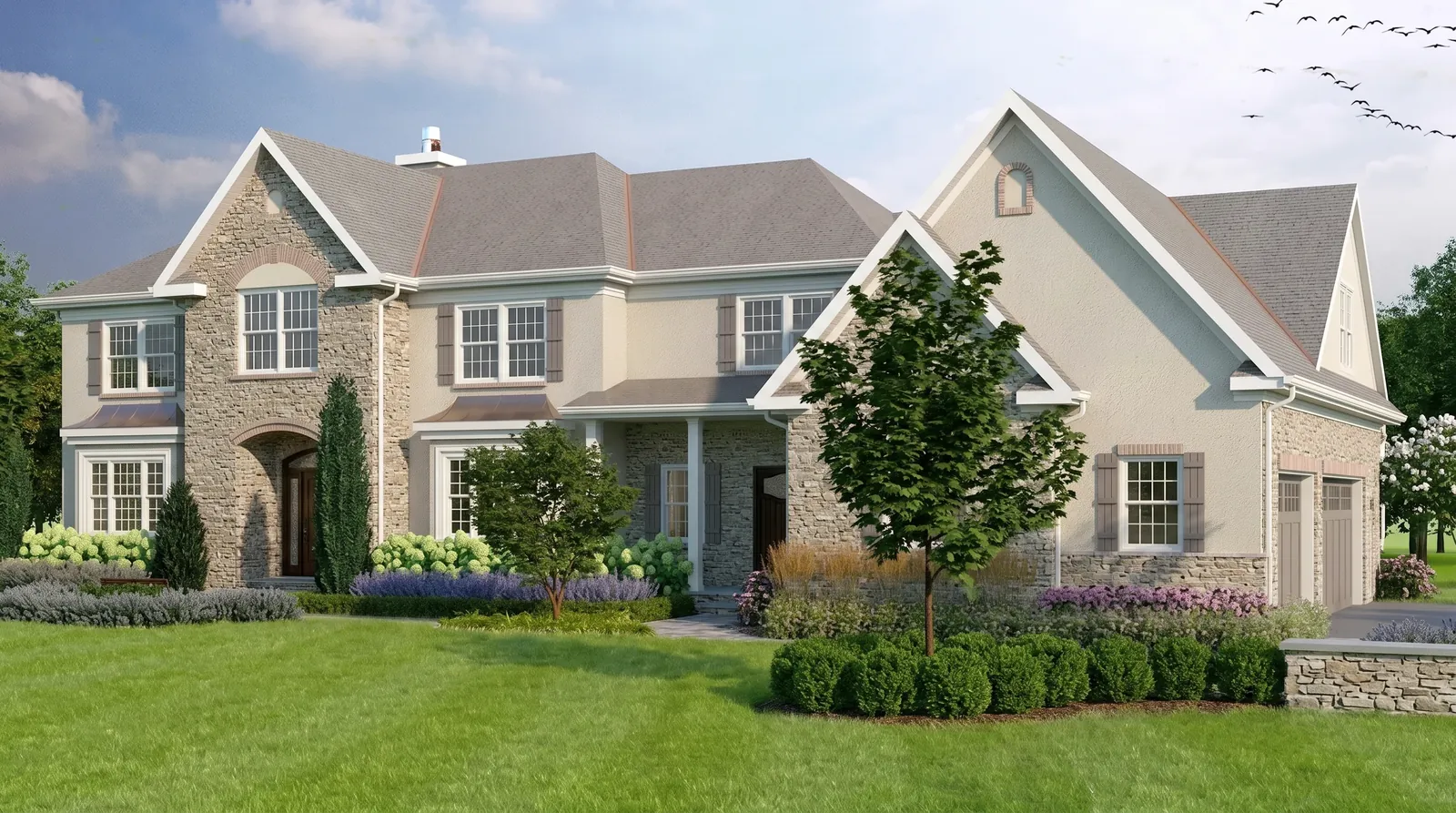
13. A flower border along the driveway
The driveway is usually the biggest hard surface in the front yard. A curving border of lavender, roses and shrubs along it softens all that concrete and leads the eye to the door. Leave at least a foot of mulch at the drive edge so car doors and snow piles do not crush the plants.
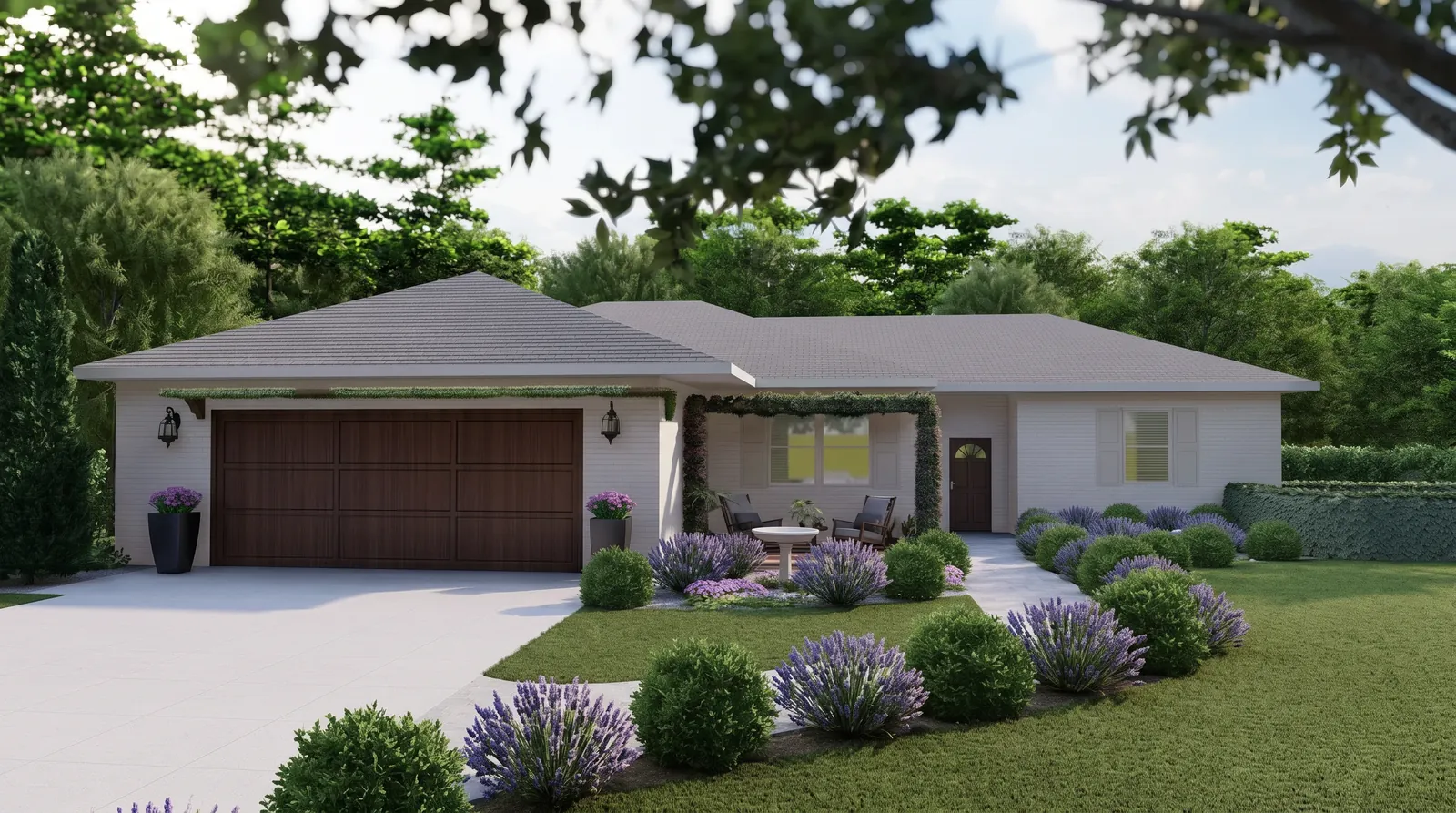
14. Lavender and white flower drifts in the lawn
Drifts of one color planted in sweeps, here lavender and white, look calmer and more expensive than mixed beds. It is also the cheapest way to plant a big area: buy many of a few plants instead of a few of many.
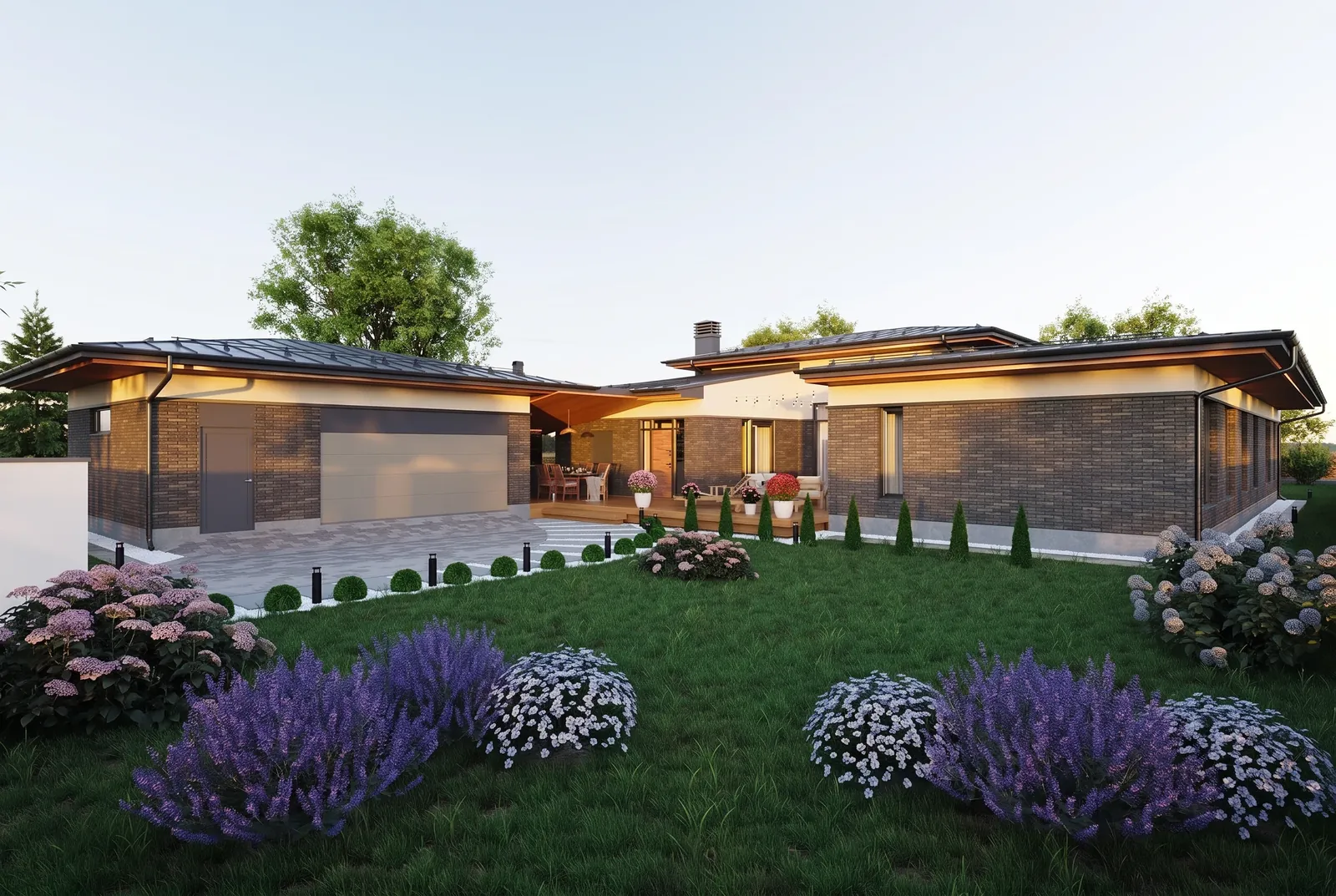
15. Ornamental grass drifts at the street edge
Planting the street edge instead of the house edge changes how the whole house is seen: the garden becomes the foreground. Grasses, red and pink flowers and two shade trees here form a soft screen without blocking the view of the house.
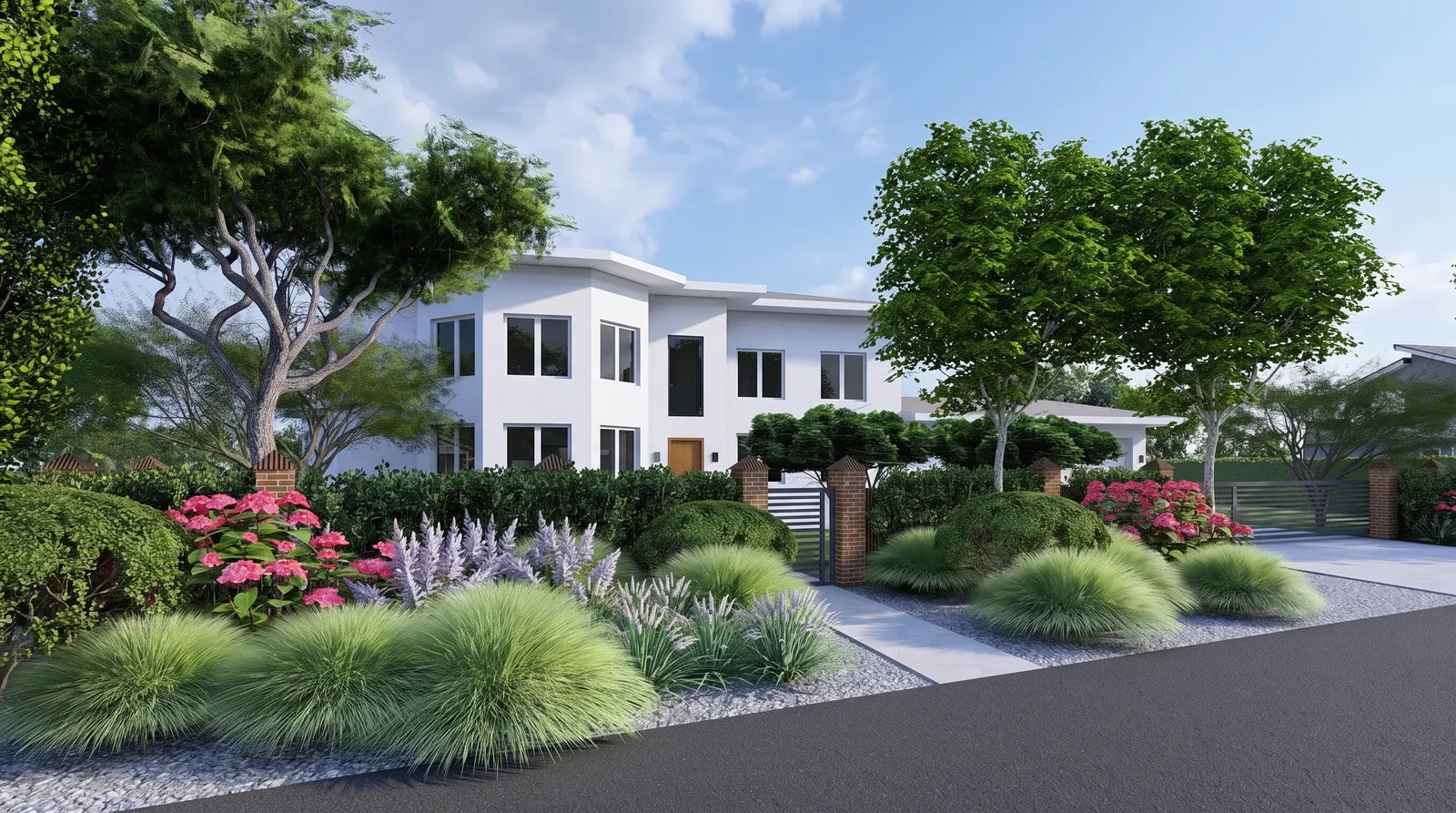
Landscaping Ideas for the Front of the House: Walks, Steps and Driveways
The front walk is the part of the yard every guest uses. Make it wide enough for two people to walk side by side, and give it a clear route from the drive and the sidewalk to the door. HomeGuide puts a walkway at about $15 per square foot installed; Angi’s paver range is $1 to $25 per square foot, depending mostly on the material.
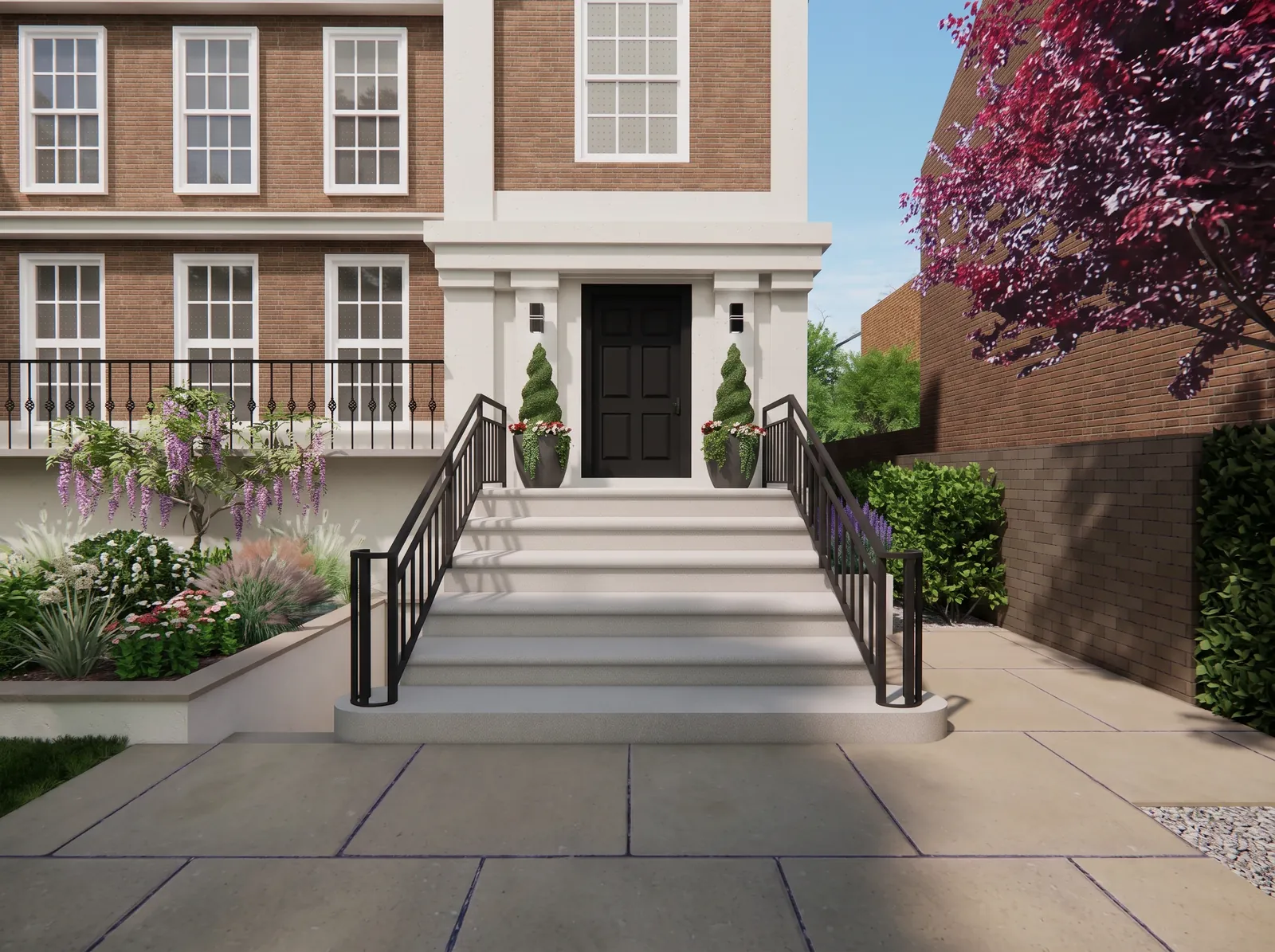
16. Wide front steps with handrails and planters
Steps are the front door of the front yard. Wide pale stone treads, black iron handrails and a pair of planters by the door make a narrow city front look generous. Handrails are a safety item, not just a style choice, so plan them in from the start.
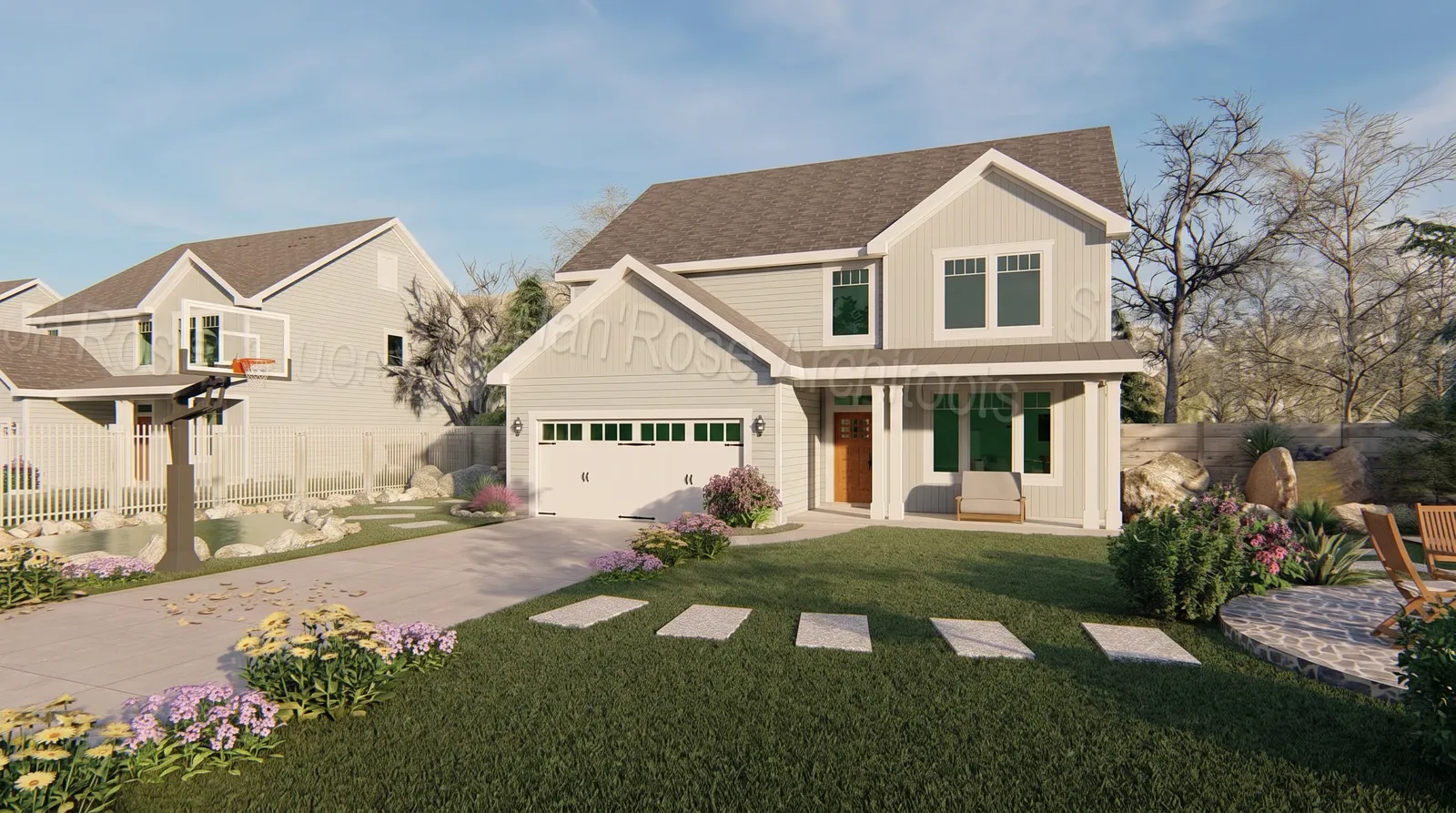
17. Stepping stones across the lawn
The cheapest walk is a line of square stepping stones set flush with the lawn, so a mower runs over them. Space them for a normal walking stride and follow the route people actually take; the worn line in the grass is your design.
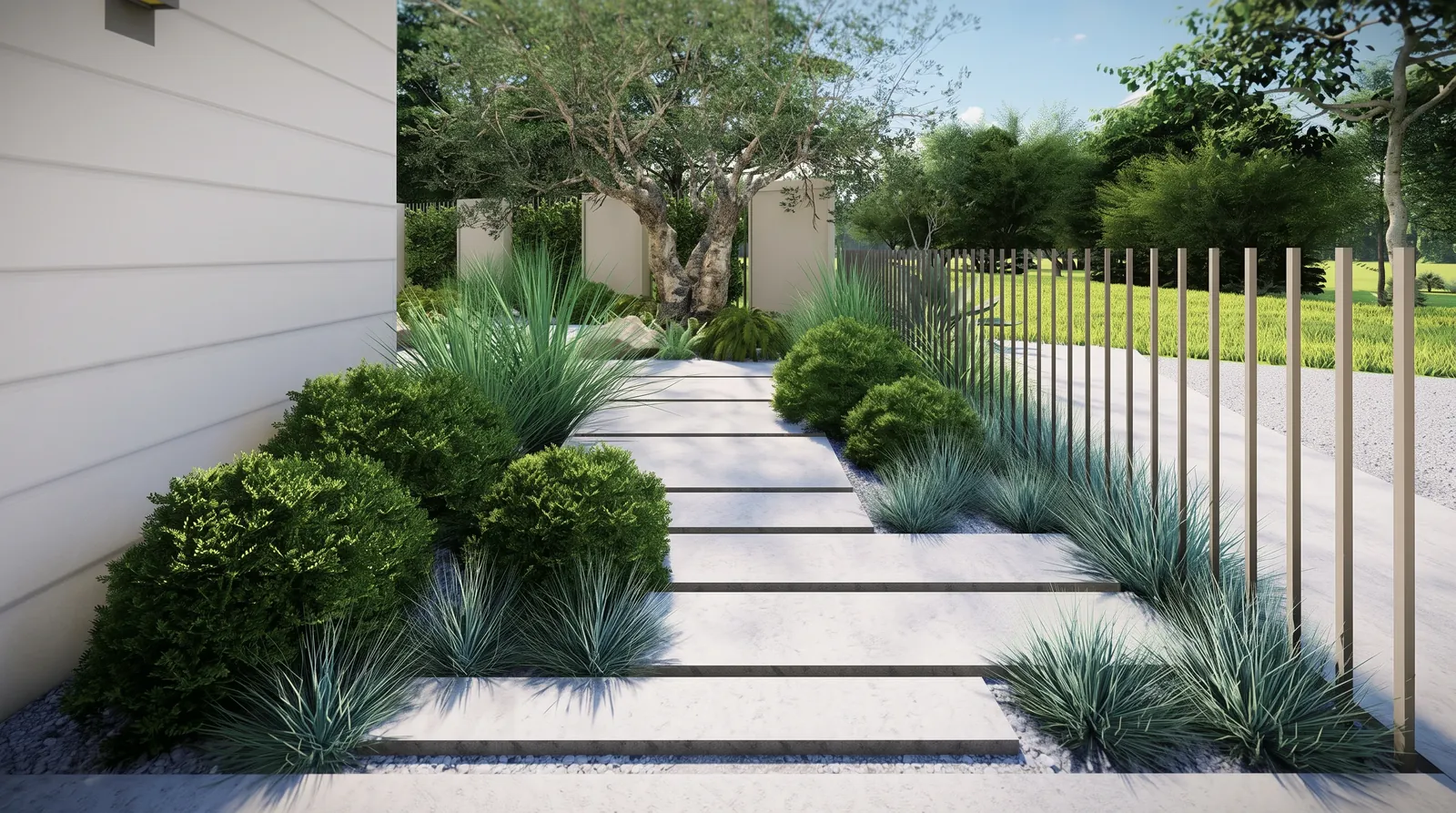
18. Large pavers lined with ornamental grasses
Big rectangular pavers with gaps between them and grasses and clipped shrubs pressing in from both sides make a modern walk feel like a garden path. It works best with a simple house and a limited plant palette.
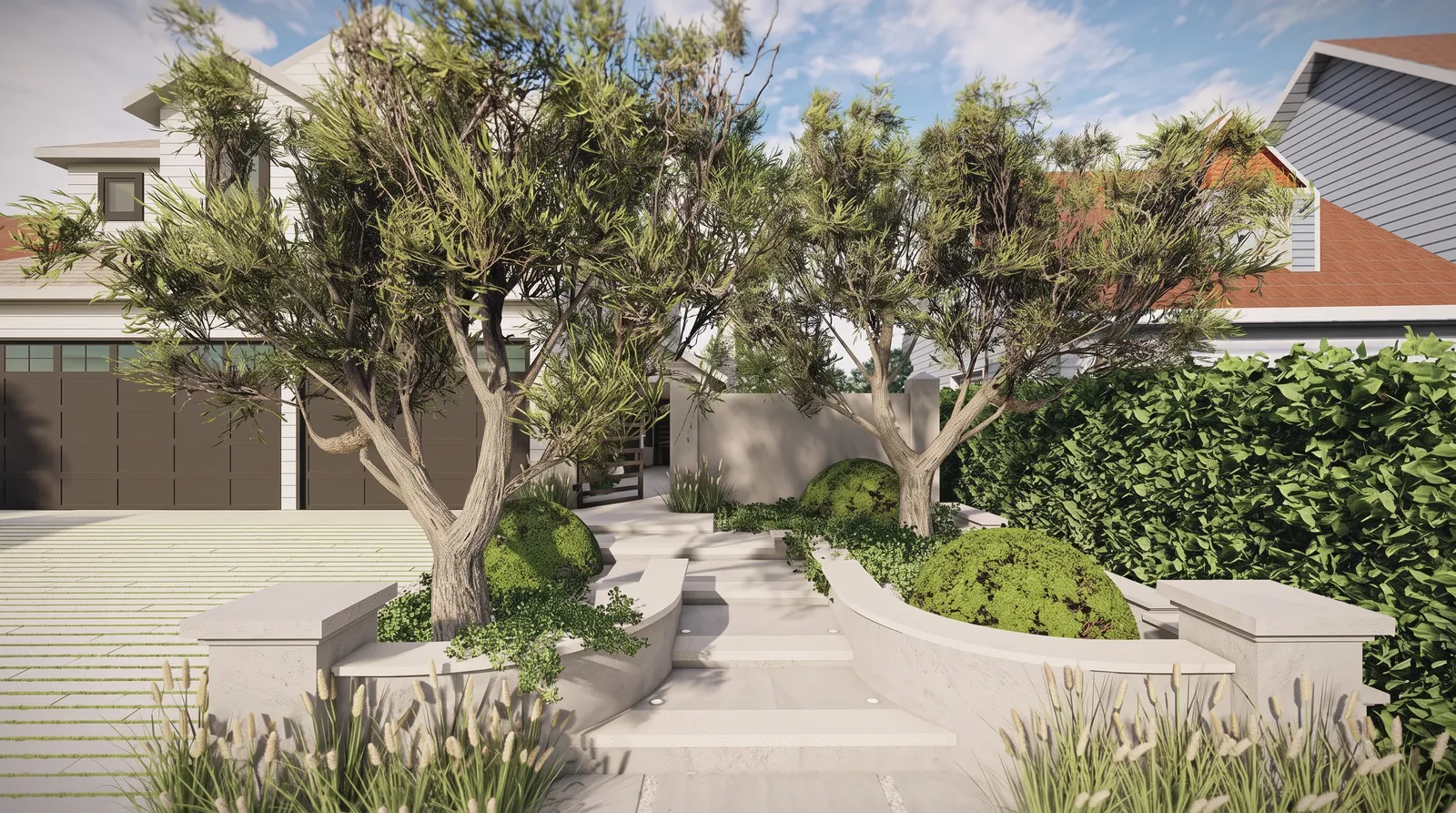
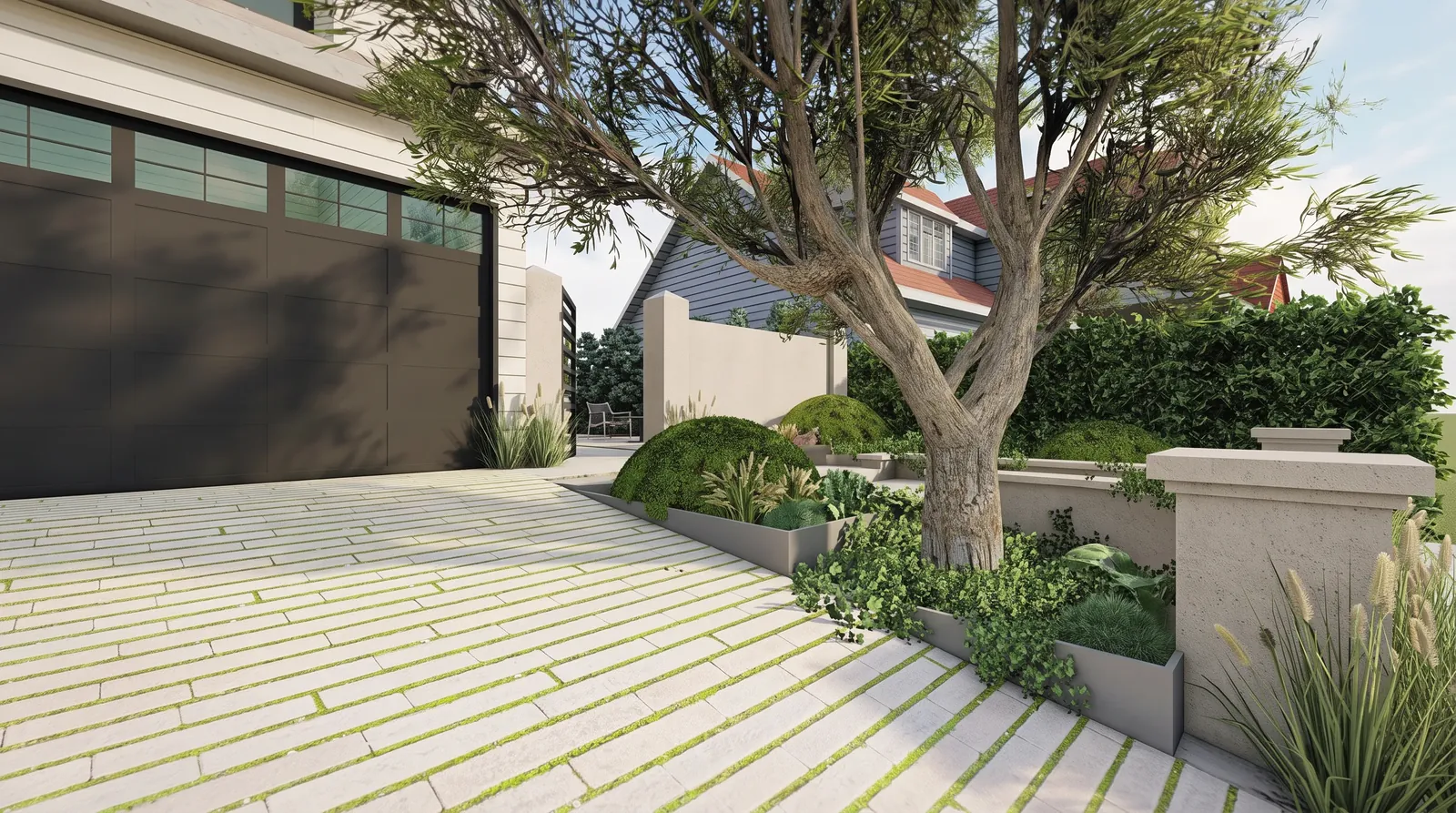
19. A paver driveway with trees in raised beds
If the driveway takes up most of the front, make it part of the garden. Pale pavers instead of asphalt, and mature trees in raised beds at the edges, turn a parking area into an entry court. Raised beds also protect tree roots from cars.
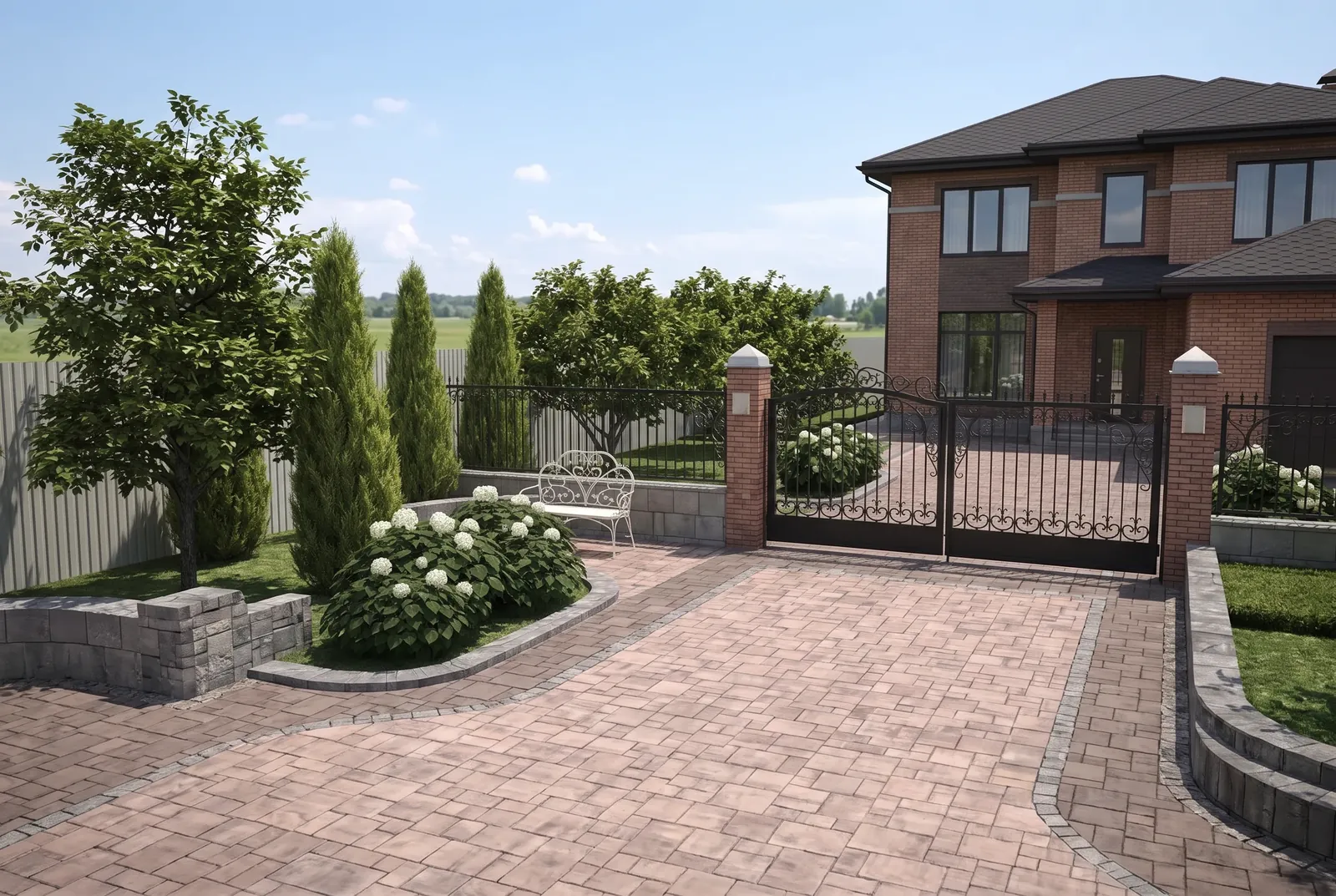
20. A brick paver entry with gates
A gated brick-paver court with evergreen planting is the formal version for a traditional brick house. It is also the most expensive idea here, and a gate across a driveway needs a check of your city and HOA rules first.
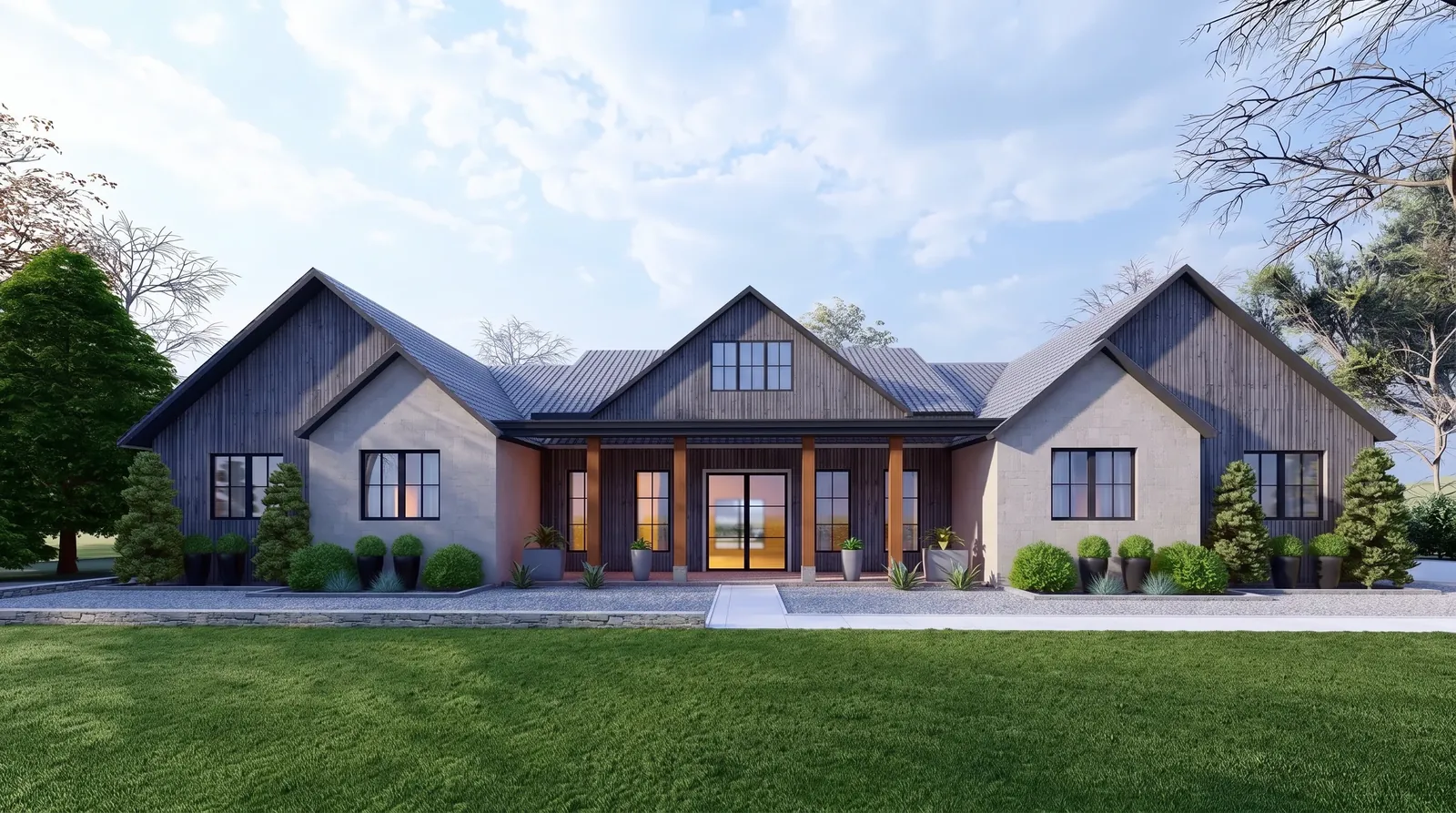
21. A straight walk and an open lawn for a farmhouse
A symmetrical house wants a simple front: one straight walk, an open lawn and low foundation shrubs. Resist the urge to add curving beds everywhere; on a farmhouse or a colonial, restraint looks intentional.
Front Yard Lighting, Tropical and Fence Ideas
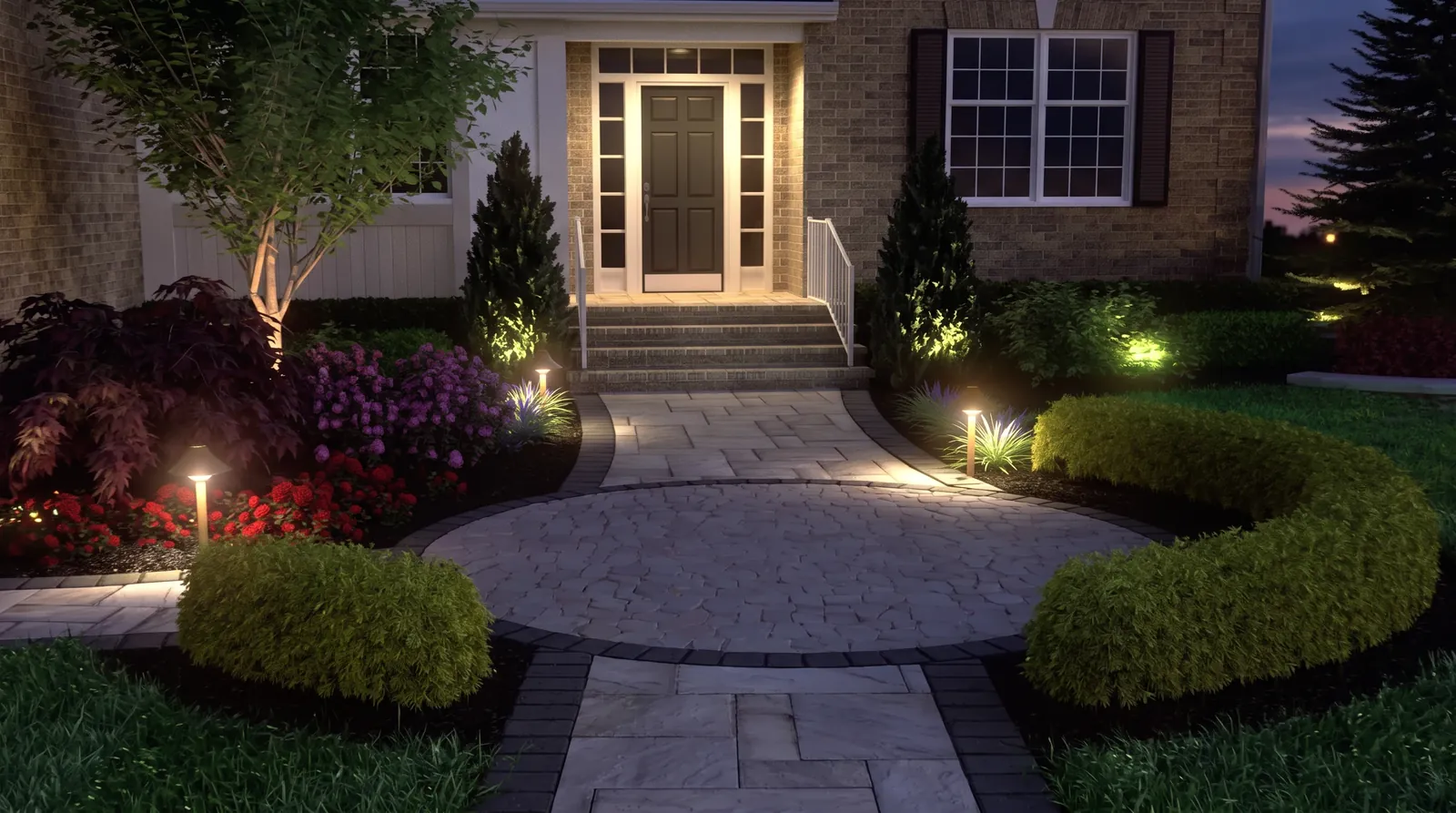
22. Path lights and uplit trees along the front walk
Lighting is what makes a front yard look finished at night. Low path lights along a curving walk, one uplight in a tree and a light at the steps are usually enough; more than that looks like a runway. NAR estimates landscape lighting recovers about 59 percent of its cost at sale, so do it for yourself, not for resale.
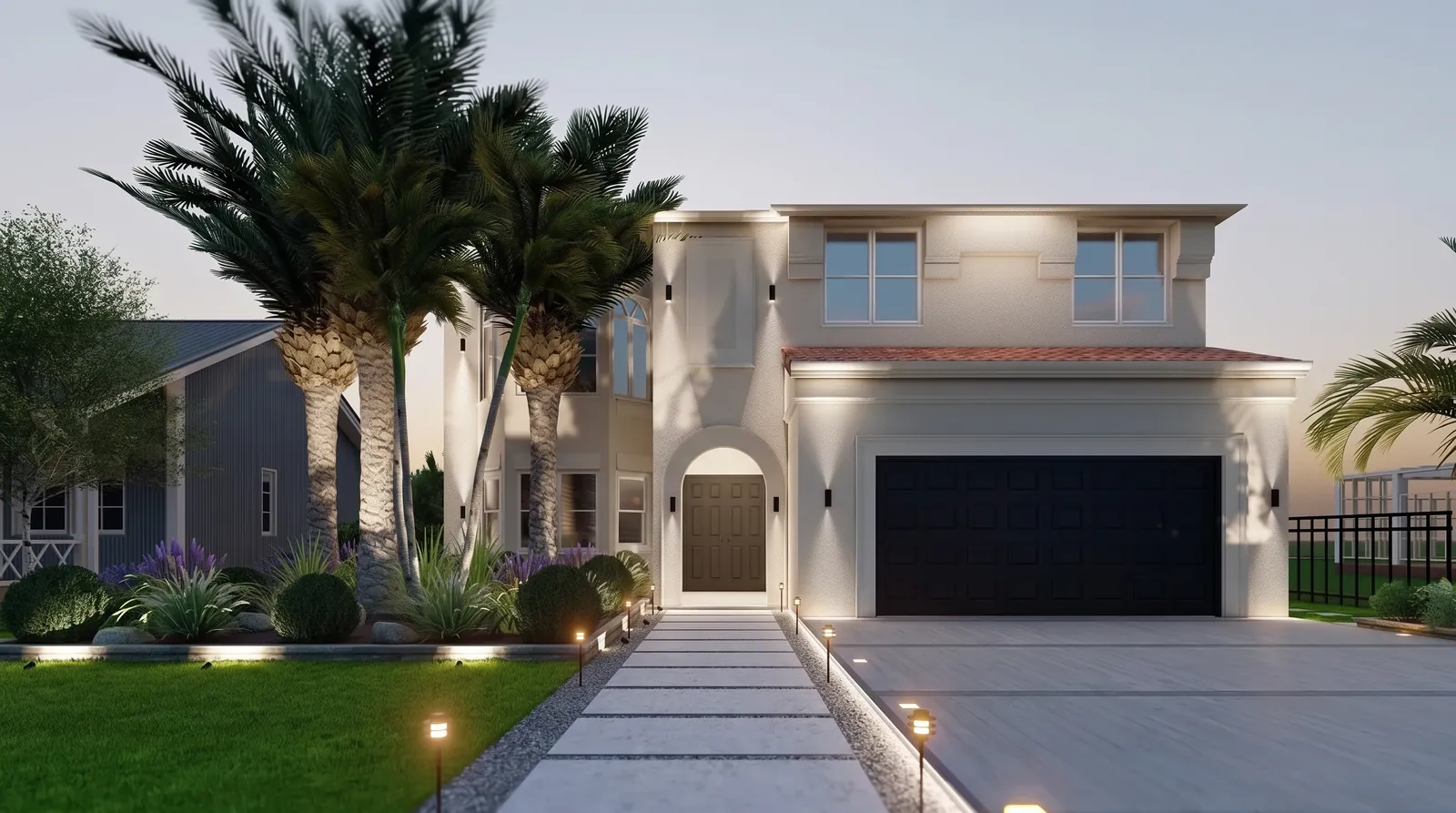
23. Palms with low lights for a stucco house
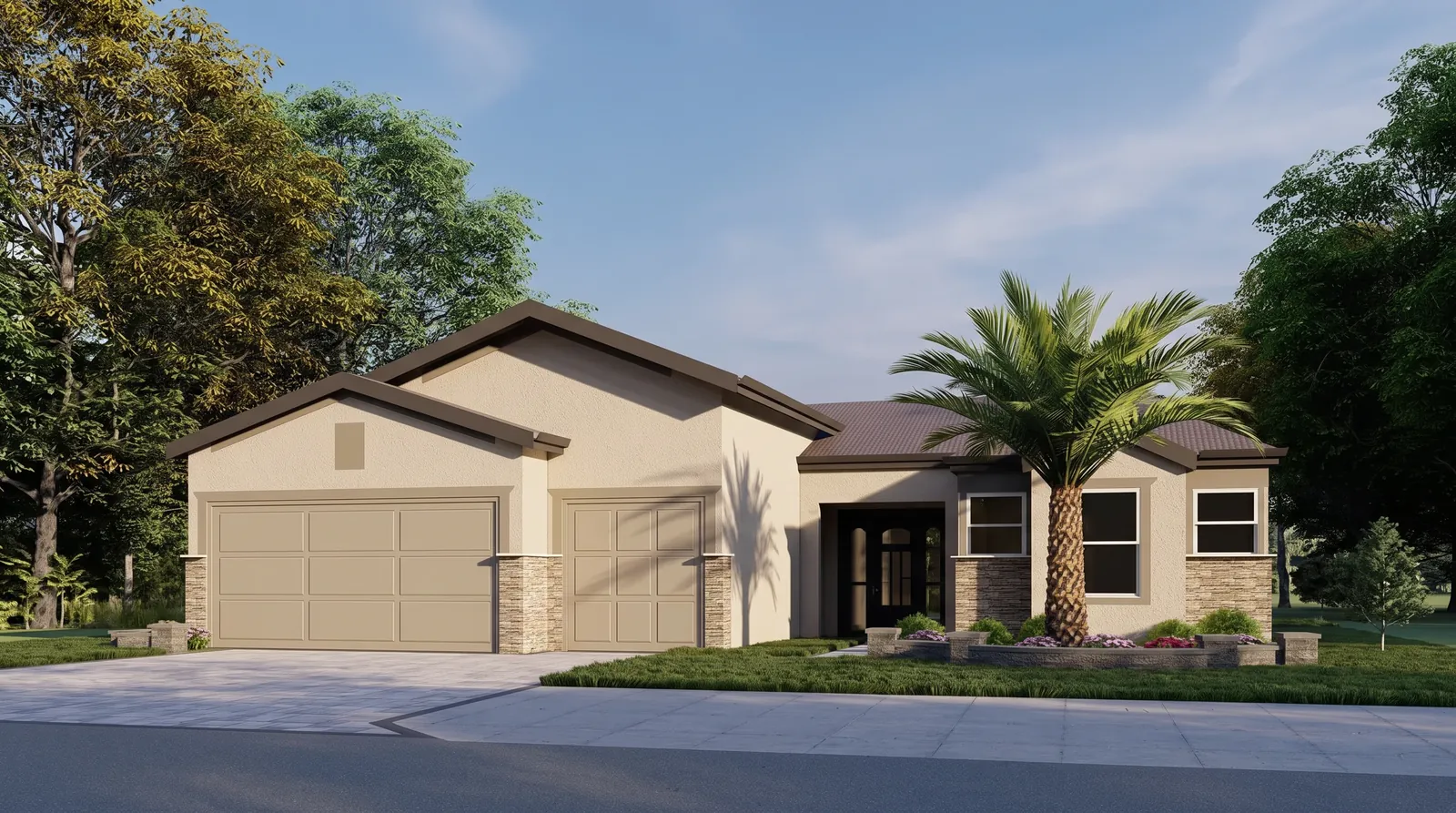
In warm climates a few palms with lights at their base do most of the work. Here a narrow lawn strip, palms and low lights along a straight concrete walk suit a two-storey stucco house.
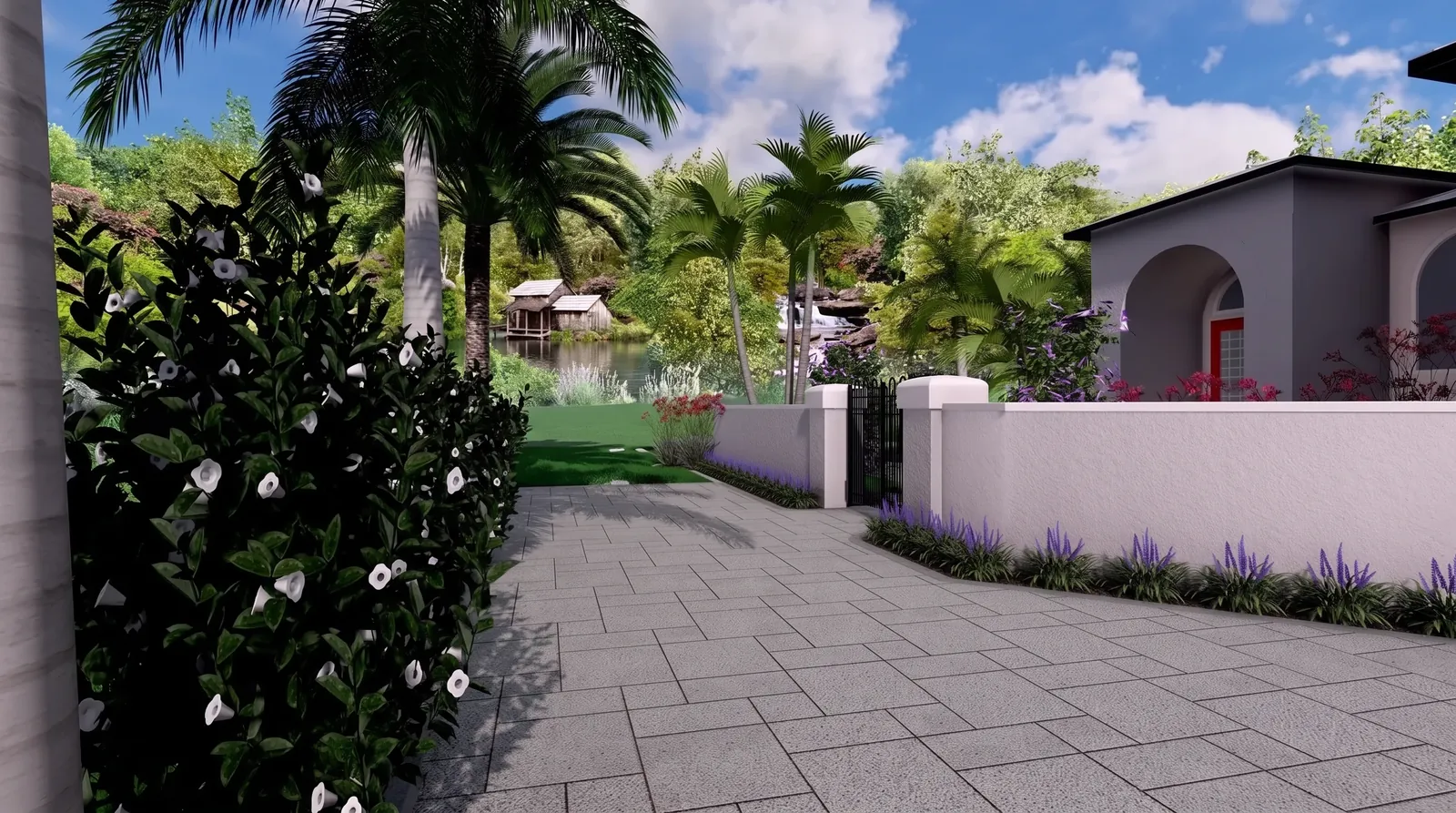
24. A tropical paver entry
A Florida-style front: a gray paver drive, a low white wall, palms and flowering shrubs layered by height. Tropical planting grows fast, so leave more space between plants than looks right on day one.
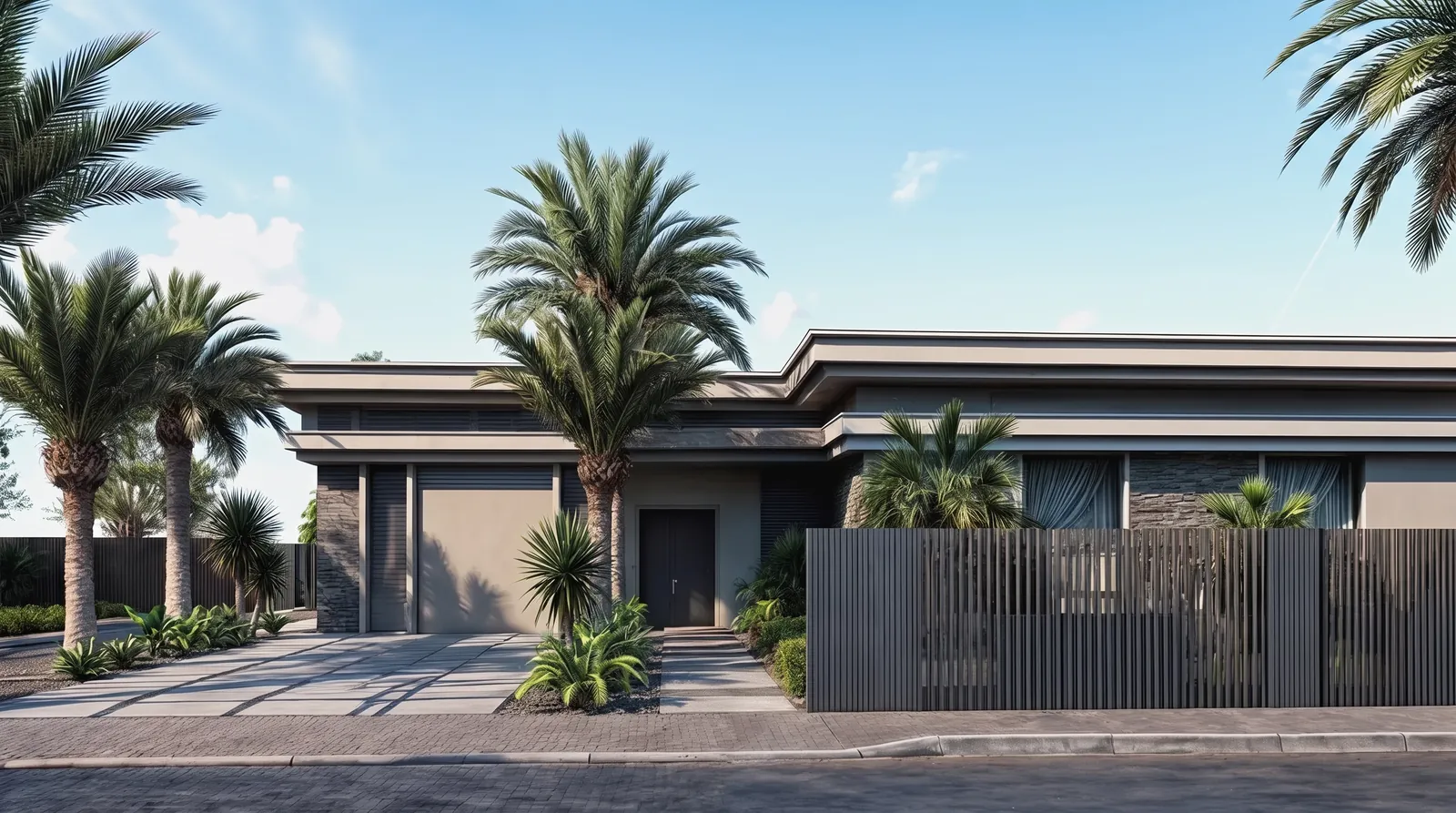
25. A slatted front fence and gate
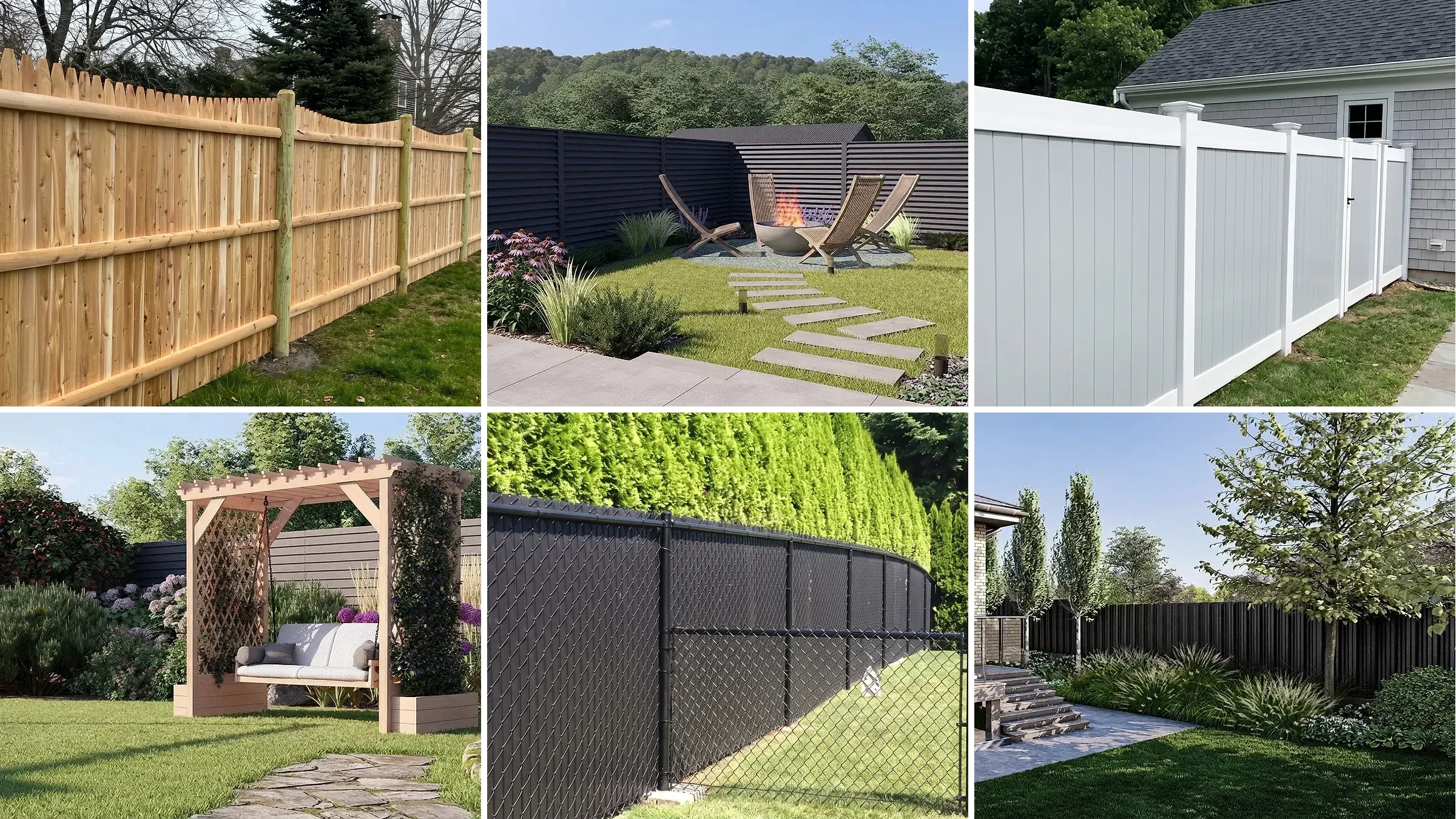
A front fence gives a modern house a clear edge and hides bins and cars. Many cities limit front yard fence height, Albany, California for example to 3 feet in the front setback, so a tall solid screen like this one may need a variance or a setback; check your city first. For more on fence styles see our privacy fence ideas, and the AI fence design tool shows a new fence on a photo of your own house.
How Much Does Front Yard Landscaping Cost?
Angi puts front yard landscaping at $1,500 to $5,000 (updated September 23, 2026), against $15,000 to $50,000 for a full backyard renovation; its national average for any landscaping project is $3,518, with most between $1,248 and $6,070, based on 32,752 projects. By area, Angi says $4.50 to $12 per square foot and HomeGuide $4 to $12 for basic work, up to $40 when everything is torn out first.
Two things to read from the table. First, the sources disagree on several lines because they measure different things: Angi’s sod figure is the material, HomeGuide’s includes installation, and HomeGuide’s retaining wall page gives both $15 to $20 and $35 to $65 per square foot. Second, hardscape is the expensive part. Planting a bed is cheap per square foot; walls, steps and paving are not. If the budget is tight, spend it on the walk and the beds next to the door, where people actually look, and plant the rest small. I could not find a sourced per-fixture price for low-voltage path lights, so the lighting line above is HomeGuide’s flood light figure, not a path light.
Before You Dig: 811, Slopes, Setbacks and Water
A front yard sits next to the street, the utility lines and the city’s rules, so it has more of them than a backyard. These are the ones that change a design.
The sight triangle rule is the one most people miss. A hedge or a wall that blocks the view where your driveway meets the street is a safety problem, and many cities cap it at around 3 feet, as Albany does. Your city’s numbers may differ, so look up the zoning code for fences, walls and hedges in front yards before you plant a row of shrubs along the sidewalk.
Water is the other rule, even where no law sets it. The EPA’s WaterSense program says outdoor use is more than 30 percent of household water on average and up to 60 percent in arid regions, that residential outdoor use in the US is nearly 8 billion gallons a day, and that up to 50 percent of outdoor water is lost to wind, evaporation and runoff. Denver Water’s seven xeriscape principles are a good checklist: planning and design, soil improvements, efficient irrigation, plant zones, mulches, turf alternatives and maintenance. In dry regions, look for a turf rebate before you start: the Southern Nevada Water Authority pays $5 per square foot for the first 10,000 square feet and $2.50 after that, and the Southern California program starts at $2 per square foot, with limited funding.
Trees are worth placing on purpose. The US Department of Energy’s landscaping guide recommends tall deciduous trees on the south side of a house and trees with lower branches on the west, says 6 to 8 foot deciduous trees planted near the house start shading windows in the first year, and notes that shading an air conditioner can raise its efficiency by as much as 10 percent. Plant them far enough from the foundation and from overhead and buried lines, which is one more reason to call 811 first.
Does Front Yard Landscaping Add Value?
It does, but not every project pays back. The National Association of Realtors’ 2023 Remodeling Impact Report on outdoor features asked Realtors to estimate what each project adds at sale, for a 2,500 square foot house on a 14,000 square foot lot:
The pattern is clear: keeping a front yard tidy pays more than adding expensive features. That matches academic work. In a 2005 study in the Journal of Environmental Horticulture, Behe and colleagues surveyed 1,323 people in seven US markets about homes with different landscapes, and found participants perceived a 5 to 11 percent higher home value for homes with a good landscape. Those are estimates and perceptions, not appraisals, so treat them as direction, not a promise.
See a New Front Yard on Your Own House: Our MeltFlex AI Test
MeltFlex AI redesigns the front yard in a photo of your own house in about 15 to 30 seconds for 10 credits through the AI garden design tool: take a photo from the street, upload it and pick a style, or describe what you want. New accounts get 15 free credits, so the first design is free; Standard is $20.99 a month, or $12.99 a month billed yearly, for 490 credits. In our test it kept the house in 23 of 24 renders but moved the camera in 10 of 24, so it is a fast way to compare looks, not a plan. MeltFlex AI is ours, so here is every result.
On November 26, 2026 I took four real house fronts from Wikimedia Commons: a split-level with a wide lawn and an asphalt drive, a raised ranch on a slope with cars at the garage, a small ranch shot from the driveway with two cars in the foreground, and a brick Colonial behind a sidewalk with front steps. I sent each one six briefs: the default with no style chosen, a low-maintenance brief (Minimalistic, Gravel, Drought tolerant), English Cottage with flowers, Desert with no lawn, Modern with balanced planting, and Prairie with a meadow. The test ran by script with exactly the prompt the garden sidebar builds and the same image model the app uses (gemini-nano-banana-2.1), so it skipped the web app itself; the grading is mine, at full size.
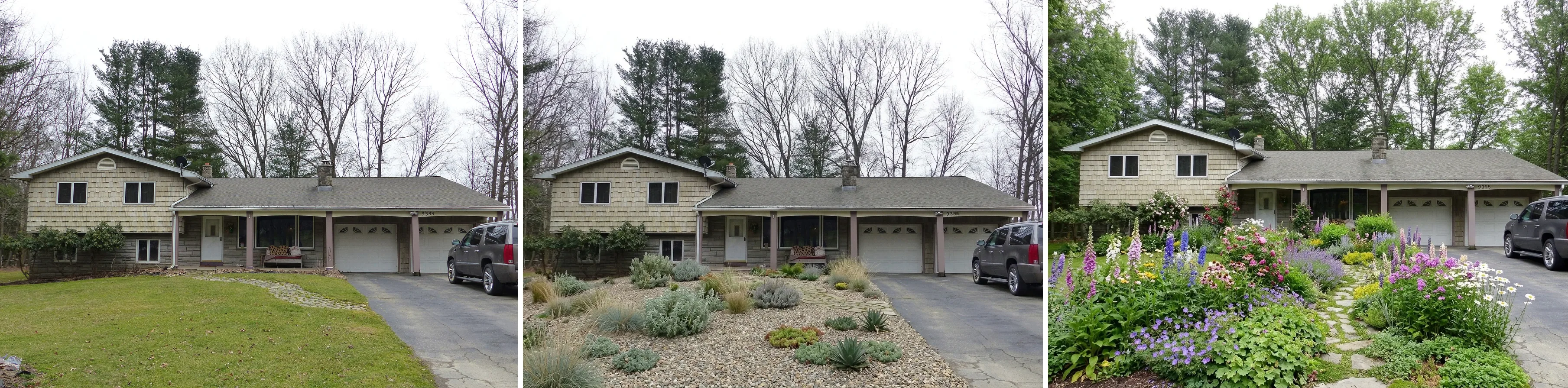
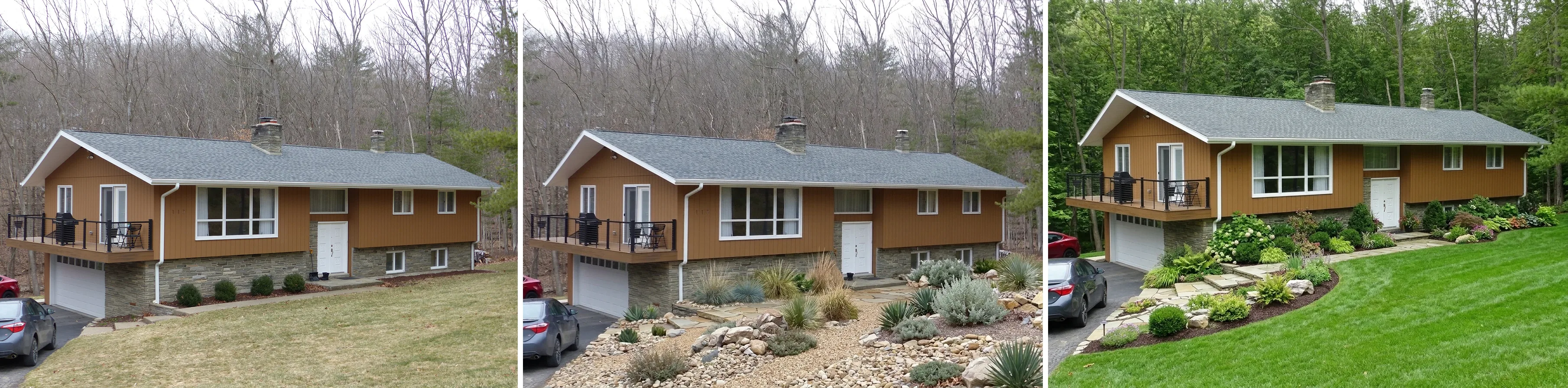
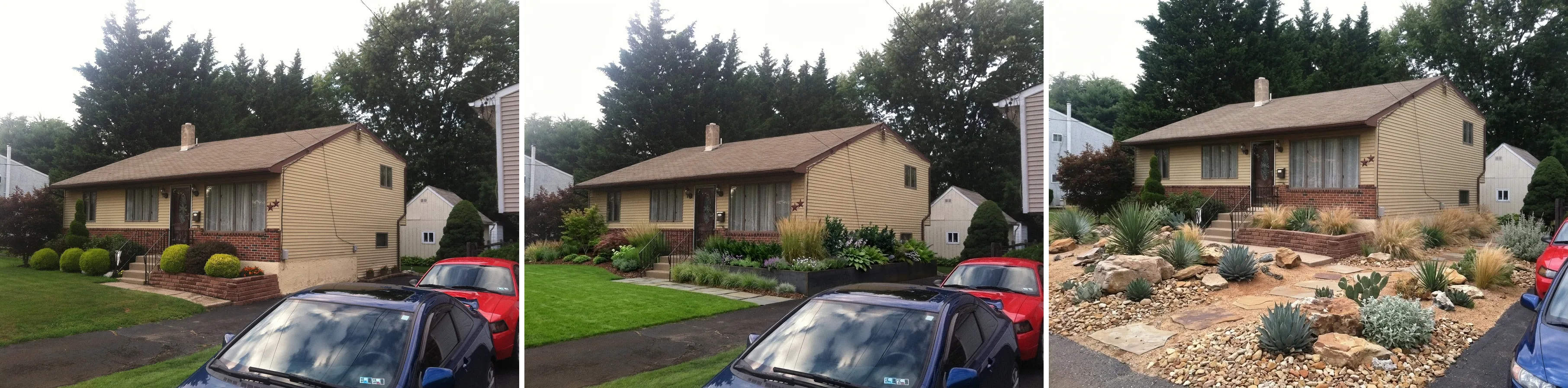
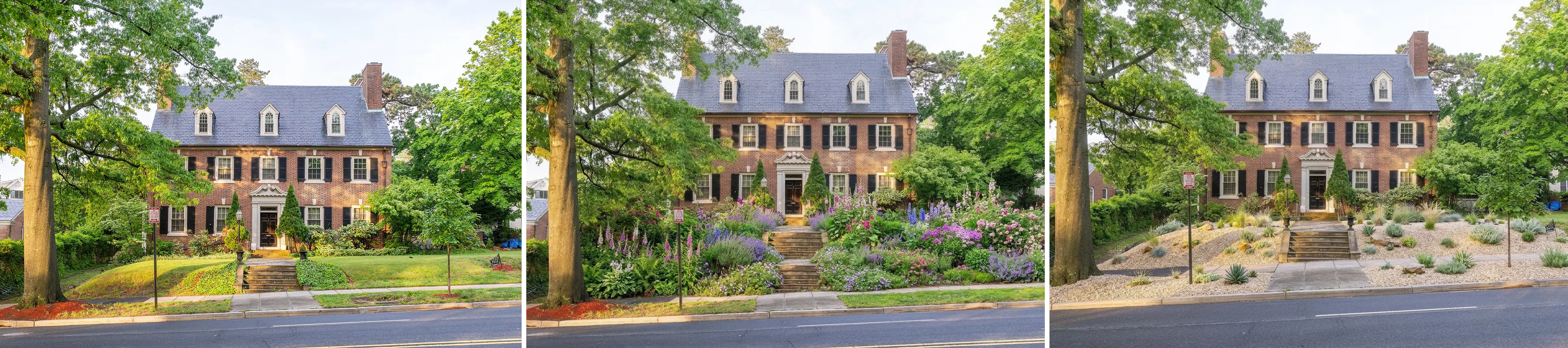
By brief, Modern kept everything in 4 of 4, Cottage and Prairie in 3 of 4, low maintenance in 2 of 4, and Desert and the default brief in only 1 of 4. The default result surprised me: with no style chosen, the tool took the most liberties, moving the camera, turning winter trees green and, on the raised ranch, redrawing the lower floor of the house. So I ran a second round of 16 renders with one extra sentence telling it this is the front of a house seen from the street and to keep the driveway, cars, steps, sidewalk, season and camera. That lifted the default brief from 1 of 4 to 6 of 8 with the camera kept, and kept the house, driveway, cars and season in 16 of 16; Modern came in at 6 of 8, so roughly one render in four still moves the camera. That sentence is now part of the front yard brief in the sidebar of this article.
What it got right: every render was a believable front yard for that house, sized to it, with a path to the door, and none of the 40 added a pool, a fire pit or patio furniture to the street side. Median time was about 17 seconds. What it got wrong: the camera moves described above, a gravel bed spread over the city planting strip between the sidewalk and the curb on the Colonial (which many cities regulate), and one Desert render that turned part of a driveway into gravel and erased a parked car. It also does not know your plant hardiness zone, your HOA rules or where the gas line runs. Use the render to choose between gravel, cottage beds and a clean modern front with the people you live with, then take it to a nursery or a designer with a measured plan.
MeltFlex AI also works inside Claude and ChatGPT through the MeltFlex AI MCP connector and for developers through the MeltFlex AI API. To compare it with other tools, read our AI landscape design tools test and best landscape design apps; for wording that works, see AI landscape design prompts. If you want to change the house too, the AI exterior design tool recolors siding, trim and roofs on the same photo.
Front Yard Landscaping Checklist
- Photo first: take a straight photo of the house from the sidewalk in daylight; it is your before picture and your design base.
- Rules: look up front yard fence, wall and hedge heights and the sight triangle at your driveway; read the HOA covenants.
- Utilities: contact 811 a few business days before you dig, even for one shrub (free).
- Grading: keep the ground falling 6 inches in the first 10 feet away from the foundation (IRC R401.3).
- Lawn: decide how much lawn you really use; replace the rest with beds, gravel or groundcover and check for a turf rebate.
- Walk: wide enough for two people, from both the drive and the sidewalk to the door, with lights at steps.
- Beds: deep enough to layer low to tall, a few plants repeated, mulch 2 to 4 inches.
- Trees: tall deciduous trees to the south, lower ones to the west, away from lines and the foundation.
- Budget: $1,500 to $5,000 for most front yards (Angi); spend it near the door first.
Planning the whole lot? Start with how to design a garden layout, see backyard ideas without grass for gravel and groundcovers, and for the house itself, our guides to exterior house colors, front door colors and modern front porch ideas. More front gardens are in our creations gallery.
Front Yard Landscaping Ideas FAQ
How much does front yard landscaping cost?
Angi puts front yard landscaping at $1,500 to $5,000 (updated September 23, 2026), against $15,000 to $50,000 for a full backyard renovation. Per square foot, Angi says $4.50 to $12 and HomeGuide $4 to $12 for basic work; a tear-out can reach $40. To see a design on your own house before you pay anyone, MeltFlex AI redesigns a photo of your front yard for 10 credits, and new accounts get 15 free credits.
Can I see a new front yard on my own house before I start?
Yes. Upload a photo of your house taken from the street to the MeltFlex AI garden design tool and pick a style. In our MeltFlex AI test on November 26, 2026, on 4 real house fronts, it kept the house unchanged in 23 of 24 renders and never added backyard features such as a pool or a fire pit, but it moved the camera in 10 of 24, so regenerate when the framing changes. Each render took about 15 to 30 seconds.
What is the lowest maintenance front yard?
A front yard with less lawn: gravel or mulch with drought-tolerant shrubs, grasses and perennials, planted closely so the ground is covered, with drip irrigation instead of sprinklers. The EPA says outdoor use is more than 30 percent of household water and up to 60 percent in arid regions, and that up to 50 percent of outdoor water is lost to wind, evaporation and runoff. Denver Water lists seven xeriscape principles, from planning and soil to mulch and maintenance.
Does front yard landscaping increase home value?
It can. In the National Association of Realtors 2023 Remodeling Impact Report on outdoor features, a standard lawn care service recovered an estimated 217 percent of its cost, landscape maintenance 104 percent, and an overall landscape upgrade 100 percent ($9,000 cost, $9,000 value), while landscape lighting recovered 59 percent. A 2005 study by Behe and colleagues found participants perceived a 5 to 11 percent higher home value for homes with a good landscape.
Do I need to call 811 before planting in my front yard?
Yes, if you dig. 811 is the free national call-before-you-dig service, and it asks you to contact it a few business days before any digging, including planting trees and shrubs and installing fences or mailboxes. In the Common Ground Alliance 2025 DIRT data, no call to 811 was the top known root cause of damage to buried utilities, at 22.3 percent of reports with a known cause.
How tall can a front yard fence or hedge be?
It depends on your city, so check the zoning code before you build. As one example, Albany, California limits fences, walls and hedges in the required front yard setback to 3 feet, and keeps them under 3 feet within 10 feet of where a driveway meets the street so drivers can see. HOA rules can be stricter than the city.
How should the ground slope next to the house?
Away from it. The International Residential Code (R401.3) says the grade shall fall at least 6 inches within the first 10 feet from the foundation, and paved surfaces within 10 feet should slope at least 2 percent away. Keep that slope when you build up beds against the house, and keep mulch 2 to 4 inches deep and at least 6 inches back from tree trunks (Iowa State and Colorado State extension).
What are cheap front yard landscaping ideas?
Mulch, edging and plants you divide or grow from small sizes give the most change per dollar: mulch costs $0.20 to $0.60 per square foot and sod $0.35 to $0.85 per square foot in materials (Angi). In dry regions, check for turf rebates first: Southern Nevada pays $5 per square foot for the first 10,000 square feet of lawn replaced, and Southern California programs start at $2 per square foot.
Sources
- Angi, How much does landscaping cost?, updated September 23, 2026.
- HomeGuide, Landscaping costs, modified February 4, 2026.
- U.S. EPA WaterSense, Statistics and facts (updated March 11, 2026) and Outdoor water use (updated July 20, 2026).
- Denver Water, Xeriscape principles.
- Southern Nevada Water Authority, Water Smart Landscapes rebate; Metropolitan Water District of Southern California, Turf replacement program.
- 811, Contact 811 before you dig; Common Ground Alliance, 2025 DIRT root cause summaries.
- National Association of Realtors, 2023 Remodeling Impact Report: Outdoor Features, March 17, 2023.
- Behe, B., Hardy, J., Barton, S., Brooker, J., Fernandez, T., Hall, C., Hicks, J., Hinson, R., Knight, P., McNiel, R., Page, T., Rowe, B., Safley, C. and Schutzki, R., Landscape plant material, size, and design sophistication increase perceived home value, Journal of Environmental Horticulture 23(3):127–133, 2005.
- International Code Council, 2024 International Residential Code, Chapter 4, section R401.3 Drainage.
- Iowa State University Extension, How deep should the mulch layer be? (March 3, 2022); Colorado State University Extension, Mulching trees and shrubs.
- City of Albany, California, Fence handout, Municipal Code 20.24.110, November 2023.
- U.S. Department of Energy, Consumer guide to home landscaping, August 2021.
- NASA Earth Observatory, Looking for lawns, November 8, 2005 (Milesi et al., Environmental Management 36(3), 2005).
- Test photos from Wikimedia Commons: “Split-Level Houses in Gang Mills 02” and “05” by Stilfehler (CC BY-SA 4.0), “Backsplit splitlevel house in Southeast PA” by Degen Earthfast (CC BY-SA 4.0), “Brick Colonial Revival House” by ajay_suresh (CC BY 4.0).
Audio version by MeltFlex AI
Listen to this article
Prefer to listen? Matthew and Bryan, the founders of MeltFlex AI, talk through Front Yard Landscaping Ideas: 25 Designs, Costs and Rules in about 17 minutes. The voices are AI-generated. Every section is a chapter, so you can jump straight to the part you need while you browse rooms or sketch a layout.
Chapters (8)
More narrated articles on AI Interior Design MeltFlex