Front Door Colors: The Best and Most Popular Picks for 2026, Shown on One House

The most popular front door colors are black and red, followed by white, blue, green and gold. That order comes from a Houzz survey of 1,106 US users fielded in May 2024: black 24%, red 22%, white 18%, blue 13%, green 11% and gold 7%. Black is also the color buyers pay most for in the only data that exists: Zillow found homes with black or charcoal gray front doors sold for $6,271 more than expected in 2018, and black drew the highest offer again in its 2022 buyer survey. For 2026 the best front door colors are those two plus navy, dark green and natural wood, chosen to match the fixed colors of your house rather than a trend list.
Our articles are still written by humans!
Get human written articles in your Google feed.
A paint chip cannot tell you what a door does to a whole facade, so we tested it. We took one white colonial from our gallery and repainted only its front door nine ways with a one sentence AI image edit, the same kind of edit our door visualizer runs on your own photo: same siding, same shutters, same lantern, only the door changing. Below that: the colors that sell, the named paints behind each one at Sherwin-Williams and Benjamin Moore, the best door for white, gray, red brick, tan and sage houses, the dark door and storm door warranty trap most color guides skip, what the meanings are really based on, and which paint to buy. We do not sell paint or doors.
The short version
- Most popular: black (24%) and red (22%), then white, blue, green and gold (Houzz, May 2024, 1,106 US users).
- Best for resale: black. Zillow: +$6,271 in 2018 listing data, +$6,449 in a 2022 buyer survey, where slate blue got the best overall score.
- White house: black, navy, red or wood. Bright yellow and teal only look intentional on white.
- Gray house: red or yellow for contrast, navy or black to stay quiet. Never a mid gray.
- Red brick: black, dark green, navy or a wood stain. Not the brick’s own red.
- Before you paint dark: full afternoon sun plus a glass storm door can void a fiberglass or steel door warranty. Read the section on heat.
- See it first: upload a photo of your entry to the AI door visualizer and compare three colors on your own door.
See Nine Front Door Colors on the Same House
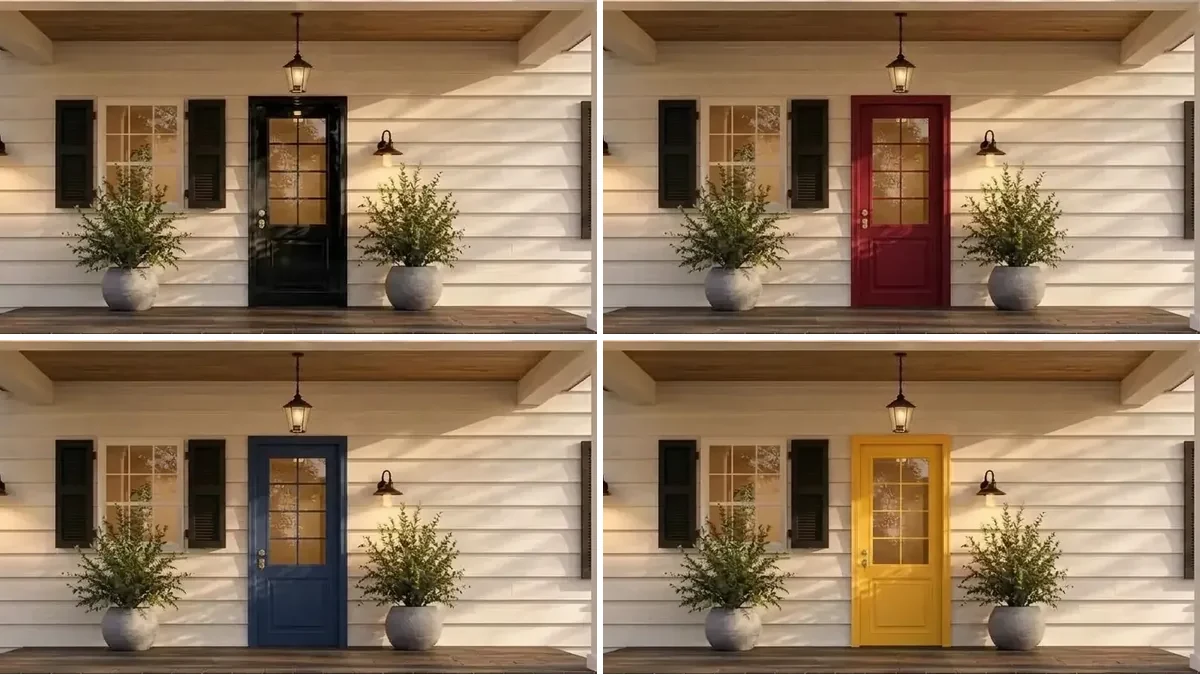
The front door is the cheapest exterior change you can make and the one you see most, which is exactly why it is worth seeing before you buy a quart. A chip is two inches of color under kitchen light; your door is about 20 square feet of it under a porch roof, next to shutters and trim that are not changing. The step in between is a photo of your own entry. Stand on the front walk, take one picture of the door with the windows on either side, upload it to the MeltFlex door visualizer and ask for one color, for example “Repaint only the front door in navy blue, keep everything else the same.” About 20 seconds later you see your door in navy. Change one word and run it again.
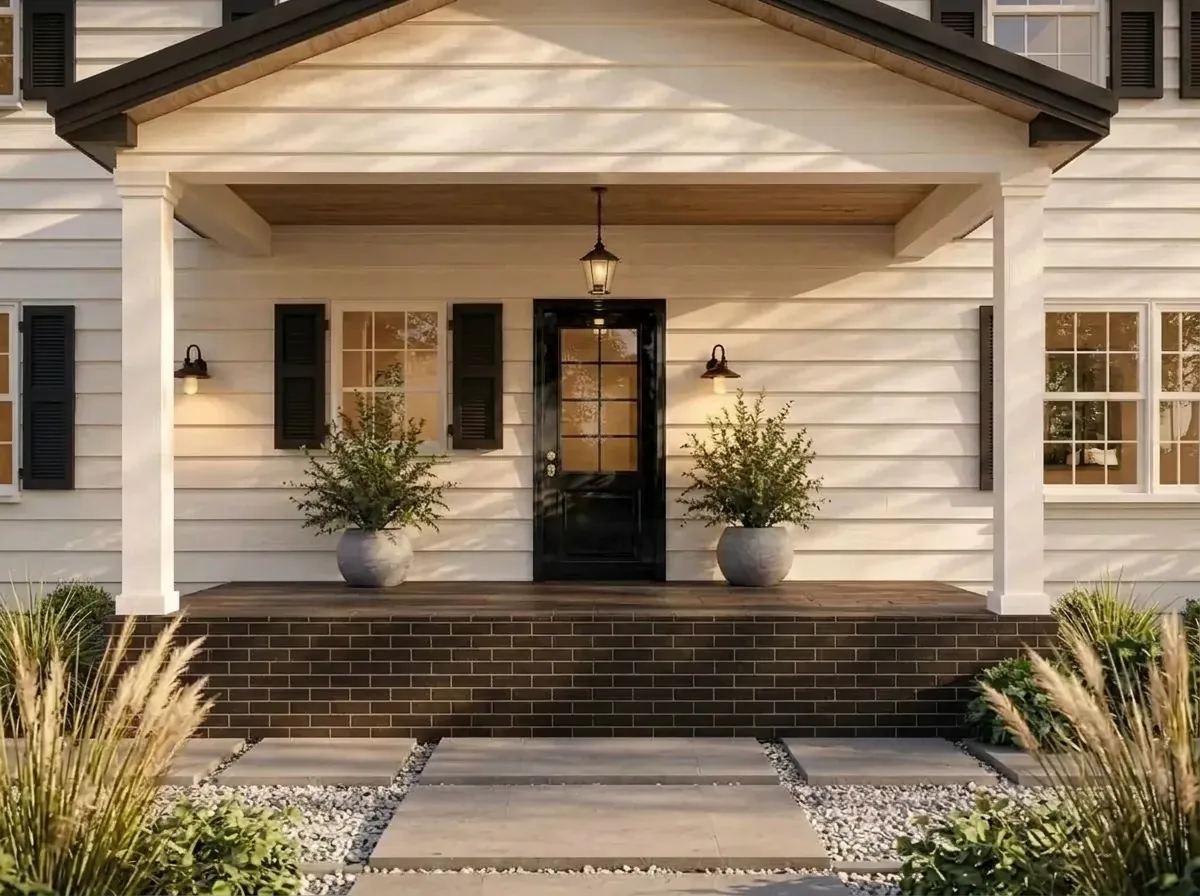
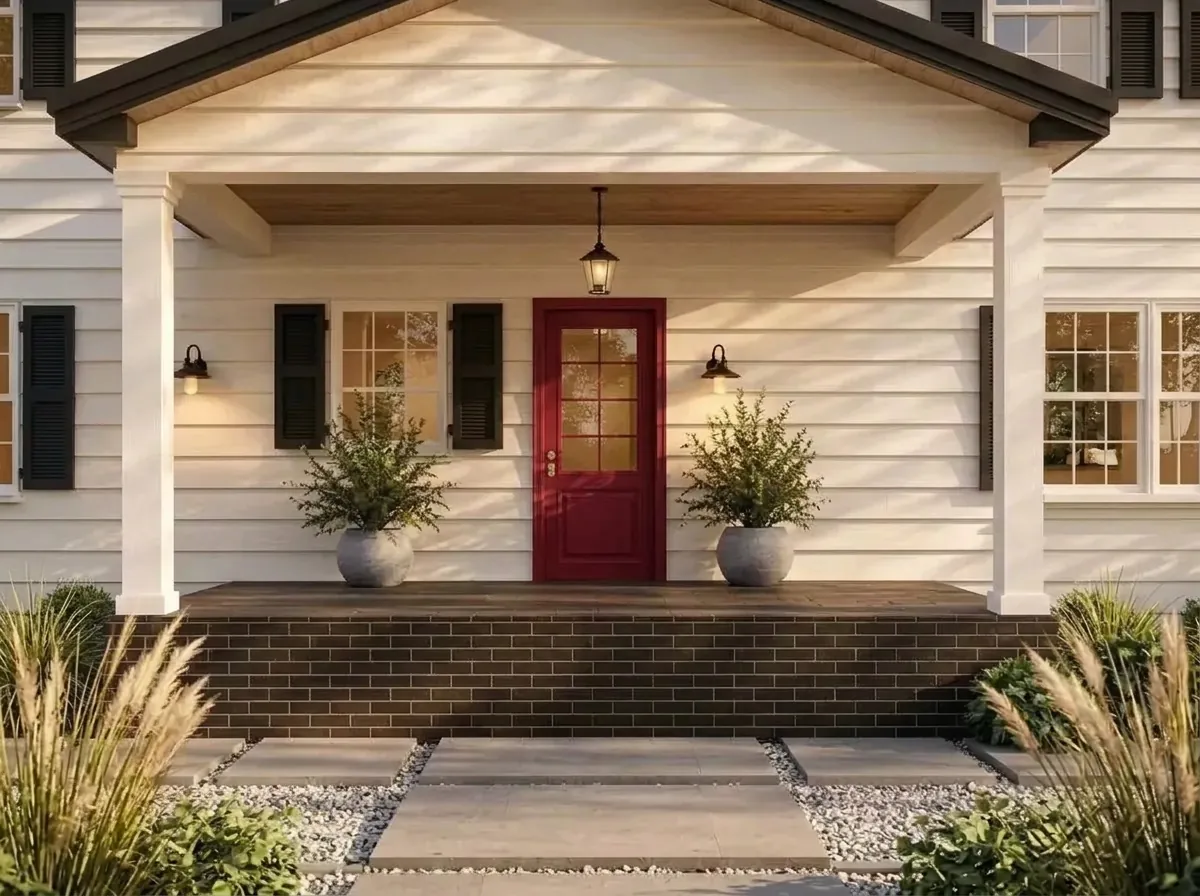
Here is that kind of edit on a white colonial from our gallery, a lap sided house with black shutters, a gabled portico and a half glass door: the most common front door setup in America and the hardest to get wrong, which makes the differences honest. We re-shot the render closer to the entry so the door reads, then made every panel below from that one image on 28 October 2026 with a prompt that changed only the door color. Siding, shutters, the brass lantern and the two planters held in all nine, so you are comparing doors, not houses.
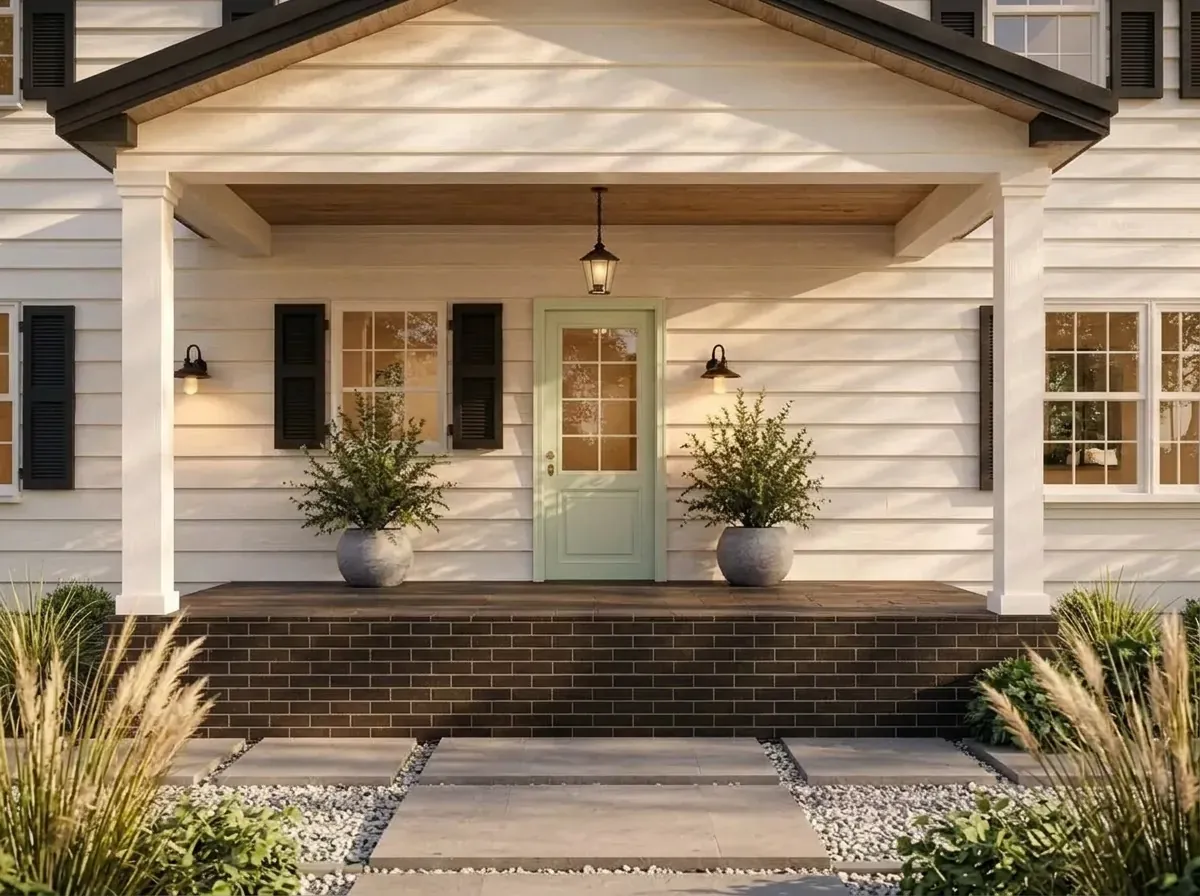
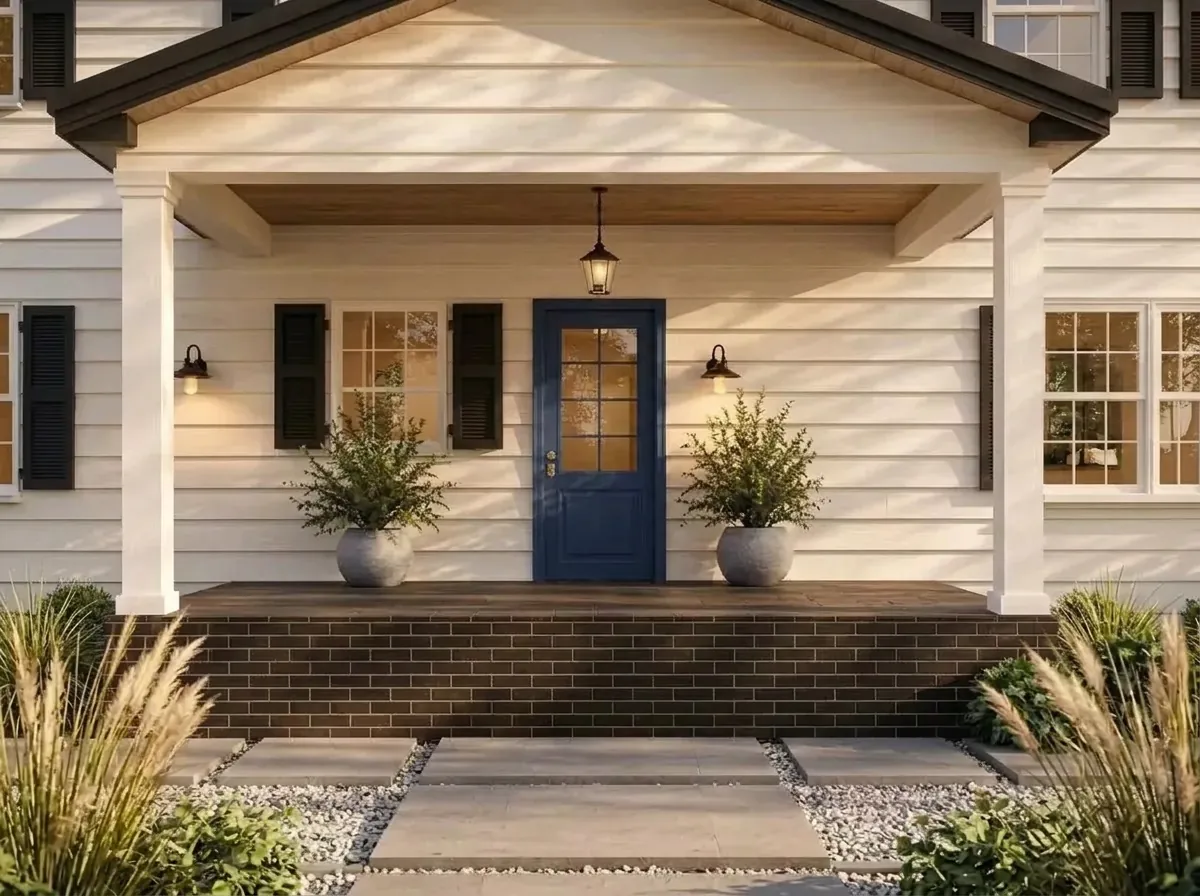
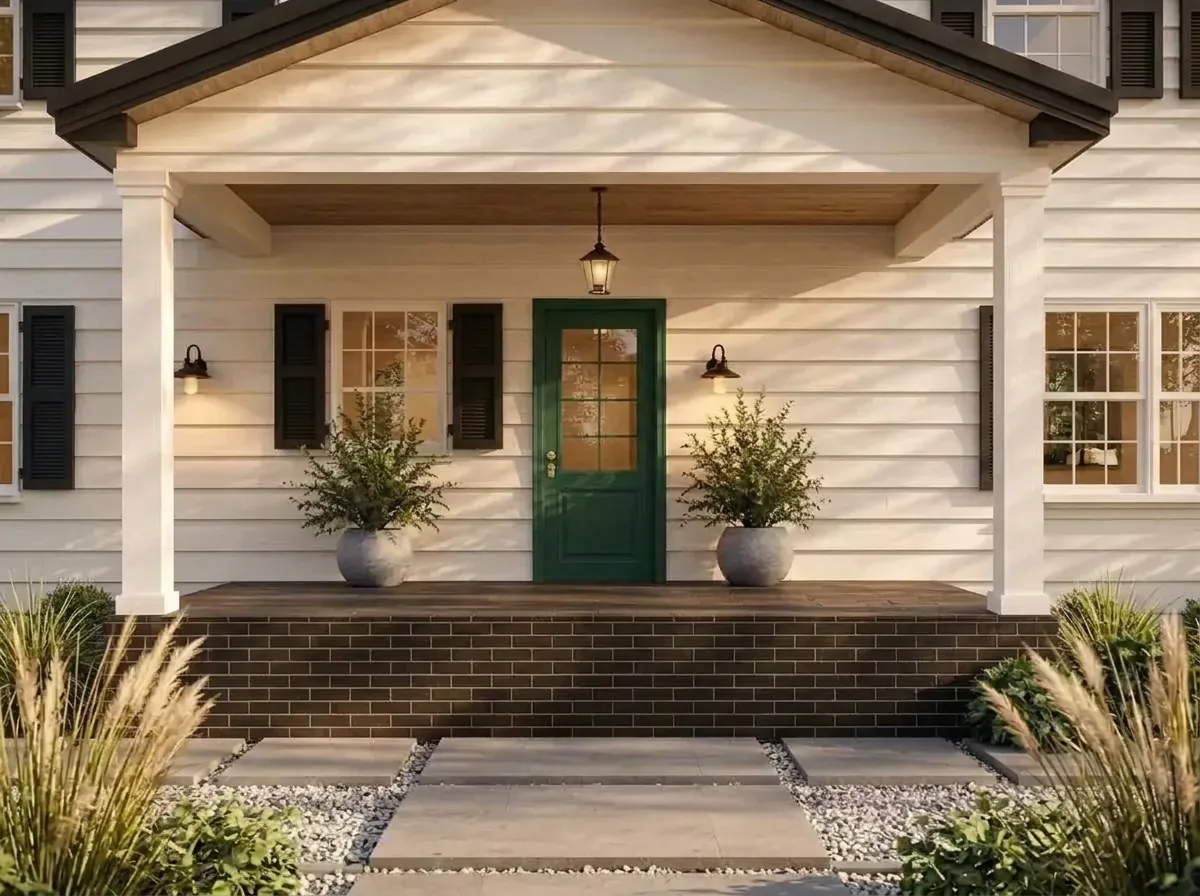
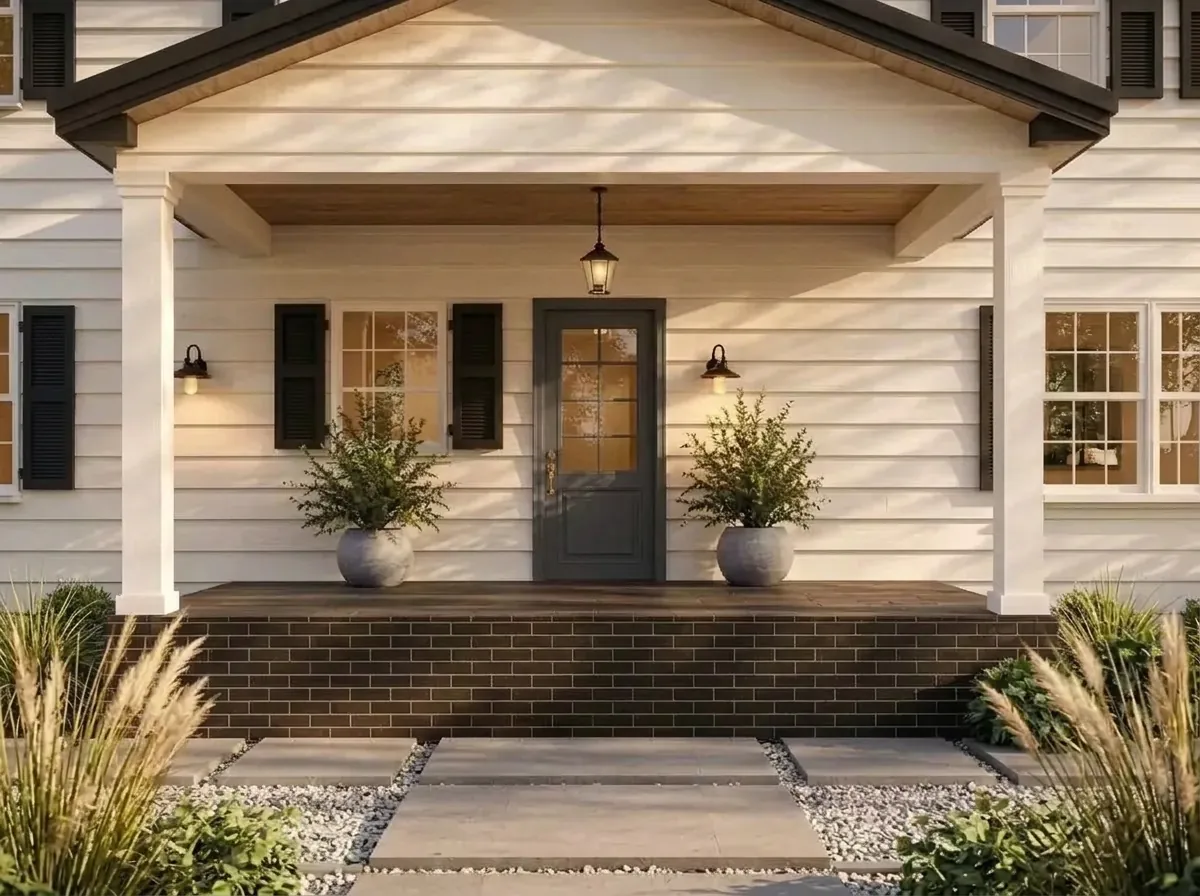
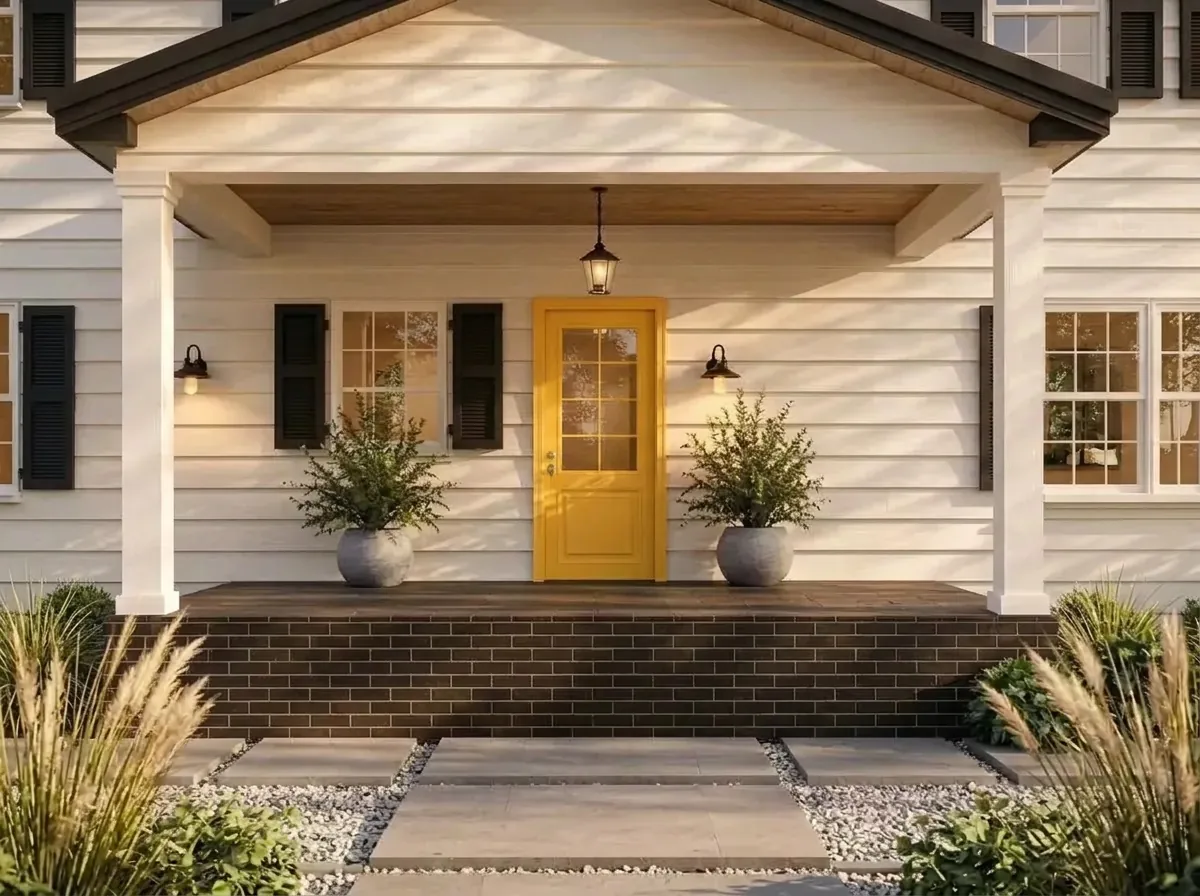
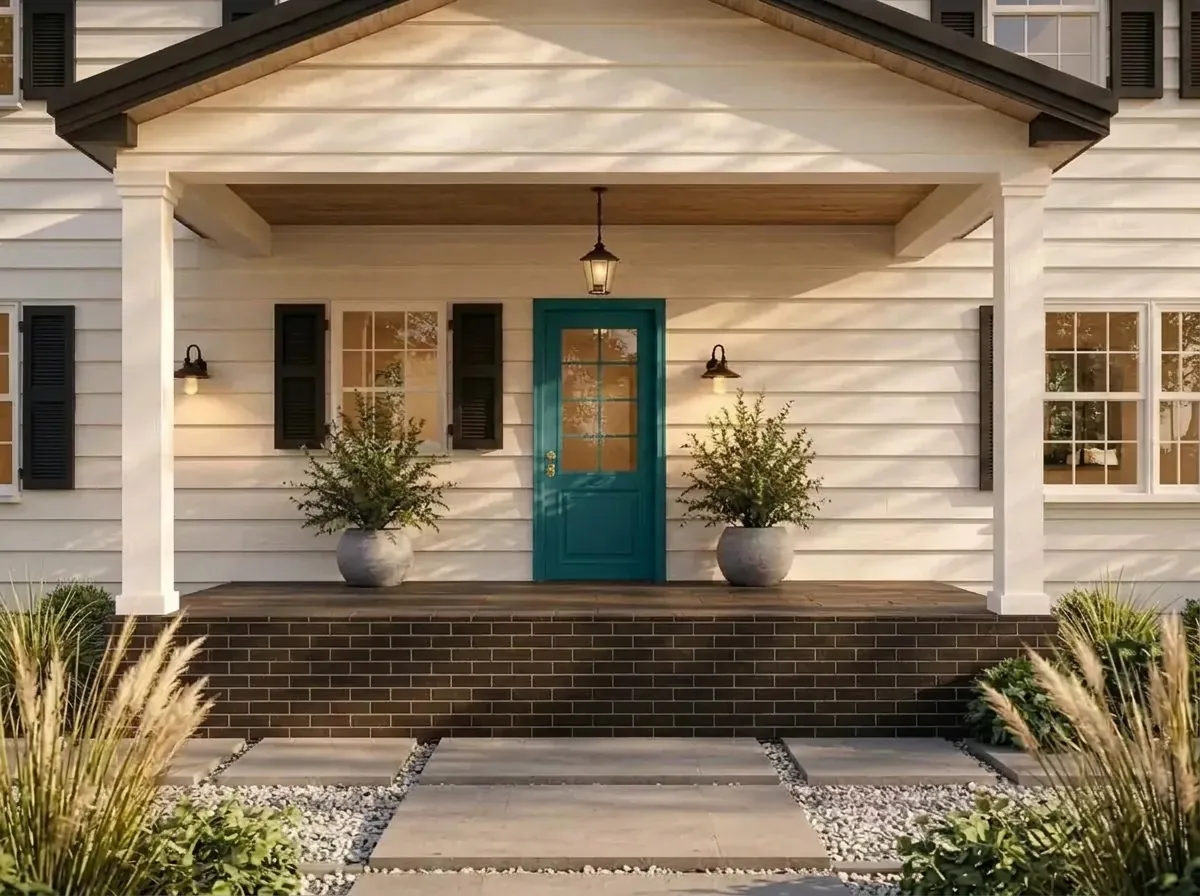
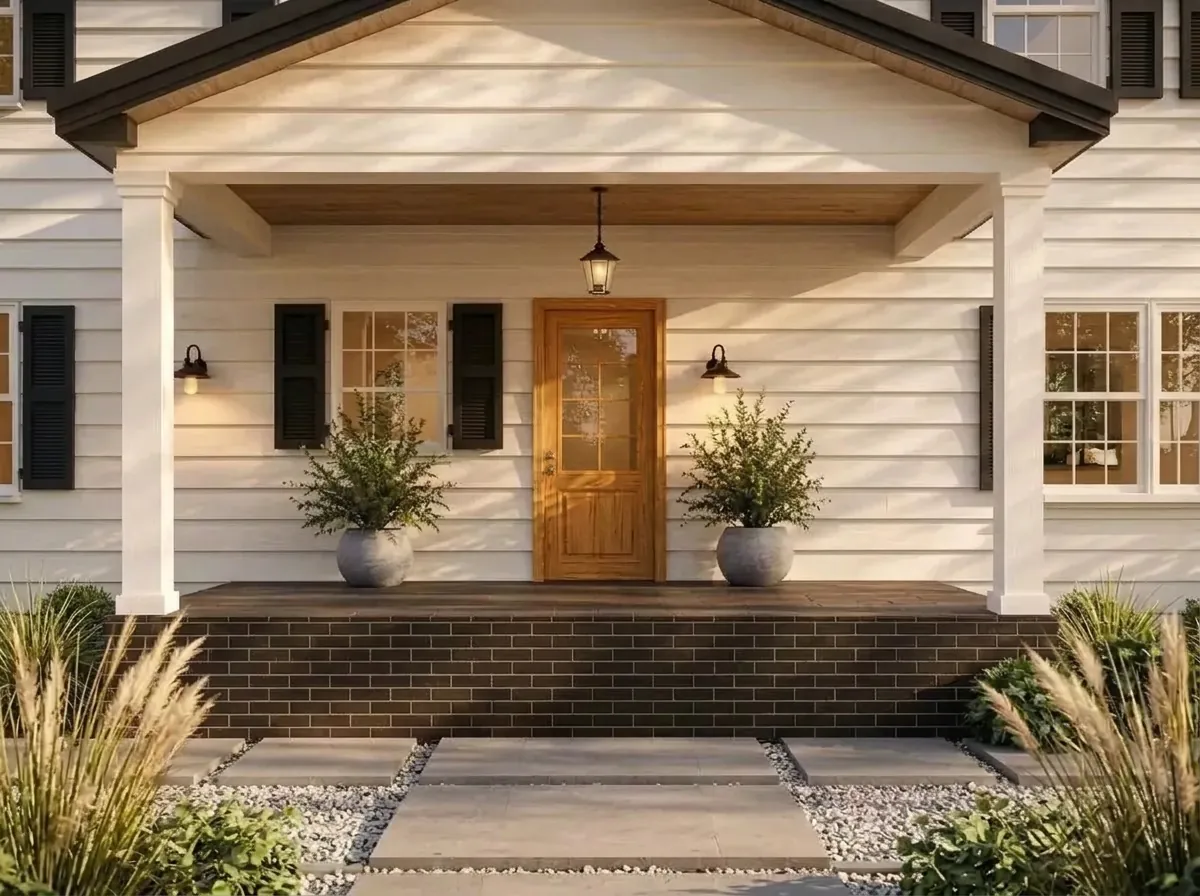
We asked for “natural stained oak” and got a warm golden oak, more orange than most people would pick. Real stain samples run from this down to a near walnut; ask for a sample door or panel before committing. Hardware also shifted slightly between panels, a known quirk of AI edits on small details.
Three things the series shows that a chart cannot. First, contrast is the whole game on a white house: black, navy and red all read from the street, while charcoal and sage nearly disappear against white siding and black shutters. Second, the shutters vote: once black shutters are on the facade, a black door matches them and every other color has to stand next to them, which is why the dark colors look so settled here. Third, the bright colors are less risky than they sound when everything else is neutral; yellow and teal look designed on this house because nothing else on it is competing. For the wording that keeps the rest of a photo still while you change one element, our AI exterior design prompts list the lines that work.
The Most Popular Front Door Colors
Black is the most popular front door color in the US, red is second, and white, blue, green and gold follow, according to Houzz’s May 2024 survey of 1,106 US users. Houzz’s exact wording: the colors were “led by black (24%) and red (22%). White (18%), blue (13%), green (11%) and gold (7%)” followed. The paint brands agree on the top. Sherwin-Williams’ front door page leads with Tricorn Black SW 6258 and says “Rich black hues, such as Tricorn Black, provide a powerful yet elegant statement that complements nearly any exterior.” Benjamin Moore’s front door page lists its most popular front door paint colors as Marblehead Gold HC-11, Yarmouth Blue HC-150, Salamander 2050-10, Black HC-190, Iron Mountain 2134-30 and Caliente AF-290.
Shares: Houzz curb appeal survey, fielded to US Houzz users in May 2024, 1,106 respondents (archived copy read 28 October 2026). Paint names: the Sherwin-Williams and Benjamin Moore front door pages, read 28 October 2026. The brand columns are colors each brand features for doors, not a sales ranking; no brand publishes front door sales by color. Neither page features a white for doors.
What about 2026 specifically? No one publishes front door data for 2026 yet, and the Colors of the Year are not door colors: Sherwin-Williams picked Universal Khaki SW 6150, Benjamin Moore picked Silhouette AF-655, described as “rich espresso hues with subtle notes of charcoal,” and Behr picked Hidden Gem N430-6A, which its release calls “a smoky jade.” Two of those three do work on a door: Silhouette is a softer alternative to black (its LRV is 10.18, so it is still a dark color for heat purposes), and Hidden Gem sits between teal and dark green. The bigger 2026 shift is material, not paint: Houzz’s 2026 exterior trends report found that “Fiberglass has become the leading front door material (27%),” and our exterior house colors 2026 guide sees the accent moving to warm wood doors.

Benjamin Moore’s Sharon Grech on choosing a front door color (8 minutes, October 2023). A paint brand’s video, so expect its own color names; the method holds for any brand.
Black Front Doors
A black front door is the most popular choice and the best supported by data: it suits nearly every house color, it matches black window frames and hardware, and buyers have paid more for it in both Zillow studies that measured door color. In 2018 Zillow analyzed more than 135,000 listing photos of homes sold between January 2010 and May 2018 and found that “Homes with black or charcoal gray front doors sell for $6,271 more than expected, the highest sales premium of all the room and color combinations analyzed.” In 2022 it switched methods to a survey in which buyers were shown the same door in 11 colors, and black again drew the highest offer, $6,449 more.
Two honest caveats. Zillow’s own 2018 release says the photo findings “may not be reflective of a causal difference in value”: a black door often comes with a recently updated house, and that is what buyers pay for. And the 2022 survey called black “more polarizing,” with some buyers describing it as “imposing”; the best overall score went to slate blue. Treat the dollar figures as evidence that black is safe, not that painting your door black adds $6,000.
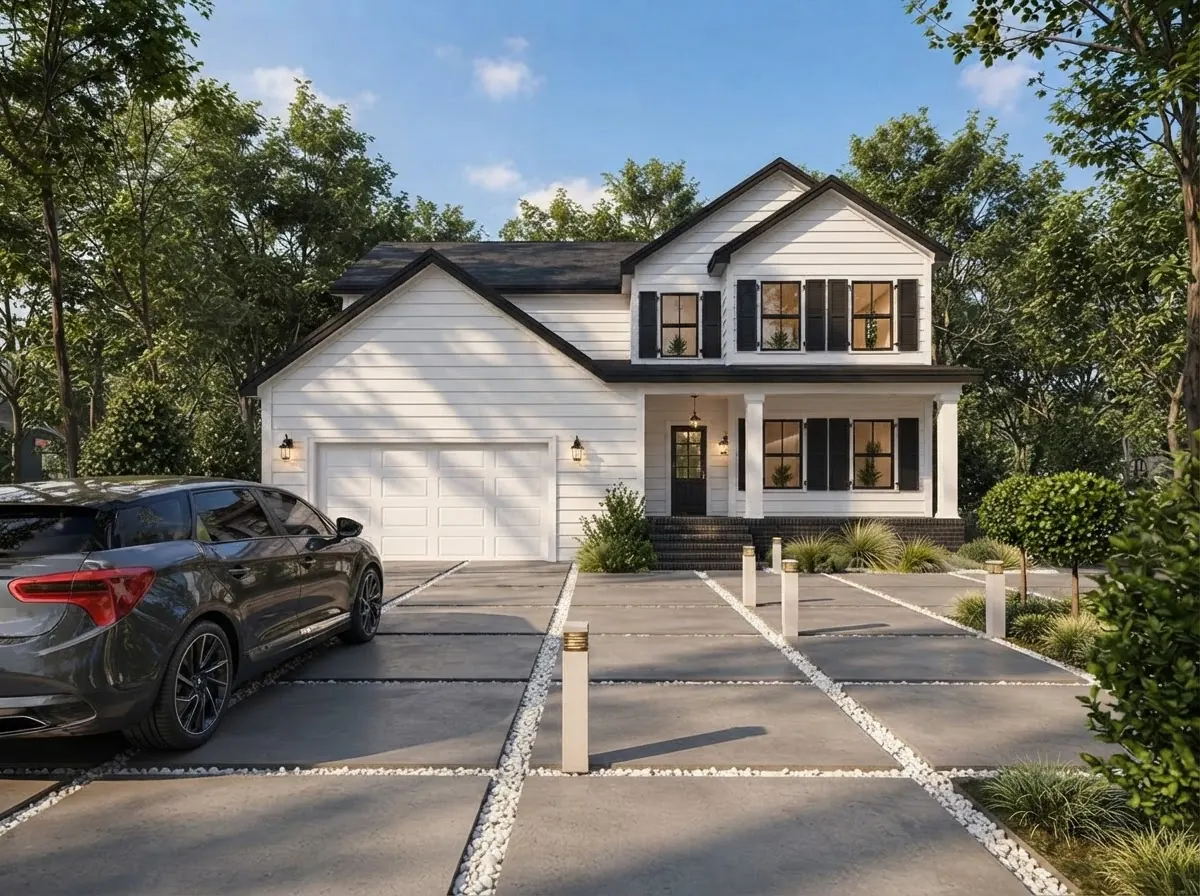
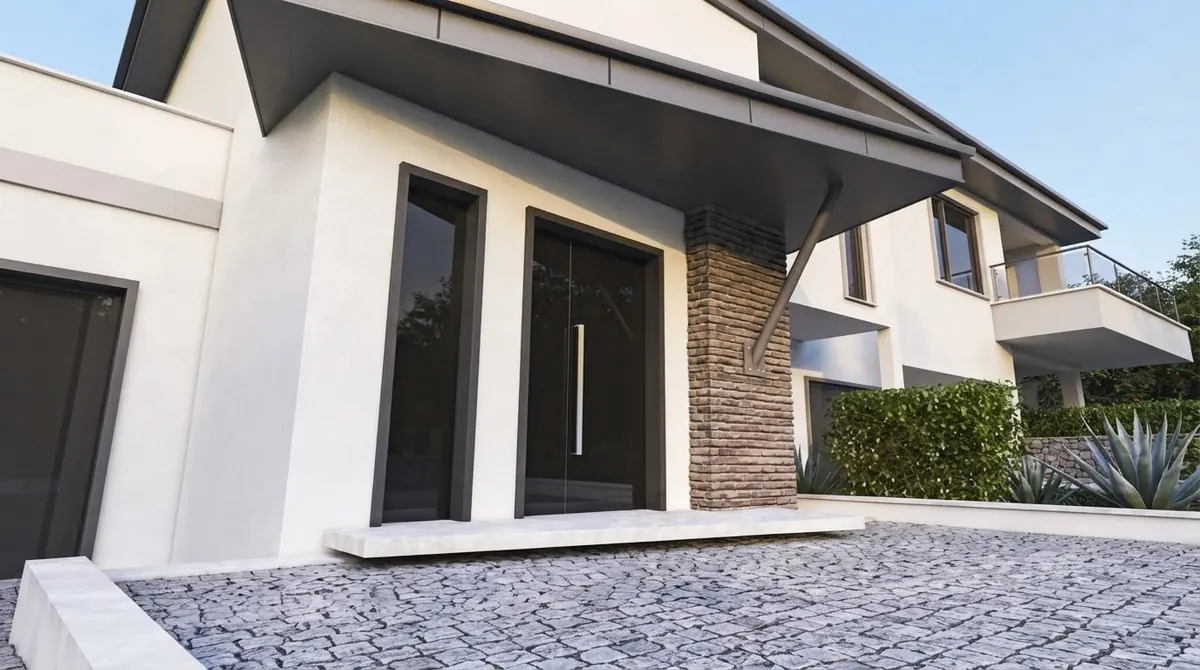
Where black goes wrong: on a dark house with black shutters it becomes one more dark rectangle (pick red, wood or a bright color there), and in full afternoon sun it gets hot enough to matter. Before you paint a fiberglass or steel door black on a west or south facing porch, read the storm door section. If you want the look inside too, our guide to black interior doors covers that version.
Red Front Doors
Red is the second most popular front door color (22% in the Houzz survey) and the classic way to add color to a white, gray, tan or navy house. The reds that work on doors are deep and slightly brown or blue, not fire engine: Sherwin-Williams features Sun Dried Tomato SW 7585 and the softer Coral Clay SW 9005, and Benjamin Moore lists Caliente AF-290 among its most popular door colors. A deep red also forgives dirt and dents better than a light color.
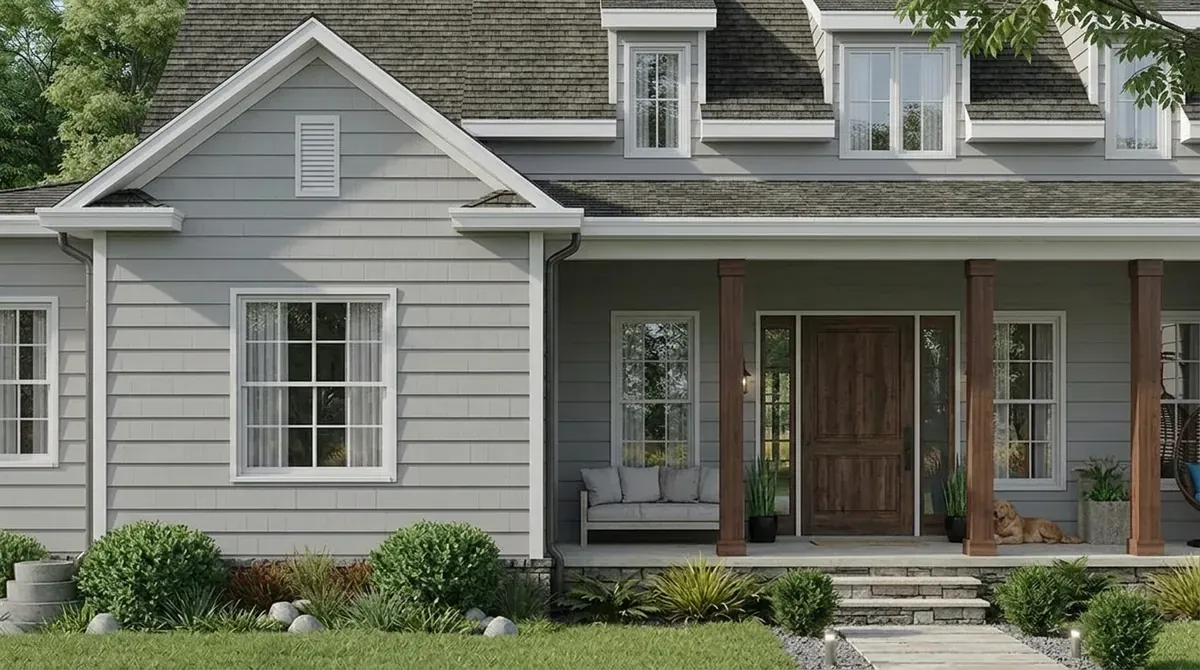
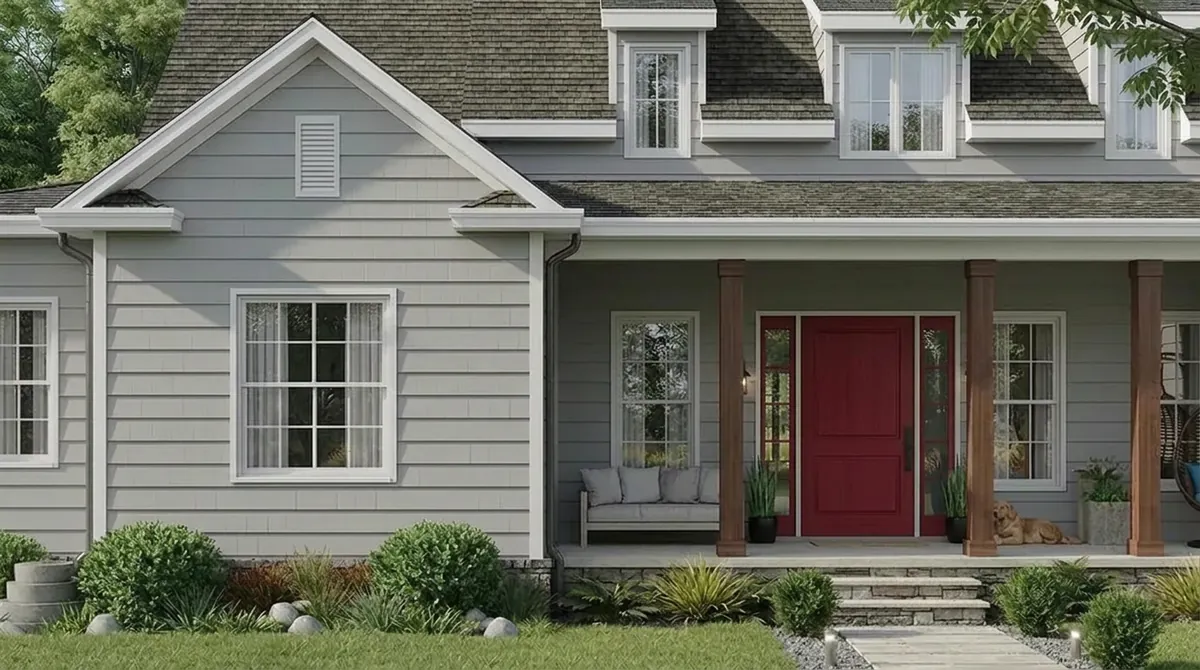
Red needs a little care. It is in the same family as red and orange brick, so on a brick house it either disappears or clashes (see the brick section). Saturated reds fade faster than black or navy on a door that gets afternoon sun, so buy a premium exterior enamel and expect to recoat sooner. And red brings the folklore with it; we cover what is and is not true about red door meanings below.
Blue and Navy Front Doors
Navy is the safest color that is not black, and blue is the color Zillow’s buyers liked best overall. Zillow’s 2017 analysis of more than 32,000 listing photos found that “homes with front doors painted in shades of dark navy blue to slate gray sold for $1,514 more,” and in the 2022 survey slate blue got the top overall score, with a $1,537 premium. Sherwin-Williams features In the Navy SW 9178; Benjamin Moore lists Yarmouth Blue HC-150, a soft gray blue, among its most popular door colors and shows Van Courtland Blue HC-145 on its door page.
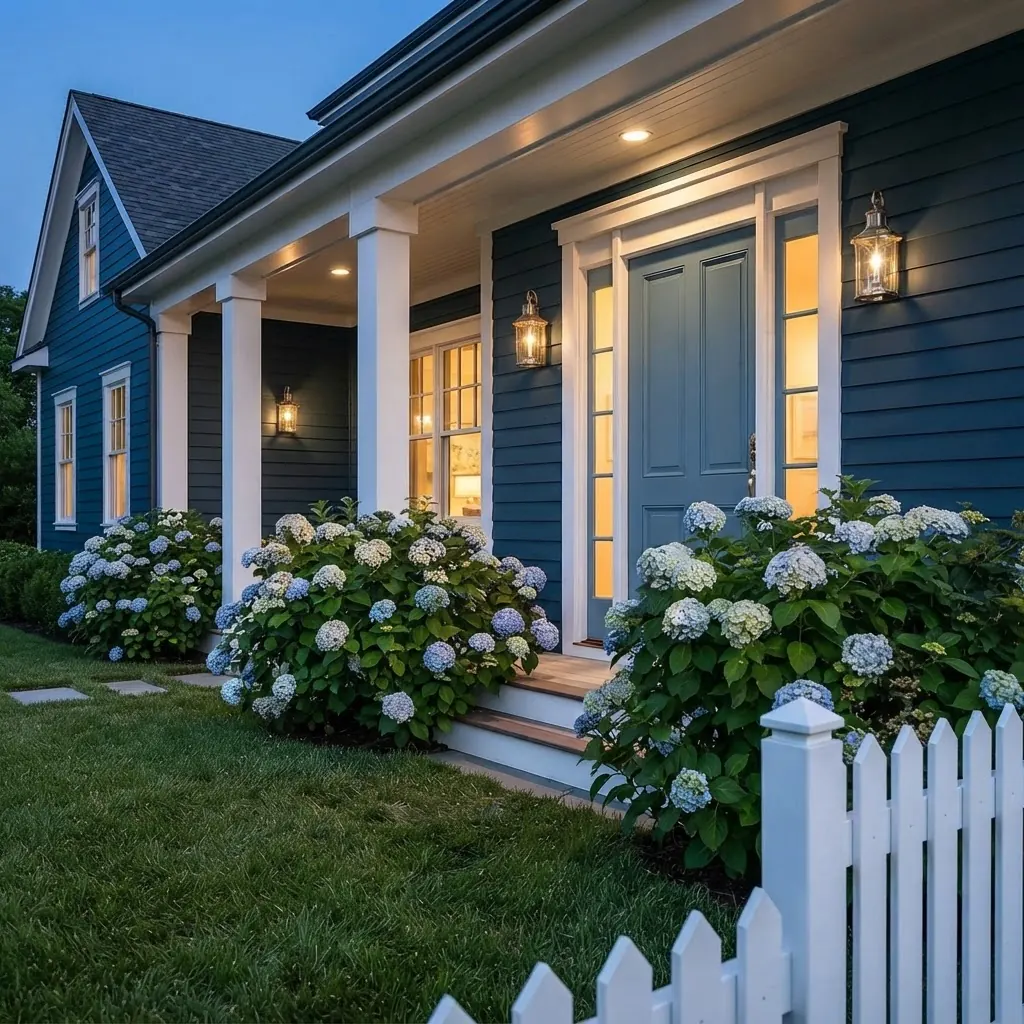
Blue gets harder as the house gets bluer. A navy door on a blue gray house reads as no contrast at all; there, go to black, red or yellow. On a yellow or tan house, navy is the best door you can pick. Pair a light blue door with a dark or navy house, as above, and keep the trim white so the door has an edge.
Green Front Doors
Dark green is the most traditional color door after black, the natural partner for red brick, and in Zillow’s 2022 survey olive green still carried a $969 premium. Sherwin-Williams features Hunt Club SW 6468 and Retreat SW 6207, a gray green; Benjamin Moore lists Salamander 2050-10, a green so dark it reads black in shade, and shows Salisbury Green HC-139 and Mohegan Sage 2138-30. Behr’s 2026 color, the smoky jade Hidden Gem, sits right between green and teal.
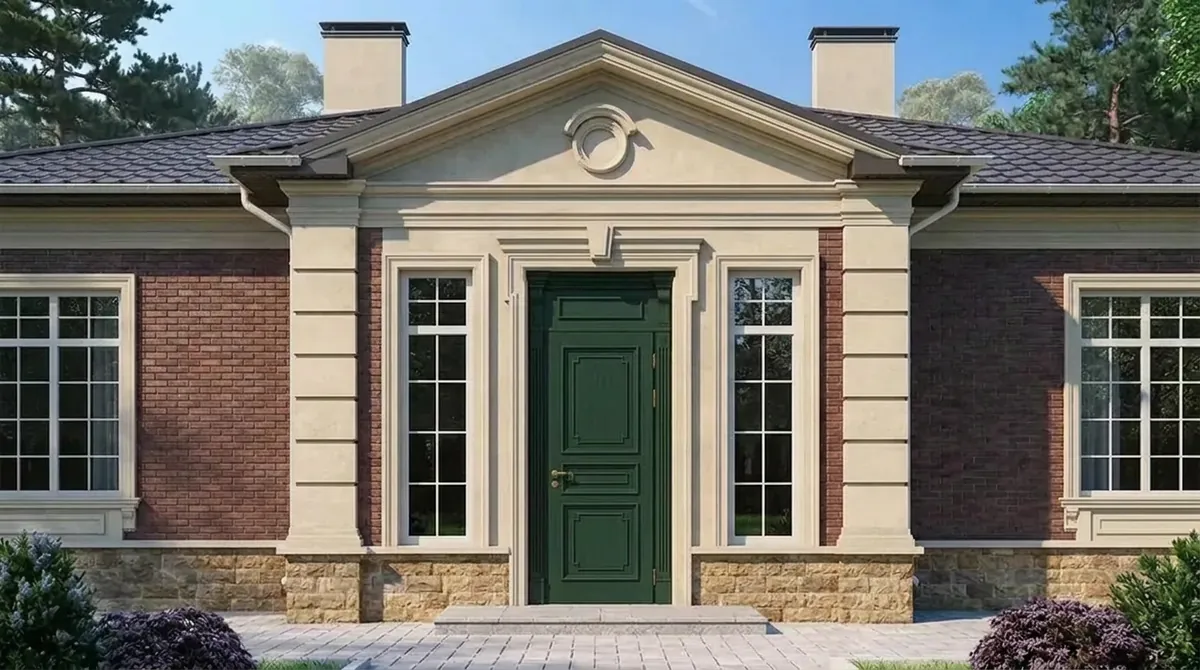
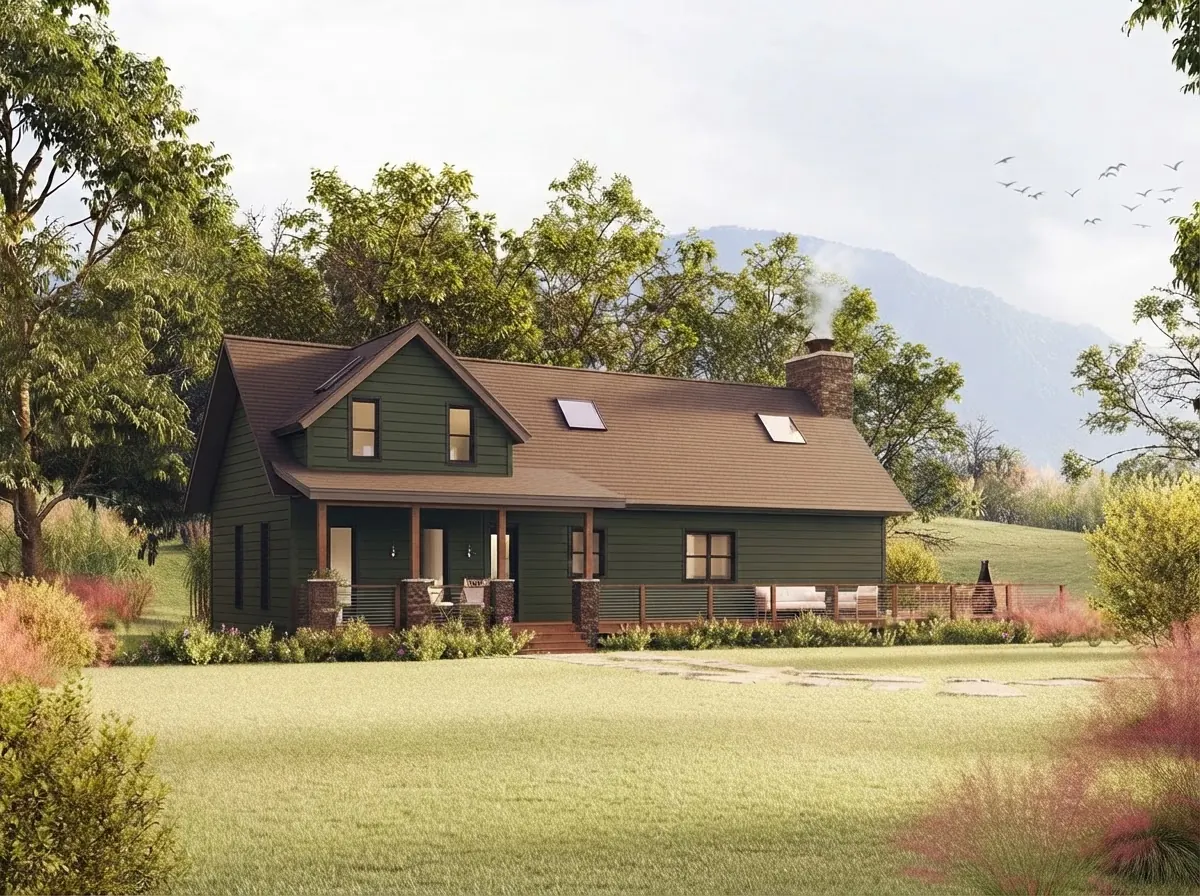
Sage is the light end of green, and it is where green goes wrong most often: our starting image had a sage door on white siding, and from the street it barely registered. Sage works on a cream, tan or stone house where it has something to contrast with, and on a door with strong black hardware. If your house is already sage, see the table below; our vinyl siding colors guide shows sage houses with black and white doors.
Yellow, Teal and Other Bold Front Doors
Bold door colors are safer than they look when the rest of the house is neutral: yellow, teal, coral and orange read as deliberate on white, gray, black and navy houses and as a mistake on beige, tan and orange brick. Benjamin Moore’s most popular door list includes Marblehead Gold HC-11, a muted mustard, and its door page FAQ adds Aegean Teal 2136-40. Sherwin-Williams shows Forsythia SW 6907 and Rookwood Amber SW 2817 at the top of its door page. Gold made up 7% of doors in the Houzz survey.
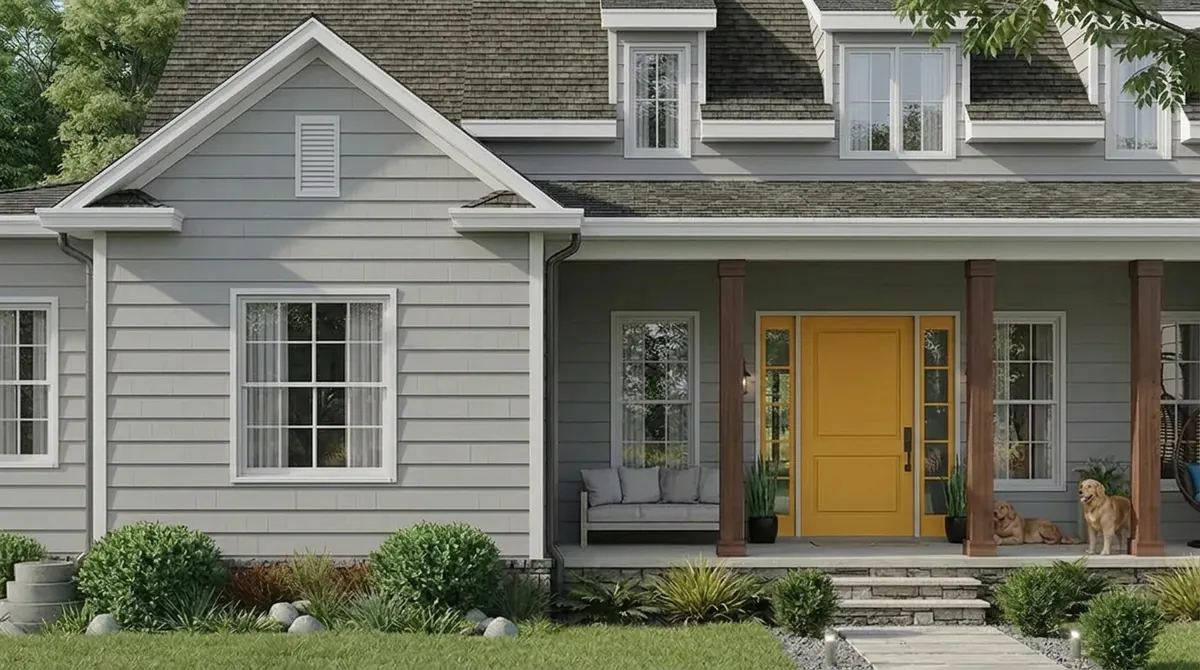
One warning from the data: not every bold color is a crowd pleaser. In Zillow’s 2022 survey a pale pink front door came with an offer $6,516 below the baseline, the biggest penalty of the 11 colors, and cement gray got the lowest overall score. If you might sell in the next two or three years, keep the bold color to a muted version (mustard rather than lemon, teal rather than turquoise) and let it be the only bright thing on the facade.
Wood and Stained Front Doors
A natural wood door is the fastest growing alternative to paint, and on dark, stone and craftsman houses it is often the best front door color of all. It warms a black, charcoal or dark green facade that would swallow a black door, and it repeats wood that is already on many houses: porch ceilings, posts, beams and garage doors. Real wood doors need refinishing every few years in full sun, which is one reason fiberglass doors with a molded wood grain and a factory stain now lead the market; Houzz’s 2026 report puts fiberglass first among front door materials at 27%.
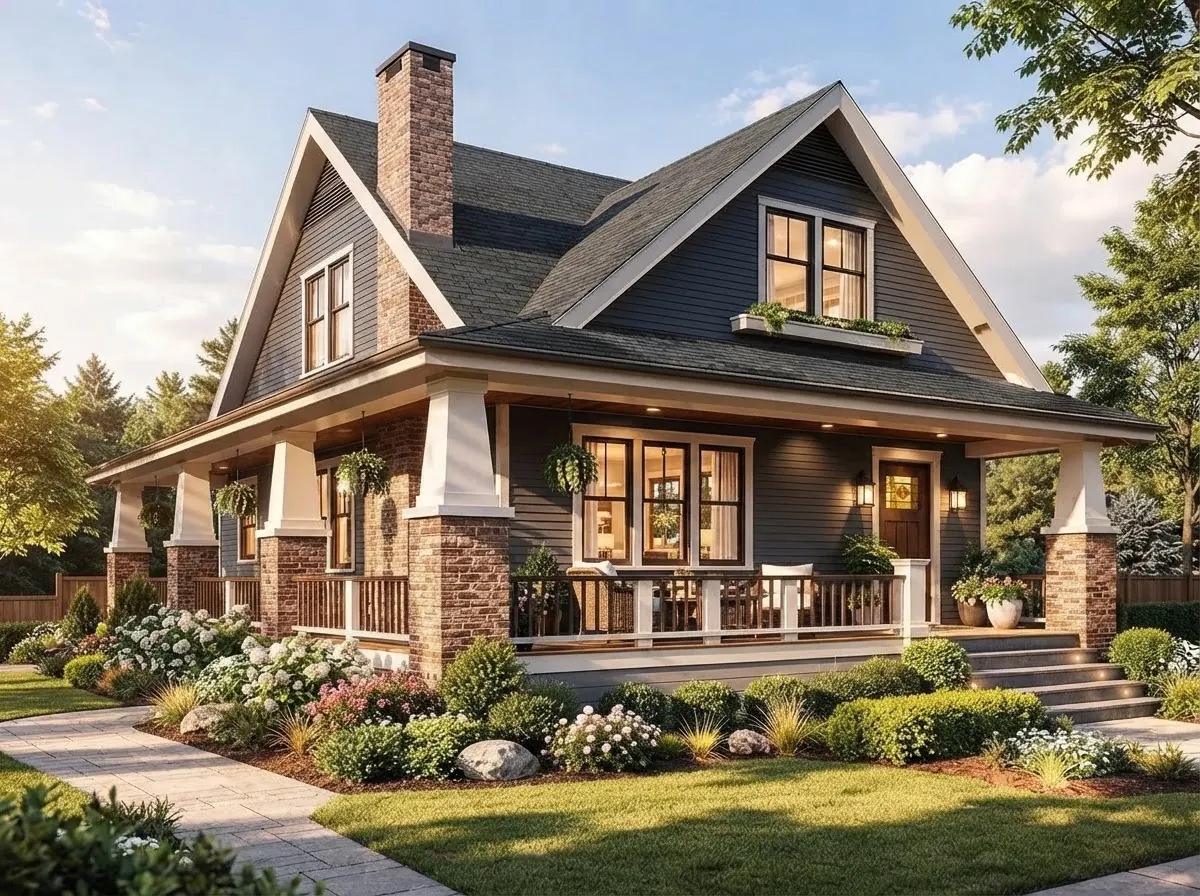
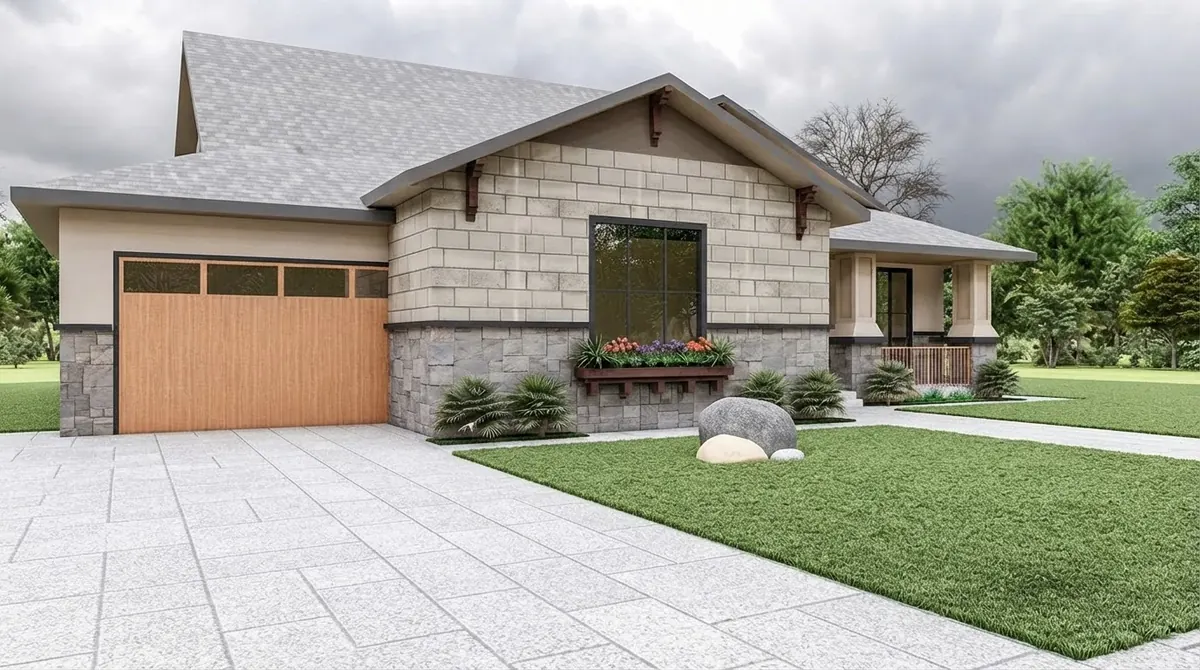
The trap with wood is orange. Fresh stain on oak and on fiberglass grain often comes out more golden than the sample, as our own demo did, and an orange door ages a house. Ask for a medium brown or walnut stain, look at a stained sample outdoors, and match the undertone of any other wood on the house. For door sizes and styles before you buy a new slab, our standard door sizes guide has the dimensions.
Front Door Colors for a White House
On a white house the best front door colors are black, navy, red and a natural wood stain, in roughly that order of safety, and white is the one house color where a bright yellow or teal still looks intentional. The demo at the top of this page is a white house, and its lesson holds: anything with enough contrast to read against white works, anything pale (sage, light gray, white) vanishes. With black shutters, the door either matches them (black) or becomes the only color on the house (red, navy, yellow, teal).
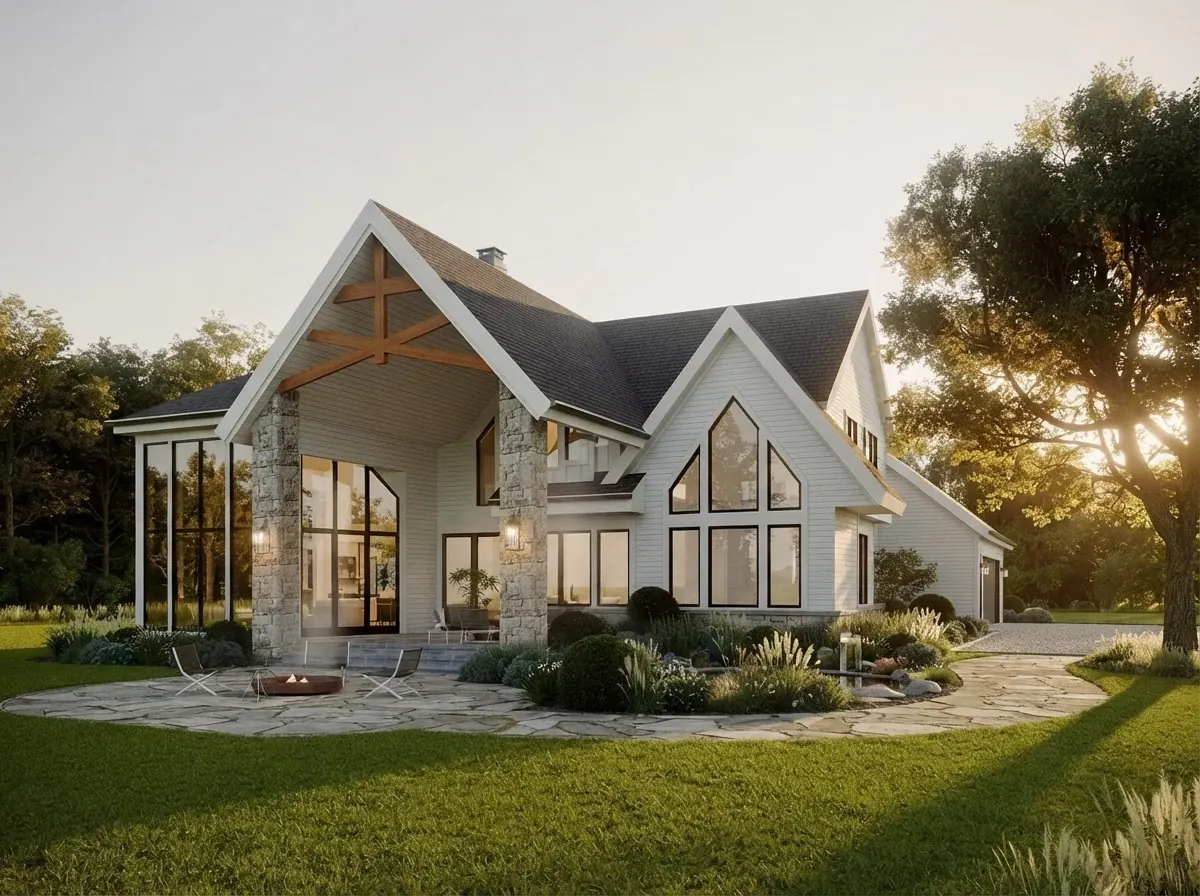
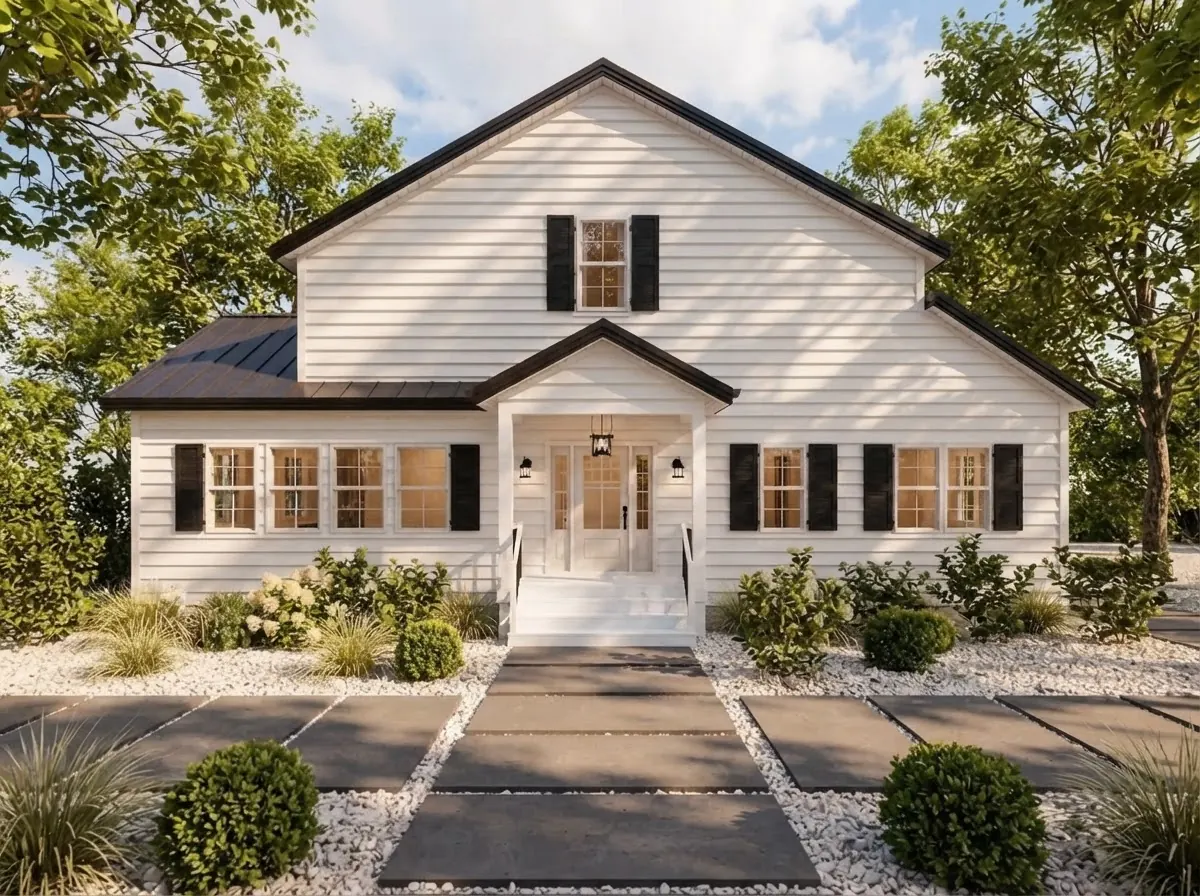
Warm white versus cool white matters more than people think. A creamy white house takes warm doors best: red, mustard, dark green, wood. A crisp cool white takes black, navy and teal. If you are also choosing the white itself, our guides to Alabaster and the rest of the 2026 exterior palettes show the warm and cool versions on whole houses.
Front Door Colors for a Gray House
A gray house takes almost any saturated front door color: red and yellow for the most contrast, navy, black and dark green for a quieter look, and wood to warm it up. Gray is neutral, so the door becomes the color of the house. The only rule is temperature: a warm greige house wants warm doors (red, wood, mustard), a cool blue gray house wants cool ones (navy, teal, black). A mid gray door on a gray house is the one combination to skip; it is the cement gray that Zillow’s 2022 buyers scored lowest of all eleven colors.
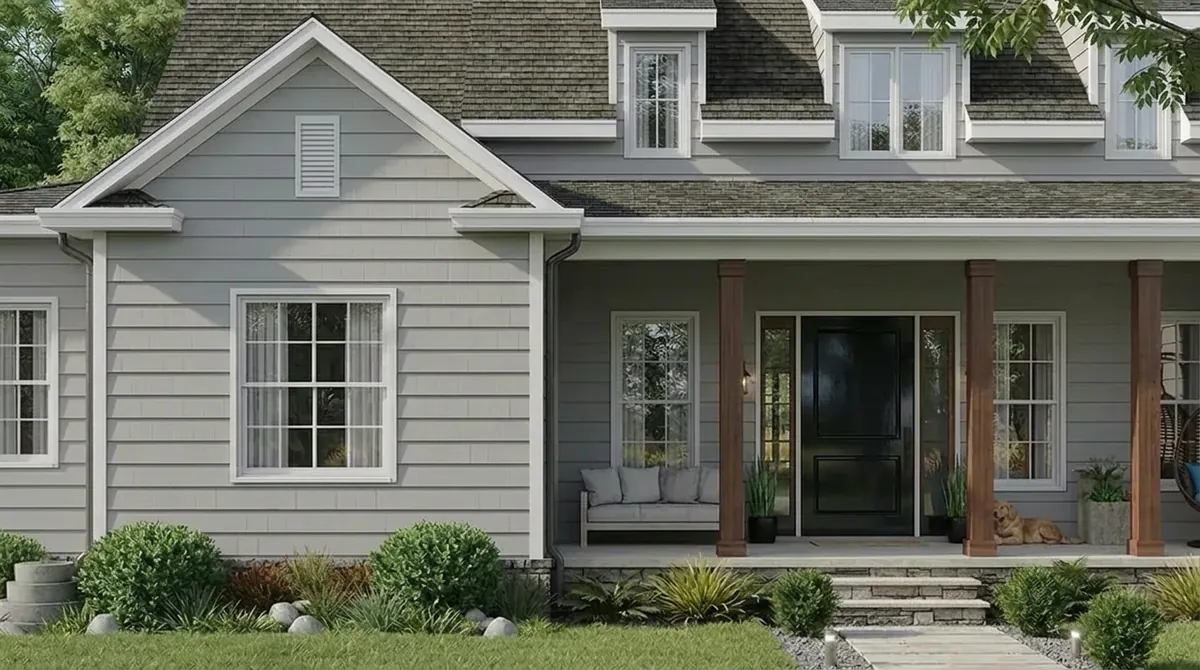
Our gray demo above shows the four main choices on one light gray cape: wood (the original), red, yellow and black. Red is the classic, yellow the friendliest, black the most formal, and the original wood is the one that best matches the wood porch posts. Pick by what else is on the facade, not by the door alone.
Front Door Colors for a Red Brick House
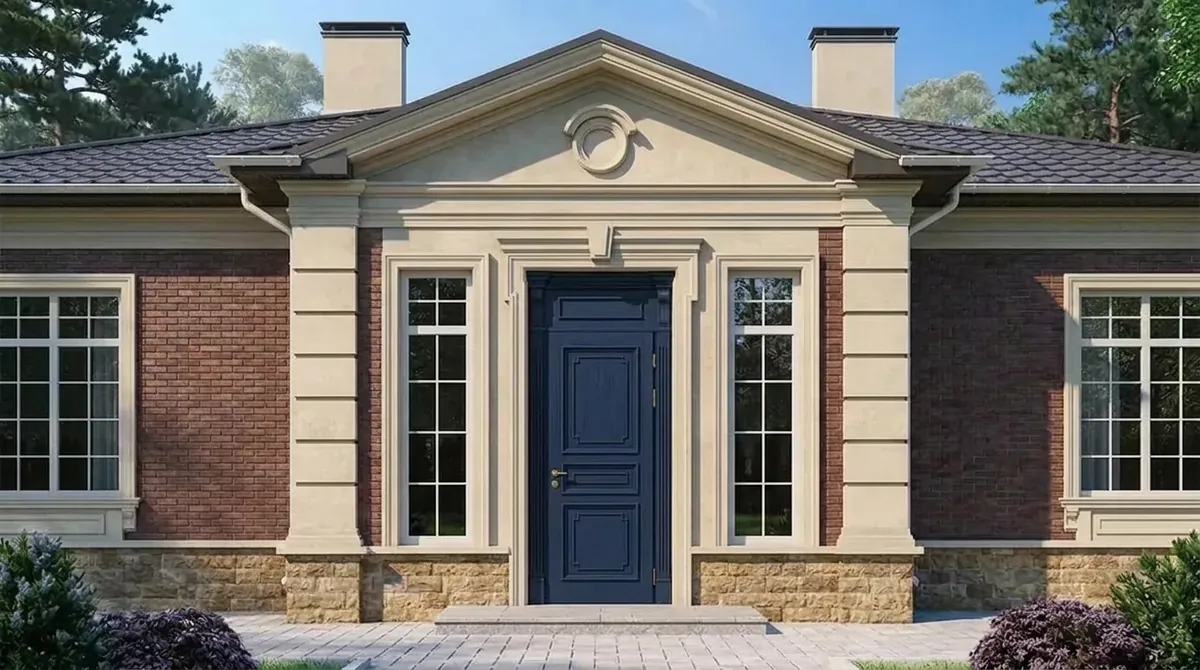
For a red brick house the best front door colors are black, dark green, navy and natural wood. Black and navy are neutral and make the brick look richer; dark green is the complement of red and the traditional contrast; a medium wood stain sits in the same warm family as the brick and the mortar. What to avoid: a red door that is close to the brick (it disappears or fights), and bright yellow or orange on orange toned brick.
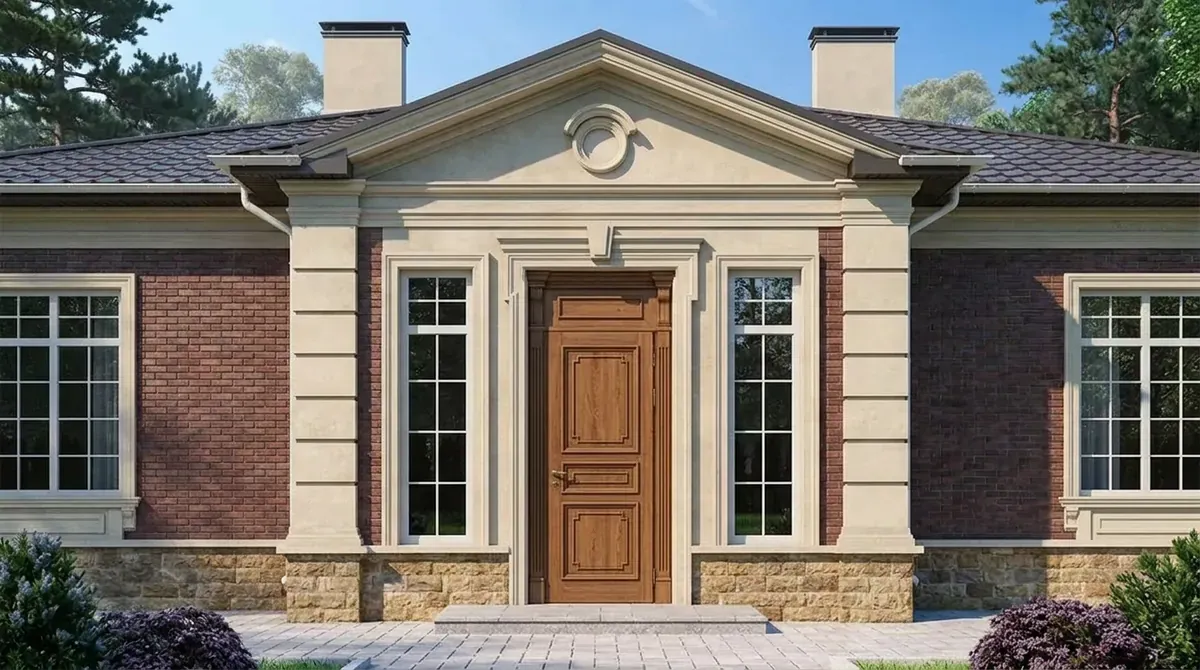
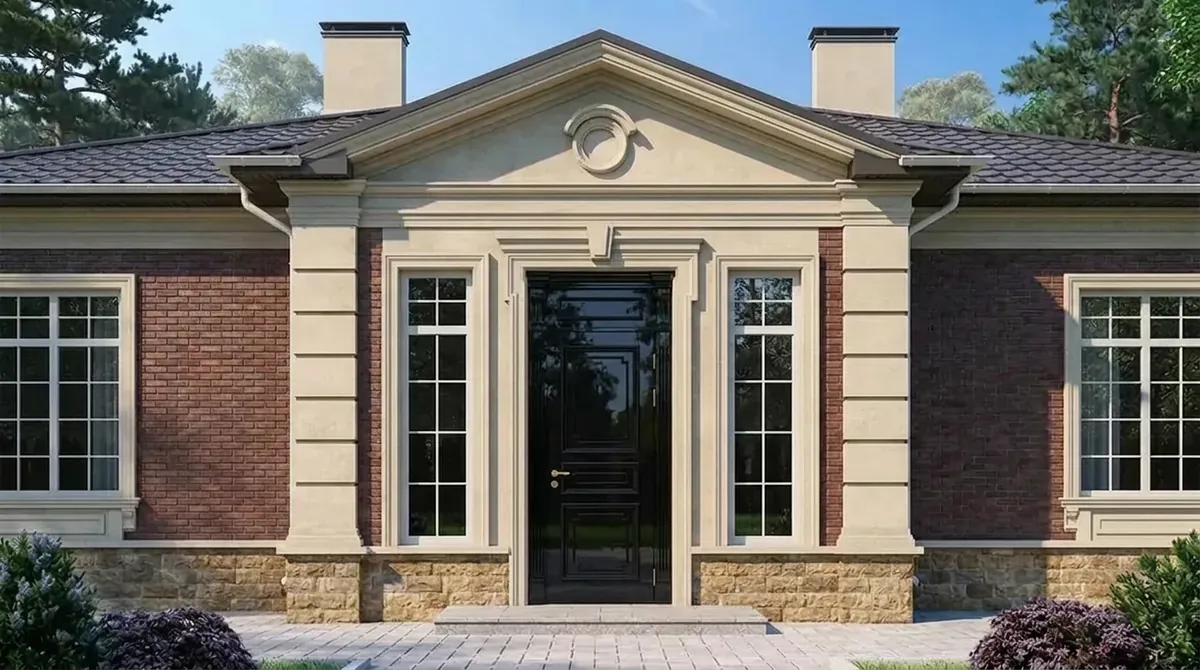
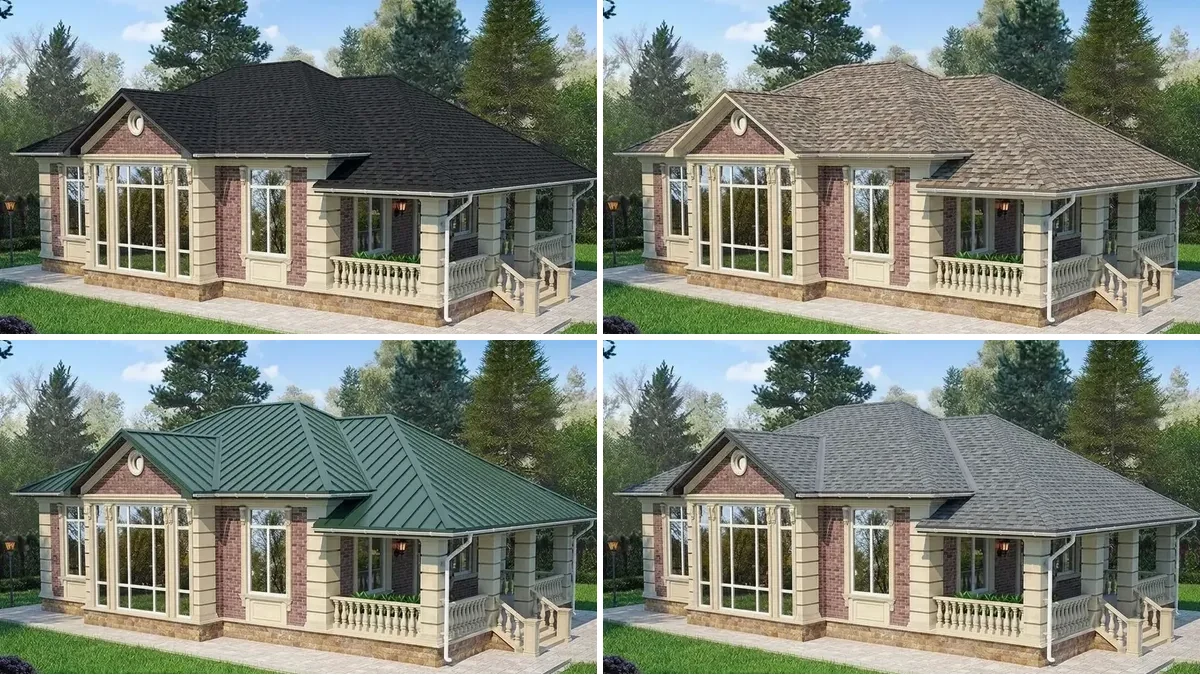
Two things to check before you choose. Look at the mortar: cream or tan mortar likes warm doors (wood, green, warm black), gray mortar likes cool ones (navy, black). And look at any stone or painted trim around the door, like the cream surround in our demo; the door has to agree with the trim first and the brick second. For the roof above the same house, our roof shingle colors guide re-roofs this kind of brick ranch eight ways.
Front Door Colors for Tan, Beige, Blue and Sage Green Houses
Match the door to the house color you cannot change, then choose contrast or harmony. The table below covers the house colors people search most after white, gray and brick. It is a starting list, not a rule; run your top two on a photo of your own house before buying paint.
Our pairing guide, built from the demos on this page and the color advice on the Sherwin-Williams and Benjamin Moore door pages. These are design judgments, not survey data.
Front Door and Shutter Color Combinations
The door and the shutters should either match exactly or contrast on purpose; two slightly different dark colors side by side is the combination that looks like a mistake. Black shutters with a black door is the most common and the most formal pairing. Black shutters with a red, navy, green or yellow door is the classic way to add one color. The demo’s charcoal panel shows the failure: a dark gray door next to black shutters reads as a faded copy of them.
If you are also adding or repainting the porch around the door, our modern front porch ideas guide shows how a dark door, one good light and a pair of planters make a small entry look designed.
Dark Front Doors, Sun and Storm Doors: Read This Before You Paint
A dark door in full sun gets much hotter than a light one, and behind a glass storm door it can get hot enough to warp panels and void the door’s warranty. This is the part most color guides leave out, and it comes straight from the door makers. Pella’s fiberglass and steel entry door owner’s manual warns that “The combination of a darker color and direct sun can affect the panel material” when a storm door is used, and adds: “The use of a storm door of any type in higher temperature climates is not recommended.” Its storm door article is blunter: “If your porch receives more than a few hours of direct sunlight in a day, you should forgo the storm door.”
Masonite’s exterior door warranty (products shipped after 1 August 2019) excludes “Damage resulting from or related to a Product being installed behind a non-vented storm door or excessive heat due to being finished a dark color.” Therma-Tru’s owner’s manual allows storm doors but only “properly installed and properly vented,” and says its PVC glass frames “are not recommended to be painted dark colors.” Different brands, same message.
- North or east facing, or under a deep porch: paint it any color you like.
- South or west facing in full sun, no storm door: dark is usually fine on fiberglass and steel; check your door’s warranty for a color limit.
- Full sun plus a glass storm door: choose a lighter color, a vented storm door, or no storm door. This is the case the warranties exclude.
- Vinyl or PVC parts (glass frames, some trim): do not paint them dark unless the maker says you can.
Sources: Pella owner’s manual (copyright 2020) and storm door article, both read through archived copies because pella.com blocks automated access; Masonite exterior door limited warranty PDF (hosted by a retail content service, not masonite.com); Therma-Tru owner’s manual (2015). Your door’s own warranty is the one that counts; it is usually printed on the box or the maker’s site.
Front Door Color Meanings and Feng Shui
Front door color meanings are tradition and folklore, not rules, so use them as a tiebreaker if they appeal to you. The most repeated one, that a red door in Scotland means the mortgage is paid off, has no documented source we could find; a University of California, Santa Barbara art history lab post on red doors lists it as “one interpretation that doesn’t apply.” Other common readings: red for welcome and protection, black for formality and status, blue for calm, green for growth, yellow for optimism.
Feng shui ties door color to the direction the door faces. As Homes & Gardens summarizes the common system: a north facing door is Water and takes “Blue, black, white, and gray”; a south facing door is Fire and takes “Red, yellow, pink and purple”; east is Wood (green, brown); west is Metal (“White, gray, yellow and light brown”). It is a tradition with several schools, not data, and a magazine summary rather than a classical text.
Feng shui column: Homes & Gardens, last updated 20 November 2022. Practical note: our addition, based on sun exposure and the door makers’ heat guidance above.
The Best Paint for a Front Door
Use an exterior door and trim enamel in satin, semi-gloss or gloss, not leftover wall paint: door paint is made to level out brush marks, resist blocking (sticking to the weatherstrip) and stand up to hands and keys. The two products most painters name are Benjamin Moore’s Aura Grand Entrance and Sherwin-Williams’ Emerald Urethane Trim Enamel. Their own data sheets:
Benjamin Moore technical data sheets 147 and 148 (2 September 2020); Sherwin-Williams Emerald Urethane product data sheet (compliance dated 24 March 2026). Benjamin Moore’s own front door page now recommends its Element Guard and Advance High Gloss lines for doors as well, and Sherwin-Williams also suggests SnapDry, which “dries to the touch in about an hour.”
Sheen is the decision people get wrong. High gloss looks expensive on a smooth, well prepared door and shows every dent and brush mark on an old one. Satin is the forgiving choice for a paneled wood door with some history. Semi-gloss sits in between and is what most painters use. Whatever you buy, check that it is rated for your door’s material: bare fiberglass and steel need the right primer, and some fiberglass doors are meant to be stained, not painted.
How to Paint a Front Door
Painting a front door takes a weekend: an hour of prep, two thin coats, and enough drying time that the door can close without sticking. Therma-Tru’s owner’s manual gives the conditions that matter: “Work only when temperatures are between 50° and 90° F,” “Do not finish in direct sunlight,” clean first with “mild detergent and water or use a TSP” cleaner, and use “high-quality acrylic latex house paint.”
- Pick the day. 50 to 90°F, dry, out of direct sun. Morning on a west facing door, afternoon on an east facing one.
- Clean and degloss. Wash, rinse, let it dry, then scuff old glossy paint with fine sandpaper so the new coat bites.
- Remove or mask hardware. Knob, lockset, kick plate off; tape glass, hinges and weatherstripping.
- Spot prime. Bare wood, bare metal and filler patches get a primer made for that material.
- Paint in order. Recessed panels first, then the center and horizontal rails, then the vertical stiles, keeping a wet edge.
- Second coat, then wait. Respect the recoat time on the can, and leave the door ajar until it no longer feels tacky. Full cure takes days.

Ask This Old House: painter Mauro Henrique repairs and repaints an old front door (10 minutes). We have no relationship with This Old House.
How to Choose a Front Door Color: Seven Checks
- List what you are not changing. Siding or brick, trim, shutters, roof, stone, the garage door. The door has to agree with these.
- Pick a side: match or contrast. Match the shutters (usually black), or make the door the one color on the house.
- Check temperature. Warm houses (cream, tan, red brick) take warm doors; cool houses (crisp white, blue gray) take cool ones. Black, navy and wood work both ways.
- Check the sun and the storm door. Full afternoon sun plus a glass storm door means a lighter color or a vented storm door.
- Check the HOA. Many associations approve a short list of door colors.
- See it on your own house. Upload a photo of your entry to the AI door visualizer, or the whole facade to the exterior design tool, and run your top three.
- Buy samples of the finalists and paint a board. Hold it against the door in morning and afternoon light. Door colors shift more than wall colors because the door sits in porch shade.
For other ways to preview color, our comparison of exterior paint visualizers covers the brand tools from Sherwin-Williams, Benjamin Moore and Behr, which show only their own colors, and the roundup of AI exterior design tools covers the rest. For the whole workflow from one photo to a renovation plan, see visualize your home before renovating.
How We Wrote This Guide
We do not sell paint, doors or storm doors. We build MeltFlex, an AI interior and exterior design tool, so the part of this subject we know first hand is what a door color does to a whole entry in a photo, which is why the three demos exist. We made them on 28 October 2026 from renders in our gallery: each starting image was re-shot closer to the entry, then repainted with a one sentence prompt that changed only the door color, sent straight to the image model (Google’s gemini-3.1-flash-image) rather than through the door visualizer’s interface, so your results in the tool can differ in the details. The tool turned our “natural oak” into a golden orange oak, flattened the raised panels on the black brick door, and moved the dog on the gray porch; we say so in the captions instead of regenerating until the pictures flatter the point.
The facts come from primary sources read on 28 October 2026: Zillow’s 2017, 2018 and 2022 paint color releases on its newsroom (its research site blocks automated access); Houzz’s May 2024 curb appeal survey (archived copy) and its 2026 exterior trends report; the Sherwin-Williams and Benjamin Moore front door pages and their 2026 Color of the Year announcements; Behr’s 2026 Color of the Year release as published on PR Newswire (behr.com blocked us); Pella’s entry door owner’s manual and storm door article (archived copies); Masonite’s exterior door warranty; Therma-Tru’s owner’s manual; Benjamin Moore’s Aura Grand Entrance data sheets; Sherwin-Williams’ Emerald Urethane data sheet; Homes & Gardens on feng shui; and the UCSB art history lab post on red doors.
What we could not verify, and therefore left out: any Zillow door figure from 2019 or 2021; ProVia’s and Andersen’s dark color rules; Cost vs Value figures for an entry door replacement (the publisher blocked us); front door sales data by color from any brand, because none publishes it; and any documented source for the Scottish red door story. The images are renders from our gallery and our own demos built from them; none is a photograph of a specific paint or door product.
Front Door Colors FAQ
What is the most popular front door color?
Black. In a Houzz survey of 1,106 US users fielded in May 2024, front door colors were led by black (24%) and red (22%), then white (18%), blue (13%), green (11%) and gold (7%). Black also tops the paint brands’ own lists: Sherwin-Williams features Tricorn Black SW 6258 first on its front door page, and Benjamin Moore lists Black HC-190 among its most popular front door colors. Red is a close second, and navy and dark green are the most common alternatives.
What front door color sells a house for more?
Black, in both Zillow studies that measured it. Zillow’s 2018 analysis of more than 135,000 listing photos found homes with black or charcoal gray front doors sold for $6,271 more than expected, and its 2022 buyer survey found black drew the highest offer, $6,449 more. But the 2022 survey also called black polarizing, and slate blue got the best overall score (+$1,537). Zillow itself says the photo analysis may not reflect a causal difference, so treat door color as a tiebreaker, not an investment.
What color front door goes with a white house?
Black is the classic and the safest, especially with black shutters or window frames. If you want color, navy, deep red, dark green and a natural wood stain all work on white, and white is the one house color where a bright yellow or teal still looks deliberate rather than loud. Avoid a white or pale gray door on a white house unless the door has glass or strong hardware; it disappears. In our same-house test, red and navy read strongest from the street, black read most formal.
What color front door goes with a gray house?
Gray houses take almost any saturated color, because gray is neutral. Red and yellow give the most contrast and are the traditional picks for a light gray house; navy, black and dark green are the quieter ones. Match the temperature: a warm greige house takes red, wood and mustard yellow well, a cool blue gray house takes navy, teal and black. A medium gray door on a gray house is the one combination to skip; Zillow’s 2022 buyers scored cement gray lowest of the 11 door colors.
What color front door goes with a red brick house?
Black, dark green, navy and natural wood are the four that rarely fail on red brick. Black and navy are neutral and make the brick look redder; dark green is the complementary color of red and gives the most classic contrast; a medium oak or walnut stain sits in the same warm family as the brick. Avoid a door in the same red as the brick, and be careful with orange or bright yellow, which can make orange brick look orange. Look at the mortar and any stone trim too, because cream mortar likes warm doors.
Is a black front door a good idea?
Usually, yes: it is the most popular choice and the one Zillow found buyers paid most for. The catch is heat. A black door in direct afternoon sun gets much hotter than a light one, and door makers warn about it: Pella says the combination of a darker color and direct sun can affect the panel material when a storm door is used, and Masonite’s exterior door warranty excludes damage from a non-vented storm door or from excessive heat due to a dark finish. With full sun and a glass storm door, choose a lighter color, a vented storm door, or skip the storm door.
What kind of paint should I use on a front door?
An exterior grade enamel or high quality acrylic latex made for doors and trim, in satin, semi-gloss or high gloss. Benjamin Moore’s Aura Grand Entrance is sold for wood, metal or fiberglass doors and is dry to the touch in 4 to 6 hours with a full cure in 5 to 7 days; Sherwin-Williams Emerald Urethane Trim Enamel is touch dry in 1 hour and recoatable in 4 at 77°F. Higher gloss is easier to wipe clean and shows the panel shadows; satin hides brush marks and dents better.
What does a red front door mean?
Mostly whatever the owner wants it to. The meanings people repeat (a red door as a sign of welcome, a safe house, or a paid off mortgage in Scotland) are folklore; we could not find a historian or heritage body that documents the Scottish mortgage story, and a University of California, Santa Barbara art history lab post on red doors files it under “one interpretation that doesn’t apply.” In feng shui, red is the fire color recommended for a south facing door. In practice red is the second most popular front door color in the US and one of the easiest to live with on white, gray and tan houses.
The summary, if you read nothing else: black and red are the most popular front door colors in America, black is the one buyers have paid most for, and navy, dark green and natural wood are the best alternatives. Match the door to what you cannot change, either match your shutters or make the door the one accent, and think twice about a dark door behind a glass storm door in full sun.
Before you buy a quart, upload a photo of your entry to the AI door visualizer and try your three finalists on your own door. For the walls around it, read vinyl siding colors; for the roof, roof shingle colors; for the whole palette, exterior house colors 2026.