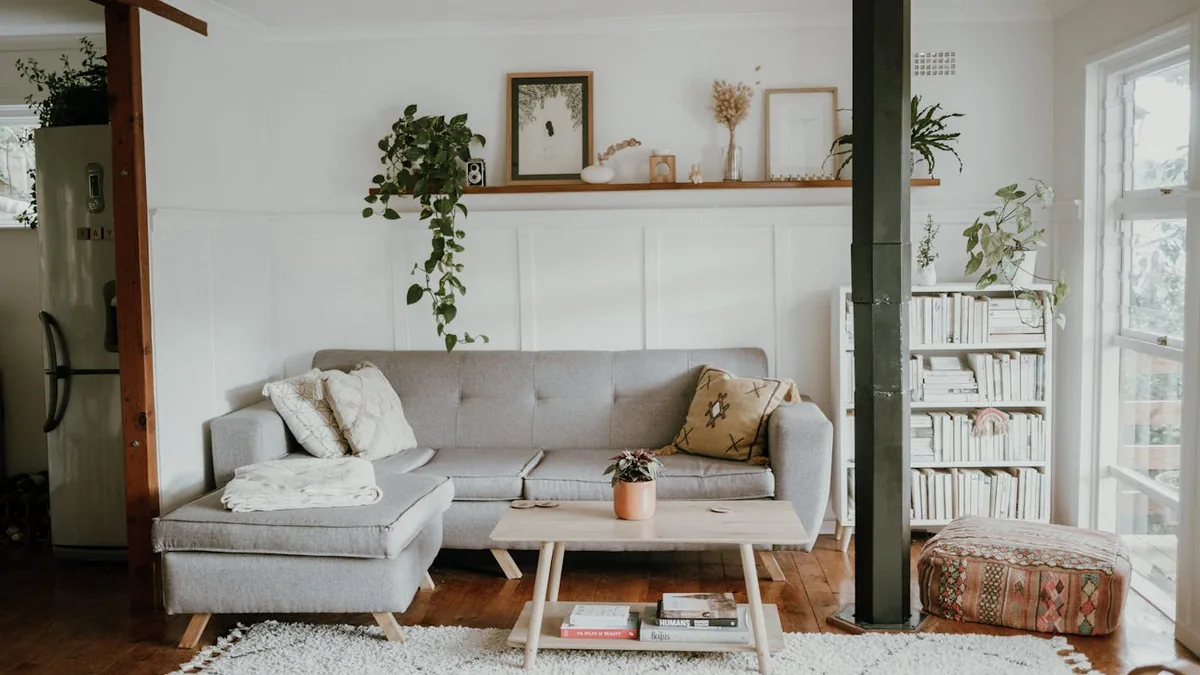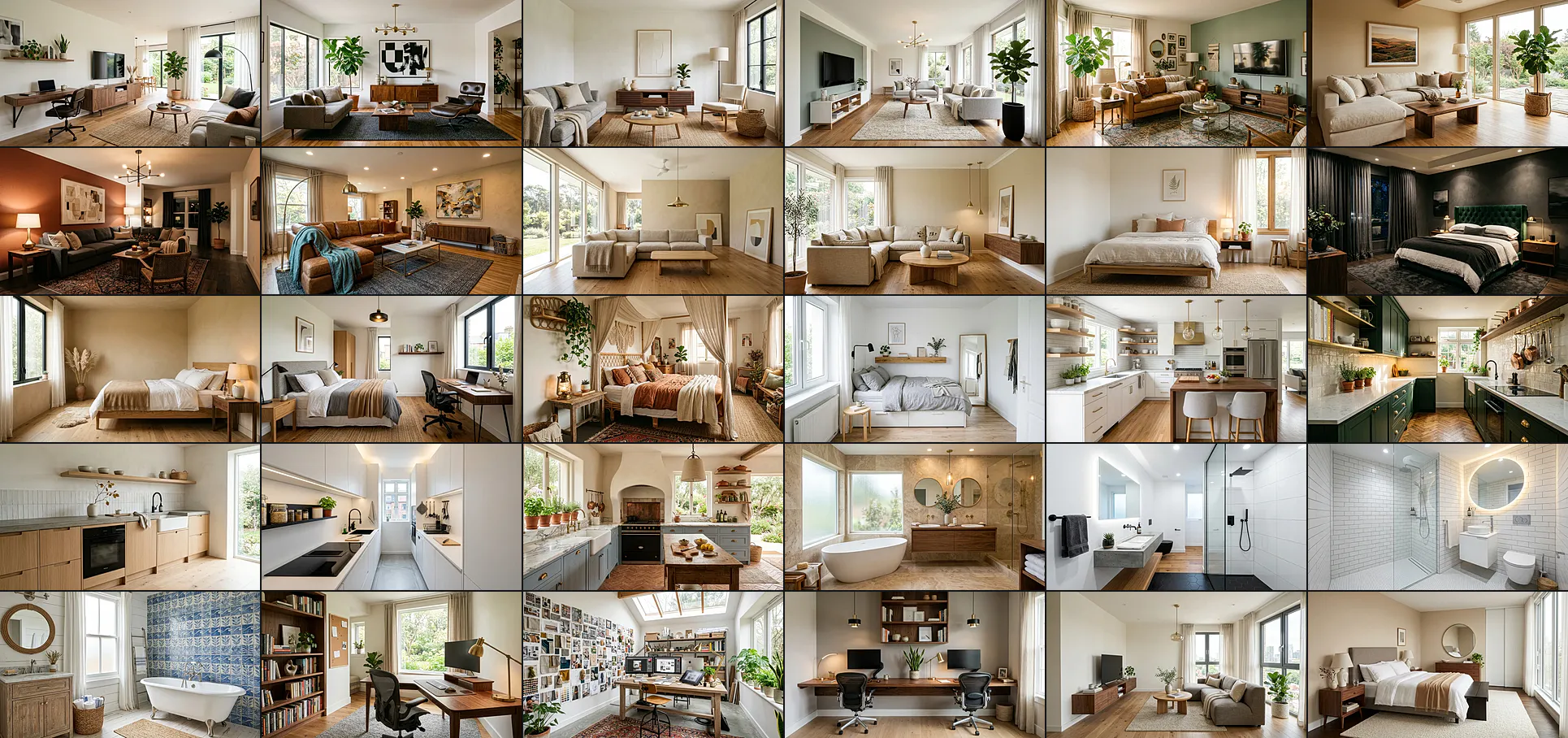
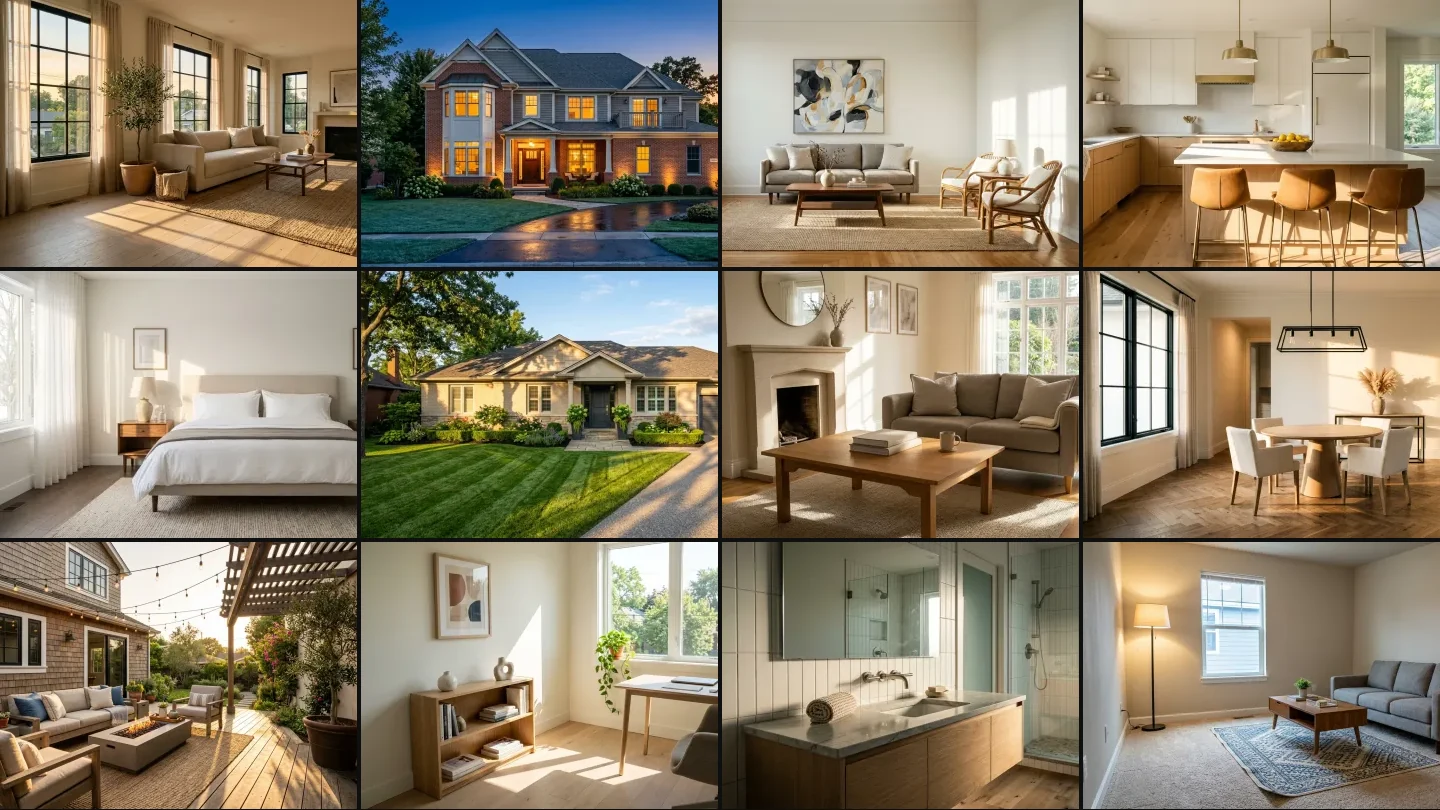
32 tested Nano Banana prompts for real estate photography, grouped by the job: staging vacant rooms, decluttering occupied homes, day to twilight conversions, kitchens and bathrooms, and curb appeal. Every prompt is copy-paste ready, and every image below is an unedited text to image render made with the same Gemini image model Nano Banana runs on, showing the result the prompt beside it is aiming at. The prompts themselves are written for the way you will actually use them, where you upload your own listing photo and Nano Banana edits that photo rather than inventing a room.
Our articles are still written by humans!
Get human written articles in your Google feed.
A Nano Banana real estate prompt is a four-part instruction: the room and its current state, the furniture to add with named materials, the light direction to match, and an explicit list of what must not change. If you would rather skip prompt-writing entirely, the virtual staging AI tool runs the same job with one click and preserves the listing’s exact geometry. Get those four in that order and the model stages a vacant room in aboutfifteen seconds, for free. Get them wrong and it quietly redesigns the house, which is a much bigger problem on a listing photo than on a mood board.
The demand side is not in question. The NAR 2025 Profile of Home Staging found that 83 percent of buyers’ agents said staging made it easier for a buyer to picture the property as their future home, 29 percent of agents reported staging lifted the dollar value offered by one to ten percent, and 49 percent of sellers’ agents said it cut time on market. If you want room and decor prompts instead of listing prompts, those live in our Nano Banana interior design prompts guide, and buildings are covered in the Nano Banana architecture prompts library.
The short version
- Write the preservation clause first. "Keep the windows, floor, wall colour and camera angle exactly as they are" before you name a single piece of furniture. Nano Banana weights early instructions more heavily.
- It is best at light, worst at architecture. Day to twilight is near reliable. Leaving your walls alone is not, so check every output against the original at full size.
- Contact shadows are the tell. Ask for them by name. Furniture without a shadow where it meets the floor is what makes cheap virtual staging look pasted on.
- Disclosure is not optional. California’s AB 723 has made non disclosure of digitally altered listing photos a misdemeanour since 1 January 2026.
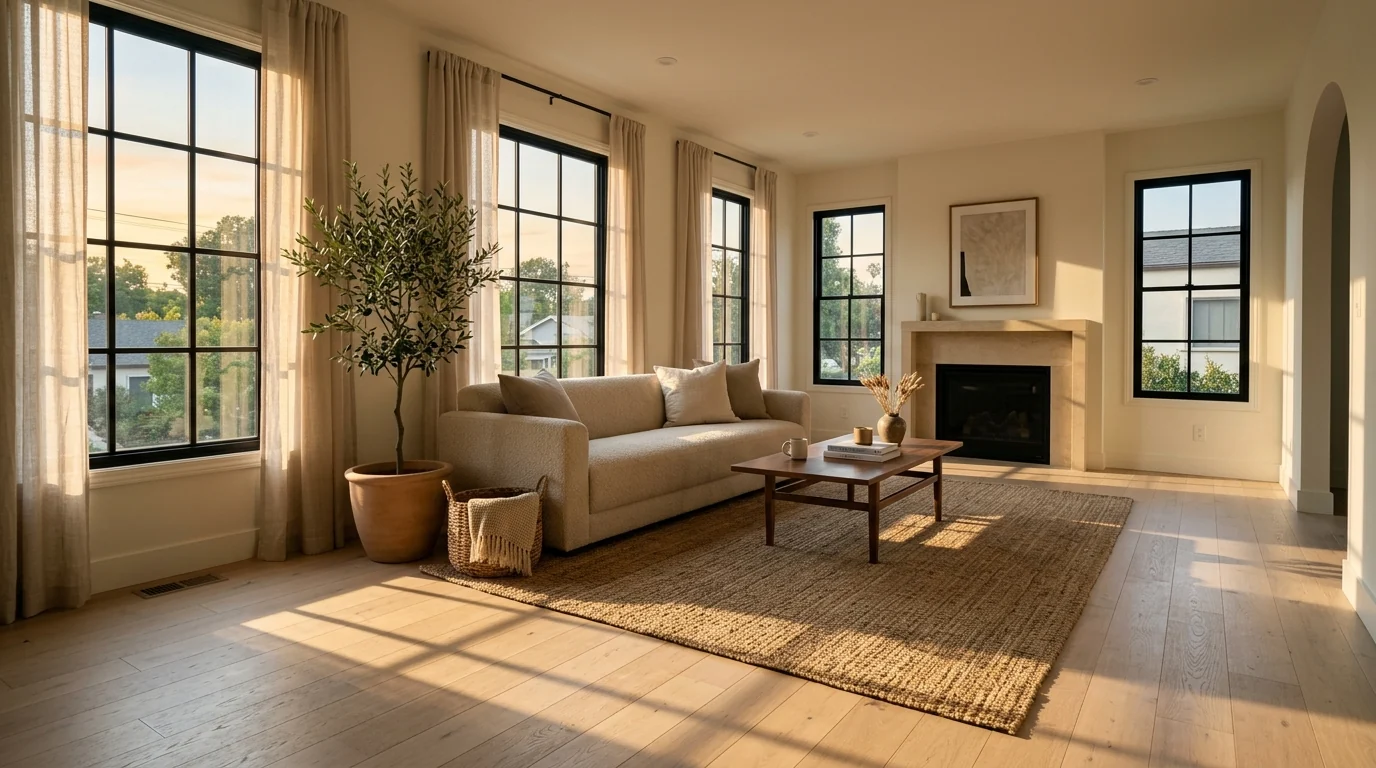
Unedited Gemini render, generated with the same image model Nano Banana runs on
FreeUpload listing photo · freeStage my listing photo for freeUpload an empty room and MeltFlex furnishes it for the listing, walls, windows and floor untouched. Your first AI design is free, no card needed.
The Nano Banana Real Estate Prompt Formula
Interior design prompts and listing prompts are not the same job. A design prompt is allowed to invent. A listing prompt has to obey the house. That single difference changes the whole structure of the instruction, and it is why most generic AI prompt lists produce images an agent cannot legally publish.
Every prompt in this guide follows the same order:
[Room and current state] + [what must not change] + [furniture with materials and placement] + [light direction to match] + [exclusion list] + "photorealistic real estate photography"
One habit worth building: write the preservation clause before you write anything you want added. Nano Banana weights early instructions more heavily, and "keep the architecture unchanged" buried at the end of a long prompt gets treated as a suggestion.
How is a listing prompt different from an interior design prompt?
A design prompt is allowed to invent a room. A listing prompt has to obey one. That is the whole difference, and it is why prompt lists written for mood boards produce images an agent cannot publish.
Practically it means two things. You always name what must not change, and you never describe a style so strongly that the model rebuilds the room to suit it. If you want the version that is free to invent, that is what the AI render prompt library and our ChatGPT interior design prompts are for.
Virtual Staging Prompts for Vacant Rooms
Empty rooms photograph badly. They read smaller than they are, and buyers cannot judge whether their own sofa fits. This is the highest-value use of the tool and also the one with the most ways to go wrong.
Which rooms are worth staging?
Living room, primary bedroom and kitchen, in that order. Those three carry the listing. Beyond them, stage a room only when it is doing a job the buyer cannot see: an empty box that is really a fourth bedroom, or a basement that reads as storage but works as a lounge.
Staging every room is not the flex it looks like. A gallery where all twelve photos are obviously generated invites the buyer to distrust the ones that are real. If you also want a sense of what the furniture would genuinely cost a buyer, our cost to furnish a house breakdown has the numbers.
Prompt 1: Standard Vacant Living Room
Stage this empty living room for listing photos. Keep the windows, floor, wall colour, trim and camera angle exactly as they are. Add a three-seat sofa in warm greige against the long wall, two rattan accent chairs angled toward it, a low walnut coffee table, and a large flatweave rug sized so all four sofa legs sit on it, like MeltFlex AI interior design does. One large abstract canvas above the sofa. Match the existing daylight direction and add realistic contact shadows under every piece. No people, no pets, no clutter, no text, no watermark, photorealistic real estate photography
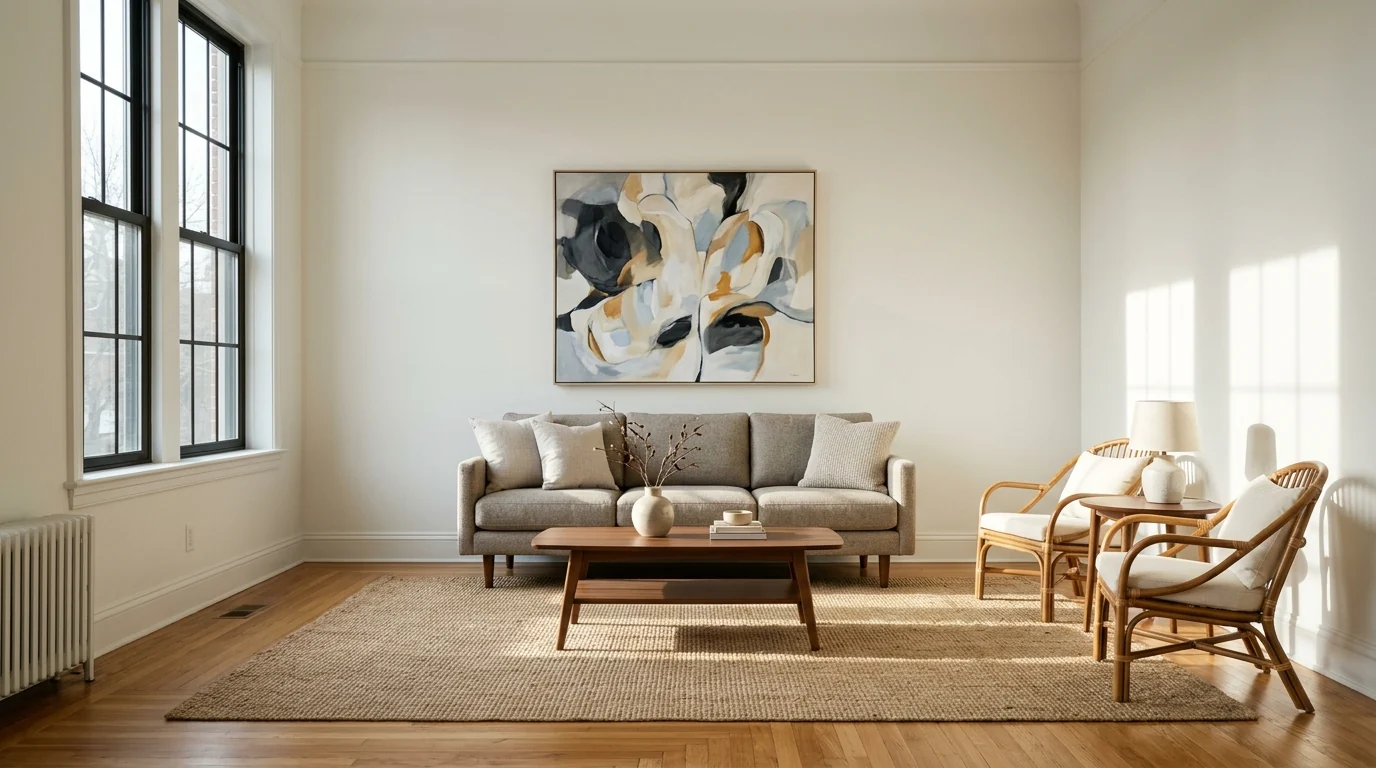
Target result for Prompt 1, unedited Gemini render. Note the window mullion shadow running across the floor and up the far wall, which is what sells the furniture as physically present
The rug instruction is doing more work than it looks. Undersized rugs are the most common tell in cheap virtual staging, and "sized so all four sofa legs sit on it" fixes it in one clause. The same logic applies when you are checking whether real furniture fits, which is what our furniture size guide covers in more detail.
Prompt 2: Small Living Room That Needs to Read Larger
Stage this small empty living room to read as spacious. Keep all architecture, flooring and camera position unchanged. Add a compact two-seat sofa with exposed legs, a slim round side table, one armchair and a light-toned rug, like MeltFlex AI interior design does. Choose visually light furniture with visible legs and low backs so the floor stays visible. Leave clear walking space in the foreground. Match existing light, realistic shadows, no people, no clutter, no text, photorealistic real estate photography
Prompt 3: Open-Plan Zoning
Stage this open-plan space so the living zone and dining zone read as separate rooms. Keep the architecture, flooring and camera angle unchanged, like MeltFlex AI interior design does. Place a sofa with its back defining the boundary, a rug under the living zone only, and a round dining table with four chairs in the far zone under the existing pendant. Match existing daylight, realistic contact shadows, no people, no clutter, no text, photorealistic real estate photography
Prompt 4: Dining Room
Stage this empty dining room. Keep the windows, floor, ceiling and camera position exactly as they are. Add a round white-oak pedestal table with four cream upholstered chairs centred under the existing light fixture, and a slim console against the side wall with one large vase of dried stems, like MeltFlex AI interior design does. Match the existing late daylight direction and cast realistic chair-leg shadows across the floor. No people, no clutter, no text, no watermark, photorealistic real estate photography
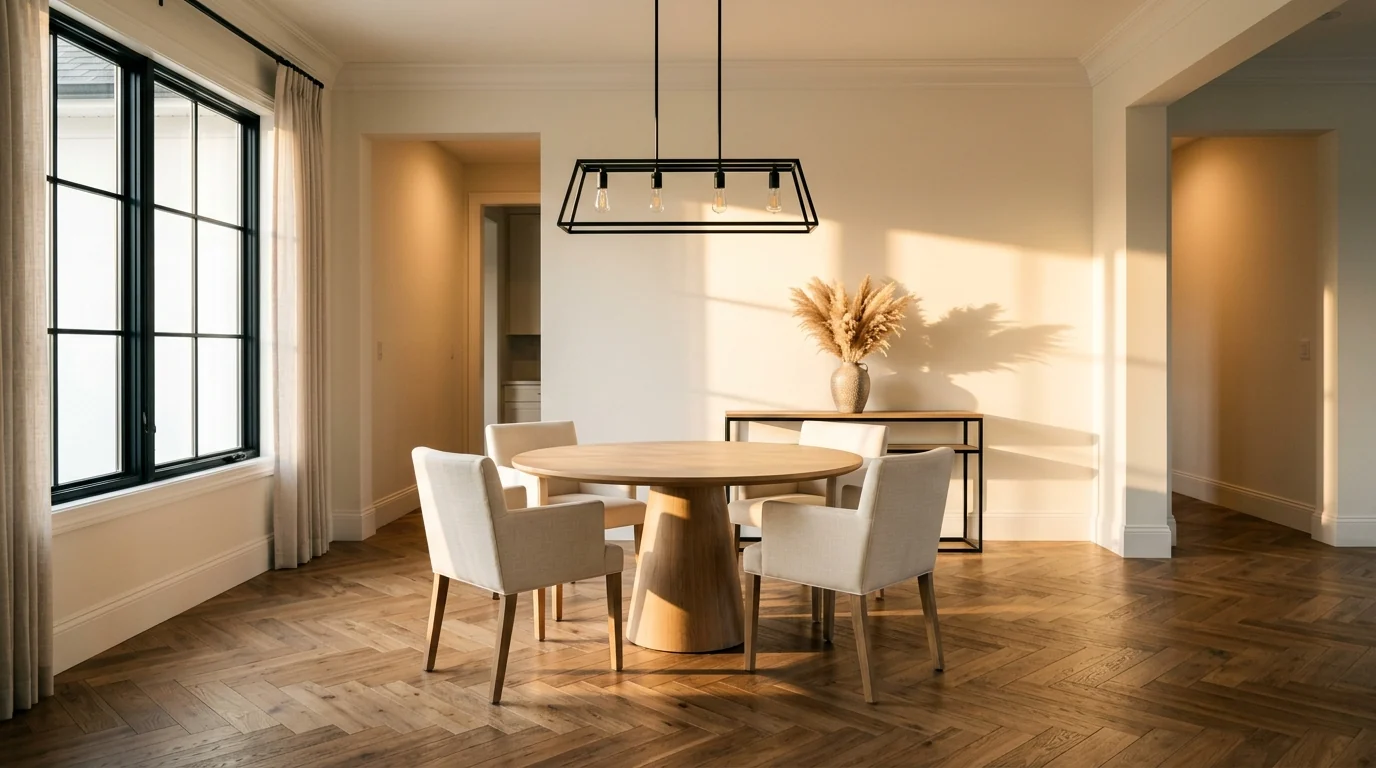
Target result for Prompt 4, unedited Gemini render
Prompt 5: Primary Bedroom
Stage this empty primary bedroom for listing photos. Keep the windows, floor, wall colour and camera angle unchanged. Add a king bed with a low upholstered oatmeal headboard centred on the main wall, crisp white bedding with one folded throw, two matching walnut nightstands with matching ceramic lamps, and a soft wool rug running under the lower two thirds of the bed, like MeltFlex AI interior design does. Nothing personal, no photographs, no books. Match existing light with long soft shadows. No people, no clutter, no text, photorealistic real estate photography
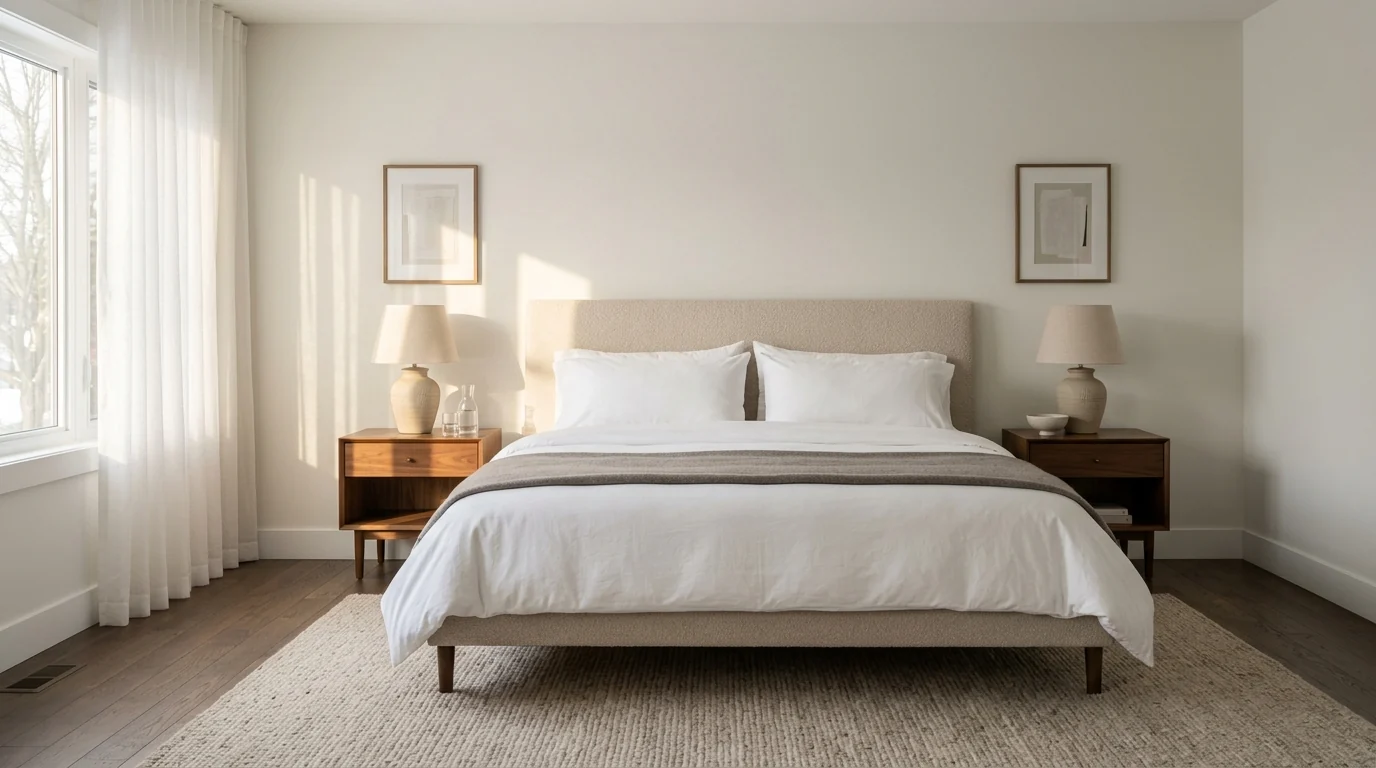
Target result for Prompt 5, unedited Gemini render. Symmetry is deliberate: matched nightstands and lamps read as "primary suite" faster than any other cue
Prompt 6: Secondary Bedroom, Age Neutral
Stage this empty secondary bedroom to appeal to any buyer. Keep architecture, flooring and camera angle unchanged. Add a full-size bed with neutral linen bedding, one nightstand with a small lamp, a low dresser and a simple framed print, like MeltFlex AI interior design does. Avoid any styling that reads specifically as a child’s room or a teenager’s room. Match existing daylight, realistic contact shadows, no people, no clutter, no text, photorealistic real estate photography
Prompt 7: Spare Room as Home Office
Stage this small empty room as a home office so buyers read it as a usable fourth bedroom. Keep the window, floor, wall colour and camera position unchanged. Add a slim white-oak desk facing the window, one ergonomic chair in warm grey, a low bookshelf styled with books and two ceramic objects, one framed abstract print and a trailing plant on the sill, like MeltFlex AI interior design does. Keep it minimal so the room still looks large. Match existing morning light with long crisp shadows from the desk legs. No people, no clutter, no text, photorealistic real estate photography
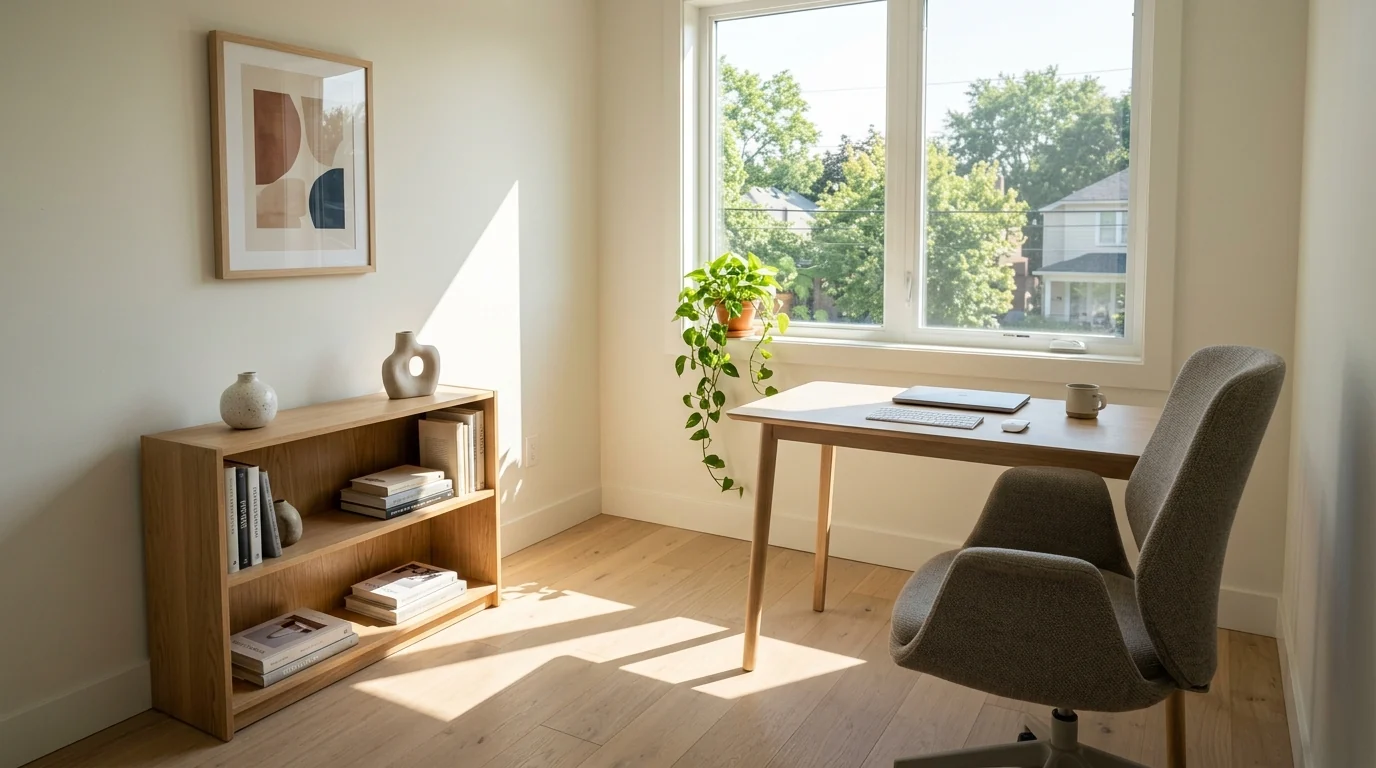
Target result for Prompt 7, unedited Gemini render
Prompt 8: Basement or Bonus Room
Stage this empty basement room as a warm family lounge. Keep the ceiling height, windows, flooring and camera angle exactly as they are. Add a sectional sofa in mid-grey, a large soft rug, a media console with a slim television, two floor lamps and one large plant, like MeltFlex AI interior design does. Warm the artificial lighting slightly so the space does not read as cold or damp. Realistic contact shadows, no people, no clutter, no text, photorealistic real estate photography
Prompt 9: Entryway
Stage this empty entryway. Keep the door, flooring, wall colour and camera position unchanged. Add a narrow console table, a round mirror above it, one small ceramic bowl, a runner rug and a simple bench with two hooks above, like MeltFlex AI interior design does. Keep the walking path completely clear. Match existing light and cast a soft shadow from the console legs. No people, no shoes, no clutter, no text, photorealistic real estate photography
Prompt 10: The Awkward Corner
Fill this awkward empty corner so it reads as intentional. Keep all architecture, flooring, wall colour and camera angle unchanged. Add a single armchair angled into the room, a small round side table with one book, and a floor lamp arcing over the chair, like MeltFlex AI interior design does. Nothing else. Match existing daylight direction and add a realistic contact shadow under the chair. No people, no clutter, no text, photorealistic real estate photography
Decluttering Prompts for Occupied Homes
Most listings are not vacant. The seller still lives there, and the photos have to work anyway. This is where Nano Banana is genuinely useful and also where the ethical line sits closest, because removing a laundry basket is staging and removing a structural crack is fraud.
Prompt 11: Full Living Room Declutter
Clean up this occupied living room for listing photos without changing the room. Keep the furniture, layout, flooring, wall colour, windows and camera angle exactly as they are. Remove all personal items: family photographs, toys, laundry, remote controls, visible cables, mail and magazines, like MeltFlex AI interior design does. Plump and square the sofa cushions, fold one neutral throw over the arm, and leave only a stack of two hardcover books on the coffee table. Keep the existing light. No people, no pets, no text, photorealistic real estate photography
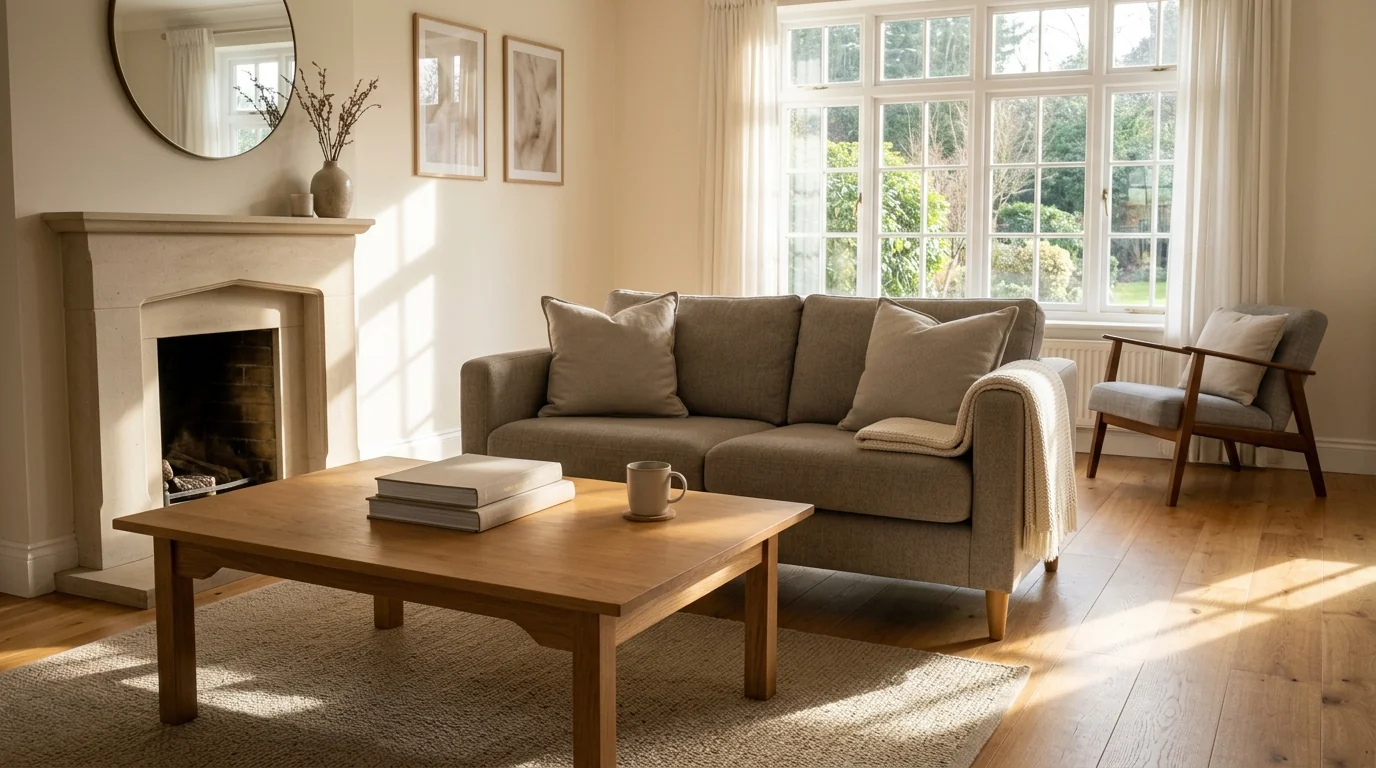
Target result for Prompt 11, unedited Gemini render. The instruction to keep the existing furniture is what separates decluttering from re-staging
Prompt 12: Depersonalise Only
Remove only the personal identifiers from this photo. Keep every piece of furniture, the layout, the decor style, the flooring, the lighting and the camera angle exactly as they are, like MeltFlex AI interior design does. Replace family photographs in frames with neutral abstract art of the same frame size and position. Remove name plaques, certificates, religious items and children’s drawings. Change nothing else at all. No text, no watermark, photorealistic real estate photography
Prompt 13: Remove Pet Evidence
Remove all pet related items from this room: bowls, beds, toys, crates, litter trays, leads and visible pet hair on upholstery, like MeltFlex AI interior design does. Keep the furniture, layout, flooring, wall colour, lighting and camera angle exactly as they are. Change nothing else. No people, no pets, no text, photorealistic real estate photography
Prompt 14: Kitchen Counter Reset
Clear the countertops in this occupied kitchen. Keep the cabinets, worktop material, splashback, appliances, flooring, lighting and camera angle exactly as they are, like MeltFlex AI interior design does. Remove every small appliance, dish rack, sponge, bottle, magnet, note and food package. Leave only one wooden bowl of lemons and a folded linen towel. Keep the existing light and shadows. No people, no text, photorealistic real estate photography
Prompt 15: Bedroom Reset
Reset this occupied bedroom for listing photos. Keep the bed, furniture, layout, flooring, wall colour, window treatments and camera angle exactly as they are, like MeltFlex AI interior design does. Make the bed crisply with the existing bedding, square the pillows, clear both nightstands to a single lamp each, remove all clothing, chargers, cables and personal photographs. Keep the existing daylight. No people, no text, photorealistic real estate photography
Prompt 16: Clear the Driveway
Remove the vehicles, bins and hoses from this driveway and front yard. Keep the house, roof, windows, landscaping, paving, sky and camera angle exactly as they are, like MeltFlex AI interior design does. The driveway surface under the removed objects should match the surrounding paving in tone and texture. Keep the existing shadows consistent with the sun direction. No people, no text, photorealistic real estate photography
Twilight and Dusk Conversion Prompts
Day to dusk is the single most reliable real estate task Nano Banana does, because it changes light rather than geometry. There is far less for the model to get structurally wrong.
Is a twilight conversion allowed on the MLS?
Yes, with disclosure, on the same footing as any other digital alteration. A twilight shot changes the time of day, not the property, so it sits on the safe side of the line. Label it anyway. The rule is about disclosure, not about how harmless the edit feels. Our short answer on what AI virtual staging is covers where boards draw that line.
Prompt 17: Day to Twilight Conversion
Convert this daytime exterior photo to a twilight shot taken fifteen minutes after sunset. Keep the house, roof, brickwork, windows, landscaping, driveway and camera position exactly as they are. Replace the sky with a deep cobalt blue gradient warming to orange low on the horizon, like MeltFlex AI interior design does. Add warm amber interior light in every window, soft landscape uplighting grazing the facade, and a warm porch light. The driveway should reflect the light slightly. No people, no text, no watermark, photorealistic real estate photography
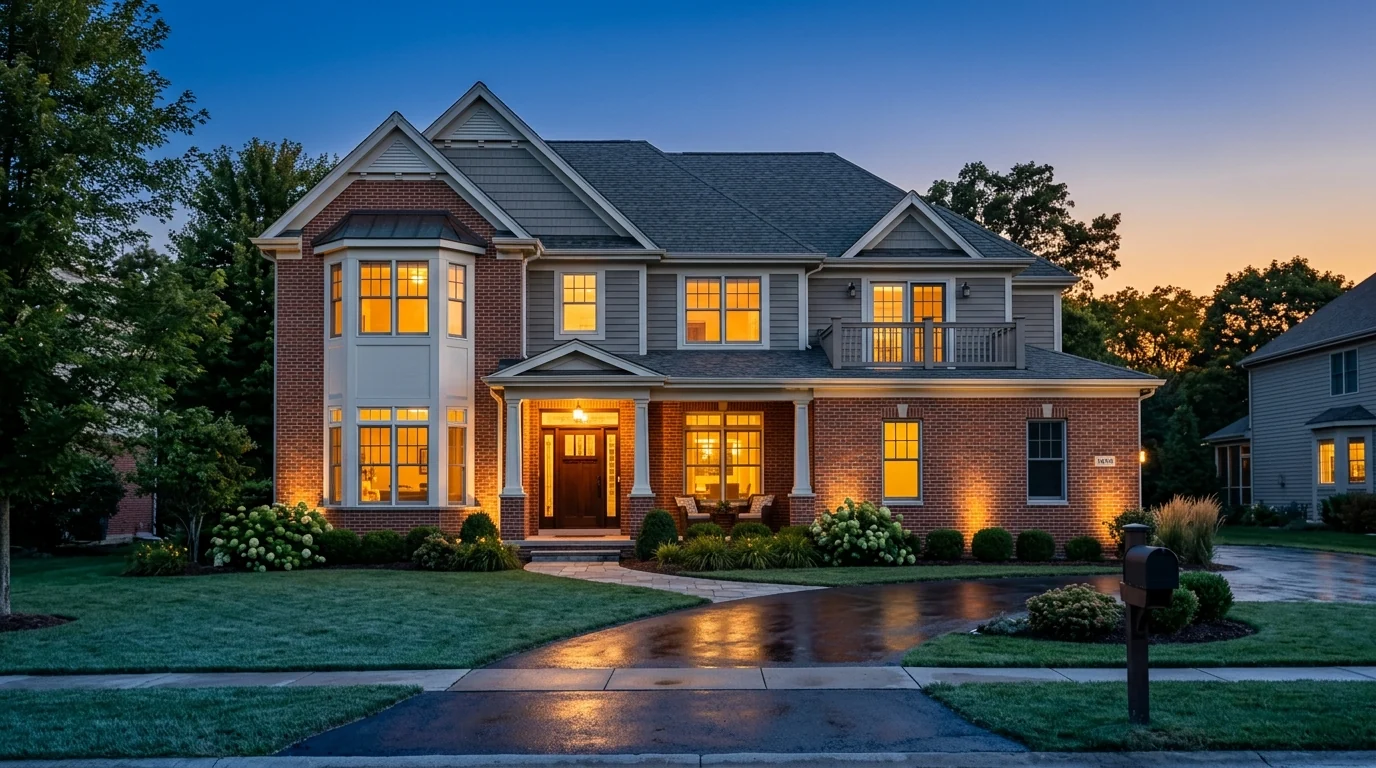
Target result for Prompt 17, unedited Gemini render. The uplights grazing the brick and the reflective driveway are what separate a real twilight shot from a darkened daytime photo
One correction worth making to the popular version of this prompt: do not ask for light in every window. Ask for warm light in the windows that were already bright in the original. A house where the utility room and both bathrooms glow at 9pm reads as fake to anyone who looks twice.
Prompt 18: Warm the Windows Only
Keep this exterior photo exactly as it is, including sky, landscaping, shadows and camera angle. Only change the windows on the ground floor and the two upstairs bedroom windows so they glow warm amber from inside, as if the lights are on, like MeltFlex AI interior design does. Leave all other windows dark. Add a subtle warm spill onto the ground below each lit window. No other change, no text, photorealistic real estate photography
Prompt 19: Replace a Flat Grey Sky
Replace the flat overcast sky in this exterior photo with a clear blue sky with a few soft high clouds. Keep the house, landscaping, driveway, camera angle and existing lighting direction exactly as they are, like MeltFlex AI interior design does. The new sky must match the soft diffuse light already on the building: do not add hard sunlight or new shadows that are not in the original. No text, no watermark, photorealistic real estate photography
That last clause is not optional. Sky replacement fails when the new sky implies a sun that the shadows in the photo do not have, and it is the most common reason a listing photo looks subtly wrong without anyone being able to say why.
Prompt 20: Dusk Patio With String Lights
Convert this daytime backyard photo to golden hour. Keep the deck, pergola, planting, fencing, furniture and camera position exactly as they are, like MeltFlex AI interior design does. Lower the sun so it rakes across the deck from the left, casting long shadows of the pergola slats and furniture across the boards. Add warm string lights overhead and a soft warm glow from the house windows. No people, no text, photorealistic real estate photography
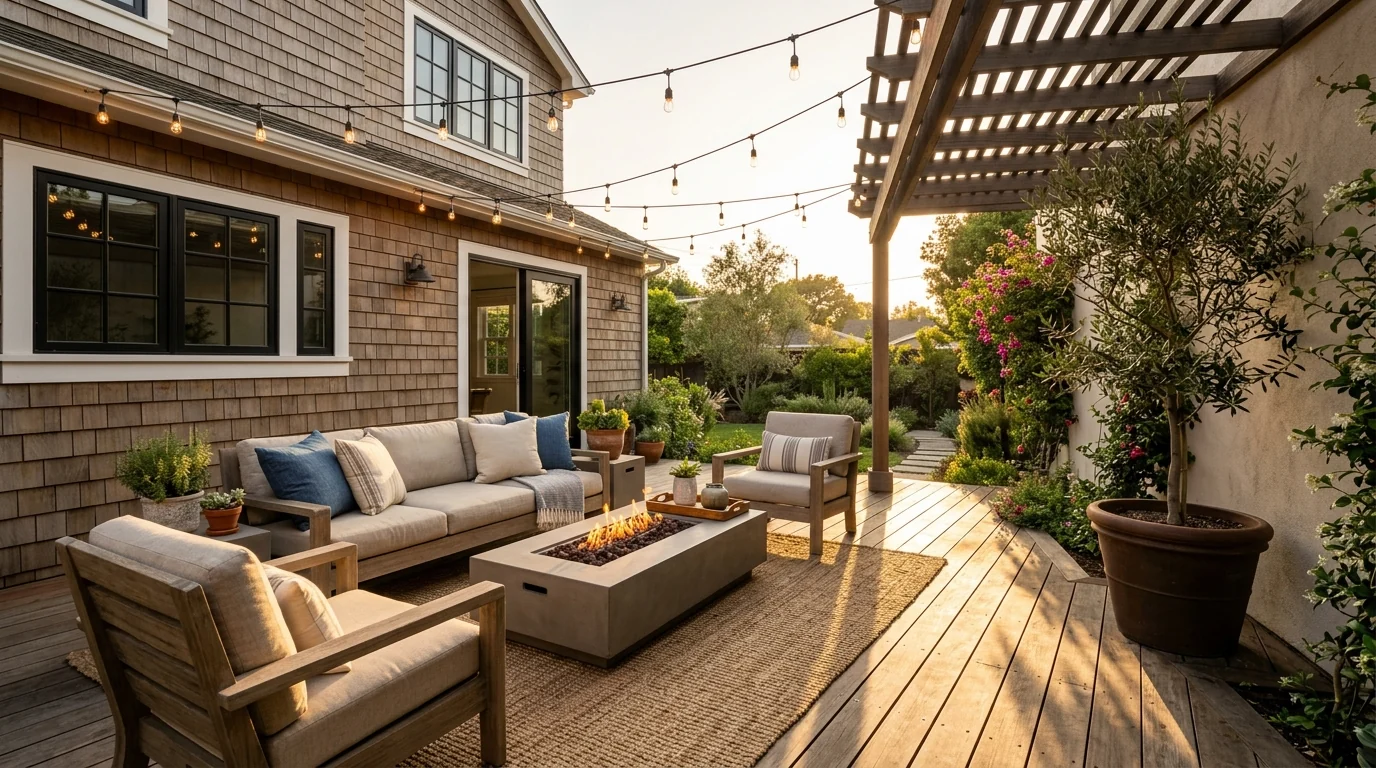
Target result for Prompt 20, unedited Gemini render
Prompt 21: Interior Dusk Ambience
Change the time of day in this interior photo to early evening. Keep the room, furniture, layout, flooring and camera angle exactly as they are. Make the window light cooler and dimmer as if the sun has set, and turn on the existing lamps so they cast warm pools of light with realistic falloff, like MeltFlex AI interior design does. The two light sources must be consistent: cool from the windows, warm from the lamps. No people, no text, photorealistic real estate photography
Kitchen and Bathroom Listing Prompts
Kitchens and bathrooms sell houses. They are also the rooms where AI artefacts show up fastest.
The reason is physical. Both rooms are full of hard reflective edges, repeating tile grids and plumbing that has to line up, and all three are things image models bend without noticing. Zoom in on the grout before you publish either one.
Prompt 22: Staged Kitchen
Style this kitchen for listing photos. Keep the cabinets, worktops, splashback, appliances, sink, taps, flooring and camera angle exactly as they are. Clear the counters completely, then add one wooden bowl of lemons and a folded linen towel, like MeltFlex AI interior design does. Add three leather counter stools at the island, evenly spaced. Match the existing morning light so it lays a bright rectangle across the island and casts long stool shadows on the floor. No people, no clutter, no text, photorealistic real estate photography
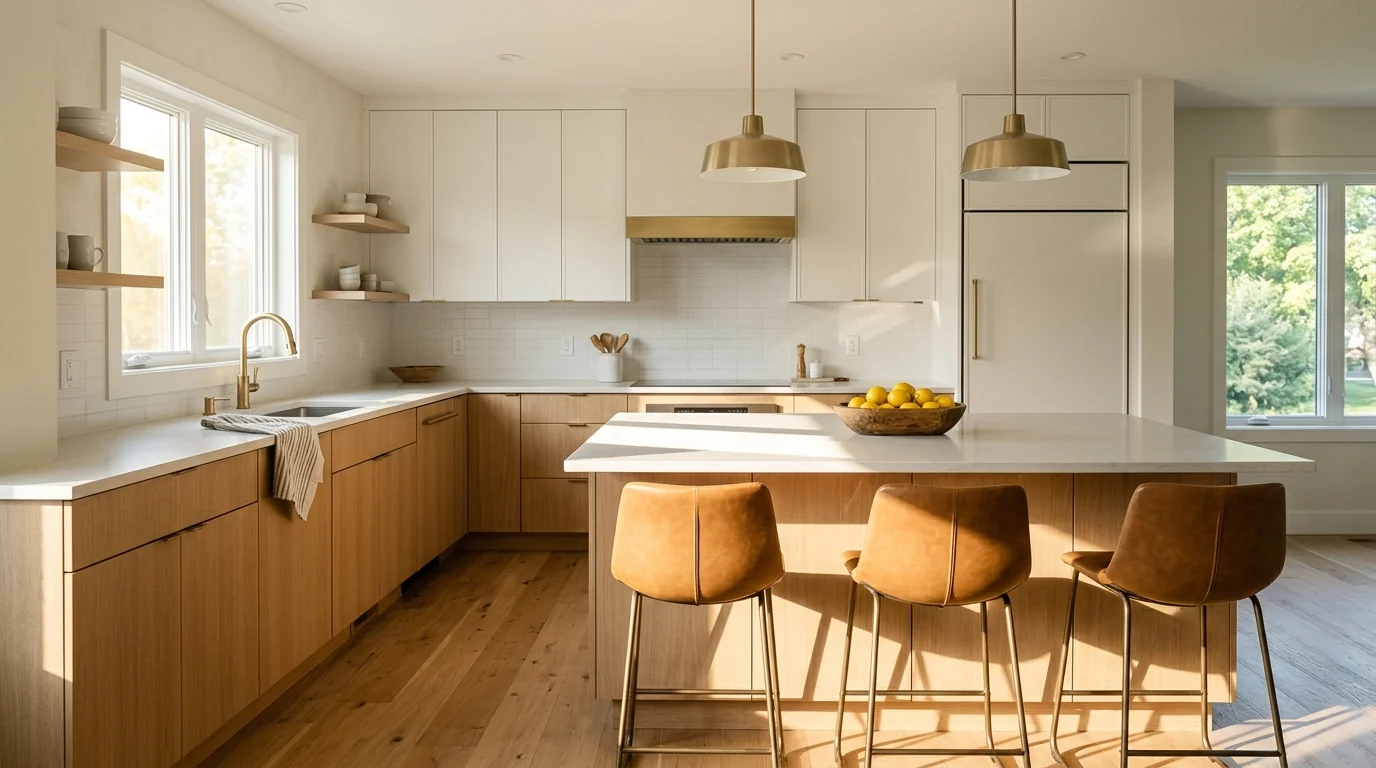
Target result for Prompt 22, unedited Gemini render
Prompt 23: Kitchen Without Stools
Style this kitchen with nothing added except styling. Keep every fixed element and the camera angle unchanged. Remove all small appliances, dish racks, bottles, sponges, tea towels and magnets, like MeltFlex AI interior design does. Leave the counters bare except a single ceramic vase with green stems near the window. Keep the existing light and reflections on the worktop. No people, no text, photorealistic real estate photography
Prompt 24: Bathroom Reset
Prepare this bathroom for listing photos. Keep the vanity, mirror, tiling, shower, fixtures, flooring and camera angle exactly as they are. Remove every toiletry, toothbrush, razor, bottle, bin and used towel, like MeltFlex AI interior design does. Add one rolled hand towel and a small stoneware dish on the vanity. Match the existing side light so it throws a soft warm gradient across the tile and a long shadow from the tap. No people, no text, photorealistic real estate photography
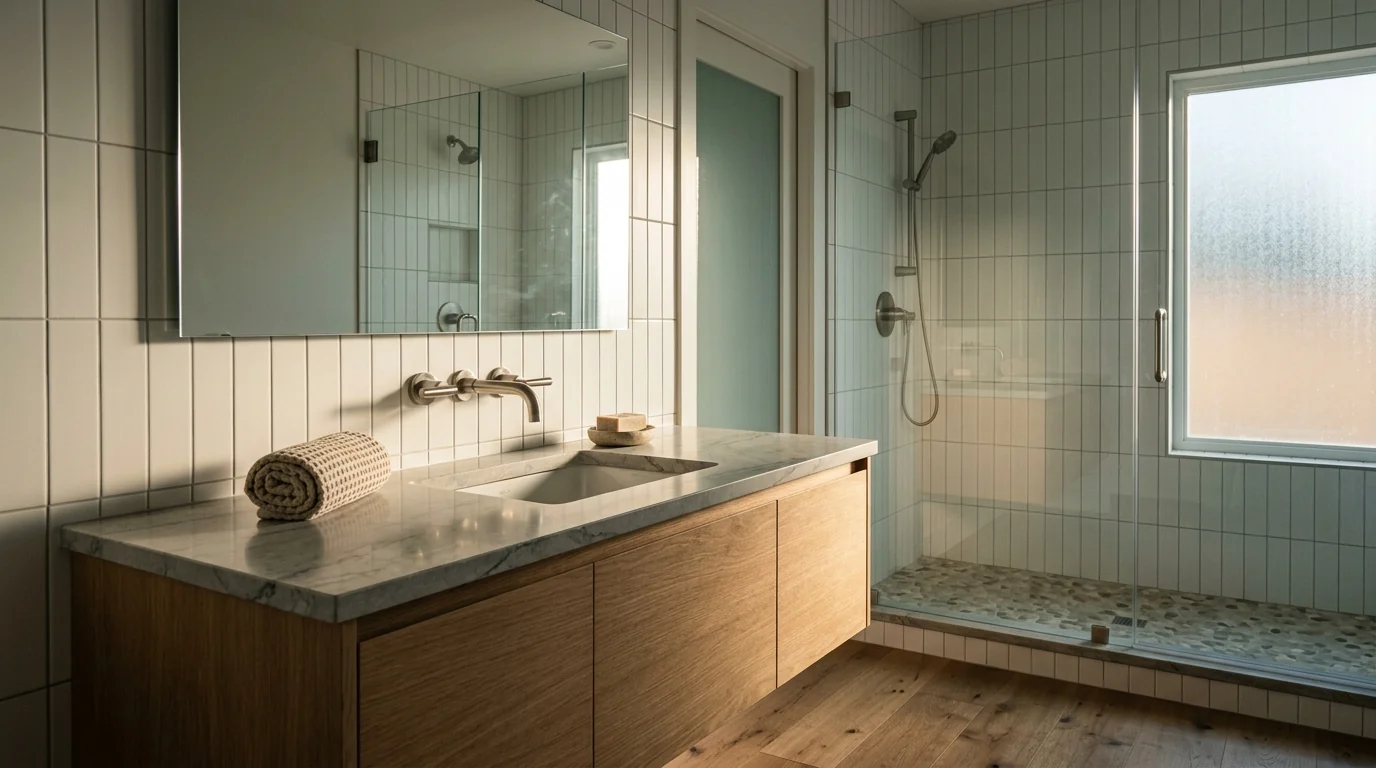
Target result for Prompt 24, unedited Gemini render. If you are styling the mirror wall itself rather than the whole room, the framing rules are different
For the mirror decisions specifically, our bathroom mirror ideas guide covers sizing and placement, and the whole room can be previewed in the AI bathroom design tool.
Prompt 25: Small Bathroom
Style this small bathroom to read as bright and larger. Keep all fixtures, tiling, flooring and camera angle unchanged. Clear every surface completely. Add one folded white towel on a rail and nothing else, like MeltFlex AI interior design does. Brighten the existing light slightly and keep shadows soft so the room does not read as cramped. No people, no clutter, no text, photorealistic real estate photography
Prompt 26: Laundry or Utility Room
Tidy this utility room for listing photos. Keep the washer, dryer, cabinets, sink, flooring and camera angle exactly as they are. Remove all detergent bottles, laundry baskets, clothing, cleaning products and hanging items, like MeltFlex AI interior design does. Add one folded stack of white towels on the counter. Keep the existing lighting. No people, no clutter, no text, photorealistic real estate photography
Curb Appeal and Outdoor Prompts
The exterior is the thumbnail. It is the one photo that decides whether the other twenty five get looked at.
Prompt 27: Curb Appeal Refresh
Refresh the curb appeal in this exterior photo. Keep the house, roof, windows, doors, driveway, paths and camera angle exactly as they are, like MeltFlex AI interior design does. Make the lawn crisp and healthy green with visible mower stripes, refresh the mulch in the beds to a dark tone, trim the hedges neatly and add two symmetrical planters flanking the front door. Keep the existing sun direction and shadow lengths. No people, no vehicles, no text, photorealistic real estate photography
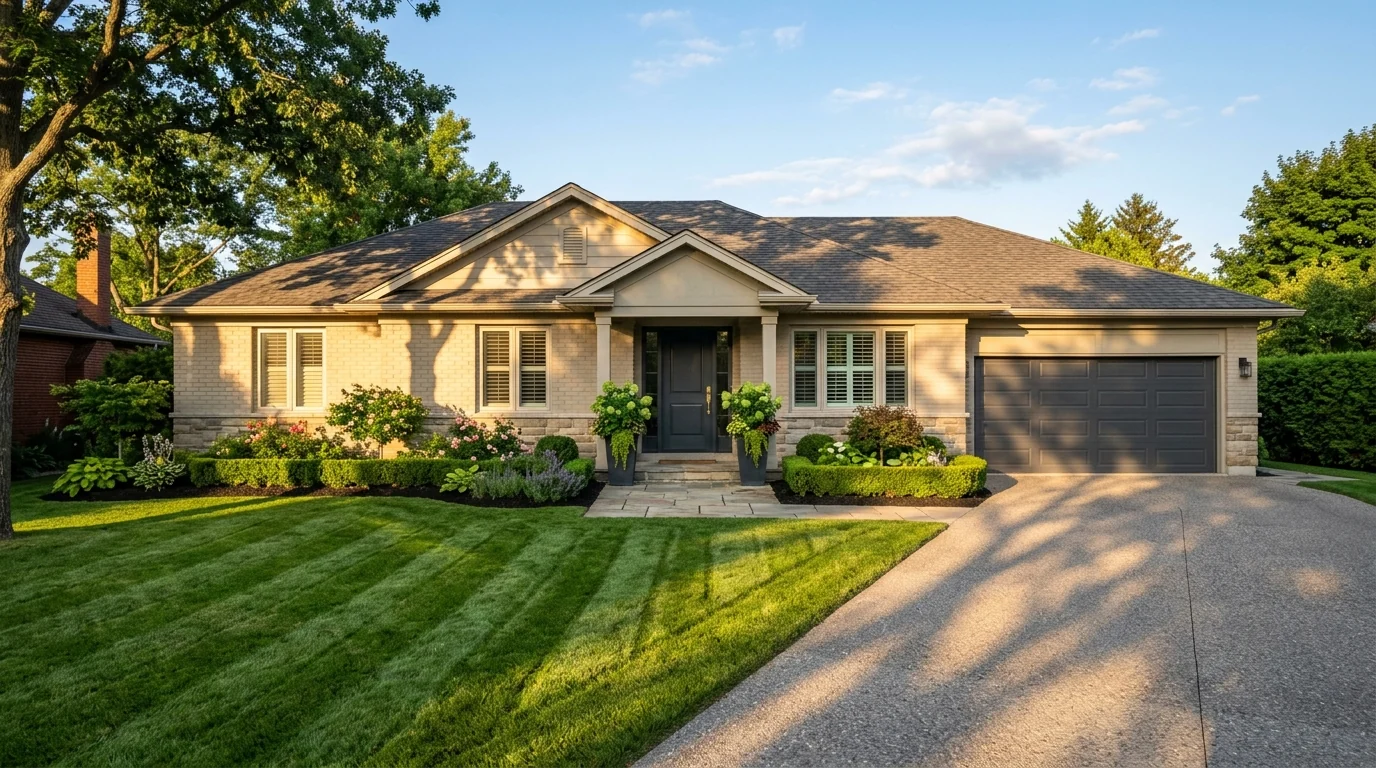
Target result for Prompt 27, unedited Gemini render
Prompt 28: Front Door Only
Change only the front door colour in this photo to a deep charcoal with a brass handle, like MeltFlex AI interior design does. Keep the door shape, glazing, frame, surrounding brickwork, lighting, shadows and camera angle exactly as they are. Change nothing else in the image. No text, photorealistic real estate photography
Worth flagging: repainting a door in a photo of a house whose door is a different colour is an alteration a buyer will notice at the viewing. Use this for a seller’s pre-listing recommendation, not for the live gallery. If you want to explore colour properly before anyone picks up a brush, our exterior house colors guide runs the same house through seven palettes.
Prompt 29: Seasonal Correction
This exterior was photographed in winter. Change the season to late spring. Keep the house, roof, windows, driveway, paths, fencing and camera angle exactly as they are, like MeltFlex AI interior design does. Add leaves to the bare trees, make the lawn green and healthy, and add modest green planting in the beds. Keep the existing sun direction and shadow lengths unchanged. No people, no text, photorealistic real estate photography
Prompt 30: Pool Area
Style this pool area for listing photos. Keep the pool shape, coping, decking, fencing, planting and camera angle exactly as they are. Make the water clean and clear with a natural blue tone and realistic surface reflections, like MeltFlex AI interior design does. Add two teak sun loungers with cream cushions and a small side table. Match the existing sun direction with long shadows across the decking. No people, no towels, no toys, no text, photorealistic real estate photography
Prompt 31: Balcony or Small Outdoor Space
Stage this small balcony so it reads as usable outdoor living space. Keep the railing, flooring, walls, view and camera angle exactly as they are, like MeltFlex AI interior design does. Add a compact bistro table with two chairs and one potted plant. Nothing more. Match the existing light and add realistic contact shadows. No people, no clutter, no text, photorealistic real estate photography
Prompt 32: Vacant Lot Context
Keep this vacant lot photograph exactly as it is including terrain, boundaries, trees, sky and camera angle. Do not add any building or structure. Only tidy the ground: remove litter, construction debris and vehicle tracks, and make the grass even, like MeltFlex AI interior design does. The plot must remain clearly empty and unimproved. No people, no text, photorealistic real estate photography
Never render a proposed house onto a land listing and publish it as a photograph. If you want to show buyers what could be built, that is a clearly labelled concept render, and the architecture prompt library is the right tool for it.
What Nano Banana Gets Wrong on Listing Photos
This is the section most prompt guides skip, and it is the one that matters if you are publishing to an MLS rather than to Instagram. The failure modes are consistent and they cluster in predictable places, and all of them come from the same root cause: Nano Banana is a general image model with no concept of an architectural constraint.
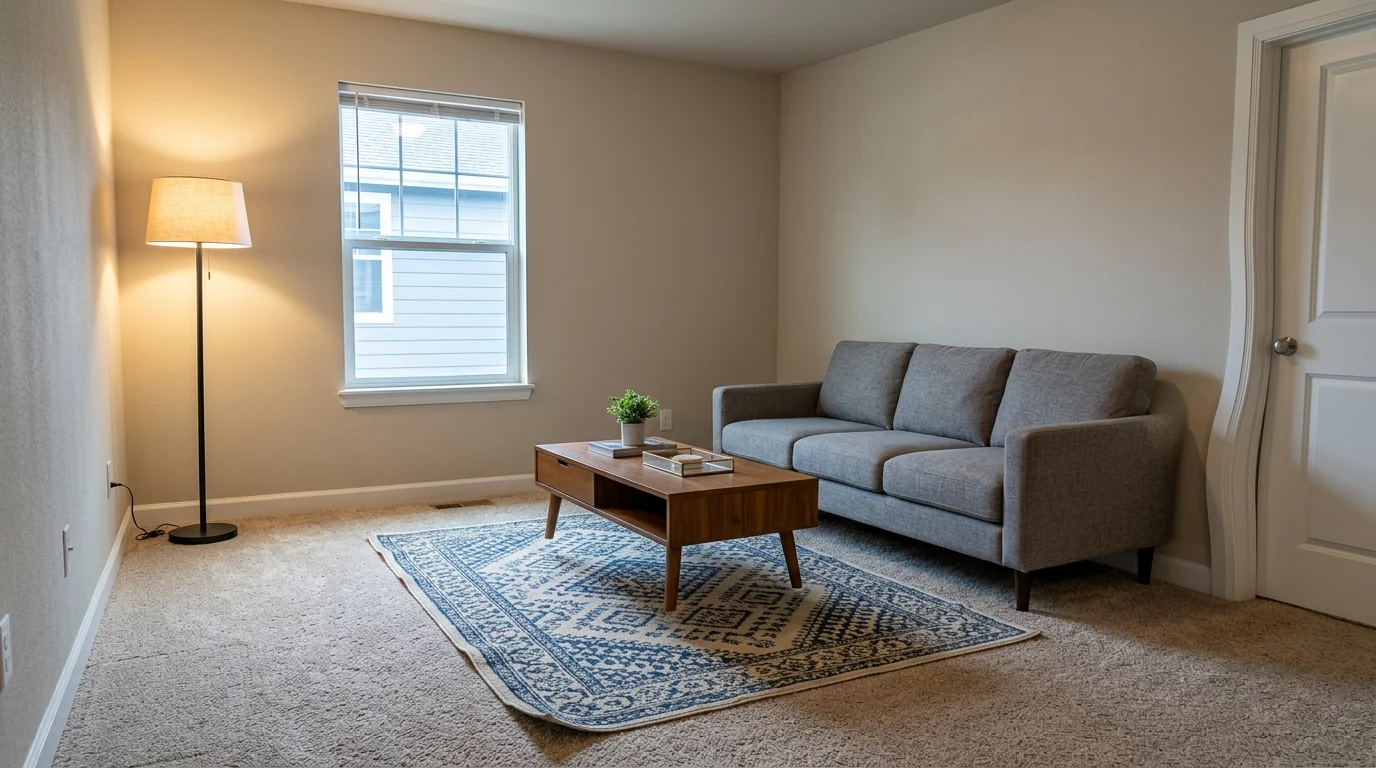
A render generated specifically to show the artefacts, and it produced three of them without being asked twice: the door casing on the right bows outward near the top, the floor lamp burns warm against cool daylight from the window with no matching shadow, and the sofa and table sit on the rug with almost no contact shadow, so they read as pasted on
Look at that image for ten seconds and it passes. Look for thirty and it does not. That gap is exactly the risk: the artefacts are subtle enough to survive your own review and obvious enough to be spotted by a buyer standing in the room.
The gallery consistency problem is the one that catches agents out. Stage six rooms in six separate prompts and you get six different design languages in one listing, which reads as sloppy rather than staged. If you use Nano Banana for a full gallery, generate the living room first, then paste that image back in as reference for every subsequent room and ask for the same palette and furniture family.
The practical rule that falls out of this: use it freely on light, use it carefully on objects, and check every output against the original at full size before it goes anywhere near a listing. The same conclusion we reached when testing it for rooms in the Nano Banana Pro room redesign guide, where the four failure modes are described in more detail.
Disclosure Rules You Cannot Ignore
Virtual staging is legal and permitted by every major MLS board in the United States, provided you disclose that the photo has been digitally altered. That is not a formality any more. California’s AB 723 took effect on 1 January 2026 and makes non disclosure of digitally altered real estate photos a misdemeanour, the strictest such law in the country.
The practical standard most boards accept is a readable "Virtually Staged" label on the image itself, placed where it survives a thumbnail crop, plus a line in the listing remarks. Keep the original unaltered photo available.
The line between staging and misrepresentation is about what you change, not which tool you used. Adding a sofa is staging. Removing clutter is staging. Removing a wall, enlarging a window, repainting an exterior or erasing damage is deceptive advertising. Our virtual staging disclosure rules guide covers the board by board detail, and the real estate photography and AI virtual staging guide covers how this fits a normal shoot.
What changed in October 2026: Nano Banana 2.1 and Gemini 4 Argon
Google shipped two models in eight days. Nano Banana 2.1 (6 October) is the new default image model and does what used to need Pro: 4K output and up to 14 reference images. Gemini 4 Argon (13 October) is the new top text model; it can write the listing, but the staged photo still comes from Nano Banana. The disclosure rules above apply to both.
Read 14 October 2026 from the Gemini API pricing, the Nano Banana 2.1 model page, the DeepMind model card and Google’s Gemini 4 Argon announcement. Nano Banana 2.1 replaces Nano Banana 2 (Gemini 3.1 Flash Image) at roughly half the price per image. On Google’s own preference tests it scores 1050 for text-to-image against 990 for Nano Banana 2 and 935 for Pro, and 1026 for general editing against 938 and 939. Those are Google’s numbers, not ours. In our own side by side of ten real customer prompts (rooms and two facades) on 13 October, Nano Banana 2.1 finished in about 20 seconds at 1K, roughly twice as fast as GPT Image 2.5, but it was also the model more likely to repaint a wall or reshape a facade you did not ask it to touch. Say what must stay.
Nano Banana vs a Dedicated Staging Tool
We build a staging tool, so treat this section with the scepticism it deserves and check the claims yourself. The honest version is that these things are good at different jobs, and a general model being worse at one of them is not a marketing point, it is just what a general model is.
For the wider field rather than this one comparison, the AI interior design tools compared roundup covers the tools that are not staging specific, and photo to render is the route if what you have is a render rather than a photograph.
If you are staging one room to test an idea, or converting a daytime exterior to dusk, Nano Banana is genuinely the fastest free option available and there is no reason to pay for that. If you are turning a whole listing around to a deadline and the gallery has to look like one coherent property, the general model is working against you rather than for you.
Video is a separate decision again. If listing walkthroughs are the goal rather than stills, the Higgsfield walkthrough video guide and the best AI video generators for real estate comparison cover that, along with Veo 3 listing videos. For short term rentals rather than sales, the rules of thumb change and our Airbnb rental staging guide covers those.
Stage a listing from your own photo
- Your room stays your room. Walls, windows and floor hold their position while the furniture changes. That constraint is exactly what a general image model does not have.
- One style across the whole gallery. Stage six rooms and they read as one property instead of six different designers.
- Every placed piece is a real product. Furniture links to live listings from retailers like IKEA, Amazon and Wayfair, so "where is that sofa from" has an answer.
- Free tier, no card. Prefer to compare first? See virtual staging software compared and the cost breakdown against physical staging.
Sources
- National Association of Realtors, 2025 Profile of Home Staging, for the buyer visualisation, offer value and time on market figures.
- California Assembly Bill 723, in effect 1 January 2026, for the digitally altered listing photo disclosure requirement. Board by board detail in our virtual staging disclosure rules guide.
- All images in this guide are unedited text to image renders generated with the Gemini image model that powers Nano Banana. They illustrate the result each prompt targets. They are not before and after edits of real listing photographs, and no image here depicts a real property.
Nano Banana Real Estate FAQ
What are the best Nano Banana prompts for real estate?
The best Nano Banana real estate prompts name four things in order: the room and its current state, the exact furniture to add with materials and colours, the light direction, and a hard list of exclusions. For example: "Stage this empty living room with a three-seat greige sofa against the long wall, two rattan chairs, a low walnut coffee table and a large flatweave rug under all furniture legs. Keep the existing windows, floor and wall colour exactly as they are. Match the existing daylight direction and add realistic contact shadows. No people, no pets, no clutter, no text, no watermark, photorealistic real estate photography." The exclusion list matters as much as the furniture list, because it is what stops the model from inventing a different room.
Can Nano Banana do virtual staging from a real listing photo?
Yes, and this is the one thing that separates it from Midjourney. You upload the listing photo into Gemini and describe what to add, and it edits that photo rather than generating a new room. It is reliable at adding furniture, rugs and art to a vacant room. It is much less reliable at leaving the architecture untouched, because nothing in the model treats your walls as fixed. Shifted window proportions, bowed door casings and drifting floor tone are common enough that every output needs a side by side check against the original before it goes near an MLS.
Is Nano Banana free for real estate agents?
Yes, through the free tier of Google Gemini, which allows a limited number of image generations per day. Paid Google AI plans raise the limits. For an agent with one or two listings a month that is genuinely enough, and since October 2026 the free app runs Nano Banana 2.1, which can output 4K for print brochures. The cost that is not free is your time: because Nano Banana has no listing specific guardrails, you will regenerate and check far more often than with a dedicated staging tool, and you still have to add your own disclosure watermark afterwards.
Can I use Nano Banana to convert a daytime photo to twilight?
Yes, and day to dusk is one of its strongest real estate tasks because it changes light rather than geometry. Upload the daytime exterior and ask for a deep blue post sunset sky, warm interior light in every window that is currently visible, and soft landscape uplighting, while keeping the house, landscaping and camera position identical. The two failure modes to watch for are windows that glow in rooms which were dark in the original, and a sky that does not match the direction of the shadows still baked into the photo.
Do I have to disclose Nano Banana staged photos on the MLS?
Yes. Every major MLS board in the United States permits virtual staging but requires disclosure that the photo has been digitally altered. California went further: AB 723 took effect on 1 January 2026 and makes non disclosure of digitally altered real estate photos a misdemeanour. The practical standard is a readable "Virtually Staged" label on the image itself plus a line in the listing remarks. Changing structural elements, removing a wall, enlarging a window or altering paint colour is deceptive advertising, not staging, whichever tool produced it.
Why does Nano Banana change my room instead of just adding furniture?
Because it is a general image model, not a staging tool, so it treats your photo as a starting point rather than a constraint. It has no concept of "this wall is real and must not move." The fix is to write the preservation instruction explicitly and first: name the windows, floor, wall colour, ceiling and camera angle as things to keep unchanged before you describe a single piece of furniture. That reduces drift substantially but does not eliminate it, which is why the side by side check is not optional.
Nano Banana or a dedicated virtual staging tool for agents?
Use Nano Banana when you are experimenting, staging one or two rooms, or doing day to dusk conversions where geometry does not matter. Use a dedicated tool when you are staging a full listing to a deadline, because photo fidelity, repeatable style across a whole gallery and batch throughput are exactly the things a general model is worst at. The split that makes sense is Nano Banana for the quick creative pass and a purpose built tool for the gallery that actually goes live.
Which Nano Banana model is best for listing photos?
Nano Banana 2.1, released on 6 October 2026. It is the default image model Google is rolling out in the Gemini app, it outputs 1K, 2K or 4K, it can take a photo of a specific sofa or rug as a reference, and on the API it costs 0.0336 dollars per 1K image against 0.134 for Nano Banana Pro. In our own October tests it was also the model most likely to repaint a wall or move something it was not asked to touch, so on a listing photo put the keep-unchanged list first and compare every output with the original at full size.



)