Christmas Light Calculator for Your House: Roofline, Gables, Strands, Watts and Cost

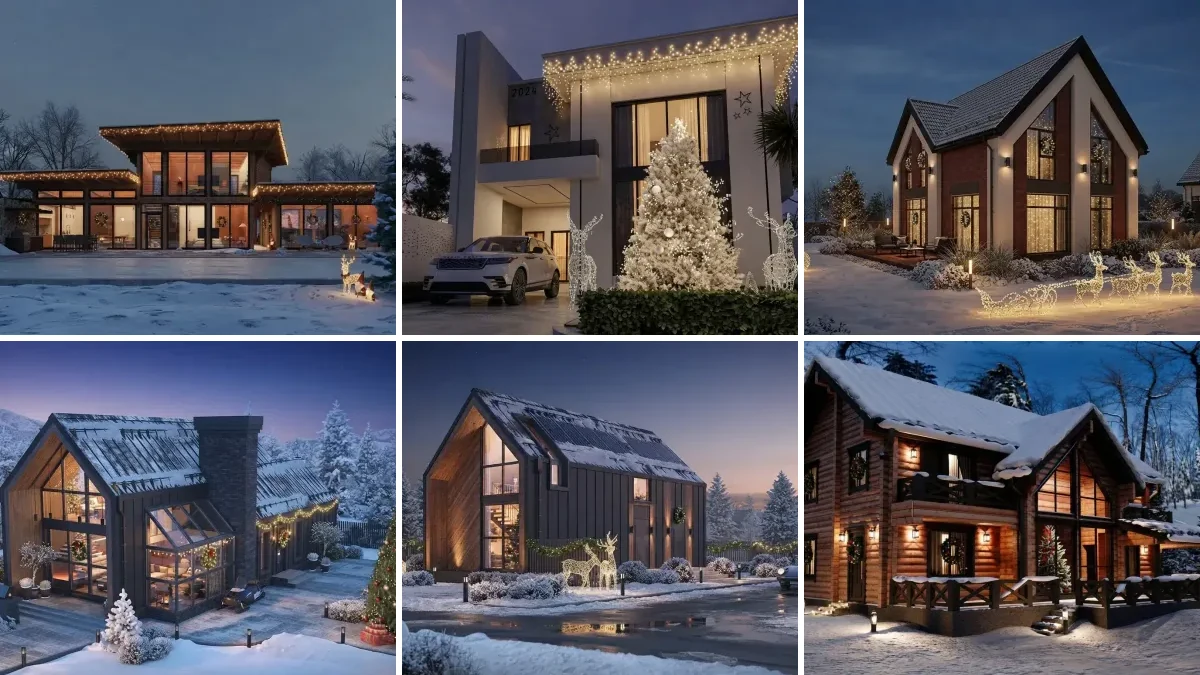
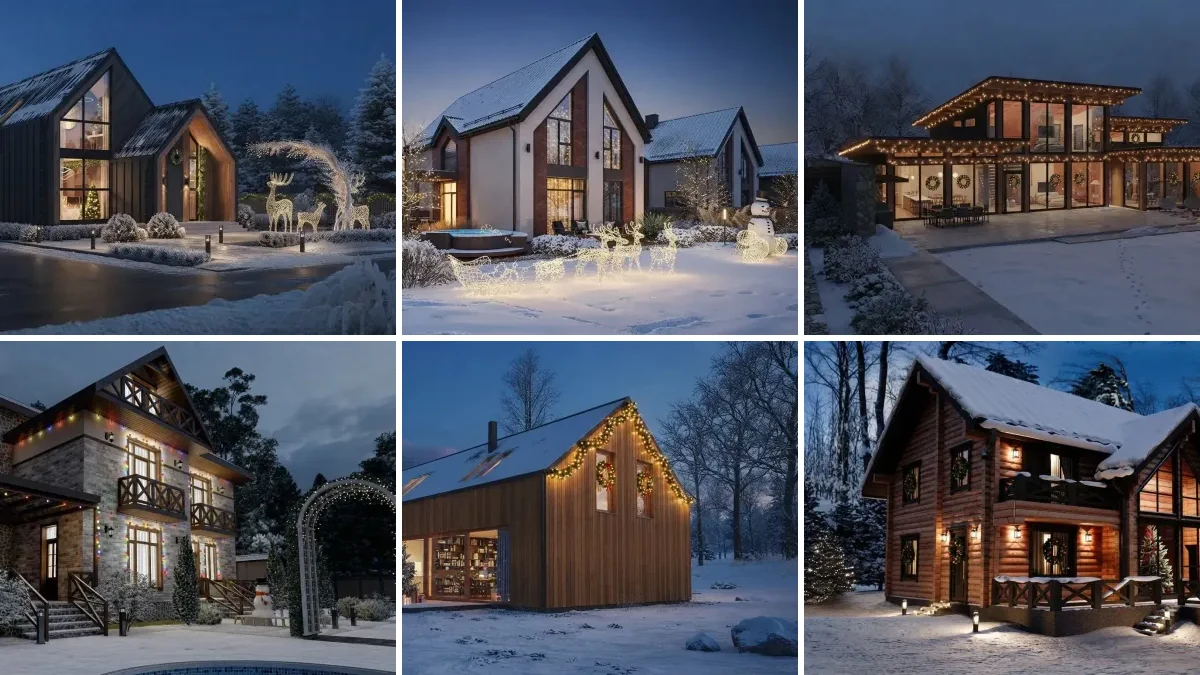
Measure every gutter line you want lit, add both sloped edges of each gable (its width times 1.118 on a common 6/12 roof), add the perimeter of every window and door, then add 10 percent: that is how many feet of lights your house needs. A modest two-story front with 40 feet of gutter, one 24 foot gable, four windows and a door comes to about 162 feet: three 25-bulb C9 sets on the roof and four mini light sets around the openings. In LED the whole display costs about $4 to run for the season. The same plan in incandescent costs $39.
Our articles are still written by humans!
Get human written articles in your Google feed.
The calculator below does that sum from your own numbers, then goes one step further than the light sellers’ guides: it turns the total into sets, plug-in runs, a check against your 15 or 20 amp circuit, and a season’s electricity bill. Every rule in it was read on the publisher’s own page on 14 November 2026 and is listed under Sources. Where we had to supply a number nobody publishes, the text says so.
Interactive calculator
Loading… if it does not appear, refresh the page.
How Many Feet of Christmas Lights Do I Need for My House?
Most single-story fronts need 100 to 150 feet of roofline lights, and a larger or two-story house 200 feet or more, before you count windows, doors and bushes. That range is Trimlight’s, and our three example houses land inside it. What moves the total is not the size of the house so much as how many gables and windows you outline: a plain ranch with one low gable needs fewer feet than a smaller house with three steep ones.
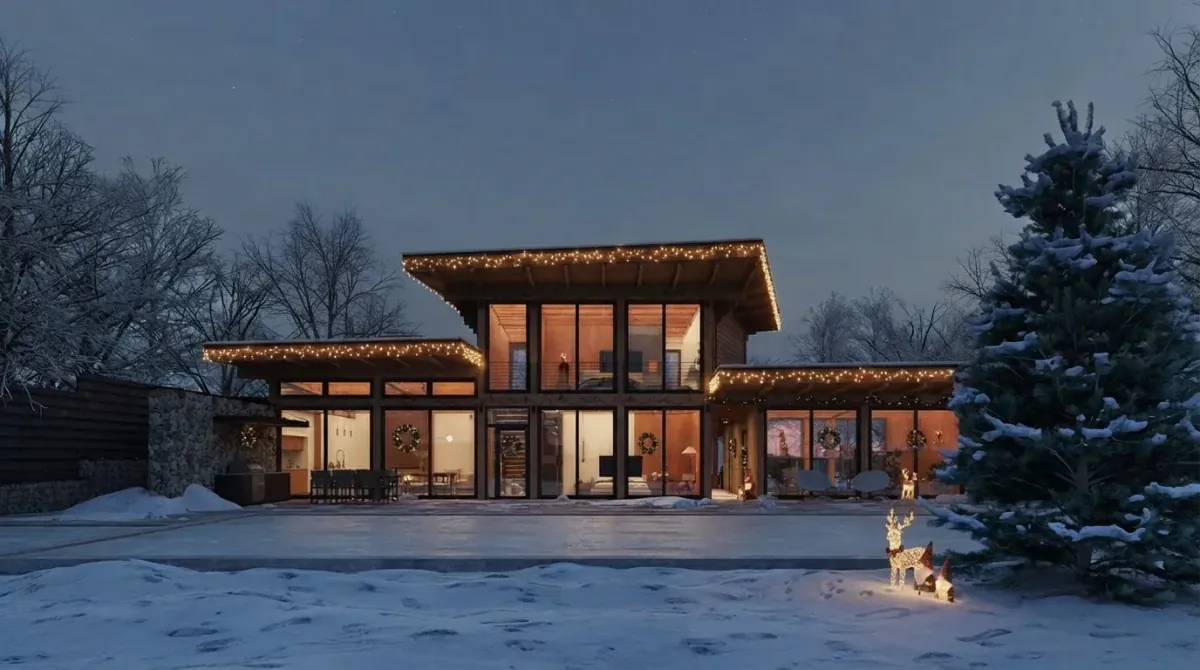
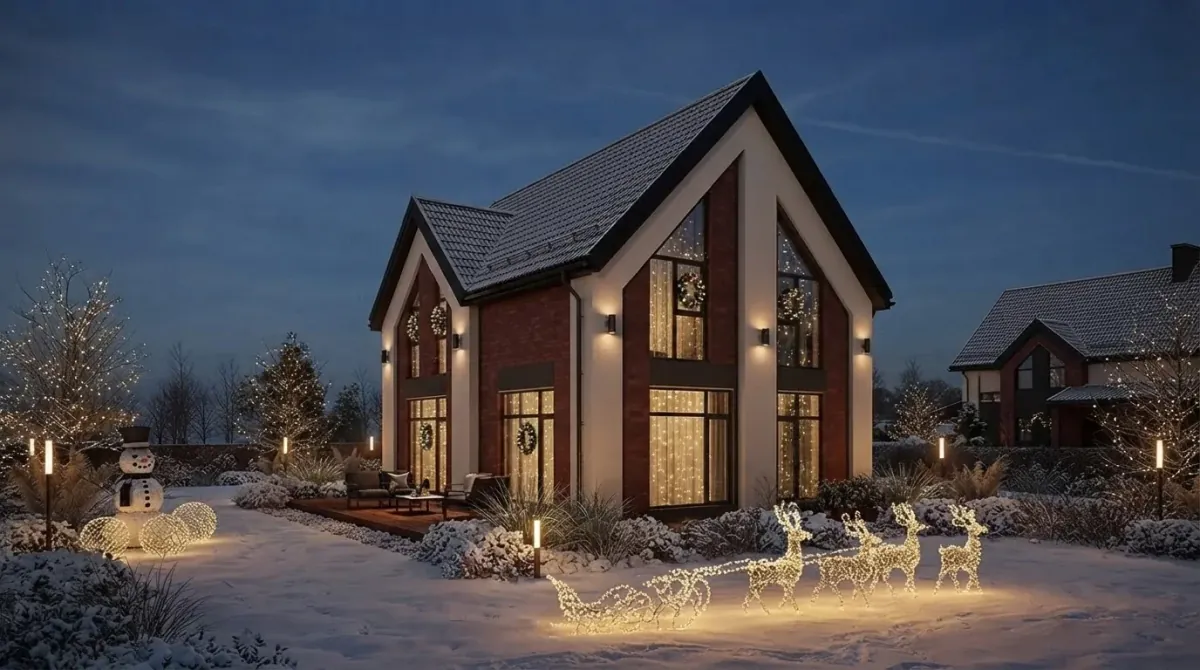
Season cost assumes 6 hours a night for 40 nights, roughly Thanksgiving weekend to Epiphany, at the 2026 US average electricity price; change all three in the calculator. Sets already include the 10 percent slack. Two things in that table surprised us when we ran it. First, windows can need more lights than the roof: the colonial outlines 345 feet of windows, doors and trunks against 140 feet of roofline. Second, the jump from one circuit to two only happens in incandescent. In LED, even the largest of these fronts uses 17 percent of one 15 amp circuit.
How Do You Measure a Roofline for Christmas Lights?
Walk the gutter line on the ground with a tape or a measuring wheel, one straight run at a time, and write each run down separately. Trimlight’s method is to run the tape “along the bottom edge of the roofline”, the fascia, and to measure dormers, bump-outs and gable ends as their own line items. Standing on the ground under the gutter gives you the horizontal length exactly, because a gutter is level. You do not need a ladder for any of it.
- Eaves. Every gutter line you want lit, front and any visible side. Add them into the Eaves box.
- Gables. Count the peaks you will outline and measure one across at the eave, wall to wall plus the overhang. Pick the pitch (below). The calculator turns that width into the sloped length.
- Everything else on the roof. A ridge line, a porch roof, a dormer: their horizontal length goes in Other roof runs. A deep front porch is often the best-lit part of a house, so measure it even if you skip the main gutter (ideas in our modern front porch guide).
- The distance to the outlet. Not lit, so not in the total, but it decides how long an outdoor extension cord you need. Measure from the outlet to where the first set starts.
The Christmas Light Emporium’s rule for slack is 10 percent “for corners and overlaps”, and we use it on every run. If your house has many short runs and corners, round up a set rather than trusting the 10 percent to absorb all of them.
How Much Longer Is a Gable Than It Looks From the Ground?
On a common 6/12 roof the two sloped edges of a gable are 12 percent longer than its width; on a steep 12/12 roof they are 41 percent longer. Every guide we read reminds you to add the gables, because, in Trimlight’s words, “those angled runs need to be added to your total footage”, but none of them tells you how to get that length without climbing up there. Geometry does: the sloped length of a roof per foot of horizontal run is the square root of 1 plus (rise over 12) squared. Carpenters call it the rafter factor. Multiply the gable’s width at the eave by it and you have both rake edges together.
Not sure of your pitch? Look at the gable straight on. A roof whose peak sits above the eave by a quarter of the gable’s width is 6/12; one whose peak is as high as half the width is 12/12. If you can hold a level against a rafter tail in the garage or attic, 12 inches along the level and the drop to the rafter in inches is the pitch. Getting it wrong by one step changes a 24 foot gable by about a foot, so this does not need to be exact, but a steep roof read as a low one will leave you a set short at the peak.
How Many Lights for Windows and Doors?
A window outline takes its perimeter: (width + height) times 2, so a 3 by 5 foot window needs 16 feet of lights before the 10 percent. That is the Emporium’s own example. A standard 36 by 80 inch door outlined up one side, across the top and down the other takes about 16 feet as well. Windows add up faster than people expect: six of them is 96 feet, more than the gutter line of many houses.
Mini lights at 4 inch spacing give a crisp outline and are what the calculator assumes for openings. A 70-count 5mm LED set at 4 inches covers about 23 feet; a 100-count incandescent set about 33. If you would rather outline windows in C7 or C9, put them in the roofline group instead by adding their perimeter to Other roof runs and setting the window count to zero.
How Many Lights Do You Need for Bushes?
Use net lights and size them by surface: the bush’s height times its circumference at the widest point, divided by 24 square feet for a standard 4 by 6 foot net, rounded up. Both the area rule and the net size are the Emporium’s. A 3 foot boxwood about 8 feet around is 24 square feet, so one net. For a hedge you only see from the front, put its length in the “around” box: 20 feet long and 3 feet high is 60 square feet, so three nets.
One honest wrinkle. The same source sizes a 5 foot planting 12 feet around at two nets, which is 60 square feet, the same area it sizes at three nets for the hedge. Nets do stretch, and nobody lights the back of a bush against a wall, so two can be enough. The calculator rounds up to three; if you are lighting only the front of a round shrub, halve the circumference you type. If the beds in front of the house need replanting before they need lights, MeltFlex AI garden design redraws them on a photo, and our landscape design prompts give you wording that works.
How Many Lights to Wrap a Tree Trunk?
Divide the height you want to wrap by the gap between wraps, then multiply by the trunk’s circumference. That is Christmas Lights, Etc.’s formula: their 4 foot trunk with a 2 foot circumference, wrapped every 3 inches, takes 32 feet. A bigger street-side tree, 6 feet up a 30 inch trunk at the same spacing, takes 24 wraps of 2.5 feet, so 60 feet, about three 70-count LED sets.
The 3 inch gap is tight and very bright. Stretch it to 6 inches and you halve the lights. Wrapping the canopy as well is a different job with no reliable rule; Christmas Lights, Etc. suggests 4 to 5 sets for the trunk and main branches of a typical yard tree, which is a starting point, not a measurement.
C7 or C9, LED or Incandescent?
C9 for a roofline seen from the street, C7 for a low ranch, a porch or anything viewed up close, and LED for both unless you specifically want the old warm incandescent glow. C7 and C9 strings both come as 25 bulbs on 12 inch spacing, so the count is the same, one bulb per foot. The difference is size and, in incandescent, power: a C9 bulb draws 7 watts, a C7 5. In LED both are under half a watt.
The last column is the one that settles most arguments: lighting 100 feet of roofline in incandescent C9 costs about $31 a season at today’s prices, in LED about $2. The wattages are typical, not universal. Govee lists incandescent C7s at 4 watts and C9s at 10, and LED sets vary by brand, so read the box. The lit length leaves out the lead wire at each end.

How Many Strands of Christmas Lights Can You Connect?
As many as the tag on that set says, and no more: it is a rating of the thin wire and the fuse in that product, not a general rule. As a guide, the Emporium says incandescent C9 strings are often rated for only 2 or 3 end to end and incandescent minis commonly for 3 to 5, while Christmas Lights, Etc. puts incandescent minis at 5 to 10 and its 5mm LED minis at about 44. The Emporium cites the US Department of Energy for LED strings often connecting up to 25 sets.
The calculator uses the cautious end: 2 sets per run for incandescent C9, 3 for incandescent C7 and minis (the CPSC’s long-standing advice: “Use no more than three standard-size sets of lights per single extension cord”), and 25 for LED. Type your own tag’s number in sets per run and the plug-in runs update. Each run starts at an outlet or at a properly rated outdoor extension cord, not at the far end of another run. LED’s higher limit is the practical reason most people switch: one plug for the whole roofline instead of five.
How Many Christmas Lights Can Be on a 15 Amp Circuit?
About 1,440 watts: 80 percent of the 1,800 watts a 15 amp, 120 volt circuit carries, which is the limit for a load that runs longer than three hours. On a 20 amp circuit it is 1,920 watts. Christmas Lights, Etc. and the Emporium both use those figures. In sets, a 15 amp circuit takes about 8 incandescent C9 sets, 36 incandescent mini sets, or 125 C9 LED sets.
Two things catch people out. First, outlets are not circuits: the porch outlet and the garage outlet are often on the same breaker, so splitting the plugs between them does nothing. Find out which outlets trip together before you plan the runs. Second, anything else already on the circuit, a porch light, an inflatable, a heater in the garage, comes off the 1,440. Put it in Already on it and the calculator subtracts it. For outdoor sets the CPSC’s advice is lights “certified for outdoor use” plugged into a GFCI-protected outlet.
How Much Does It Cost to Run Christmas Lights?
Watts divided by 1,000, times hours a night, times nights, times your price per kWh: a typical LED front costs $4 to $11 for the season, the same front in incandescent $39 to $95. The calculator’s default price is 18.19 cents per kWh, the US residential average for January to August 2026 in the EIA’s Electric Power Monthly (released 23 October 2026). Your own bill has the real rate; in some states it is double that.
For scale, Christmas Lights, Etc.’s own power page still uses 11.3 cents per kWh, which was a fair number a decade ago and now understates the cost by about 40 percent. A timer matters more than the bulb choice once you are on LED: 6 hours instead of 12 halves the bill, and it also means the lights are off when nobody is awake to notice a problem. The CPSC counted 14,700 emergency room visits from holiday decorating in one season, and 41 percent were falls, so the cheapest light is still the one you hang from the ground with a pole or a stable ladder.
Can You See the Lights on Your House Before You Buy?
Yes: photograph the front of your house and an AI visualizer will draw the lights on it, which is the fastest way to decide whether the gables are worth lighting before you count anything. We compared seven of them in AI Christmas lights on my house. With MeltFlex AI exterior design you upload the photo and describe the look, warm white C9 on the eaves only, or the full outline with icicles. A render shows the look, not the count: the picture will happily put bulbs where no clip can hold them, so the numbers still come from the calculator above. If you would rather click along the roofline on your photo than measure it, the free Grants Pro Estimator covered in that guide counts C9 feet from two scale points; it does not size nets, plug-in runs, circuits or the electricity bill.
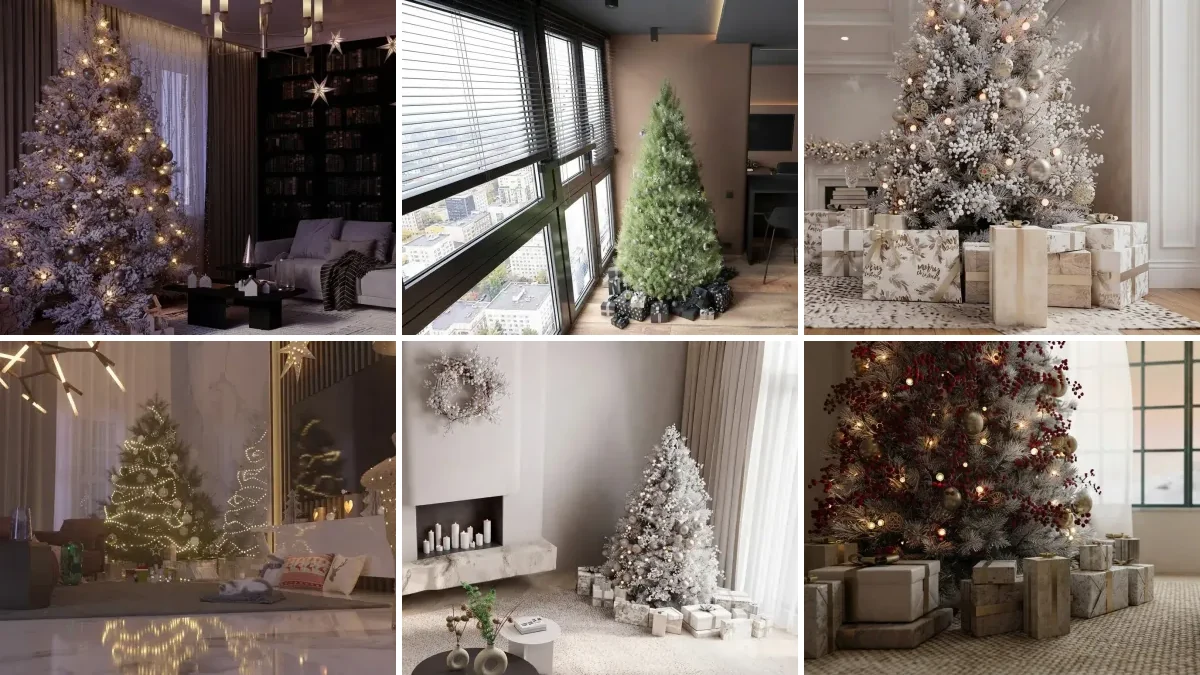
Lighting the tree inside as well? The Christmas tree light calculator does lights, ornaments, garland and ribbon for its height and width, and where to put the Christmas tree covers the window-or-corner question, including how it looks from the street. For the rest of the house, AI tools to decorate your house for Christmas covers rooms, and if the facade itself needs work first, see exterior house colors, board and batten siding or our exterior design prompts and house elevation prompts.
How This Calculator Works, and What We Could Not Verify
- Roofline = eaves + gables × width × √(1 + (pitch/12)²) + other roof runs + walkway (times 2 for both sides). Openings = windows × 2 × (width + height) + doors × 16.3 ft + trunks. Both get 10 percent.
- Sets = feet with slack divided by one set’s lit length (bulbs × spacing), rounded up. Runs = sets divided by the tag limit, rounded up, per group, because you cannot join a C9 string to a mini string.
- Nets = per bush, height × circumference divided by 24 sq ft, rounded up.
- Circuits = total watts divided by (amps × 120 × 0.8 minus what is already on it), rounded up. Cost = kW × hours × nights × price. Clips = 1.35 per foot of roofline, the middle of the Emporium’s 60 to 75 per 50 feet.
- Tests: 47 assertions run against the maths, including the sources’ own worked examples (the 32 ft trunk, the 16 ft window, the 175 W C9 string, 1,440 W on 15 A).
What we could not verify, or supplied ourselves:
- The rafter-factor conversion for gables is standard geometry, but none of the lighting guides we read publishes it. It is our addition, and it ignores the overhang on the rake, which adds a little.
- C7 LED at 0.4 W per bulb is our estimate from the low end of the Emporium’s 0.4 to 0.6 W range for LED C9. The 150 bulbs per 4 by 6 net, used only for watts, is our assumption.
- The Emporium’s two net examples contradict each other (60 sq ft is two nets in one, three in the other). We round up.
- The end-to-end defaults are cautious readings of ranges, not product ratings. Your tag overrides them.
- The CPSC’s 14,700 figure is from its December 2017 release and covers the 2016 season. We found nothing newer on cpsc.gov of the same kind, and two pages claiming a 2025 CPSC bulletin could not be traced to cpsc.gov.
- Christmas Designers’ calculator sits behind a bot check and holidaylightcalculator.com rendered an empty page for us, so we could not compare their logic.
Christmas Light Calculator FAQ
How many feet of Christmas lights do I need for my house?
Add up every gutter line you want lit, add both sloped edges of each gable (the width times 1.118 on a common 6/12 roof), add the perimeter of each window and door, then add 10 percent. A typical single-story front comes to about 100 feet of roofline, and Trimlight puts most single-story homes at 100 to 150 feet and larger or two-story homes at 200 feet or more.
How do I measure my roofline for Christmas lights?
Measure the gutter line on the ground directly under it with a tape or a measuring wheel, one straight run at a time. For each gable, measure its width at the eave and multiply by the pitch factor: 1.054 for a 4/12 roof, 1.118 for 6/12, 1.202 for 8/12, 1.414 for 12/12. That gives both sloped edges together. Then add 10 percent for corners and overlaps.
How many strands of Christmas lights can you connect?
Whatever the tag on that set says, because it is a rating of the wire and fuse in that product. As a guide: incandescent C9 strings are often rated for only 2 or 3 end to end, incandescent minis for about 3 to 10, and LED strings commonly for 25 or more. The CPSC also advises no more than three standard-size sets per extension cord.
How many Christmas lights can be on a 15 amp circuit?
About 1,440 watts, which is 80 percent of the 1,800 watts a 15 amp, 120 volt circuit carries, the limit for a load that runs more than three hours. That is about 8 sets of 25 incandescent C9 bulbs, 36 sets of 100 incandescent minis, or 125 sets of C9 LEDs, minus anything else already plugged into that circuit.
How much does it cost to run Christmas lights on a house?
Watts divided by 1,000, times hours a night, times nights, times your price per kWh. At the 2026 US average of 18.19 cents and 6 hours for 40 nights, 100 feet of C9 LED costs about $2 for the season and 100 feet of incandescent C9 about $31. A whole typical front lit in LED costs $4 to $11; the same plan in incandescent costs $39 to $95.
How many lights do I need for bushes?
Use net lights and size them by surface: bush height times its circumference at the widest point, divided by 24 square feet for a standard 4 by 6 foot net, rounded up. A 3 foot bush about 8 feet around takes one net. A hedge 20 feet long and 3 feet high takes three.
How many lights do I need to wrap a tree trunk?
Divide the height you want to wrap by the gap between wraps, then multiply by the trunk circumference. A 6 foot trunk 30 inches around, wrapped every 3 inches, takes 24 wraps of 2.5 feet: 60 feet of lights, about three 70-count LED mini sets.
Should I use C7 or C9 lights on my roofline?
C9 for a roofline seen from the street, C7 for a low ranch, a porch or anything viewed up close. Both come as 25 bulbs on 12 inch spacing, so the count is the same: one bulb per foot. In LED the running cost is almost the same; in incandescent a C9 draws 7 watts against a C7 at 5.
Sources
All read on 14 November 2026. Quotations are verbatim from the page linked.
- The Christmas Light Emporium, How Many Christmas Lights Do I Need? (roofline, windows, nets, 10 percent slack).
- The Christmas Light Emporium, How Many Strings of Christmas Lights Can You Connect? (end-to-end ranges, wattages, 80 percent rule).
- The Christmas Light Emporium, How to Light Bushes and Shrubs With Net Lights and Icicle Lights Done Right (clips, icicle set lengths, DOE note).
- Christmas Lights, Etc., How Many Christmas Lights Do I Need (updated 13 Aug 2026), Hanging Christmas Lights and How Much Electricity Do Christmas Lights Use (both updated 28 Jan 2026).
- Trimlight, How Many Christmas Lights Do I Need? Footage by Roofline (9 Sep 2026).
- 1000Bulbs, How to Calculate Maximum Runs from Wattage (LED C9 at 0.46 W).
- Novelty Lights, C7 5 watt bulbs, Creative Displays, C7 and C9 FAQ and Govee, C7 vs C9 (bulb wattages).
- US Energy Information Administration, Electric Power Monthly, Table 5.3 (released 23 Oct 2026).
- US Consumer Product Safety Commission, Put Safety at the Top of Your List When Decorating This Holiday Season (6 Dec 2017) and CPSC Urges Consumers to Decorate Safely for the Holidays (5 Dec 2002, three sets per extension cord).
Audio version by MeltFlex AI
Listen to this article
Prefer to listen? Matthew and Bryan, the founders of MeltFlex AI, talk through Christmas Light Calculator for Your House: Roofline, Gables, Strands, Watts and Cost in about 16 minutes. The voices are AI-generated. Every section is a chapter, so you can jump straight to the part you need while you browse rooms or sketch a layout.
Chapters (8)
More narrated articles on AI Interior Design MeltFlex