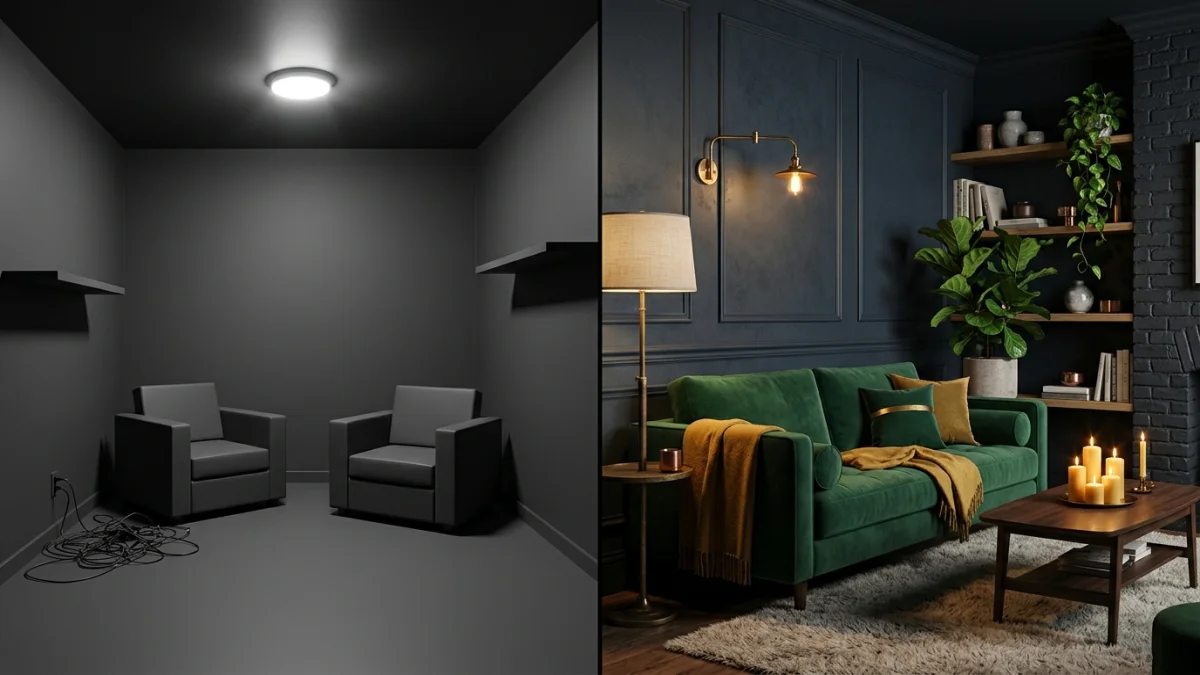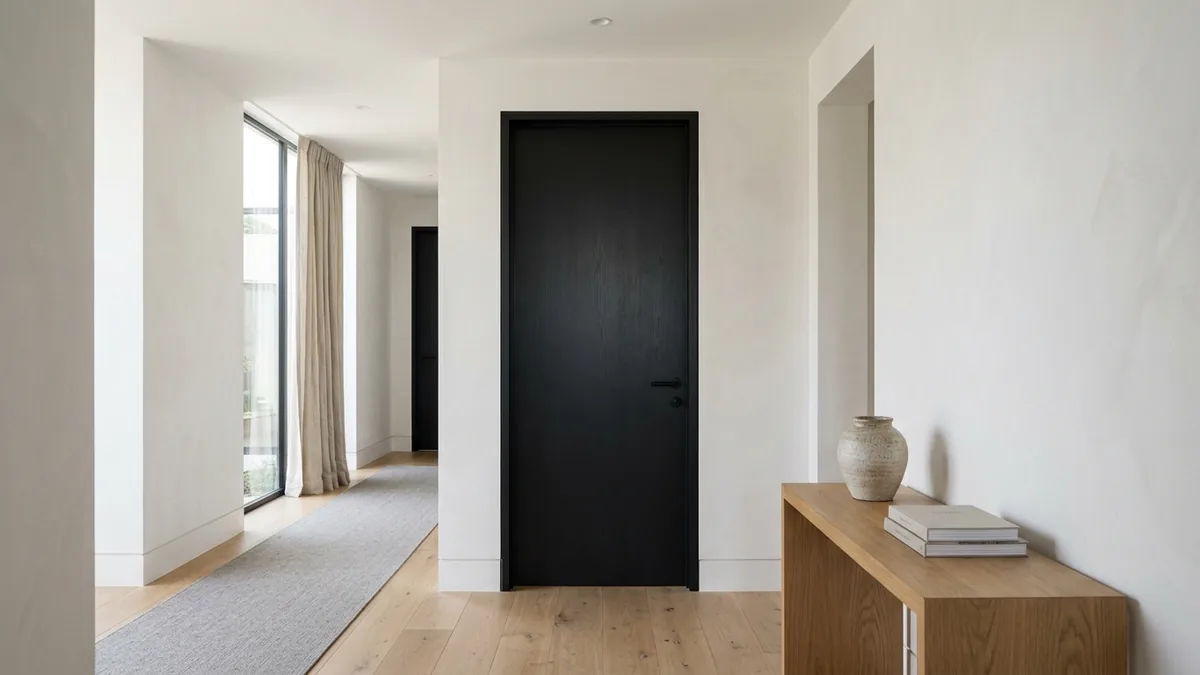
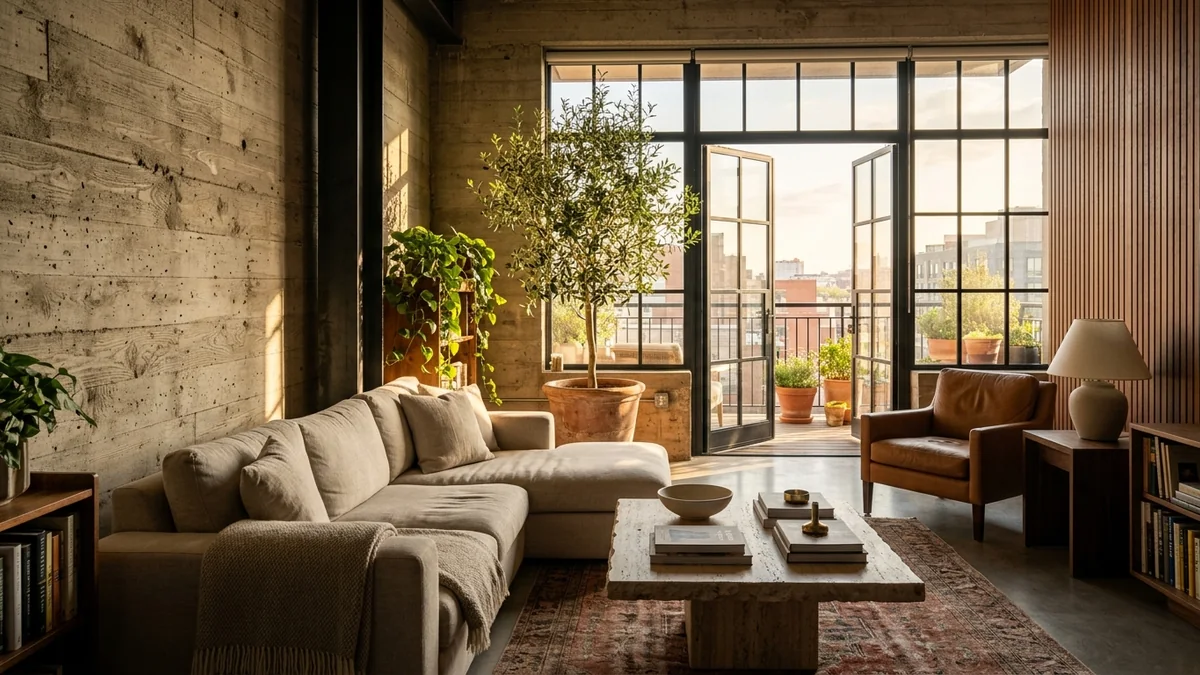
Metal makes a room feel cold only when it is the only hard material in it. Balance blackened steel, brass or concrete with wood, natural stone, soft textiles, greenery and warm light, and the same metal reads as calm, warm and deliberate instead of clinical. That is the whole idea behind this guide, and it is more achievable than it looks.
Our articles are still written by humans!
Get human written articles in your Google feed.
Metal itself is never the problem. Steel, chrome and polished concrete are the materials people reach for to make a room feel modern, and the same materials get the blame when the finished space feels more like a car park than a home. The real cause is a room where every surface is smooth, grey and reflective, with nothing to answer back with warmth. And there is real appetite for getting it right: the global metal furniture market is forecast to grow from about $79.5 billion in 2026 to $100.9 billion by 2034, according to Fortune Business Insights, so metal in the home is only becoming more mainstream.
The clearest example of the fix is not a living room at all. For an aesthetic-medicine clinic, the studio JA architekti started from the industrial character of the building itself, exposed concrete, metal and glass, and instead of fighting it, balanced it. Wood, natural stone, greenery and organic curves brought in warmth, calm and a human scale. The goal was never one dominant material. It was the balance between them: the technical against the natural, the hard against the soft, the straight line against the organic curve. As the studio put it, materials on their own do not create good architecture; the relationships between them do. A healthcare interior does not have to feel sterile, and metal does not have to feel cold.
This guide takes that principle into the home. Below are the pairings, finishes and room-by-room moves that let you use metal generously, blackened steel, brass, concrete, Crittall glass, without ever landing in cold, clinical territory. Every idea is shown in a real photo, and at the end you can preview any of them in your own room with AI before you spend anything.
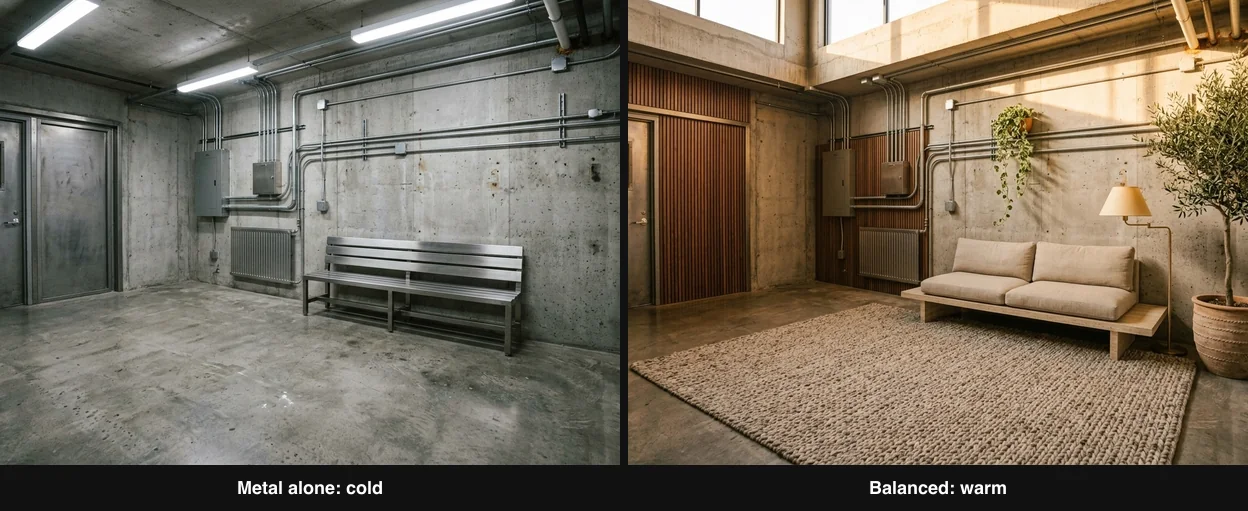
Drag the handle to compare: the same concrete-and-metal shell, cold on one side and balanced with wood, stone, greenery and warm light on the other. The materials did not change. The relationships between them did.
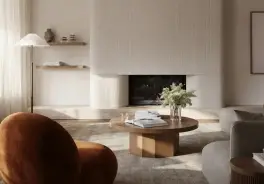
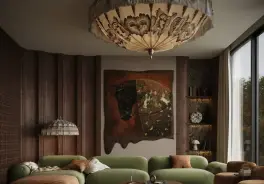
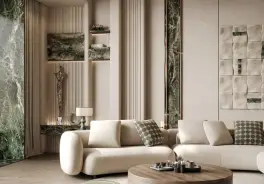
Why Metal Feels Cold, and How to Fix It
There are three real reasons a metal-heavy room feels cold, and none of them is the metal itself.
Everything is smooth and reflective. Steel, chrome, glass and polished concrete all bounce light rather than absorb it. A room made only of those surfaces has nothing to soften the light or the sound, so it feels hard and echoey. The eye reads the lack of texture as a lack of warmth.
The palette is low in warmth. Raw steel, aluminium and grey concrete all sit in the cool, desaturated part of the spectrum. Put them together with cool white light and there is no warm colour anywhere for the eye to rest on. The room technically works and still feels unwelcoming.
The lighting is flat. Cold rooms are almost always lit with flat, cool overhead light. Metal needs raking, directional, warm light to look good. Light that skims across a surface reveals the grain of concrete and puts a soft glow on brass or a matte sheen on blackened steel. Flat 4000K downlight does the opposite and makes every metal look like a fridge.
The fix for all three is the same, and it is the thesis of this whole guide: you do not remove the metal, you balance it. Add texture, add warm colour through natural materials, and light it properly. Do that and the exact same steel that looked clinical starts to look intentional. For the lighting side of this specifically, our guide to interior design lighting goes deep on how warm, directional light changes a material.
The Material-Balance Rule
Good industrial interiors are not about one hero material. They are about the tension between opposites. The clinic project put it as three balances, and they are the most useful mental model for using metal at home:
- Technical against natural. For every hard, man-made surface, concrete, steel, glass, bring in a natural one: wood, stone, plants, wool. Aim for at least a rough 50/50 by visual weight, and if a room still feels cold, tip it further toward natural.
- Hard against soft. Metal and concrete are hard and cold to the touch. Answer them with soft things you want to touch: a chunky wool rug, a leather sofa, linen curtains, a boucle chair. Softness is what turns a space into a room you relax in.
- Straight line against organic curve. Industrial architecture is all straight lines and right angles. A single curved element, an arched doorway, a round travertine table, a curved sofa, a sculptural pendant, breaks the grid and stops the room feeling like a technical drawing. This is why the curved furniture trend pairs so well with hard industrial shells.
Hold those three balances and you can use as much metal as you like. Break them, and even a little steel starts to feel cold. Materials on their own do not make a good room. The relationships between them do.
This is not only about looks. In the Human Spaces report, a study of 7,600 office workers across 16 countries, people in spaces with natural elements such as wood, greenery and daylight reported 15% higher wellbeing and 15% more creativity, and rated natural light the single most wanted feature of any space. The warm, natural materials you add to balance the metal are doing measurable work, not just softening the picture.
How to Make Industrial Style Feel Warm
To make an industrial or metal-heavy room feel warm, keep the raw concrete, brick and steel, then balance them with wood, soft texture, greenery and warm light. Six moves do almost all the work, in rough order of impact:
- Keep the raw bones. Leave the concrete, brick and exposed metal on show. You are balancing the industrial character, not hiding it.
- Add wood on a large surface. A walnut or oak slat wall, ceiling or floor is the single biggest warmth lever. Matte, slightly imperfect timber beats glossy new finishes.
- Layer soft texture. A chunky wool rug, linen curtains and a leather or boucle seat give the room something soft to touch.
- Bring in greenery. One large leafy plant, an olive tree or fiddle-leaf fig, adds life and organic colour against the hard surfaces.
- Warm the light. Swap cool white for 2700K to 3000K bulbs and light from lamps at different heights, not a single cold ceiling fixture.
- Lead with warm metals. Make brushed brass, bronze or blackened steel your dominant metal and keep chrome and bright stainless as small accents.
Do three or four of these and even a bare concrete-and-steel shell reads warm. The rest of this guide is those moves in detail, room by room.
Watch: Warm Industrial With Steel, Wood and Concrete
Before the room-by-room ideas, it helps to see the balance in motion. This walkthrough runs through industrial interiors that pair steel, wood, concrete and brick, the same metal-plus-natural-material tension this guide is built on, so you can watch how quickly a raw shell warms up once wood and soft materials enter the frame.

Warm industrial interiors built from steel, wood, concrete and brick. Video by Grig Stamate on YouTube. Notice how the wood and soft layers, not the metal, are what stop each room feeling cold.
Warm Metals vs Cool Metals
Not all metal reads the same temperature. Half the battle is simply choosing warmer finishes. Brass, copper and bronze carry warm colour in the metal itself, so they add to the warmth of a room. Chrome, nickel and stainless steel are cool and mirror-like, so they lean the other way. Blackened steel sits in the middle: it is neutral and grounding, and because it is matte rather than shiny it never feels as cold as chrome.
The practical takeaway: make your dominant metal a warm one or a matte black, and keep chrome and bright stainless as small accents. A room led by brushed brass and blackened steel will feel warm almost no matter what else you do.
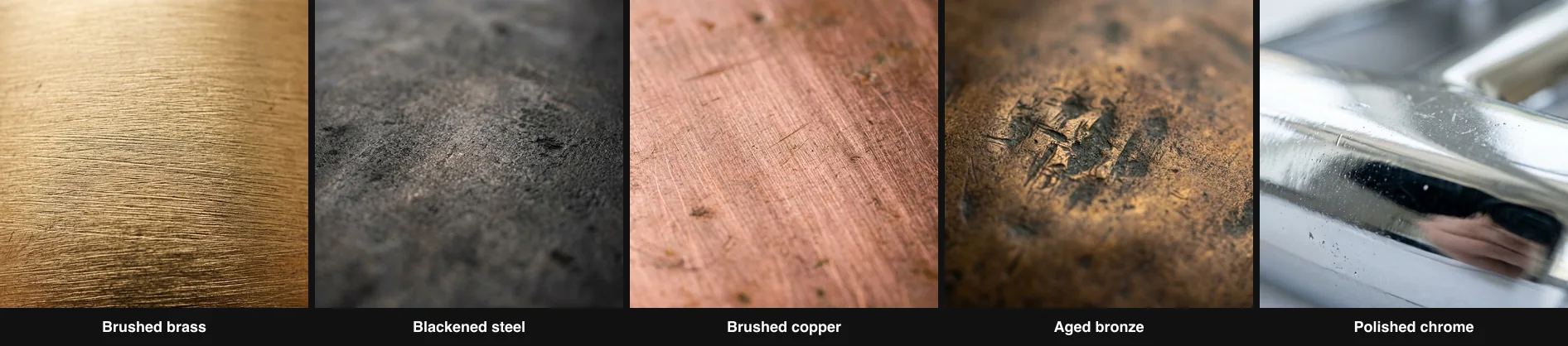
The finishes up close. The four on the left, brass, blackened steel, copper and bronze, all carry warmth. Polished chrome on the right is the cool one, best kept to small accents.
Minimalist Stainless Steel, Done Tastefully
Stainless steel is the finish this guide keeps calling cool, and in a busy room it is. But there is one context where stainless is not just acceptable but genuinely beautiful, and that is pared-back minimalism. When a space is quiet and uncluttered, brushed stainless stops reading as canteen and starts reading as gallery. The trick is three things: choose brushed stainless rather than mirror-polished, keep the forms simple and seamless, and light it with warm, soft, directional light so the steel picks up a satin glow instead of a hard glare.
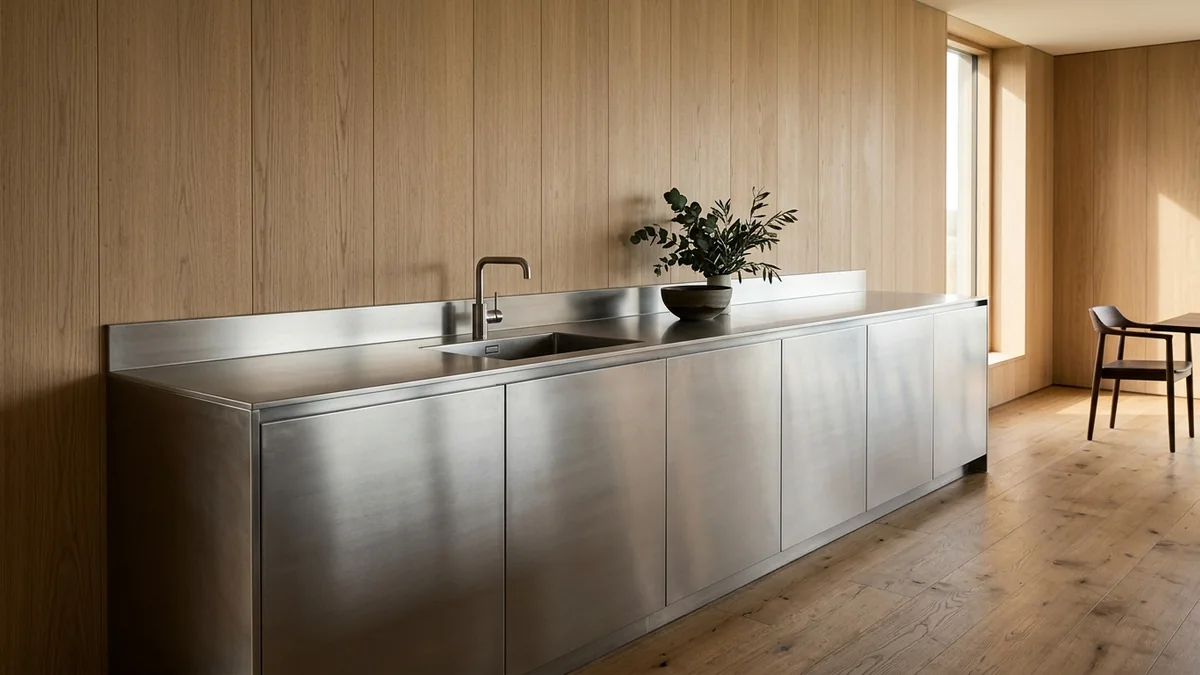
Brushed stainless done as warm minimalism. Seamless, handleless and quiet, warmed by oak and soft light. Cool metal, but not a cold room.
A monolithic stainless island is the purest version of the idea. A single clean block, soft edges, nothing on it but one stone bowl, reads as sculpture rather than appliance. Because minimalism removes visual clutter, the one material you keep has to be beautiful in its own right, and brushed steel earns that place through its soft, even surface and the way it quietly reflects the warm tones around it.
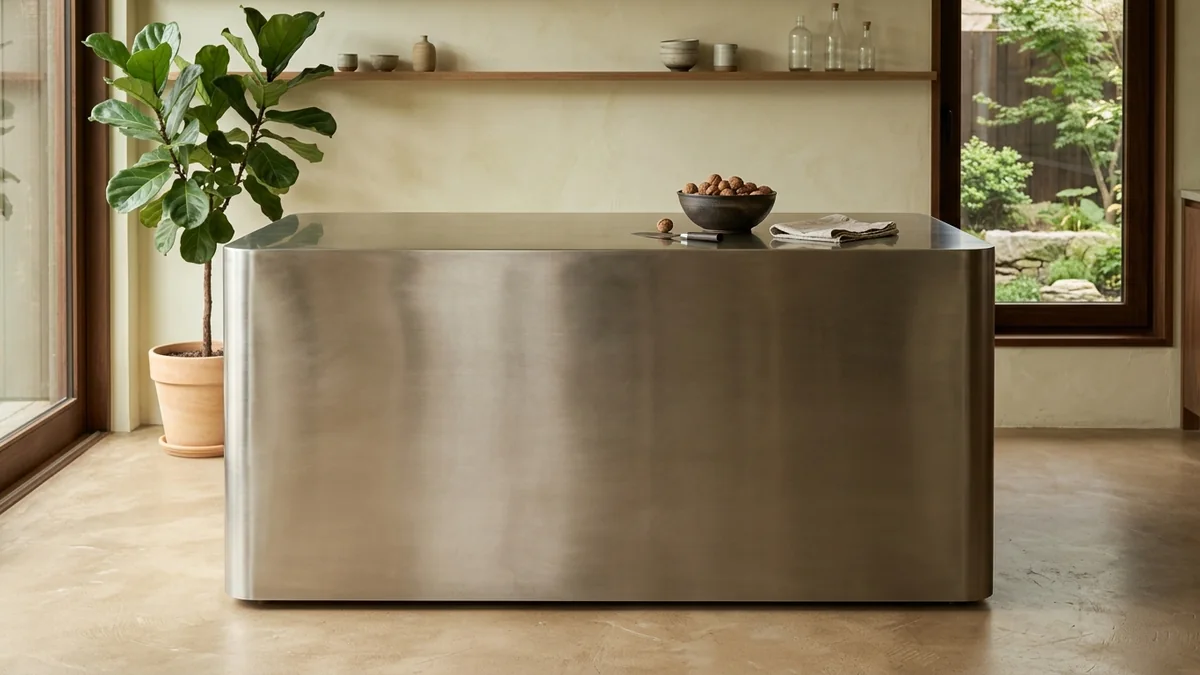
A monolithic brushed stainless island reads as sculpture. In minimalism, the one material you keep has to earn it, and brushed steel does.
The same logic scales all the way down to the small stuff. A slim brushed stainless tap, a simple steel kettle, a plain cylinder vase, a seamless bowl, a bracketless shelf: individually they are quiet, and together they build a calm, considered stainless language without a hint of the clinical. Keep the forms honest and the finish brushed, and stainless becomes one of the most timeless materials you can choose.
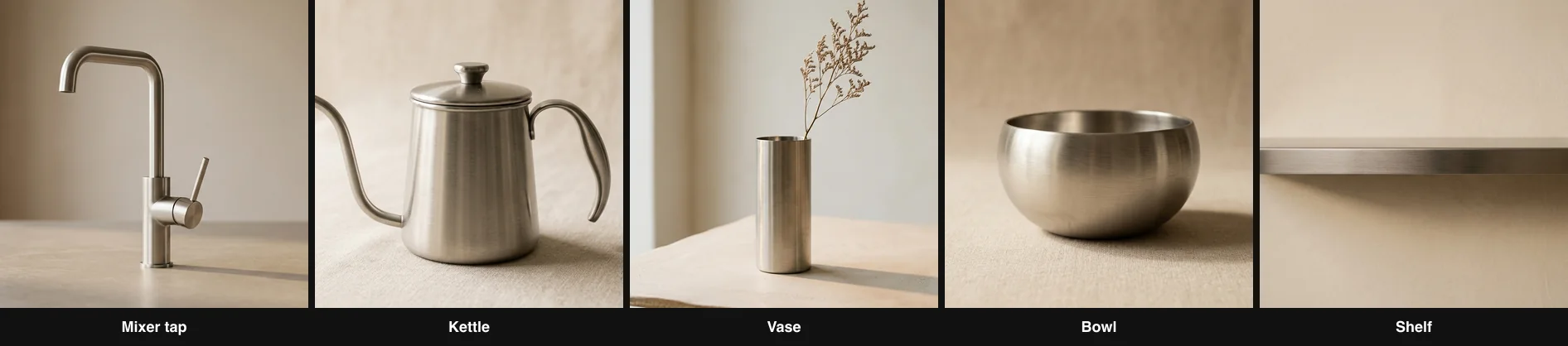
Minimalist stainless in the details. Brushed, simple and honest, each piece is quiet on its own and calm together.
Even a bathroom, the room most at risk of feeling clinical, can carry stainless when it is done this way. A seamless brushed stainless trough basin on a warm oak vanity, a slim steel wall tap, soft diffuse light: the result is spa, not surgery. The rule from the top of this guide still holds. Stainless is the coolest metal, so you balance it, here with oak, warm plaster and soft light, and it turns beautiful.
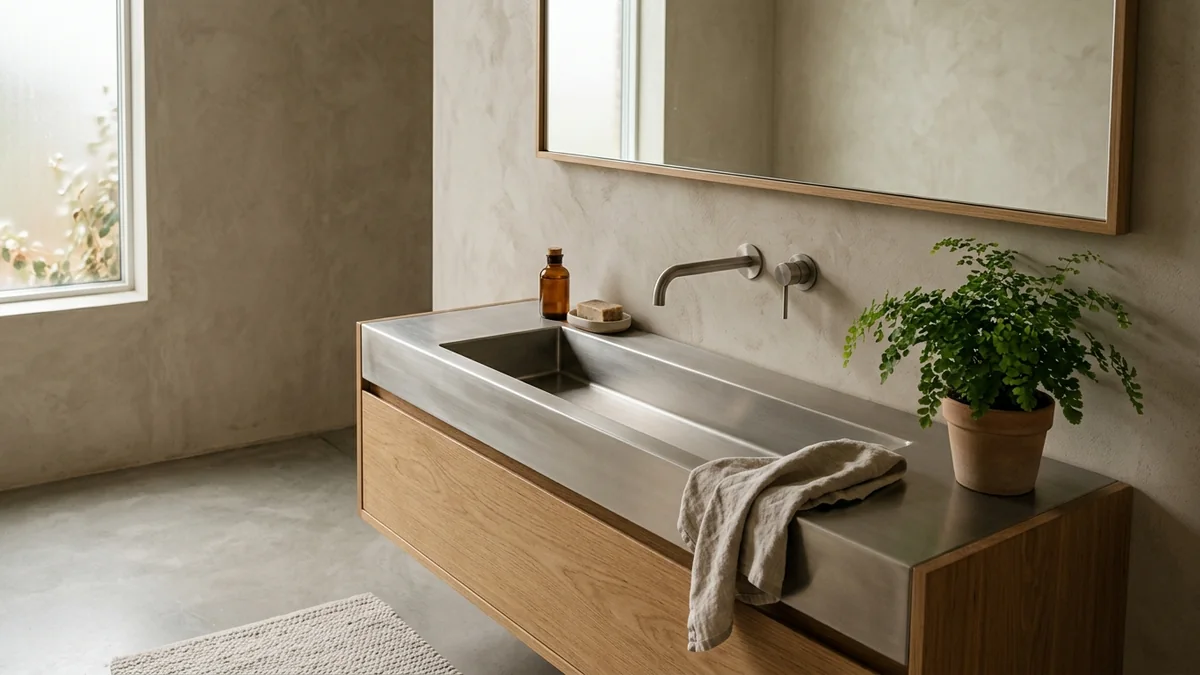
A brushed stainless trough basin on a warm oak vanity. Balanced with wood and soft light, even the coolest metal reads calm and spa-like.
Metal and Wood: the Core Pairing
If you only remember one pairing, make it metal and wood. Wood answers everything metal lacks. It is warm where metal is cool, it has grain where metal is smooth, and it is a natural material against a man-made one. A blackened steel frame filled with warm walnut shelves is the single most reliable move in warm industrial design, which is why it appears in almost every project in this style.
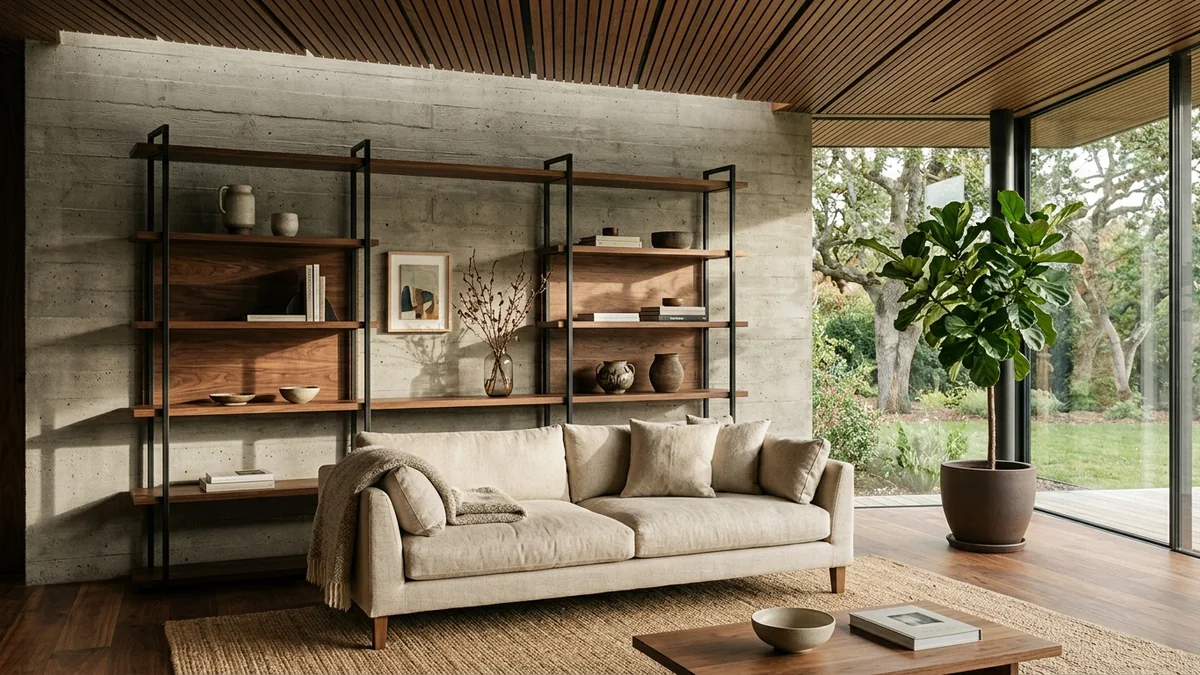
Blackened steel and walnut against board-formed concrete. The wood carries the warmth, the steel gives the structure, and neither feels cold.
Ways to bring wood in against metal, from biggest to smallest impact:
- A wood slat wall or ceiling. A large expanse of walnut or oak slats is the fastest way to warm a concrete-and-steel room, and it doubles as texture. It is the same instinct behind the best feature wall ideas, applied to a hard shell.
- Steel-and-wood furniture. Shelving, consoles, desks and dining tables that combine a black metal frame with a solid wood top are the workhorses of this look.
- A warm wood floor. Swapping grey polished concrete underfoot for warm oak instantly lowers the temperature of the whole room. If you are choosing flooring, the 2026 flooring trends guide covers the warm woods leading right now.
- Small wood objects. Chopping boards, bowls, stools and frames. Not enough on their own, but they finish the job.
Metal and Natural Stone
Stone is the second great partner for metal. Where wood adds warmth, natural stone adds organic pattern, the veining of marble, the pitted texture of travertine, the movement in a slab of quartzite. Set against the flat, even surface of steel or concrete, that natural pattern is what stops the room feeling manufactured.
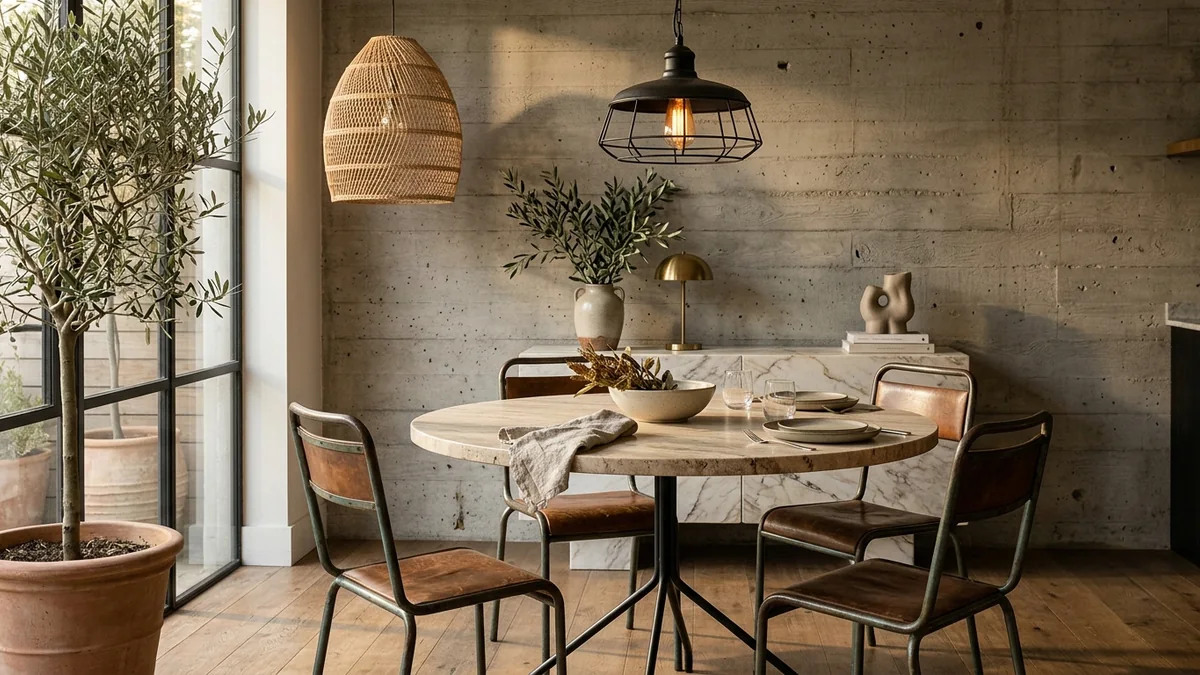
A travertine table on a slim steel base. The stone brings organic pattern and warmth to the hard metal and concrete around it.
The classic combinations are a travertine or marble tabletop on a blackened steel base, a stone kitchen worktop against metal shelving, and a natural-stone basin on a metal-framed vanity. Honed and matte stone finishes work better here than high polish, because a mirror-polished stone next to chrome doubles down on the cold, reflective quality you are trying to break up. Warm-toned stones, travertine, some marbles, warm limestone, do more work than cool grey ones.
Steel-Framed Glass and Crittall
Slim black steel-framed glass, usually called Crittall after the English company that has made steel windows since 1849, is one of the most useful moves in the whole style. A Crittall-style internal screen or door divides space without blocking light, so it keeps an open plan feeling open while still giving you separate zones. The black frame reads as industrial and architectural, and because it is mostly glass it adds very little visual weight.
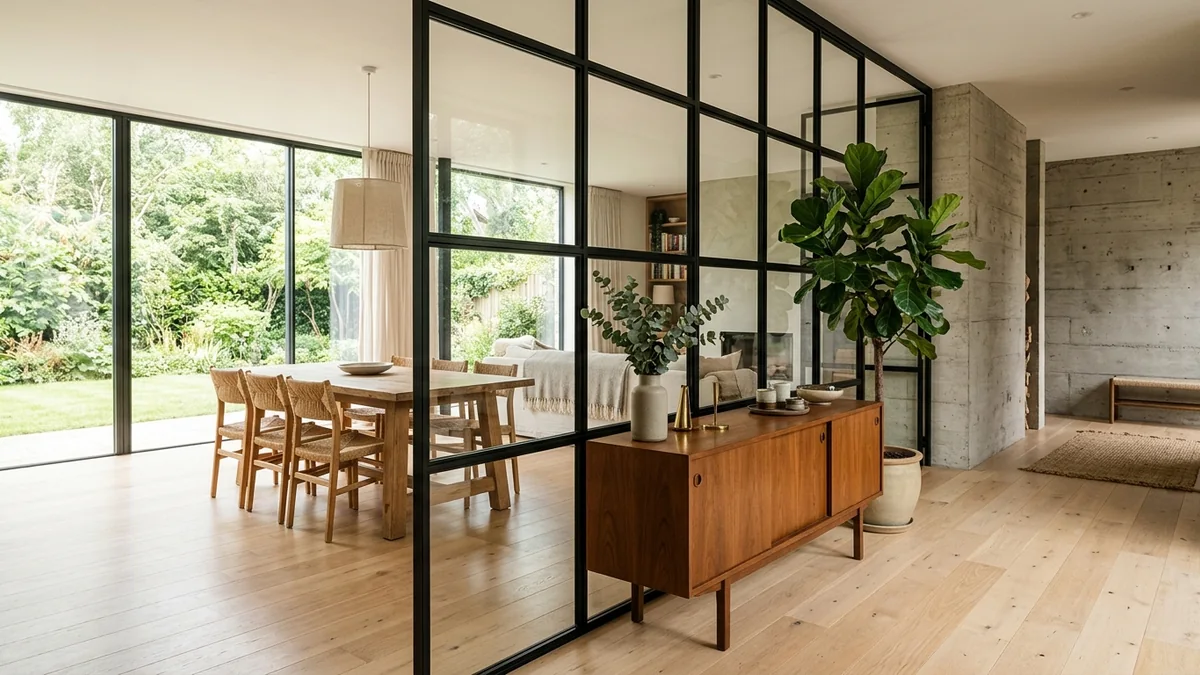
A Crittall-style steel and glass partition. It divides the space and carries the industrial language, but lets light travel deep into the plan so nothing feels closed in.
Where Crittall earns its keep:
- Between a kitchen and a living or dining room, to zone an open plan without losing light or sightlines.
- As a shower screen, which turns a functional bathroom fitting into an architectural feature.
- As internal doors or a home-office wall, so a room can be closed off for quiet while still borrowing daylight from the rest of the home.
Genuine steel systems are an investment, often 1,000 to 4,000 dollars per opening installed. Powder-coated aluminium and slim black uPVC look-alikes deliver most of the effect for meaningfully less, which is how the look has spread so far beyond high-end projects. If it is the doors themselves you are weighing up, our guide to black interior doors and how to preview them covers Crittall and solid black doors side by side.
Metal Ideas by Room
The balance rule stays the same everywhere, but each room has its own natural way to use metal.
Metal in the kitchen
The kitchen is where metal is most at home, because so much of it is functional: the hood, the tap, the shelving, the appliances. The trick is to stop it reading like a commercial kitchen. Pair stainless and blackened steel with warm wood cabinet fronts, a stone worktop and brass or bronze hardware, and add something living, a herb pot, trailing greenery on an open shelf.
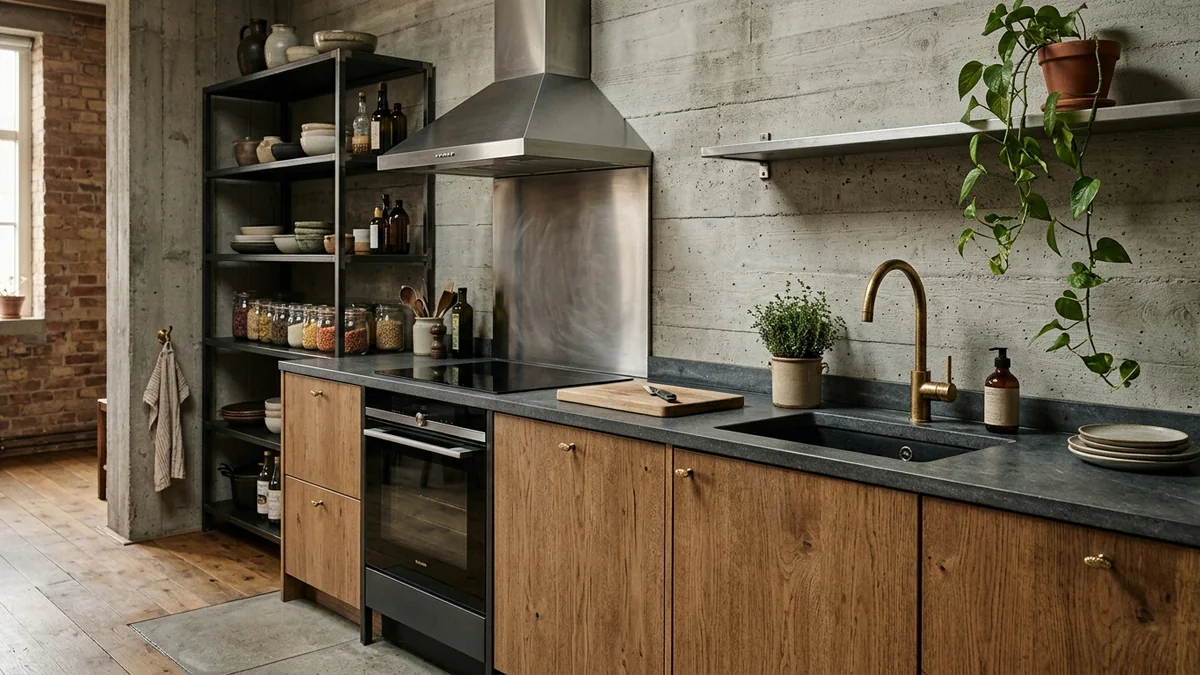
Metal in the kitchen, warmed by oak fronts, a stone worktop, brass hardware and greenery. Functional metal without the canteen feel.
For more on this room specifically, see our guide to AI kitchen design tools.
Metal in the living room
The living room is where warm metals earn their place. A brushed-brass arc lamp, an aged-bronze coffee table, a copper pendant, these add glow and glint without any of the coldness of chrome. Keep the big soft pieces warm too, a caramel leather or oatmeal linen sofa, a wool rug, and let the metal be the jewellery of the room rather than its structure.
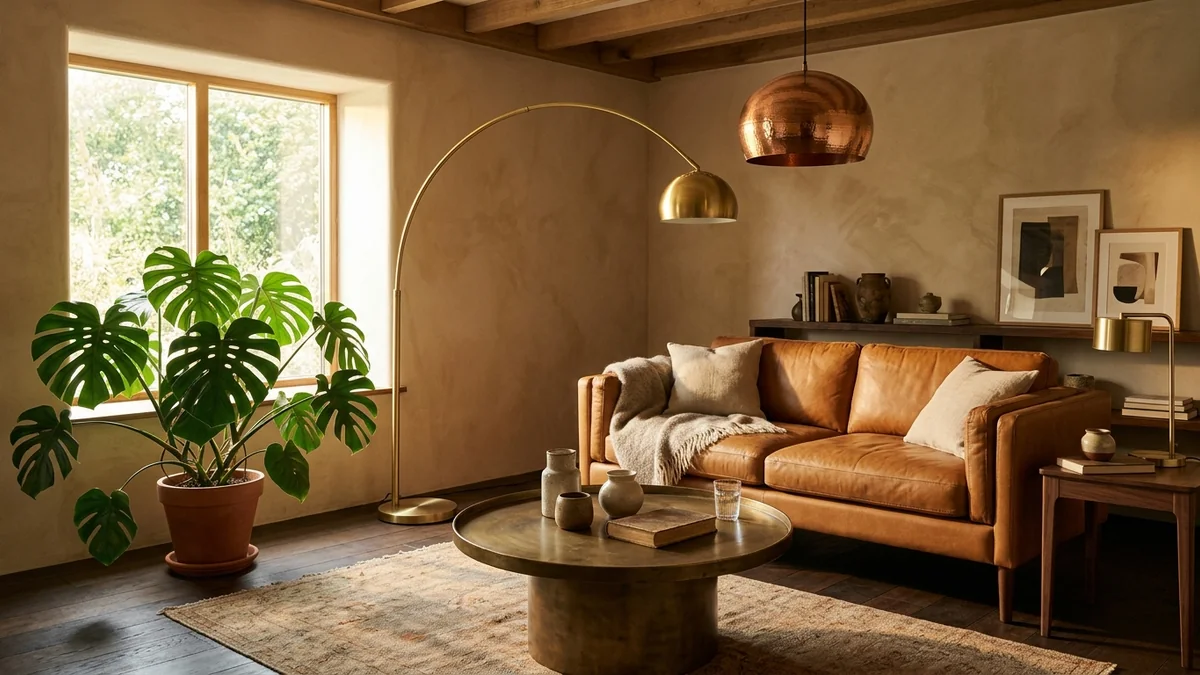
Warm metals as the jewellery of a living room. Brass, bronze and copper glow rather than glare, and read as luxury rather than utility.
Metal in the bedroom
A bedroom is the room people most fear will feel cold, so it is the one where balance matters most. A slim blackened steel or four-poster bed frame gives the room an architectural anchor, then everything around it goes soft and warm: a walnut slat headboard wall, layered linen bedding, a chunky wool rug, a brass wall light and one large plant. The steel keeps it from looking twee, the wood and textiles keep it from feeling cold, and the result is calm and cocooning rather than industrial.
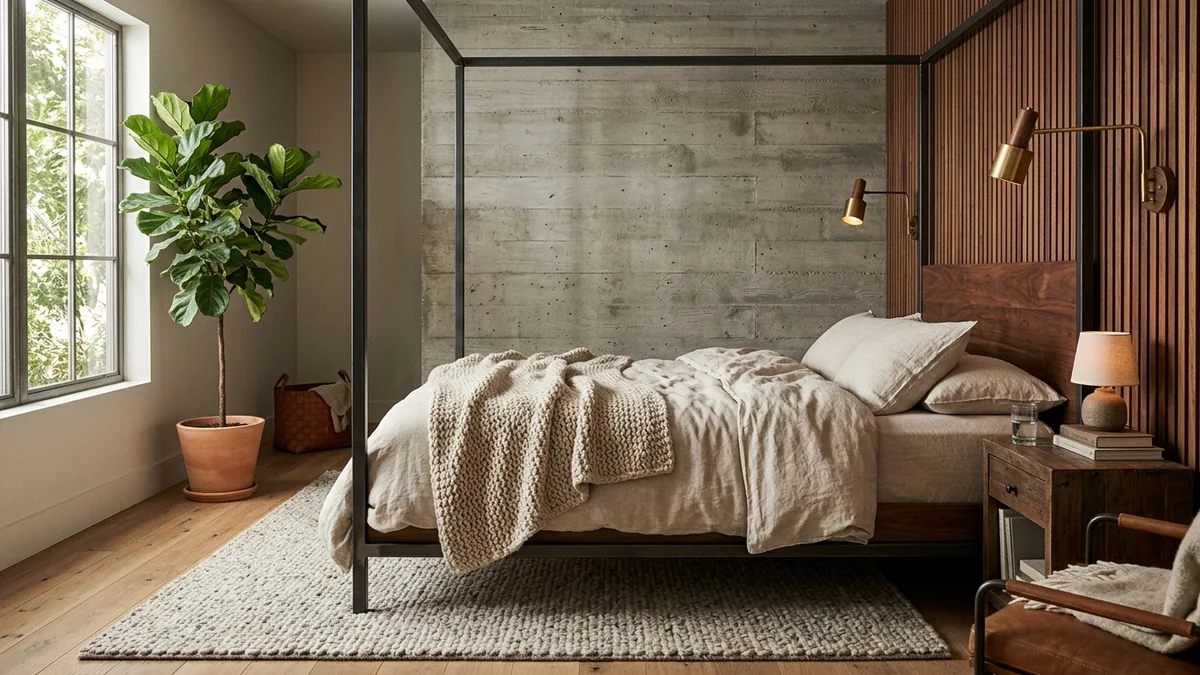
A blackened steel bed frame anchors the room; walnut, linen and a brass light keep it warm. For more, see our bedroom design guide.
Metal in the bathroom
Bathrooms slide into cold and clinical faster than any other room, which makes them the best place to prove the point. Keep the concrete or microcement and the metal-framed screen, then warm them with a wood vanity, a natural-stone basin, brass tapware and a generous plant. Warm, diffuse light finishes it. The result is closer to a spa than a clinic. If you are planning a full redo, our bathroom design and renovation ideas go further.
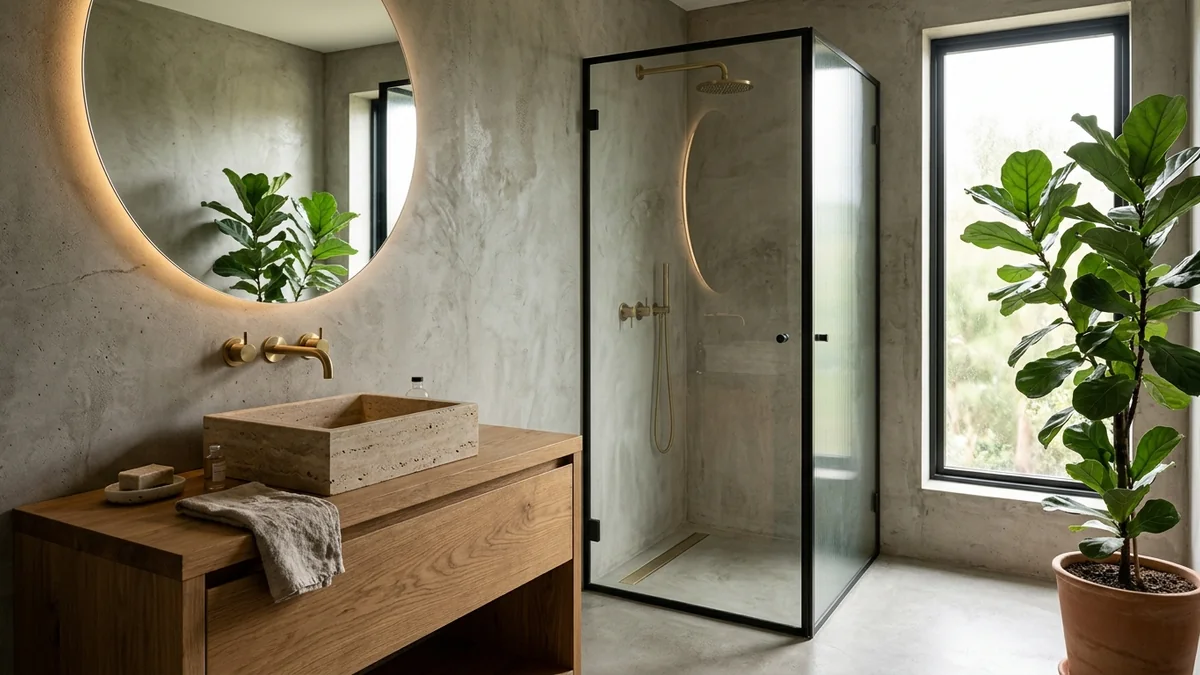
Concrete and blackened steel in a bathroom, warmed with a stone basin, oak vanity, brass taps and a plant. Spa, not clinic.
Metal as Architecture: Staircases, Brick and Lighting
Some of the strongest uses of metal are not furniture at all. They are built into the fabric of the room, which is where warm industrial design does its best work.
Staircases and railings
A blackened steel stringer with solid oak treads is one of the most beautiful things you can do with metal in a home. The steel does the structural work and reads as architectural, while the warm wood treads stop it feeling like a fire escape. A steel-mesh or slim-bar balustrade keeps sightlines open so the stair floats rather than blocks. It is the same balance the rest of this guide runs on, applied to the one element everyone touches.
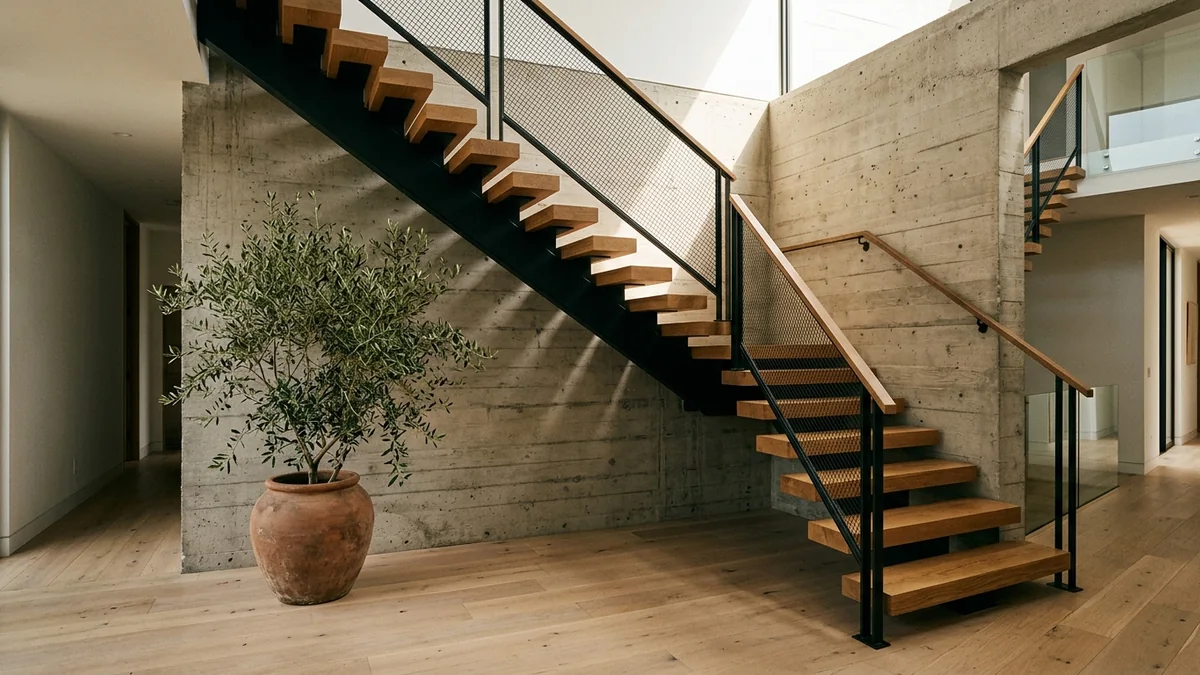
Blackened steel and oak. The metal carries the structure, the wood carries the warmth, and the open railing lets the stair float.
Exposed brick
Brick is the warmest of the raw industrial materials, which is why a brick wall does so much of the work in a loft. Its colour and texture are already warm, so paired with black steel window frames and shelving it gives you the industrial edge without the chill. Add a tan leather sofa, a wood table and plenty of greenery and the room reads characterful and lived-in, never cold.
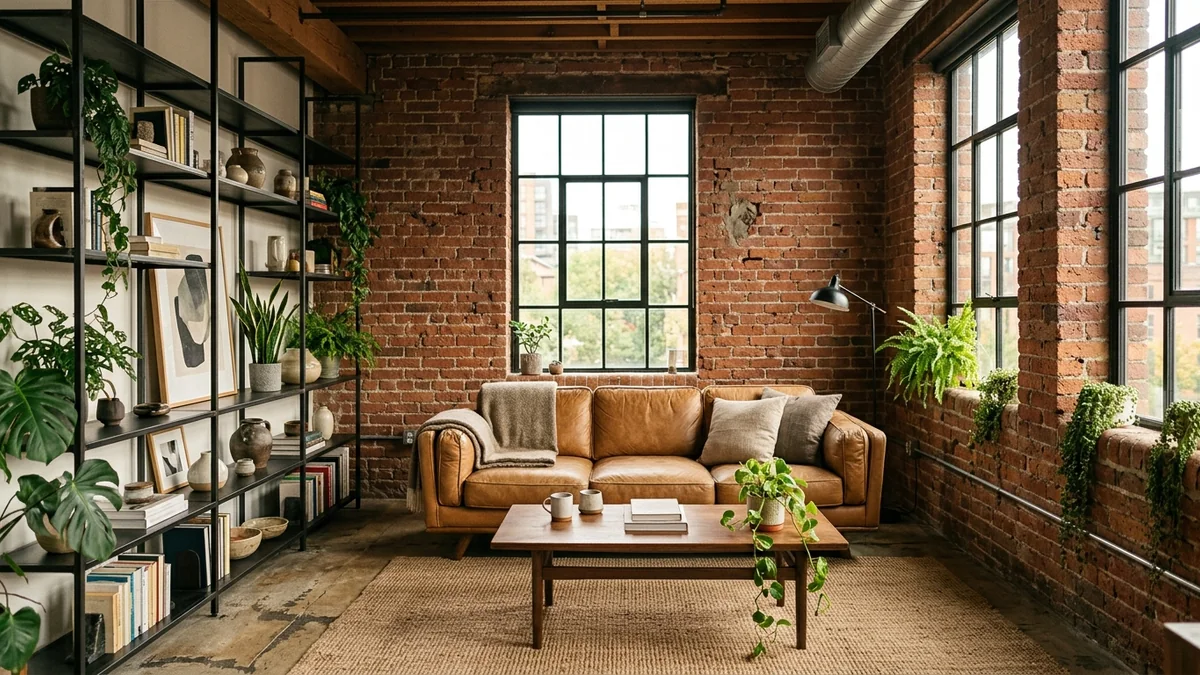
Exposed brick is the warmest industrial material. With steel frames, leather and plants, a loft reads characterful, not cold.
Statement lighting
Metal light fittings are the easiest way to add the industrial note in a rental or a room you do not want to rebuild. A cluster of blackened-steel, brass or copper pendants over a dining table brings the material in at eye level, and because the metal is warmed by the light it casts, it glows rather than glares. Warm bulbs at 2700K are what make it work. For the full approach to lighting a room, see our interior design lighting guide.
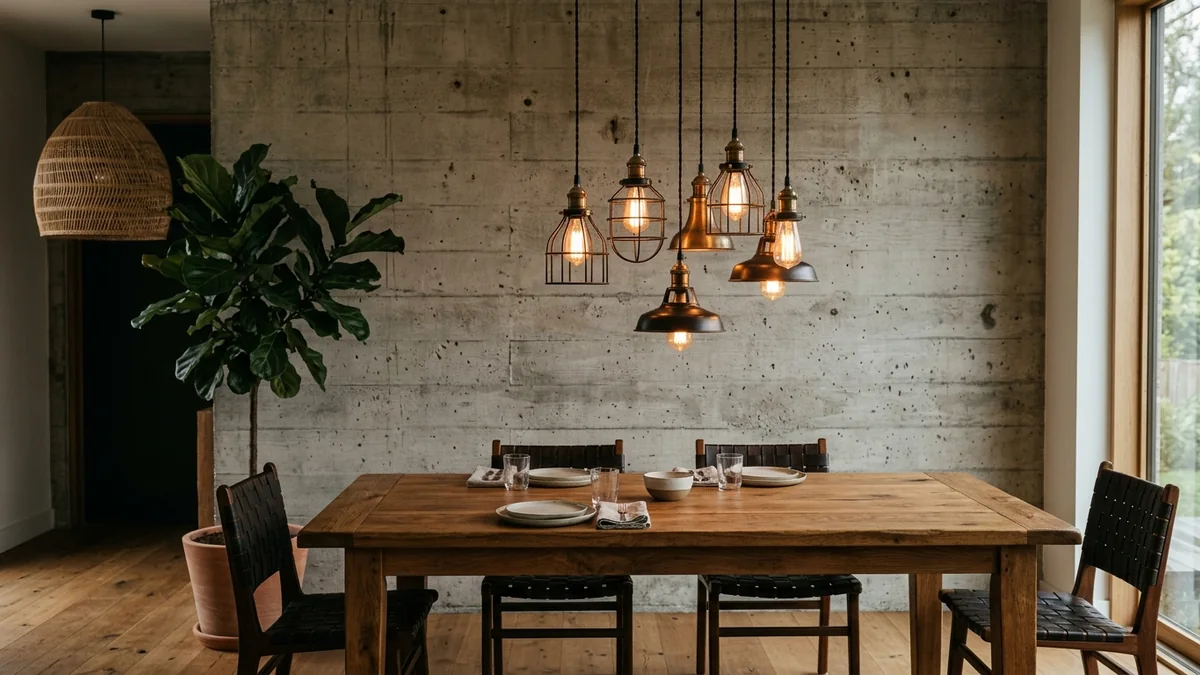
A cluster of metal pendants over the table. Warmed by the light they cast, industrial fittings glow rather than glare.
How to Mix Metals Without Clashing
The old rule that every metal in a room must match is gone. Mixing metals looks more collected and more expensive, as long as you do it on purpose. Three guidelines keep it from looking accidental:
- Pick a dominant metal. Choose one metal to carry roughly 70 percent of the room, usually a warm one like brass or a grounding blackened steel. Everything else is an accent. Without a clear lead, mixed metals just look indecisive.
- Limit yourself to two or three. A dominant plus one or two accents is plenty. Brass and black is the safest pairing going, brass and black and a touch of bronze is richer, and beyond three the room starts to feel busy.
- Repeat each metal at least twice. A single brass object looks like it wandered in. The same brass in the lighting, a handle and a frame looks like a decision. Repetition is what turns a mix into a scheme.
Where you can, keep the accents in the same temperature family as the lead, warm with warm. Brass, bronze and copper live together happily. If you want one cool metal in the mix for contrast, chrome or nickel, keep it to a single small moment rather than spreading it around.
Metal Finishes Compared
Finish matters as much as the metal. The same brass is a different material brushed, polished or antiqued. This is the quick reference for choosing:
For most warm interiors, brushed brass and blackened steel are the two finishes to build around. They are the most forgiving in daily use, they carry the most warmth, and they work together out of the box.
Preview Metal in Your Room With AI
Metal is one of the harder materials to commit to on faith. Brass tapware, a Crittall screen or a blackened steel wall unit are expensive and often permanent, and a finish that looks warm in a showroom can look cold in your light. That is exactly the kind of decision worth testing before you buy.
With MeltFlex AI you upload a photo of your real room and describe the metal you want to add: a blackened steel and walnut shelving wall, brushed-brass lighting and taps, a Crittall-style glass partition between the kitchen and living room. The AI keeps your real walls, furniture and light and shows you the result photorealistically, so you can hold warm brass against cool chrome, or steel against wood, side by side before spending anything. It is the fastest way to check that your metal will read warm and not cold in your own space.
Ready to try it? Design your room free on MeltFlex, or browse real industrial interior design examples first. To keep going on the warm-not-cold direction, our guides to dark and moody interiors, color drenching, biophilic design and the wider 2026 interior design trends are the natural next stops.