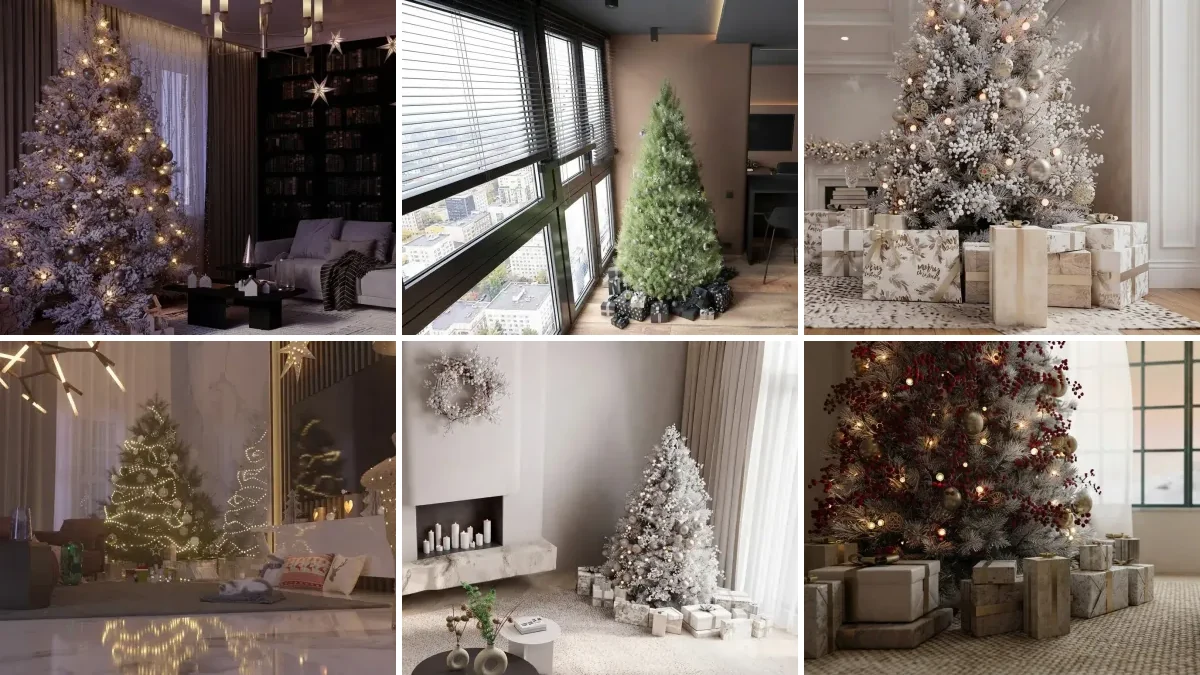
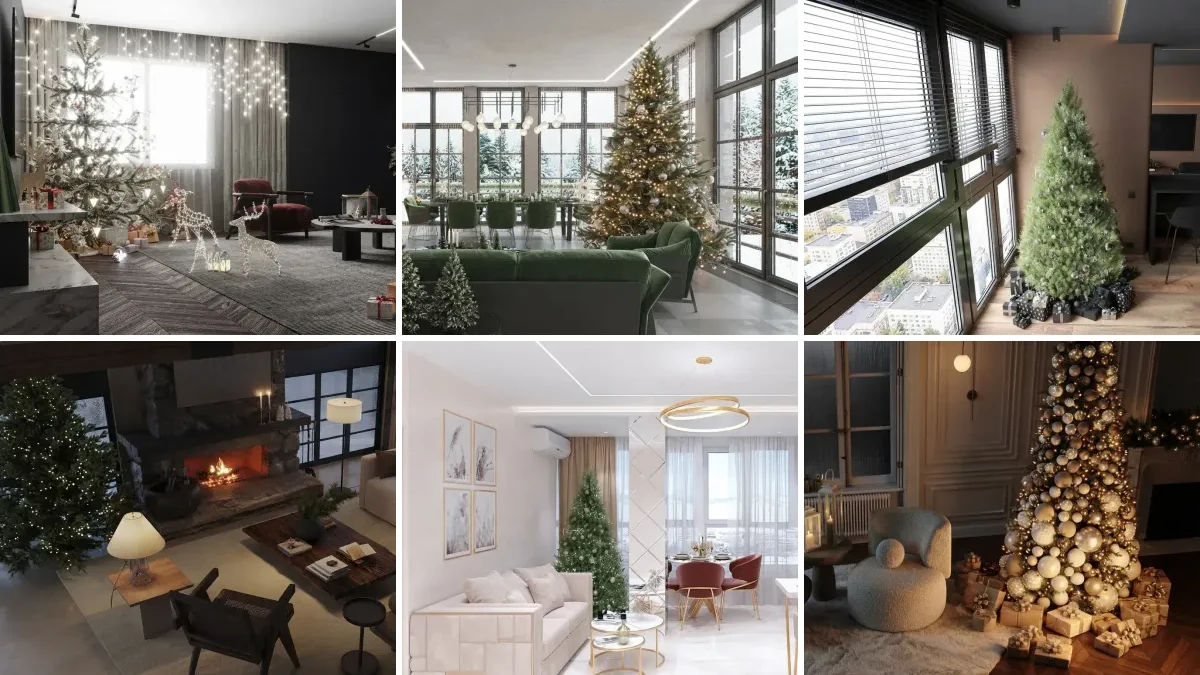
Christmas Tree Decorating Ideas: 20 Themes for 2026, and How to See Each One in Your Room

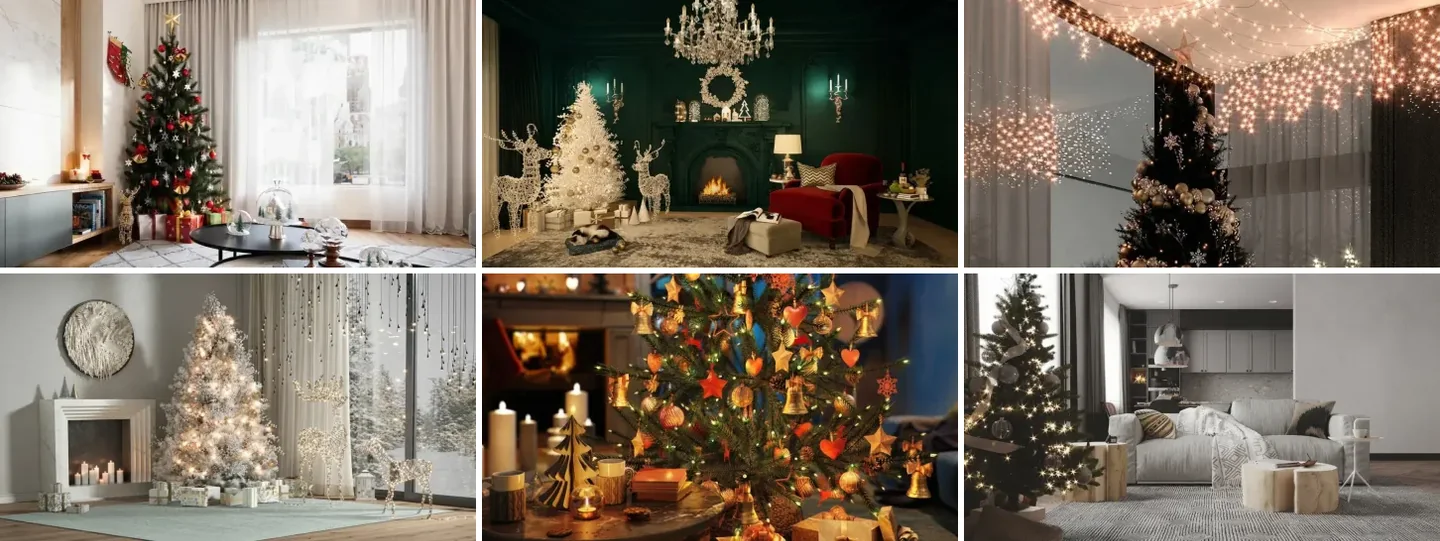
The best Christmas tree decorating ideas start from the room, not the store: pick two colors and one metal the room already has, then choose a theme such as classic red and gold, winter white, champagne and blush, Scandinavian natural or black and gold, and check it on a photo of your own room with MeltFlex AI before you buy a single ornament. Below are 20 themes, each with the palette, the ornaments, the ribbon and the topper that make it work, the numbers for how much of everything you need, and what happened when we put eight of the themes on one real living room.
Our articles are still written by humans!
Get human written articles in your Google feed.
I’m Braňo, one of the founders of MeltFlex AI, an AI interior design tool that redesigns a room from a photo. MeltFlex AI is ours, and it appears below where it does a real job: showing a theme in your room before you decorate. Every room on this page is a render from our gallery, rebuilt from interior designers’ Christmas projects, so you see each theme in a real space rather than on a tree in a store. The quantities come from the same formulas as our Christmas tree light calculator.
The short version
- Start with the room. Two colors plus one metal from the walls, sofa or floor. A theme that fights the room looks like a store display. All 20 themes.
- The most copied themes: classic red and gold, winter white flocked, champagne and blush, Scandinavian natural, black and gold.
- Quantities for a 7 foot tree: about 1,050 lights, 105 ornaments and 21 yards of ribbon for a classic look; 1,400, 175 and 28 for a full one. Table.
- Our MeltFlex AI test: eight themes on one living room photo, 4 to 5 seconds each, the room kept in 8 of 8. Leave out where the tree goes and it lands in front of the window. Results.
- Try it free: MeltFlex AI shows a theme on your own room photo. The first design needs no card; after that a render is 10 credits.
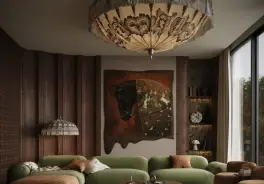

What Are the Best Christmas Tree Decorating Ideas for 2026?
The 20 themes below cover almost every look people search for, grouped by mood: elegant, white and flocked, traditional and vintage, modern and minimal, and colorful. The table gives the recipe for each at a glance. The sections after it show each theme in a room and say who it suits, because a theme is only good in the right room. A black and gold tree is stunning against charcoal walls and looks like a hole in a white farmhouse kitchen.
The rule behind every row is the same: two main colors, one metal, and repetition. Ten ornaments in five colors read as clutter; a hundred ornaments in two colors read as a theme. If you are short on ornaments, buy one color of plain glass balls in three sizes and let the ribbon carry the second color.
What Are the Most Elegant Christmas Tree Ideas?
Elegant trees are about restraint: a tight palette, lots of warm light and ornaments of one finish, with gold, champagne or white doing most of the work. These five themes make up most of the “elegant Christmas tree decorating ideas” people search for, and they suit the neutral living rooms most of us actually have.
1. Classic red and gold
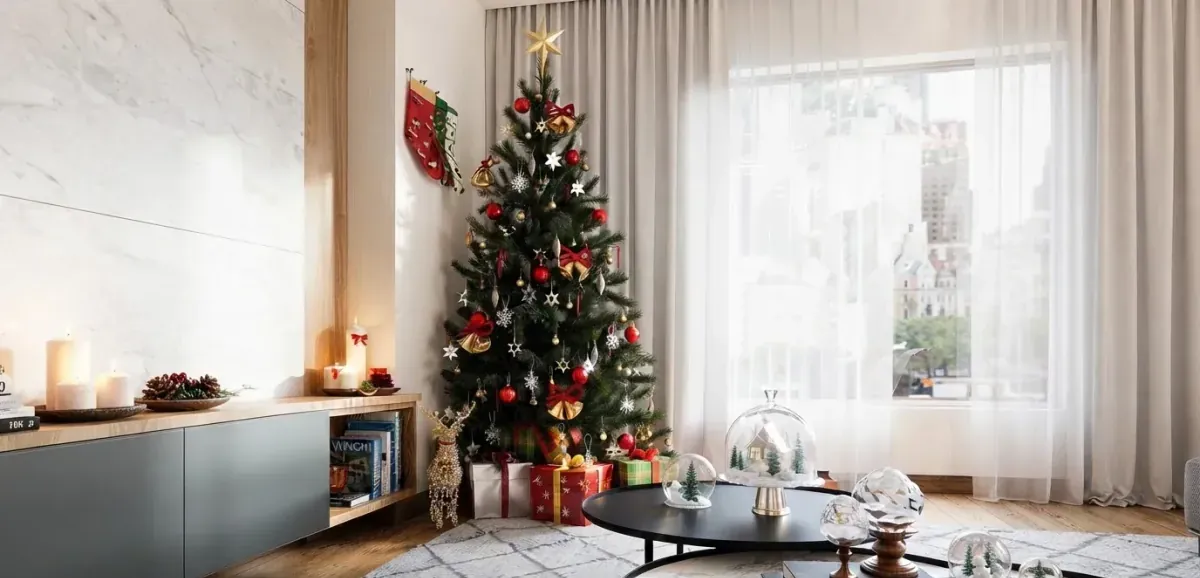
The theme everyone recognizes, and the safest one for a first real tree. Use red and gold glass balls in three sizes, a red velvet ribbon spiraling down, warm white lights and a gold star. The trick that makes it look expensive rather than generic is leaving out a third color: no green ornaments, no silver, no multicolor lights. It works in almost any room, and best in a white or wood one, where the tree becomes the only saturated thing in view.
2. Champagne and blush
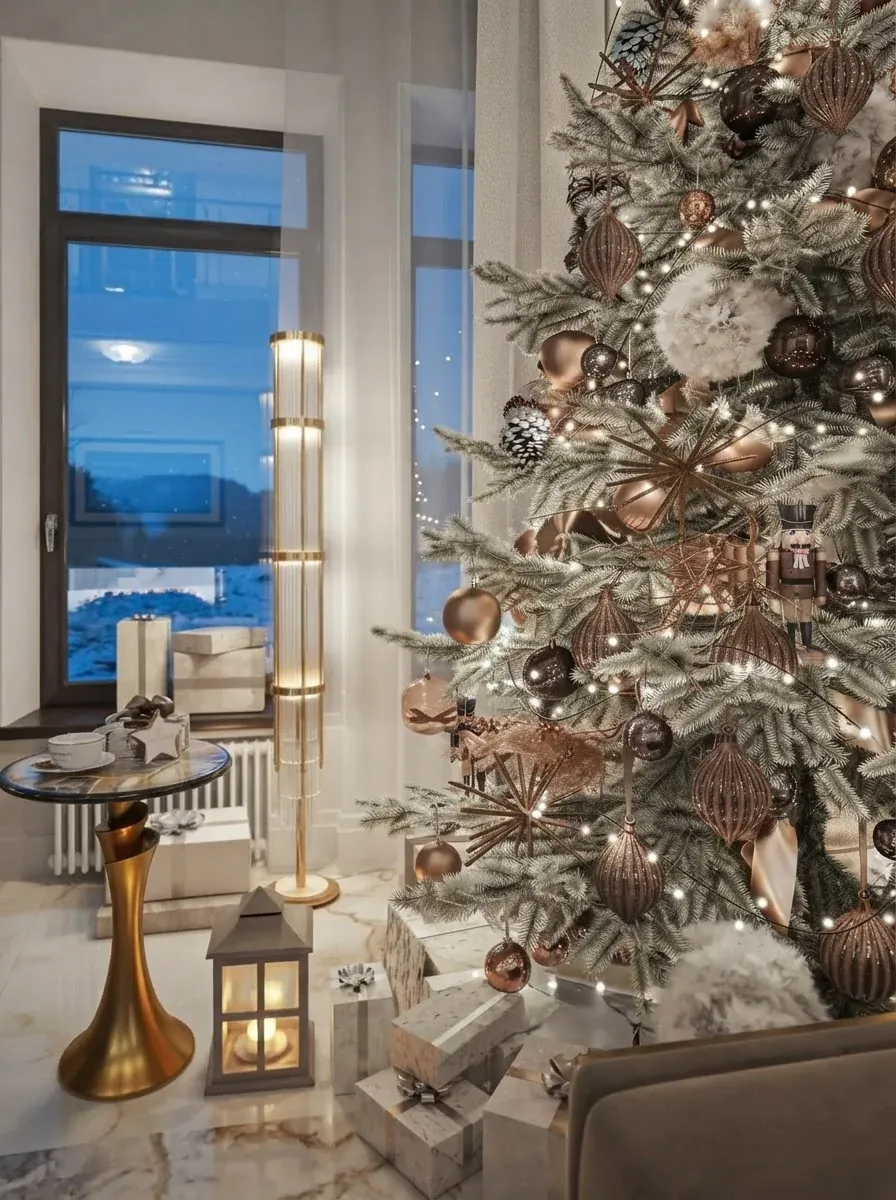
The softest of the elegant themes, and the one that suits cream, beige and greige rooms best, including most quiet luxury schemes, because it is made of the same colors. Mix satin and mercury glass balls in champagne and copper with a few blush ones, and add a sheer or velvet ribbon in champagne. A lightly flocked tree helps; on a dark green tree, champagne can look muddy. Skip it if the room is already very pale and has no dark wall behind the tree: the whole thing will fade.
3. A white tree with gold in a dark room
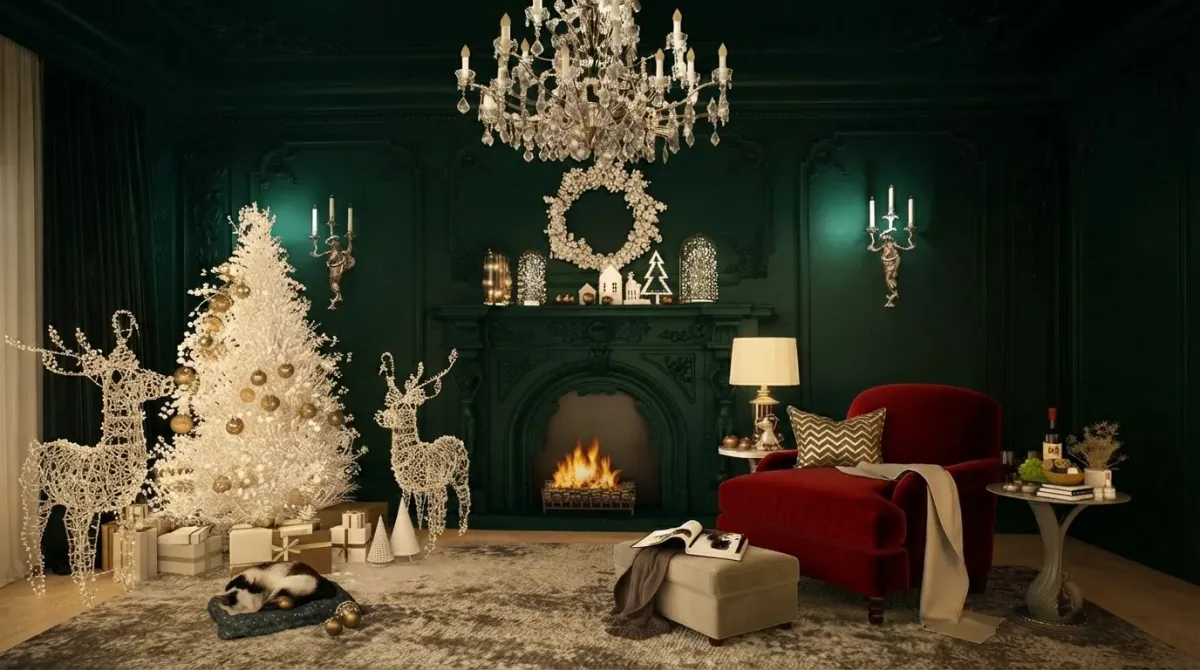
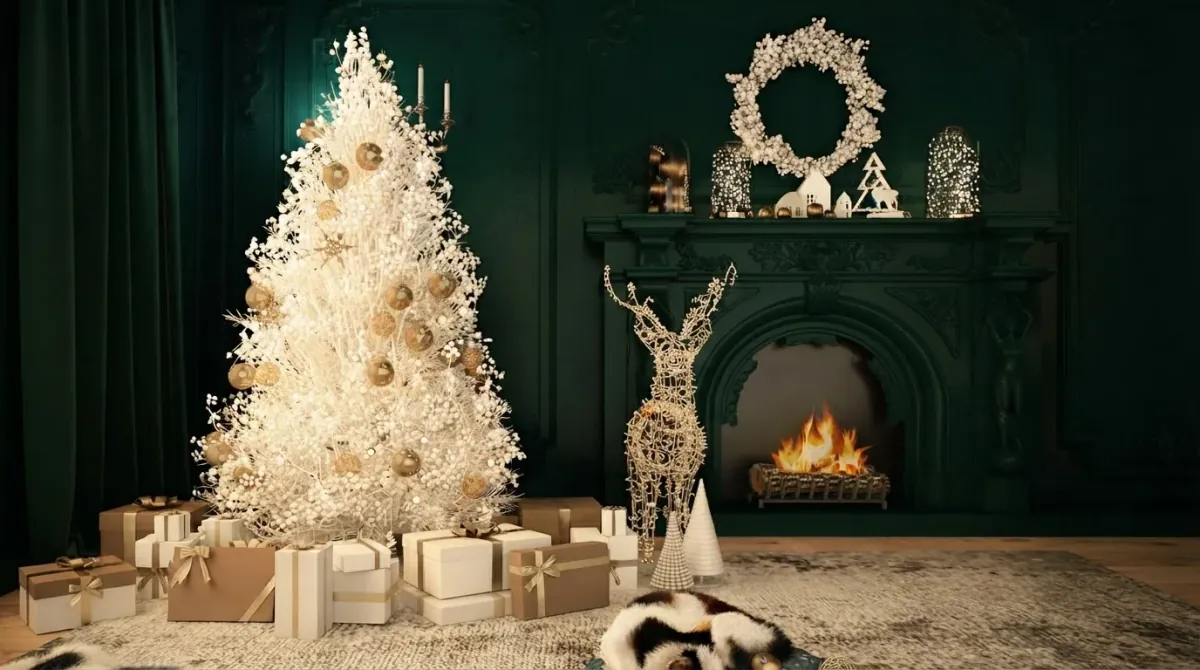
This is the answer for “white Christmas tree ideas” that do not look washed out. A white artificial tree needs contrast, and the best contrast is the wall behind it: emerald, navy, charcoal or oxblood. Decorate it in gold only, add warm lights rather than cool ones, and let a few big gold pieces, such as the wire reindeer here, carry the theme off the tree. In a white room, the same tree is a white shape on a white wall; choose winter white flocked instead.
4. All gold light
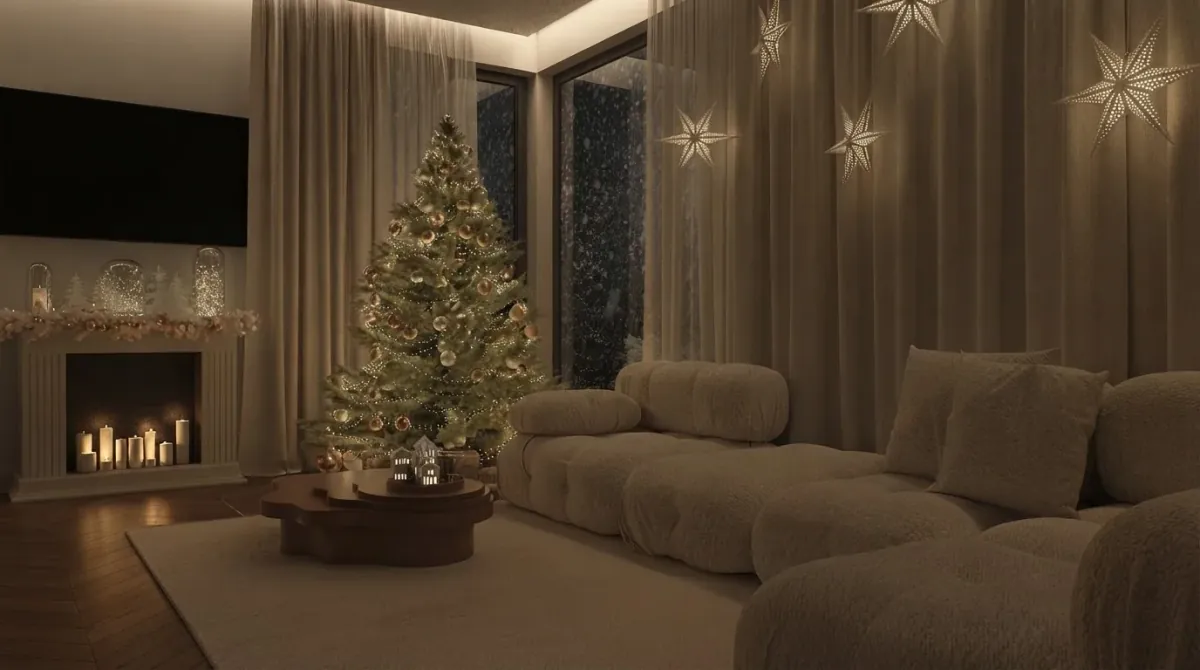
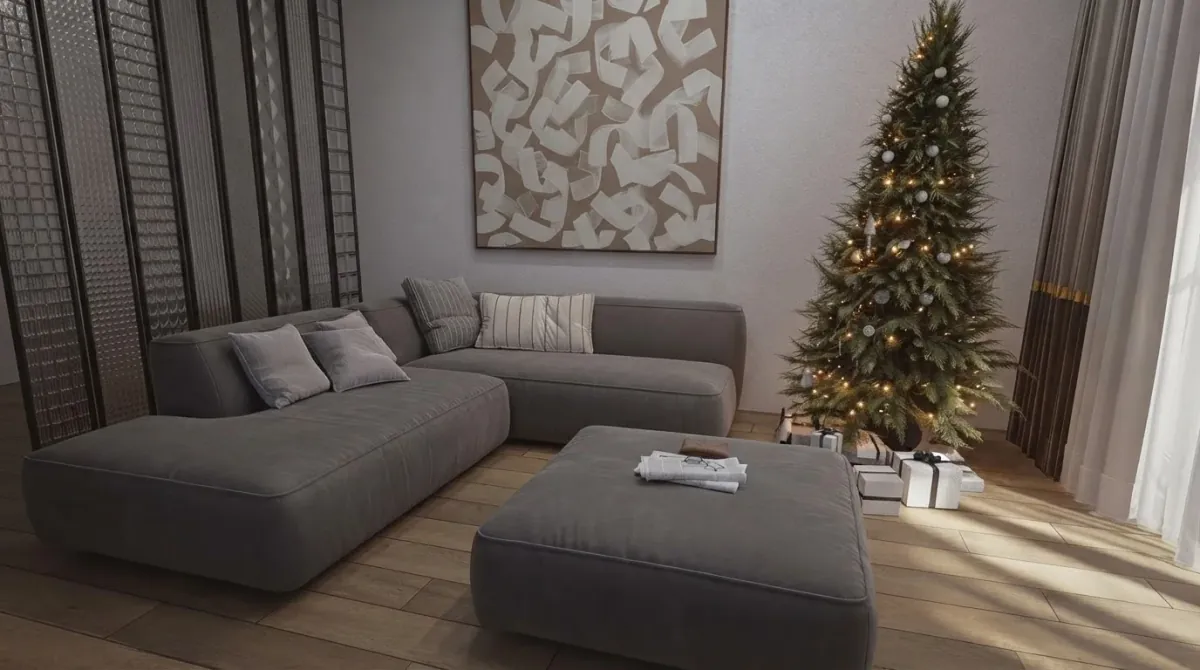
One metal, no second color, and about twice the usual lights. It sounds plain and photographs better than anything else on this page, because the tree becomes a warm light source in the evening. Use the full look from the quantities table: around 1,400 lights on a 7 foot tree. It is the best theme for gray and taupe rooms, which make red look harsh and silver look cold.
5. Black and gold
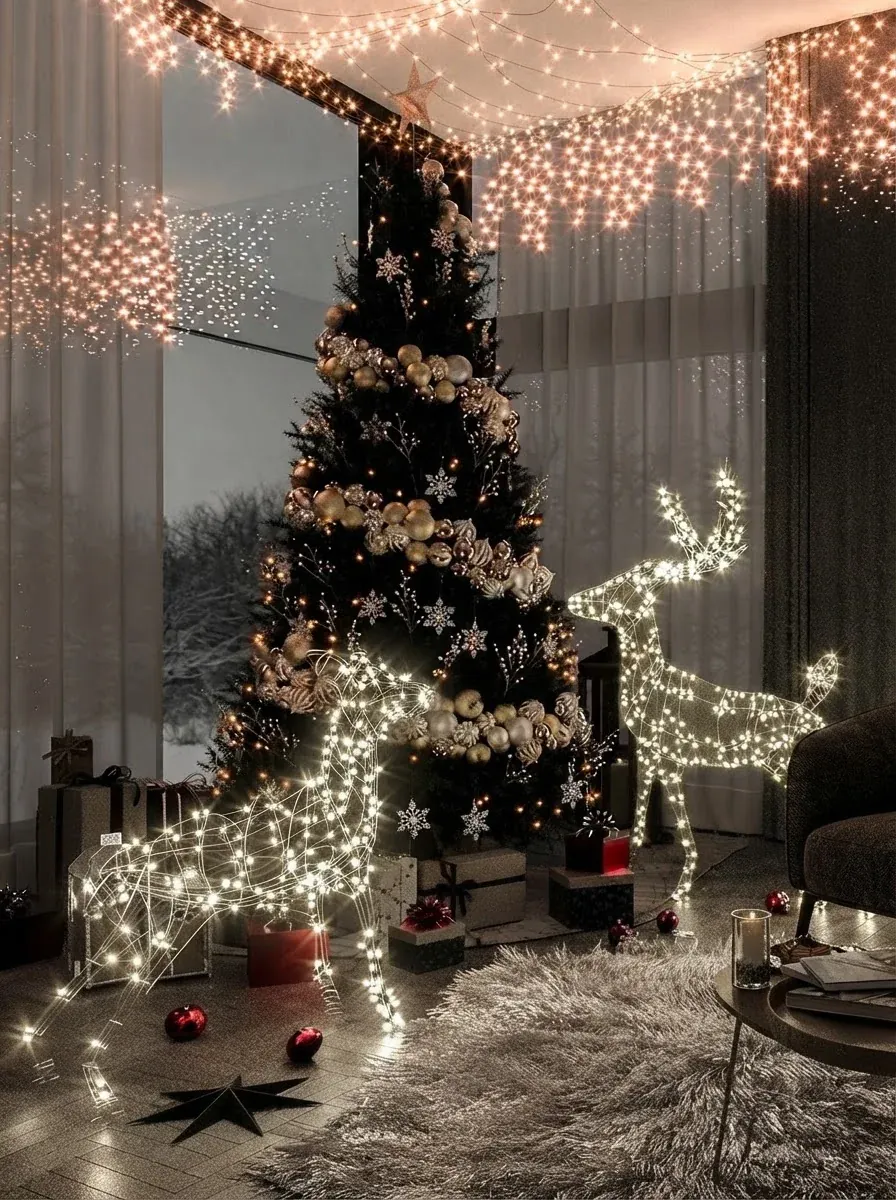
The most modern theme here, and the most unforgiving. Black needles swallow light, so a black tree needs more lights than a green one and ornaments that reflect: gold, brass, champagne, clear glass and some white. Dark reds and navy disappear on it. It suits a dark, moody room and fights a cottage. If you search for black Christmas tree ideas, start with gold only and add white later if it feels heavy.
How Do You Decorate a White or Flocked Christmas Tree?
With warm white lights, one metal and one soft accent color, and with something dark behind it. Flocking is white, so white ornaments vanish into it, and a white tree against a white wall loses its outline. These three themes show what works.
6. Winter white flocked
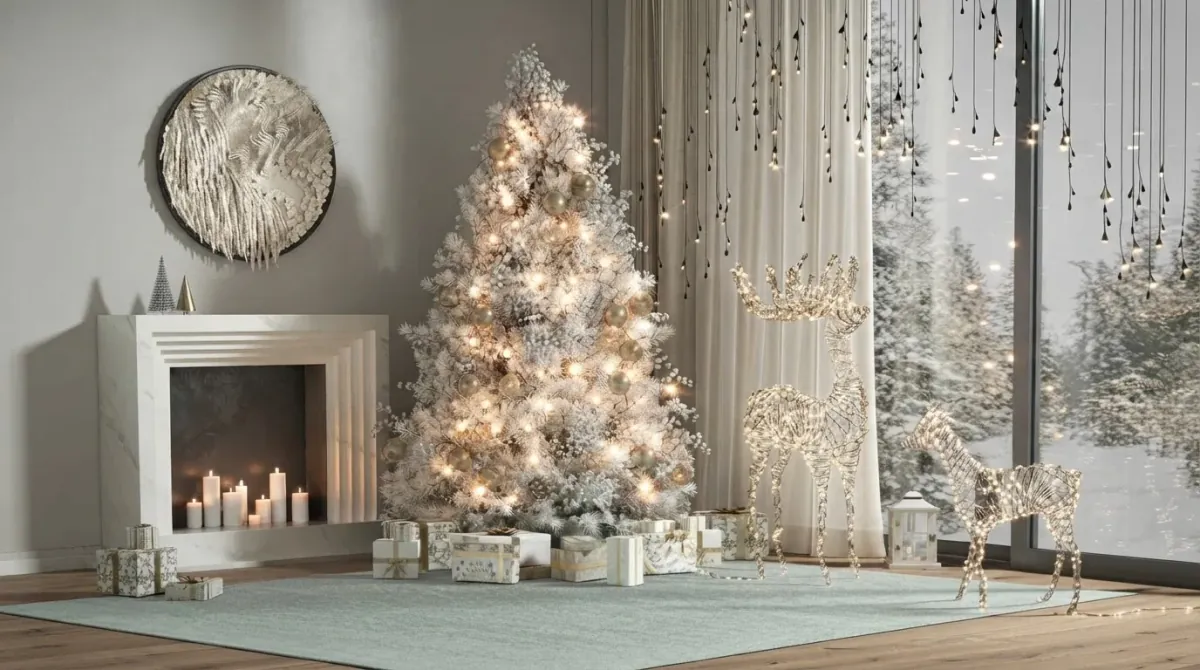
A white flocked tree, silver and clear glass, a few white feathers or snowflakes, and warm lights. Cool white lights make it look like a freezer. This is the classic flocked Christmas tree decorating idea, and its weak point is that it can look bare. Give it one soft accent, mint, ice blue or blush, and plenty of glass for sparkle. It sits best beside a fireplace or a window with a view, as here.
7. Three flocked trees instead of one
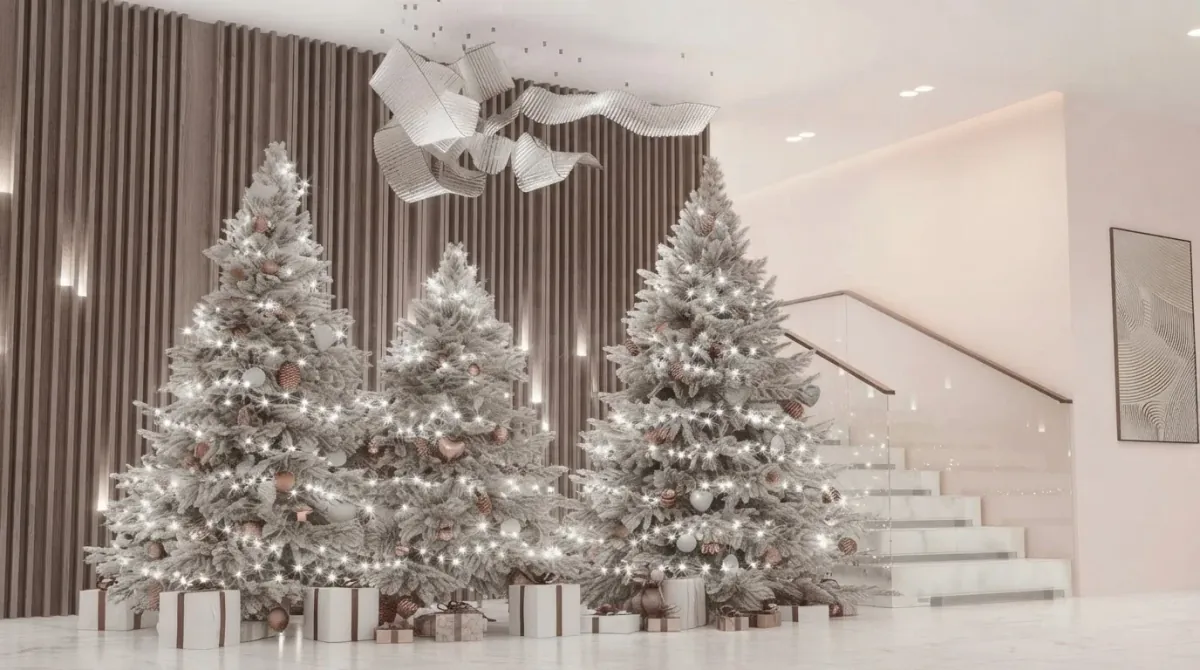
A unique Christmas tree idea for a hall, a staircase or a long wall: three trees of different heights, lightly decorated, mostly lights. Three 5 to 7 foot trees cost more than one, but each one needs far fewer ornaments, and the group reads as a winter scene. Keep them the same type and the same lights so they look planned.
8. Lightly flocked Nordic
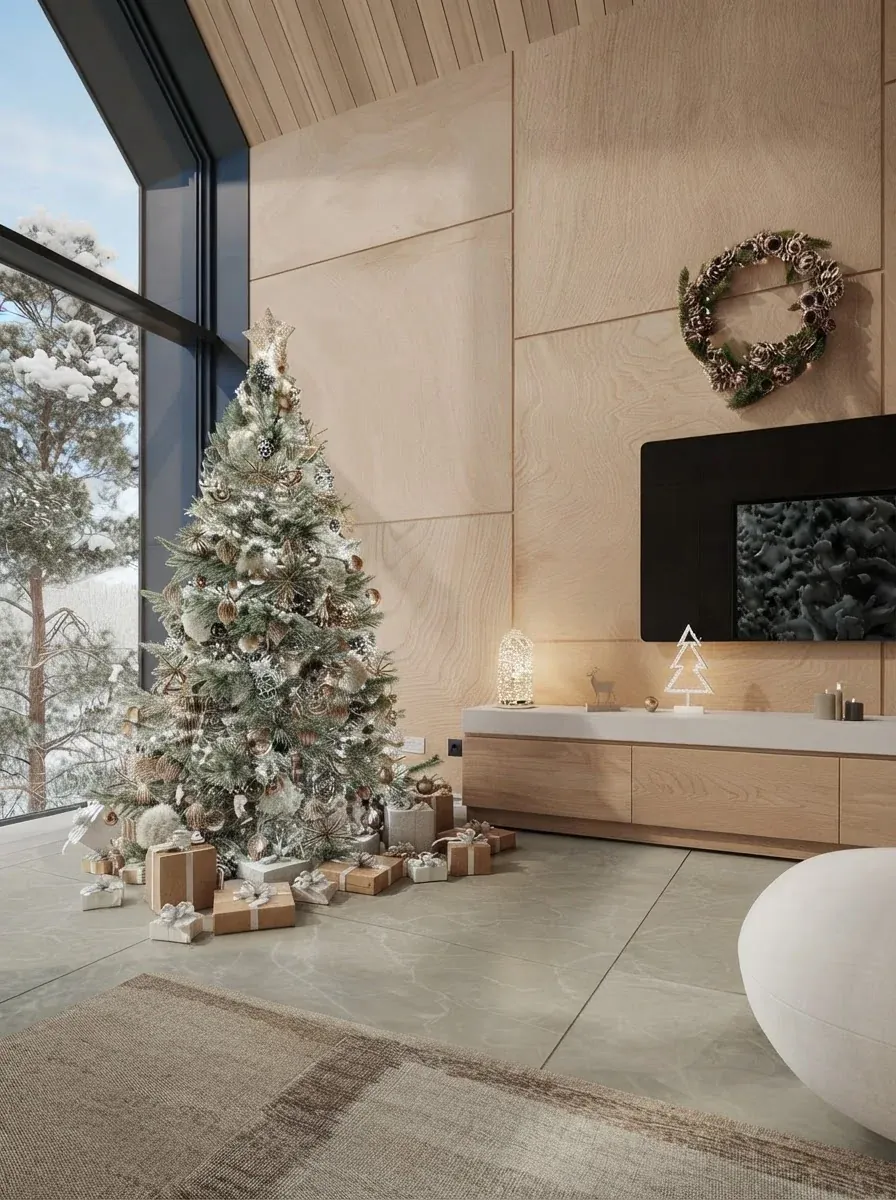
A tree with a dusting of flock, not a full coat, decorated with small clear glass and a few natural pieces, and a dried wreath elsewhere in the room. It is the middle ground between a white tree and a natural one, and the right call for oak, pine and cabin rooms, and for a Japandi living room, where a full white tree would look artificial next to all that wood.
What Are Traditional and Vintage Christmas Tree Themes?
Traditional trees mix more colors and more ornament types, and they work because the ornaments have stories, not because they match. The four themes below are the ones to choose if you have a box of family ornaments you would never throw out.
9. Classic fireside multicolor
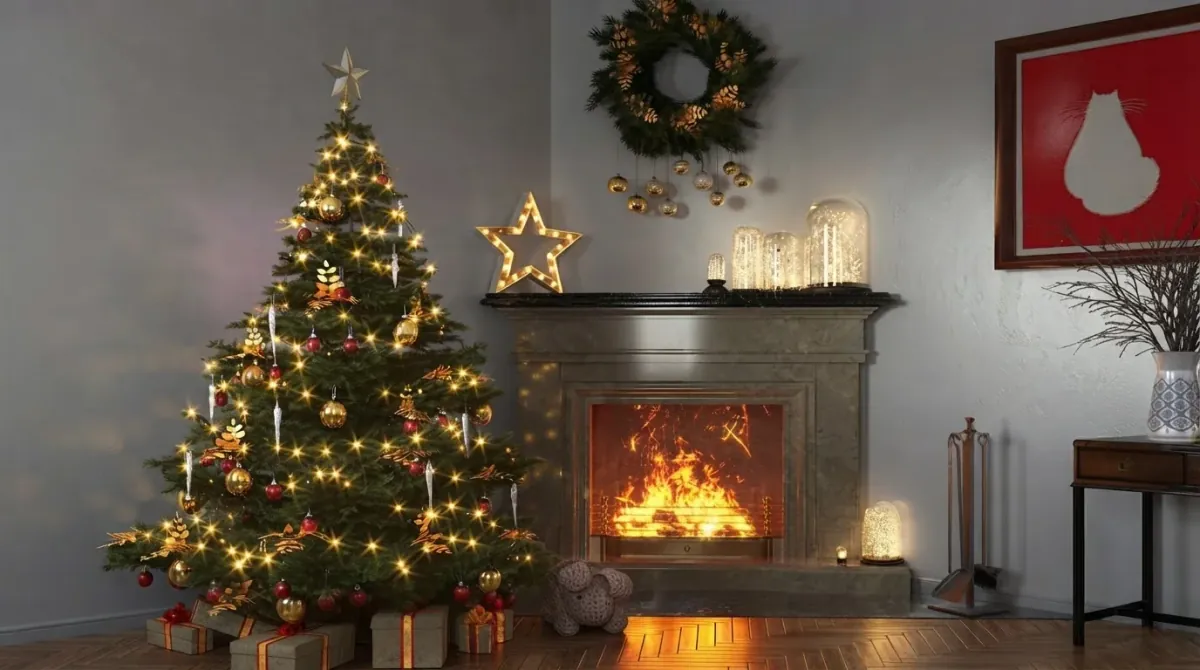
Mixed ornaments, a star on top and the fire nearby, the tree most family rooms already have. The one thing that makes this look intentional is the lights: if the ornaments are mixed, keep the lights one color, warm white or classic multicolor, not both. Keep the tree at least 3 feet from the fireplace; the NFPA counts heat sources too close to the tree behind roughly one in four Christmas tree fires. Our guide on where to put the Christmas tree covers the placement rules, and the one on a TV above the fireplace covers sharing that wall.
10. Old world ornaments
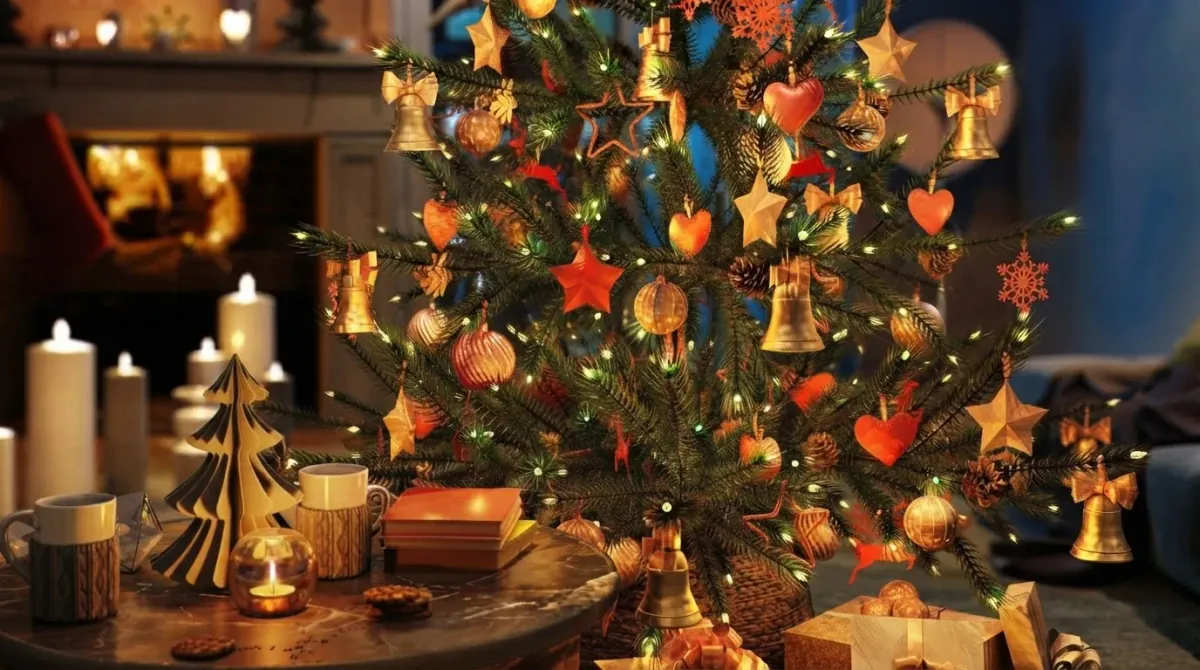
Brass bells, red hearts, gold stars, wooden toys and blown glass in shapes rather than balls. It is the vintage Christmas tree idea that does not need actual antiques: shaped ornaments in red, gold and natural wood read as old world even when new. Use small warm lights, not big bulbs, so the shapes stay the focus. It suits traditional rooms with wood furniture and looks out of place in a glossy modern one.
11. Victorian maximalist
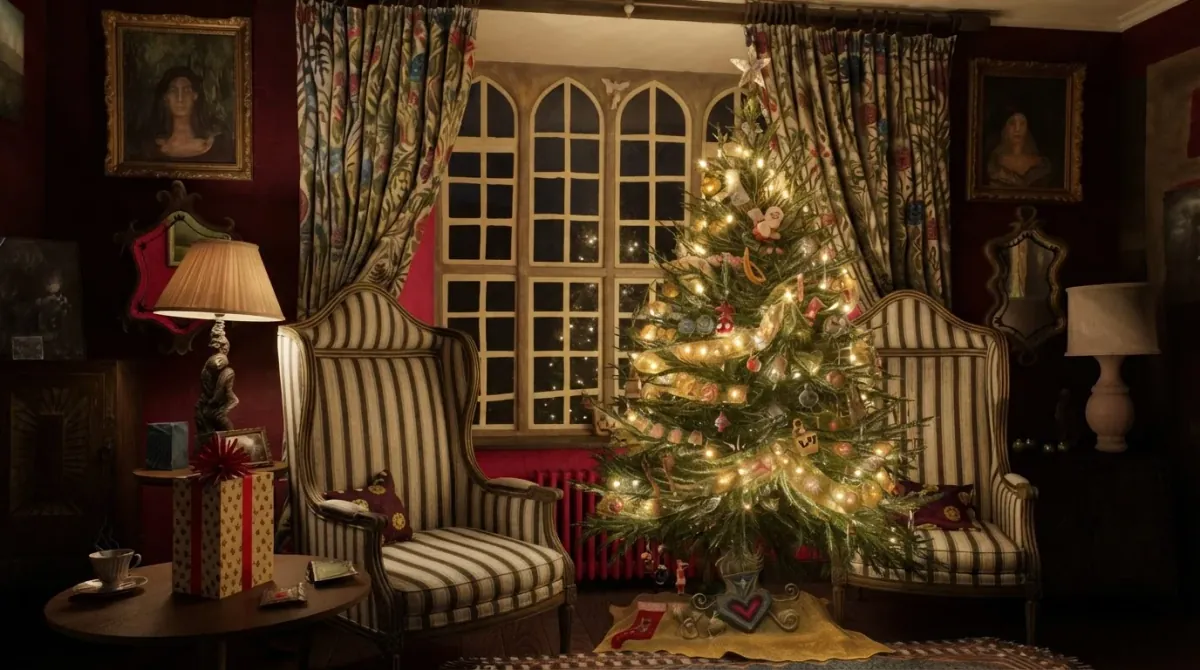
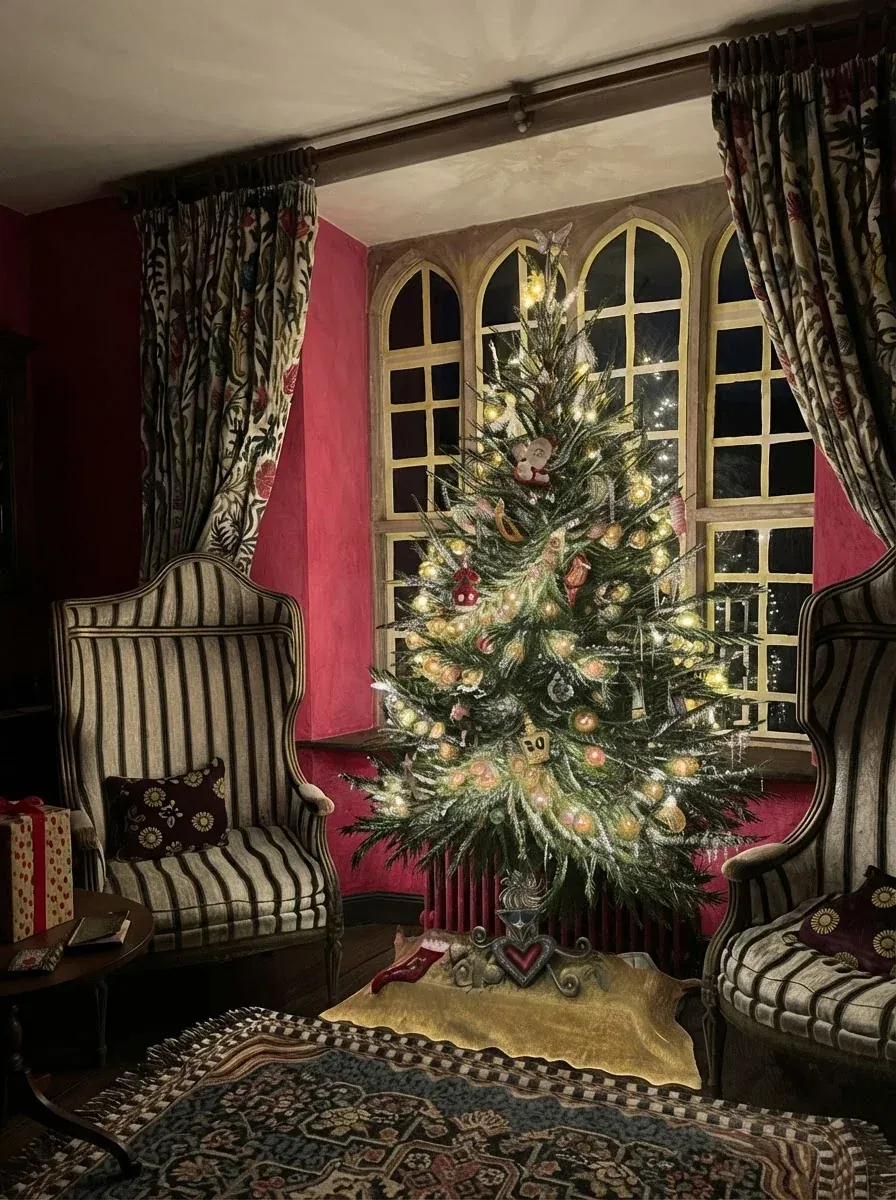
More is more: vintage glass, tinsel, garlands, ribbons in two colors, an angel or a glass spire on top. It only works in a room with the same energy, pattern on the walls, collected furniture, deep colors. Put this tree in a minimal white room and it looks like a mistake; in a parlor like this one, a restrained tree would look underdressed.
12. Red and white
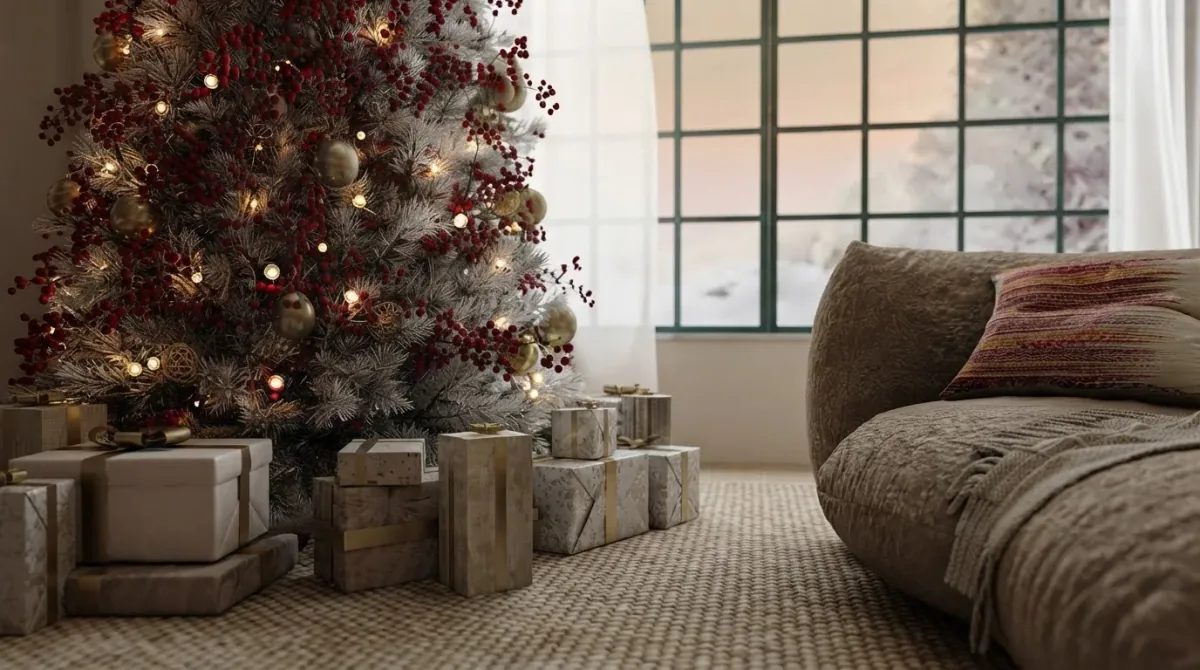
Red berry picks and red flowers on a flocked tree, with kraft or white gift wrap underneath. It is the candy cane palette made grown up: the red comes from natural shapes, berries and blooms, rather than shiny balls. It is easy to get right because flocking already supplies the white, and it ties in neatly with a room that has any red or green accent.
What Are Modern and Minimalist Christmas Tree Ideas?
Modern trees use fewer ornaments, natural materials or a single finish, and they rely on the shape of the tree and the quality of the light. They are the right answer for small apartments, where our small living room ideas apply, and for rooms where a full traditional tree would take over.
13. Scandinavian natural
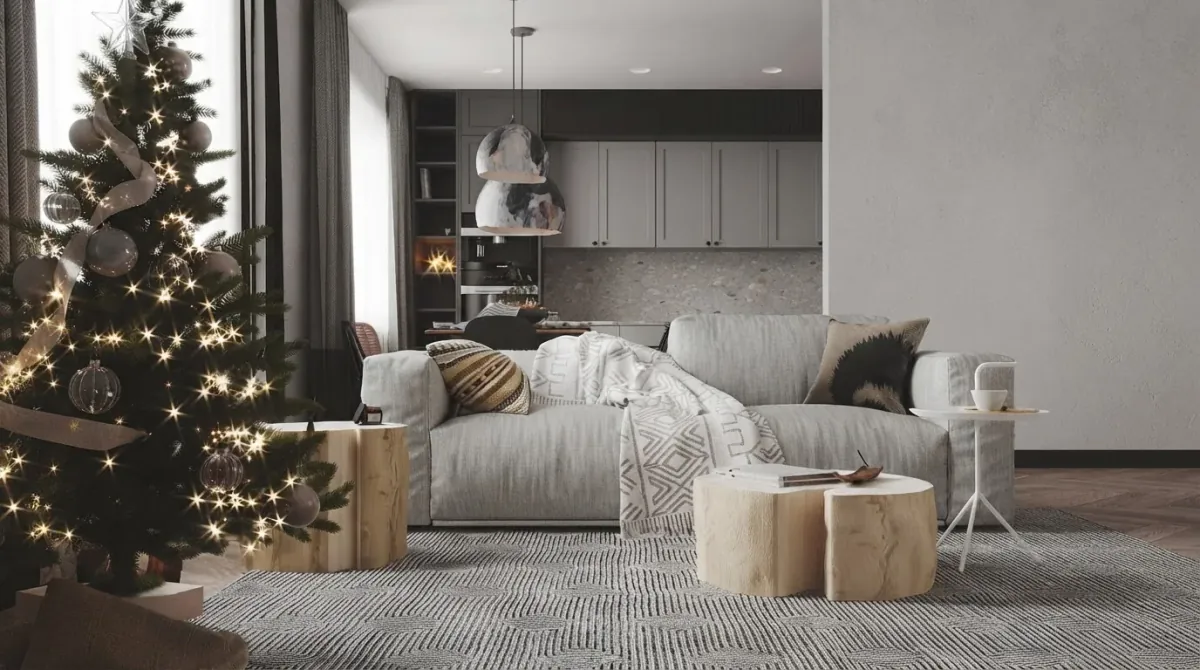
A real-looking green tree with small warm lights, straw stars, wooden beads, white paper or felt ornaments and no red. It looks calm and costs less than any other theme, because straw and wood are cheap, and it is the natural partner for a Scandinavian interior. If you have a slim tree, this is the theme to give it; in our test, though, asking for a slim tree still produced a full one, so check the shape in any preview.
14. Lights only
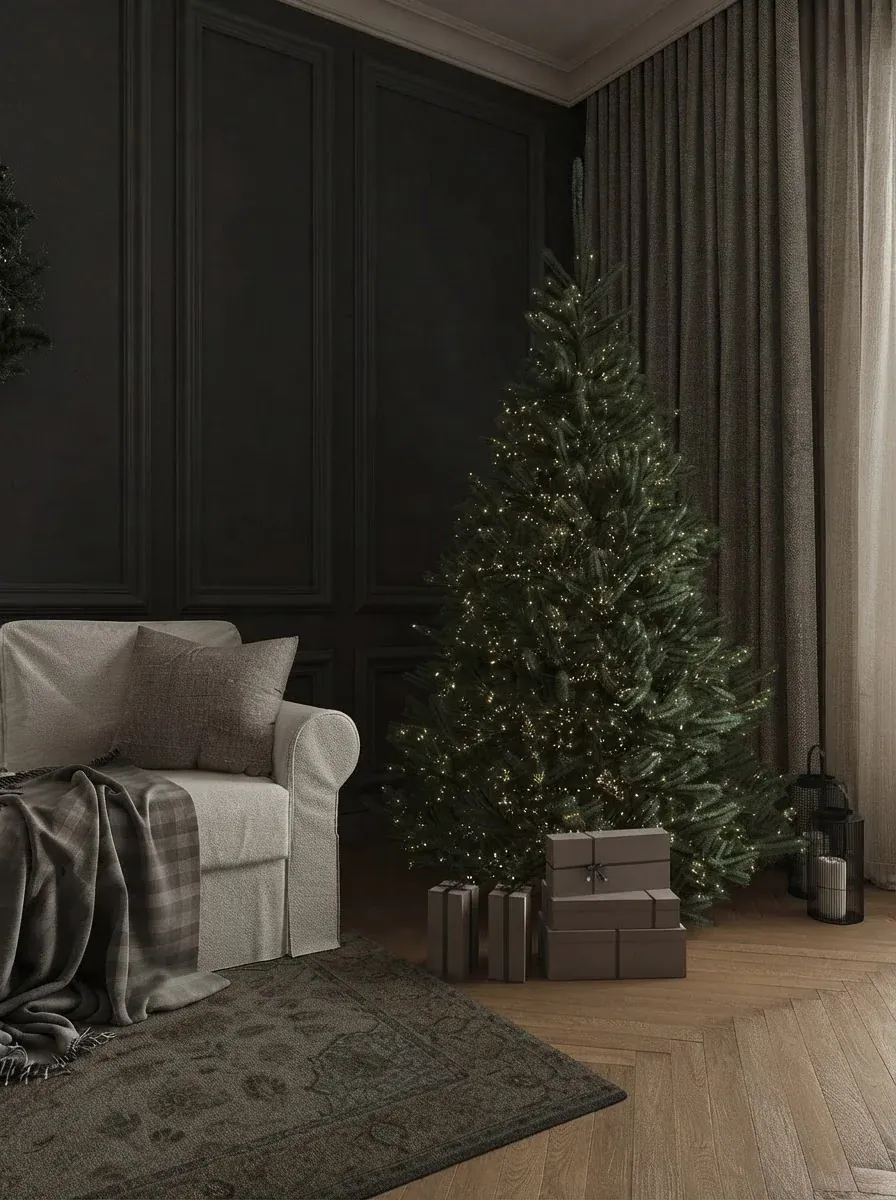
The minimalist Christmas tree idea taken all the way: a full, good-quality tree and nothing on it but tiny warm lights, at the full 200 per foot. Against charcoal or dark green paneling it looks like a forest at dusk. It fails on a cheap, sparse tree, because there is nothing to hide the gaps, so spend the ornament budget on the tree itself.
15. Silver and glass
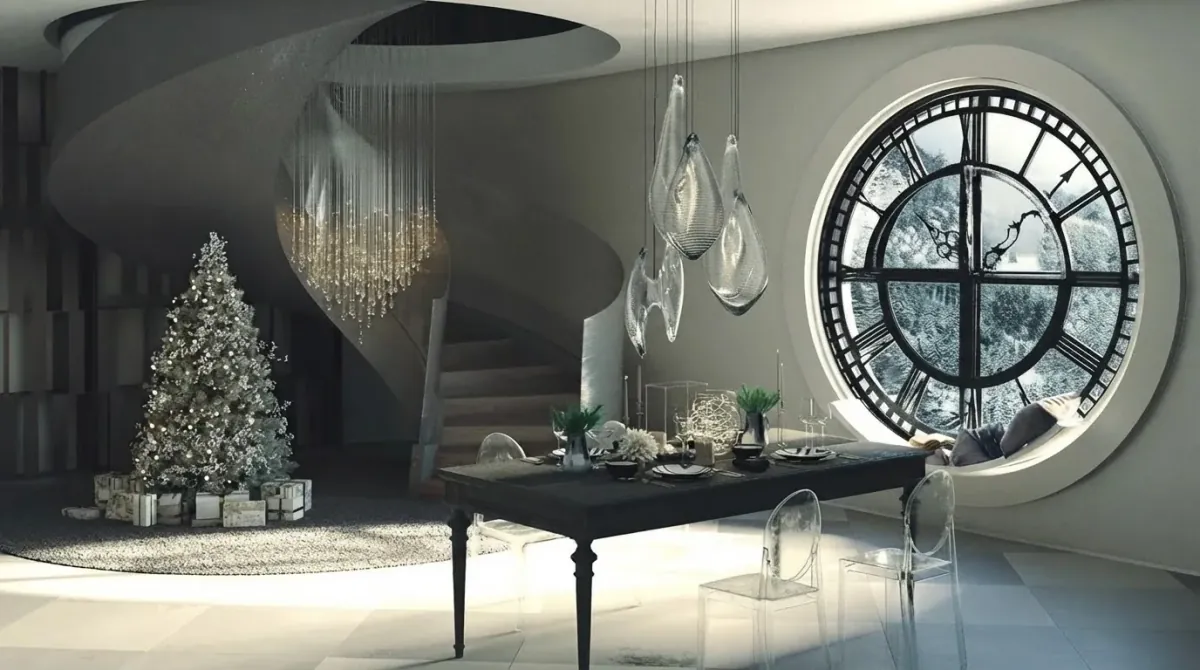
Mirrored, silver and clear glass balls on a green or lightly flocked tree, with cool or neutral lights. This is the theme for gray, concrete and industrial rooms, and for anyone who has worked out what goes with gray walls, where gold can feel out of place and steel and glass are already part of the look. Keep it to silver and white; one gold piece breaks the spell.
16. Copper and bronze woodland
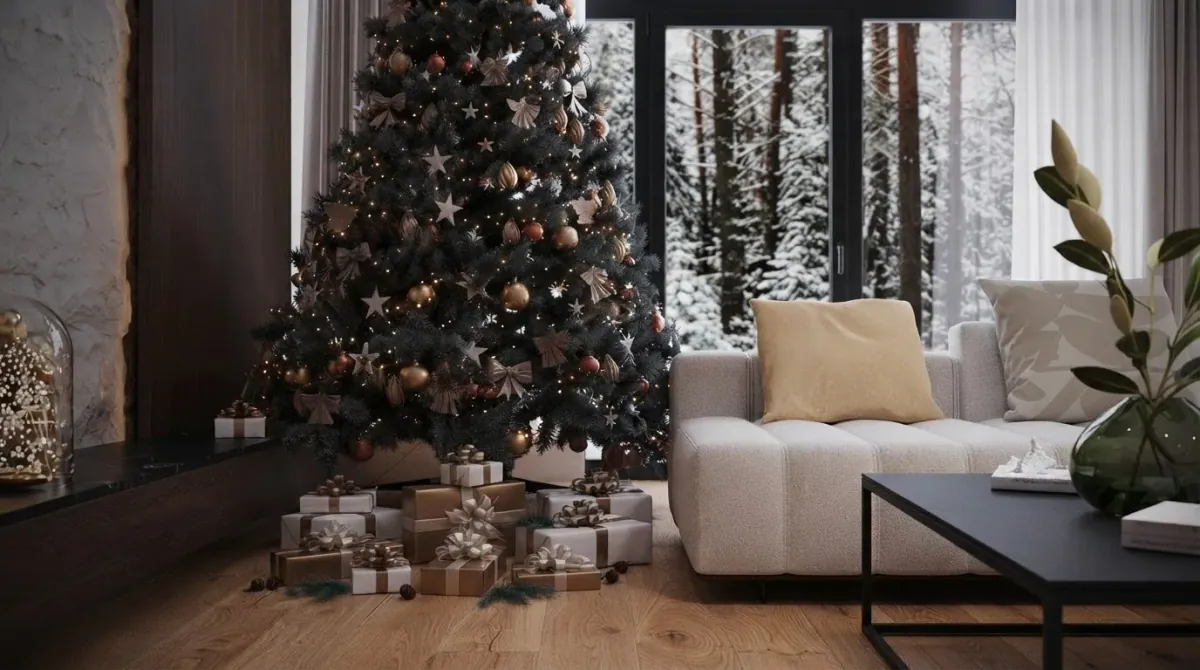
Copper, bronze and cream ornaments, pinecones and a few wooden pieces. The warm metals tie a tree to wood floors, stone and forest views better than gold does. It is our pick for a modern rustic room that wants to avoid the obvious red plaid, and it works with a green or a lightly flocked tree.
What Are Colorful and Fun Christmas Tree Themes?
Colored themes work when the color is already in the room: a teal sofa, a blue rug, a pink chair. Blue and silver, pink and gold and farmhouse plaid are also three of the eight themes we tested on a real room photo, so the notes below include what we saw.
17. Teal and gold
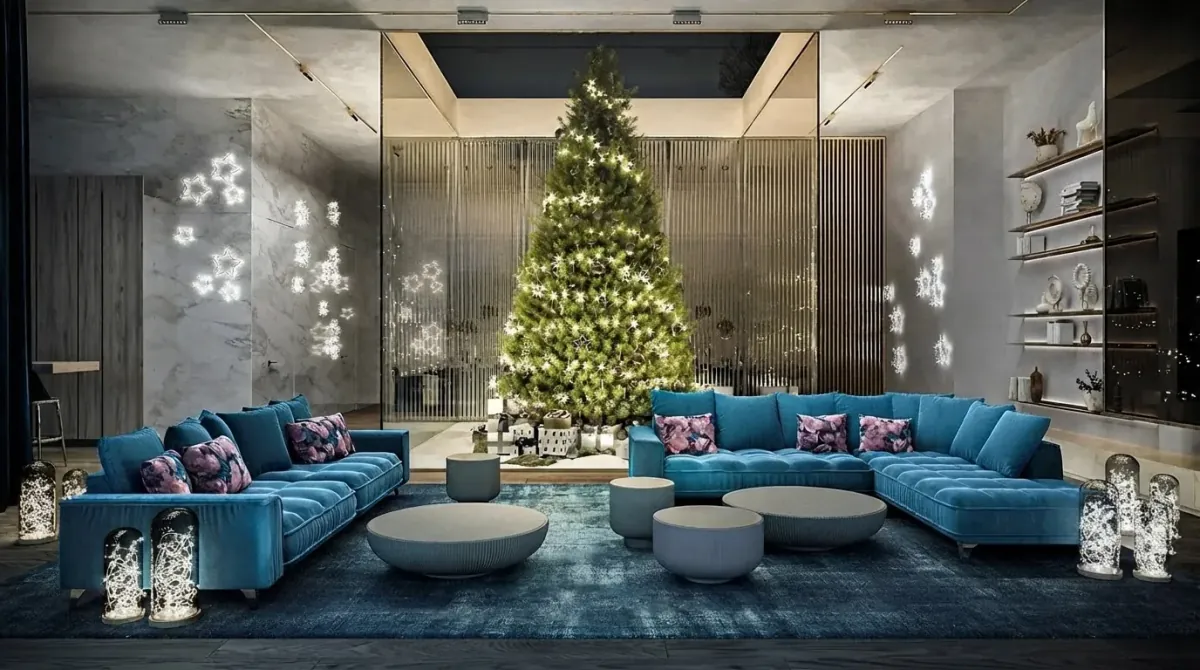
If your furniture is teal, navy or emerald, do not repeat the color on the tree. Decorate it gold and let the sofa be the second color, as in this hall. Add a few jewel-tone glass ornaments only if the tree looks disconnected from the room.
18. Blue and silver
Navy and ice blue balls, silver snowflakes, a silver ribbon and a snowflake topper on a green tree. It is the right theme for coastal and white rooms and one of the few that suits cool white lights. In our test the blue was strong: so many blue ornaments covered the tree that it read as a blue tree, not a green one with blue on it. If you want the green to show, use half the blue ornaments and twice the silver.
19. Pink and gold
Blush pink and soft gold balls with pink velvet bows on a green tree and a gold star. It suits light living rooms and bedrooms and reads as playful rather than sweet if you keep the pink dusty, not bright. In our test this theme was the one most likely to spread into the room: the model added a pile of pink wrapped gifts and a pink throw on an armchair nobody asked for. If you like the look but not the extra pink, say so in the brief.
20. Rustic farmhouse plaid
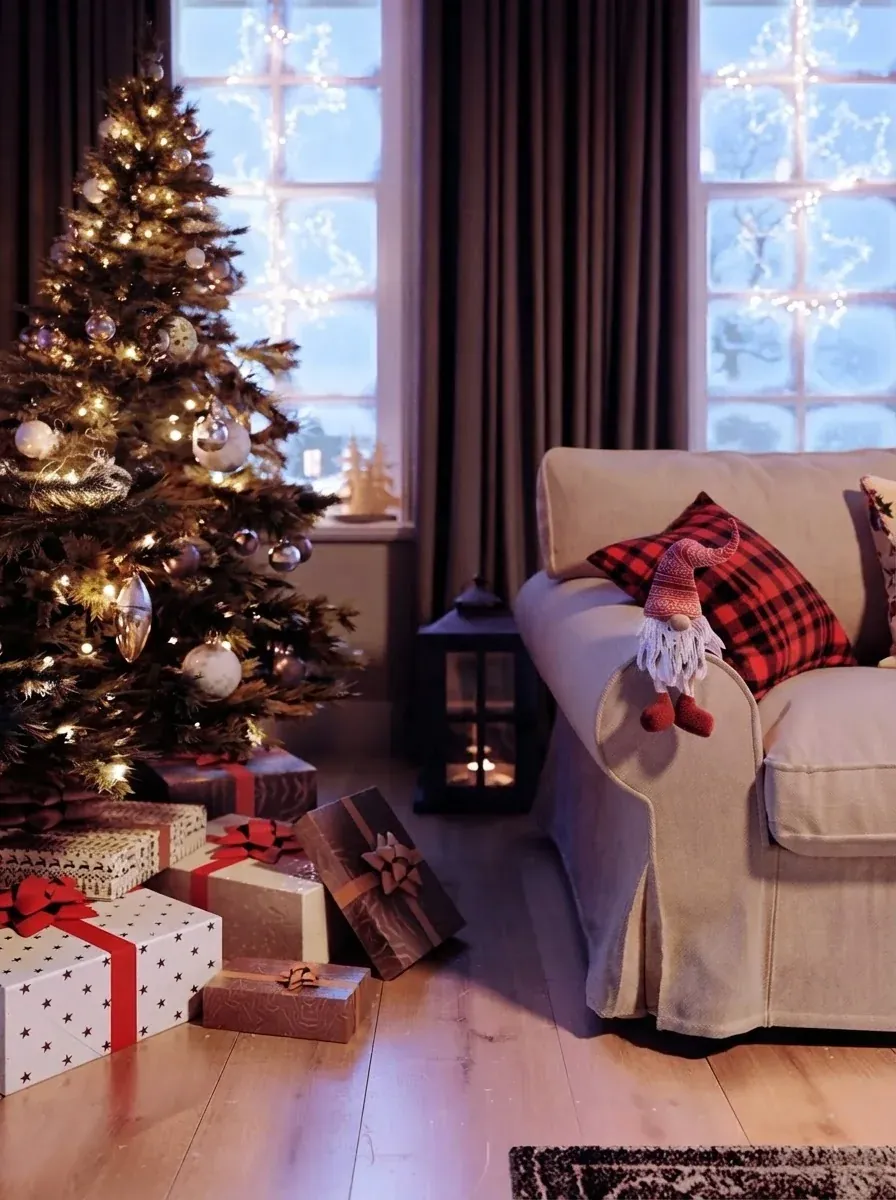
Red and black buffalo plaid ribbon, wooden and galvanized metal ornaments, pinecones, a burlap or woven collar, and a tin star or a burlap bow on top. It belongs in farmhouse and cottage rooms with wood and white paint. Repeat the plaid once more in the room, a cushion or a throw, so the tree does not look like it came with its own theme. Grinch, gingerbread and candy cane trees follow the same logic: a strong theme looks best when it shows up once off the tree too.
Can You See a Christmas Tree Theme in Your Own Room Before You Decorate?
MeltFlex AI does it from one photo: upload your room, say where the tree stands and describe the theme, and you get the same room with the tree in it in seconds; in our test the image model took 4 to 5 seconds per image. Your first design is free without a card. After that a photo redesign costs 10 credits and a follow-up edit 5; a new account starts with 15 free credits, and the Standard plan is $20.99 a month for 490 credits. The MeltFlex AI interior design tool is the place to start, and the same engine is available through the MeltFlex AI MCP server for ChatGPT and Claude and through the MeltFlex AI API. It shows you the look; it does not count ornaments, so use the table below for the shopping list.
To find out how reliable that is, we ran a test. In our MeltFlex AI test on November 15, 2026, we took one living room from our gallery, a cream coastal room with a sofa, two armchairs, a console and a potted olive tree in the right corner, and gave it ten briefs through the same image model the free MeltFlex AI demo uses. Eight briefs named the spot, “the empty right corner, between the wooden console and the window,” and described one theme each. Two control briefs used the same theme text with no spot. Every brief ended with the same instruction to keep the room exactly as it is.
What we learned. Naming the spot is what keeps your room yours: with it, all eight themes went into the named corner and every piece of furniture, the rug, the curtains and the sea view stayed. Without it, both control runs put the tree in front of the glass, which is exactly where our placement guide says not to put it, and the farmhouse run rearranged the sofa and added eight things. Our own mistake is in the table too: we called the corner “empty” when it held an olive tree, and the model resolved the contradiction by removing the olive tree in seven of eight images. Say what is in the spot and where it should go. Every theme read correctly at a glance; the misses were in the details, a full tree when we asked for slim and a blue that swallowed the green.
“Place one 7 foot Christmas tree in [the corner between the sofa and the window]. Move [the floor plant] to [the other side of the sofa]. Theme: [classic red and gold]. Warm white lights, [red and gold glass ball ornaments in three sizes], [a red velvet ribbon], [a gold star topper]. Keep this exact room: the same furniture, rug, curtains, windows, floor and the same camera angle. Do not add anything else.”
That is the brief we would use now, with the two fixes from the test built in. Paste it into MeltFlex AI with a daylight photo of your room, change the bracketed parts, and run two or three themes side by side before you buy. If you would rather decorate the whole room, not only the tree, our guide to AI tools that decorate your house for Christmas compares the options, and the Christmas lights visualizer guide does the same for the outside.
Try a tree theme on your own room
- Upload a daylight photo of the room, taken from where you usually sit.
- Name the corner and what to do with anything already in it.
- Seconds per image; run three themes and compare.
- First design free, no card; then 10 credits a render.
How Do You Decorate a Christmas Tree Step by Step?
Fluff, lights, ribbon or garland, large ornaments, small ornaments, then the topper and the skirt. Balsam Hill’s guide gives the same order, and it works because each layer hides the gaps left by the one before. Most of the time goes into the first three steps, and it is time well spent.
- Pick the theme from the room. Two colors and one metal that already appear in the room. Decide the topper and the ribbon now; they are the two things that are hardest to swap later.
- Fluff every branch. Work from the trunk outward and from the bottom section up, spreading the tips up, down and sideways. An unfluffed artificial tree shows its pole, and no amount of ornaments fixes that.
- Lights first, and test them. Weave the strings in and out along each branch, from the trunk to the tip, rather than wrapping the outside like a bandage. That puts light inside the tree, which is what makes it glow. Plug every string in before anything else goes on.
- Ribbon or garland. See the ribbon section. Do it before the ornaments, so the ornaments can sit on and around it.
- Large ornaments, then small. Balsam Hill’s advice is to hang the large ones first, because they are heavier and look best toward the bottom, spread evenly so they do not clump. Push some medium ornaments deep into the branches for depth, then fill the gaps with small balls. Step back every few minutes and look from the sofa, not from 2 feet away.
- Picks, topper and skirt. Florals, berry picks or sprays fill the last gaps. The topper goes on, then a skirt at least 6 inches wider than the tree, or a collar: Balsam Hill sizes small collars for trees under 7 feet and large ones for 7 to 11 feet.
On safety, the U.S. Consumer Product Safety Commission’s advice is no more than three standard sets of lights on one extension cord, and the U.S. Fire Administration’s is to keep the tree 3 feet from any heat source. Check strings for frayed wires as you unpack them.
How Do You Put Ribbon on a Christmas Tree?
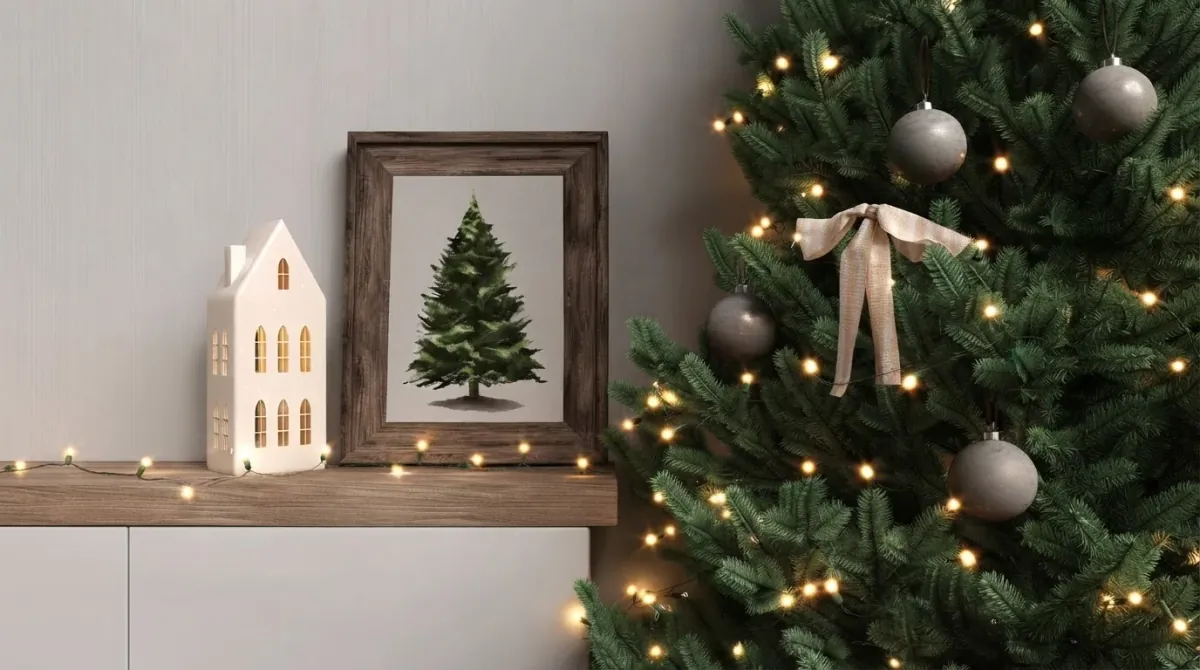
There are three ways, and the amount you need depends on which: a spiral down from the top, vertical cascades from the top to the floor, or individual bows. Balsam Hill’s rule of thumb is at least 3 yards of ribbon per foot of tree, which their table turns into 19.5 yards for a 6.5 foot tree, 22.5 yards for 7.5 feet and 27 to 30 yards for 9 to 10 feet. Use 1 to 2 inch ribbon on small trees and 2.5 to 4 inch on full size ones, and buy wired ribbon so it holds a curve.
- Spiral. The simple look. Start at the top and wrap down at a slight angle, letting it dip between branches rather than lying flat on the outside.
- Vertical cascades. The designer look in our ribbon test brief. Tuck one end under the topper and let the ribbon fall to the floor, pushing it into the branches every 12 to 18 inches so it billows out between. Five or six cascades go around a full tree; on a corner tree, only the front three are needed.
- Bows. Cut 24 to 30 inch lengths, tie them into bows, and wire them to the branches. It uses less ribbon than either run, and it is the easiest way to add a second color to a one-color tree.
What Are the Best Christmas Tree Topper Ideas?
Match the topper to the shape of the tree: a star or an angel on a full tree, a finial or a tall bow on a slim one, and a snowflake on a white or blue tree. Balsam Hill lists the types as stars, angels and figures, snowflakes, finials, bouquets of faux flowers and berries, and bows. Two practical rules from the same guide: leave at least 6 inches between the top of the topper and the ceiling, and test the weight in your palm, because a topper that falls over within 3 seconds needs extra support. A wooden dowel zip-tied to the top section does it.
A bouquet topper, a spray of picks and berries in the theme colors, is the most forgiving choice and the cheapest: it can be made from the same picks you use lower down. Count the topper and the stand when you check the ceiling; the tree calculator works out the tallest tree for your exact ceiling.
How Many Lights, Ornaments and Ribbon Does a Christmas Tree Need?
For a standard 7 foot tree, about 1,050 lights, 105 ornaments and 21 yards of ribbon for a classic look, and 1,400 lights, 175 ornaments and 28 yards for a full designer look. These are the numbers from our calculator, which takes the published rules (Balsam Hill’s 100 lights and 10 to 20 ornaments per foot and 3 yards of ribbon per foot, King of Christmas’s 150 to 200 lights per foot for a bright tree) and scales them for the width of a standard tree, about 60 percent of its height.
Two adjustments. A tree in a corner takes about three quarters of everything, since nobody sees the back. And about 40 percent of the ornaments should be small filler balls, 1 to 2 inches, which is the share Mahoney’s Garden Center recommends, with the large 5 to 8 inch ones kept to roughly a fifth. A slim or pencil tree needs about 30 percent less; the Christmas tree light calculator handles slim trees, corners, garland and skirt size.
What Are the Most Common Christmas Tree Decorating Mistakes?
- Too many colors. Five colors of ornaments, two kinds of lights, and a ribbon in a sixth. Cut to two colors and one metal and the same ornaments suddenly look planned.
- Lights wrapped around the outside. The tree looks caged and dark inside. Weave the lights along the branches toward the trunk.
- Every ornament on the tips. Hanging everything at the ends of the branches makes the tree flat. Push a third of the ornaments deep inside.
- A theme that ignores the room. A pink tree in a red room, a white tree on a white wall. Pick the theme from the room, or test it on a photo first.
- The tree in the wrong place. In front of the window, next to the fire, blocking the door. Our test showed AI makes the same mistake when you do not tell it where; people do it for the same reason, because it is the obvious open space.
How we made this guide, and what we could not verify
Keyword research: Ahrefs Keywords Explorer, US, November 15, 2026. The 20 themes are the ones with search demand or the ones that kept appearing in the top results for Christmas tree decorating ideas, themes and colors. The room images are AI renders in our gallery, rebuilt with our engine from interior designers’ Christmas projects on Behance; they illustrate each theme and are not photographs of real homes. The test ran on November 15, 2026 with a single run per brief, on one room photo, with the image model behind the free MeltFlex AI demo; paid plans can use a different model, and results on your room will vary. Times are wall-clock from our script. Balsam Hill’s guide was read on November 15, 2026. The quantities come from our calculator’s formulas, which are documented in the calculator post; they are a starting point, not a rule.
Sources
- Balsam Hill, Christmas Tree Decorations: The Ultimate Guide: decorating order, 10 to 20 ornaments per foot, ornament sizes, 3 yards of ribbon per foot and the ribbon table, ribbon widths, topper types, 6 inch clearance and the 3 second palm test, collar sizes. Read 15 November 2026.
- Balsam Hill, How Many Lights Do I Need for My Christmas Tree? (updated 30 March 2026): 100 lights per foot, double for drama.
- King of Christmas, What Size Christmas Tree for 8, 9, 10 and 12 Foot Ceilings?: 150 to 200 lights per foot for a bright tree, tree width 55 to 65 percent of height.
- Mahoney’s Garden Center, Christmas Tree Decorating by the Numbers (4 November 2025): about 40 percent filler ornaments.
- David Christopher’s, Christmas Tree Decorating Recipe Guide: a corner tree takes three quarters of the decorations.
- U.S. Fire Administration, Holiday fire safety: 3 feet from heat sources.
- U.S. Consumer Product Safety Commission, Holiday safety leaflet, publication 611 (PDF): no more than three standard sets of lights per extension cord.
- NFPA, winter holiday fire statistics (2020 to 2024), as summarized in our Christmas tree placement guide: heat sources too close behind nearly one in four tree fires.
Frequently Asked Questions
What are the most popular Christmas tree decorating ideas?
Classic red and gold, a white flocked tree in silver and white, champagne and blush, a natural Scandinavian tree with wood and straw, and black and gold are the themes most homes copy, with rustic buffalo plaid and old world glass close behind. Pick the theme from the room, not from the store: the tree has to work with the sofa, the walls and the floor it stands on. MeltFlex AI shows any of these themes on a photo of your own room in seconds, with your first design free and no card needed.
How can I see a Christmas tree theme in my room before I decorate?
Upload a photo of the room to MeltFlex AI and describe the tree: where it stands, the theme and the topper. In our MeltFlex AI test on November 15, 2026, eight themes on one living room photo each took 4 to 5 seconds and kept the sofa, rug, console and windows in all eight images. Name the corner in the brief: in the two runs that did not, the tree moved in front of the window. Your first design is free without a card; after that a render costs 10 credits.
How many ornaments do I need for a 7 foot Christmas tree?
About 105 for a classic look and 175 for a full designer look on a standard 7 foot tree, or roughly three quarters of that if the tree stands in a corner. That follows Balsam Hill's 10 to 20 ornaments per foot, scaled for a 50 inch wide tree. Make about 40 percent of them small filler balls of 1 to 2 inches and save the large 5 to 8 inch ones for the lower half.
What order do you decorate a Christmas tree in?
Fluff the branches, then lights, then the large ornaments spread evenly, then smaller ornaments, ribbon, garland and fillers, and finally the topper and the skirt. That is Balsam Hill's order, and it works because each layer hides the gaps of the one before. Test the lights before anything else goes on; finding a dead string under 100 ornaments ruins an evening.
How do you put ribbon on a Christmas tree?
Either spiral it down from the top, which is the simple look, or run it in vertical cascades from the top to the floor, tucking it into the branches every 12 to 18 inches so it billows. Plan on at least 3 yards per foot of tree, which is 22.5 yards for a 7.5 foot tree, and use wired ribbon 2.5 to 4 inches wide on a full size tree so it holds its shape.
How do you decorate a white or flocked Christmas tree?
Use warm white lights, then one metal and one soft accent: gold and champagne for warmth, or silver and clear glass for an icy look, with blush, sage or ice blue as the accent. Avoid pure white ornaments in large numbers, they disappear into the flocking. A flocked tree also reads best against a darker wall, so if your walls are white, add a dark ribbon or dark ornaments for contrast.
What colors go with a black Christmas tree?
Gold and brass first, because they glow against black, then champagne, white or clear glass. Use warm white lights, more of them than on a green tree, since black needles absorb light. Avoid dark reds and navy on a black tree; from across the room they vanish into the branches.
What should I put on top of my Christmas tree?
A star or an angel on a full tree, a finial or a tall bow on a slim tree, and a snowflake on a white or blue themed tree. Balsam Hill's rules are to leave at least 6 inches between the topper and the ceiling and to test the weight in your palm: if the topper tips over within 3 seconds, it needs a dowel or wire to support it.
Ready to pick a theme? Take a daylight photo of the room from the sofa, try two or three themes on it with MeltFlex AI, and buy for the one that looks like it belongs. Then let the calculator write the shopping list and our guide to where to put the Christmas tree settle the corner.