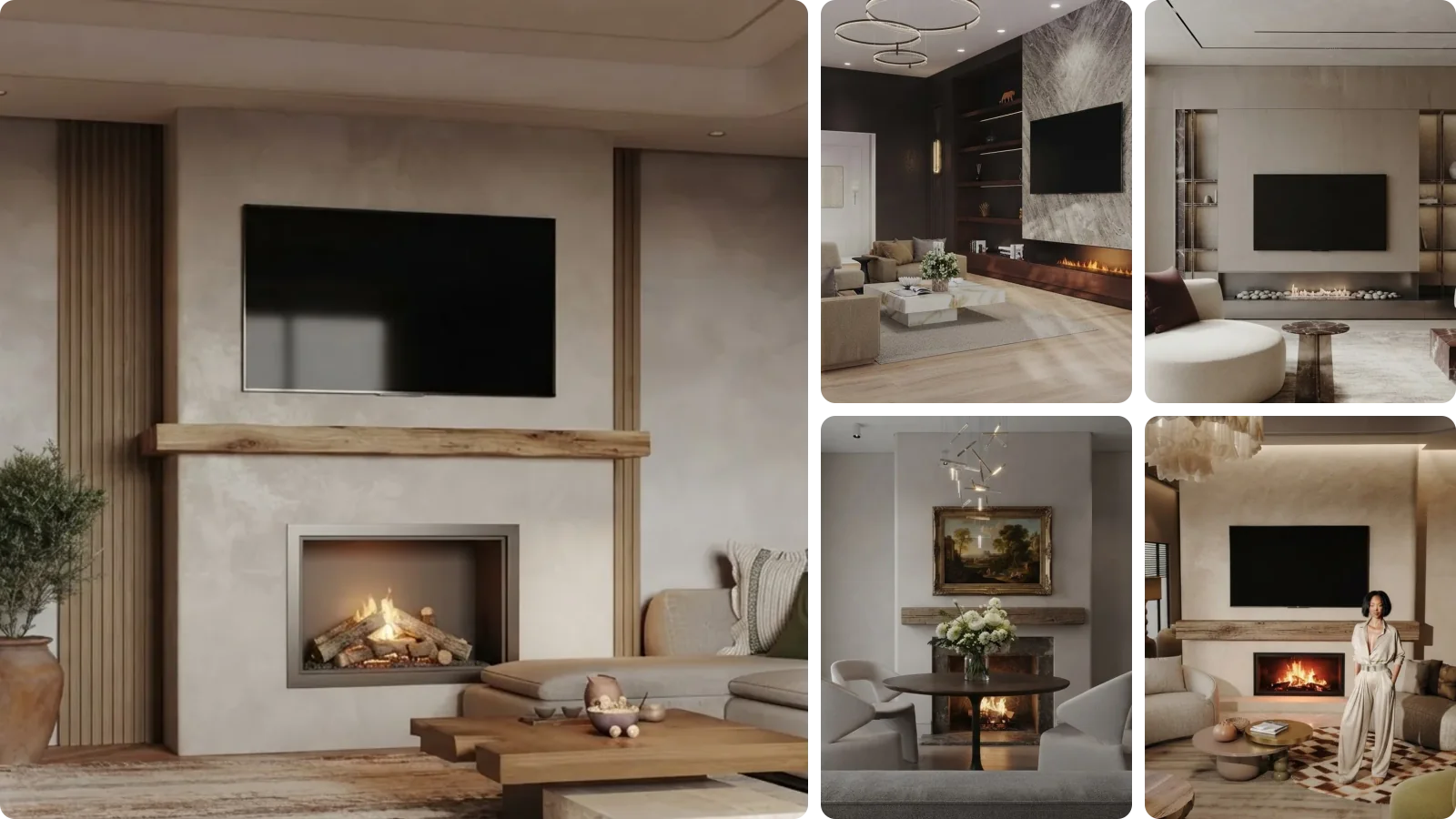
Mounting a TV above a fireplace is usually too high. Above a standard 54 inch mantel, the centre of a 65 inch screen lands about 76 inches off the floor, roughly 34 inches above a seated eye line of 42 inches, which is nearly 20 degrees of permanent upward gaze from an 8 foot sofa. OSHA puts the centre of a screen 15 to 20 degrees below the eye line, so a mantel mount finishes roughly 35 degrees from the recommendation, in the one direction the guidance singles out as worse. It is fixable for about $190, and some rooms genuinely have no other wall. It is still worth knowing the number before the bracket goes in.
Our articles are still written by humans!
Get human written articles in your Google feed.
The short version
- The height is the real problem, not the heat. A 65 above a standard mantel puts the screen centre 34 inches above your eye line, and no mount height avoids it.
- Guidance wants the screen below horizontal. A fireplace puts it above, so the sign flips. Too high is also worse than too low, which is why it feels wrong rather than merely high.
- The heat threshold is published: 104°F. That is the operating ceiling Samsung and LG both quote. Open wood fires clear it easily; direct vent gas often does not.
- Test, do not guess. Tape a thermometer where the middle of the screen would sit, run the fire for a few hours, read it. At 100°F or above, that wall is out.
- A pull down mount is the one real fix. 27 inches of drop almost exactly cancels the overshoot, from $189.95.
- A Frame TV fixes the look and nothing else. Same height, same neck angle, about $1,098 more.
- A 75 does not fit. Above a standard mantel on a standard 8 foot ceiling its top edge lands at roughly 97 inches, and the ceiling is at 96.
Jump to: The short answer · How high it ends up · By TV size · Why it feels too high · The heat question · Gas, wood, electric · With no mantel · Clearance rules · The four fixes · Frame TVs · Alternatives · Seeing it first · FAQ
Should you put a TV above a fireplace?
The argument never ends because the two sides are not discussing the same thing. Designers object to the look: the chimney breast is already the focal point, so hanging a black rectangle on it gives you two focal points fighting over one wall. Everybody else objects to the neck. Both are real. Only one can be measured, so that is the one this page leads with.
Here is the same room twice, from an identical camera position. On the left the television is where most people put it. On the right it has been taken off that wall entirely. Nothing else changed: not the furniture, not the light, not the fire.
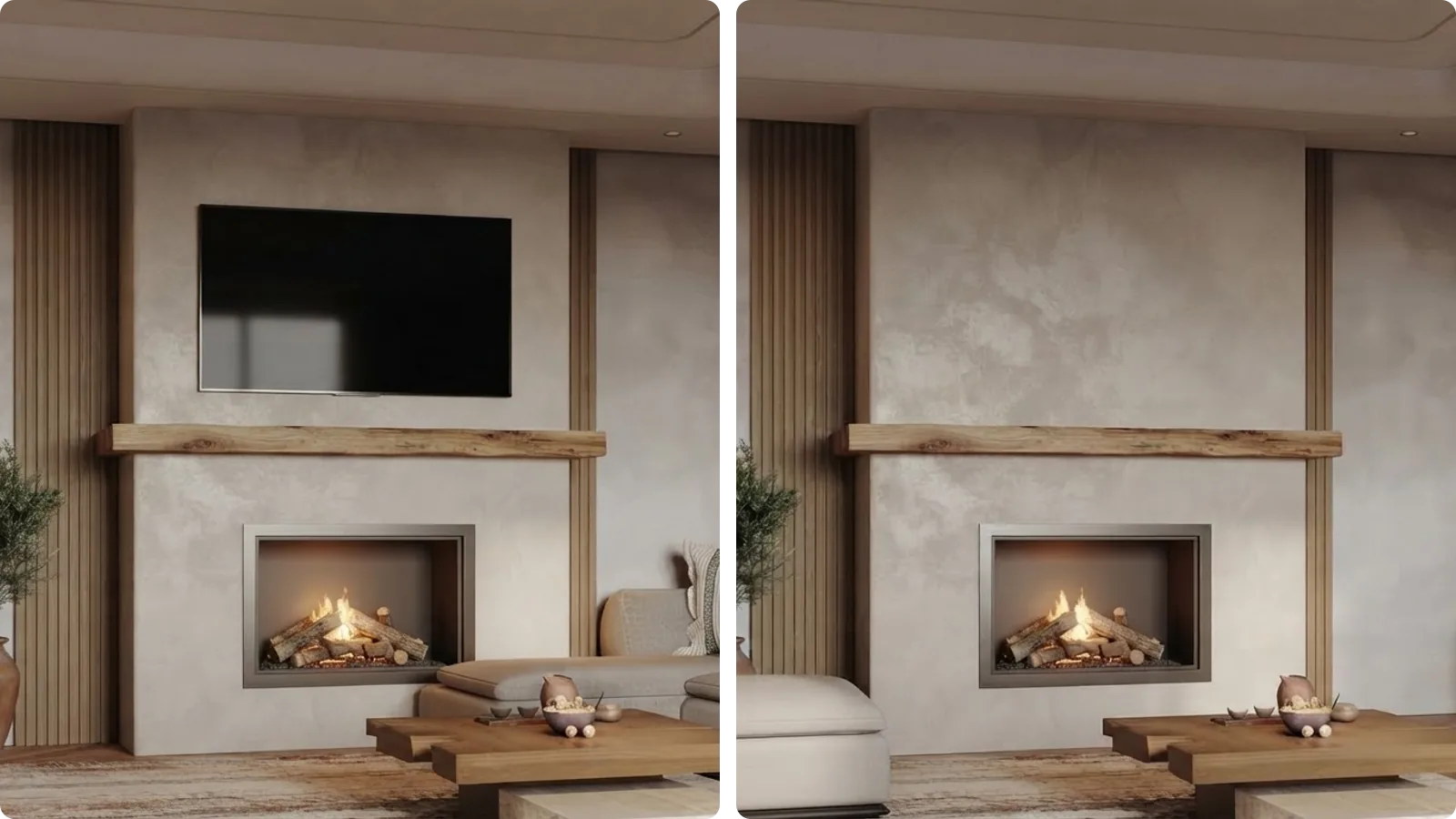
So the honest answer is not “never”. It is that the arrangement costs you about 34 inches of screen height, that the cost is the same whoever installs it, and that there are four ways to buy it back. Three of them are cheaper than the television.
How high does a TV above a fireplace actually end up?
Three numbers decide it. A seated eye line is about 42 inches off the floor on a normal sofa, and a screen is comfortable when its centre sits on that line. A standard mantel shelf is about 54 inches. Fireplace makers ask for clearance between the mantel and the screen, commonly 5 to 8 inches, and Heat & Glo puts it at 12 inches above the appliance for a passive heat system. Take the middle and the bottom edge lands at 60 inches.
Most guides then work the screen height from the diagonal, because on a 16:9 panel the glass is the diagonal times 0.4905. That formula is correct and slightly misleading: it gives you the picture, not the panel. Real televisions are taller than their own glass, because the bezel and the chassis are not part of the advertised size. We checked current models against the formula:
Be clear about how much that matters, because it would be easy to oversell: half an inch of extra panel moves the screen centre by a quarter of an inch and the viewing angle by about two tenths of a degree. Nobody will ever feel it. Where it does matter is the top edge, and the top edge is the number that decides whether the television physically fits on the wall. So the table below uses real panel heights, not the formula.
Read the last column first. A standard ceiling height is 96 inches. Above a standard mantel with a standard clearance gap, a 75 inch TV does not fit. Its top edge lands at about 97 inches and the ceiling is at 96. An 85 misses by half a metre. People usually discover this with the television already in the room, which is the single most expensive way to find out. If you are still choosing a size, the TV size chart works from seating distance instead, which is the right way round.
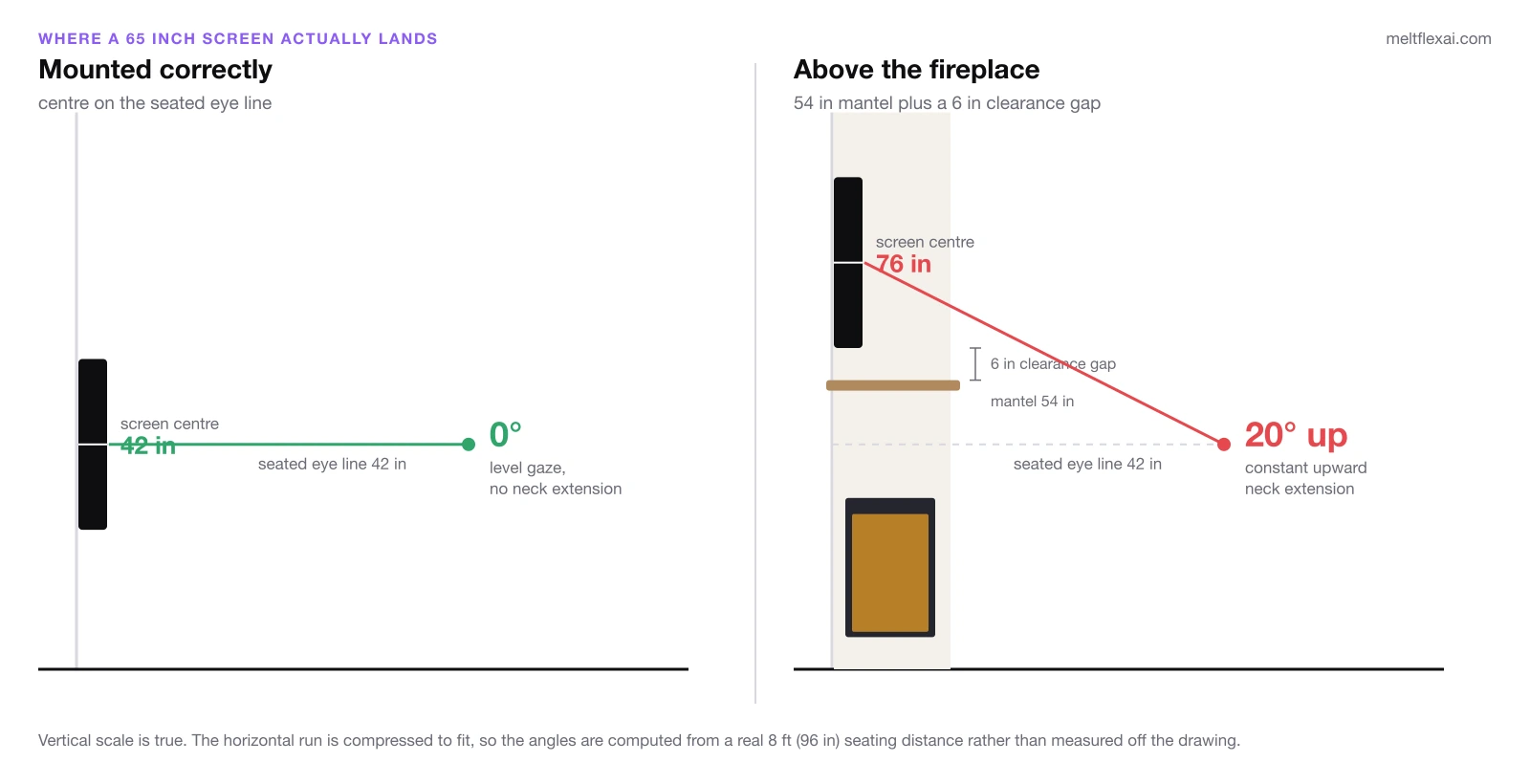
Sitting further back helps and never solves it. Move the sofa from 8 feet to 10 and the 65 goes from nearly 20 degrees to 16. At 12 feet it is 13. The line keeps flattening and never crosses the horizontal, because the screen is above your eyes and distance does not change which side of them it is on.
How high to mount a 55, 65 or 75 inch TV above a fireplace
The question is usually asked per size, so here it is per size. Every row assumes the common case: a 54 inch mantel and a 6 inch clearance gap, which fixes the bottom edge at 60 inches regardless of the television. The size only changes what happens above that line.
How high to mount a 55 inch TV above a fireplace
Bottom edge 60 inches, centre about 74, top about 88. That leaves 8 inches of wall under a standard ceiling and puts the centre 32 inches above your eye line. A 55 is the largest screen that sits comfortably over a mantel without looking crammed against the ceiling, which is worth knowing before you size up.
How high to mount a 65 inch TV above a fireplace
Bottom edge 60 inches, centre about 76, top about 93. Three inches of wall left. This is the most common combination in real houses and it is right at the edge of what the wall can take. For comparison, a 65 mounted correctly anywhere else in the room has its bottom edge at 26 inches.
How high to mount a 75 inch TV above a fireplace
It does not fit, and this is the useful answer rather than a height. Bottom edge 60 plus a 37 inch panel puts the top at 97 inches on a 96 inch ceiling. To make a 75 work above a fireplace you have to remove the mantel, lower the firebox, or accept a screen that runs into the ceiling line. See mounting with no mantel below, which is the version that can actually be built.
Why a TV above a fireplace feels too high
This is the part missing from nearly every page arguing about fireplaces, and it explains why a high screen feels wrong rather than merely high. Screen placement guidance puts the display below the horizontal line of sight, never above it. OSHA’s computer workstation eTool is explicit: the top of the monitor should be at or slightly below eye level, and the centre should normally sit 15 to 20 degrees below horizontal eye level.
That is written for desks, and nobody is claiming you should watch films at a monitor angle. The transferable part is the direction, and the direction is what makes the arithmetic ugly. OSHA wants the centre 15 to 20 degrees below your eye line. A mantel mount puts it nearly 20 degrees above. The real gap is not 20 degrees, it is closer to 35, which is why the difference between a TV on a console and a TV on a chimney breast feels so much larger than the 30 inches of wall between them.
OSHA also names the mechanism in plain terms: a screen that is too high makes you work with your head and neck tilted back, and holding that posture for a prolonged period fatigues the muscles that support the head. Two hours of a film is a prolonged period.
The sentence that should settle the argument comes from the Canadian Centre for Occupational Health and Safety: discomfort from a monitor that is too high is worse than from one that is slightly too low. The penalty is not symmetrical. Erring downward costs you very little. Erring upward, which is the only direction a fireplace lets you err, costs you the most.
Will the heat from a fireplace damage the TV?
Sometimes, and unlike the height question this one has a published threshold you can test against. Samsung rates its televisions for an operating ambient of 50 to 104°F, and LG rates its own for 0 to 40°C, which is the same 104°F ceiling. That is the number. Everything else is about whether your particular fireplace clears it.
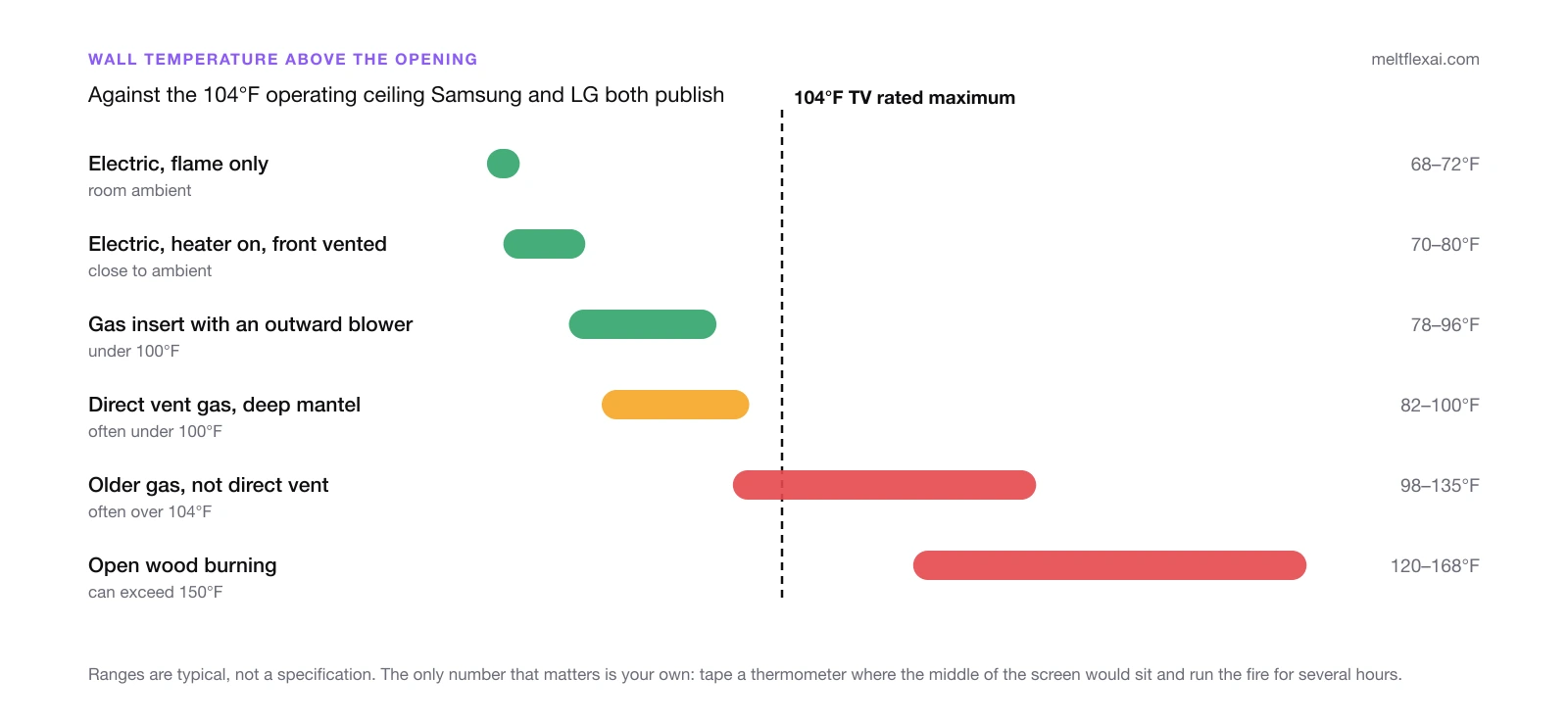
The test costs about five dollars and one evening. Tape a thermometer to the wall at the height the middle of the screen would sit, light the fire, run it the way you actually run it, and come back after several hours. If it reads 100°F or more, that wall is not a TV wall, and no bracket, heat shield or hopeful forum post changes it. In the eighties you have margin.
Two details move the reading more than people expect. A mantel shelf is a heat deflector before it is a decoration: 6 to 8 inches of depth throws the rising column of hot air out into the room instead of up the wall. Which means removing the mantel to get the television lower can make the heat problem worse at the same moment it fixes the height problem. And modern inserts, particularly pellet and high efficiency wood units, are built to push heat outward rather than up, which is why two fireplaces that look identical can read 50 degrees apart.
Gas, wood or electric: does the fuel change the answer?
It changes the heat answer completely and the height answer not at all. Worth separating, because the two get argued as one.
Is it bad to put a TV above a gas fireplace?
Less bad than above a wood fire, and it turns on one word: direct vent. A modern direct vent unit with a deep mantel above it often holds the wall under 100°F, inside the published ceiling. An older gas fireplace that is not direct vent frequently runs past it. A gas insert with a blower pushes heat into the room rather than up the wall and is usually the safest of the three. Test yours rather than trusting the category.
Above a wood burning fireplace
This is the one case where the answer is simply no. An open wood fire can drive the wall above the opening past 150°F, which is not a marginal call against a 104°F rating. No mount, shield or mantel depth rescues it. If the firebox burns wood and the chimney breast is the only wall you have, a pull down mount that keeps the screen away from the wall while the fire is lit is the only arrangement worth considering.
Above an electric fireplace
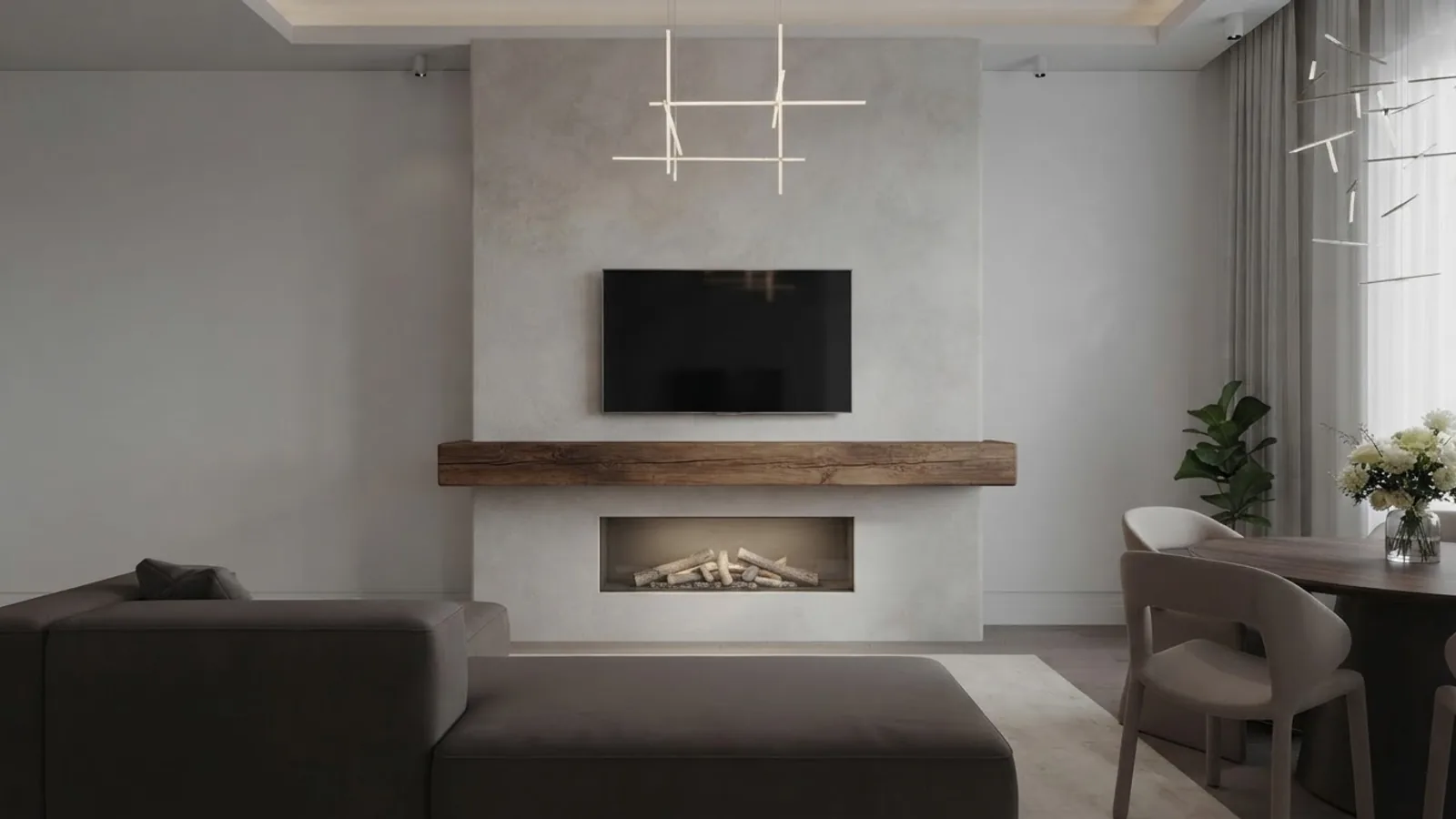
Electric changes the terms. Most units vent forward at low temperature and in flame only mode add no heat at all, so the 104°F problem largely disappears, and with it the reason for a deep mantel and a clearance gap. That frees you to put the firebox wherever it looks best, which in practice means low and linear, which in turn lets the screen sit at a sensible height on the same wall. An electric fireplace under a television is one of the few arrangements that gives you both a fire and a comfortable viewing angle. The compromise moved rather than vanished: you gave up a real fire to get it.
How high to mount a TV above a fireplace with no mantel
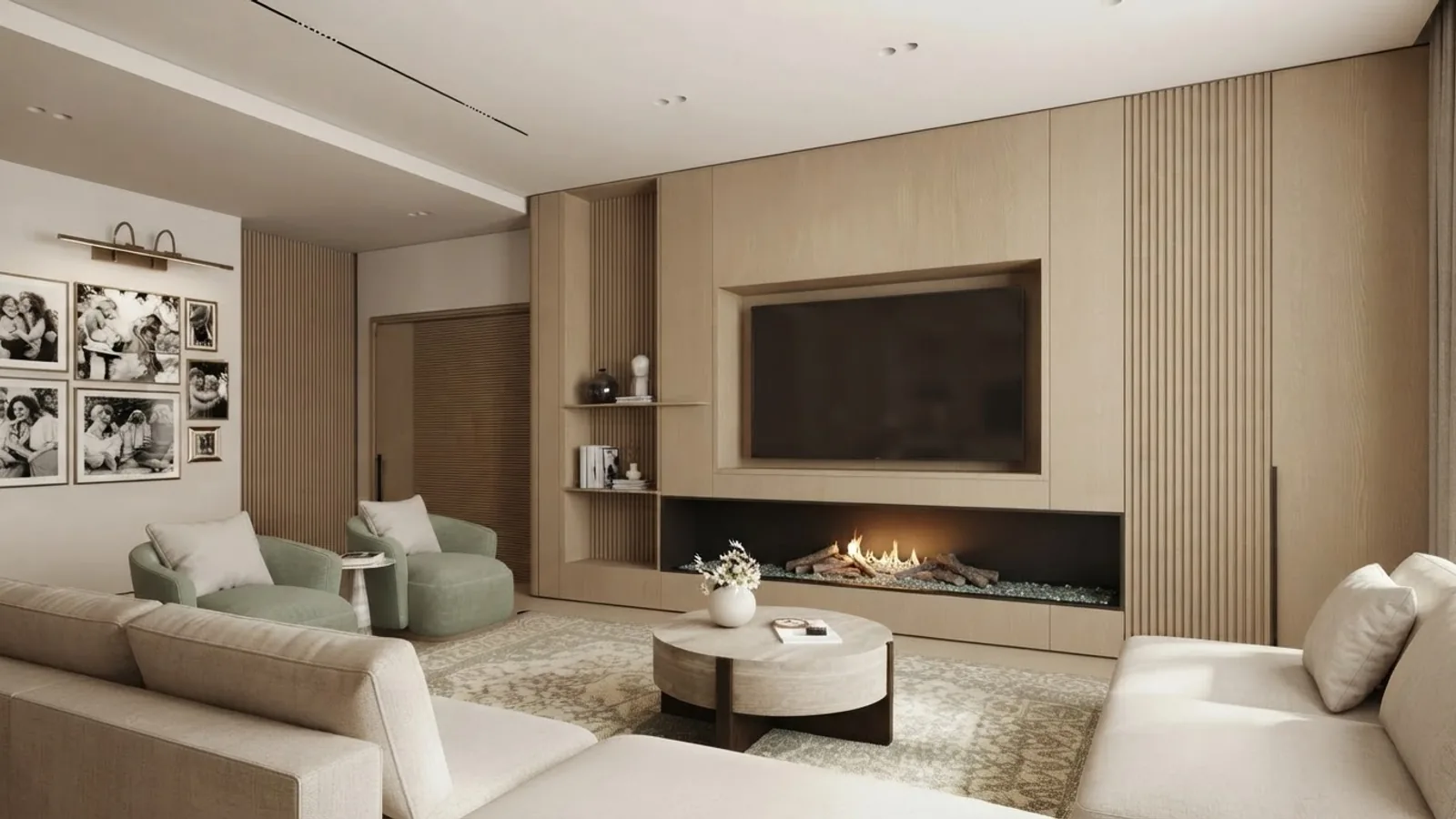
Removing the mantel is the most under-discussed fix on this page, and the numbers explain why it works. The mantel is what forces the bottom edge to 60 inches. Take it away, set the firebox low, and the bottom edge can drop to roughly 30 inches without breaking any clearance.
For a 65 that puts the centre near 46 inches, which is 4 inches above the eye line and under 3 degrees. Effectively solved. It is also the version that reads as designed rather than as a compromise, because the television stops being an object stuck onto a chimney breast and becomes part of a composed wall.
The catch is the one from the heat section: the mantel was deflecting heat. A no mantel wall only works with a unit that does not need deflecting, which in practice means direct vent gas or electric. Do not strip the mantel off a wood burner to get the screen lower.
The clearance rules nobody reads until afterwards
Two numbers from IRC R1001.11 are worth knowing before anyone cuts into a chimney breast. Combustible mantels and trim may sit on the masonry face of the fireplace, but nothing combustible may come within 6 inches of the fireplace opening. And combustible material directly above the opening and within 12 inches of it may not project more than 1/8 inch for every inch of distance from the opening.
Work the second rule backwards and it tells you something useful. A mantel deep enough to deflect heat, meaning the 6 to 8 inches above, cannot live inside that first 12 inches at all. It has to sit at least a foot above the firebox opening. So the shelf that protects your television is also the shelf that pushes your television higher. That tension is the whole reason this arrangement is awkward, and it is why the fixes that work are the ones that change the fireplace rather than the bracket.
Gas and electric appliances ship their own clearance sheets, which override the generic rule and are what an installer is actually held to. Read the unit instructions before the code.
TV above the fireplace is too high: the four fixes
Ranked by how much of the problem they buy back per dollar spent, not by how often they get recommended.
1. A pull down mount
The fix that sounds like a gadget and turns out to be the serious answer. A MantelMount MM540 gives 27 inches of vertical drop and 30 degrees of swivel, takes 44 to 80 inch panels up to 90 pounds, and lists at $249.95. The entry level MM340 gives the same 27 inches of travel at $189.95, the MM700 takes up to 90 inch and 115 pound panels at $349.95, and the motorised MM815 is $649.95. Prices checked 12 September 2026.
Twenty seven inches of drop against a 34 inch overshoot is a satisfying piece of arithmetic. It brings the centre of a 65 from 76 inches down to about 49, which is 7 inches above the eye line, a little over 4 degrees. That is inside the range a neck does not register. It does not get you to level and it does not need to.
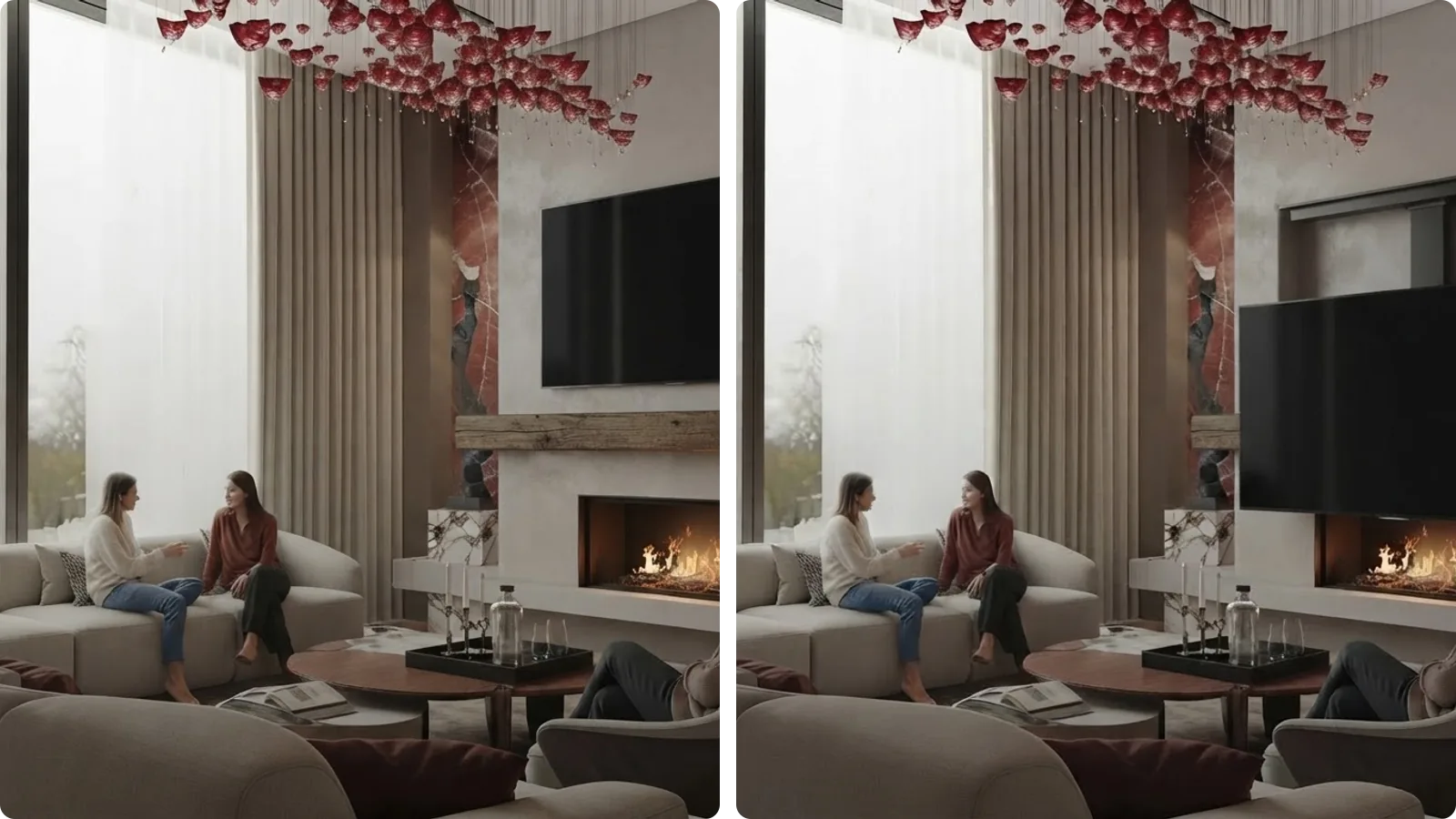
Two caveats worth saying out loud. You pull it down every time, which suits a household that watches in sessions and irritates one that leaves the television on in the background. And the stowed depth means you have traded a flush panel for a hinged one, which some people mind more than the neck angle they were trying to fix.
2. Change the fireplace, not the bracket
The screen is high because of the mantel, and the mantel is there because of a masonry firebox at hearth level. A low linear gas or electric unit removes both, and the numbers are in the no mantel section above: bottom edge at 30 inches, centre at 46, under 3 degrees. This is the expensive fix and usually arrives as part of a larger change to the room rather than on its own.
3. Deepen the mantel
Cheap, quick, and it fixes the heat rather than the height. If your thermometer came back in the high nineties, 6 to 8 inches of shelf at least 12 inches above the opening is the difference between marginal and fine. If it came back at 150°F because there is an open fire underneath, a shelf will not save you.
4. Move the television
The fix nobody wants and most rooms can take. Where it goes is in the alternatives below.
Does a Frame TV fix a TV above a fireplace?
It fixes the look and none of the ergonomics, and that is worth being blunt about, because the Frame is marketed straight into this situation. A matte panel showing a painting when it is off genuinely answers the design objection: the chimney breast keeps reading as a chimney breast with art over it, the way it did before anyone bought a television. A 65 inch Frame runs about $1,098 for the 2025 model, down from $1,698, and $1,999.99 for the 2026 Frame Pro.
What it does not do is move the screen. A Frame above a 54 inch mantel sits at the same 76 inches and asks for the same 20 degree gaze as a $300 panel. If the complaint in your house is that the room looks cluttered, the Frame is a reasonable answer. If the complaint is that someone has a sore neck by the end of a film, it is an expensive way of not addressing it. The two objections have different solutions and the marketing blurs them.
Art mode also runs the panel all evening in a room where the thing underneath it makes heat, which is the opposite of what a 104°F ceiling wants. On a marginal wall, a Frame is switched on when an ordinary television would be off.
TV over fireplace alternatives
Four, in rough order of how often they turn out to be right in a real room.
Perpendicular wall, angled seating. Put the television on the wall at right angles to the fireplace and turn the sofa to split the difference. This is the one that works most often and gets dismissed most often, usually because people assume the seating has to square up to one wall or the other. It does not. A chair turned 30 degrees solves rooms that look unsolvable on paper.
Give the television its own wall. The fireplace stops being something you watch and becomes something you sit beside, which is what fireplaces were for. In rooms with two usable walls this beats making either object share.
Media unit at console height. Not everything has to be mounted. A long low unit puts the screen centre near 40 inches with no bracket at all, and gives you somewhere to put the things currently living on the mantel.
Mirror or art on the chimney breast. If that wall really is the best surface in the room, use it for something that does not care what height it hangs at. Our mirror wall ideas and standard picture frame sizes guides cover the sizing, and a board and batten wall or a limewash finish will do more for a chimney breast than a screen will.
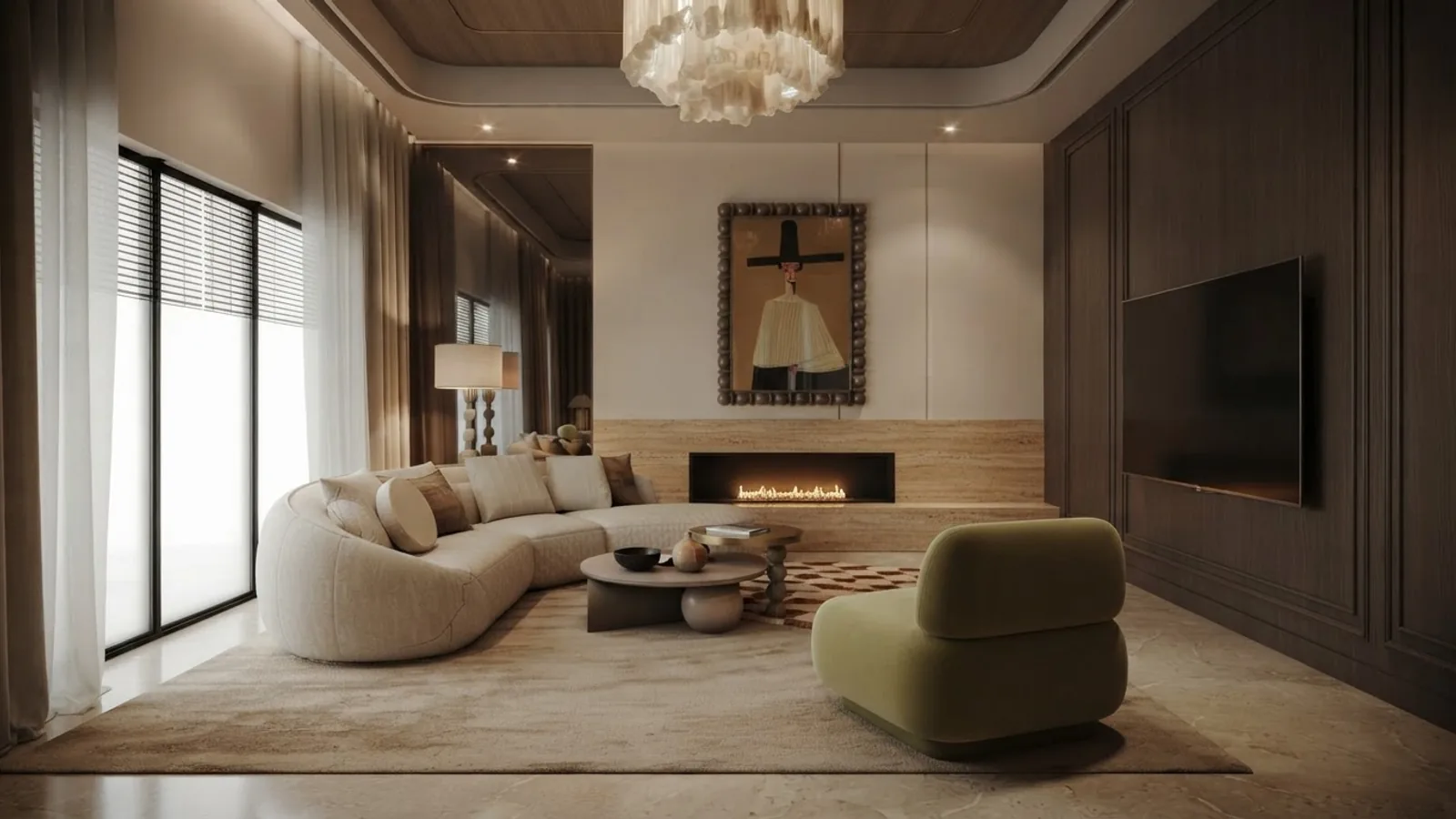
Moving a television is rarely just moving a television, because the seating usually moves with it. If that is where this is heading, the room rearranging guide and the awkward room layout guide are the two to read next, and the living room layout guide has the clearances. A rug layered over the existing carpet is the cheapest way to make a new seating position look deliberate, and accent wall ideas covers the surface once the two objects are placed.
Seeing it in your own room before you drill
This decision is unusually hard to reverse and unusually hard to imagine. A bracket leaves four holes and a patch of chimney breast that will never quite match, and nobody can picture a 65 inch black rectangle on their own wall from a photograph of somebody else’s.
The low tech test still works: cut cardboard to the real screen size, which is 57 inches wide for a 65, tape it up with its bottom edge at 60 inches, then sit down and watch a film with it there for an evening. You will know by the end.
The faster version is to photograph the wall and render it both ways. MeltFlex works from a photo of your actual room, so you can see your own fireplace with the screen high, with it low and with it gone, in your own light. Every pair on this page was made that way: one room, rendered once, with only the television moving between frames, which is also how we found that a mantel wall leaves nowhere lower for the screen to go. If you are working from a builder’s drawing rather than a finished room, the photo to render tool takes a 3D draft or a SketchUp screenshot instead.
If the answer turns out to be that the whole room needs rethinking rather than the wall, turning the floor plan into a 3D model is the place to start, and the AI interior design tools compared roundup covers what else is out there. For the strictly dimensional questions, the furniture fit calculator will tell you whether the sofa can move to where you want it.
Frequently asked questions
Is it bad to put a TV above a fireplace?
Usually, yes, and the reason is geometry rather than taste. Above a standard 54 inch mantel with the clearance gap fireplace makers ask for, the centre of a 65 inch screen lands around 76 inches off the floor. Your seated eye line is about 42 inches, so that is a 34 inch overshoot, or nearly 20 degrees of permanent upward gaze from an 8 foot sofa. OSHA puts the centre of a screen 15 to 20 degrees below the eye line, so a mantel mount is about 35 degrees away from the recommendation, in the one direction the guidance says is worse. It is not automatically wrong, and some rooms have no other wall, but it is a compromise worth pricing before the bracket goes in.
How high should a TV be above a fireplace?
As low as the fireplace and the clearances allow. Fireplace makers commonly ask for 5 to 8 inches between the top of the mantel and the bottom of the screen, and Heat and Glo puts 12 inches above the appliance on a passive heat system, so above a 54 inch mantel the bottom edge usually lands between 59 and 66 inches. The useful rule is the opposite of what most people assume: you are not trying to hit a height, you are trying to lose height. If the screen centre finishes more than about 20 inches above your seated eye line, choose a pull down mount or a different wall.
How high should a 65 inch TV be above a fireplace?
Bottom edge at about 60 inches above a standard 54 inch mantel, which is the mantel height plus a 6 inch clearance gap. A real 65 inch panel is about 32.7 inches tall, so that puts the centre near 76 inches and the top edge near 93. Compare that with the correct height for a 65 anywhere else in the room, which is a bottom edge of about 26 inches and a centre of 42. Mounting it over a fireplace raises the screen by roughly 34 inches, and there is no version of the arrangement that avoids it.
Is it bad to put a TV above a gas fireplace?
Less bad than above a wood fire, and it depends entirely on whether the unit is direct vent. A modern direct vent gas fireplace with a deep mantel above it often holds the wall under 100F, which is inside the 104F operating ceiling Samsung and LG both publish. An older gas unit that is not direct vent frequently runs past it. A gas insert with a blower pushes heat out into the room rather than up the wall and is usually the safest of the three. The height problem is identical either way: gas changes the heat answer, never the geometry.
Will the heat from a fireplace damage the TV?
It can, and the threshold is published. Samsung rates its TVs for an operating ambient of 50 to 104F and LG rates its own for 0 to 40C, which is the same 104F ceiling. An open wood fire or an older non direct vent gas unit can push the wall above the opening past 150F. A direct vent unit with a deflecting mantel often holds under 100F. Do not guess: tape a thermometer to the wall where the middle of the screen would sit, run the fire the way you actually run it for several hours, and read it. At 100F or above, that wall is not a TV wall.
Is a TV above a fireplace too high, and can it be fixed?
It is usually too high, and yes. A pull down mount is the one fix that solves it without rebuilding anything. A MantelMount MM540 gives 27 inches of vertical drop and lists at $249.95, and the entry level MM340 gives the same travel at $189.95, prices checked 12 September 2026. Twenty seven inches almost exactly cancels the 34 inch overshoot on a 65: it brings the centre to about 49 inches, a little over 4 degrees above the eye line, which is inside the range a neck does not register. The trade is that you pull it down every time and it stands 5 to 6 inches off the wall when stowed.
How high should a TV be above an electric fireplace?
Lower than above a real one, because you are only solving for height. Most electric fireplaces vent their heat forward at low temperature, and in flame only mode they add no heat at all, so the 104F problem largely disappears and with it the reason for a deep mantel and a clearance gap. That frees you to set the firebox low and put the screen centre near 42 inches on the same wall. An electric unit under a television is one of the few arrangements that gives you both a fire and a comfortable viewing angle.
Does a Frame TV fix the problem with a TV above a fireplace?
It fixes the look and none of the ergonomics. Art mode and a matte panel genuinely answer the objection that a black rectangle ruins the focal wall, and a 65 inch Frame runs about $1,098 for the 2025 model or $1,999.99 for the 2026 Frame Pro. What it does not do is move the screen. A Frame above a 54 inch mantel sits at the same 76 inches and asks for the same 20 degree upward gaze as a $300 panel. If the complaint in your house is clutter, the Frame answers it. If the complaint is a sore neck, it is an expensive way of not addressing it.
What are the alternatives to putting a TV above the fireplace?
Four, in rough order of how often they are the right answer. Put the TV on the wall perpendicular to the fireplace and angle the seating to face between the two. Give the TV its own wall and let the fireplace be something you sit beside rather than watch. Replace a tall mantel with a low linear fireplace so the screen can come down to eye level on the same wall. Or keep the chimney breast for a mirror or a painting, which do not care what height they hang at, and put the television in a media unit at console height.
Sources
- US Occupational Safety and Health Administration, Computer Workstations eTool: Monitors, for the top of the screen at or slightly below eye level, the centre 15 to 20 degrees below horizontal eye level, and the statement that a screen which is too high makes you work with the head and neck tilted back and fatigues the muscles that support the head.
- Canadian Centre for Occupational Health and Safety, Monitor Positioning, for the asymmetry this page leans on: discomfort from a monitor that is too high is worse than from one that is slightly too low.
- International Code Council, 2018 IRC R1001.11, Fireplace clearance, for the 6 inch combustible clearance to the fireplace opening and the 1/8 inch per inch projection limit on combustible material within 12 inches above it.
- Samsung and LG published operating temperature specifications, 50 to 104°F and 0 to 40°C respectively, for the 104°F ceiling this page tests fireplace walls against.
- Heat & Glo, Mounting a TV Above Your Gas Fireplace, for the 12 inch figure above an appliance with a passive heat system, and Valor Fireplaces, Mounting a TV above a gas fireplace, for the thermometer test method and the difference between direct vent and non direct vent wall temperatures.
- MantelMount, MM540 Enhanced Pull Down TV Mount, for the 27 inch drop, the 44 to 80 inch and 90 pound limits and the MM340, MM540, MM700 and MM815 prices, read from the product pages on 12 September 2026.
- Samsung, The Frame, for the art mode and matte display claims and the 65 inch pricing quoted, checked 12 September 2026. Frame prices move constantly, so treat them as a September 2026 snapshot rather than a fixed figure.
- Panel heights are real published dimensions without stand, cross checked against the 16:9 glass formula of diagonal times 0.4905. The 65 inch figure of 32.7 inches is a current Samsung specification; the 55, 75 and 85 figures are rounded from published dimensions across current models and are marked approximate because bezel depth varies by a few tenths between them. The mounting geometry, the angles and the ceiling clash are our own, worked from a 42 inch seated eye line, a 54 inch mantel and a 6 inch clearance gap.
- All photographs on this page are MeltFlex’s own AI renders. Every pair is two step image to image from a single frame, so the room, furniture, light and camera are identical on both sides and only the television moves.