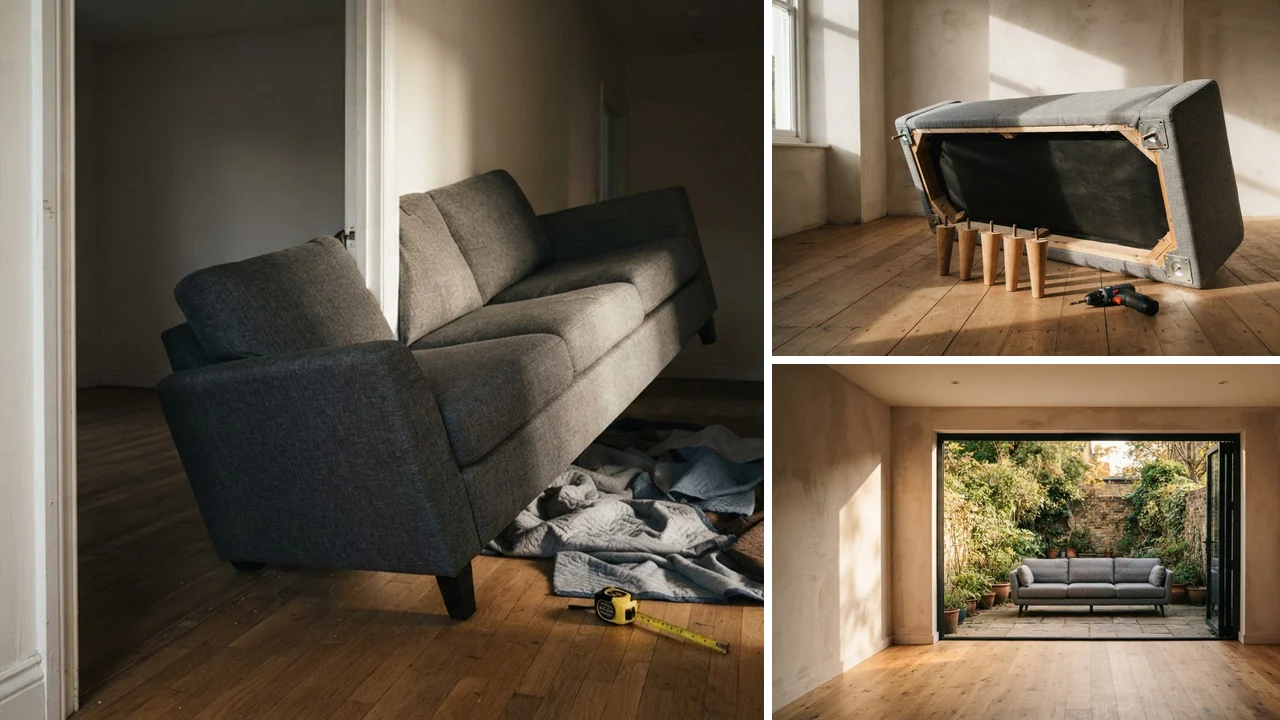
The sofa is halfway through the doorway and it has stopped. Turning it the other way will not help. What helps is knowing which number is blocking you, and then attacking that one number in the right order.
Our articles are still written by humans!
Get human written articles in your Google feed.
Work from free to expensive: strip the cushions and cover, unscrew the legs, lift the door off its hinges, then tilt and pivot it through corner first. Those four steps together usually recover 6 to 9 inches, which is more than most jams need. Only after that is it worth taking the piece apart, finding a wider entrance, or paying somebody to hoist it through a window. Almost every guide on this subject lists the same six tricks and never tells you what any of them are worth in inches, which is exactly the number you need at the moment you are standing in the hallway deciding what to unscrew.
FreeUpload photo · freeRearrange my room for freeUpload a photo and MeltFlex plans a new furniture layout around your walls, windows and doors. Your first AI design is free, no card needed.


The 60-second version
If you only read one thing: the door is rarely the real problem and the length of the piece is almost never the problem. What stops furniture is the depth of the piece against the clear width of the opening, or the turn immediately behind the door. Before you unscrew anything, measure the gap you are actually missing. Every fix below is worth a known number of inches, and there is no point pulling a door lining off the wall to gain an inch when the legs under the sofa are worth five.
If the piece has not been delivered yet, you are in a much better position than this article assumes. Run the numbers through our furniture fit calculator first: it checks the doorway, the hallway turn, the stairs and the lift, and it will tell you which of those is going to be the problem before anyone is holding anything heavy.
Before you do anything else
If the piece is wedged in the frame right now, thirty seconds of the right behaviour saves a door lining and somebody’s back.
- Stop pushing. A jam that will not move with two people will not move with three. Everything past this point is geometry, and force only converts the problem into damage.
- Take the weight off the frame. Slide it back out until it is free rather than leaving it hanging on the architrave. Chipboard linings crack at the hinge side first.
- Protect what you are about to scrape. A folded moving blanket over the jamb and a second one under the piece on the floor. Upholstery survives a scuffed jamb; a painted lining does not survive a staple.
- Count your people. The pivot below needs two, one taking the weight and one steering the trailing end. A third person is only useful holding the door.
Find out which number is blocking you
A piece of furniture has three dimensions and a doorway has two. Only two of the furniture numbers ever matter, and they are the two smallest ones. Nobody carries a sofa through a door lengthways, so the 84 inches printed on the label is irrelevant. What has to get through is the cross-section: typically the depth and the height, around 38 by 34 inches on a three-seat sofa.
So measure three things, in this order:
- The clear opening, with the door standing open. Not the size printed on the door. An open leaf sits inside the opening, so a nominal 32 inch door gives you about 30.5 inches of actual gap.
- The two smallest dimensions of the piece, measured at the widest points, arms and cushions included.
- The gap you are missing. Subtract. If you are two inches short, this is a fifteen minute job. If you are eight inches short, no amount of technique is going to close that and you should skip straight to taking the piece apart or finding another way in.
That last number is the one that decides everything, and it is the one most people never work out. They try things at random, get frustrated, and eventually damage something. Put the four figures in here and it will tell you whether you are one inch short or eight, which is the difference between a screwdriver and a phone call.
Interactive calculator
Loading… if it does not appear, refresh the page.
It is the same tool that runs on our furniture fit calculator page, where the measuring guide for each scenario lives. The full method for measuring a route properly, including the stairs and the lift, is in our guide to what size furniture fits my room, and the 30 second version is the answer on whether a couch will fit through the door.
The opening a sofa actually needs
Here is the rule our own calculator runs on, written out so you can check it rather than trust it. Two of the three furniture dimensions ever meet the doorway, and the one that binds is the smaller of the depth and the height. On a typical three-seat sofa, 38 deep and 34 tall, that is the height. The figures below are the clear opening, not the size printed on the door, and they assume a normal 80 inch door height.
The last column is where the rule of thumb lives: the clear opening has to be at least the binding dimension minus about six inches. To be straight about where that six comes from, it is not something we measured. It is the allowance our calculator is built on, and it is six because that is what sofa legs are: 4 to 6 inches, and they are the only intervention that shrinks the binding dimension itself. Taking the door off does not make the sofa smaller, it makes the opening bigger, which is worth another 1.5 to 2 inches on top. Cushions and a zip-off cover come off the depth, so they only help on the pieces where depth is the binding number rather than height.
Run the standard case and you can see why this is the argument everybody has on moving day. A 34 inch sofa needs about 28 inches of clear opening. A nominal 30 inch door gives about 28.5. The single commonest sofa in the single commonest doorway clears by half an inch, which is close enough that a thick carpet or a proud threshold decides it.
The order to try things in, and what each one buys
This is the table nobody publishes. Work down it and stop as soon as you have recovered more than the gap you measured. The gains are typical figures for standard residential doors and mid-market upholstery, so treat them as planning numbers rather than guarantees.
Read the first two rows again. Cushions and legs are free, they take twenty minutes between them, and together they are worth more than removing the door and its trim combined. The door in the photograph below is what everybody reaches for first, and it is worth less than either of them.
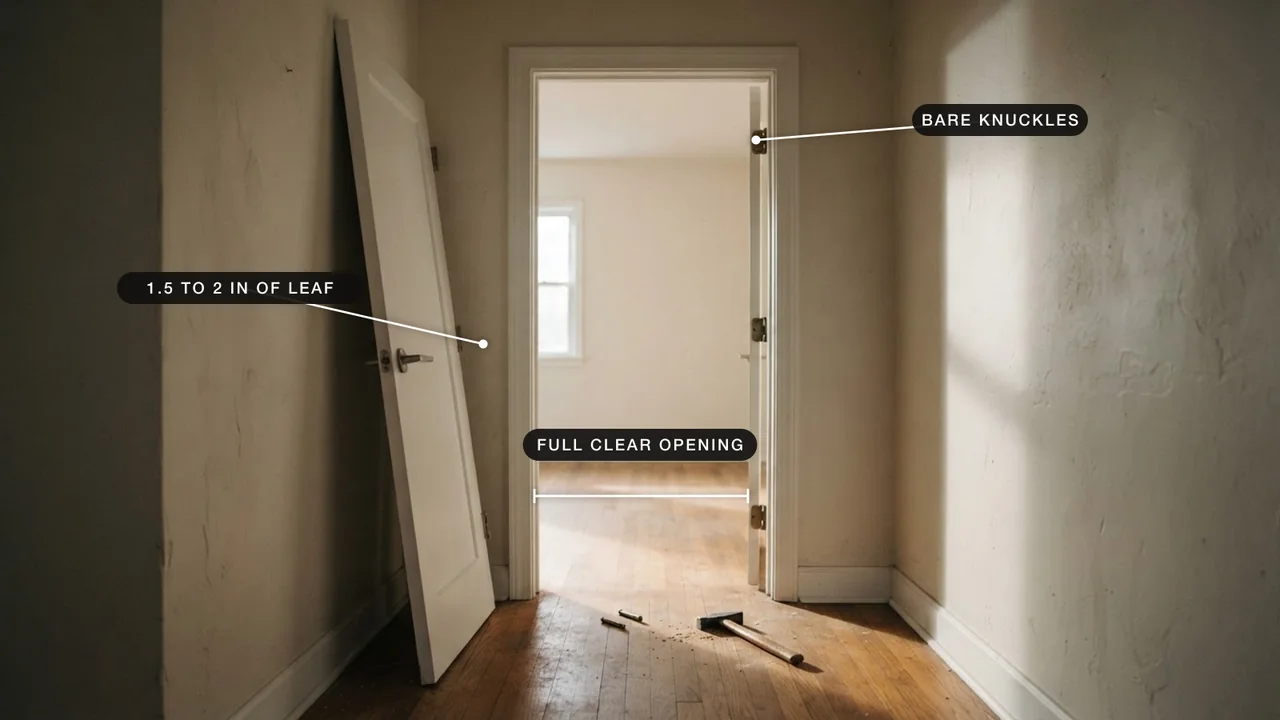
One row deliberately points elsewhere: if the piece that is stuck is a bed base rather than a sofa, the physics change completely and the fixes are different, because a rigid panel cannot use most of this list. That case has its own guide on what to do when a box spring will not fit, and the softer half of the bed is covered in the mattress fit guide.
Take the legs off
Sofa legs are between 4 and 6 inches on almost every modern design, and on a piece that is stuck on height rather than width they are the entire problem. Removing them is the single largest free gain available to you, and on most sofas it takes one person about fifteen minutes.
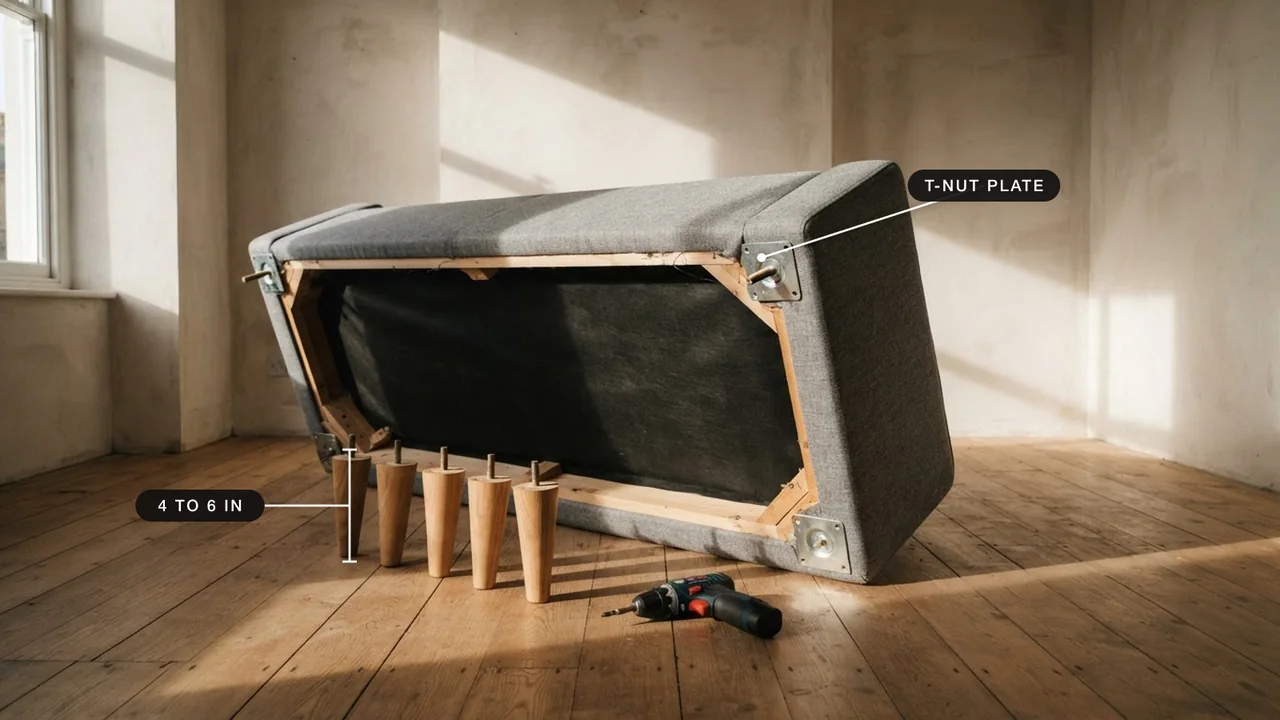
Tip the sofa back onto a folded blanket so you are not standing it on the upholstery, and look at how the legs are fixed before you turn anything. There are three common fittings and they behave differently:
Two things not to do. Do not cut a leg down to make it fit, because a shortened leg cannot be put back and the piece is then worth nothing second hand. And do not force a seized T-nut: if it will not turn, penetrating oil and ten minutes of patience is cheaper than pulling the nut out through the frame, which is a repair rather than a job.
What actually comes apart on a modern sofa
This is the question that separates a piece that goes in from a piece that goes back on the lorry, and the answer was decided in a factory long before you bought it. Sofas fall into two families.
Knock-down frames are designed to come apart. The back lifts off two steel brackets once you slide it upwards, and the arms are held to the seat unit by bolts you reach from underneath. Taking the back off a knock-down sofa turns something around 38 inches deep into something near 28, which is the difference between refusing a 30 inch door and walking through it. Most flat-pack sofas and a large share of mid-market ones are built this way, and you can usually tell by tipping it forward and looking for bolt heads or a horizontal seam behind the back cushions. If you are still shopping, the sofas for narrow doorways guide lists which flat pack and modular models publish their box sizes.
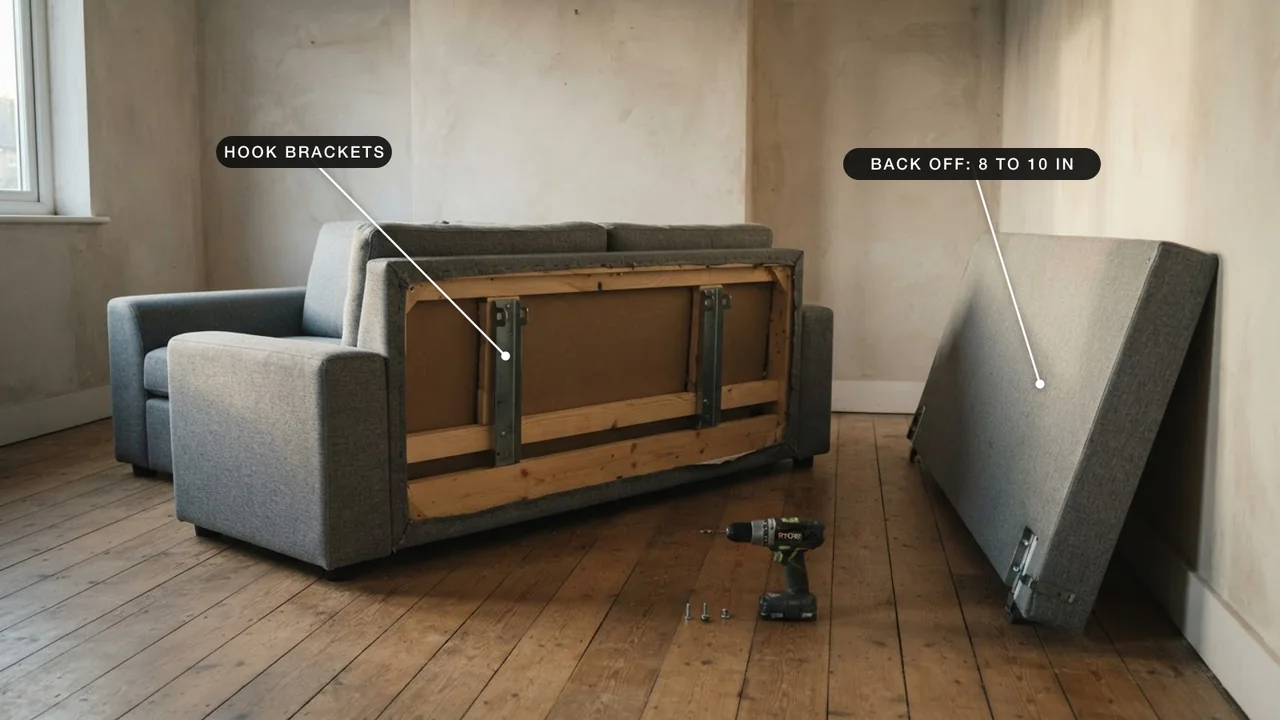
Traditional frames are glued, stapled and upholstered as one unit. There is no seam and no bolt, and the only way to make one smaller is to cut it. Cutting ends the warranty, ends the resale value, and on a sprung seat can end the sofa. If you have a traditional frame and you are more than a couple of inches short, stop reading the disassembly advice and go to the section on other entrances.
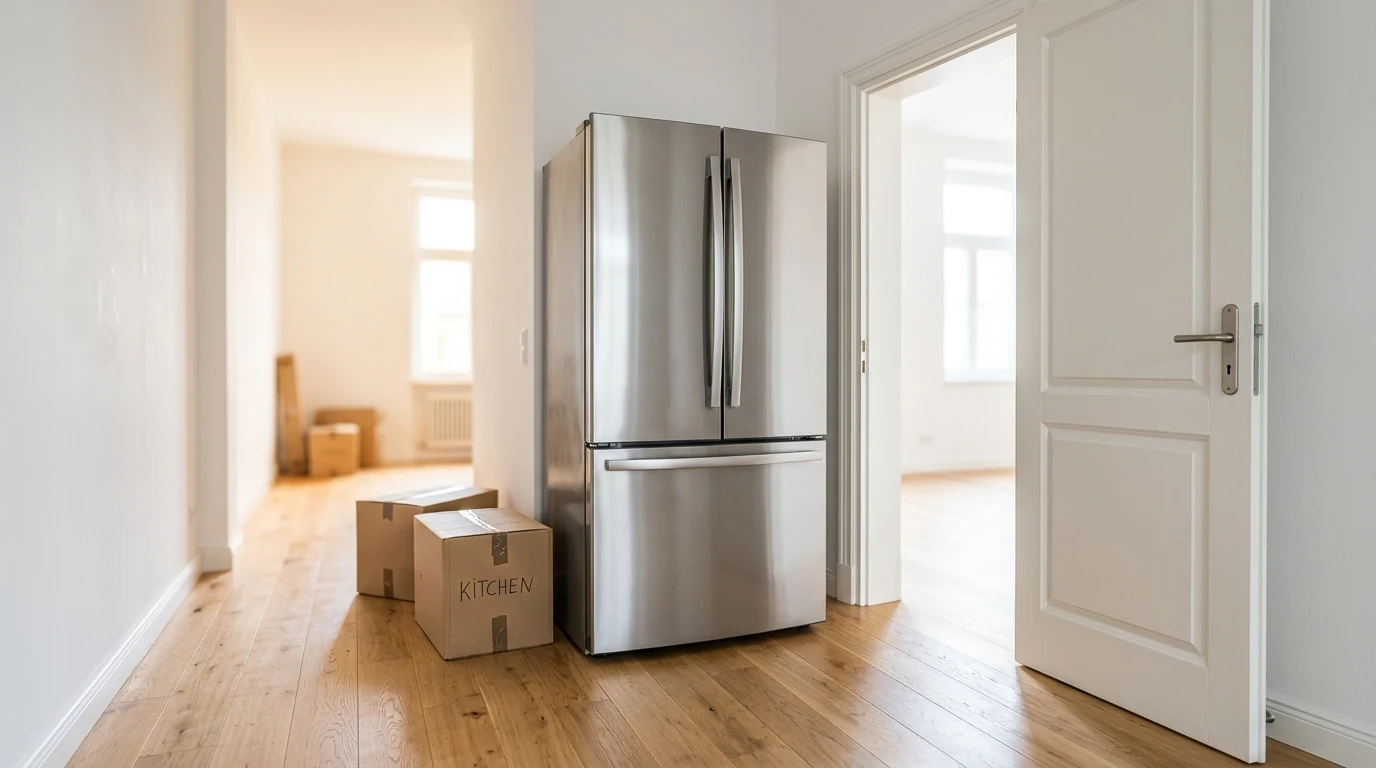
Whichever family it is, take the cover off first if it has one. Zip-off covers are common now, and removing the cover and the seat pads gives back 2 to 3 inches of depth on a deep-seated design for five minutes of work and no tools. The same logic applies to appliances, where the real dimension is the cabinet rather than the doors and handles bolted to it, which is covered properly in will my fridge fit through the door and in the short answers on a washing machine and a wardrobe.
When it is the hallway, not the door
Plenty of pieces clear the doorway and then stop dead two metres later, because a right-angle turn is a harder problem than a straight opening and it is governed by different maths. The limiting length for a thin object rounding a corner between corridors of width A and B is roughly (A^(2/3) + B^(2/3))^(3/2). A sofa is not thin, so the real limit is well below that, which is why our calculator treats anything above three quarters of that figure as tight rather than safe.
In practice there are only three things you can do at a corner:
- Lead with a corner, never the face. A diagonal presented to the turn is geometrically smaller than a flat face, and it lets the trailing end swing.
- Use the ceiling. Standing the piece upright into the vertical space at the turn is often the only move available, which is why headroom matters as much as width on a staircase.
- Check the depth against the narrower corridor. If the slimmest side of the piece is wider than the narrower of the two corridors, it cannot rotate at all and no technique will change that. This is the honest stopping point.
Radiators, skirting boards, light switches and a coat hook all count as the wall. Measure at the narrowest point, not the average, and measure at the height the piece will actually be travelling.
The manoeuvre is easier watched than written. This is a full-size couch going through a tight hallway and doorway on its end, led with a corner, the trailing end steered rather than shoved.
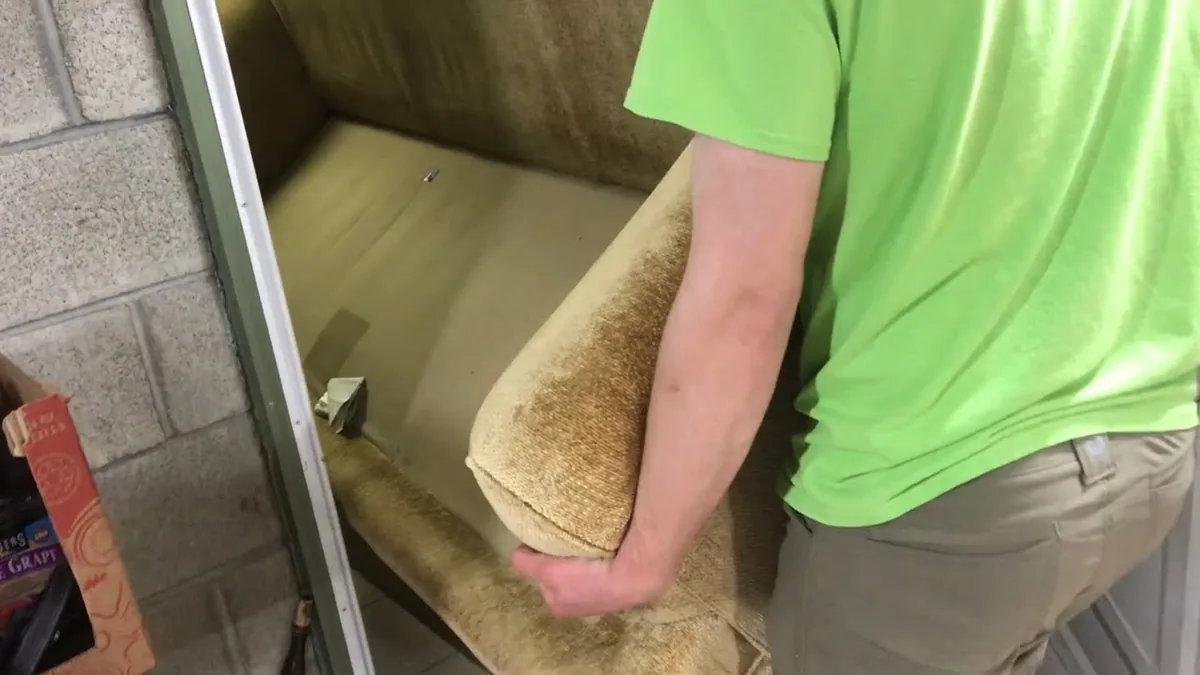
Video: “how to move a ‘full-size’ couch through TIGHT hallways and doorways” by Live Free.
Another way in: patio doors, balconies and windows
Before anybody prices a crane, walk around the building. The internal doors in a home are the smallest openings it has, and the wider ones are usually unlocked and forgotten.
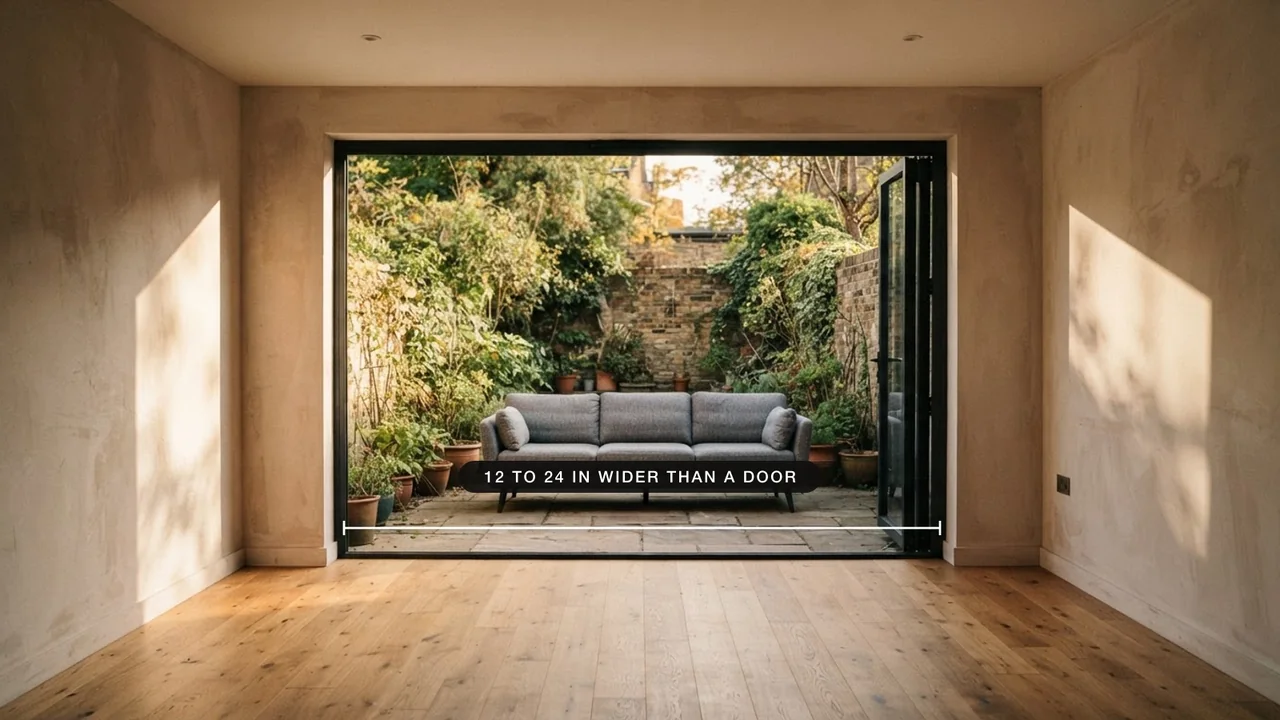
Patio and French doors are typically 12 to 24 inches wider than an internal door, and sliding panels often lift out of their track entirely to leave the full aperture. A garage entrance, a utility door or a set of bifolds will all beat a hallway. In a flat, a balcony is frequently the widest opening in the property, and it is the reason the balcony question comes up so often when people are working out what furniture fits a small balcony.
If none of that exists, hoisting is a real service rather than a last-ditch improvisation. Published rates put a strap hoist to a second or third floor at 100 to 300 dollars per item, and a crane to higher floors at 500 to 1,500 dollars and up, depending on weight and access. Some crews price it as an hourly crew rate instead, in the region of 150 dollars an hour for two movers, with the hoist quoted on top.
Do not do this yourself with rope. Amsterdam built hoist beams into the gables of its canal houses for exactly this problem, and the people using them were professionals with the right gear. A sofa dropped from a second-floor window costs more than the sofa.
What each option costs
At some point this stops being a puzzle and becomes an arithmetic problem. These are the numbers worth having in front of you before anybody commits to forcing it.
The row people never price is the last one. A cracked door lining and a scuffed staircase is a weekend and a decorator; a torn arm takes a mid-range sofa off the second-hand market entirely. If the free steps have not worked and the piece was bought online inside the last fortnight, the cheapest line in that table is almost always the return.
When to stop and send it back
There is a point where the cheapest outcome is admitting the piece is wrong for the property, and most people pass it about two hours later than they should. The maths is simple: a damaged door lining, a torn arm and a scuffed staircase cost more to put right than a return, and the sofa is worth less afterwards.
Your position depends on where you bought it. In the UK, if you ordered online or over the phone, the Consumer Contracts Regulations 2013 give you 14 days from delivery to cancel without giving any reason at all, and the refund includes the standard delivery charge. "It does not fit" is a perfectly good non-reason. Two exceptions matter here: goods made to your specification are outside that right, which can include a sofa ordered in a fabric you picked, and if you damage the piece while forcing it the retailer can deduct for the value you destroyed. That second one is worth reading twice before anyone gets a crowbar out.
If you bought it in a shop, there is no automatic right to change your mind. Retailers are consistent on this: checking that it fits through the door and up the stairs is the buyer’s responsibility, and most will charge a collection or redelivery fee if they have to take it away again. You still have grounds if the piece was described inaccurately, for example if the listed depth was wrong, because that is a description problem rather than a measuring problem.
And then the obvious thing, which is to not be in this position next time. Measure the route before you order, not after, using the furniture fit calculator for the doorway, the hallway turn, the stairs and the lift, and the sofa fit calculator and size chart if the piece in question is a sofa. If you are furnishing a whole property, the mistakes tend to repeat, and we collected the common ones in moving into a new apartment without the furnishing mistakes.
Frequently asked questions
What size door opening does a sofa need?
A sofa needs a clear opening of roughly its binding dimension minus six inches. The binding dimension is the smaller of the depth and the height, which on a typical three-seat sofa is the height, measured floor to the top of the back. A 34 inch sofa therefore needs about 28 inches of clear opening, and a nominal 30 inch door gives about 28.5, which is why the commonest sofa in the commonest doorway clears by half an inch. The six inches is not a measured margin, it is the allowance for the legs: 4 to 6 inches, and the only thing that makes the sofa itself smaller. Taking the door off its hinges is worth another 1.5 to 2 inches on top, because it widens the opening rather than shrinking the sofa.
What do you do if your couch doesn’t fit through the door?
Work in order of what is free before what costs money: strip the cushions and cover, unscrew the legs, lift the door off its hinges, then try standing the couch on one end and pivoting it through corner first. Those four steps together typically recover 6 to 9 inches, which clears most jams. If it still will not go, check whether the couch comes apart, then look for a wider entrance such as a patio door before you price a professional hoist.
How much space does taking a door off its hinges give you?
About 1.5 to 2 inches, or 4 to 5 cm. A standard interior door leaf is 1 3/8 inches thick and sits inside the opening when it is open at ninety degrees, and the hinge knuckles project a little further. Removing the leaf gives all of that back. Prising off the door stop trim adds roughly another inch, half an inch per side, but only do that when you are less than an inch short.
How do you remove sofa legs without screws?
Most sofa legs that look screwless are threaded: they have a bolt cast into the top that turns into a T-nut in the frame, so they unscrew anticlockwise by hand once you break them free. The other common fittings are a metal bracket held by four wood screws, and a push-in socket where the leg is tapped out with a rubber mallet from inside the frame. Tip the sofa onto its back on a blanket and look at the fixing before you force anything, because snapping a T-nut out of the frame is not a repair you want.
Can you take a sofa apart to get it through a door?
Sometimes, and it depends entirely on how it was built. Knock-down sofas, which are most flat-pack and many mid-market models, have a back that lifts off two brackets and arms held by bolts under the seat, and taking the back off can turn a 38 inch deep piece into something near 28 inches. Traditional sofas built on a glued and stapled hardwood frame do not come apart without cutting, and cutting voids the warranty and usually the resale value with it.
How do you get a couch through a narrow hallway?
Turn it so the slimmest side faces the walls and lead with a corner rather than the full face. The limit at a right-angle turn is set by the two corridor widths, not by the door: the longest thin object that can round the corner between corridors A and B is roughly (A^(2/3) + B^(2/3))^(3/2), and a real sofa with thickness gets nowhere near that figure. If the couch is deeper than the narrower corridor it cannot turn flat at all, and standing it upright into the ceiling void is the only move left.
How much does it cost to hoist furniture through a window?
Rope-and-strap hoisting to a second or third floor typically runs 100 to 300 dollars per item with a professional crew, and full crane jobs to higher floors run from about 500 dollars up past 1,500 depending on height, weight and access. Some movers price it as an hourly crew rate instead, in the region of 150 dollars an hour for two movers, with the hoist quoted on top. Price it against the cost of returning the piece and buying one that fits, because the return is often cheaper.
Can I return a sofa if it does not fit through my door?
If you bought it online or over the phone in the UK, yes: the Consumer Contracts Regulations 2013 give you 14 days from delivery to cancel without giving a reason, and the refund includes standard delivery. Two traps: goods made to your specification, which can include a sofa ordered in a fabric you chose, are excluded from that right, and if you damage the piece trying to force it in the retailer can deduct for the lost value. If you bought it in a shop there is no automatic right at all. Retailers are clear that making sure it fits is the buyer’s job, and most charge a collection or redelivery fee.
Should I take the door frame off as well?
Only as a genuine last resort, and only when you are an inch or two short after everything else. The architrave and the stop trim come off with a flat bar and go back on with a nail gun, but the frame itself is fixed to the structure and pulling it out means replastering. Measure the exact gap you are missing first: people regularly destroy a door lining to gain space they would have got for free by unscrewing four legs.
See it in the room before you buy it
A calculator proves a piece fits through the door. It says nothing about whether it belongs in the room once it is in there, which is the other half of the problem and the reason a lot of furniture gets returned even when it fitted perfectly. Working out what size sofa suits your living room is a different question from whether it clears the frame.
That is what MeltFlex does: upload a photo of the actual room and try real furniture in it at true scale before you spend anything. If you are replacing a piece that went back, the AI furniture changer swaps the sofa in your own photo for a different one, and the photo to render tool turns the room you already have into something you can plan against. It is the same idea as seeing furniture in your room before buying, and if you only have a floor plan rather than a photo, you can measure a room from a photo first. Try it free.