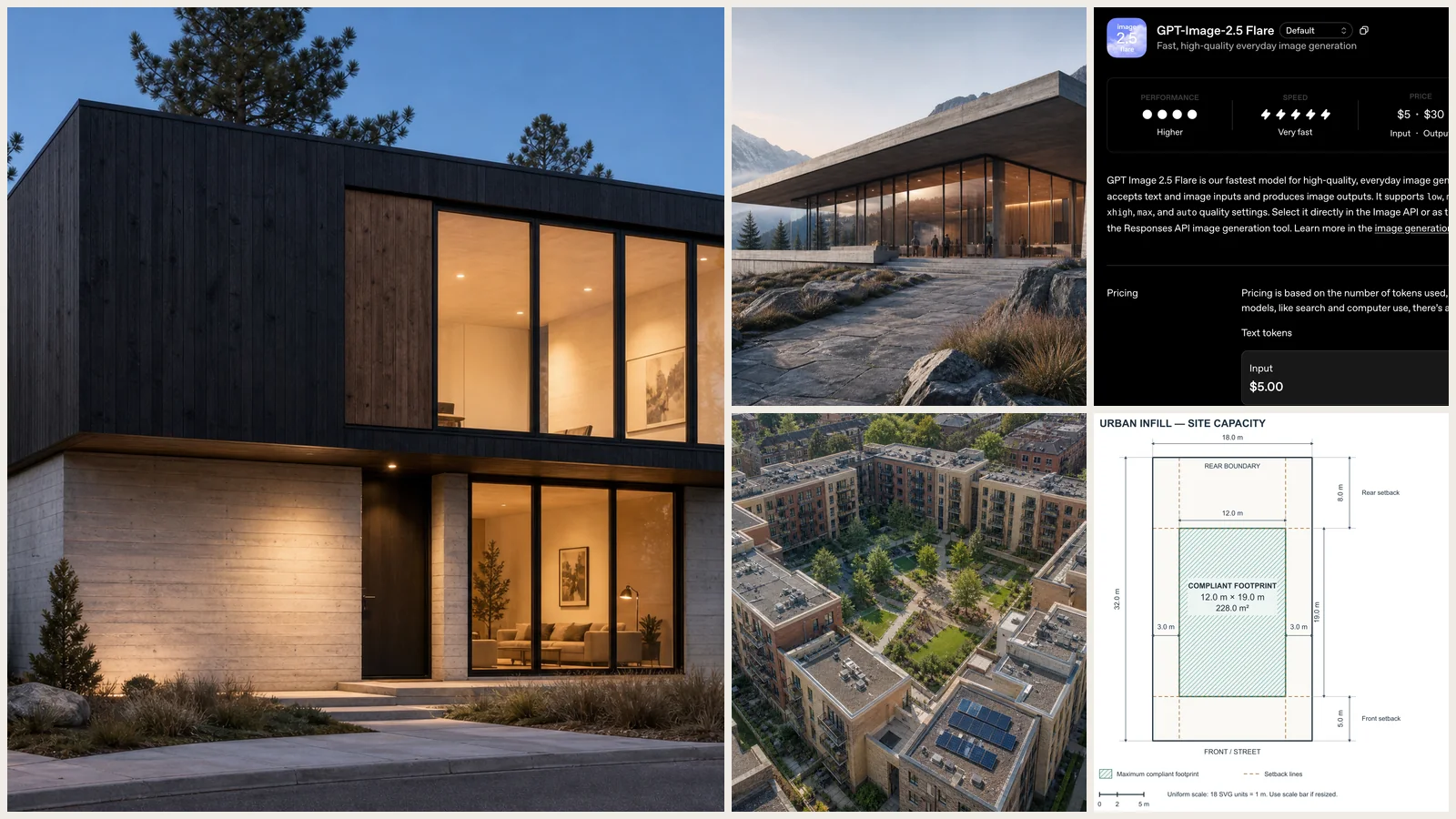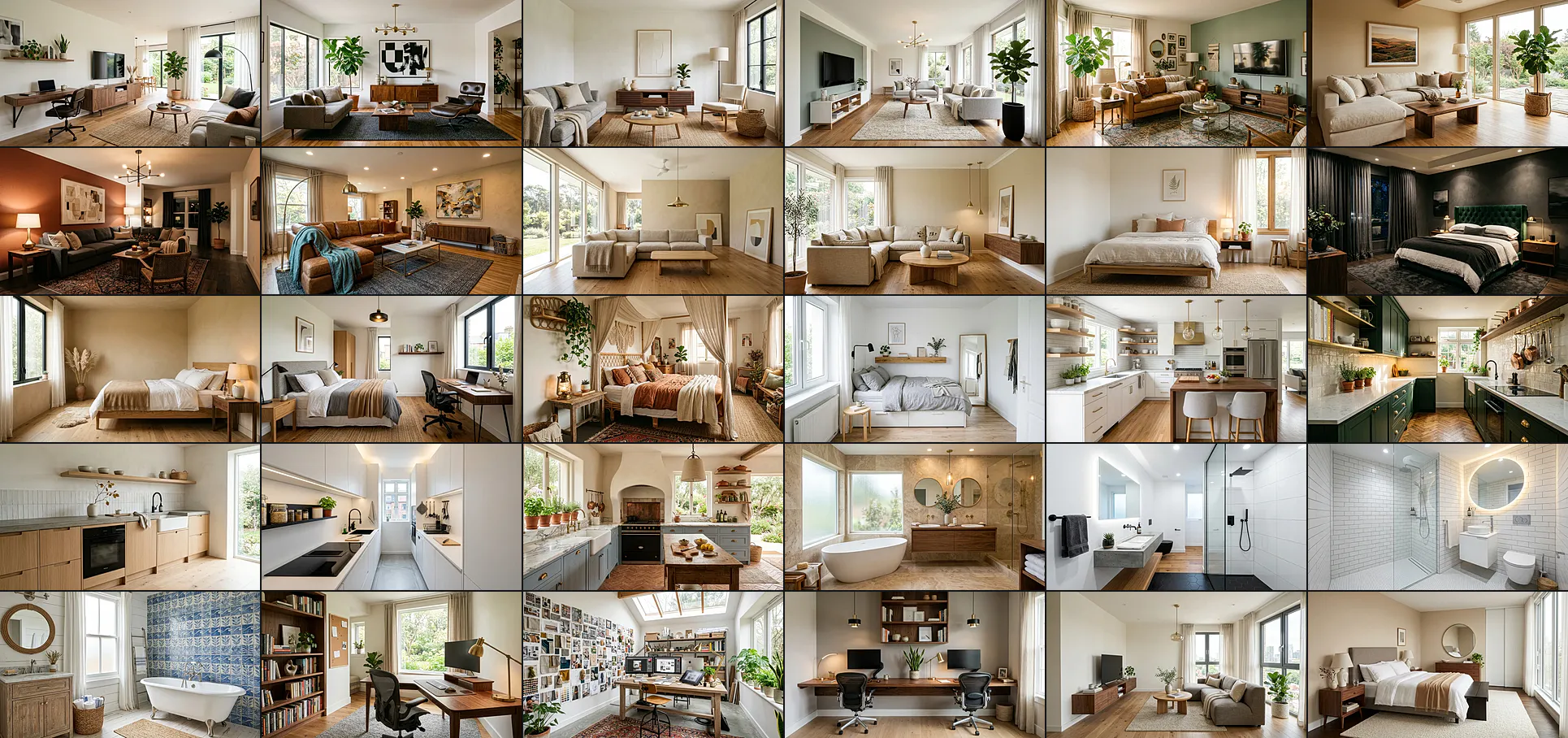
40 ChatGPT Images 2.5 interior design prompts, written for the model OpenAI shipped on 8 September 2026, plus what its three headline changes actually do to a room render. Every brief is copy-paste ready, and where an image follows a brief it is the unedited output of exactly those words.
Our articles are still written by humans!
Get human written articles in your Google feed.
ChatGPT Images 2.5 is OpenAI’s new image model, and for interiors the upgrade is about editing rather than generating. It preserves the subjects in a reference photo more faithfully, it changes only the element you name and leaves the rest of the frame alone, and it holds earlier edits across a long conversation instead of degrading. OpenAI also cut generation latency by up to 50 percent against Images 2.0. For anyone restyling a photo of a real room, those three things matter more than any prompt trick.
Read this before the numbers. Every render on this page was made on 8 September 2026 with gpt-image-2, the generation Images 2.5 replaces, driven through GPT-6 Astra’s image tool. We could not re-shoot them on 2.5: gpt-image-2.5-flare and gpt-image-2.5-sunburst still return model_not_found on our API key. So read the images and the measurements below as the baseline that Images 2.5 is claiming to beat, not as 2.5 output. Every caption says which model drew it, and we will re-run the set once the new models reach our account.
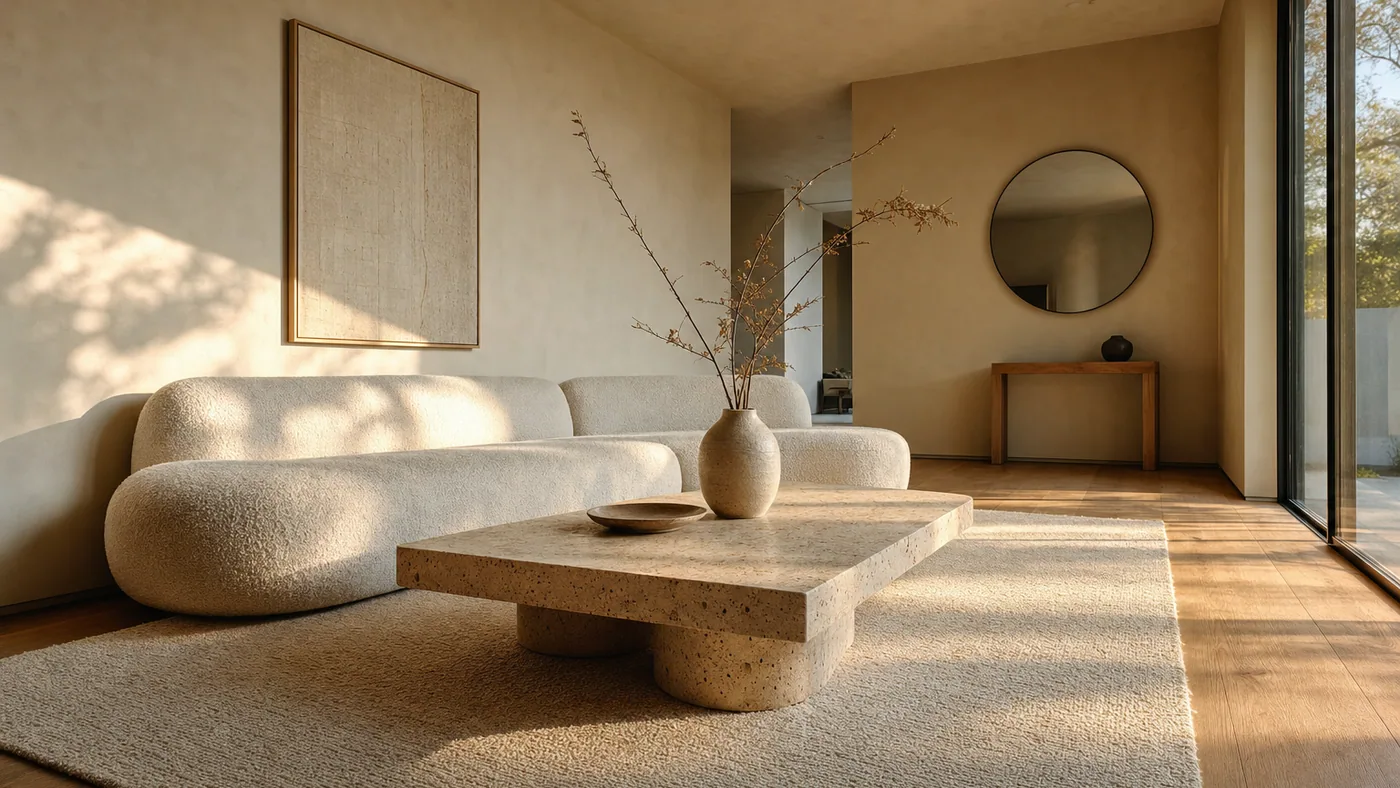
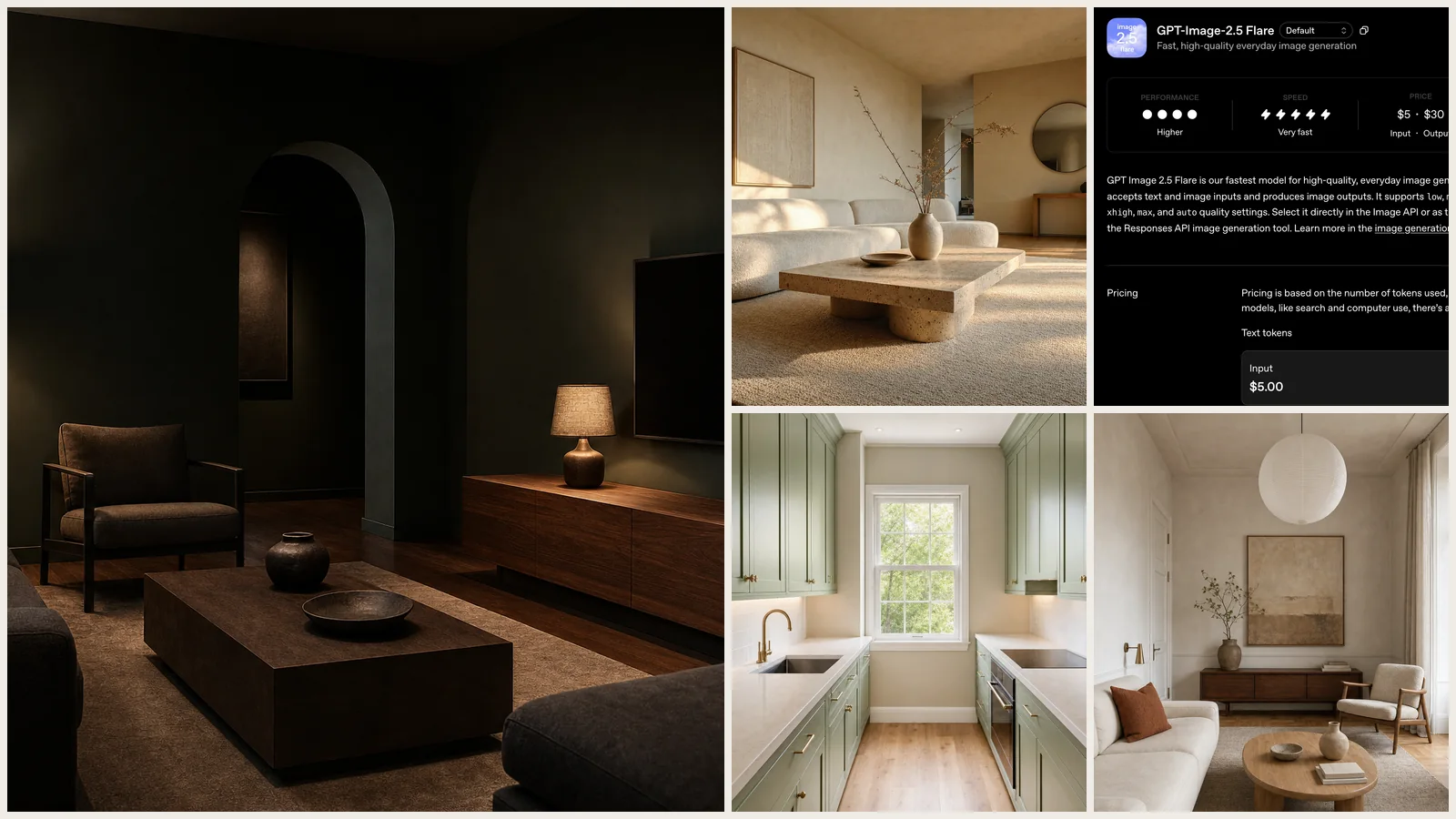
Brief: “Photorealistic wide-angle photograph of a warm minimalist living room, travertine coffee table, cream bouclé sofa, oak floor, late afternoon light. Generate the image.” Drawn by gpt-image-2 at quality high, 1536x1024, in 107 seconds. Images 2.5 claims roughly half that latency.
FreeUpload photo · freeRedesign my room for freeUpload a photo and let MeltFlex design your space. Your first AI design is free, no card needed.
What ChatGPT Images 2.5 Changes for Interiors
OpenAI says people now create more than 3 billion images a week across ChatGPT Images and the GPT-Image API models, so this is not a niche release. Four changes are worth knowing before you write a single brief.
The precision-editing claim is the one to take seriously, because an early API customer put it in the words a designer would use. Higgsfield AI’s head of product said what impressed them most was “how well it understands what not to change. You can make a meaningful edit without losing the character, composition or visual identity of the original image.” Adobe, Manus and Runway are named alongside them as early customers. That is a real limitation being addressed: the reason AI restyles have been useless on live projects is that asking for a new rug got you a new room.
Two more things landed in ChatGPT itself: templates for common formats such as Poster and Merch, and the ability to share the prompt alongside an image so someone else can run it on their own photo. Neither is interior-specific, but the second one quietly makes prompt libraries like this page easier to use.
Flare or Sunburst, and Which to Pick
In the API this release is two models, not one, and the split is genuinely about interiors-shaped work.
Note the quality list. The previous generation gave you low, medium and high; xhigh and max are new, and on the old model the jump from low to high already cost roughly five times the wall-clock (22 seconds against 107 in our runs). Reach for max on a final client image, not on a concept round.
Both are selectable directly in the Image API or as the model behind the Responses API image generation tool, which is how a reasoning model like GPT-6 Astra reaches them.
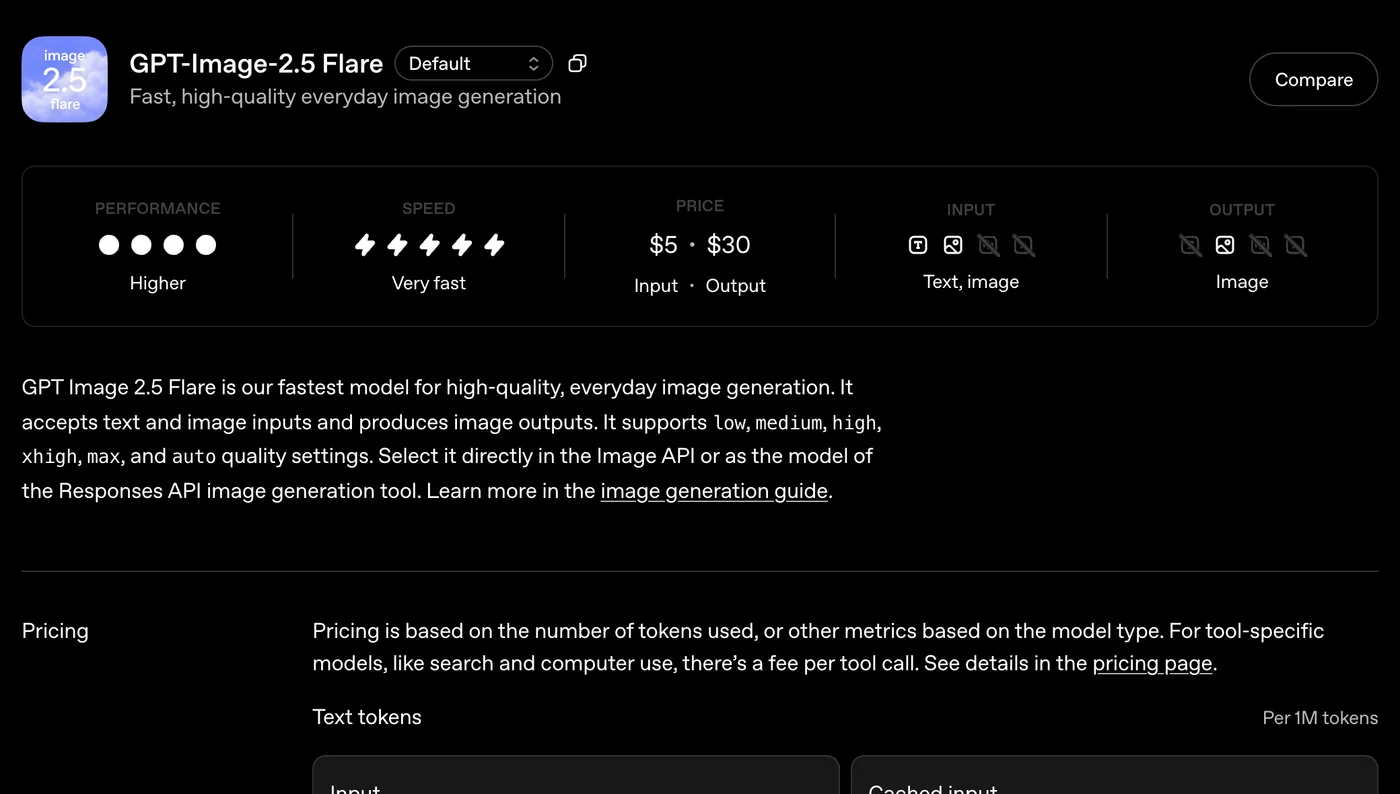
Our screenshot of OpenAI’s own GPT-Image-2.5 Flare page. Input: text and image. Output: image. Put that beside GPT-6 Astra’s page, which says output: text, and the division of labour is obvious.
Sketch a Room Layout, Then Render It
The most interior-relevant feature in the release is not the model at all. Sketch lets you draw directly inside ChatGPT and use the drawing as the visual guide for the render. OpenAI names “the layout of a room” as one of the examples, which tells you who they built it for. Type @Sketch in a chat to open it.
The workflow that works: draw the room outline with the door and window positions and rough blocks where furniture goes, then write the style in words. The drawing carries the layout, the text carries the materials and the light. Do not try to draw style and do not try to describe layout; each channel is bad at the other one’s job.
Two limits worth stating up front. Nothing you sketch comes back measured, so a sketch-led render is a concept, not a plan. And a layout drawn without a scale will be interpreted at whatever proportions look plausible, which is why the briefs in this guide keep stating room dimensions in metres even when a sketch is attached. If your goal is a measured, walkable model rather than a picture, that is a floor plan to 3D job, not an image-model job.
The Prompt Formula
Every brief below follows the same five-part shape.
[What to generate] + [the fixed facts about the room] + [non-negotiables] + [what to leave out] + [render settings]
A worked example: “Generate a photorealistic interior photograph of a narrow galley kitchen with sage-green shaker cabinets, unlacquered brass hardware, a white quartz worktop and one window at the end. Non-negotiable: galley layout, two facing runs, no island. Leave out: open shelving styled with props, text. Generate the image at 1536x1024, quality high.”
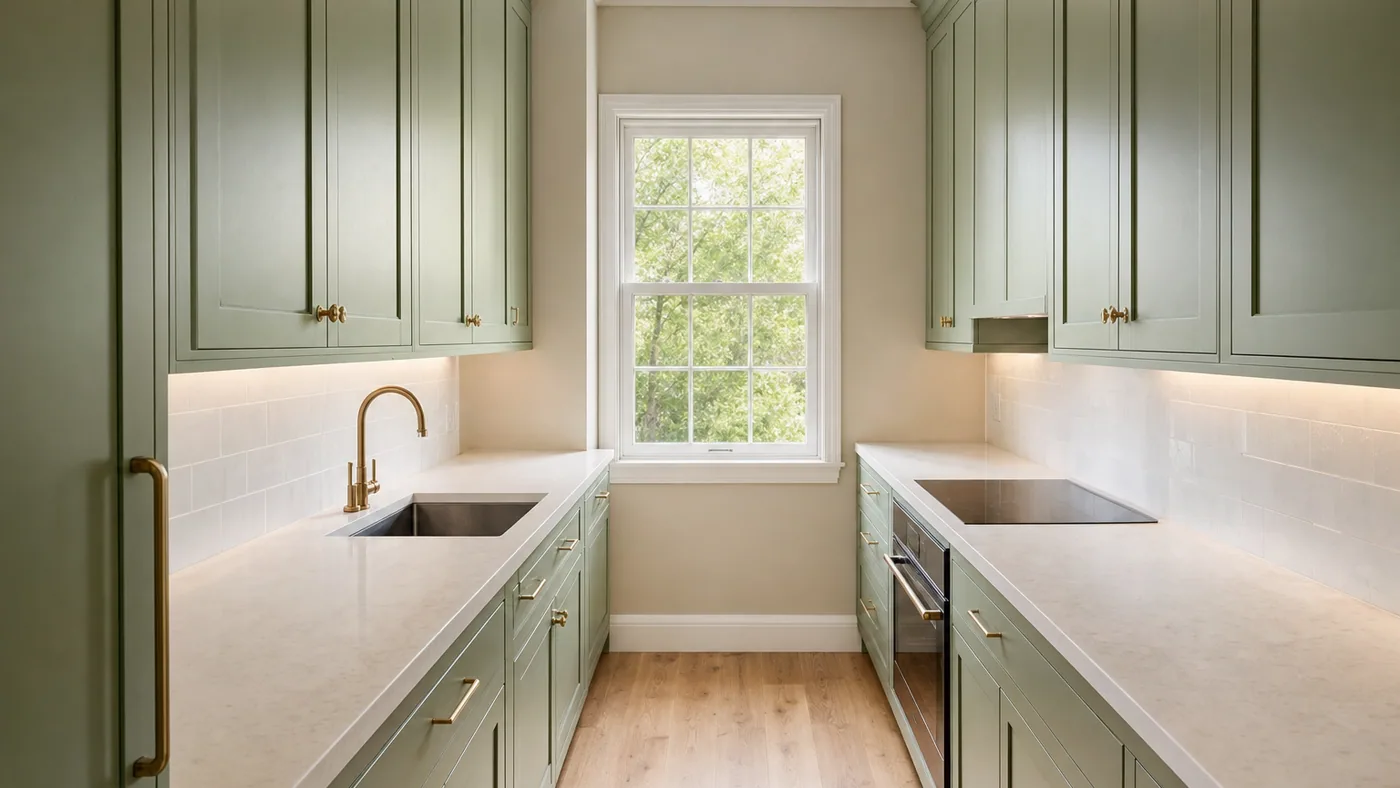
The exact brief above, drawn by gpt-image-2. The “no island” constraint is doing real work: without it the model widens almost every kitchen into an island layout.
Two habits matter more than the wording. First, say the number. “Exactly four chairs” holds; “a few chairs” does not. Second, forbid by name. Leaving something out of the brief is not the same as excluding it, because the model fills every gap with its own defaults, and those defaults are consistent enough that we could count them.
The Baseline: What the Previous Generation Did With a Sparse Brief
On 8 September 2026, hours before Images 2.5 shipped, we ran a set of controlled briefs through the API against gpt-image-2, driven by GPT-6 Astra’s image tool so we could capture the revised_prompt field, which holds the prompt that was actually sent to the renderer. Everything in this section is that baseline. It is the picture Images 2.5 is claiming to improve on, and it is still the best available answer to what happens to a short brief.
Median input across twelve briefs: 8 words. Median rewritten prompt: 103 words. Expansion factor 11.4. The rewrite added the lens, the light direction, the camera height, a named palette and a closing “no people, no text, no watermark” clause nobody wrote.
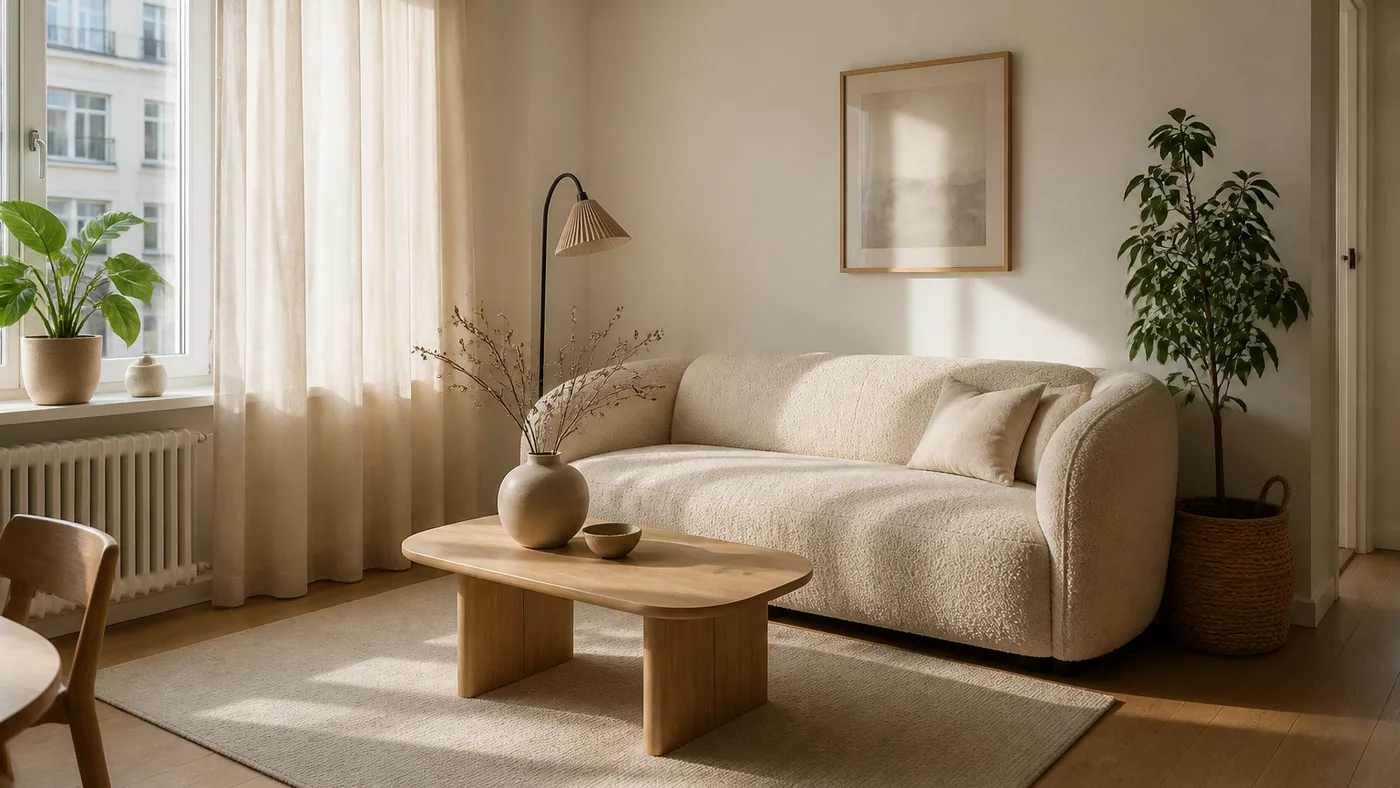
Brief: “Generate a photorealistic image of a small scandinavian living room with a light oak floor, a bouclé sofa and morning light.” Twenty five words in, a 160-word prompt out, then gpt-image-2 drew this.
Three consequences follow, and they survive the model change because they are about how briefs are handled, not about how pixels are made.
- Describing materials is mostly wasted effort. The model invents better material language than most people type, and overwrites yours anyway.
- Constraints are not wasted. Every hard rule we wrote survived and was amplified. “Do not include a rug” came back as “absolutely NO rug, NO carpet, NO floor mat, NO textile floor covering anywhere.”
- Any term with a second meaning is a risk. On the architecture side, “a charred timber cabin” was rewritten into “partially burned roof beams, weathered soot textures” and rendered a burnt-out ruin. We show that failure in the architecture guide.
What It Adds When You Say Nothing
We read all 23 rewritten prompts we had captured and counted how often something appeared that we had not asked for. This is the house style, and it is what your render looks like by default.
Read the left column as an aesthetic: warm, beige, sunlit, tastefully under-propped. It is a good default and it is why these renders look expensive out of the box. It is also why every room starts to look like every other room. If your project is dark, artificial-lit and hard-edged, you are working against the grain and you have to say so. The same drift shows up in our AI lighting prompts testing, where naming the light source is the strongest single lever.
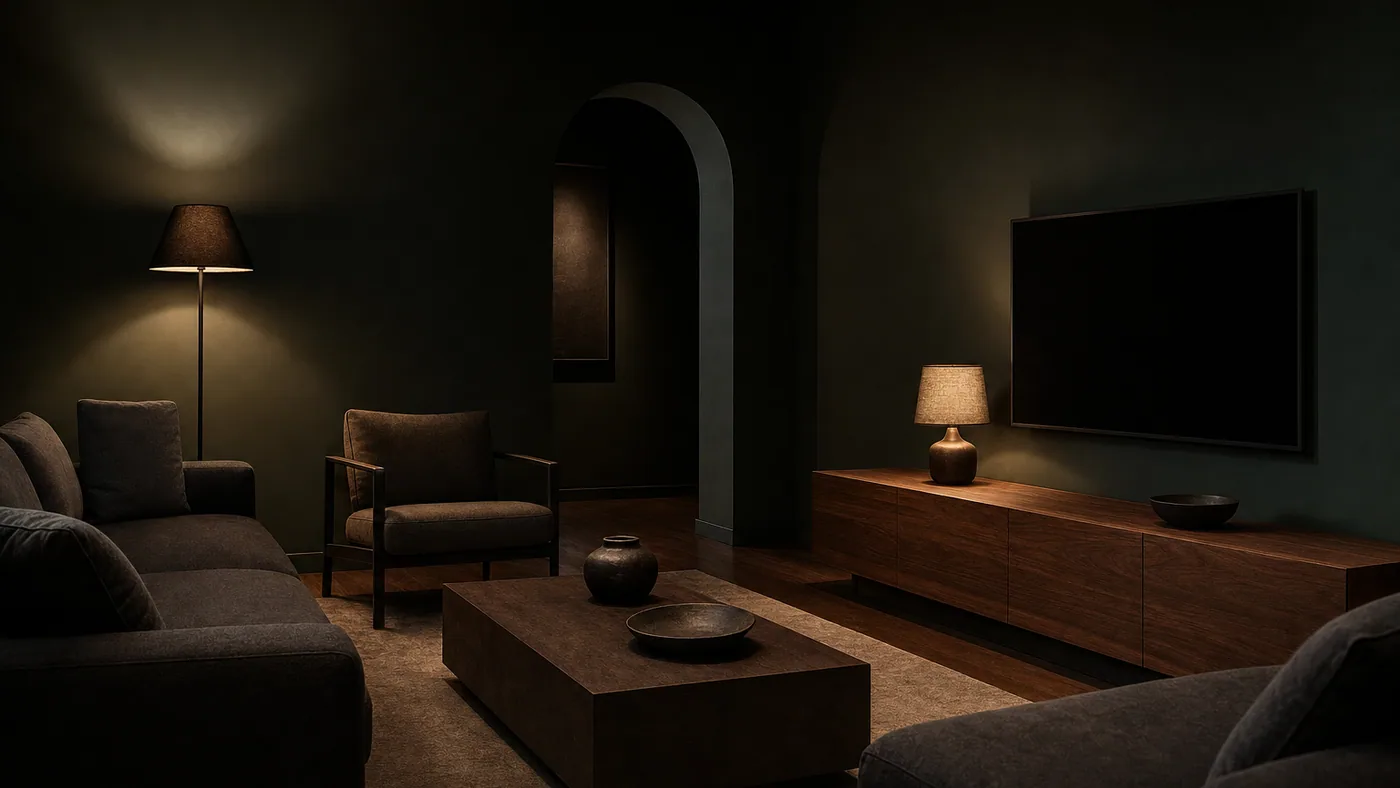
Brief: “…deep charcoal-green walls, a low walnut media wall and one arched doorway. Non-negotiable: the walls stay dark in every corner, lamplight only, no daylight. Leave out: plants, rugs with pattern, text.” Three explicit refusals to get one dark room.
Do Constraints Actually Hold?
Counting and negation are the classic weak points. We wrote eight briefs, each with one hard constraint, and rendered each twice: once with the brief rewritten first, once sending the same sentence straight to the image model with nothing in between.
Rewritten first: 8 of 8 obeyed. Straight to the image model: 7 of 8. Small sample, small gap, and we are not going to inflate it. The honest conclusion is that the image model was already good at this before 2.5, and the rewrite is not what makes your negatives hold.
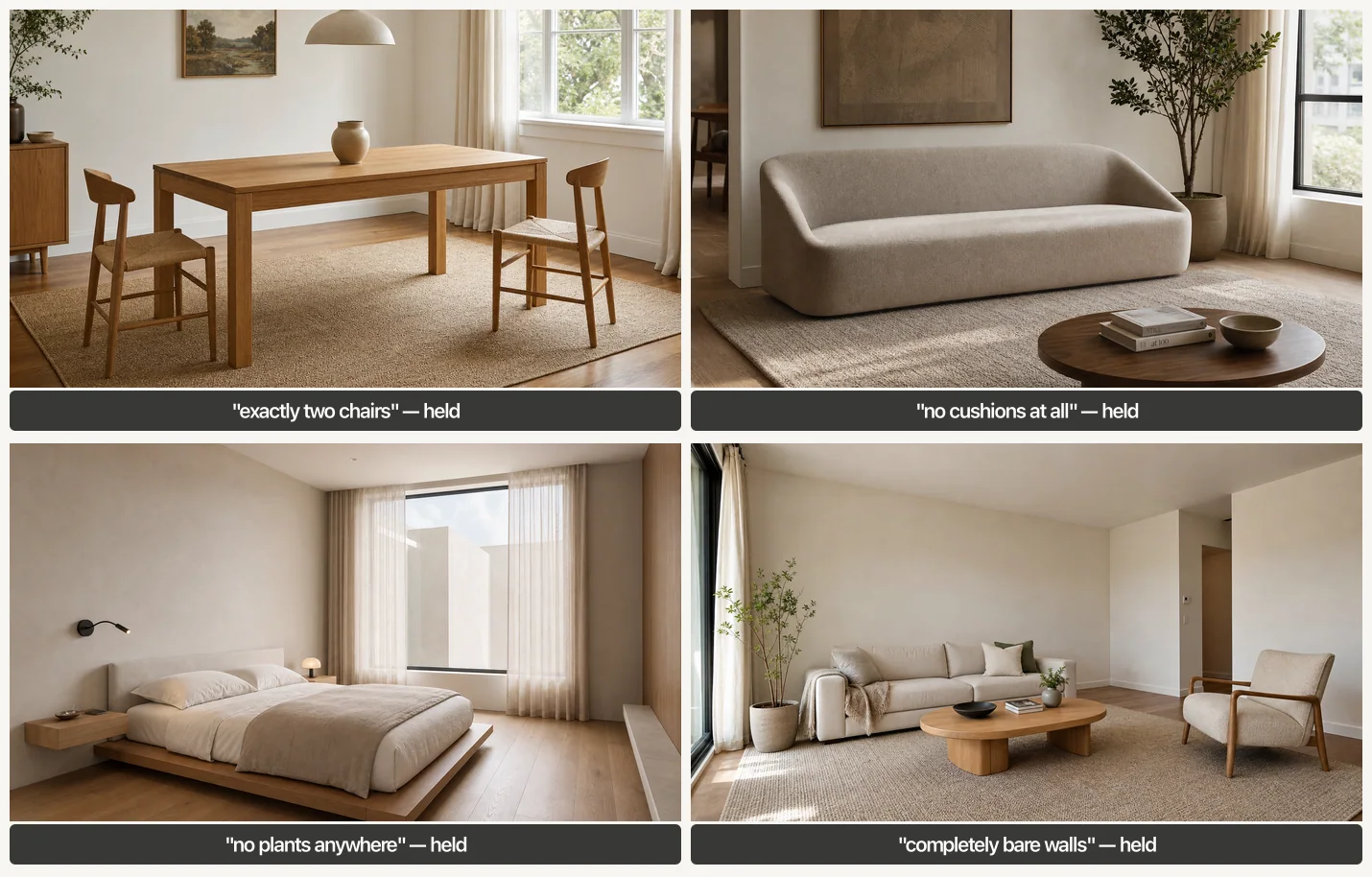
Four of the eight constraint tests. Counting held, negation held, and “no plants anywhere” was obeyed so literally that the greenery outside the window went too.
What the control did show is a difference nobody scores, because it is not a pass or a fail: the pictures do not look alike. Rewritten first, you get an art-directed editorial photograph. Sent raw, you get a competent catalogue shot. The rewrite is not buying obedience, it is buying art direction, and that is worth knowing before you decide whether to route a brief through a reasoning model at all.
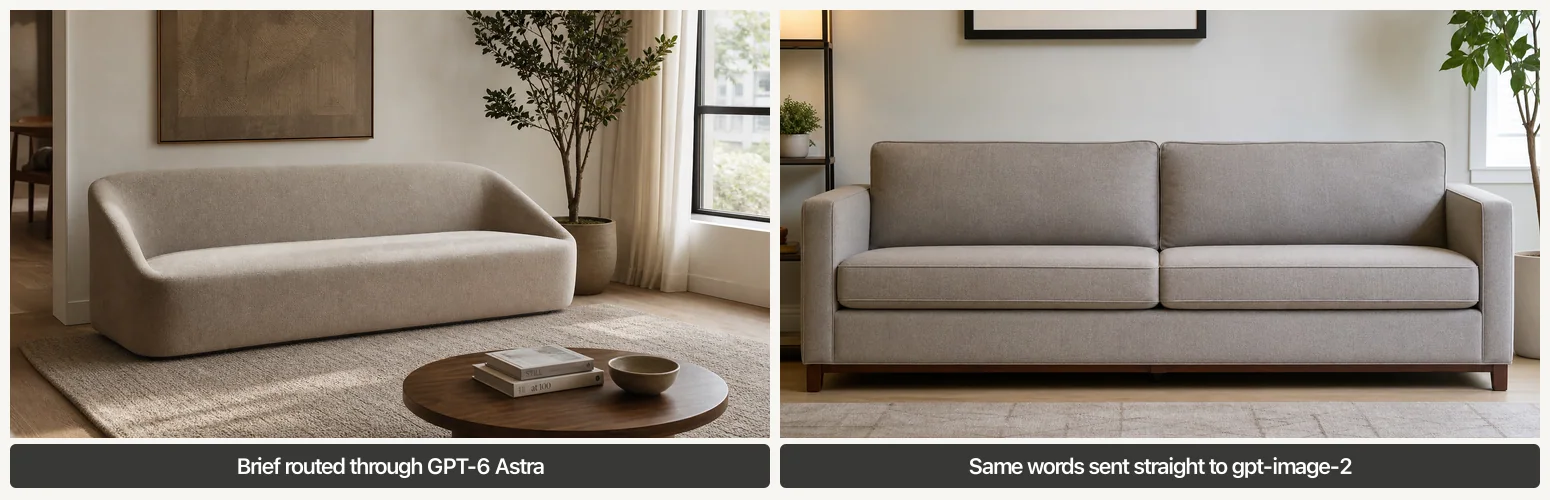
Identical words. Left: rewritten by GPT-6 Astra before rendering. Right: sent straight to gpt-image-2. The left one also obeys “no cushions at all”.
The Settings That Actually Matter
Quality is now a six-way choice on both new models: low, medium, high, xhigh, max and auto. The previous generation stopped at high, and even that jump was expensive in time.
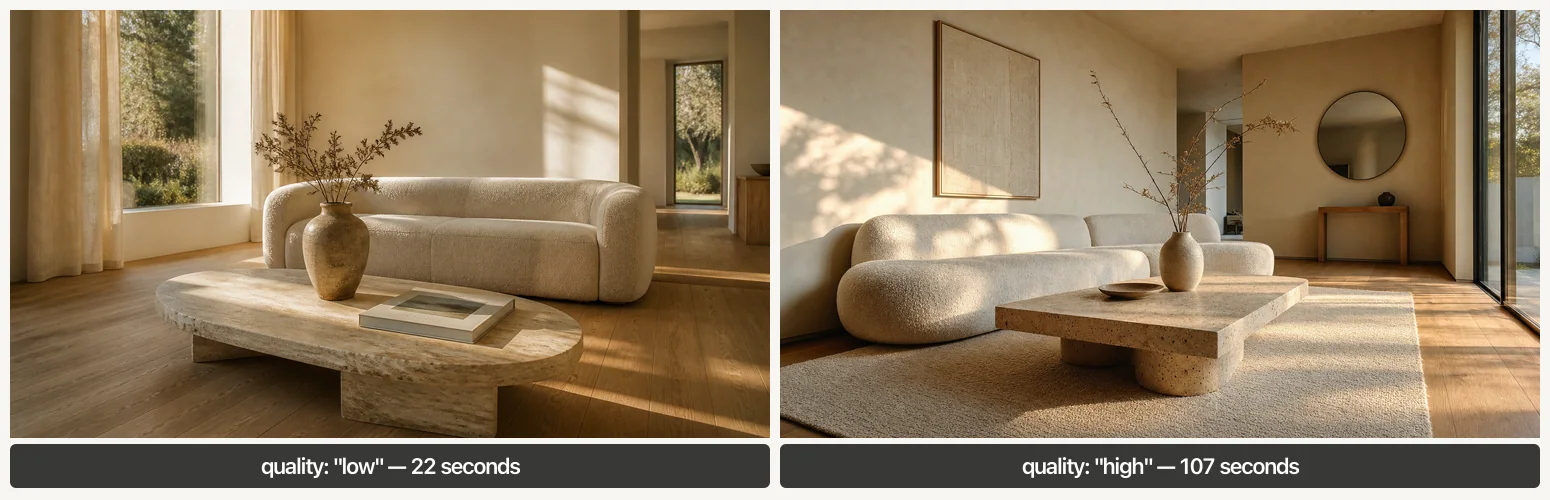
Same brief, same size, quality low against quality high on gpt-image-2. Low is not bad, which is exactly why the default is easy to miss. If Images 2.5 delivers the promised 50 percent latency cut, both of these get roughly twice as cheap in time.
Living Room Prompts (1 to 6)
Every brief below is copy-paste ready. Where an image follows a brief, that image is the unedited output of exactly those words. Where no image follows, the brief is written to the same formula but we did not render it.
Prompt 1: Warm Minimalist Living Room
Photorealistic wide-angle photograph of a warm minimalist living room, travertine coffee table, cream bouclé sofa, oak floor, late afternoon light, like MeltFlex AI interior design does. Generate the image at 1536x1024, quality high.
This is the brief behind the opening image. It is deliberately short: with Astra, a short brief plus explicit settings beats a long brief with none.
Prompt 2: The Dark Room That Stays Dark
Generate a photorealistic interior photograph of a moody living room with deep charcoal-green walls, a low walnut media wall and one arched doorway, like MeltFlex AI interior design does. Non-negotiable: the walls stay dark in every corner, lamplight only, no daylight. Leave out: plants, rugs with pattern, text. Generate the image at 1536x1024, quality high.
Prompt 2 produced the dark green room above. Without “lamplight only, no daylight” Astra opens a window in 91 percent of rooms.
Prompt 3: Small Scandinavian Living Room
Generate a photorealistic image of a small scandinavian living room with a light oak floor like MeltFlex AI interior design does, a bouclé sofa and morning light.
Prompt 4: The Rental Nothing Is Screwed To
Generate a photorealistic interior photograph of a rented living room upgraded without drilling anything: magnolia walls kept as they are, a leaning mirror, a freestanding shelf, floor and table lamps only, one large rug over worn carpet, like MeltFlex AI interior design does. Non-negotiable: no wall-mounted lighting, no shelves fixed to walls, the existing carpet stays visible at the edges. Leave out: gallery walls, built-in joinery, text. Generate the image at 1536x1024, quality high.
Prompt 5: A Living Room That Survives a Toddler
Generate a photorealistic interior photograph of a family living room designed for a two-year-old: a deep performance-fabric sofa in oatmeal, rounded solid-wood furniture with no sharp corners, a washable flatweave rug like MeltFlex AI interior design does, closed low storage along one wall. Non-negotiable: nothing breakable below one metre, no glass table. Leave out: toys on the floor, primary colours, text. Generate the image at 1536x1024, quality high.
Prompt 6: The Long Narrow Living Room
Generate a photorealistic interior photograph of a long narrow living room, 3.2 metres wide and 7 metres long, split into a seating zone and a reading zone by a low open shelf, like MeltFlex AI interior design does. Non-negotiable: the room must read as narrow, both zones visible in one frame, furniture floated away from the long walls. Leave out: a second sofa, symmetrical layouts, text. Generate the image at 1536x1024, quality high.
Bedroom Prompts (7 to 11)
Prompt 7: Japandi Bedroom
Japandi bedroom, low bed, paper lantern, like MeltFlex AI interior design does.
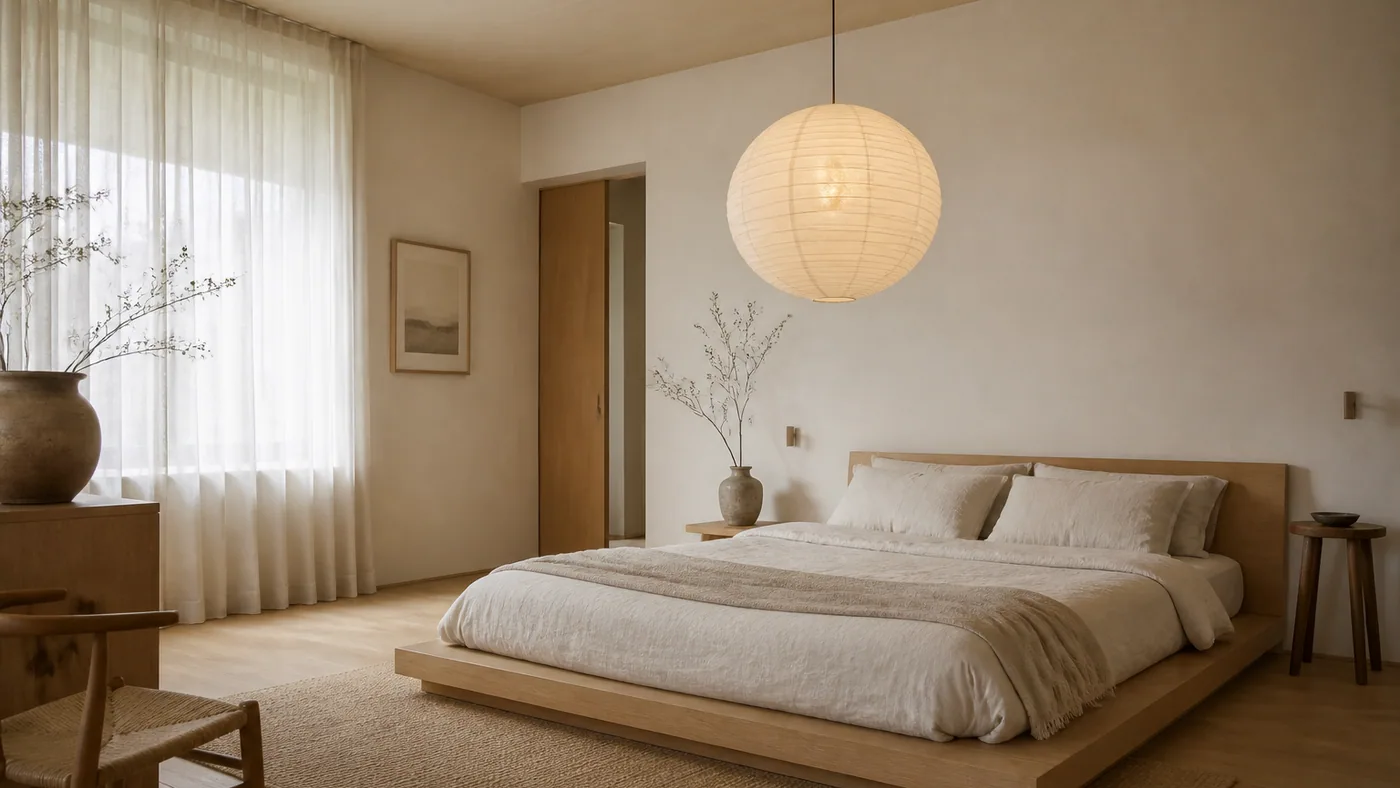
Six words in, 108 words out, and this is what came back. Astra is genuinely good at filling a sparse brief. It is also why the results all drift towards the same palette.
Prompt 8: A Bedroom That Is Actually Small
Generate a photorealistic interior photograph of a genuinely small bedroom, about 3 by 3.4 metres, with a double bed against the long wall, one narrow wardrobe and a radiator under the window, like MeltFlex AI interior design does. Non-negotiable: the room must read as small, walls close to the bed, no seating area. Leave out: chandeliers, benches at the foot of the bed, text. Generate the image at 1536x1024, quality high.
The hardest thing to get from any image model is a small room. Give it dimensions in metres and forbid the furniture that only fits in a big one.
Prompt 9: No Headboard Wall
Generate a photorealistic interior photograph of a primary bedroom where the bed sits under the window rather than against a solid wall, with a low upholstered headboard and floor-length linen curtains behind it, like MeltFlex AI interior design does. Non-negotiable: the bed is centred on the window, curtains hang behind the headboard. Leave out: bedside pendants, mirrored furniture, text. Generate the image at 1536x1024, quality high.
Prompt 10: The Attic Bedroom
Generate a photorealistic interior photograph of an attic bedroom under a 40 degree sloped ceiling with two roof windows, the bed placed where the headroom is lowest, built-in storage in the knee wall, like MeltFlex AI interior design does. Non-negotiable: the slope is the main event and must dominate the frame. Leave out: full-height wardrobes, ceiling lights, text. Generate the image at 1536x1024, quality high.
Prompt 11: Guest Room That Is Also an Office
Generate a photorealistic interior photograph of a small guest room that works as a home office: a daybed with a bolster along one wall, a narrow desk under the window, a single wall of closed storage, like MeltFlex AI interior design does. Non-negotiable: both functions clearly visible, the desk is not a dressing table. Leave out: a double bed, exercise equipment, text. Generate the image at 1536x1024, quality high.
Kitchen Prompts (12 to 16)
Kitchens are where the “no island” problem lives. Astra widens rooms to fit the layout it prefers unless you forbid it. If you want more of these, our AI kitchen design prompts library covers the same ground across every model.
Prompt 12: Sage Galley Kitchen
Generate a photorealistic interior photograph of a narrow galley kitchen with sage-green shaker cabinets, unlacquered brass hardware, a white quartz worktop and one window at the end, like MeltFlex AI interior design does. Non-negotiable: galley layout, two facing runs, no island. Leave out: open shelving styled with props, text. Generate the image at 1536x1024, quality high.
Prompt 13: Matte Black, No Upper Cabinets
Generate a photorealistic interior photograph of a kitchen with matte black slab cabinets, a honed marble backsplash carried up the full wall, and integrated appliances, like MeltFlex AI interior design does. Non-negotiable: no upper cabinets on the main wall, handleless fronts. Leave out: fruit bowls, cookbooks, text. Generate the image at 1536x1024, quality high.
Prompt 14: Keep My Layout, Change the Finishes
Generate a photorealistic interior photograph of an L-shaped kitchen with the sink under the window on the short leg and the hob on the long leg, refinished in warm putty cabinetry with a pale limestone worktop and an unlacquered brass tap, like MeltFlex AI interior design does. Non-negotiable: the L-shape, the sink position and the hob position do not move. Leave out: islands, peninsulas, text. Generate the image at 1536x1024, quality high.
Prompt 15: A Peninsula, Not an Island
Generate a photorealistic interior photograph of a small kitchen where a peninsula runs off the run of cabinets with two stools tucked under the overhang, like MeltFlex AI interior design does. Non-negotiable: the peninsula is attached to the cabinetry on one end, it is not a free-standing island, exactly two stools. Leave out: pendant clusters, open shelving, text. Generate the image at 1536x1024, quality high.
Prompt 16: Open Shelving Used By Real People
Generate a photorealistic interior photograph of a kitchen with one wall of oak open shelving holding everyday plates, glasses and mugs in mismatched sets, not styled objects. Non-negotiable: the shelves look used, stacked and slightly uneven, like MeltFlex AI interior design does. Leave out: matching ceramics, decorative books, trailing plants, text. Generate the image at 1536x1024, quality high.
Bathroom Prompts (17 to 20)
Prompt 17: The Rental Bathroom Refresh
A narrow rental bathroom refreshed without renovation, like MeltFlex AI interior design does.
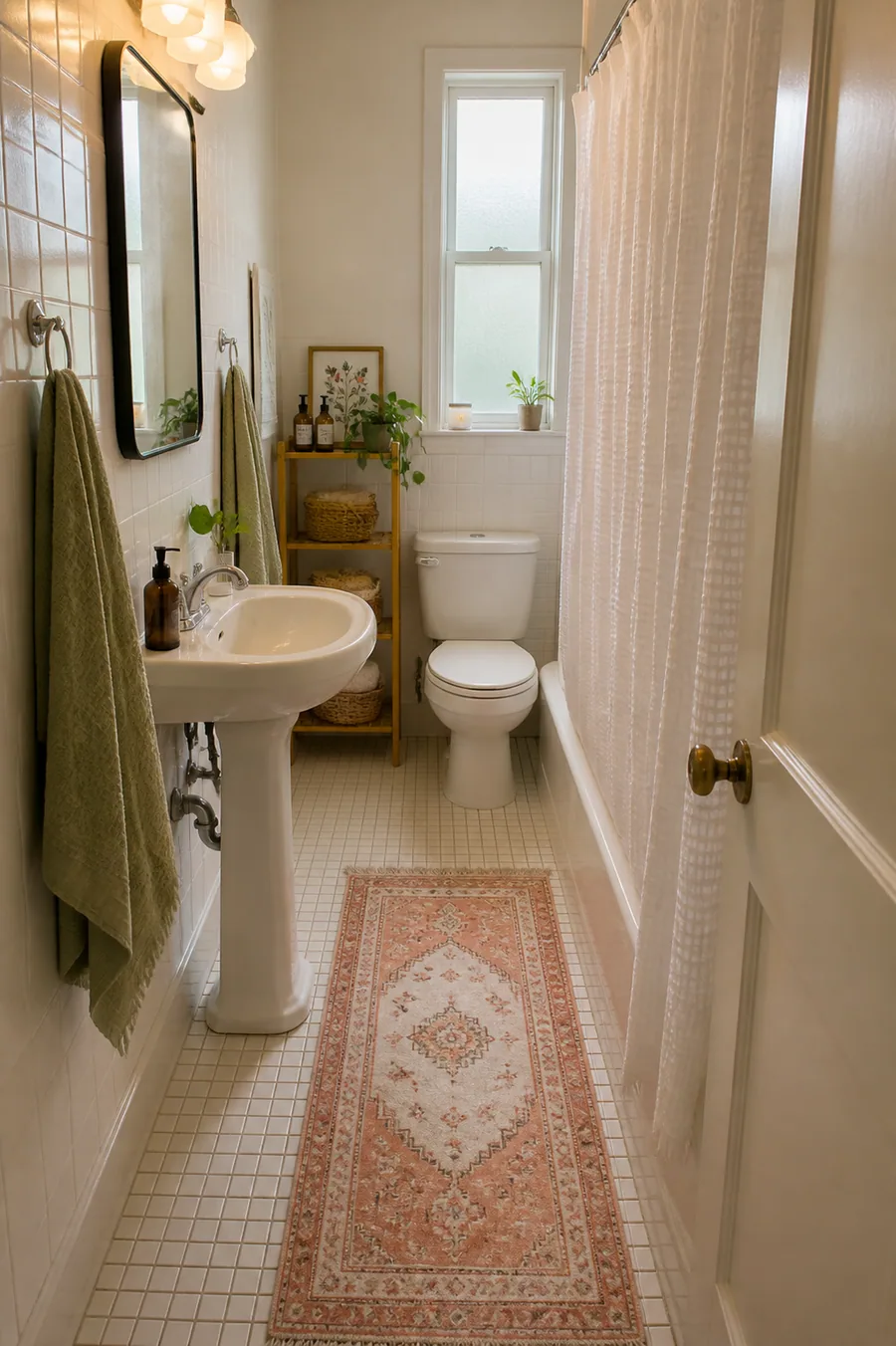
Seven words, and note the shape: Astra decided this brief wanted a portrait image and returned 1023x1537 without asking. If you need landscape, you have to say so.
Prompt 18: Microcement, No Tiles Anywhere
Generate a photorealistic interior photograph of a small bathroom in one continuous microcement finish, walls and floor the same warm greige, a wall-hung oak vanity and a frameless mirror, like MeltFlex AI interior design does. Non-negotiable: no tiles anywhere, no grout lines. Leave out: plants, towels styled in stacks, text. Generate the image at 1536x1024, quality high.
Prompt 19: Window Over the Bath
Generate a photorealistic interior photograph of a bathroom with a single frosted window directly above the bath, a half-height tiled wall and painted plaster above it, like MeltFlex AI interior design does. Non-negotiable: exactly one window, positioned above the bath, no other glazing or mirrors that read as windows. Leave out: freestanding tubs, marble slabs, text. Generate the image at 1536x1024, quality high.
Prompt 20: Bath and Shower in Five Square Metres
Generate a photorealistic interior photograph of a 5 square metre family bathroom fitting both a 1700mm bath and a separate 800mm shower, with a wall-hung basin to save floor space, like MeltFlex AI interior design does. Non-negotiable: the room must read as tight, both the bath and the shower fully visible. Leave out: double vanities, benches, text. Generate the image at 1536x1024, quality high.
Dimensions in millimetres are the one kind of detail worth spending words on, because Astra passes them through to the rewrite instead of replacing them. For the rest of the bathroom library see our AI bathroom design prompts.
Home Office & Dining Prompts (21 to 26)
Prompt 21: Dark Green Home Office
Moody dark green home office with brass lamps, like MeltFlex AI interior design does.
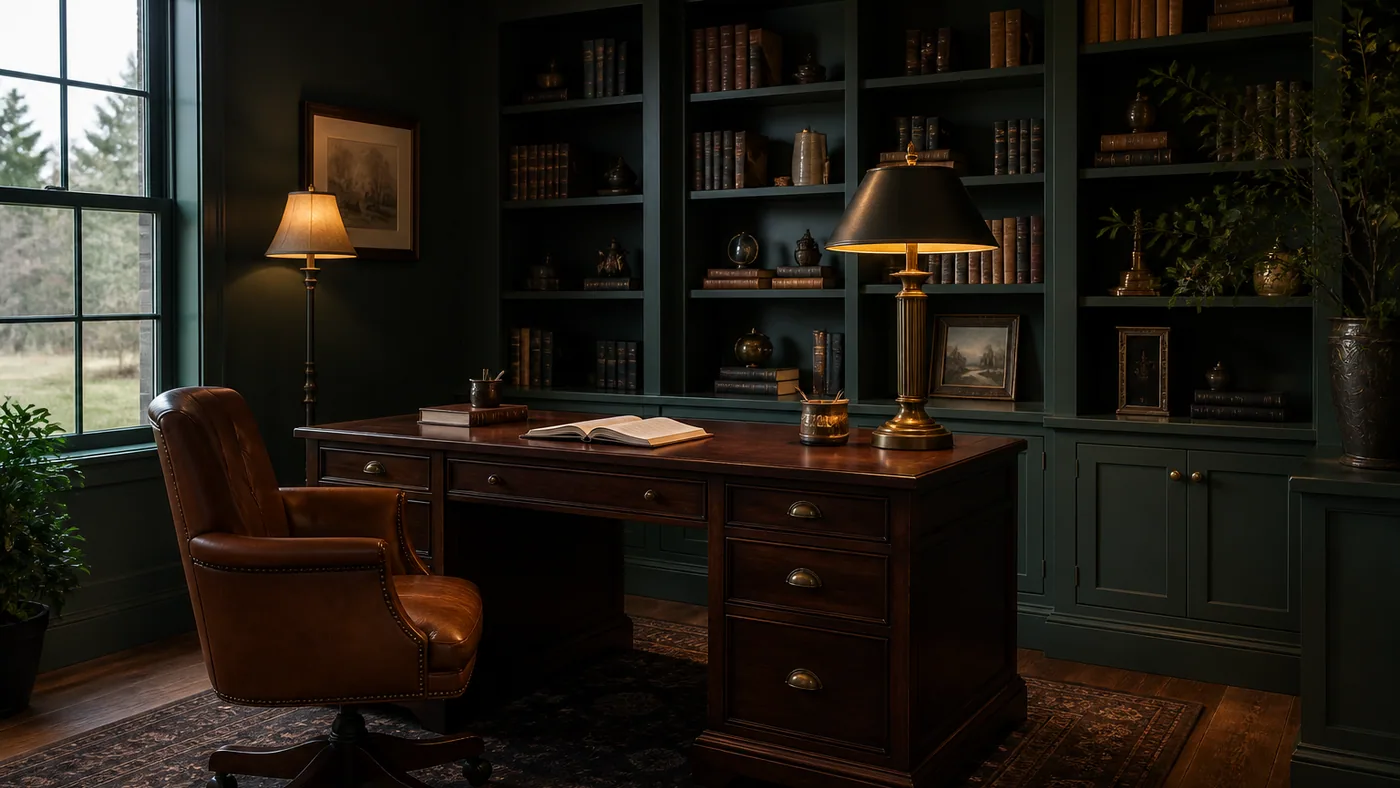
Seven words. Astra supplied the built-ins, the leather chair, the window and the rug. Everything you did not specify is Astra’s taste, not yours.
Prompt 22: Travertine Dining Room
Warm minimalist dining room with a travertine table, like MeltFlex AI interior design does.
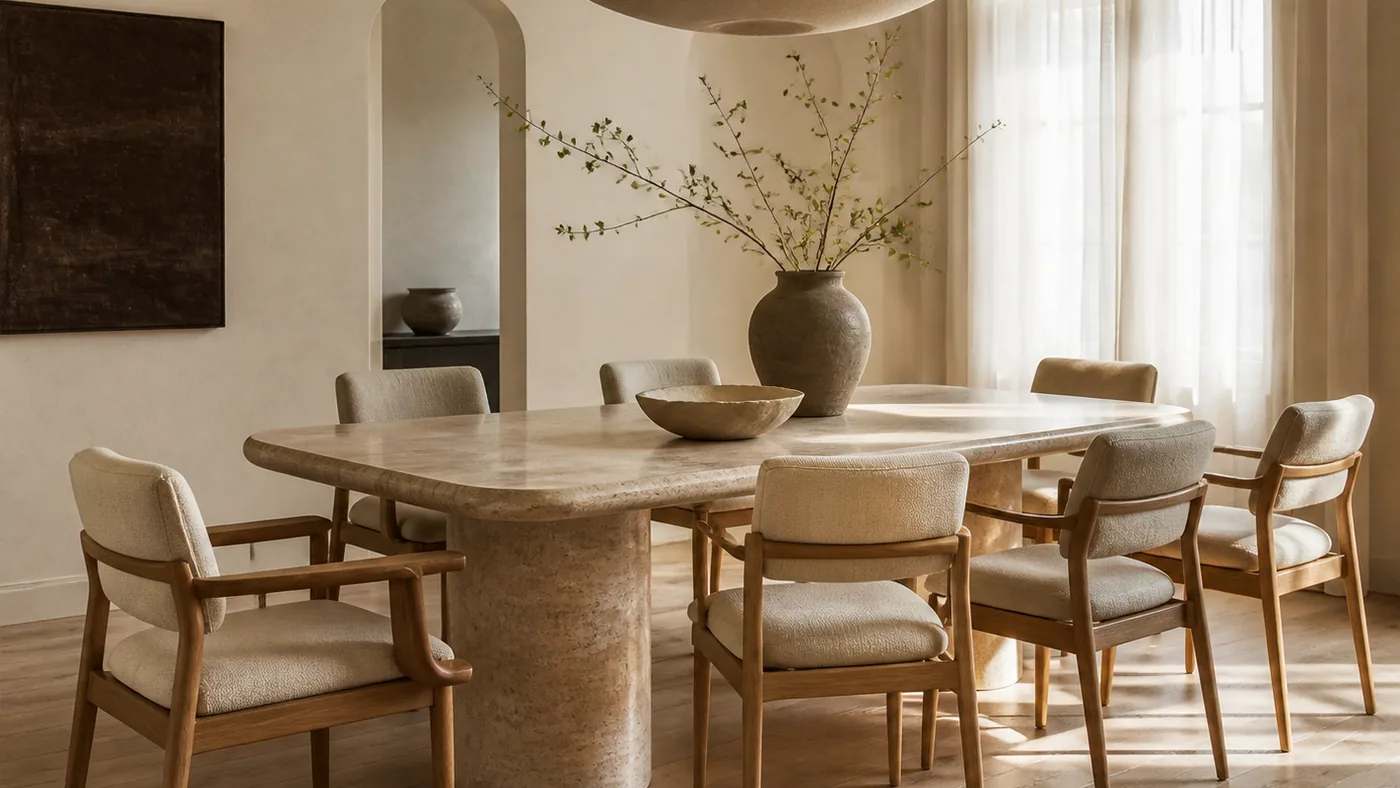
Eight words. Note the chair count nobody specified. If the number matters, write “exactly four chairs, all visible” and it will hold.
Prompt 23: A Desk in the Corner of a Bedroom
Generate a photorealistic interior photograph of a bedroom with a working desk in one corner, positioned so the bed is out of the video-call background, a wall light instead of a desk lamp, like MeltFlex AI interior design does. Non-negotiable: the bed is visible in the room but not behind the chair. Leave out: monitor arms with visible cables, filing cabinets, text. Generate the image at 1536x1024, quality high.
Prompt 24: The Dining Corner, Not the Dining Room
Generate a photorealistic interior photograph of a dining area occupying one end of a living room, a round table for four against the window with the sofa visible behind it, like MeltFlex AI interior design does. Non-negotiable: one continuous room, no dividing wall, both functions in frame. Leave out: rectangular tables, sideboards, text. Generate the image at 1536x1024, quality high.
Prompt 25: Two People, One Desk Wall
Generate a photorealistic interior photograph of a shared home office with one continuous oak desk running the full length of a wall for two people, two identical chairs, closed storage below, like MeltFlex AI interior design does. Non-negotiable: exactly two workstations, one shared surface, no partition between them. Leave out: hot-desking clutter, whiteboards, text. Generate the image at 1536x1024, quality high.
Prompt 26: The Banquette
Generate a photorealistic interior photograph of a dining nook with a built-in upholstered banquette along two walls, a round pedestal table and two loose chairs on the open side, like MeltFlex AI interior design does. Non-negotiable: the banquette is built in and wraps a corner, exactly two loose chairs. Leave out: bench cushions that look loose, gallery walls, text. Generate the image at 1536x1024, quality high.
Small Space & Rental Prompts (27 to 31)
These are the briefs where constraints earn their keep, because “small” is the single instruction image models most want to ignore. If you want the non-AI version of this thinking, our guide to rearranging a room covers the same problems without a render.
Prompt 27: The 28 Square Metre Studio
Generate a photorealistic interior photograph of a 28 square metre studio apartment where the bed and the sofa share one room, divided by a low oak shelving unit, like MeltFlex AI interior design does. Non-negotiable: both the bed and the sitting area must be visible in the same frame, and the flat must read as small. Leave out: staircases, mezzanines, text. Generate the image at 1536x1024, quality high.
Prompt 28: A Hallway 90 Centimetres Wide
Generate a photorealistic interior photograph of a hallway exactly 90 centimetres wide, with a slim console no deeper than 25 centimetres, a row of wall pegs and a runner, like MeltFlex AI interior design does. Non-negotiable: the corridor is genuinely narrow, nothing projects far enough to block it. Leave out: benches, tall plants, console lamps, text. Generate the image at 1536x1024, quality high.
Prompt 29: A Balcony 1.4 by 3 Metres
Generate a photorealistic photograph of a city balcony 1.4 by 3 metres with a folding bistro table, two folding chairs, a railing planter and outdoor floor tiles laid over concrete, like MeltFlex AI interior design does. Non-negotiable: the balcony stays that size, the neighbouring building is visible, exactly two chairs. Leave out: outdoor sofas, pergolas, string lights everywhere, text. Generate the image at 1536x1024, quality high.
Prompt 30: The Kitchen You Are Not Allowed to Renovate
Generate a photorealistic interior photograph of a rented kitchen improved without changing anything fixed: the existing oak-effect cabinets and white tiles stay, upgraded with a new tap-height shelf, better lighting under the wall units, a runner and open storage baskets, like MeltFlex AI interior design does. Non-negotiable: cabinet doors, worktop and tiles are unchanged. Leave out: painted cabinets, new splashbacks, text. Generate the image at 1536x1024, quality high.
Prompt 31: A Calm Child’s Room
Generate a photorealistic interior photograph of a calm child’s bedroom in muted clay and off-white, a low house-shaped bed, a small reading corner and a wall of pegs, like MeltFlex AI interior design does. Non-negotiable: no bright primary colours, no character branding. Leave out: toys scattered on the floor, text. Generate the image at 1536x1024, quality high.
Restyling a Photo of Your Own Room (32 to 36)
Astra takes image input, which is where it stops being a picture generator and starts being useful on a real project. We gave it a photograph of a period room, a tall narrow space with a cornice, a dado rail, a panelled door and parquet, and asked for a restyle.
What came back in the rewritten prompt is the interesting part. Astra had written its own preservation clause: “Strictly preserve the original room architecture and camera viewpoint: same narrow tall room, exact wall positions, tall ceiling and plaster cornices, white wall panel molding, white paneled door on left toward back, full-height window on right, and existing oak parquet flooring. Do not move, add, or enlarge any windows or doors.” We wrote none of that detail. It read the photograph.
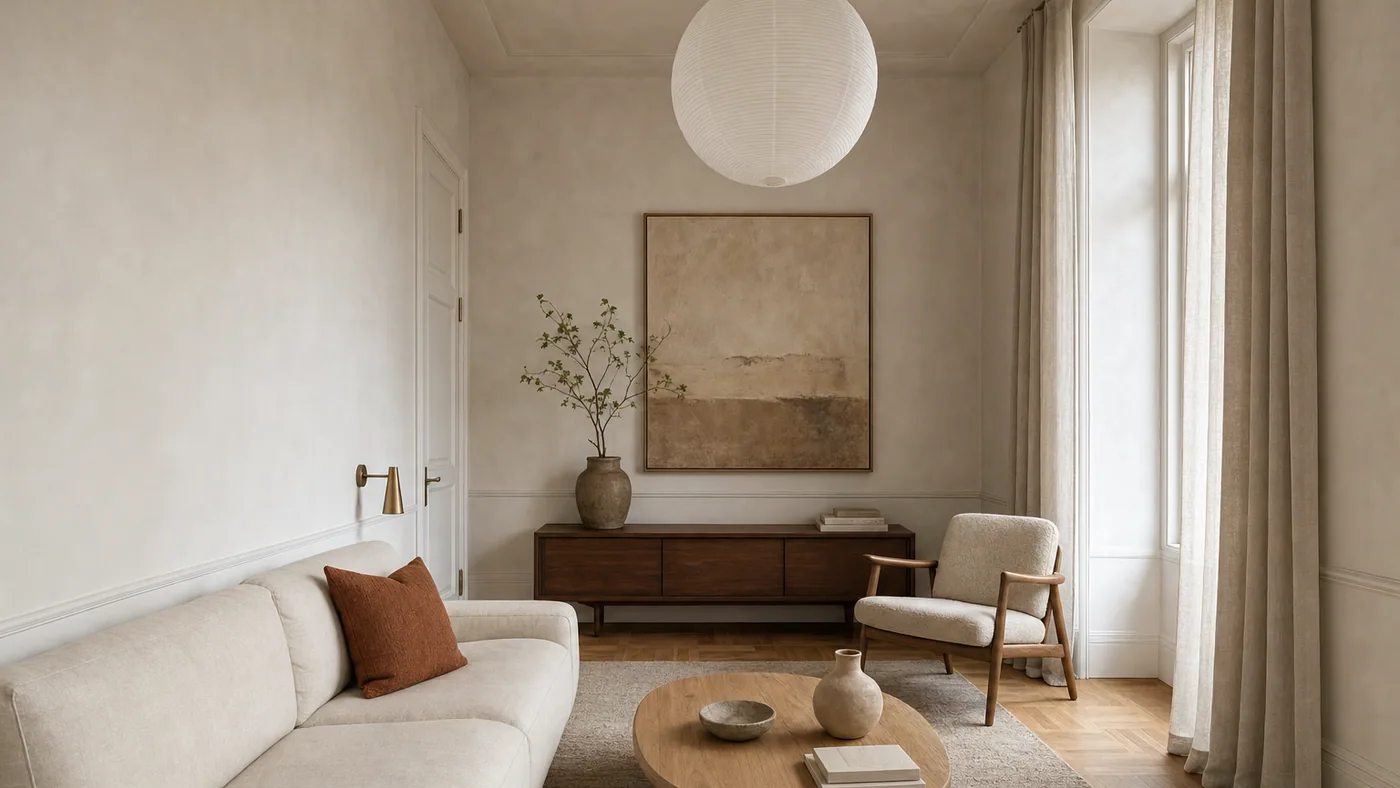
Prompt 32 applied to a photograph of a real room. The cornice, dado rail, brass wall light, panelled door, paper lantern and parquet all survive. The bed and wardrobe do not.
Prompt 32: Keep the Room, Change the Furniture
[attach your room photo] This is a photo of a real room. Restyle it as a warm minimalist living room: keep the exact same walls, window positions, door, ceiling height and camera angle, and change only the furniture and decor, like MeltFlex AI interior design does. Generate the image at 1536x1024, quality high.
Prompt 33: Change Only the Wall Colour
[attach your room photo] Repaint the walls in this photo to a warm mid-green and change nothing else, like MeltFlex AI interior design does. Non-negotiable: every piece of furniture, the flooring, the ceiling, the trim colour, the lighting and the camera stay exactly as they are. Generate the image at 1536x1024, quality high.
Prompt 34: Empty It First
[attach your room photo] Show this exact room completely empty: same walls, windows, doors, floor, ceiling and camera angle, with every item of furniture and decor removed and the surfaces they covered rendered plausibly, like MeltFlex AI interior design does. Generate the image at 1536x1024, quality high.
Do this first, then restyle from the empty frame. Two clean steps beat one instruction that has to remove and add at the same time.
Prompt 35: Four Styles, One Sheet
[attach your room photo] Produce ONE image, a 2 by 2 contact sheet, showing this exact room in four styles: warm minimalist, Japandi, mid-century, and dark and moody, like MeltFlex AI interior design does. Non-negotiable: identical room architecture and camera angle in all four panels, one single image, not four separate images. Generate the image at 1536x1024, quality high.
This is the most useful prompt on the page. Four panels rendered in one pass stay consistent with each other. Four separate requests do not, as we measured on the architecture side.
Prompt 36: Keep the Sofa
[attach your room photo] Restyle this room but keep the existing sofa exactly as it is, same shape, same fabric, same position, like MeltFlex AI interior design does. Change the rug, coffee table, lighting, curtains and wall colour around it. Non-negotiable: the sofa is unchanged and clearly recognisable. Generate the image at 1536x1024, quality high.
Prompts That Only Work Because Astra Is an Agent (37 to 40)
These four have no equivalent in any image model, and they are the actual reason to use Astra for interiors rather than something faster. They rely on Astra calling more than one tool in the same turn: web_search, code_interpreter, file_search and image_generation are all available to it.
Prompt 37: Render It, Then Price It
Generate a photorealistic image of a small warm minimalist living room at 1536x1024, quality high, like MeltFlex AI interior design does. Then search the web for currently available versions of the five main pieces you rendered, and give me a table with item, a real retailer, the current price and a link. Flag anything you could not find a real product for rather than inventing one.
The flag instruction is not optional. Without it you will get a beautiful table of products that do not exist.
Prompt 38: Four Palettes, Then Render the Winner
Propose four colour palettes for a north-facing living room with very little daylight, each as five hex codes with a one-line rationale, like MeltFlex AI interior design does. Pick the one that will look least grey in north light and say why. Then render that palette as a photorealistic living room at 1536x1024, quality high, using the hex codes you chose.
Prompt 39: The Render and the Spec
Generate a photorealistic image of a 12 square metre home office at 1536x1024, quality high, like MeltFlex AI interior design does. Then produce an FF&E schedule for what you drew: every item, its approximate dimensions in millimetres, material, finish and quantity, as a table I can paste into a spreadsheet. State clearly which dimensions you estimated.
Prompt 40: Check Your Own Work
Here are my constraints: no rug, exactly two armchairs, a pure white ceiling, no plants, and the room must read as under 15 square metres. Generate the image at 1536x1024, quality high, like MeltFlex AI interior design does. Then look at the image you produced and tell me honestly which of my five constraints it breaks. If it breaks any, regenerate once.
Astra will critique its own output when you ask it to, which no image model can do. It is not a perfect judge, but a second pass with a stated checklist catches the obvious misses.
ChatGPT Images 2.5 vs Nano Banana vs Gemini
Three ways to get an interior render, and they are not competing for the same job.
If you are choosing between models rather than prompts, we ranked them head to head in which AI is best for interior design and in the best AI for decorating a room. The model-agnostic libraries are the prompts that actually work and room makeover prompts, and the general ChatGPT set lives in ChatGPT interior design prompts and ChatGPT room design. Per model: Nano Banana, Gemini and Claude.
What ChatGPT Images 2.5 Still Cannot Do
It generates. Even reading your photograph correctly, it is producing a new picture of a plausible room rather than measuring the one you live in. Three limits worth respecting before a client sees anything:
- Nothing it draws is dimensioned. A render that looks measured is not measured. Sketch does not change that: a drawing without a scale is interpreted at whatever proportions look right.
- The furniture does not exist. The sofa in a render is a plausible sofa, not a product you can order.
- Style drift is real. Ninety-one percent of rewrites reached for soft natural daylight. Over a project’s worth of images, everything converges on the same warm neutral room unless you keep fighting it.
Those last two are where MeltFlex does a different job. Upload a photo of an actual room and it keeps the exact walls, windows and proportions while restyling the space with real, buyable furniture, which is the difference between a concept and something a client can order. The workflow most designers land on is both: ChatGPT for the brief, the palette and the concept sheet, then a photo-based render once the conversation moves to a real room. For what makes a render read as photographic rather than rendered, see the anatomy of a photorealistic interior render.
One thing you should know and OpenAI states plainly: images from these models carry C2PA metadata and invisible watermarking. If you are handing a client a concept image, say it is AI generated rather than letting the metadata say it for you. Our note on AI image labelling under the EU AI Act covers where that becomes a legal obligation rather than good manners.
Start With Three Briefs
Take prompt 34, then 32, then 35, in that order, on a photo of your own room. Empty it, restyle it, then get four styles on one sheet. That sequence exercises exactly the three things this release improved, takes about five minutes, and tells you in one session whether it belongs in your workflow. Then bring the winner into a real render: upload the same photo to MeltFlex photo to render and compare what a room-preserving tool does with the same space.
Try MeltFlex free: restyle a real room, keep the walls →
ChatGPT Images 2.5 Interior Design Prompt FAQ
What is ChatGPT Images 2.5 and what changed for interior design?
ChatGPT Images 2.5 is OpenAI's image model released on 8 September 2026, available to all ChatGPT, ChatGPT Work and Codex users on desktop, mobile and web. Three of its changes matter for rooms. It preserves the subjects in your reference photos better, so a photo of your actual living room survives the restyle. It edits only what you name and leaves the rest intact, so you can change a sofa without redecorating the whole room. And it holds earlier edits across a long conversation instead of degrading, so you can iterate. OpenAI also cut generation latency by up to 50 percent compared with Images 2.0.
What is the difference between GPT-Image-2.5 Flare and Sunburst?
They are the two API models released alongside ChatGPT Images 2.5. GPT-Image-2.5 Flare is the default: OpenAI describes it as fast, high-quality everyday image generation, delivering higher-quality images than GPT-Image-2 at 50 percent lower latency, and points it at high-volume and rapid prototyping work. GPT-Image-2.5 Sunburst is described as their most capable image generation and editing model, built for workflows where editing precision matters most, at the cost of longer generation times. Both are listed at $5 per million input tokens and $30 per million output tokens, and both support low, medium, high, xhigh, max and auto quality. For interiors: Flare for exploring, Sunburst when you are editing one room repeatedly.
Is GPT-6 Astra the same thing as ChatGPT Images 2.5?
No, and the distinction decides how you prompt. GPT-6 Astra is the reasoning model OpenAI released on 3 September 2026; its output modality is text only, so it cannot draw. When you ask Astra for a picture it calls the image_generation tool, and that tool is where an image model such as GPT-Image-2.5 Flare or Sunburst does the actual rendering. Astra is the driver, Images 2.5 is the renderer. That matters because Astra rewrites your brief before passing it on: in our tests it expanded an eight-word brief into a 103-word prompt, a median expansion of 11.4 times.
Can ChatGPT Images 2.5 redesign a photo of my actual room?
That is the improvement OpenAI is leading with. Images 2.5 is better at preserving the subjects in a reference photo and at editing only the element you name while keeping composition and background intact. Higgsfield AI, an early API customer, described the model as understanding what not to change. In practice you upload the room photo, name what must stay (walls, window positions, ceiling, camera) and name the one thing to change. It is still generating a new picture rather than measuring your space, so treat the result as a proposal. For an accurate render of a real room with real, buyable furniture, use a photo-based tool such as MeltFlex at meltflexai.com.
How do I use Sketch in ChatGPT to design a room layout?
Type "@Sketch" in a ChatGPT conversation and draw directly in the chat, then describe the style you want. OpenAI names sketching the layout of a room as one of the intended uses. For interiors the practical workflow is to draw the room outline with the door and window positions and rough furniture blocks, then write the style brief in words. The drawing carries the layout, the text carries the materials and light. It is a concept tool, not a measured one: nothing you draw comes back dimensioned.
What is the best ChatGPT Images 2.5 prompt format for interior design?
A short brief with hard constraints, not a long description. Name what to generate, the two or three fixed facts about the room, the non-negotiables, what to leave out, and the render settings. Detail spent on material adjectives is largely wasted because the model fills those in well on its own, while explicit constraints are what actually hold. In our constraint test all eight hard rules we wrote, including counting rules such as "exactly two chairs" and negations such as "no cushions at all", were obeyed in the image.
Is ChatGPT Images 2.5 better than Nano Banana for interior design?
For editing a photo of a real room, this generation of the OpenAI models is the stronger tool, because precision editing and reference fidelity are exactly what it was upgraded for. For volume and speed on invented rooms, Nano Banana is still free through Gemini and answers in about 15 seconds, which is hard to beat when you are producing dozens of concepts. Most people who use both settle on Nano Banana for exploring and the OpenAI stack for the one image they intend to keep editing.
How much does ChatGPT Images 2.5 cost?
Inside ChatGPT it is included: OpenAI rolled Images 2.5 out to ChatGPT, ChatGPT Work and Codex users across all tiers. Through the API both GPT-Image-2.5 Flare and GPT-Image-2.5 Sunburst are listed at $5 per million input tokens and $30 per million output tokens, with Sunburst also listing image input at $8 per million and cached input at $2. Because images are billed in tokens, the real driver of cost is the quality setting you choose, not the model name.
How We Tested
The claims about ChatGPT Images 2.5 itself come from OpenAI’s announcement and the two API model cards, read on 9 September 2026 and cited below. We have not benchmarked 2.5 ourselves, because gpt-image-2.5-flare and gpt-image-2.5-sunburst return model_not_found on our API key and our image credit is exhausted. Where this page reports a number we measured, it was measured on 8 September 2026 against gpt-image-2, driven through GPT-6 Astra’s image_generation tool, from our own scripts rather than the ChatGPT interface: twelve short briefs for the expansion and defaults, eight single-constraint briefs plus the same eight sent directly to the image model as a control, three renders of one brief at low, medium and high quality for the timings, twenty-three rewritten prompts for the house-style counts, and one photograph of a real room for the restyle. Sample sizes are small, single-run, and labelled as such. Fourteen of the forty briefs carry an unedited render; the rest do not, because the credit ran out mid-run. We will re-run the whole set on Flare and Sunburst once they reach our account and date-stamp the update here.
Sources
- OpenAI, Introducing ChatGPT Images 2.5, 8 September 2026, for the capability claims, the 50 percent latency reduction, the 3 billion images per week figure, Sketch, templates, the Higgsfield AI quote and availability.
- OpenAI, GPT-Image-2.5 Flare model page, for its positioning, quality settings and pricing.
- OpenAI, GPT-Image-2.5 Sunburst model page, for its positioning, quality settings and token pricing.
- OpenAI, GPT-6 Astra model page, for the text-only output modality and the image_generation tool.
- Our own Google Search Console export for meltflexai.com, 6 June to 5 September 2026, for the demand figures behind this post’s planning.
Related: ChatGPT Images 2.5 architecture prompts, ChatGPT interior design prompts, Nano Banana interior design prompts, AI bedroom design prompts, AI lighting prompts, and the best paint colour visualizers.



)