US mattresses come in six standard sizes: twin 38 x 75 in, twin XL 38 x 80, full 54 x 75, queen 60 x 80, king 76 x 80 and California king 72 x 84. Those are mattress sizes; the frame around them is about 4 inches wider and 6 inches longer, and that footprint plus the walkways is what has to fit the room. The chart below has every size in inches, feet and centimetres, the calculator turns your own room into a yes or no for each bed, and the drawings show the three things the tables hide: a full gives each sleeper less width than a crib, the “king needs 12 x 12” rule leaves a foot beside each nightstand, and the California king is the smaller bed.
Our articles are still written by humans!
Get human written articles in your Google feed.
Bed sizes chart: every US mattress size
Width by length, mattress only. Twin is occasionally sold as 39 inches wide and length runs plus or minus half an inch by brand, but every fitted sheet, frame and bed skirt is made to these numbers, as published by Sleep Foundation and Amerisleep. The last column is the number that decides whether a bed is really for two.
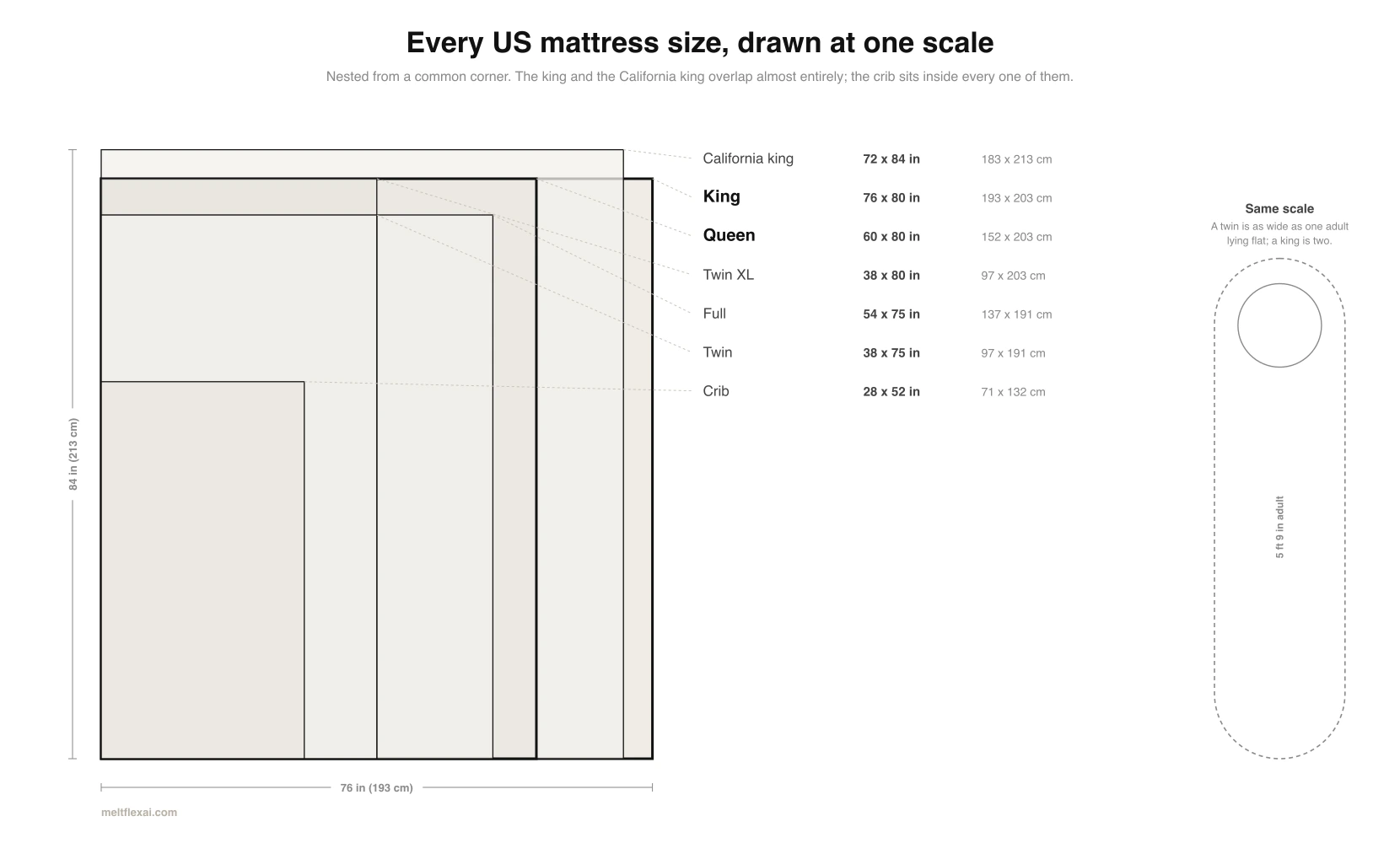
Two things jump out once the sizes are drawn on top of each other rather than listed. The king and the California king overlap almost entirely: one is four inches wider, the other four inches longer, and they are not the same bed even though every mattress shop files them next to each other. And the twin sits inside the king exactly twice. A king is two twin XL mattresses, 38 plus 38 by 80, which is why a split king uses two twin XL fitted sheets and one king flat sheet.
The queen is the most bought size in the US, and the arithmetic explains why: it is the smallest bed that gives two adults 30 inches each, and it is the largest bed that still fits the 10 by 10 foot bedrooms most houses have. The next section turns your own room into that decision.
Which bed fits your room? Calculator
Measure both walls, say how many nightstands you want and whether a dresser or wardrobe faces the foot of the bed. The calculator adds the frame allowance, tries every size both ways round, keeps 24 inches beside the bed and 30 at the foot as the floor, and draws the plan for whichever size you click. “Tight” means you can pass sideways; “one side to the wall” means the bed only works pushed into a corner.
Interactive calculator
Loading… if it does not appear, refresh the page.
The drawing matters more than the verdict. A number like “20 inches beside the nightstand” sounds fine until you see it as a strip narrower than the nightstand itself. If the room is the real question rather than the bed, our bedroom layout guide covers where the bed, wardrobe and door have to sit relative to each other, and feng shui bedroom layout has a checker for the commanding position. Getting the mattress into the room is a separate problem, answered in will a mattress fit through the door.
Minimum bedroom size for each bed
Every minimum-room table online quotes 10 x 10 for a queen and 12 x 12 for a king without saying what the room contains. These figures are derived instead: the mattress, plus a frame 4 inches wider and 6 inches longer, plus 24 inches of walkway on each side and 30 at the foot for the tight column; 30 inches a side, two 20 inch nightstands and 36 at the foot for the comfortable one. Twins get one nightstand in the comfortable column, since nobody puts two beside a single bed.
The first dimension is the wall the headboard goes on. That is the number to measure, because the length direction is rarely the problem: even a California king with 36 inches at the foot needs only 10 and a half feet. Width is where beds fail, and the drawing below is the reason the 12 x 12 rule keeps disappointing people.
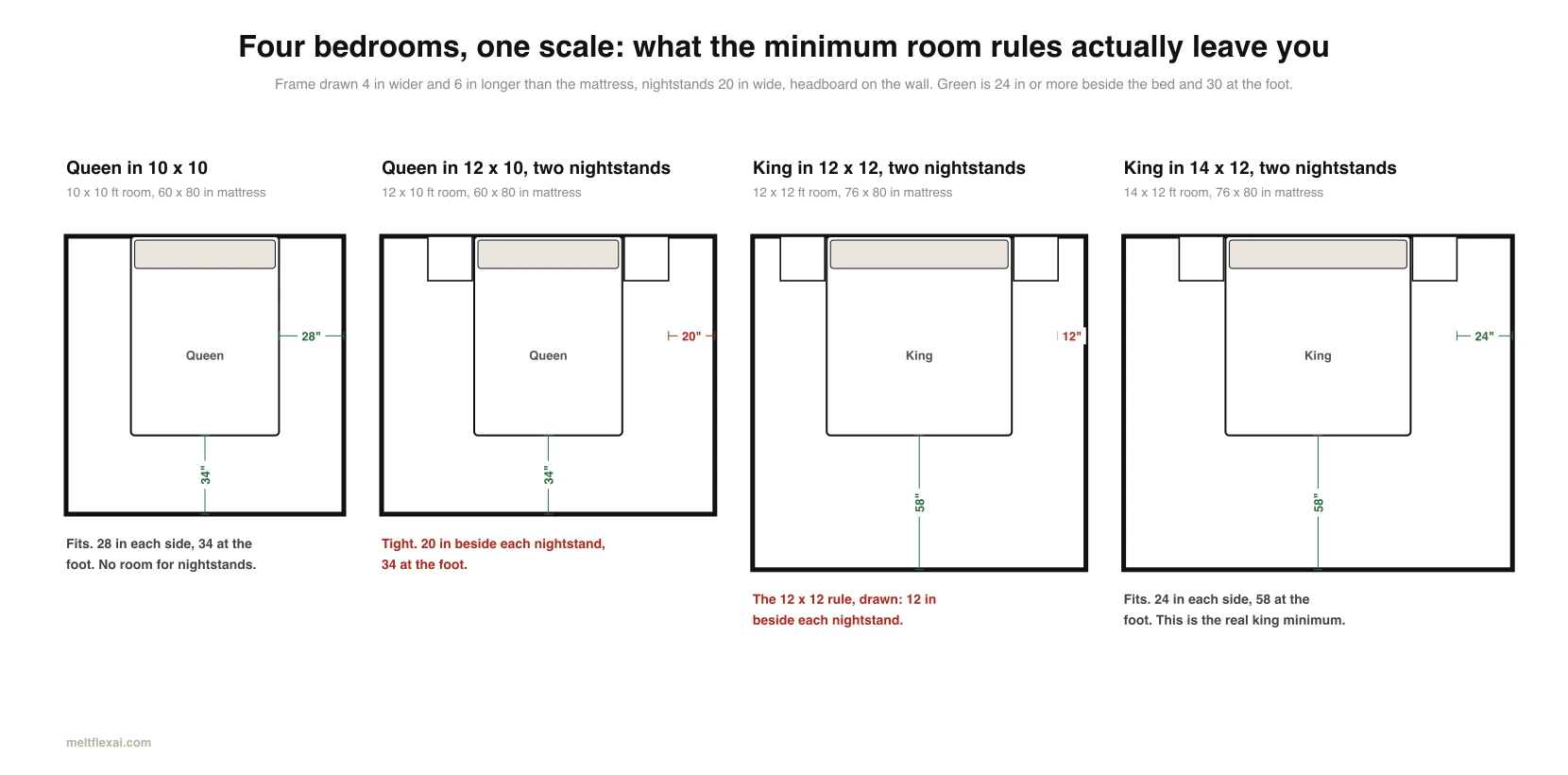
A king in a 12 x 12 with two nightstands leaves 12 inches beside each one. That is a gap you turn sideways for, not a walkway, and it is the layout in a large share of the houses that were sold with a “king-size master”. The same king with no nightstands has a generous 32 inches a side, which is why wall-mounted lights and a floating shelf are the honest fix for a 12 foot wall. On a 14 foot wall it fits properly; 15 feet is comfortable. For the room itself, the International Residential Code R304 sets the floor at 70 square feet with no dimension under 7 feet, and our guide to average room sizes has what bedrooms actually measure in new US homes. A 7 x 10 code-minimum room takes a twin against the wall and nothing else.
Bed frame vs mattress size
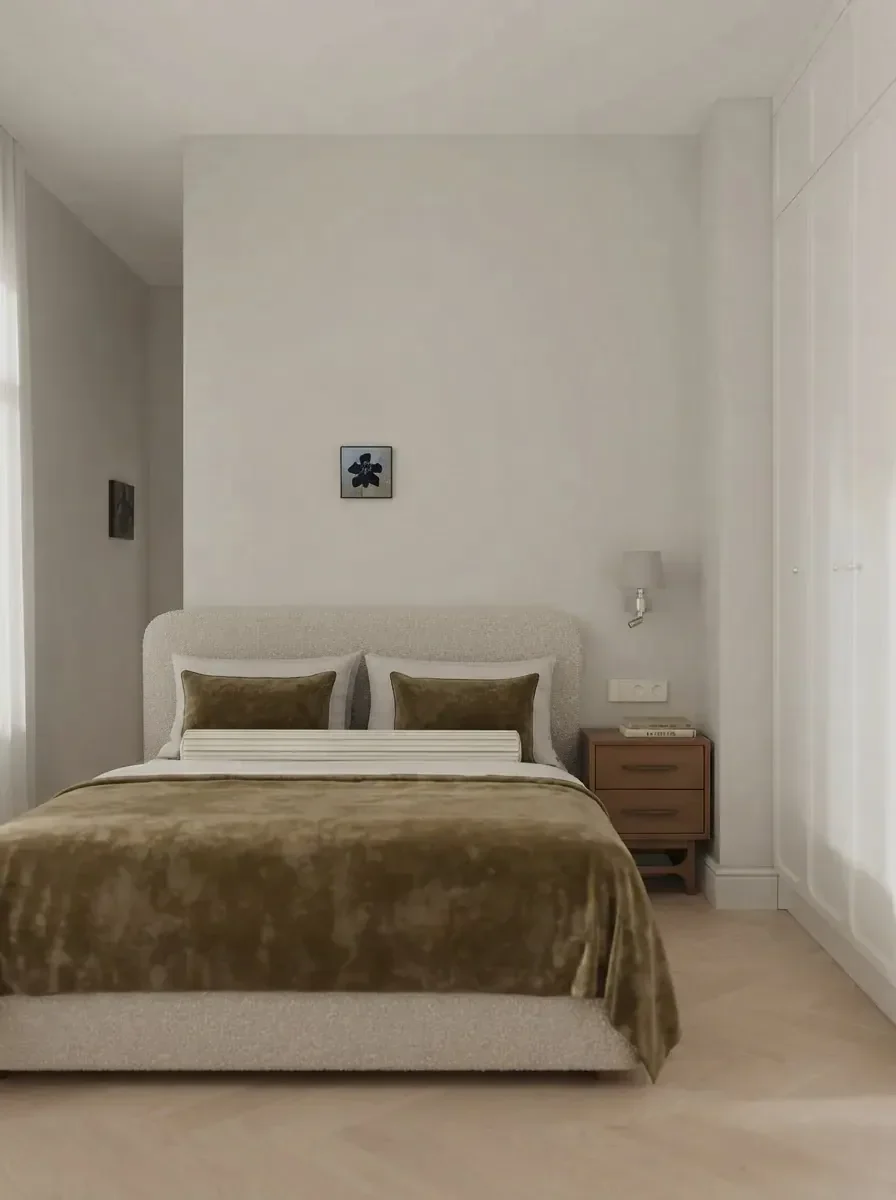
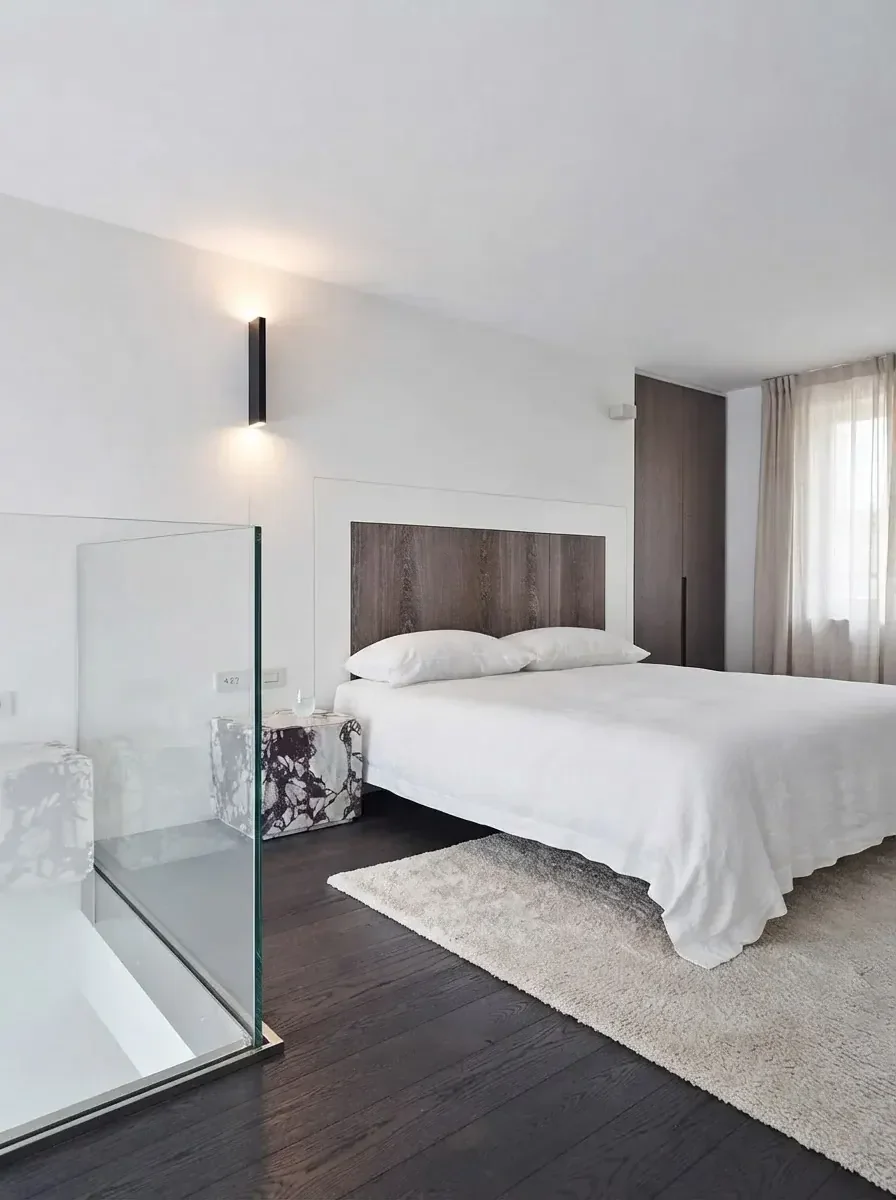
Nobody sells a bed frame by its outside dimensions, which is how a “queen” frame ends up 4 inches too wide for the gap somebody measured. The mattress size is fixed; the frame adds whatever its construction needs.
The 4 by 6 inch allowance used throughout this page is the middle row, a normal headboard bed. A sleigh bed can add more than a foot of length, which turns a queen into a California king’s footprint; if you own one, measure it rather than trusting any table, including this one. Height is the other dimension people forget: mattresses run 8 to 14 inches thick, pillow tops to 16 and beyond, and fitted sheets are sized in “pocket depth” for that reason. A thick mattress on a tall platform also raises the top of the bed above the windowsill in older houses, which is one of the arguments in bed in front of a window.


Full vs queen: width per sleeper
The full was the standard couple’s bed until the 1960s, and its width tells you why the queen replaced it. Fifty-four inches shared two ways is 27 inches each, and a crib mattress is 28 inches wide. Two adults on a full each have less width than a baby, which is exactly what it feels like when the other person turns over.
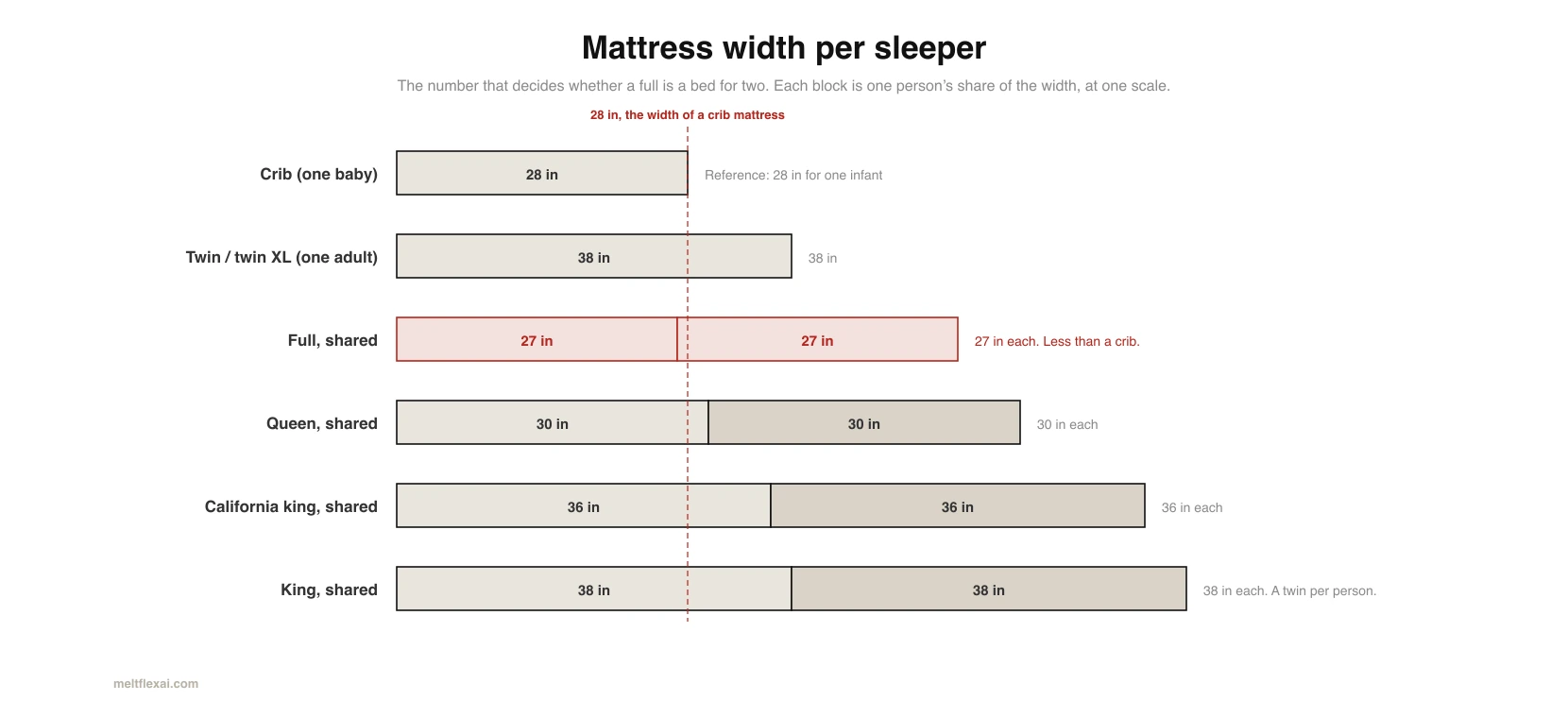
A queen adds 6 inches of width and 5 of length to a full, which is 18 percent more mattress and 30 inches per person. That is enough to sleep, not enough to sprawl: side sleepers with their knees up use about 30 inches on their own. A king gives each person a twin, 38 inches, and the difference between a queen and a king in a room that takes both is the difference between sharing a bed and sharing a room. The full has not disappeared, though. It is the right size for one adult who wants space, for a guest room that sees a few nights a month, and for the small bedroom where a queen would block the closet. Our studio apartment layouts use it for that reason.
Queen vs king vs California king
Sixteen inches of width separate a queen from a king, and it is a bigger jump than it sounds: 27 percent more mattress, and the change from 30 inches per person to 38. What the king costs is the room. Its frame is about 80 inches wide, so a 12 foot wall keeps 32 inches a side with no nightstands and 12 inches with them; a queen on the same wall keeps 40 inches and 20. In practice the choice is made by the wall, not by the sleepers.
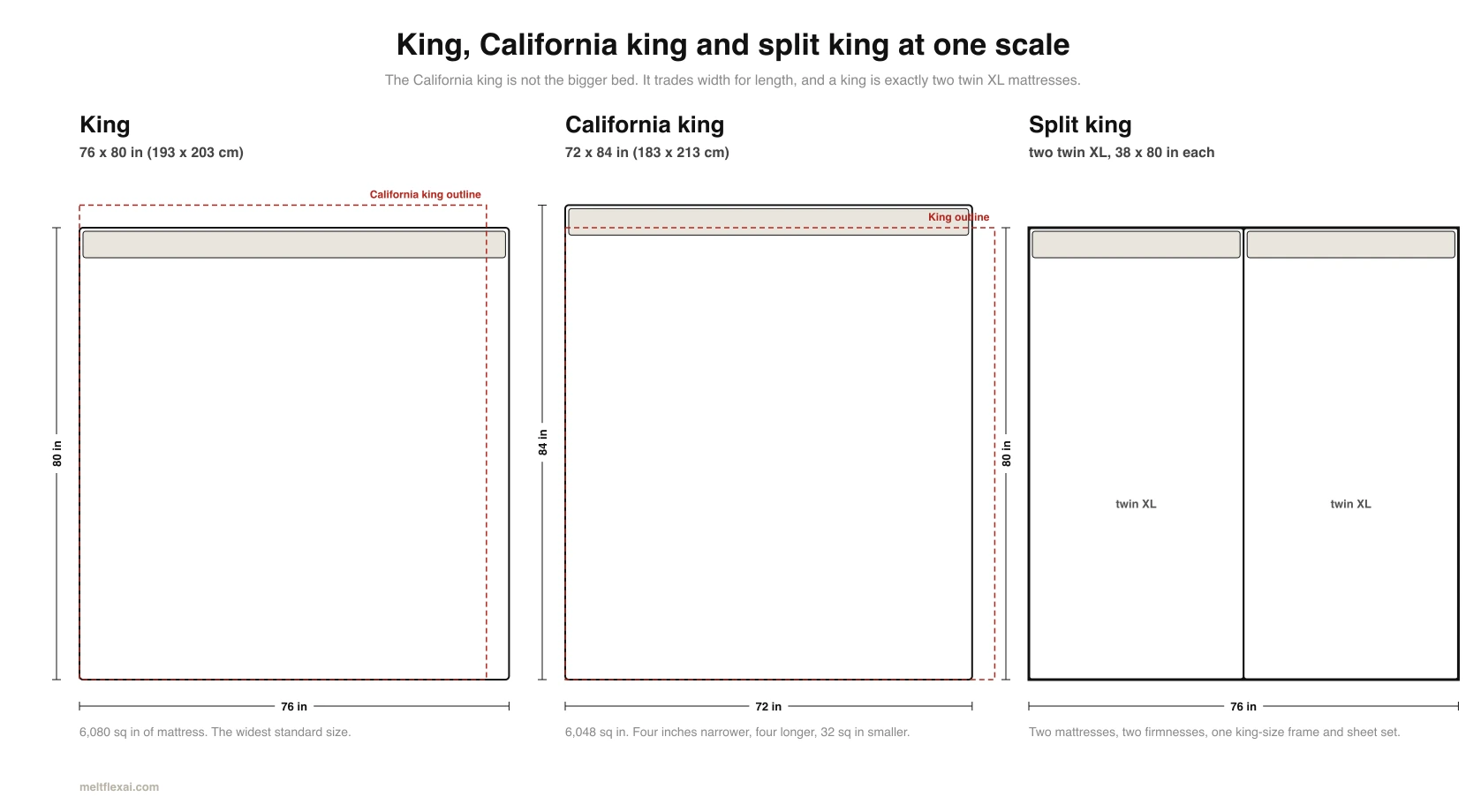
The California king is the most misunderstood size in the chart. It is not the bigger bed: at 72 by 84 inches it has 6,048 square inches of mattress to the king’s 6,080. It is the longer bed, four inches longer and four narrower, made for people over about 6 feet 4 inches and for long, narrow rooms where a king’s width would eat the walkway. If you are choosing between them for two average-height adults in a square room, the king is the better bed and the easier one to buy sheets for. The split king is the third option, two twin XL mattresses on one king frame, and it exists for adjustable bases and for couples who want different firmness; it uses two twin XL fitted sheets and one king flat.

Mattress length for tall sleepers
Length is the number that gets ignored until somebody’s feet hang off the end. The 75 inch sizes, twin and full, are 6 feet 3 inches long; a 6 foot sleeper has 3 inches to spare and a 6 foot 2 sleeper has one. The rule most retailers use is a mattress at least 4 to 6 inches longer than the person, so the 80 inch sizes (twin XL, queen, king) cover sleepers to about 6 feet 4 inches and the 84 inch California king covers to 6 feet 8. This is the real reason twin XL exists: it is the twin’s width with the queen’s length, and every university dorm bed in the US is one.
UK, European and Australian bed sizes
The names travel; the sizes do not. A UK king is 150 by 200 centimetres, which is within an inch of a US queen. A European king is usually 160 by 200. A US king, at 193 by 203, is closest to a UK super king. Anyone buying a frame in one market and a mattress in another needs the centimetres, never the word.
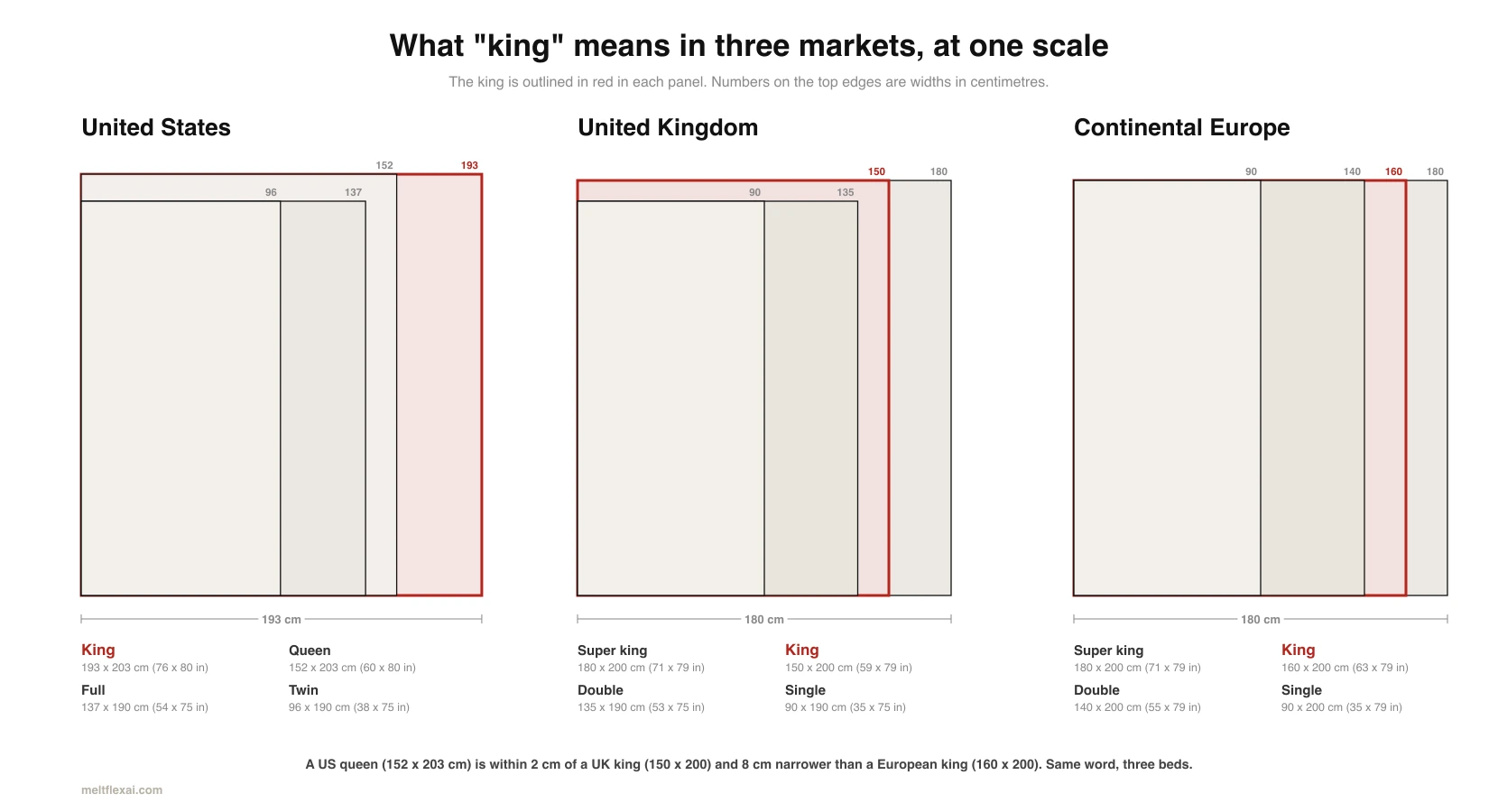
UK sizes also run 190 centimetres long in the smaller sizes, 3 to 4 inches shorter than the US 75 inch beds, which is why an American full mattress does not sit in a British double frame. Australian sizes are their own set again: an Australian queen at 153 by 203 is a US queen to the centimetre, but an Australian king is 183 wide, narrower than the US 193. IKEA in North America has sold US sizes since 2012; an IKEA frame bought in Europe is metric, and a US mattress will not fit it.
Less common sizes
The six standard sizes cover almost everything sold, but the catalogue has a long tail, and most of it exists to solve one of three problems: length, split firmness, or an RV.
The crib size is the one with a legal definition: a US full-size crib mattress must measure 27 and a quarter by 51 and five-eighths inches, within five-eighths of an inch, and be no more than 6 inches thick, under 16 CFR Part 1241. The oversized kings have no standard at all: a Wyoming king from one maker is not guaranteed to match another’s, and the frames, sheets and the route up the stairs are all custom problems. Check standard door sizes before ordering anything wider than a king; a one-piece 84 inch mattress stands 84 inches tall on edge and does not clear an 80 inch door head without tilting.
Which sheets fit which bed
Sheets are the place the small differences bite. Fitted sheets are cut to the exact size and a pocket depth; flat sheets and duvets are more forgiving.
Pocket depth is the other number on the packet. Standard fitted sheets are cut for mattresses to about 12 inches; deep pocket runs to 15 to 17 and extra deep to 18 to 22. A pillow-top mattress with a 3 inch topper on it is a 17 inch bed and will pull a standard sheet off the corners by morning. Measure the thickness with the topper on, per the measuring steps below, and while the bedding is off it is the moment to follow how to clean a mattress.
How to measure a mattress and a room
- Measure the mattress, not the bed. Strip the bedding and run the tape across the top surface, edge to edge at the widest point, then head to foot. Quoted sizes are mattress sizes: a queen is 60 by 80 inches of mattress, and the frame around it is bigger.
- Measure the frame you already own. If you are buying a mattress for an existing bed, measure the inside of the frame or the platform top. A queen needs a 60 by 80 inch opening; an inch of play is normal, four inches means the frame is a different size or a different market.
- Measure the room wall to wall at floor level. Both walls at skirting height where the bed will actually sit, not across the middle of the room. Note the door swing, the closet doors and any radiator or window that drops below headboard height. If you are drawing the room, floor plan symbols covers the door-swing arc and the bed symbol.
- Add the frame allowance. Four inches to the width and six to the length for a typical headboard bed, more for a sleigh bed or footboard. That footprint, not the mattress, is what has to fit.
- Subtract the walkways. At least 24 inches beside every side you climb out of, 30 at the foot, and 36 in front of any drawer or closet door that opens toward the bed. Whatever is left is the largest frame the room takes, which is what the calculator above does with the same numbers. A room that needs its square footage first is covered in how to calculate the square feet of a room.
- Check the route in. A mattress goes through a doorway on its long edge, so only its thickness has to clear the opening. Box springs and one-piece frames do not bend; box spring won’t fit up the stairs is the page for that, and the furniture fit calculator handles the hallway turn and the stairwell for the frame.


See the bed in your own bedroom
The calculator settles whether a king fits; it cannot tell you whether the room still looks like a room with one in it. That is what a render on your own photo is for. Upload a photo of the bedroom to MeltFlex, ask for a queen or a king with the nightstands you plan to buy, and you get the same walls, window and door with the bed laid in at scale, which is the fastest way to discover that a king turns a 12 foot bedroom into a corridor. The bedroom design prompts post has the wording that gets the size right, and the floor plan creator draws the room plan with the bed footprint and clearances if you would rather see it from above first. For everything else in the room, master bedroom design ideas and what size rug (which includes the queen and king bedroom rug sizes) pick up where the bed leaves off.

FAQ
What are the standard bed sizes in the US?
Six: twin 38 by 75 inches, twin XL 38 by 80, full (double) 54 by 75, queen 60 by 80, king 76 by 80 and California king 72 by 84. In centimetres that is 97 x 191, 97 x 203, 137 x 191, 152 x 203, 193 x 203 and 183 x 213. A crib mattress is 28 by 52. Everything else (full XL, Olympic queen, split king, Texas king) is a variation on those.
How big is a queen size bed?
A queen mattress is 60 inches wide and 80 inches long, which is 5 feet by 6 feet 8 inches, or 152 by 203 centimetres. It gives two people 30 inches of width each. With a typical frame the bed occupies about 64 by 86 inches of floor, and it wants a room at least 9 feet 4 inches by 9 feet 8 inches with no nightstands, or roughly 10 by 12 feet with two.
How wide is a king size bed?
A standard king mattress is 76 inches wide and 80 inches long, 6 feet 4 inches by 6 feet 8 inches, or 193 by 203 centimetres. It is exactly two twin XL mattresses side by side, which is what a split king is. A California king is narrower at 72 inches but four inches longer at 84.
Is a California king bigger than a king?
No. A king is 76 by 80 inches, 6,080 square inches; a California king is 72 by 84, 6,048 square inches, so the king is the bigger mattress by a small margin and the wider one by four inches. The California king is for length: it suits sleepers over about 6 feet 4 inches, or a long narrow room where the extra width of a king would block the walkway.
What size room do you need for a queen bed?
A queen fits a 10 by 10 foot room with about 28 inches beside the bed and 34 at the foot, but with nothing else against those walls. Add two 20 inch nightstands and the same 10 foot wall leaves 8 inches a side, so a queen with nightstands really wants a 12 foot wall, or one side of the bed against the wall. The building code minimum bedroom is 70 square feet with a 7 foot minimum dimension; a queen does not fit that room with both sides open.
What size room do you need for a king bed?
The rule of thumb says 12 by 12 feet, and drawn to scale that rule leaves 12 inches beside each nightstand. Without nightstands a king in a 12 by 12 has a comfortable 32 inches a side. With two 20 inch nightstands and 24 inches of walkway each side it needs a 14 foot wall; 15 feet makes it comfortable. Measure the wall the headboard goes on, not the room area.
Is a full bed big enough for two adults?
It is 54 inches wide, so each person gets 27 inches, which is narrower than a crib mattress (28 inches). Couples manage on a full in small rooms and short stays; for every night, a queen adds 6 inches of width and 5 of length and is the smallest size most people are happy sharing. A full suits one adult who wants to spread out, or a guest room.
Is a UK king the same as a US king?
No. A UK king is 150 by 200 centimetres, about 59 by 79 inches, which is within an inch of a US queen. A US king (193 by 203 centimetres) is closest to a UK super king (180 by 200). Continental Europe sits between them: a European king is usually 160 by 200. Always compare centimetres, never the names, when buying a frame and mattress from different markets.