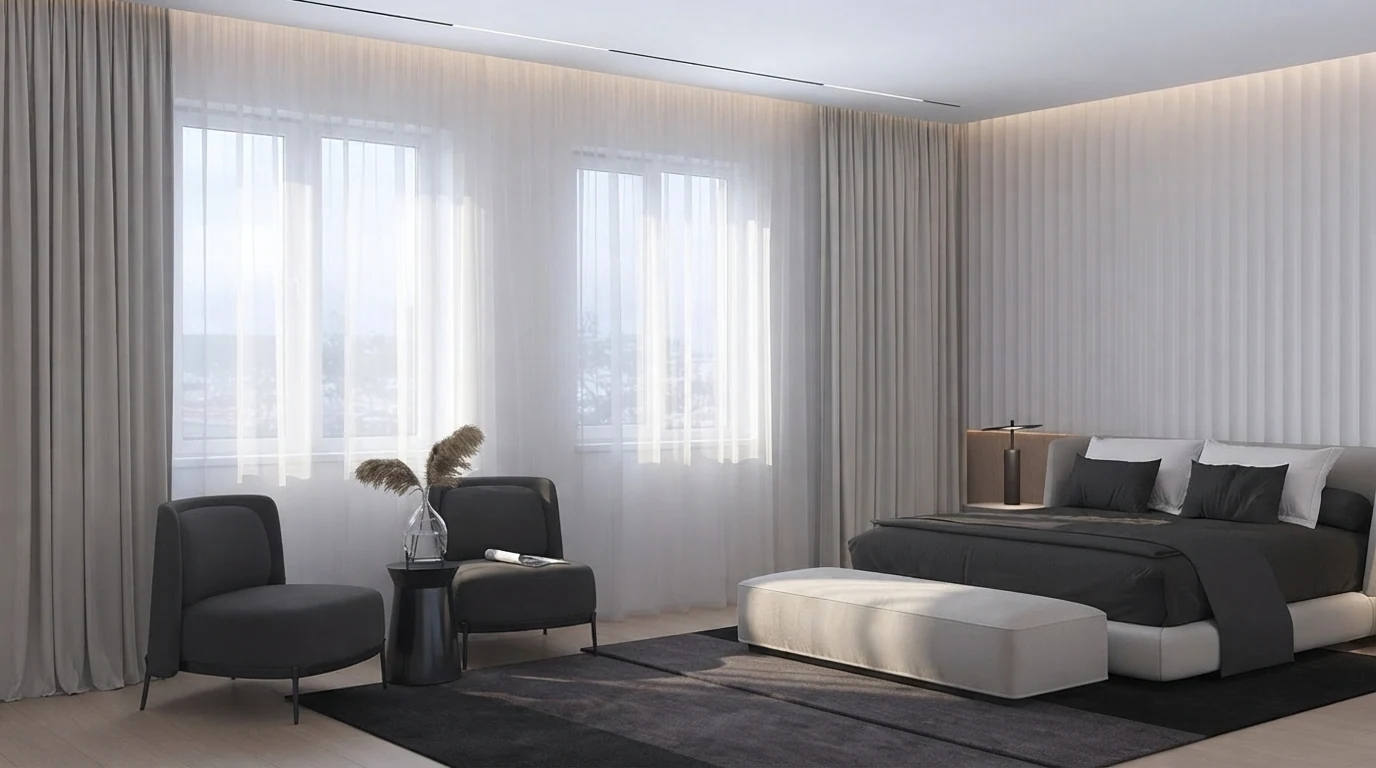

To soundproof a room, seal the gaps first, then add mass to the weakest surface, then decouple the wall if you can. In that order, because a gap the width of a door sweep leaks more sound than a whole wall of foam stops. Most of the noise in a normal home comes in around the door, through the window and through outlets on the shared wall, and those fixes cost under $150. Acoustic foam panels, which is what most people buy first, do not stop sound passing through a wall at all. They only reduce echo inside the room.
Our articles are still written by humans!
Get human written articles in your Google feed.
Here is the uncomfortable part that most guides leave out: the cheap fixes take the edge off, they do not make a room silent. The building code standard between apartments is a wall rated STC 50, where normal speech becomes inaudible, and a typical interior wall is around STC 33 to 35, where speech is clearly audible. Closing that gap takes construction. Below is what each fix actually does, what it costs, which versions work for renters, and how to do all of it without turning your bedroom into a recording booth.

The best looking soundproofing there is. A floor to ceiling bookcase full of books adds real mass to a shared wall and breaks up reflections, and nobody who walks in reads it as a noise fix. It will not match a new wall layer, but it beats any foam panel you could hang in the same spot.
The short version
- Seal before you buy anything. A wall with 1% of its area open blocks about 20 dB at best, whatever it is made of.
- Foam and acoustic panels absorb, they do not block. Buy them for echo, never for a neighbor’s TV.
- Doors and windows are the weak points. A sweep, seals and a window insert beat any wall treatment for the money.
- Real wall upgrades cost real money. Damped drywall such as QuietRock 510 rates STC 47 to 52 in a 2x4 wall, against about 33 to 35 for an ordinary one.
- Renters can still get a noticeable result with seals, inserts, heavy curtains, a full bookcase and a rug on a dense pad.



Soundproofing vs Sound Absorbing: Why Foam Panels Disappoint
Soundproofing stops sound traveling from one room into another. Sound absorption reduces echo inside a single room. They are different problems with different materials, and confusing them is the most expensive mistake in this whole topic. A neighbor’s TV coming through the wall is a blocking problem. A home office where your own voice bounces off bare walls on a video call is an absorbing problem.
Blocking sound takes three things. Mass, because heavy, dense layers are harder for sound to vibrate. Airtightness, because sound goes through any opening with almost no loss. And decoupling, because in a standard wall the studs carry vibration straight from one face to the other. Foam has none of the three: it is light, porous and stuck to the existing wall. It does a good job of what it is for, and almost nothing for what most people buy it for.
Our ranking of each fix by what it does, built from the measurements cited further down. The order matters more than any single product.
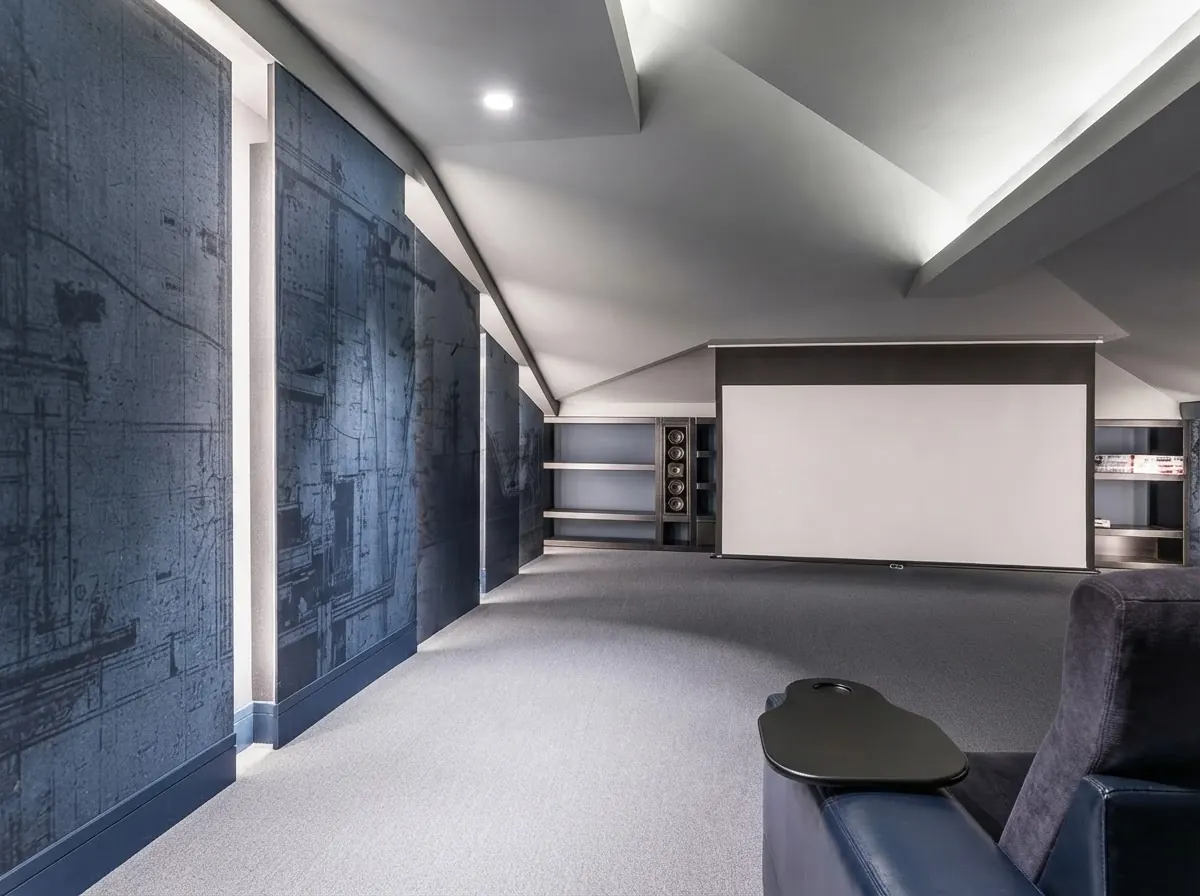
Fabric wrapped panels on every wall and carpet underfoot. This room will sound dead and controlled inside, which is what a cinema wants. Whether the rest of the house hears the film depends entirely on what is behind those panels, not on the panels.
How to Soundproof a Room: The Order That Actually Works
Find the leaks, seal them, fix the weakest surface, add mass, then treat echo. Doing it in this order means every dollar goes to the thing currently letting the most sound in. Doing it backwards, which is what happens when the first purchase is a pack of foam squares, means paying for the step with the smallest effect first.
- Find where the sound gets in. Turn the lights off on the quiet side of the door and look for a line of light at the bottom and edges. Play music in the noisy room and listen with your ear near the outlets, the vents, the door and the window frame. Sound will be loudest at the leaks, not in the middle of the wall.
- Seal every gap. Door sweep, perimeter seals, acoustic caulk where window trim meets the wall, and foam gaskets behind outlet and switch plates on the shared wall. This is the cheapest step and the one with the best return.
- Upgrade the weakest surface. Almost always the door or the window. A hollow core door or a single pane window is the low point of the whole room, and a wall is only as good as its worst part.
- Add mass to the shared wall. For renters, that means furniture: a full bookcase or a padded headboard. For owners, it means a layer of damped drywall, properly sealed.
- Treat the echo. Rug, pad, upholstery, curtains, and acoustic panels if the room still sounds hard. This makes the room calmer and stops your own noise building up, but it is the last step, not the first.
Why the gaps come first, in numbers. Second Skin Audio publishes the standard open-area table for this: with 0.1% of a wall open, the best it can block is about 30 dB. With 1% open, about 20 dB. With 5% open, about 13 dB. A 1/2 inch gap under a 30 inch door is 15 square inches of open area. That is why a $30 sweep often makes a bigger audible difference than a $300 panel kit, and why an expensive wall upgrade with an unsealed outlet in it underdelivers.
How Much Does It Cost to Soundproof a Room?
Under $150 for the sealing tier, $250 to $3,000 for door and window upgrades, and $1,000 to $4,000 or more for a professional wall job. HomeAdvisor (updated June 2026) puts professional soundproofing of a room at $1,036 to $2,743, or $10 to $30 per square foot, and Fixr gives a national average of $2,000. Here is how that breaks down by what you are actually buying.
Cost ranges from HomeAdvisor and Fixr, US averages including labor where a pro is involved. The tier 1 and 2 totals are our own sums of those item prices, not a quoted figure. Your quote will depend on room size and on how much of the wall has to be opened.
The honest reading of that table: tiers 1 and 2 are what most people should do, because they are cheap and reversible and they fix the leaks. Tier 3 is worth it for a bedroom on a busy street or a door onto a loud hallway. Tier 4 is the only way to get anywhere near the STC 50 that the International Building Code, Section 1206.2 requires between dwelling units, and it is a renovation, not a weekend project.
How to Soundproof a Door
Close the gaps around it, then make it heavier. Most interior doors are the weakest point in a wall twice over: they have a gap underneath for air flow, and they are often hollow core, which means two thin skins over a cardboard honeycomb. Seal first, because a heavy door with gaps around it still leaks.
- Door sweep. An adjustable sweep or an automatic drop seal that lowers when the door closes. Fixr prices sweeps and acoustic thresholds at $20 to $100 each.
- Perimeter seals. Compressible seals along the door stop on both sides and the top. Check your work with the light test: no light should show at any edge.
- Solid core slab. Commonly rated around STC 30 to 35, against the low to mid 20s typically quoted for hollow core. Fixr puts a hollow to solid replacement at $500 to $3,000 installed, and you can often reuse the existing frame and hardware.
- A heavy curtain over the door for renters, on a ceiling or wall mounted track that clears the swing. It is not a seal, but it adds a layer and absorbs some of what gets through.
If you would rather watch it done, this is the clearest walkthrough we found for the door specifically, and it follows the same order as this guide: what does not work first, then rehang the door so it closes properly, then seal it, then the common mistakes.

By the Soundproof Guide channel (April 2025, 12 minutes). Two things to know before you watch: the products are linked as Amazon affiliate links in the description, so the channel earns from what you buy. It is one creator’s door in one house, not a lab test, so use it for the order and the technique and the tables above for what to expect.
Two cautions. Do not seal the door of a room that relies on the gap underneath for HVAC return air without adding another path for it, or the room will be stuffy and the system will work harder. And if you are replacing the slab, measure first: standard door sizes covers the widths and heights, and the new slab has to match the existing frame. For the look of a heavier, darker door, black interior doors is a useful starting point, or try it on your own hallway with the AI doors design tool.
How to Soundproof Windows
Seal the frame, add an interior insert, then hang heavy lined curtains. For outside noise the window is almost always the weakest part of the wall. A standard double glazed window rates around STC 32 to 35, about the same as an ordinary interior wall and far below the STC 50 a party wall needs, and single pane glass is worse. Even a good window is a hole in the wall acoustically.
The insert is the step that moves the number. It is a second pane mounted inside the frame with an air gap between it and the existing glass, which is a small decoupled wall. The figure you will see quoted everywhere is that Indow’s Acoustic Grade insert cuts noise by 18.9 dBA, from testing at Portland State University. We went to the original Portland State report (Green Building Research Laboratory, March 2013) instead of the marketing, and the full picture is more useful than the headline.
Outdoor to indoor level reduction per ASTM E966, white noise source, measured in an insulated 6 by 4 by 4 foot test enclosure, from Table 1 of the Portland State report. Eight samples, median about 9 dBA.
Three honest readings of that table. The 18.9 is real, but it is the best of eight samples and it came from the thickest pane, so it is a ceiling, not an average: the typical insert in the same test cut about 9 dBA. A double pane insert did no better than single pane ones, which says the thickness and the seal matter more than the number of layers. And it was measured over old single pane glass in a plywood box, not over the double glazing most American homes already have, so expect less in your room. Nine dBA is still worth having: by the standard rule of thumb in acoustics, about 10 dB is the difference between a sound and one twice as loud. HomeAdvisor prices inserts at $250 to $500 per window, against $500 to $1,500 for a soundproof replacement window.

Floor length, generously gathered and hung wide of the frame. These are the curtains that help: heavy, full, and covering more than the glass. Pull them closed and the room quiets a little and stops echoing.
Then curtains, with expectations set properly. A lab test in Sydney run by Acoustic Blinds and Curtains, a company that sells acoustic curtains, measured 7 to 10 dB of improvement for curtains with dedicated acoustic linings, and no tested fabric did worse than 8 dB. That is a seller testing its own product line, so treat it as an upper bound for specialist curtains, not a number to expect from a $30 blackout panel. What makes curtains work is weight, fullness, and coverage: hang them high and wide, let them touch the floor, and use a wraparound rod so sound cannot slip round the sides. How to measure for curtains and how to install a curtain rod cover the sizing.
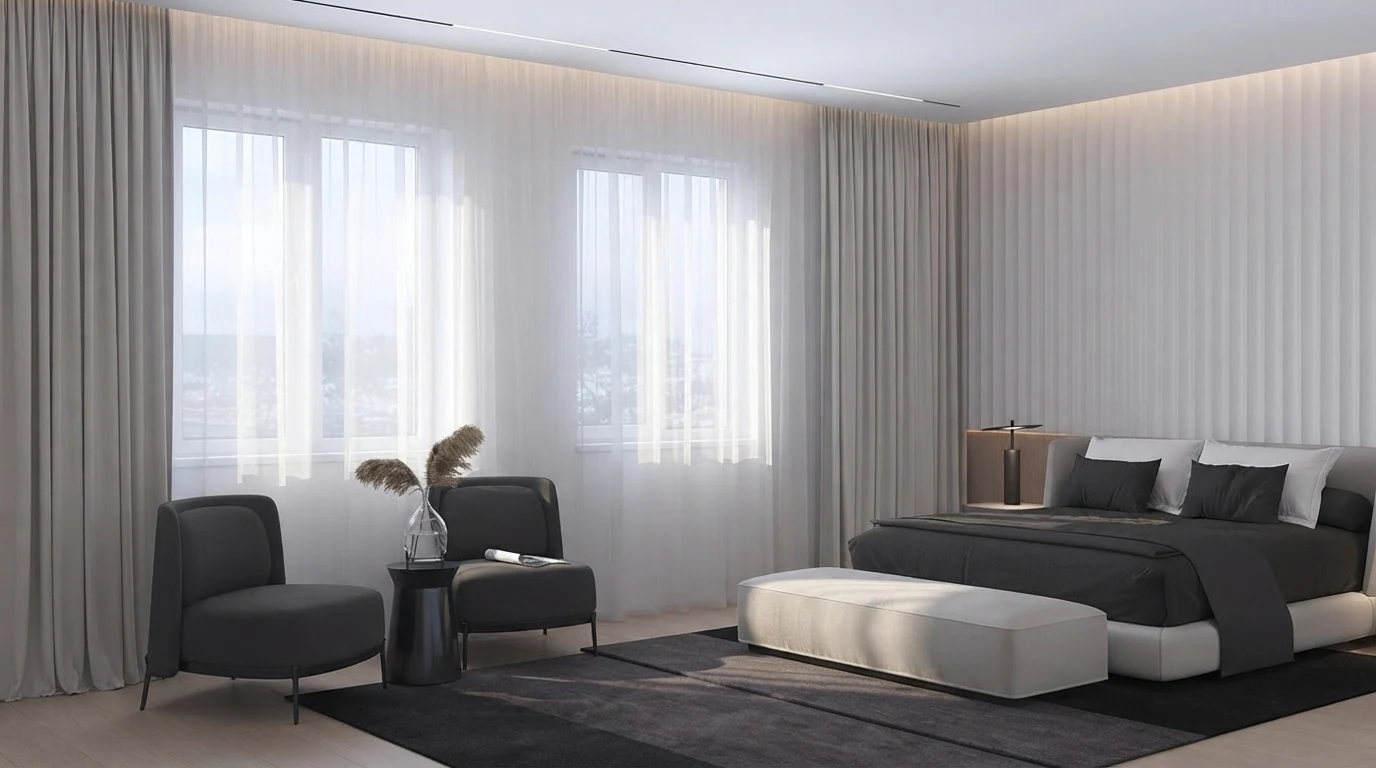
The counter example. A wall of sheers is beautiful and soft looking, and acoustically it is close to nothing: too light and too open to block or absorb much. If you love this look for a noisy street, put a heavy lined layer behind the sheers on a double track.
If you want to see the room with a different window treatment before ordering, the AI windows design tool will put new curtains or frames on your own photo.
Does Soundproof Drywall Work?
Yes, measurably, and it is the main way to get from clearly audible to muffled through a wall you own. Damped drywall is two gypsum layers with a viscoelastic polymer bonded between them, so the panel turns vibration into a tiny amount of heat instead of passing it through. PABCO’s QuietRock 510 datasheet lists the 1/2 inch panel, 2.13 lbs per square foot, at STC 47, 49 and 52 in single 2x4 wood stud walls depending on the build, and STC 69 in a double stud wall.
Lab STC ratings. Standard wall, window, solid core door and audibility bands from the STC chart published by Commercial Acoustics, an acoustics contractor; hollow core door is the commonly quoted range, not a single test; QuietRock figures from PABCO’s datasheet. Field results are lower, which is why the code allows NNIC 45 when a wall is tested on site.
The catch is in PABCO’s own small print, and it is the most useful sentence on the datasheet: “PABCO® Gypsum cannot guarantee actual STC ratings. Flanking sound patterns, the integrity of the wall, and construction methods factor in” the result. Flanking means sound going around the wall instead of through it: under the door, through back to back outlets, along a shared floor or ceiling. Spend $2,000 on a damped wall and leave the outlets unsealed and you have paid for a number you will not get.
Why decoupling matters as much as weight: the National Research Council of Canada tested about 400 gypsum board walls in a single laboratory, and in Warnock and Quirt’s summary of that work the two main factors for walls whose faces are isolated or resiliently connected are the mass of the gypsum board and the depth of the cavity. Insulation in the cavity helps most once the two faces are separated, which is why stuffing batts into an ordinary stud wall disappoints people: the studs still carry the sound straight across.
Two practical notes. Adding a layer to an existing wall is far cheaper than tearing it down to the studs, and QuietRock 510 is marketed specifically for remodel and retrofit work. And a new layer moves the wall face out by half an inch or more, so outlets need box extenders and trim needs refitting. That is where the labor in a quote comes from.
How to Soundproof a Room When You Rent
Seal what peels off, add mass that stands on its own, and move the noisy furniture off the shared wall. You will not reach construction-level numbers, but tiers 1 and 2 combined give a clearly noticeable result and all of it leaves with you.
- Adhesive door seals and a sweep that clamps or sticks on. Keep the packaging and the instructions for removal.
- A press-in window insert rather than a screwed one. Compression mounted inserts are designed to come out without marks.
- Heavy lined curtains on a tension rod or a renter friendly bracket, hung wide and to the floor.
- A full bookcase on the shared wall, anchored with the landlord’s permission. Books are dense and irregular, which is exactly what you want.
- The bed against an interior wall, not the one you share with a neighbor. Free, immediate, and often the single best change in a bedroom. Bedroom layout covers where else it can go.
- A thick rug on a dense felt pad. This mostly protects the neighbor below from your footsteps and calms echo, so it is also the courteous one. If the floor is already carpeted, rug on carpet covers how to layer it, and the rug size calculator sizes it to your furniture.
What renters cannot fix, and should know before spending: footsteps from the apartment above. That is impact noise traveling through the structure, and it is solved in the ceiling and floor build, not in your room. Rugs upstairs help. Anything you hang on your ceiling mostly does not. The same is true of deep bass, which passes through light construction more easily than voices do.

Soft seating and a big rug do the echo work here, but the marble TV wall is the loudest surface in the room: hard, flat and right where the sound comes from. A media room is quieter for everyone else if the speakers are not on the shared wall.
How to Soundproof a Room Without Making It Ugly
Choose the heavy, soft and full version of things you would put in the room anyway. The reason soundproofed rooms tend to look grim is that the products are designed by acoustics companies and sold as products: grey foam pyramids, studio blankets, black panels. The materials that help most in a home are the ones interior design already loves: books, upholstery, wool, thick curtains and wood with texture.
- A wall of books instead of a wall of panels. Mass plus diffusion, and it reads as a library, not a fix.
- An upholstered headboard that runs wide, or full height upholstered wall panels behind the bed. Soft surfaces on the wall you lean against do the absorbing quietly.
- Curtains as architecture. Ceiling to floor, wall to wall, in a heavy fabric. It looks expensive and it is the one curtain style that does something acoustically.
- Wood slat panels with felt backing if you want panels. The felt and the gaps do the absorbing and the wood makes it look like joinery. Plain fluted wood without the felt absorbs much less, because it is still a hard surface.
- Panels as art. Fabric wrapped panels printed with an image, hung where a canvas would go, as long as the printed fabric is the open weave kind that lets sound into the core.
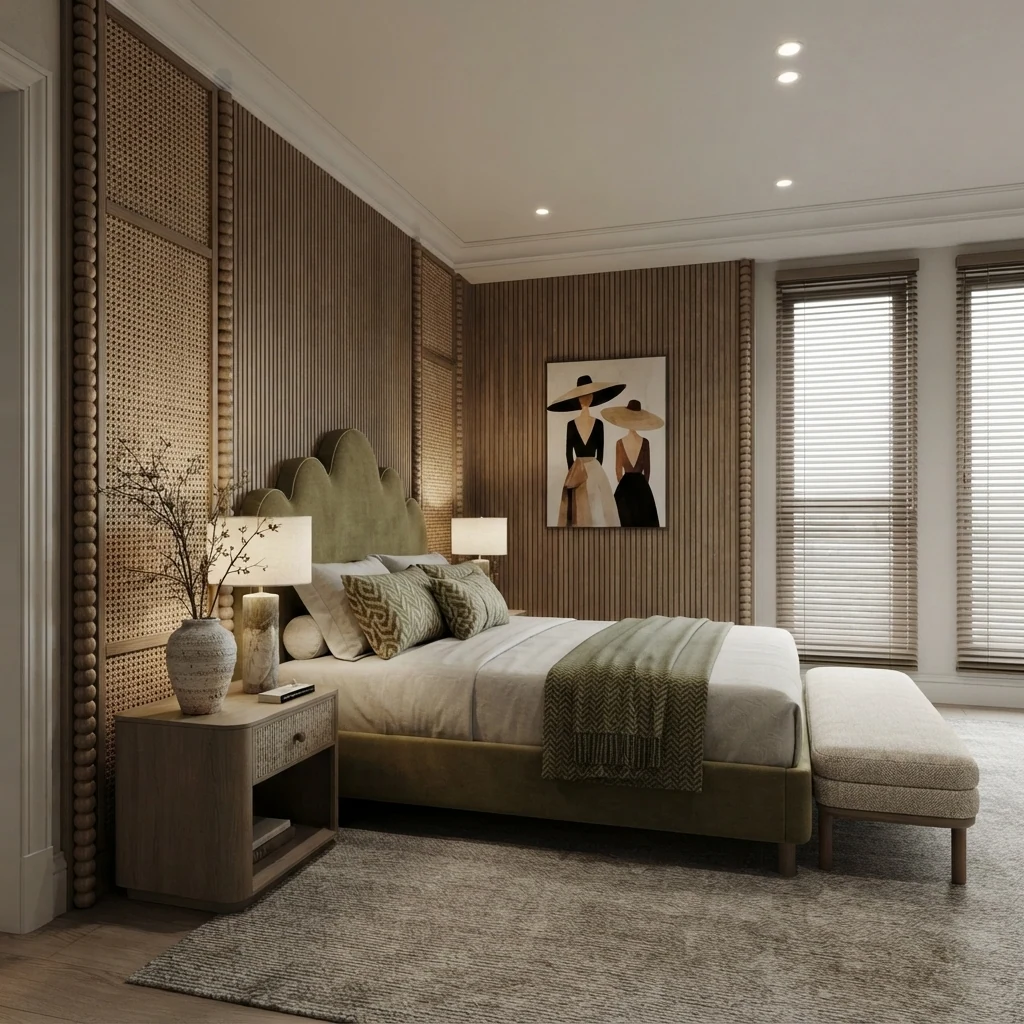
Textured woven panels and an upholstered headboard against the wall behind the bed. Every surface you touch is soft or broken up, which is why a room like this sounds calm. It would not stop a loud neighbor on its own, but it is the right finish on top of a sealed wall.

Velvet drapes run the full height and length of the wall, so they work as both decoration and absorption. For a room you watch films in, this is the design-first version of acoustic treatment, and it costs less than panelling.
If you are deciding between finishes, feature wall ideas and board and batten cover the wall side, quiet luxury interior design covers the heavy soft material palette this all fits into, and the wall texture tool will put a woven, slatted or upholstered finish on a photo of your own wall. For layout, living room layout and studio apartment layout ideas cover where the loud and quiet zones should sit.
How We Built This Guide, and What We Did Not Do
Plainly: we are not acousticians and we did not measure anything in a lab for this article. We build MeltFlex, an AI interior design tool, so what we know first hand is the design half: how a bookcase, a curtain or a panel reads in a real room. The acoustic numbers come from published sources, linked inline, and we fetched each one ourselves rather than repeating figures from other guides.
What we checked and where it came from: the STC 50 requirement is the text of IBC Section 1206.2. The QuietRock ratings and the flanking warning are quoted from PABCO’s own datasheet. The decoupling point comes from the National Research Council of Canada’s 400 wall study. The window insert table is copied from the original 2013 Portland State report rather than from Indow’s marketing, which quotes only its best sample. The loudness rule is Georgia State University’s HyperPhysics. Costs are HomeAdvisor (updated June 2026) and Fixr (updated January 2025). The open-area table comes from Second Skin Audio and the curtain figures from Acoustic Blinds and Curtains, and both of those companies sell soundproofing, which is why we say so next to each number.
One more piece of data, because it explains why this article exists. When we pulled the Google results for “how to soundproof a room” (US, Ahrefs snapshot of 23 September 2026), the first five slots were an AI Overview, a Reddit thread, People Also Ask, videos and forum threads. Of the five articles below them, three were published by companies selling soundproofing or building materials (a big box retailer and two acoustic panel makers), one by an apartment rental company and one by an interior design blog. Nothing in that list is wrong to read, but almost every guide on the page has a product to sell you at the end, and so do we, which is why the method is written out here.
What we left out: any number for soundproof paint. We did not find an independent test of it, so its row in the first table is our judgment from the mass argument (a coat of paint adds almost no weight to a wall), not a measurement. We also left out a precise STC for hollow core doors: sources range from the high teens to the high 20s, so the table gives a range rather than a false number. The images are renders from our own gallery, chosen because each shows a technique the article describes, not photographs of a tested room.
See It in Your Room Before You Buy
The expensive mistakes here are visual as much as acoustic: a run of black panels that makes a bedroom feel like a studio, curtains that are too short, a bookcase that eats the room. Upload a photo of the room to MeltFlex and try the heavy curtains, the full height headboard or the bookcase wall at real scale first. For a work room, the AI office design tool is set up for desks, shelving and quiet corners. If furniture has to come in through a tight door on the way, furniture that won’t fit through the door covers that problem.
How to Soundproof a Room FAQ
What is the cheapest way to soundproof a room?
Seal the gaps. A door sweep, a set of perimeter door seals, a tube of acoustic caulk around the window trim and foam gaskets behind the outlet covers on the shared wall cost roughly $50 to $150 together and fix the leaks that let the most sound through for the least money. Acoustic tables put it bluntly: a wall with 1% of its area open can block no more than about 20 decibels however heavy the wall is. After sealing, the next cheapest real gain is mass you would buy anyway: a full bookcase on the shared wall, heavy lined curtains and a thick rug with a dense pad.
Do acoustic foam panels soundproof a room?
No. Foam and fabric acoustic panels absorb sound that is already inside the room, which cuts echo and makes a room feel calmer, but they are light and porous, so they do almost nothing to stop sound passing through a wall. Blocking needs mass, airtightness and, for bigger gains, decoupling. Buy panels if your complaint is that the room itself sounds harsh or echoey, for example a home office on video calls. Do not buy them to stop a neighbor's TV, which is the most common way people spend money on this problem and hear no difference.
How do I soundproof a room from outside noise?
Start with the windows, because they are usually the weakest part of an exterior wall. Seal the frame with acoustic caulk, then add an interior window insert, which is the biggest single upgrade short of replacing the window: In Portland State University testing, the best of eight Indow inserts cut noise by 18.9 dBA over a single pane window and the typical one by about 9 dBA. Heavy lined curtains add a few decibels on top. Then check the exterior door for daylight at the edges and fit seals and a sweep. Traffic rumble is low frequency and the hardest part to stop, so expect it to be reduced, not removed.
How do I soundproof a room without damaging walls?
Use things that stand, hang or press in place. Door sweeps and adhesive seals peel off, window inserts press into the frame with compression tubing and no screws, curtain rods can be tension mounted, and a full bookcase, a padded headboard, a thick rug on a dense pad and heavy curtains all add mass or absorption without a single new hole. Moving the bed or desk off the shared wall costs nothing and is often worth more than any product. What renters cannot do is add a decoupled drywall layer, which is where the big numbers live.
Does soundproof drywall really work?
Yes, measurably, but only as part of a sealed wall. PABCO lists its 1/2 inch QuietRock 510 at STC 47 to 52 in single 2x4 wood stud walls, against roughly STC 33 to 35 for a standard 2x4 wall with one layer of ordinary 1/2 inch drywall each side. That is the difference between hearing speech clearly and hearing muffled voices. PABCO itself says it cannot guarantee field ratings because flanking paths and workmanship decide the result, so an unsealed outlet or a gap under the door will waste most of what you paid for.
How much does it cost to soundproof a room?
Anywhere from under $100 to several thousand dollars, depending on how much you need it to work. HomeAdvisor puts professional soundproofing of a room at $1,036 to $2,743, or $10 to $30 per square foot, and Fixr gives a national average of $2,000. DIY sealing costs $50 to $150, a window insert $250 to $500 per window, and replacing a hollow core door with a solid core one $500 to $3,000 installed. The cheap tier fixes leaks. Only the expensive tier, a new wall layer, gets you to the STC 50 that building code requires between apartments.
Can you completely soundproof a room?
Not in an ordinary home, and any product that promises it is overselling. Recording studios get there with a room built inside a room, floating floors and sealed ventilation. In a house or apartment the realistic target is to make speech from the next room unintelligible and to take the edge off traffic and TV. Every 10 decibels of reduction is heard as roughly half as loud, so going from clearly audible to muffled is a real, noticeable change even though it is not silence. Bass and footsteps from upstairs are the hardest to stop.
How do I soundproof a door?
Close the gaps first, then add mass. Fit an automatic or adjustable door sweep at the bottom, perimeter seals around the stop, and check by turning the lights off on one side and looking for light at the edges. Fixr prices sweeps and thresholds at $20 to $100 each. If the door is hollow core, the next step is a solid core slab, which commonly rates around STC 30 to 35 against the low to mid 20s often quoted for hollow core. A thick door with gaps around it still leaks, so the seals come first.
The summary, if you read nothing else: seal the door, the window and the outlets before you buy anything. Foam stops echo, not neighbors. The window insert and a solid core door are the best mid budget upgrades. A damped drywall layer is the only route to code level quiet, and it only works if the wall is sealed. And the heavy, soft, full versions of normal furniture do the rest without making the room look like a studio.
Before you buy panels, try MeltFlex free and see the curtains, headboard or bookcase in your actual room. For the bedroom side of the same problem, bed in front of a window covers the placement trade off this article keeps running into.



)